Procedia Engineering 15 (2011) 2010 – 2014 1877-7058 © 2011 Published by Elsevier Ltd. doi:10.1016/j.proeng.2011.08.375
Procedia
Engineering
Procedia Engineering 00 (2011) 000–000 www.elsevier.com/locate/procediaAdvanced in Control Engineeringand Information Science
Face recognition based on improved Retinex and
sparse representation
Kunlun Li
a*, Guoyan Zhang
a, Xia Li
b, Jing Xie
aaCollege of Electronic and Information Engineering, Hebei University, Baoding, 071002 ,China bInformation Science and Engineering, Chongqing Jiaotong University, Chongqing, 400074, China
Abstract
In this paper, we proposed a method based on improved Retinex theory and sparse representation to deal with the difficulties for face recognition under inhomogeneous illumination. In our work, the total variation model was introduced to optimize the parameters of Retinex and the illumination insensitive features were extracted as the dictionary of sparse representation. Finally, the facial images could be recognized by the proposed algorithm. The experimental results on different benchmark face databases indicated that the proposed approach could be more efficient than traditional methods for face images under uncontrolled illumination conditions.
© 2011 Published by Elsevier Ltd.
Selection and/or peer-review under responsibility of [CEIS 2011]
Keywords: face recognition, inhomogeneous illumination, sparse representation 1. Introduction
Face recognition has become a focus issue in many fields, such as pattern recognition, image processing, computer vision, artificial intelligence and cognitive science. The main process of recognition system involves three key steps: detection and rough normalization of faces, feature extraction and
* Kunlun Li. Tel: 86-312-5079368
E-mail address: [email protected] , [email protected]
Open access under CC BY-NC-ND license. Open access under CC BY-NC-ND license.
selection, identification or verification. Compared with other authentication modes such as DNA, retinal scans, and fingerprints, face images are easier to collect in a contactless way.
However, the recognition rate will be decrease sharply when it refers to the non-ideal imaging environments or the incorporation of users, such as illumination variations, pose variations, expression variations, accessory variations and dressing [1].With further development, a promising method based on sparse representation has been proposed by Wright et al. in 2008, it has been one of efficient approach for face recognition [2]. The works of [3, 4] respectively test the sparse representation method under interference or existing noise conditions, and the results clearly validated that sparse representation could successfully used for face recognition in both variety of occlusion and corruption.
Nevertheless, the sparse representation for face recognition may not handle well when facial images appeared in variant illumination. In order to deal with the inhomogeneous lightness of facial images, we proposed a method based on improved Retinex theory and sparse representation (STR). In our work, the original Retinex algorithm will be optimized by partial differential equation and then the obtained features will be used as dictionary of sparse representation for classification (SRC). Finally, the original input test facial images could be recognized accurately and efficiently by the algorithm of sparse representation. 2. Related work
2.1Overview of the Retinex theory
In 1964 Ediwin H. Land proposed the Retinex theory. This theory contains two main aspects: the first is that the color of an object is decide by its reflection ability of long-wave or medium-wave or even short-wave, rather than the absolute intensity of the reflection; the second is that the color of an object is not affected by uncontrolled lighting conditions. By the estimation of light, there have been several methods developed based on the Retinex, including the Random-walk algorithm, the Poissen Equation algorithm and Homonorphic Filter algorithm [5]. Then the original image S( , )x y will represent as:
S( , )x y =R( , ) ( , )x y L x y (1) WhereL( , )x y means the input light and reflects the nature of the image itself. Generally, the illumination region was considered as the low frequency element of one image, so we could obtain R x y( , )
( , )x y
R through the low frequency filters. But the reflectance of image from the filters were always exist halo phenomena that may reduce the efficiency of recognition. Therefore, we use the total variation model, which is more flexible and adaptable, to optimize the parameters of Retinex. Through this way, the essential feature will be obtained easier and more accurate from intricate illumination images.
2.2. Overview of sparse representation for face recognition
Face recognition via sparse representation (SRC) was first proposed by Wright et al. in 2008, by using its discriminate characteristic to achieve the classification of different person. In previous work [2-4], the training face images are used as the dictionary of representative samples different from the work used in signal processing, and the training matrix is stretched by input samples. When the number of samples is enough, the input testing image will be coded as a sparse linear combination of these samples via sparse representation.
However, if we use the above method to solve images with illumination the effectiveness of the face recognition systems will decrease sharply. It is because that the illumination changes will influence the gray information of the face images, then it misleads the construction of dictionary. So we proposed a method which uses illumination invariant features as the dictionary for sparse representation. This is a novel approach for face recognition under complex lighting conditions.
3. Face recognition based on improved Retinex theory and sparse representation
• If we useI( , )x y to represent a facial image from database, then making use of the Retinex theory: I( , )x y =R( , ) ( , )x yU x y (2) In order to obtainR( , )x y , we use logarithms to transformI x y( , ), so obtain the linear relationship as:
( , ) ( , )x y = ( , )x y +
i u r x y (3)
• The item of u( , )x y is evaluated by the Total Variation model:
( )
[ ] P
Jp u = ∫Ω∇u ∇u dΩ (4) WhereP(.)is 1 or 2, that is to say, when the edge pixel in the image ∇u →0,P(∇u)=2 while in the flat areas∇u → ∞,P(∇u)=1. Then we can change the formula to:
[ ] 2
Jλ dxdy λ dxdy
Here is a positive number that balances the image boundary. λ u =∫ ∇u + ∫u i− (5)
• The above formula is equivalent to a function optimization problem:
arg min 1 2
J u u i
u λ
= ∇ + − (6) There, the first item is the total variation of the image that means the level of image smoothness, the second one is the characteristic of image edge preservation and could also adjusting the parameters of the whole model. And through several iterations of the front and back differential, the equations can achieve the final illumination estimation .uˆ
• By utilizing of ˆu, we can recover the model of reflection coefficient ( , )R x y , then ( , )R x y will be used as the atoms of the dictionary for sparse representation.
• Given a training database of k object classes, and for each class it containsnksamples. The whole dictionary can represent as follow:
[
11, 12,..., 1 , 21,..., 2 ,...,]
= R R R R R R R 1 2 k n n kn Where ij (7)R are the column vectors of ( , )R x y , and each column vector represent a reflected image. However, the dimensional requirement of the samples is very high for sparse representation to classification. So we need the principal component analysis to filter unnecessary features. Then the dictionary represents as:
[
, ,...,]
[
, ,..., ,..., ,...,]
= =
A A A A a a a a a
1
1 2 k 11 12 1n k1 knk
• The input test sample can be represented byy Ax= and when the number of training samples reaches
a level, 1 i T m i in (8) 0, 0,..., 0, ,...,x x , 0,..., 0 =
⎡⎣
x
⎤⎦
∈R as a coefficient vector is very sparseness. Then as the same way of [6], it is changed to usel0 -norm to get the number of non-zero elements of the equation.After that the non-zero elements’ location will be used to determine the class of the samples.
• The problem of finding the sparsest solution of an underdetermined system is an NP-hard problem, and even difficult to approximate. However, the research of several fields such as the atomic tracking or the sparse representation and compressed sensing reveals that when the solution elements sought is sparse enough, the solution of the l0-minimization problem is equal to the solution of l1-minimization
problem: 1 1 ˆ =arg min x x ˆ (9) And this equation can be solved by standard linear programming methods.
• Based on above global sparse representation, we adopt methods in [2] to output the finally value of classification. Letδi:
n n
R →R to be the characteristic function for each class i. That means δiis vectors whose only nonzero entries are the entries in x∈Rn that are associated with class i . So the test sample y will be approximations as:
1
ˆi = δi( )
• Then the test samples based on these approximations is assigned it to the object class by minimizes the residual betweeny andyˆi:
1 2
ˆ min ( )i i( )
i r = − δ
y y A x (11)
• And the final output:
( ) arg min ( )i i
identity y = r y (12)
4. Experiments
In order to evaluate the performance of proposed method, we compared our method (STR) with the SRC and the original Retinex theory on two publicly available facial image databases.
4.1. Results on CAS-PEAL Database
The CAS-PEAL face database is designed and constructed by the Institute of Computing Technology from Chinese Academy of Sciences and the ICT–ISVISION Joint Research and Development Laboratory for Face Recognition [7]. In this paper, we choose the Lighting database. There are 2,450 facial images of 230 individuals, and the number of facial images for each person is from 9 to 20.
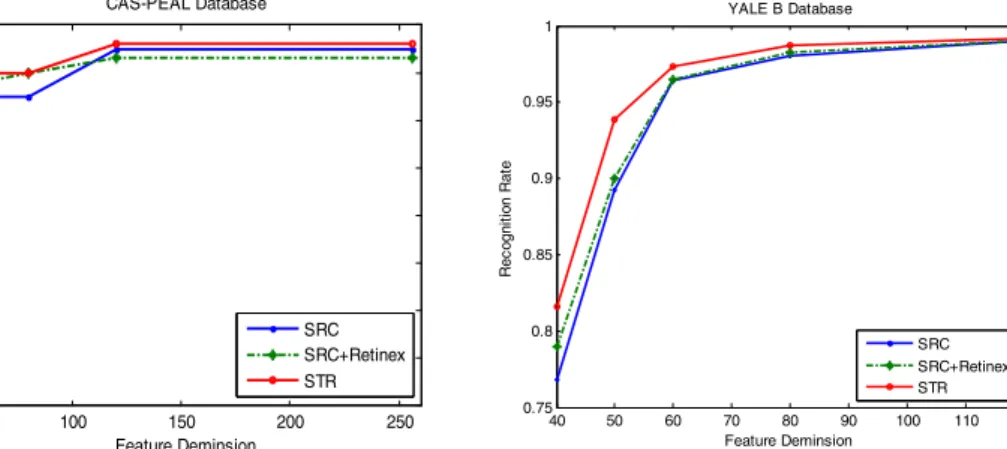
We chose 220 images of 22 individuals under 15 different illumination conditions. The figures show the recognition rates versus the dimension of features. Fig.1shows that our method (STR) consistently out when compared with other two methods. The recognition results are obviously when the dimensions between 60 and 120, that is because the extract dimension between these areas could better reflect the invariant illumination features. During the increasing of dimension the recognition rates tends to a balance. 50 100 150 200 250 0.91 0.92 0.93 0.94 0.95 0.96 0.97 0.98 0.99 Feature Deminsion R ec og ni tio n R at e CAS-PEAL Database SRC SRC+Retinex STR 40 50 60 70 80 90 100 110 120 0.75 0.8 0.85 0.9 0.95 1 Feature Deminsion R ec ogni tio n R at e YALE B Database SRC SRC+Retinex STR
Fig. 1. Recognition rates on the CAS-PEAL Database; Fig. 2. Recognition rates on the YALE-B Database 4.2 Results on Yale face database B
Yale face database B is publicly available for studying illumination and pose problem in face recognition. The database consists of 2,414 frontal-face images of 38 individuals which captured under various laboratory-controlled lighting conditions [8].
In ordinary, the recognition rate will decreased when the size of images is significantly reduced, but from the experiment results we can see that it is also effective and fast to identify the reduced size images
after combining the modified Retinex algorithm and the sparse representation. Fig.2 demonstrates the recognition rates of our method are better than the original sparse representation, and the proposed method is suitable to deal with the complex illumination of images. When the feature dimensions increase gradually, the performance are becoming to a balance.
5. Conclusions
In this paper, we proposed an optimized method based on the Retinex theory and sparse representation for face recognition (STR) under varying lighting conditions. In the novel work the original Retinex algorithm is optimized by the partial differential equation and then the obtained features are used as dictionary of SRC. The experimental results on two different face image databases show that STR is not only better in accuracy but also appropriate to large-scale data. STR adopts both advantages of SRC and Retinex theory for invariant illumination feature extraction, and avoids disadvantages of two algorithms. In conclusion, the proposed approach is more suitable to deal with the face recognition of variant illumination, and more effective for issues caused by illumination. In the future, we will investigate to reduce the computational complexity and try to cope with more complex conditions of face recognition. Acknowledgement
This work is supported by the National Natural Science Foundation of China under Grant (No.60773062, No.61073121) and Natural Science Foundation of Hebei Province of China (No. F2009000215).
Reference
[1]P.Jonathon Phillips, W.Todd Scruggs, Patrick J.Flynn et al. FRVT 2006 and ICE 2006 Large-Scale Experimental Results.
IEEE Transactions on Pattern Analysis and Machine Intelligence; 2010, p.834-846.
[2]J.Wright, A.Yang, A.Ganesh, S.Sastry. Robust face recognition via sparse representation. IEEE Transactions on Pattern Analysis and Machine Intelligence; 2009, p.210-227.
[3]Jianchao Yang, John Wright, Thomas Huang. Image Super-Resolution via Sparse Representation. IEEE Transactions on Image Processing; 2010, p.1057-2873.
[4]Hansung Lee, Yunsu Chung, and Jeongnyeo Kim. Face Image Retrieval Using Sparse Representation Classifier with Gabor-LBP Histogram. Information Security Applications; 2011, p.273-280.
[5]Jean Michel Morel, Ana Belen Petro,and Catalina Sbert. A PDE Formalization of Retinex Theory. IEEE Transactions on Image Processing; 2010, p.2825-2837.
[6]Xudong Xie , Kin-Man Lam. Gabor-Based Kernel PCA with Doubly Nonlinear Mapping for Face Recognition with a Single Face Image. IEEE Transactions on Image Processing; 2006, p.2481-2492.
[7]Wen Gao, Bo Cao and Shiguang Shan et al. The CAS-PEAL Large-Scale Chinese Face Database and Baseline Evaluations.
IEEE Transactions on System Man, and Cybernetics (Part A); 2008 , p.149-161.
[8]Georghiades, A.S. and Belhumeur. From Few to Many: Illumination Cone Models for Face Recognition under Variable Lighting and Pose. IEEE Transactions on Pattern Analysis and Machine Intelligence; 2001, p.643-660.