EDUCATION BEYOND THE CURRICULUM:
AFTER-SCHOOL PROGRAMS and THEIR BENEFITS
April 26
th, 2003
by
Esra Kazan
in partial fulfillment of the requirements in SCE 5308
Abstract
Daily lives have been becoming increasingly demanding for parents. We are living with busy schedules, and working in demanding jobs while children are home alone, exposed to TV, computer games, and junk food. Children often become lonely, isolated, and therefore, unsocial due to the limited contact with
their parents and school peers. For that purpose, a questionnaire was given to a sample of 6th, 7th, and 8th
grade students, who have been attending after-school programs in a Houston charter school. Students’ interests were measured by a descriptive research. Statistics were collected to make sound judgment on what they expect and what they get. This study was conducted to determine the benefits of such activities, which will help school administrations to design fruitful after-school programs.
INTRODUCTION
As the number of children with caregivers working outside the home has increased, so has interest in how these children spend their time after-school and before their parents return from work (Cosden, 2001). An estimated eight million school-age children are home alone after-school (US Department of Education, 2001). Those children are constantly exposed to the damaging stream of bad examples such as drug and alcohol use, and premature sexual activity. Research has substantiated educators’ concerns that children who are unsupervised during the after-school hours can suffer an array of negative developmental outcomes, especially when those children come from high-risk circumstances (Lee, 2001).
Well-designed and managed after-school programs can solve the problems listed above. Such programs will not only keep the children away from those problems, but also will contribute to their learning process and academic success. Quality after-school programs serve children and youth through ongoing relationships with caring adults, an environment that strengthens social skills and character, healthy snacks and/or meals to meet students’ nutritional needs, as well as safe and well-designed indoor and outdoor activities.
LITERATURE REVIEW
Recently there has been an explosion of interest in after-school programs. Such programs have increased the awareness of the American public because of their benefits. That is also the reason why policy makers see in these programs the chance to address numerous social and educational problems (Thirteen Education Online, 2001). Quality after-school programs support developmentally appropriate cognitive, social, physical, and emotional outcomes. Specific benefits can be listed as (i) getting academic help (homework assistance), (ii) preparing for career college and job training, community internships (for middle and high school), (iii) exploring special interests such as art, music, theatre, dance, athletic and, crafts and games, and (iv) taking part in cultural activities. In addition to that, students have the chance to receive emotional support through after-school programs. It has been observed that children’s participation in formal after-school programs was associated with better conduct ratings by teachers, better peer relations, and better emotional adjustment (Cosden, 2001).
Tutoring and homework assistance are also important part of after-school programs. The current emphasis on performance standards and testing has led schools to look to the after-school hours as time that can be spent developing children’s academic skills (National Institute on Out-of-School Time, 2001). Today too many children fail to read and succeed on math, science, and social studies at a degree we would expect for their grade level (U.S. Department of Education, 1999). After-school programs may give children those skills they need to improve by providing them extra education beyond their curriculum. Several programs have described the use of general academic topics not associated with special school curricula. In each instance, these after-school programs have enhanced positive school adjustments for participants (Cosden, 2001). Students can go further in-depth with research that they may have begun in their often limited class time (Thirteen Education Online, 2001).
Another benefit of the after-school programs is that the students will be better prepared in terms of career awareness for the real-life challenges. Such programs may provide age-appropriate job readiness training, as well as, information about career and career training options, preferably through firsthand experiences with community business leaders and tours of local businesses (Schwartz, 1996).
After-school programs offer an array of activities not always available during the traditional day; these programs give students many opportunities for growth and learning they might not find elsewhere. For example, at a time when many schools have had to cut or reduce spending on art and music programs, after-school programs can offer kids the opportunity to paint, draw, perform in a dramatic production, play music, participate in a dance performance, and visit museums (Thirteen Education Online, 2001). Not only art, music, and drama, but also other activities such as athletics, crafts, games, and hobbies are important because they provide a unique setting in which students feel high levels of intrinsic motivation, freedom,
concentration, and challenge (Bergin, 1996).
METHOD
Participants
The management of a charter school in Houston wanted to contribute to this study. It has been a successful educational institute chartered to the State of Texas. The school’s total enrolment is 320.
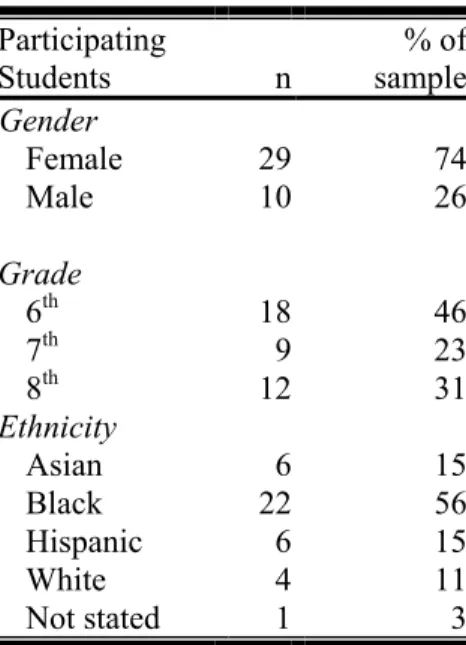
After-school programs were provided for the 6th, 7th, and 8th grades only, which totaled 52 students. Exactly 75 %
of those students stated that they were attending at least one of the after-school activities. Therefore, the sample size for this study is 39, which was sufficient for statistical inference. Table 1 provides the gender, grade, and ethnicity information about the participants:
Table 1: Student Characteristics
Participating Students n % of sample Gender Female 29 74 Male 10 26 Grade 6th 18 46 7th 9 23 8th 12 31 Ethnicity Asian 6 15 Black 22 56 Hispanic 6 15 White 4 11 Not stated 1 3
Procedure and Survey Instrument
A questionnaire, which was designed for collecting data on the benefits of the after-school programs, was distributed. Then the participants were provided with some verbal instructions about how to answer the questions, and asked to fill in their own answers. They were given as much as time they needed to complete all the questions. At the end, the questionnaires were collected.
The questionnaire consists of two parts. In Part I, students were asked about their grade, gender, race, after-school programs they are attending, whether care was provided at home, education level of their
parents, activities they are doing at home when they are not attending the programs, and importance of general after-school activities. In Part II, a Likert scale was used to measure their interest in the after-school programs. All 39 students were asked to rate their interests ranging as “Strongly Agree”, “Agree”,
“Undecided”, “Disagree”, and “Strongly Disagree”. The numbers 5, 4, 3, 2, and 1 were assigned, respectively, as quantitative values to measure their responses (Gay, 2000).
Results
The general data of the study are provided in Table 2. According to the table, a student is attending an average 2.6 after-school programs with an average of 6.2 hours per week.
Table 2: General Statistics
Number of students 39 Number of active programs 10 Avg number of after-school hrs per week 6.2 Avg number of semesters, a student has been attending 2.1 Max number programs, a student attending 5 Avg number programs, a student attending 2.6
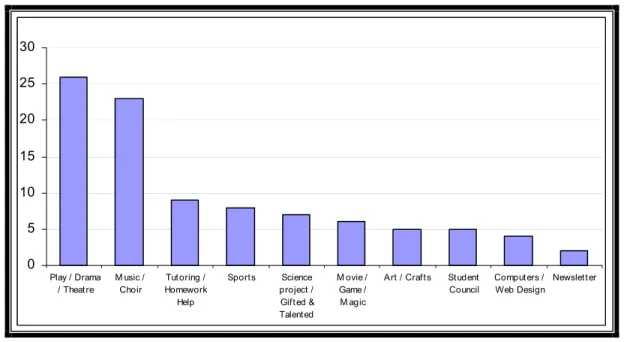
There are currently 10 different after-school programs offered by the school. The following figure illustrates the attendance to those programs. According to the data, the most popular program, with 67% attendance, is “Play/Drama/Theatre”, followed by “Music/Choir” with 59% attendance. The third most popular after-school program was observed to be “Tutoring/Homework Help”. After “Sports”, “Science
Projects for Gifted and Talented” has an 18% attendance. In those programs, students are getting ready for science project competitions under the guidance of their teachers. They usually spent long hours after the bell, either as individuals or team members, in order to prepare a project for the competition. They were observed to be very eager to attend the program for successful representation of their school.
Figure 1: Number of Attendance to the Programs
0 5 10 15 20 25 30 Play / Drama / Theatre M usic / Choir Tutoring / Homework Help Sports Science project / Gifted & Talented M ovie / Game / M agic
Art / Crafts Student Council
Computers / Web Design
Newsletter
After-school programs bring undeniable benefits both to the students and their families. The most direct benefit is that the students will gain experience on the subject of the programs. There are also indirect benefits. By keeping the children engaged in positive activities, after-school programs will steal their extra time and prevent them from being exposed to less constructive or even harmful activities. Therefore, it may be an interesting inquiry to ask what the children are doing when they are not attending after-school
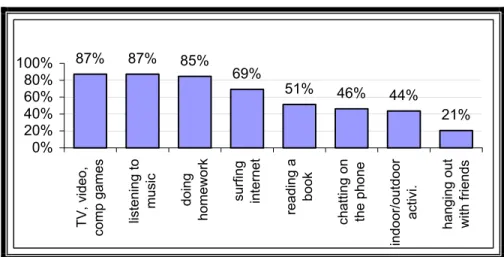
programs. The answers were presented in Figure 2, which clearly states that more than 87% of all students are spending most of their time in front of TV, video or computer games. That is a significant number which clearly states that after-school programs are decreasing the children’s exposure to passive TV watching, and computer games.
Figure 2: Home activities if not attending to after-school programs 87% 87% 85% 69% 51% 46% 44% 21% 0% 20% 40% 60% 80% 100% T V , video,
comp games list
ening t
o
music doing
homework
surfing internet
reading a book chat ting on the phone indoor/ out door act ivi.
hanging out wit
h f
riends
Listening to music also has a high percentage, followed by doing homework. Sixty nine percent of the children are surfing the Internet during their off hours. It has been observed by researchers that the children surfing the Internet without a proper guidance are usually spending their time inefficiently. In addition to that, students can easily get exposed to contents which may negatively affect their psychological and physical development (NEC Education, 2003).
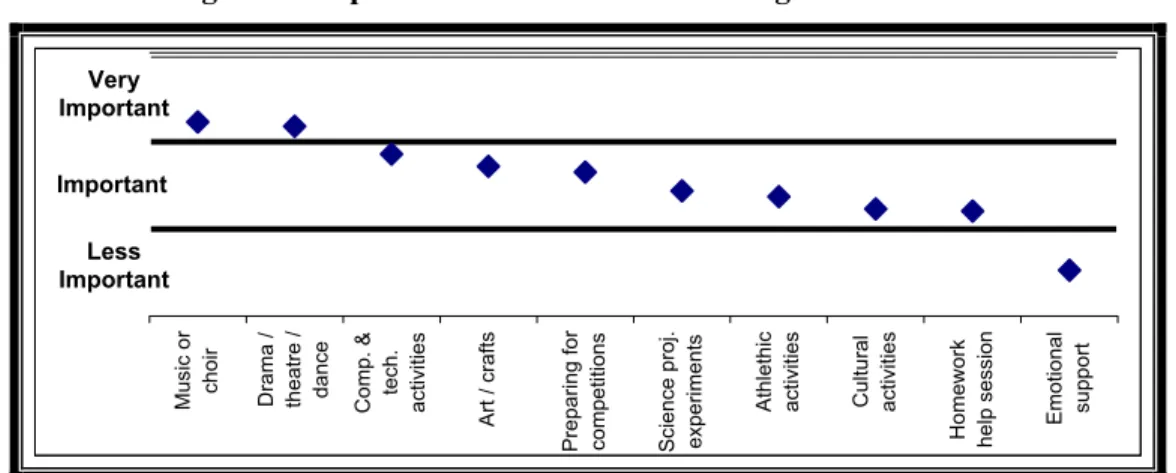
Another interesting outcome of the research is the relative importance of programs according to the students. As presented in Figure 3, they found the most important types of after-school programs as
“Music/Choir” and “Drama/Theatre/Dance”. “Computer and technological activities” also have significance with respect to the others. Even though 85% of the students spent their after-hours by doing homework (see Figure 2), they list it as the last item in the important section of Figure 3. That may imply that the students are actually doing homework not because they entirely believe in its benefits, but rather because they have to do it.
Figure 3: Importance of activities according to the students
Music or choir Drama / theat
re /
dance
Comp. & tech. activitie
s Ar t / cr a fts P reparing f o r compet itions S
cience proj. experiment
s A thlet hic a ctivitie s Cultural activitie s
Homework help session E
m
ot
ional
support
The most striking observation is that the students ranked “Emotional support” as the least important subject for an after-school program. This should not be read as the type of program that they need least, but rather that students perceive it to be less important than actual activities.
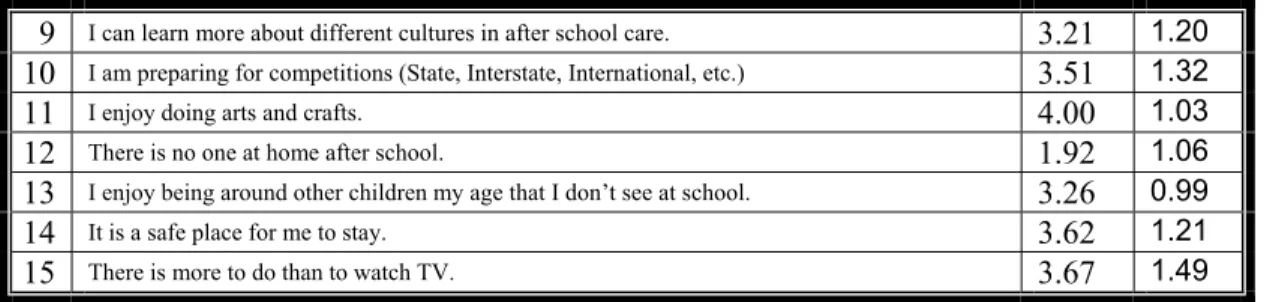
Part II of the questionnaire (Appendix A) was designed to identify the reasons behind why students want to participate in after-school programs. The students were asked to respond to a series of 15 statements by indicating the level of their “agreement”. Table 3 provides the questions asked. The original format of the questions given to students can be found in the Appendix. The mean values of the answers were computed after translating them into numeric values. Standard deviations of the series were also provided to determine the variation of the answers. For example, statement 1 has the minimum variation, which suggests that most of the students selected close choices. Interestingly, statement 15 on watching TV has the highest variation, signifying the gap between their responses. Figure 4 locates their assessment on a linear scale between 5 (Strongly agree) and 1 (Strongly disagree).
Table 3: Questions and quantitative values for answers in Part II
# Question Mean Stdev
1 I like specific after school programs. 4.31 0.69
2 After school programs are fun for me. 4.21 0.86
3 It is nice to get help with my homework. 3.67 1.03
4 It is nice to get some emotional support from my teachers. 3.56 1.02
5 I like to do different activities other than the subjects we have covered in school. 4.00 1.12
6 I interact with my teachers just like good friends during the after school programs. 3.15 1.18
7 Because I need extra help with my classes. 2.97 1.25
8 Because I need more time to think about and study my projects (Science, Math, Social Studies) 3.36 1.27
Very Important
Important
Less Important
9 I can learn more about different cultures in after school care. 3.21 1.20
10 I am preparing for competitions (State, Interstate, International, etc.) 3.51 1.32
11 I enjoy doing arts and crafts. 4.00 1.03
12 There is no one at home after school. 1.92 1.06
13 I enjoy being around other children my age that I don’t see at school. 3.26 0.99
14 It is a safe place for me to stay. 3.62 1.21
15 There is more to do than to watch TV. 3.67 1.49
Figure 4: Answers to the questions in Part II
The above figure presents the relative assessment of statements in a visual format. One can easily keep track of the statements falling into close assessment value. For example, evaluation of the statements 1, 2, 5, and 11 is positioned between “Agree” and “Strongly agree”. When those statements were analyzed, it was noticed that the students wanted to attend specific, off-the-curriculum, and fun activities. Most of the remaining statements fall between “Undecided” and “Agree”. The only outlier statement is number 12. According to that sentence, the majority of the students deny that they are home alone after school. This may conflict with the results of a recent research, which claimed that it was estimated that as many as seven to fifteen million school-age children leave school for an empty home on any given day (US Department of Education, 2000).
DISCUSSION
After-schools programs supplement the regular curriculum. The families should not perceive after-school programs just as another childcare opportunity. Personal contact with parents by speaking about the importance of activities is a more effective strategy. They have to believe in the positive effects of the programs and support the school administrations and their children for active participation. There are also
5
Strongly Agree4
Agree3
Undecided2
Disagree1
Strongly Disagree 1 2 5 11 6 7 12 13 3 4 8 9 10 14many educators, program administrators, and community leaders, who are working throughout the country to build support for after-school programs (Jacobson, 2001). Programs can either be self-supporting through tuition paid by participants; supported by grants and contracts; or founded through combination both. In urban areas, families usually pay nothing or only a very small fee. Many Federal and local government agencies offer funding for after-school programs. It may be possible to combine special purpose funds from several agencies to create a full service programs. Therefore, support from Governmental or private
foundations is very crucial so that students will be ready for a better future.
Tutoring/Homework Help took the third place in terms of attendance (See Figure 1). It is really essential for students to receive homework help. On the other hand, parents should not be kept out of the cycle, even if they feel inadequately equipped to help with homework. Moreover, taking the parent out of the homework equation could also have negative effect of reducing actual and perceived parent involvement with the schooling process (Cosden, 2001).
Coordinator of the after-school programs in this school stated that the majority of the students attending to the programs are indeed successful students. But he also added that their participation further improved their grades. The principal of the school reported that they were collecting statistics on the grades of participating students to identify trends. They witnessed an overall upward surge in the grades. The coordinator also added that the participating students have been building self-esteem and better conduct with their classmates.
Another significant achievement of the after-school programs was that several students succeeded in science project competitions. That motivated other student to participate to similar programs. Also, families were very proud of the achievements of their kids. Their approval and support to the programs have grown significantly.
CONCLUSION
Spending more in the school is reducing the exposure of student to bad habits (Schwartz, 1996) such as exposure to TV, sex, violence, substance abuse, and crime. After-school programs will keep the children
busy in more constructive activities and they will not be vulnerable to those bad habits. After-school programs can be flexible in tailoring children’s time to their needs, have a better student/staff ratio, and benefit from multi-age groupings (Schwartz, 1996). After-school participants are also in smaller classes and can take advantage of the extra time with teachers. They provide constructive activities and opportunities to develop healthy relationships with adults (Patten, 2001).
Students feel the need to learn more about other cultures and understandings from all around the world. After-school programs may also provide a valuable opportunity to introduce different cultures and languages through students clubs. That aspect has been more essential due to the globalization of our life.
Evaluating the benefits of after-programs is vital for success. There may be two types of evaluations for after school programs: measuring enrollment and dropouts, and review of individual participants’ performance and group experiences. The programs have been increasing the children’s self-esteem. For example, they play in a drama, sing in a choir, present a science project, or design a website. Such activities will provide us the clues about their progress over the time. Thus, it takes time to see the positive results of the programs.
The teachers at this school expressed that the children who participated in the activities are developing better social skills and showing fewer behavior problems than the children who do not participate. They also said that the grades of the participants have been improving. This is important evidence about the contributions of the after-school programs to the academic success. The teachers’ assessment are based the observations they had over a two-year timeline.
All parties involved, students, parents, and teachers expressed the positive effects of the programs. Time, material, and dedication invested in such programs will ultimately pay off enormous benefits to the society by raising well-educated and social individuals.
REFERENCES:
Bergin, D. A. (1996). Adolescents’ out-of-school learning strategies. Journal of Experimental Education,
64(4), 309–326.
Cosden, M., Morrison, G., Albanese, A. L., Macias, S. (2001). When homework is not homework:
After-school programs for homework assistance. Educational Psychologist, 36(3), 211–221.
Gay, L.R. (2000). Educational research: Competencies analysis and application (6th edition.). Upper Saddle
River, New Jersey: Merrill Publishing Company.
Jacobson, L. (2001). Children & Families. Education Week, 21(13), 12.
Lee, S. (2001). Academic effects of after-school programs. Champaign, IL: ERIC Clearinghouse on
Elementary and Early Childhood Education. (ERIC Document Reproduction Service No. ED 458 010) National Institute on Out-of-School Time. (2001, March). Fact sheet on school-age children’s out-of-school
time [Online]. Wellesley, MA: National Institute on Out-of-School Time. Available: http://www.niost.org/fact_sheet_01.pdf.
NEC Education. Online Safety Program. Retrieved April 24, 2003, from http://www.nec.co.jp/community/en/educate.html
Patten, P., Robertson, A. S. (2001). Focus on after-school time for violence prevention. ERIC Clearinghouse on Elementary and Early Childhood Education. (ERIC Document Reproduction Service No. EDO-PS-01-7)
Schwartz, W. (1996). After-schools programs for urban youth. ERIC Clearinghouse on Urban Education. (ERIC Document Reproduction Service No. EDO-UD-96-3)
Thirteen Education Online. (2001). After-School Programs – From Vision to Reality: Explanation. [Online]. Available: http://www.thirteen.org/edonline/concept2class/month11/.
U.S. Department of Education. (1999). After-School Resources. [Online]. Available: http://www.ed.gov/pubs/After_School_Programs/Afterschool_Programs.html.
U.S. Department of Education. (2000). Working for children and families: Safe and smart after-school programs. [Online]. Available: http://www.ed.gov/pubs/parents/SafeSmart/.
U.S. Department of Education. (2001). 21st Century Community Learning Centers [Online]. Available:
APPENDIX A
QUESTIONNAIRE
Part I
` Grade: _________ Female: ___ Male: __
Ethnicity: Asian: __ Black: __ Hispanic: __ White: __ Other: __
How long have you been attending after school programs? Answer: __ semesters.
How many hours a week are you attending after school programs? Answer: ___ hours a week. What are the after school programs you are currently attending?
1): __________________________________________________
2): __________________________________________________
3): __________________________________________________
4): __________________________________________________
5): __________________________________________________
Is there care provided for you at home after school? Yes: __ No: __
What is the education level of your parents? (Graduate, College, High school, Secondary, Elementary, Not Applicable)
Mother: ____________________ Father: _________________________
What would you be doing at home if you were not attending to after school programs? (Check all that apply)
___ Doing homework ___ Surfing the Internet ___ Reading a book
___ Indoor / Outdoor activities (Sports, etc.) ___ Chatting on the telephone
___ TV / Videos / Video-Computer Games ___ Listening to music
___ Hanging out with friends
___ Other: _______________________________________________________
Please rank the following after school activities according to their importance to you. (1 is the most important, 10 is the least).
___ Art / Crafts
___ Athletic Activities
___ Computer & Technological Activities
___ Cultural Activities
___ Drama / Theatre / Dance ___ Emotional Support ___ Homework Help Session ___ Music or Choir
___ Preparing for Competitions ___ Science Project Experiments
Part II
I take part in after school care because:
Str
ongl
y
Agree Agree Undecided Disagree Strongly Disa
gree
1 I like specific after school programs. 2 After school programs are fun for me. 3 It is nice to get help with my homework.
4 It is nice to get some emotional support from my teachers. 5 I like to do different activities other than the subjects we have
covered in school.
6 I interact with my teachers just like good friends during the after school programs.
7 Because I need extra help with my classes.
8 Because I need more time to think about and study my projects (Science, Math, Social Studies)
9 I can learn more about different cultures in after school care.
10 I am preparing for competitions (State, Interstate, International, etc.) 11 I enjoy doing arts and crafts.
12 There is no one at home after school.
13 I enjoy being around other children my age that I don’t see at school. 14 It is a safe place for me to stay.
15 There is more to do than to watch TV.