Volume 2 ~ Issue 10 (2014) pp: 26-32 ISSN(Online) : 2347-3002
www.questjournals.org
*Corresponding Author: Andi Kusumawati 26 | Page
Research Paper
Effects of Intention Mediation towards Attitude, Subjective
Norms and Perceived Behavioral Control on Taxpayers’ Behavior
Andi Kusumawati, Abdul Halim, Darwis Said, Mediaty
University of Hasanudin,IndonesiaR
eceived 18 November, 2014;
A
ccepted 29 November, 2014 © The author(s) 2014. Published with
open access at
www.questjournals.org
ABSTRACT:-
Taxation as a regulatory tool used by the government in making policies that can stimulate the economy and increase revenue for the community. Until now, tax reform has been running over 20 years, but in reality they got some problems. First, the low tax ratio. Second, the percentage level of compliance enroll Taxpayer low. Third, the low coverage of tax. Taxpayer Compliance in the rights and obligations in accordance with existing regulations is a problem faced by several countries including the Directorate General of Taxation (DGT) of Indonesia. This study analyzed the behavior Taxpayer Taxpayer hotel area. Research on the behavior of local Taxpayer done, because the delegation of authority to the local government demanded to seek other forms of policies that will encourage acceptance of local revenues in order to fund the availability of services to the community. Source of data used is primary data in the form of a questionnaire or closed questions were given to the taxpayer Hotel. Statitics inferential methods used in the data analysis of this study is the Structural Equation Modeling (SEM). The research concludes that the presence of a significant indirect effect of the taxpayers’ behavior towards the taxpayers’ behavior through intention. Subsequently, there is a significant indirect effect of subjective norms towards taxpayers’ behavior through the intention. And, there is a significant indirect effect of perceived behavioral control on the behavior of taxpayers through the intention to behave.Keywords
:-
Perceived Behavior, intention, Taxpayer.I.
INTRODUCTION
According to General Provisions Law and Taxation Procedures (KUP), tax is a compulsory contribution to the state, which is payable by the individual or entity. It is coercive in nature, does not obtain direct reward, and is used for the purpose of the state for the greatest welfare of the people. The tax definition gives the sense that the tax is the duty of an individual or entity. Individuals or entities paying tax will not obtain direct rewards. The tax paid by those individuals or entities is used as a source of state financing (budgeter) and as a means of regulation (reguleren) in undertaking government policies. As a means of reguleren, the tax is used by the government in creating policies capable of stimulating the economics and increasing the income for the community. In 1983, the government made a breakthrough in the field of taxation by conducting reforms in taxation. To date, reforms in taxation have been running over 20 years, however, in reality, several problems are still found. Firstly, the tax ratio is low. The tax ratio can be used to measure the level of compliance of the community in paying the tax, in measuring the performance of taxation, and in observing the potential of the tax owned. In 2012, the Indonesian tax ratio was approximately 12%; this ratio is included in a low category if being compared to similar countries. Secondly, the percentage compliance level of the taxpayers in enrolling the taxation is included low. Thirdly, the tax coverage is low. The tax coverage is a measuring tool of tax compliance level which is marked by the return of the notification of tax (SPT).
The compliance of taxpayers in performing the rights and duties in accordance with existing regulations is a problem encountered by several countries (Tsakumis et al., 2009; Alabede et al., 2011). The tax compliance level of taxpayers which is still low has also been recognized by the Director General of Taxation. In a press release on October 11th, 2010, the Director General of Taxation released that one of the problems faced by the Directorate General of Taxation (DGT) currently is the low level of tax compliance of the taxpayers (DGT, Press Release October 11th, 2010). According to Allingham and Sandmo (1972), the taxpayers’ decision to evade the tax is affected by economic factors. Economic factors mentioned are tax rates, penalties and tax audit possibilities. However, with time, economic factors do not solely affect the taxpayers’ compliance; there are several other factors also, such as economic, social, cultural and psychological factors.
Ajzen and Fisben (1975), through the theory of reasoned action (TRA) state that behavior is determined by the intention. One’s intention to behave is affected by attitude towards behavior and subjective norm. The theory is an assessment result between the intention and behavior as human usually behave in a conscious manner. They consider all available information, either explicitly or implicitly, human also take the implication of their actions into account. The theory of reasoned action (TRA) developed by Ajzen (1991) into the theory of planned behavior (TPB) by augmenting the construct which is not available in TRA is the perceived behavioral control. The theory of planned behavior describes that the intention to behave is affected by three factors, namely: attitude toward behavior, subjective norm, and perceived behavioral control (PBC). Theory of planned behavior (TPB) has been used by several researchers to observe the behavior of taxpayers.
The taxpayer behavior is an action or a reaction of the taxpayers on the taxation policies made by the government. In this research, the researcher used a behavioral approach to observe what factors affecting the behavior of the taxpayers to comply with their duties. This approach was used on the basis that there might be other factors besides financial consideration that may motivate the taxpayers in improving the compliance. Sociology and psychology consider that individuals are not only independent, selfish, utility maximisers; they also interact with other human possessing different attitudes, beliefs, norms and roles (Alm, 1999).
This research analyzed the hotel taxpayers’ behavior as the local taxpayers. The research on the local taxpayers’ behavior was conducted as the delegation of authorities to the local level demands the local government demanded to seek other forms of policies that will encourage the acceptance increase in local revenue in the context of fund availability for services to the community.
II.
THEORIES
Hotel taxpayers’ behavior is an action or reaction the taxpayer to comply with taxation policies made by the government. In order to examine the behavior of hotel taxpayers in implementing tax collection of self assessment and official assessment, thus this research will use behavioral theories, taxation theories and other supporting theories. The theories used as the basis for this research is described in detail as the following:
Behavioral theories are part of psychology. Psychology is a science of the behavior and mental process which seek to describe, explain, predict and control the aspects of the sense, thoughts, perceptions and activities. In psychology, behaviorism studies the behavior that is observable and measurable. The behavioral theory used in this research was the theory of reasoned action and theory of planned behavior. These theories are the result of the assessment of the relationship between intention and behavior derived from several previous theories, including self-efficacy theory, social cognitive theory, attribution theory and the consistent theory.
Theory of reasoned action (TRA) is the most basic behavioral theory and has been used in various research fields. In psychology, TRA is a theory about the relationship between the attitude and behavior. According to Fishbein and Ajzen (1975), human usually behave in a conscious manner, they consider all available information. Explicitly or implicitly human also take the implication of their actions into account. Human attitude affects behavior through one decision-making process which is a careful and reasoned. The process of the decision making is limited to three things, namely: (1) the behavior is not largely determined by general attitude, but by a specific attitude on something (attitude towards behavior); (2) behavior is not only affected by the attitude but also by subjective norms; and (3) attitude toward behavior simultaneously with subjective norms will form an intention (behavioral intention) to behave.
Variables of theory of reasoned action (TRA) are the behavior intention, attitudes toward the behavior (attitude towards behavior) and subjective norms (subjective norm). Intention (intention) is defined by Fishbein and Ajzen (1975) as the desire to perform the behavior. Intention is not always static but it can change over time. According to Fishbein and Ajzen, to measure the intention in order to be useful in predicting the behavior (1975), there are four elements that must be considered, namely: the intention must be in accordance with the criteria in the behavior, what targets to achieve by an individual, in what context the intention should be measured and the last is time issue measurement. According to TRA, the behavioral intention is a function of attitude towards behavior and subjective norms. Fishbein and Ajzen (1975) define the attitude as the sum of the affections sensed by somebody to accept or reject an object or behavior. Fishbein and Ajzen (1975: 302) state that the subjective norms are the extent to which a person is motivated to abreast the view of people on behavior that will be undertaken (normative belief).
The intention is a major factor in the theory of reasoned action to perform the behavior. The intention is assumed to summarize the motivational factors as well as efforts in performing the behavior. Thereby, the greater the intention, the greater possibility of the behavior implementation. However, the intention can be realized into the behavior, if the behavior is under the control of a person to perform or not perform the behavior.
Theory of planned behavior from Ajzen (1991) provides the postulate that there are three conceptually independent determinants of intention. The first is the attitude toward the behavior refers to the extent to which a
norm, which refers to the social pressure sensed to perform or not to perform the behavior. The third is the perceived behavioral control, referring to the perceived ease or difficulty in performing the behavior. Perceived behavioral control (PBC) is defined by Ajzen (1991) as an individual perception on the ability to perform the behavior. PBC is a factor that has a great role in predicting the behavior which is not under the full control of the individuals. The attitude, subjective norms, and perceived behavioral control in predicting intention may vary in situations and behaviors.
Theory of planned behavior (TPB) explains that attitude towards behavior is affected by the belief that the behavior will lead to the desired or undesirable results. Beliefs in what behavior which is normative (expected by others) and the motivation to act in accordance with the normative expectations form subjective norms within the individual. Perceived behavioral control is determined by past experiences and individual estimation of how difficult or easy it is to perform the behavior in question.
Attitude towards specific behaviors, subjective norms, and perceived behavioral control interact and becomes a determinant for the intention, which in turn will determine whether the behavior will be performed or not. The model theory of planned behavior or planned behavioral theory states that the intentions is affected by 3 main factors, i.e. attitude towards behavior, subjective norms, and perceived behavioral control. Each factor affecting the intention is affected by other antecedent, i.e. beliefs. The attitude is affected by behavioral beliefs, subjective norms are influenced by normative beliefs and perceived behavioral control is affected by control beliefs.
According to the theory of planned behavior, the performance of a behavior is a function of intention and perceived behavioral control. To predict the behavior more accurately, several conditions must be fulfilled. Firstly, intention and perceived behavioral control must be suitable or compatible with the behavior to be predicted. It means the intention and perceived behavioral control should be assessed in relation to the behavior to be performed.
The result of the research by Ajzen (1991) also shows that a number of researchers have used the TPB in predicting intention to perform various activities. The result of the research shows that those three predictors in predicting intention provide different results. Therefore, findings from various researches indicate that the behavior is also affected by social pressure.
Tax is a compulsory contribution to the state, which is payable by the individual or entity. It is coercive in nature, does not obtain direct reward, and is used for the purpose of the state for the greatest welfare of the people (Law of KUP no. 28 of 2007, Article 1). Thus, the tax payment is a mandatory duty for every citizen and it is expected that each of them can voluntarily fulfill the duty. The tax collected by the government has two functions, i.e. budgeter function (financial function) and regulerend function (regulating function).
Hotel tax is one that taxes of which collecting authority is implemented by local level. Hotel tax collection system uses two methods, namely: self assessment system and official assessment system. Self assessment tax system gives trust to the taxpayers to compute, calculate, pay and report their tax obligations. Official assessment system is a system delegating the authority to the government to determine the amount of tax payable.
James and Alley (1999) believe that self assessment system is better than the computation system by the tax administrators (official assessment system). Therefore, many developed and developing countries switch their tax collection system, from official assessment into self-assessment. Self assessment is deemed to increase tax revenue and efficient in the use of human resources. However, self assessment system shifting the tax computation, from tax officials to the taxpayers makes the taxpayers obliged to understand the frequently changing taxation regulations. The voluntarily compliance of the taxpayers is highly expected in the self assessment system.
Jackson and Milliron (1986), Alm (1991) and Kirchler (2007) define tax compliance as compliance in the payment and reporting of all revenues by fulfilling all existing provisions of the taxation. The compliance of taxpayers in meeting taxation obligations will help the success of the government in carrying out the duties and responsibilities in the taxation. Tax compliance can be undertaken by forced or voluntarily. Voluntary compliance will be created if there is trust and cooperation between the taxpayers and the tax authorities. The taxpayers’ compliance can be improved through the use of rewards, punishments, threats and assessment.
According to the Director General of Taxes, obedient taxpayers are the taxpayers fulfilling certain criteria [KEP-213/PJ./2003]. Later in the SE-02/ PJ/ 2008 on Procedures for Determination of Taxpayers With Specific Criteria as a follow up of the Regulation of Minister of Finance No. 192 / PMK.03 / 2007.
The hypothesis is a prediction on the relationship between one dependent variable with one or more independent variables. The hypothesis serves as a temporary answer on various relationships investigated. The hypotheses of the research are as follows: the attitude affects the behavior of hotel taxpayers to comply with tax via the intention to behave obediently.
III.
RESULTS AND DISCUSSION
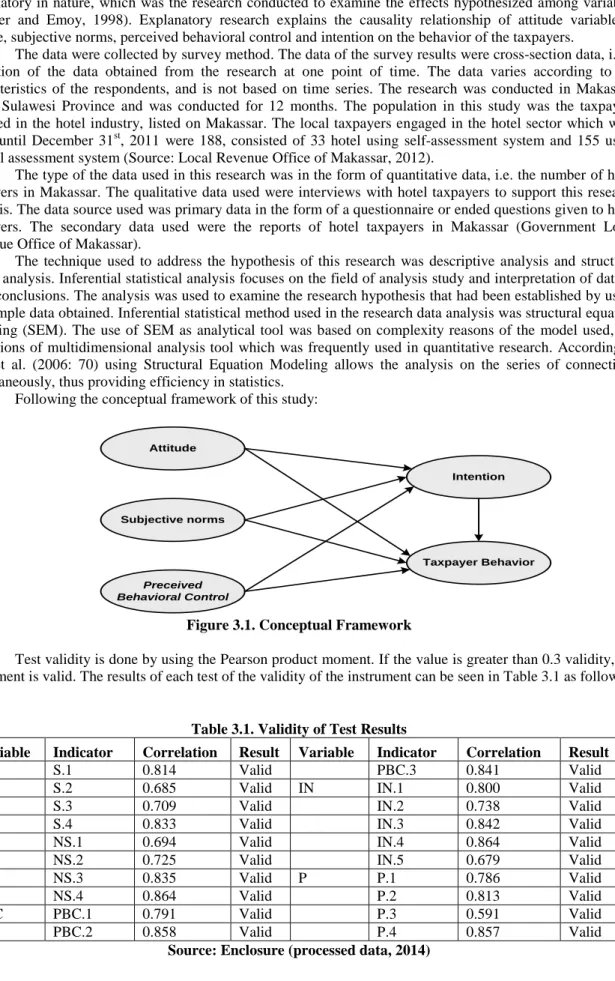
Based on the research problem and the conceptual framework presented earlier, this research was explanatory in nature, which was the research conducted to examine the effects hypothesized among variables (Cooper and Emoy, 1998). Explanatory research explains the causality relationship of attitude variable to behave, subjective norms, perceived behavioral control and intention on the behavior of the taxpayers.
The data were collected by survey method. The data of the survey results were cross-section data, i.e. a collection of the data obtained from the research at one point of time. The data varies according to the characteristics of the respondents, and is not based on time series. The research was conducted in Makassar, South Sulawesi Province and was conducted for 12 months. The population in this study was the taxpayers engaged in the hotel industry, listed on Makassar. The local taxpayers engaged in the hotel sector which were listed until December 31st, 2011 were 188, consisted of 33 hotel using self-assessment system and 155 using official assessment system (Source: Local Revenue Office of Makassar, 2012).
The type of the data used in this research was in the form of quantitative data, i.e. the number of hotel taxpayers in Makassar. The qualitative data used were interviews with hotel taxpayers to support this research analysis. The data source used was primary data in the form of a questionnaire or ended questions given to hotel taxpayers. The secondary data used were the reports of hotel taxpayers in Makassar (Government Local Revenue Office of Makassar).
The technique used to address the hypothesis of this research was descriptive analysis and structural model analysis. Inferential statistical analysis focuses on the field of analysis study and interpretation of data to draw conclusions. The analysis was used to examine the research hypothesis that had been established by using the sample data obtained. Inferential statistical method used in the research data analysis was structural equation modeling (SEM). The use of SEM as analytical tool was based on complexity reasons of the model used, the limitations of multidimensional analysis tool which was frequently used in quantitative research. According to Hair et al. (2006: 70) using Structural Equation Modeling allows the analysis on the series of connections simultaneously, thus providing efficiency in statistics.
Following the conceptual framework of this study:
Subjective norms Taxpayer Behavior Attitude Intention Preceived Behavioral Control
Figure 3.1. Conceptual Framework
Test validity is done by using the Pearson product moment. If the value is greater than 0.3 validity, the instrument is valid. The results of each test of the validity of the instrument can be seen in Table 3.1 as follows:
Table 3.1. Validity of Test Results
Variable Indicator Correlation Result Variable Indicator Correlation Result
S S.1 0.814 Valid PBC.3 0.841 Valid
S.2 0.685 Valid IN IN.1 0.800 Valid
S.3 0.709 Valid IN.2 0.738 Valid
S.4 0.833 Valid IN.3 0.842 Valid
NS NS.1 0.694 Valid IN.4 0.864 Valid
NS.2 0.725 Valid IN.5 0.679 Valid
NS.3 0.835 Valid P P.1 0.786 Valid
NS.4 0.864 Valid P.2 0.813 Valid
PBC PBC.1 0.791 Valid P.3 0.591 Valid
PBC.2 0.858 Valid P.4 0.857 Valid
According to the table 3.1 above, it can be seen that all the indicators on all variables have been declared invalid because it has a correlation value of> 0.30. Therefore, all of the indicators can be used in this study.
In this study the reliability test used Cronbach's alpha coefficient. The test results stated realibel if the value is greater than 0.6 (Malhotra, 1992 in Solimun, 2010). Results of reliability test each variable as shown in Table 3.2.
Table 3.2. Results of reliability test Variable Alpha Cronbach Result
Attitude 0.758 Reliable
Subjective Norms 0.779 Reliable
Behavioral Control 0.751 Reliable
Intention 0.842 Reliable
Taxpayer Behavior 0.767 Reliable
Source: Enclosure (processed data, 2014)
Based on table 3.2 obtained Cronbach alpha values> 0.6 in all indicators. This means that the instrument was valid and reliable research. Therefore, the indicators in this study can be used for further analysis using Structural Equation Modeling (SEM). The reason for using SEM, that the causal relationship is formulated in this study using a simple model that is not a double role ie Taxpayer behavior Hotel.
Based on the table above, it can be seen that all indicators on all variables have been found invalid for having the correlation value of > 0.30. Therefore, all indicators can be used in this research. Based on the table above, Cronbach alpha value > 0.6 in all indicators is obtained. It means that the instrument in the research is valid and reliable.
Some suitability index and the cut-off value to test whether a model can be accepted or rejected. The results of testing the goodness of fit overall model can be seen in Table 3.3 below:
Table 3.3. Goodness of Fit Testing Results Overall Model Criteria Cut-of value Testing Results Remark Chi Square/DF Expected to be small 1.360 Fit Model RMSEA ≤ 0,08 0.055 Fit Model
It is found that he test result of Goodness of Fit Overall based on Table 3.3 has the value CMIN/ DF 1.360 < 2.000 and the Root Mean Square Error of Approximation (RMSEA) is 0.055<0.08, after fulfilling the cut-off value. Solimun (2010 mentions that one or two (mainly RMSEA and CMIN / DF), and thus the model is found well. Referring to the parsimony principle and rule of thumb, if there is one or two criteria of goodness of fit that have fulfilled, the model is well and deserves to be used, thus the interpretation can be done for further discussion.
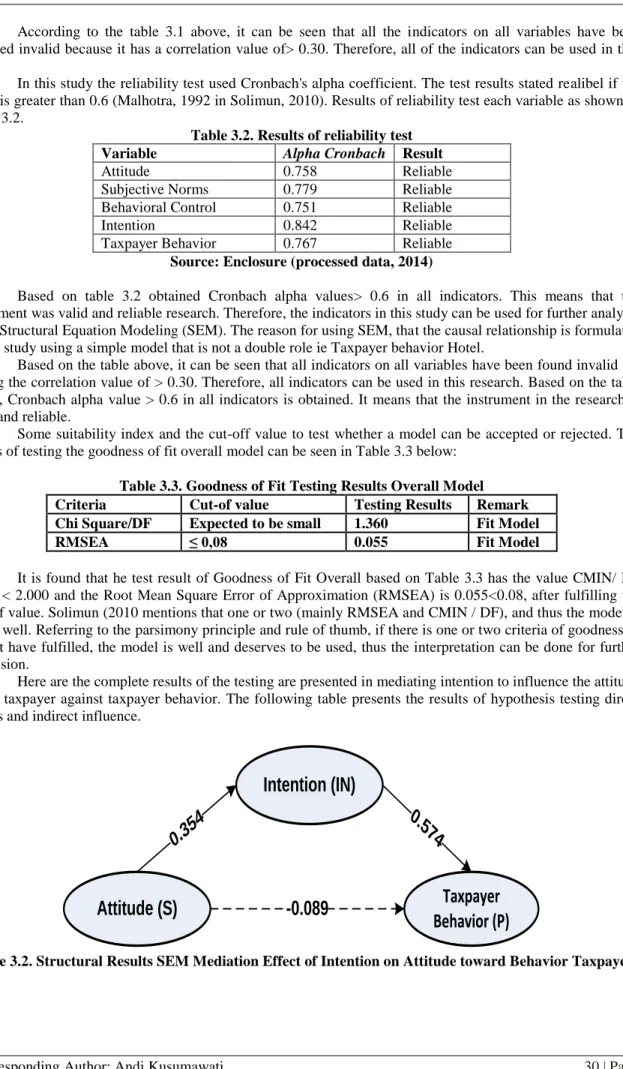
Here are the complete results of the testing are presented in mediating intention to influence the attitude of the taxpayer against taxpayer behavior. The following table presents the results of hypothesis testing direct effects and indirect influence.
Intention (IN)
Attitude (S)
Taxpayer
Behavior (P)
0.
35
4
0.5
74
-0.089
Table 3.4.Mediation of Intention in Influence Attitudes toward Taxpayer Behavior Relationship Between Variables Coefficient P-value Explanation
S IN 0.354 0.007 Significant 5%
IN P 0.574 0.012 Significant 5%
S P -0.089 0.549 Not Significant
S IN P 0.203 0.035 Significant 5%
Source: Primary Data Processed, 2014
The complete result of the intention mediation testing in the effect of taxpayers’ behavior on the taxpayers’ behavior is presented to the following. Based on Table 3.4 and Figure 3.2, the testing of indirect effects between the attitude (S) on the taxpayers’ behavior (P) through intention (IN), the sobel test coefficient of 0203 with p-value of 0.035 <0.05 is obtained, thus it can be said there is a significant indirect effect between the relationship between attitudes towards the taxpayers’ behavior through intention. With a positively-marked coefficient, it indicates a positive relationship. It means, the higher the taxpayers’ attitude, the higher the taxpayers’ behavior if the intention to behave is also high. The test results indicate that the intention variable becomes the mediator of the effect of attitude towards the taxpayers’ behavior. The higher the taxpayers’ attitude, with the higher intention mediation, it will increase the taxpayers’ behavior. The research result is consistent with the theory of planned behavior (Ajzen, 1991), i.e. a person's behavior is determined by intention. Therefore, the intention plays an important role as an intervening factor of a person to conduct the behavior.
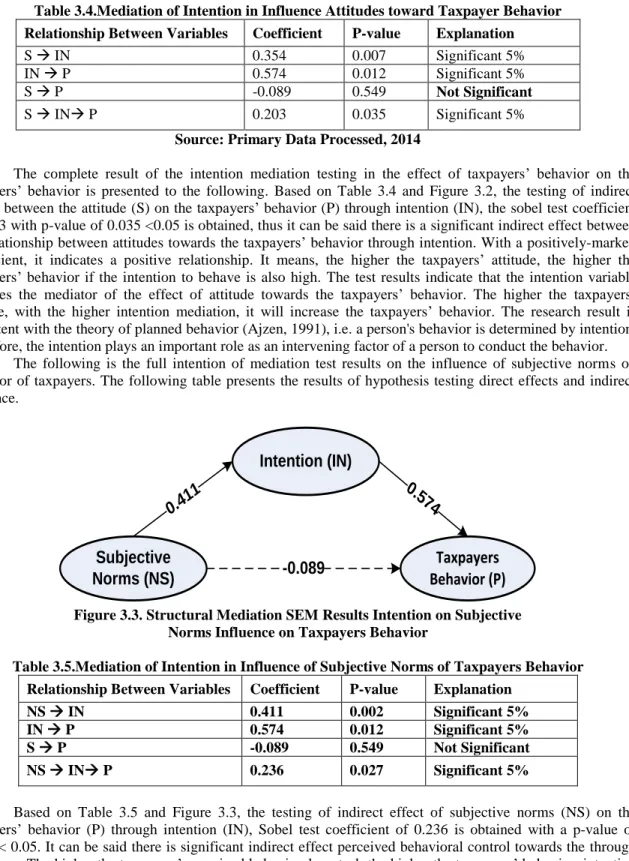
The following is the full intention of mediation test results on the influence of subjective norms on behavior of taxpayers. The following table presents the results of hypothesis testing direct effects and indirect influence.
Intention (IN)
Subjective
Norms (NS)
Taxpayers
Behavior (P)
0.
41
1
0.5
74
-0.089
Figure 3.3. Structural Mediation SEM Results Intention on Subjective Norms Influence on Taxpayers Behavior
Table 3.5.Mediation of Intention in Influence of Subjective Norms of Taxpayers Behavior Relationship Between Variables Coefficient P-value Explanation
NS IN 0.411 0.002 Significant 5% IN P 0.574 0.012 Significant 5% S P -0.089 0.549 Not Significant NS IN P 0.236 0.027 Significant 5%
Based on Table 3.5 and Figure 3.3, the testing of indirect effect of subjective norms (NS) on the taxpayers’ behavior (P) through intention (IN), Sobel test coefficient of 0.236 is obtained with a p-value of 0.027 < 0.05. It can be said there is significant indirect effect perceived behavioral control towards the through intentions. The higher the taxpayers’ perceived behavioral control, the higher the taxpayers’ behavior, intention mediation, it will increase the taxpayers’ behavior, if the intention to behave is also high.
The test results indicate that the intention variable becomes the mediator of the effect of perceived behavioral control towards the taxpayers’ behavior. The higher the perceived behavioral control, with the intention mediation, it will increase the taxpayers’ behavior. The research result is inconsistent with the theory of Bobek and Hatfield (2003) and Blanthome (2000), but in line with the results of the research by Mustikasari (2007) and Harinurdin (2009).
IV.
CONCLUSION
The research concludes that the presence of a significant indirect effect of the taxpayers’ behavior towards the taxpayers’ behavior through intention. Subsequently, there is a significant indirect effect of subjective norms towards taxpayers’ behavior through the intention. And, there is a significant indirect effect of perceived behavioral control on the behavior of taxpayers through the intention to behave.
REFERENCES
[1]. Ajzen, Icek. 1991. The Theory of Planned Behavior, Organizational Behavior and Human Decision Process. Vol. 50.
[2]. Allingham, Michael G., Agnar Sandmo. 1972. Income Tax Evasion: A Theoretical Analysis. Journal of Public Economics. Vol. 1.
[3]. Alm, James. 1999. Tax Compliance and Administration. Chapterin the Handbook on Taxation, Newyork: Marcel Dekker. [4]. Bobek, Donna D and Hatfield, Richard C. 2003. An Investigation of the Theory of Planned Bahavior and The Role of Moral
Obligation in Tax Compliance. Behavioral Research in Accounting, Vol. 15.
[5]. Chan CW, Troutman CS, O’Bryan D. 2000. An Expanded Model of Taxpayer Compliance. Empirical Evidence from the United States and Hong Kong. Journal International Accounting, Auditing and Taxation.9.
[6]. Cooper, D.R and C.W.Emoy. 1998. Metode Penelitian Bisnis, (In Indonesian) Translation (Widyana Soetjipto and Uka Wikarya). Volume 1 and volume 2. The fifth edition. Erlangga. Jakarta.
[7]. Dinas Pendapatan Kota Makassar. 2012. Daftar Wajib Pajak Hotel Tahun 2011. (In Indonesian)
[8]. Fishbein, Martin and Ajzen, Icek. 1975. Belief, Attitude, Intention and Behavior: An Introduction to Theory and Research. London: Addison-Wesley Publishing Company.
[9]. Hair, J. F., et al. 2006. Multivariate Data Analysis. 6th Edition. New Jersey: Pearson Education Inc.
[10]. Harinurdin, Erwin. 2009. Perilaku Kepatuhan Wajib Pajak Badan. (In Indonesian) Bisnis dan Birokrasi, Jurnal Ilmu Administrasi dan Organisasi, Mei – Agustus.
[11]. Hofstede, G.2001.Culture’s Consequences: Comparing Values, Behaviors, Institution, and Organizations Across Nations. Second Edition. Sage Publications. International Educational and Professional Publisher. Thousand Oaks. London. New Delhi. [12]. James, Simon and Alley, Clinton. 1999. Tax Compliance, Self-Assesment and Tax Administration, Journal of Finance and
Management in Public Services. Volume 2 Number 2.
[13]. Mustikasari, Elia. 2007. Kajian Empiris Tentang Kepatuhan Wajib Pajak Badan di Perusahaan Industri Pengolahan di Surabaya, (In Indonesian) SNA X Unhas Makassar.
[14]. Solimun. 2010, Multivariate Analysis Structural Equation Modelling (SEM) Lisrel dan Amos. Fakultas MIPA, Universitas Brawijaya