Distribution Agreement
In presenting this Thesis as a partial fulfillment of the requirements for an advanced degree from Emory University, I hereby grant to Emory University and its agents the non-‐exclusive license to archive, make accessible, and display my Thesis in whole or in part in all forms of media, now or hereafter known, including display on the world wide web. I understand that I may select some access restrictions as part of the online submission of this Thesis. I retain all ownership rights to the copyright of the Thesis. I also retain the right to use in future works (such as articles or books) all or part of this Thesis.
________________________________________________________________ Signature of Student Date
A FRAMEWORK FOR EVALUATING NON-‐HEALTH TECHNOLOGY FOR APPLICABILITY WITHIN PUBLIC HEALTH
BY
Brian Alexander Lee Degree to be awarded: M.P.H.
Executive MPH ________________________________________________________________ Melissa Alperin, MPH, MCHES, Committee Chair Date
________________________________________________________________ Thomas G. Savel, MD, Field Advisor Date
________________________________________________________________ J. Mark Conde, Committee Member Date
________________________________________________________________ Kathleen R. Miner, PhD, MPH, MCHES Date
Associate Dean, Applied Public Health
A FRAMEWORK FOR EVALUATING NON-‐HEALTH TECHNOLOGY FOR APPLICABILITY WITHIN PUBLIC HEALTH
BY
Brian Alexander Lee M.P.H, Emory University, 2014 B.B.A., Georgia State University, 2006
Thesis Committee Chair: Melissa Alperin, MPH, MCHES
An abstract of
A Thesis submitted to the Faculty of the Rollins School of Public Health of Emory University in partial fulfillment of the requirements of the degree of
Master of Public Health in the Executive MPH program 2014
Abstract
A FRAMEWORK FOR EVALUATING NON-‐HEALTH TECHNOLOGY FOR APPLICABILITY WITHIN PUBLIC HEALTH
BY
Brian Alexander Lee
The existing literature has many valuable frameworks for evaluating public health informatics systems. The existing frameworks provide a useful set of valid attributes and measures for determining the value and impact of a system within a public health organization or community. However, emerging tools and technologies are developed outside of public health that may be of value within public health informatics systems or as stand-‐alone tools used by public health practitioners. These tools need to be evaluated as stand-‐alone components to be included, if useful, within public health information systems and practice.
This research seeks to extend the available methods for public health informaticians to evaluate particular tools, approaches, practices or non-‐public health systems for their viability of use within public. While much software exists outside of the public health and health information technology domains, it is important to evaluate potentially useful tools based on the characteristics important for public health. This study performed a systematic review of the public health literature to determine commonly used attributes for evaluation, harmonized them into a common set of attributes appropriate for evaluating technology and created a simple tool for performing and documenting evaluations.
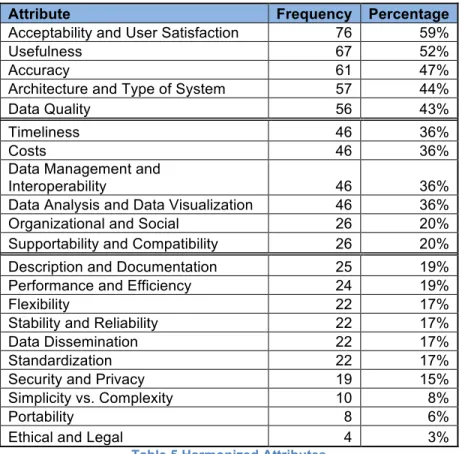
Thirty-‐two attributes are commonly occurring within the health literature, analyzing frequency and harmonizing these attributes for generalizability in evaluation of technology outside of health and public health led to the selection of nine attribute concepts that are most useful to evaluations: Acceptability, Usefulness, Accuracy, Architecture, Data Quality, Timeliness, Costs, Organizational, and Supportability. Thirteen additional attributes may be useful depending on the judgment of the evaluator: Data Management, Data Analysis, Documentation, Performance, Flexibility, Stability, Data Dissemination, Standardization, Security, Simplicity, Portability, and Ethical. Additional attributes can be included based on the judgment and determined need of evaluators using the tool within their
organizations.
Using these attributes this study developed a method for evaluating technology, a template for use by informaticians, an example evaluation using the template and a method to represent evaluation results in a reusable JSON data structure.
A FRAMEWORK FOR EVALUATING NON-‐HEALTH TECHNOLOGY FOR APPLICABILITY WITHIN PUBLIC HEALTH
BY
Brian Alexander Lee M.P.H, Emory University, 2014 B.B.A., Georgia State University, 2006
Thesis Committee Chair: Melissa Alperin, MPH, MCHES
A Thesis submitted to the Faculty of the Rollins School of Public Health of Emory University in partial fulfillment of the requirements of the degree of
Master of Public Health in the Executive MPH program
2014
ACKNOWLEDGEMENTS
It is impossible to thank all who have helped me; it is only through their knowledge, experience, compassion and tolerance that I was able to complete this work. Thanks to my family who has supported me during this time: my wife, Christy; my children Drake, Matthew and Isabel; and my parents Robert and Mary. Thanks to all of the faculty and fellow students at Emory University and to my
current and past colleagues at the US Centers for Disease Control and Prevention. Thanks to my committee chair, Melissa “Moose” Alperin for her guidance. Thanks to my committee member and informatics track advisor Mark Conde for his experience and insight. Thanks to Tom Savel, MD for his perspective into the concept and methods and his passion for how evaluation is important for changing
CHAPTER 1: INTRODUCTION ... 8
INTRODUCTION AND RATIONALE ... 8
PROBLEM STATEMENT ... 9
THEORETICAL FRAMEWORK ... 11
PURPOSE STATEMENT ... 11
STUDY OBJECTIVES ... 11
SIGNIFICANCE STATEMENT ... 12
DEFINITION OF TERMS ... 12
CHAPTER 2: LITERATURE REVIEW ... 17
PUBLIC HEALTH INFORMATION SYSTEM EVALUATION FRAMEWORKS ... 18
HEALTH SYSTEM INFORMATION EVALUATION FRAMEWORKS ... 29
SYSTEMATIC REVIEW FRAMEWORKS ... 34
GENERAL TECHNOLOGY ASSESSMENT FRAMEWORKS ... 37
SUMMARY OF CURRENT PROBLEM ... 38
CHAPTER 3: METHODS ... 39
INTRODUCTION ... 39
POPULATION AND SAMPLE ... 39
RESEARCH DESIGN ... 39
Stage 1: Systematic review ... 40
Stage 2: Harmonization of evaluation attributes ... 42
Stage 3: Tool development project ... 42
PROCEDURES ... 43
Stage 1: Systematic review ... 43
Stage 2: Harmonization of evaluation attributes ... 46
Stage 3: Tool development project ... 46
INSTRUMENTS ... 47
PLANS FOR DATA ANALYSIS ... 47
LIMITATIONS AND DELIMITATIONS ... 47
CHAPTER 4: RESULTS ... 49
INTRODUCTION ... 49
FINDINGS ... 49
Stage 1: Systematic review results ... 49
Stage 2: Harmonization of evaluation attributes ... 60
Stage 3: Tool development project ... 63
CHAPTER 5: CONCLUSION ... 72
SUMMARY OF STUDY ... 72
CONCLUSION ... 72
IMPLICATIONS ... 73
RECOMMENDATIONS ... 73
REFERENCES ... 74
APPENDIX A: FULL EVALUATION TEMPLATE ... 76
APPENDIX B: FULL EXAMPLE EVALUATION OF TABLEAU DESKTOP USING EVALUATION TEMPLATE ... 85
Chapter 1: Introduction
Introduction and rationale
The existing literature has many valuable frameworks for evaluating public health informatics systems and specifically public health surveillance systems. Foremost, and most recent, is Buehler et al’s 2004 framework for evaluating public health surveillance systems [1]. The existing frameworks provide a useful set of valid attributes and measures for determining the value and impact of a system as a whole within a public health organization or community. However, emerging tools and technologies are developed outside of public health that may be of value within public health informatics systems or as stand-alone tools to be used by
informaticians and other public health practitioners. These tools need to evaluated as stand-alone components to be included or excluded within a public health information system [2]. This research seeks to extend the available methods for public health informaticians to evaluate particular tools, approaches, practices or non-public health systems for their viability of use with public health practice and information systems. While much software exists outside of the public health and health information technology domains, it is important to evaluate potentially useful tools based on the characteristics of public health and the needs of public health practitioners.
Technology tools can have a positive impact on public health practices and systems when properly planned and integrated into public health practice [3]. But the determination of fit for technology is highly dependent on organizational structure, interaction with other
components of a system and potential reuse. The system planning and design of an information system involves a mixture of new software components and subcomponents while also
integrating existing components and techniques. While the proper selection of a tool will extend the functionality of a system or process, the inclusion of an inappropriate tool can have
immediate or long-term detrimental effects [4].
Public health information systems are frequently developed using external tools and technology systems [5]. The architecture of a particular information system needs to include in
its design not only new developed components used specifically for public health, but existing technologies such as general purpose programming languages such as Java and Ruby on Rails, relational database systems such as Microsoft SQLServer, MongoDB, and MySQL [6], and statistical analysis tools such as SAS and R. The appropriate technology selection will depend on the specific functional needs of the public health information system as well as the organization where the technology is to be used [7].
The selection of appropriate fit technology becomes more complex for public health practitioners without experience in informatics as they may not have experience with attributes that are not detectable on initial use, but may have long-term negative effects on the continued use of the tool [8]. If informaticians create evaluations of tools using a structured approach and shared evaluations within the public health community, non-informaticians can discover and more easily assess tools for their applicability within their own organization and public health processes.
This research aims to conduct three novel tasks:
• Perform an extensive search and systematic review of the public health informatics literature in the area of system evaluation that can be applied to technologies not designed for public health.
• Identify a set of common and applicable attributes and measures that are harmonized for use in evaluating non-public health technology
• Design a structured evaluation tool template for use by informaticians to assess non-public health technologies
Problem statement
The literature currently contains sound guidance for evaluating public health and healthcare information systems [1, 7, 9-11] to provide guidance and structure for assessing entire systems for impact. However, technologies exist outside of dedicated, purpose-built
public health systems that can be useful components within systems or components within a public health workflow. The literature contains indicators, attributes and measures specifically used for public health evaluation that can also be applied to technologies, tools, and
approaches that will help to determine whether a tool is useful for public health practitioners and informaticians.
By assessing appropriate attributes and developing an evaluation tool that can be used beyond public health informatics systems, this research seeks to improve the rate at which new techniques are brought into public health from outside domains. Inappropriate technologies introduced into public health can detract from the efficiency and effectiveness of public health [12]. Choosing appropriate technology and tools is needed to improve the adoption of health information technology. If translated effectively into public health informatics, technology will help not only public health practitioners, but also non-informatics public health practitioners who are most frequently the users of such new approaches.
With a set of evaluation tools for smaller components rather than entire systems,
informaticians can more easily share results of evaluations. If results can more easily be shared, then results will be more widely available to assist system designers in the selection and use of new technology within their system planning procedures. In the creation of informatics systems, system designers will be able to review and select specific components from outside of public health to assist in the architecture and planning of what needs to be built anew, rather than reused or modified for reuse.
The risk of incorrect or inefficient selections is high for system designers and program leads working with system designers. Being able to collect together lessons learned from each tool or component evaluation will help to reduce the risk of system mismatch and increase understanding and use of the technology [13].
Theoretical framework
This study is a hybrid between the subjectivist research evaluation study approach art criticism approach and the objectivist research evaluation study approach of the comparison based approach technique [14]. The criticism approach relies on an informatics subject matter expert (SME) to systematically review existing literature for attributes used in the evaluation of public health systems and extracting data from each review that used one or more defined attributes as part of its evaluation. The comparison approach reviews the extracted attributes to identify clusters of commonly used attributes based on their use within the matching articles and papers. Again, both approaches will be used to develop a structured tool that can be used depending on the level of effort available to the informatics practitioner and the potential significance of the tool used within public health.
Purpose statement
Informatics will benefit from a detailed structured evaluation tool for technology, tools and approaches that examines potential impact within public health systems and programs. This tool should use well-defined attributes appropriate and useful to public health that guides
informaticians and reduces time necessary for a useful evaluation. The output of the tool should be able to be discovered and reused by other informaticians with similar questions and needs as well as non-informaticians trying to determine tool fit within their organization and systems used.
Study objectives
This study focuses on three specific objectives:
• Objective 1: Perform a systematic review of published public health informatics evaluations of systems, tools and approaches.
• Objective 2: Identify commonly used attributes within evaluation literature and develop a harmonized set of evaluation attributes suitable for use with non-public health
• Objective 3: Develop a structured evaluation tool template that can be used to evaluate non-public health technologies for potential impact to public health
Significance statement
Tools and technologies are currently evaluated based on how they improve public health practice as part of public health information system design. These evaluations are carried out in various manners by informaticians and non-informaticians alike. Evaluations are sponsored by organizations responsible for carrying out public health functions such as surveillance and epidemiology and typically have the specific needs of the organization and surveillance system in mind as part of the evaluation [1]. Each organization has specific contexts and needs that influence the applicability or fit of a technology within the systems of that organization. As a result, the findings from one evaluation may not be useful to programs outside of the immediate domain of the initial evaluation. By providing a structured evaluation tool that seeks to reduce or remove the biases of each evaluator, results can be captured and shared in a manner that allows for greater reuse including use by public health practitioners with minimal training in public health informatics.
Over time, the output created by evaluators using this tool will allow public health practitioners to compare evaluations of similar tools and make an informed selection without being forced to repeat an evaluation.
Definition of terms
Term Definition
Architecture “…a systematic approach that organizes and guides design,
analysis, planning, and documentation activities.” [15]
Attribute “…a specific characteristic of the object: what is being
measured. Information resource speed, blood pressure, the correct diagnosis (of a clinical case), the number of new
patient admissions per day, the number of kilobases (in a strand of DNA), and computer literacy are examples of pertinent attributes within biomedical informatics.” [14]
Data Standard “…uniform use of common terms and common methods for
sharing data.” [4]
Domain characteristic A particular attribute selected due to the specific
characteristics important for a particular system evaluation, for example characteristics may be more important for certain diseases or public health functions
eHealth “the transfer of health resources and health care by electronic
means.” Using information technology and e-commerce for health, public health and health services. [16]
Electronic Health Record (EHR)
An EHR is a digital representation of a patient’s traditional paper chart and all associated data. EHRs contain a patient’s medical history and are used to automate and streamline healthcare provider workflow. [17]
Evaluation “… the systematic application of social science research
procedures to judge and improve the way information resources are designed and implemented” [18]
Folksonomy A folksonomy is a classification method where content is
organized collaboratively by users creating and changing tags to annotate objects and content over time [19]
Information System “… a discrete set of IT, data, and related resources, such as
personnel, hardware, software, and associated information technology services organized for the collection, processing,
maintenance, use, sharing, dissemination or disposition of information in accordance with defined procedures, whether automated or manual.” [15]
Information Technology “… any equipment or interconnected system or subsystem of
equipment that is used in the automatic acquisition, storage, manipulation, management, movement, control, display, switching, interchange, transmission or reception of data or information by an executive agency.” [15]
JavaScript Object Notation (JSON)
“…a lightweight data-interchange format. It is easy for humans to read and write. It is easy for machines to parse and
generate.” [20] JSON is a rapidly accepted method for exchanging data in a machine-readable format that can be reused across the diverse and growing set of devices, applications, services and systems.
Operations “…day-to-day management of an asset in the production
environment and include activities to operate data centers, help desks, data centers, telecommunication centers, and end user support services... Operational costs include the
expenses associated with an IT asset that is in the production environment to sustain an IT asset at the current capability and performance levels including Federal and contracted labor costs; and costs for the disposal of an asset.” [15]
Public Health Informatics “…the systematic application of information and computer science and technology to public health practice, research, and learning.” [4]
Public Health Surveillance “…ongoing, systematic collection, analysis, interpretation, and dissemination of data about a health-related event for use in public health action to reduce morbidity and mortality and to improve health” [21]
Stakeholder “…those who are or will be affected by a program, activity, or
resource.” [15]
Surveillance “the ongoing systematic collection, analysis, and interpretation
of health-related data essential to the planning,
implementation, and evaluation of public health practice, closely integrated with the timely dissemination of these data to those who need to know.” [22]
Surveillance System A surveillance system is an organized infrastructure that
enables the ongoing systematic collection, management, analysis, and interpretation of health-related data, followed by their dissemination to those who need to know so they may: Monitor populations to detect unusual instances or patterns of disease, toxic exposure, or injury;
Act to prevent or control these threats; Intervene to promote and improve health.
The term surveillance system applies to both electronic and paper-based systems. [23]
Systematic Review “a review of a clearly formulated question that uses systematic
and explicit methods to identify, select, and critically appraise relevant research, and to collect and analyze data from the studies that are included in the review” [24]
Tool A tool is an application that supports surveillance by enabling a very specific task (e.g., message transport, data
transformation, communications, identity management). Tools differ from systems mainly in size, complexity, and the number of functions they support. A system can be comprised of multiple tools to meet a function or business need. In the context of the National Biosurveillance Registry for Human Health, a tool is an application that provides targeted
functionality that can be used independently or by a system. The Public Health Information Network Messaging System (PHIN MS) is an example of a tool [23].
Chapter 2: Literature review
This research builds on the body of literature for public health system evaluation, non-health technology evaluation. This literature review is organized into sections depending on what material is available for:
• Public health system evaluation frameworks • Health system evaluation frameworks • Systematic review approaches
• General technology assessment frameworks
The available literature provides a perspective on what attributes are presented as the minimum necessary set of conditions that should be included within the evaluation of an information system. These evaluation frameworks were frequently cited within the evaluation publications included in this research’s systematic evaluation, but were expanded upon by the authors of numerous system evaluation publications.
While public health evaluation frameworks provide clear alignment to public health priorities, other evaluation frameworks from healthcare and global health provide a useful perspective on what attributes and measures are commonly used for evaluating the impact of eHealth systems and interventions.
In order to develop and refine the procedures of the systematic review it was useful to identify different methods available for planning and conducting systematic reviews. An appropriate design of systematic review procedures was important to be able to accurately determine what attributes are commonly and most frequently used as part of public health information system evaluations.
Finally, including general IT analysis and assessment literature, unassociated with health altogether, was useful in identifying how technology is commonly evaluated for maturity and applicability within organizations. The level of maturity of a particular technology is an
important factor for organizations with varying levels of informatics expertise to be able to adopt and support new technology.
Public health information system evaluation frameworks
CDC has sponsored the creation of four major evaluation frameworks from 1988 through 2011 [1, 21, 25, 26]. These evaluation frameworks form a strong basis for determining what attributes are intended by expert public health practitioners and even informaticians. While these attributes are intended for assessing a complete information system rather than individual components of these systems, they provide a strong basis and understanding of what is
important from a public health perspective.
Dr. Klaucke and the CDC Surveillance Coordination Group present a set of best practices and recommendations for how public health surveillance systems should be
evaluated. The earliest framework is not specific to information systems, but presents a method for evaluating the system independent of its informatics components. Partially this is an artifact of its time as information systems were quite nascent in 1988, but this framework also presents the priority of focusing on the public health impact of the system independent of technology. This early framework’s goal is to finally present best practice guidance on how public health programs can assess and evaluate the effectiveness of their surveillance. This framework, like other public health frameworks are specific to surveillance systems and include attributes that are very useful to surveillance and outbreak detection such as timeliness, that are less relevant to non-surveillance systems such as surveys, laboratory systems and public health registries. Later frameworks like the 2011 framework are adapted to the technology and informatics aspects of systems independence from their need to provide surveillance functions.
Each framework presents a process or set of tasks for conducting evaluations in such a structured way as to be able to be reproduced by secondary evaluations as well as the output of evaluations to be able to compare the impact of different surveillance systems. In 1988, CDC proposes a set of six tasks:
1. Public health importance – describe the system under evaluation in terms of the
importance of the public health event under surveillance. This task explains the need for the system and need for the data collected and used within the system and frames the evaluation in terms that do not emphasis information technology.
2. System Description – a thorough description of the system under evaluation including the objectives, what events or diseases are under surveillance, a graphical
representation of the system, and the components and subcomponents within the system. This task provides a understanding of what a system is attempting to accomplish and describes the system in multiple views and perspectives for each potential reader type of the evaluation: policy maker, public health practitioner, data provider, and potential other stakeholders and user types.
3. Usefulness – a description of the output and uses of the data produced by the system. This task assesses whether a system actually meets the need and design as described in tasks one and two.
4. Attribute-based evaluation – an assessment 7 system attributes determined to be
important for surveillance systems. This set of attributes is the first time a common set of attributes is defined that together will attempt to reach objective measures of a system’s quality that will allow funders to determine the impact of the system and system
providers to determine how a system can be revised and improved over time. a. Simplicity - the simplicity of both the structure of the system and how users
interact with the system. This attribute includes the directive that a system should be as simple as possible to meet its objectives but not so simple as to miss necessary requirements and functions.
b. Flexibility – the ability of the system to adapt to changing stakeholder needs through operation of the system. Because public health conditions may change between the initial set up and deployment of a system and while it is used over
time, it is important that a system be able to adapt to new uses needed by existing stakeholders as well as meeting the uses of new stakeholder groups. c. Acceptability – the willingness of stakeholders to participate and extract value
from the system. This attribute is called out based on how users interact with and use the system versus their potential to abandon the system or use alternate, less effective surveillance means that may not meet the functionality needed by the sponsoring public health program. Later frameworks will include similar attributes such as ease of use, learning curve for adoption and user satisfaction. This attribute becomes important and called out by non-public health frameworks as a differentiating factor for how users interact with the system, also called human computer interaction. As technology adoption matured from 1988 through the 2000s, acceptability and ease of use became differentiators between similar systems that both meet functional requirements.
d. Sensitivity - the proportion of cases of a disease or condition the system is meant to detect that are detected by the system. Public health system evaluation
frameworks were able to break out and include the ability to measure specific public health attributes such as sensitivity. Non-public health system evaluation frameworks included similar attributes like accuracy and validity to measure how a system was able to identify and reflect the condition under investigation. e. Predictive Value Positive - the proportion of cases detected by the system that
have the disease under surveillance. Early frameworks measured sensitivity and predictive value, positive separately to be able to measure the true positives and true negatives identified by the system.
f. Representativeness – the ability of the system to accurately reflect the detected events to the occurrence of events within the population. Early frameworks brought up the importance of data quality as a need that systems must meet, but
only representativeness was first called out in 1988. In 2001, CDC would include a stand along attribute for data quality and in 2004, CDC would include data quality and its subcomponents of representativeness, validity and completeness. g. Timeliness – the amount of time between each step of the system. In early
frameworks timeliness was focused on surveillance and the need to understand that data was more useful for enabling decisions closer to the point of
occurrence. Later frameworks would describe this attribute more specifically for outbreaks.
5. Costs – describe the resources that are necessary to operate and use the system. While costs was broken out as a major component in early frameworks, successive
frameworks expanded this task to include assessment of different types of costs- direct and indirect- compared to the benefit or describe value in the usefulness task evaluation. The 2011 framework greatly expanded this task to describe changes in software and hardware licensing models and how these license models affect operations and maintenance costs for how a system can be adopted.
6. Conclusions and recommendations – summarize whether the system is accomplishing its purpose and describe recommendations to improve the system based on findings. This task was included in the initial framework and is a consistent best practice in all frameworks to provide the evaluation team a task to qualitatively summarize a system’s current state as well as to issue recommendations for changes necessary as well as recommendations for similar systems or program adoption of systems.
In 2001, Dr. German and others from the CDC Guidelines Working Group published a new evaluation framework that sought to establish methods for consistent evaluation to help the integration of surveillance systems, establish reusable data standards, increase the electronic exchange of health data and to facilitate the response of public health to new emerging health
threats. This paper expanded on the earlier work described above in CDC’s 1988 guidelines by adding additional attributes necessary for evaluation and clarifying changing needs within public health from 1988 to 2001. Specifically, the evaluation guideline was enhanced to compensate in the increased use and value of electronic surveillance systems over non-electronic systems, particularly in enhancing the timeliness and data quality attribute of completeness [27]. While the updated guidelines still focus on surveillance systems and even non-electronic surveillance systems it included new attributes that were specific to eHealth systems such as stability and reliability of how a system is able to perform in a consistent manner.
The 2001 framework includes all of the initial seven system attributes while adding in two additional attributes that were identified:
1. Data quality – the completeness and validity of the data contained within the system. Representativeness is still considered a separate attribute but is assessed in
combination with new attributes of how a system’s data are suitable for use by
epidemiologists and other public health practitioners. When compared to other health evaluation frameworks, this attribute becomes very common to describe the differences for how a system meets its usefulness requirement as if a systems data are not
dependable, then it is a challenge for whether a system is worthwhile or can be effectively used.
2. Stability – the reliability and availability of the system to be used by its stakeholders. This attribute is new in 2001 to reflect the new adoption of electronic systems and the
instability that occurs when systems are not designed and maintained in a way that provides continuous uptime. This attribute also addresses what other frameworks will call sustainability or the costs associated with continuous maintenance and operation.
German’s framework also has six tasks, but these six tasks have different names and particulars but still fulfill the intention of the 1988 evaluation tasks:
1. Stakeholder Engagement – involve the appropriate stakeholders of the surveillance system in the execution of the evaluation. This task replaces the earlier task of public health importance. Although the importance of a system is still paramount, German’s framework focuses on the social aspects of how different stakeholder groups are engaged to define, develop and use the system. Each stakeholder’s public health need is defined and mapped to an eventual system function in the following tasks.
2. System Description – describe the public health importance and need of the system, the purpose of the system and how it operates and the resources required to operate the system. This task is common through all public health evaluation frameworks and
continues to make sure that the evaluators capture the intended functions of a system as compared to the actual performance that is assessed during task #4, evidence
gathering.
3. Focus of Design – efficiently planning the approach and execution of the evaluation to be performed. German et al present the importance of how the evaluation is designed and was carried out. It introduces the ability of an evaluation team to introduce and explain the need for additional attributes to be measured during task #4, evidence gathering. This was an important factor in how the evaluation tool produced by this research included the ability for evaluators to customize and vary from guidance when appropriate.
4. Evidence Gathering – collect evidence of the system performance according to usefulness as well as through 9 attributes that are important to system functionality. 5. Conclusions and Recommendations – present a summary of the evaluation with any
suggested changes that should be implemented within the system. This task is also common to all of the public health evaluation frameworks.
6. Lessons Learned – strategies for how the findings of the evaluation should be shared with the public health community. German introduces this task as independent from
conclusions to allow for evaluations to be generalizable to other systems, other public health programs and other evaluation teams who will be able to benefit from the findings of a particular evaluation.
In 2004, Dr. Buehler and the CDC Working Group for evaluation published a revised framework for evaluating surveillance systems through the lens of early outbreak detection. This framework was released based on the experiences of detecting potential bioterrorism events and introduced new aspects, tasks and attributes that, although intended for being important for outbreak detection, are still generalizable to other non-outbreak public health information
systems.
Rather than presenting an approach focused on tasks and attributes, the Buehler framework is broken into four category sections of the evaluation: system description, outbreak detection, experience and conclusions with the expectation that any system evaluation cover all four areas.
System description is broken into three elements: system purpose, stakeholders and system operation. The purpose is important to an evaluation by setting the context for the importance of other elements of the evaluation. For example, a system intended to detect rare terrorism events, and then the priorities of the system will be different from one intended to detect routine foodborne disease outbreaks. The stakeholders of a system are important to describe the relationships between the different parties providing data, using the system directly and using the outputs and analysis of a system. Operation is meant to describe the workflow and specific actions of a system in context of how it meets its priorities.
The Buehler framework calls for the need to evaluate systems based on 9 attributes called domain characteristics. These attributes are partially common with earlier frameworks, but combine together Representativeness and Data Quality into a single attribute and introduce a new attribute called Portability. Portability is the ability of a system to be reused from a setting other than where it was originally developed. Later frameworks will include similar attributes
such as generalization and customization and emphasize that it is important for systems to not only be flexible to adapt to shifting requirements but also not be solely specific to a particular program or jurisdiction’s needs.
In 2011, CDC’s Informatics Research and Development Unit (IRDU) published an evaluation tool specifically for public health informatics evaluation rather than specifically for surveillance systems. This tool was intended to guide public health informaticians in assessing technology tools, including but not limited to information systems, in a structured manner that allowed objective comparison of evaluation quantitative scores as determined by an evaluator or evaluation team. This framework differs in that it is the first framework intended for use by informaticians rather than by epidemiologists or public health surveillance specialists.
The tool provides a quick summary of tool evaluations including keywords for discovery, alignment to public health business processes, establishing weighting conditions to be used within the evaluation, comparison to alternatives approaches and a description of the legal and license characteristics of the tool. The tool also introduces the concept of having a graphic visualization summary of each evaluation to allow for aggregation and publishing of evaluations in a Consumer Reports style that allows reuse of the evaluation output by non-informatics decision makers.
This tool requires evaluation with 7 domain characteristics that are similar to the attributes presented in earlier public health frameworks but leaves out data quality and timeliness and adds in the attributes:
• Performance – the responsiveness and operational performance of a system. This characteristic is slightly different than Buehler’s usefulness in that it directly refers to the speed of how the system responds to user interaction (i.e., user interface time between button press and system function change, time lapse between query submitted and response received). Also similar to timeliness, performance focuses on the time spent within a systems’ functions such as the time between when a user presses a button and
when the system completes the expected action, where timeliness functions on the time between data collection and availability. Performance is included for similar reasons to why acceptability or ease of use are included.
• Ease of installation – how a tool is installed and integrated into a public health process or system. Earlier frameworks include this as a factor of costs or acceptability, but this 2011 framework has a separate attribute to call how easy it is for a system to be quickly installed and integrated into an organization’s portfolio of available systems or tools. Earlier frameworks include an attribute for usefulness to describe how a system
accomplishes its purpose, but the 2011 framework calls this attribute “domain functionality” and combines the tasks of describing the requirements of a system as well as how the technology meets these requirements. Domain functionality is a customized description of the specific functionality provided by a tool according to its aspect of public health or disease domain. This area varies depending on the intended use of the tool and its alignment to the public health business processes. This is similar in concept to Buehler’s description of the outbreak detection specific needs for evaluating outbreak systems.
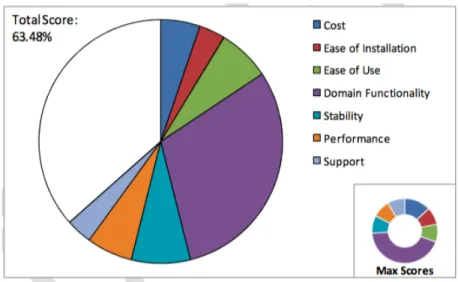
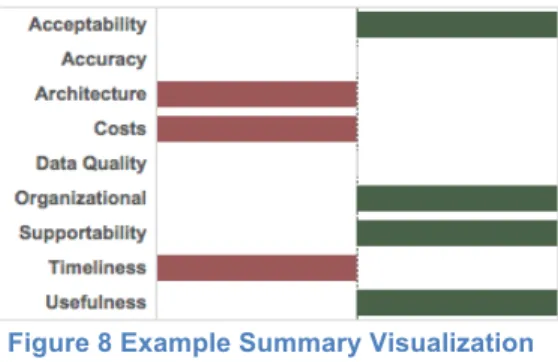
This framework includes quantitative elements in the form of an evaluator scoring each attribute on a scale of 1-10 and then allowing evaluators to weight each attribute according to their organizations needs to produce an overall score between 1-100. While this numeric score presents a quick summary of a technology’s overall grade, it presents challenges in the amount of time necessary to develop and review a scoring and weighting system. This experience factored into this research’s tool development in that rather than having evaluators develop a specific numeric score, this research uses a non-interval determination of positive, neutral or negative for each attribute. Figure 1 below shows an example scoring visualization that collects together an evaluations score by each attribute weighted by the important assigned during the evaluation design. Earlier frameworks do not include quantitative measures so while diagrams and images are included in evaluations, this framework explicitly calls out and instructs
evaluations to include visualization of the evaluation’s findings in an easy to understand manner.
These four evaluation frameworks provide a strong background of what a base set of attributes should be for assessing future technology, systems and other tools. The challenge in evaluating non-public health technology is in trying to determine how attributes relevant to public health can be generalized to test and assess technologies that do not address public health needs like sensitivity and predictive value, positive.
One element that was important in viewing how these frameworks determined how a system was useful or met public health needs was how systems fit into public health practices, sometimes called business processes or public health work flows. A search of the grey literature for a reference set of defined public health business processes revealed the Public Health Informatics Institute’s Common Ground Project [28]. The Common Ground Project was
developed with funding from the Robert Wood Johnson Foundation and presents the results of a collaborative process with national, state and local public health for documenting and defining business processes within public relevant for inclusion within technology and system
evaluations. Emory’s Public Health Informatics coursework includes training in using the business process definition and documentation processes for creating novel activities, but this
Figure 1 Example visualization of technology scores by attribute and maximum scores available.
resource is used to provide a suggested reference for existing public health practices that evaluators can use to signal what parts of public health have high potential to be improved by using a technology.
Since many technologies and tools are not specifically designed for use within public health, the Common Ground method presents a means for aligning tools for use within public health and evaluating based on the characteristics of those specific public health business processes. Common Ground defines a business process as the way that a public health organization conducts its activities to achieve specific public health goals and objectives. The framework describes and captures business processes used within public health with the
following characteristics: name, goal, objective, business rule, trigger, task set, input, output and outcome.
While Common Ground is a framework for public health to use to describe its processes, the community around Common Ground has worked to describe a set of business processes that serve as an initial baseline for use in aligning evaluations to public health:
• Conduct Exercise To Evaluate Organizational Response Capacity • Conduct Syndromic Surveillance
• Conduct Notifiable Disease Surveillance • Conduct Active Surveillance
• Conduct Public Health Investigation • Initiate Alerts
• Develop And Report Situational Information • Manage Resources
• Develop And Initiate Risk Communication • Administer Medical Countermeasures (MCMS) • Data Collection
• Data Management
• Process, Store, And Analyze Data • Conduct Epidemiological Research
• Community Health Assessment
• Develop Strategic Plan
• Identify And Deploy Health Guidelines • Deliver Programs And Services • Develop Public Health Intervention
• Link Individuals/Populations To Programs/Services • Develop And Implement Program Evaluation
This is not an exhaustive list of all business processes and activities used within public health but serves as a valuable resource for informaticians when trying to determine how tools under evaluation can fit into public health practice. This set is used as an appendix within the research’s evaluation tool to allow for evaluations to consistently mark where within public health practices technology can be used.
Health system information evaluation frameworks
While the public health evaluation frameworks were valuable to understand how public health agencies intend for systems to be assessed, it was important to find additional
frameworks for evaluation to help generalize attributes for application to non-public health and non-health technology. Evaluations within the health literature frequently referenced and followed Dr. Aqil et al’s Performance of Routine Information System Management (PRISM) framework [7] and Dr. Sajwani et al’s PANACeA framework [11].
The PRISM framework was developed to improve the evaluation of routine health information systems (RHIS) to improve the performance of health systems within low resource environments and developing countries. A difference between the PRISM framework and the
early public health system evaluation frameworks is that PRISM is developed specifically for eHealth systems. While not developed with the particular lens of public health, the techniques for systematic design and evaluation of health systems are useful for evaluation of new
technology for use within public health. The PRISM framework provides four tools (performance diagnostic tool, office/facility checklist, organizational and behavioral assessment tool, and the management assessment tool) that follow a logic model of inputs, processes, outputs, outcomes and impact. While PRISM does not call out attributes, Table 2 demonstrates how each tool collects specific information items collected that are the same or similar to the set of attributes called out within the public health specific frameworks.
Table 2 PRISM Tools mapped to units of analysis mapped to information collected.
PRISM Tool Unit of Analysis Information Collected
RHIS performance diagnostic tool
RHIS performance Data quality
Information use
Processes System processes
Promotion of culture of information
System communication Supervision quality
Technical determinants Simplicity/Complexity
RHIS overview, office/facility checklist
RHIS overview System mapping
Data collection and transmission Information flow chart
Office/facility checklist Availability of equipment and data Availability of human resources RHIS organizational
and behavioral assessment tool (OBAT)
Behavioral Self-efficacy for RHIS tasks
Motivation Problem-solving skills Promotion of a culture of information Data quality Empowerment/accountability Reward RHIS management assessment tool (MAT)
RHIS management functions Governance
Planning Training Finance
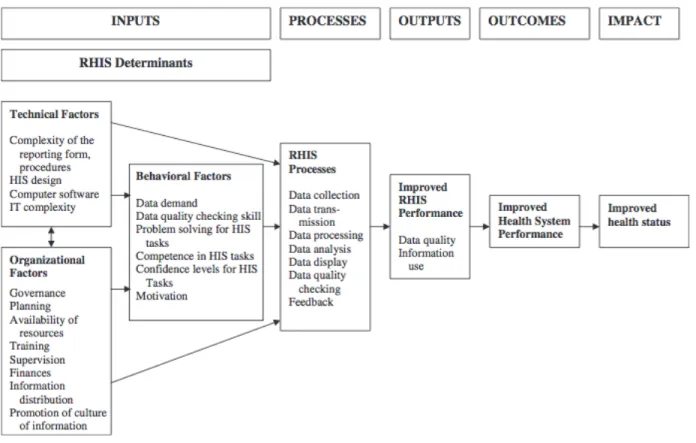
The PRISM framework presented a clear logic model (Figure 2) for how the different evaluation sub tools were to be used, by whom and to what purpose to assess the overall quality and performance of eHealth systems. This logic model is useful for demonstrating how the evaluation breaks down an information system to the health inputs and determinants, processes, outputs, outcomes and impact and connects them to the evaluation tasks and processes. This is a graphical representation of what public health frameworks call a system’s usefulness.
PRISM uses many similar attributes as the earlier frameworks from CDC and Sosin, but groups attributes into tools, unit of analysis and then information collected. PRISM is the first framework, chronologically to put a large focus on the organizational, behavioral and social aspects of a system and how they are important for how a system is able to be effective at meeting its purpose. Organizational assessment was a common attribute addressed in this research’s systematic review as the maturity and capability of organizations and the cultural aspects of the users working with a system or technology are important to whether a technology is able to create the necessary impact.
Figure 2 PRISM framework logic model
In addition to the PRISM framework, evaluations reviewed during this research pointed to another health evaluation framework that was not developed for public health systems still contained useful lessons in developing a technology evaluation tool: the Pan-Asian
Collaboration for Evidence-based eHealth Adoption and Application (PANACeA) evaluation method [11]. PANACeA was developed to meet the specific needs of low resource countries and is applied within global health settings for improving programs and services within low resource environment. This framework developed an evaluation tool focusing on key evaluation questions (KEQ) rather than evaluation attributes. KEQs were open ended in order to stimulate the participating systems into sharing their opinions structured around three main categories: Collaboration and Teamwork, Capacity Building, and Knowledge Management. This process of stakeholder evaluation follows the subjectivist evaluation techniques of focus groups and both formal and informal interviews [4].
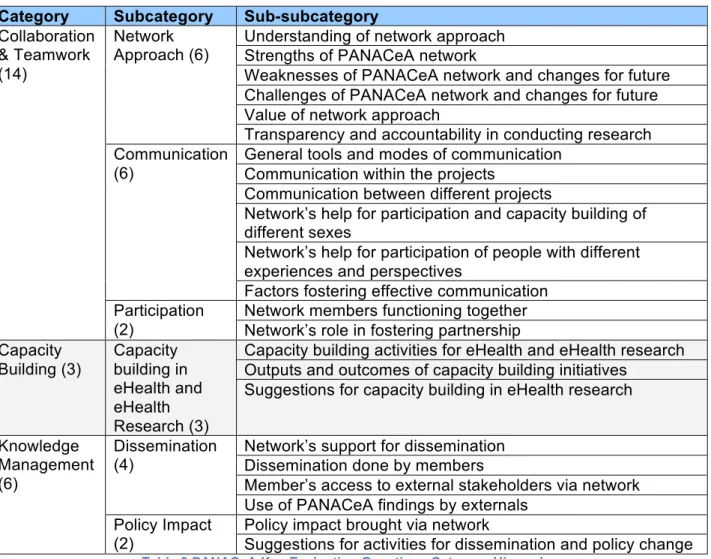
Twenty-three KEQs were developed to serve as an evaluation guide that was performed by trained evaluators interviewing users and administrators of systems under evaluation. The KEQs were organized under the main three categories and a set of sub-categories to group KEQs together. Table 3 describes the organization of the KEQs into a hierarchy:
Category Subcategory Sub-subcategory
Collaboration & Teamwork (14)
Network
Approach (6) Understanding of network approach Strengths of PANACeA network
Weaknesses of PANACeA network and changes for future Challenges of PANACeA network and changes for future Value of network approach
Transparency and accountability in conducting research Communication
(6)
General tools and modes of communication Communication within the projects
Communication between different projects
Network’s help for participation and capacity building of different sexes
Network’s help for participation of people with different experiences and perspectives
Factors fostering effective communication Participation
(2)
Network members functioning together Network’s role in fostering partnership Capacity Building (3) Capacity building in eHealth and eHealth Research (3)
Capacity building activities for eHealth and eHealth research Outputs and outcomes of capacity building initiatives
Suggestions for capacity building in eHealth research
Knowledge Management (6)
Dissemination (4)
Network’s support for dissemination Dissemination done by members
Member’s access to external stakeholders via network Use of PANACeA findings by externals
Policy Impact (2)
Policy impact brought via network
Suggestions for activities for dissemination and policy change Table 3 PANACeA Key Evaluation Questions Category Hierarchy
This evaluation framework was also developed to meet specific eHealth needs and so serves as a useful example of what attributes are specific for evaluating technology rather than as complete business processes or work flows such as described by the public health
evaluation frameworks.
While PRISM had heavy attributes focused on organization and social, PANACeA expands this focus on organizational fit with the policy stakeholder interaction through
collaboration. PANACeA places importance in identifying the underlying infrastructure used by or provided by the system under evaluation.
Systematic review frameworks
Identifying existing public health and health frameworks gave an understanding of what attributes were designed to be included, but this research needed to confirm what attributes are used in common practice as well as develop a method to harmonize attributes from being specific for use in assessing health technology to more generalized attributes that can test technology for usefulness within public health. Coursework at Emory University identified the Cochrane Handbook [29] for conducting systematic review and references within other reviewed literature identified the Preferred Reporting Items for Systematic Reviews and Meta-analyses (PRISM) statement [24] for identifying elements that should be included within systematic reviews.
The Cochrane Collaboration is an international organization focused on improving the ability of decision makers to use high quality systematic reviews about healthcare and health policy. The Cochrane Collaboration develops methods for conducting systematic reviews and collects these methods into handbooks to guide reviewers in conducting systematic reviews with the aim of minimizing bias.
The handbook defines a systematic review as an attempt to collate all existing empirical evidence that fits reviewer defined eligibility criteria in order to answer specific research
questions. The handbook presents five key characteristics for reducing bias through systematic review:
1. Clearly stated set of objectives with pre-defined eligibility criteria for studies 2. Explicit, reproducible methodology
3. Systematic search that attempts to identify all studies that meet eligibility studies 4. Assessment of the validity of findings of all matching studies
This research does not use the fourth characteristic as the studies identified are used to collect the frequency of attributes used in evaluation rather than assess the findings of each evaluation.
PRISMA was developed for healthcare, not public health, and identifies four major concepts to be addressed by health systematic reviews:
1. Systematic reviews are an iterative process
2. Conducting research and reporting on research are distinct concepts
3. A thorough assessment of the risk bias in review requires both an assessment on both the study-level and outcome-level
4. Accurately describing the different types of reporting biases
The PRISMA statement presents a 27-item checklist of elements that are useful to include in a systematic review as well as four-phase process of identification, screening, eligibility and inclusion for conducting systematic reviews. Both the checklist and process flow were useful in conducting the research within this thesis to reducing bias in identifying attributes that are useful for evaluating tools and technologies. This four-phase process was used to design and carry out the method of this research.
While this thesis itself is not a systematic review, it uses the elements of the systematic review as an input to developing an evaluation tool. The 27-item checklist includes the elements of:
• Title
• Abstract with structured summary • Introduction
o Rationale o Objectives • Methods
o Protocol and registration o Eligibility criteria
o Information sources o Search
o Study selection
o Data collection process o Data items
o Risk of bias of individual studies o Summary measures
o Synthesis of results o Risk of bias across studies o Additional analyses
• Results
o Study selection o Study characteristics o Risk of bias within studies o Results of individual studies o Synthesis of results
o Risk of bias across studies o Additional analysis • Discussion o Summary of evidence o Limitations o Conclusions • Funding
The literature available on systematic reviews was integral to designing the systematic review portion of this research as well as in documenting and addressing selection bias and developing methods for identifying reporting biases for publications selected for inclusion within the systematic review.
General technology assessment frameworks
The final element of this research’s literature review was to identify other research that addresses the non-health altogether concept of technology maturity and adoption risk. Gartner Inc., is an information technology analyst firm that provides search analysis to clients within various industries, including healthcare and public health. Gartner publishes a graphical tool called the Gartner Hype Cycle [30] is an information technology maturity assessment tool. The hype cycle describes where a technology is within a life cycle of early adoption through to productivity and eventual retirement. The research is used by organizations looking to learn about the promise or a new or emerging technology within the context of their own organization and ability to accept risk.
The hype cycle collects technology onto a spectrum that falls into five phases of technology life cycle described by Gartner as:
• Technology Trigger – a very early technology only recently introduced. These technologies are early proofs of concept and frequently lack any usable product. • Peak of Inflated Expectations – technology begins to be adapted and tested by arly
stage companies that include both successes and failures
• Trough of Disillusionment – initial projects begin to complete, sometimes unsuccessfully. Technologies only progress beyond this stage if they improve and mature.
• Slope of Enlightenment – companies begin wide adoption of a technology with second and third generation projects run through completion.
While this assessment tool is not developed specifically for public health, it is useful for determining where a new technology exists within its life cycle. Evaluators then need to take into account their organization’s needs and culture in how much risk is appropriate for integrating and using new technology.
Summary of current problem
While the literature exists within health literature for guiding the evaluation of public health information systems and surveillance systems, there is a gap for how to assess individual technology, systems and tools from outside of health for impact within public health. Techniques for systematic review are useful for reviewing the current state of public health related literature to harmonize attributes used for assessing systems, developing a hierarchy of attributes and using them to create a novel tool for use in assessing tool for potential impact to public health.
Chapter 3: Methods
Introduction
The research carried out by this thesis takes place in three stages, a systematic review of existing public health literature for evaluation studies to identify common attributes, a
harmonization of attributes by similarity of concept, and the development of a guided tool that uses commonly used attributes.
Population and sample
This systematic review is conducted on the body of literature as indexed by the National Library of Medicine (NLM)’s PubMed service [31]. MEDLINE, also provided by NLM, was
considered but Pubmed was selected due to the larger collection of citations and publications of in process and ahead of print articles for greater timeliness. Pubmed Central was also
considered but Pubmed was selected due to the greater selection within Emory’s library resources and CDC library resources.
The review is performed solely by the author based on the controls of the Emory academic honesty policy. This bias is described in more detail in the limitations.
Research design
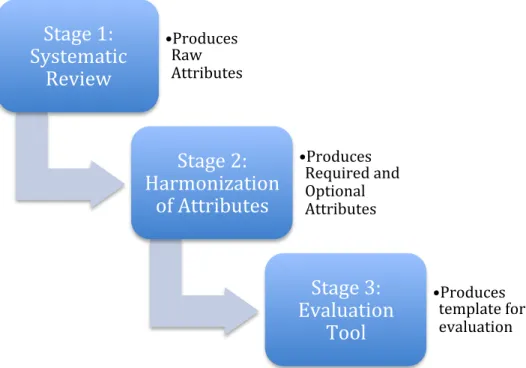
This research design is separated into three stages as described below in Figure 3: systematic review of public health informatics system evaluations, harmonization of evaluation attributes, and new evaluation tool development.
Figure 3 - Research Stages with Incremental Output
Stage 1: Systematic review
The inclusion criteria for the review considered the following types of documents: peer-reviewed articles conducting assessment or evaluation of one or more information systems, peer-reviewed articles presenting a framework for evaluation of information systems and reports from global health agencies.
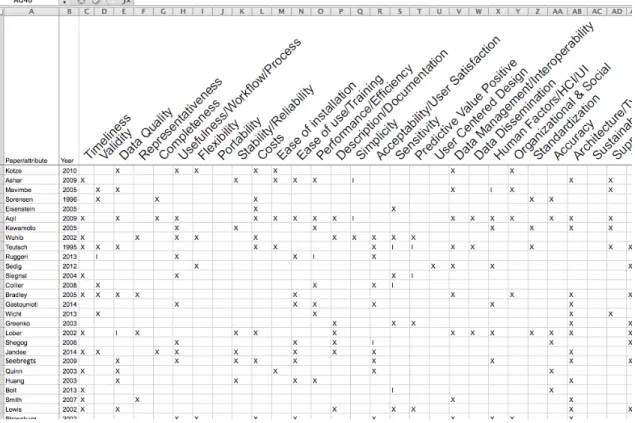
The reviewer extracted attributes used as a significant element of the evaluation. Attributes will be defined using a combination of the reviewed literature and the reviewer’s subject matter expertise. Data extraction will differentiate attributes mentioned directly (marked with “X”) or attributes that apply to the evaluation based on context and meaning, but not directly mentioned (marked with “I”). For example, an evaluation that does not mention “accuracy” explicitly, but does mention how values within the system are compared against another system that has similar values still uses the concept of accuracy as part of the evaluation. The reviewer developed a harmonized glossary of attribute definitions that were used as part of the
developed evaluation tool in stage 2 of this thesis.
Stage 1:
Systematic
Review
• Produces Raw AttributesStage 2:
Harmonization
of Attributes
• Produces Required and Optional AttributesStage 3:
Evaluation
Tool
• Produces template for evaluationThe search strategy was designed to access published and not yet published, but approved, documents using the following steps:
1. Pubmed search will be restricted to English-language journal articles using the following search queries:
a. "public health" AND ("system" OR "tool" OR "framework") AND ("evaluation" OR “evaluating” OR "assessment" OR “assessing”) AND ("informatics" OR
“information technology” OR “IT”) [456 results]
b. "public health informatics" AND (evaluation OR assessment) AND (system or tool or framework) [182 results]
2. Bibliographies from eligible documents will be reviewed and with additional articles identified based on title and author.
3. Public health agency websites for the US Centers for Disease Control and Prevention, World Health Organization, Gates Foundation will be searched for relevant documents based on title and document body text that reference peer reviewed documents. In order to be included in the analysis, each publication must be valid. Validity was determined if a publication:
1. Has the basic characteristics expected in peer reviewed literature such as possessing a well-defined purpose and research methods; performing sound data collection and analysis methods; and presenting clear findings and conclusion [32].
2. Only includes evaluation of a system, software tool, or technology.
3. Focuses on information systems. Literature that focuses on non-informatics aspects of a system will not be included.
4. Is not a systematic review or meta-analysis. Literature that is itself is a systematic review will not be included to prevent duplicate counting of attributes, but review bibliographies will be reviewed for inclusion.
If a publication was determined to be valid, it was included in the data collection tool and its attributes and measures were added to a matrix of publications to attributes described below. If a publication was not valid, it was noted but not included for analysis.
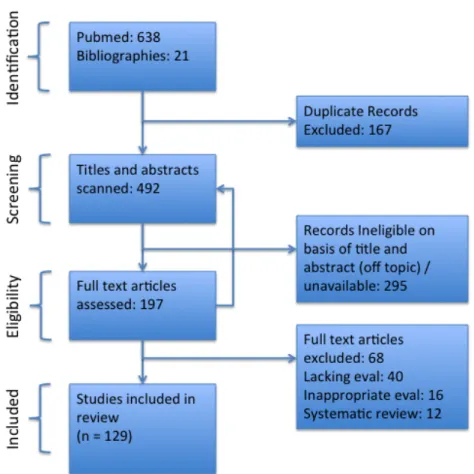
Data collection took place by the reviewer extracting all attributes used in the evaluation of the identified system or systems within the document. The first phase of data collection was in identification of documents from Pubmed and bibliographies. Any duplicate records were removed from the review set. Remaining titles and abstracts were scanned and any ineligible documents were removed. Only documents that described evaluation frameworks or directly evaluated a system were included. Remaining documents had full text assessed and any ineligible documents were removed.
Data was synthesized by grouping attributes into related hierarchies of concepts based on definition within document and reviewer’s informatics experience.
Stage 2: Harmonization of evaluation attributes
The raw matrix of attributes to publications was reviewed to consolidate similar and related terms using the reviewer’s expertise in public health informatics. For example the concepts of sensitivity and accuracy were grouped together as accuracy is a broader concept outside of public health, but still applicable to tools being able to achieve accurate results based on user expected behavior.
Stage 3: Tool development project
Using the synthesized data from the harmonized attributes, the author created a template document that serves as a new evaluation tool that includes a set of common attributes relevant to public health. The author used informatics subject matter expertise to develop weighting schemes and visualization techniques for how the tool can represent any quantitative conclusions from the evaluation. The goal of the project was to develop a Microsoft Word template tool that includes instructions for completion with a full level of detail and an abbreviated level when limited resources are available for evaluation.