Static Analysis, Abstract Interpretation and Verification
in (Constraint Logic) Programming
Giorgio Delzanno1, Roberto Giacobazzi2, and Francesco Ranzato3 1
Universit`a di Genova, Italy,[email protected] 2
Universit`a di Verona, Italy,[email protected] 3
Universit`a di Padova, Italy,[email protected]
Introduction
Logic programming has served as a unique training ground for static analysis, abstract interpretation and verification. Operational and denotational semantics of logic pro-grams feature simple and clean inductive definitions that made it possible to apply a variety of known analysis and verification techniques and tools and to define new ones tailored to solve specific problems arisen in logic programming (e.g. variable aliasing and unification). We survey here some general notions and methods — in particular ab-stract interpretation and model checking — for analysing and verifying programs and systems, especially focused to (constraint) logic programs.
In Section 1 we first review the principles of the abstract interpretation approach, in particular methodologies for designing abstract domains through systematic techniques such as abstract domain refinement and simplification. We then show how these meth-ods have been applied in the systematic design of analyses and semantics in the context of logic programming.
In Section 2 we recall the main concepts underlying model checking. In model checking, the behavior of a concurrent system is described by a finite graph (a Kripke model) that describes the set of all reachable states. In this setting, temporal formulae can be used to naturally specify functional properties of the system (e.g. safety and ab-sence of starvation). The model checking problem consists in checking the temporal specification against the model of the system. For specifications given in Computation Tree Logic (CTL), the algorithm for deciding the model checking problem is based on a fixpoint semantics of the temporal connectives. We exploit here this connection to establish a link between CTL model checking and the fixpoint semantics of logic pro-grams. We then discuss implications of this link with a particular focus on the utiliza-tion of evaluautiliza-tion strategies used for logic programming as a tool for model checking of infinite-state concurrent systems.
In Section 3 we focus on abstract interpretation-based model checking. In abstract model checking, the verification of a temporal specification is performed in an abstract model that can be designed as an abstract interpretation of the concrete system. In par-ticular, we concentrate on strong preservation properties of abstract models, namely on the equivalence of verifying temporal specifications in abstract and concrete models. Strong preservation is highly desirable since it allows us to draw consequences on the concrete model from negative answers on the abstract model. We survey how abstract
interpretation allows to cast strong preservation as a completeness property of abstract models and consequently how this provides systematic methods to design strongly pre-serving abstract models through abstract domain refinements.
Finally, in Section 4 we discuss how methods used for evaluation and analysis of logic programs can be used to extend verification methods based on abstract model checking, e.g., to the case of infinite-state systems.
1
Semantics, Static Analysis and Abstract Interpretation
1.1 Abstract Interpretation BasicsOne fundamental feature of abstract interpretation is that most properties in approximat-ing semantics, like precision, completeness, and compositionality, which may involve complex operators, fixpoints etc., all depend upon the notion ofabstraction, which is precisely and uniquely determined by the chosen domain of properties [16]. Central in the design of abstract interpretations is therefore the notion ofdomain. This is the case for instance in program analysis, in type inference and in comparative semantics, where the various abstract (approximate) semantics all correspond to suitable abstractions, namely domains.
In the following,hC,≤,∨,∧,>,⊥idenotes a generic complete latticeC, with or-dering≤, lub∨, glb∧, greatest element (top) >, and least element (bottom)⊥. The downward closure of a subsetS ⊆ C is defined as↓S,{x∈C| ∃y∈S. x≤y}, where↓xis a shorthand for↓ {x}. The upward closure↑is dually defined. The notation
C ∼=Ddenotes thatCandDare isomorphic, possibly ordered, structures. Recall that a functionf :C→Dis (Scott-)continuous iff preserves lub’s of (nonempty) chains ifffpreserves lub’s of directed subsets. In what follows, we consider abstract interpre-tation based on Galois connections or, equivalently, closure operators [15, 16]. A pair of functionsf :A→Bandg:B →Abetween posets forms an adjunction, or Galois connection (GC for short), denoted by(A, f, B, g), if
∀x∈A.∀y∈B. f(x)≤B y⇔x≤Ag(y).
f (resp.g) is called the left- ( right-) adjoint tog(f) and it is an additive (co-additive) function, i.e.,fpreserves lub’s (glb’s) of all subsets ofA(empty set included). Additive and co-additive functionsfadmit, respectively, rightf+and leftf−adjoint as follows:
f+ ,λx.∨ {y| f(y)≤x}andf− ,λx.∧ {y| x≤f(y)}. Let us also recall that
(f+)−= (f−)+ =f. In GC-based abstract interpretation the concreteCand abstract
A domains are often assumed to be complete lattices and are related by abstraction
α : C → Aand concretization γ : A → C maps forming a GC(C, α, A, γ). If in addition ∀a ∈ A. α(γ(a)) = a, then(C, α, A, γ)is called a Galois insertion (GI). When(C, α, A, γ)is a GI each value of the abstract domainAis useful in representing
C, namely all the elements ofArepresent distinct members of C, beingγ 1-1. Any GC may be lifted to a GI by identifying in an equivalence class those values of the abstract domain with the same concretization. This process is known as reduction of the abstract domain. An (upper) closure operator on a posetCis a mapρ:C→Cwhich is monotone, idempotent, and extensive (∀x ∈ C. x ≤ ρ(x)). The set of all closure
operators onCis denoted byuco(C). Each closure operatorρis uniquely determined by its imageρ(C)as follows:ρ(x),∧{y∈ρ(C)|x≤y}. A fundamental property of closure operators is that ifCis a complete lattice then bothhuco(C),vi, wheretis the pointwise ordering, andhρ(C),≤Ciare complete lattices. It is well known since [16] that abstract domains can be equivalently specified either as Galois insertions or as closure operators on the concrete domain. In particular, a subsetX⊆Cis the image of a closureρonCiffXis a Moore-family ofC, i.e.,X =M(X),{∧S ∈C|S⊆X}
(where ∧∅ = > ∈ M(X)) iff X is isomorphic to an abstract domain A in a GI
(C, α, A, γ). For any subsetX⊆C,M(X)is called the Moore-closure ofXinC, i.e.,
M(X)is the least (w.r.t. set-inclusion) subset ofCwhich containsXand it is a Moore-family ofC.huco(C),viis isomorphic to the so-called latticehAbs(C),viof abstract interpretations ofC[16]. Hence, given any two abstractionsA, B∈Abs(C),Ais more precise (or conrete) thanB, denoted byAvB, whenB⊆Aas Moore families ofC. In the following, it is particularly convenient to identify an abstract domainA∈Abs(C)
as (image of) a closure operator onC, which, as a function, is denoted byρA. 1.2 Backward and Forward Completeness
Soundness of an abstraction can be specified in two equivalent ways [15]. Let C be a concrete domain,(C, α, A, γ)a Galois insertion,f : C → Ca concrete semantic operation andf]:A →Aa corresponding abstract operation. Then,(C, α, A, γ)and
f]give rise to a sound abstraction whenα◦f vf]◦α, or equivalently (by adjunction) when f◦γ v γ◦f]. While the above two definitions of soundness are equivalent, it turns out that they are not equivalent when equality is required and they encode two different forms of completeness: in the first case,α◦f =f]◦αis called backward (B-) completeness whilef◦γ=γ◦f]is called forward (F-) completeness — the reason for these names will be clear later in the paper.B-completeness (see [44]) corresponds to ask that the abstract functionf]perfectly mimics the concrete functionfwhen the latter is approximated inA, viz. both functions are compared in the abstract domainA. On the other hand,F-completeness (see [37]) corresponds to ask thatf]perfectly mimics the functionf when applied to the same abstract value, viz. they are both compared in the concrete domainC.
Recall that the best correct approximation off on the abstract domainAis defined to be the abstract functionα◦f◦γ. It turns out (this is a simple extension of a characteri-zation in [44]) that, given an abstract domainA, there exists an eitherB- orF-complete abstract functionf]defined onAiff the best correct approximation off onAis, re-spectively, eitherB- orF-complete. This means that bothB- andF-completeness are properties of abstract domains, namely a property of the GI(C, α, A, γ). Therefore, one may defineB- andF-completeness as follows: an abstract domainA ∈Abs(C)isB -(F-) complete for a semantic functionf ifρA◦f =ρA◦f◦ρA(f◦ρA=ρA◦f◦ρA).
WhileB-completeness is well known in abstract interpretation and corresponds to the standard notion of completeness [44, 59], the notion of forward completeness is less known.B-completeness for a domainAmeans that the expessive power ofAis such that no loss of precision is accumulated inAby abstracting inAitself the arguments of a semantic functionf. Conversely,F-completeness means that no loss of precision is accumulated by approximating inAthe result of the functionf when computed on
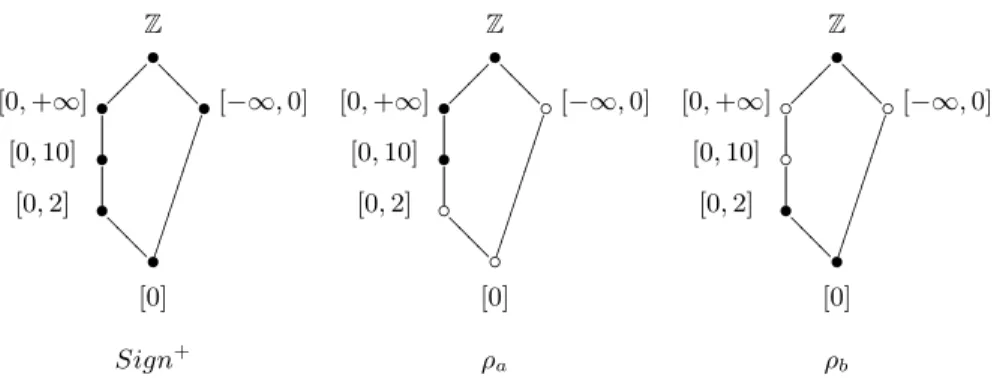
• • • • • • ? ? ? ? ???? Z [0,+∞] [0,10] [0,2] [0] [−∞,0] • • • ◦ ◦ ◦ ? ? ? ? ???? Z [0,+∞] [0,10] [0,2] [0] [−∞,0] • ◦ ◦ • • ◦ ? ? ? ? ???? Z [0,+∞] [0,10] [0,2] [0] [−∞,0] Sign+ ρa ρb
Fig. 1.The abstract domainSign+and two abstractions
abstract values inA. This justifies the choice of the backward and forward terminology above. We denote by, respectively,F(C, f)andB(C, f)the set ofF- andB- complete abstractions of C for f. It is worth noting that in general F(C, f) 6⊆ B(C, f)and
F(C, f)6⊆ B(C, f), namelyB- andF-completeness are incomparable notions.
Example 1. LetSign+ be the simple abstraction ofh℘(
Z),⊆i for analysing integer variables depicted in Fig. 1. Consider the pointwise square operationsq:℘(Z)→℘(Z)
defined as follows:sq(X),{x2 | x∈X}. Letρ∈uco(℘(
Z))be the closure oper-ator associated withSign+, i.e.ρ=γ
Sign+◦αSign+, where the abstraction and con-cretization maps are the obvious ones. The best correct approximation ofsqinSign+is
sq]:Sign+ →Sign+defined assq](X)
,ρ(sq(X)), withX ∈Sign+. It is easy to note that the closure operatorsρa ,{Z,[0,+∞],[0,10]}andρb,{Z,[0,2],[0]}, de-fined by their images — the images ofρaandρbare depicted as bullets in Fig. 1 — are such that:
– ρa ∈ F(Sign+, sq])butρa 6∈ B(Sign+, sq]): for example,ρa(sq](ρa([0]))) =
[0,+∞]whileρa(sq]([0])) = [0,10];
– ρb ∈ B(Sign+, sq])butρb 6∈ F(Sign+, sq]): for example,ρb(sq](ρb([0,2]))) =
Zwhilesq](ρb([0,2])) = [0,10]. ut
One key result in [44] provides a constructive characterization of the structure of ab-stract domains that areB-complete for continuous functions. Given a functionf :C→ CandS ⊆C,f−1(S)denotes the inverse image off inS, i.e.,{x∈C| f(x)∈S}. Then, [44] shows that
ρ∈uco(C)isB-complete forf⇔ [
y∈ρ(C)
max(f−1(↓y))⊆ρ(C) (∗)
Let us consider Example 1. It is easy to see that ρa is not B-complete because ρa does not include the maximal inverse image of sq] of the subset ↓ [0,10], namely
max(sq]−1(↓[0,10])) ={[0,2]}.
An analogous (and trivial to prove) result can be stated forF-completeness. In this case, F-complete domains can be characterized for merely monotone operations as
follows:
ρ∈uco(C)isF-complete forf ⇔f(ρ(C))⊆ρ(C) (∗∗)
Thus, whileB-complete domainsρare closed under (maximal) inverse images of the function f onρ(C),F-complete domainsρare closed under direct images of f
on ρ(C). It is easy to see in Example 1 thatρb is notF-complete becauseρb does not include the direct image ofsq], for instance the value[0,10] = sq]([0,2]). Char-acterizations(∗) and(∗∗)together establish a tight relationship between B- and F -completeness, which can be specified as an adjunction when the concrete function ad-mits a right adjoint. In fact, it turns out that iff :C →Cis an additive function (and therefore admits right adjointf+) then
B(℘(S), f) =F(℘(S), f+). (‡)
Moreover, it is always possible, by relying on(∗)and(∗∗), to associate with each continuous semantic function f : C → C a corresponding domain refinement that transforms any abstract domainAinto the closest (most abstract)B-/F-complete do-main forf which includes (i.e., is more precise than)A. This provides the notions of
B- andF-complete shell [44]. The domain transformersRB
f :uco(C)→uco(C)and
RF
f :uco(C)→uco(C)are defined as follows: – RB f ,λX∈uco(C).M( S y∈Xmax(f−1(↓y))); – RF f ,λX∈uco(C).M(f(X)). It is immediate to note that both RB
f and R
F
f are monotone operators on uco(C). The following equivalence, which follows from(∗)and(∗∗), characterizes in a unique domain-equational form theB-/F-complete shell of abstract domains for a continuous functionf :C→C. LetA∈uco(C)and`∈ {B,F }:
X vAandXis`-complete forf ⇔ X =Au R` f(X). Therefore, the most abstract domain that includesAand is`-complete forfis
`-Shellf(A),gfp(λX.Au R`f(X)).
This domain is called the`-complete shell ofAwith respect tof.
1.3 Abstract Domain Refinement and Simplification
In recent years, systematic design methods of program analysis frameworks attracted a growing interest. This is mainly justified by the fact that the most successful static an-alyzers are parametric with respect to the property of interest [20] and therefore allow to easily handle a variety of possible analyses. Moreover, automatic methods for tuning static analyses in accuracy and cost are needed in order either to avoid reimplementa-tion when these analyses are modified or to minimize false alarms. Similar construc-tions are also used in designing semantics by abstract interpretation (e.g., Hoare logic as tensor product [14] and compositional semantics as reduced power [33, 42]) and in
type inference (e.g., polymorphism as disjunctive completion [13, 51]). Formal meth-ods that compare/transform abstract interpretations are therefore inherently based on corresponding methods to compare/transform abstract domains. A domain, at any level of abstraction, is a set of mathematical objects which represent the properties of interest about a computational system and that are partially ordered with respect to their rela-tive degree of precision. In program analysis, for instance, the design of a static analyzer basically corresponds to study a particular abstract domain, while modifying domains corresponds to modify analyses. As shown for instance in [70] for a reconstruction of groundness analysis in logic programming, the design of a complex abstract domain is generally the result of a number of steps which can be in some cases made systematic by applying suitable domain transformers to simpler domains for the property of interest.
The main idea behind domain transformers in abstract interpretation consists in designing abstract domains systematically from the specification of some simpler do-mains of basic properties of interest and then solving a recursive domain equation in order to achieve completeness with respect to some target precision level. This game can be played for most of the existing abstract domain transformers, by viewing them as instances of completeness refinements: (1) in program analysis, where a given simple (and imprecise) analysis is refined until completeness is reached by avoiding specific families of false alarms, and (2) in program semantics where a given observation is re-fined towards completeness in order to attain compositionality, condensation properties, etc.
The foundations of a theory of abstract domain transformers were layed by Cousot and Cousot [16] in 1979. In that seminal work the authors introduced the main struc-ture of abstract domains enjoying Galois connections and some fundamental operators for systematically compose domains in order to achieve attribute independent and rela-tional analyses (respectively, the reduced product and reduced power operations). Since then, a number of papers put forward novel domain transformers and studied the im-pact of these operations in designing abstract interpreters for specific program analysis and languages. These include Cousot and Cousot’s reduced product, disjunctive com-pletion and reduced cardinal power [16–18]; Nielson’s tensor product [60]; Giacobazzi et al.’s dependencies, dual-Moore-set completion, complete kernels and shells, Heyt-ing completion, and least disjunctive basis [40, 44, 46]; Cortesi et al.’s open product, pattern completion, and complementation [11]. The notions of domain refinement and domain simplification, introduced in [27, 39], provided the very first generalization of these ideas. Intuitively, a refinement is any domain operator that performs an action of refinement with respect to the standard precision orderingv, i.e., that adds information to domains; on the other hand, simplificators and compressors perform the dual action of “taking out” information from domains. Still these operators represent a basis for any design of abstractions.
Many domain refinements can be specified asF-complete refinements with respect to a given semantic operation [35]. Intuitively, a domain refinement can be viewed as adding the functionalities of a given semantic operation of interest, that is, the direct image of a semantic function. As a result of the above properties of complete abstrac-tions, this corresponds to say that a domain refinement can be specified as (greatest) solution of aF-completeness equation. As recalled above in(‡), whenever the
seman-tic operation is additive, such a characterization can be put in an equivalent formulation in terms ofB-completeness.
Clearly, the construction of domains by iterative refinement (e.g., by solving a re-cursive domain equation) may lead to excessively complex domains for practical ap-plications, as well as it may be interesting to isolate inner structures inside complex domains that model precisely some basic properties around which complex abstract do-mains are built. As observed in [39], it is possible to define a dual theory of domain simplificators and compressors, which shares with the above theory of domain refine-ments precisely the same, but dual, ideas and constructions. The common aspects of simplificators and compressors is that they both reduce precision in domains. A typical pattern for domain simplificators is the operation that transforms a given domainAinto the most concrete (when it exists) among the abstractions ofAwhich is complete for a given function. Like refinements, also simplificators and compressors have a construc-tive definition as (greatest) solutions of (systems of) recursive domain equations [44]. The main difference between simplificators and compressors can be grasped by viewing how they react when composed with the corresponding refinements, when they exist. Assume that an idempotent refinementRis given.Radmits a simplificatorSwhen, for any abstractionX,R(S(X)) =S(X)andS(R(X)) =R(X). This holds when both
RandStransform domains to meet a given common property, like, for instance in the above case, completeness. A relevant example of domain refinement which has a cor-responding simplificator is in fact the complete shell refinement in [44]. The complete shell refinement, given a domainA, returns the most abstract domain which includesA
and is complete for some given semantic operationf; the corresponding simplificator, called complete core, returns the most concrete domain which is contained inAand is complete forf. Compressors, instead, act like “zip” runs on files. IfRis a given do-main refinement,Cis a compressor forRif, for any abstractionX,R(X) =R(C(X))
andC(R(X)) = C(X), namely whenC(X)is the most abstract domainBsuch that
R(B) =R(X), and this basically holds when the whole refined domainR(X)can be fully reconstructed by refinement from its so-called basisB =C(X). A domain theo-retic definition of abstract domain compressors has been introduced in [41]. Examples of domain compressors include complementation [11, 28], which is the compressor as-sociated with reduced product, and least disjunctive basis [40], which is asas-sociated with the disjunctive completion refinement. Clearly, not all refinements admit a correspond-ing simplificator or compressor. Moreover, as suggested by the above definitions, it is possible to relate refinements and simplificators/compressors by means adjunctions [35, 39].
1.4 How to Cook an Abstract Domain or Semantics
The above methods can be used as a recipe for “cooking” an abstract domain/semantics for specific applications.
1. Specify a concrete semantics for the considered programming language, with a (possibly many sorted algebra as) concrete domainC=hC, op1, . . . , opni; 2. Identify, as a subset of the lattice of abstract interpretations, some basic semantics
3. Design a suitable refinementRπwhich adds to domains some functionalities of the concrete algebraC, in such a way thatRπ(X) =X ⇒X∈π;
4. Define an adequate abstract domainAthat encodes the basic properties of interest (e.g. the basic properties to analyze) concerning concrete data objects;
5. Solve the (system) of recursive domain equationsX =Au Rπ(X).
Step (1) is common to any abstract interpretation, and corresponds to the design of a suitable base (typically collecting) semantics. Step (2) is instead a meta-level operation: The designer has to identify the common structure of any domain which shares a given semantic property that has to be preserved in the abstraction process. This may include completeness, compositionality, and any combination of semantic properties of interest for the specific application. A taxonomy of basic observable properties of semantics is essential in order to solve this problem, see e.g. [21] for a recent account on the logic programming case. Step (3) is strongly related to step (2) and is based on the theory of domain refinements described above [39]. Step (4) strongly needs a creative contribution of the designer, which has to guess a minimal domain of basic properties of interest for concrete data objects. Compressors may provide here a tool for simplifying and adapting the solutions envisaged at design time. Steps (5) is standard. Most of these steps, in particular (3) and (5), are systematic and, in most cases, constructive.
1.5 Applications in Logic Programming
Logic programming has been an ideal programming setting where the above ideas have found straight application. This because of the clean nature of the declarative semantics of a (constraint) logic program, which consists of a simple fixpoint solution of a recur-sive equation on predicates, where ground predicates provide the so called model-based semantics and possibly nonground predicates provide the so called computed-answer substitution semantics, also called s-semantics [26]. This motivates the use of logic programming as a natural and intelligible environment where abstract domain trans-formers can be tested and applied for a very first practical use, and characterized the research in abstract interpretation in the years across Y2000 mainly in Padova, Parma, Pisa and Verona. Of course, all the above definitions and notions hold on generic com-plete lattices and semantic structures, fulfilling the language independence feature of abstract interpretation. Here, we list some results in semantics and static program anal-ysis obtained by applying the above mentioned domain transformers. These results are characterized by a scattered coverage of known and new properties of semantics of logic programming, all having a distinctive nature of being systematically derived by means of abstract domain transformations. The result was a puzzle of methods and techniques for handling semantics and analyses with the ambition of fully developing Strachey’s programme of “understanding of the mathematical ideas of programming languages and combine them with other principles of common sense as correctives of exaggera-tion, allowing the individual reader to draw as moderate conclusions as she/he will”
[73].
Analysis. The abstract domain for relational groundness analysisPoshas been recon-structed as solution of a completeness problem, i.e., as greatest (w.r.t.v) solution of
the simple recursive abstract domain equationX=G u(X→X)over the concrete domain of downward-closed sets of idempotent substitutions with respect to vari-able instantiation, where→is the Heyting completion of an abstract domain [46] andGis the basic domain for groundness analysis, specifying whether a variable is ground or not [70]. Disjunctive completion and bases for groundness analysis have been studied in [40].
The phenomenon of so-called condensation in logic program analysis has been fully modeled as a completeness property of the underlying abstract domains in [45]. A static analysis is condensing if (bottom-up) goal-independent and (top-down) goal-dependent analyses agree, i.e., whenever it is possible to reconstruct the analysis of a given goal from the result of a goal-independent analysis without loss of precision. In this case, a condensing domain can always be systematically derived from a possibly noncondensing oneA by solving the recursive domain equationX=AuXu(X(∧ X)on the concrete quantale of sets of idempotent substitutions, where the conjunction∧in the quantale of idempotent substitutions is most general unification and where(∧ is the linear refinement with respect to∧
[45]. Condensing domains for freeness, independence, type representations, pair-independence, non-pair-sharing, and information-flow analysis have all been de-rived in this way in [45, 55–57, 72]. A condensing domain for sharing analysis, i.e., a solution to the equationX =ShuXu(X(∧ X), withShbeing the domain for set-sharing, is still unknown. Completeness has been also used in combination with complementation to prove that set-sharing is redundant for pair-sharing [3].
Semantics. Semantics can be composed and complemented as easy as abstract do-mains. Applications in logic programming have shown that the semanticsSC, obtained by complementing [11] the Clark semantics of correct answer substitu-tionsCwith respect to the more concrete semantics of computed answer substitu-tionS, corresponds precisely to the fully abstract semantics for partial computed answer substitutions [38]. Similar characterizations have been obtained by domain complementation of Clark vs. Herbrand model-based semantics and call vs. success pattern semantics [38]. By considering linear refinement, the OR-compositional se-mantics of logic programs can be systematically derived as least solution of the recursive domain equationX =S uXu(X(_ X)over the concrete quantale of SLD-traces of atoms where conjunction is trace concatenation_[42] and(_ is the linear refinement w.r.t._. A more general construction for arbitrary compositional semantics on traces can be found in [34].
2
Temporal Logic and Model Checking
2.1 Basics of Model CheckingAutomated verification methods are based on formal specification languages for model-ing system and qualitative properties and on automated deduction engines and theorem proving for checking the properties against a model. Model checking [10] is probably the most widely used method for verification of temporal properties against finite-state
models. The model checking problem, writtenM |=ϕ, consists in checking whether a given property specificationϕis satisfied by a modelM that describes the behavior of the system. In this setting,M is formally defined as a Kripke model, i.e., a finite graph in which nodes are labeled by propositions (the basic properties that hold in a given state) and edges represent transitions between states (transition relation). The property
ϕis specified by means of a temporal logic formula, a formalism that can be used to rea-son on the transitive closure of the state transition relation. There exist several types of temporal logic specification languages. Two well known examples are Linear Temporal Logic (LTL) and Computation Tree Logic (CTL). In the following, we briefly recall the basics of CTL model checking.
CTL can be used to reason about branching time properties of concurrent systems. A CTL model is a tupleM =hStates,→, `isuch thatStatesis a set of states,→ ⊆
States×Statesis a (typically total) transition relation and` : States → ℘(Atoms)
is a labeling function that defines the set of atomic predicates, taken from a finite set
Atoms, that holds at each state. When a labeling function is omitted, we assume that
`(s) ={s}(i.e., states are used as predicates).
CTL formulae extend propositional logic with temporal formulae of the formQPQT, whereQP is a path quantifier andQT is a temporal quantifier. The path quantifier can be either A(for all paths) or E(there exists a path). The temporal quantifier can be eitherX(next state),F(eventually),G(always), orU(until). For instance, the formula
EXϕholds in the current state if there exists a successor in whichϕholds,EFϕholds in the current state if there exists a path in whichϕeventually holds, andAGϕholds in the current state if in all pathsϕalways holds. To formally define the semantics of CTL formulae, we define a pathσinM as an infinite sequence of statess0s1. . . si. . .such thatsk →sk+1fork ≥0and we useσ[i]to denote thei-th state inσ. Furthermore, we usePM(s)to define the set of pathsσinM such thatσ[0] = s. The satisfiability relationM, s|=ϕis defined then as follows:
– M, s|=p iff p∈`(s) – M, s|=¬φ iff s6|=φ – M, s|=ϕ∨ψ iff s|=ϕors|=ψ – M, s|= EXϕ iff ∃σ∈PM(s).σ[1]|=ϕ – M, s|= E(ϕUψ) iff ∃σ∈PM(s)∃j ≥0. σ[j]|=ψ∧(∀k∈[0, j). σ[k]|=ϕ) – M, s|= EFϕ iff ∃σ∈PM(s)∃j≥0.σ[j]|=ϕ – M, s|= EGϕ iff ∃σ∈PM(s)∀j≥0.σ[j]|=ϕ
The semantics of the other logical/temporal operators is derived by exploiting seman-tic equivalences like¬EF ϕ ≡ AG¬ϕ. Given a CTL model M, an initial states0, and a CTL formulaϕ, the CTL model checking problem consists in checking whether
M, s0|=ϕholds or not.
2.2 Model Checking Algorithm
The model checking decision procedure is based on a fixpoint characterization of the semantics of CTL formulae. Given a formulaϕwe define its denotation as the set of states that satisfies it, i.e.,
The set of CTL formulae ordered with respect to the inclusion of their denotations forms a complete lattice. The bottom element isfalse (any unsatisfiable formula), the top element istrue(any tautology), and∧and∨correspond to the greatest lower bound and the least upper bound operations, respectively. Temporal connectives can be viewed as transformers of sets of states (i.e., of denotations). To clarify this point, let us recall that temporal connectives as e.g.EFsatisfy expansion axioms like
EFϕ≡ϕ∨EX EFϕ.
Lifting this axiom to the denotation level we obtain the fixpoint equation
Z =h(Z)
whereh:℘(States)→℘(States)is defined as
h,λZ.[[ϕ]]∪Pre(Z)
wherePre(Z)is the set of predecessor states ofZ, i.e.,
Pre(Z),{s∈States | ∃s0∈Z.s→s0}.
The denotation of the formulaEFϕ is theleast fixpoint of the operatorh, which is monotonic over the complete latticeh℘(States),⊆,∪,∩,States,∅i. By applying Knaster-Tarski fixpoint theorem, the least fixpoint ofhis the unionS
i≥0Iiof the setsI0, . . . , Ii, . . . inductively defined asI0 = ∅andIi+1 =h(Ii)fori ≥ 0. This computation corre-sponds to a backward visit of the graph that defines the state transition relation starting from the set of states that satisfyϕ. Since the model has finitely many states this back-ward analysis is always guaranteed to terminate and requires a number of steps that is linear in the size of the model (in the worst case one state is added in each computation ofPre).
A similar reasoning can be applied to the other CTL connectives. The denotation of formulae that quantify over all states along a path, likeAGandEG, can be com-puted as greatest fixpoints of their corresponding transformers, whereas the denotation of temporal formulae likeAFandEFcan be computed as least fixpoints. The model checking algorithm is defined then by induction on the structure of the input formulaϕ
and computes its denotations bottom-up starting from the denotations of its subformu-lae. For instance, given the formulaAG((EFp)∧q)we first compute the denotation of the subformulaEFp, by means of a least fixpoint computation, and that ofq. We then compute their intersectionI. Finally, we compute the denotation of the transformerAG
applied toIby using a greatest fixpoint computation.
The time complexity of this model checking algorithm is polynomial in the size of the input formulaϕand of the modelM. It is important to notice that the number of states in the transition graph is in general exponential in the description of the model which is usually given in some high level language (e.g. a collection of formulae), and this is commonly referred to as state explosion problem. Heuristics like symbolic model checking [6] attack this problem by using compact representations of sets of states, e.g., by using binary decision diagrams as a representation of sets of states.
3
Abstract Model Checking and Refinement
Approximate automated verification by abstract model checking [9] provides one im-portant solution to the state explosion problem [8] that arises in model checking systems with parallel components. In abstract model checking, approximation is encoded by an abstract model A that hides some details of the concrete model M so that verifica-tion becomes more efficient onArather than onM. The design of an abstract model checking framework always includes a preservation result, roughly stating that for any formulaϕexpressed in some languageL, ifA |= ϕthenM |= ϕ. Clearly, abstract verification ofϕonAmay yield false negatives due to the approximation ofM toA. On the other hand, strong preservation means that a formulaϕinLholds onAif and only ifϕholds onM. Strong preservation is thus highly desirable since it allows to draw consequences from negative answers on the abstract side.
The relationship between abstract model checking and abstract interpretation has been the subject of a number of works (e.g. [9, 19, 22, 37, 43]). We recall here how the above notion of strong preservation in abstract model checking can be generalized from an abstract interpretation perspective. This abstract interpretation-based view of strong preservation allows to understand some common principles in well-known algorithms that refine abstract Kripke structures in order to make them strongly preserving for some temporal language.
3.1 Abstract Semantics of Languages
We deal with generic (temporal) languagesLwhose state formulaeϕare inductively defined by:
L 3ϕ::=p|f(ϕ1, ..., ϕn)
where pranges over a (typically finite) set of atomic propositions Atoms, while f
ranges over a finite setOpof operators, for example standard temporal operators like existential/universal nextEX/AX, untilEU/AU, globallyEG/AG, etc. The seman-tics of a language is determined by a suitable semantic structure S, e.g. a Kripke structure, on a concrete state space States, that provides an interpretation of atoms and operators inLas, respectively, elements and operators on the powerset℘(States). Thus,Sdetermines for any formulaϕ ∈ La concrete semantics[[ϕ]]S ∈ ℘(States),
namely the set of states makingϕtrue w.r.t.S. In turn, this also defines a state partition
PL∈Part(States), i.e. state equivalence, induced by the languageLas follows:
PL(s),{s0∈States | ∀ϕ∈ L. s∈[[ϕ]]S ⇔s0 ∈[[ϕ]]S}.
As shown in Section 1, abstract interpretation provides a systematic technique for approximating a concrete semantics by an abstract semantics defined on some abstract domain. We consider abstract domains of the powerseth℘(States),⊆ithat plays here the role of concrete semantic domain. An abstract domainA ∈ Abs(℘(States)), de-fined by abstraction/concretization maps α/γ, induces an abstract semantic structure
SA where the interpretation of an atomp ∈ ℘(States)is abstracted toα(p)while a concrete semantic operatorf :℘(States)n →℘(States)is abstracted by its best cor-rect approximationfA onA, that isfA(a1, ..., an) , α(f(γ(a1), ..., γ(an))). Thus,
any abstract domainA systematically induces an abstract semantics[[ϕ]]A
S ∈ Athat
evaluates formulaeϕ∈ Lin the abstract domainA.
It turns out that this approach based on abstract semantics generalizes standard ab-stract model checking [10]. Given a Kripke structureK = (States,→), a standard abstract model is specified as an abstract Kripke structureA= (AStates,→])where the setAStatesof abstract states is defined by a surjective maph: States→AStates
that groups together indistinguishable concrete states whereas→]is the transition re-lation between abstract states. Thus,AStatesdetermines a partition ofStatesand vice versa any partition ofStatescan be viewed as a set of abstract states.
It turns out that state partitions can be viewed as a particular class of abstract do-mains. On the one hand, a partitionP ∈ Part(States)can be considered an abstract domain by means of the following Galois insertion(℘(States)⊆, αP, ℘(P)⊆, γP):
αP(S) def
={B∈P |B∩S=6 ∅}; γP(B) def
= ∪B∈BB.
Hence,αP(S)encodes the minimal over-approximation ofSthrough blocks of the state partitionP. On the other hand, any abstract domainA∈Abs(℘(States))induces the following partitionpart(A)∈Part(States):
part(A)(x)def={y∈States |αA({y}) =αA({x})}.
An abstract domainA∈Abs(℘(States))is called partitioning when it represents pre-cisely a state partition, namely whenγA◦αA=γpart(A)◦αpart(A).
3.2 Generalized Strong Preservation
In standard abstract model checking, given a languageL and a corresponding inter-pretation on a Kripke structureK, an abstract Kripke structureAstrongly preservesL
when for anyϕ∈ Lands∈States, we have that
A, h(s)|=ϕ ⇔ K, s|=ϕ
whereh: States→AStatesis the abstraction map.
It turns out that strong preservation can be generalized from standard abstract Kripke structures to abstract interpretation-based models. A generalized abstract model is given as an abstract domainA∈Abs(℘(States))that systematically induces an abstract se-mantics[[·]]A
S. We therefore define the abstract semantics[[·]]AS to be strongly preserving
(s.p. for short) forLwhen for anyϕ∈ LandS ∈℘(States),
α(S)≤A[[ϕ]]AS ⇔S⊆[[ϕ]]S.
Observe that strong preservation is an abstract domain property, meaning that it does not depend on the abstract interpretation of atoms and logical/temporal operators on the abstract domain A but only depends onAitself. Thus, an abstract domain A ∈
Abs(℘(States))is strongly preserving forLwhen[[·]]A
S is strongly preserving forL.
Standard strong preservation becomes a particular instance, because it turns out that an abstract Kripke structure strongly preservesLif and only if the corresponding parti-tioning abstract domain strongly preservesLaccording to the above generalized mean-ing. Generalized strong preservation may work where standard strong preservation may
GFED
@ABCR stop // GFED@ABC
RY stop // GFED@ABCG go // GFED@ABCY
go
xx
Fig. 2.A U.K. traffic light.
fail. In fact, it may happen that although a strongly preserving abstract semantics on a partitionP always exists this abstract semantics cannot be derived from a strongly pre-serving abstract Kripke structure onP. The following example shows this phenomenon.
Example 2. Consider the following simple languageL:
L 3ϕ::=stop|go|AXXϕ
and the Kripke structureKdepicted in Figure 2, where superscripts determine the la-beling function. K models a four-state traffic light controller (like in the U.K.): Red
→RedYellow→Green→Yellow. According to the standard semantics ofAXX, we have thatK, s|=AXXϕ iff for any paths0s1s2. . . starting from s0 = s, it happens thatK, s2|=ϕ. It turns out that[[AXXstop]]K={G, Y}and[[AXXgo]]K ={R, RY}.
We thus consider the state partitionP = {{R, RY},{G, Y}}. However, it turns out that there exists no abstract transition relation
]on the abstract state space P such that the abstract Kripke structureA= (P ,])strongly preservesL. Assume by con-tradiction that such an abstract Kripke structureAexists. LetB1 = {R, RY} ∈ P andB2 = {G, Y} ∈ P. Since K, R |= AXXgoandK, G |= AXXstop, by strong preservation, it must be thatA, B1|= AXXgoandA, B2|= AXXstop. Hence, neces-sarily,B1
]B
2(otherwiseB1can never reach the stateB2where the atomgoholds) andB2
]B
1(otherwiseB2can never reach the stateB1where the atomstop holds). This leads to the contradictionA, B16|=AXXgo. In fact, if
]={(B
1, B2),(B2, B1)} then we would have thatA, B16|=AXXgo. On the other hand, if, instead,B1
]B 1(the caseB2
]B
2is analogous), then we would still have thatA, B16|=AXXgo. Even more, along the same lines it is not hard to check that no proper abstract Kripke structure that strongly preservesLcan be defined, because even if eitherB1orB2is split (i.e., refined) we still cannot define an abstract transition relation that is strongly preserving forL.
On the other hand, let us consider the partitioning abstract domain
A,{∅,{R, RY},{G, Y},{R, RY, G, Y}}
that is induced by the above partitionP. This abstract domainAinduces a correspond-ing abstract semantics[[·]]A
K : L → A, where the best correct approximation of the
operatorAXX:℘(States)→℘(States)onAis as follows:
αA◦AXX◦γA={∅7→∅,{R, RY} 7→ {G, Y},{G, Y} 7→ {R, RY},
{R, RY, G, Y} 7→ {R, RY, G, Y}}.
It is easy to check that this abstract semantics[[·]]A
Kis strongly preserving. As observed
above, in the abstract Kripke structure A, the formulae AXXgo and AXXstop are not strongly preserved. Here, instead, we have thatαP(S) ≤A [[AXXgo]]AK ⇔ S ⊆
3.3 Strong Preservation as Completeness
Given a languageLand a Kripke structureK= (States,→), a well-known key prob-lem is to compute the smallest abstract state spaceAStatesL, when this exists, such that
one can define an abstract Kripke structureAL = (AStatesL,→])that strongly
pre-servesL. This problem admits solution for a number of well-known temporal languages likeCTL(or, equivalently, theµ-calculus),ACTLandCTL-X(i.e.CTLwithout the next-time operatorX). A number of algorithms for solving this problem exist, like those by Paige and Tarjan [61] forCTL, by Henzinger et al. [49], Tan and Cleaveland [74], Ranzato and Tapparo [65] and Gentilini et al. [32, 47] forACTL, and Groote and Vaan-drager [48] forCTL-X. These are coarsest partition refinement algorithms. Given a languageLand a state partitionP ∈Part(States)which is determined by a state la-beling` : States → ℘(Atoms)— namely,P , {`−1(X)|X ⊆ Atoms}— these algorithms can be viewed as computing the coarsest partitionPLthat refinesP and
al-lows to define an abstract Kripke structure(P,→])that strongly preservesL. It is worth remarking that most of these algorithms have been designed for computing well-known behavioural equivalences used in process algebra like bisimulation (forCTL), simula-tion (forACTL) and divergence-blind stuttering (forCTL-X) equivalence. Our abstract interpretation-based framework allows us to provide a generalized view of these parti-tion refinement algorithms. It turns out that the most abstract (i.e., least informative) domain, denoted by ADL, that strongly preserves a given languageL always exists,
namely the domain
t{A∈Abs(℘(Σ))|Ais s.p. forL}
results to be s.p. forL. It turns out thatADLis a partitioning abstract domain if and only
ifLincludes propositional logic, that is whenLis closed under logical conjunction and negation. Otherwise, a proper loss of information occurs when abstractingADLto the
corresponding partitionPL. Moreover, for some languagesL, it may happen that one cannot define an abstract Kripke structure on the abstract state spacePLthat strongly preservesLwhereas the most abstract strongly preserving domain instead exists. In fact, in Example 2, the domainAactually is the most abstract s.p. domain for the language
Lwhilst no s.p. abstract Kripke structure can be defined.
As discussed in Section 1, completeness in abstract interpretation encodes an ideal situation where the abstract semantics coincides with the abstraction of the concrete se-mantics. A precise correspondence between generalized strong preservation and com-pleteness in abstract interpretation can be established. This is based on the notion of for-ward complete abstract domain. As recalled in Section 1, it turns out that forfor-ward com-plete abstract domains can be systematically and constructively derived from noncom-plete abstract domains by minimal refinements. Given any domainA∈Abs(C), recall that we denote byF-Shellf(A)the forward complete shell ofAforf.F-Shellf(A)
can be obtained by iteratively closingγ(A)under direct images off until a fixpoint is reached, i.e.,
F-Shellf(A),lfp
λX ⊆C.γ(A)∪X∪f(X).
It turns out that strong preservation is related to forward completeness as follows. As described above, the most abstract domainADLthat strongly preservesLalways exists.
It turns out thatADLcoincides with the forward complete shell for the logical/temporal
operators ofLof a basic abstract domainA` , M({`−1(X)|X ⊆Atoms}) deter-mined by the state labeling`, i.e.,
ADL=F-ShellOpL(A`).
This characterization provides a generalization of partition refinement algorithms used in standard abstract model checking that can be therefore logically viewed as refine-ments w.r.t. forward completeness.
Example 3. Conside the above Example 2 where the labeling determines the abstract domainA` ={∅,{R, RY},{G, Y},{R, RY, G, Y}}. LetAXXbe the semantic in-terpretation ofAXX. It turns out thatA`is already forward complete forAXXbecause
AXX({R, RY}) ={G, Y}andAXX({G, Y}) ={R, RY}. Thus, here
ADL =F-ShellAXX(A`) =A`
namelyA`is the most abstract strongly preserving domain for the languageL. ut Bisimulation Equivalence. As an example, let us describe how this approach allows us to derive a novel characterization of bisimulation equivalence in terms of forward completeness of abstract domains.
Bisimulation equivalencePbis on some Kripke structure K can be computed by the well-known Paige-Tarjan partition refinement algorithmPT. More precisely, ifP` denotes the state partition determined by the labeling function`thenPT(P`) =Pbis. It is well known [5] that whenKis finitely branching, bisimulation equivalence coincides with the state equivalence induced by Hennessy-Milner logic
HML3ϕ::=p|ϕ1∧ϕ2| ¬ϕ|EXϕ
that is,PHML = Pbis. As usual, the semantic interpretation of EX is the predeces-sorPre : ℘(States) → ℘(States), while conjunction and negation are, respectively, interpreted as intersection∩and complementation{on℘(States).
The following characterization can then be derived in our abstract interpretation-based framework:
PT(P`) = part(F-Shell{Pre,{}(A`)).
Note that the forward complete shell does not need to take into account the intersec-tion on℘(States)since abstract domains, being closed under intersections, are always forward complete for intersections. This characterization in turn leads to design a gen-eralized Paige-Tarjan-like procedure for computing most abstract strongly preserving domains [66].
4
Model Checking and (Constraint) Logic Programming
4.1 Model Checking and Fixpoint Semantics in LPAs discussed in Section 2, the semantics of CTL properties is defined as a least or greatest fixpoint of a monotonic operator defined over sets of configurations, i.e., states.
This property can be exploited in order to provide a link between model checking and logic programming. As an example, let us interpret an atomic formulap(s1, s2, val)as a configuration of a system with two processes whose current states are, resp.,s1ands2 and with a shared variable whose current value isval. Now letPbe the logic program defined as
p(idle, X, f ree) :−p(use, X, lock). p(use, X, Y) :−p(idle, X, f ree). p(X, idle, f ree) :−p(X, use, lock). p(X, use, Y) :−p(X, idle, f ree).
According to the above mentioned interpretation of the predicatep, the Horn clauses inP represent one-step transitions (possible moves of one of the two processes) of a concurrent system in which the access to the critical section useis controlled via modifications to the global variable with stateslockandf ree.
Let us now consider the set of ground atomic predicates
Bad,{p(use, use, lock), p(use, use, f ree)}.
They represent violations to the mutual exclusion property for the system represented by the programP. To draw a link between the semantics ofP and CTL properties like
EF, we need to resort to the fixpoint semantics of logic programs. We first recall that the immediate consequence operator of the logic programQ,P∪Badis defined as
TQ(I),{Aθ|A:−B ∈P, Bθ∈I, θgrounding forA, B} ∪Bad
whereI is a set of ground atoms with predicate pand constants taken from the set
{idle, busy, f ree, lock}. It is immediate to see that whenTQis applied to a set of atoms
I, it computes (a representation of) the set of one-step predecessors of the configurations inI. The fixpoint semanticsFQof the programQis defined as the least fixpoint of the
TQoperator, i.e., as the set of ground atoms
FQ,lfp(TQ) = [
i≥0
TQi(∅).
Based on the link betweenTQand the operatorPreused in the semantics of CTL, we have thatFQ is a representation of the set of all predecessors of violations to mutual exclusion contained inBad. In other words,FQis equivalent to the denotation of the CTL formulaEF(use1∧use2), whereusei is the predicate that is true if and only if the processiis in the critical section. In a similar way, we can use the greatest fixpoint semantics of logic programs to characterize CTL properties likeEG.
4.2 From Finite-state to Infinite-state Models
The interpretation of logic programs as a symbolic representation of transition systems paves the way to several different logic-based methods for the verification of finite-state and infinite-finite-state systems. For instance, in [24], the s-semantics of constraint logic programs is applied to symbolically reason on infinite-state transition systems. The s-semantics of logic programs is obtained by lifting the fixpoint s-semantics to a domain in
which interpretations are sets of nonground atoms. Going back to the previous example, we first observe that the setBadcan be represented with the single nonground atom
b,p(use, use, X)
where X is a free variable. Furthermore, the bottom-up evaluation of the program
Q0 , P ∪ {b} can be computed symbolically by replacing the operatorTQ with the corresponding nonground versionSQ. The nonground immediate consequence opera-torSQ is obtained by replacing in the definition of TQ the grounding substitutionθ with the most general unifier betweenBand an atom inI. More formally, given a set of nonground atomsI, the operatorSQis defined as
SQ(I),{Aθ|A:−B ∈P, C∈I, θ=m.g.u.(B, C)} ∪Bad.
The nonground fixpoint semantics is defined as the least fixpoint of theSQ operator, i.e., as the result of a bottom-up evaluation ofQ. It is important to notice that the sub-sumption test between nonground atoms can be used as termination test for this type of symbolic fixpoint computation. Optimizations like magic set templates can be used to specialize the bottom-up evaluation procedure with respect to a given query (e.g., a set of initial states).
As shown in [24], the s-semantics for CLP can be used to extend the link between bottom-up evaluation of logic programs and model checking to the case of infinite-state transition systems. CLP clauses can be used to symbolically represent a possibly infinite set of transition rules, and constrained atoms, i.e., atoms likep(X, Y) :−X > Y can be used to symbolically represent infinite sets of configurations, i.e., all the instances obtained by solving the constraint.
4.3 Verification and Evaluation Strategies in LP
Several other types of evaluation of logic programs have been proposed for the verifi-cation of temporal properties of transition systems.
In [30, 31] the transition system of counter automata (automata with guards and assignments over a finite set of counters) are symbolically represented as logic programs with linear arithmetic constraints. The bottom-up evaluation of logic programs with gap-order constraints (obtained by relaxing the linear constraints in the automata) is used to over-approximate the set of successors, i.e.,Post∗, of the original automata.
Program specialization methods (e.g. partial evaluation) is another example of tech-niques that can be used to automatically control the abstraction required for infinite-state model checking [54, 52, 53]. In [29, 62] program transformation techniques com-bined with specialized decision procedures are used to verify temporal properties of infinite-state systems.
The application of tabling to the evaluation of logic programs represents a fur-ther important research line in-between logic programming and verification. The model checker XMC based on the XSB system has been applied to several families of verifica-tion problems and concurrent models including pi-calculus and mobile process algebra [25, 64, 68, 69, 71]. For this kind of systems, tabling can be used to efficiently evaluate
logic programs that encode the semantics of CTL operators. Since tabling exploits dif-ferent types of subsumption mechanisms, the resulting engine can be applied both to finite-state and infinite-state systems.
As shown in [4, 23], bottom-up evaluation methods for logic programming lan-guages like LO [1] and MSR [7] extend the use of symbolic techniques based on unifica-tion (e.g.SP-like operators) to languages that naturally model concurrency via multiset rewriting.
Other promising approaches to verification are based on logic programming lan-guages that incorporate connectives to express least and greatest fixpoint computations as Bedwyr [2] and LolliMon [58]. These languages are based on nonstandard logics like intuitionistic and linear logic and can be used to specify operational semantics and temporal properties of a large class of concurrent systems.
References
1. J.-M. Andreoli, R. Pareschi: Linear Ojects. Logical Processes with Built-in Inheritance.New Generation Comput., 9(3/4): 445-474 (1991)
2. D. Baelde, A. Gacek, D. Miller, G. Nadathur, A. Tiu. The Bedwyr system for model checking over syntactic expressions InProc. CADE 2007: 391-397.
3. R. Bagnara, P. Hill, and E. Zaffanella. Set-sharing is redundant for pair-sharing. Theor. Comput. Sci., 277(1-2):3–46, 2002.
4. M. Bozzano, G. Delzanno, M. Martelli. Model Checking Linear Logic Specifications.TPLP, 4(5-6): 573-619 (2004)
5. M.C. Browne, E.M. Clarke and O. Grumberg. Characterizing finite Kripke structures in propositional temporal logic.Theoret. Comp. Sci., 59:115–131, 1988.
6. J. R. Burch, E. M. Clarke, K. L. McMillan, D. L. Dill, L. J. Hwang. Symbolic Model Check-ing:1020States and Beyond InProc. IEEE LICS 1990:428-439, 1990.
7. I. Cervesato. Typed Multiset Rewriting Specifications of Security Protocols.ENTCS 40, 2000.
8. E.M. Clarke, O. Grumberg, S. Jha, Y. Lu, H. Veith. Progress on the state explosion problem in model checking. InInformatics - 10 Years Back, 10 Years Ahead. LNCS 2000, pp. 176-194, 2001.
9. E.M. Clarke, O. Grumberg and D. Long. Model checking and abstraction. ACM Trans. Program. Lang. Syst., 16(5):1512–1542, 1994.
10. E.M. Clarke, O. Grumberg and D.A. Peled.Model Checking. The MIT Press, 1999. 11. A. Cortesi, G. Fil´e, R. Giacobazzi, C. Palamidessi, and F. Ranzato. Complementation in
abstract interpretation.ACM Trans. Program. Lang. Syst., 19(1):7–47, 1997.
12. A. Cortesi, B. Le Charlier, and P. Van Hentenryck. Combinations of abstract domains for logic programming: open product and generic pattern construction. Sci. Comput. Program., 38(1-3):27–71, 2000.
13. P. Cousot. Types as abstract interpretations (Invited Paper). InProc. ACM POPL’97, pp. 316– 331, 1997.
14. P. Cousot. Constructive design of a hierarchy of semantics of a transition system by abstract interpretation.Theor. Comput. Sci., 277(1-2):47–103, 2002.
15. P. Cousot and R. Cousot. Abstract interpretation: A unified lattice model for static analysis of programs by construction or approximation of fixpoints. InProc. of Conf. Record of the 4th ACM Symp. on Principles of Programming Languages(POPL ’77), pp. 238–252, 1977. ACM Press.
16. P. Cousot and R. Cousot. Systematic design of program analysis frameworks. InProc. of Conf. Record of the 6th ACM Symp. on Principles of Programming Languages(POPL ’79), pp. 269–282, 1979. ACM Press.
17. P. Cousot and R. Cousot. Abstract interpretation and application to logic programs.J. Logic Program., 13(2-3):103–179, 1992.
18. P. Cousot and R. Cousot. Higher-order abstract interpretation (and application to comport-ment analysis generalizing strictness, termination, projection and PER analysis of functional languages) (Invited Paper). InProc. of the 1994 IEEE Internat. Conf. on Computer Lan-guages(ICCL ’94), pp. 95–112, 1994.
19. P. Cousot and R. Cousot. Temporal abstract interpretation. InProc. 27th ACM POPL, pp. 12–25, 2000.
20. P. Cousot, R. Cousot, J. Feret, L. Mauborgne, A. Min´e, D. Monniaux, and X. Rival. The ASTR ´EE Analyser. InProc. ESOP’05, LNCS 3444, pp. 21–30, 2005.
21. P. Cousot, R. Cousot, and R. Giacobazzi. Abstract interpretation of resolution-based seman-tics.Theor. Comput. Sci., 410(46):4724–4746, 2009.
22. D. Dams, O. Grumberg and R. Gerth. Abstract interpretation of reactive systems. ACM Trans. Program. Lang. Syst., 16(5):1512–1542, 1997.
23. G. Delzanno. An Overview of MSR(C): A CLP-based Framework for the Symbolic Verifi-cation of Parameterized Concurrent Systems.ENTCSvol. 76, 2002.
24. G. Delzanno, A. Podelski. Model Checking in CLP. InProc. TACAS 1999: 223-239, 1999. 25. Y. Dong, X. Du, Y.S. Ramakrishna, C.R. Ramakrishnan, I.V. Ramakrishnan, S.A. Smolka,
O. Sokolsky, E.W. Stark, D. Scott Warren. Fighting Livelock in the i-Protocol: A Compara-tive Study of Verification Tools. InProc. TACAS 1999, pp. 74-88, 1999.
26. M. Falaschi, G. Levi, C. Palamidessi, and M. Martelli. Declarative modeling of the opera-tional behavior of logic languages.Theor. Comput. Sci., 69(3):289–318, 1989.
27. G. Fil´e, R. Giacobazzi, and F. Ranzato. A unifying view of abstract domain design. ACM Comput. Surv., 28(2):333–336, 1996.
28. G. Fil´e and F. Ranzato. Complementation of abstract domains made easy. InProc. of the 1996 Joint Internat. Conf. and Symp. on Logic Programming(JICSLP ’96), pp. 348–362, 1996.
29. F. Fioravanti, A. Pettorossi, M. Proietti. Verification of Sets of Infinite State Processes Using Program Transformation. InProc. LOPSTR 2001, pp. 111-128, 2001.
30. L. Fribourg, J. Richardson. Symbolic Verification with Gap-Order Constraints. InProc. LOP-STR 1996, pp. 20-37, 1996.
31. L. Fribourg, H. Ols´en. A Decompositional Approach for Computing Least Fixed-Points of Datalog Programs with Z-Counters.Constraints, 2(3/4):305-335, 1997.
32. R. Gentilini, C. Piazza and A. Policriti. From bisimulation to simulation: coarsest partition problems. J. Automated Reasoning, 31(1):73-103, 2003.
33. R. Giacobazzi and I. Mastroeni. Compositionality in the puzzle of semantics. InProc. of the ACM Symp. on Partial Evaluation and Semantics-Based Program Manipulation (PEPM’02), pp. 87–97, 2002.
34. R. Giacobazzi and I. Mastroeni. Transforming semantics by abstract interpretation. Theor. Comput. Sci., 337(1-3):1–50, 2005.
35. R. Giacobazzi and I. Mastroeni. Transforming abstract interpretations by abstract interpreta-tion. InProc. 15th International Static Analysis Symposium, SAS’08, LNCS 5079, pp. 1–17, 2008.
36. R. Giacobazzi, C. Palamidessi, and F. Ranzato. Weak relative pseudo-complements of clo-sure operators.Algebra Universalis, 36(3):405–412, 1996.
37. R. Giacobazzi and E. Quintarelli. Incompleteness, counterexamples and refinements in ab-stract model-checking. InProc. 8th Internat. Static Analysis Symp. (SAS’01), LNCS 2126, pp. 356–373, 2001.
38. R. Giacobazzi and F. Ranzato. Complementing logic program semantics. InProc. of the 5th Internat. Conf. on Algebraic and Logic Programming(ALP ’96), LNCS, pp. 238–253, 1996. 39. R. Giacobazzi and F. Ranzato. Refining and compressing abstract domains. In Proc.
ICALP’97, LNCS 1256, pp. 771–781, 1997.
40. R. Giacobazzi and F. Ranzato. Optimal domains for disjunctive abstract interpretation. Sci. Comput. Program, 32(1-3):177–210, 1998.
41. R. Giacobazzi and F. Ranzato. Uniform closures: order-theoretically reconstructing logic program semantics and abstract domain refinements. Information and Computation, 145(2):153–190, 1998.
42. R. Giacobazzi and F. Ranzato. The reduced relative power operation on abstract domains. Theor. Comput. Sci, 216:159–211, 1999.
43. R. Giacobazzi and F. Ranzato. Incompleteness of states w.r.t. traces in model checking. Information and Computation, 204(3):376-407, 2006.
44. R. Giacobazzi, F. Ranzato, and F. Scozzari. Making abstract interpretations complete. J. ACM, 47(2):361–416, 2000.
45. R. Giacobazzi, F. Ranzato, and F. Scozzari. Making abstract domains condensing. ACM Transactions on Computational Logic, 6(1):33–60, 2005.
46. R. Giacobazzi and F. Scozzari. A logical model for relational abstract domains.ACM Trans. Program. Lang. Syst., 20(5):1067–1109, 1998.
47. R. van Glabbeek and B. Ploeger. Correcting a space-efficient simulation algorithm. InProc. 20thCAV, LNCS 5123, pp. 517-529, 2008.
48. J.F. Groote and F. Vaandrager. An efficient algorithm for branching bisimulation and stutter-ing equivalence. InProc. 17thICALP, LNCS 443, pp. 626-638, 1990.
49. M.R. Henzinger, T.A. Henzinger and P.W. Kopke. Computing simulations on finite and infinite graphs. InProc. 36thFOCS, pp. 453-462, 1995.
50. T.A. Henzinger, R. Maujumdar and J.-F. Raskin. A classification of symbolic transition systems.ACM Trans. Comput. Log., 6(1):1-31, 2005.
51. T. P. Jensen. Disjunctive program analysis for algebraic data types. ACM Trans. Program. Lang. Syst., 19(5):751–803, 1997.
52. M. Leuschel and H. Lehmann. Coverability of Reset Petri Nets and Other Well-Structured Transition Systems by Partial Deduction. InProc. Computational Logic 2000, pp. 101-115 53. M. Leuschel and H. Lehmann. Solving coverability problems of petri nets by partial
deduc-tion. InProc. PPDP 2000, pp. 268-279, 2000.
54. M. Leuschel and T. Massart. Infinite State Model Checking by Abstract Interpretation and Program Specialisation. InProc. LOPSTR 1999, pp. 62-81, 1999.
55. G. Levi and F. Spoto. An experiment in domain refinement: Type domains and type repre-sentations for logic programs. InProc. PLILP/ALP’98, LNCS 1490, pp. 152–169, 1998. 56. G. Levi and F. Spoto. Non pair-sharing and freeness analysis through linear refinement. In
Proc. ACM PEPM, pp. 52–61, 2000.
57. G. Levi and F. Spoto. Pair-independence and freeness analysis through linear refinement. Information and Computation, 182(1):14–52, 2003.
58. P. L´opez, F. Pfenning, J. Polakow, K. Watkins. Monadic concurrent linear logic program-ming. InProc. PPDP 2005, pp. 35-46, 2005.
59. A. Mycroft. Completeness and predicate-based abstract interpretation. InProc. of the ACM Symp. on Partial Evaluation and Program Manipulation(PEPM ’93), pp. 179–185, 1993. 60. F. Nielson. Expected forms of data flow analyses. InProceedings of Programs as Data
Objects Workshop, LNCS 217, pp. 172–191, 1986.
61. R. Paige and R. E. Tarjan. Three partition refinement algorithms.SIAM Journal on Comput-ing, 16(6):977–982, 1987.
62. A. Pettorossi, M. Proietti, V. Senni. Transformational Verification of Parameterized Protocols Using Array Formulas. InProc. LOPSTR 2005, pp. 23-43, 2005.
63. C.R. Ramakrishnan. A Model Checker for Value-Passing Mu-Calculus Using Logic Pro-gramming. InProc. PADL 2001, pp. 1-13, 2001.
64. Y.S. Ramakrishna, C.R. Ramakrishnan, I.V. Ramakrishnan, S.A. Smolka, T. Swift, D.S. War-ren. Efficient Model Checking Using Tabled Resolution. InProc. CAV 1997, pp. 143-154, 1997.
65. F. Ranzato and F. Tapparo. A new efficient simulation equivalence algorithm. InProc. 22nd IEEE Symp. on Logic in Computer Science (LICS’07), pp. 171–180, 2007.
66. F. Ranzato and F. Tapparo. Generalizing the Paige-Tarjan algorithm by abstract interpreta-tion. Information and Computation, 206(5):620-651, 2008.
67. K.I. Rosenthal. Quantales and their applications. InPitman Research Notes in Mathematics. Longman Scientific & Technical, London, 1990.
68. A. Roychoudhury, K. Narayan Kumar, C.R. Ramakrishnan, I.V. Ramakrishnan, S.A. Smolka. Verification of Parameterized Systems Using Logic Program Transformations. In Proc. TACAS 2000, pp. 172-187, 2000.
69. A. Roychoudhury, C.R. Ramakrishnan. Unfold/Fold Transformations for Automated Veri-fication of Parameterized Concurrent Systems. InProgram Development in Computational Logic 2004: 261-290, 2004.
70. F. Scozzari. Logical optimality of groundness analysis. Theor. Comput. Sci., 277(1-2):149– 184, 2002.
71. A. Singh, C.R. Ramakrishnan, S.A. Smolka. Query-Based Model Checking of Ad Hoc Net-work Protocols. InProc. CONCUR 2009, pp. 603-619, 2009.
72. F. Spoto. Optimality and condensing of information flow through linear refinement. Theor. Comput. Sci., 388(1-3):53–82, 2007.
73. C. Strachey. The varieties of programming language. InProc. of the International Computing Symposium, pp. 222–233, Cini Foundation, Venice, Springer, 1972.
74. L. Tan and R. Cleaveland. Simulation revisited. In InProc. TACAS’01, LNCS 2031, pp. 480-495, 2001.
75. P. Yang, S. Basu, C. R. Ramakrishnan. Parameterized Verification of pi-Calculus Systems. InProc. TACAS 2006, pp. 42-57, 2006.