David Basin, Cas Cremers, Catherine Meadows
Model Checking Security
Protocols
Draft manuscript
October 22, 2012
24.1 Introduction
Cryptographic protocols are communication protocols that use cryptography to achieve security goals such as secrecy, authentication, and agreement in the presence of adversaries. Examples of well-known cryptographic protocols are SSL/TLS [DR06], IKEv2 [KHNE10], and Kerberos [NHR05], which can be used, respectively, to secure web-based traffic, setup virtual private networks, and perform authentication in distributed environments. In order to ensure that such protocols always achieve their goals, they are designed under the assumption that the network is completely controlled by an adversary (also called the intruder or attacker). This means that the adversary can intercept, redirect, and alter data, have access to any operation that is available to legit-imate agents, and even control one or more legitlegit-imate agents and thus access their keys. Given the hostility of the intended environment, it is not surprising that cryptographic protocols are difficult to design and are subject to subtle flaws, even when the cryptographic primitives used, such as encryption and hash functions, are themselves secure.
To give an idea of what can go wrong, consider Lowe’s often-cited attack [Low96] on the Needham-Schroeder public key protocol [NS78]. The goal of the protocol is to allow two parties to authenticate each other, i. e., after execution of the protocol they can be sure that they have been communicating with the intended partner. The protocol achieves this by combining two challenge-response interactions. Agents can execute the initiator roleAor the responder roleB. At the end of the protocol, the initiator and the responder agree on a pair of shared secrets,NA andNB, whereNAis a random number (or nonce) generated by the initiator andNB is a nonce generated by the responder. The protocol relies on public key encryption: anyone can send a message to an agentX usingX’s public key, but onlyXcan decrypt it. We write{|M|}a
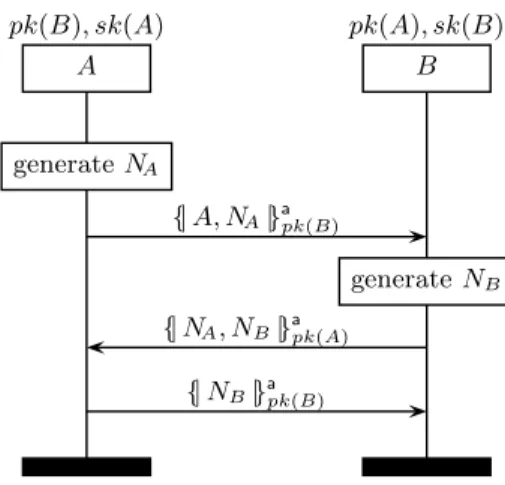
pk(X) to denote the (asymmetric) encryption of the messageM withX’s public key. A message sequence chart describing the protocol is shown in Figure 24.1.
Let us go through the protocol steps and their rationale. 1. A→B:{|A, NA|}apk(B)
The responder receives the initiator’s message and decrypts it. At this point, the responder assumes that the initiator has indeed sent the message recently and will try to confirm his assumption in the next two steps. The responder generates a nonceNB.
2. B→A:{|NA, NB|}apk(A)
When the initiator receives this message, she decrypts it. Because the message contains the nonce NA, which the initiator generated recently and sent encrypted for the responder, the initiator concludes that the message was indeed sent recently by the responder.
3. A→B:{|NB|}apk(B)
The last message is sent so that the responder can verify his assumptions. He reasons that the message is recent, sinceNB is recent. Moreover, only
pk(B), sk(A) A pk(A), sk(B) B generateNA {|A, NA|} a pk(B) generateNB {|NA, NB|}apk(A) {|NB|} a pk(B)
Fig. 24.1.Needham-Schroeder protocol (NS)
the initiator and the responder knowNB, and the responder did not send the message. So the message must come from the initiator. Finally, the initiator will have received NB as part of the responder’s message that also contained NA, so she would not have responded unless NA was also recently sent by the initiator.
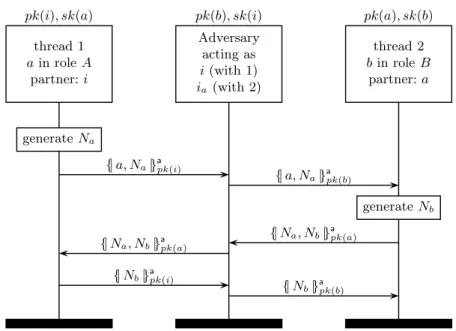
Although this informal correctness argument may seem convincing, it suf-fers from the following attack. Here i denotes the adversary and ia denotes the adversary impersonating agent a. The corresponding message sequence chart is shown in Figure 24.2.
The attack proceeds in the following way. 1. a→i:{|a, Na|}apk(i)
The agentainitiates the protocol in the initiator role, aiming to commu-nicate withi, and generates a fresh nonceNa.
2. ia→b:{|a, Na|}apk(b)
The adversaryiusesa’s nonce to impersonateaand initiates an instance of the protocol withb, who executes the responder role.
3. b→a:{|Na, Nb|}apk(a)
b responds to a correctly, generating his own nonce Nb in the process. Sinceasees the nonce she sent toi, she assumes the message is fromi. 4. a→i:{|Nb|}apk(i)
aresponds to i, following the rules of the initiator role of the protocol. 5. ia→b:{|Nb|}apk(b)
ire-encryptsNb under b’s public key and sends the result tob. Sincebis expecting this response from a, he concludes that he shares Na and Nb withaandaalone.
Sinceb thinks he is communicating with a, and neitheranorb deviate from the protocol and their keys are not known to the adversary,bexpects thatNa
pk(i), sk(a) thread 1 ain roleA partner:i pk(b), sk(i) Adversary acting as i(with 1) ia (with 2) pk(a), sk(b) thread 2 bin roleB partner:a generateNa {|a, Na|} a pk(i) {|a, Na|} a pk(b) generateNb {|Na, Nb|} a pk(a) {|Na, Nb|} a pk(a) {|Nb|} a pk(i) {|Nb|} a pk(b)
Fig. 24.2.Lowe’s man-in-the-middle attack on the Needham-Schroeder protocol
and Nb are only known to aand himself. Clearly,b’s assumption is violated by the attack.
There are two things to notice about this attack. First, it is nonintuitive: if one looks closely, one sees that the security argument relies on the assumption that agents do not reveal secrets, and that this assumption is violated by i
when forwarding a’s nonce to b. Indeed, Needham and Schroeder explicitly make this assumption in their paper. However, relaxing the assumption has surprising consequences, as this attack makes clear. Second, the attack does not depend on any flaws in the cryptographic primitives used and requires only a very simple adversary model. The only operations on data that the adversary employs are concatenation and splitting of messages, and encryption and decryption.
In general, we would like to establish the correctness of protocols with respect to even more powerful, but realistic, adversaries. We typically also give the adversary the ability to compute a limited set of functions on data. Namely, the adversary can read, redirect, and delete any message sent along a network, impersonate any agent, and create new messages by applying func-tions available to him to data he has already seen. This results in a model that can capture a large class of potential protocol problems. Such a model, which is both simple and expressive enough to capture a large class of nonintuitive security flaws, lends itself well to model checking. Hence it is not surprising that the analysis of protocols with respect to such models has been a ma-jor application of model checking in security. Basically, one uses the model
checker to find all possible ways an adversary can interact with a protocol by using arbitrary combinations of interception, redirection, and the other basic operations available to him. The state space thus generated is of course infi-nite, but as we will see, the problem is decidable under certain limiting but reasonable restrictions, and heuristics and abstraction techniques have been developed to reason about the case in which the restrictions are not assumed. Model checking cryptographic protocols is not just of intellectual inter-est. It can do much to streamline the development and adoption of security standards. New cryptographic protocols are constantly being invented as new communication paradigms are introduced. Since a protocol must be widely adopted before it is useful, new protocols are usually introduced through a standardization process. This process can be drawn-out and argumentative, and standards can be difficult to modify once they are in place. Formal anal-ysis can help speed up standardization by finding problems early and giving evidence of security if no flaws are found. Moreover, it can also help pre-vent flawed protocols from being standardized. Finally, model checking has the advantage that the counter-examples it finds depict actual attacks on the protocol. This gives insight into a protocol’s vulnerabilities, and how they can be fixed.
We proceed as follows. In Section 24.2 we give a brief historical overview of the field. Then, in Section 24.3, we describe a basic model for security protocols and their properties. In Section 24.4 we give an overview of several issues that arise in model checking security protocols, and approaches that have been taken to address them. In Section 24.5 we describe representative systems based on these approaches. We discuss current and future research questions in Section 24.6 and we draw conclusions in Section 24.7.
24.2 History
In this section, we give a brief history of model checking cryptographic pro-tocols. In order to keep the historical record clear while maximizing access to technical results, we provide, when necessary, two references for each result we cite. The first citation is for the historical record, giving the first appear-ance of the result. Since these often appear in technical reports or conference papers that are inaccessible or incomplete, we also provide a reference to the result as it finally appeared, usually in a journal paper.
The first symbolic approach to cryptographic protocol analysis that has become the basis of the methods used by current model checking tools was that of Dolev and Yao [DY81, DY83], and shortly later, Dolev, Even, and Karp [DEK82], just after the invention of public key cryptography. They introduced the paradigm now known as the Dolev-Yao model. In this model, a protocol is modeled as a machine consisting of an arbitrary number of honest agents executing the protocol, in which all messages sent are intercepted by the adversary (even if he does no more than forward them), all messages received
are sent by the adversary, and any message processing done by the adversary is done using an arbitrary combination of a finite set of operations. The model also formalizes an abstraction of cryptography where messages are represented by terms rather than bit-strings and cryptography is “perfect” in the sense that cryptographic operators do not leak information, e. g., the only way for the adversary to decrypt an encrypted message is to have the decryption key. The Dolev-Yao model is at the basis of all applications of model checking to cryptographic protocols, although today’s protocol analysis tools take a very different approach than that taken originally. Dolev and Yao were interested in low-complexity algorithms for proving secrecy, and gave several polynomial-time algorithms for a class of protocols they characterized as “ping-pong” protocols. However, it turned out that the problem quickly became unde-cidable when the algebraic properties of the cryptographic algorithms were represented more faithfully [EGS85], and interest in the problem petered out. A few years later, researchers started tackling the problem from another point of view, developing tools that would exhaustively search the problem space or some portion of it. The first tool to take this approach was Millen’s Interrogator [MCF87], followed by the Longley-Rigby search tool [LR92] and the NRL Protocol Analyzer (NPA) [Mea96]. These can be thought of as proto-model checkers. Indeed the NPA offered many features of a proto-model checker, in-cluding an automated means of proving that exhaustive search of a finite space implied exhaustive search of the infinite state space, and later, a temporal logic language, NPATRL [SM96], for describing protocol security properties.
Interest in model checking cryptographic protocols really took off with Lowe’s use of the FDR model checker to analyze the Needham-Schroeder public key protocol [Low96], described above. The fact that he could demon-strate a problem that had gone unnoticed for seventeen years alerted people to the power of model checking. Other researchers began applying their own model checkers to the problem, most notably the use of the Murphi model checker by Mitchell et al. [MMS97] to analyze variations on the TLS protocol. From there it was a short step to the development of special purpose model checkers, such as Clarke et al.’s Brutus [CJM00].
Parallel to this was research on the complexity of model checking. The key feature turned out to be the number of sessions involved, where a ses-sion refers to a single (potentially partial) execution of the protocol. As we see from the attack on the Needham-Schroeder protocol, attacks often inter-leave different sessions. Indeed it is possible to create protocols that are only vulnerable to attacks that require interleaving an arbitrarily large number of sessions [Mil99]. In [DLMS99, DLM04], Durgin et al. show that, given a model similar to the one described in this chapter, the secrecy problem (that is, the problem of deciding whether or not the adversary learns a particular term) is undecidable if the number of sessions and nonces is unbounded. Rusinowitch and Turuani [RT01] later showed that the secrecy problem is NP-complete if the number of sessions is bounded. Moreover, their procedure applies more
generally to arbitrary state properties, and thus can also be applied to other reachability properties such as authentication.
The decidability of security for the bounded session case led to the de-velopment ofbounded session model checkers, in which the user specifies the number of sessions the model checker should search. Bounded session model checkers are of practical significance, since most attacks on realistic proto-cols require only a few sessions. Indeed, an attack that requires interleaving many sessions would not be practical to implement. Bounded session model checkers include Shmatikov and Millen’s constraint based tool [MS01], the Constraint-Logic-based Attack Searcher (CL-Atse) [Tur06], the On-the-Fly Model Checker (OFMC) [BMV05b], and the based Model Checker SAT-MC [AC04]. The same period saw the development of unbounded session model checkers relying on abstraction (such as ProVerif [Bla01]) and heuris-tics (such as Maude-NPA [EMM07] and Athena [Son99], the latter of which formed the basis for the current tool Scyther [Cre08]). We present these tools in more detail in Section 24.5.
In recent years, as the field matures, researchers are increasingly concen-trating on making the tools available for others to use, and are applying them to practical problems such as the verification of standards. Some of the tools that have seen the widest use are the AVISPA tool suite [ABB+05, Vig06], which is a set of model checkers (the above-mentioned CL-Atse, SAT-MC, and OFMC), with a common front end, and the above-mentioned ProVerif tool. Many tools have been used in the analysis of standards, sometimes detecting problems that would have gone unnoticed otherwise. For example, the NPA was used in the verification of two IETF protocols: the Internet Key Exchange Protocol [Mea99] and the Group Domain of Interpretation (GDOI) protocol [MSC04]. In the case of GDOI, the tool was instrumental in catching some vulnerabilities early on that were straightforward to fix in the design stage but could have led to problems if they had not been caught in time. The AVISPA tools have been applied to a suite of protocol standards. ProVerif has been used in the production of formally verified implementations of TLS [BFCZ08] and the smart card protocol InfoCard [BFGS08]. Scyther has been used in the analysis of the MQV family of protocols [BC10b], and has found attacks against members of that family when the adversary is able to compromise parts of the local state of the agents. Furthermore, Scyther has been used for the analysis of the entity authentication protocols in the ISO/IEC 9798 standard [BCM12] and the IKE key exchange protocols in the IPsec stan-dard [Cre11].
Ultimately, we would expect model checking to become a standard tool for cryptographic protocol design, as it has become in hardware design. This has not quite happened yet. Although model checking has proved useful in the analysis of standards, it has not yet become part of the standards designer’s basic toolbox. However, designers of new protocols are starting to accompany them with formal analyses. The field is still actively growing and changing, and
we would not be surprised to see model checking being more widely adopted in the near future.
Although the basic decidability results and model checking algorithms for what is commonly accepted as the standard Dolev-Yao model are well under-stood, there is still much to be learned, and there is currently active research going on in a number of areas. These include making the Dolev-Yao model more precise and expressive, e. g., by including equational properties of cryp-tographic algorithms such as the associativity-commutativity of exponentia-tion, and incorporating cryptographic theories of correctness, reasoning about non-trace properties such as non-repudiation, non-interference, and indistin-guishability, extending soundness results down to the code level, and handling probabilistic behavior. These topics will be discussed in further detail in Sec-tion 24.6.
24.3 Formal model
Each of the tools mentioned in the previous section is based on a formal model of cryptographic protocols and the actions available to the adversary. Although these models differ in their details, they have a number of important features in common, since they are all based on the Dolev-Yao model presented in Section 24.2. In this section we present a basic symbolic model (based on [BC10b]) for formalizing and reasoning about security protocols, which captures the main features shared by these different models. We will use this model as a reference point when we describe the different tools and approaches later in this chapter.
As the model is symbolic, messages are represented by terms in a term algebra. Protocols themselves are described by a set of roles, each role with an associated script that describes the sequence of events taken by the agents executing the role. The protocols are given an operational semantics where agents may play in multiple roles giving rise to arbitrarily many role instances (also called threads). This gives rise to a semantics formalized by an infinite-state transition system, with an associated notion of trace.
For expository purposes, we present a simple model that handles only a restricted class of security protocols. We describe these restrictions along with extensions and other design options. We also explain how basic security properties can be formalized within this model.
24.3.1 Notational preliminaries
Letf be a function. We write dom(f) andran(f) to denotef’s domain and range, respectively. We write f[a 7→ b] to denote f’s update, which is the function f′ where f′(x) = b when x = a and f′(x) = f(x) otherwise. We
to elements from Y. We write fn to denote the n-fold composition of f, for
n≥0, wheref0is the identity function.
For any setS,P(S) denotes the power set ofS andS∗denotes the set of
finite sequences of elements fromS. We writehs0, . . . , sni(omitting brackets when no confusion can result) to denote the sequence consisting of the ele-mentss0 throughsn. Forsa sequence of length|s|andi <|s|, we writesi to denote thei-th element. We writesˆs′ for the concatenation of the sequences sands′. Abusing set notation, we write e∈siff∃i . s
i=e, and writeset(s) for{x|x∈s}.
We use standard notions (see e. g., [BN98]) for manipulating terms. Let
Subdenote the set of substitutions of terms for variables (we will define these syntactic categories shortly). We write [t0, . . . , tn/x0, . . . , xn]∈ Subto denote the substitution ofti forxi, for 0≤i≤n. We extend the functions dom and
ranto substitutions. We writeσ∪σ′ to denote the union of two substitutions,
which is defined whendom(σ)∩dom(σ′) =∅. We writeσ(t) for the application
of the substitutionσtot.
For R a binary relation, we write R−1 to denote the inverse of R, i. e.,
R−1 ={(y, x)| (x, y)∈ R}. Furthermore,R+ denotes the transitive closure ofR.
24.3.2 Terms and events
We assume given the pairwise-disjoint infinite sets Agent,Role, Fresh, Var,
Func, TID, and AdvConst of agent names, roles, freshly generated terms (nonces, session keys, coin flips, etc.), variables, function names, thread iden-tifiers, and adversary-generated constants.
In order to bind local terms, such as freshly generated terms or local variables, to a protocol role instance (thread), we write t♯tid. This denotes that the term tis local to the protocol role instance identified by the thread identifiertid, where tid∈TID.
Definition 1.Basic terms
BasicTerm ::=Agent | Role | Fresh | Var | AdvConst
| Fresh♯TID | Var♯TID
Definition 2.Terms
Term::=BasicTerm | (Term,Term)
| pk(Term) | sk(Term) | k(Term,Term)
| {|Term|}a
Term | {|Term|}
s
Term | Func(Term
∗)
For eachX, Y ∈Agent,sk(X) denotes the long-term private key ofX,pk(X) denotes the long-term public key belonging to X, and k(X, Y) denotes the long-term symmetric key shared betweenX andY. Moreover,{|t1|}at2denotes
the asymmetric encryption of the termt1with the keyt2, and{|t1|}st2denotes symmetric encryption. Elements of the setFunc can be used to model other cryptographic functions, such as hash functions. Freshly generated terms and variables are assumed to be local to a thread. We model constants as 0-ary functions.
Depending on the protocol analyzed, we assume that symmetric or asym-metric long-term keys have been distributed prior to protocol execution. We assume the existence of an inverse function on terms, where t−1 denotes the inverse key of t. We have pk(X)−1 = sk(X), sk(X)−1 = pk(X) for all
X ∈Agent, andt−1=t for all other termst.
As noted in the introduction, one of the distinguishing features of model checking security protocols is that they operate in an environment controlled by an adversary. To formalize the powers of a Dolev-Yao-style adversary, we define a binary relation⊢, whereM ⊢tdenotes that the termtcan be inferred from the set of terms M. Lett0, . . . , tn ∈Term and letf ∈Func. We define
⊢as the smallest relation satisfying:
t∈M ⇒M ⊢t M ⊢t1∧M ⊢t2⇔M ⊢(t1, t2) M ⊢t1∧M ⊢t2⇒M ⊢ {|t1|}st2 M ⊢t1∧M ⊢t2⇒M ⊢ {|t1|} a t2 M ⊢ {|t1|}st2∧M ⊢t2⇒M ⊢t1 M ⊢ {|t1|}at2∧M ⊢(t2)−1⇒M ⊢t1 ^ 0≤i≤n M ⊢ti⇒M ⊢f(t0, . . . , tn)
Subtermstof a termt′, writtent⊑t′, are defined as the syntactic subterms of t′, e. g.,t
1⊑ {|t1|}st2 andt2⊑ {|t1|}st2. We writeFV(t) for the free variables of
t, defined asFV(t) =
t′
t′ ⊑t∧t′∈Var∪ {v♯tid|v∈Var∧tid∈TID} .
An agent can engage in the following events.
Definition 3.Events
Event ::=create(Role,Sub) | send(Term) | recv(Term)
Note that the send and receive events do not include explicit sender or re-cipient fields. The messages sent or received can, of course, include subterms identifying the sender and the intended recipient, although this information is not a priori authentic. As is standard, the adversary receives all messages sent, independent of the intended recipient.
We will explain the interpretation of the events shortly. Here we note that the events are conventional and are given a standard interpretation in a setting with concurrently executing, communicating processes: starting a thread, sending a message, and receiving a message.
We extend the domain of substitutions over events and sequences of events in the standard way, i. e.,σ(send(m)) =send(σ(m)).
24.3.3 Protocols and threads
A protocol is a mapping from role names to event sequences, i. e.,Protocol :
Role 7→ Event∗. We require that no thread identifiers occur as subterms of
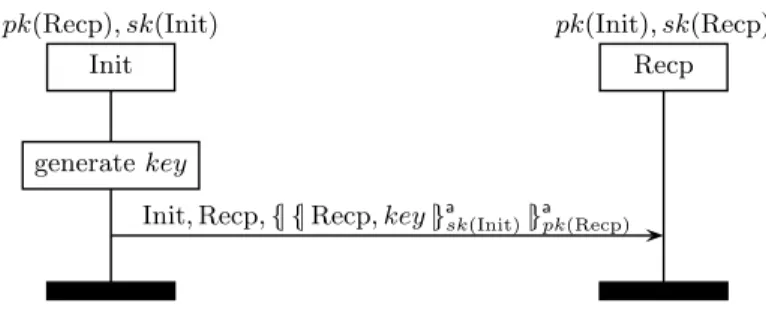
events in a protocol definition. The following is a very simple example of a protocol with two roles: an initiator and a recipient.
pk(Recp), sk(Init) Init
pk(Init), sk(Recp) Recp
generatekey
Init,Recp,{| {|Recp, key|}a
sk(Init)|} a
pk(Recp)
Fig. 24.3.Simple protocol
Example 1 (Simple protocol). Let{Init,Recp} ⊆Role, key∈Fresh, andx∈
Var. LetP be the protocol defined as follows.
P(Init) =hsend(Init,Recp,{| {|Recp, key|}a
sk(Init)|}
a
pk(Recp))i
P(Recp) =hrecv(Init,Recp,{| {|Recp, x|}a
sk(Init)|}
a
pk(Recp))i
The message sequence chart for this protocol is shown in Figure 24.3. Here, the initiator generates a key and sends it (together with the recipient’s name) signed and encrypted, along with the initiator and recipient names. The re-cipient expects to receive a message of this form.
Protocols are executed by agents who execute roles, thereby instantiating role names with agent names. Agents may execute each role multiple times. We distinguish between the fresh terms and variables of each thread by assigning them unique names, using the function localize : TID → Sub. Note that we abuse notation and extend the domain of substitutions toVar∪Role∪Fresh.
Definition 4 (Localize). Let tid∈TID. Then localize(tid) = [
cv∈Fresh∪Var
[cv♯tid/cv].
We define a functionthread : (Event∗×TID× Sub)→Event∗ that yields the sequence of agent events that may occur in a thread.
Definition 5 (Thread). Let l be a sequence of events,tid∈TID , and letσ be a substitution. Then
thread(l, tid, σ) =σ(localize(tid)(l)).
Example 2.LetP be the protocol from Example 1, t1 ∈TID, and{A, B} ⊆
Agent. For a thread t1 performing the Init role we havelocalize(t1)(key) =
key♯t1and
thread(P(Init), t1,[A, B/Init,Recp]) =
hsend(A, B,{| {|B, key♯t1|}ask(A)|}
a
pk(B))i.
24.3.4 Initial adversary knowledge
We assume that the adversary initially knows all agent names and can gener-ate an unbounded set of constantsAdvConst, whereAdvConst⊂Funcand no protocol description contains elements ofAdvConst. The setAdvConst repre-sents the set of fresh values that are generated by the adversary. The adversary additionally knows the long-term public keys of all agents. We also assume that the adversary has compromised the long-term private keys of some of the agents. We model this by partitioning the setAgent into the honest agent set
Honest and the compromised agent set Compromised. Moreover, we include the long-term private keys of the compromised agents in the initial knowledge of the adversary.
The long-term secret keys of an agentaare defined as
LongTermKeys(a) ={sk(a)} ∪ [
b∈Agent
{k(a, b), k(b, a)}. We define the initial adversary knowledgeIK0 as
IK0=Agent∪AdvConst∪ [ a∈Agent pk(a)∪ [ a∈Compromised LongTermKeys(a). 24.3.5 Execution model
We define the setTraceas (TID×Event)∗, which represents possible execution
histories. Using this set, we define the set State of system states as Trace× P(Term)×(TID 7→Event∗). The components of a state (tr,IK, th)∈State
are (1) a tracetr, (2) the adversary knowledgeIK, and (3) a partial function
thmapping thread identifiers of initiated threads (executing or completed) to event traces. Note that in conventional model checking approaches, (1) would not be part of the state but would be defined over runs of the transition system. We include the trace as part of the state to facilitate defining the partner function later.1
1Actually there are a number of representation options here. For example,IK and
thcan be computed directly fromtr. We explicitly include them in the state to improve the readability of our operational semantics.
R∈dom(P) σ∈dom(P)→Agent tid6∈dom(th)
(tr,IK, th)−→(trˆh(tid,create(R, σ))i,IK, th[tid7→thread(P(R), tid, σ)])[createP] th(tid) =hsend(m)iˆl
(tr,IK, th)−→(trˆh(tid,send(m))i,IK∪ {m}, th[tid7→l])[send] th(tid) =hrecv(pt)iˆl IK ⊢σ(pt) dom(σ) =FV(pt)
(tr,IK, th)−→(trˆh(tid,recv(σ(pt)))i,IK, th[tid7→σ(l)]) [recv] Fig. 24.4.Execution-model rules
The initial system statesinitis defined as
sinit= (hi,IK0,∅) ,
whereIK0is the initial adversary knowledge as defined above.
The semantics of a protocolP ∈Protocol is defined by a transition system whose transitions are given by the rules in Figure 24.4. Each rule describes how the execution of one of the three events causes a state transition. We describe each rule in turn.
Execution-model rules.Thecreaterule starts a new instance of a protocol roleR(athread). In the premises, the substitutionσassociates the role names
dom(P) with agents, andtidis a fresh thread identifier. In the state transition in the conclusion, the successor state’s trace is extended, reflecting that the thread identified by tid executed the create event, and the thread mapping (“thread pool”) is extended with the thread assigned totid.
Thesendrule sends a messagemto the network. The premise refers to a thread identified by tid, whose next event is to send the message m. In the conclusion, the trace is updated with this event, the adversary knowledge is updated with m, and thread fortid is updated.
Finally, the receive rule models an agent, running a thread, receiving a message from the network. The message must match the message patternpt
under a substitutionσ, whereptis a term that may contain free variables. Note that by the second premise, the adversary must be able to infer σ(pt) from his current knowledgeIK. One can see this as formalizing that the adversary controls the network and effectively determines who receives which messages. In our model, recipients accept all messages that match the message pattern
pt, and block on any other messages. The resulting substitutionσ is applied to the remaining protocol stepsl.
Definition 6 (Transition relation).LetP be a protocol. We define a tran-sition relation→Pusing the execution-model rules from Figure 24.4. For states
s and s′, s →
P s′ iff there exists an execution-model rule with the premises
Q1(s), . . . , Qn(s)and the conclusions→s′ such that all of the premises hold. Given a protocol P and a set of states T, let PostP and PreP denote the successors and predecessors ofT, respectively, i. e.,
PostP(T) ={ s′∈State | ∃s ∈T . s→P s′} PreP(T) ={ s∈State | ∃s′ ∈T . s→P s′}.
Definition 7 (Reachable states).Let P be a protocol. We define the set of reachable states ofP as Reachable(P) = ∞ [ n=0 PostnP({sinit}).
We will see Pre and Post again when we discuss model checking algorithms in Section 24.4.
24.3.6 Property specification
We focus on basic security properties that can be expressed as reachability properties, i. e., properties of reachable states. Because the adversary knows the long-term private keys of the compromised agents, protocol sessions that involve compromised agents cannot guarantee the secrecy of data such as shared keys or exchanged terms. This is reflected in the definition of most security properties by considering only those threads that do not involve com-promised agents.
We introduce an auxiliary predicate HT (forhonest thread) that identifies completed threads that do not involve compromised agents.
Definition 8 (HT). Let s = (tr, IK, th) be a state, tid a thread identifier, andσ a substitution. We writeHT(s, tid, σ) to denote
∃R .(tid,create(R, σ))∈tr∧th(tid) =hi ∧ran(σ)∩Compromised =∅ .
For example, let s= (tr, IK, th) be the state reached after the attack trace represented in Figure 24.2. We have that both thread 1 and 2 are completed, i. e.th(1) =th(2) =hi, and the tracetrcontains (1,create(A,[a, i/A, B])) and (2,create(B,[a, b/A, B])). Hence we have that HT(s,2,[a, b/A, B]) but there exists no σ such that HT(s,1, σ), because a in thread 1 starts a thread to communicate with the compromised agenti.
Definition 9 (Secrecy). Let t∈Fresh. We say that a state s= (tr,IK, th) satisfies secrecy oft if and only if
∀tid, σ .HT(s, tid, σ)⇒ ¬(IK ⊢(t♯tid)).
We say that a protocolP ensures secrecy oft if and only all reachable states of P satisfy secrecy oft.
For example, the protocol in Figure 24.3 ensures secrecy of the initiator’s key.
Authenticationis an important property for many security protocols, and numerous notions of authentication have been proposed in the literature. As
a simple example, consider weak aliveness. This weak form of authentica-tion guarantees only that if a non-compromised agent completes a thread of the protocol under the assumption that he is communicating with a non-compromised agentaexecuting role R, then it is indeed the case thata pre-viously started a thread in roleR.
Definition 10 (Weak Aliveness). Let R be a role. We say a state s = (tr,IK, th) satisfies weak aliveness of Rif and only if
∀tid′, σ′.HT(s, tid′, σ′)⇒ ∃tid, σ .(tid,create(R, σ))∈tr∧σ′(R) =σ(R) . We say that a protocol P ensures weak aliveness if and only if all reachable states of P satisfy weak aliveness of all rolesR∈dom(P).
Stronger forms of authentication (see e. g., [Low97]) impose additional require-ments on the state. For example, they require that the threads’ assumptions on agents match, e. g., by requiringσ=σ′, or they place additional
require-ments on the exchanged messages or the instantiation of variables, or they require that messages are recent. Some of these properties require instru-menting the model with additional markers, such as labeling communications or introducing signal events to simplify expressing agreement on the contents of variables.
24.3.7 Alternatives
We have intentionally kept our formalism simple to highlight the main ideas. At each step along the way there are design options, reflecting the class of protocols and adversaries one intends to capture.
To begin with, we have formalized cryptographic messages using a free term algebra, where term equality is therefore just syntactic equality. Addi-tional cryptographic operators can be added, but this requires formalizing how the adversary can construct and reason about terms built from them. In Section 24.6 we describe how this can be done for operators formalized by sets of equations.
Our protocol roles are specified by straight-line sequences of events, with-out control flow primitives such as branching or loops. This is sufficient to model many security protocols, provided we ignore error cases, for example where a thread receives an unexpected message. Such cases are handled implic-itly: no transition is enabled and hence the thread simply does not progress. In contrast, a richer execution model would be needed to fully model proto-cols that support multiple options and subprotoproto-cols, such as the Internet Key Exchange (IKE) [HC+98], or that require loops, such as the stream authen-tication protocol TESLA [PT02, HL04]. It is not difficult to add control flow primitives or alternatively to base the execution model on a process calculus or some transition-system formalism. We will give examples of tools whose input languages are based on such formalisms in Section 24.5.
The simplicity and power of the Dolev-Yao adversary model has made it extremely popular. However, for many real-world scenarios an adversary who has complete control of the network may be unrealistic, and therefore protocols that offer weaker security guarantees may be preferred for efficiency reasons. At the other end of the spectrum, assuming that the adversary can learn nothing about encrypted data unless he obtains a decryption key may be unrealistic in other scenarios. We will consider alternative adversary models in Section 24.6.
24.4 Issues in developing model checking algorithms for
security protocols
Here we present a number of issues that arise in model checking security proto-cols, and the approaches that have been taken to address them. In particular, we indicate various design decisions, such as forward or backward search, state representations, and bounding the state space.
24.4.1 Forward versus backward search
We consider security properties that can be expressed as reachability proper-ties, i. e., as a set of statesS. We say that a protocolP satisfies the property
S if and only if
Reachable(P)⊆S. (24.1)
LetS=State\Sbe the property’s complement, representing possible attacks. Then the above formula can be rewritten as
Reachable(P)∩S=∅. (24.2)
Then, we can rewrite Formula 24.2 either as
∞ [ n=0 PostnP({sinit})∩S=∅ (24.3) or alternatively as sinit∈/ ∞ [ n=0 PrenP(S). (24.4)
Algorithms that iteratively compute a representation of (all, or some subset of) PostnP({sinit}), as in Formula 24.3, are said to useforward search. If, for some
n, an element is found that is also inS, a counterexample can be constructed representing an attack. Alternatively, if there is annwhere we reach a fixpoint, i.e. PostPn({sinit}) = PostPn+1({sinit}), and additionally Post
n
P({sinit})∩S =
∅, then the property holds of the protocol. A fixpoint will be reached, in general, only in finite-state models.
In contrast, backward search iteratively constructs PrenP(S), as in For-mula 24.4. Similar observations hold as for the forward search, except that we check whethersinitoccurs in the constructed set.
In the analysis of security protocols, the set of reachable states is infinite, as new threads can always be created. Hence the closure in forward search contains infinitely many states. Similarly, the closure in backward search con-tains infinitely many states, but for a different reason: for the properties we consider here,S contains infinitely many states.
The main idea behind searching infinite sets of states is to use finite repre-sentations of the infinite sets. The selection criteria for such a finite representa-tion include the complexity of computing PreP or PostP, and the complexity of evaluating whether or not all elements of the represented set satisfy the propertyS.
When exploring infinite state spaces, it is often efficient to use as much information as possible about the states. In general, the negation S of the security property provides more information about the states than the initial state {sinit}. For example, the negation will specify that particular events must have occurred or that the adversary knows certain terms. As a result, backward search is often employed when exploring infinite sets of states.
A simpler case occurs if the number of reachable states is restricted to a finite set, for example, by limiting the number of threads or sessions that can be created. In this case, forward search for violations of secrecy or au-thentication properties can be trivially implemented: checking that a given state satisfies these properties can be done using either Definition 9 or 10. A bounded backward search starts from the finite set of attack states S, from which PrenP(S) can be computed. Depending on the property and the (finite) size of the set of states, the size of (the representation of)Scan be significant. In practice, forward search is commonly used to explore finite sets of states.
24.4.2 Bounded instances
The execution model presented in Section 24.3 gives rise to an infinite-state transition system. Infinitely many states arise in two distinct ways. First, the createrule may start unboundedly many new protocol threads. Second, under thereceiverule, there are unboundedly many different messages that a thread could receive from the network. This is modeled by the rule’s second premise, which formalizes that a thread can be updated with any messageσ(pt) that is in the closure of the adversary knowledge.
The first source of infinity is a fundamental problem. As mentioned in Section 24.2, even relatively simple properties such as secrecy are undecidable for security protocols formalized using operational semantics similar to ours [DLM04]. If we restrict the number of sessions (or threads), then the problem becomes NP-complete [RT01], provided messages are formulated as terms in a free term algebra. Note that in practice, when analyzing real-world protocols, it is usually only necessary to consider a small number of threads. If there is
an attack on the protocol, then there is normally an attack where the number of threads is at most a small factor more than the number of roles, e. g., twice the number of roles, which allows for messages from one protocol session to be replayed in another session. For a class of protocols where attacks require arbitrarily many threads, see [Mil99].
The second source of infinity, an infinite space of messages, turns out not to be a problem. The NP-completeness result of Rusinowitch and Turuani [RT01] establishes that if there is an attack, then there is one where the size of the messages involved is polynomially bounded in the size of the protocol and the number of threads, provided messages are represented by directed acyclic graphs. As a result, assuming a finite number of threads, and hence fresh data, one can bound a priori the messages that must be considered in protocol analysis. We will see below how both bounds on the number of threads and messages have been used by different protocol analysis tools.
24.4.3 Representing states
The Equations 24.3 and 24.4 can be directly used for forward or backward model checking after fixing a representation of states for which one can ef-fectively compute successors or predecessors. There are different options here depending on whether states are explicitly or symbolically represented.
It is simple to turn the operational semantics given in Section 24.3 into an explicit state model checker. A state is just a triple, all of whose components can be finitely encoded. The problem in practice is efficiently representing large sets of states, i. e., reducing the impact of state-space explosion. An example of a model checker for security protocols based on forward search using explicit state enumeration is Murphi [SD95]. This tool uses techniques inspired by explicit state model checkers like SPIN [Hol02], such as hash ta-bles and hash compaction, to improve its efficiency. Another example of an explicit state coding is implemented by Lowe’s Casper system [Low98], which encodes the operational semantics of the protocol and the adversary as a (fi-nite state) CSP process and uses the FDR model checker to either identify attacks or verify the protocol for instances with a bounded number of threads and messages.
The second possibility is to encode sets of states using formulas as in sym-bolic model checking. Many tools take this approach. Here terms, in partic-ular messages, are represented by non-ground terms (cf.message patterns in Section 24.3.5) which contain variables. These variables may be instantiated during search. For example, under our operational semantics, this instanti-ation would occur when applying the rules using unificinstanti-ation. In approaches based on rewriting, such as Maude-NPA, instantiation occurs during rewriting by narrowing.
When working with symbolic representations, unification is often com-bined with constraint solving. In the formal model we have given, the need for constraint solving arises from the second premise of therecvrule,IK ⊢σ(pt).
When applying rules of the operational semantics backwards (either in forward or backward search), this gives rise to a subgoal often called theintruder de-duction problem. The simplest version of this problem is to determine whether
IK ⊢m, for a ground messagem using the rules formalizing the Dolev-Yao adversary given in Section 24.3.2. This problem is often decidable, which can be shown by using the notion of locality [BG01, CT03] to bound the size of terms occurring in derivations. During symbolic reasoning, the non-ground problem arises: determining whether there exists a substitution σ such that
σ(IK)⊢σ(pt). The ground problem can be tackled by considering a restricted class of normal form derivations [CLT04]. The non-ground problem is gener-ally solved either by unification-based procedures or specialized constraint solvers such as those used in OFMC or CL-Atse.
An alternative symbolic approach is that of bounded model checking. In the simplest case, the closure specified in Equation 24.3 is simply unrolled some bounded number of timesk, thereby specifying the existence of an attack given bykor fewer applications of rules from the operational semantics. If this finite unrolling is combined with a bound on the number of messages that may appear (and the result of Rusinowitch and Turuani gives us an exponential bound), then the resulting formula can be encoded within propositional logic and SAT solvers can be used to search for attacks, as shown in Chapter 10. Different encodings and optimizations for using SAT-based model checking for security protocols have been explored by Armando and Compagna and implemented in the model checker SAT-MC [AC08].
Symbolic representations of terms can be combined with partially-ordered finite sets of events to represent (possibly infinite) sets of states or traces. Such a partially-ordered setE is used to represent all traces of the protocol that contain an instance ofE as a substructure. By applying the operational semantics backwards to the events inE, additional constraints on its traces can be derived fromE, such as adding preceding events, unifying messages, or adding constraints on the adversary knowledge. This process can either lead to a contradiction, in which caseE represents no traces of the protocol, or to a witness trace of the protocol that contains an instance of E. Such representations form the basis of Athena, Scyther, and Tamarin.
24.4.4 Partial Order Reduction
Partial order reduction, as discussed in Chapter 11, is a natural optimization technique in the context of model-checking security protocols. The reasons for this are twofold. First, separate threads are largely independent processes, which communicate only through a single shared channel. Second, secrecy (Definition 9) depends only on the adversary knowledge and, in our definition, on the communication partners of completed threads.
Example 3 (POR). As a simple example, consider a stateswith two threads identified bytid1 andtid2. Assume that the next actions of both threads are
respectively the receive eventse1ande2of the patternspt1andpt2, and that there exist messages in the adversary knowledge such that bothe1ande2can be executed. More formally, consider the states= (tr,IK, th), two sequences
l1, l2, and two substitutions σ1, σ2, such that for alli∈ {1,2},
ei=recv(pti)∧th(tidi) =heiiˆli∧IK ⊢σi(pti)∧dom(σi) =FV(pti), and whereFV(pt1)∩FV(pt2) =∅.
Observe that in this state,e1 and e2 can be executed in any order. This results in eithers1 ors2, where
s→∗
P s1 , ands1= (trˆh(tid1, σ1(e1))iˆh(tid2, σ2(e2))i,IK, th′),
s→∗
P s2 , ands2= (trˆh(tid2, σ2(e2))iˆh(tid1, σ1(e1))i,IK, th
′),
and whereth′=th[tid
17→σ1(l1)][tid27→σ2(l2)]. Observe thats1 is identical to s2 except for its trace component. Because the premises of the transition rules do not depend on a state’s trace component, the successor states ofs1 are identical to those ofs2except for the traces.
To simplify the example, we additionally assume that fori∈ {1,2},
∀tid, σ .HT(s, tid, σ)⇔HT(si, tid, σ).
Hence, if the secrecy property is violated in state s1, then it is also violated in s2, and vice versa. Thus, we can safely explore only one of these successor states: if there is a state reachable froms1that violates secrecy, then there will also be a state reachable froms2 that is identical up to the trace component and thus secrecy is violated, and vice versa.
Similarly, for secrecy properties, one can consider only paths in which threads with send actions are executed first (and ignore paths in which these same sends are executed later) as this will only provide the adversary with more knowledge earlier.
For authentication properties, POR techniques are not necessarily sound: authentication properties depend on the order in which events occur, and therefore ignoring some orderings may cause attacks to be missed. For each property (or class of properties), the soundness of a particular partial order reduction scheme must be individually proven. The main proof obligation is to show that if there is an attack in a state that is not explored by the POR scheme, then there is also an attack on a state that is explored in the scheme. POR techniques are used in several tools. Examples include Brutus [CJM00], OFMC [BMV05b], and Maude-NPA [EMM07].
24.4.5 Handling equations
The formal model introduced in Section 24.3 uses a free algebra to represent operations on data. Thus the adversary’s ability to perform encryption is
represented by the deduction rule stating that {|t1|}at2 may be deduced from
t1andt2, and his ability to perform decryption is represented by the deduction rule stating thatt1may be deduced from{|t1|}at2 andt
−1
2 . This approach is in general adequate for a large class of operators, but we run into trouble when we include operations such as exclusive-or which obey different equational theories. In this case, we need to include not only a rule such as
M ⊢t1∧M ⊢t2⇒M ⊢t1⊕t2 But also the set of equations
t⊕0 =t t1⊕t2=t2⊕t1
t⊕t= 0 t1⊕(t2⊕t3) = (t1⊕t2)⊕t3
Similar problems arise when we introduce protocols based on Diffie-Hellman exponentiation or protocols based on homomorphic encryption, such as those involving blind signatures.
There are two ways of dealing with this problem. The first is to replace the equational theory with a set of inference rules that is equivalent under certain syntactic restrictions on the protocol. This is the approach followed in the previously mentioned work on encryption-decryption [Mil03] and also by K¨usters and Truderung, who develop inference rules for the theory governing exclusive-or [KT08] and a subtheory of the theory governing Diffie-Hellman exponentiation [KT09]. This approach is most appropriate when one wishes to use a tool that does not directly support reasoning about equational prop-erties.
The second approach is to adapt the reasoning used by the tool to the equational theory at hand. A substantial amount of work has been done in this area. There are two main techniques that researchers have concentrated on. One is an extension of the intruder deduction problem to include equa-tional theories. Thus, we now ask: given a set of terms M, a term t, and an equational theory E, is it possible to determine whether or not M ⊢ t
modulo E? The decidability of the intruder deduction problem in the free theory was the main component of Rusinowitch’s and Turuani’s proof of de-cidability of security in the bounded session model. Decision procedures have been subsequently given for a large class of equational theories relevant for model checking cryptographic protocols [AC06]. These theories include a class of rewrite theories known as subterm-convergent (for which the intruder de-duction problem is decidable in polynomial time), and other theories such as homomorphic encryption and exclusive-or. Algorithms for verifying intruder deduction modulo finite convergent rewrite theories have been implemented in several tools [BCD09b, CDK09, CBC11].
The other technique is equational unification: given an equational theory
Eand two termstands, find a complete description of all the substitutionsσ
such thatσs=σt moduloE. This is useful for determining which states can immediately follow (or precede) a given state: one unifies the current state
with the output (or input) of a state transition. Equational unification was a well-known technique long before it was applied to cryptographic proto-col analysis. Indeed, anyone who has solved an arithmetic equation such as
x+ 7 = 12 +y has applied equational unification. However, unification re-search generally concentrated on algorithms for special-purpose theories. In cryptographic protocol analysis, it is necessary to be able to apply unification to a range of theories, and to different combinations of theories. Thus generic approaches that apply to classes of theories that can be easily combined are preferable to special purpose algorithms, even when the special purpose al-gorithms may be more efficient. One technique that follows this approach is the process known as variant narrowing[EMS09], which can be applied to a class of theories that satisfy a property known as the finite variant property
[CLD05]. This is satisfied by a large number of equational theories of interest for cryptographic protocol analysis, with the major exception being homo-morphic encryption. A version of variant narrowing has been implemented in the Maude-NPA protocol analysis tool, discussed in Section 24.5.1.
We note that although there is a large overlap between subterm conver-gent and finite variant theories, the finite variant property does not imply subterm convergence, since by definition no associative-commutative theories are subterm convergent. Whether the converse holds is, to the best of our knowledge, still an open problem.
The most pressing open problem in the short term is how to extend the available tools to handle additional theories. In some cases (e. g., the intruder deduction problem for non-subterm-convergent theories) the exact complexity is not known and needs to be understood better. In other cases (for example some of the unification problems connected with different homomorphic en-cryption theories), the problem is known to be intractable or undecidable, and what instead needs to be investigated are (preferably syntactic) conditions on cryptographic protocol specifications that make the problems tractable. There is also the issue of combining theories. For example, in the case of unification, general algorithms for combining unification algorithms for different theories have been known for some time [SS89], but their generality forces them to be highly nondeterministic, and thus they are usually too slow to be practical. It may be possible to restrict ourselves to particular types of theories such that practical algorithms can be developed. However, it is still unknown whether such classes of theories contain the main theories of interest for cryptographic protocol analysis.
More generally, there is the problem of determining what one actually learns from an analysis with respect to an equational theory. For example, Kremer et al. [KRS10] have been using subterm-convergent theories to analyze voting protocols. However, the primitives that they describe with subterm-convergent theories are implemented by algorithms satisfying richer equational theories, usually involving Abelian groups. Are the higher-level descriptions in terms of subterm-convergent theories safe approximations? Conversely, when would a free theory be a safe approximation for a subterm-convergent theory?
This question has been answered for the subterm-convergent theories involving both shared and public key encryption [Mil03]. Can this result be extended to more general cases? Finally, when is any theory a safe approximation of a computational theory of protocol correctness? Some initial work on this last problem has been done by Baudet et al. [BCK09], but there is still much to be learned.
24.5 Systems and algorithms
In this section, we give some representative examples of systems based on the algorithmic approaches just presented.
24.5.1 NPA and Maude-NPA
The NRL Protocol Analyzer, or NPA, was one of the earliest tools for verify-ing the security of cryptographic protocols. Although not originally designed as a model checker, it later took on many of the features of one, including the ability to check properties expressed in a temporal logic language, NPATRL [MSC04]. In NPA, both the actions of honest agents and the adversary were specified in terms of state transitions. Model checking employed backward search, where the output of a state transition was unified with the current state. NPA had limited support for equational unification and could, for ex-ample, model properties such as the cancellation of encryption and decryption. One of the most interesting properties of NPA was that it was an un-bounded session model checker. It included built-in inductive techniques for building grammars defining languages of infinite search paths. Once NPA reached a state that contained a term in the grammar, it would not explore beyond that state. This technique often allowed NPA to terminate after a finite number of steps, although of course termination was not guaranteed. It has been used to verify a number of protocols and protocol standards, in-cluding the Internet Key Exchange Protocol [Mea99], the Group Domain of Interpretation Protocol [MSC04], and the Simmons Selective Broadcast Pro-tocol [Mea92].
Maude-NPA is a descendant of NPA, implemented in the Maude rewriting language[CDE+07]. It shares many of NPA’s features, including the use of unification to implement backward search and the reliance on grammars to ensure termination. There are two main differences. First, it is implemented in the Maude rewriting language, which gives it a formal basis in rewriting logic. In particular, backward search in Maude-NPA is implemented via narrowing over a simple transition model that is expressed via a small set of rewrite rules. Narrowing is a technique for deduction using rewrite rules and unification that given a termt, finds a substitutionσthat unifies a subterm with the left-hand side of a rewrite rulel→r. The subtermσlofσtis replaced byσr. When the rewrite rules describe state transitions, narrowing gives an algorithm for state
space exploration. When the arrows are reversed, as they are in Maude-NPA, narrowing can be used to implement backward search from a final goal. A sec-ond difference is that Maude-NPA is devoted to reasoning about the different equational theories that describe the behavior of cryptographic algorithms. Maude-NPA makes use of unification modulo different equational theories as the unification step in its narrowing algorithm.
Maude-NPA also incorporates two state space reduction techniques that were originally used in NPA, but have been refined and extended in Maude-NPA. The first is subsumption-based partial order reduction, in which the unreachability of a Maude-NPA state description is implied by the unreach-ability of another state description if a certain subsumption relation exists between them. The second is a super-lazy intruder. This is similar to the lazy intruder of the OFMC, except that it is adapted for backward search. If a variable term or a term constructed out of variable terms appears in the ad-versary knowledge part of the state, then this term is not searched any further (that is, it is removed from the state), since the adversary should be able to find it using arbitrary terms.2 However, it is not deleted entirely but kept around in a ghost state. If any of the variables in the term are instantiated, the ghost state is resuscitated. Among the equational theories that Maude-NPA can currently handle are a subclass of subterm-convergent theories, as well as exclusive-or, Abelian groups, modular exponentiation, bounded asso-ciativity and homomorphic encryption over a free operator. Work is ongoing on incorporating more general homomorphic encryption.
24.5.2 AVISPA and related tools
The AVISPA tool [ABB+05] is a model checker that integrates several dif-ferent model-checking approaches. AVISPA provides a high-level specification language, HLPSL, for specifying protocols and their properties. Protocols are specified in HLPSL in terms of their roles, using control flow patterns, data structures, alternative adversary models, as well as different cryptographic primitives and their algebraic properties. HLPSL specifications have a declar-ative semantics based on Lamport’s Temporal Logic of Actions [Lam94] and an operational semantics defined in terms of a rewrite-based formalism called the intermediate format, or IF. Different model-checking backends interpret the IF and can be used for (bounded) verification or falsification.
The main backends in the AVISPA tool are the Constraint-Logic-based Attack Searcher CL-Atse, the On-the-fly Model-Checker OFMC, and the SAT-based Model-Checker SAT-MC. We previously discussed SAT-MC in Section 24.4.3 and restrict our attention here to CL-Atse and OFMC.
Cl-Atse, like the other AVISPA backends, operates on IF specifications of protocols. CL-Atse represents protocol states symbolically as collections of
2Maude-NPA does not have secret types, so we assume that the adversary can
non-ground facts, which record the states of different threads, the messages sent to the network, and the adversary knowledge. In particular, constraints are used to describe what the different agents know and a constraint calculus is used to solve for what they can know, from messages previously exchanged, i. e., the calculus is used to solve a variant of the non-ground intruder de-duction problem. CL-Atse was designed to allow the easy integration of new deduction rules and operator properties. In particular, CL-Atse integrates a version of Baader and Schulz’s unification algorithm [BS96] with modules for xor, exponentiation, and associative pairing.
OFMC combines a number of techniques to enable the efficient analysis of security protocols. First, OFMC uses lazy data types (in a functional program-ming setting) as a simple way of building efficient on-the-fly model checkers for protocols with very large, or even infinite, state spaces. A lazy data type is one where data constructors (such as cons for building lists or node for building trees) build data without evaluating their arguments; this allows one to represent and compute with infinite data (e. g., streams or infinite trees), generating arbitrary prefixes of the data on demand. In [Bas99], lazy data types are used to build, and compute with, models of security protocols: a protocol and a description of the powers of an adversary are formalized as an infinite tree. Lazy evaluation is used to decouple the model from search and heuristics, building the infinite tree on the fly, in a demand-driven fash-ion. Second, OFMC models the adversary in a lazy fashion (the so-called “lazy intruder”), where adversary communication is represented symbolically and solved during search. To this end, like CL-Atse, it integrates a constraint solver for the non-ground intruder deduction problem. Effectively, OFMC per-forms search at two levels: search in the space of symbolic states, and search in the space of constraints. Third, while OFMC performs verification for a bounded number of sessions, it works withsymbolic session generation which avoids enumerating all possible ways of instantiating possible sessions. Fourth, OFMC exploits a state-space reduction technique, inspired by partial-order re-duction, called constraint differentiation [MVB10]. Constraint differentiation works by eliminating certain kinds of redundancies that arise in the search space when using constraints to represent and manipulate the messages that may be sent by the adversary. Namely, different symbolic states may describe overlapping sets of ground states. Constraint differentiation essentially com-putes a set-difference symbolically, to minimize these overlaps. This can be seen as generalizing the kind of subsumption-based partial-order reduction used in Maude-NPA. Finally, OFMC also provides some limited support for handling different equationally specified operators on messages [BMV05a].
24.5.3 Athena, Scyther, and Tamarin
The Athena [Son99] and Scyther [Cre08] algorithms implement model check-ing with respect to the unbounded model described in Section 24.3.5 by per-forming a backward-style search. For these methods, the model is extended
withadversary events forencrypting, decrypting, hashing, andknowing mes-sages. Infinite sets of states are represented by (trace) patterns: partially-ordered sets of events that must occur in the traces, and whose messages may contain variables. (In the Athena model, patterns are referred to as semi-bundles.) The events in patterns must satisfy a number of criteria that follow from the semantics. For example, if an event occurs in the pattern from a roleRwith thread identifiertid, then (a) the pattern does not contain events from other roles with thread identifiertidand (b) the event is preceded in the pattern by all events that precede it in the role R, with identical substitu-tions and thread identifiertid. However, it is not required for receive events in patterns that the received term can be inferred from the union of the initial knowledge and the messages that occur in preceding send events within the pattern. Patterns allow for specifying properties such as secrecy.
Example 4 (Secrecy pattern).The following patternP T specifies the violation of secrecy of the nonce of the responder role of the Needham-Schroeder proto-col, performed bybwhen trying to communicate witha, whereX andtidare variables. TheAdversaryKnowsevent is used to encode the secrecy violation.
e1= (tid,recv(a, b,{|a, X|}apk(b)))
e2= (tid,send(b, a,{|X, NB♯tid|}apk(a)))
e3= (tid,recv(a, b,{|NB♯tid|}apk(b)))
e4=AdversaryKnows(NB♯tid)
P T ={e1, e2, e3, e4},(e1, e2),(e2, e3) +
This pattern represents an infinite set of traces of the Needham-Schroeder protocol, e. g., the attack from Figure 24.2 and all traces that additionally include arbitrarily interleaved threads. In contrast, the corresponding pattern for the initiator role (also with agents a and b) represents the empty set of traces.
By introducing restrictions on variable instantiations into the algorithm, and replacing a and b by variables that can only be instantiated by non-compromised agents, we can faithfully represent all violations of the secrecy property for the protocol in the above example.
During backward search, a case distinction on the source of messages is used for branching and the patterns are extended by either adding events, adding ordering constraints, or unifying terms. The search can terminate in two ways. First, the pattern can be proven to be empty, i. e., it contains no traces of the protocol. The main mechanism here is detecting cyclic dependen-cies of the messages. Second, the receive events in the pattern meet all premises of the receive event: the adversary can produce an appropriate message from the preceding events. In such a case, the pattern is calledrealizableand it cor-responds to an infinite set of actual traces; a representative trace (of minimal length) from this set can be generated by linearizing the non-adversary events and instantiating the remaining variables from the adversary knowledge.
Scyther differs from Athena in how it makes the case distinction and in the possible outcomes of the analysis. With respect to the possible outcomes, Scyther bounds the size of the patterns but detects whether the bound is reached. By bounding the size of the patterns, termination is guaranteed and one of three possible results occurs. First, if a realizable pattern is found, a representative (attack) trace is constructed. Second, if no realizable patterns are found, and the bound is not reached, no realizable patterns exist (for any bound). In case of an attack pattern, this corresponds to the absence of attacks. Third, if no realizable patterns are found but the bound is reached, the result can be interpreted as verification with respect to a bounded number of sessions and is similar to the guarantees provided by, e. g., OFMC or CL-AtSe when they do not find attacks.
The Tamarin prover [SMCB12] is a generalization of the algorithms under-lying Athena and Scyther. Tamarin uses a backward search that can handle more expressive protocol and property specifications. Protocols and adver-sary capabilities can be specified using multiset rewriting rules, allowing for the specification of protocols with branching and loops. Tamarin provides support for Diffie-Hellman exponentiations and a class of user-defined equa-tional theories. Protocols can be analyzed with respect to properties specified in a guarded fragment of first-order logic that supports quantification over timepoints.
24.5.4 ProVerif
The ProVerif tool [Bla01] uses abstractions to obtain an efficient analysis method. In particular, it employs two main abstractions compared to the operational semantics presented before. First, individual fresh values are ab-stracted into sets of fresh values. Second, each action of a thread can be executed multiple times.
The abstracted protocol model can be represented as a set of Horn clauses. These Horn clauses are analyzed using a two-phase resolution algorithm. In the first phase, the Horn clauses are saturated in a forward fashion until a fixpoint is reached. This phase combines multiple derivations into single rules, thereby optimizing the rule set. Facts can be derived from the optimized rule set if and only if they can be derived from the original rule set. In the second phase, a backward depth-first search is used to try to establish that a fact (usually representing the adversary knowing a message that is supposed to be secret) cannot be derived from the saturated Horn clauses. If this cannot be established because the fact can be derived, an attempt is made to reconstruct a corresponding protocol trace.
If we assume that the fact represents a secret, we can interpret each of the four possible results of running the tool in the following way. First, if the fact cannot be derived, the over-approximation ensures that no protocol execution will leak the secret, and hence the protocol satisfies secrecy. Second, if the
fact can be derived and the derivation can be translated into a correspond-ing (attack) trace, the protocol does not satisfy secrecy, as witnessed by the trace. Third, if the fact can be derived but no corresponding trace can be reconstructed from the derivation, the result is inconclusive. Finally, either of the two phases in the algorithm may not terminate and again no knowledge is gained about the security of the protocol.
ProVerif can handle authentication properties formalized as correspon-dence properties [Bla09]. These properties express that when evente1occurs, evente2 must have occurred earlier with related parameters ρ1 and ρ2. For exampleρ1 could be a nonce andρ2 a variable that is supposed to be instan-tiated withρ1. In this case, it does not suffice to prove that the values of ρ1 andρ2 abstract into the same set (i. e., they are in the same equivalence class in the abstraction) and a finer abstraction is used. By introducing session identifiers in the construction of ρ1 and ρ2, we increase the precision of the verification at the cost of efficiency and termination.
24.6 Research problems
Although the research community has come far in the past decades, many re-search challenges remain. Below we describe some of the most pressing prob-lems being tackled as well as open probprob-lems.
24.6.1 Link to computational soundness
The Dolev-Yao model, even when equational properties are added, treats cryp-tosystems as black boxes. If the adversary possesses the appropriate key, he can learn the contents of an encrypted term. Otherwise he is completely ig-norant of the corresponding plaintext. Moreover he is only able to perform the operations specified in the protocol. This is very different from defini-tions used by cryptographers. In these definidefini-tions, the adversary is modeled as a probabilistic polynomial time Turing machine. The security properties of the cryptosystems themselves vary depending on what kinds of attacks they are assumed to be secure against, e. g., chosen plaintext or chosen ciphertext. Finally, secrecy is usually specified not in terms of the adversary not being able to obtain a given secret, but in the indistinguishability between two dif-ferent versions of the protocol, e. g., two versions with difdif-ferent secrets, or one constructed using a secret and one constructed using random data, or in the indistinguishability between the real secret and a random bit string. Is it possible to come up with an approach to proving protocols correct that combines the amenability to exhaustive search of the Dolev-Yao model with the stronger requirements of cryptographic models?
There has been a substantial amount of work on this problem. The general idea is to have two models, a symbolic model and a computational model, and establish some sort of relationship between them, e. g., a simulation relation,