Florida International University
FIU Digital Commons
FIU Electronic Theses and Dissertations
University Graduate School
3-28-2018
On Some Ridge Regression Estimators for Logistic
Regression Models
Ulyana P. Williams
Florida International University, [email protected]
DOI:
10.25148/etd.FIDC006547
Follow this and additional works at:
https://digitalcommons.fiu.edu/etd
Part of the
Applied Statistics Commons
,
Other Statistics and Probability Commons
, and the
Statistical Methodology Commons
This work is brought to you for free and open access by the University Graduate School at FIU Digital Commons. It has been accepted for inclusion in FIU Electronic Theses and Dissertations by an authorized administrator of FIU Digital Commons. For more information, please [email protected].
Recommended Citation
Williams, Ulyana P., "On Some Ridge Regression Estimators for Logistic Regression Models" (2018).FIU Electronic Theses and
Dissertations. 3667.
FLORIDA INTERNATIONAL UNIVERSITY
Miami, Florida
ON SOME RIDGE REGRESSION ESTIMATORS FOR LOGISTIC REGRESSION MODELS
A thesis submitted in partial fulfillment
of the requirements for the degree of
MASTER OF SCIENCE
in
STATISTICS
by
Ulyana Williams
2018
ii
To: Dean Michael R. Heithaus
College of Arts, Sciences and Education
This dissertation, written by Ulyana Williams, and entitled
On Some Ridge Regression
Estimators for Logistic Regression Models
, having been approved in respect to style and
intellectual content, is referred to you for judgment.
We have read this dissertation and recommend that it be approved.
_______________________________________
Jie Mi
_______________________________________
Florence George
_______________________________________
B.M. Golam Kibria, Major Professor
Date of Defense: March 28, 2018
The dissertation of Ulyana Williams is approved.
_______________________________________
Dean Michael R. Heithaus
College of Arts, Sciences and Education
_______________________________________
Andrés G. Gil
Vice President for Research and Economic Development
and Dean of the University Graduate School
iii
ABSTRACT OF THE THESIS
ON SOME RIDGE REGRESSION ESTIMATORS FOR LOGISTIC REGRESSION MODELS
by
Ulyana Williams
Florida International University, 2018
Miami, Florida
Professor B. M. Golam Kibria, Major Professor
The purpose of this research is to investigate the performance of some ridge regression
estimators for the logistic regression model in the presence of moderate to high correlation among
the explanatory variables. As a performance criterion, we use the mean square error (MSE), the
mean absolute percentage error (MAPE), the magnitude of bias, and the percentage of times the
ridge regression estimator produces a higher MSE than the maximum likelihood estimator.
A Monto Carlo simulation study has been executed to compare the performance of the
ridge regression estimators under different experimental conditions. The degree of correlation,
sample size, number of independent variables, and log odds ratio has been varied in the design of
experiment.
Simulation results show that under certain conditions, the ridge regression estimators
outperform the maximum likelihood estimator. Moreover, an empirical data analysis supports the
main findings of this study.
This thesis proposed and recommended some good ridge regression estimators of the
logistic regression model for the practitioners in the field of health, physical and social sciences.
iv
ACKNOWLEDGMENTS
I would like to express my sincere gratitude to my advisor Prof. B. M. Golam Kibria for
the continuous support of my M.S study and related research. Also, I have to thank Prof. Kristofer
Mansson for assistance with simulation study. Besides my advisor, I would like to thank the rest
of my thesis committee: Prof. Jie Mi, Prof. George Florence for their contributions in the
completion of this thesis. Finally, I must express my very profound gratitude to my parents and to
my husband for providing me with support throughout my years of study.
v
TABLE OF CONTENTS
CHAPTER PAGE
I. INTRODUCTION ... 1
1.1 Literature Review...1
1.2 Research Purpose and Tasks...2
II.STATISTICAL METHODOLOGY...3
2.1 Logistic Regression Model...3
2.2 Estimation of the Ridge Parameter k...5
2.3 Criterions of a Good Estimator...10
III. SIMULATION STUDY... 11
3.1 Simulation Techniques...11
3.2 Result Discussion...12
3.3 Some Proposed New Estimators of k...17
IV. APPLICATION... 20
V. SUMMARY AND CORRESPONDING REMARKS...22
REFERENCES...24
vi
LIST OF FIGURES
FIGURE PAGE
1.
Performance of estimators as a function of sample size for p = 4, ρ =0.95, intercept = 0...
.12
2. Performance of estimators as a function of sample size for p = 4, ρ =0.95, intercept = 0...13
3. Performance of the estimators as a function of ρ when p = 4, n = 100 and intercept = 0...14
4. Performance of the selected estimators as a function of ρ when p = 4, n = 100, intercept = 0...14
5. Performance of the estimators as a function of ρ when p = 8, n = 100 and intercept = 0...15
6. Performance of the selected estimators as a function of ρ when p = 8, n = 100, intercept = 0...15
7. Performance of the estimators as a function of p with ρ = 0.95, n = 100 and intercept = 0...16
8. Figure 8. Performance of the estimators as a function of the intercept
when ρ = 0.95, n = 100 and p = 4...17
9. Performance of estimators as a function of sample size for p = 4, ρ =0.95, intercept = 0...18
10. Performance of estimators as a function of sample size for p = 4, ρ =0.95, intercept = -1...19
1
CHAPTER I
INTRODUCTION
1.1 Literature Review
In a multiple linear or non-linear regression model, one may deal with near- linear
dependency among the explanatory variables known as a multicollinearity. If two or more
explanatory variables are highly correlated with one another, methods such as the least squares
and maximum likelihood (ML) for estimating the regression parameters give a very poor
precision of the estimates. There is perfect multicollinearity if absolute value of the correlation
coefficient between two independent variables is equal to 1. We seldom have perfect
multicollinearity in practice. In general, if simple correlation coefficient between two regressors
is greater than 0.8 or 0.9 or variance inflation factor is greater than 3, the multicollinearity will
affect calculations regarding individual predictors by inflating the variance of the parameter
estimates (see Mansson, 2011).
One of the many remedies for solving the multicollinearity problem, is to use the ridge
regression method proposed by Hoerl and Kennard (1970). Their work is the most frequently
cited in the literature and generally regarded as the seminal paper on the subject. Many authors
have worked on developing estimates for ridge regression parameter for the mainly linear
regression models. To mention a few, Lawless and Wang (1976), Kibria (2003), Khalaf and
Shukur (2005), Alkhamisi, Grhadban and Shukur (2007), Gisela and Kibria (2009) and very
recently Kibria and Banik (2016) and Asar and Genc (2017) among others. However, few
researchers have been studying non-linear ridge regression model, such as the logistic ridge
regression model. Among them Schaefer et al. (1984), Hoerl et al. (1975), Mansson and Shukur
(2011) and very recently
Månsson
(2017) are notable. This thesis expands on that study by
evaluating more ridge estimators and proposing some new k estimators for the logistic ridge
regression model.
2
Logistic regression is a widely used method for categorical data. It is a type of regression
model where the response variable is a dichotomous variable and the independent variables are
continuous or categorical. The logistic regression widely employed in many fields, such as
epidemiological research, health science and social sciences. A very good example of this model
is to investigate the occurrence of a disease as related to different characteristics of patients, such
as, age, sex, food habit, calorie intake etc. The motivational example of this model is to predict the
recreational trip of the registered leisure boat owners in 23 counties of East Texas using the
following explanatory variables: facility's subjective quality ranking, respondent's taste for
water-skiing, travel cost to Lake Conroe, travel cost to Lake Somerville, travel cost to Lake. The Texas
example will be analyzed in Chapter 4.
1.2 Research Purpose and Tasks
The present thesis will propose different methods for estimating the ridge parameter,
k.
In
order to judge the performance of the estimators, we need to compare these estimators under
different performance criterion. The main objective of my research is to investigate the
performance of the popular ridge estimators for the logistic regression model in the presence of
moderate to high correlation among the explanatory variables employing the following criteria:
1. Mean squared error (MSE),
2. Mean absolute percentage error (MAPE),
3. Magnitude of bias,
4. Performance of ridge regression estimator compared to the ML estimator, in terms of the
percentage of times the ridge regression estimator produces a higher MSE than the ML estimator.
The organization of the thesis is as follows. We define different ridge regression estimators of
k
in Chapter 2. A Monte Carlo simulation study is conducted in Chapter 3. In Chapter 4, the
empirical application of the ridge logistic regression will be presented. Summary and concluding
remarks are given in Chapter 5.
3
CHAPTER II
STATISTICAL METHODOLOGY
2.1 Logistic Regression Model
Logistic regression is one of the most commonly used tools for applied statistics to explain
the relationship between dependent binary variable and discrete and/or continuous explanatory
variables. The jth value of the dependent variable
Y
of the regression model is Bernoulli random
with the following parameter
𝜋
j(see Mansson (2011)):
𝜋
j= P(y
j= 1) =
exp(𝐱𝒋𝛃)
1+exp(𝐱𝒋𝛃)
, j = 1, . . . , n (2.1)
where
𝐱
𝑗is the j
throw of n × (p + 1) data matrix
𝜲
and
β
is a (p + 1) × 1 vector of coefficients.
The most common method to estimate
β
is to apply ML method because this method does not
require any restrictions on the characteristics for independent variables.
The joint PMF of y
j’s is given by
L
(
β|
𝜲
) =
∏
𝑛𝑗=1{𝜋
𝑗𝑦𝑗(1 − 𝜋
𝑗)
1−𝑦𝑗}
(2.2)
and the log likelihood function by
log (
L
(
β|
𝜲
)) =
∑
𝑗=1𝑛𝑦
𝑗log(𝜋
𝑗) + ∑
𝑛𝑗=1(1 − 𝑦
𝑗) log(1 − 𝜋
𝑗)
. (2.3)
To find the MLE of
β
we need to take the first derivative of the above equation and solve the
likelihood equation
𝜕log(𝐿(𝛃|𝚾))
𝜕𝛃
=
∑
x
𝑗𝑛
𝑗=1
(𝑦
𝑗− 𝜋
𝑗)
= 0 (2.4)
which is nonlinear in
β
. The most common method of obtaining the MLE is to apply the iteratively
weighted least squares algorithm as follows (see Mansson(2011)):
𝛽̂
𝑀𝐿=
(𝛸
′𝑊
̂ 𝛸)
−1𝛸
′𝑊
̂ 𝑧̂
, (2.5)
where
𝑊
̂
= diag (
𝜋̂
𝑗(1 -
𝜋̂
𝑗)) and
𝑧̂
𝑗= log(
𝜋̂
𝑗) +
𝑦𝑗−𝜋̂𝑗
𝜋
̂𝑗(1−𝜋̂𝑗)
is the
j
th
4
The asymptotic variance-covariance matrix of the ML estimator is obtained by differentiating
log-likelihood function second time with respect to each element of
β
, denoted by
𝛃
′(see
Mansson(2011)):
𝜕 2log(𝐿(β|Χ)) 𝜕β𝜕β′
=
𝜕 𝜕β′∑
x
𝑗 𝑛 𝑗=1(𝑦
𝑗− 𝜋
𝑗)
= -
𝜕 𝜕β′∑
x
𝑗 𝑛 𝑗=1𝜋
𝑗= -
∑
𝑛𝑗=1x
𝑗𝜋
𝑗(1 − 𝜋
𝑗)x
𝑗′
=
(𝛸
′𝑊
̂ 𝛸)
−1.
(2.6)
One of the disadvantages of using ML method is that the ML estimator can be affected by the
presence of collinearity. Because of collinearity in X matrix, the elements of
(𝛸
′𝑊
̂ 𝛸)
−1will be
large and consequently the variance of ML estimator become inflated. To combat the problem of
multicollinearity, the ridge logistic estimator has been proposed (see Schaefer, 1986). It is defined
as
𝛽̂
𝑅(𝑘)
=
(𝛸
′𝑊
̂ 𝛸 + 𝑘𝐼)
−1𝛸
′𝑊
̂ 𝛸𝛽̂
𝑀𝐿=
𝑉𝛽̂
𝑀𝐿,
k
> 0 (2.7)
where
𝑉 = (𝛸
′𝑊
̂ 𝛸 + 𝑘𝐼)
−1𝛸
′𝑊
̂ 𝛸
. The asymptotic mean square error (MSE) of the ridge
estimator is obtain as follows (see Mansson (2011)):
MSE (
𝛽̂
𝑅(k))
=
E
[
(𝑉𝛽̂𝑀𝐿
− 𝛽)
′(
𝑉𝛽̂𝑀𝐿
– β
)]
=
E
((𝛽̂
𝑀𝐿− 𝛽)
′𝑉′𝑉
(
𝛽̂
𝑀𝐿– β
)) +
E
(
𝛽
′(𝑉 − 𝐼)
′(𝑉 − 𝐼)
β
)
+ 2*
E
(
(𝛽̂
𝑀𝐿− 𝛽)′𝑉′(𝑉 − 𝐼)𝛽)
).
It is known that for large
n
,
(𝛽̂
𝑀𝐿− 𝛽
) ~ N (0,
(𝛸
′𝑊
̂ 𝛸)
−1) (see Lee (1988)).
Therefore,
E
(
(𝛽̂
𝑀𝐿− 𝛽)′𝑉′(𝑉 − 𝐼)𝛽)
) = 0.
Then the MSE becomes as follows:
MSE (
𝛽̂
𝑅(k))
=
E
((𝛽̂
𝑀𝐿− 𝛽)
′𝑉′𝑉
(
𝛽̂
𝑀𝐿– β
)) +
E
(
𝛽
′(𝑉 − 𝐼)
′(𝑉 − 𝐼)
β
)
E
((𝛽̂
𝑀𝐿− 𝛽)
′𝑉′𝑉
(
𝛽̂
𝑀𝐿– β
)) =
tr
(
E
(𝑉(𝛽̂
𝑀𝐿– 𝛽)
(
𝛽̂
𝑀𝐿– β
)
′𝑉
′)) =
𝑡𝑟(𝑉𝐶𝑜𝑣(𝛽̂
𝑀𝐿)𝑉
′) =
𝑡𝑟(𝑉(𝛸
′𝑊
̂ 𝛸)
−1𝑉′)
=
𝑡𝑟((𝛸
′𝑊
̂ 𝛸 + 𝑘𝐼)
−2𝛸
′𝑊
̂ 𝛸)
.
5
=
𝛽
′(𝑘
2(𝛸
′𝑊
̂ 𝛸 + 𝑘𝐼)
−2)
𝛽
Let
C
=
𝜲
′𝑾
̂
𝜲
and
Ʌ =
diag
(
𝜆
1, ....
𝜆
𝑝)
Suppose there exists an
orthogonal matrix
P
, such that
𝑷′𝑪𝑷
=
Ʌ
, then
𝑡𝑟((𝛸
′𝑊
̂ 𝛸 + 𝑘𝐼)
−2𝛸
′𝑊
̂ 𝛸)
=
𝑡𝑟(𝑃𝑃′(𝛸
′𝑊
̂ 𝛸 + 𝑘𝐼)
−1𝑃𝑃
′(𝛸
′𝑊
̂ 𝛸 + 𝑘𝐼)
−1𝑃𝑃′𝛸
′𝑊
̂ 𝛸)
=
=
𝑡𝑟 (𝑃
′(𝛸
′𝑊
̂ 𝛸 + 𝑘𝐼)
−1𝑃𝑃
′(𝛸
′𝑊
̂ 𝛸 + 𝑘𝐼)
−1𝑃𝑃
′𝛸
′𝑊
̂ 𝛸𝑃)
=
= 𝑡𝑟 ((𝑃
′𝛸
′𝑊
̂ 𝛸𝑃 + 𝑘𝐼)
−1(𝑃
′𝛸
′𝑊
̂ 𝛸𝑃 + 𝑘𝐼)
−1𝑃′𝛸
′𝑊
̂ 𝛸𝑃)
=
𝑡𝑟((Ʌ + 𝑘𝐼)
−1(Ʌ + 𝑘𝐼)
−1Ʌ
)=
=
∑
𝜆𝑖 (𝜆𝑖+𝑘)2 𝑝 𝑖=1(2.8)
k
2𝛽
′(𝛸
′𝑊
̂ 𝛸 + 𝑘𝐼)
−2𝛽
=
k
2(𝑃𝛽)
′(𝑃
′𝛸
′𝑊
̂ 𝛸𝑃 + 𝑘𝑃𝑃
′)
−2(𝑃𝛽) =
𝑘
2∑
𝛼𝑖2 (𝜆𝑖+𝑘)2 𝑝 𝑖=1(2.9)
So, MSE (
𝛽̂
𝑅(k))
=
Var
(
𝛽̂
𝑅)
+ (Bias (
𝛽̂
𝑅))
2=
∑
𝜆𝑖 (𝜆𝑖+𝑘)2 𝑝 𝑖=1+
𝑘
2∑
𝛼𝑖2 (𝜆𝑖+𝑘)2 𝑝 𝑖=1,
(2.10)
where
𝜆
𝑖is the i
theigenvalue of the
𝚾
′𝐖
̂ 𝚾
matrix and
α
=
Pβ
(see Mansson (2011)).
The first term in Eq. (2.10) is a continuous, monotonically decreasing function of
k
, and the
second term is a continuous, monotonically increasing function of
k.
For large value of
k,
the
variance vanishes and the bias dominates the MSE. The main goal of logistic ridge regression
method is to find an appropriate
k
such that the decrease in variance of the ridge regression
estimator exceeds the increase in its bias.
2.2 Estimation of the Ridge Parameter k
.
The first method of choosing the biasing or ridge parameter
k
was proposed by Hoerl and
Kennard (1970) for linear regression model. It states that there always exists a k > 0 such that MSE
(
𝛽̂
𝑅(k))
< MSE (
𝛽̂𝑀𝐿)
. Schaefer (1984) followed the same principal to find the ridge parameter for
6
logistic regression. To show that we minimize the mean square error of ridge estimator, the first
derivative of Eq. (2.10) with respect to
k
is
𝜕MSE(𝛽̂𝑅) 𝜕𝑘
= -2
∑
𝜆𝑖 (𝜆𝑖+𝑘)3 𝑝 𝑖=1+ 2
𝑘 ∑
𝜆𝑖𝛼𝑖2 (𝜆𝑖+𝑘)3 𝑝 𝑖=1. (2.11)
Since
𝜆𝑖
> 0, the first derivatives of the first and second terms are always non-positive and
non-negative, respectively. We note that when
k
is equal to zero
𝛽̂
𝑅(𝑘)
=
𝛽̂
𝑀𝐿with equal variance
∑
1𝜆𝑖 𝑝
𝑖=1
and zero bias.
Moreover, the optimal value of any individual parameter
k
ican be found by setting Eq.
(2.11) to zero and solve for
k
. Then it can be shown that
𝑘
𝑖=
1𝛼𝑖2
(2.12)
The optimal value of
k
ifully depends on the unknown
𝛼
𝑖, which can be estimated from the
data. Schaeffer et al. (1984) suggested to replace
𝛼
𝑖by its estimator
𝛼̂
𝑖.That means, the optimum
value if
k
is obtained as follows:
𝑘̂
𝐻=
1𝛼̂𝑖2
(2.13)
Schaefer (1984) showed that the optimal value of
k
for ridge logistic regression model as
follows:
𝑘̂
𝐻1=
1𝛼̂𝑚𝑎𝑥2
(2.14)
Hoerl
et al.
(1975) suggested a different estimator of
k
taking the harmonic mean of the
ridge parameter
𝑘̂𝑖
. The estimator is given as:
𝑘̂
𝐻2=
𝑝 ∑𝑝 𝛼̂𝑖2𝑖=1
=
𝛼̂𝑝′𝛼̂(2.15)
Lawless and Wang (1976) proposed the following ridge estimator for
k
:
𝑘̂
𝐿𝑖=
1
𝛼̂𝑖2𝜆𝑖
(2.16)
and represent as a single value by taking harmonic mean of
𝑘̂
𝐿𝑖:
7
𝑘̂
𝐿=
𝑝 ∑𝑝𝑖=1𝛼̂𝑖2𝜆𝑖=
𝑝 𝛼̂′𝑋′𝑋𝛼̂(2.17)
Hocking et al. (1976) suggested the following estimator:
𝑘̂
𝐻𝐺=
∑𝑝 (𝜆𝑖𝛼̂𝑖)2 𝑖=1 (∑ 𝜆𝑖𝛼̂𝑖2) 𝑝 𝑖=1 2(2.18)
Batah et.al (2008) suggested the following:
𝑘̂𝐵𝐻
=
𝑝 ∑ [ 𝛼̂𝑖2 (𝛼̂𝑖4𝜆𝑖 2 4 + 6𝛼̂𝑖2𝜆𝑖 1 ) 1/2 −𝛼̂𝑖2𝜆2𝑖 ] 𝑝 𝑖=1(2.19)
Noruma (1988) proposed the following estimator:
𝑘̂
𝑁𝑅=
𝑝 ∑ [ 𝛼̂𝑖 2 1+(1+𝜆𝑖(𝛼̂𝑖2)1/2) ] 𝑝 𝑖=1.
(2.20)
Kibria (2003) proposed new estimators for
k
by taking the geometric mean, arithmetic mean
and median (p ≥ 3) of the ridge estimator of
𝑘̂
𝑖. These estimators are represented respectively as
follows:
𝑘̂
𝐾1=
1 (∏𝑝𝑖=1𝛼̂𝑖2)1/𝑝(2.21)
𝑘̂
𝐾2=
1 𝑝∑
1 𝛼 ̂𝑖2 𝑝 𝑖=1(2.22)
𝑘̂𝐾3
= 𝑚𝑒𝑑 (
𝛼̂1 𝑖2).
(2.23)
Furthermore, Muniz et al (2009, 2012) proposed some estimators of
k
in the following form:
The square root of the geometric mean of
𝑘̂
𝑖𝑘̂
𝐾4=
∏
(√
1 𝛼̂𝑖2)
1/𝑝 𝑝 𝑖=1(2.24)
The reciprocal of the square root of the geometric mean of
𝑘̂
𝑖𝑘̂
𝐾5=
∏
(
1 √𝛼̂1 𝑖 2)
1/𝑝 𝑝 𝑖=1(2.25)
8
The median of the square root of
𝑘̂
𝑖𝑘̂
𝐾6=
𝑚𝑒𝑑(√
1 𝛼̂𝑖2
)
(2.26)
The maximum of the reciprocal of the square root of
𝑘̂
𝑖𝑘̂
𝐾7=
𝑚𝑎𝑥(
1 √𝛼̂1 𝑖 2))
(2.27)
The median of the reciprocal of the square root of
𝑘̂
𝑖𝑘̂𝐾8
=
𝑚𝑒𝑑(
1√𝛼̂1
𝑖 2)
)
(2.28)
The maximum of the square root of
𝑘̂𝑖
𝑘̂
𝐾9=
𝑚𝑎𝑥(√
1 𝛼̂𝑖2
)
(2.29)
Doruge (2013) proposed a new estimator for
k
by multiplying the denominator with
𝜆
𝑚𝑎𝑥/2:
𝑘̂𝐷𝑖
=
2𝜆𝑚𝑎𝑥𝛼̂𝑖2
(2.30)
Lukman et al (2017) proposed the following estimators:
𝑘̂
𝐿1= 𝑚𝑎𝑥(
2 𝜆𝑚𝑎𝑥𝛼̂𝑖2)
(2.31)
𝑘̂
𝐿2= 𝑚𝑎𝑥(1/
2 𝜆𝑚𝑎𝑥𝛼̂𝑖2)
(2.32)
Following Kibria (2003), the modification on the Doruge’s estimator also have been
performed:
𝑘̂
𝐷1=
2𝑝 𝜆𝑚𝑎𝑥∑ 𝛼̂𝑖2 𝑝 𝑖=1(2.33)
𝑘̂
𝐷2= 𝑚𝑒𝑑(
2 𝜆𝑚𝑎𝑥𝛼̂𝑖2)
(2.34)
𝑘̂
𝐷3=
2 𝜆𝑚𝑎𝑥(∏ 𝛼̂𝑖2) 𝑝 𝑖=1 1/𝑝(2.35)
𝑘̂
𝐷4=
2 𝜆𝑚𝑎𝑥𝑝∑
1 𝛼̂𝑖2 𝑝 𝑖=1(2.36)
9
Khalaf and Shukur (2005) suggested a new estimator of
k
as modification of
𝑘̂
𝐻1:
𝑘̂
𝐾𝑆=
𝜆𝑚𝑎𝑥
(𝑛−𝑝)+𝜆𝑚𝑎𝑥𝛼̂𝑚𝑎𝑥2
.
(2.35)
Kibria
et al.
(2012) and Alkhamisi (2006) proposed new estimators based on modifications
of
q
i=
𝜆𝑚𝑎𝑥 (𝑛−𝑝)+𝜆𝑚𝑎𝑥𝛼̂𝑖2as follows:
𝑘̂
𝐾𝑆1=
𝑚𝑎𝑥(√𝑞𝑖
)
(2.36)
𝑘̂
𝐾𝑆2=
𝑚𝑎𝑥(
1 √𝑞𝑖)
(2.37)
𝑘̂
𝐾𝑆3=
𝑚𝑒𝑑(
1 √𝑞𝑖)
(2.38)
𝑘̂
𝐾𝑆4=
(∏
𝑝𝑖=1√𝑞𝑖
)
1/𝑝(2.39)
𝑘̂
𝐾𝑆5=
(∏
1 √𝑞𝑖 𝑝 𝑖=1)
1/𝑝(2.40)
𝑘̂
𝐴𝑙1=
𝑚𝑎𝑥(𝑞
𝑖)
(2.41)
𝑘̂
𝐴𝑙2=
1 𝑝∑
𝑞
𝑖 𝑝 𝑖=1(2.42)
Alkhamisi and Shukur (2007) suggested some new estimators of
k
as modification of
𝑘̂
𝐻1:
𝑘̂
𝐴𝑆1=
𝑘̂
𝐻1+
1
𝜆𝑚𝑎𝑥
(2.43)
and its functions as
𝑘̂
𝐴𝑆2=
𝑚𝑎𝑥(
1 𝛼 ̂𝑖2+
1 𝜆𝑚𝑎𝑥)
(2.44)
𝑘̂
𝐴𝑆3=
𝑚𝑒𝑑(
1 𝛼̂𝑖2+
1 𝜆𝑚𝑎𝑥)
(2.45)
𝑘̂
𝐴𝑆4=
1 𝑝∑
1 𝛼 ̂𝑖2+
1 𝜆𝑚𝑎𝑥 𝑝 𝑖=1( 3.46)
Furthermore, Alkhamisi and Shukur (2007) proposed new estimator based on Lawless and
Wang (1976):
𝑘̂
𝐴𝑆5=
𝑘̂
𝐿+
110
Since, just a few estimators of
k
have been studied for the ridge logistic regression in
literature, all proposed estimators of
k
are under consideration.
2.3 Criterion of a Good Estimator
In the current study we employed different criteria to evaluate the performance of ridge
parameter,
k
. The main criterion is to investigate the performance of the estimators is the mean
square error (MSE). It defines as follows:
Average MSE =
∑ (𝛽̂−𝛽) ′ (𝛽̂ −𝛽) 2000 𝑟=1 2000, at
r
thstep of the simulation (2.48)
In case of equal MSEs for any two estimators, we will prefer the estimator with smaller
bias. Therefore, the average bias has been calculated for each proposed estimator as follows
Average Bias =
∑ 𝑏𝑖𝑎𝑠(𝛽̂)2000 𝑟=1
2000
, at
r
th
step of the simulation (2.49)
where
𝑏𝑖𝑎𝑠(𝛽̂)
= -
𝑘̂
Uβ , U =
(𝑋
′𝑊
̂ 𝑋 + 𝑘̂𝐼)
−1.
Another interesting criteria of performance of the estimators is the Mean Absolute Percent
Error (MAPE) which measures the size of the error in percentage terms. It defines as
Average MAPE =
∑ 𝑀𝐴𝑃𝐸(𝛽̂)2000 𝑟=1
2000
, at
r
th
step of the simulation (2.50)
where
𝑀𝐴𝑃𝐸(𝛽̂)
=
1 𝑝∑
|𝛽̂−𝛽| |𝛽| 𝑝 𝑖=1.
In addition, the proportion of replication (out of 2000) for which ML estimator had a
smaller MSE than the proposed ridge regression estimator has been presented.
11
CHAPTER III
SIMULATION STUDY
Since a theoretical comparison among the estimators is not possible, a Monte Carlo
simulation study has been conducted to compare the performance of the estimators in Chapter
Three. We use R-3.2.2 software to complete the simulation study.
3.1 Simulation Techniques
The main factor in the design of the experiment is the degree of correlation between the
regressors. To vary the strength of the correlation, following Kibria (2003) we generate the datasets
by using
𝑥
𝑗𝑖=
(1 − 𝜌
2)
1/2𝑧
𝑗𝑖+
𝜌𝑧𝑗𝑝
i
= 1, 2, . . . ,
p j
= 1, 2, . . . ,
n
(3.1)
where
𝑧
𝑗𝑖are independent standard normal pseudo-random numbers and
ρ
is specified such that the
correlation between two explanatory variables is given by
𝜌
2. The main restriction in simulation
study without loss of generality is that the parameter values of
β
are equal and chosen so that
∑
𝑝𝑖=1𝛽
𝑖2= 1 (see Kibria 2003). For given X matrix and
β
, the n observations for dependent variable
y
was obtained from Be(
𝜋
j) distribution, where
𝜋
j= P(y
j= 1) =
exp(𝐱𝒋𝛃)
1+exp(𝐱𝒋𝛃)
, j = 1, . . . , n (3.2)
In the simulation technique, four different values of
ρ
as 0.75, 0.85, 0.95, 0.99 are used. To
investigate the effect of the sample sizes on the performance of the estimator, we will set sample
size
n
as 70, 100, 200. Also, we consider
p
= 4 and
p
= 8 explanatory variables. Another
consideration is taken to the value of the intercept since it represents the average value of the log
odds ratio. In the simulation study we set the value of intercept be -1 ,0, and 1.
For given values
n, ρ
,
p
, and intercept, the set of explanatory variables was generated. Then
the experiment is replicated 2000 times and the MSE, MAPE, bias, and proportion of replication
for which ML estimator had a smaller MSE was calculated for 35 estimators.
12
3.2 Results Discussion
Here in the results from Monte Carlo study concerning the performance of the different
estimators of
k
and the ML estimate are summarized. The outputs of the estimators except the
proposed one are presented for different values of n, p and ρ in Tables A1 – A3 for intercept
-1, 0 and 1 respectively. The output for all estimators including proposed estimators are presented
in Table A.4.
3.2.1 Results as a function of n
Overall, increasing the sample size has a positive effect on all estimators of
k.
Results show
that mean square error decreases as the number of observations increases. Graphical illustration of
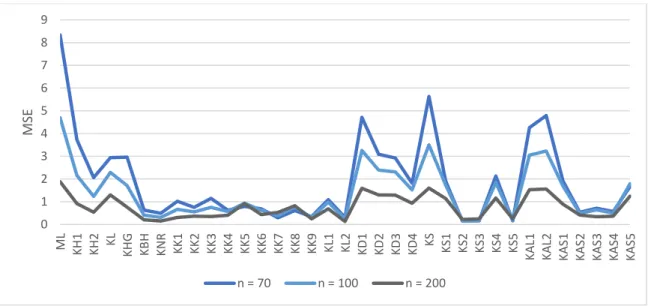
the performance based on MSE for different sample sizes with fixed p = 4, correlation coefficient
0.95 and intercept 0 is presented in the Figure 3.1.
Figure 3.1
.Performance of estimators as a function of sample size for p = 4, ρ =0.95, intercept = 0
Figure 3.1 shows that all RR estimators outperform the ML estimator in the sense of
smaller MSE for different sample sizes and it is evident the advantage of using logistic ridge
regression estimators over ML estimator when explanatory variables are correlated.
0 1 2 3 4 5 6 7 8 9 ML KH1 KH2 KL KHG KBH RKN KK1 KK2 KK3 KK4 KK5 KK6 KK7 KK8 KK9 KL1 KL2 KD1 KD2 KD3 KD4 KS 1KS KS2 KS3 KS4 KS5 KA L1 KA L2 KA S1 KA S2 KA S3 KA S4 KA S5 MSE n = 70 n = 100 n = 200
13
Furthermore, increasing sample size has a positive effect on the mean absolute percent
error (MAPE). In general, MAPE decreases as the number of observation increase with a few
exceptions. Graphical illustration of the performance based on MAPE for different sample sizes
with fixed p = 4, correlation coefficient 0.95 and intercept 0 is presented in the Figure 3.2.
Figure 3.2
. Performance of estimators as a function sample size for p = 4, ρ =0.95, intercept = 0
Figure 3.2 shows that all RR estimators outperform the ML estimator in terms of MAPE
for different sample sizes and it shows the advantage of using logistic ridge regression estimators
over ML estimator. The best RR estimators in terms of MAPE achieved when sample size is large,
in this case when n is 200.
3.2.2 Results as a function of ρ
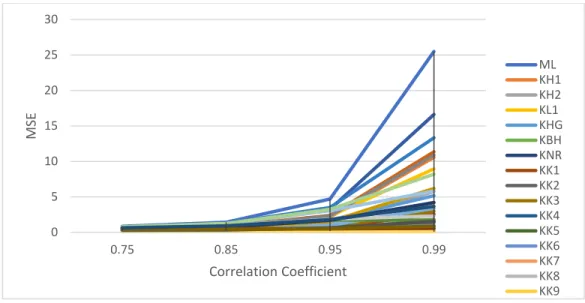
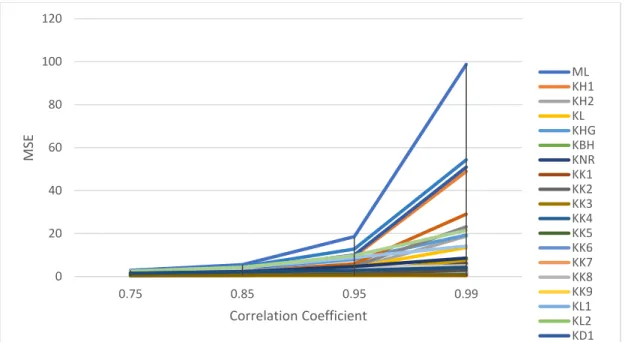
It is easy to see that MSEs for estimators of
k
increases as correlation coefficient increases.
For smaller correlation coefficient (ρ = 0.75 and ρ = 0.85), the MSEs are almost the same for any
sample size, an intercept and number of parameters. For given n = 100 and intercept 0, performance
of estimators as a function of the correlation between the explanatory variables for p = 4 and p = 8
is provided in Figure 3.3 – 3.4 and Figure 3.5 - 3.6, respectively.
0 0.5 1 1.5 2 2.5 ML KH1 KH2 KL KHG KBH KNR KK1 KK2 KK3 KK4 KK5 KK6 KK7 KK8 KK9 KL1 KL2 KD1 KD2 KD3 KD4 KS 1KS KS2 KS3 KS4 KS5 KA L1 KA L2 KA S1 KA S2 KA S3 KA S4 KA S5 MAPE n = 70 n = 100 n = 200
14
Figure 3.3.
Performance of the estimators as a function of ρ when p = 4, n = 100 and intercept = 0
Figure 3.4.
Performance of the selected estimators as a function of ρ when p = 4, n =100,intercept=0
0 5 10 15 20 25 30 0.75 0.85 0.95 0.99 MSE Correlation Coefficient ML KH1 KH2 KL1 KHG KBH KNR KK1 KK2 KK3 KK4 KK5 KK6 KK7 KK8 KK9 0 1 2 3 4 5 6 7 0.75 0.85 0.95 0.99 MSE Correlation Coefficient KL2 KBH KS2 KS3 KS5 KK1 KK9 KNR KAS3 KK3 KK4 KK6 KH2 KK2 KAS4
15
Figure 3.5.
Performance of the estimators as a function of ρ when p = 8, n = 100 and intercept = 0
Figure 3.6.
Performance of the selected estimators as a function of ρ when p = 8, n = 100 and
intercept = 0
0 20 40 60 80 100 120 0.75 0.85 0.95 0.99 MSE Correlation Coefficient ML KH1 KH2 KL KHG KBH KNR KK1 KK2 KK3 KK4 KK5 KK6 KK7 KK8 KK9 KL1 KL2 KD1 0 2 4 6 8 10 12 14 16 18 20 0.75 0.85 0.95 0.99 MSE Correlation Coefficient KH2 KBH KNR KK1 KK2 KK3 KK4 KK6 KK9 KL2 KS2 KS3 KS5 KAS3 KAS416
These figures show that as correlation increases the MSE also increases. Also, MSE of ML
estimator increases rapidly as correlation coefficient increase from 0.85 to 0.99. All the RR
estimators have smaller MSE compared with ML and they don’t change as rapidly as ML estimator.
3.2.3 Results as a function of p
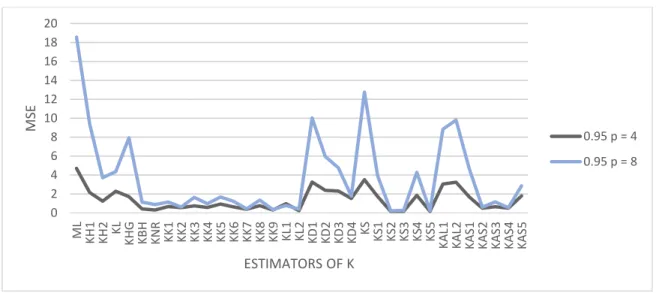
Overall, the MSE increases when more explanatory variables are included, disregarding
the fact that changing the number of explanatory variables from 4 to 8 the number of observations
is also changes. For given n = 100, intercept 0, and correlation coefficients 0.95, performance of
estimators as a function of the number of explanatory variables for p = 4 and p = 8 is provided in
Figure 3.7.
Figure 3.7
.Performance of the estimators as a function of p with ρ= 0.95, n= 100 and intercept = 0
From this figure 3.8, we observe that as the number of explanatory variables increases from
4 to 8, the MSE also increases. Also, as the number of explanatory variables increases proportion
for which ML estimator has bigger MSE than the other estimator decreases.
3.2.4 Results as function of the intercept
Since the value of the intercept is equal to the average value of the log odds ratio, then with
intercept equal to zero there is an equal probability of obtaining ones and zeros. With intercept
equal to 1 there is a greater probability of obtaining ones than zeros. Also, with intercept equal to
0 2 4 6 8 10 12 14 16 18 20 ML KH1 KH2 KL KHG KBH KN R KK1 KK2 KK3 KK4 KK5 KK6 KK7 KK8 KK9 KL1 2KL KD1 KD2 KD3 KD4 KS KS1 KS2 KS3 KS4 KS5 KAL1 KAL2 KAS1 KAS2 KAS3 KAS4 KAS5 MSE ESTIMATORS OF K 0.95 p = 4 0.95 p = 8
17
-1 there is a greater probability of obtaining zeros than ones. For given n = 100, p = 4, and
correlation coefficients 0.95, performance of estimators as a function of the log odds ratio is
provided in Figure 3.8.
Figure 3.8
. Performance of the estimators as a function of the intercept when ρ = 0.95, n = 100 and
p = 4.
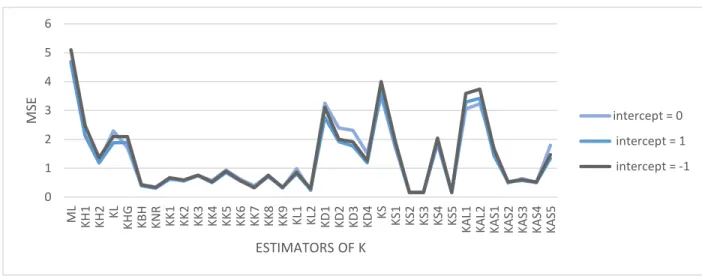
From Figure 3.8, we observe that changing the log odds from zero to 1 or -1 MSE increases
for the ML and the KD1 – KD3 and KAL1, KAL2. The MSEs for the other estimators are the same
or slightly decreases. Hence, these estimators are more robust to changes of the log odd ratio than
ML and the KD1 – KD3 and KAL1, KAL2.
3.3 Some Proposed New Estimators of k.
From the results analysis in section 3.2, it is evident that the following estimators: KHB, KNR,
KK2, KK4, KK6, KK7, KK9, KK12, KS2, KS5 are performing better than the rest of the estimators.
Thus, the following new estimators of
k
are proposed in this section:
1.
KN1 = Maximum (KHB, KNR, KK2, KK4, KK6, KK7, KK9, KK12, KS2, KS5)
2.
KN2 = Arithmetic mean of (KHB, KNR, KK2, KK4, KK6, KK7, KK9, KK12, KS2, KS5)
3.
KN3 = Median (KHB, KNR, KK2, KK4, KK6, KK7, KK9, KK12, KS2, KS5)
4.
KN4 = Harmonic mean (KHB, KNR, KK2, KK4, KK6, KK7, KK9, KK12, KS2, KS5)
0 1 2 3 4 5 6 ML KH1 KH2 KL KHG KBH RKN KK1 KK2 KK3 KK4 KK5 KK6 KK7 KK8 KK9 KL1 KL2 KD1 KD2 KD3 KD4 KS KS1 KS2 KS3 KS4 KS5 KA L1 KA L2 KA S1 KA S2 KA S3 KA S4 KA S5 MSE ESTIMATORS OF K intercept = 0 intercept = 1 intercept = -118
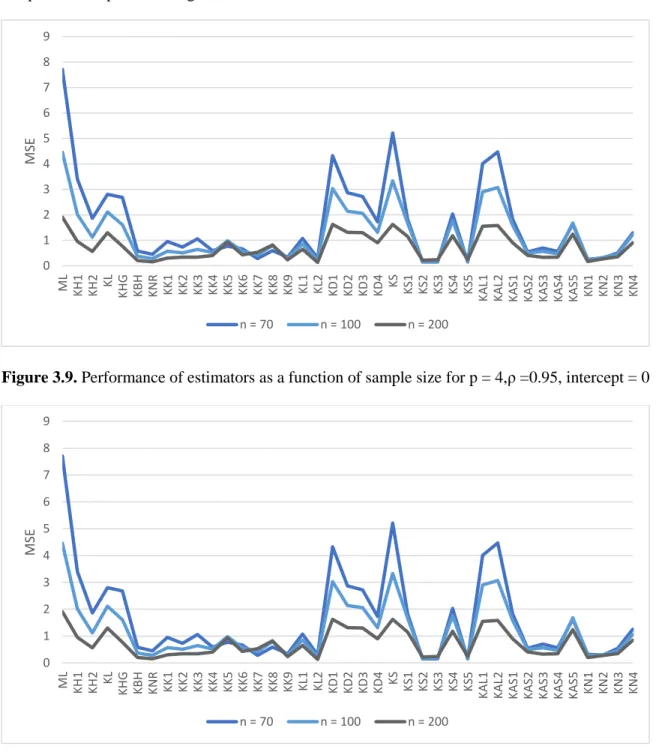
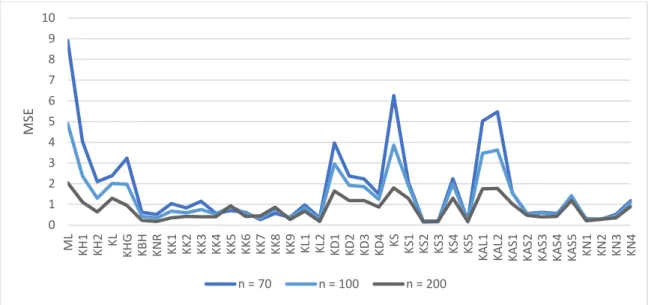
The MSEs values for n = 70, 100, and 200, ρ = 0.95 and p = 4 are reported for different values
of intercept in table A4. Also, performance of estimators including new estimators as a function of
sample size are plotted in Figures 3.9 – 3.11.
Figure 3.9.
Performance of estimators as a function of sample size for p = 4,ρ =0.95, intercept = 0
Figure 3.10
.Performance of estimators as a function of sample size for p = 4,ρ =0.95,intercept = 1
0 1 2 3 4 5 6 7 8 9 ML KH1 KH2 KL KHG KBH RKN KK1 KK2 KK3 KK4 KK5 KK6 KK7 KK8 KK9 KL1 KL2 KD1 KD2 KD3 KD4 KS KS1 KS2 KS3 KS4 KS5 KA L1 KA L2 KA S1 KA S2 KA S3 KA S4 KA S5 KN 1 KN 2 KN 3 KN 4 MSE n = 70 n = 100 n = 200 0 1 2 3 4 5 6 7 8 9 ML KH1 KH2 KL KHG KBH KNR KK1 KK2 KK3 KK4 KK5 KK6 KK7 KK8 KK9 KL1 KL2 KD1 KD2 KD3 KD4 KS KS1 KS2 KS3 KS4 KS5 L1KA KAL2 KAS1 KAS2 KAS3 KAS4 KAS5 KN 1 KN 2 KN 3 KN 4 MSE n = 70 n = 100 n = 200
19
Figure 3.11
.Performance of estimators as a function of sample size for p= 4,ρ =0.95,intercept = -1
It appears from Figures 3.9 – 3.11 and Tables in A.4, that all new proposed estimators
performed better in the sense of smaller MSE compare to the rest of the estimators. The estimator,
KN3 performed the best among proposed five and rest of the estimators.
0 1 2 3 4 5 6 7 8 9 10 ML KH1 KH2 KL KHG KBH KNR KK1 KK2 KK3 KK4 KK5 KK6 KK7 KK8 KK9 KL1 KL2 KD1 KD2 KD3 KD4 KS KS1 2KS KS3 KS4 KS5 KAL1 KAL2 KA S1 KA S2 KA S3 KA S4 KA S5 KN 1 KN 2 KN 3 KN 4 MSE n = 70 n = 100 n = 200
20
CHAPTER IV
APPLICATION
To illustrate the findings of this thesis, we consider the data, which have been taken from
survey of 659 registered leisure boat owners in 23 counties of East Texas collected by Sellar, Stoll
and Chavas (1985). We consider the following logistic regression model
Y =
exp(β0+X1β1+X2β2+X3β3+X4β4+X5β5)
1+exp(β0+X1β1+X2β2+X3β3+X4β4+X5β5)
,
(4.1)
where Y is defined as 0, if survey participant has not taken a recreational trip and 1, otherwise. X
1is the facility's subjective quality ranking, X
2is the respondent's taste for water-skiing, X
3is travel
cost to Lake Conroe, X
4is travel cost to Lake Somerville, X
5is travel cost to Lake Houston. The
correlation matrix of the variables in model (4.1) is presented in Table 4.1 (see Shiferaw Gurmu,
1996)
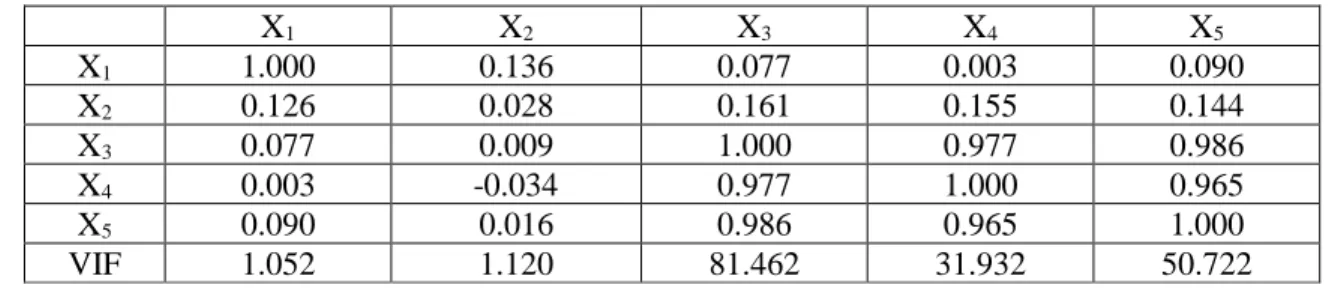
Table 4.1
. Correlation among the variables with corresponding VIF
X
1X
2X
3X
4X
5X
11.000
0.136
0.077
0.003
0.090
X
20.126
0.028
0.161
0.155
0.144
X
30.077
0.009
1.000
0.977
0.986
X
40.003
-0.034
0.977
1.000
0.965
X
50.090
0.016
0.986
0.965
1.000
VIF
1.052
1.120
81.462
31.932
50.722
It is observed from Table 4.1 that the explanatory variables X
3, X
4, X
5are highly
correlated. Also, variance inflation factors for X
3, X
4, X
5are 81, 31, and 50 respectively.
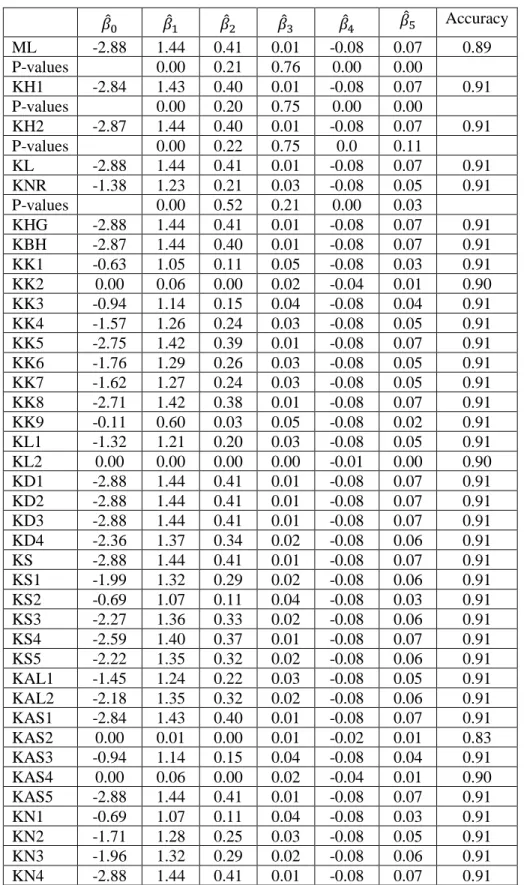
It implies the existence of multicollinearity problem in the data set. The estimated predicted proba
bility along with the ridge regression coefficients of the estimators are presented in Table 4.2. I als
o provided the p-values for testing the significance of regression parameters of the following estim
ators: ML, KH1, KH2 and KNR. From Table 4.2, we observed that all ridge regression estimators
have higher prediction accuracy than that of ML estimator, which supported our findings from sim
ulation study in Chapter 3.
21
Table 4.2.
The MSEs along with the ridge regression coefficients of the estimators
𝛽̂
0𝛽̂
1𝛽̂
2𝛽̂
3𝛽̂
4𝛽̂
5Accuracy
ML
-2.88
1.44
0.41
0.01
-0.08
0.07
0.89
P-values
0.00
0.21
0.76
0.00
0.00
KH1
-2.84
1.43
0.40
0.01
-0.08
0.07
0.91
P-values
0.00
0.20
0.75
0.00
0.00
KH2
-2.87
1.44
0.40
0.01
-0.08
0.07
0.91
P-values
0.00
0.22
0.75
0.0
0.11
KL
-2.88
1.44
0.41
0.01
-0.08
0.07
0.91
KNR
-1.38
1.23
0.21
0.03
-0.08
0.05
0.91
P-values
0.00
0.52
0.21
0.00
0.03
KHG
-2.88
1.44
0.41
0.01
-0.08
0.07
0.91
KBH
-2.87
1.44
0.40
0.01
-0.08
0.07
0.91
KK1
-0.63
1.05
0.11
0.05
-0.08
0.03
0.91
KK2
0.00
0.06
0.00
0.02
-0.04
0.01
0.90
KK3
-0.94
1.14
0.15
0.04
-0.08
0.04
0.91
KK4
-1.57
1.26
0.24
0.03
-0.08
0.05
0.91
KK5
-2.75
1.42
0.39
0.01
-0.08
0.07
0.91
KK6
-1.76
1.29
0.26
0.03
-0.08
0.05
0.91
KK7
-1.62
1.27
0.24
0.03
-0.08
0.05
0.91
KK8
-2.71
1.42
0.38
0.01
-0.08
0.07
0.91
KK9
-0.11
0.60
0.03
0.05
-0.08
0.02
0.91
KL1
-1.32
1.21
0.20
0.03
-0.08
0.05
0.91
KL2
0.00
0.00
0.00
0.00
-0.01
0.00
0.90
KD1
-2.88
1.44
0.41
0.01
-0.08
0.07
0.91
KD2
-2.88
1.44
0.41
0.01
-0.08
0.07
0.91
KD3
-2.88
1.44
0.41
0.01
-0.08
0.07
0.91
KD4
-2.36
1.37
0.34
0.02
-0.08
0.06
0.91
KS
-2.88
1.44
0.41
0.01
-0.08
0.07
0.91
KS1
-1.99
1.32
0.29
0.02
-0.08
0.06
0.91
KS2
-0.69
1.07
0.11
0.04
-0.08
0.03
0.91
KS3
-2.27
1.36
0.33
0.02
-0.08
0.06
0.91
KS4
-2.59
1.40
0.37
0.01
-0.08
0.07
0.91
KS5
-2.22
1.35
0.32
0.02
-0.08
0.06
0.91
KAL1
-1.45
1.24
0.22
0.03
-0.08
0.05
0.91
KAL2
-2.18
1.35
0.32
0.02
-0.08
0.06
0.91
KAS1
-2.84
1.43
0.40
0.01
-0.08
0.07
0.91
KAS2
0.00
0.01
0.00
0.01
-0.02
0.01
0.83
KAS3
-0.94
1.14
0.15
0.04
-0.08
0.04
0.91
KAS4
0.00
0.06
0.00
0.02
-0.04
0.01
0.90
KAS5
-2.88
1.44
0.41
0.01
-0.08
0.07
0.91
KN1
-0.69
1.07
0.11
0.04
-0.08
0.03
0.91
KN2
-1.71
1.28
0.25
0.03
-0.08
0.05
0.91
KN3
-1.96
1.32
0.29
0.02
-0.08
0.06
0.91
KN4
-2.88
1.44
0.41
0.01
-0.08
0.07
0.91
22
CHAPTER V
SUMMARY AND CORRESPONDING REMARKS
In this thesis, we investigated some ridge regression (RR) estimators for estimating the
ridge regression parameter
k
for logistic regression model when the explanatory variables are highly
correlated. Since a theoretical comparison among the estimators is not possible, a Monto Carlo
simulation study has been conducted to compare the performance of the proposed ridge regression
estimators. In simulation, we evaluated proposed estimators of
k
for different experimental
conditions: the degree of correlation, sample size, the number of independent variables, and the log
odds ratio. For each combination of parameters, we performed 2000 replications. The evaluation
of the performance of these estimators has been done by using the MSE, MAPE, the magnitude of
bias, and the proportion of times the ML outperforms the RR estimators.
The simulation results show that the increase of the correlation among the explanatory
variables and the number of independent variables have a negative effect on the performance of the
estimators, the MSE and MAPE increases. In most of the cases, RR estimators outperform ML
estimator even when the correlation between the explanatory variables are large. When the sample
size increases the MSEs as well as MAPE decreases for all estimators including ML estimator. The
analysis of the log odds ratio reveals that majority of estimators are robust to changes of the log
odds ratio with few exceptions. The top ten estimators of
k
from our simulation study are KHB,
KNR, KK2, KK4, KK6, KK7, KK9, KK12, KS2, KS5. Also, new proposed estimators based on
top ten estimators have performed well compared to other estimators. Furthermore, the analysis
from real data supported the results from simulation study to some extent.
23
The following estimators KBH, KNR, KK2, KK6, KK7, KL2, KS2, KS5, KN1, KN2, KN3
are recommending for the practitioners for using them when they analysis data with
multicollinearity problem.
We have considered the logistic regression model. As a future research, this can further be
extended for the following models:
(i)
Two parameters logistic regression model. That means, a model with both ridge
regression estimator and Liu (1993) estimator.
(ii)
Ridge Regression Based on Some Robust Estimators (see Samkar and Alpu, 2010).
(iii)
Ridge regression estimators for the restricted linear model.
24
REFERENCES
1.
Alkhamisi M.A., G. Shukur.A. (2007). “Monte Carlo study of recent ridge parameters”.
Communications in Statistics – Simulation and Computation, 36 (3), pp. 535-547.
2.
Alkhamisi M.A., Mahdi & Khalaf, Ghadban & Shukur, Ghazi. (2006). “Some Modifications for
Choosing Ridge Parameters”. Communications in Statistics. Theory and Methods. 35(11), pp.
2005-2020.
3.
Asar, Y and Genc, A. (2017). “A note on some new modifications of ridge estimators”. Kuwait J.
Sci. 44 (3)
pp. 75-82.
4.
Batah, F. S.M., Ramanathan, T.V., Gore, S.D. (2008). “The efficiency of modified Jack-knife and
ridge type regression estimators: a comparison”. Surveys in Mathematics and its Applications. 3,pp.
111 – 122.
5.
Dorugade A.V. (2013). “New ridge parameters for ridge regression”. Journal of the Association
of Arab Universities for Basic and Applied Sciences. 15, 94-99.
6.
Hocking R.R., F.M. Speed, M.J. Lynn. (1976) “A class of biased estimators in linear regression”.
Technometrics, 18 (4) , pp 425-437.
7.
Hoerl, Arthur E., and Robert W. Kennard (1970). “Ridge regression: Biased Estimation for
Nonorthogonal Problems”. Technometrics. 12(1), pp. 55 – 67.
8.
Hoerl, Arthur E., Robert W. Kannard & Kent F. Baldwin. (1975) “Ridge regression:some
simulations.” Communications in Statistics . 4(2), pp. 105 – 123.
9.
Kibria B. M. G. (2003). “Performance of Some New Ridge Regression Estimators” .
Communications in Statistics- Theory and Methods. 32(2), pp. 419 – 435.
10. Kibria, B. M. Golam and Banik, Shipra (2016). “Some Ridge Regression Estimators and Their
Performances.” Journal of Modern Applied Statistical Methods. 15(1), Article 12, pp. 206-238.
11. Lawless, J. F., Wang, P. (1976). “A simulation study of ridge and other regression estimators”.
Communications in Statistics—Theory and Methods. 5, pp. 307–323.
12. A. H. Lee & M. J. Silvapulle (1998). “Ridge estimation in logistic regression”. Communications in
Statistics - Simulation and Computation, 17(4), pp.1231-1257
13. Liu, K. (1993). “A new class of biased estimate in linear regression”. Communications in
Statistics: Theory and Methods. 22, pp. 393–402.
25
14. Lukman, A. F., Ayinde, K., & Ajiboye, A. S. (2017). “Monte Carlo study of some
classification-based ridge parameter estimators”. Journal of Modern Applied Statistical Methods, 16(1), pp.
428-451.
15. Månsson K., Shukur G. (2011).” On Ridge Parameters in Logistic Regression”. Communications
in Statistics - Theory and Methods . 40(18), pp. 3366-3381.
16.
Månsson, K, Shukur, G. and Kibria, B. M. G. (2017). “Performance of Some Ridge Regression
Estimators for the Multinomial Logit Model”. Communications in Statistics-Theory and
Methods.
17. Muniz, Gisela and Kibria, B.M. Golam (2009). “On Some Ridge Regression Estimators: An
Empirical Comparisons”. Communications in Statistics- Theory and Methods. 38 (3), pp. 621 - 630
18. Muniz, Gisela; Kibria, B.M. Goam; and Shukur, Ghazi. (2012). “On Developing Ridge Regression
Parameters: A Graphical investigation”. Department of Mathematics and Statistics. 10, pp. 1 – 25.
19. Nomura M.(1988) “ On the almost unbiased ridge regression estimator”. Communications in
Statistics - Simulation and Computation . 17(3), pp. 729 – 743.
20. Sellar, C., Stoll, J. R., and Chavas, J. P. (1985), “Validation of Empirical Measures of Welfare
Change: A Comparison of Nonmarket Techniques.” Land Economics, 61, 156-175.
21. Samkar, Hatice and Alpu, Ozlem (2010) "Ridge Regression Based on Some Robust Estimators,"
Journal of Modern Applied Statistical Methods. 9(2),Article 17, pp. 495-501
22. Schaefer R.L., L.D. Roi & R.A. Wolfe (1984).“A ridge logistic estimator”. Communications in
Statistics - Theory and Methods . 1391). pp. 100-112
23. Shiferaw Gurmu and Pravin K. Trivedi (1996). “Excess Zeros in Count Models for Recreational
Trips. Journal of Business & Economic Statistics”.14(4), pp. 469-47.
26
APPENDICES
Table A1.
Estimated MSEs, MAPEs, Bias and proportion of times in simulation when the ridge
regression estimator produces a higher MSE than the ML estimator of the proposed estimators
with intercept = 0 for the following cases:
p = 4, ρ =0.75
n = 70 n = 100 n = 200
MSE Bias MAPE Pr. MSE Bias MAPE Pr. MSE Bias MAPE Pr.
ML 1.40 0.00 0.91 0.00 0.84 0.00 0.72 0.00 0.36 0.00 0.48 0.00 KH1 0.75 0.20 0.65 0.02 0.49 0.16 0.54 0.03 0.26 0.10 0.40 0.04 KH2 0.47 0.37 0.52 0.04 0.33 0.31 0.45 0.05 0.19 0.20 0.34 0.07 KL 0.92 0.11 0.73 0.01 0.67 0.06 0.64 0.02 0.34 0.02 0.46 0.02 KHG 0.85 0.15 0.70 0.01 0.56 0.12 0.58 0.03 0.28 0.07 0.42 0.03 KBH 0.24 0.68 0.42 0.09 0.20 0.63 0.38 0.12 0.13 0.50 0.30 0.17 KNR 0.31 0.98 0.51 0.09 0.29 0.99 0.50 0.12 0.26 0.96 0.48 0.17 KK1 0.35 0.69 0.49 0.11 0.28 0.62 0.44 0.14 0.17 0.46 0.34 0.18 KK2 0.48 1.09 0.62 0.23 0.43 1.05 0.59 0.31 0.34 0.90 0.50 0.43 KK3 0.39 0.68 0.51 0.11 0.30 0.61 0.45 0.14 0.19 0.45 0.36 0.18 KK4 0.35 0.37 0.47 0.03 0.30 0.30 0.43 0.04 0.19 0.18 0.35 0.05 KK5 0.73 0.10 0.69 0.01 0.61 0.06 0.62 0.01 0.32 0.02 0.45 0.02 KK6 0.38 0.36 0.48 0.03 0.31 0.28 0.44 0.04 0.20 0.17 0.35 0.05 KK7 0.45 0.21 0.55 0.01 0.44 0.12 0.54 0.02 0.28 0.05 0.42 0.02 KK8 0.67 0.12 0.66 0.01 0.57 0.07 0.61 0.02 0.31 0.03 0.45 0.02 KK9 0.33 0.78 0.49 0.12 0.28 0.69 0.45 0.16 0.19 0.50 0.36 0.19 KL1 0.52 0.92 0.62 0.18 0.44 0.78 0.56 0.22 0.29 0.50 0.44 0.23 KL2 0.22 0.60 0.39 0.02 0.18 0.50 0.34 0.03 0.12 0.40 0.28 0.09 KD1 0.94 0.11 0.74 0.01 0.67 0.06 0.64 0.02 0.34 0.02 0.46 0.02 KD2 0.68 0.28 0.63 0.04 0.53 0.18 0.56 0.04 0.30 0.06 0.43 0.04 KD3 0.65 0.27 0.61 0.03 0.51 0.17 0.55 0.03 0.30 0.06 0.43 0.03 KD4 0.56 0.63 0.60 0.12 0.46 0.51 0.55 0.13 0.29 0.30 0.43 0.14 KS 1.23 0.03 0.86 0.01 0.77 0.02 0.69 0.01 0.35 0.01 0.47 0.02 KS1 0.92 0.08 0.75 0.01 0.65 0.05 0.64 0.02 0.32 0.02 0.45 0.02 KS2 0.23 0.43 0.38 0.02 0.24 0.30 0.39 0.03 0.19 0.15 0.35 0.04 KS3 0.24 0.41 0.39 0.02 0.24 0.29 0.40 0.03 0.19 0.14 0.35 0.04 KS4 0.93 0.08 0.76 0.01 0.66 0.05 0.64 0.02 0.32 0.02 0.45 0.02 KS5 0.24 0.41 0.39 0.02 0.24 0.29 0.39 0.03 0.19 0.14 0.35 0.04 KAL1 1.19 0.03 0.85 0.01 0.76 0.02 0.69 0.01 0.35 0.01 0.47 0.02 KAL2 1.21 0.03 0.85 0.01 0.77 0.02 0.69 0.01 0.35 0.01 0.47 0.02 KAS1 0.65 0.22 0.61 0.02 0.47 0.17 0.53 0.03 0.25 0.10 0.40 0.04 KAS2 0.59 1.38 0.72 0.32 0.56 1.35 0.69 0.43 0.48 1.21 0.63 0.60 KAS3 0.37 0.69 0.50 0.11 0.29 0.61 0.45 0.14 0.19 0.45 0.36 0.18 KAS4 0.48 1.09 0.62 0.23 0.43 1.05 0.58 0.31 0.34 0.90 0.50 0.43 KAS5 0.79 0.14 0.69 0.01 0.63 0.07 0.62 0.02 0.34 0.02 0.46 0.02
27
p = 4, ρ =0.85
n = 70 n = 100 n = 200
MSE Bias MAPE Pr. MSE Bias MAPE Pr. MSE Bias MAPE Pr.
ML 2.37 0.00 1.17 0.00 1.42 0.00 0.93 0.00 0.60 0.00 0.61 0.00 KH1 1.18 0.16 0.78 0.01 0.76 0.14 0.65 0.01 0.37 0.10 0.47 0.02 KH2 0.67 0.31 0.59 0.02 0.47 0.26 0.51 0.02 0.25 0.19 0.39 0.03 KL 1.26 0.13 0.83 0.00 0.98 0.07 0.76 0.01 0.53 0.02 0.57 0.01 KHG 1.25 0.14 0.81 0.00 0.82 0.12 0.68 0.01 0.40 0.08 0.49 0.01 KBH 0.26 0.54 0.41 0.03 0.21 0.50 0.37 0.04 0.13 0.42 0.30 0.08 KNR 0.27 0.80 0.46 0.03 0.23 0.79 0.43 0.04 0.19 0.77 0.40 0.08 KK1 0.40 0.60 0.50 0.06 0.31 0.54 0.45 0.07 0.18 0.40 0.35 0.08 KK2 0.49 1.02 0.61 0.14 0.43 0.97 0.58 0.20 0.32 0.84 0.49 0.28 KK3 0.46 0.60 0.53 0.06 0.35 0.53 0.47 0.08 0.21 0.40 0.36 0.09 KK4 0.40 0.34 0.49 0.01 0.36 0.27 0.46 0.02 0.25 0.16 0.39 0.02 KK5 0.87 0.12 0.75 0.00 0.80 0.06 0.72 0.01 0.49 0.02 0.56 0.01 KK6 0.43 0.33 0.51 0.01 0.39 0.25 0.48 0.02 0.26 0.15 0.40 0.02 KK7 0.45 0.23 0.54 0.00 0.50 0.13 0.57 0.01 0.39 0.05 0.50 0.01 KK8 0.76 0.13 0.71 0.00 0.72 0.08 0.69 0.01 0.47 0.03 0.55 0.01 KK9 0.32 0.73 0.48 0.06 0.29 0.64 0.45 0.08 0.20 0.46 0.36 0.09 KL1 0.57 0.88 0.63 0.11 0.50 0.73 0.59 0.14 0.34 0.45 0.47 0.13 KL2 0.23 0.66 0.40 0.01 0.18 0.55 0.34 0.01 0.12 0.41 0.28 0.04 KD1 1.45 0.10 0.90 0.00 1.07 0.06 0.79 0.01 0.54 0.02 0.58 0.01 KD2 0.98 0.25 0.72 0.01 0.81 0.16 0.68 0.02 0.47 0.06 0.53 0.01 KD3 0.90 0.24 0.70 0.01 0.78 0.15 0.66 0.01 0.46 0.05 0.53 0.01 KD4 0.68 0.60 0.64 0.07 0.60 0.48 0.61 0.08 0.38 0.26 0.48 0.07 KS 1.96 0.02 1.07 0.00 1.25 0.02 0.87 0.01 0.56 0.01 0.59 0.01 KS1 1.23 0.08 0.88 0.00 0.95 0.05 0.77 0.01 0.50 0.02 0.56 0.01 KS2 0.21 0.43 0.36 0.00 0.23 0.30 0.38 0.01 0.23 0.15 0.38 0.01 KS3 0.22 0.41 0.37 0.00 0.24 0.29 0.39 0.01 0.23 0.15 0.39 0.01 KS4 1.27 0.07 0.89 0.00 0.97 0.05 0.77 0.01 0.50 0.02 0.56 0.01 KS5 0.22 0.41 0.37 0.00 0.24 0.29 0.39 0.01 0.23 0.15 0.39 0.01 KAL1 1.83 0.03 1.04 0.00 1.22 0.02 0.86 0.01 0.56 0.01 0.59 0.01 KAL2 1.88 0.03 1.05 0.00 1.23 0.02 0.87 0.01 0.56 0.01 0.59 0.01 KAS1 0.90 0.19 0.71 0.01 0.70 0.15 0.63 0.01 0.37 0.10 0.47 0.02 KAS2 0.57 1.32 0.70 0.20 0.53 1.27 0.67 0.28 0.45 1.16 0.61 0.43 KAS3 0.40 0.61 0.51 0.06 0.33 0.53 0.46 0.08 0.20 0.40 0.36 0.10 KAS4 0.47 1.03 0.61 0.14 0.43 0.97 0.58 0.20 0.32 0.84 0.49 0.28 KAS5 1.00 0.15 0.76 0.00 0.90 0.08 0.73 0.01 0.52 0.02 0.57 0.01
28
p = 4, ρ =0.95
n = 70 n = 100 n = 200
MSE Bias MAPE Pr. MSE Bias MAPE Pr. MSE Bias MAPE Pr.
ML 8.34 0.00 2.19 0.00 4.70 0.00 1.67 0.00 1.88 0.00 1.07 0.00 KH1 3.72 0.09 1.33 0.00 2.15 0.08 1.04 0.00 0.92 0.07 0.70 0.00 KH2 2.06 0.17 0.95 0.00 1.23 0.16 0.76 0.01 0.54 0.13 0.53 0.00 KL 2.94 0.12 1.17 0.00 2.29 0.08 1.08 0.00 1.30 0.03 0.86 0.00 KHG 2.96 0.12 1.17 0.00 1.71 0.11 0.92 0.00 0.76 0.09 0.63 0.00 KBH 0.63 0.28 0.56 0.00 0.41 0.27 0.46 0.01 0.20 0.24 0.33 0.01 KNR 0.49 0.43 0.50 0.00 0.31 0.44 0.42 0.01 0.15 0.43 0.31 0.01 KK1 1.02 0.37 0.67 0.01 0.66 0.35 0.57 0.02 0.31 0.31 0.41 0.02 KK2 0.75 0.77 0.66 0.03 0.55 0.73 0.58 0.05 0.36 0.70 0.49 0.10 KK3 1.15 0.37 0.71 0.01 0.75 0.37 0.61 0.02 0.35 0.32 0.43 0.02 KK4 0.62 0.24 0.58 0.00 0.57 0.19 0.56 0.00 0.40 0.13 0.47 0.00 KK5 0.79 0.15 0.72 0.00 0.93 0.09 0.78 0.00 0.92 0.03 0.78 0.00 KK6 0.69 0.23 0.61 0.00 0.62 0.19 0.58 0.00 0.43 0.13 0.49 0.00 KK7 0.29 0.28 0.43 0.00 0.39 0.17 0.51 0.00 0.53 0.06 0.59 0.00 KK8 0.61 0.18 0.63 0.00 0.76 0.10 0.71 0.00 0.82 0.04 0.73 0.00 KK9 0.34 0.59 0.48 0.01 0.31 0.50 0.44 0.02 0.24 0.39 0.38 0.02 KL1 1.09 0.68 0.75 0.02 0.98 0.54 0.71 0.04 0.69 0.39 0.61 0.04 KL2 0.31 0.93 0.50 0.00 0.23 0.77 0.43 0.00 0.13 0.55 0.30 0.01 KD1 4.71 0.06 1.56 0.00 3.25 0.04 1.34 0.00 1.59 0.01 0.97 0.00 KD2 3.09 0.15 1.20 0.00 2.39 0.11 1.09 0.00 1.30 0.05 0.85 0.00 KD3 2.92 0.14 1.16 0.00 2.31 0.09 1.08 0.00 1.29 0.04 0.85 0.00 KD4 1.81 0.45 0.91 0.01 1.52 0.33 0.85 0.02 0.93 0.23 0.71 0.02 KS 5.63 0.02 1.79 0.00 3.50 0.02 1.44 0.00 1.60 0.01 0.99 0.00 KS1 1.91 0.07 1.11 0.00 1.73 0.05 1.04 0.00 1.14 0.02 0.84 0.00 KS2 0.15 0.44 0.30 0.00 0.16 0.30 0.32 0.00 0.22 0.14 0.38 0.00 KS3 0.16 0.40 0.31 0.00 0.18 0.28 0.34 0.00 0.24 0.14 0.39 0.00 KS4 2.13 0.07 1.16 0.00 1.84 0.05 1.07 0.00 1.16 0.02 0.85 0.00 KS5 0.16 0.41 0.31 0.00 0.18 0.28 0.33 0.00 0.24 0.14 0.39 0.00 KAL1 4.26 0.03 1.61 0.00 3.05 0.02 1.36 0.00 1.53 0.01 0.97 0.00 KAL2 4.79 0.03 1.68 0.00 3.23 0.02 1.40 0.00 1.56 0.01 0.98 0.00 KAS1 1.92 0.12 1.03 0.00 1.69 0.09 0.95 0.00 0.89 0.07 0.69 0.00 KAS2 0.54 1.07 0.64 0.04 0.49 1.03 0.61 0.08 0.41 0.99 0.56 0.16 KAS3 0.71 0.39 0.62 0.01 0.64 0.37 0.58 0.02 0.34 0.32 0.43 0.02 KAS4 0.57 0.78 0.61 0.03 0.50 0.73 0.57 0.05 0.36 0.70 0.49 0.10 KAS5 1.66 0.15 0.95 0.00 1.79 0.09 0.98 0.00 1.24 0.03 0.84 0.00
29
p = 4, ρ =0.99
n = 70 n = 100 n = 200
MSE Bias MAPE Pr. MSE Bias MAPE Pr. MSE Bias MAPE Pr.
ML 40.12 0.00 4.76 0.00 25.49 0.00 3.88 0.00 10.39 0.00 2.49 0.00 KH1 16.51 0.03 2.69 0.00 10.57 0.03 2.22 0.00 4.42 0.03 1.44 0.00 KH2 8.91 0.06 1.89 0.00 5.76 0.05 1.57 0.00 2.46 0.05 1.03 0.00 KL 10.20 0.09 1.97 0.00 8.94 0.05 1.95 0.00 5.28 0.03 1.60 0.00 KHG 7.72 0.09 1.68 0.00 5.15 0.08 1.41 0.00 2.11 0.08 0.92 0.00 KBH 2.74 0.08 1.11 0.00 1.81 0.07 0.92 0.00 0.82 0.08 0.62 0.00 KNR 2.54 0.15 0.98 0.00 1.57 0.14 0.79 0.00 0.62 0.15 0.51 0.00 KK1 4.00 0.15 1.18 0.00 2.54 0.14 0.98 0.00 1.14 0.14 0.67 0.00 KK2 2.23 0.46 0.87 0.00 1.36 0.45 0.74 0.00 0.70 0.44 0.56 0.01 KK3 4.64 0.16 1.27 0.00 2.96 0.16 1.05 0.00 1.26 0.15 0.71 0.00 KK4 0.88 0.13 0.67 0.00 0.84 0.10 0.66 0.00 0.70 0.07 0.59 0.00 KK5 0.22 0.23 0.36 0.00 0.34 0.14 0.44 0.00 0.71 0.05 0.67 0.00 KK6 1.02 0.12 0.72 0.00 0.95 0.10 0.70 0.00 0.77 0.07 0.62 0.00 KK7 0.12 0.43 0.28 0.00 0.10 0.27 0.25 0.00 0.21 0.10 0.37 0.00 KK8 0.16 0.27 0.31 0.00 0.23 0.17 0.36 0.00 0.51 0.06 0.57 0.00 KK9 0.36 0.40 0.45 0.00 0.33 0.34 0.43 0.00 0.28 0.27 0.38 0.00 KL1 3.66 0.41 1.10 0.00 3.37 0.34 1.11 0.00 2.62 0.24 1.02 0.00 KL2 0.57 1.41 0.73 0.00 0.50 1.32 0.67 0.00 0.31 1.01 0.52 0.00 KD1 21.40 0.02 3.24 0.00 16.61 0.01 2.95 0.00 8.37 0.01 2.15 0.00 KD2 13.48 0.06 2.43 0.00 11.35 0.04 2.29 0.00 6.52 0.02 1.82 0.00 KD3 12.58 0.05 2.35 0.00 10.88 0.03 2.26 0.00 6.46 0.02 1.82 0.00 KD4 6.99 0.25 1.58 0.00 6.18 0.20 1.56 0.00 4.13 0.14 1.35 0.00 KS 19.62 0.01 3.16 0.00 13.32 0.01 2.70 0.00 6.38 0.01 1.92 0.00 KS1 1.47 0.06 0.97 0.00 1.71 0.04 1.05 0.00 1.88 0.02 1.09 0.00 KS2 0.12 0.51 0.30 0.00 0.07 0.35 0.22 0.00 0.09 0.15 0.24 0.00 KS3 0.10 0.43 0.26 0.00 0.08 0.29 0.21 0.00 0.11 0.13 0.27 0.00 KS4 2.17 0.05 1.15 0.00 2.30 0.03 1.20 0.00 2.19 0.02 1.16 0.00 KS5 0.10 0.43 0.26 0.00 0.07 0.30 0.21 0.00 0.11 0.13 0.26 0.00 KAL1 6.46 0.02 1.95 0.00 5.81 0.02 1.90 0.00 4.33 0.01 1.64 0.00 KAL2 10.06 0.02 2.38 0.00 8.18 0.01 2.20 0.00 5.10 0.01 1.75 0.00 KAS1 3.14 0.05 1.34 0.00 4.19 0.04 1.52 0.00 3.53 0.03 1.32 0.00 KAS2 0.57 0.71 0.59 0.01 0.56 0.69 0.58 0.01 0.45 0.68 0.51 0.02 KAS3 1.35 0.18 0.82 0.00 1.54 0.16 0.84 0.00 1.10 0.15 0.68 0.00 KAS4 0.80 0.48 0.65 0.00 0.85 0.45 0.65 0.00 0.64 0.45 0.55 0.01 KAS5 2.40 0.11 1.10 0.00 3.65 0.06 1.36 0.00 4.12 0.03 1.44 0.00
30
p = 8, ρ =0.75
n = 70 n = 100 n = 200
MSE Bias MAPE Pr. MS
E Bia
s MAPE Pr. MSE Bias MAPE Pr.
ML 208.80 0.00 2.22 0.00 2.87 0.00 1.29 0.00 1.04 0.00 0.80 0.00 KH1 3.38 0.20 1.28 0.00 1.62 0.18 0.95 0.00 0.70 0.13 0.65 0.00 KH2 1.21 0.47 0.80 0.00 0.72 0.43 0.64 0.00 0.38 0.33 0.48 0.00 KL 2.43 0.22 1.17 0.00 1.74 0.13 1.01 0.00 0.89 0.04 0.74 0.00 KHG 4.10 0.13 1.45 0.00 2.01 0.10 1.07 0.00 0.83 0.07 0.71 0.00 KBH 0.39 0.82 0.49 0.00 0.28 0.81 0.43 0.00 0.18 0.72 0.35 0.01 KNR 0.35 1.13 0.51 0.00 0.29 1.20 0.48 0.00 0.25 1.26 0.46 0.01 KK1 0.47 0.96 0.55 0.00 0.35 0.92 0.49 0.01 0.23 0.77 0.39 0.02 KK2 0.61 1.85 0.73 0.03 0.56 1.83 0.69 0.07 0.48 1.71 0.64 0.23 KK3 0.62 0.81 0.60 0.00 0.43 0.78 0.52 0.00 0.26 0.64 0.41 0.01 KK4 0.57 0.58 0.60 0.00 0.52 0.47 0.57 0.00 0.39 0.30 0.49 0.00 KK5 1.71 0.23 1.05 0.00 1.60 0.11 1.01 0.00 0.89 0.03 0.75 0.00 KK6 0.69 0.52 0.65 0.00 0.62 0.42 0.62 0.00 0.44 0.26 0.52 0.00 KK7 0.70 0.49 0.67 0.00 0.83 0.27 0.74 0.00 0.69 0.09 0.67 0.00 KK8 1.49 0.27 0.98 0.00 1.46 0.13 0.96 0.00 0.87 0.04 0.74 0.00 KK9 0.45 1.49 0.61 0.01 0.39 1.36 0.56 0.02 0.29 1.07 0.46 0.06 KL1 0.65 1.92 0.76 0.03 0.59 1.74 0.70 0.06 0.45 1.32 0.59 0.16 KL2 0.36 1.22 0.53 0.00 0.27 0.93 0.44 0.00 0.19 0.61 0.36 0.00 KD1 2.95 0.18 1.28 0.00 1.93 0.11 1.06 0.00 0.92 0.04 0.75 0.00 KD2 1.72 0.36 0.96 0.00 1.33 0.24 0.87 0.00 0.78 0.10 0.69 0.00 KD3 1.29 0.44 0.84 0.00 1.10 0.30 0.79 0.00 0.72 0.12 0.66 0.00 KD4 0.69 1.29 0.70 0.01 0.63 1.10 0.66 0.03 0.48 0.72 0.56 0.06 KS 8.47 0.05 1.69 0.00 2.52 0.03 1.22 0.00 0.99 0.01 0.78 0.00 KS1 2.39 0.16 1.23 0.00 1.84 0.09 1.06 0.00 0.89 0.04 0.74 0.00 KS2 0.37 0.75 0.49 0.00 0.40 0.51 0.50 0.00 0.41 0.25 0.51 0.00 KS3 0.39 0.70 0.50 0.00 0.43 0.49 0.52 0.00 0.42 0.24 0.52 0.00 KS4 2.48 0.16 1.25 0.00 1.86 0.09 1.07 0.00 0.89 0.04 0.74 0.00 KS5 0.39 0.70 0.50 0.00 0.42 0.49 0.52 0.00 0.42 0.24 0.52 0.00 KAL1 7.47 0.07 1.60 0.00 2.43 0.04 1.20 0.00 0.98 0.01 0.78 0.00 KAL2 7.69 0.06 1.62 0.00 2.46 0.03 1.20 0.00 0.98 0.01 0.78 0.00 KAS1 1.91 0.26 1.06 0.00 1.42 0.20 0.91 0.00 0.69 0.13 0.64 0.00 KAS2 0.78 2.36 0.86 0.04 0.75 2.35 0.85 0.11 0.71 2.29 0.82 0.41 KAS3 0.51 0.84 0.57 0.00 0.40 0.79 0.51 0.00 0.26 0.65 0.41 0.01 KAS4 0.60 1.86 0.72 0.03 0.56 1.83 0.69 0.07 0.48 1.71 0.64 0.23 KAS5 1.72 0.27 1.02 0.00 1.55 0.15 0.97 0.00 0.88 0.05 0.73 0.00
31
p = 8, ρ =0.85
n = 70 n = 100 n = 200
MSE Bias MAPE Pr. MSE Bias MAPE Pr. MSE Bias MAPE Pr.
ML 4369.38 0.00 5.59 0.00 5.53 0.00 1.77 0.00 1.82 0.00 1.05 0.00 KH1 6.19 0.15 1.70 0.00 2.96 0.13 1.27 0.00 1.12 0.10 0.81 0.00 KH2 2.17 0.34 1.03 0.00 1.26 0.31 0.82 0.00 0.54 0.26 0.56 0.00 KL 3.16 0.23 1.31 0.00 2.59 0.14 1.22 0.00 1.36 0.05 0.90 0.00 KHG 7.20 0.11 1.87 0.00 3.49 0.09 1.40 0.00 1.29 0.07 0.88 0.00 KBH 0.62 0.58 0.59 0.00 0.40 0.58 0.49 0.00 0.21 0.54 0.36 0.00 KNR 0.45 0.79 0.53 0.00 0.29 0.85 0.44 0.00 0.18 0.92 0.37 0.00 KK1 0.75 0.72 0.64 0.00 0.47 0.72 0.53 0.00 0.25 0.65 0.40 0.00 KK2 0.62 1.58 0.70 0.01 0.55 1.65 0.67 0.02 0.46 1.58 0.61 0.08 KK3 1.06 0.61 0.73 0.00 0.63 0.60 0.59 0.00 0.31 0.55 0.44 0.00 KK4 0.72 0.48 0.66 0.00 0.67 0.39 0.64 0.00 0.49 0.26 0.55 0.00 KK5 1.68 0.28 1.04 0.00 1.99 0.13 1.13 0.00 1.37 0.04 0.92 0.00 KK6 0.88 0.43 0.73 0.00 0.81 0.35 0.70 0.00 0.56 0.23 0.58 0.00 KK7 0.58 0.55 0.61 0.00 0.81 0.30 0.72 0.00 0.88 0.11 0.76 0.00 KK8 1.42 0.31 0.95 0.00 1.75 0.15 1.06 0.00 1.30 0.05 0.90 0.00 KK9 0.43 1.32 0.58 0.00 0.38 1.24 0.54 0.01 0.28 0.99 0.46