By ARC Advisory Group
ARC
WHITE PAPER
SEPTEMBER 2008
Custom Controller or COTS?
Step-by-step guide to making the right choice
Overview... 2
Step 1: Assess and Compare Features... 3
Step 2: Analyze All the Costs ... 4
Step 3: Do not Overlook the Impact of Advanced Technologies ... 8
Step 4: See the Global Picture...10
Step 5: Make an Informed Choice ...11
Still Not Sure? Review these Advantages ...12
OEM and Supplier Partnerships...13
OEMs typically have two choices, to develop “green boards”, which are internally designed custom controllers, or to apply COTS micro PLCs.
Overview
Custom design or COTS (commercial-off-the-shelf) controller? Which choice should OEMs make when designing and assembling controllers into their products? For OEMs embarking on any system design and assembly, the answer depends on system specifications and type of installation.
When OEMs choose a solution, whether for control-lers developed for use within or outside of general manufacturing, the decision making process re-quires a bit of scrutiny.
Whether the application of the OEMs product is for manufacturing or for office buildings, retail stores or entertainment facilities, the controllers re-quire the same level of functionality to provide automation, remote monitoring, connectivity to the enterprise and Web-enablement. In the de-sign and assembly of their products, OEMs typically have two choices, to develop “green boards”, which are internally designed custom controllers, or to apply COTS micro PLCs.
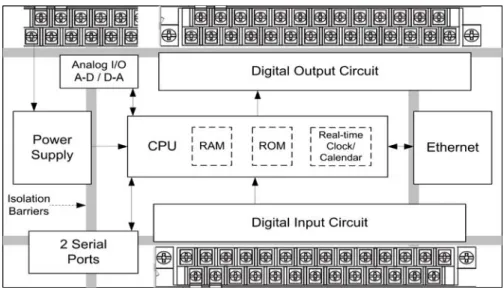
The internal workings of both types of these controllers are basically the same. Figure 1 shows an internal block diagram that is applicable to either a custom controller or a micro PLC. Initially, making the optimum control-ler choice may seem simple for the OEM, but a closer look reveals a more complex decision. Many OEMs continue to use internally designed control-lers largely because they are familiar with them or because they have always done so. In some cases, the OEM may not have considered all the expenses involved. In today’s competitive global market, OEMs proceed-ing in this fashion may not always be makproceed-ing the wisest decision. Evaluating the total picture may lead the OEM to make a different control-ler selection, one that results in the OEM selecting modern micro PLCs. This whitepaper will examine some of the important and sometimes over-looked factors involved in choosing between a custom controller and a COTS micro PLC. This step-by-step review of the issues will help OEMs make the best controller choice, beginning first by comparing the features that each controller option offers.
Step 1: Assess and Compare Features
Both types of controllers have advantages and drawbacks, as well as capa-bilities in common. However, when assessing each, certain features are more readily apparent with one controller than with the other. While the lists that follow are not mutually exclusive, OEMs should consider these summaries of the primary qualities and benefits typically found in each op-tion:
Custom controllers:
• Are purchased at a lower hardware cost
• Are designed for a specific purpose
• Usually include only the features and I/O points required for the task
• Incorporate no unused capabilities
• Are small in size
• Protect the OEM’s investment because a custom design is not easily altered
Micro PLCs:
• Provide a variety of I/O expansion options
• Require no board level component engineering
• Use industry standard programming languages that provide scal-able and reusscal-able code
• Include all applicable agency approvals (UL, CE, C1D2, CSA, etc.)
• Are small enough and low cost enough to be used in places where they were once thought to be impractical or not economical
Now what do these features bring to mind as OEMs begin to evaluate these products? Well for one thing, with a custom controller, the OEM is respon-sible for the interconnect wiring of the external devices and the internal components of the controller. On the other hand, the COTS micro PLC eliminates the custom design, greatly reducing total design and engineering time and enabling the OEM to bring products to market more quickly. OEMs face many other questions regarding controller selection, such as:
• What other concerns may be raised by the features associated with each alternative?
• How easy is it to make design changes or system modifications?
• Can the supply voltage or I/O signal specifications on a custom controller design be changed?
• How can I/O capacity be added beyond the original specifications? Offering variations can be difficult. The more flexible micro PLC, however, allows with little or no design effort or cost for I/O points to be added or removed, signal types (voltage, amperage) to be changed, or specialty fea-tures to be added to its modular design. Responding to a request for a software change is also quicker and easier with a micro PLC.
Now, keeping these considerations in mind, let’s look at the costs that are involved in each option and how they influence the OEM’s decision proc-ess.
Step 2: Analyze All the Costs
Total Cost of Ownership Value ChainObtaining a complete economic picture is critical to any decision. Total costs include numerous elements, some of which may not be immediately apparent. Nonetheless, an accurate portrait of any economic analysis re-quires consideration of direct and indirect costs.
Design & Development Cost Integration & Testing Cost Product Unit
Cost Support Product
By definition, the total cost of ownership (TCO) in any system is the sum of the fixed and variable costs throughout a product’s life:
TCO = Fixed costs + Variable costs
A custom controller may have lower fixed costs compared to an equivalent micro PLC, but its variable costs, which are affected by many factors, are often higher. Typically, a micro PLC supplier absorbs the costs of engineer-ing and support efforts such as component compatibility testengineer-ing, agency approvals and future obsolescence of board level components, which re-duces variable costs. As a result, when micro PLCs are viewed in terms of their total life cycle cost, they are becoming the controller of choice in more and more cases.
So how do these following factors affect TCO? Each of these factors in-volves direct costs. But what indirect costs also are associated with these factors? How costly is each factor in terms of a custom controller versus a micro PLC? Here are some comparisons:
• The cost of design and engineering: Typically, the largest invest-ment an OEM makes in a new product is in R&D hours. When the new OEM product involves a custom controller, both hardware board layout and component compatibility need to be engineered. In addition, the application software must be engineered and inter-face drivers between IC chips must be written. How can an OEM reduce the number of R&D hours required for the control system? Might these hours be better allocated to the OEM’s core competency and to the intellectual property of the OEM’s product rather than to expensive control system R&D? A standard micro PLC only re-quires the OEM to engineer the compatibility of the selected external wired devices and to write the PLC application program.
• The cost of component obsolescence: Product obsolescence im-pacts the OEM as much as any PLC supplier. With a custom controller, OEMs must maintain adequate stock of all the compo-nents in a controller, which can be a costly endeavor. And what if a component becomes obsolete? How many components should OEMs purchase for the lifetime buyout? How will component ob-solescence affect the OEMs product design? What will it cost to re-certify the controller with a new component? An off-the-shelf solu-tion transfers those responsibilities to the PLC supplier. When the technology changes, the PLC supplier adapts the controller to main-tain the form, fit and function.
• The cost of purchasing overhead: OEMs always wish to reduce their purchasing overhead, cutting the number of separate purchase orders typically placed for a design. How many purchase orders are there? With a custom controller, multiple purchase orders are the norm just to build the controller. However, with many PLC suppliers, an off-the-shelf micro PLC requires just one purchase or-der.
• The cost of certification: What happens when an OEM product has been certified, but a component and subsequently the product de-sign must be changed? When a custom controller is involved, the OEM is responsible for obtaining all required certifications based on the industry in which the OEM’s product will be applied or the lo-cation to which the OEM product will be shipped. With a micro PLC, the PLC supplier assumes these responsibilities and incurs the certification costs for a global product across multiple industries.
• The cost of connectivity: Will it be cost pro-hibitive to add connectivity to a custom controller design? What will the cost be? A custom controller is designed to specific con-nectivity and communication requirements, but a micro PLC can incorporate communica-tion protocols through firmware or an expansion module, making upgrades to exist-ing designs easier and lower in cost.
• The cost of support: How many people does an OEM need to employ to offer a full range of support for a custom controller? How much added cost risk does an OEM incur by provid-ing hardware, software and manufacturprovid-ing expertise to support deployed systems? A mi-cro PLC requires support only for the software program. All other hardware and intercon-necting component issues are the
responsibility of the PLC supplier. Addition-ally, end-user maintenance personnel are often reluctant to troubleshoot a custom controller, assuming it is defective if the run light is off. A micro PLC-based system offers end user maintenance personnel tools for troubleshooting, including LEDs, mode switches and standard programming software, along with technical support through 24/7 PLC supplier call centers that make available phone technicians or local application or distributor ser-vice personnel.
Compact form factor Easy mounting options and wiring Simple programming using industry
standard languages Scalable and portable application
programs
Built-in functions for common control needs
Powered by common AC/DC voltages Wide variety of I/O to connect almost
any digital or analog signal Standard communication and networking
capabilities
Multi-level password software protection Web enabled intranet/internet
connectivity
Rugged industrial design for maximum electrical and temperature reliability
Preferred Features and Functions of Micro PLCs
Now let’s use a specific example to compare the expenses involved in de-veloping a custom controller versus a micro PLC. This example compares the costs of a typical system with multiple digital I/O points, dual analog input channels, an analog output channel, and serial and Ethernet commu-nications.
Note: For a supporting life cycle cost analysis spreadsheet that compares custom controllers and micro PLCs, visit the Siemens Energy & Automation, Inc. Web site at www.sea.siemens.com/microPLC.
The custom controller designrequires:
• Moderate capital investment for software, compiler, software de-velopment kit (SDK) tools, and dede-velopment hardware
• Significantly higher design and test costs
• Engineering costs for hardware board layout and component com-patibility, and for writing application software and interface drivers between IC chips
• Ongoing support after field deployment for hardware, software, and manufacturing engineers that may account for up to 20 percent of all support costs, depending on system design complexity and quality
• Additional and increased investment if a board level component becomes obsolete and the custom controller needs to be reengi-neered, a common occurrence within the first three years of design
The micro PLC design requires:
• Capital investment for development hardware and software similar to the custom controller
• Minimum engineering time to draft and test the system, which some estimates indicate up to 75 percent fewer design hours may be needed for many micro PLCs systems than for custom controllers
• Engineering time for writing the application program
• No hardware engineering performed by the OEM on any internal micro PLC component, nor any expenses for agency approval costs (UL, CE, etc.) or maintenance over the product life cycle
• Typically, only one electrical controls technician to maintain the ap-plication program or perform an occasional I/O module
replacement
• Support costs, usually shared by OEMs with the PLC supplier, who often also provides telephone help and local application engineer-ing staffs
In summarizing the cost comparison and analysis, it is important to re-member that when totaling up TCO, OEMs must include all costs, fixed and
variable, direct and indirect, apparent and not-so-apparent. These costs add up, and must be factored in to the decision making process.
Step 3: Do not Overlook the Impact of
Advanced Technologies
Beyond economics and features, there are always additional elements to include in any analysis. Choosing between a custom controller and a micro PLC is no exception. Many end user customers of OEMs today are under pressure to increase production and cut downtime and waste with a re-duced workforce. These end users are demanding flexible products that can perform multiple operations and require minimal changeovers. As a result, OEMs on the cutting edge are turning more and more to advanced technologies and tools such as product life cycle management (PLM) and digital manufacturing (DM) to optimize their businesses and to help their customers achieve their goals.
The impact of these tools on the decision-making process should not be overlooked. Commercially available micro PLCs enable early adopters to more easily use PLM and DM tools to capture real costs and reduce engi-neering overhead. These capabilities are more difficult to leverage with green boards/custom controllers because they typically do not use industry standard hardware and software.
Incorporating PLM tools and DM software capabilities provides enhanced design efficiency and quality while capturing accurate costs. These tools also:
• Offer virtual validation functions within DM tools that help model, optimize, and validate control system designs to comply with panel layout, power distribution and device signal wiring electrical codes before a product is constructed.
• Help micro PLC suppliers provide OEMs with compatible electrical CAD drawings of their modules for use with their electrical control panel design software.
• Allow OEMs to pre-document a micro PLC program before any code is written, saving programming and editing time because sup-plier drawings simplify the production of electrical schematics and bills of materials and allow electrical device names, wire numbers and other labels to be extracted from the schematics and imported into most PLC programming software.
Automation suppliers are striving to provide additional DM tools to help OEM customers optimize the development process. Future tools are ex-pected to validate a product’s functional control though simulation, eliminating the need to construct a physical model. Also on the horizon, are virtual controls training, increased control reusability and standardiza-tion, and modular virtual control libraries of devices and systems to promote efficient model development.
When the PLM of an OEM control system is assessed, one of the elements to consider is the number of changes or derivative models of the original design that will be developed. Such changes are not trivial in a custom con-troller design that does not allow I/O expansion, changes to power or signal specifications, or programming structure modification.
As a result, the number of micro PLCs used by OEMs is growing. Accord-ing to recent research findAccord-ings by the ARC Advisory Group, shipments of micro PLCs to OEMs between 2003 and 2007 have risen rapidly (Fig 2). Advantages of modern micro PLCs, bolstered by a comprehensive supplier support infrastructure, are expanding the role of micro PLCs beyond the traditional discrete manufacturing markets.
Fig 2: Growth of Worldwide PLC Shipments to OEMS
Step 4: See the Global Picture
OEMs should consider their decision to use a custom controller or a micro PLC in light of today’s global marketplace. OEMs are faced with the need to bring their products to market as rapidly as possible. Any delay may result in lost sales. The changing demands of end users mean shorter life cycles for many of the OEM products. As a result, early adopter OEMs are looking at using commercially available automation components, such as micro PLCs, for such reasons as:
• Time to market: Micro PLCs help OEMs
achieve faster time to market and more rapidly update their existing products to meet end user demands. Such capabilities increase OEM product flexibility and reduce costs.
• Significance of life cycle costs: OEMs must
look at more than purchase price. When con-sidering total costs, OEMs must also consider the life cycle costs. Products such as micro PLCs that improve productivity, flexibility and reliability, while reducing maintenance costs, offer significant advantages over internally de-signed solutions. As overall prices drop, the gap between micro PLCs and custom designed controllers is narrowing, tipping the scales in favor of the micro PLC.
• Impact of developing technologies: Other
fac-tors, among them standard networks,
comprehensive diagnostics, Web enablement, and increased component interoperability, are driving faster integration of OEM products to the enterprise. Automation suppliers have been working on providing Ethernet-based networks with standard protocols that meet controllers’ real-time high-performance de-mands. Networking technologies in micro PLCs facilitate
troubleshooting, reduce start-up time and speed up fault finding. Standard network interfaces also enable faster integration and lower installation costs that, in the end, will increase product value and reduce TCO.
•
Need for competitive advantage: When it comes to controllers,OEMs who are striving to achieve operational excellence and to run lean to gain the competitive advantage must carefully evaluate
de-HVAC Compressors Commercial Appliances Vending Products Entertainment/Amusement Equipment Gasoline Pumps Recycling Products Air Handlers Supermarket Freezers Traffic Signal Controls Trash Collection Equipment Building Automation & Lighting Retail & Tradeshow Display Equipment
Automatic Gate & Door Controls Sprinkler Systems
OEM Applications Suited for Micro PLCs
sign/buy decisions in terms of today’s current demand for flexibil-ity at the lowest possible life cycle product cost.
Step 5: Make an Informed Choice
In the end, the decision to choose micro PLCs or custom controllers must be weighed against two goals: achieving lowest total cost, and meeting the business objectives of producing multiple products that are able to respond to changing demands. Proprietary equipment such as a custom controller is driven by a single end user. A COTS micro PLC system is driven by many and varied end users. A custom controller based design meets the needs of only a small fraction of the market. Technical problems of custom controllers often are specific and unique. A micro PLC, on the other hand, is applicable to virtually all situations and industries. Problems that arise usually have been seen before. Solutions to these technical problems have typically already been documented and are easily implemented.
Before OEMs finalize their controller decisions, they should consider these recommendations:
• OEMs should set internal key performance indicators (KPIs) that promote productivity, flexibility and agility throughout their opera-tions
• OEMs should ensure that their engineering is investing in core product competencies instead of designing custom components when commercial solutions are available
• OEMs should focus on product improvements that generate higher productivity at a lower cost, evaluating and comparing the impact of micro PLCs and custom controllers on design and support time, product size and total cost.
When all these factors have been scrutinized and evaluated, application needs and TCO must, in the end, guide an OEM’s controller selection deci-sions. And, if micro PLCs are the choice, as the evidence here indicates they should be, OEMs should ensure they are working with a PLC supplier that has a track record proven to support products throughout their life cy-cle. OEMs should take time to study the steps discussed here, consider the features and the options, account for all the costs, reflect on their place in
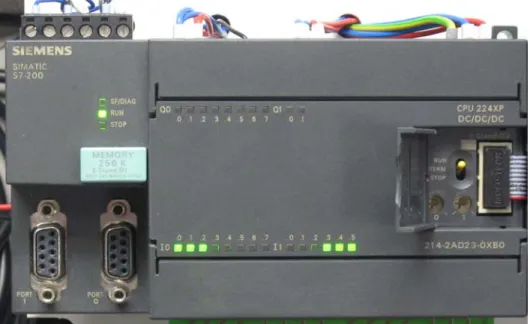
Fig 3: Micro PLC with Finger Safe IP20 Case, Diagnostic LEDs, Run/Stop Switch and Removable Terminal Blocks
Still Not Sure? Review these Advantages
Choosing one technology over another can be a painstaking and difficult process. If OEMs are still unsure which option is best, they should take a moment to review these 11 micro PLC advantages. Micro PLCs provide:
• A variety of I/O and communication expansion options
• A highly scalable and portable programming structure to make de-sign changes less time consuming and less costly
• Shorter time to market because they are quicker to implement and install
• PLC supplier support that makes them more cost effective and eas-ier to maintain
• A more compact installation with a smaller mechanical footprint, standard DIN rail or panel mounting clip options, built-in power supply, and removable terminals
• Low implementation costs with built-in common control functions (timers, counters, real-time clock, motion control, temperature con-trol) and I/O options that solve complex tasks with minimal programming
• Software reusability to accommodate changes
• Ease of maintenance by making use of standard Ethernet and serial communication capabilities that enable remote program editing and
Six strengths of OEM and supplier partnerships
The innovation of future micro PLC products is driven by the commitment of the entire industrial community, not to one proprietary design or vendor, but to im-proving product quality and capability overall. Micro PLC suppliers have in-depth experience with electronic controllers for automation and control that extends be-yond that of green board component and chip providers. Among the benefits Micro PLC suppliers provide and/or offer are:
1. Strong partnerships with OEMs that include a willingness to provide techni-cal services at little or no added cost
2. A variety of micro PLC products and related electromechanical control com-ponents that conform to common electrical standards
3. Exceptional product reliability through extensive testing and field experi-ence with innumerable customers. Micro PLCs are produced in modern, automated factories whose operations conform to manufacturing standards such as ISO-9000 and Six Sigma practices. Such practices ensure a level of quality beyond that found in a custom green board controller
4. Global technical phone support that includes call centers that let OEMs con-tact representatives of the micro PLC supplier for technical and
transactional advice, typically 24/7 from anywhere in the world. Such cen-ters let OEMs access a supplier’s technical expertise and global inventory and shipping capabilities, freeing the OEM to concentrate on equipment de-velopment and customer service
5. Local application support for new designs, including proof-of-concept pro-gramming, pre-configured demo micro PLC units, software development under non-disclosure agreements, and technical training tailored to the OEM’s equipment. Many large suppliers now provide such services as they grow local application engineering staffs and seek to increase the benefit packages they provide
6. Comprehensive product availability and support throughout the product life cycle
troubleshooting, intelligent interfacing to other equipment, and plug-and-play replacements
• Security that offers configurable password protection to prevent unauthorized use and allows multi-level and multi-function access control and ‘view-only’ modes
• Web-enabled, real-time data reporting through standard Inter-net/intranet and cellular connections
• Industrial standards conformance for continuous operation in harsh environments and added reliability
OEM and Supplier Partnerships
Analysts: Craig Resnick and Himanshu Shah Editor: Dick Hill
Acronym Reference:For a complete list of industry acronyms, refer to our web page at www.arcweb.com/Community/terms/terms.htm
AC Alternating Current A-D Analog to Digital CAD Computer Aided Design CE Conformité Européenne COTS Commercial-Off-The-Shelf CPU Central Processing Unit
CSA Canadian Standards Association C1D2 Hazardous Location Certified
Class1 Division2 D-A Digital to Analog DC Direct Current
DIN Deutsches Institut für Normung DM Digital Manufacturing
HVAC Heating, Ventilation, Air Condi-tioning
I/O Inputs/Outputs IC Integrated Circuit
IP Ingress Protection
ISO International Organization for Standardization
KPI Key Performance Indicator LED Light Emitting Diode OEM Original Equipment
Manufacturer
PLC Programmable Logic Controller PLM Product Lifecycle Management RAM Random Access Memory R&D Research and Development ROM Read Only Memory SDK Software Development Kit TCO Total Cost of Ownership UL Underwriters Laboratories 24/7 24 Hour, Seven Day per Week
Coverage
Founded in 1986, ARC Advisory Group has grown to become the Thought Leader in Manufacturing and Supply Chain solutions. For even your most complex business issues, our analysts have the expert industry knowledge and firsthand experience to help you find the best answer. We focus on simple, yet critical goals: improving your return on assets, operational performance, total cost of ownership, project time-to-benefit, and shareholder value.
All information in this report is proprietary to and copyrighted by ARC. No part of it may be reproduced without prior permission from ARC. This research has been sponsored in part by Siemens Energy & Automation. However, the opin-ions expressed by ARC in this paper are based on ARC's independent analysis. You can take advantage of ARC's extensive ongoing research plus experience of our staff members through our Advisory Services. ARC’s Advisory Services are specifically designed for executives responsible for developing strategies and directions for their organizations. For membership information, please call, fax, or write to:
ARC Advisory Group, Three Allied Drive, Dedham, MA 02026 USA Tel: 781-471-1000, Fax: 781-471-1100, Email: [email protected]