NEUTRON CROSS SECTIONS
© M. Ragheb 11/15/2014
INTRODUCTION
Neutron interactions with matter can be either scattering or absorption reactions. Scattering can result in a change in the energy and direction of motion of a neutron but cannot directly cause the disappearance of a free neutron. Absorption leads to the disappearance of free neutrons as a result of a nuclear reaction with fission or the formation of a new nucleus and another particle or particles such as protons, alpha particles and gamma-ray photons.
The probability of occurrence of these reactions is primarily dependent on the energy of the neutrons and on the properties of the nucleus with which it is interacting. We here consider the different reactions by which a neutron can interact with matter.
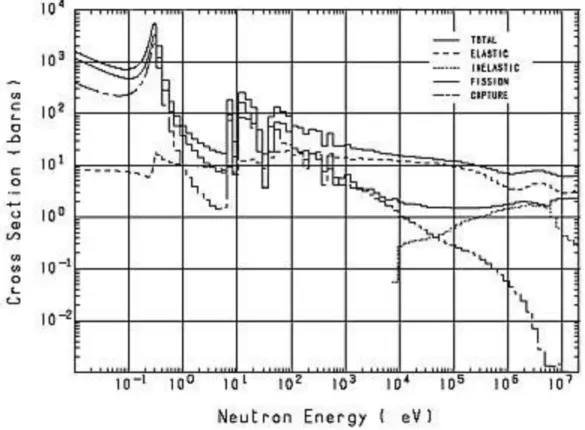
Figure 2. Plutonium239 group-averaged total, elastic, inelastic, fission and capture cross sections.
Neutron cross sections data are normally expressed in units of barns, where: -24 2
1[barn] = 10 [cm ].
They are tabulated and plotted as a function of the kinetic energy of the neutrons in electron volts [eV] or million electron volts [MeV]. The actual measured cross section (Fig.1) displaying a large number of resonances or their evaluated group averages (Fig. 2), are normally used in numerical calculations.
Cross sections averaged over the appropriate neutrons energy range are needed for realistic computations. A common error in numerical applications is the use of cross sections that are not correctly defined over the appropriate energy range.
MICROSCOPIC CROSS SECTION, REACTION RATE DENSITY
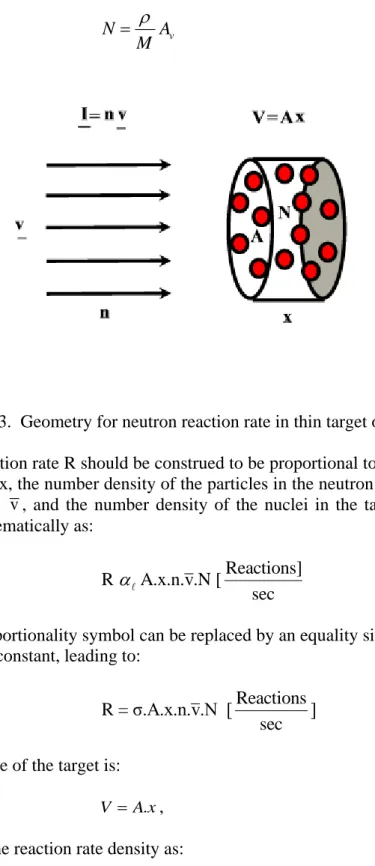
We consider a thought or gedanken experiment to determine the reaction rate R [reactions/sec] that would occur in a small volume of a thin target material of area A [cm2] and thickness x [cm] when a neutron beam of neutrons moving in the x direction with a density n [neutrons/cm3] and velocity v [cm/sec] as shown in Fig. 3.
If the density of the material is ρ [gm / cm3], and its atomic weight is M [amu] we can use a modified form of Avogadro’s law to determine the nuclei density in the target as:
v
N A
M
(1)
Figure 3. Geometry for neutron reaction rate in thin target of volume V.
The reaction rate R should be construed to be proportional to the area of the target A, its thickness x, the number density of the particles in the neutron beam, n, the velocity of the neutrons, v , and the number density of the nuclei in the target N. This can be expressed mathematically as:
Reactions] R A.x.n.v.N [
sec
(2)
The proportionality symbol can be replaced by an equality sign provided we add a proportionality constant, leading to:
Reactions R = σ.A.x.n.v.N [ ]
sec (3)
Since the volume of the target is:
.
V A x, (4)
3
R R Reactions
R' = = = n.v.N.σ [ ]
V A.x cm .sec (5)
From this equation we can infer the units of the proportionality constant as:
' 3 2 3 3 [Reactions/(cm .sec)] ,or:[cm ] .v. [neutrons/cm ].[cm/sec].(nuclei/cm ) R n N (6)
Thus the proportionality constant σ has units of area and physically represents the effective area that a nucleus in the target presents to the interacting neutrons in the impinging beam.
The number of particles in the beam crossing a unit area per unit time is designated as the beam intensity or the beam current, and is given by:
3 2 neutrons cm neutrons I = n.v . or: cm sec (cm .sec) (7)
Thus the “microscopic cross section” can be written as:
' 3 2 2 3 [Reactions/(cm .sec)] , :[cm ] . [neutrons/(cm .sec)].(nuclei/cm ) R or I N , (8)
which identifies it as the reaction rate density per unit beam intensity per nucleus in the target per unit volume, and the overall unit is a unit of area: cm2.
However, the characteristic size of a nucleus is in the range of 10-12 [cm], and accordingly, neutron cross sections data are more conveniently expressed in terms of the square of this characteristic distance in the barn unit, where:
-24 2 1[barn]=10 [cm ]. In this case reaction rate densities can be estimated as:
'
. .
R I N (9)
This allows an interpretation of the microscopic cross section as the reaction rate density per unit beam intensity per nucleus per cubic centimeter of the target.
The cross section is not in general equal to the actual area of the nucleus. For instance the radiative capture cross section for Au197 at the peak of 4.9 eV resonance is 3x10-20 cm2, whereas the geometrical area of its nucleus is just 1.938x10⁻²⁴ cm2. The reaction cross section is much greater than the physical cross section of the nucleus, except at very high neutron energies where the cross section becomes of the same order of magnitude as the nucleus.
This can be calculated from the knowledge about the empirically determined expression for the radius of the nucleus as:
1 3 0
13 0
r = r A , A is the mass number r 1.35 10 [cm]
(10)
The cross sectional area of a nucleus from Eqn. 10 becomes: 2
2 2 3 2
0 [ ]
sr r A cm (11)
For Au197, the area of the nucleus becomes:
2 13 2 3 24 2 (1.35 10 ) (197) 1.938 10 [ ] s cm
Since the cross section has such a small magnitude, the unit of the barn was chosen jokingly to express such a small area with the name of a large structure.
Incidentally, the characteristic size of the atom is given by the first Bohr’s radius as: -3 11 9 0 7 -3 7 1 7.297352 10 5.291772 10 [ ] 5.291772 10 [ ] 4 4 1.097373 10
is the fine structure constant = 7.297352 10 is the Rydberg constant = 1.097373 10 [ ]
m cm R R m
Thus the nuclear to atomic radius ratio is: 13 5 0 9 0 r 1.35 10 2.555 10 5.291772 10
MICROSCOPIC REACTION CROSS SECTIONS
Each probable reaction that a neutron can undergo with a nucleus is associated with a specific cross section. The most important of them are:
elastic scattering cross section inelastic scattering cross section radiative capture cross section fission cross section
(n , p) reaction cross section (n , T) reaction cross section
se si f p T
(n , ) reaction cross section
The sum of the cross sections that can lead to the disappearance of the neutron is designated as the absorption cross section:
...
a f p T
(12)
The sum of the all reactions is designated as the total cross section: ... t se si f p T se si a (13)
The capture cross section incorporates all the cross sections that do not lead to fission:
...
c p T
(14)
Thus, for a fissile nucleus:
a c f
(15)
The microscopic cross sections are tabulated as a function of energy and are compiled in data bases such as the Evaluated Nuclear Data File at Brookhaven National Laboratory (BNL) as ENDF-B VII, the latest roman numerals being the version number.
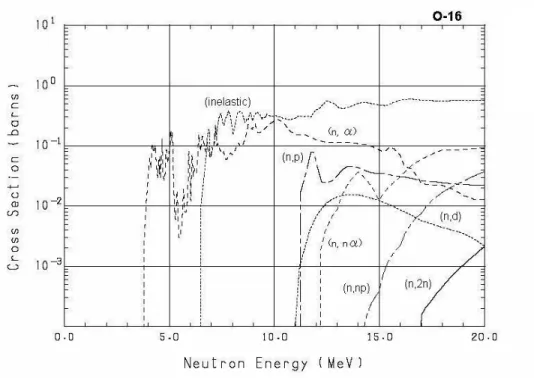
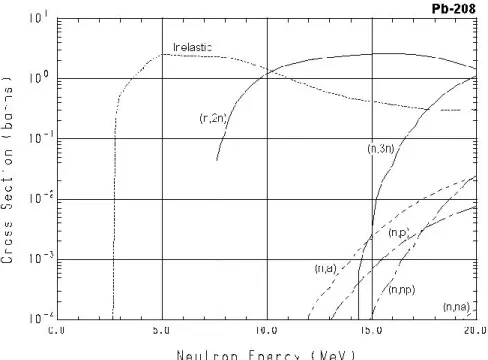
Cross sections plots for a light element, O16 are shown in Fig. 4, and for a heavy element, Pb208 are shown in Fig. 5.
Figure 5. Neutron reactions in a heavy element, Pb208.
The cross sections for U235 and U238 are shown in Figs. 6 and 7. These graphs display a large number of resonances.
Figure 7. Actual neutron reactions in U238.
To calculate reaction rates of interest such as tritium production from Li6 (Fig. 8) and from Li7 (Fig. 9), and the threshold neutron multiplying reactions from U238 (Fig. 10), libraries of reaction cross sections or response functions are generated.
Figure 9. Reaction cross sections for tritium production in Li7.
ESTIMATION OF NUMBER DENSITIES
The cross section is normally determined experimentally, and the number density N of the target material, can be calculated from a modified form of Avogadro’s law as:
3 atoms or nuclei cm v N A M , (16)
which is a modification of the conventional form of Avogadro’s law:
' atoms or molecules v g N A M (16)’where: ρ is the density of the target in [gm / cm3], g is the mass of the target in [gm],
M is the atomic or molecular weight in atomic mass units in [gm / mole] or [amu], Av=0.6023x1024 [nuclei, atoms, or molecules / mole], is Avogadro’s number. Four practical situations are encountered in the estimation of number density of materials.
CASE I: PURE SUBSTANCES AND SINGLE SPECIES.
The modified form of Avogadro’s can be applied in a straight forward way in the case of single species materials.
EXAMPLE 1 Single species
For Sodium (Na),
3 24 24 3 v ρ(Na)=0.97[gm/cm ], M(Na)=22.99[gm/mole], ρ(Na) 0.97 N(Na)= A = 0.6023 10 =0.0254 10 [atoms/cm ] M(Na) 22.99
When we do not have a single species or a pure substance, other cases present themselves in practice.
CASE II: MOLECULAR AND ISOTOPIC COMPOSITIONS. ATOMIC PERCENTAGES, (a/0).
Given:
1. ρmixture of elements
2. Atomic weights of constituent elements
In this case: mixture element v a mixture a ρ N = .A .f M
Number of atoms of element f =
Atom or molecule of mixture
(17)
EXAMPLE 2 Molecular composition
In the case of molecules such as water,
3 mixture 2 mixture 2 24 24 3 2 24 3 2 ρ =ρ(H O)=1.0 [gm/cm ], M =M(H O)=(2 1.00797+1 15.994)=18.0153 0.6023x10 N(H O)=1 [1]=0.03343 10 [molecules/cm ] 18.0153 N(O) =N(H O) [1]=0.03343 10 [atoms/cm ] N(H) =N(H 24 3 2O) [2]=0.06686 10 [atoms/cm ]
EXAMPLE 3 Isotopic composition
Isotopic abundances are normally reported in atomic percentages (a/o). Consider the case of Boron.
3 mixture 10 11 10 11 mixture 24 10 24 3 24 11 ρ =ρ(B)=2.45 [gm/cm ] M(B )=10.0, M(B )=11.0 a/o(B ) 19.8 %, a/o(B ) 80.2 % M =0.198 10 +0.802 11 = 10.8 0.6023 10 N(B )=2.45 [0.198]=0.02701 10 [atoms/cm ] 10.8 0.6023 10 N(B )=2.45 1 24 3 [0.802]=0.110 10 [atoms/cm ] 0.8
EXAMPLE 4 Mixed Molecules and isotopic abundances
3 mixture 4 10 11 12 13 mixture 24 24 3 ρ =ρ(B C)=2.52 [gm/cm ] M(B)=10.81, M(C)=12.01 a/o(B ) 19.80 %, a/o(B ) 80.2 % a/o(C ) 98.89 %, a/o(C ) 1.11 % M =4 10.81 +12.01 = 55.25 0.6023 10 N(B)=2.52 [4]=0.1099 10 [atoms/cm 55.25 24 24 3 10 24 3 11 24 3 12 24 3 13 ] 0.6023 10 N(C)=2.52 [1]=0.0275 10 [atoms/cm ] 55.25 N(B )=0.1980 N(B)=0.0218 10 [atoms/cm ] N(B )=0.8020 N(B)=0.0881 10 [atoms/cm ] N(C )=0.9889 N(C)=0.0272 10 [atoms/cm ] N(C )=0.0111 N(C)=0.00 24 3 03 10 [atoms/cm ]
CASE III: COMPOSITION BY WEIGHT, ALLOYS AND ENRICHMENT, (w/o).
Given: 1. ρmixture
2. Atomic weights of constituent elements
3. Mixture proportions as weight percentages (w/o) In this case: mixture w element v element w effective element v element ρ .f N = .A , M
f =weight percentage of element or:
ρ (element)
N = .A
M
(18)
EXAMPLE 5 Enrichment given in w/o
3 mixture 235 3 effective 238 3 effective 24 235 21 3 238 ρ =ρ(U)=19.1 [gm/cm ] ρ (U )= 0.20 ρ(U)=0.20 19.1 [gm/cm ] ρ (U )= 0.80 ρ(U)=0.80 19.1 [gm/cm ] 0.6023 10 N(U )=(0.20 19.1) =9.79 10 [atoms/cm ] 235.0439 0 N(U )=(0.80 19.1) .6023x1024 22 3 =3.86 10 [atoms/cm ] 238.0508
EXAMPLE 6 Alloy compositions
We consider Zircaloy-4 used as cladding material in fission reactors, with a density: 3
ρ(Zircaloy-4)=6.74 [gm/cm ], and composition:
98.24 w/o Zr, M(Zr)=91.220 0.10 w/o Cr, M(Cr)=51.996 0.21 w/o Fe, M(Fe)=55.847 1.45 w/o Sn, M(Sn)=118.69 24 22 3 24 19 3 24 20 3 0.6023x10 N(Zr)=(6.745 0.9824) =4.37 10 [atoms/cm ] 91.22 0.6023x10 N(Cr)=(6.745 0.0010) =7.81 10 [atoms/cm ] 51.996 0.6023 10 N(Fe)=(6.745 0.0021) =1.53 10 [atoms/cm ] 55.847 0.6 N(Sn)=(6.745 0.0145) 023 1024 20 3 =4.96 10 [atoms/cm ] 118.69
EXAMPLE 7 Aqueous Solutions (Mixed Case I and Case II)
We consider the case of Sulfuric Acid 10 w/0 in solution in water, with a density: 3
2 4 2
3 effective 2 3 effective 2 4 24 22 3 2 24 20 3 2 4 ρ (H O) = 0.90 1.08 [gm/cm ] ρ (H SO )= 0.10 1.08 [gm/cm ] 0.6023 10 N(H O) =(0.90 1.08) =3.252 10 [atoms/cm ] 18 0.6023 10 N(H SO )=(0.10 1.08) =6.638 10 [atoms/cm ] 98 N(H)=2.N(H 22 20 22 3 2 2 4 22 20 22 3 2 2 4 20 3 2 4 1 22 O)+2.N(H SO )=2 3.252 10 +2 6.638 10 =6.638 10 [atoms/cm ] N(O)=1.N(H O)+4.N(H SO )=1 3.252 10 +4 6.638 10 =3.518 10 [atoms/cm ] N(S)=1.N(H SO )=6.638 10 [atoms/cm ] N(H )=0.99985 N(H)=6.637 10 3 2 18 3 16 22 3 17 19 3 32 20 3 33 [atoms/cm ] N(D )=0.00015 N(H)=9.956 10 [atoms/cm ] N(O )=0.99756 N(O)=3.509 10 [atoms/cm ] N(O )=0.00039 N(O)=1.372 10 [atoms/cm ] N(S )=0.95000 N(S)=6.306 10 [atoms/cm ] N(S )=0.00750 N(S)=4.978 18 3 34 19 3 36 16 3 10 [atoms/cm ] N(S )=0.04200 N(S)=2.788 10 [atoms/cm ] N(S )=0.00015 N(S)=9.956 10 [atoms/cm ]
CASE IV: HETEROGENEOUS SYSTEMS. VOLUMETRIC MIXTURES, (v/o).
Given:
1. Volume fractions (v/o) of either cases I or II. 2. Densities of components of volume mix. In this case:
*
N (element)=N(element in primary mix) (Volume fraction of primary mix in secondary mix)
(19)
EXAMPLE 8 Volumetric mixture
Here we consider a secondary mix of 10 v/0 Zircaloy-4 and 90 v/0 water. The Zircaloy-4 and water can be considered as primary mixes and we use their results from examples 1 and 6:
* * * * * * N (Zr)=0.10 N(Zr) N (Cr)=0.10 N(Cr) N (Sn)=0.10 N(Sn) N (Fe)=0.10 N(Fe) N (H)=0.90 N(H) N (O)=0.90 N(O)
EXAMPLE 9 Volumetric Homogenization.
We consider the homogenization of a uranium dioxide fuel rod of 0.7 cm diameter covered with stainless steel, considered as Fe, cladding of 0.05 cm thickness. The densities of these materials are:
3 3
2
ρ(UO )=10.0[gm/cm ],ρ(Fe)=7.8[gm/cm ] We can calculate the following number densities;
24 22 3 24 22 3 2 2 22 3 2 2 22 3 2 2 2 2 7.8 N(Fe)= 0.6023 10 =8.41 10 [atoms/cm ] 55.85 10.0
N(UO )= 0.6023 10 =2.23 10 [molecules/cm (UO )] (238+32)
N(U)=N(UO )=2.23 10 [atoms/cm (UO )] N(O)=2N(UO )=4.46 10 [atoms/cm (UO )]
π V(UO )= (0.7) =0.3 4 2 2 2 2 849[cm ] π V(Fe)= [(0.8) -(0.7) ]=0.1178[cm ] 4
The homogenized number densities become:
* 2 22 22 3 2 * * 22 3 * 22 22 3 2 V(UO ) 0.3849 N (U)=N(U) =2.23 10 =1.71 10 [atoms/cm ] V(UO )+V(Fe) 0.3849+0.1178
N (O)=2N (U) =3.42 10 [atoms/cm ] V(Fe) 0.1178 N (Fe)=N(Fe) =8.41 10 =1.97 10 [atoms/cm ] V(UO )+V(Fe) 0.3849+0.1178
EXAMPLE 10
We consider some uranium dioxide fuel of density (UO2) 10.5[ gm cm/ 3], that has its uranium enriched to ε = 30 w/o in the U235 isotope. To calculate the number density of U235 we use the formula:
235 235 235 ( ) ( ) ( ) effective v U N U A M U
The effective density for U235 is:
235 235 2 2 3 2 2 ( ) ( ) ( ) ( ) ( ) ( ). . ( ) ( ) ( ) effective gm UO M U gm U gm U U UO M UO cm gm UO gm U
We need to determine M(U) and M(UO2). To determine the atomic weight of U, we use: 235 238 235 238 235 238 235 238 235 238 ( ) ( ) ( ) ( ) ( ) ( ) ( ) ( ) ( ) : ( ) . ( ) ( ) (1 ). ( ) : 1 (1 ) ( ) ( ) ( ) v v v N U N U N U U U U A A A M U M U M U Since U U U U Then M U M U M U
From the last equation we can calculate the atomic mass of the enriched uranium as: 235 238 238 235 ( ). ( ) ( ) . ( ) (1 ). ( ) 235.04 238.0508 (0.30 x 238.0508) + (0.70 x 235.04) 237.14 M U M U M U M U M U
We can also evaluate the molecular mass of uranium dioxide as:
2 2
( ) ( ) ( ) 237.14 (2 15.994)=269.14
From which the number density of U235 can finally be calculated as: 235 235 235 2 2 235 24 21 3 ( ) ( ) ( ) ( ) ( ). . ( ) ( ) 237.14 10.5 0.30 269.14 0.6023 10 235.04 7.112 10 [ / ] effective v U N U Av M U M U UO M UO A M U atoms cm
MACROSCOPIC CROSS SECTION AND MEAN FREE PATH
The sum of the microscopic cross sections of the individual nuclei in the target per unit volume is designated as the “macroscopic cross section” and is given by:
2 1 3 . cm : [ ] N or cm cm (20)
If a mixture of nuclear species exists in a unit volume, the overall macroscopic cross section becomes:
1 1. 1 2. 2 ... n. n[ ]
N N N cm
(20)’
The macroscopic cross section can be conveniently estimated from the relation: 1
0.6 . [cm ]
M
(20)’’
where the microscopic cross section σ is expressed in units of barns.
EXAMPLE 11
The macroscopic scattering cross section for U238 with a density of 19 [gm/cm3] is: 1 0.6 . [ ] s s cm M 1 19 0.6 8.9 0.426[ ] 238 s cm EXAMPLE 12
Consider a uniform mixture of U235 and graphite with moderator to fuel ratio of 10,000. The macroscopic absorption cross section for carbon with a density of 1.6 gm/cm3 is: 3 1 1.6 0.6 3.4 10 0.00027[ ] 12 aC cm
The number density of U235 is a factor 10-4 that of the graphite, hence:
4 1.6 1 10 0.6 681 0.00545[ ] 12 aU cm
The total macroscopic cross section for the moderator and fuel mixture becomes: 1
0.00027 0.00545 0.0057[ ]
a aC aU cm
A simple expression for the reaction rate density is just the product of the beam intensity and the macroscopic cross section as:
' 3 . .sec reactions R I cm (21)
The inverse of the macroscopic cross section has units of length and has the physical meaning of representing the average distance traveled by a neutron between two interactions or “mean free path”:
1 mean free path: [cm]
(22)
NEUTRON FLUX
In the case of a radiation shield or a nuclear reactor neutrons acquire a random directional motion, which suggests the replacement of the velocity vector in the definition of beam intensity or current by the magnitude of the velocity or speed, which defines the neutron flux as:
2 .sec neutron n v nv cm , (23)
which is now a scalar rather than a vector quantity.
The neutron flux can be interpreted as the total distance traveled by the neutrons per unit volume per unit time [cm / (cm3.sec)].
The neutron flux can also be considered as the number of neutrons per second entering an imaginary sphere of surface area of 4 cm2 and with a diametrical plane of area equal to 1 cm2.
The reaction rate density can still be expressed in term of the neutron flux as: ' 3 . .sec reactions R cm (24)
The reaction rate is now:
. .
sec
reactions R V
(25)
where V is the volume under consideration in cm3.
In general, the reaction rate is an integral of the form: ( , ) ( , ) sec E V reactions R E r E r dEdV
, (26)where the energy and spatial dependencies of both the neutron flux and the cross sections are accounted for. This integral is approximated as a summation in terms of the flux per unit energy interval as the form:
, , sec i j i j i j i j E V reactions R E V
(27)For a constant cross section in each volume:
, ( ). sec : i i i i i i j i E reactions R V where E
(28)The last equation is sometimes expressed in the inner product format: ( ), ( ) .
sec
reactions
R E E V
(29)
THERMAL NEUTRONS MAXWELLIAN VELOCITY
DISTRIBUTION
When fast neutrons from the fission process collide with the reactor or shield material they loose they energy to the thermal equilibrium energy E = kT where they have as much probability of gaining energy as of loosing it through further collisions.
The thermalized neutrons diffuse through the surrounding material until they are absorbed or leak from its surface. They have a population density or number of neutrons per cm3 that follows the Maxwellian distribution:
2 v 2 2 0 3/ 2 4 v n(v) = n 2 kT/m m kT e (30)This distribution is normalized over all neutron velocities to n0 as:
2 v 2 2 0 3/ 2 0 0 4 v n dv = n 2 kT/m m kT e
23 27 3 0where: k is the Boltmann constant=1.3805x10 [ / ] m is the rest mass of the neutron=1.675x10 [ ] n is the thermal neutrons density [n/cm ]
273 o , is the Kelvin temperature
Joule K kg T C If we let:
3/ 2 4 2 kT/m C then we can write:
2 v 2 2 0 n(v) = n Cv m kT e (31)
MOST PROBABLE VELOCITY
The most probable velocity of thermal neutrons would occur at the maximum point of the Maxwellian distribution and can be obtained by setting the derivative of the neutron density distribution with respect to the velocity equal to zero.
2 2 v v 2 2 2 0 0 dn(v) mv 2 v v 0 dv 2kT m m kT kT n C e n C e
2 2 v v 2 2 2 0 0 dn(v) mv 2 v v 0 dv kT m m kT kT n C e n C e
The most probable thermal neutron velocity becomes:
mp 2
v kT, v 0
m
(32)
The neutron kinetic energy corresponding to the most probable velocity is: 2 mp 1 1 2kT v kT 2 2 m mp E m m (33)
Thermal neutrons are also referred to as kT neutrons. It is interesting to note that the thermal neutrons energy is independent of its mass.
The Emp energy is different from the average neutrons kinetic energy which is equal to:
3 2
E kT (34)
EXAMPLE 13
At the most probable velocity the thermal neutrons kinetic energy is: -16 12 4 1 kT=1.38 10 293 1.6 10 252.7125 10 0.025 mp erg eV E K K erg eV eV
Thermal neutrons are also designated as 0.025 eV neutrons.
EXAMPLE 14
The most probable velocity for neutrons at room temperature or 20 oC can be calculated as: 16 mp 24 4 2 1.38 10 (273 20) v 1.66 10 22.0716 10 [cm/sec] 2, 200[m/sec] x x (35)
Thermal neutrons are also designated as 2,200 m/sec neutrons.
MEAN NEUTRON VELOCITY
The mean, average or mathematical expectation of the thermal neutrons velocity can be estimated from:
2 2 2 2 0 0 v 2 2 0 3/ 2 0 v 2 2 0 3/ 2 0 v 2 2 0 3/ 2 0 0 v 3 2 3/ 2 0 v n(v)dv v = n(v)dv 4 v v n dv 2 kT/m 4 v n v 2 kT/m 4 v v n dv 2 kT/m n 4 v dv 2 kT/m m kT m kT m kT m kT e e d e e
where we applied the normalization condition for the Maxwellian distribution. To estimate the integral, let us make the change of variables:
2 v 2vdv m c=-2kT u du
Thus we can write:
2 v 3 2 3/ 2 0 3/ 2 0 3/ 2 0 4 v v dv 2 kT/m 2 du 2 kT/m 2 du 2 kT/m m kT cu cu e ue ue
Integrating by parts by using the relationship: udvuv vdu
we get: 0 0 0 0 0 2 2 0 2 2 2 2 1 1 [ ] 1 [ ] 1 [ ] 1 4 cu cu cu cu cu cu m u m kT u kT ue du ude c ue e du c e ue c c e ue c c c k T m
Thus:
3/ 2 0 2 2 3/2 2 3/2 1/2 1/2 1/2 1/2 2 v du 2 kT/m 2π 4k T m 2πkT/m 2 k T m 8 cu ue kT m
(36)TEMPERATURE CORRECTION
Most materials in the thermal neutrons region have an absorption cross section that varies inversely with the neutron velocity:
1/2 1/2 1 v 1 E 1 T a since: 1 v2 , 273 2 o E m kT T C
Accordingly, we can write for the absorption cross section at any absolute temperature T, in terms of the thermal absorption cross section at T = 273 + 20 oC = 293 Kelvin: 1/ 2 1/2 ( ) (293) (293) T a a T
From which the temperature corrected absorption cross section becomes: 1/ 2 293 ( ) (293) a T a T (37)
MAXWELLIAN AND TEMPERATURE CROSS SECTION
CORRECTION
The ratio of the mean velocity to the most probable velocity is given by:
mp 8 v 4 2 1.12838 v 2 kT m kT m
Thus the average thermal neutron velocity is larger than the most probable velocity. Since the absorption cross section is inversely proportional to the neutron speed, it should also be corrected by the inverse of the ratio of the mean to most probable velocity.
The combined Maxwellian and temperature corrected absorption cross section for a 1/v absorber can thus be written as:
1/ 2 293 ' ( ) (293) 2 a T a T (38) EXAMPLE 15
The absorption cross sections for the gold isotopes at 0.025 eV are: 197 198 (293) 98.8 (293) 26, 000.0 Au a Au a b b
For a foil of gold irradiated in a reactor at a temperature of 50 oC:
1 197 198
0n 79Au 79Au
The Maxwellian and temperature corrected absorption cross sections of the two gold isotopes will be:
197 198 197 1/ 2 1/ 2 1/ 2 293 ( ) 26, 000 2 273 50 293 98.8 2 323 98.8 0.886227 0.952428 83.394 293 ( ) (293) 2 26, 000 0.886227 0.952428 21, 946 Au a Au Au a a T x x b T T x x b
EXERCISE
1. Compare the area of the nucleus of U238 to its neutron radiative capture at thermal (0.025 eV) and fission (1.99 MeV) energies.
2. Calculate the macroscopic absorption cross section for natural uranium. 3. Estimate the mean free path for thermal neutrons scattering in beryllium.
4. A stainless steel composition is 69 w/o Fe, 17 w/o chromium, 12 w/o nickel and 2 w/o molybdenum. Calculate its absorption cross section for thermal neutrons.
5. For 2,200 m/sec or thermal neutrons, calculate the following quantities: 1. Number densities,
2. Total macroscopic cross-sections, 3. Total mean free paths,
In the following materials: 1. Uranium,
2. Beryllium,
3. Carbon in the form of graphite. (Note that diamonds is a form of carbon with a high density).
REFERENCES
1. M. Ragheb, “Lecture Notes on Fission Reactors Design Theory,” FSL-33, University of Illinois, 1982.
2. J. R. Lamarsh, “Introduction to Nuclear Engineering,” Addison-Wesley Publishing Company, 1983.
3. Arthur R. Foster and Robert L. Wright, Jr., “Basic Nuclear Engineering,” Allyn and Bacon, 1978.