HCRI Project Final Report Format
I. Report Title: Characterizing green algal biodiversity of Hawaiian reef and estuarine communities: expansion of the sequence diversity assessment framework to distinguish native from alien genotypes
Author: Alison R. Sherwood and Gernot G. Presting Organization: University of Hawaii
Grant Number: NOA06NOS4260200 Date: 31 January 2008
II. Abstract
We aimed to collect, voucher, and analyze using DNA sequencing representatives from as many species of Hawaiian green algae as possible. We collected a total of 250 specimens from most Main Hawaiian
Islands, and supplemented these with expertly identified material from Bishop Museum. Our trials of four different markers lead us to recommend two for further analyses of most Hawaiian green algal diversity: the plastid UPA marker and the nuclear LSU gene fragment. Green algal groups investigated in detail (e.g. the Ulvales) appear to be not well resolved taxonomically, and much further work needs to be done on the alpha taxonomy of Hawaiian seaweeds to be able to accurately estimate algal species diversity and identification in the Hawaiian Islands.
III. Executive Summary
We have modified an existing DNA sequence diversity assessment procedure that is currently being applied to Hawaiian red algae to characterize the coral reef and estuarine green algal diversity of Hawai‘i. Such a system has strong potential for rapid and accurate characterization of algae that may be difficult or impossible to identify based on available morphological characters. This well-rounded DNA-based
assessment procedure overcomes many of the difficulties associated with traditional taxonomic work and builds on the strengths of modern DNA-barcoding. The acquired data have the potential to allow detection of different strains within a species, which may be of importance in monitoring invasive strains of some green algae, such as Caulerpa taxifolia, or non-native species, such as Caulerpa prolifera, which was recently discovered in Hawaii through the aquarium trade. The results of this study – a strongly populated sequence diversity framework for Hawaiian green algae, will be invaluable in rapid assessments of native versus alien genotypes, and will serve as a baseline profile for current coral reef and estuarine species composition. We have collected 250 samples of green algae from the main Hawaiian Islands of Kauai, Oahu, Molokai, Maui, Lanai and Hawaii, and have also sampled 90 Bishop Museum specimens representing 47 species. Collections represent the orders Bryopsidales, Dasycladales, Cladophorales, Ulvales, and some small lineages. Construction of the Hawaiian Algal Database (HADL) is complete, data from the current project is in the process of being entered, and public release of the database is scheduled for late summer / early fall 2008. Following PCR and sequencing trials with four different markers (UPA, or universal plastid amplicon, plastid rbcL, nuclear LSU and nuclear ITS) we are recommending the following combination of markers for molecular assessment of Hawaiian green algae: the UPA and a region of the
nuclear LSU gene. For studies of the green algal order Ulvales, we also recommend sequencing of the ITS regions, since much data has already been gathered with these regions, and they are available via
GenBank for comparison.
IV. Purpose
A. Detailed description of the HCRI research priority addressed.
This project responds to Priority 1 - Native biotic reef and closely related aquatic habitats (profiling native biotic reef habitats in shallow nearshore areas and estuarine habitats). The purpose of the project was to characterize the green algal flora of marine and estuarine areas of the Main Hawaiian Islands using molecular techniques, in order to provide the first baseline data on the genetic diversity of Hawaiian Chlorophyta. We also wanted to generate these data in order to be able to compare genotypes present in Hawaii to those elsewhere, and to be able to detect new arrivals to the state.
B. Objectives of the project.
The goal of the proposed research was to use DNA barcode-based taxonomic techniques to develop a contextual framework for rapid identification of Hawaiian green algae. The benchmark for achieving this goal would be inclusion of most or all known Hawaiian marine and estuarine green algae in the framework, and evidence that the framework can be used for accurate species identification. Specific objectives of the study were:
a) to tailor an existing DNA sequence diversity procedure for red algae (using two gene regions) so it can be applied to Hawaiian green algae,
b) to populate the resulting sequence framework with all available marine and estuarine Hawaiian green algal species using both archived material (Bishop Museum) and new field collections, and
c) as the sequence framework becomes populated, to evaluate the limits of the framework as an identification tool by comparing morphological identifications with DNA sequences for species represented by multiple accessions.
V. Approach
A. Detailed description of the work that was performed.
All four inter-island collecting trips were completed by fall 2007 (one each to Kauai and Maui, and two to Hawaii), and a number of collecting trips were also made around the island of Oahu. Additional trips to Lanai and Molokai were made by students and researchers in the Sherwood lab for other projects, and green algal samples for the present study were also obtained to support the current project. Approximately 250 collections of green algae were collected from marine and estuarine habitats, and morphological vouchers (herbarium sheets and / or formalin samples) have been prepared for all collections. Formalin vouchers and herbarium sheets have been labeled with preliminary taxonomic information, collecting site and date information, and a unique accession number that allows us to link genetic and morphological data from a single sample. Approximately 90 collections from Bishop Museum have been sampled by A.
Sherwood, representing 47 species. DNA was extracted from all collections and samples from Bishop Museum. All green algal samples that have been extracted have had PCR attempted multiple times (as necessary) for multiple markers.
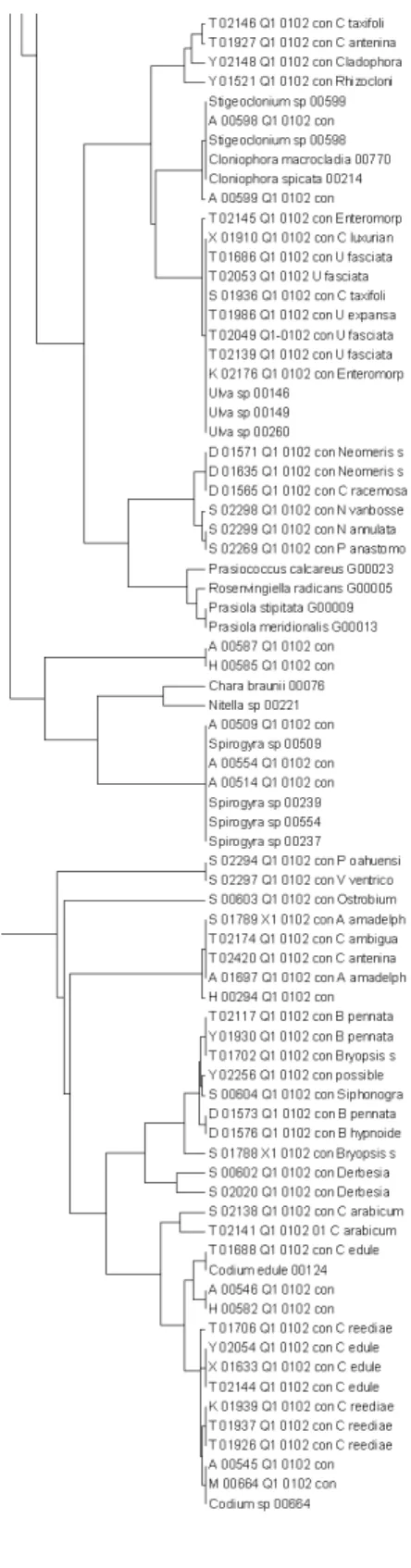
We originally proposed to amplify and sequence two markers – UPA (a plastid 23S rRNA marker) and COI (mitochondrial cytochrome oxidase subunit I, which is used as the DNA barcode for most groups of organisms). Initial PCR success rates in June 2007 for the 23S rRNA plastid marker were 20-25%, which was much lower than anticipated based on preliminary data collection (Fig. 1). In total, we have attempted
PCR at least once for every DNA extract using the UPA protocols, but have been unable to increase success for the green algae. As a result, we focused attention in later months on identifying and testing additional markers to use for the sequence assessment.
Fig. 1. DNA sequence framework (UPGMA analysis using Kimura-2-parameter distances) for Hawaiian green algae based on
the plastid UPA marker.
The mitochondrial COI gene was initially proposed as the second marker, but subsequent literature reviews have indicated that this region is inappropriate for our purposes given the widespread occurrence
of introns in the COI gene for green algae. Additionally, the Consortium for the Barcode of Life has yet to endorse specific region(s) for land plant barcoding, which further illustrates the difficulty in developing such a protocol for closely related organisms to the green algae. Nonetheless, we have attempted PCR and sequencing of several candidate second markers, with complex results.
We have investigated several “second markers” since June 2007, including the nuclear ITS regions (which are commonly used for taxonomic purposes for at least some green algae; Fig. 2), a fragment of the nuclear LSU gene (again, also used commonly for some green algal groups; Fig. 3), and approximately 50% of the plastid rbcL gene (generally used at or above the species level in green algae; Fig. 4). Sequencing results vary depending on the green algal order to which samples belong. For example, the nuclear ITS region can be successfully sequenced with a single set of amplification primers from members of the Ulvales, but not other groups, while the nuclear LSU region is much more successful, and can be sequenced from basal chlorophytes, Ulvales, Bryopsidales and Cladophorales. The plastid rbcL gene sequencing is not successful with the order Cladophorales, but works well for the Bryopsidales and Ulvales. As a result, we are generally recommending that the plastid UPA marker be sequenced for as many
collections as possible, plus the nuclear LSU region.
S 02890 Ulva fasciata T 02880 Ulva fasciata T 02049 Ulva fasciata X 02905 Ulva fasciata X 02906 Ulva sp B 01455 Ulva rigida B 01449 Ulva fasciata T 01986 Ulva expansa X 03076 Ulva fasciata X 03067 Ulva fasciata B 01450 Ulva fasciata T 02053 Ulva fasciata A 00578 Ulva sp X 02907 Ulva reticulata B 01452 Ulva reticulata X 02908 Enteromorpha sp X 02911 Ulva fasciata reticula
B 01451 Ulva reticulata B 01178 Enteromorpha clathrata B 01434 Entermorpha intestinal B 01438 Enteromorpha linza T 02881 Enteromorpha sp B 01183 Enteromorpha flexuosa T 02145 Enteromorpha sp B 01179 Enteromorpha clathrata B 01439 Enteromorpha paradoxa T 02181 Enteromorpha sp X 03063 Enteromorpha sp B 01442 Enteromorpha prolifera X 03073 Ulva fasciata X 03074 Enteromorpha sp A 02878 Enteromorpha sp 0.005
Fig. 2. DNA sequence framework (UPGMA analysis using Kimura-2-parameter distances) for Hawaiian green algae based on
the nuclear ITS regions.
The most successful order of green algae in our analyses has been the Ulvales, for which we are able to sequence all markers tested. This order of green algae is characterized by relatively simple
morphologies (flat sheets or tubes of cells, and a lack of secondary compounds that might inhibit molecular protocols, such as calcium carbonate). Additionally, this group of algae contains species of concern, species that are very difficult to discern morphologically, and species that have not been previously recognized as members of the Hawaiian green algal flora. Thus, we have identified this order as one that deserves detailed attention. To date, we have collected 81 samples that can be identified as members of
Ulva or “Enteromorpha” (currently a form genus), and are underway with a separate analysis of these
Z 00668 Cladophora vagabunda T 01690 Cladophora sp A 00780 Rhizoclonium A 00516 Cladophora sp H 00608 Cladophora sp S 01923 Cladophora sp T 02409 Rhizoclonium grande T 02182 Chaetomorpha antennina T 02198 Chaetomorpha antenina A 00524 Chaetomorpha sp H 00607 Cladophora sp T 01925 Dictysphaeria cavernos E 01922 Cladophora sp S 01929 Siphonocladus tropicus T 02268 Cladophora luxurians A 00499 Phyllodictyon anastomo T 02380 Phyllodictyon anastomo A 00515 Chaetophorales H 00596 Halimeda kanaloana S 02300 Halimeda kanaloana H 00595 H kanaloana H 00594 Halimeda kanaloana X 02055 Caulerpa lentillifera T 02416 Caulerpa taxifolia T 02015 Chlorodesmis caespitos S 02286 Caulerpa taxifolia T 02257 Caulerpa taxifolia T 01701 Caulerpa sertularoides S 02231 Caulerpa webbiana T 02258 Caulerpa webbiana S 01541 Caulerpa mexicana D 01558 Caulerpa serrulata B 02120 Caulerpa antoensis T 02143 Caulerpa racemosa 0.05 S 02890 Ulva fasciata T 02880 Ulva fasciata T 02049 Ulva fasciata X 02905 Ulva fasciata X 02906 Ulva sp B 01455 Ulva rigida B 01449 Ulva fasciata T 01986 Ulva expansa X 03076 Ulva fasciata X 03067 Ulva fasciata B 01450 Ulva fasciata T 02053 Ulva fasciata A 00578 Ulva sp X 02907 Ulva reticulata B 01452 Ulva reticulata X 02908 Enteromorpha sp X 02911 Ulva fasciata reticula
B 01451 Ulva reticulata B 01178 Enteromorpha clathrata B 01434 Entermorpha intestinal B 01438 Enteromorpha linza T 02881 Enteromorpha sp B 01183 Enteromorpha flexuosa T 02145 Enteromorpha sp B 01179 Enteromorpha clathrata B 01439 Enteromorpha paradoxa T 02181 Enteromorpha sp X 03063 Enteromorpha sp B 01442 Enteromorpha prolifera X 03073 Ulva fasciata X 03074 Enteromorpha sp A 02878 Enteromorpha sp 0.005
Fig. 3. DNA sequence framework (UPGMA analysis using Kimura-2-parameter distances) for Hawaiian green algae based on
the nuclear LSU regions for most green algae (left) and the order Ulvales (right).
The community outreach component of the project is twofold: 1) a public presentation explaining the concepts behind using DNA technologies for identification purposes, and 2) construction and release of a publicly accessible database that houses the data collected for the project. The first component will be presented in early 2008 by Tara Chandrasekharan. She has been working with a professor in the
Philosophy Department at UH to identify public school classrooms that would be interested in hearing her speak about the project, and although this could not be included in the fall curriculum for the schools, it will be completed in early 2008. The second component (the project database) is explained under section IX, dissemination of results. 02139 Ulva rbcl con 01986 Ulva rbcl con 01455 Ulva rbcl con 01450 Ulva rbcl con Ulva PrasF1 R2 00578 Ulva rbcl 02176 Enteromorpha rbcl con 01439 Enteromorpha rbcl con 02181 Enteromorpha rbcl con Codium PrasF1 R2 00550 possible enteromorpha rb 02145 Enteromorpha rbcl con Bornetella PrasF1 R1 Bryopsis PRASF1 R2 02564 Halicystis rbcl 01545 Halimeda rbcl con 02570 Rhipidosiphon rbcl 02544 Green Siphon rbcl Rhipidosiphon javensis PRASF1
02561 Chlorodesmis rbcl 02019 Derbesia rbcL con Chlorodesmis PrasF1 R1
0.02
Fig. 4. DNA sequence framework (UPGMA analysis using Kimura-2-parameter distances) for Hawaiian green algae based on
In late summer 2007 we contacted state resource managers and explained the nature of project, and sent instructions on how to send samples for analysis and inclusion in the project. These requests resulted in a number of collections (approximately 50 samples) from the island of Maui, which were a great help to the study and are still being analyzed. The informational brochure that was constructed and
distributed is appended to this report.
B. Project management: List individuals and/or organizations actually performing the work and how it was done.
Dr. Alison R. Sherwood, Assistant Professor (Botany Department, University of Hawaii) – P.I. Dr. Gernot G. Presting, Assistant Professor (MBBE, University of Hawaii) – co-P.I.
Tara Chandrasekharan, undergraduate student research assistant (U. of Hawaii)
The P.I. (Alison Sherwood) was responsible for overseeing the spending of funds as outlined in the budget and justification, and for the hiring of student assistance to assist with sample processing. Co-P.I. Gernot Presting assisted with training, oversaw the management of the large amount of DNA sequence data that are being generated through the study, and advised the design and maintenance of the project database. Tara Chandrasekharan (student research assistant) completed the majority of the field work to collect specimens (in coordination with other researchers in the Sherwood lab), and sample processing (DNA extraction and making vouchers, PCR, sequencing and data assembly). Sherwood and Presting analyzed the data and led troubleshooting efforts. Sherwood undertook the final data analyses, made all presentations and wrote reports for HCRI, and will take the lead on publishing the results from the study.
VI. Findings
A. Actual accomplishments and findings.
• 250 collections of green algae were made and vouchered from the Main Hawaiian Islands and 90 samples were collected from archived material of green algae at Bishop Museum.
• Green algae can be most effectively characterized using a combination of two markers: the plastid UPA region (which works well with all plastid-containing
organisms as well as cyanobacteria, facilitating multi-lineage assessments), and the nuclear LSU fragment.
• The systematics of many groups of green algae, such as one of the simplest groups of green algae, the Ulvales, and the genus Codium, are not well understood for Hawaiian species. Detailed sequencing analyses of these groups indicate that more work needs to be done to clarify species level relationships.
• The Hawaiian green algal flora is almost certainly more speciose and complex than previously realized based on morphological identifications alone. Much diversity lies hidden behind relatively simple morphologies, and more detailed research is needed at the genus and species level of most taxa to untangle and sort out these taxonomic problems.
• Species level placements of Hawaiian green algal collections based on molecular signatures are premature given the upheaval in systematics and taxonomy of this group of seaweeds, but genus level placement is typically possible.
B. Site specific results
No site specific results to report (analysis was across all collecting sites).
VII. Evaluation To be included in final report.
A. Describe the extent to which the project goals and objectives were attained. This description should address the following:
1. Were the goals and objectives attained? How? If not, why?
The goals and objectives of the project were to characterize the green algal flora of the Hawaiian Islands using molecular tools, and to establish a comparative data set for new samples of green algae. These goals and objectives were attained in that large numbers of collections from a broad taxonomic sweep of green algae were successfully collected and vouchered for the project, and recommendations have been made for a multi-marker assessment procedure for green algae. Originally we aimed to comprehensively cover all green taxa in the assessment, and to be able to assign new collections to a taxon using this method. More details are given below on the problems that we encountered over the course of the study.
2. Were modifications made to the goals and objectives? If so, explain.
Yes, modifications were made to the goals and objectives of the study. During the first quarter of the study it became obvious that the proposed mitochondrial marker (as the second marker) was not a good choice for the project, and much of the effort for the summer months was spent on testing additional markers to back up the plastid marker. We also spent time re-designing and testing the plastid primers to be green algal specific, which did cut down on the proportion of contaminant sequences obtained. Finally, as we gathered substantial molecular data for some green algal genera (e.g. Codium, Ulva), we
encountered many unresolved taxonomic difficulties that preclude species-level assignments with this technique. These taxonomic difficulties need to be resolved before this technique can be exploited to its full potential.
3. If significant problems developed which resulted in less than satisfactory or negative results, they should be discussed.
See above for #2 for an explanation of issues and how they were dealt with. 4. Description of need, if any, for additional work.
We see a strong need for taxonomic research involving molecular tools to unravel the taxonomic and systematic issues that we have just begun to reveal with this project. Molecular assessment or diagnostic techniques are powerful, but alpha taxonomy of the group of interest needs to be in place.
B. Indicators of success (What performance measures were used to evaluate how well the project met its stated goals and objectives?)
We measured success of the project by meeting benchmarks of accomplishment. For example, all field collection trips to outer islands were completed on schedule by interfacing with other biodiversity projects in the lab and coordinating interisland trips so multiple groups of taxa were covered at once. Samples from Bishop Museum were collected and processed on a weekly schedule to complete this part of the project in a timely manner. Excel spreadsheets of extraction, PCR, and sequencing success were maintained and included data on every sample for the project. Summary statistics of success were used to evaluate whether particular markers were economical to pursue, and examinations of sequence divergence based on these markers (in the form of NJ trees) were used to evaluate whether markers were useful at the appropriate taxonomic levels.
VIII. Recommendations to managers
Substantial data have been collected that form a baseline for genetic diversity of green algae in Hawaiian coral reef and other coastal communities, and the results of this project form the most
comprehensive data set of this type for the Hawaiian Islands. Our collections and analyses indicate that the green algal flora is not as simple or taxonomically well-defined as previously thought; nevertheless, we have made good progress toward representing the green algal flora in our biodiversity assessment
framework. We recommend that Resource Managers continue to feel welcome to contact us for analyses of green algal samples – although the project has formally ended, we would be happy to include any further samples in analyses. This is especially important and of interest in the case of suspected introductions and invasive species. We can provide identifications to the best of our ability based on the data collected over the past year, and provide information on how widespread the genotype of the sample at hand is from our database of sequences. Through continued cooperation with Resource Managers we hope to be able to continue with this project and provide useful diagnoses of collections of concern.
IX. Dissemination of Project results:
A. Explain, in detail, how the projects results have been, and will be, disseminated.
We have constructed a relational database to house all forms of data generated by studies such as this HCRI green algal biodiversity study. The database was under construction from August 2006 – April 2007 (funded by the National Science Foundation), and is now being used on a daily basis by the Sherwood lab as a central repository for all data. Over the next few months we will be adding in
photographs of herbarium sheets and microscope slide vouchers, nomenclatural information, collecting site information, and DNA sequences for all collections made for this study. These data will be eventually available via an internet-accessible website (currently projected for release in late summer or early fall 2008).
We also expect that two peer-reviewed journal articles will result from the research (outlining the construction of the DNA barcode framework for green algae and presenting comparisons between the frameworks based on the markers, and analyzing the Ulva specimens), and there is also strong potential for descriptions of new taxa that may be revealed through the barcode comparisons. These manuscripts will be in preparation in 2008.
B. List of publications and presentations No publications to date. Anticipated for 2008.
Presentations:
HCRI Presentation #1 (January, 2007), given by A. Sherwood, KCC, Lihue, Kauai
HCRI Presentation #2 (August, 2007), given by A. Sherwood, State Capitol Building, Honolulu, Oahu HCRI Presentation #2 (January, 2008), given by A. Sherwood, Bishop Museum, Honolulu, Oahu