Say on Pay Design, Executive Pay, and Board
Dependence
∗
July 2011, this version September 2012
Robert F. G¨
ox
†∗The author acknowledges helpful comments and suggestions from Anne Beyer, Oliver Fabel, Ilan
Guttman, Jon Glover, Mirko Heinle, Thomas Hemmer, Steven Kachelmeier, Daehyun Kim, Dave Larcker, Volker Laux, Ivan Marinovic, Allan McCall, Stefan Reichelstein, Jeroen Suijs as well as participants of the 2012 MAS midyear conference at Houston, the 2012 EIASM Workshop on Accounting and Economics, the 2012 GEABA symposium, and seminars at UT Austin, Graz University, Rice University, Stanford GSB, Tilburg University, and University of Zurich.
†Prof. Dr. Robert F. G¨ox, Chair of Managerial Accounting, University of Fribourg, Bd. de P´erolles 90, CH-1700 Fribourg, Switzerland, Tel.: +41 26 300 8310/8311, Fax +41 26 300 9659, email: [email protected].
Abstract:
I study the impact of ”say on pay” (SoP) on the compensation decisions and the structure of the board of directors (BoD) in a setting where the CEO has the real authority over the composition of the BoD. The CEO’s authority arises endogenously from an informational advantage about individual board members’ contribution tofirm value and allows her to establish a dependent BoD. Shareholders approve the CEO’s director slate because they can only control the level of board dependence but not the board’s contribution tofirm value. In this setting, SoP has two effects. On the one hand, it prompts a BoD with a given dependence level to reduce the CEO’s bonus. On the other hand, it allows the CEO to extract the rent generated by the improved compensation policy and to establish a more dependent BoD. In equilibrium the board becomes more dependent from the CEO and pays her a higher bonus for the same performance. This outcome can only be avoided if the CEO is restricted in her ability to adjust the board composition. Motivated by existing differences in SoP design, I also analyze the consequences of a binding and a pre-contractual vote. I find that a binding vote creates a moral hazard problem on the part of the firm’s shareholders if the vote takes place after the agent has supplied her effort. Its consequences critically depend on the legal protection standard of the CEO. Whenever the shareholders can enforce a retroactive bonus cut, the allowable amount of the bonus reduction determines whether or not SoP improves the efficiency of the pay process or diminishes firm value. I show that the moral hazard problem can be avoided by a pre-contractual vote. If the vote is binding, SoP can improve the efficiency of the compensation arrangement and effectively reduce the equilibrium level of board dependence without impairing the CEO’s effort incentives.
Keywords: Say on Pay, Executive Compensation, Board Dependence, Corporate Gover-nance.
JEL Classification: G34, G38, K22, M12, M48.
1
Introduction
1.1
Motivation and overview of main results
In an attempt to improve the compensation practice in publicly listed firms, the U.S. as well as several European countries have recently introduced shareholder votes on the com-pensation of executives, also referred to as “say on pay” (henceforth SoP). According to its proponents, SoP is thought to facilitate the communication between shareholders and the board of directors (henceforth BoD) on compensation issues and to strengthen the BoD’s responsibility towards its shareholders.1 By this means SoP should ideally make the
com-pensation policy of public firms less dependent from the interests of their executives and discourage the use of pay practices that are not in the best interest of shareholders.
Since inefficient compensation arrangements such as a poor link between pay and perfor-mance and excessive compensation levels seem to be more pronounced in firms with weak governance structures, SoP can be expected to be most effective in firms where the CEO has some power over the board of directors.2 In this paper, I show that this view might be wrong and that SoP can have exactly the opposite consequences. Namely, SoP can reduce the efficiency of compensation contracts, aggravate existing governance problems, and di-minish shareholder value. I demonstrate these problems in the context of an agency model with three risk neutral players: the CEO, the BoD, and the firm’s shareholders. The CEO must be motivated to exert productive effort in order to increase thefirm’s profit. An agency problem arises because she is protected by limited liability.
The decision on the agent’s compensation contract is in the hands of the BoD. Its com-position is determined as the equilibrium of a non-cooperative game between the CEO and thefirm’s shareholders. The CEO can use her influence to propose a director slate that must be approved by the firm’s shareholders. Potential board members differ in their ability to contribute to firm value and their dependence from the CEO. The degree of independence is common knowledge but only the CEO can evaluate the potential contributions of indi-vidual board members. This informational advantage is the source of the CEO’s power over 1 See e.g. European Commission (2004) or Gordon (2009, p.337) who defines the role of SoP as ”to buttress
boards independence-in-fact by making them more accountable.”
2 See e.g. Bebchuk and Fried (2003, 2004), or Bertrand and Mullainathan (2000, 2001). A critical discuss-sion of executive compensation pratices in the U.S. can be found in Kaplan (2008) and Bogle (2008).
the BoD. It allows her to combine the two qualities of board members in a manner that makes a dependent BoD attractive to shareholders. Due to the lack of information on the contribution of individual board members, shareholders cannot implement an efficient board structure but only threaten to establish an independent BoD with an expected contribution of zero.
The key variable in the model is the level of board dependence. The CEO is interested in a more dependent BoD because it partly considers her utility in designing the compensation contract and offers her a higher bonus for a given performance. To make a dependent BoD acceptable to shareholders, the CEO composes the BoD so that its contribution tofirm value is positively related to the level of board dependence. Faced with the trade-off between an increasing contribution to firm value and higher compensation cost, shareholders accept a dependent board. The equilibrium level of board dependence is determined by the point where the shareholders attain the same utility as with their outside option of replacing the CEO’s director slate with an independent BoD.
In this setting, the introduction of a vote on the CEO’s compensation has a direct and an indirect effect. First, a BoD with a given dependence level reduces the CEO’s bonus for a given firm performance. It does so because the board members derive a disutility from a negative shareholder vote and the shareholders’ voting dissent is increasing in the agent’s compensation. Second, since the CEO has the real authority over the composition of the BoD and the shareholders face the same outside option, she can extract the rent generated by the improved compensation policy and establish a more dependent BoD. As a matter of fact the board becomes more dependent from the CEO and pays her a higher compensation for the same level of performance. This outcome can only be avoided if the CEO is restricted in her ability to adjust the board composition.
The standard SoP model used in the U.S. and the U.K. gives shareholders an advisory vote on the CEO’s compensation after the firm’s result are realized. As explained in more detail in section 1.2, there are important international differences in SoP design, especially regarding its enforceability and its timing. To analyze how changes of the basic SoP model affect the compensation decisions of the BoD and the level of board dependence, I provide two extensions of my basic model. First, I examine the consequences of a binding SoP and second, I analyze the impact of a pre-contractual vote.
shareholders if the timing of the standard model is maintained. Since the vote takes place after the agent has supplied her effort, shareholders have an incentive to refuse the CEO’s bonus payment. A rational CEO anticipates the threat of an expropriation by the firm’s shareholders and adjusts her effort accordingly. As a matter of fact the consequences of a binding SoP critically depend on the legal protection standard of the CEO. If shareholders cannot impair existing contractual arrangement between the BoD and the CEO, a binding SoP offers no advantage over an advisory vote. If the shareholders can only enforce moderate bonus cuts, a binding SoP can improve the efficiency of the pay setting process and limit the equilibrium level of board dependence. However, if all bonus payments are subject to shareholder approval, the threat of a retroactive pay cut completely destroys the agent’s effort incentives and diminishes firm value.
The moral hazard problem can be avoided if the vote on the compensation takes place before the BoD signs the compensation contract with the agent. If the pre-contractual vote is advisory, the change of the timing has not much impact on the equilibrium of the game except for a weakly higher voting dissent. If the pre-contractual vote is binding, shareholders can force the BoD to improve the efficiency of the compensation arrangement and effectively reduce the equilibrium level of board dependence. Since the vote takes place before the contract is signed, these effects are not caused by a moral hazard problem but by the requirement to find the shareholders’ majority support for the SoP proposal.
These findings suggest that SoP design can have a significant impact not only on the equilibrium degree of board dependence and the level of executive compensation but also on the utilities of the players. On these grounds the enforceability and the timing of SoP are also critical for its ability to improve the pay setting process in weakly governed firms and to contribute to shareholder value. The standard approach of an advisory SoP usually leaves the shareholders’ utility unaffected and can only add to shareholder value if the CEO is restricted in her ability to extract the surplus. By contrast, the consequences of a post-contractual binding SoP critically depend on the legal protection standard of the CEO. There are conditions under which shareholders strictly benefit from a binding SoP but there is also a minimum protection standard below which a binding SoP diminishes firm value. This risk is usually excluded with a pre-contractual vote but it is not guaranteed that shareholders strictly benefit from such a step. If the vote is advisory, the shareholders typically attain the same utility as with a post-contractual SoP. If the vote is binding, shareholders attain a higher utility whenever the compensation paid with an advisory vote is not supported by
the majority of shareholders.
The rest of the paper is organized as follows. The next subsection provides an overview of the institutional background and a review of the related literature. Section 2 explains the model assumptions and the structure of the multi-stage game. Section 3 derives the optimal contract and the equilibrium board structure in the absence of SoP. Section 4 analyzes the impact of the standard advisory SoP model on the equilibrium of the multi-stage-game. Section 5 extends the analysis and examines first the consequences of a binding SoP, second the impact of a pre-contractual vote, and third the implications of SoP design for regulatory policy. Section 6 concludes the analysis with a summary of the main results and some suggestions for further research.
1.2
Institutional background and related literature
The first SoP legislation was introduced in 2002 in the U.K. where listed firms are required to submit an annual remuneration report to an advisory vote at the annual shareholder meeting.3 The U.S. introduced a similar regulation with the Dodd-Franck Act in 2010.
Starting with the 2011 reporting season, it asks public firms in the U.S. to provide share-holders at least every three years with the opportunity to give a non-binding vote on the compensation of the executives for which the compensation must be disclosed in the firm’s proxy statements.4
In recent years, several European countries adopted similar rules. According to a report of the European Commission (2010), a total of 19 out of the 27 member states of the European Union have either introduced mandatory legal provisions or at least recommendations in their local corporate governance codes requiring shareholder votes on the remuneration of executives. The report shows important disparities not only concerning the legal basis but also with respect to the practical implementation of SoP, most importantly with regard to the enforceability, the subject and the timing of the shareholder vote.
Different from the Anglo-Saxon model of an advisory SoP, the majority of European SoP adopters has actually introduced binding shareholder votes.5 Moreover, a substantial
3 See The Directors Remuneration Report Regulations (2002) for details.
4 See Larcker et al (2012) for a detailed record of the SoP legislation in the U.S. and Glass, Lewis & Co. (2011) for a report on the voting results in thefirst proxy season.
fraction of the newly introduced voting rights do not refer to the annual compensation report but to the firm’s compensation policy or to the actual remuneration of executives. For example, countries such as the Netherlands and Sweden have adopted a binding SoP vote on the firms’ compensation systems, whereas Switzerland is confronted with a public voting initiative proposing a binding vote on the actual compensation of executives.6 Since
votes on the compensation policy apply to future compensation arrangements and not to the compensation paid out during the current reporting period, the different subject of the vote also implies a different timing. These observations suggest that there is no unique approach to SoP and underscore the relevance of a better understanding of the economic incentives generated by different SoP designs.7
Due to the fact that SoP is a relatively recent phenomenon, the economic literature on the topic is limited. There are a couple of empirical studies that analyze the relation between advisory SoP and executive pay using data from the U.K.8 These analyses suggest
that higher compensation levels trigger a higher voting dissent on the part of shareholders, but they provide mixed results on the consequences of a negative shareholder vote. Alissa (2009) finds that a high voting dissent seems to curb extreme cases of excess compensation. Both, Carter and Zamora (2009) and Ferri and Maber (2012)find a positive relation between voting dissent and the pay-for-performance-sensitivity in later periods, particularly in the case of poor performance.
Ferri and Maber (2012) also find that a high voting dissent seems to motivate boards to remove controversial provisions from compensation contracts. They report further thatfirms often adjust contracts before the advisory SoP is conducted in order to avoid a disapproval of questionable compensation arrangements by shareholders. Larcker et al. (2012) make similar observations for the U.S. but they attribute the changes in firms’ compensation programs to the threat of receiving a negative voting recommendation from one of the major proxy rely on a pure advisory vote and 2 countries allow for both types of votes, see European Commission (2010) for details.
6 See European Commission (2010). Wagner and Wenk (2011) as well as Economist (2007) provide a detailed account of the legislative process in Switzerland.
7 Gordon (2009, p. 337) classsifies the available design options along“....four binary choices: (1) ‘before’ versus ‘after’, (2) ‘binding’ versus ‘advisory’, (3) ‘general’ versus ‘specific’ compensation plans, and (4) ‘mandatory’ versus ‘firm-optional’.”
8 See Alissa (2009), Carter and Zamora (2009), Conyon and Sadler (2010) as well as Ferri and Maber (2012). A recent survey of the the SoP literature is provided by G¨ox and Kunz (2012).
advisorfirms. Moreover, the study of Larcker et al. (2012) suggests that the changes infirms’ compensation programs induced by SoP are associated with a negative stock market reaction and conclude that the voting recommendations of proxy advisors can trigger compensation policies that diminish firm value.
Unlike other empirical studies, Conyon and Sadler (2010) do notfind any evidence for the hypotheses that a negative shareholder vote affects the compensation structure or reduces the overall level of executive pay. Moreover, consistent with the results of the theoretical analysis in section 4, they evenfind a weak positive relation between voting dissent and total CEO compensation. This observation is confirmed in a laboratory experiment conducted by G¨ox et al. (2010). In this study, shareholders face the problem of motivating a risky investment decision of a CEO who has partial control over the terms of her own incentive compensation. The experiment analyzes the effectiveness of post-contractual SoP in solving the resulting trade-offbetween rent extraction and goal congruent project selection. As long as SoP is advisory, it motivates higher rent extraction by the CEO but does not affect the CEO’s investment incentives as compared to a world without SoP.
G¨ox et al. (2010) also show that a post-contractual binding SoP provides shareholders with an effective instrument to control the agent’s compensation but that it destroys the agent’s investment incentives and thereby significantly reduces thefirm’s profit. These fi nd-ings are consistent with the predictions regarding the impact of a post-contractual binding SoP in the absence of legal protection standards for the CEO. Empirical support for the potential risks associated with this SoP method is provided by Wagner and Wenk (2011). These authors analyze the reaction of capital market participants to the announcement of a public voting initiative proposing a post-contractual binding SoP for listed firms in Switzer-land. They find abnormal negative price reactions for two thirds of the firms in their sample suggesting that shareholders understand the fundamental problems associated with a post-contractual binding SoP.9
This paper contributes to the literature by providing the first theoretical analysis of the relation between SoP design, executive compensation and board dependence. Earlier theoretical studies such as Drymiotes (2007), Kumar and Sivaramakrishnan (2008), and Laux 9 See Cai and Walkling (2011) for a similar study regarding the announcement effect of an advisory SoP bill in the U.S where theyfind positive market reactions forfirms with inefficient compensation practices. They also analyze the market reaction to company-specific SoP-proposals andfind a negative impact of labor union-sponsored proposals.
and Mittendorf (2011) have analyzed the cost and benefits of delegating the compensation decision to a partially dependent boards in settings where the BoD also monitors the CEO’s activities or where it must provide incentives to identify profitable investment incentives. In all these studies, a partially dependent BoD offers some net contribution to firm value, albeit for different economic reasons.10 However, none of these studies has so far analyzed
the relation between shareholder votes on the remuneration of executives and the equilibrium composition of the board of directors.
The study is also related to Levit and Malenko (2011). These authors analyze the role of non-binding votes on shareholder proposals as a mechanism to convey the expectation of shareholders to the CEO and find that non-binding votes are generally less effective in this respect than binding votes. Levit and Malenko (2011) neither consider an incentive contracting problem nor a BoD. They also assume a different information structure. In their model the shareholders are better informed about the prospects of their proposal than the CEO. Since the vote takes place before the CEO decides on the proposal, she can update her beliefs after observing the voting outcome and make a better informed project decision. In a broader sense, both models are related to Aghion and Tirole (1997) who identify the information structure as the critical factor determining the formal and the real authority in organizations. In my model, the shareholders have the formal authority over the composition of the BoD but the CEO has the real authority because of her superior information about the contribution of individual board members. In Levit and Malenko (2011) the CEO has the formal authority to decide over the shareholder proposal but shareholders can obtain the real authority by conveying decision relevant information to the CEO in a pre-contractual shareholder vote.
10 From a broader perspective, this paper also contributes to the literature on endogenously determined boards of directors. See Hermalin and Weisbach (1998, 2003), Adams and Ferreira (2007), as well as Adams et al. (2010) for a recent survey.
2
Model assumptions
2.1
Firm setup, technology, and compensation system
I consider an agency-relation between three risk neutral parties: a group of shareholders (the ”principal”), a board of directors (”BoD”), and a CEO (the ”agent”). The agent’s personal effort a, a ∈ [0,1], affects the distribution of the firm’s results. There are two possible outcomes, xH and xL. The probabilities of the high and the low result depend on
the agent’s effort and are given by p(xH|a) = a and p(xL|a) = 1−a, respectively. That
is, the higher the agent’s effort, the higher the likelihood of a high outcome and the higher the expected result, E[x] = xL+a·∆x, where ∆x = xH −xL > 0. The amount of effort
spent on improving the distribution of the firm’s results is the agent’s private information and not contractible. Effort is personally costly to the agent. The cost equals C(a), where I assume that C(a) satisfies the Inada conditions (C(0) = C0(0) = 0, C0(1) = +∞) and is
monotonically increasing and strictly convex in ato assure that the incentive problem has a non-trivial solution.
For some exogenous reasons shareholders are not in a position to design the agent’s compensation contract and delegate this task to the BoD. To focus on the role of SoP on the CEO’s compensation, I let the BoD receive a salary wB but no performance-based
compensation for its services. I subsequently normalize wB to zero. To motivate the agent,
the BoD offers her a contract s(x) that comprises a salaryw and a bonus b in case of good performance. From these assumptions, the agent’s expected remuneration equals E[s(x)] =
w+a·band her expected utility is
E[UA] =w+a·b−C(a). (1)
An agency problem arises from the agent’s limited liability. Particularly, I assume that the agent’s compensation cannot fall below the amount of w, where xL > w ≥ 0. The income
levelwcan be interpreted as the minimum income that the agent can attain without exerting a positive effort level.11 The minimum income must be distinguished from the reservation
11 See e.g. Poblete and Spulber (2012) for a corresponding asumption. Other limited liabilty models assume that the agent’s pay can become negative but cannot fall below an exogenously given wealth level−L <0.
See e.g. Laffont and Martimort (2002), pp. 155. Lettingw <0 would not change results. I choosew≥0 because negative executive compensation is uncommon and since the minimum pay interpretation is more convenient in terms of the research question.
utility U ≥ 0 that the agent receives from her next best employment alternative. While w
puts a lower bound on the agent’s pay, U restricts the agent’s expected utility from below. In what follows, U is normalized to zero so that w≥U .
2.2
Governance structure
A necessary condition for a non-trivial economic analysis of SoP is the presence of ineffi -ciencies in the pay-setting process, otherwise the regulation cannot provide any benefits to shareholders. Inspired by the managerial power approach, I consider a firm in which the CEO has some control over the nomination of individual directors and thereby over the composition of the BoD. Since the BoD is responsible for designing the agent’s compensa-tion contract, the CEO’s power over the BoD allows her to (indirectly) influence her own pay.12 In line with recent literature I model a potentially dependent BoD that balances the
interests of shareholders and the CEO in setting the agent’s compensation according to the following objective function13
VB = (1−λ)·UP +λ·UA, (2)
whereUP is the utility of the principal andλmeasures the degree of board dependence. The
level of board dependence represents the aggregate preferences of a given mix of independent and dependent directors sitting on the firm’s board. Let the BoD have a fixed size of n
members and let λi,λi ∈ [0,1/2], denote the dependence level of the ith director, then the
average dependence level of the BoD is λ = 1/n·Pλi. That is, the higher the fraction of
dependent board members, the higher is λ and the more the board considers the agent’s utility in designing the compensation contract. Limiting λi and thereby λ to take values
from the interval [0,1/2] avoids scenarios in which the CEO’s interest dominates shareholder interest.14
12 In fact, Bebchuk and Fried (2004) identify the CEO’s influence on the nomination of directors as the main source of inefficiency in the pay-setting process.
13 See e.g. Drymiotes (2007), Kumar und Sivaramakrishnan (2008), and Laux and Mittendorf (2011). 14 See Laux and Mittendorf (2011) for a corresponding assumption. Essentially, this restriction assures that
the agent’s compensation enters with a negative sign into the board’s objective function. In fact, since
s(x) enters negatively into the principal’s utility function and positively into the agent’s utility function the net weight on the agent’s compensation in (2) equalsψ(λ) =−(1−2λ).
The equilibrium degree of board dependence is determined by the CEO and the firm’s shareholders as the outcome of a multi-stage game. The full time line of this game is given in figure 1 (see section 2.4). At stage one, the CEO proposes a director slate to the firm’s shareholders. The candidates on the slate can be characterized along two dimensions: First, their dependence on the CEO, and second, their potential to contribute to firm value.
The two qualities of potential directors can be related in many ways. For example, the board can be mainly composed of outside directors that contribute to firm value but are largely independent. A typical example are bankers who provide valuablefinancial expertise but are usually not considered as being dependent from the CEO. Likewise, the presence of venture capitalists on the BoD facilitates the firm’s financing opportunities but reportedly reduces the CEO’ power over the board of directors. The CEO can also propose directors that contribute to firm value but also increase the dependence level of the BoD. Examples are insiders, such as former CEOs, or managers of peer firms on the BoD. On the one hand, these directors typically possess industry-specific human capital and are capable of providing valuable strategic advice. On the other hand they tend to be more supportive to the CEO and to tolerate higher compensation levels.15
Apart from the joint occurrence of director qualities at the individual level, the con-tribution of particular types of directors can also depend on the aggregate level of board dependence. For example, the presence of compliance and audit experts is certainly most effective in firms with insufficient internal control systems and weak governance structures. Also, it has been found that the presence of labor representatives on the boards of public
firms negatively affectsfirms’ investment decisions and productivity. Moreover, the resulting valuation discounts seem to be more pronounced infirms with a significant level of employee representation.16 These observations suggests that the impact of stakeholders on firm value varies in a nontrivial way with the overall level of board dependence.
To capture these considerations in the model, let yi(λ) = (vi +ρi · λ)/n denote the
contribution of the ith board member. The parameter vi ∈ [−v, v], v > 0, denotes the
basic contribution of the ith board candidate, whereas ρi ∈ [−ρ,ρ],ρ > 0, is a measure for
potential synergies (dysergies) that arise from appointing candidateito a board with a given 15 See Adams et al. (2010) for a detailed discussion of the potential impact of different type of directors
and an overview of the existing empirical evidence on the subject. 16 See Adams et al. (2010) for details and further references.
dependence level λ.17 With this structure, the aggregate contribution of the BoD becomes
y(λ) =v+ρ·λ, (3)
where v = 1/n · Pvi and ρ = 1/n · Pρi. Since v and ρ can take any sign, the linear
specification in (3) is suitable for capturing a wide array of possible relations between the board’s contribution to firm value and its dependence from the CEO.
Without loss of generality, I assume that λi is publicly observable so that λ is common
knowledge among all players. By contrast, the parameters determining the individual con-tribution of candidates for the BoD, vi and ρi,are ex ante unknown with an expected value
of E[vi] = E[ρi] = 0. Unlike shareholders, the CEO can infer the potential contributions of
candidates for the BoD before putting them on the slate. Being responsible for the firm’s strategy and overall performance, the CEO is in the best position to identify the firm’s requirements and to compose a BoD that provides a maximum contribution to firm value. In addition, the CEO can employ the firm’s resources to examine the qualities of poten-tial board members before proposing their names to shareholders. In fact, the search and evaluation of new board members is routinely performed by professional executive search consultants acting on behalf of the companies that seek to fill board positions. Since the CEO controls thefirm’sfinancial resources, she can also claim priority access to the informa-tion generated by the consultant or other advisors. By contrast, shareholders of large public
firms are typically not in a position to micro-manage the board structure. Identifying and evaluating the qualities of potential directors is a demanding and time consuming task that is too costly to carry out for individual shareholders and can hardly be coordinated among different (groups of) shareholders.18
Following these considerations, I subsequently assume that the CEO observes a costless signal over the type of each candidate before composing the candidate list. For the ease of exposition, the signal is supposed to perfectly reveal the actual values of vi and ρi.19 Based
17 The board’s contribution represents the net benefits that shareholders derive from its advice and its monitoring efforts. Since the focus of the model is the impact of SoP on executive pay and shareholder value, I do not explicitly model the value creating activities of the BoD but take the contribution as given. See e.g. Hermalin (2005), Adams and Ferreira (2007), or Kumar and Sivaramakrishnan (2008) for more detailed models of board activities.
18 Consistent with these arguments Bebchuk and Fried (2004, p.25) report that there is virtually no evidence of shareholders proposing their own list of candidates for the BoD.
on this information, the CEO composes the director slate and truthfully communicates its aggregate production function y(λ) to shareholders. Thus, since λ is common knowledge, there is symmetric information about the properties of the BoD at the time the CEO makes the slate public.
The exclusive access to the information about vi and ρi prior to composing the director
slate allows the CEO to aggregate her information on the contribution of individual board members and to combine it with an appropriate level ofλin a manner that makes a dependent BoD attractive to shareholders. Since the proposal reveals no information on the qualities of individual directors or other candidates that have been considered for a board position, the CEO has the power to make a take-it-or-leave-it offer to the firm’s shareholders.
After the CEO has composed the director slate, the board proposal must be approved by the firm’s shareholders. The shareholders aim to maximize the net value of thefirm, given by the difference between the contributions of the BoD and the agent and the expected compensation. From the above assumptions, the shareholders’ expected utility equals
E[UP] =y(λ) +xL−w+a·(∆x−b). (4)
The expression in (4) is increasing in the board’s contribution to firm value, y(λ), and the agent’s effort (a) but it is decreasing in the parameters of the compensation scheme, i.e. the salary (w) and the bonus (b). Since the agent’s effort depends on the size of the bonus and the BoD determines the agent’s compensation by maximizing (2), the equilibrium levels of a
and bare functions ofλ. That is, the critical variable determining the utility of shareholders is the level of board dependence.
In the absence of SoP, the requirement of a shareholder approval for the director slate is the only constraint imposed on the CEO’s power over the BoD. However, the efficacy of this instrument is limited because the shareholders are unable to solve the bundling task performed by the CEO due to the lack of information on the individual contributions of board members. That is, if the shareholders were to compose their own director slate, the expected contribution of individual candidates would equalE[yi(λ)] = 0. However, sinceλ is common
knowledge, shareholders can credibly threaten to disapprove the CEO’s board proposal and to nominate a BoD with the desired dependence level and an expected contribution of zero. Doing so incurs a transaction cost of k≥0.
2.3
SoP votes and BoD concerns
Disapproving the director slate is an extreme measure and not well adapted for the share-holders’ objective of signalling their dissatisfaction with the BoD’s compensation policy. The introduction of SoP permits shareholders to address potential compensation issues more di-rectly and to eventually resolve them without putting the current BoD into question. For the main part of the analysis I consider an advisory vote on the CEO’s realized compensation as it is mandatory for firms listed at major stock exchanges in the U.S. and in the U.K. In a model extension, I also analyze the consequences of a binding vote as it is practiced in a number of European countries.
There is a conceptual problem with an advisory vote on executive compensation. Even if the majority of shareholders disagrees with its compensation policy, the BoD can simply ignore the vote because it is not enforceable. Moreover, anticipating that their vote cannot force the BoD to change its compensation policy, rational shareholders should not vote against the compensation proposal in the first place. Even though these arguments are theoretically appealing, they are inconsistent with recent empirical evidence.
Particularly, the data from the U.K. as well as those from the last two proxy seasons in the U.S. convey two facts: First, although the vast majority of SoP proposals is supported by a majority of shareholders, virtually no SoP proposal receives full shareholder support. That is, despite the fact that their vote is seemingly irrelevant, a substantial fraction of shareholders rejects SoP proposals.20 Moreover, the voting dissent is more pronounced for
firms with high compensation levels (Conyon and Sadler 2010), a poor link between pay and performance (Ferri and Maber 2012), and for firms having received negative voting recommendations from proxy advisors (Larcker et al. 2012). Second, boards actually seem to consider the threat of a negative SoP vote in their compensation decisions despite the fact that they are not forced to do so. Actually, Ferri and Maber (2012) as well as Larcker et al. (2012)find that a number offirms has made important changes to their compensation contracts before submitting the SoP proposal to shareholders.
Thesefindings suggest that the advisory SoP mechanism works more subtly than standard 20 For example, Conyon and Sadler (2010) find a mean voting dissent of 7.61 % in a sample of 3,640 SoP votes in the U.K. Likewise, Glass Lewis & Co (2011) report average support rates of 87.5 % for the S&P 500 companies and 90.1 % for the full sample of Russel 3000 firms in 2011. However, only 6 out of the 2658firms in the sample provided 100 % support to the SoP proposal.
theory predicts. SoP seems to motivate a certain fraction of shareholders to signal their concerns about problematic compensation practices and at the same time it prompts boards to propose less controversial compensation arrangements. To capture these considerations in the context of my model, I subsequently assume that shareholders base their voting decision on an individual evaluation of the BoD’s compensation policy and that the BoD derives disutility from a negative shareholder vote.
More precisely, shareholders are supposed to compare the proposed compensation s(x) with a benchmark pay levelt and to disagree with any compensation s(x) exceeding t. The benchmark pay can represent the average compensation paid by a sample of peerfirms with comparable performance or the shareholders’ individual perception of an appropriate com-pensation level given the realized result. In fact, in the binary outcome model an increasing pay level is equivalent to an inferior pay-for-performance relation.21 Forfirms relying on the
voting recommendations of proxy advisors,t can also represent the maximum pay level that the proxy advisor would accept in order to provide a positive recommendation for thefirm’s SoP proposal.22 To allow for heterogeneity in shareholders’ reference points, I assume thatt
is uniformly distributed over the interval [s, s], where s > s so that t has a strictly positive density function. That is, all shareholders accept compensation levels less or equal to s and refuse compensation levels aboves. The upper boundscan take arbitrary values. To assure that no shareholder rejects the minimum compensation that the firm must offer the agent in order to satisfy her limited liability constraint, I assume that s ≥w.
The board’s disutility function takes the simple multiplicative form DB = θ·α, where
α ∈[0,1] denotes the percentage level of shareholder voting dissent realized in the SoP vote. θ is a nonnegative parameter representing the BoD’s responsiveness to shareholder concerns as well as the strictness of the regulatory environment. A strictly positive disutility can arise from several risk factors faced by the BoD ranging from concerns about a negative press coverage to an eventual shareholder litigation.23 Most importantly, boards failing to
react appropriately to a significant voting dissent in an SoP proposal face a significant risk 21 In the model, inefficient compensation arrangements can only arise in the form of inflated bonus awards. Since the bonus is paid in case of a good performance (x=xH) and the performance is fxed, an increase of the pay level implies an inferior pay-for-performance ratio.
22 As Larcker et al. (2012) point out, many instutional investors such as mutual funds follow the voting recommendations of proxy advisors instead of making their own evaluation of compensation policies in their investment portfolio.
of not being reelected. In fact, proxy advisors routinely recommend to vote against the reappointment of the compensation committee or even the full BoD if the firm has failed to change its compensation policy after a substantially negative SoP vote.24
The higher the BoD’s responsiveness to shareholder concerns, the stricter the regulatory environment, the higher the anticipated voting dissent, and the higher is the disutility of the BoD. It can also be seen that the BoD incurs no disutility if either θ or α are zero. That is, whenever the shareholders unanimously agree with the BoD’s compensation proposal, or the BoD disregards the shareholders’ concerns about its pay policy, or if there is no SoP, no disutility arises on the part of the BoD.
2.4
Order of moves
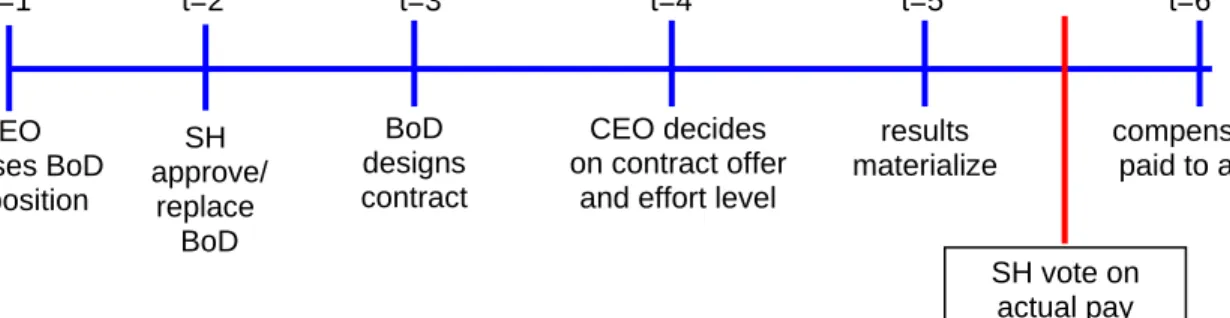
The board composition and the level of board dependence is determined as the equilibrium of the multistage game exhibited in figure 1.
[please insertfigure 1 about here]
At date 1, the CEO proposes a BoD with a given level of board dependence λ and an aggregate contribution tofirm value ofy(λ) to shareholders. At date 2, the firm’s sharehold-ers approve the CEO’s board proposal or replace it with their own director slate incurring transaction cost k whenever it is profitable to do so. At date 3, the approved BoD designs the CEO’s compensation contract and at date 4, the agent decides on the contract offer and makes her effort decision. At date 5, thefirm realizes its actual profit and at date 6, it pays out the corresponding compensation to the agent.
The vote on the agent’s compensation takes place between dates 5 and 6, after the results are realized but before the agent’s compensation is paid out. Since the vote is advisory, it has no impact on the enforceability of the compensation contract signed at date 4 so that the agent’s compensation is paid out according to the contractual terms specified at date 3. It follows that the potential consequences of the advisory vote on the firm’s compensation policy must already be reflected in the BoD’ contract proposal made at date 3.
effectiveness of non-binding shareholder votes. A detailed analysis and discussion of the relation between negative press coverage and executive pay is provided by Core et al. (2008).
24 ISS (2012) defines a voting dissent of more than 30 % as substantial, and, according to Larcker et al (2012), Glass Lewis & Co fixes the hurdle at a voting dissent of 25 %.
3
Optimal contract and BoD composition without SoP
3.1
First-best solution
As a benchmark case for the subsequent analysis of the multi-stage game I consider the
first-best solution of the agency problem. If effort were contractible and the individual contribution of board candidates were publicly observable, the principal could compose the board without an efficiency loss and write a contract specifying the effort level that maximizes the joint surplus of the agency25
E[W] =E[UP] +E[UA] =y(λ) +E[x]−C(a). (5)
The surplus comprises the contribution of the BoD, the expected result and the agent’s personal cost. The surplus maximizing effort level is implicitly defined by the followingfirst order condition
∆x =C0(aF B). (6)
According to (6) the first-best effort is found by equating the agent’s marginal contribution to the firm’s result with its marginal cost of effort. Since effort is contractible, the agent’s compensation contract contains a salary but no bonus. Assuming that C(aF B)
≥ w, the
optimal contract satisfies the agent’s participation and her limited liability constraint,
E[s(x)]−C(a) ≥ 0 (7)
s(x) ≥ w ∀ x. (8)
Since C(aF B)
≥ w, the participation constraint is binding and stricter than the limited liability constraint. It follows that the agent receives just her reservation utility.
The first-best composition of the BoD maximizes the contribution of all board members in (3). Since v is the intercept and ρthe slope of (3), the BoD’s contribution function takes its maximum value for a given value of λ if vi = v = v, and ρi = ρ = ρ. Since ρ > 0, the
resulting first-best contribution function, yF B(λ) =v+ρ·λ, is monotonically increasing in λ so that λF B = 1/2.26
25 The surplus definition in (5) is standard in agency theory. Adding the BoD’s utility would imply double counting because the BoD already maximizes a weighted average of the principal’s and the agent’s utility. 26 If effort were contraticble, the shareholders could delegate the contracting task to the BoD without any efficiency loss. Since VB(1/2) =W/2, thefirst best effort level is also obtained ifλ= 1/2 and the BoD writes the contract ona.
3.2
Second-best solution
3.2.1 Optimal contract for a given board structure
Since the agent’s effort is not contractible, the compensation must not only assure a suffi -cient pay level but also provide incentives to exert productive effort. At date 3, the BoD designs the optimal bonus contract by maximizing its objective function in (2) subject to the limited liability constraint in (8), the agent’s participation constraint (7) and the incentive constraint:
b=C0(a). (9)
The incentive constraint in (9) stems from maximizing the agent’s expected utility in (1) with respect to a and implicitly defines the agent’s optimal effort choice as the effort level that equates the bonus with the marginal cost of effort provision. Since C(a) is strictly convex, the agent’s equilibrium effort is monotonically increasing in the bonus. Solving the BoD’s optimal contracting problem at date 3 yields the following result.
Lemma 1: The agent’s equilibrium effort is monotonically increasing in the level of board
dependence. For λ<1/2 the equilibrium effort is implicitly defined by the following
expres-sion a∗(λ) =h(λ)· ∆x−C 0(a) C00(a) , h(λ) = 1−λ 1−2·λ, (10)
where the term h(λ) is monotonically increasing in λ. For λ = 1/2, a∗ = aF B. Proof: see
appendix.
Lemma 1 suggests that an increasing level of board dependence alleviates the agency problem. The higher the level of board dependence, the closer is the agent’s equilibrium effort to the first-best effort level. The optimal compensation contract is obtained by solving (8) for the salary and (9) and (10) for the optimal bonus. As an immediate consequence of lemma 1, we can make the following statement about the agent’s compensation without giving a formal proof:
Corollary 1: The optimal compensation comprises a salary equal to the minimum pay level and a bonus that is monotonically increasing in the level of board dependence:
w∗ =w, b∗(λ) =∆x−
a·C00(a)
That is, an increasing level of board dependence affects the agent’s bonus but not her salary so that in equilibrium, the performance-based part of the agent’s compensation is distorted whenever λ >0.
In the limited liability setting, the agency problem arises because the bonus determines not only the agent’s effort incentives but also the sharing of the surplus between the agent and the principal. The total surplus generated by the agent’s effort equals Π(a) =a·∆x−C(a)
whereof the agent receives the share G(a) and the principal retains the share H(a). In equilibrium, these shares are defined as follows
G(a) =a·C0(a)−C(a), H(a) =a·(∆x−C0(a)), (12)
where I use the fact that b=C0(a) from the agent’s incentive constraint. From the
assump-tions about the cost function, G(a) is monotonically increasing whereas H(a) is strictly concave in a.
To implement the first-best effort, the principal must set the bonus equal to b = ∆x.
This solution cannot be optimal because it transfers the entire surplus to the agent. At the other extreme, a bonus of zero would attribute the maximum share to the principal but provide no effort incentives. An independent BoD solves this trade-off in the best interest of the principal by setting a bonus rate of b∗(0) = ∆x−a·C00(a) and thereby implements
an equilibrium effort level of a∗(0) = [∆
x −C0(a)]/C00(a), the effort level that maximizes
H(a). An increasing level of board dependence puts more weight on the agent’s share and thereby mitigates the conflict between surplus sharing and incentive provision. For λ= 1/2,
the BoD puts equal weight on both parties’ shares so that the BoD essentially maximizes the agent’s contribution to the joint surplus.27
3.2.2 Equilibrium board composition
I determine next the equilibrium composition of the BoD. At date 1 the CEO proposes a BoD with a given dependence level λ and a contribution function y(λ). This proposal is subject to shareholder approval at date 2. If the shareholders accept the CEO’s proposal, their utility equals
E[UP(y(λ), a∗(λ))] =y(λ) +H(a∗(λ)) +xL−w (13)
The CEO’s proposal has two countervailing effects on the utility of shareholders. As long as y(λ) >0, the shareholders’ utility is increasing in the BoD’s contribution to firm value. Further, if the CEO composes the BoD so that ρ > 0, y(λ) is increasing in λ so that shareholders partly benefit from an increasing level of board dependence. This positive effect is offset by a reduction of the principals’ share in the surplus generated by the agent because
H(a) is monotonically decreasing in a for λ > 0. The optimal level of board dependence from the principal’s perspective balances the two effects and can be found by maximizing (13) with respect to λ.
Lemma 2: Let λ∗ denote the optimal level of board dependence from the shareholders’
perspective. It holds that λ∗ <1/2 if ρ<ρ+,where ρ+ >0. Proof: see appendix.
Intuitively, lemma 2 requires that the BoD’s marginal contribution to firm value is not always larger than the marginal loss resulting from the decline of the shareholders’ surplus share generated by the agent’s effort. In fact, if ρ > ρ+ there is no conflict of interest between the CEO and thefirm’s shareholders because both player prefer a dependence level of λ = 1/2. To focus on non-trivial equilibria, the subsequent analysis considers the case where ρ<ρ+ so that λ∗ <1/2.
Since shareholders cannot control the optimal BoD composition, they are not interested in implementing a BoD with a dependence level of λ∗. While the shareholders can control
the level of board dependence, they can only compose a BoD with an expected contribution of zero. However, for y(λ), the shareholders’ best alternative consists of implementing an independent BoD in order to maximize the agent’s contribution to firm value,H(a). In this case, the shareholders’ utility equals E[UP(0, a∗(0))]−k. A rational CEO anticipates the
shareholders’ decision problem and proposes a BoD so that it maximizes her utility and is accepted by shareholders at date 2. The solution is summarized in Proposition 1:
Proposition 1: In the absence of SoP, the equilibrium composition of the BoD comprises
the first-best contribution function yF B(λ) and a strictly positive level of board dependence
λ=λN. If the board’s contribution is sufficiently large,λN =λF B.Otherwise, the equilibrium
level of board dependence solves
yF B(λN) +H(a∗(λN)) =H(a∗(0))−k, (14)
the solution λN ∈(0,1/2) is unique. Proof: see appendix.
As in the first-best solution, the CEO proposes a BoD with a maximum contribution functionyF B(λ). This strategy is optimal because the CEO’s utility does not directly depend
on the parameters ofy(λ) but a higher board contribution prompts shareholders to approve a higher dependence level. Since the CEO’s utility is monotonically increasing in λ, she uses her ability to bundle the two essential director qualities in a manner that the firm’s shareholders accept the highest possible level of board dependence.
The equilibrium level of board dependence is strictly positive. It holds thatλN
≤1/2 be-cause the principal must solve the trade-offbetween incentive provision and surplus sharing. Since H(a∗(1/2)) = 0, it is only optimal for the principal to allow for the first-best level of
board dependence if the BoD’s contribution to firm profit is relatively more important than the net contribution of the agent. Particularly, the shareholders approve the first-best level of board dependence if and only if yF B(λF B)≥H(a∗(0))−k.That is, the net contribution of a BoD with λ = 1/2 must not be lower than the difference between the surplus share attainable with an independent board and the transaction cost, otherwiseλN <1/2.Ceteris
paribus, the shareholders are willing to accept a more dependent board, the higher the in-tercept (v) and the slope (ρ) of the BoD’s contribution function. Likewise, the equilibrium level of board dependence is decreasing in the benchmark contribution of an independent board, H(a∗(0)),and increasing in the transaction cost (k).
4
Optimal contract and BoD composition with SoP
4.1
Optimal contract with SoP
In this section, I consider the consequences of an advisory shareholder vote on the agent’s compensation. As shown in figure 1, the vote takes place between date 5 and date 6, after the firm’s results are realized but before the compensation is paid out to the agent. Before submitting their vote, shareholders observe thefirm’s profit and the resulting compensation and evaluate the prospective total compensation against the benchmark level t. As long as
s(x) ≤ t, the shareholders accept the BoD’s compensation proposal, otherwise they reject it. Since t is uniformly distributed over the interval [s, s] with density φ(t) = 1/(s−s),the fraction of shareholders refusing to approve a given compensation of s(x) equals
α(x) =Φ[s(x)] =φ(t)·[s(x)−s]. (15)
The expression in (15) reflects the well documented empirical observation that the share-holder voting dissent is positively related to the level of CEO compensation. The higher the
CEO’s compensation level, the higher the fraction of shareholders that disapprove the BoD’s compensation policy.
The optimal voting strategy of shareholders depends on the realized result. According to corollary 1, the level of board dependence does not affect the agent’s salary so that the
firm sets w = w for all types of boards. The presence of SoP cannot alter this result because a higher salary merely increases the likelihood of a shareholder disapproval without providing any benefits to the BoD. It follows that α(xL) = 0 because s ≥ w regardless of
the firm’s result. Accordingly, shareholders can only have an incentive to disapprove the agent’s compensation in case of a good result. They do so if w+b > t so that α(xH) =
φ(t)·(s(xH)−s)>0. Considering the optimal voting strategy of shareholders, the expected
equilibrium level of voting dissent equals αb =a·α(xH).
Anticipating the shareholders’ equilibrium vote, the BoD maximizes its objective function in (2) net of the disutility arising from a negative shareholder vote to determine the optimal contract. Lemma 3 characterizes the equilibrium effort induced by the optimal contract.
Lemma 3: The agent’s equilibrium effort in the presence of SoP is implicitly given by the following expression
a◦(λ) = (1−λ)·[(∆x−C
0(a)]−θ·α(x H)
(1−2·λ+θ·φ(t))·C00(a) . (16)
For a given value of λ, it holds that a◦(λ) ≤ a∗(λ) and b◦(λ) ≤ b∗(λ). The inequalities are
strict whenever θ is positive. Proof: see appendix.
According to lemma 3, SoP prompts a BoD with a given dependence levelλ to offer the agent a contract that provides lower effort incentives. It does so by reducing the bonus, whereas the equilibrium salary is not affected by the shareholder vote and equal tow. That is, with an identical salary and a lower bonus, advisory SoP can be expected to reduce the total compensation granted by a BoD with a given dependence level λ.
Setting the CEO’s compensation requires the BoD to trade off its interest in balancing the principal’s and the agent’s utilities against the disutility arising from the prospects of a negative shareholder vote. Since the BoD’s utility is decreasing in α but α is increasing in the agent’s compensation, the anticipation of a negative advisory vote leads the BoD to reduce the agent’s compensation even though the vote is not directly enforceable. In equilibrium, the downward adjustment of the bonus partly corrects for the positive impact of board dependence on the agent’s compensation. The higher the BoD’s responsiveness to
shareholder concerns (θ) and the equilibrium voting dissent in case of a good result,α(xH),
the lower is the bonus and the lower is the equilibrium effort motivated by the optimal contract.
The same effect is induced by a higher value of the uniform density functionφ(t).Fixing the lower bound of the support at s, a higher value of the density function is equivalent to a lower value of s, the highest acceptable compensation to shareholders. That is, a lower tolerance of shareholders towards high compensation levels prompts the BoD to reduce the agent’s pay. However, advisory SoP can only impact the compensation policy if the BoD is actually responsive to shareholders’ concerns. If θ = 0, the compensation contract is the same as without SoP even if the BoD anticipates a strictly positive voting dissent. Likewise, it is essential for the effectiveness of advisory SoP that some shareholders openly disagree with the firm’s compensation policy even if doing so does not add to their utility once the compensation contract has been signed. Only the interplay of a responsive BoD with shareholders willing to evaluate the firm’s compensation levels against a benchmark, such as the pay level of peer firms with similar performance, makes SoP an effective governance instrument despite the fact that it is not binding.
4.2
Equilibrium BoD composition with SoP
The equilibrium level of board dependence is determined as in section 3.2. At date 1, the CEO anticipates the shareholders’ decision problem and proposes a board with the maximum acceptable level of board dependence at date 2. The result is summarized in proposition 2:
Proposition 2: The equilibrium composition of the BoD with advisory SoP combines the
first-best contribution function yF B(λ) with a strictly positive level of board dependence λ=
λA.The equilibrium level of board dependence solves
yF B(λA) +H(a◦(λA)) =H(a∗(0))−k, (17)
whenever an interior solution λA
∈ (0,1/2) exists. Otherwise, λA = 1/2. It holds that
λA≥λN. The inequality is strict whenever λN <1/2. Proof: see appendix.
According to proposition 2, the presence of SoP does not affect the shape of the BoD’s contribution function, yF B(λ), but it leads to a weakly higher level of board dependence
as compared to the equilibrium level in the absence of SoP. Intuitively, λA
≥ λN because
higher level of board dependence before eventually replacing the BoD at date 2. Particularly, since the contribution function is the same as in the absence of SoP, the marginal benefit of board dependence is unaffected by its introduction. By contrast, the marginal cost of board dependence is reduced because the BoD anticipates that a fraction of shareholders disagrees with the CEO’s compensation and reduces the agent’s bonus for a given value of λ. This direct effect on the agent’s compensation increases the shareholders utility for a given level of board dependence so that
E[UP(y(λ), a◦(λ))]> E[UP(y(λ), a∗(λ))] ∀ λ. (18)
Shareholders can only benefit from the reduction in compensation cost if the CEO proposes the same level of board dependence as without SoP. However, since the utility derived from the outside option of replacing the current BoD with a board that makes no contribution to
firm value, rational shareholders cannot credibly refuse to accept a more dependent board than in the absence of SoP. A rational CEO anticipates the shareholders’ willingness to accept a higher level of board dependence and proposes λA so that the shareholders are indifferent between approval and disapproval. Essentially, the constant outside option of shareholders puts the CEO in the position of the residual claimant.
Thus, whenever (17) has an interior solution,λA>λN and shareholders attain the utility
level associated with their outside option, H(a∗(0))−k. Shareholders can only benefit from SoP if the CEO is constrained in her ability to extract the surplus. For example, ifλN = 1/2,
the CEO cannot further increase the level of board dependence so that λA =λN. It follows
directly from (18) that shareholders benefit from SoP under these conditions.28 Proposition
3 summarizes the impact of advisory SoP on the CEO’s compensation:
Proposition 3: Whenever (17) has an interior solution so that λA < 1/2, advisory SoP increases the CEO’s compensation, that is a◦(λA) > a∗(λN), and b◦(λA) > b∗(λN). If λA =
1/2,the impact of SoP on the CEO’s compensation is ambiguous. Proof: see appendix.
If λN < λA < 1/2, the increased level of board dependence directly translates into a
higher effort despite the fact that SoP reduces a◦(λ)< a∗(λ) for a given value of λ, so that
a◦(λA) > a∗(λN). That is, in equilibrium the difference between the two levels of board
dependence λA and λN outweighs the marginal reduction of the agent’s effort level caused
28 The same holds ifλN <1/2 butλA= 1/2 because the CEO can extract the full surplus in the absence
by SoP. To induce the increased equilibrium effort, the firm must raise the agent’s bonus so that the agent’s compensation is higher than without SoP. That is, whenever SoP has a non-trivial impact on the firm’s board structure, it can be expected to increase the level of executive compensation.
As for the utility of shareholders, advisory SoP only unambiguously increases the agent’s compensation if the CEO is constrained in her ability to extract the surplus. If λA is not
determined by (17) but limited to its boundary value ofλA= 1/2,the agent’s compensation
can also decrease. A clear prediction can be made for the case where λA = λN = 1/2.
For this case it follows directly from lemma 3 that a◦(λA) < a∗(λN) so that the agent’s
equilibrium effort and the corresponding compensation are reduced by the introduction of SoP. For intermediate cases, where λN is interior but λA is bounded, the impact of SoP on
the agent’s effort and her compensation is ambiguous.
5
Extensions and regulatory implications
5.1
Binding SoP
As mentioned in the introduction, a number of European countries did not follow the Anglo-Saxon approach of an advisory vote but have introduced a binding shareholder vote on the remuneration of executives. In this section, I briefly discuss whether and how this change of the SoP design affects the predictions of my model. As in section 4, I assume that the vote takes place after the firm’s results are realized and the size of the agent’s bonus has been determined but before the agent’s compensation is paid out so that the time line of the game in figure 1 remains unchanged.29
With a binding vote, the BoD can only pay out the prospective compensation to the agent if the firm’s shareholders approve the payment, otherwise the agent’s compensation needs to be adjusted. As a practical matter, this type of regulation requires that the BoD closes all compensation contracts subject to later shareholder approval in order to avoid the payment of damages in case of a negative shareholder vote. Otherwise, the CEO may 29 Apart from Switzerland, where a post-contractual binding vote is currently included in a law proposal put forward in a public voting initiative, a binding vote on the actual remuneration amount is already law in Czechia and in Latvia, see European Commission (2010).
successfully sue the firm for the payment of her contractual claims.
To address these legal issues within my model framework, I subsequently assume that the shareholders can effectively refuse the payout of any compensation exceeding an exogenously given amount of m, provided that the SoP proposalfinds majority support. The amountm
defines the legal protection standard of the CEO. On the one hand it determines the extent to which the SoP vote can overrule existing compensation arrangements, and on the other hand it limits the amount of compensation that can be granted without shareholder approval. For example, ifm=w,all bonus payments are subject to prior shareholder approval, whereas if
m > w, the CEO is essentially in a position to enforce a part of her bonus awards by legal
action. To assure that the agent accepts the compensation contract at date 4, I subsequently assume that m≥w.
The analysis of the players’ equilibrium strategies starts with the shareholders’ voting decision between dates 5 and 6. Since the vote takes place after the agent has supplied her effort, the shareholders face a moral hazard problem. As before, shareholders compare the prospective compensation with their individual benchmark pay level t and refuse it if
t < s(x). However, even shareholders that do not vote against the CEO’s compensation in
an advisory vote because t≥ s(x),have an incentive to disapprove the BoD’ compensation proposal whenever s(x) > m. If they approve the CEO’s compensation, they must pay
s(x). If they refuse it, they must only pay a compensation of m. It follows that rational shareholders are strictly better off if they refuse any compensation exceeding m.
Since m ≥ w, the agent’s salary cannot be reduced so that a negative SoP vote can only affect the agent’s bonus in case of a good result (x = xH). Particularly, whenever
b > b:=m−w,all shareholders vote against the agent’s compensation and force the BoD to
cut the bonus tob. Thus, the equilibrium voting dissent isα = 1 as long as the BoD proposes a bonus exceeding b. Otherwise α(xL) = 0 and α(xH) = Φ[s(xH)] as with advisory SoP.
The consequences of the shareholder vote on the agent’s compensation and the equilibrium composition of the BoD are summarized in Proposition 4
Proposition 4: With a binding SoP, the equilibrium composition of the BoD comprises the
first-best contribution function yF B(λ) and a board dependence level of λB. The equilibrium
degree of board dependence is determined by the legal protection standard of the CEO. If
m < s(xH) it holds that λB ∈ [0,λA) and the agent’s bonus equals b =m−w < b◦(λA). If
i.e. λB=λA and b=b◦(λA). Proof: see appendix.
According to proposition 4, the enforceability of the shareholder vote on the SoP proposal can only affect the player’s equilibrium strategies if the legal protection standards are low. Particularly, if shareholders can effectively preclude any compensation payment abovem, the shareholders can effectively cut the agent’s bonus tobwhenevers(x)> m,otherwise the BoD implements the same contract as with advisory SoP. A rational board of directors anticipates this threat and reduces the contractually specified bonus to b. This strategy is optimal for the BoD because it minimizes the equilibrium voting dissent. As a consequence, the threat of a retroactive bonus cut by the firm’s shareholders is never carried out in equilibrium.
Faced with a contractual bonus of b, the CEO reduces her level to a = C0−1(b). This
effort level is lower than a◦(λA),the equilibrium effort with advisory SoP. Further, sincebis
increasing inm, the agent’s effort is increasing in the legal protection standard. The higher (lower) the amount of the agent’s compensation that can be granted without shareholder approval, the higher (lower) her equilibrium effort. To assure that the BoD pays no bonus below b, the CEO composes the BoD so that λB
≥ 0 and a◦(λB) = a. Both conditions,can
only be met ifa > a◦(0),otherwise the shareholders disapprove the optimal bonus proposed
by an independent BoD. In this case, the CEO does not benefit from proposing a dependent BoD and composes the board so thatλB = 0.Shareholders accept the CEO’s board proposal at date 2 because they attain a higher utility than in case of a rejection.
The analysis shows that a binding SoP can be more effective than an advisory vote for controlling the level of board dependence and thereby the CEO’s compensation. The consequences of a binding SoP crucially depend on the legal protection standard of the CEO. Ifmis high so that shareholders cannot impair existing contractual arrangement between the BoD and the CEO, a binding SoP offers no advantage over an advisory vote. For lower values ofm, a binding SoP becomes an effective control mechanism for shareholders. However, this mechanism can also become too rigid and impair the agent’s effort incentives. In the worst case, when m=w,the agent exerts no effort because the perspective of a retroactive bonus cut prompts the BoD to remove any bonus payment from the agent’s compensation contract.
5.2
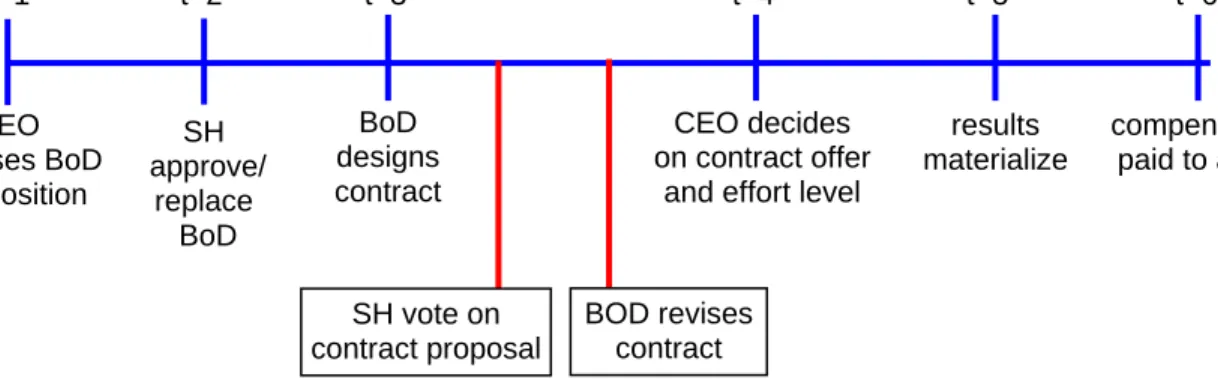
Pre-contractual SoP
The moral hazard problem caused by a binding SoP can basically be avoided if the vote on the compensation takes place before the BoD signs the compensation contract with the