Artwork based on the theme “Freedom” made by Juvenile Prisoners from Romania who Participated in CLAP Project, Courtesy of Convicts Liberty Aid Project (CLAP) Magazine
Critical Reflections
on Higher Education
in Prison
J
OURNAL OF
P
RISON
E
DUCATION
&
R
EENTRY
Vol 6 No 1
Special Issue- 2019
Vol. 6 No. 1, 2019
FEATURE–EDITORIAL
Critical Reflections on Higher Education in Prison
DRS. HELEN NICHOLS, SUZANNE YOUNG AND CORMAC BEHAN
Since the publication of the first issue of the Journal of Prison Education and Reentry (JPER) in 2014,
the journal has provided an international platform for researchers and practitioners to explore education in prison and during re-entry into the community with a multidisciplinary approach. These approaches include, but are not limited to, criminology, sociology, pedagogy and policy. We, the editors, are delighted to present the first special issue of JPER within which we explore the current landscape of higher education in prisons through a collection of contributions. More specifically, this special issue brings together examples of ini
-tiatives that involve partnership work between universities and criminal justice institutions to create oppor
-tunities for educational innovation involving people in the free community as well as those impacted by the criminal justice process.
University involvement with criminal justice institutions in an educational capacity is not a new phe
-nomenon. Through the establishment of the “Crime-A-Challenge” Society at the University of Oxford in the 1950s, criminologist Max Grunhut, a firm believer in prison as a place for education and reform, brought together boys serving sentences at Huntercombe Borstal with Oxford law students, which involved Oxford students attending the borstal for residential stays. This kind of engagement was later continued via education
-al classes delivered by the University of Oxford at HMPs Grendon, Oxford and Bedford. At the same time, the Open University has provided higher education in UK prisons for over 40 years spreading their Students in Secure Environments programme to over 150 prisons through the core belief that education should be ac -cessible to all.
In the 1990s, the Inside Out initiative was established by Professor Lori Pompa at Temple University in the United States. Now described as an international movement, the Inside Out programme comprises of more than 150 correctional and higher education partnerships, more than thirty think tanks and in some cases, public workshops. Realising the need for incarcerated individuals to have the opportunity to continue their education on release, Professor Baz Dresinger (John Jay College, Central University of New York) founded
the Prison to College Pipeline in 2011. Administered by the Prisoner Reentry Institute, the pipeline provides prisoners with access to public university-level education, mentorship, and community support to increase their chances of timely graduation and employment upon release. Replications of this initiative are now being seen in the UK, South Africa, Jamaica and Trinidad. Similar initiatives have once again resurfaced in the UK with the establishment of the Learning Together programme led by Drs Amy Ludlow and Ruth Armstrong at the University of Cambridge. This has since become a national and international programme which brings students from outside and within prison walls together to learn alongside one another and is situated within a broader scope of programmes within the Prison University Partnerships in Learning (PUPiL) network.
Although this is not an exhaustive list of such programmes, the aforementioned examples evidence the internationalisation of collaborative practice which aims to facilitate innovative, interactive higher education experiences in “hard to reach” environments involving students, practitioners and academics to create mean
-ingful exchanges between people who would usually be separated by the imperatives of the criminal justice system. Beyond these initiatives, other educational projects have begun to emerge globally including Making the Connection Project (Australia), Book Clubs for Inmates (Canada), India Vision Foundation (India), Af-rica Prisons Project (East Africa), Hudson Link for Higher Education (USA) and Project Rebound (USA).
The increasing number of universities partnering with criminal justice institutions globally (but particularly in Western countries) to deliver higher education can be viewed as a reflection of the positive success stories shared amongst the higher education communities (see Inderbitzin, 2015; King, et al. 2018; Lockard and
Correspondence: Cormac Behan , Email: [email protected] (Accepted: 9 July2019) ISSN: 2387-2306 doi: https://doi.org/10.25771/07f1-3s63
Rankins-Robertson, 2011).
The aim of this special issue is to bring together insights and challenges of delivering higher education in prison or within reentry settings. The papers within this issue offer critical reflections, student evaluations and innovative pedagogical approaches that acknowledge the learning journeys of students, teachers, facilita
-tors, coordinators and academics. There is no doubt that these partnerships are creating meaningful learning journeys and breaking down societal barriers for people with convictions, but as acknowledged by the collec
-tion of articles, there must also be cau-tion given to the ethical, pedagogical and practical challenges that are embedded in these initiatives. On ethical grounds people residing in prison, or those recently released, can be considered one of the most vulnerable populations of learners. People in prison or who have since been released are positioned very differently in society from university students and care needs to be taken not to put any of the learners at a disadvantage or in worst case scenario, cause any harm. The wellbeing of both the people with convictions and the university students is paramount, yet the nature of the short term HE courses can lead to difficulties for individual learners both during and after the learning process (see Young, 2018). This special issue seeks to elaborate on some such challenges and how they have been responded to in prac -tice.
The setting of many of the learning programmes that are being developed and the ability of the learners on those programmes results in a number of pedagogical challenges that have received very little attention to date. These courses are higher education initiatives and thus consideration must be given to how higher edu
-cation is being delivered. Furthermore, the pedagogical lessons learned from the programmes are important to explore the similarities and differences between traditional higher education and those delivered in a crim
-inal justice context. There is an abundance of pedagogical literature on education in prison and strategies of teaching and learning in higher education but less have been developed when the two institutions have come together in a learning capacity. The aim of this special issue is to highlight the pedagogical approaches used in the programmes and consider the challenges that have arisen.
The articles in the issue fall under four key themes that address the issues discussed above. The first theme of the issue is transformative learning. Bringing together university students with people currently or recently incarcerated is often argued to have to a transformative effect for learners, however the relationship between transformation of self and learning is multifaceted and by no means a linear process. The first paper by Gray, Ward and Fogarty, “Transformative Learning Through University and Prison Partnerships: Reflec
-tions From ‘Learning Together’Pedagogical Practice”,discusses transformative learning through a lens of a transformative ripple model. The authors draw on evaluation data from two Learning Together courses and discuss the importance of a transformative pedagogy to help facilitate the learners’ transformative learning journey of self. The transformative ripple model is applied to demonstrate how university-prison learning partnerships can lead to both individual and institutional transformations. The authors argue that for these learning environments to be truly transformative, the pedagogical approach must also be transformative in na
-ture. The paper emphasises that it is equally important to consider how higher education is delivered as well as what is delivered within these spaces. The paper by Ludlow, Armstrong and Bartels, “Learning Together: Localism, Collaboration and Reflexivity in the Development of Prison and University Learning Communi
-ties”, engages with the challenges of collaboration and reflexivity in the conceptualisation and development of partnership learning communities between higher education and criminal justice institutions. It is grounded in experiences of partnerships in the United Kingdom and beyond, and considers the policy and practice chal
-lenges of partnership-working between higher education and criminal justice institutions. They argue persua
-sively that we need to reflect critically on how different socio-political and cultural realities (both within and beyond national borders) might shape the particular nature of these partnerships.
The second theme of the special issue recognises the importance of inclusive learning environments.
This is an important theme given the unfamiliarity of learning spaces for different cohorts, who would not ordinarily occupy educational environments in the manner in which these initiatives are delivered. Gosling and Burke present their article “‘People Like Me Don’t Belong in Places Like This’: Creating and Developing a Community of Learners Beyond the Prison Gates”, which reflects on a community-based model of higher education in the UK involving university students, criminal justice service users and practitioners. Adopting
edgework as a conceptual framework to create an inclusive learning space, the authors discuss their explo
-ration of students’ motivations to engage with higher education and consider how lecturers providing taught sessions have come to think differently about how they deliver higher education; leading to exploratory ques
-tions about higher education delivery more broadly. In the article, the authors reflectively examine the pro
-cess of “pedagogical brokerage” in navigating the management of expectations, incongruity and vulnerability while also identifying the emerging institutional differences in how the purpose of higher education is viewed. Gosling and Burke argue in this contribution that more intensive pastoral care is needed for those engaging in challenging personal journeys and they acknowledge the recognition of the importance of pathways both into and out of higher education. The second article within this theme by Zampini, Österman, Stengel and Bennalick entitled “Turning Gender Inside-Out: Delivering Higher Education in Women’s Carceral Spaces” offers an important contribution to the special issue by discussing the gendered learning space in the context of prison education. Drawing on their experiences of delivering higher education with women and men in prison, the authors offer critical reflections of gender dynamics within the classrooms and the pedagogical challenges that arose. This paper highlights the normative gendered assumptions within the prison setting and draws comparisons between an all-female cohort of learners and mixed cohorts of learners. The authors argue that a gendered consciousness can be beneficial in unifying student and prisoner learners whilst also disrupt
-ing the hegemonic masculine environments that can too often lead to women’s voices be-ing marginalised in learning spaces.
Theme three of the contributions centres on reconsiderations of social identities. With a particular focus on broader “behaviours of desistance” (Nichols, 2018) whereby notions of self and conceptions of others are challenged within unique learning spaces, the following articles examine the personal transformations experienced by learners. In their article “‘There’s More That Binds Us Together Than Separates Us’: Exploring the Role of Prison-University Partnerships in Promoting Democratic Dialogue, Transformative Learning Opportunities and Social Citizenship”, O’Grady and Hamilton explore the way in which education in penal institutions can present opportunities for social, economic and cultural transformation. Considering the role of education in enhancing social citizenship, the authors reflect on how their higher education programme delivered in a UK prison facilitated the positive challenging of stereotyping and othering through debate creating “de-othering attitudes”. Arguing for a need for social citizenship to grow into active citizenship, the authors propose that better cooperation is needed between prisoners and “outside communities”, and through a critical pedagogical approach, positive change can be achieved amongst all involved in agency, legitimacy and empowerment. The subsequent article by Turner, Broad, Miles and Maruna, “Learning Desistance Together”, considers transformation of self by discussing processes of desistance though learning. Their paper highlights how aspects of desistance were evident amongst both university and prison-based students on their course “Learning Criminology Inside”. The authors discuss desistance in a broader sense, whereby the focus is not desistance from crime but rather desisting from previously held norms and values. Drawing upon feedback from students on the course, the authors argue that bringing together university and prison learners can be beneficial for encouraging desistance from stereotypical views and criminogenic identities. The authors also discuss the challenges in delivering a course within the prison setting and consider the importance of resilience amongst staff and students and how this in itself can feed in to desistance.
The final theme of the special issue concerns practitioner reflections. Within these important contri
-butions, practitioner narratives provide more personal commentary on the junction between lived experience and reflections on educational practice. The first piece to be presented in this theme by Arroyo, Diaz and McDowell, “Needed Specialists for a Challenging Task: Formerly Incarcerated Leaders’ Essential Role in Postsecondary Programs in Prison”, provides the authors’ own experiences of managing, leading and teaching post-secondary education programmes in the United States are examined. Detailing the work of the “Hudson Link for Higher Education” project in New York, the authors (and self-proclaimed activists) of this paper spe
-cifically focus on the lived experience of incarceration as a source of expertise. The authors argue in this paper that it is those with such experiences who are the “needed specialists” for delivering academic programmes for incarcerated people. As a third-party coordinator, the Hudson Link project brings together correctional or
-ganisations with partner colleges for accredited work with the overarching objective of breaking the cycles of intergenerational poverty, mass incarceration and institutional racism. The authors have taken the opportunity
in this paper to communicate a call to action to recognise the kinds of expertise that should be seen as valuable in this work, the value of “inside teaching” experiences and the need to give those who have been formerly incarcerated empowering opportunities. The second article within this theme, and the closing article to this special issue, is “‘It’s About Whose Voices Matter and What That means’: Reflections on Insider/Outsider Sta
-tus in Prison Classrooms”. Within this article, Tynan presents a practitioner piece which provides a different view of the value of lived experience in the prison setting. Rather than seeing lived experience as inherently valuable, Tynan argues instead that it is “another tool in the pedagogical toolbox” to disrupt institutional norms and that this approach can still be achieved by those without such experiences. Through a distinctly personal reflective account, the author examines the challenges and outcomes of bringing together university students and serving prisoners in a learning space that she describes as a “nexus between prison and universi
-ty”. Describing such environments as being dialectical and held together by dialogue, Tynan positions herself within the reflection to broaden the reader’s consideration of how lived experience can be placed within such initiatives to generate dialogue and facilitate critical thinking about imprisonment and future prospects.
We believe this special issue highlights many of the successful outcomes that stem from prison-uni
-versity partnerships while also presenting a significant insight into the challenging nature of this work. The initiatives reflected on throughout the articles highlight how valuable this work is to learners, educators and institutions in overcoming the long-standing barriers to higher education for people with convictions. Evi
-dently, the collaborative nature of this work is central to possibilities of success. However, as highlighted in this special issue, critical reflection lies at the heart of ensuring that the aims of the programmes can be realised and sustained. Therefore, we present here a collection of articles that provide a ‘realistic celebration’ of the projects being undertaken, whereby challenge and adversity reveal themselves to be just as empowering as the rewards experienced.
References
Inderbitzin, M. (2015). Active Learning and Educated Hope: College and Prison Partnerships in Liberal Edu -cation. Liberal Education, 101(3).
King, H., Measham, F. and O’Brien, K. (2018). Building Bridges Across Diversity: Utilising the Inside-Out prison exchange programme to promote egalitarian higher education community within three UK pris -ons. International Journal of Bias, Identity and Diversity in Education, 4(2), 66–81.
Lockard, J, Rankins-Roberston, S. (2011) The Right to Education, Prison-University Partnerships, and Online Writing Pedagogy in the US. Reading and Writing in Prison, 23(3), 23–39.
Nichols, H. (2018) Higher Education in High Security: Meaningful Education Experiences in the Absence of Learning Technologies. Advancing Corrections: Journal of the International Corrections and Prisons Association, Issue 6
Young, S. (2018, October 15). Evaluation of the Leeds Beckett University Prison: Learning Together Pro-gramme 2017. Retrieved from Prisoners' Education Trust website: https://www.prisonerseducation.org. uk/resource/evaluation-of-leeds-beckett-university-prison-learning-together-programme-2017/
Special Issue Editors: Guest Editors
Dr. Helen Nichols is a Senior Lecturer in Criminology in the School of Social and Political Sciences at the University of Lincoln, United Kingdom. Prior to taking up post at the University of Lincoln, Dr. Nichols was a Senior Lecturer in Criminology at Leeds Beckett University during which time she worked with colleagues to establish the Prison Research Network. In addition, she worked collaboratively to develop an accredited 'Learning Together' module which was delivered to a combined cohort of university students and serving pris
-oners within a high security prison. Her research focuses broadly on contemporary adult male imprisonment. More specifically her interests lie in prison education, the experience of imprisonment and the renegotiation of identities in the prison environment through transformative experiences.
Dr. Suzanne Young is a Lecturer in Criminal Justice at the University of Leeds, United Kingdom. Dr. Young has been teaching in the fields of criminology, criminal justice and sociology for the past 12 years. She is the British Society of Criminology’s joint coordinator of the Yorkshire and Humberside regional group and Deputy Chair of the BSC Learning and Teaching Network. She has been awarded the 2017 Inspiring Teacher of the Year Award at Leeds Beckett University and also was awarded Senior Fellow of the Higher Education Academy in 2018.
Lead Editor
Dr. Cormac Behan is a Lecturer in Criminology at the University of Sheffield, United Kingdom. His research interests include penal history, prisoners’ rights, comparative penology and prison education. Prior to taking up this position, he taught politics and history in Irish prisons for 14 years. He has served on the executive boards of the Correctional Education Association and the European Prison Education Association. Currently, Dr. Behan is the lead editor of our Journal of Prison Education and Reentry (JPER)
Vol. 6 No. 1, 2019
FEATURE–HISTORICAL VIGNETTE
Correspondence: Thom Gehring, Email: [email protected] (Accepted: 14 June 2019) ISSN: 2387-2306 doi: https://doi.org/10.25771/fh2e-e549
Except where otherwise noted, content on this site is licensed under a Creative Commons Attribution 4.0 International License.
When Pestalozzi Went to Meet Bonaparte
THOM GEHRING
The effort to democratize higher education—to make it accessible to working, and even underclass people—has been a difficult and protracted journey, full of impediments and outright reversals. One juncture on this journey was the establishment of the first polytechnic institute, in Paris, 1795, by the French Rev
-olution’s National Convention. The purpose of the institute was to connect secondary and postsecondary education, especially for the preparation of civil and military engineers. (The Compact Edition of the Oxford English Dictionary. [1971]. New York: Oxford University Press, vol. II, p. 1097). But as prison educators know, political and administrative changes can sometimes reverse the effect of improvements, however secure they may seem at the moment. Hence, the story of Pestalozzi and the man who established the Paris polytech -nic institute.
Johann Heinrich Pestalozzi (1746-1827) was an important Swiss educator. He is also known as the person who started teacher education, and was most famous while alive for establishing education-oriented juvenile institutions for delinquent war orphans. Pestalozzi was a supporter of the French Revolution, but there was a terrible problem after the French invaded and occupied Switzerland in 1798. In many villages all the parents had been massacred and the children needed help. The French army supported Pestalozzi in his prison education work, mostly by providing buildings and other resources, but there were limits to what they could do. In 1802 he went to meet Napoleon Bonaparte.
Pestalozzi made a journey to Paris, as a member of the consulta called by Bonaparte to decide the fate of Switzerland. He hoped to take advantage of his stay in France to disseminate his pedagogical ideas. But Bonaparte refused to see him, saying that he had
something else to do besides discussing questions of a, b, c. Monge, the founder of the Polytechnic School, was more cordial, and kindly listened to the explanations of the Swiss pedagogue. But he
concluded by saying, ‘It is too much for us!’ More disdainful still, Talleyrand had said, ‘It is too much for the people!’ (Compayre, G. [1907]. The History of Pedagogy. London: Swan Sonnenschein & Co., pp. 434-435; emphasis in original).
Despite their different roles, Napoleon, Talleyrand, Monge, and Pestalozzi were supposed to be on the same side; that is precisely why this story is so difficult. Pestalozzi went on to help many people, but did it without assistance from those who should have been his natural allies. From literacy education, through to postsecondary and advanced education, prison educators have to be consistent in their support for each oth
-er—if only because very few others support them.
Thom Gehring retired as the research director of the Center for the Study of Correctional Education at California State University, San Bernardino. His scholarly emphasis is on the history of correctional education and prison reform. He has been a correctional educator since 1972. Dr. Gehring did his Ph.D. dissertation on the correctional school district pattern of organization. He serves as the historian for the Correctional Education Association. Earlier as a Professor of Education, he worked to direct the erstwhile EDCA correctional and alternative masters degree program.
Vol. 6 No. 1, 2019
RESEARCH PAPER
Transformative Learning Through University and Prison Partnerships: Reflections
From “Learning Together” Pedagogical Practice
NATALIE GRAY & JENNIFER WARD Middlesex University, London, UK
JENNY FOGARTY
London School of Hygiene & Tropical Medicine, London, UK
Abstract: This paper critically discusses two London-based “Learning Together” prison university partner-ships—Middlesex University with Her Majesty’s Prison (HMP) Wandsworth and London South Bank Univer-sity (LSBU) with HMP Pentonville. The paper documents how students experienced the shared classroom learning approach designed on principles of “transformative pedagogy”, and how students interpret their personal development and the knowledge and skills gained as a result. We share the steps taken to bring the learning together pedagogical philosophy to life and use evidence from module evaluation findings and criti-cal reflections to demonstrate the transformations that happen. We interpret our findings through the lens of a transformative ripples model. In addition to exploring personal transformation, the wider transformations that occur within the public institutions at the centre of these collaborations—the prisons and the universities —are discussed. We argue that for prison and university partnerships to be truly effective, they must embed transformative pedagogic practices at their heart, ensuring the “how”we teach is as important, and deliber-ately considered, as the “what” we teach.
Keywords: Prison education, transformative pedagogy, prison–university partnerships, experiential learn-ing, social justice education, prisons
Correspondence: Jennifer Ward, Email: [email protected] (Accepted: 20 March2019) ISSN: 2387-2306 doi: https://doi.org/10.25771/jbrt-q510
Except where otherwise noted, content on this site is licensed under a Creative Commons Attribution 4.0 International License.
The UK is currently seeing expansion in the development of prison–university education partnerships in the way community-based students are brought together to learn alongside in-prison students. These are styles of classroom knowledge exchange that encourage active participation and nurture dynamic processes of self-realisation. They are collaborations specifically intent on developing mutually beneficial exchange for the students taking part and the prisons and universities involved. Moreover, they are collaborations that can have impacts for wider social change. The growth in prison–university partnerships currently occurring in the UK can be linked to the government’s ambition to improve the provision of education in prisons both at the compulsory curriculum level and at the higher university level (Coates, 2016; Gauke, 2018). These partner
-ships can also be connected to understandings of prison “rehabilitation” and the factors that most successfully assist reintegration into the community on release. It is shown that engagement in education while in prison is linked to lower rates of re-offending (Davis et al., 2013; Ministry of Justice, 2011; Ministry of Justice, Gov
-ernment of the United Kingdom, Justice Data Lab and Prisoners’ Education Trust, 2014) and greatly improves chances of entering employment on leaving prison.
The aims of this paper are to critically discuss the delivery of two prison-based modules founded on the shared classroom design and pedagogic practice of the Learning Together approach. The module Contemporary Issues in Criminal Justice was delivered by Middlesex University in HMP Wandsworth prison (January–May 2017) and the Education as Social Justice module was taught by London South Bank University
(LSBU) in HMP Pentonville prison (September 2016–January 2017). The partnerships come under the umbrella of the Learning Together network led by Amy Ludlow and Ruth Armstrong since the collaboration of Cambridge University and HMP Grendon in place from 2015 (Armstrong and Ludlow, 2015). Transformative learning is an underpinning principle of the learning together model in that it is learner-centered, participatory, and interactive. Classroom participation and dialogue are core features of the learning and teaching approach.
For the academic year 2018–19, 24 universities and 23 prisons are partnered together delivering 31 different courses. Geographically, Learning Together courses are run throughout England, with clusters in Cambridge, London and the North West of England. The majority of the partnerships have been in place for between two and three years. A number of the modules are running as first-time pilot projects, but many are in their second and third year of delivery. A second Middlesex–Wandsworth module was delivered between October 2018 and January 2019. Nearly half (46%) of the courses being delivered within the network are Criminology focused (Learning Together Network, 2018a). The authors of this paper led the delivery of the modules in the two London prisons comprising groups of community-based and in-prison students.
In this paper, we document how students experienced the shared learning approach designed on princi -ples of transformative pedagogy, and how they interpreted their personal self-development and the knowledge and skills gained as a result. The discussion reflects on the common pedagogical practice that is grounded in the values of the wider learning together approach, which endeavors to create high-quality and academically rigorous learning experiences that encourage and support individual, as well as social and institutional trans
-formation. The learning together model is typically narrated as inclusive learning communities with princi
-ples of equality and mutual respect reflected in the structures, policies and practice in place.
In this paper, we share the steps taken to bring the learning together pedagogical philosophy to life and use evidence from module evaluation findings and critical reflections to demonstrate the various trans
-formations that happen. The concept “transformative pedagogy” is central to our interpretations (cf. Pompa, 2013a, 2013b). An underpinning framework, or model, applied to the material we present is the metaphor
of the transformative ripple. This is useful to convey how, by planting the foundations of an enriching and empowering education base, other important social values emerge, which become shared within, and beyond the classroom. The paper demonstrates the wider value and benefits that emerge through this ripple-like effect as the impact and influence of the learning approach filters out beyond the student learners and the teachers immediately involved. Both the community-based and in-prison students reported significant alterations to their sense of self-determination and confidence as a result of participating in this shared class teaching model. As a knock-on effect, aspirations and goals for the future are reimagined (cf. Werts, 2013). Thus, we critically discuss the nature of transformation itself: What is it that is changing as a result of the conditions created, and what is the wider impact that can be deduced from this transformative ripple model? This is an underpinning research question of this paper.
A key organising concept of the learning together approach is transformative pedagogy and the way special attention is paid to how people teach and learn. Classroom participation and dialogue are core features of this pedagogical practice. In this way, students are contributing to the co-creation of knowledge that draws from the exchange of different perspectives and ideas among a diverse, mixed group of learners. We argue that for prison and university partnerships to be truly effective, they must embed transformative pedagogic practices at their heart, ensuring the how we teach is as important, and deliberately considered, as the what we
teach.
In addition to exploring personal growth, we discuss the changes that can occur within the public insti
-tutions at the centre of these collaborations—the prisons and the universities. A second underpinning question of this paper therefore is: Through these enriching higher education experiences, can universities go further, in their role as public institutions, to extend values of social inclusion? Removing barriers to higher education can contribute more widely to social change and social justice.
The Learning Together network and the other prison university initiatives emerging in the UK are part of a more extensive prisons–university educational movement.1 These emulate and borrow from programmes
established in the USA such as the Inside-Out programme operating from Temple University, Philadelphia since 1997 and the “Prisons-to-College Pipeline” project in John Jay College of Criminal Justice, New York
(Halkovic et al., 2013). Other international initiatives include the “African Prison Project”, “The Prison Education Project” and “Project Rebound” (Champion, 2018), illustrating the growing popularity of prison education. These partnerships go beyond the standardized lower-level literacy and numeracy courses and core curriculum teaching that make up education provision in English and Welsh prisons. Further, they add a different dimension to the distance learning model of the Open University (OU) degree courses accessible in English and Welsh prisons. Specifically, this is in the way partnership courses are delivered through face-to-face, in-class teaching in the same format as conventional university teaching and that comprise in-prison and community-based students learning together.
Transformative Pedagogy
Transformation is a key concept in interpretations of teaching and learning journeys and is applied extensively in analysis of prison education that brings community-based students into prisons to learn along
-side in-prison students. Theories of transformation, in this context, make reference to the personal individual transformations that occur, as well as the wider societal, community and institutional changes that can happen.
Armstrong and Ludlow (2016) suggest by bringing prisons to the outside community, and the outside com
-munity into prisons; in essence delivering education across walls, acts of wider social responsibility, societal awareness and acceptance of prisoner rehabilitation and reintegration is enhanced. Darke and Aresti (2016), writing from their experience of running a university prison partnership say, “it not only provides an enriching educational experience, but transcends social barriers and changes the ways that participants can view them
-selves and the world around them” (p. 31). Similarly, authors writing on the Inside-Out programme, collated
in Turning Teaching Inside-Out (2018), report on the transformative effects, relating it to the individual change it brings, the values of social change it contributes to, and the institutional impacts it has on universities and prisons. Pompa (2013b), the founder of the USA Inside-Out programme, states it “moves beyond the walls that separate us. In a more literal sense, it moves, actually, through the walls. It is an exchange, an engage
-ment–between and among people who live on both sides of the prison wall…” (p. 133). Bumiller (2013) also writing on Inside-Out states “testimonials from both inside and outside students often report ‘life changing’ effects of participating in a course, such as finding a direction in the pursuit of social justice or renewing their commitment to higher education” (p. 178). These themes are drawn out further in our paper.
Different terms are used in reference to the combined community and in-prison student groups in pris
-on university programmes such as inside and outside students or in-prison and community-based students. In this paper we adopt the terms community-based and in-prison students.
Prison–University Collaborations in Context
The university and prison educational partnerships emerging across the UK can be linked to the gen
-eral drive for better educational provision within prisons, as well as the benefits from building and investing in these organisational relationships. Internationally, there is widespread recognition of the importance of providing meaningful education in prison (Champion, 2018), provided by the Council of Europe Recommen
-dations 1989 (Council of Europe, 1990) and echoed by the United Nations Standard Minimum Rules for the Treatment of Prisoners (2015), known as the Mandela rules. The Council of Europe particularly note that education in prison should be “no less important” than education provided in the outside community (p. 11), and indeed, should “resemble adult education outside prison” (p. 13). Costelloe and Warner (2014), in their analysis of “Prison Education Across Europe”, argue that if learning is grounded in an adult-education phi
-losophy, it “offers a far richer and more authentic form of education” and as such, “can facilitate changes in a learner’s perception, attitudes and world view that are more likely to be truly transformative and lasting” (p. 175).
Following this global trend, in line with evidence on the effectiveness of prison education on recidi
-vism rates (Champion, 2018), UK prison and university partnerships can be discussed within ideas that those who are incarcerated should be able to build necessary skills and competences that facilitate re-entry and inclusion in society upon release. The Coates report (2016) Unlocking Potential called for improved prison education highlighting that education provides “the chance to re-enter society successfully, to find work, to
live fulfilling lives” (p. i). Indeed, Coates acknowledged the value of higher education in prison and went fur
-ther by calling for prison–university projects to be more than “isolated initiatives” and for higher education in
-stitutes (HEIs) and universities to ensure “pathways are facilitated for prison learners to gain access to college or university on release” (p. 55). This philosophy is advocated by the Council of Europe’s recommendations (15 and 16) that the outside community should be involved as fully as possible in prison education and that measures should be taken to enable those in prison to continue their education after release (1990).
The significantly lower rates of re-offending among those who participate in education while in pris
-on was menti-oned earlier. The USA longitudinal “Three-State Recidivism Study”, consisting of a treatment (involvement in correctional education) and a comparison group (no involvement), showed lower rates of recidivism by those who participated, in terms of re-arrest, re-conviction and re-incarceration (Streurer et al., 2003). The meta-analysis of educational programmes for incarcerated adults by Davis et al., (2013) found that people who participated in education in prison were 43% less likely to recidivate than those who did not.
More recent ministerial statements relating to prison reform and education in England and Wales were made by Justice Secretary David Gauke in May 2018. Similar to Coates, Gauke paid particular regard to prisoner re-entry and reintegration on release from prison and acknowledged the importance of access to education and employability skills saying prison should be “a turning point” where “the first step is education” (Ministry of Justice, 2018).
Discussions on the state of prison education in the justice system of England and Wales can therefore be located within the prison reform agenda under government scrutiny, albeit interrupted, and arguably with insufficient progress, since its initial announcement in 2016. The Prison Safety and Reform White paper (Min
-istry of Justice, 2016) set out ambitions for reform and in 2016, six prisons across England and Wales were “re-rolled” as “reform prisons”.2 Intended as models of radical reform, these empowered prison governors
with devolved budgets and autonomy, so improvements could be made more effectively within individual prisons. HMP Wandsworth was designated as one of the six reform prisons. The Middlesex–Wandsworth partnership was established during this period of internal change along with HMP Wandsworth’s desire to make available a greater breadth of education to the people in their prison. Indeed, amongst the ambitious, yet in part, contentious reform prisons management policy, HMP Wandsworth lost its designated status. This is too complex to discuss here, but it must be noted, reform and continued improvement is an ongoing institu
-tional priority. Political upheaval as a result of the EU Referendum and Brexit and the subsequent dissolution of Parliament on 3 May 2017 caused a halt on the meaningful continuation of the prisons reform policy as envisaged in the 2016 White Paper, and the criminal justice system of England and Wales has a long way to go to fulfil its stated ambitions.
The HMPs Wandsworth and Pentonville Learning Together Courses
The following section provides a brief description of the two prisons in which our modules were de
-livered, an overview of module content, the students participating, and their motivations to take part in the learning together teaching and learning style.
HMPs Wandsworth and Pentonville are combined category B and C adult male prisons in London.3
Both prisons were built in the mid-1800s and hold populations in excess of 1000 men.4 Both are local pris-ons designed to accommodate people serving short sentences and are close to courthouses in which trials are scheduled to take place with transfers out to other prisons. As such, the two prisons in which our courses were delivered, operate with highly transient populations. The average stay for a person in HMP Pentonville is approximately 60 days (HMIP, 2017, p 5). The transient populations inherent in both prisons was a challenge in terms of ensuring the in-prison students remained in residence long enough to complete the modules. A number of the Wandsworth students requested to be put “on hold” so they could complete the course before transfer. This in itself placed great responsibility on the course conveners to provide a valued and meaningful educational experience that outweighed the option of transferring to a less crowded, more appropriate prison environment.
The Contemporary Issues in Criminal Justice module delivered in Wandsworth mirrored the criminal justice course teaching at Middlesex University. The module was run over ten weeks in 40-minute subject-
specific lectures given by Middlesex academics with subjects explored and debated in small focused group discussions led by a team of group facilitators. Topics included crime and deviance, youth justice, court sen
-tencing, desistance theories, comparative international prison perspectives and race and the criminal justice system.
Sixteen students completed the module; nine in-prison and seven community-based students. The Middlesex community-based students were candidates in law, politics and criminology. Six were female and one male, which broadly reflects the gender balance of Social Science students generally. The main interest in taking part was linked to the experience of studying in a prison setting. A core feature of studying criminology is to appreciate the complex and nuanced nature of crime and offending, and having the chance to engage in what was referred to as an “immersive” learning experience, was highly regarded. The Middlesex students especially commented on the rewarding opportunity they had been given to learn alongside people in prison. Advancing knowledge by applying theoretical learning to real life was also an incentive. To them, this was an enriching experience they emphasized could never be achieved through any subject expert, or specialist criminal justice texts. These benefits are summed up in the following comments provided by Middlesex par
-ticipants:
Overall I think it was fantastic. …one of the main things that drew me to it was the fact that it was going to be this very immersive experience that had two elements of society that don’t necessarily overlap very frequently. (Middlesex University)
“It was an invaluable lesson being with those that have been through the criminal justice system…we wouldn’t have had this any other way” (Middlesex University).
“This kind of experience is not replaceable…from talking to those students (Wandsworth)…that is something I could never get from a book…” (Middlesex University).
Interests also related to gaining employment within the criminal justice system, with this seen as expe
-rience that would facilitate it, in addition to the way this type of opportunity could enhance already established professional practice skills. Two community students were developing specialisms in restorative justice
ap-proaches, and one had for many years worked with homeless and young adults. Sadly, there are many overlaps among these groups with imprisonment experiences. Shay (2018), reflecting on her experience of running a version of the Inside-Out programme, similarly set out the particular usefulness studying a course of this na
-ture has for law school students, in the way it involved more nuanced discussions about certain criminal justice topics (p. 248).
The main motivations for the Wandsworth in-prison students to take up this shared classroom oppor
-tunity included keenness to study at the level of university education with a special interest in criminology as a subject. A few expressed the wish to understand the criminal legal process with more clarity, with topics such as court sentencing and the disparity in sentence lengths between offence types of particular interest. Comparative prison systems were also subjects they were keen to hear about. The Wandsworth in-prison stu
-dents viewed the contribution they could make to a criminology module as valuable in the way personal life experiences could illuminate the theoretical perspectives applied in studies of criminal justice. One young man expressed this in the following comment:
“I feel there are many contentious issues that have not been addressed or are pending that need to be brought to light about the prison system.”
The Wandsworth in-prison students came from a range of educational backgrounds with a mixture of those leaving school without formal qualifications, and those achieving GCSEs, A Levels and bachelor’s de
-grees prior to prison.5 Three were currently studying Open University (OU) courses by distance learning and
felt our weekly class-based sessions helped with that learning.
The “Education for Social Justice” module delivered in HMP Pentonville was linked to the Education faculty of LSBU and focused on how education is used as a tool for social change and the factors that can influence that. The history of education, the different learning theories, and the use of technology in education were covered in this course. The partnership developed as a result of the prison wishing to explore a prison– university course outsideof the traditional criminology subjects that are typically taught within these
progra-mmes. Twenty-four students completed the module: 12 LSBU students and 12 Pentonville students. The LSBU students were on an Education Studies programme comprising traditional undergraduate students, plus work-based students. The work-based students (four of the 12) were employed in nursery, primary and secondary school settings and attended LSBU one day a week on an accelerated study programme. Ten of the 12 students were female. Akin to the Social Sciences, this is the typical gender balance among students on Education Studies degree programmes in the UK. Similar to the Wandsworth cohort, and in-prison popula
-tions more generally, a wide range of educational backgrounds were reflected, including those who left formal education before secondary school and others who had completed a degree prior to their prison sentence.
The delivery of the modules in both institutions carried the same academic expectations of universi
-ty level tuition, with formal processes of assessment and achievement expected. A strength of the learning together approach is embedding academic rigour. Both modules finished with a celebration event where stu
-dents completing the courses were able to recognise their achievements in front of friends and family.
Transformative Pedagogy in Practice
Before discussing our findings in detail, this section describes how Learning Together courses utilise an approach of transformative pedagogy in the classrooms they create. A working definition of pedagogy is the science of the art of teaching (Pollard, 2011). Particular attention is paid to the mechanisms and practical approaches that are employed to create purposeful learning environments which, in turn, facilitate transfor
-mation. In the context of transformative learning, learning together draws heavily on the work of Mezirow (1997), whereby transformation is defined as “the process of effecting change in a frame of reference” (p. 5). The process of personal change occurs when students are provided with alternative frames of reference and a new lens through which to view the world. Learning can be said to be transformative when a person has the opportunity to form and re-form meaning as an ongoing and iterative process. It is learning that is dynamic and evolving, where the roles of student and teacher are interchangeable and interlinked (Taylor, 1998). By placing particular emphasis on the contribution adult learners can make in the classroom, their experience and pre-existing knowledge acts as a valuable starting point for future transformation (Dirkx, 1998).
The chance for students to engage in critical self-reflection is a key feature of transformative learning theory. However, the process of learner transformation is not linear, does not happen at the same rate for all students, and the resulting transformation can be difficult to measure and evaluate. In the analysis presented in this paper, we are exploring transformation in terms of the pedagogy developed and embedded in our prisons learning. That is, the explicit tools and teaching techniques used in the Learning Together classroom, which facilitate self-reflection and recognition of how the learning is changing one’s capabilities. More recent defini
-tions of transformative learning explore the reimagining of “identity” as a hallmark of transformation (Illeris, 2014), which is particularly relevant in the context of the learning together approach. This is explored further later on in this paper.
A Transformative Toolkit
Transformative learning assumes that learning is a social process and as such is built on social con
-structivist models developed by key theorist Lev Vygotsky (1986). Social constructivism focuses on the role of language in learning and how the social interactions between peers, and more experienced others, combine to support a learner to extend their knowledge and understanding (Mujis and Reynolds, 2018). This learning theory is also aligned to the critical pedagogy approach advocated by Friere (1972), which places dialogue as the most important tool in the classroom.
In the learning together context, transformative pedagogy is learner-centred, participatory and interac
-tive, therefore a range of tools and techniques are employed that help foster a transformative learning culture. These tools and techniques have a common purpose, which is to develop and support effective dialogue be
-tween learners and is central to the learning approach we apply (cf. Darder et al., 2009).
It is important to describe the specific tools and techniques employed within our prison courses, as assump
that enables it to truly happen. The pedagogic tools employed in both of our Learning Together courses align specifically with the methods employed by Kilgore (2011) in his account of bringing critical pedagogic prac
-tice into a prison education environment. The careful selection of such methods is a means to enable student autonomy, engagement and dialogue—all central features of transformative learning.
In tune with referring to tools and techniques, the following section describes the key components of the “transformative toolkit” as we refer to it. This places emphasis on the “authentic learning space” and the deliberately structured class sessions we design. The authentic learning space refers to creating an accessi
-ble and inclusive learning environment and is achieved in a range of specific ways sensitive to the context in which the teaching is being delivered and molded to our student audience. As part of this authentic learning space, the use of effective questioning to support class dialogue and debate is crucial and was planned into each week’s class session. In the context of our courses, this is to maintain focus on the social and criminal justice subjects under discussion and to maximize subject comprehension. Importantly, however, it has par
-ticular relevance for making sure sessions do not stray into conversation areas that objectify the in-prison stu
-dents with their personal experiences. Moreover, valuing the stu-dents’ ideas and contributions is built into the small group discussion format and reiterates the culture of respect. The learning together approach empowers students to take risks with their learning, pushing them outside of their usual comfort-zone, which is the very essence of transformation (Maguire, 2016).
The close planning and structuring of our teaching and learning sessions with the aims of each session explicitly set out, embraces the diverse learning needs of the student group. As part of the planning process, establishing clear expectations for learning is also a consistent tool, avoiding assumed knowledge, particularly for those who may have had negative experiences of education (Kilgore, 2011). Paying due consideration to effective working arrangements, designing the classroom space so that students can engage in dialogue and hold open and exploratory conversations within small groups, is another important method in a transformative learning approach (Cranfield, 2016). This is particularly important when students are discussing life experi
-ences, and pays attention to the sensitive nature of the dialogue. With this in mind, establishing clear bound
-aries and high levels of confidentiality and trust between students is essential and is agreed and developed in the initial set-up. Establishing this atmosphere is a key intention of the learning together style and is put in place by the students themselves, in the way boundary-setting and establishing trust and parity is agreed at the beginning of the modules.
Methods
The following critical discussions of individual and institutional transformation are founded on reflec
-tions of our experiences in setting up and implementing the prison courses, as well as the immediate outcomes and effects felt by the students, and the staff more widely involved. The findings based on the Middlesex University–Wandsworth prison course are drawn from a formal process and outcome evaluation carried out during the course delivery (see Ward, Gray and Cracknell, 2017). The evaluation used a combination of methods, such as one-to-one student interviews and interviews with Middlesex lecturers, group facilitators and Wandsworth education staff. A fieldwork diary was also kept which documented the many and various discussions held during the setting up and implementation stages of the module. As the teaching style was a new undertaking for Middlesex University and Wandsworth Prison, a dynamic process of reflexivity was necessary. Documenting detail and nuance was an important part of the process. Classroom observation also formed a valuable method of evaluation. Ethical approval to conduct the evaluation research was granted by the Middlesex University ethics review board and permission given by Her Majesty’s Prison and Probation Service (HMPPS) to share the research findings.
Due to resource limitations, a formal evaluation of the LSBU module was not possible, but intrinsic to teaching and learning practice, critical reflection on the teaching was imposed. The Pentonville data is taken from student reflective journals, field notes compiled by the course convenor and feedback comments by visitors to the course through its duration. By collecting and presenting personal stories, a rich narrative is constructed and is used for a fuller understanding of the methodological challenges associated with evaluating transformative learning (Kim and Merriam, 2011).
The “Transformative Ripples Model” in Action
When reflecting on the evaluations undertaken of our two modules, common themes emerged in the way transformation happens on a personal, individual basis, and on a social and institutional basis. We use a transformative ripple model to illustrate the impacts. Pompa (2013a) similarly referred to the “ripple” effect when discussing the Inside-Out programme and the wider impacts taking place from this style of shared learn
-ing. She gave examples of the “rippling” out expansions in the form of more “classes, think tanks, regional development and alumni activity” stating “the effects of this vibrant program are rippling in ever-widening circles” (p. 123). We develop the ripple model further by adding student voices which captures the transfor
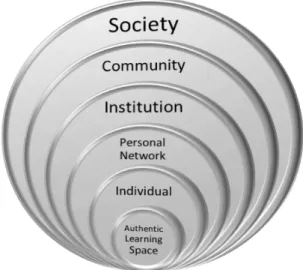
-mative effects that happen when a pedagogical approach based on how students really learn, is embedded. If we consider the pedagogy we apply as a pebble dropped into a pond, the impact of the approach has various circular outward ripples as outlined below:
Figure 1. Transformative ripples associated with prisons university learning
Each of these is considered using evidence from our formal evaluation and critical reflections. As set out in Figure 1, the transformative ripples model begins with the authentic learning space, the classroom space we deliberately created to achieve the optimum conditions to foster student confidence. This ripples out from the individual learner to the students’ personal networks including family, friends and peers, before extending fur
-ther to the universities and prison institutions involved. As the ripples become wider, but indeed less explicitly transformative, the community and societal level impact of this type of course design can also be considered. Whilst we acknowledge this level of transformation is hardest to capture, and difficult to illustrate with hard evidence, the critical reflection within our research indicates the real possibility for changes at the community and societal level.
Individual personal transformations and the authentic learning space. Both sets of students, prison and community-based, enthusiastically reflected upon the atmosphere created by the authentic learning space, the first drop in our transformative ripples model. Students reported on the positive, enriching experi
-ence involvement in the modules gave them, in terms of the interesting and stimulating topics and the in-depth discussions they were able to engage in within the format of the small mixed groups. Both the in-prison and community-based students commented on the unique opportunity sharing a learning space with people from different backgrounds to their own and exchanging knowledge and experience through dialogue gave. The small group discussions were particularly appraised as helping to test their held ideas and perspectives, know
-ing their contributions were valued, even if they were to be challenged and scrutinized by the other students. The sense of satisfaction the learning together shared classroom approach embeds, that in turn helped students find their confidence and strengthen self-belief, were communicated with several student comments, such as the following:
“I like the fact that prisoners can integrate with university students. It creates a very good blend of knowledge and experience and also promotes a very positive environment to learn in.”
Similar sentiments were aired by the Pentonville in-prison students:
The course has been exciting and inspiring. The group work brought the best out of each and every one of us. There was an amazing exchange of knowledge amongst the group and it revealed the different skills that each individual brings to the table.
The cohesion and confidence established early on within the learning space was pivotal for students to put forward their opinions in a relaxed, non-judgmental way, allowing for the dynamic interrogation of ideas. A number of students, particularly the in-prison group, expressed thoughts on their own personal transfor
-mation as “personal growth” and as part of a “journey” with feelings of achievement and pride. The journey was not only from an emotional viewpoint, but also in the practical sense of gaining new skills, or building upon existing ones, that could be put towards further study and future employment. One Pentonville student reflected on the changes that had occurred in him personally in regard to inspiring ideas for future study: “I would describe my experience on the course as a brilliant eye opener. I’ve really enjoyed learning again and hope to use this as a platform to further my education.”
Student reflections also centred on points such as the sense of challenge and achievement they were taking from participating in university-level teaching and learning modules. The university-style environ
-ment, with specialist lectures, academic journal readings, set critical questions and the small group discus
-sions, were particularly noted as part of the positive, enriching educational experience. It gave a chance to test and validate their capabilities at this higher level of learning and related to the structured sessions and guided critical questioning we set in place. By presenting a set of questions for discussion, independent student think
-ing is promoted, and the development of critical perspectives is supported. This is in the way students are encouraged to challenge existing perceptions and draw connections between the academic reading and per
-sonal experience. Questions such as the following are put forward: “How do the author’s arguments compare with last week’s reading?”, “How does the author draw their conclusions?”, “How does this compare to other reading you have done?”, “To what extent do you agree with their conclusions? Why? Why not?”
Appreciation was expressed at the sense of inclusion the classroom space garnered. This sense of inclusion and acceptance was uniquely powerful and expressed in the way “the university accepted us as one of them”. One student commented on the enriching experience of “studying in a normal environment”. The comments made in this regard can be interpreted from a perspective that it is the university as an entity that is viewed as accepting of people like them who were imprisoned at least in the present period. Indeed, feel
-ings of stigma and concerns of social exclusion from societal opportunities on release from prison is a great concern, and the degree of humanity experienced within these courses went some way towards hope for the future. In some regard it can be linked to notions of identity and shaping new or rediscovered identities as students (cf. Clarke, 2016).
In exploring the concept of individual transformation, and in response to the question on the overall feeling students had been left with at the end of the course, one in-prison student who reported a fragmented early education expressed pride in himself for succeeding in the module: “I’m proud of myself for doing it.” The power of education was apparent within many of the comments connected to feelings of “building confi
-dence and self-esteem” and developing “a good sense of achievement” and “a sense of self-belief.” These are important attributes for all student learners, but for some of the in-prison students who had not previously ex
-perienced education in any satisfying way, the learning together approach, intent on embedding empowerment and self-belief, is likely to have had an enduring impact. This aligns with the accepted notion that education is an empowering tool and is central to the critical pedagogy developed by Paulo Freire. This underpins both transformative pedagogy and the values of the Learning Together network: “What the educator does in teach
-ing is to make it possible for the students to become themselves” (Horton and Freire, 1990, p. 181).
With regards to the aim that involvement in the module can transform and shape future aspirations, many of the students talked about how the courses made them want to further their studies, or that it had given them ideas for future employment that would not otherwise have occurred. One Wandsworth student now has ideas to combine his accountancy background with statistical analysis of criminal justice data, for the em
-ployment options it could open up. This student stood out for the academic ability he already held, but other students noted how the opportunity to access education at this higher level had given them techniques
to reflect on what they could do, and how it could be applied in terms of future employment. One young man, now undergoing his second long spell in prison, had been moved to thoughts of employment in helping young people, saying “I want to help young people…guiding them using my own experiences”.
Transformation “rippling” out to personal networks. With reference to the next ripple within our model, we found a wider impact on the personal networks of those involved. These included peers based in the prison, among the university community, friends and family and other members of their close networks, as well as the education staff within the prisons, prison staff and university colleagues.
For the in-prison students, the effects as they ripple out to their personal networks were immediately felt within the general prison environment when they returned from their weekly courses. A number of stu
-dents remarked the module sparked interesting and spirited discussions “on the wings” that were a welcome departure from the usual prison conversations. A Wandsworth in-prison student noted the different reception from his prison peers as a consequence of studying and doing well on the Learning Together course. He men
-tioned how others saw a difference in him which in a way can be linked to a reshaped identity as a university student. This was perhaps more emphatically endorsed due to achieving this success while mastering English as a second language. Werts (2013), in his writing on studying an Inside-Out course in Graterford Prison, Pennsylvania, similarly noted the ripple out impact from the class: “The energy generated in the class carried over into the prison, where men were studying together, competing for the best grade against each other, and having positive impacts on their peers” (p. 138).
These ripples outwards, and their effects, can be linked to notions of identity transformation. Clark (2016) writes on the change in identity that prison education can bring, discussing the way engaging in educa
-tion in prison can help to shape self-identities that go beyond being “a prisoner”. Clark draws from the desis
-tance writings of McNeil (2012), setting out how “the identities and narratives in prison reinforce a prisoner’s criminal identity (the term ‘offender’, a prison number, the subject of a narrative around risks of offending and its mitigation), rather than promoting any prosocial positive alternatives” (p. 4). As one Wandsworth student noted, “I have never really given myself an identity. I suppose I am a student”.
Several of the Wandsworth students not only commented on their own feelings of accomplishment from completing the module, but also the pride of their families. For some students this was particularly meaningful. It is true many people in prison have experienced disrupted, problematic family backgrounds and for whom demonstrating young adult success and receiving sufficient parental attention has had no place to emerge. One student in this category noted how pleased his father was which he said made him “feel good about myself” and was uniquely powerful in terms of the impact this course was having on personal self-fulfillment. This family pride was particularly felt at the end of course celebration when students, along with their family and friends, the group facilitators, lecturers, prison and education staff and wider university colleagues, gathered together in the graduation-style event to celebrate students’ successful participation and completion of the modules.
The importance of family support and the acceptance towards people being released from prison is recognised in criminal justice policy documents and reform proposals as essential in the rehabilitation and re
-integration process (Ministry of Justice, 2014; Ministry of Justice, 2016; Cameron, 2016; Gove, 2016). This is also supported by literature on desistance theories and the crucial role of families as effective social bonds for reducing reoffending (Sampson & Laub, 1993, 2001; Brunton-Smith & McCarthy, 2017).
The deeper and wider penetration the Learning Together course was having, which can be linked to notions of social change, related also to the nature of discussions the community-based students were having with peers, friends and family. They talked about conversations they held, in which assumptions and stereo
-types could be challenged and narrow fixed views held about people in prison and their intellectual capabili
-ties, could be confronted. One Middlesex student commented on the nature of the conversations she had been drawn into:
It opens up this great conversation about how useful and kind of wonderful a programme like this in terms of … breaking down barriers and creating commonality. For me, it’s been the great basis for larger conversations about criminal justice and the way we perceive people who are incarcerated. (a Middlesex University student)