P
erfect
S
imulation of Finite Queueing Networks
Ψ
2
a Free Software Tool
J-M Vincent and J. Vienne
Laboratoire d’Informatique de Grenoble
MESCAL-INRIA Project
Universities of Grenoble, France
{
Jean-Marc.Vincent,Jerome.Vienne
}
@imag.fr
1
Software architecture
2
Modelling queueing systems
3
Simulation kernel
4
Simulation control and parameters
finite capacity queueing
network simulator
rare events estimation
(rejection, blocking,...)
statistical guarantees
(independence of samples)
⇒
Simulation kernel
open source (C, GPL licence)
extensible library of events
multiplatforms (linux
(debian), mac OSX,...)
Software architecture
Aim of the software
finite capacity queueing
network simulator
rare events estimation
(rejection, blocking,...)
statistical guarantees
(independence of samples)
⇒
Simulation kernel
open source (C, GPL licence)
extensible library of events
multiplatforms (linux
(debian), mac OSX,...)
finite capacity queueing
network simulator
rare events estimation
(rejection, blocking,...)
statistical guarantees
(independence of samples)
⇒
Simulation kernel
open source (C, GPL licence)
extensible library of events
multiplatforms (linux
(debian), mac OSX,...)
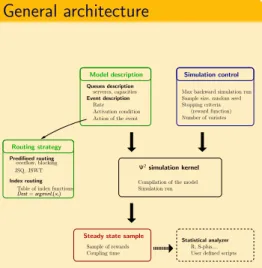
Action of the event
Predifined routing JSQ, JSWT overflow, blocking Index routing Queues description servercs, capacities Event description
Table of index functions Dest=argminIi(xi)
Compilation of the model Simulation run Rate
Activation condition
Sample of rewards Coupling time
Max backward simulation run Sample size, random seed Stopping criteria
(reward function) Number of variates
Statistical analyzer R, S-plus,... User defined scripts
Model description Simulation control
Ψ2simulation kernel Routing strategy
Queueing network description
Constrained communications
Capacity
C
λ
ν
µ
2µ
1Overflow
Events types
type
action
1
Server departure
2
External arrival to the first empty room in the list DQ
3
Multi-server departure to DQ
4
Join the shortest queue in DQ
5
Index routing according an index table
6
Routing to the first empty room in the list DQ and overflow
7
Routing to the first empty room in the list DQ and
blocking in the origin queue
Description file
# Number of queues
3
# Queues capacities
1 1 50
# queues minimal initial state
0 0 0
# queues maximal initial state
1 1 50
# Number of events
4
# Index file - N for No index file
File:
N
# table of events
# id type rate nbq origin d1 d2 d3 d4
0 2 0.8 5 -1 :
0 1 2 -1
1 1 0.6 2 0 :
-1
2 1 0.4 2 1 :
-1
3 7 2.0 5 2 :
0 1 2 -1
Capacity
C
λ
ν
µ
2µ
1Overflow
Events types
type
action
1
Server departure
2
External arrival to the first empty room in the list DQ
3
Multi-server departure to DQ
4
Join the shortest queue in DQ
5
Index routing according an index table
6
Routing to the first empty room in the list DQ and overflow
# Number of queues
3
# Queues capacities
1 1 50
# queues minimal initial state
0 0 0
# queues maximal initial state
1 1 50
# Number of events
4
# Index file - N for No index file
File:
N
# table of events
# id type rate nbq origin d1 d2 d3 d4
0 2 0.8 5 -1 :
0 1 2 -1
1 1 0.6 2 0 :
-1
2 1 0.4 2 1 :
-1
Queueing network description
Constrained communications
Capacity
C
λ
ν
µ
2µ
1Overflow
Events types
type
action
1
Server departure
2
External arrival to the first empty room in the list DQ
3
Multi-server departure to DQ
4
Join the shortest queue in DQ
5
Index routing according an index table
6
Routing to the first empty room in the list DQ and overflow
7
Routing to the first empty room in the list DQ and
blocking in the origin queue
Description file
# Number of queues
3
# Queues capacities
1 1 50
# queues minimal initial state
0 0 0
# queues maximal initial state
1 1 50
# Number of events
4
# Index file - N for No index file
File:
N
# table of events
# id type rate nbq origin d1 d2 d3 d4
0 2 0.8 5 -1 :
0 1 2 -1
1 1 0.6 2 0 :
-1
2 1 0.4 2 1 :
-1
States
Time
Simulation method
Perfect simulation (Propp & Wilson 1996)
X
n
+1
= Φ(
X
n
,
e
n
+1
)
Initial
Generated
state
Stopping rule (empirical)
state
Forward simulation
States
Steady state ?
state
Stopping rule (empirical)
Initial
Generated
state
Forward simulation
States
Time
Simulation method
Perfect simulation (Propp & Wilson 1996)
X
n
+1
= Φ(
X
n
,
e
n
+1
)
No : biaised sample
dependence on initial state
control of the burn in time
Steady state ?
Initial
state
Generated
state
Stopping rule (empirical)
Forward simulation
States
Time
Backward simulation
States
Simulation method
Perfect simulation (Propp & Wilson 1996)
X
n
+1
= Φ(
X
n
,
e
n
+1
)
Time
0
Time
0
Simulation method
Perfect simulation (Propp & Wilson 1996)
X
n
+1
= Φ(
X
n
,
e
n
+1
)
Time
Backward simulation
States
Unbiaised sample
Steady state
Exact stopping rule
Backward simulation
0
States
Simulation method
Perfect simulation (Propp & Wilson 1996)
X
n
+1
= Φ(
X
n
,
e
n
+1
)
Time
Monotone backward simulation
States
Exact stopping rule : coupling time
τ
Unbiaised sample
Steady state
Monotone backward simulation
States
Time
0
Simulation method
Perfect simulation (Propp & Wilson 1996)
X
n
+1
= Φ(
X
n
,
e
n
+1
)
Exact stopping rule : coupling time
τ
Unbiaised sample
Steady state
Monotone backward simulation
States
Time
0
E
τ
=
O(K
.
C
max
2
)
Exact stopping rule : coupling time
τ
Steady state
Unbiaised sample
0
States
Time
Simulation control and output
Control parameters
# Sample number
10000
# Number of Antithetic variable
1
# Size of maximal trajectory
3000000
# Random generator seed
5
# Coupling file name
File:
No file
Output
# P.S.I.2 version 4.4.4
# Data Network model
# Number of queues
...
# Parameters
# Sample number
# 10000
# Number of Antithetic variates
...
# =============
0 [ [ 0 1 10 ] ]
1 [ [ 1 1 13 ] ]
2 [ [ 1 1 2 ] ]
3 [ [ 1 1 33 ] ]
...
9999 [ [ 1 1 2 ] ]
# Size 10000 Sampling time :
3809.202000 micro-seconds
# Seed Value 5
# Sample number
10000
# Number of Antithetic variable
1
# Size of maximal trajectory
3000000
# Random generator seed
5
# Coupling file name
File:
No file
# P.S.I.2 version 4.4.4
# Data Network model
# Number of queues
...
# Parameters
# Sample number
# 10000
# Number of Antithetic variates
...
# =============
0 [ [ 0 1 10 ] ]
1 [ [ 1 1 13 ] ]
2 [ [ 1 1 2 ] ]
3 [ [ 1 1 33 ] ]
...
9999 [ [ 1 1 2 ] ]
Simulation control and output
Control parameters
# Sample number
10000
# Number of Antithetic variable
1
# Size of maximal trajectory
3000000
# Random generator seed
5
# Coupling file name
File:
No file
0 0.03 0.04 0.05 0.06 0.07 0.08 0.09 0.1 0.11 0 10 20 30 40 50 0.01 0.02 Statistical analysisProbability distribution in the buffer
Output
# P.S.I.2 version 4.4.4
# Data Network model
# Number of queues
...
# Parameters
# Sample number
# 10000
# Number of Antithetic variates
...
# =============
0 [ [ 0 1 10 ] ]
1 [ [ 1 1 13 ] ]
2 [ [ 1 1 2 ] ]
3 [ [ 1 1 33 ] ]
...
9999 [ [ 1 1 2 ] ]
# Size 10000 Sampling time :
3809.202000 micro-seconds
# Seed Value 5
11 12 13 14 15 17 18 19 20 21 22 23 25 26 27 28 29 30 31 1 2 3 4 5 6 7 10 9
9999 [ [ 0 2 5 7 2 8 7 4 0 7 10 3 3 2 1 5 0 0 6 3 3 6 0 3 9 1 2 4
3 1 3 6 ] ]
Extensions
Variance reduction
functional coupling
antithetic trajectories
Models extensions
multiple servers
index routing strategies
batch arrival
non monotone events
...
Applications
networking : rare events
call center dimensioning
grid scheduling
Variance reduction
functional coupling
antithetic trajectories
Models extensions
multiple servers
index routing strategies
batch arrival
non monotone events
...
Applications
networking : rare events
call center dimensioning
grid scheduling
University of So Maine, USA
Technical Program Chairs
Olivier Dalle
Université de Nice Sophia Antipolis, CNRS & INRIA, France
Gabriel Wainer
Carleton University, Canada
Steering Committee
Imrich Chlamtac, Chair,
CreateNet, Italy
Workshop Chairs
Kejie Lu
University of Puerto Rico at Mayaguez, Puerto Rico
Hua Zhu
San Diego Research Center, USA
Local Workshop Chair
Joanna Moulierac
Université Nice Sophia Antipolis, CNRS & INRIA, France
Industry Track Chair
Bozidar Radunovic
Microsoft Research Ltd., United Kingdom Finance Chair Karen Decker ICST US Local Chair Claudia Frydman
LSIS - Université Aix-Marseille, France
Publication Chair
Tricha Anjali
Illinois Institute of Technology, USA
Publicity Chair
o Methodology/Simulation Art: Web based simulation, Agent based simulation, Petri Nets simulation, Fluid flow simulation, Bond Graphs simulation, Simulation-based Scheduling
o Application areas: Telecommunication, Network Security, Health Care, Transportation, Manufacturing, Public Systems, Education and Training
o Tools: OPNET, NS-2, interconnected simulation platforms, ATDI ICS, Qualnet, OMNET++, NIIST, Dymola, Matlab/Simulink, open source tools...
Extended versions of selected papers will be published in relevant special issues of leading journals. Authors of accepted papers should register and present their work at the conference. A poster session will accommodate short papers and works in progress.
Important Dates
o Full Papers due: October 15, 2007 o Notification of Acceptance: December 14, 2007 o Camera-ready Manuscripts due: January 18, 2008 o Conference Dates: March 3-7, 2008 Submission Instructions & Reviewing Policy
Authors are invited to submit either Regular Papers or Short Papers, in a PDF file, complying with the ACM conference proceedings format through COCUS (http://cocus.create-net.it). Regular papers are 6 to 10 pages long, are eligible for Best Paper award, and may be selected for publication in a Journal. Short papers are 4 to 6 pages long and do not compete for Best Paper award or Journal Selection. Short Papers are intended for authors that wish to present their ongoing work or new open issues. Each paper will be peer reviewed for quality and correctness by at least three reviewers. Only original papers, written in English, which have not been published previously elsewhere, will be accepted.
Call for Workshops
We solicit workshop proposals on new and emerging topics in Simulation Tools and Techniques for Communications, Networks and Systems. We are seeking high-quality submissions that focus on a specific theme of current interest. Proposals for one-day workshops to be held in conjunction with the main conference are solicited and should be forwarded to the workshops chairs [email protected] by September 21, 2007. Acceptance notification by October 1, 2007.
Call for Panel Sessions
Panel sessions proposals should be submitted to [email protected], by September 21, 2007. Proposals should state the session title, a description of the topic, and the names of key organizers and potential panelists. Panel Session topics will be decided by November 10, 2007.
Call for Exhibitors at EXPOTools
In addition to the main technical program, the conference will hold a parallel exhibition, EXPOTools. This will be a unique opportunity for industry, researchers and professionals to exhibit simulation tools, techniques and related products. For exhibitor information contact the conference coordinator, Zita