UNIVERSITÀ DEGLI STUDI DI
PADOVA
_______________________________________________
Dipartimento di Tecnica e Gestione dei Sistemi Industriali
Corso di laurea in Ingegneria Gestionale
Tesi di Laurea Magistrale
Applications of Blockchain Technology in
International Logistics - a Case Study
Relatore Laureando
Roberto Panizzolo Riccardo Caneve
______________________________________
Anno Accademico 2017-2018
Abstract
The aim of this work is to give some insights about the beneficial impact that blockchain technology could have on the trust paradigm of modern supply chains, especially in the international logistics sector.
The elaborate is divided into three main parts. In the first one (Chapter 1), a non-technical but detailed description of how the Bitcoin protocol works will be given. It is worth noting that the aim of the project is not to make the reader an expert in the field of blockchain and decentralized technologies. However, some explanations are needed in order to properly understand concepts like the security model and the fault-tolerant nature of this new protocol, which will be central arguments in favor of blockchain technology.
In the second part (Chapters 2 and 3), the focus will shift on the possible applications of blockchain technology in the logistics industry, highlighting some notable pilot project already implemented and a possible classification of the solution which the ecosystem is developing towards.
The third part (Chapters 4 and 5) will be reserved for the case study, theorized with the support of Luxottica. A summary of the company’s history and main strengths will be followed by a description of how the process of a container shipment is structured nowadays. Finally, a complete description of the new process, structured using a distributed ledger as a backbone, will be formulated. Every step of the flow will be analyzed and the benefits of blockchain underlined. In order to measure the improvements such a re-designed process could bring to the company its performance will be evaluated on a set of criteria which have a critical importance for Luxottica.
Summary
Introduction………..………..………...1
1. Blockchain technology………3
1.1. Introduction………..………..………3
1.2. Blockchain Definition………..………..………5
1.3. Keys and Addresses………..………...………..7
1.3.1. Keys………..………..………...…..…7 1.3.2. Private Key………..………..………..9 1.3.3. Public Key………..………..………….………..9 1.3.4. Addresses………..………..……….……..12 1.4. Wallets………..………..………..13 1.5. Transactions………..………..…………...………..…15
1.6. Mining and Consensus…..………....………...…17
1.7. Mining Concerns………..………..………..24
1.8. Other Blockchains………..…...………….………..26
1.9. Public and Private Blockchains………..………..27
2. Blockchain as an Innovation in the Field of Logistics………..………..31
2.1. Introduction………..………..………..31
2.1.1. Paperwork and Manual Processes………..……...……31
2.1.2. Physical, Information and Financial Flow………..……..32
2.1.3. Need for Transparency………..………..……..33
2.1.4. Counterfeiting………..………..………34
2.2. Types of Solutions………..………..………..………..35
2.2.1. Bill of Lading and Cargo Documentation Digitization….……35
2.2.2. Trade Finance Optimization………..…………..……..37
2.2.4. IoT and Smart Contracts Automation………..….……40 2.3. Blockchain Threats………..………..………….……..42 2.3.1. Throughput Rate………..………..………42 2.3.2. Latency………..………..………..43 2.3.3. Centralization Risk………..………..………43 2.3.4. Transactions Costs………..………..…….……44
2.3.5. Inaccessibility for Average Users………..………45
2.3.6. Lack of Standards………..………..……..45 2.3.7. Industry Adoption………..………..……..46 2.3.8. Public Opinion………..………....………….47 2.3.9. Regulation………..………..……...…………..48 3. Ecosystem Analysis………..………..…………..………..49 3.1. Introduction………..…49 3.2. Blockchain Stakeholders………..………49 3.3. Platforms………..………..………..……52 3.3.1. Hyperledger………..………...………..53 3.3.2. CargoX………..………..………..54 3.3.3. Hijro………..………..……….…………..57 3.3.4. Provenance………..………..……..…………..59 3.4. Case studies………..………..………..61
3.4.1. IBM and Maersk………..………..………61
3.4.2. Provenance (Indonesian Tuna Fishing Industry) ………….….65
4. Case Study: Luxottica and the Current Process………..69
4.1. Introduction………..………..………..69
4.2. The Company’s History and Business Model………..70
4.2.1. The History………..………..…..………..70
4.2.2. The Business Model………..………....……76
4.2.3. The Logistics System………..………..78
4.3. The AS-IS Process………..………..……...…………85
5. Case Study: the Blockchain Solution………...95
5.1. The Solution Proposal……….……….95
5.1.1. The Blockchain Choice………..….………..……96
5.1.2. The Platform………..………..………..96
5.1.3. Hardware Verification………..………...…..97
5.1.4. Documents Tokenization and Decentralized Storage…...……99
5.1.5. Process Proposal………..………102
5.2. KPIs Definition………..………..………..108
5.3. KPIs Evaluation………..………..………...………..112
5.3.1. Delays at Departure………..………...………113
5.3.2. Customs Clearance Lead Time………..……..………114
5.3.3. Forwarder On Time Percentage……..………..……..115
5.3.4. Overall Costs of the Shipment………...…..116
5.3.5. Documentation Errors………..………….…………..118
5.3.6. Easiness of Dispute Resolution………...…………119
5.3.7. Security of Information Shared………..……….119
5.3.8. Speed of Information Access………..………120
5.3.9. Flexibility of the Platform………..………...………..121
5.4. Results………..………..………....121
Conclusions………..………..……….…….125
Introduction
Transparency has been one of the key elements of every business relation since the birth of human commerce. However, with the globalization and internalization of supply chains it has become more and more difficult and expensive for companies to maintain visibility over the network’s participants and flows. In order to maintain the desired level of trust, significant inefficiencies have to be tolerated and intermediaries have to be paid.
The term blockchain was born in 2008 as a definition for the underlying
database of the first and most famous cryptocurrency, Bitcoin. Although the concepts of blockchain and digital currencies are tightly correlated, the two seem to follow different innovation paths. In fact, it is now clear that this new paradigm is well suited to revolutionize not only the financial sector, but a broad spectrum of markets ranging from the insurance industry to the healthcare and energy ones.
According to Seppälä, the possible uses of this technology cover “any sort of asset registry, inventory, and exchange, including every area of finance, economics, and money; hard assets (physical property) and intangible assets (votes, ideas, reputation, intention, health data, information, etc)” (Seppälä, 2016).
The term has been at the center of a mediatic hype in the recent months. The total market capitalization of the available cryptocurrencies rose from only $10 billions at the beginning of 2017, to more than $800 billions in December of the same year. Venture investments in blockchain-related startups have soared as well, trying to ride what could be defined a “maniac” trend. Pilot projects started to be launched also by important enterprises, like IBM or Maersk.
But while many described blockchain as a possible solution for almost every aspect of human interactions, others (like Jamie Dimon, J.P. Morgan’s
CEO) expressed their absolute antipathy for what Bitcoin could bring to the world. Therefore, one of the purposes of this work will be to give an objective and factful description of what is currently achievable with this technology, which are the main threats and the available solutions.
The thesis conceptualization and creation were part of an internship done in Luxottica, an Italian multinational company currently leader in the eyewear and sunglasses industry. Particularly, the experience was conducted in the logistics department of the Oakley AFA business unit, responsible for the shipment of the apparel products of the notorious American brand. The company confirmed its interest towards the new technology and its possible logistics applications and gave precious insights on the main inefficiencies as well as drivers for a process improvement.
Chapter 1 – Blockchain Technology
1.1 Introduction
In this chapter we are going to examine the core technological elements that make Bitcoin such a ground-breaking innovation that will change the way we exchange value on the internet, from money applications to supply chain and logistics ones. The aim of the following technical introduction is not to make the reader an expert in the field of distributed ledger technology but to justify, in the clearest and simplest way possible, how it is possible to state that blockchain technology grants more security, immutability and transparency than modern centralized information systems.
Even though the concept of blockchain goes well beyond any single cryptocurrency project, the Bitcoin protocol has been undoubtedly the conceptual foundation of the entire ecosystem. We will therefore take Bitcoin as a reference for the following analysis of the technology behind blockchain.
All the features and benefits of blockchain technology, such as transparency, immutability and censorship-resistance, derive from a simple but powerful set of mechanisms and inventions that were theorized well before Bitcoin’s idea was published by the anonymous Satoshi Nakamoto, in late 2008.
E-cash was invented by David Chaum in 1983, as one of the first notable attempts of an anonymous electronic currency, which took advantage of public key digital signature schemes (D. Chaum, 1983). Every coin was cryptographically signed by a bank, ensuring its value. People could spend and exchange E-cash with Vendors in a peer to peer and totally anonymous way, and then redeem the fiat currency at any time.
Hashcash’s aim, proposed in 1997, was to create an email protocol which could resist to spam and denial-of-service (DoS) attacks. Its creator Adam Back intelligently used a proof-of-work system to achieve his goal. In a way similar
to Bitcoin’s proof of work algorithm, which we’ll see in depth later, senders using Hashcash were required to generate a valid header for their messages. Finding a valid header took time, because the only way possible was through brute force iteration, until a valid one was found; on the other side, verifying the correctness of this header was immediate for receivers, that could mark emails with such a valid title as legitimate and the others as spam (A. Back, 2002).
Another interesting project was B-money, also referenced in the Nakamoto’s 2008 whitepaper. The idea was published by Wei Dai, its founder, on the famous cypherpunks mailing list in 1998. It was essentially the first theoretical implementation of Hashcash’s proof-of-work algorithm for digital money purposes. Dai also envisioned the possibility of programming some basic smart contracts logics on B-money, but never created a practical version of his proposal.
The Bit Gold project, proposed by Nick Szabo in 2005, was arguably one of the closest to Bitcoin’s protocol. Szabo imagined a way to produce scarce proofs-of-work that would therefore have an intrinsic value and link them to the creator’s public key. All these digital assets were chained to one another, maintaining a global consensus on the chronological order and thus preventing double spending attacks (N. Szabo, 2005). Szabo also projected the possibility of pairing the assets with real life properties, such as domain names or even physical possessions.
The elegance of the Nakamoto paper, published on October 31st, 2008, resides in the fact that he was able to condensate the work of his precursors in an elegant and incredibly powerful protocol. He introduced the idea as “A purely peer-to-peer version of electronic cash that would allow online payments to be sent directly from one party to another without going through a financial institution” (S. Nakamoto, 2008).
1.2 Blockchain definition
The term “blockchain” appeared for the first time in 2008, as the database structure chosen for the implementation of the Bitcoin protocol. Essentially, it can be defined as a “chronological chain of blocks” (see a graphical example in Figure 1.1) where each one is destined to contain a “record of valid network activity since the last block was added to the chain” (Needham & Company, LLC, 2015).
Every transaction first has to be propagated to the network. All the nodes will then validate and add it to the next block on the chain, giving the recipient the confirmation that the associated funds can be spent.
While reading the blockchain is immediate, because it’s shared with all the peers, changing it is practically impossible. Once a transaction is included in a valid block, and the block has a sufficient number of followers in the chain, deleting or modifying it is impossible. This important feature removes the need for any central authority that has any intermediary role, because the peers can autonomously verify each movement and ensure that no one can fraud the system.
The network is completely open, and any node can freely leave and join it whenever it wants. The incentive for participating and sustaining it comes from
the rewards that special nodes, called “miners”, get for the computational effort they provide.
The main features of any blockchain, not only Bitcoin’s one, are:
- Decentralized and distributed consensus: as stressed before, “decentralized” means that there’s no single point of failure in the system. Even if 99% of the nodes turn off at the same time, the remaining 1% would have no problem in keeping the network up and running. Moreover, when the nodes would come back online, they would be able to immediately agree on the past transaction history (achieving
consensus) and proceed from that point. This characteristic makes the system more reliable than any centralized network, which has always a higher risk of malfunctioning or deliberate attack.
- Public: although in most of the cases the single addresses (that represent individual nodes) are anonymous, the ledger is always completely transparent. Everyone can check all the transactions happened to the Bitcoin blockchain, back until the first one on January 2009. This feature makes the system essentially trustless: nodes don’t need to put trust in any other peer, but only in the network itself and its structural security, which has never been violated until now.
- Immutable: as mentioned before, re-writing an event that is tracked on a blockchain is almost impossible. We’ll cover the mining process in depth later, but it’s important to understand that each block is linked to the previous one, so if any actor wants to change one block, he must be able to re-validate all the following blocks for the network to trust the new blockchain he created. This is an incredibly hard task, requiring at least half of the total computational power of the entire Bitcoin network in order to have some chances of succeeding.
- Encrypted and secure: it is based on encryption built on private and public keys to keep privacy completely intact. All the incredible features blockchains possess have their foundations in simple but powerful cryptography instruments, that we will cover below.
1.3 Keys and Addresses
Bitcoin was born with the aim of becoming the first real form of electronic workable money. The first aspect of digital money that it was trying to solve was ensuring that the ownership of the assets (in this case, the bitcoins) came with absolute security. That meant that nobody could steal or move them unless he provided the needed authentication key.
As the first part of the word “cryptocurrency” implies, Bitcoin uses cryptography to achieve this objective, declined in two elements we’re going to briefly cover: keys and addresses.
1.3.1 Keys
While Visa and other centralized networks typically transmit personal information about their customers (including credit card numbers and passwords) over a channel that has to be secured against external attacks, decentralized cryptocurrencies must encrypt the messages they send, because no one can be excluded from the network, which is open and trustless by design.
The mathematical foundation chosen for the first implementation of the Bitcoin protocol was Public Key Cryptography (A. Antonopoulos, 2014). After its conception in the 1970s, many useful instruments and functions have been invented and heavily tested, making public key infrastructure one of the most secure for any application interested in sending authenticated and encrypted messages over an insecure network.
What all these functions share is a very important feature: practical irreversibility: it means that, while computing the specific function could be relatively easy, finding the inputs given the final results is possible only through
brute force. In other words, it’s impossible (or highly expensive) to find the inverse of the given function (Figure 1.2).
An example, useful to understand this concept, could be a sudoku game (Figure 1.3). In a sudoku table, verifying that a solution is valid isn’t a complex task: all you have to do is check that every row, column and sub-square contains the 9 digits allowed, one time for each digit. While checking the validity of a proposed sudoku solution can be done in under a minute, finding a new solution could take many minutes or hours, depending on the difficulty.
In order to participate in the Bitcoin network, any user has to create a key pair that gives him access to an account, capable of receiving and sending bitcoin through the web. The private key can be seen as the PIN code that we have to
Figure 1.2: relationship between keys and addresses: the concept of irreversibility (Antonopoulos, 2017).
Figure 1.3: checking the validity of a sudoku game solution is exponentially easier than finding one.
use to authorize payments. The public key is mathematically derived from the private key and must be shared to other peers that want to send us funds. It can be seen, using the same banking analogy, as our IBAN number.
1.3.2 Private Key
The private key is a random number of 256 binary digits, most of the times represented in 64 hexadecimal digits, like the following one:
1E99423A4ED27608A15A2616A2B0E9E52CED330AC530EDCC32C8FFC6A526AEDD
As stressed before, this bunch of digits are the centre of all the security model of the Bitcoin network, when it comes to ownership of the funds. It’s important to keep this key safe and don’t let others see it. Everyone with access to this key can freely move our bitcoins, while the loss of it would cause the complete and irreversible loss of the associated funds.
1.3.3 Public key
The public key of a pair is directly derived from the private one, using one of the aforementioned cryptographical functions: elliptic curve multiplication. This mathematical model is based on the discrete logarithm problem and has an important feature: while it allows to easily add and multiply factors, the reverse operator is impossible to find. In this way, finding the initial inputs, knowing the result, requires trying in a brute force and iterative fashion.
The elliptic curve used in the Bitcoin protocol can be visualized in the graph below (Figure 1.4):
Specifically, the function used in the software is:
𝑦" = (𝑥&+ 7)𝑜𝑣𝑒𝑟(𝔽
/)
“𝑜𝑣𝑒𝑟(𝔽/)” means the curve is defined over a finite field of prime order
p, and therefore it consists in a pattern of dots. This mathematics allows for addition and multiplication, in a way similar to the traditional algebraic operations.
Addition can be conceptually explained as follows: given to numbers belonging to the curve, P1 and P2, P3 = P1 + P2 is another point of the elliptic curve, found using the following procedure:
- We trace a line, intersecting both P1 and P2
- This line will intersect the curve in another point, which we will call P3’
- P3 is defined as the symmetrical point of P3’, found reflecting P3’ in the X axis
Multiplication can be defined using the addition operation just explained. As in the traditional theory, the multiplication:
Figure 1.4: an elliptic curve, conceptually similar to the one used in the Bitcoin protocol.
𝑃" = 𝑘 ∗ 𝑃3
Can be seen as:
𝑃" = 𝑃3+ 𝑃3+ 𝑃3+ ⋯ (𝑘 𝑡𝑖𝑚𝑒𝑠)
What it means graphically is the following (Figure 1.5):
The public key is directly derived from the private key, multiplying it by a Generator Point (G) which is a constant of the Bitcoin protocol.
𝐾 = 𝑘 ∗ 𝐺
As a consequence of the security of asymmetric cryptography, this function is not reversible. In this way, even if G is known and we give others our public key (K), nobody can calculate our private key (k), computing the following equation:
𝑘 =
<=
Figure 1.5: Multiplication operator in the elliptic curve domain.
1.3.4 Addresses
The metaphor of the IBAN representing our public key was in reality not totally accurate. What we share with other peers is in fact not the public key, but the bitcoin address. This address can be easily derived from the public key itself, through a series of two hashing functions:
A = RIPEMD160(SHA256(K))
Where SHA256 is a hash function developed by National Security Agency (NSA) of US Government, and RIPEMD160 is a European cryptographic algorithm developed in academic environment.
Given that hashing functions are widely used in the Bitcoin protocol and in general in the cryptocurrency & blockchain space, it’s worth spending some lines defining them: a hashing function essentially maps data into a fixed size format, usually a string of text. The maps are deterministic, so the same inputs will result always in the same hashes, and its execution is most of the times very easy to calculate and not computationally heavy. Hashing functions are adopted in many cryptography applications, because of their infeasibility to be inverted: just like the elliptic curve multiplication, starting from a hash, no-one can obtain the originally input data.
An address can be presented in a special format, called “Base58Check”, which uses all the uppercase and lowercase letters except 0, O, I (capital i), l (lower l) for an easier reading and comprehension (See Figure 1.6).
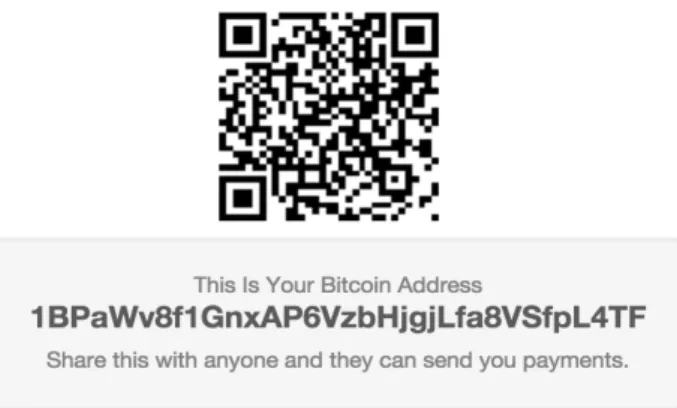
Graphically, the same address can be easily converted in a QR code; many applications take advantage of this function nowadays, because it simplifies the procedure of manually copying and pasting the text string.
Addresses usually represent a public key, owned by a person, but can also be linked to a script. In this case the funds received won’t be tied to a specific private key, which is mandatory in order to later move them, but instead to a script, which will need some special conditions for allowing its value to be transacted. Although Bitcoin doesn’t allow for elaborate smart contract programming (as we’ll see later) this “pay-to-script hash” function can be seen as one of the first moves towards real programmable digital money.
One simple example of a script is the so-called multi-signature address; as the term suggests, more than one digital signature are needed in order to move the funds, and different configurations can be easily created (for example M out of N signatures needed, with M < N).
1.4 Wallets
A wallet is simply a software, capable of safely store the key pairs owned by an individual (A. Antonopoulos, 2017). Given the aforementioned attention one has to put on the security of his keys, it seems obvious that some programs and interfaces have been created to make this process more similar to the normal use we make of our passwords. Here’s how a modern wallet looks like (Figure 1.7):
Naturally many different wallet types have been created, obtaining trade-offs between the two most critical features such applications must have: security
and usability.
The most secure ones are software wallets that download the entire blockchain locally, like the original Bitcoin Core reference, having complete freedom of verifying each and every transaction by themselves. Computers running this kind of instance are called “full nodes” and are the ones that truly embed the decentralized spirit of the Bitcoin project. They don’t need any other node nor have to put trust in any actor, in order to gain consensus on the network status.
As the blockchain steadily grows (nowadays it’s about 161 Gb in size, Charts.bitcoin.com, 2018) it becomes harder and harder for a normal pc, let alone a mobile phone, to run a full node. Many web and lightweight wallet were born to satisfy this necessity, delegating the hurdle of the blockchain management to a central server. In this way, each light node asks the server only the pieces of data it needs to perform the required verifications on the transactions, so less hardware is needed, and wallets can exist also in the form of mobile applications. Of course, security is partially compromised, although many measures have been implemented to minimize the trust needed towards the full node providing the data (like changing dynamically the supporting full node, lowering the possibility of receiving malicious or fraudulent information).
Devices have been built to physically protect the key pairs. This
hardware wallets are able to store such keys locally, embedding them on the individual item. Security is often ensured by the choice of a PIN code to unlock them and dispose payments, while in case of loss or theft a recovery code (usually saved offline in the form of a random set of words) can be used to restore the data and the funds on a new device. These devices combine great security standards with high portability and a relatively easy user interface. Examples are the Trezor wallet (see Figure 1.8) or the Nano Ledger.
Another primitive but highly secure way to store bitcoins are paper wallets: these are literally paper sheets with private keys printed on them. Usually the keys are not pasted in their binary or Base58 format, but properly encrypted (with a password one has to store elsewhere) or a QR code. They seem outdated, but actually printing a private key directly on paper is one of the safest ways to securely hold our funds, above all if the keys were generated offline: in this case the term we use is “cold wallet”.
1.5 Transactions
Transactions are the basic constituents of the entire Bitcoin network. Everything else in Bitcoin is designed to ensure that transactions can be created, propagated, validated, and finally added to the global ledger of transactions, the blockchain (A. Antonopoulos, 2017).
A transaction is simply a data structure, which contains all the relevant information in order for all the peers to process the change in ownership of a given value of bitcoins.
The key elements of a transaction are:
- Inputs: what has to be spent in the transaction. Precisely, every movement of value takes some previous transactions that have not been
spent yet (called UTXO, or Unspent Transaction Output)that adds to the desired amount.
- Outputs: the value that has to be sent with the related transaction. There’s at least one output, the one of the recipient, even though most of the times past UTXOs don’t sum up to the exact wanted number, so a change is needed.
- Fee: the fee is paid to the miner that will manage to include the transaction in the blockchain (explained in detail later), thus confirming it. Fees are not explicitly written in the data, but can be computed by every node, removing the sum of the outputs from the sum of the inputs.
- Signatures: these are the most important part of the transaction. In fact, while every other element (including unspent transactions of every account, which are public by definition in the Bitcoin network) can be easily written and aggregated in a candidate transaction by anyone, only the owner of the sender account can create the digital signature that makes the entire data structure valid. As we have anticipated earlier, talking about public key cryptography, the signature system of Bitcoin allows users to digitally sign the transactions they want to authorize, proving unequivocally that they have the rights to do that, but without revealing their private key.
This solution is incredibly elegant, because “it enables for the first time the exchange of value in a very secure way, over a highly insecure network” (A. Antonopoulos, 2017). Every node does not need to trust any other peer yet can be sure that the sender is authorized to spend the funds, if presenting the correct digital signature. In the credit cards networks, this would not be possible. Even though at the moment they’re more at scale than Bitcoin, their network must be always kept secured, because sensitive financial information is transmitted in order to process the transactions.
Once signed, a transaction is propagated to the network, specifically to 7 to 10 peers at a time. Each node independently verifies it, checking that the sender has the private keys needed to spend the money. If the transaction is valid, the nodes propagate it to their peers, making it reach the entire network in some fractions of a second. If something in the structure is not valid, the transaction is not propagated, thus preventing attempts of spam or DDOS (Distributed Denial of Service) attacks.
As soon as the transaction is included in a miner’s valid block and the block is correctly added to the blockchain the transaction is defined as confirmed and its output becomes a valid UTXO itself, that the recipient can spend whenever he wants. Essentially, the blockchain is a large database of all the transactions, made by every user of the Bitcoin network, since its birth in 2009. There are no balances written on them, but every node or wallet independently computes them.
1.6 Mining and Consensus
As previously stated, for a decentralized currency to exist, every participant must be able to independently validate all the transactions that the other nodes want to make (S. Nakamoto, 2008). In order to do that, everyone must therefore have a copy of the ledger which they can use to retrieve the balances of the transactions’ senders and check if they have the rights to spend the desired amounts. Furthermore, the version of this ledger must be the same for all actors, otherwise conflictual validations would arise.
Every node must agree on a single and official history of the validated transactions, thus gaining and maintaining a consensus: this consensus on the transactions and balance history of the entire network (and all its participants) was the key element missing before Bitcoin, in order to create a pure decentralized currency.
In Bitcoin, it is obtained through a process called mining, which has two main objectives. The first is to increase the length of the blockchain (the number of validated transactions), keeping one single chain as the valid history for all
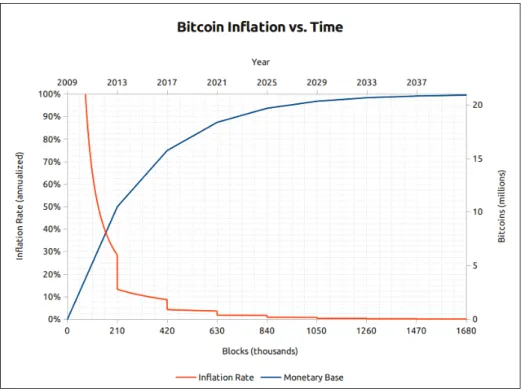
the network’s participants. The second purpose is to “create” and issue new bitcoins. In fact, new bitcoins are mined every time a block is created, guaranteeing to the overall network a stable and deflationary new money supply.
Figure 1.9 shows the projected issuance rate for the Bitcoin protocol:
Miners collaborate on sustaining the network with their processing power, incentivized by the bitcoins they receive in exchange. In addition to the new bitcoins mined for every block, miners receive as a reward also all the fees of the transactions they include in their block.
Let’s see the process of mining a new block in more depth, given that is similar for many blockchains and cryptocurrency projects and it is the centre of all blockchain security.
Participants compete on a simple and statistically predictable computational problem, based on a cryptographic hash algorithm. Since the problem is meant to be completely random, the probability of finding a valid solution is only proportional to the hashing power (or computational power) a
Figure 1.9: deflationary issuance curve of Bitcoin’s supply through the mining process (Bitcointalk.org).
node provides to the network. This mechanism is called Proof of Work because finding a valid solution implies that sufficient amount of work has been spent in the validation process. In this way, presenting a valid result is a proof of the work done for the network.
This invention has been the missing piece that all of Bitcoins’ predecessors didn’t have and prevented them from becoming the first true decentralized digital currency. Particularly, the invention mentioned in Nakamoto’s paper makes possible to have an emergent consensus(S. Nakamoto, 2008). The word emergent means that is built and maintained over time, not in a fixed or scheduled moment (A. Antonopoulos, 2017).
As mentioned, participants compete on a simple and statistically predictable computational problem. In particular, they need to repeatedly hash a string of text until the resulting number (in hexadecimal format) is lower than the system’s specified target. It can be visually seen as throwing 4 dices at a time, trying to obtain a number lower that 7 (Figure 1.10).
With only some simple rules, coded in the Bitcoin protocol, every node is able to independently build a copy of the blockchain, knowing it is the most recent one and the one all the other nodes agree to use.
The entire process is made by four distinct activities, which are independently managed by the network’s nodes:
- Every node independently verifies and implicitly authorizes every transaction
- Every mining node arbitrarily chooses a group of transactions, assembling them in what is called a candidate block
- Every miner constructs the block header, trying to obtain a valid proof of work
- Every node verifies the new block and adds it to the local copy of the blockchain
Let’s look at each activity more in depth:
Independent verification of transactions computed by every node: every node running the Bitcoin reference code will receive pending transactions from its peers and propagate them if valid. The validity of a transaction depends on a pre-determined set of criteria, which include:
- The data structure in which it has been constructed must be valid
- Has to contain at least one input or output
- The size doesn’t exceed the maximum allowed value (for bitcoin is currently 100 bytes)
- Every input the sender is willing to spend must exist in the blockchain and not have been already spent in other previous valid transactions
- The sum of the inputs must exceed (or at least be equal to, if no fees are planned) the sum of all the outputs
- For each input, a valid digital signature must be added. The digital signature is produced from the private key, without disclose it. Thanks to the irreversibility of the underlying cryptography, every node is able to check that the signature has been created by the correct private key, without seeing it
As previously seen, every note that validates a transaction propagates it to some of its peers (a number not so high, most of the times between 5 and 10 nodes). In this way, authorized transactions are seen from the entire network in
some fractions of a second, while incorrect or fraudulent transactions are immediately stopped by every node deciding not to pass them on.
Aggregation of transaction into candidate blocks: after validating a transaction, every node will add it to a temporary storage called memory pool, where transactions not yet confirmed will remain until they’re included in a valid block.
Some nodes of the Bitcoin network arbitrarily choose to run an additional part of the protocol, which gives them the right to participate in the collective “game” that takes place every 10 minutes for the creation of a new block. These nodes are called miners, and there are currently about 10’000 of them, at the time of this writing (Bitnodes.earn.com, 2018).
When mining nodes receive a transaction, which is declared valid, they proceed in adding that same transaction to their current candidate block. A candidate block is properly structured but cannot be confirmed and added to the blockchain until a valid proof of work is provided from the miner, which is found as a solution to the Proof of Work algorithm.
A block has a size limit, currently 2 Mb (En.bitcoin.it, 2018), therefore a miner must choose which transactions have the highest priority. The criteria for this choice are:
- The age of the transaction UTXOs, that is calculated based on the date of the block in which they were confirmed. Older transactions have higher priority
- The value of the inputs, so transactions that move more value tend to be processed earlier
- The amount of fees that the miner will earn if the transaction is included in the block he manages to validate. Let’s remember that fees are arbitrarily chosen from the sender (or the sender’s wallet) in an implicit manner, as difference between the total inputs and the total outputs
The first transactions a miner will include in his candidate block is a special type of transaction, called the coinbase transaction. It doesn’t spend any
previous output and contains only one input, called the coinbase. The output consists of the value of the current mining reward and has to be paid to the miner’s personal bitcoin address; the coinbase transaction is responsible for the minting of newly created bitcoins mentioned earlier.
The rewards for the newly created blocks depend on the current block height (the length of the blockchain). This rate started as 50 bitcoins for every block in 2009, when the Bitcoin network was born, and has halved every 210’000 blocks (approximately every 4 years). This mechanism, called halving, will cause the issuance of all 21’000’000 existing bitcoins in the year 2140, if the block creation rate remains constant.
Just as the other transactions, also the coinbase transaction has a data field, which can be filled by the transaction’s creator with arbitrary information. As a side note, the first block mined by the personal computer of Satoshi contained in the coinbase data field the following string of text: “The Times03/Jan/2009 Chancellor on brink of second bailout for banks”, with a double function. First, it acted as a proof of timing for the birth of his protocol, and moreover served as a reminder for the reason this invention was needed so much and so fast.
Construction of the block header: the block header can be seen as the title of every block and it’s the key for the entire blockchain structure. It is composed by six fields:
- A Version number (4 bytes) use to specify the protocol version and to track the latest updates
- A reference to the previous block hash (32 bytes). The fact that every block must contain in the header the hash of the previous one is what links every block to its predecessor and successor, forming a chain whose integrity and immutability is strengthened as the blockchain itself grows
- A Merkle Root hash (32 bytes): it is a hash of the root of the Merkle Tree of all the transactions included in the block. In other words, it can be defined as a “fingertip” of the combination of all the transactions, and it’s important because any change of the underline transaction database
would make the root change and, as a consequence, the solution to the proof of work would change too. Changing an older transaction would cause the block header to change, and this means the following bocks must be re-created, because they have to be linked to the new block header
- A Timestamp (4 bytes), which is represented in seconds from Unix Epoch (January 1st, 1970) and declares the approximate creation date of the block
- A Difficulty Target (4 bytes) which represent the threshold, under which the proof of work must fall, in order to be considered valid
- The Nonce (4 bytes): a completely arbitrary data field that the miner can fill with whatever number he wants. This is the field that all the mining algorithms change, hoping that the hash of the total block header will result in a value under the stated difficulty. At the time of writing, approximately 1,8 ∗ 10"3 random nonces are needed in order for the entire network to find a suitable one in about 10 minutes
Then, every miner starts trying different values of the nonce until the block header hash (obtained with the SHA-256 algorithm) is less than the current difficulty target.
Addition to the longest current blockchain: when someone finds a valid solution, the candidate block is propagated through the Network, until everyone agrees on a unique version of the new blockchain. As miners receive a new valid block, they will interrupt the current “match”, create a candidate with the reference to the new block, and repeat the process from the beginning, in a continuing cycle that has sustained the Bitcoin ecosystem since January 2009.
It can happen that two or more miners will simultaneously find a valid block (resulting from two valid solutions of the proof of work algorithm). In this case, all the other miners will start to work on the block that reached them first. So, until a new valid block is mined, two blockchains will compete for being the longest (and, as a consequence, the valid) one: this phenomenon is called fork.
Forks of this type happen quite often and are easily resolved after about ten minutes, when the new block is created and will make one of the two blockchains the longer. But there are other situations, in which blockchains are divided on purpose: these are called soft forks and hard forks.
Soft forks happen when the network, in the form of its miners, agrees on an increase of the validation rules of the new blocks, for example when a new protocol update adds more capabilities to the blocks or transactions data structures. In this way, what happens in the original blockchain is still valid in the new one, which only admits more functionalities.
On the other hand, when a hard fork happens, the network splits in two separate chains, essentially restricting the rules for consensus and block validation. For example, when on August 1st, 2017 the Bitcoin hard fork took place, the new blockchain that was born became a completely new cryptocurrency (called Bitcoin Cash), with a new set of rules that were different from the ones of the original Bitcoin Core implementation, that remained valid.
1.7 Mining concerns
The costs of the mining activity can become quite significative and are steadily growing to a higher and higher rate. For the first years, it was possible to mine some blocks also with a personal computer, as the earliest adopters did. But the more Bitcoin gained popularity, the more difficult it became to find a suitable solution for the proof of work algorithm: the software is programmed to dynamically change the difficulty target, in order to maintain a block rate of one every ten minutes.
Every 2016 blocks, the protocol calculates the rate and retargets the difficulty, so during the years miners started to use more sophisticated hardware to achieve their objective. CPU have been abandoned and GPU used instead, which were more efficient and powerful. Then, ASICs (Application Specific Integrated Circuits) were invented, which are electronic circuits built specifically for Bitcoin mining, able to achieve incredibly higher levels of efficiency than normal graphic boards.
This technological advancements in mining hardware, combined with the entrance of so much hashing power(computational effort of the new miners) has two main hurdles: first, it significantly centralizes the network, which was meant to be completely decentralized. With the appearance of mining pools, which are organizations of miners that share their hardware in exchange of a fraction of the reward if someone of the pool finds the new block, the network now is dominated by a handful of players, mostly located in countries with low energy costs (see Figure 1.11).
Decentralization is critical for the security of the network, given that potentially anyone with more than the 51% of the hashing power could try to impose his malicious version of the blockchain with a significant chance of succeeding.
The energy costs related to the hardware are growing as well, reaching 71 TWh per year at the time of this writing (Digiconomist, 2018).
Solutions are already in the testing phase. The most notable one is called
Proof of Stake. Essentially, instead of receiving a reward based on the computational power one provides to the network, in this new paradigm miners get compensated proportionally to the amount of actual coins they put as “collateral”. The more coins one invests (which are not spent but blocked as
collateral and lost in the case of a malicious attack attempt) the more probability he has to mine the new block.
This hardware-free consensus protocol is currently in beta testing for the world’s second cryptocurrency, Ethereum, but many other implementations have been proposed.
1.8 Other Blockchains
Even if, as stated in the chapter introduction, Bitcoin is the first cryptocurrency and the first working example of a blockchain, it is certainly not the last and for some applications the most influential. Given that the original reference code of the protocol was open source, everyone interested in creating their bitcoin-like alternative currency could easily fork it (make a copy and modify it as he wanted).
Therefore, since 2010 many other projects were born, with purposes ranging from improvement of Bitcoin technology to pure speculation.
Coloured coins were one of the first examples: the original Bitcoin code was maintained, but the creators added a feature that made possible to attach a “digital label” to little amounts of bitcoins, converting it in another asset of any form. You could “colour” 1$ of value in BTC with a certificate representing ownership of a company’s share, and exchange that same chunk of bitcoins as if it were exactly that stock.
Another alternative coin, or alt-coin, derived from the Bitcoin protocol, is Litecoin, which is today the sixth biggest coin, with a total market capitalization of about 5,6$ Billions. The founders made two important changes: first, they chose a different Proof of Work algorithm called Scrypt, which was built to be ASIC resistant, thus preventing the centralization phenomenon seen before for Bitcoin. Second, they shortened the average block throughput rate to 2,5 minutes. These features make Litecoin, to its followers, more suited for retail purchases and frequent uses.
The most notable alternative coin (at this moment the second biggest cryptocurrency after Bitcoin) is Ethereum. Born in 2015, Ethereum’s purpose is
far from being only a digital and exchangeable asset: the coin “ether” is meant to power what is called the Ethereum Virtual Machine (EVM), a sort of global and distributed computer in which everyone can run code (called smart contracts) which benefits of all the advantage blockchains bring, such as immutability, transparency and security (Buterin, 2014). The main difference is in the scripting language: while Bitcoin’s language is intentionally limited for security reasons, Ethereum’s one is “Touring-complete”. This means that all sorts of code structures can be created. Security is maintained in the EVM through a fee system, in which users pay for contract execution that is computed by a miners’ network similar to the Bitcoin’s one. A program is triggered with a payment of any value, plus some data that act as inputs for the execution. The sender decides (or the wallet sets in an implicit fashion) two key variables:
- Gas Price: the cost per computational step (paid in ether) he is willing to pay. Computational steps are precise fractions of the contract execution, whose amount is known in advance since the code is open source
- Gas Limit: the maximum number of computational steps allowed by the sender
Multiplying these two values one gets the highest amount he can pay for the contract use. When sending the initial transaction, the protocol immediately withdraws this total amount as a safety deposit from the sender’s account. After the complete execution of the contract, what remains of the safety deposit is sent back to the original account. If the maximum fee is reached, all of the safety deposit is lost, and the contract completely reverted: that means all the computation it has already concluded are cancelled.
1.9 Public and private blockchains
An important definition, used to classify existing blockchain solutions, is between public and private ones. Both solutions can have the same protocol features, such as consensus algorithm, immutability and decentralization (to different degrees). What differentiates them is the possibility of nodes to enter the network.
In a public blockchain, nodes can freely enter the network, without any limitation. This is the case of the most notable blockchains, like Bitcoin’s or Ethereum’s. Nodes are incentivized through a system of fees and rewards and can leave and join the network at any time if they want.
On the other side, in a private blockchain only some specific actors are allowed to act as nodes. The company multichain, for example, enables its clients to create every type of private blockchain the need, varying the constituent parameters and granting the necessary authorization to the selected peers (Greenspan, 2015).
Although a private blockchain seem counterintuitive, in a world where decentralization and distributed power are the main purposes, some notable solutions have been built. This structure, in fact, enables the creation of a hybrid network where some actors, who normally use an intermediary to manage the relationships, can reach and maintain a consensus on a continuing basis, without taking the risk of being fully transparent with the outer market.
The concept of public and private ledgers can be further dissected. While the mentioned dichotomy depends on the right that nodes have in participating in the network from a user perspective (transmitting transactions), there’s also another distinction that has to be made, which is between permissioned and permissionless blockchains.
In a permissioned network, only some selected nodes can manage the protocol and approve changes to it, while in a permissionless blockchain (like Bitcoin’s) every node is able to suggest a protocol update and fork its variant. This double distinction creates a series of 3 major classes of commercial blockchains, which we’ll briefly cover below:
- Permissionless Public Ledger: such a protocol is inherently accessible by everyone. No limitations are imposed to nodes that want to access the network or leave it. Furthermore, miners and validators are unknown and untrusted. The most notable example is the Bitcoin blockchain.
- Permissioned Public Ledger: in these systems a limited number of validators are admitted (which can be also democratically chosen from the user base), but there are no limitations for the users’ admittance. Some examples are Ripple and Neo.
- Permissioned Private Ledger: there is a selection both to participate and to vote and act as a validator of the network. Such blockchains are normally built for business consortia or aggregates, when sensitive information is shared between the peers. Technically these structures lose most of the decentralization that public ledgers provide, but costs for transactions and latencies can be dramatically reduced
Its straightforward that a permissionless private blockchain can’t exist, because of the opposition of the two concepts.
Chapter 2 – Blockchain as an Innovation in the
Field of Logistics
2.1 Introduction
The innovation a new technology brings is not always enough for it to reach meaningful scale. Drivers for innovation are mandatory: in simple terms, there must be a need or a desired improvement that the technology can satisfy, otherwise the resistance to change will prevail.
In the following paragraph the main drivers of the logistics sector will be examined, detailing the benefits blockchain technology could bring. These are
the high presence of manual and paper-based processes, the interdependence of
different process flows, the increasing desire for greater transparency along the
chain, and the significant losses caused by counterfeiting.
2.1.1 Paperwork and manual processes
Even though new technologies are slowly revolutionizing every aspect of the supply chain, the logistic industry remains full of manual and paperwork-based processes: It has been estimated that between 15% and 50% of the costs of the transport can be allocated in the management of the trade-related paperwork (Groenfeldt, 2017). Moreover, for heavily regulated processes like customs clearance procedures, manual data-entry and paper documents are still highly in use.
This of course increases the risks associated with the process, particularly in terms of:
- Risk of counterfeit: paper is much easier to alter at our own advantage, in fact documents like the Bill of Lading are often subjected to fraud. A digitization of the shipments’ relevant documents, even without any blockchain implementation or any trust minimization technology, would significantly decrease the rate of frauds happening in the logistic sector.
- Human error: needless to say, although computers and IT systems are not 100% reliable, manual procedures have a higher probability of containing inaccurate or incorrect information: it is estimated that a stunning 10% of all freight invoices contains inaccurate data, which leads to disputes and all sorts of process inefficiencies along the supply chain. With thousands of different transactions happening on a daily basis, reconciliation of discrepancies is a costly and laborious activity which profoundly impacts every stakeholder involved. Furthermore, at least 5% of the total freight spend could be saved through improved invoice accuracy and reduction of overpayments (DHL Trend Research, 2018).
- Planning & forecasting constraints: Information about freight movements goes through the supply chain with a delay (Credits’ blog, 2018). This effect, added to the necessary reconciliations that have to be made between different databases involved, makes forecasting a difficult task for the stakeholders, which most of the times must do their planning analysis on relatively scarce and not updated data.
2.1.2 Physical, information and financial flow
A typical logistics supply chain is made of three different flows (Comelli, 2008). The first is the physical flow, responsible for the purchase, transformation, manipulation and delivery of the products.
The second is the information flow, that tends to be coordinated with the physical one, and involves the creation and transmission of relevant cargo documentation, customs declarations and certificates, and back-office
paperwork. However, documents delays are common and can cause in many cases significant delays in cargo movement, as well as demurrages costs in case of permanence in port.
Finally, a financial flow is responsible of guaranteeing the correct timing of monetary transactions; normally the financial and physical flows of some goods are not synchronized, and most of the times financial operations are only locally optimized (Comelli, 2008), like between a supplier and its own trade finance partner.
The flows integration is usually made by enterprise information systems based on software tools like Enterprise Resource Planning (ERP) and/or Advanced Planning and Scheduling (APS) (Comelli, 2008). However, these centralized systems all share the disadvantages of having information stored in separated data silos, like reconciliation costs and higher risk of counterfeiting and human error.
2.1.3 Need for transparency
The demand for greater transparency in modern supply chains is increasing. Knowing exactly the history of a product is becoming mandatory; on the first hand because consumers start to care more and more about the conditions and want to be sure companies acted coherently with their social responsibility standards. Secondly, big organizations and consumer-facing brands are raising the bar of openness about their processes, in order to gain the clients’ trust, thus fueling this transparency wave into the entire space.
Frank Yiannas, Walmart’s vice president of food safety, conducted an interesting experiment in late 2016. On his way to work, he went to a Walmart store, bought some sliced mangoes and put it on the table as he arrived in the office, asking to his team: ”Find out where these mangoes came from, I set the timer”. It took almost 7 days to give him back an answer.
Yiannas later decided to run a pilot test in collaboration with IBM’s blockchain division, in order to have greater and up to date visibility on the product state in every moment. In the project, mangoes shipments were tracked
and digitally registered on blockchain with numeric identifiers from the moment the farmer harvested them; every time they crossed a checkpoint - from the farmer to another supplier, then to the store and so on - their status changed and was tracked in the system.
When, some months later, Yiannas repeated the experiment, the result was significantly changed. He just prompted a code printed on the label on a web portal, and in a few seconds the following information appeared: Mango “Tommy” variety, harvested on 24 April in Mexico; on 25, mangoes were submitted to a special treatment and few days later the shipment entered a U.S. plant where they were sliced and moved to a cold storage facility, and finally they reached the shelves of the Walmart stores.
2.1.4 Counterfeiting
Fraud costs the global economy more than $600 billion a year (Research.ibm.com, 2018). Reports show that counterfeit and pirated products are being produced and consumed in virtually all economies, with Asia emerging as the single largest producing region (Zeliha, 2014). Particularly complex supply chains, made of multiple suppliers in different geographical areas, make it hard to prevent malevolent actors from tampering with everything, from paper currency to consumer electronics. These products known as counterfeits are identical in appearance to the authentic brand and fraudulently display the brand name being copied (Cohen, 2005).
In the past, counterfeiting activities were limited to high-priced exclusive merchandise. However, the increased activities in international marketing and advancements in technology have allowed counterfeits to penetrate into lower priced intensively distributed, non-durable goods (Byrne, 2007). According to recent estimates, New York City alone lost approximately $350 million and 25000 jobs a year due to the counterfeit market (Geiger-Oneto, 2007).
Counterfeit products result in consumers paying higher prices for legitimate goods, as companies are forced to pay additional costs associated with improved packaging and the efforts used against counterfeiters. Furthermore, the
sale of counterfeit goods creates an unfair competition that drives down sales of the rightsholders, possibly resulting also in job losses.
The items that counterfeiters and pirates produce and distribute are often substandard and can even be dangerous, posing health and safety risks that range from mild to life-threatening (Zeliha, 2014).
2.2 Types of solutions
The logistic and transportation market is currently affected by a superficial and insecure understanding about the possible uses of the technology. Moreover, the literature does not provide any categorization of the potential uses of blockchain in logistics. The aim of this paragraph is to isolate and briefly describe the four main clusters which efforts have been invested towards. Many problems will be probably not mentioned, giving priority to the most urgent matters, the ones that could result in the biggest advancements if solved.
These topics are the digitization of cargo documentation, especially the
Bill of Lading, the optimization of the trade finance flows, the product
traceability and anti-counterfeiting and the IoT automation and smart contract integration into physical objects.
Let’s deep dive into each one of them.
2.2.1 Bill of Lading & cargo documentation digitization
As we’ve covered before, the transportation of some goods involves not only the physical movement of the freight, but also the transmission of all the related cargo and customs documentation, which include Bill of Lading, Manifest, Notification of dangerous goods, Discharge List, and so on. This information flow is acknowledged to be equally important as the physical flow since it enables stakeholders to efficiently perform their tasks (Pruksasri et al., 2014).
However, despite the growing digitization, most of these documentations still travel in paper copies (Takahashi, 2016; Pruksasri et al., 2016). Furthermore,
in case of mismatch between the information on the documentation hard-copy and the reality, the issue is solved with bilateral means of communications (Phone calls, emails), which are not efficient in a network perspective.
This forces every company to create its own cargo information and redundantly align with the network in order to ensure its correctness during the process, which causes lead time to increase and costs to soar as well. Many data are also kept secret in companies’ data silos, posing a centralization risk in case of loss or cyber-attack.
The feature of blockchain that raised the interest for this type of applications is its capacity of creating unique digital assets, which cannot be duplicated nor deleted, but only transmitted in a secure and transparent way. This warranty enables the creation of a unique documentation that does not change throughout its life-cycle, so that the holder of the document can exercise the right to claim the performance of the obligation (Takahashi, 2016).
Many attempts to digitize the Bill of Lading have been made in the past. Since 1986, some experiments of digital registries have emerged, but they were always closed or with members selection, never reaching critical mass of adoption (Takahashi ,2016).
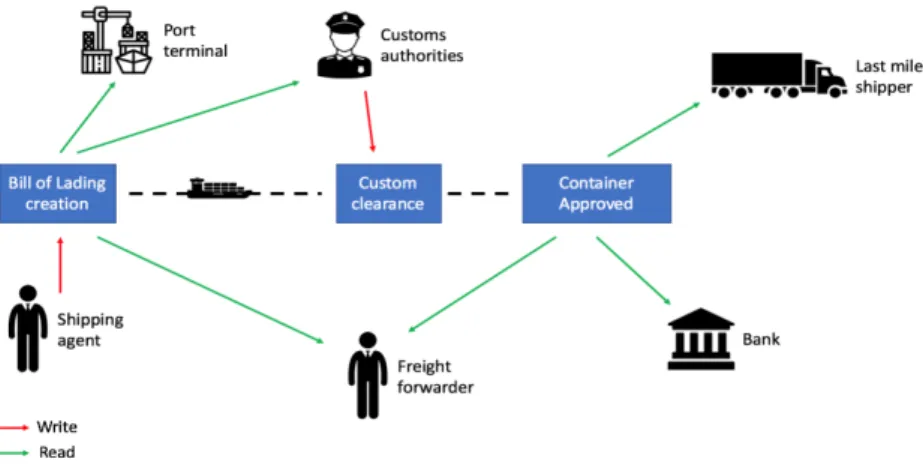
As we’ve seen, cargo documentation is usually transmitted (digitally or manually) from one actor to another, in a direct and often redundant way. Peers follow some specified rules for sending the documentation in a specified way,
respecting some hard deadlines. This logic can be seen as a push one, where the
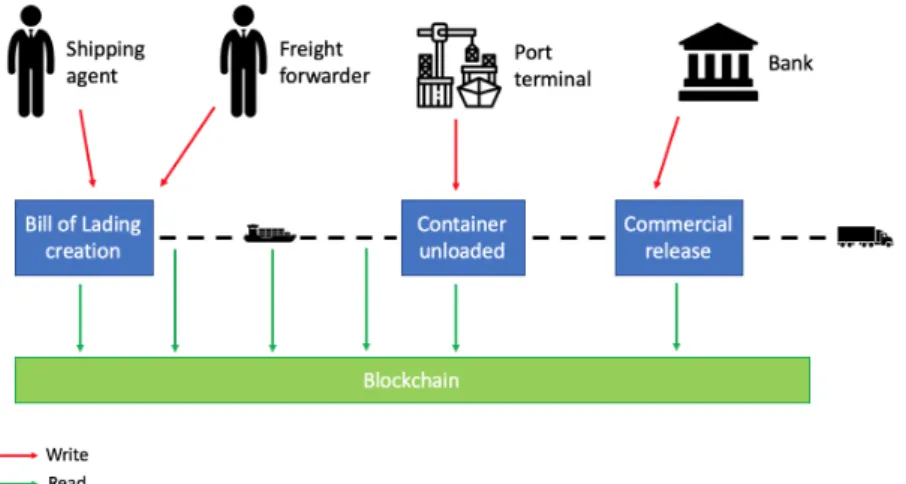
data movement is generated by the instruction each actor has been given from the network leader or the common set of procedures. What blockchain aims to
realize is a common database, a ledger, where each information creator can
upload its documentation, while the other participants are able to retrieve the
data if and when they’re needed. This, on the other side, can be seen as a pull
logic, in which information is safely stored on a common blockchain and is available for everyone, who can retrieve it at any time. A graphical explanation of the flow can be seen in Figure 2.1 below.
Information owners can be the freight forwarder, the shipping agent, the port logistics operators and so on. By cryptographically signing their data, the entire network can verify that they were responsible for uploading and/or updating the information under their competence area.
Following modification or omission of data can be easily detected, thanks to immediate access to the history of the documentation, reducing fraud attempts or errors by a huge factor.
These types of blockchain implementations mainly focus on digitizing and validating the Bill of Lading, one of the most important documents in international transportations. Companies like Blockfreight, Skuchain or CargoX have clearly stated this as their main purpose, given the possible savings and lead time improvement such a revolution could bring.
2.2.2 Trade finance optimization
Trade financing is known to be characterized by large inefficiencies and high chances of frauds (Skinner, 2016). For instance, the U.S. market accounted for losses that reached 0.5 billion US dollars in 1995 due to trade finance frauds (Barnes and Byrne, 1996). Similarly, the Commercial Crime Bureau recorded a loss of 2.4 billion Hong Kong dollars (around 0.3 billion US dollars) in 1998 (Zhang, 2011).
One of the most common counterfeits involves the letter of credits, that are used for financing international trade operations. For instance, fraudulent actors can falsify the documentation needed to receive payments from the bank, even when products are inexistent, or of minor than specified quality. Today, banks protect themselves from this type of frauds by asking for additional confirmations and certificates. All these activities naturally drive up costs and increase operative lead times, given that in many cases financial payments are the bottle-neck to the entire flow. For example, containers are usually hold in the terminal until they do not receive the proof of commercial viability from the financing bank.
One of the reasons of these reconciliation delays is that banks and financial institutions are usually not included in the operation procedures but are only notified when an action from them is needed. The use of a blockchain, towards which every actor poses absolute trust, could enable the inclusion of trade finance intermediaries in the ledger, where they would be able to monitor in real time the advancement of the transportation and port operations. This would speed up dramatically the waiting time needed for a payment to be processed, improving the operative lead time as a consequence.
At least some types of payments and funding could be also automated, thanks to the use of smart contracts as escrow accounts. Money can be cryptographically blocked in a specified account and freed only when and if certain conditions from the debtor are met. The openness of blockchain technology could ensure that the contract terms are respected, even without disclosing the identities of the involved parties and the value that is exchanged.
2.2.3 Product traceability and anti-counterfeiting
Moving a single container or product involves an incredible number of actors over an international, inter-company and inter-cultural network in most cases. Every step of the process increases the possibility of losing information over the freight, due to human error or malevolent theft attempts; On the other