Working Paper/Document de travail
2011-20
A Stochastic Volatility Model with
Conditional Skewness
Bank of Canada Working Paper 2011-20
October 2011
A Stochastic Volatility Model with
Conditional Skewness
by
Bruno Feunou
1and Roméo Tédongap
21
Financial Markets Department
Bank of Canada
Ottawa, Ontario, Canada K1A 0G9
[email protected]
2Department of Finance
Stockholm School of Economics
Stockholm, Sweden
[email protected]
Bank of Canada working papers are theoretical or empirical works-in-progress on subjects in economics and finance. The views expressed in this paper are those of the authors.
Acknowledgements
An earlier version of this paper was circulated and presented at various seminars and
conferences under the title “Affine Stochastic Skewness.” We thank Nour Meddahi, Glen
Keenleyside, Scott Hendry, seminar participants at the Duke University Financial
Econometrics Lunch Group, participants at the Conference of the Society for
Computational Economics (Montréal, June 2007), the Forecasting in Rio Conference at
the Graduate School of Economics (Rio de Janeiro, July 2008), and the Summer
Econometric Society Meetings (Boston University, June 2009).
Abstract
We develop a discrete-time affine stochastic volatility model with time-varying
conditional skewness (SVS). Importantly, we disentangle the dynamics of conditional
volatility and conditional skewness in a coherent way. Our approach allows current asset
returns to be asymmetric conditional on current factors and past information, what we
term contemporaneous asymmetry. Conditional skewness is an explicit combination of
the conditional leverage effect and contemporaneous asymmetry. We derive analytical
formulas for various return moments that are used for generalized method of moments
estimation. Applying our approach to S&P500 index daily returns and option data, we
show that one- and two-factor SVS models provide a better fit for both the historical and
the risk-neutral distribution of returns, compared to existing affine generalized
autoregressive conditional heteroskedasticity (GARCH) models. Our results are not due
to an overparameterization of the model: the one-factor SVS models have the same
number of parameters as their one-factor GARCH competitors.
JEL classification: C1, C5, G1, G12
Bank classification: Econometric and statistical methods; Asset pricing
Résumé
Les auteurs élaborent un modèle discret affine à volatilité stochastique et asymétrie
conditionnelle variable (modèle SVS). Leur approche a ceci d’intéressant qu’elle dissocie
de façon cohérente la dynamique de la volatilité conditionnelle de celle de l’asymétrie
conditionnelle. Elle permet une distribution asymétrique des rendements courants des
actifs conditionnellement aux facteurs du moment et à l’information passée, asymétrie
que les auteurs qualifient de «
contemporaine
». Dans leur modèle, l’asymétrie
conditionnelle découle de la combinaison explicite de l’effet de levier conditionnel et de
l’asymétrie contemporaine. Les auteurs établissent les formules analytiques pour divers
moments des rendements utiles pour l’estimation par la méthode des moments
généralisés. En se servant de données relatives aux rendements journaliers de l’indice
S&P 500 et aux options connexes, ils montrent que les modèles SVS à un et à deux
facteurs décrivent mieux la distribution des rendements (tant historique que risque neutre)
que les modèles GARCH affines existants. Leurs résultats ne tiennent pas à un
surparamétrage, puisque les modèles SVS unifactoriels comptent le même nombre de
paramètres que les modèles GARCH unifactoriels.
Classification JEL : C1, C5, G1, G12
Classification de la Banque : Méthodes économétriques et statistiques; Évaluation des
actifs
1
Introduction
The option-pricing literature holds that generalized autoregressive conditional heteroskedasticity (GARCH) and stochastic volatility (SV) models significantly outperform the Black-Scholes model. However, SV models have traditionally been examined in continuous time and the literature has paid less attention to discrete-time SV option valuation models. This is due to the limitations of existing discrete-time SV models in capturing the characteristics of asset returns that are essential to improve their fit of option data. In particular, these models commonly assume that the conditional distribution of returns is symmetric, violate the positivity of the volatility process or do not allow for leverage effects. This paper contributes to the literature by examining the implications of allowing conditional asymmetries in discrete-time SV models.
The paper proposes and tests a parsimonious discrete-time affine model with stochastic volatility and conditional skewness. Our focus on the affine class of financial time-series volatility models is motivated by their tractability in empirical applications. In option pricing, for example, European options admit closed-form prices. To the best of our knowledge, there is no discrete-time SV model delivering a closed-form option price that has been empirically tested using option data, in contrast to tests performed in several GARCH models. Heston and Nandi (2000) and Christoffersen et al. (2006) describe examples of one-factor GARCH models that belong to the discrete-time affine class, and feature the conditional leverage effect (both papers) and conditional skewness (only the latter paper) in single-period returns. Christoffersen et al. (2008) provide a two-factor generalization of Heston and Nandi’s (2000) model to long- and short-run volatility components. The model features only the leverage effect but not conditional skewness in single-period returns. We compare the performance of the new model to these benchmark GARCH models along several dimensions.
As pointed out by Christoffersen et al. (2006), conditionally nonsymmetric return innovations are critically important, since in option pricing, for example, heteroskedasticity and the leverage effect alone do not suffice to explain the option smirk. However, skewness in their inverse Gaussian GARCH model is still deterministically related to volatility and both undergo the same return shocks, while our proposed model features stochastic volatility. Existing GARCH and SV models also characterize the relation between returns and volatility only through their contemporaneous
covariance (the so-called leverage effect). In contrast, our modeling approach characterizes the entire distribution of returns conditional upon the volatility factors. We refer to the asymmetry of that distribution as contemporaneous asymmetry, which adds up to the leverage effect to determine conditional skewness.
We show that, in the case of affine models, all unconditional moments of observable returns can be derived analytically. We develop and implement an algorithm for computing these unconditional moments in a general discrete-time affine model that nests our proposed model and all existing affine GARCH models. Jiang and Knight (2002) provide similar results in an alternative way for continuous-time affine processes. They derive the unconditional joint characteristic function of the diffusion vector process in closed form. In discrete time, this can be done only through calculation of unconditional moments, and the issue has not been addressed so far in the literature. Analytical formulas help in assessing the direct impact of model parameters on critical unconditional moments. In particular, this can be useful for calibration exercises where model parameters are estimated to directly match relevant sample moments from the data.
Armed with these unconditional moments, we propose a generalized method of moments (GMM)-based estimation of affine GARCH and SV models (GMM)-based on exact moment conditions. Interestingly, the sample variance-covariance matrix of the vector of moments is nonparametric, thus allowing for efficient GMM in one step. This approach is faster and computationally more efficient than alternative estimation methods (see Jacquier et al. 1994; Andersen et al. 1999; Danielsson 1994). Moreover, the minimum distance between model-implied and actual sample return moments ap-pears as a natural metric for comparing different model fits.
Applying this GMM procedure to fit the historical dynamics of observed returns from January 1962 to December 2010, we find that the SVS model characterizes S&P500 returns well. In addition to the sample mean, variance, skewness and kurtosis of returns, the models are estimated to match the sample autocorrelations of squared returns up to a six-month lag, and the correlations between returns and future squared returns up to a two-month lag. The persistence and the size of these correlations at longer lags cannot be matched by single-factor models. We find that the two-factor models provide the best fit of these moments and, among them, the two-factor SVS model does better than the two-factor GARCH model.
Our results point out the benefit of allowing for conditional skewness in returns, since the one-factor SVS model with contemporaneous normality fits better than the GARCH model of Heston and Nandi (2000), although both models share the same number of parameters. Our results also show that the SVS model with contemporaneous normality is more parsimonious than the inverse Gaussian GARCH model of Christoffersen et al. (2006), which has one more parameter and nests the GARCH model of Heston and Nandi (2000). In fact, the SVS model with contemporaneous normality and the inverse Gaussian GARCH model have an equal fit of the historical returns distribution.
Fitting the risk-neutral dynamics using S&P500 option data, we find that explicitly allowing for contemporaneous asymmetry in the one-factor SVS model leads to substantial gains in option pricing, compared to benchmark one-factor GARCH models. We compare models using the option implied-volatility root-mean-square error (IVRMSE). The one-factor SVS model with contempo-raneous asymmetry outperforms the two benchmark one-factor GARCH models in the overall fit of option data and across all option categories as well. The IVRMSE of the SVS model is about 23.26% and 19.85% below that of the GARCH models. The two-factor models show the best fit of option data overall and across all categories, and they have a comparable fit overall. The two-factor SVS model has an overall IVRMSE of 2.98%, compared to 3.00% for the two-factor GARCH model. The rest of the paper is organized as follows. Section 2 discusses existing discrete-time affine GARCH and SV models and their limitations. Section 3 introduces our discrete-time SVS model and discusses the new features relative to existing models. Section 4 estimates univariate and bivariate SVS and GARCH models on S&P500 index daily returns and provides comparisons and diagnostics. Section 5 estimates univariate and bivariate SVS models, together with competitive GARCH models, using S&P500 index daily option data, and provides comparisons and diagnostics. Section 6 concludes. An external appendix containing additional materials and proofs is available from the authors’ webpages.
2
Discrete-Time Affine Models: An Overview
A discrete-time affine latent-factor model of returns with time-varying conditional moments may be characterized by its conditional log moment-generating function:
Ψt(x, y;θ) = lnEt h
expxrt+1+y>lt+1
i
=A(x, y;θ) +B(x, y;θ)>lt, (1)
where Et[·] ≡E[· |It] denotes the expectation conditional on a well-specified information set It,
rt is the observable returns, lt = (l1t, .., lKt)> is the vector of latent factors and θ is the vector
of parameters. Note that the conditional moment-generating function is exponentially linear in the latent variable lt only. Bates (2006) refers to such a process as semi-affine. In what follows,
the parameter θ is withdrawn from functions A and B for expositional purposes. In this section, we discuss discrete-time affine GARCH and SV models and their limitations, which we want to overcome by introducing a new discrete-time affine SV model featuring conditional skewness.
The following SV models are discrete-time semi-affine univariate latent-factor models of returns considered in several empirical studies. The dynamics of returns is given by
rt+1 =µr−λhµh+λhht+ p
htut+1, (2)
where the volatility process satisfies one of the following:
ht+1 = (1−φh)µh−αh+ φh−αhβh2 ht+αh εt+1−βh p ht 2 , (3) ht+1 = (1−φh)µh+φhht+σhεt+1, (4) ht+1 = (1−φh)µh+φhht+σh p htεt+1, (5)
and where ut+1 and εt+1 are two i.i.d. standard normal shocks. The parameter vector θ is (µr, λh, µh, φh, αh, βh, ρrh)>with volatility dynamics (3), whereas it is (µr, λh, µh, φh, σh)>with
au-toregressive Gaussian volatility (4) and finally (µr, λh, µh, φh, σh, ρrh)> with square-root volatility
(5), where ρrh denotes the conditional correlation between the shocks ut+1 and εt+1. The special case ρrh = 1 in the volatility dynamics (3) corresponds to Heston and Nandi’s (2000) GARCH
model, which henceforth we refer to as HN.
Note that volatility processes (4) and (5) are not well defined, sincehtcan take negative values.
This can also arise with process (3) unless the parameters satisfy a couple of constraints. In simulations, for example, one should be careful when using a reflecting barrier at a small positive number to ensure the positivity of simulated volatility samples. Besides, if the volatility shockεt+1 in (4) is allowed to be correlated to the return shock ut+1 in (2), then the model loses its affine property. Also notice that the conditional skewness of returns in these models is zero.
Christoffersen et al. (2006) propose an affine GARCH model that allows conditional skewness in returns, specified by rt+1 =γh+νhht+ηhyt+1, (6) ht+1 =wh+bhht+chyt+1+ah h2t yt+1 , (7)
where, given the available information at timet,yt+1 has an inverse Gaussian distribution with the degree-of-freedom parameterht
ηh2. Alternatively,yt+1 may be written as
yt+1 = ht η2 h + √ ht ηh zt+1, (8)
wherezt+1follows a standardized inverse Gaussian distribution with parameterst= 3ηh/ √
ht. The
standardized inverse Gaussian distribution is introduced in Section 3.1.1. Interestingly, Christof-fersen et al. (2006) provide a reparameterization of their model so that HN appears to be a limit asηh approaches zero: ah = αh ηh4, bh=φh− αh ηh2 − αh−2αhηhβh η2h , ch =αh−2αhηhβh, wh = (1−φh)µh−αh, γh =µr−λhµh, νh =λh− 1 ηh . (9)
Henceforth we refer to this specification as CHJ.
While CHJ allows for both the leverage effect and conditional skewness, it does not separate the volatility of volatility from the leverage effect on the one hand, and conditional skewness from volatility on the other hand. In particular, conditional skewness and volatility are related by
st= 3ηh/ √
ht. In consequence, the sign of conditional skewness is constant over time and equal to
the sign of the parameter ηh. This contrasts with the empirical evidence in Harvey and Siddique
(1999) that conditional skewness changes sign over time. Feunou et al.’s (2011) findings also suggest that, although conditional skewness is centered around a negative value, return skewness may take positive values.
Christoffersen et al. (2008) introduce a two-factor generalization of HN to long- and short-run volatility components, which henceforth we refer to as CJOW. In addition to the dynamics of return (2), the volatility dynamics may be written as follows:
ht=h1,t+h2,t where h1,t+1 =µ1h+φ1hh1,t+α1hu2t+1−2α1hβ1h √ htut+1 h2,t+1 =µ2h+φ2hh2,t+α2hu2t+1−2α2hβ2h √ htut+1, (10)
withµ1h = 0, since only the sumµ1h+µ2h is identifiable.
Liesenfeld and Jung (2000) introduce SV models with conditional heavy tails, but their model is non-affine. However, SV models with conditional asymmetry have received less attention so far. In this paper, we aim to combine in a coherent way both the affine property and the ability of an SV model to fit critical moments of the data (mean, variance, skewness, kurtosis, multiple-day autocorrelation of squared returns and cross-correlation between returns are future squared returns). In the next section, we develop an affine multivariate latent-factor model of returns such that both conditional variance ht and conditional skewness st are stochastic. We refer to such
a model as SVS. The proposed model is parsimonious and solves for the limitations of existing models. Later in Sections 4 and 5, we use S&P500 index returns and option data to examine the relative performance of the one- and two-factor SVS to the GARCH alternatives (HN, CHJ and CJOW).
3
Building an SV Model with Conditional Skewness
3.1 The Model Structure
For each variable in what follows, the time subscript denotes the date from which the value of the variable is observed by the economic agent; to simplify notations, the usual scalar operators will
also apply to vectors element-by-element. The joint distribution of returns rt+1 and latent factors
σt2+1 conditional on previous information denotedIt and containing previous realizations of returns
rt={rt, rt−1, ...}and latent factorsσ2t ={σ2t, σ2t−1, ...} may be decomposed as follows:
f rt+1, σ2t+1 |It ≡fc rt+1 |σt2+1, It ×fm σt2+1 |It . (11)
Based on this, our modeling strategy consists of specifying, in a first step, the distribution of returns conditional on factors and previous information, and, in a second step, the dynamics of the factors. The first step will be characterized by inverse Gaussian shocks, and the second step will follow a multivariate autoregressive gamma process.
3.1.1 Standardized Inverse Gaussian Shocks
The dynamics of returns in our model is built upon shocks drawn from a standardized inverse Gaussian distribution. The inverse Gaussian process has been investigated by Jensen and Lunde (2001), Forsberg and Bollerslev (2002), and Christoffersen et al. (2006). See also the excellent overview of related processes in Barndorff-Nielsen and Shephard (2001).
The log moment-generating function of a discrete random variable that follows a standardized inverse Gaussian distribution of parameter s, denoted SIG(s), is given by
ψ(u;s) = lnE[exp (uX)] =−3s−1u+ 9s−2 1− r 1− 2 3su ! . (12)
For such a random variable, one has E[X] = 0, EX2= 1 and EX3=s, meaning that sis the skewness of X. In addition to the fact that theSIG distribution is directly parameterized by its skewness, the limiting distribution when the skewness s tends to zero is the standard normal distribution, that is SIG(0)≡ N(0,1). This particularity makes the SIG an ideal building block for studying departures from normality.
3.1.2 Autoregressive Gamma Latent Factors
The conditional distribution of returns is further characterized byKlatent factors, the components of the K-dimensional vector process σ2
gamma process with mutually independent components. We use this process to guarantee the positivity of the volatility factors so that volatility itself is well defined. Its cumulant-generating function, conditional on It, is given by
Ψσt (y)≡lnEhexpy>σt2+1|It i = K X i=1 fi(yi) + K X i=1 gi(yi)σi,t2 , fi(yi) =−νiln (1−αiyi) and gi(yi) = φiyi 1−αiyi . (13) Each factor σ2
i,t is a univariate autoregressive gamma process, which is an AR(1) process with
persistence parameter φi. The parameters νi and αi are related to persistence, unconditional
mean µi and unconditional variance ωi as νi = µ2i /ωi and αi = (1−φi)ωi/µi. A more in-depth
treatment of the univariate autoregressive gamma process can be found in Gourieroux and Jasiak (2006) and Darolles et al. (2006). Their analysis is extended to the multivariate case and applied to the term structure of interest rates modeling by Le et al. (2010). The autoregressive gamma process also represents the discrete-time counterpart to the continuous-time square-root process that has previously been examined in the SV literature (see, for example, Singleton 2006, p. 110). We denote by mσt, vσt and ξσt the K-dimensional vectors of conditional means, variances, and third moments of the individual factors, respectively. Their ith component is given by
mσi,t = (1−φi)µi+φiσ2i,t and vi,tσ = (1−φi)2ωi+
2 (1−φi)φiωi µi σi,t2 , ξi,tσ = 2 (1−φi) 3 ω2i µi +6 (1−φi) 2 φiωi2 µ2 i σi,t2 . (14)
The AR(1) processσ2i,t thus has the formal representation
σi,t2 +1= (1−φi)µi+φiσi,t2 + q
vσ
i,tzi,t+1 (15)
where vi,tσ is given in equation (14) and zi,t+1 is an error with mean zero and unit variance and skewness ξi,tσ
vσi,t
−3/2
. The conditional density function of an autoregressive gamma process is obtained as a convolution of the standard gamma and Poisson distributions. A discussion and a formal expression of that density can be found in Singleton (2006, p. 109).
3.1.3 The Dynamics of Returns
Formally, we assume that logarithmic returns have the following dynamics:
rt+1= ln
Pt+1
Pt
=µrt +urt+1, (16)
whereP is the price of the asset,µrt ≡Et[rt+1|It] denotes the expected (or conditional mean of)
returns, which we assume are given by
µrt =λ0+λ>σt2, (17)
and urt+1 ≡ rt+1−Et[rt+1|It] represents the unexpected (or innovation of) returns, which we
assume are given by
urt+1 =β> σt2+1−mσt+σ>t+1ut+1. (18)
Our modeling strategy thus decomposes unexpected returns into two parts: a contribution due to factor innovations and another due to shocks that are orthogonal to factor innovations. We assume that the ith component of this K-dimensional vector of shocks ut+1 has a standardized inverse Gaussian distribution, conditional on factors and past information,
ui,t+1| σt2+1, It ∼SIG ηiσi,t−1+1 , (19)
and that the K return shocks are mutually independent conditionally on σ2t+1, It
. Ifηi = 0, then
ui,t+1 is a standard normal shock. Under these assumptions, we have
lnE exp (xrt+1)|σ2t+1, It =µrt −β>mσtx+ K X i=1 (βix+ψ(x;ηi))σi,t2+1, (20)
where the functionψ(·, s) is the cumulant-generating function of the standardized inverse Gaussian distribution with skewnesssas defined in equation (12). In total, the model has 1 + 6K parameters grouped in the vector θ = λ0, λ>, β>, η>, µ>, φ>, ω>
>
. The scalar λ0 is the drift coefficient in conditional expected returns. All vector parameters in θareK-dimensional. Namely, the vectorλ
contains loadings of expected returns on the K factors, the vector β contains loadings of returns on the K factor innovations, the vector η contains skewness coefficients of the K standardized inverse Gaussian shocks, and the vectorsµ,φand ω contain unconditional means, persistence and variances of theK factors, respectively.
Although, for the purpose of this paper, we limit ourselves to a single-return setting, the model admits a straightforward generalization to multiple returns. Also, we further limit our empirical application in this paper to one and two factors. Since the empirical evidence regarding the time-varying conditional mean is weak from historical index daily returns data, we will restrict ourselves in the estimation section to λ = 0 and will pick λ0 to match the sample unconditional mean of returns, leaving us with 5K critical parameters from which further interesting restrictions can be considered.
3.2 Volatility, Conditional Skewness and the Leverage Effect
In the previous subsection, we did not model conditional volatility and skewness or other higher moments of returns directly. Instead, we related returns to stochastic linearly independent positive factors. In this section, we derive useful properties of the model and discuss its novel features in relation to the literature. In particular, we show that, in addition to stochastic volatility and the leverage effect, the model generates conditional skewness. This nonzero and stochastic conditional skewness, coupled with the ability of the model to generalize to multiple returns and multiple factors, constitutes the main significant difference from previous affine SV models in discrete time. The conditional variance,ht, and the conditional skewness,st, of returns,rt+1, may be expressed as follows: ht≡Et h (rt+1−µrt)2 |It i =ι>mσt + β2>vσt = K X i=1 hi,t, (21) sth3t/2 ≡Et h (rt+1−µrt) 3| It i =η>mσt + 3β>vtσ+ β3>ξtσ = K X i=1 %i,t, (22) with
where ι is the K-dimensional vector of ones, and the coefficients ci,h and ci,s depend on model
parameters θ. These coefficients are explicitly given by
c0i,h = (1−φi) µi+ (1−φi)ωiβi2 and ci,h = 1 +2 (1−φi)ωiβ 2 i µi φi, c0i,s= (1−φi) ηiµi+ 3 (1−φi)ωiβi+ 2 (1−φi)2ω2iβ3i µi ! , ci,s= ηi+ 6 (1−φi)ωiβi µi +6 (1−φi) 2 ωi2βi3 µ2 i ! φi. (24)
Conditional onIt, covariance between returnsrt+1 and volatilityht+1 (the leverage effect) may be expressed as:
Cov(rt+1, ht+1 |It) = (βch)>vσt = K X
i=1
ϑi,t with ϑi,t =c0i,rh+ci,rhσ2i,t, (25)
wherech = (c1,h, c2,h, . . . , cK,h)> and the coefficients ci,rh are explicitly given by
c0i,rh= 1 +2 (1−φi)ωiβ 2 i µi (1−φi)2φiωiβi, ci,rh = 2 1 +2 (1−φi)ωiβ 2 i µi (1−φi)φ2iωiβi µi . (26)
It is not surprising that the parameter β alone governs the conditional leverage effect, since it represents the slope of the linear projection of returns on factor innovations. In particular, for the one-factor SVS model to generate a negative correlation between spot returns and variance as postulated by Black (1976) and documented by Christie (1982) and others, the parameter β1 should be negative.
In our SVS model, contemporaneous asymmetry η, alone, does not characterize conditional skewness, as shown in equation (22). The parameter β, which alone characterizes the leverage effect, also plays a central role in generating conditional asymmetry in returns, even when η = 0. In contrast to SV models discussed in Section 2, where the leverage effect generates skewness only in the multiple-period conditional distribution of returns, in our setting it invokes skewness in the single-period conditional distribution as well.
To better understand the flexibility of the SVS model in generating conditional skewness, we consider the one-factor SVS without loss of generality. The left-hand side of the last equality in equation (22) shows that conditional skewness is the sum of three terms. The first term has the sign ofη1 and the last two terms have the same sign ofβ1. A negativeβ1 is necessary to generate the well-documented leverage effect. In that case, the last two terms in (22) are negative. The sign of conditional skewness will then depend onη1. Ifη1 is zero or negative, then conditional skewness is negative over time, as in CHJ. Note that conditional skewness may change sign over time if η1 is positive andc01,sc1,s<0. There are lower and upper positive bounds onη1 such that this latter condition holds. These bounds are, respectively, −3 (1−φ1)ω1β1/µ1 −2 (1−φ1)2ω12β13/µ21 and
−6 (1−φ1)ω1β1/µ1−6 (1−φ1)2ω12β13/µ21. This shows that the one-factor SVS model can generate a more realistic time series of conditional skewness compared to CHJ.
We acknowledge that extensions of the basic SV model in continuous time can capture the stylized facts of daily asset prices just as well as the SVS model introduced in this paper. However, the econometrics required for estimating continuous-time processes are demanding, because of the complexity of the resulting filtering and sampling. The advantage of our discrete-time affine approach is not only that it gives an alternative to discrete-time users, but also that discrete-time GARCH and SV models provide straightforward tools to deal with estimation and inference. In the external appendix, we show that although the current SVS model is written in discrete time and is easily applicable to discrete data, it admits interesting continuous-time limits, including the standard SV model of Heston (1993) and an SV model with a jump process with stochastic intensity.
In the next section, we develop an estimation procedure for the one- and two-factor SVS models together with their competitors, HN, CHJ and CJOW. We seek a unified framework where these different models can be estimated and evaluated according to the same criteria, thereby facilitating their empirical comparison. Our proposed framework uses the generalized method of moments to estimate, test and compare the models under consideration. It exploits the affine property of the models to compute analytically model-implied unconditional moments of returns that are further compared to their empirical counterparts. We describe our approach in detail in the next section, and in Section 5 we compare the option-pricing performance of the models.
4
SVS vs. GARCH Models: Time-Series Analysis
4.1 Analytical Expressions of Unconditional Moments
Given the joint conditional log moment-generating function (1) of returns and latent variables, the unconditional log moment-generating function of the latent vectorlt, denoted by Ψl(·), satisfies
Ψl(y) =Al(y) + Ψl(Bl(y)), (27)
where Al(y) ≡A(0, y) andBl(y) ≡B(0, y). Proof of equation (27) can be found in the external
appendix. The function Ψl(·) obtains analytically in some cases, for instance the affine
jump-diffusion processes, as in Jiang and Knight (2002). In a discrete-time setting, it is sufficient to find the derivatives of Ψl(y) at y= 0, and this can be done through differentiation of equation (27).
We show that the nth unconditional cumulant of the latent vectorlt is the Kn−1 ×K matrix
κl(n)≡κl(n) =DnΨl(0), whereDnΨl(0) is the solution to the equation
DnΨl(0) =DnAl(0) + Dn(Ψl(Bl(y)))|y=0, (28)
and depends on DΨl(0), D2Ψl(0),. . ., Dn−1Ψl(0), DBl(0), D2Bl(0),. . ., DnBl(0), and where the
operator D defines the Jacobian of a matrix function of a matrix variable, as in Magnus and Neudecker (1988, p. 173).
The higher-order derivatives of the composite function in the right-hand side of equation (28) are evaluated through the chain rule given by Fa`a di Bruno’s formula, of which the multivariate version is discussed in detail in Constantine and Savits (1996). In the case of a univariate latent variable (lt is scalar), it is easy to solve equation (28) for higher-order cumulants of the latent
variable. However, this task is more cumbersome and tedious when lt is a vector. In the latter
case, the solution to equation (28) for n= 1, which is for the first cumulant, is given by
DΨl(0) =DAl(0) [IdK− DBl(0)]−1, (29)
latent vector lt. Whenn >1, which is for the second- and higher-order cumulant, it can be shown
that the matrix DnΨ
l(0) satisfies DnΨl(0)− (DBl(0))⊗(n−1) > DnΨl(0)DBl(0) =DnAl(0) +Cn, (30)
where the matrixCndepends on the matrices DjB l(0) 1≤j≤n−1and DjΨ l(0) 2≤j≤nthrough the
multivariate version of Fa`a di Bruno’s formula. For example, the second unconditional cumulant of the latent vector is given by
D2Ψl(0)− DBl(0)>D2Ψl(0)DBl(0) =D2Al(0) + (IdK⊗ DΨl(0))D2Bl(0). (31)
Equation (30) shows thatDnΨ
l(0) is the solution to a matrix equation of the formX−∆XΓ =
Λ. The solution to that equation is given by
vec(X) =
h
Id−Γ>⊗∆
i−1
vec(Λ).
Moments and cross-moments of returns can also be computed analytically, and this can be per-formed through cross-cumulants of couples (rt+1, rt+1+j)>,j >0. The unconditional log
moment-generating function of such couples is easily obtained in the case of affine models (see Darolles et al. 2006). It is given by
Ψr,j(x, z) =Ar,j(z) +A(x, Br,j(z)) + Ψl(B(x, Br,j(z))), (32)
where the functionsAr,j and Br,j satisfy the forward recursions
Ar,j(z) =Ar,j−1(z) +Al(Br,j−1(z)), (33)
Br,j(z) =Bl(Br,j−1(z)), (34)
with the initial conditionsAr,1(z) =A(z,0) and Br,1(z) =B(z,0).
returns rt is the numberκr,j(n, m)≡ ∂ n+mΨ r,j ∂xn∂zm (0,0) where ∂n+mΨ r,j ∂xn∂zm (0,0) is the solution to ∂n+mΨr,j ∂xn∂zm (0,0) = ∂n+m ∂xn∂zm(A(x, Br,j(z))) x=0,z=0 + ∂ n+m ∂xn∂zm(Ψl(B(x, Br,j(z)))) x=0,z=0 . (35)
Equation (35) shows that cumulants of the latent vectorltare essential to compute cumulants and
cross-cumulants of returns.
We have just provided analytical formulas for computing return cumulants and cross-cumulants
κr,j(n, m), j >0, n ≥0, m > 0. This also allows us to compute analytically the corresponding
return moments and cross-moments µr,j(n, m) = E h
rn trmt+j
i
through the relationship between multivariate moments and cumulants.
4.2 GMM Procedure
All the moments previously computed are functions of the parameter vectorθthat governs the joint dynamics of returns and the latent factors. We can then choose N pertinent moments to perform the GMM estimation of the returns model. In this paper, we choose N pertinent moments among all the momentsµr,j(n, m) =E
h
rntrtm+ji such thatj ≥1 , n≥0 and m >0. Since the moments of observed returns implied by a given model can directly be compared to their sample equivalent, our estimation setup evaluates the performance of a given model in replicating well-known stylized facts. Letgt(θ) = h rni t r mi t+ji−µr,ji(ni, mi) i
1≤i≤N denote theN×1 vector of the chosen moments. We
have E[gt(θ)] = 0 and we define the sample counterpart of this moment condition as follows:
b g(θ) = b E h rtn1rm1t+j1 i −µr,j1(n1, m1) . . . b EhrnN t r mN t+jN i −µr,jN(nN, mN) . (36)
Given the N×N matrixWc used to weight the moments, the GMM estimatorθbof the parameter
vector is given by b θ= arg min θ T b g(θ)>cW b g(θ) , (37)
where T is the sample size. Interestingly, the heteroskedasticity and autocorrelation (HAC) esti-mator of the variance-covariance matrix of gt(θ) is simply that of the variance-covariance matrix
of h rni t r mi t+ji i
1≤i≤N, which does not depend on the vector of parameter θ. This is an advantage,
since with a nonparametric empirical variance-covariance matrix of moment conditions, the optimal GMM procedure can be implemented in one step. It is also important to note that two different models can be estimated via the same moment conditions and weighting matrix. Only the model-implied moments [µr,ji(ni, mi)]1≤i≤N differ from one model to another in this estimation procedure.
In this case, the minimum value of the GMM objective function itself is a criterion for comparison of the alternative models, since it represents the distance between the model-implied moments and the actual moments.
We weigh the moments using the inverse of the diagonal of their long-run variance-covariance matrix:
c
W =nDiagV ard[gt]
o−1
.
This matrix is nonparametric and puts more weight on moments with low magnitude. If the number of moments to match is large, as is the case in our estimation in the next section, then inverting the long-run variance-covariance matrix of moments will be numerically unstable. Using the inverse of the diagonal instead of the inverse of the long-run variance-covariance matrix itself allows for numerical stability if the number of moments to match is large, since inverting a diagonal matrix is simply taking the diagonal of the inverse of its diagonal elements. The distance to minimize reduces to N X i=1 b E h rni t r mi t+ji i −E h rni t r mi t+ji i b σ h rni t r mi t+ji i /√T 2 , (38)
where observed moments are denoted with a hat and the model-implied theoretical moment without. In some cases, this GMM procedure has a numerical advantage compared to the maximum-likelihood estimation even when the maximum-likelihood function can be derived. Maximum-maximum-likelihood es-timation becomes difficult to perform numerically and theoretically, especially when the support of the likelihood function is parameter-dependent. While the appeal of GARCH models relies on the availability of their likelihood function in analytical form, which eases their estimation, the
support of the likelihood function for CHJ is parameter-dependent. This complicates its estimation by maximum likelihood and, most importantly, its inference. In fact, there exists no general theory in the statistical literature about the distributional properties of the maximum-likelihood estimator when the support of the likelihood function is parameter-dependent.
On the other hand, the maximum-likelihood estimation of semi-affine latent variable models of Bates (2006) and the quasi-maximum-likelihood estimation based on the Kalman recursion have the downside that critical unconditional higher moments (skewness and kurtosis) of returns can be poorly estimated due to the second-order approximation of the distribution of the latent variable conditional on observable returns. Moreover, in single-stage estimation and filtering methods such as the unscented Kalman filter and Bates’s (2006) algorithm, approximations affect both parameter and state estimations.
Conversely, our GMM procedure matches critical higher moments exactly and requires no ap-proximation for parameter estimation. Given GMM estimates of model parameters, Bates’s (2006) procedure, or any other filtering procedure, such as the unscented Kalman filter, can be followed for the state estimation. In this sense, approximations required by these techniques affect only state estimation.
4.3 Data and Parameter Estimation
Using daily returns on the S&P500 equal-weighted index from January 2, 1962 to December 31, 2010, we estimate the 5-parameter unconstrained factor SVS model, the 4-parameter one-factor SVS model with the constraint η1 = 0 (contemporaneous normality), and the 10-parameter unconstrained two-factor SVS model, which we respectively denote SVS1FU, SVS1FC and SVS2FU. We also estimate their GARCH competitors, the one-factor models CHJ with five parameters and HN with four parameters, and the two-factor model CJOW with seven parameters.
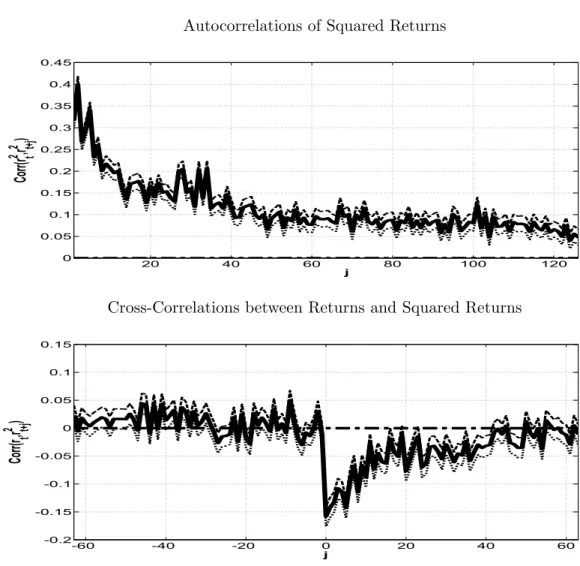
To perform the GMM procedure, we need to decide which moments to consider. The top panel of Figure 1 shows that autocorrelations of daily squared returns are significant up to more than a six-month lag (126 trading days). The bottom panel shows that correlations between daily returns and future squared returns are negative and significant up to a two-month lag (42 trading days). We use these critical empirical facts as the basis for our benchmark estimation. We then consider
the moments
Ert2rt2+j j=1 to 126 and Ertr2t+j j=1 to 42.
The return series has a standard deviation of 8.39E-3, a skewness of -0.8077 and an excess kurtosis of 15.10, and these sample estimates are all significant at the 5% level. We then add the moments
{E[rtn]}n=2 to 4
in order to match this significant variance, skewness and kurtosis. Thus, in total, our benchmark estimation uses 126+42+3=171 moments and the corresponding results are provided in Panel A of Table 1.
Starting with the SVS model, Panel A of Table 1 shows that β1 is negative for the one-factor SVS and both β1 and β2 are negative for the two-factor SVS. These coefficients are all significant at conventional levels, as well as all the coefficients describing the factor dynamics. The SVS model thus generates the well-documented negative leverage effect. Contemporaneous asymmetry does not seem to be important for the historical distribution of returns. For the one-factor SVS model, the minimum distance between actual and model-implied moments is 46.23 whenη1 is estimated, and 46.77 whenη1 is constrained to zero. The difference of 0.54 that follows aχ2(1) is not statistically significant, since itsp-value of 0.46 is larger than conventional levels.
The minimum distance between actual and model-implied moments is 32.27 for the SVS2FU model. The difference from the SVS1FC model is then 14.50 and follows a χ2(6). It appears to be statistically significant, since the associated p-value is 0.02, showing that the SVS2FU model outperforms the one-factor SVS model. The SVS2FU model has a long-run volatility component with a persistence of 0.99148, a half-life of 81 days, as well as a short-run volatility component with a persistence of 0.81028, a half-life of approximately three days. The factor persistence in the one-factor SVS model, 0.98235 for the SVS1FU and 0.97985 for the SVS1FC, is intermediate between these long- and short-run volatility components, having a half-life of 39 days and 34 days, respectively.
Panel A of Table 1 also shows results for the GARCH models. All parameters are statistically significant at conventional levels and the parameterη1h is negative by our new estimation strategy,
corroborating the findings of Christoffersen et al. (2006). In addition, the “LR-test” largely rejects HN against both CHJ and CJOW, with p-values lower than or equal to 2%, suggesting that conditional skewness as well as more than one factor are both important features of the historical returns distribution. It is important to note that the long- and short-run volatility components implied by CJOW have persistence, 0.99193 and 0.80466, comparable to those of their analogue implied by the SVS2FU model, 0.99148 and 0.81028 respectively. The volatility persistence in CHJ and HN, 0.98232 and 0.98457 respectively, is also intermediate between the long- and short-run volatility components.
Although the SVS1FC model and HN have the same number of parameters, the fit of actual moments is different. The fit is better for the SVS1FC model, 46.77, compared to 52.94 for HN, a substantial difference of 6.17, attributable to conditional skewness in the SVS1FC model. Also note that the fit of the SVS1FC model and CHJ is comparable, 46.77 against 46.35, although the SVS1FC has one less parameter. Non-reported results show that several constrained versions of the two-factor SVS model cannot be rejected against the SVS2FU model, and they all outperform CJOW as well. We examine one of these constrained versions in more detail in the option-pricing empirical analysis.
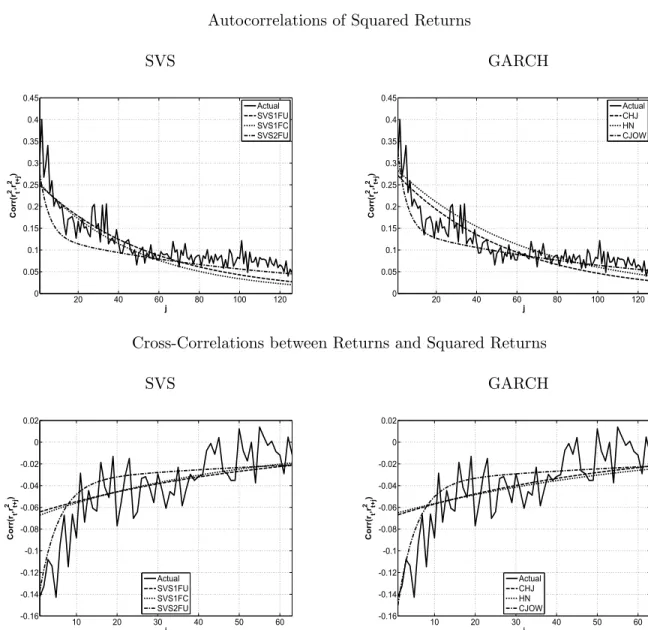
To further visualize how well the models reproduce the stylized facts, we complement the results in Panel A of Table 1 by plotting the model-implied autocorrelations and cross-correlations together with actual ones in Figure 2, for both SVS and GARCH. The figure highlights the importance of a second factor in matching autocorrelations and cross-correlations at both the short and the long horizons. In particular, a second factor is necessary to match long-horizon autocorrelations and cross-correlations.
Panel B of Table 1 shows the estimation results when we decide to match the correlations between returns and future squared returns up to only 21 days instead of the 42 days in Panel A. In Panel B, we therefore eliminate 21 moments from the estimation. All the findings in Panel A still hold in Panel B. In the external appendix, a table shows the estimation results over the subsample starting January 2, 1981. All findings reported for the full sample are confirmed over this subsample.
5
SVS vs. GARCH Models: Option-Pricing Analysis
5.1 Option Pricing with Stochastic Skewness
In this section, we assume that both GARCH and SVS dynamics are under the risk-neutral measure. Hence we have
E[exp (rt+1)|It] = exp (rf), (39)
where rt+1 and rf refer to the risky return and the constant risk-free rate from date t to date
t+ 1, respectively. In particular, for the SVS model, the pricing restriction (39) implies that the coefficients λ0 and λi, i= 1, . . . , K are given by
λ0 = rf + K X i=1 νi(βiαi+ ln (1−αi(βi+ψ(1;ηi)))), λi = φi βi− βi+ψ(1;ηi) 1−α(βi+ψ(1;ηi)) , i= 1, . . . , K.
Because all models considered in this paper are affine, the price at datetof a European call option with strike priceXand maturityτ admits a closed-form formula, reported in the external appendix owing to space limitations. We next discuss the option data used in our empirical analysis. Then we estimate the models by maximizing the fit to our option data.
5.2 Option Data
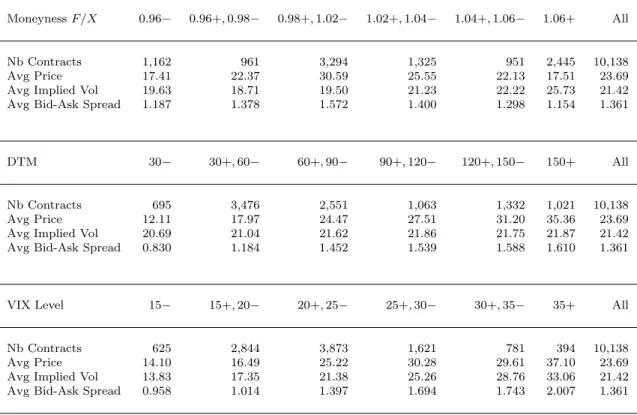
We use closing prices on European S&P500 index options from OptionMetrics for the period January 1, 1996 through December 31, 2004. In order to ensure that the contracts we use are liquid, we rely on only options with maturity between 15 and 180 days. For each maturity on each Wednesday, we retain only the seven most liquid strike prices. We restrict attention to Wednesday data to enable us to study a fairly long time-period while keeping the size of the data set manageable. Our sample has 10,138 options. Using Wednesday is common practice in the literature, to limit the impact of holidays and day-of-the week effects (see Heston and Nandi 2000; Christoffersen and Jacobs 2004). Table 2 describes key features of the data. The top panel of Table 2 sorts the data by six
mon-eyness categories and reports the number of contracts, the average option price, the average Black-Scholes implied volatility (IV), and the average bid-ask spread in dollars. Moneyness is defined as the implied index futures price,F, divided by the option strike priceX. The implied-volatility row shows that deep out-of-the-money puts, those withF/X >1.06, are relatively expensive. The implied-volatility for those options is 25.73%, compared with 19.50% for at-the-money options. The data thus display the well-known smirk pattern across moneyness. The middle panel sorts the data by maturity reported in calendar days. The IV row shows that the term structure of volatility is roughly flat, on average, during the period, ranging from 20.69% to 21.87%. The bottom panel sorts the data by the volatility index (VIX) level. Obviously, option prices and IVs are increasing in VIX, and dollar spreads are increasing in VIX as well. More importantly, most of our data are from days with VIX levels between 15% and 35%.
5.3 Estimating Model Parameters from Option Prices
As is standard in the derivatives literature, we next compare the option-pricing performance of HN, CHJ, CJOW, SVS1FU, SVS1FC, SVS2FU and the 8-parameter two-factor model with the constraints η1 = 0 andβ2 = 0, which we further denote as SVS2FC. We use the implied-volatility root mean squared error (IVRMSE) to measure performance. Renault (1997) discusses the benefits of using the IVRMSE metric for comparing option-pricing models. To obtain the IVRMSE, we invert each computed model option priceCjM od using the Black-Scholes formula, to get the implied volatilityIVjM od. We compare these model IVs to the market IV from the option data set, denoted
IVjM arket, which is also computed by inverting the Black-Scholes formula. The IVRMSE is now
computed as IV RM SE≡ v u u t 1 N N X j=1 e2j, (40)
where ej ≡IVjM kt−IVjM od and where N denotes the total number of options in the sample. We
estimate the risk-neutral parameters by maximizing the Gaussian IV option-error likelihood:
lnLO ∝−1 2 N X j=1 ln IV RM SE2+e2j/IV RM SE2. (41)
Model option prices CjM od depend on time-varying factors. In the GARCH option-pricing literature, it is standard to compute the volatility process using the GARCH volatility recursion, since the factors are observable. Factors in the SVS models, however, are latent, and we need to filter them in order to price options. To remain consistent and facilitate comparison with the GARCH alternative, we develop a simple GARCH recursion that approximates the volatility dynamics in the SVS model by matching the mean, variance, persistence and covariance with the returns of each volatility component. The dynamics of each volatility component is then approximated using Heston and Nandi’s (2000) GARCH recursion (3), where the GARCH coefficients are expressed in terms of the associated SVS factor coefficients, as follows:
µih=µi+ 1−φ2i ωiβi2 and φih=φi, (42) αih=φi s µiωi 1−φ2i 2µih 1 +2 (1−φi)ωiβ 2 i µi and βih=−βi s 1−φ2iωi 2µiµih . (43)
Our matching procedure can be viewed as a second-order GARCH approximation of the SVS dynamics, intuitively analogue to the approximation of the log characteristic function used by Bates (2006) when filtering affine latent processes.
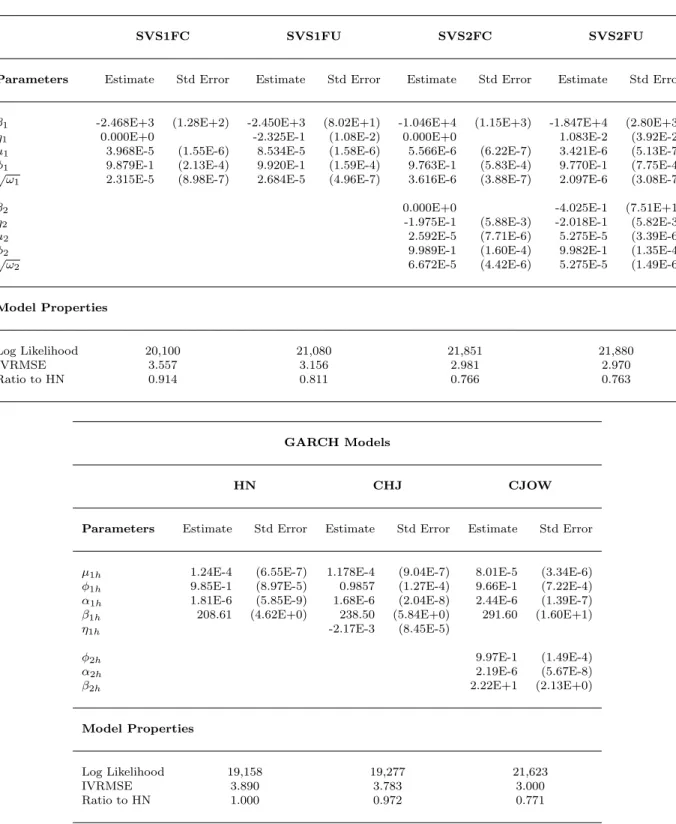
The top panel of Table 3 reports the results of the option-based estimation for SVS models, and the bottom panel reports the results of the GARCH alternative. All parameters are significantly estimated at the 1% level. Compared to historical parameters, the risk-neutral dynamics is more negatively skewed and the variance components are more persistent. These two findings are very common in the option-pricing literature. Higher negative skewness of the risk-neutral dynamics is reflected in higher negative values of βi and ηi estimates for SVS models, and a larger negative
value of βih estimates for GARCH models. For example, the estimated values of β1 and η1 for the SVS1FU model are, respectively, -2450 and -0.2325 for the risk-neutral dynamics in Table 3, compared to -500 and -0.00364 respectively for the historical dynamics in Panel A of Table 1. The persistence of the variance for the SVS1FU model is 0.9920 for the risk-neutral dynamics in Table 3 and 0.9824 for the historical dynamics in Panel A of Table 1. The risk-neutral variance is more persistent than the physical variance. Also, note that, for the SVS2FU model, both volatility components are now very persistent under the risk-neutral dynamics, with half-lives of 30 days for
the short-run component and 385 days for the long-run component, compared to 3 days and 81 days, respectively, under the historical dynamics.
The last three rows of each panel in Table 3 show the log likelihood, the IVRMSE metric of the models and their ratios relative to HN. The IVRMSE for the restricted one-factor SVS model, SVS1FC, outperforms its one-factor GARCH competitors, HN and CHJ. The IVRMSE for the SVS1FC model is 3.56%, compared with 3.89% and 3.78% for HN and CHJ, corresponding to an improvement of 9.38% and 6.35%, respectively. Moving to the unrestricted one-factor SVS model, SVS1FU, considerably reduces the pricing error and yields an impressive improvement of 23.26% and 19.85% over HN and CHJ, respectively. This result illustrates the superiority of our conditional skewness modeling approach over existing affine GARCH, since CHJ has the same number of parameters as the SVS1FU model, and more than the SVS1FC model. This result also highlights the clear benefit of allowing more negative skewness in the risk-neutral conditional distribution of returns.
Not surprisingly, the two-factor GARCH model (i.e., CJOW), with a RMSE of 3.00%, fits the option data better than the one-factor GARCH and SVS models combined. In fact, as pointed out by Christoffersen et al. (2008) and Christoffersen et al. (2009), a second volatility factor is needed to fit appropriately the term structure of risk-neutral conditional moments. Our restricted two-factor SVS model, SVS2FC, has a comparable fit to CJOW, with a RMSE of 2.98%. The performance of the unconstrained two-factor SVS model is almost similar to the constrained version, reflecting the fact that bothη1andβ2are not significantly estimated at the conventional 5% level. Option pricing thus seems to favor a risk-neutral distribution of stock prices that features a Gaussian as well as a negatively skewed shock; i.e., a discrete-time counterpart to a continuous-time jump-diffusion model.
Overall, the results of model estimation based on option data confirm the main conclusions from the GMM estimation based on returns in Section 4.3. Both conditional skewness in returns and a second volatility factor are necessary to reproduce the observed stylized facts, and disentangling the dynamics of conditional volatility from the dynamics of conditional skewness offers substantial improvement in fitting the distribution of asset prices.
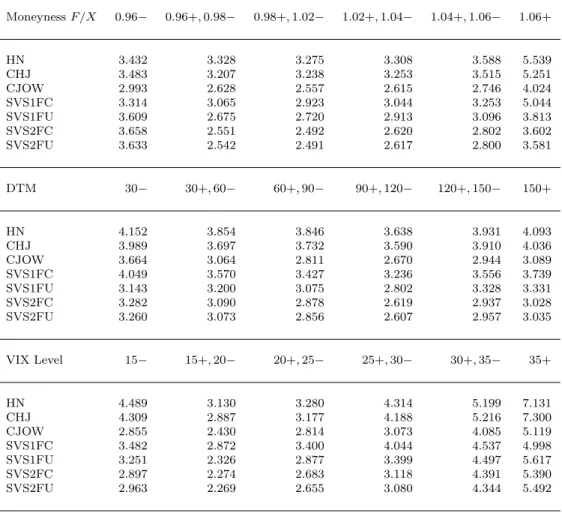
moneyness, maturity and VIX levels, using the bins from Table 2. The top panel of Table 4 reports the IVRMSE for the seven models by moneyness. We see that the two-factor models, with the lowest overall IVRMSE in Table 3, also have the lowest IVRMSE in each of the six moneyness categories. The benefits offered by the two-factor models are therefore not restricted to any particular subset of strike prices. Note that all models tend to perform worst for deep out-of-the-money put options (F/X > 1.06), also corresponding to the highest average implied volatility, as shown by the top panel of Table 2. For example, HN, CHJ and the SVS1FC model fit deep OTM options with IVRMSEs of 5.54%, 5.25% and 5.04%, respectively. With a fit of 4.02%, CJOW is outperformed by the SVS1FU, the SVS2FC and the SVS2FU models, which have fits of 3.81%, 3.60% and 3.58%, respectively.
For deep-in-the-money options (F/X < 0.96), CJOW has the best fit, an IVRMSE of 2.99%, compared to more than 3.31% for any other concurrent model. For all other moneyness categories, CJOW and the two-factor SVS models have comparable fits, the difference in their IVRMSEs being less than 0.10%. The performance of the SVS1FU model is very consistent across strikes as well, the best among the one-factor models. Thus, contrary to the historical dynamics of returns, contemporaneous asymmetry appears to be important in characterizing the risk-neutral dynamics, and the low IVRMSE of the SVS1FU model compared to the SVS1FC model across all categories demonstrates the impact of the significant and negative estimate ofη1 reported in Table 3.
The middle panel of Table 4 reports the IVRMSE across maturity categories. Again we see that all two-factor models have a comparable fit across all maturity categories, but the shortest maturity (DT M <30) where the two-factor SVS models perform better compared to CJOW. The SVS1FU model still outperforms any other one-factor competitor along the maturity dimension. While all models have relatively more difficulty fitting the shortest and the longest maturity compared to intermediate maturity options, our results show the superiority of the SVS over the GARCH regarding the shortest maturity options. With an IVRMSE of 3.14% for this category, the SVS1FU model provides the best SVS fit, while the best GARCH fit of 3.66% is due to CJOW.
The bottom panel of Table 4 reports the IVRMSE across VIX levels. The two-factor models provide the best fit across the six VIX categories, and the SVS1FU model remains the best one-factor fit along this dimension. All models have difficulty fitting options when the level of market
volatility is high (V IX ≥ 35%), since, for all models, the IVRMSE is the highest for these VIX levels.
To summarize, our option results show that, focusing on single-factor models, the empirical performance of the SVS is superior to that of affine GARCH models in fitting the risk-neutral distribution of asset prices inferred from option data. However, while the two-factor affine GARCH model is comparable to the two-factor SVS in the overall fit, results across different option categories are mixed.
6
Conclusion and Future Work
This paper presents a new approach for modeling conditional skewness in a discrete-time affine stochastic volatility model. The model explicitly allows returns to be asymmetric conditional on factors and past information. This contemporaneous asymmetry is shown to be particularly important for the model to fit option data. An empirical investigation suggests that the flexibility that the model offers for conditional skewness increases its option-pricing performance relative to existing affine GARCH models. In particular, the one-factor SVS model with contemporaneous asymmetry outperforms existing one-factor affine GARCH models across all option categories.
The paper also develops a methodology for estimating the historical distribution parameters of a multivariate latent-factor model that nests the proposed SVS as well as existing affine GARCH models. The setting allows for model comparison along the same statistics, the minimum distance between model-implied and actual sample return moments.
In future research, it would be interesting to study the implications of the model for a parsi-monious multiple-returns setting as well. An interesting exercise would be to look at “skewness transmission” among international stock markets.
References
Andersen, T. G., Chung, H. J., and Sorensen, B. E. (1999), “Efficient Method of Moments Es-timation of a Stochastic Volatility Model: A Monte Carlo Study,” Journal of Econometrics,
91, 61–87.
Barndorff-Nielsen, O. E., and Shephard, N. (2001), “Non-Gaussian Ornstein-Uhlenbeck-Based Models and Some of Their Uses in Financial Economics,” Journal Of The Royal Statistical Society Series B, 63 (2), 167–241.
Bates, D. S. (2006), “Maximum Likelihood Estimation of Latent Affine Processes,” Review of Financial Studies, 19 (3), 909–965.
Black, F. (1976), “Studies of Stock Price Volatility Changes,” inProceedings of the 1976 Meetings of the American Statistical Association, Business and Economic Statistics Section,pp. 177–181.
Christie, A. A. (1982), “The Stochastic Behavior of Common Stock Variances: Value, Leverage and Interest Rate Effects,” Journal of Financial Economics, 10 (4), 407–432.
Christoffersen, P., and Jacobs, K. (2004), “Which GARCH Model for Option Valuation?,” Man-agement Science,50 (9), 1204–1221.
Christoffersen, P., Heston, S., and Jacobs, K. (2006), “Option Valuation With Conditional Skew-ness,” Journal of Econometrics,131 (1-2), 253–284.
(2009), “The Shape and Term Structure of the Index Option Smirk: Why Multifactor Stochastic Volatility Models Work So Well,”Management Science, 55 (12), 1914–1932.
Christoffersen, P., Jacobs, K., Ornthanalai, C., and Wang, Y. (2008), “Option Valuation With Long-Run and Short-Run Volatility Components,”Journal of Financial Economics,90 (3), 272– 297.
Constantine, G. M., and Savits, T. H. (1996), “A Multivariate Fa`a di Bruno Formula with Appli-cations,” Transactions of the American Mathematical Society,348 (2), 503–520.
Danielsson, J. (1994), “Stochastic Volatility in Asset Prices Estimation with Simulated Maximum Likelihood,”Journal of Econometrics,64 (1-2), 375–400.
Darolles, S., Gourieroux, C., and Jasiak, J. (2006), “Structural Laplace Transform and Compound Autoregressive Models,”Journal of Time Series Analysis,27 (4), 477–503.
Feunou, B., Jahan-Parvar, M. R., and T´edongap, R. (2011), “Modeling Market Downside Volatil-ity,” Review of Finance, in press.
Forsberg, L., and Bollerslev, T. (2002), “Bridging the Gap Between the Distribution of Realized (ECU) Volatility and ARCH Modelling (of the Euro): the GARCH-NIG Model,” Journal of Applied Econometrics, 17 (5), 535–548.
Gourieroux, C., and Jasiak, J. (2006), “Autoregressive Gamma Processes,”Journal of Forecasting,
25 (2), 129–152.
Harvey, C. R., and Siddique, A. (1999), “Autoregressive Conditional Skewness,”Journal of Finan-cial and Quantitative Analysis, 34 (04), 465–487.
Heston, S. (1993), “A Closed-Form Solution for Options with Stochastic Volatility with Applications to Bond and Currency Options,” Review of Financial Studies,6 (2), 327–343.
Heston, S., and Nandi, S. (2000), “A Closed-Form GARCH Option Valuation Model,” Review of Financial Studies, 13 (3), 585–625.
Jacquier, E., Polson, N. G., and Rossi, P. E. (1994), “Bayesian Analysis of Stochastic Volatility Models,” Journal of Business & Economic Statistics,12 (4), 371–389.
Jensen, M. B., and Lunde, A. (2001), “The NIG-S&ARCH Model: A Fat-Tailed, Stochastic, and Autoregressive Conditional Heteroskedastic Volatility Model,”Econometrics Journal,4 (2), 319– 342.
Jiang, G. J., and Knight, J. L. (2002), “Estimation of Continuous-Time Processes via the Empirical Characteristic Function,” Journal of Business & Economic Statistics, 20 (2), 198–212.
Le, A., Singleton, K. J., and Dai, Q. (2010), “Discrete-Time Affine Term Structure Models with Generalized Market Prices of Risk,” Review of Financial Studies,23 (5), 2184–2227.
Liesenfeld, R., and Jung, R. C. (2000), “Stochastic Volatility Models: Conditional Normality versus Heavy-Tailed Distributions,” Journal of Applied Econometrics,15 (2), 137–160.
Magnus, J., and Neudecker, H. (1988)Matrix Differential Calculus with Applications in Statistics and Econometrics, Chichester, U.K: Wiley Series in Probability and Statistics.
Renault, E. (1997)“Econometric Models of Option Pricing Errors,” inAdvances in Economics and Econometrics: Theory and Applications, Seventh World Congress, eds. D.M. Kreps and K.F. Wallis, Cambridge: Cambridge University Press, pp. 223-278.
Singleton, K. J. (2006) Empirical Dynamic Asset Pricing: Model Specification and Econometric Assessment, Princeton, NJ: Princeton University Press.
Autocorrelations of Squared Returns 20 40 60 80 100 120 0 0.05 0.1 0.15 0.2 0.25 0.3 0.35 0.4 0.45 j Co rr( r t 2 ,r t+ j 2 )
Cross-Correlations between Returns and Squared Returns
-60 -40 -20 0 20 40 60 -0.2 -0.15 -0.1 -0.05 0 0.05 0.1 0.15 j Co rr( r t ,r t+j 2 )
The figure shows the actual autocorrelations of squared returns,Corr rt2, r2t+j
, in the top graph, and the actual cross-correlations between returns and squared returns,Corr rt, rt2+j
, in the bottom graph, for the S&P500 equal-weighted index. The data are sampled at the daily frequency and cover the period from January 2, 1962 to December 31, 2010, for a total of 12,336 observations. The dashed and the dotted line represent the 95% confidence bounds of the correlation.
Autocorrelations of Squared Returns SVS GARCH 20 40 60 80 100 120 0 0.05 0.1 0.15 0.2 0.25 0.3 0.35 0.4 0.45 j C o rr (rt 2,r t+ j 2 ) Actual SVS1FU SVS1FC SVS2FU 20 40 60 80 100 120 0 0.05 0.1 0.15 0.2 0.25 0.3 0.35 0.4 0.45 j C o rr (rt 2,r t+ j 2 ) Actual CHJ HN CJOW
Cross-Correlations between Returns and Squared Returns
SVS GARCH 10 20 30 40 50 60 -0.16 -0.14 -0.12 -0.1 -0.08 -0.06 -0.04 -0.02 0 0.02 j C o rr (rt ,rt+ j 2 ) Actual SVS1FU SVS1FC SVS2FU 10 20 30 40 50 60 -0.16 -0.14 -0.12 -0.1 -0.08 -0.06 -0.04 -0.02 0 0.02 j C o rr (rt ,rt+ j 2 ) Actual CHJ HN CJOW
The figure shows the model-implied autocorrelations of squared returns, Corr rt2, r
2
t+j
, for SVS dynamics in the top left graph and for GARCH dynamics in the top right graph. It also shows the model-implied cross-correlation between returns and squared returns,Corr rt, rt2+j
, for SVS dynamics in the bottom left graph and for GARCH dynamics in the bottom right. Returns are those of the S&P500 equal-weighted index. The data are sampled at the daily frequency and cover the period from January 2, 1962 to December 31, 2010, for a total of 12,336 observations.
T able 1: Estimation Results on S&P500 Index Returns: F ull Sample The en tries of the table a re GMM parameter estimates and tests for v arious SVS a nd GAR CH mo dels, and for tw o differen t sets of momen t conditi o ns. The set of momen ts n E h r j t i , j = 1 to 4 o and n E h r 2rt 2 t+ j i , j = 1 to 126 o are used in estimations and tests in b oth panels, in addition to the set n E h rt r 2 t+ j i , j = 1 to 42 o in P anel A and its subset n E h rt r 2 t+ j i , j = 1 to 21 o in P anel B. Returns data are dail y and span the p erio d from Jan uary 2, 196 2 to Dec em b er 31, 2010, for a total of 12 ,3 36 observ ations. New ey-W est standard errors are giv en b elo w the estimates. The ro w “min” sho ws the GMM criterion, with the smaller n um b er b eing the b etter fit of the mo del. The ro w “LR-test” sho ws the GMM analogue of the LR-test where the n ull h yp othesis is the mo del SVS1F C for alternativ e SVS m o dels, and the mo del HN for alternativ e GAR CH mo de ls. The ro w “ p -v alue” sho ws the p -v alue of the asso ciated test. P anel A P anel B SVS Mo dels GAR CH Mo dels SVS Mo dels GAR CH Mo dels SVS1FU SVS1F C SVS2FU CHJ HN CJO W SVS1FU SVS1F C SVS2FU C HJ HN CJO W β1 -500.74 -437.62 -3762.95 β1 h 83.99 83.27 55.97 β1 -172.03 -188.43 -387.13 β1 h 54.83 51.75 86.09 171.98 180.48 1100.47 41.04 39.45 11.12 74.54 81.01 175.66 21.86 18.96 37.84 η1 -0.00364 0.01831 η1 h -0.00203 η1 0.00231 0.00620 η1 h -0.00177 0.00201 0.00913 0.00069 0.00135 0.00820 0.00058 µ1 4.42E-5 4.79E-5 4.84E-6 µ1 h 8.47E-5 8.01E-5 µ1 6.97E-5 6.91E-5 2.55E-5 µ1 h 1.02E-4 1.02E-4 2.41E-5 2.29E-5 2.18E-6 1.27E-5 1.12E-5 2.47E-5 2.41E-5 1.92E-5 2.58E-5 2.57E-5 φ1 0.98235 0.97985 0.99148 φ1 h 0.98232 0.98457 0.80466 φ1 0.94577 0.95304 0.99204 φ1 h 0.94410 0.94536 0.86644 0.00862 0.08997 0.00247 0.00862 0.00694 0.05614 0.01725 0.01592 0.00257 0.01733 0.01706 0.03339 √ω 1 6.80E-5 7.21E-5 1.28E-5 α1 h 1.08E-5 1.07E-5 3.86E-5 √ ω1 1.02E-4 9.93E-5 7.48E-5 α1 h 2.41E-5 2.52E-5 2.66E-5 3.07E-5 2.90E-5 5.93E-6 5.05E-6 4.75E-6 1.60E-5 3.90E-5 3.87E-5 3.20E-5 8.74E-6 8.89E-6 1.32E-5 β2 -276.48 β2 h 169.28 β2 -3919.86 β2 h 59.17 156.32 58.83 1910.53 20.77 η2 0.02844 η2 h η2 0.01730 η2 h 0.03300 0.00877 µ2 5.69E-6 µ2 h 6.68E-5 µ2 7.50E-7 µ2 h 6.74E-5 4.29E-7 9.48E-6 1.77E-7 1.07E-5 φ2 0.81028 φ2 h 0.99193 φ2 0.87020 φ2 h 0.99245 0.06583 0.00227 0.03584 0.00238 √ω 2 2.73E-5 α2 h 4.11E-6 √ ω2 2.87E-6 α2 h 6.51E-6 1.70E-6 1.39E-6 8.81E-7 1.59E-6 min 46.23 46.77 32.27 min 46.35 52.94 37.74 min 33.39 33.77 20.95 min 33.31 40.91 26.71 LR-test 0.54 14.50 LR-test 6.59 15.20 LR-test 0.38 12.82 LR-test 7.59 14.20 p -v alue 0.46 0.02 p -v alue 0.01 0.00 p -v alue 0. 54 0.05 p -v alue 0.01 0.00
Table 2: S&P500 Index Option Data
We use Wednesday closing out-of-the-money (OTM) call and put option data from OptionMetrics from January 1, 1996 through December 31, 2004.F denotes the implied futures price of the S&P500 index,Xdenotes the strike price and DTM denotes the number of calendar days to maturity. The average bid-ask spread is reported in dollars.
MoneynessF/X 0.96− 0.96+,0.98− 0.98+,1.02− 1.02+,1.04− 1.04+,1.06− 1.06+ All
Nb Contracts 1,162 961 3,294 1,325 951 2,445 10,138 Avg Price 17.41 22.37 30.59 25.55 22.13 17.51 23.69 Avg Implied Vol 19.63 18.71 19.50 21.23 22.22 25.73 21.42 Avg Bid-Ask Spread 1.187 1.378 1.572 1.400 1.298 1.154 1.361
DTM 30− 30+,60− 60+,90− 90+,120− 120+,150− 150+ All
Nb Contracts 695 3,476 2,551 1,063 1,332 1,021 10,138 Avg Price 12.11 17.97 24.47 27.51 31.20 35.36 23.69 Avg Implied Vol 20.69 21.04 21.62 21.86 21.75 21.87 21.42 Avg Bid-Ask Spread 0.830 1.184 1.452 1.539 1.588 1.610 1.361
VIX Level 15− 15+,20− 20+,25− 25+,30− 30+,35− 35+ All
Nb Contracts 625 2,844 3,873 1,621 781 394 10,138 Avg Price 14.10 16.49 25.22 30.28 29.61 37.10 23.69 Avg Implied Vol 13.83 17.35 21.38 25.26 28.76 33.06 21.42 Avg Bid-Ask Spread 0.958 1.014 1.397 1.694 1.743 2.007 1.361
Table 3: Estimation Results on S&P500 Index Options: SVS and GARCH Models
We estimate the four SVS and the three GARCH models using option data for the period January 1, 1996 to December 31, 2004. Standard errors, computed using the outer product of the gradient, are indicated in parentheses.
SVS Models
SVS1FC SVS1FU SVS2FC SVS2FU
Parameters Estimate Std Error Estimate Std Error Estimate Std Error Estimate Std Error
β1 -2.468E+3 (1.28E+2) -2.450E+3 (8.02E+1) -1.046E+4 (1.15E+3) -1.847E+4 (2.80E+3)
η1 0.000E+0 -2.325E-1 (1.08E-2) 0.000E+0 1.083E-2 (3.92E-2)
µ1 3.968E-5 (1.55E-6) 8.534E-5 (1.58E-6) 5.566E-6 (6.22E-7) 3.421E-6 (5.13E-7)
φ1 9.879E-1 (2.13E-4) 9.920E-1 (1.59E-4) 9.763E-1 (5.83E-4) 9.770E-1 (7.75E-4)
√
ω1 2.315E-5 (8.98E-7) 2.684E-5 (4.96E-7) 3.616E-6 (3.88E-7) 2.097E-6 (3.08E-7)
β2 0.000E+0 -4.025E-1 (7.51E+1)
η2 -1.975E-1 (5.88E-3) -2.018E-1 (5.82E-3)
µ2 2.592E-5 (7.71E-6) 5.275E-5 (3.39E-6)
φ2 9.989E-1 (1.60E-4) 9.982E-1 (1.35E-4)
√
ω2 6.672E-5 (4.42E-6) 5.275E-5 (1.49E-6)
Model Properties Log Likelihood 20,100 21,080 21,851 21,880 IVRMSE 3.557 3.156 2.981 2.970 Ratio to HN 0.914 0.811 0.766 0.763 GARCH Models HN CHJ CJOW
Parameters Estimate Std Error Estimate Std Error Estimate Std Error
µ1h 1.24E-4 (6.55E-7) 1.178E-4 (9.04E-7) 8.01E-5 (3.34E-6)
φ1h 9.85E-1 (8.97E-5) 0.9857 (1.27E-4) 9.66E-1 (7.22E-4)
α1h 1.81E-6 (5.85E-9) 1.68E-6 (2.04E-8) 2.44E-6 (1.39E-7)
β1h 208.61 (4.62E+0) 238.50 (5.84E+0) 291.60 (1.60E+1)
η1h -2.17E-3 (8.45E-5) φ2h 9.97E-1 (1.49E-4) α2h 2.19E-6 (5.67E-8) β2h 2.22E+1 (2.13E+0) Model Properties Log Likelihood 19,158 19,277 21,623 IVRMSE 3.890 3.783 3.000 Ratio to HN 1.000 0.972 0.771
Table 4: IVRMSE Option Error by Moneyness, Maturity and VIX Level
We use Wednesday closing out-of-the-money (OTM) call and put option data from OptionMetrics from January 1, 1996 through December 31, 2004.F denotes the implied futures price of the S&P500 index,Xdenotes the strike price and DTM denotes the number of calendar days to maturity. We report IVRMSE from the models estimated in Table 3 by moneyness, maturity and VIX level. MoneynessF /X 0.96− 0.96+,0.98− 0.98+,1.02− 1.02+,1.04− 1.04+,1.06− 1.06+ HN 3.432 3.328 3.275 3.308 3.588 5.539 CHJ 3.483 3.207 3.238 3.253 3.515 5.251 CJOW 2.993 2.628 2.557 2.615 2.746 4.024 SVS1FC 3.314 3.065 2.923 3.044 3.253 5.044 SVS1FU 3.609 2.675 2.720 2.913 3.096 3.813 SVS2FC 3.658 2.551 2.492 2.620 2.802 3.602 SVS2FU 3.633 2.542 2.491 2.617 2.800 3.581 DTM 30− 30+,60− 60+,90− 90+,120− 120+,150− 150+ HN 4.152 3.854 3.846 3.638 3.931 4.093 CHJ 3.989 3.697 3.732 3.590 3.910 4.036 CJOW 3.664 3.064 2.811 2.670 2.944 3.089 SVS1FC 4.049 3.570 3.427 3.236 3.556 3.739 SVS1FU 3.143 3.200 3.075 2.802 3.328 3.331 SVS2FC 3.282 3.090 2.878 2.619 2.937 3.028 SVS2FU 3.260 3.073 2.856 2.607 2.957 3.035 VIX Level 15− 15+,20− 20+,25− 25+,30− 30+,35− 35+ HN 4.489 3.130 3.280 4.314 5.199 7.131 CHJ 4.309 2.887 3.177 4.188 5.216 7.300 CJOW 2.855 2.430 2.814 3.073 4.085 5.119 SVS1FC 3.482 2.872 3.400 4.044 4.537 4.998 SVS1FU 3.251 2.326 2.877 3.399 4.497 5.617 SVS2FC 2.897 2.274 2.683 3.118 4.391 5.390 SVS2FU 2.963 2.269 2.655 3.080 4.344 5.492