The Toronto Mindfulness Scale:
Development and Validation
䊲
Mark A. Lau
Centre for Addiction and Mental Health and the University of Toronto
䊲
Scott R. Bishop
University of Toronto䊲
Zindel V. Segal
Centre for Addiction and Mental Health and the University of Toronto
䊲
Tom Buis
Centre for Addiction and Mental Health, Toronto
䊲
Nicole D. Anderson
Baycrest Centre for Geriatric Care and the University of Toronto
䊲
Linda Carlson
Tom Baker Cancer Centre and the University of Calgary
䊲
Shauna Shapiro
Santa Clara University䊲
James Carmody
University of Massachusetts Medical School
We are grateful to Miriam Aziz and Trixie Reichardt for data collection and analysis. This work was supported by a grant provided by Canadian Institutes of Health Research (CIHR# 49612) awarded to the second author. Correspondence concerning this article should be addressed to: Mark A. Lau, Centre for Addiction and Mental Health, 250 College Street, Toronto, Ontario, M5T 1R8, Canada; e-mail: [email protected]
JOURNAL OF CLINICAL PSYCHOLOGY, Vol. 62(12), 1445–1467 (2006) © 2006 Wiley Periodicals, Inc. Published online in Wiley InterScience (www.interscience.wiley.com). DOI: 10.1002/jclp.20326
䊲
Susan Abbey
University Health Network and the University of Toronto
䊲
Gerald Devins
University Health Network and the University of Toronto
In this study, the authors both developed and validated a self-report mind-fulness measure, the Toronto Mindmind-fulness Scale (TMS). In Study 1, partici-pants were individuals with and without meditation experience. Results showed good internal consistency and two factors, Curiosity and Decen-tering. Most of the expected relationships with other constructs were as expected. The TMS scores increased with increasing mindfulness medita-tion experience. In Study 2, criterion and incremental validity of the TMS were investigated on a group of individuals participating in 8-week mindfulness-based stress reduction programs. Results showed that TMS scores increased following treatment, and Decentering scores predicted improvements in clinical outcome. Thus, the TMS is a promising measure of the mindfulness state with good psychometric properties and predic-tive of treatment outcome. © 2006 Wiley Periodicals, Inc. J Clin Psychol 62: 1445–1467, 2006.
Keywords: Toronto Mindfulness Scale; self-report assessment; mindfulness; meditation; psychometric characteristics
Mindfulness training is increasingly being used as a clinical intervention for a variety of problematic conditions. Salmon, Santorelli, and Kabat-Zinn (1998) documented that there were more than 240 programs using mindfulness-based interventions, a number that no doubt has increased. Mindfulness-based stress reduction (MBSR; Kabat-Zinn, 1990) and mindfulness-based cognitive therapy (MBCT; Segal, Williams, & Teasdale, 2002) are among the more widely practiced treatments designed to cultivate mindfulness skills primarily through formal meditation practices. Furthermore, dialectical behavior therapy (DBT; Linehan, 1993) and acceptance and commitment therapy (ACT; Hayes, Strosahl, & Wilson, 1999) advocate the development of mindfulness largely through the practice of behavioral skills. Finally, theoretical rationales have been proposed for integrating mindfulness training into the treatment of other clinical syndromes such as generalized anxiety disorder (e.g., Roemer & Orsillo, 2002), posttraumatic stress disorder (Wolfsdorf & Zlotnick, 2001), and substance abuse (Breslin, Zack, & McMain, 2002; Marlatt, 2002). Although there has been considerable variability in terms of methodological rigor in clinical trials (for reviews see Baer, 2003; Bishop, 2002; Grossman, Niemann, Schmidt, & Walach, 2004), mindfulness-based interventions appear to lead to substantial reduc-tions in a variety of medical and psychological condireduc-tions. For example, symptoms of chronic pain (Kabat-Zinn, Lipworth, & Burney, 1985), stress (Shapiro, Schwartz, & Bon-ner, 1998), panic disorder (Kabat-Zinn et al., 1992), depressive relapse (Teasdale et al., 2000), disordered eating (Kristeller & Hallett, 1999), and suicidal behavior (Linehan,
Armstrong, Saurez, Allmon, & Heard, 1991) have all been shown to decrease following implementation of mindfulness-based interventions. Despite the encouraging outcome results, whether these treatments lead to increased mindfulness and whether increased mindfulness mediates mindfulness-based treatment outcomes has yet to be systemati-cally investigated. Until recently, this has been due, in large part, to the lack of an oper-ational definition of mindfulness.
Broadly conceptualized, mindfulness has been described as a elaborative, non-judgmental, present-centered awareness in which each thought, feeling, or sensation that arises in the attentional field is acknowledged and accepted as it is (Kabat-Zinn, 1990; Shapiro & Schwartz, 1999; Segal et al., 2002). The goal of mindfulness in clinical set-tings is twofold: First, to increase insight into how automatic, habitual patterns of over-identification and cognitive reactivity to sensations, thoughts, and emotions increase stress and emotional distress; second, to reduce the vulnerability to these mind states, thereby producing lasting improvements in emotional well-being (Linehan, 1994; Teasdale, 1999). This mental training is achieved through becoming skillful in the practice of mindfulness meditation (e.g., Germer, 2005; Kabat-Zinn, 1990, 1994, 1998; Segal et al., 2002; Sha-piro & Swartz, 1999, 2000). However, the insufficiently operationalized definitions have presented an important research challenge in evaluating mindfulness programs referred to above (Bishop, 2002).
Recently, a number of self-report mindfulness measures have been developed, includ-ing the Cognitive and Affective Mindfulness Scale (CAMS; Feldman, Hayes, Kumar, & Greeson, 2004), the Freiburg Mindfulness Inventory (FMI; Buchheld, Grossman, & Walach, 2001), the Kentucky Inventory of Mindfulness Skills (KIMS; Baer, Smith, & Allen, 2004), the Mindful Attention Awareness Scale (MAAS; Brown & Ryan, 2003), and the Mind-fulness Questionnaire (MQ; Chadwick, Hember, Mead, Lilley, & Dagnan, 2005). In addi-tion, The Revised Cognitive and Affective Mindfulness Scale (CAMS-R; Feldman, Hayes, Kumar, Kamholz, Greeson, & Laurenceau, 2005) and the Philadelphia Mindfulness Scale (PHLMS; Cardaciotto & Hebert, 2005) are under development. Interestingly, all these measures were originally designed to assess mindfulness as a trait-like quality that is manifest as a general tendency to be mindful in daily life.
Alternatively, mindfulness can be viewed as a mode, or state-like quality, that is maintained only when attention to experience is intentionally cultivated with an open, nonjudgmental orientation to experience (Bishop et al., 2004). Specifically, the proposed two-component mindfulness definition was (a) the intentional self-regulation of attention to facilitate greater awareness of bodily sensations, thoughts, and emotions; and (b) a specific quality of attention characterized by endeavoring to connect with each object in one’s awareness (e.g., each bodily sensation, thought, or emotion) with curiosity, accep-tance, and openness to experience. Such a state involves an active process of relating openly with one’s current experience by allowing current thoughts, feelings, and sensa-tions (Hayes et al., 1999). Based on this definition, the next step was to develop a scale that could assess the subjective experience of a mindfulness state retrospectively in ref-erence to mindfulness meditation techniques designed to evoke the mindfulness state. This retrospective method has been demonstrated to increase reliability and validity, and to minimize error attributable to memory bias (Ericsson & Simon, 1980; Klinger, 1978; Singer & Kolligian, 1987).
Furthermore, Bishop et al. (2004) proposed that mindfulness is distinct from other forms of self-focused attention such as anxious preoccupation or rumination that, con-trary to the goals of mindfulness-based treatments, have been shown to exacerbate dis-tress and maintain psychopathology (e.g., Nolen-Hoeksema, 1991; Pyszczynski & Greenberg, 1987; Trapnell & Campbell, 1999). This model defines mindfulness as an
intentional, reflective style of introspection or self-observation that, in addition, differs from concentrative meditation (Smith, 1975). Concentrative practices involve maintain-ing one’s attention on a smaintain-ingle focus of awareness such as a smaintain-ingle word or phrase, a candle flame, or even one’s own breathing (e.g., transcendental meditation, clinically standardized meditation). Although mindfulness, or insight meditation, also includes some concentrative practices, the focus of attention is unrestricted such that the meditator devel-ops an awareness of one’s present experience, including thoughts, feelings, or physical sensations as they consciously occur on a moment-by-moment basis.
Based on this definition, we investigated relationships between the Toronto Mind-fulness Scale (TMS) and several measures of attention and awareness to evaluate the construct validity of the TMS. As far as mindfulness is thought to reflect a self-regulated awareness of bodily sensations, thoughts, and feelings, the construct appears to be con-ceptually similar to situational self-awareness, defined as an awareness of both internal states (thoughts and feelings) and an awareness of one’s surroundings (SSAS; Buss, 1980). Mindfulness appears to share some overlap with absorption, which is defined as the ability to maintain a state of attentional involvement on current experience and is typically measured using the Tellegen Absorption Scale (TAS; Tellegen & Atkinson, 1974). However, the TAS also assesses the tendency to think in images and to experience altered states of consciousness (Tellegen, 1982). Thus, mindfulness is expected to over-lap to a modest degree with absorption. Mindfulness further seems to reflect the polar opposite of inattentiveness or absentmindedness that might result in cognitive failures (e.g., attention drifting while reading, forgetting why one chose to move from one part of his or her house to the other). Finally, although mindfulness involves the self-regulation of attention, it appears to be distinct from other forms of attention control, most notably dissociation, which involves altered states of consciousness such as feelings of merger or depersonalization along with a lack of awareness of one’s own experience (Putnam, 1985). We thus predicted that the TMS would be positively correlated with situational self-awareness, negatively correlated with cognitive failures, and independent of dissociation.
Mindfulness is further defined by a style of self-focused, nonelaborative attention characterized by experiential openness, curiosity, and acceptance. Mindfulness thus appears to be related more to intentional states of self-reflectiveness (a curious, decentered style of introspection) than to involuntary states of rumination (RRQ; Trapnell & Campbell, 1999) or self-consciousness (SSAS-Self-Consciousness; Buss, 1980), which are distinct styles of self-focused attention. Mindfulness also appears to be related to openness to experience, which refers to receptivity to feelings, intellectual curiosity, and a willing-ness to have new experiences (NEO-FFI; McCrae & Costa, 1985). Mindfulwilling-ness would not appear to share much overlap with psychological mindedness, which refers to the ability to reflect upon and understand the meanings and motivations for one’s thoughts, feelings, and behaviors (Conte, Ratto, & Karasu, 1996). Thus, we predicted that the TMS would be positively correlated with measures of reflectiveness and openness to experi-ence and unrelated to ruminative self-focused attention, self-consciousness, and psycho-logical mindedness. Finally, we would expect that these qualities are also unrelated to socially desirable responding. Thus, the second goal of this study was to investigate whether mindfulness shares qualities with other constructs involving a reflective style of self-focused attention and experiential openness, and is distinct from anxiously preoccu-pied or ruminative forms of self-focused attention.
Furthermore, Bishop et al. (2004) proposed that mindfulness is similar to a skill that can be developed with practice; developing the skills through meditation practice is thus thought to allow one to choose a mindfulness state more often. We predicted that
respondents with greater experience in mindfulness meditation would score higher on the TMS than those with less experience in mindfulness meditation. Finally, be-cause increased mindfulness is thought to improve clinical outcomes (Kabat-Zinn, 1994), we predicted that increases in TMS scores from pre- to postparticipation in an MBSR program would be associated with reduced stress and mood disturbances.
In sum, the development of the TMS represents an initial step in a line of research evaluating mindfulness as a mechanism underlying the efficacy of mindfulness-based treatments. In this article, we describe the development of the TMS and two studies that were designed to determine the psychometric properties of the instrument. Study 1 inves-tigates internal consistency, factor structure, relationships with other constructs, and criterion-related validity. Study 2 further examines the criterion-related, and incremental validity, of the TMS for a group of individuals who participated in an 8-week mindfulness-based treatment.
Development of the Toronto Mindfulness Scale Candidate Items
Forty-two statements were derived to reflect the operational definition of mindfulness developed by our consensus team (Bishop et al., 2004), and judged by the researchers of those meetings to be consistent with the conceptual model. These included items reflect-ing the subjective aspects of attentional self-regulation and a quality of nonelaborative attention characterized by curiosity, acceptance, and openness to experience with all items referring to an immediately preceding meditation session. The TMS instructions asked participants to reflect on an immediately preceding meditation session and to indicate the degree to which each of the 42 statements described what they just experienced on a 5-point scale from 0 (not at all) to 4 (very much).1
Study 1: Internal Consistency, Factor Structure, Construct, and Criterion Validity Method
Participants and procedure.Three-hundred ninety participants consisting of 176 men and 214 women with a mean age of 40.8 years (SD⫽13.3) were recruited for this study. Participants with no mindfulness meditation experience were recruited through news-paper advertisements (n⫽134) and among a group of people registered (but not partici-pating) in a mindfulness meditation training retreat (n⫽24). These participants were carefully screened to ensure that they had no previous experience with any form of med-itation (including yoga, tai chi, and qi-gong). Participants (n⫽232) with various levels of experience in mindfulness meditation were recruited from a variety of settings. Expe-rience was defined as having at least 8 weeks of expeExpe-rience in the daily practice of mindfulness meditation.2We recruited from the following settings: (a) a local Buddhist meditation center, (b) experienced practitioners registered for a mindfulness meditation retreat, (c) MBSR clinicians trained in mindfulness techniques, (d) a nonclinical sample of participants who recently completed an 8-week mindfulness-based stress reduction
1The instructions were as follows: “We are interested in what you just experienced. Below is a list of things that people sometimes experience. Please read each statement. Next to each statement are five choices: “not at all,” “a little,” “moderately,” “quite a bit” and “very much.” Please indicate the extent to which you agree with each statement. In other words, how well does the statement describe what you just experienced?”
2Because mindfulness-based treatments are typically 8 weeks in duration, we reasoned that this would be a conservative estimate of the amount of practice in the techniques required to acquire the skills to evoke mindfulness.
program offered through a local community center, and (e) newspaper advertisements ask-ing for volunteers with experience in mindfulness meditation. The range of mindfulness
med-itation experience was 2–360 months (mode⫽6 months). There were no significant
differences in terms of age between the meditators and nonmeditators (p⬎.05), and the ratio of men to women was similar across the two inexperienced and experienced groups. Participants, tested in groups of 5 to 25, were seated in chairs or on meditation cushions according to their preference, and given the following instructions: “For the next 15 minutes, please pay attention to your breathing and anything that might arise during your experience.” No other instructions were given. Maintaining awareness on the breath and noting sensations, thoughts, and feelings that arise is a basic mindfulness meditation technique. Thus, it was expected that asking experienced meditators to be aware of their breath in this manner would be sufficient to evoke a state of mindfulness. For those inexperienced in mindfulness techniques, we would not expect a mindfulness state to be evoked. After 15 minutes, participants completed the TMS in reference to what they were aware of experiencing during that period. To assess construct validity, a subset of 165 research participants completed the battery of self-report measures described below following completion of the TMS. Participants were paid $20 for their time.
Measures
The Tellegen Absorption Scale (TAS; Tellegen, 1982) was used to measure absorption. This scale consists of 34 true–false items. Internal consistency coefficient alpha is 0.88 and it correlates with several variables such as the ability to be hypnotized and imagery (Roche & McConkey, 1990).
The Situational Self-Awareness Scale (SSAS; Govern & Marsch, 2001) was used to measure situational self-awareness. This 9-item scale yields three subscales re-flecting private self-awareness or internal state awareness (e.g., “Right now, I am con-scious of my inner feelings”;a⫽0.70), public self-awareness or self-consciousness (e.g.,
“Right now, I am self-conscious about the way I look”; a⫽ 0.82) and awareness of
immediate surroundings (e.g., “Right now, I am keenly aware of everything in my envi-ronment”;a⫽0.72). The measure is sensitive to changes in self-awareness over time and across situations (i.e., laboratory manipulations to increase self-awareness).
The Cognitive Failures Questionnaire (CFQ; Broadbent, Cooper, FitzGerald, & Parkes 1982) was used as the measure of cognitive failures. This 25-item scale measures the propensity to experience failures in cognition and behavior due to inattention. Internal consistency coefficient alpha is 0.79.
The Dissociative Experiences Scale (DES; Bernstein & Putnam, 1986) was used to measure dissociative experiences. This 28-item instrument assesses the frequency with which individuals experience a variety symptoms of dissociation, defined as “a lack of normal integration of thoughts, feelings, and experiences into the stream of conscious-ness and memory” (Bernstein & Putnam, 1986, p. 727). Internal consistency coefficient alpha is 0.60 and the scale has been shown to discriminate between those with and with-out dissociative-spectrum disorders.
The NEO-Five Factor Inventory (NEO-FFI; Costa & McCrae, 1992) Openness sub-scale was administered to evaluate openness to experience. This is a 12-item subsub-scale that measures openness to feelings and new experiences~a⫽0.87).
The Psychological Mindedness Scale (PMS; Conte et al., 1990) was used to measure psychological mindedness, defined as a “person’s ability to see relationships among thoughts, feelings, and actions, with the goal of learning the meanings and causes of his
experiences and behavior” (Applebaum, 1973, p. 36). This 45-item scale measures, for example, access to one’s feelings, interest in the relations between feelings and behavior and motivation for change. Internal consistency coefficient alpha is 0.84.
The Rumination-Reflection Questionnaire (RRQ; Trapnell & Campbell, 1999) was administered to measure style of self-focused attention. This 24-item scale measures two orthogonal styles of self-observation: rumination (e.g., “I tend to “ruminate” or dwell over things that happened to me for a really long time afterward”;a⫽0.90) and reflec-tion (e.g., “My attitudes and feelings about things fascinate me”;a⫽0.91).
The Marlow-Crowne Social Desirability Scale (Crowne & Marlowe, 1960) was used to measure socially desirable responding. This 33-item inventory assesses the tendency to present oneself in a socially desirable manner. Internal consistency coefficient alpha is .88.
Internal Consistency
Sixteen of the original 390 participants were identified and removed as multivariate outliers with endorsement patterns that could be considered markedly atypical, such as endorsing every item with either a 0 or a 4. Six of the 42 candidate items with extreme skewness and kurtosis were removed from the pool of candidate items. We proceeded to examine the correlations among the remaining 36 candidate items and computed relia-bility estimates based on the responses of the 374 individuals. One item was removed due to its comparatively low item-total correlation (r⫽.28). The remaining 35 items showed high internal consistency, with an alpha coefficient of .95 and an average item-total cor-relation ofr⫽.53. The item content of the deleted items was general in scope, and there was no clear evidence of redundancy in meaning among the remaining items based on magnitude of interitem correlations or face validity.
Exploratory Factor Analysis
Participants.We used random sampling to split the remaining 374 individuals into Sample 1 (n ⫽174) for the exploratory factor analysis (EFA), and Sample 2 for the confirmatory factor analysis (CFA;n⫽200). In Sample 1, the mean age was 41.2 years (SD⫽13.6) and 54% were women. Meditation experience ranged from no experience to 17 years (M⫽3.4,SD⫽4.6). The sample size of 174 cases was considered to be suffi-cient for the EFA (MacCallum, Widaman, Zhang, & Hong, 1999) based on the initial pool of 35 test items with moderate-sized prior communalities (M⫽0.49,SE⫽0.02).
Using Sample 1, responses to the 35 candidate TMS items were subjected to EFA using squared multiple correlations for prior communalities. The method of maximum likelihood (ML) extraction method was used, followed by an oblimin (oblique) rotation to allow for correlation between the factors. No restriction was applied to the number of factors to be estimated, and the ML method was used to make use of goodness of fit indices not available with other extraction methods (Fabrigar, Duane, MacCallum, & Strahan, 1999).
Results and Discussion
The initial run resulted in a three-factor solution, but the scree plot provided evidence for a two-factor solution, and 20 items either failed to load substantially on one factor (i.e., factor loading less than .40), or loaded strongly on two or more factors. We deleted these
20 items and attempted to derive a new solution based on the remaining 15 items. The second run resulted in a clear two-factor solution based on an examination of the scree plot and preliminary eigenvalues. The first and second factors accounted for about 66% and 29%, respectively, of the explainable variance. The solution converged in four iter-ations with simple structure, a Kaiser’s measure of sampling adequacy of .86 and a Tucker and Lewis reliability coefficient of .91, indicating that this two-factor model demon-strated a good fit to the data. The factors themselves were correlated (r⫽ .26), and because the average interitem correlations for each factor are substantially larger than the interfactor correlation, we have some initial support for the discriminant validity of a two-factor TMS (Clark & Watson, 1995). The TMS items and their factor loadings, along with reliability estimates are presented in Table 1.
Factor 1 is labeledCuriosityas the items loading on this factor all reflect awareness of present moment experience with a quality of curiosity. Factor 2 is labeledDecentering as the items loading on this factor emphasize awareness of one’s experience with some distance and disidentification rather then being carried away by one’s thoughts and feel-ings and is conceptually similar to decentering as defined by Teasdale et al. (2002).
Table 1
Exploratory Factor Analysis (EFA) Results: Factor Loadings and Reliability Estimates
Factor loadings Toronto Mindfulness Scale (TMS) items:
Original item number and content 1 2
17: I was curious about my reactions to things. .83 ⫺.13 32: I was curious about what I might learn about myself by taking notice of how I react
to certain thoughts, feelings or sensations. .78 ⫺.12 26: I was curious to see what my mind was up to from moment to moment. .73 .10 06: I was curious about each of the thoughts and feelings that I was having. .71 ⫺.09 39: I remained curious about the nature of each experience as it arose. .70 .23 41: I was curious about what I might learn about myself by just taking notice of what
my attention gets drawn to. .70 .13
29: I noticed subtle changes in my mood. .46 .08
34: I was more invested in just watching my experiences as they arose, than in figuring
out what they could mean. ⫺.09 .82
33: I was more concerned with being open to my experiences than controlling or
changing them. .08 .71
37: I was receptive to observing unpleasant thoughts and feelings without interfering
with them. ⫺.07 .70
42: I approached each experience by trying to accept it, no matter whether it was
pleasant or unpleasant. .01 .67
20: I was open to taking notice of anything that might come up. .10 .55
40: I was aware of my thoughts and feelings without over-identifying them. ⫺.01 .53
35: I experienced my thoughts more as events in my mind than as a necessarily
accurate reflection of the way things ‘really’ are. ⫺.04 .52
36: I experienced myself as separate from my changing thoughts and feelings. .09 .49
Scale reliability estimates F1 F2
Coefficient alpha .88 .84
Mean interitem correlations .50 .39
Standard deviation of interitem correlations .10 .10
Percentage of explained variance 66 29
Confirmatory Factor Analysis
Participants.We used data based on the 200 remaining cases from the second ran-domly sampled data set to conduct a CFA using the CALIS procedure in SAS (SAS Institute, Inc., 1989) with the maximum likelihood estimation method. A CFA with two-factors would have 31 estimated parameters, and this would require a minimum of 155 cases (5 times the number of parameters) making the sample size of 200 adequate for this procedure. The mean age of the participants in this sample was 42.5 years (SD⫽13.1) and 56% were women. Meditation experience ranged from no experience to 17 years (M⫽3.6,SD⫽4.7). There were no age or sex differences between the two samples.
Results and Discussion
The CFA was used to test the fit between the EFA-derived factors and items in an inde-pendent sample. We found mixed support for the proposed two-factor model. All esti-mated parameters were statistically significant and at least of moderate size. Residuals were symmetrical but with a few extreme values, and this lack of fit was reflected in the modest values for fit indices. It became clear after a systematic review of residuals, covariance matrices, and modification indices that two items (i.e., TMS20 from Factor 1 and TMS29 from Factor 2) were multidimensional, loading across factors and covarying more strongly than predicted with at least half of the items from the other factor. Instead of modifying the model by adding two parameters, we reestimated a simplified version of the two-factor model by removing these two items. We acknowledge a susceptibility to chance characteristics of the CFA sample driving this decision (MacCallum, Roznowski, & Necowitz, 1992). However, given that this modification served to simplify the model rather than add to its complexity, and that the two items in question also were not strong performers in the EFA independent sample, we felt justified in refitting this simpler model, which would retain more than enough items per scale at six and seven, respectively. The chi-square test fit criterion for the modified CFA model was significant,x2(64)⫽ 138.24,p ⬍ .0001, but with a magnitude of just over twice the number of degrees of freedom, meeting a general threshold for goodness of fit (Hatcher, 1994). Other ML fit indices provided support for the model, notably Bentler’s Comparative Fit Index (CFI; Bentler, 1990) and Bentler and Bonett’s Non-normed Index (NNFI; Bentler & Bonett, 1980) with values of .94 and .92, respectively. These indices reflect goodness of fit as they exceed .90, and approach a value of 1.00; hence, they are less likely to be influenced by sample size (Marsh, Balla, & McDonald, 1988).
Factor loadings were both statistically significant and at least moderately large in magnitude, ranging from .56 to .82, indicating that items converged meaningfully onto the scales as predicted. Normalized residuals were symmetric but contained extreme values. Further modification was ruled out, however, to guard against too heavy a reli-ance on the unique structure of this sample for conclusions about the TMS subscales.
Scale reliability was assessed in several ways. Item variance, indicated by the squared correlation between matched items and factors, ranged from .32 to .67. The proportion of item-level variance to measurement error was .57 and .27 for Curiosity and Decentering, respectively. Reliability estimates of the composites, analogous to a coefficient alpha for internal consistency for the scales, were .86 and .87.
The discriminant validity of the two-factor model was also assessed. A chi-square difference test, which compares the difference between the current two-factor model and one in which the interfactor correlation parameter is fixed to 1, was statistically signifi-cant, x2(1)⫽ .349.74, p ⬍ .0001, indicating that a unidimensional model would be
clearly inferior to the current two-factor model. The 95% confidence interval for the interfactor correlation (r⫽.42) did not include a value of 1 (.28ⱕCI.95ⱕ.56) providing further support for two distinct but related latent constructs. The final set of TMS items with factor loadings and reliability estimates are presented in Table 2.
Correlations Between the Toronto Mindfulness Scale and Other Constructs
Participants. The subset of 165 research participants who received the additional measures described above were part of the larger sample randomly divided into two sets for the main analyses. The mean age of the participants in this subsample was 42.1 years (SD⫽13.3) and 52.7% were women. Meditation experience ranged from no experience to 15 years (M⫽2.9,SD⫽5.7). There were no age or sex differences between this and the two main samples.
Results and Discussion
In Table 3, we provide a summary of correlates with the subscale scores for Curiosity and Decentering. Both the Curiosity and Decentering subscales were significantly and positively
Table 2
Confirmatory Factor Analysis: Factor Loadings and Reliability Estimates
TMS Factors and item numbers
Standardized
loading tTesta Item reliability
Curiosity 17 .77 8.31 .59 32 .76 8.38 .58 26 .77 8.23 .60 06 .62 9.25 .38 39 .77 8.20 .60 41 .82 7.53 .67 Decentering 34 .76 7.93 .57 33 .72 8.35 .52 37 .59 9.19 .34 42 .78 7.62 .61 40 .63 8.97 .40 35 .69 8.64 .47 36 .56 9.28 .32 Curiosity Decentering
Composite Reliability Indexb .93 .91
Variance Extracted Indexc .89 .59
Correlation between factors (95% CI)d .42, CI(95)⫽.28 to .56
Note. TMS⫽Toronto Mindfulness Scale.
aConvergent validity is demonstrated because allttests for associated factor loadings are significant atp⬍.001 (i.e., all items are measuring same construct).bMeasures the internal consistency by factor, analogous to a coefficient alpha.cMeasures the amount of item variance associated with the underlying factor relative to measurement error. Discriminant validity is demonstrated because each value exceeds the square of the interfactor correlation (.18).dDiscriminant validity is demonstrated because the value 1.0 (complete construct overlap) is outside the confidence interval.
correlated with absorption, and awareness of one’s surroundings; however, only Curios-ity was significantly correlated with awareness of internal states (thoughts and feelings). The two subscales did not correlate significantly with dissociation. Cognitive failures correlated negatively with Decentering but were not significantly correlated with Curi-osity. Thus, the pattern of findings generally confirms that the TMS is measuring a height-ened focus of attention to internal states and to a lesser degree one’s environment.
Furthermore, both Curiosity and Decentering were significantly and positively cor-related with reflective self-awareness and psychological mindedness. Interestingly, only the Decentering subscale was positively correlated with openness to experience, which reflects an open attitude towards one’s experience. The two subscales did not correlate significantly with ruminative self-focused attention, self-consciousness, and social desir-ability, although there was a significant positive correlation of Curiosity with self-consciousness. This pattern of findings suggests that the TMS is measuring a reflective, introspective self-awareness that is distinct from ruminative styles of self-focused atten-tion or self-consciousness. Moreover, given the weakness of the significant correlaatten-tions, the results of the correlation analyses support the discriminant validity of the TMS in relation to the other constructs.
Finally, to further examine the criterion validity of the TMS, we investigated whether or not the TMS scales would change with increased meditation experience. This infor-mation was available for 223 research participants, 130 and 92 men and women, respec-tively (one case was missing gender information), with an average age of 39.73 years (SE⫽0.90). Meditation type was categorized as mindfulness meditation (i.e., MBSR) or meditation in the Shambhala Buddhist tradition (Trungpa, 1988), and duration of meditation
Table 3
Relationships Between the Toronto Mindfulness Scale (TMS) and Other Measures in Sample 2 (n⫽200)
Measures Construct Curiosity Decentering
TAS Absorption .31*** .22**
SSAS Internal State Awareness .41*** .15 SSAS Awareness of Surroundings .16* .21**
CFQ Cognitive Failures .06 ⫺.16*
RRQ Reflective Self-Awareness .23** .42*** NEO-PI-R Openness to Experience .09 .23** PMS Psychological Mindedness .22** .19*
SSAS Self-Consciousness .31*** ⫺.13
DES Dissociation .06 ⫺.04
RRQ Ruminative Self-Awareness .06 ⫺.19
MC Social Desirability .04 .13
Note. TAS: Absorption⫽Tellegen Absorption Scale; SSAS: Internal State Awareness⫽Private subscale from the Situational Self-Awareness Scale; SSAS: Awareness of Surroundings⫽ Sur-roundings subscale from the Situational Self-Awareness Scale; CFQ: Cognitive Failures⫽ Cog-nitive Failures Questionnaire; RRQ: Reflective Self-Awareness⫽Reflection subscale of the Rumination-Reflection Questionnaire; NEO-PI-R: Openness to Experience⫽Openness subscale of the NEO-PI-R; PMS: Psychological Mindedness⫽Psychological Mindedness Scale; SSAS: Self-Consciousness⫽Public subscale from the Situational Self-Awareness Scale; DES: Dissoci-ation⫽Dissociative Experience Scale; RRQ: Ruminative Self-Awareness⫽Rumination subscale of the Rumination-Reflection Questionnaire and MC: Social Desirability⫽Marlow-Crowne Social Desirability Scale.
experience was categorized as less versus more than one year. Of the 43 participants practicing mindfulness meditation, 20 had less than one year and 23 had more than one year of experience, and of the remaining 180 participants, 79 had less than a year and 101 had more than one year of experience. There were no significant differences in age or sex among the research participants.
We conducted a 2⫻2 between subjects MANOVA on the Curious and Decentering
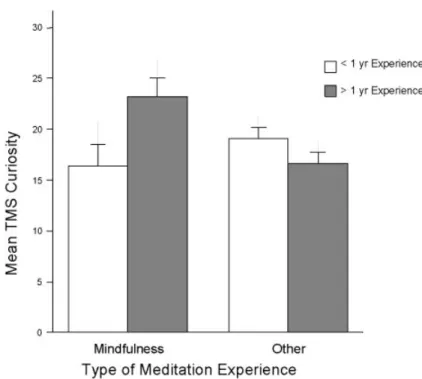
scores with type (MBSR, Shambhala) and experience (⬍1 year,⬎1 year) as indepen-dent variables, adjusting for the nonorthogonality between the TMS scales. We entered the scales in the same order as they were defined in the factor analyses (i.e., Curious then Decentering). There was a significant Type⫻Experience interaction effect,F(2, 218)⫽ 3.73, p⫽.025. To investigate the interaction effect on individual TMS scales, we per-formed a Roy–Bargmann stepdown analysis (Bock & Haggard, 1968). The stepdown analysis analyzed Curiosity in the first step followed by Decentering in the second step with Curiosity treated as a covariate. A unique contribution to explaining the joint differ-ences in type and experience was made by the TMS Curiosity subscale, Stepdown F(1, 219)⫽7.31,p⫽.007, but not TMS Decentering. A simple effects analysis showed that the Type⫻Experience interaction for TMS Curiosity was true for mindfulness prac-titioners only: Those with more than 1 year of experience scored significantly higher on TMS Curiosity than those with less than 1 year of experience (p⫽.027).
A main multivariate effect was observed for experience,F(2, 218)⫽12.75,p⬍.001 and investigated using a Roy–Bargmann stepdown analysis (Bock & Haggard, 1968) on the dependent measures in priority with Curiosity followed by Decentering. The TMS Curiosity subscale was found to be unrelated to the amount of meditation experience as a main effect, but after covarying the effects of Curiosity, the TMS Decentering scores were found to be significantly higher for research participants with greater meditation
experience, Stepdown F(1, 218)⫽25.27, p ⬍ .001. Both mindfulness and Shambhala
meditators with more than one year of experience scored higher on TMS Decentering (M⫽27.10,SE⫽0.80) than those with less than one year of experience (M⫽21.75, SE⫽0.71), with means adjusted for the effects of Curiosity used as a covariate (see Table 4).
In sum, mindfulness meditation experience was related to increased Curiosity scores (see Figure 1). In addition, both mindfulness and Shambhala meditators with greater experience demonstrated increased Decentering scores (see Figure 2).
Table 4
Mean Toronto Mindfulness Scale (TMS) Curiosity and Decentering by Amount and Type of Meditation
⬍1 year experience ⬎1 year experience
Type of meditation M SD n M SD n TMS Curiosity Mindfulness 16.42 9.42 20 23.26 8.54 23 Shambhala 19.09 9.81 79 16.67 10.68 101 TMS Decentering Mindfulness 23.29 7.81 20 28.70 7.74 23 Shambhala 21.43 7.77 79 26.69 8.37 101
Figure 1. Mean Toronto Mindfulness Scale–Curiosity (plus standard error) by type and amount of meditation experience (N⫽223).
Figure 2. Mean Toronto Mindfulness Scale–Decentering (plus standard error) by amount of meditation expe-rience (N⫽223).
Study 2: Criterion and Incremental Validity—Sensitivity to Treatment and Prediction of Treatment Outcome
In Study 2, we examined the validity of the TMS by studying samples of patients par-ticipating in mindfulness-based stress reduction (MBSR) programs. If the measure taps mindfulness as a state as hypothesized, and if the instrument is to be useful in research, it is necessary to demonstrate that the TMS is sensitive to change. Because MBSR was developed to assist patients in developing the capacity for mindfulness, their mindfulness scores on the TMS would be expected to increase from pre- to posttreatment. Study 2 was also undertaken to evaluate the incremental validity of the TMS over pretreatment levels of stress and symptoms in the prediction of stress and symptom levels at posttreatment. Increased mindfulness is thought to improve clinical outcomes (Kabat-Zinn, 1994). Thus, we hypothesized that increases in TMS scores from pretreatment to posttreatment would be associated with reduced stress and mood disturbances.
Method
Participants. Ninety-nine participants were recruited from MBSR programs offered at the University of Massachusetts Medical School (UMMS) in Worcester, Massachusetts (n⫽75), and the Department of Psychosocial Oncology at the Tom Baker Cancer Centre (TBCC) in Calgary, Alberta, Canada (n⫽24). Patients at UMMS had a range of condi-tions including general stress, anxiety disorder or primary depression, chronic pain dis-order, diabetes, and multiple sclerosis. Patients at the TBCC consisted of patients with various cancer malignancies at all stages of illness (localized to metastatic). The data sets from the two settings were combined into a single sample. The mean age of the sample was 46.68 years (SD⫽13.32) with a range of 19 to 79 years. Women made up 67.5% of the sample.
Interventions
The 8-week MBSR program at UMMS followed the original manualized treatment devel-oped by Kabat-Zinn (1984) and Kabat-Zinn et al. (1990). This program has been shown to be associated with general reductions in stress, anxiety, and depression in medical patients (e.g., Kabat-Zinn et al., 1985; Kabat-Zinn, Lipworth, Burney, & Sellers, 1987; Miller, Fletcher, & Kabat-Zinn, 1995). The treatment manual used at TBCC was based on the UMMS manual, but with modifications for cancer patients. The main modifications related to educational content (e.g., applying the skills to cope with cancer-related stress). A recent randomized controlled trial has demonstrated that the TBCC MBSR program significantly reduces stress and mood symptoms in cancer patients (Carlson, Ursuliak, Goodey, Angen, & Speca, 2001; Speca, Carlson, Goodey, & Angen, 2000). Both pro-grams provided patients with training in various mindfulness meditation skills (e.g., body scan, sitting meditation, gentle yoga).
Measures
In addition to the TMS, the Perceived Stress Scale (PSS; Cohen, Kamarck, & Mermel-stein, 1983) was used as a measure of subjective stress. Using the present sample, the coefficient alpha was .88.
The Brief Symptom Inventory (BSI; Derogatis, 1993) was used as a measure of psychopathology. This 53-item measure provides subscale scores of psychiatric symptoms
and a composite score reflecting total level of psychological distress. The coefficient alpha for the BSI using this sample was .96.
Procedure
Participants were tested on two separate occasions, pre- and post-MBSR. Pretreatment testing occurred during an orientation session preceding the first treatment session. Post-treatment testing occurred immediately following the last session (participants stayed after the session ended). The procedures were identical at each testing period. Partici-pants were first instructed to engage in a mindfulness meditation technique (sitting med-itation), and asked to practice it for 15 minutes. Participants immediately completed the TMS and then the battery of outcome measures.
Results and Discussion
Change in clinical outcome measures and TMS scores.We examined changes in the clinical outcome measures from pre- to post-MBSR using pairedt tests. All measures indicated a trend to wellness from pretreatment to posttreatment. The PSS and BSI scores decreased significantly and TMS Curiosity and Decentering subscales increased signifi-cantly (see Table 5).
TMS scores and clinical outcome.To test the incremental validity of the TMS, we used increases in Curiosity and Decentering scores as predictors for clinical outcome measures in a hierarchical linear regression analysis controlling for pretreatment clinical outcome scores.
Post-treatment BSI scores were treated as the dependent measure predicted by their associated pretreatment scores in the first step and in the second and third steps by resid-ualized change scores for Curiosity and Decentering. After partialling out variance in posttreatment BSI associated with pretreatment BSI, the remaining variance was predict-able by increases in TMS Decentering~rp⫽ ⫺.22) but not TMS Curiosity. A similar result was found for outcome PSS scores using the same hierarchical linear regression procedure. Increases in TMS Curiosity were not associated with lowered PSS scores, but increases in TMS Decentering did in fact predict lower PSS scores at post-treatment partialrp⫽ ⫺.36 (see Table 6).
Table 5
Pretreatment and Posttreatment BSI, PSS, TMS Curiosity and Decentering (N⫽99)
M SD
Pre- Post- Pre- Post- t d
PSS 31.58 23.59 8.21 6.88 ⫺10.73*** 1.05
BSI 1.11 0.61 0.66 0.51 ⫺9.81*** 0.85
TMS Curiosity 19.46 23.37 9.74 8.88 3.41** 0.42
TMS Decentering 19.15 24.01 8.41 7.91 5.07*** 0.60
Note. PSS⫽Perceived Stress Scale, BSI⫽Brief Symptom Inventory. **p⬍.01. ***p⬍.001,
General Discussion
The goal of this research was to develop and validate a self-report instrument measuring the capacity to invoke a mindfulness state. Results indicated that the TMS demonstrated high internal consistency. A two-factor structure (Curiosity, Decentering) was found in the initial sample and subsequently confirmed in a second sample. The relationships between the two TMS factors and other constructs were largely as expected. Mindfulness scores were positively but only weakly correlated with psychological constructs that included assessments of awareness, openness to experience, and curiosity about one’s current experience. Conversely, mindfulness appears to be distinct from anxiously pre-occupied or ruminative forms of self-focused attention. The criterion validity of the TMS was supported by demonstrating higher scores on both factors for participants after an 8-week MBSR group and in individuals with greater than one year versus less than one year of mindfulness meditation experience. Furthermore, Decentering showed incremen-tal validity in the prediction of psychological distress.
At a descriptive level, the two factors of this empirically derived model are consis-tent with the second factor of a two-component mindfulness offered by Bishop et al. (2004), that is, an attentional quality characterized by a curious, open, accepting aware-ness of experience including bodily sensations, thoughts, or emotions. The items of Fac-tor 1 (Curiosity) reflect an attitude of wanting to learn more about one’s experiences. The items of Factor 2 (Decentering) reflect a shift from identifying personally with thoughts
Table 6
Summary of Hierarchical Regression Analysis for Toronto Mindfulness Scale (TMS) Predicting Clinical Outcome (N⫽99)
Variable B SEb b Posttreatment PSSa Step 1 Pretreatment PSS .444 .072 .529*** Step 2 Pretreatment PSS .447 .072 .533*** Change in TMS Curiosity ⫺.081 .069 ⫺.102 Step 3 Pretreatment PSS .437 .068 .521*** Change in TMS Curiosity .132 .086 .165 Change in TMS Decentering ⫺.371 .098 ⫺.404*** Posttreatment BSIb Step 1 Pre-treatment BSI .517 .057 .675*** Step 2 Pre-treatment BSI .529 .057 .691*** Change in TMS Curiosity ⫺.007 .004 ⫺.123 Step 3 Pre-treatment BSI .517 .056 .675*** Change in TMS Curiosity .001 .006 .021 Change in TMS Decentering ⫺.015 .007 ⫺.215*
Note. PSS⫽Perceived Stress Scale; BSI⫽Brief Symptom Inventory.
aFor Posttreatment PSS: R2⫽.280 for Step 1;DR2⫽.010 for Step 2 (p⫽ns);DR2⫽.092 for Step 3 (p⬍.001).bFor Posttreatment BSI: R2⫽.456 for Step1 (p⬍.001);DR2⫽.015 for Step 2 (p⫽ns);DR2⫽.026 for Step 3 (p⫽.03).
and feelings to relating to one’s experience in a wider field of awareness (Teasdale et al., 2002). However, our results did not provide support for the first component of Bishop et al.’s definition, that is, the active self-regulation of attention to immediate experience. The lack of support for the first component does not appear to be due to the lack of items reflecting attentional self-regulation in the original item pool (e.g., “I was paying atten-tion to the ‘here and now’ ”; “I was aware of what my mind was doing from moment to moment”; “I purposefully paid attention to each experience for the sake of seeing what I could learn about myself”). One possibility is that attentional self-regulation and the quality of that attention cannot be easily separated by self-report measures in that one cannot be curious, open or accepting about experiences that one has not brought their attention to. In support of this notion, the CAMS (Feldman et al., 2004) represents four factors (Attention, Awareness, Present-Focus, and Acceptance/Nonjudgment) that load on a single mindfulness factor. Similarly, the FMI (Buchheld et al., 2001) assesses non-judgmental, open observation of present-moment experience that is best interpreted unidimensionally.
The findings of this study support a conceptualization of mindfulness that has at least two factors. In contrast, four currently available mindfulness questionnaires (e.g., MAAS, FMI, CAMS, and MQ) are comprised of just one factor. It is important to highlight, however, that the original form of the MAAS (Brown & Ryan, 2004) initially had an acceptance factor that was dropped as it demonstrated no incremental validity in predict-ing criterion measures. Furthermore, both the 12-item CAMS (Feldman et al., 2004) and the 30-item FMI (Buchheld et al., 2001) had four factors that were scored as a single factor due to weak psychometric properties of the four scales for each measure. More-over, Baer, Smith, Hopkins, Krietemeyer, and Toney (2006) support the notion of mind-fulness as a multifaceted construct in a recent investigation of the factor structure of mindfulness using items from these three mindfulness questionnaires along with the KIMS (Baer et al., 2004) and the MQ (Chadwick et al., 2005). Given that the various mindful-ness questionnaires have been designed from different operational definitions and have been validated on a range of student and clinical samples, further research is required to investigate how the TMS relates to other mindfulness questionnaires and to better under-stand the nature of the construct.
The finding that Curiosity scores were associated with greater meditation experience among individuals trained in MBSR versus those that practiced Shambhala Buddhist meditation may provide further criterion related validity for the TMS. This finding is consistent with important differences in the instructional set associated with these two meditation practices. Non-secular mindfulness practice as typically taught in a clinical context encourages one to “investigate your distractions” (Rosenberg, 1998, pp. 170– 171), whereas in the Shambhala tradition one practices, in part, to gain greater degrees of concentration and attentional focus. When distractions do arise, practitioners are discour-aged from taking an active investigative interest in the nature of their thoughts, feelings, or sensations, and urged to return to the primary focus of attention (Dunn, Hartigan, & Mikulas, 1999; Goldstein, 2002).
Only the Decentering subscale showed incremental validity in the prediction of per-ceived stress and distress. The concept of decentering has previously been recognized as playing a central role underlying the efficacy of cognitive therapy (CT; Beck, Rush, Shaw, & Emory, 1979; Ingram & Holllon, 1986). A shift in one’s cognitive perspective known asdecenteringordisidentificationis thought to lead to a change in one’s relation-ship to negative thoughts and feelings such that one can see negative thoughts and feel-ings simply as passing events in the mind rather than reflections of reality. If changes in Decentering scores can be shown to precede changes in criterion measures, the TMS may
prove useful in investigations of the mediating role of mindfulness in observed outcomes and in efforts to understand the psychological processes by which mindfulness reduces general stress and emotional distress levels. At 13 items, the TMS is brief (it typically requires only 3 minutes to complete the scale itself, see Appendix) and can be incorpo-rated into mindfulness-based treatments with minimal intrusiveness or response burden. There are a number of limitations to this study that need to be considered. First, the initial 15-item TMS was modified by deleting two items to improve the fit in the valida-tion sample. Although we recognize that the findings that influenced our decision may have been due to the characteristics specific to the CFA sample, this one modification served to simplify the model (MacCallum et al., 1992). Although we felt justified in refitting this simpler model, evaluation with independent samples is required to further validate the 13-item TMS.
Second, although the procedure of assessing the subjective experience of mindfulness retrospectively in reference to an immediately preceding mindfulness meditation session increases the reliability of the measure, the results obtained may not be generalizable across mindfulness meditation sessions nor to mindfulness in everyday life. The TMS assesses the level of mindfulness during a single point in time and thus may not reflect a respondent’s true or average capacity to evoke a state of mindfulness. Multiple testing periods should yield an indication of the ability to evoke a mindfulness state. In terms of using the TMS in eval-uation research, we recommend multiple assessments of mindfulness at pre-, mid- and post-treatment to ensure reliable estimates of the respondent’s ability to cultivate a state of mindfulness. This is because participants in meditation-based treatments may develop the capacity to evoke mindfulness generally, but may fail to do so effectively on a given testing session (e.g., at posttest for idiosyncratic reasons such as fatigue or extreme stress), result-ing in misleadresult-ing TMS scores. Further research is required to establish whether the ability to invoke a mindful state during meditation practice as measured by the TMS generalizes to the degree of mindfulness in everyday life.
Third, the frequency and duration of meditation sessions were not assessed for the experienced meditators. Thus, it is possible that there were significant variations in the practice level within this group. For example, four-year follow-up examinations of the practice behavior among individuals who completed MBSR programs at the Univer-sity of Massachusetts have shown that many people who claim to formally meditate actually meditated less than once weekly for prolonged intervals or less than 3 times weekly for less than 15 minutes per session (Kabat-Zinn, Lipworth, Burney, & Sellers, 1987). Future research should include efforts to better characterize an individual’s med-itation practice.
In summary, our findings show that the TMS is a reliable and valid measure of mindfulness and depicts the latter as a state of curious, decentered awareness of one’s experience that is operationally and conceptually distinct from anxiously preoccupied and ruminative states of self-focused attention. Thus, the TMS may be a useful instru-ment in investigations of the mediating role of mindful awareness in mindfulness-based interventions and observed patient outcomes.
References
Applebaum, S. A. (1973). Psychological mindedness: Word, concept and essence. International Journal of Psychoanalysis, 54, 35– 46.
Baer, R. A. (2003). Mindfulness training as a clinical intervention: A conceptual and empirical review. Clinical Psychology: Science and Practice, 10, 125–142.
Baer, R. A., Smith, G. T., & Allen, K. B. (2004). Assessment of mindfulness by self-report: The Kentucky Inventory of Mindfulness Skills. Assessment, 11, 191–206.
Baer, R. A., Smith, G. T., Hopkins, J., Krietemeyer, J., & Toney, L. (2006). Using self-report assessment methods to explore facets of mindfulness. Assessment, 13, 27– 45.
Beck, A. T., Rush, A. J., Shaw, B. F., & Emery, G. (1979). Cognitive therapy of depression. New York: Guilford Press.
Bentler, P. M. (1990). Comparative fit indexes in structural models. Psychological Bulletin, 107(2), 238–246.
Bentler, P. M., & Bonett, D. G. (1980). Significance tests and goodness of fit in the analysis of covariance structures. Psychological Bulletin, 88, 588– 606.
Bernstein, E. M., & Putnam, F. W. (1986). Development, reliability, and validity of a dissociation scale. Journal of Nervous and Mental Disease, 174, 727–735.
Bishop, S., Lau, M., Shapiro, S., Carlson, L., Anderson, N., Carmody, J., et al. (2004). Mindfulness: A proposed operational definition. Clinical Psychology: Science and Practice, 11, 230–241. Bishop, S. R. (2002). What do we really know about mindfulness-based stress reduction?
Psycho-somatic Medicine, 64, 71–83.
Bock, R. D., & Haggard, E. A. (1968). The use of multivariate analysis of variance in behavioral research. In D. K. Whitla (Ed.), Handbook of Measurement and Assessment in Behavioral Sciences. Reading, MA: Addison-Wesley.
Breslin, F. C., Zack, M., & McMain, S. (2002). An information-processing analysis of mindfulness: Implications for relapse prevention in the treatment of substance abuse. Clinical Psychology: Science and Practice, 9, 275–299.
Broadbent, D. E., Cooper, P. F., FitzGerald, P., & Parkes, K. R. (1982). The Cognitive Failures Questionnaire (CFQ) and its correlates. British Journal of Clinical Psychology, 21(Pt. 1), 1–16.
Brown, K. W., & Ryan, R. M. (2003). The benefits of beings present: Mindfulness and its role in psychological well-being. Journal of Personality and Social Psychology, 84, 822–848. Buchheld, N., Grossman, P., & Walach, H. (2001). Measuring mindfulness in insight meditation
(Vipassana) and meditation-based psychotherapy: The development of the Freiberg Mindful-ness Inventory (FMI). Journal for Meditation and Meditation Research, 1, 11–34.
Buss, A. H. (1980). Self-consciousness and social anxiety. San Francisco: Freeman.
Cardaciotto, L., & Herbert, J. D. (2005, November). The development of a bi-dimensional measure of mindfulness: The Philadelphia Mindfulness Scale (PHLMS). Paper presented at the 39thAnnual Convention of the Association for Behavioral and Cognitive Therapies, Washington, DC. Carlson, L. E., Ursuliak, Z., Goodey, E., Angen, M., & Speca, M. (2001). The effects of a
mind-fulness meditation-based stress reduction program on mood and symptoms of stress in cancer outpatients: 6-month follow-up. Supportive Care in Cancer, 9, 112–123.
Chadwick, P., Hember, M., Mead, S., Lilley, B., & Dagnan, D. (2005). Responding mindfully to unpleasant thoughts and images: Reliability and validity of the Mindfulness Questionnaire. Unpublished manuscript, University of Southampton Royal South Hants Hospital, UK. Clark, L. A., & Watson, D. (1995). Constructing validity: Basic issues in objective scale
develop-ment. Psychological Assessment, 7, 309–319.
Cohen, S., Kamarck, T., & Mermelstein, R. (1983). A global measure of perceived stress. Journal of Health and Social Behavior, 24, 385–396.
Conte, H. R., Plutchik, R., Jung, B. B., Picard, S., Karasu, T. B., & Lotterman, A. (1990). Psycho-logical mindedness as a predictor of psychotherapy outcome: A preliminary report. Compre-hensive Psychiatry, 31, 426– 431.
Conte, H. R., Ratto, R., & Karasu, T. B. (1996). The psychological mindedness scale. Journal of Psychotherapy Practice and Research, 5, 250–259.
Costa, P. T., & McCrae, R. R. (1992). Revised NEO Personality Inventory (NEO PI-R) and NEO Five-Factor Inventory (NEO-FFI): Professional manual. Odessa: Psychological Assessment Resources, Inc.
Crowne, D. P., & Marlowe, D. (1960). A new scale of social desirability independent of psycho-pathology. Journal of Consulting Psychology, 24, 349–354.
Derogatis, L. R. (1993). BSI Brief Symptom Inventory. Administration, scoring, and procedures manual (4th ed.) Minneapolis: National Computer Systems.
Dunn, B. R., Hartigan, J. A., & Mikulas, W. (1999). Concentration and mindfulness meditations: Unique forms of consciousness? Applied Psychophysiology and Biofeedback, 24, 147–165. Ericsson, K. A., & Simon, H. A. (1980). Verbal reports as data. Psychological Review, 87, 215–251. Fabrigar, L. R., Duane, T. W., MacCallum, R. C., & Strahan, E. J. (1999). Evaluating the use of
factor analysis in Psychological Research. Psychological Methods, 4, 272–299.
Feldman, G. C., Hayes, A. M., Kumar, S. M., Greeson, J. M., & Laurenceau, J. P. (in press). Mindfulness and emotion regulation: The development and initial validation of the Cognitive and Affective Mindfulness Scale-Revised (CAMS-R). Journal of Psychopathology and Behav-ioral Assessment.
Feldman, G. C., Hayes, A. M., Kumar, S. M., Kamholz, B. W., Greeson, J. M., & Laurenceau, J. (2005, November). Assessing mindfulness in the context of emotion regulation: The Revised Cognitive and Affective Mindfulness Scale (CAMS-R). Paper presented at the 39th Annual Convention of the Association for Behavioral and Cognitive Therapies, Washington, DC. Germer, C. K. (2005). Mindfulness: What is it: What does it matter? In C. K. Germer, R. D. Siegel,
& P. R. Fulton (Eds.), Mindfulness and psychotherapy. New York: Guilford Press. Goldstein, J. (2002) One dharma: The emerging western Buddhism. San Fransisco: Harper. Govern, J. M., & Marsch, L. A. (2001). Development and validation of the situational
self-awareness scale. Consciousness and Cognition, 10, 366–378.
Grossman, P., Niemann, L., Schmidt, S., & Walach, H. (2004). Mindfulness-based stress reduction and health benefits: A meta-analysis. Journal of Psychosomatic Research, 57, 35– 43. Hatcher, L. (1994). A step-by-step approach to using SAS for factor analysis and structural
equa-tion modeling. Cary, NC: SAS Institute, Inc.
Hayes, S. C., Strosahl, K. D., & Wilson, K. G. (1999). Acceptance and commitment therapy. New York: Guilford Press.
Ingram, R. E., & Hollon, S. D. (1986). Cognitive therapy of depression from an information pro-cessing perspective. In R. E. Ingram (Ed.), Information propro-cessing approaches to clinical psychology (pp. 259–281). San Diego: Academic Press.
Kabat-Zinn, J. (1984). An outpatient program in behavioral medicine for chronic pain patients based in the practice of mindfulness meditation: Theoretical considerations and preliminary results. General Hospital Psychiatry, 4, 33– 47.
Kabat-Zinn, J. (1990). Full catastrophe living: Using the wisdom of your body and mind to face stress, pain, and illness. New York: Dell Publishing.
Kabat-Zinn, J. (1994). Wherever you go, there you are: Mindfulness meditation in everyday life. New York: Hyperion.
Kabat-Zinn, J. (1998). Meditation. In J. C. Holland (Ed.), Psycho-oncology (pp. 767–779). New York: Oxford University Press.
Kabat-Zinn, J., Lipworth, L., & Burney, R. (1985). The clinical use of mindfulness meditation for the self-regulation of chronic pain. Journal of Behavioral Medicine, 8, 163–190.
Kabat-Zinn, J., Lipworth, L., Burney, R., & Sellers, W. (1987). Four-year follow-up of a meditation-based program for the self-regulation of chronic pain: Treatment outcomes and compliance. Clinical Journal of Pain, 2, 159–173.
Kabat-Zinn, J., Massion, M. D., Kristeller, J., Peterson, L. G., Fletcher, K. E., Pbert, L., et al. (1992). Effectiveness of a meditation-based stress reduction program in the treatment of anx-iety disorders. American Journal of Psychiatry, 149, 936–943.
Klinger, E. (1978). Modes of normal conscious flow. In K. S. Pope & J. L. Singer (Eds.), The stream of consciousness: Scientific investigations into the flow of human experience (pp. 225– 258). New York: Wiley.
Kristeller, J. L., & Hallett, B. (1999). Effects of a meditation-based intervention in the treatment of binge eating. Journal of Health Psychology, 4, 357–363.
Linehan, M. M. (1993). Cognitive–behavioral treatment of borderline personality disorder. New York: Guilford Press.
Linehan, M. M. (1994). Acceptance and change: The central dialectic in psychotherapy. In S. C. Hayes, N. S. Jacobson, V. M. Follette, & M. J. Dougher (Eds.), Acceptance and change: Content and context in psychotherapy (pp. 73–86). Reno, NV: Context Press.
Linehan, M. M., Armstrong, H. E., Suarez, A., Allmon, D., & Heard, H. L. (1991). Cognitive– behavioral treatment of chronically parasuicidal borderline patients. Archives of General Psy-chiatry, 48, 1060–1064.
MacCallum, R. C., Roznowski, M., & Necowitz, L. B. (1992). Model modifications in co-variance structure analysis: the problem of capitalization on chance. Psychological Bulletin, 111, 490–504.
MacCallum, R. C., Widaman, K. F., Zhang, S., & Hong, S. (1999). Sample size in factor analysis. Psychological Methods, 4, 231–251.
Marlatt, G. A. (2002). Buddhist philosophy and the treatment of addictive behavior. Cognitive and Behavioral Practice, 9, 42–50.
Marsh, H. W., Balla, J. R., & McDonald, R. P. (1988). Goodness of fit indexes in confirmatory factor analysis: The effect of sample size. Psychological Bulletin, 103, 391– 410.
McCrae, R. R., & Costa, P. T. (1985). Openness to experience. In R. Hogan & W. H. Jones (Eds.), Perspectives in personality (pp. 145–172). Greenwich, CT: JAI Press.
Miller, J. J., Fletcher, K., & Kabat-Zinn, J. (1995). Three-year follow-up and clinical implications of a mindfulness meditation-based stress reduction intervention in the treatment of anxiety dis-orders. General Hospital Psychiatry, 17, 192–200.
Nolen-Hoeksema, S. (1991). Responses to depression and their effects on the duration of depres-sive episodes. Journal of Abnormal Psychology, 100, 569–582.
Putnam, F. W. (1985). Dissociation as a response to extreme trauma. In R. P. Kluft (Ed.), Childhood antecedents of multiple personality (pp. 65–97). Washington DC: American Psychiatric Press. Pyszczynski, T., & Greenberg, J. (1987). Self-regulatory perseveration and the depressive self-focusing style: A self-awareness theory of reactive depression. Psychological Bulletin, 102, 122–138.
Roche, S. M., & KcConkey, K. M. (1990). Absorption: Nature, assessment, and correlates. Journal of Personality and Social Psychology, 59, 91–101.
Roemer, L., & Orsillo, S. M. (2002). Expanding our conceptualization of a treatment for general-ized anxiety disorder: Integrating mindfulness/acceptance-based approaches with existing cognitive–behavioral models. Clinical Psychology Science and Practice, 9, 54– 68.
Rosenberg, L. (1998). Breath by breath: The liberating practice of insight meditation. Boston: Shambhala Publications, Inc.
Salmon, P. G., Santorelli, S. F., & Kabat-Zinn, J. (1998). Intervention elements in promoting adher-ence to mindfulness-based stress reduction programs in the clinical behavioral medicine set-ting. In S. A. Shumaker, E. B. Schron, J. K. Ockene, & W. L. Bee (Eds.), Handbook of health behavior change (2nd ed., pp. 239–268). New York: Springer.
SAS Institute, Inc. (1998). SAS/STAT user’s guide (Version 7-1) [Computer software]. Cary, NC: Author.
Segal, Z. V., Williams, J. M. G., & Teasdale, J. D. (2002). Mindfulness-based cognitive therapy for depression: A new approach to preventing relapse. New York: Guilford Press.
Shapiro, S., & Schwartz, G. (1999). Intentional systemic mindfulness: An integrative model for self-regulation and health. Advances in Mind-Body Medicine, 15, 128–134.
Shapiro, S. L., & Schwartz, G. E. (2000). The role of intention in self-regulation: Toward inten-tional systemic mindfulness. In M. Boekaerts, P. R. Pintrich, & M. Zeidner (Eds.), Handbook of self-regulation (pp. 253–273). New York: Academic Press.
Shapiro, S. L., Schwartz, G. E., & Bonner, G. (1998). Effects of mindfulness-based stress reduction on medical or premedical students. Journal of Behavioral Medicine, 21, 581–599.
Singer, J. L., & Kolligian, J., Jr. (1987). Personality: Developments in the study of private experi-ence. Annual Review of Psychology, 38, 533–574.
Smith, J. C. (1975). Meditation as psychotherapy: A review of the literature. Psychological Bulle-tin, 82, 558–564.
Speca, M., Carlson, L. E., Goodey, E., & Angen, M. (2000). A randomized, wait-list controlled clinical trial: The effect of a mindfulness meditation-based stress reduction program on mood and symptoms of stress in cancer outpatients. Psychosomatic Medicine, 62, 613– 622. Teasdale, J. D. (1999). Metacognition, mindfulness and the modification of mood disorders.
Clin-ical Psychology and Psychotherapy, 6, 146–155.
Teasdale, J. D., Moore, R. G., Hayhurst, H., Pope, M., Williams, S., & Segal, Z. V. (2002). Meta-cognitive awareness and prevention of relapse in depression: Empirical evidence. Journal of Consulting and Clinical Psychology, 70, 275–287.
Teasdale, J. D., Segal, Z. V., Williams, J. M. G., Ridgeway, V. A., Soulsby, J., & Lau, M. A. (2000). Prevention of relapse/recurrence in major depression by mindfulness-based cognitive therapy. Journal of Consulting and Clinical Psychology, 68, 615– 623.
Tellegen, A. (1982). Content categories: Absorption items (Revised). Unpublished manuscript, University of Minnesota, Minneapolis.
Tellegen, A., & Atkinson, G. (1974). Openness to absorbing and self-altering experiences (“absorp-tion”), a trait related to hypnotic susceptibility. Journal of Abnormal Psychology, 83, 268–277. Trapnell, P. D., & Campbell, J. D. (1999). Private self-consciousness and the five-factor model of personality: Distinguishing rumination from reflection. Journal of Personality and Social Psy-chology, 76, 284–304.
Trungpa, C. (1988). Shambala: The sacred path of the warrior. Boston: Shambala Publications. Wolfsdorf, B. A., & Zlotnick, C. (2001). Affect management in group therapy for women with
posttraumatic stress disorder and histories of childhood sexual abuse. Journal of Clinical Psy-chology, 57, 169–181.
Appendix
Toronto Mindfulness Scale
Instructions:We are interested in what you just experienced. Below is a
list of things that people sometimes experience. Please read each statement. Next to each statement are five choices: “not at all,” “a little,” “moderately,” “quite a bit,” and “very much.” Please indicate the extent to which you agree with each statement. In other words, how well does the statement describe what you just experienced, just now? Not
at all A little Moderately Quite a bit V ery much
1. I experienced myself as separate from my changing thoughts
and feelings. 0 1 2 3 4
2. I was more concerned with being open to my experiences than
control-ling or changing them. 0 1 2 3 4
3. I was curious about what I might learn about myself by taking notice of
4. I experienced my thoughts more as events in my mind than as a
neces-sarily accurate reflection of the way things ‘really’ are. 0 1 2 3 4 5. I was curious to see what my mind was up to from moment to moment. 0 1 2 3 4 6. I was curious about each of the thoughts and feelings that I was having. 0 1 2 3 4 7. I was receptive to observing unpleasant thoughts and feelings without
interfering with them. 0 1 2 3 4
8. I was more invested in just watching my experiences as they arose,
than in figuring out what they could mean. 0 1 2 3 4 9. I approached each experience by trying to accept it, no matter whether
it was pleasant or unpleasant. 0 1 2 3 4
10. I remained curious about the nature of each experience as it arose. 0 1 2 3 4 11. I was aware of my thoughts and feelings without overidentifying
with them. 0 1 2 3 4
12. I was curious about my reactions to things. 0 1 2 3 4 13. I was curious about what I might learn about myself by just taking
notice of what my attention gets drawn to. 0 1 2 3 4 Scoring:
Key: All items were written in the positively keyed direction, so no reverse scoring of items is required. Curiosity score: The following items are summed: 3, 5, 6, 10, 12, 13