German
EQF Referencing Report
Table of Contents
Abbreviations ... 5 0. Executive Summary... 51. The German Qualifications Framework for Lifelong Learning (DQR) and its objectives... 11
2. The education system in the Federal Republic of Germany...14
2.1. Political responsibilities... 14
2.2. Design and basic structure ... 17
2.3. General education... 21
2.3.1. Pre-school education: day-care for children... 21
2.3.2. Primary education: Grundschule (primary school) ... 22
2.3.3. Transition from primary to secondary education ... 22
2.3.4. Lower secondary education... 23
2.3.5. Upper secondary education ... 24
2.4. Vocational education and training ... 27
2.4.1. In-company initial and further vocational education and training... 31
2.4.1.1. Dual system of vocational education and training ... 31
2.4.1.2. Regulated vocational further training under the Vocational Training Act and Handicrafts Code... 33
2.4.2. Initial and further training at school ... 35
2.4.2.1. Full vocational qualification and assistant training at Berufsfachschulen... 35
2.4.2.2. Fachoberschulen, Berufsoberschulen, Berufliches Gymnasium/Fachgymnasium... 36
2.4.2.3 Further training at Fachschulen/Fachakademien... 37
2.4.3. Transitional sector between general education schools and vocational education and training ... 37
2.5. Higher education... 40
2.5.1. Universities and equivalent higher education institutions, universities of applied sciences ... 40
2.5.2. Berufsakademien ... 43 2
……… 2.6. Continuing education ... 44 2.6.1. Legal bases ... 44
2.6.2. Education institutions in the continuing education sector ... 45
2.6.2.1. Types of continuing education ... 46
2.6.2.2. Degrees and certificates in continuing education ... 49
2.7. Non-formal and informal learning ... 49
3. The drawing up of the DQR ...55
3.1. Overview of the process ... 55
3.2. The concept of ‘competence’ in the DQR... 57
3.3. The DQR matrix... 59
3.4. Pilot phase ... 66
3.5. Communication ... 68
3.6. Participation of stakeholders ... 68
4. Compliance with the referencing criteria ... 71
4.1. Criterion 1 71 4.2. Criterion 2 ………..……….73
4.2.1. Structural comparison of the DQR and EQF... 74
4.2.2. Relationship to the European Higher Education Area... 80
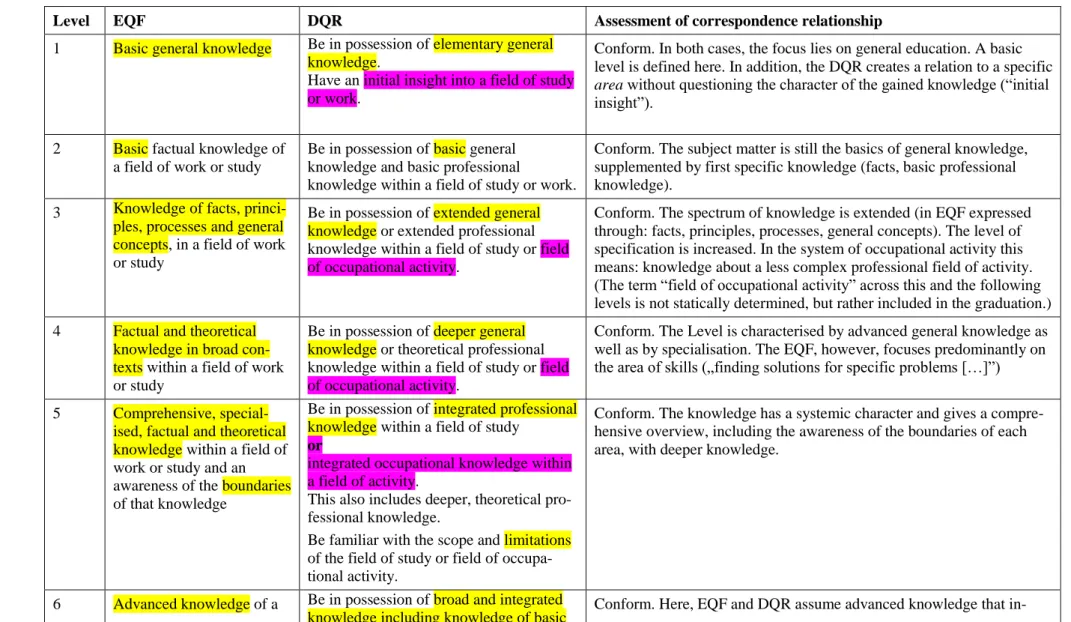
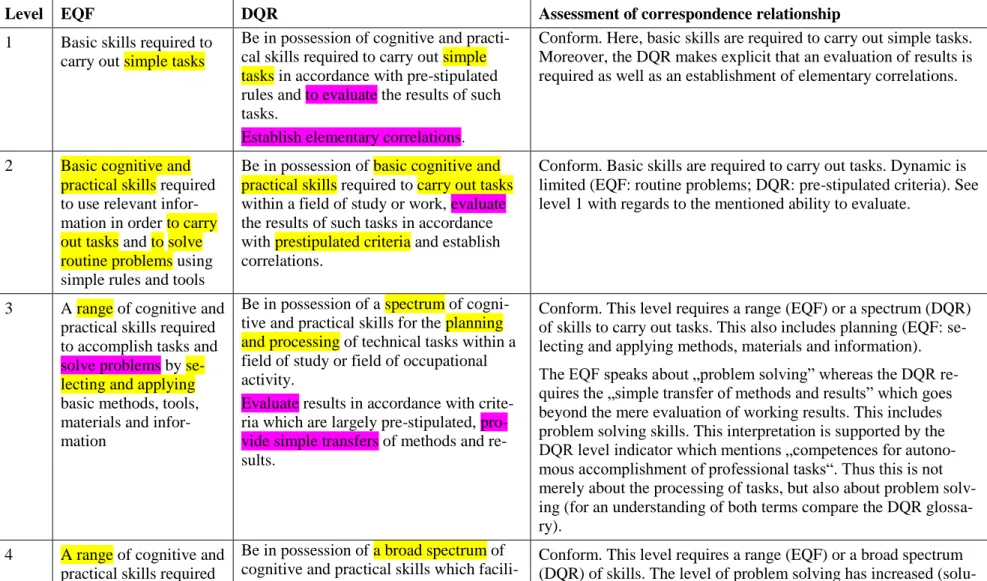
4.2.3. Referencing at descriptor level... 81
4.3. Criterion 3……… ... 97
4.3.1. Learning outcome orientation in the German education system ... 97
4.3.1.1. School-based general education ... 99
4.3.1.2. Dual vocational education and training... 101
4.3.1.3. Higher education sector... 103
4.3.2. Credit points and credit systems in the German educational sector ... 105
4.3.2.1. Initial and continuing vocational education and training ... 105
4.3.2.2. Higher education sector... 107
4.3.3. Measures to validate non-formal and informal learning ... 108
4.4. Criterion 4 ………..110
4.4.1. Allocation methodology ... 110
4.4.2. The level allocations and their justification... 113
4.5. Criterion 5 ………..170
4.5.1. Quality assurance and the DQR ... 170
4.5.2. General and vocational schools ... 171
4.5.2.1. Specific legal framework... 171
4.5.2.2. Responsible bodies... 171
4.5.2.3. Quality assurance measures... 171
4.5.3. In-company vocational training in the dual system... 173
4.5.3.1. Specific legal framework... 173
4.5.3.2. Responsible bodies... 174
4.5.3.3. Quality assurance measures... 176
4.5.4. Continuing education ... 178
4.5.4.1. Specific legal framework... 178
4.5.4.2. Responsible bodies... 178
4.5.4.3. Quality assurance measures... 179
4.5.5. Higher education ... 181
4.5.5.1. Specific legal framework... 181
4.5.5.2. Responsible bodies... 182
4.5.5.3. Quality assurance measures... 182
4.6. Criterion 6 ………..185
4.7. Criterion 7 ... 185
4.7.1. Workshops and conferences involving international experts ... 185
4.7.2. Involvement of international experts in the context of the referencing process... 186
4.7.3. Country network meeting Germany – Lichtenstein – Austria – Switzerland (D-L-A-CH) ... 189 4.8. Criterion 8 ………..190 4.9. Criterion 9 ………..191 4.10.Criterion 10 ………...192 5. Annexes ... 193 5.1. DQR-Document... 194 5.2.Joint Resolution... 224
5.3.Statement of the German Qualifications Framework Working Group... 226
5.4. Committees and working groups... 230 4
5.4.1. Federal Government/Länder Coordination Group for the German Qualifications
Framework ... 230
5.4.2. German Qualifications Framework Working Group... 231
5.4.3. Working groups in the second phase of development... 233
5.4.3.1. Working group on “Metalworking and electrical professions”... 233
5.4.3.2. Working group on “Health/care” ... 234
5.4.3.3. Working group on “Trade”... 235
5.4.3.4. Working group on “IT” ... 236
5.4.4. Working groups to take account of non-formal and informal learning ... 237
5.4.4.1. Working group on “General, political and cultural education”... 234
5.4.4.2. Working group on “Occupational fields metalworking/electrical professions, health/care, trade, IT”... 235
5.5. International workshops... 240
5.6. Conferences... 241
Abbreviations
DQR German Qualifications Framework for Lifelong Learning
ECTS European Credit Transfer and Accumulation System
ECVET European Credit System for Vocational Education and Training
EQF European Qualifications Framework for lifelong learning
HQR Qualifications Framework for German Higher Education Qualifications
0.
Executive Summary
The purpose of this report is to present the German Qualifications Framework for Lifelong Learning (known by its German abbreviation ‘DQR’) in relation to the European Qualifications Framework (EQF). To this end the EQF Advisory Group’s ten referencing criteria are explored in detail. With the aim of creating the greatest possible degree of confidence in the DQR, the key aspects – learning-outcome orientation and quality assurance in the education system, com parison of EQF and DQR descriptors, and methodological approach in allocating qualifications to the DQR – are described in detail. This is intended to help clarify the varied and complex processes in the German education system. Prior to this, the German education system and its qualifications are presented, and the development phases of the German Qualifications Frame work explained.
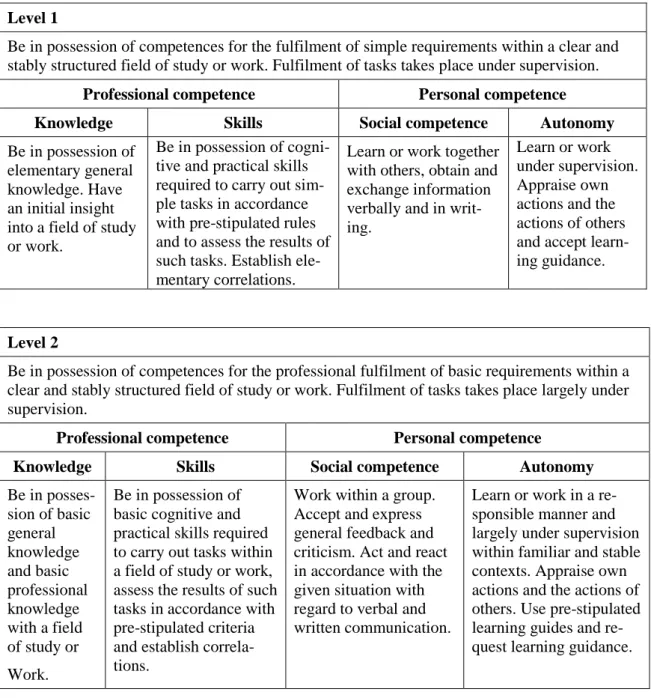
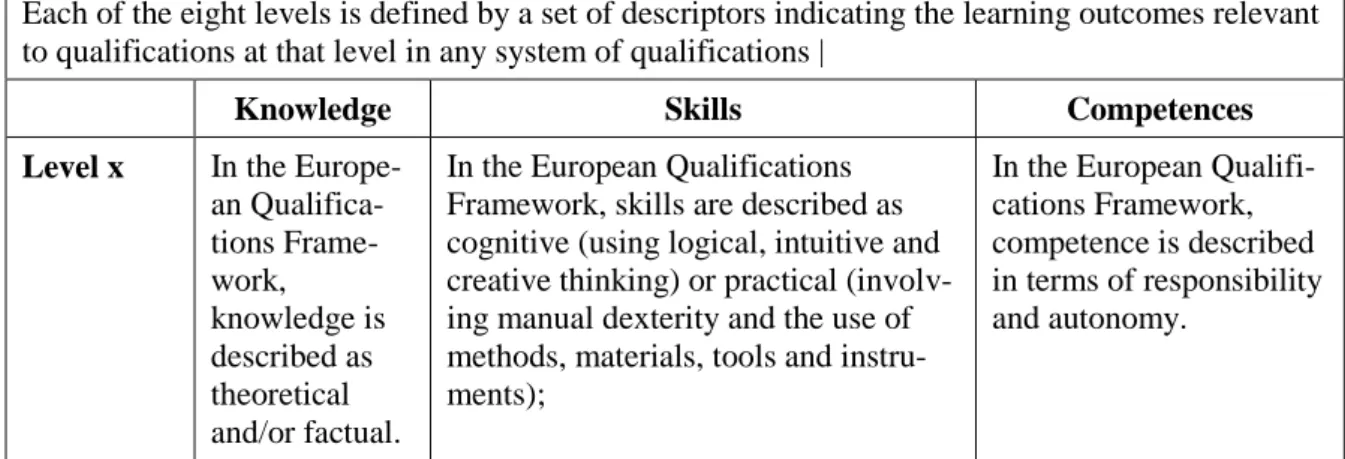
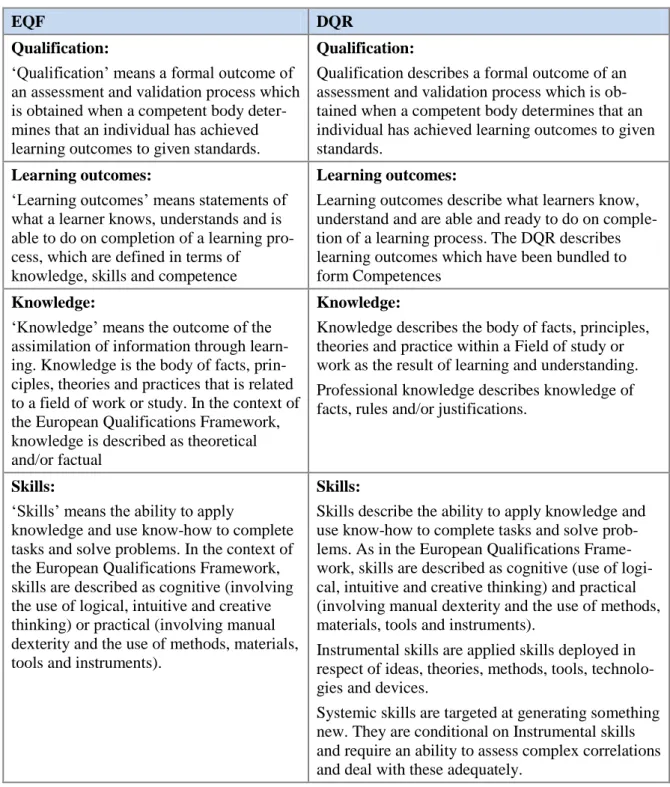
The DQR, like the EQF, has eight levels. In order to do justice to the special characteristics of the German education system the DQR focuses firmly on the concept of ‘competences’, thereby developing the learning-outcome approach of the EQF.
Knowledge and skills are therefore represented as aspects of professional competence.
The descriptors incorporate new subcategories which were not explicitly mentioned in
the EQF, such as “judgement”.
Personal competence in particular has been differentiated into social competence
(team/leadership skills, involvement, communication) and autonomy (autonomous re sponsibility/responsibility, reflectiveness and learning competence.
The DQR therefore exhibits a “four-pillar structure”. The structure of requirements which is characteristic of the DQR levels is summarised in each case with the aid of a “level indicator”.
The DQR is therefore based on an integrated understanding of competences, expressed in the concept of a holistic ability to act (see Section 3.2.). In the course of the referencing process correspondent relationships between the EQF and DQR are set out for each EQF descriptor (see Section 4.2.).
The DQR and the Referencing Report are being developed under the shared responsibility of the Federal Ministry of Education and Research (BMBF) and the Standing Conference of the Ministers of Education and Cultural Affairs of the Länder in the Federal Republic of Germany (KMK), with the ongoing participation of the social partners and business organisations and other stakeholders and experts in the “German Qualifications Framework Working Group” (see 5.4.2). Its members have facilitated feedback on results to delegates’ home institutions and
committees. Other Federal Government and Länder ministries with special responsibility and expertise within this area have also been involved in the process. All decisions were prepared jointly in the German Qualifications Framework Working Group and are based on consensus between the stakeholders represented in it. The decisions documented in this Report have been the subject of this consensus and are taken by the stakeholders represented in the German Qual ifications Framework Working Group.
So far the following qualifications have been described in accordance with the descriptors of the DQR matrix and allocated to the German Qualifications Framework:
DQR/ EQF level
Qualifications
1 Vocational training preparation [Berufsausbildungsvorbereitung]
Employment agency measures (vocational preparation schemes) [Maßnahmen der Arbeitsagentur (Berufsvorbereitende Bildungsmaßnahmen – BvB)]
Pre-vocational Training Year [Berufsvorbereitungsjahr (BVJ)] 2 Vocational training preparation [Berufsausbildungsvorbereitung]
Employment agency measures [Maßnahmen der Arbeitsagentur]
Year of pre-vocational training [Berufsvorbereitungsjahr (BVJ)]
Introductory training for young people (Einstiegsqualifizierung, EQ)
Berufsfachschule [full-time vocational school] (Basic Vocational Training [Berufliche Grundbildung])
3 Dual vocational education and training (2-year training courses)
Berufsfachschule (Mittlerer Schulabschluss) [full-time vocational school] (general edu cation school leaving certificate obtained on completion of grade 10 at Realschule or, under certain circumstances, at other lower secondary school types)
4 Dual vocational education and training (three-year and three-and-a-half-year training courses)
Berufsfachschule [full-time vocational school] (assistant occupations) Berufsfachschule [full-time vocational school](full vocational qualification)
5 IT-Spezialist (Zertifizierter) [Information Technology Specialist (Certified)], Service techniker (Geprüfter) [Service Technician (Certified)]*
6 Bachelor
Fachkaufmann (Geprüfter) [Commercial Specialist (Certified)], Fachwirt (Geprüfter) [Business Management Specialist (Certified)], Meister (Geprüfter) [Master Craftsman (Certified)], Operativer IT-Professional (Geprüfter) [Operative IT Professional (Certi fied)]*
Fachschule (Staatlich Geprüfter…) [Fachschule (State-Certified…)] 7 Master
Strategischer IT-Professional (Geprüfter) [Strategic IT Professional (Certified)]* 8 Doctoral studies
* The German Qualifications Framework Working Group agrees that additional further vocational training qualifications should be allocated in accordance with the procedure described in the DQR Manual.
The original goal was to include the qualifications from the formal sector – general education, higher education and vocational education and training, including continuing education in each case – in the first stage, while initial qualifications from the non-formal sector were to be in cluded in a second stage. The fact that it has not been possible to fully accomplish this objective by the referencing stage is due to the consistent consideration of the above principle of consen sus. Since it has not thus far been possible to reach a consensus supported by all stakeholders on
the allocation of the Allgemeine Hochschulreife [general higher education entrance qualifica
tion] and the Fachgebundene Hochschulreife [higher education entrance qualification restricted
to a specified field of study]) to a level on the basis of learning outcomes, in the interests of a
holistic consideration for the time being the general education sector has not been allocated as a
whole. But this does not signify any move away from the concept of a qualifications framework spanning all educational sectors. A consensual allocation of general education qualifications is now to be developed during a five-year introductory phase. There is consensus that the DQR should include all educational sectors and that the comparability of general and vocational edu cation must be adequately reflected.
The fact that there is comparability between vocational qualifications and academic qualifica tions is a central result of the work for the DQR. To ensure international understanding of the education system in the Federal Republic of Germany this aspect is therefore of particular im portance, as the middle qualification segment of vocational education and training is exception ally strong in Germany and makes a major contribution to the skilled training of large parts of the working population.
Access to many occupational fields, where other countries require education at a higher
education institution, is achieved through dual vocational education and training.
The share of higher education graduates in the workforce is therefore lower in Germany
compared to other European countries.
Further training qualifications such as Meister (master craftsman) and Techniker (tech
nician) are comparatively more important. Basic and further vocational education and training are closely interlinked and build upon each other.
In the DQR matrix the “or” formulations express – in line with the EQF formulation “in a field of study or work” – the character of the descriptors as spanning all educational sectors. In the process of DQR allocation, discussions about the equivalence of learning outcomes from voca tional education and training and those of other education sectors played a special role.
Since the descriptions of qualifications in the curricula and training regulations not habitually oriented to learning outcomes did not allow precise allocations to levels, methodologically two approaches were taken. If the experts involved in the process agreed on proposed level alloca tions, these were adopted. If not, the discussion across educational sectors was continued in the political bodies until a consensus was reached. The comparability of general education and vo cational training is expressed, for instance, in the fact that qualifications from both the academic
and the vocational sectors have been allocated to DQR levels 6 and 7 (including Bachelor,
Meister [Master Craftsman], Fachwirt [Business Management Specialist], and Fachschule [full
time vocational school] degrees such as Techniker [Technician] and IT Professional).
In line with the Recommendation of the European Parliament and of the Council of the Europe an Union of 23 April 2008 in Germany a joint coordination point is being set up: the – Federal
Government/Länder Coordination Point for the German Qualifications Framework [
Bund-Länder-Koordinierungsstelle DQR] – (see Section 4.1.). It assumes the functions of the Nation al Coordination Point. The basis of its work is the Joint Resolution between the Standing Con ference of the Ministers of Education and Cultural Affairs, the Federal Ministry of Education and Research, the Conference of Ministers of Economics of the Länder, and the Federal Minis try of Economics and Technology adopted in the German Qualifications Framework Working Group (see Annex 5.2).
In the introductory phase the Federal Government/Länder Coordination Point for the German Qualifications Framework will complete the bases of the DQR together with the German Quali fications Framework Working Group. This involves in particular:
laying down standards and procedures for additional allocations and their description in
the “DQR Manual”,
referencing levels of qualifications within the DQR to those of the EQF,
completing allocations in the formal area,
developing proposals and procedures for the inclusion of the results of non-formal and
informal learning,
advising and supporting those responsible in the educational sectors with the allocation
of new qualifications (on the basis of the DQR Manual) and with the reference to the EQF level on certificates,
quality assurance measures, and
implementing evaluation measures, and making adjustments where applicable.
The Report is divided into five sections:
Section 1 describes the objectives of the German Qualifications Framework for Lifelong
Learning (DQR).
Section 2 describes the education system in the Federal Republic of Germany, its institu tions and qualifications.
Section 3 describes the development stages of the DQR, the committee structures, the par
ticipating stakeholders and the involvement of international experts.
Section 4 is the focus of the report. It deals with the compliance with the referencing crite
ria in the referencing process and presents in the section on criterion 4 (4.4.2.) the reasoned qualifications allocations in detail.
Section 5 provides relevant documents as an Annex and informs about the committees in
volved in the DQR process and their activities.
1.
The German Qualifications Framework for Lifelong
Learning (DQR) and its objectives
In October 2006, the Federal Ministry of Education and Research (BMBF) and the Standing Conference of the Ministers of Education and Cultural Affairs of the Länder in the Federal Re public of Germany (KMK) agreed to work together to develop a German Qualifications Framework for Lifelong Learning (known by its German abbreviation ‘DQR’). Implementing
this undertaking complies with the European Commission document presented on 8 July 20051,
the European Commission’s Proposal for a Recommendation of the European Parliament and of the Council on the establishment of the European Qualifications Framework for lifelong learn
ing of 5 September 20062, and the ensuing Recommendation of the European Parliament and of
the Council which entered into force on 23 April 2008. The Federal Ministry of Education and Research and the Standing Conference set up a joint “Federal Government/Länder Coordination Group” for the German Qualifications Framework” in 2007, which was given the task of draw ing up a proposal involving stakeholders from general education, higher education, and initial and continuing vocational education and training, the social partners and other experts from research and practice. This has essentially taken place within the “German Qualifications
Framework Working Group” [Arbeitskreis DQR], the members of which have facilitated feed
back on results to delegates’ home institutions and committees. Other Federal Government and Länder ministers with special responsibility and expertise within this area have also been in volved in the process. All decisions were prepared jointly in the German Qualifications Frame work Working Group and are based on consensus between the stakeholders represented in it.
1 Commission of the European Communities: “Towards a European Qualifications Framework for lifelong learning”, COMMISSION STAFF WORKING DOCUMENT. SEC (2005) 957. Brussels, 8 July 2005.
2 Commission of the European Communities: Proposal for a RECOMMENDATION OF THE EURO PEAN PARLIAMENT AND OF THE COUNCIL on the establishment of the European Qualifica tions Framework for lifelong learning. COM (2006) 479. Brussels, 5 September 2006.
The objectives of the DQR are to
make the German qualifications system more transparent, promote reliability, permea
bility and quality assurance, and clarify the comparabilities which result in the process, particularly between vocational training and general education on the one hand, and vo cational training and higher education on the other, and to make differences between qualifications more apparent,
provide stakeholders in the education and employment system with a translation device
to allow them to categorise qualifications better and simplify the recognition of qualifi cations obtained in Germany throughout Europe,
allocate qualifications on the understanding of the comparability of general, vocational
and higher education,
promote the mobility of learners and employees between Germany and other European
countries, and within Germany, to afford the best possible level of opportunity, and to promote the orientation of qualifications to competences,
promote the idea that qualification processes should be based on learning outcomes
(“outcome orientation”),
improve opportunities for the validation of results of non-formal and informal learning
in order to reinforce lifelong learning as a whole.
The allocation of the qualifications within the German education system to the reference levels of the DQR should not replace the existing system of admission entitlements. Directive
2005/36/EC is unaffected3
3 Directive 2005/36/EC of the European Parliament and of the Council of 7 September 2005 on the
recognition of professional qualifications (OJ L 255 of 30 September 2005, p. 22), as amended by Council Directive 2006/100/EC (OJ L 363 of 20 December 2006, p. 141).
. Allocation takes place in accordance with the principle that each qualification level should generally be accessible via various educational pathways. Achieving a certain reference level of the DQR does not provide automatic admission to training courses or courses of education in the next higher level. Nor has the achievement of a reference level been considered in conjunction with the implications for collective wage agreements and laws relat ing to remuneration.
All relevant stakeholders were involved in drawing up the DQR at an early stage. These include experts and practitioners from all educational sectors: ministries of education, cultural affairs and economy, social partners (trade associations, trade unions), representatives of higher educa tion institutions, vocational education and training, general continuing education, and represent atives of research institutes.
It was always a key aim of the stakeholders involved in the DQR development process to ensure maximum transparency to the general public. Through regular public debates, hearings and
communications from the German Bundestag, information from the Federal Government, meet
ings and conferences, and the website www.deutscherqualifikationsrahmen.de, the latest state of play regarding implementation of the DQR has been published and discussed in expert forums at national and international level. The various interest groups and the expert public were in formed in detail about developments and results by this means.
Stakeholders and interest groups demonstrated great interest in the DQR process from the out set, and actively participated in it. Their extensive involvement has proved extremely beneficial to the development of the DQR.
Back in 2005 Germany adopted a Qualifications Framework for German Higher Education Qualifications (HQR), and then completed self-certification in 2008 in the context of the Euro pean Higher Education Area. The option of developing a framework incorporating other areas of the education system (particularly vocational training and continuing education) has already been put forward in this context. In developing the DQR attention was paid to compatibility with the HQR. In this sense the DQR represents a framework which extends across educational sectors.
2. The education system in the Federal Republic of Germany
The education system in the Federal Republic of Germany is a state-run, predominantly public sector, legally regulated structure comprising various education institutions. Under Article 30 of the Basic Law, it falls within the cultural sovereignty of the Länder and therefore has a federal structure. In some educational sectors, other public and non-public institutions are involved in design and maintenance.
The federal German education system is a historically grown structure of education offers for people of all ages, from early childhood education in the elementary sector to the field of adult education in the sense of lifelong learning. The formal education system is divided into school based general education, vocational education and training, including initial vocational educa tion and training and the further training opportunities building on it, higher education and con tinuing education.
In the following Section, the political responsibilities in the different education areas are first described. The structure of the education system is then presented schematically. Finally, the different education formats and the resulting qualifications are explained in the educational sectors “general education”, “vocational education and training”, “higher education” and “con tinuing education”.
2.1. Political responsibilities
The Federal Republic of Germany consists of 16 states [Länder]. They have responsibility for legislation and administration in the areas education, science and culture. The distribution of legislative competence between the Federal Government and the Länder is defined in the Basic
Law, in that the Länder shall have the right to legislate insofar as the Basic Law does not con
fer legislative power on the Federal Government (Article 70). Educational and cultural legisla tion is therefore primarily the responsibility of the Länder.
In the education system, this is especially relevant with regards to schools, higher education and the area of adult education/continuing education. A decisive factor in the development of the German education system in a similar direction in each of the Länder from 1945 onwards was the cooperation of the Länder in the Standing Conference of the Ministers of Education and
Cultural Affairs of the Länder in the Federal Republic of Germany [Kultusministerkonferenz],
which was founded in 1948. The Standing Conference brings together the ministers and sena 14
tors of the Länder responsible for education and training, higher education and research, and also cultural affairs. Cooperation within the Standing Conference has led to uniform and com parable developments in many areas of the school and higher education system.
Within the Federal Government, the Federal Ministry of Education and Research [Bundesminis
terium für Bildung und Forschung – BMBF] is primarily responsible for the Federal Govern ment’s areas of responsibility in the educational sector. Wherever necessary, consultations be
tween the Federal Government and the Länder take place in the Bundesrat, the Joint Science
Conference [Gemeinsame Wissenschaftskonferenz – GWK], the Standing Conference of the
Ministers of Education and Cultural Affairs and the Science Council [Wissenschaftsrat].
Under the Basic Law [Grundgesetz] and the constitutions of the Länder, the entire school sys
tem is under the supervision of the state. Schools are, as a rule, institutions of the local authori
ties or the Länder. Higher education institutions are also institutions of the Länder. In addi
tion, there are church-run or other privately-run schools and institutions of higher education.
In the school sector the Standing Conference ensures, through its resolutions and agreements, the conformity or comparability of courses of education and qualifications at schools in the individual Länder. The same is true of teacher training. In this way the Standing Conference maximises mobility for learners and teachers. In its recommendations on subjects and areas of learning it also lays down content requirements which have to be implemented in the Länder
curricula. Since the so-called “Hamburger Abkommen” [Hamburg Agreement] adopted in 1964,
alongside general provisions on the academic year, the start and duration of compulsory school ing and the holidays, there are also rules on standard terms in the school system, forms of or ganisation, the recognition of examinations and certificates, and names used in the grading sys tem.
As regards vocational training, the Federal Government is responsible for in-company voca
tional training, and the Länder are responsible for vocational training in schools. In dual voca tional education and training, which takes place in cooperation between two places of learning,
in schools and at the Berufsschule (part-time vocational school), the Federal Government and
the Länder agree on fundamental issues and in particular on training rules and regulations for the places of learning. Due to the fact that the responsibility is divided, a Coordinating Commit tee for Vocational Education and Training was set up on the basis of an agreement entered into in 1972. This Committee deals with fundamental issues relating to the coordination of in
company vocational education and training and vocational training in the Berufsschule in rec
ognised training occupations [anerkannte Ausbildungsberufe] under federal law. An on-going
task of the Coordinating Committee is the re-structuring of training occupations, harmonising training regulations and framework curricula for training in companies and at school. In the
Coordinating Committee, the Federal Government is represented by the Federal Ministry of
Education and Research, the Federal Ministry of Economics and Technology [Bundesministeri
um für Wirtschaft und Technologie – BMWi], and by the competent Ministry for the respective occupation. The Länder are represented by the members of the Standing Conference’s Commit
tee for Vocational Education and Training [Fachausschuss für Berufliche Bildung]. The Federal
Ministry of Education and Research embraces the Federal Institute for Vocational Education
and Training [Bundesinstitut fur Berufsbildung – BIBB]. It is a public institution which is di
rectly accountable to the Federal Government and is responsible for researching and developing initial and continuing vocational education and training in Germany. It is a major instrument for cooperation between employers, trade unions, Federal Government and Länder at national level.
Under the Vocational Training Act [Berufsbildungsgesetz] the Institute is responsible inter alia
for taking part, in accordance with the instructions of the competent federal ministry, in the drafting of training regulations and other ordinances.
Vocational education and training in Germany is based on the consensus principle. Whenever major decisions on structure and substance have to be taken, such decisions are reached in co operation between the Federal Government and the Länder, employers and employees. These groups – as well as a representative of the municipal associations, the Federal Employment
Agency [Bundesagentur für Arbeit] and the advisory council acting as advisors – are members
of the Federal Institute for Vocational Education and Training’s Board, which thus represents the “Round Table” of vocational education and training.
Decisions on continuing vocational education and training are made jointly by employers
and employees in Germany. However, through implementing an active continuing education policy with its incentives and regulatory functions, the State can contribute to
an increase in vocational participation in continuing education,
an increase in participation in in-company continuing education by employees,
an improved continuing education participation by certain target groups, e.g. low
skilled persons, women, the elderly, persons with a migration background.
A sub-area is subject to state regulation (regulated vocational further training). The Federal Government is responsible for the enactment of further training regulations.
The regulation of and assistance for general continuing education, continuing education lead
ing to school qualifications, continuing vocational education and training at Fachschulen and
continuing education with an academic bias, as well as some areas of political continuing edu cation, is in the hands of the Länder. The responsibilities of the Federal Government refer in
particular to continuing vocational education and training outside the school context, the devel opment of new approaches to continuing education through pilot projects, certain elements of political continuing education and statistical matters relating to continuing education. The pro
motion of continuing vocational education and training under the Social Security Code [Sozi
algesetzbuch] III is the responsibility of the Federal Employment Agency. Responsibility for
further vocational training as regulated by the Vocational Training Act [Berufsbildungsgesetz]
and the Handicrafts Code [Handwerksordnung] lies with the Federal Ministry of Education and
Research. Further education courses for which there is a regional need only are regulated by the competent bodies, generally the relevant chambers (e.g. chambers of handicrafts, chambers of industry and commerce), under their own responsibility. Responsibility for the master craftsman examinations as regulated by the Handicrafts Code lies with the Federal Ministry of Economics and Technology. The funding of continuing education by all those involved reflects the com plex pattern of responsibility for this sector. In addition, there are numerous continuing educa tion offers in place which are implemented without state regulation on the free market (see Sec tion 2.6).
2.2. Design and basic structure
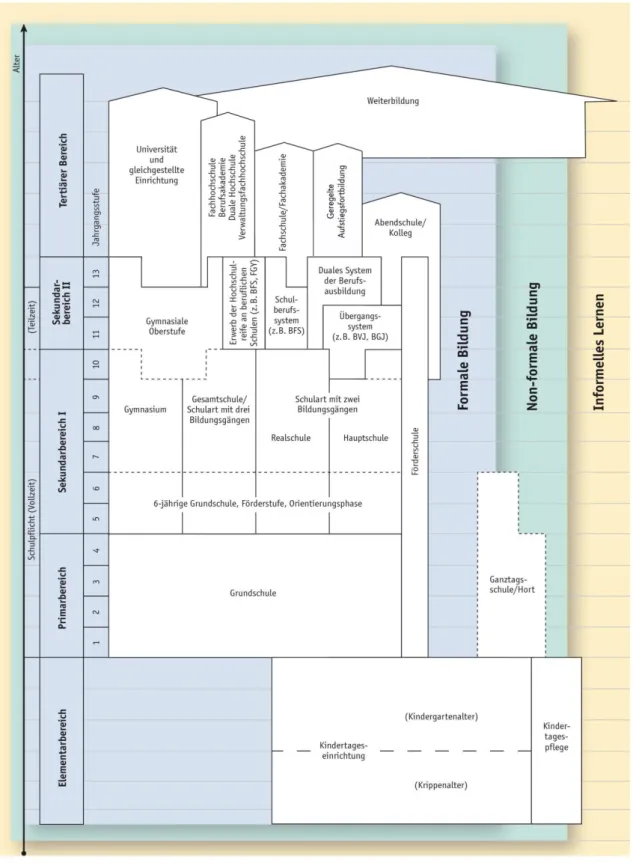
The education system is structured in educational sectors (general education, vocational educa tion and training, higher education and continuing education), in educational levels (elementary, primary, secondary and tertiary levels) and in courses of education, which are in turn allocated to different education institutions. The following figure 1 presents the structure of the education system of the Federal Republic of Germany in line with this categorisation. The size of the fields in the figure does not reflect any quantitative conditions.
Figure 1: Places of Learning and Spheres of Learning in Germany
(Source: Bildung in Deutschland 2012 [Education in Germany 2012], p. XI; slightly amended)
Glossary: Places of Learning and Spheres of Learning in Germany
BFS = Berufsfachschule full-time vocational school at upper secondary level BGJ = Berufsgrundbildungsjahr basic vocational training year
BOS = Berufsoberschule full-time / part-time vocational school at upper secondary level BVJ = Berufsvorbereitungsjahr pre-vocational training year
Duales System der Berufsaus bildung
dual system of vocational education and training
Elementarbereich pre-school education
Fachhochschule University of Applied Science
FGY = Fachgymnasium school at upper secondary level including both general education and career-oriented subjects leading to the general higher education en trance qualification
Förderschule special school
Formale Bildung formal education
FOS = Fachoberschule two-year vocational school at upper secondary level leading to the qualification to study at a University of Applied Science
Geregelte berufliche Aufstiegsfortbildung
regulated further vocational training
Gesamtschule/ Schulart mit drei Bildungsgängen
comprehensive school/ school offering three types of course of educa tion
Grundschule primary school
Gymnasium school type of general education covering lower and upper secondary level leading to the general higher education entrance qualification Hort establishment offering care and supervision of schoolchildren outside
of lessons Informelles Lernen informal learning Kindergartenalter kindergarten age Kindertageseinrichtung pre-school education Kindertagespflege child day-care
Krippenalter crèche age
Non-formale Bildung non-formal education
Primarbereich primary education
Schularten mit zwei Bild ungsgängen
schools offering two types of course of education
Sekundarbereich I lower secondary education Sekundarbereich II upper secondary education Tertiärer Bereich tertiary education sector Übergangssystem transitional sector Universitäten und
gleichgestellte Hochschulen
universities and equivalent institutions of higher education
Verwaltungsfachhochschule University of Applied Science for public administration
Vollzeit full-time
Vollzeitschulpflicht compulsory full-time schooling Weiterbildung continuing education
The following Table contains quantitative data on the use of the education offers.
Table 1: Number of participants in education institutions in the 2010/11 school year
(Quantitative data taken from: Bildung in Deutschland 2012 [Education in Germany 2012], p. 227)
Day-care centres for children 3,122,700
General education schools Sub-total 8,796,894
Of which Grundschulen [primary level] 2,837,737
Hauptschulen [lower secondary level] 703,525
Realschulen [lower secondary level] 1,166,509
Gymnasien [lower and upper secondary levels]
2,475,174
Schools offering several courses of educa tion/integrated comprehensive schools
955,622
Vocational schools Sub-total 2,687,974
Of which: Berufsschulen [part-time vocational schools] (school part of training in the dual system)
1,697,868
Higher education institutions 2,217,294
Total 16,824,862
Table 2 shows the new entrants in the different segments of the vocational training system in 2010.
Table 2: New entrants in the vocational training system 2010
(Quantitative data taken from: Bildung in Deutschland 2012 [Education in Germany 2012], p. 277)
Dual system 509,901
School-based occupation system 212,364
Transitional sector 320,172
Vocational education and training under a public-sector training contract (training for middle grade civil servants)
7,314
Vocational training system as a whole 1,049,751
For comparison: new entrants in higher education 444,719
2.3. General education
The general education area is a central and key area within the education system: it has the highest number of students, schools and teachers. It is comprised of all education institutions and courses of education in the primary and secondary levels (with the exception of vocational courses of education provided at upper secondary level vocational schools) and in some Länder also includes parts of pre-school education (e.g. pre-school classes, school kindergartens). The general education school system is an overall system organised along horizontal levels, with vertical courses of education which ensure reciprocal permeability.
On 18 November 2010, the Standing Conference adopted a position paper on “educational and legal aspects in the implementation of the United Nations Convention of 13 December 2006 on
the Rights of Persons with Disabilities in school education” [Pädagogische und rechtliche
Aspekte der Umsetzung des Übereinkommens der Vereinten Nationen vom 13. Dezember 2006 über die Rechte von Menschen mit Behinderungen [Behinderten-rechtskonvention – VN-BRK] in der schulischen Bildung]. It forms the basis for the recommendations on the inclusive educa tion of children and young people with disabilities in schools of 20 October 2011.
The recommendations on inclusive education take up the basic positions of the “Recommenda
tions on Special Education in Schools in the Federal Republic of Germany” [Empfehlungen zur
sonderpädagogischen Förderung in den Schulen in der Bundesrepublik Deutschland] (Resolu
tion of the Standing Conference of 6 May 1994), including the recommendations on promotion priorities, and provide the framework conditions for increasingly inclusive teaching practice in general and vocational schools.
2.3.1. Pre-school education: day-care for children
Pre-school education incorporates institutions (e.g. nursery schools, kindergarten, child day care facilities) catering for children from a few months to six years, the age at which they usual ly start school. Children of school age who have not yet attained a sufficient level of develop
ment to attend a school have a further option in some Länder (e.g. Schulkindergärten and
Vorklassen). These institutions are allocated either to the pre-school sector or the primary sector according to the particular Land. Attendance is usually voluntary, although in most of the Län der it can be made compulsory. Traditionally in Germany children under the age of three years are looked after in Kinderkrippen (crèches) and children from the age of three up to starting
school in Kindergarten. Every child from the age of three up to starting school has a legal right
to day-care in a child day-care facility or in a child-minding service. Day-care for children is part of child and youth welfare. In each of the Länder it is regulated by Land law.
Day-care centres for children are called upon to encourage the child’s development into a re sponsible and autonomous member of the community. This includes instructing, educating and caring for the child. Under the joint framework of the Länder for early education in day-care
centres for children [Gemeinsamer Rahmen der Länder für die frühe Bildung in Kindertag
eseinrichtungen], the focus lies on communicating basic competences and developing and strengthening personal resources, which motivate children and prepare them to take up and cope with future challenges in learning and life, to play a responsible part in society and be open to lifelong learning.
2.3.2. Primary education:
Grundschule
(primary school)
As a rule children are required to attend school in the year in which they reach the age of six.
All pupils in Germany enter the Grundschule which covers grades 1 to 4. In Berlin and Bran
denburg, the Grundschule covers six grades.
For pupils with special educational needs whose development cannot be adequately assisted at
mainstream schools, there is a range of special schools [Förderschulen], are also known as
Sonderschulen, Förderzentren or Schulen für Behinderte in some Länder.
Lessons at primary school initially focus on reading, writing and arithmetic. Teaching takes place both in lessons concentrating on a specific subject or area and in cross-disciplinary clas
ses. As a rule subjects include German, mathematics, Sachunterricht, art, music and sport, and
in most Länder religious instruction. The Länder have developed various approaches systemati cally enabling a first encounter with foreign languages at primary school age. The curricula are published as ordinances of the Ministries of Education and Cultural Affairs of the Länder.
2.3.3. Transition from primary to secondary education
The transition from the Grundschule (primary school) to one of the different lower secondary
school types where pupils remain at least until the completion of their full-time compulsory education is dealt with differently depending on Land legislation. The vote of the school which the pupil is leaving is taken as a basis for the decision or as guidance in the decision regarding the pupil’s future school career. This is accompanied by detailed consultations with parents.
The final decision is taken either by the parents or the school or school supervisory authority. For certain school types, it is dependent on pupils demonstrating a certain level of ability and/or on the capacity available in the desired school.
2.3.4. Lower secondary education
Secondary education breaks down into lower secondary level [Sekundarstufe I], which compris
es the courses of education from school grades 5/7 to 9/10, and upper secondary level [Sekundarstufe II], which comprises all the courses of education that build on the foundations laid in the lower secondary level.
The function of all the courses of education at lower secondary level is to prepare pupils for courses of education at upper secondary level, completion of which is required for vocational qualification or admission to university. Accordingly, courses of education at lower secondary
level are predominantly of a general nature whereas, apart from the Gymnasium, vocational
courses of education predominate at upper secondary level (see Section 2.4., Vocational educa tion and training).
Lower secondary education comprises the following types of school:
Hauptschule: The Hauptschule provides its pupils with a basic general education. It nor mally covers grades 5–9. With ten years of compulsory full-time education, the Hauptschule also includes grade 10. As a rule, the subjects taught at Hauptschulen include German, a foreign language (usually English), mathematics, physics/chemistry, biology,
geography, history, Arbeitslehre (i.e. pre-vocational studies) and social studies, music, art,
sport, religious education and, in some Länder, domestic science and economics and other work-related subjects.
Realschule: The Realschule provides a more extensive general education. The standard
Realschule covers grades 5 to 10. As a rule, the subjects taught at Realschulen include German, a foreign language (usually English), mathematics, physics, chemistry, biology, geography, history, politics, music, art, sport and religious education. In addition to com pulsory courses, pupils are generally required to take three to six hours a week of compul sory electives from grade 7 or 8 onwards. According to their personal inclinations and abili ties, the pupils may take additional classes in certain compulsory subjects or choose new subjects, including, among others, a second foreign language (usually French) from grade 7 or 8. Some Länder provide the option of choosing a second foreign language from as early
as grade 6. A Realschule leaving certificate qualifies a pupil to transfer to a school that pro
vides vocational or higher education entrance qualification.
Gymnasium: The Gymnasium provides an intensified general education. The course of
education in the standard Gymnasium comprises both the lower and upper secondary level
and covers grades 5 to 13 or 5 to 12 (or grades 7 to 13 or 7 to 12 following a six-year pri
mary school). In almost all Länder, the conversion from nine to eight years at the Gymnasi
um is currently under way (G9 – G8). In grades 5–10 of the Gymnasium, which comprise
the lower secondary level there, the main subjects taught are: German, at least two foreign languages, mathematics, physics, chemistry, biology, geography, history, politics, music, art, sport and religious education.
Gesamtschule: The Gesamtschule is a school offering more than one type of course of edu
cation – usually Hauptschule, Realschule and Gymnasium.
Schools offering several courses of education bring two or three courses of education
under one umbrella – usually Hauptschule and Realschule. The Hauptschule and Re
alschule courses of education are also offered at schools offering several courses of educa tion, the names of which differ from one Land to another.
2.3.5. Upper secondary education
Upper secondary education comprises the following types of school: Gymnasium,
Gesamtschule,
Abendgymnasium, Kolleg,
Berufsbildende Schule (vocational school; see Section 2.4. Vocational education and training).
The Gymnasium course of education is also offered at the Gesamtschule, which is a comprehen sive school. In the cooperative comprehensive schools, three courses of education [Hauptschule, Realschule and Gymnasium] are brought under one educational and organisa tional umbrella; these form an educational and organisational whole at the integrated Gesamtschule. Gesamtschule provision varies in accordance with the respective educational laws of the Länder. Three courses of education are also offered at the following types of school: Integrierte Sekundarschule (Berlin), Oberschule (Bremen), Stadtteilschule (Hamburg), and to
some extent the Regionale Schule (Mecklenburg-Western Pomerania) and the Gemeinschaftss
chule (Schleswig-Holstein, Thuringia).
The courses of education provided at general education schools within the gymnasiale Ober
stufe, i.e. the upper secondary level, lead to a higher education entrance qualification. The aim
of learning and work within the upper level of the Gymnasium is to obtain the Allgemeine
Hochschulreife, which gives the holder access to higher education and also enables them to
commence a course of vocational training. The instruction at the gymnasiale Oberstufe provides
an in-depth general education, general capacity for academic study and the propaedeutics of scientific work. Of particular importance are in-depth knowledge, skills and competences in the subjects German, a foreign language and mathematics. The instruction offers an introduction to academic issues, categories and methods, and provides an education which facilitates the devel opment and strengthening of personality, the shaping of a socially responsible life, and partici
pation in democratic society. Instruction at the gymnasiale Oberstufe includes appropriate in
formation on higher education institutions, on occupational fields, and on the structures and requirements of higher education study programmes and of the professional and working world.
The subjects at the gymnasiale Oberstufe are taught at different levels of academic standards in
accordance with the Uniform Examination Standards in the Abitur Examination [Einheitliche
Prüfungsanforderungen in der Abiturprüfung]. They are divided into basic and intensified courses. The basic courses teach the propaedeutics of scientific work, and the intensified cours es provide in-depth teaching of the propaedeutics of scientific work by way of specific exam ples.
The gymnasiale Oberstufe ends with the Abitur examination. The Abitur provides the student
with certification of the Allgemeine Hochschulreife (general higher education entrance qualifi
cation), which allows for access to any study course at the university as well as for comparable
vocational training.
In the general education sector, the Abitur examination takes place at the end of the Gymnasiale
Oberstufe, i.e. the upper level of the Gymnasium or a Gesamtschule. The Allgemeine Hochschulreife can, however, also be acquired in institutions of vocational education, especially
in the vocational Gymnasium, the Fachoberschule offering grade 13, and the Berufsoberschule.
Through the so-called “Zweiter Bildungsweg” (second chance education), Abendgymnasien
and Kollegs provide adults with the opportunity to obtain the Allgemeine Hochschulreife.
Those preparing independently for the Abitur can also acquire it through a non-pupil or external
examination. An amended version of the examination for non-pupils is also completed by pu
pils of Waldorfschulen.
In Germany, there are the following three types of higher education entrance qualifications: 25
The Allgemeine Hochschulreife is the school-leaving qualification which enables access to
any study course at a university or other higher education institution. The basic structure of the gymnasiale Oberstufe includes a division into a one-year introductory phase and a two
year qualification phase. The Allgemeine Hochschulreife is obtained after 12 or 13 years of
schooling. The basis is formed by the Resolution of the Standing Conference on the
“Agreement on the structure of the gymnasiale Oberstufe in the upper secondary level”
[Vereinbarung zur Gestaltung der gymnasialen Oberstufe in der Sekundarstufe II] of 7 July 1972 as amended on 9 February 2012.
The Fachgebundene Hochschulreife (higher education entrance qualification restricted to
a specified field of study) as a limited higher education entrance qualification (a second for eign language is not acquired) permits entry only to specified subjects at universities and equivalent institutions as well as all courses of studies at universities of applied sciences. The Fachgebundene Hochschulreife is usually acquired at Berufsoberschulen, but may also
be acquired at other schools with a gymnasiale Oberstufe. The certificates include the
Fachhochschulreife [higher education entrance qualification for the Fachhochschule (uni versity of applied sciences)]. The higher education entrance qualification restricted to a specified field of study is also obtained by graduates of a two-year vocational education and
training course regulated by federal or Länder laws under the Vocational Training Act
[Berufsbildungsgesetz]/Handicrafts Code [Handwerksordnung] in an area related to the study course being followed who also have at least three years of professional practice in a related area. An additional examination evaluates aptitude.
The Fachhochschulreife entitles holders to study at a university of applied sciences [Fach
hochschule] or to enter a corresponding study course at another higher education institution. The Fachhochschulreife is comprised of a school-based part (i.e. upper secondary level general and vocational schools) and a work-related part (as a rule, a completed vocational
education and training course, one year work placement). Students of the gymnasiale Ober
stufe, who graduate from school without acquiring the Allgemeine Hochschulreife, may ap
ply for the recognition of the acquisition of the Fachhochschulreife (school-based part) at
the earliest when they have completed two school semesters in the final two years of upper Gymnasium level [Qualifikationsphase].
2.4
Vocational education and training
In the Federal Republic of Germany the vocational education and training system is of central importance. The middle qualification segment of vocational education and training is excep tionally strong and makes a major contribution to the skilled training of large parts of the work ing population. The generation of higher qualifications in Germany is the responsibility not only of academic education but also of vocational training. This contributes significantly to the strength of the German innovation system.
Training in the dual system, i.e. training in companies and in the Berufsschule (part-time voca
tional school), has a leading role. This form of training is complemented by a range of school based forms of vocational training.
In Germany, access to many occupational fields is achieved through dual vocational education and training where other countries require education at a higher education institution. This means that the share of higher education graduates in the workforce is lower in Germany com
pared to other European countries. For that reason, further training qualifications such as Meis
ter (master craftsman) and Techniker (technician) are comparatively more important. Individu
als with these further training qualifications – like academics – are regarded as highly qualified workers and make up 10 per cent of the overall working population. Basic and further vocation al education and training are closely interlinked and build upon each other.
The German vocational education and training system has divided into three major sectors each with their own institutional structures: the dual system of in-company and school-based training as the largest sector in quantitative terms, the vocational school system, and the transitional sector between general education schools and regular vocational education and training, in which different types of vocational preparation competences are taught rather than a full voca tional qualification.
Of those pupils who have acquired the Allgemeine Hochschulreife, around one-fifth complete
vocational education and training in the dual system or in the school-based occupation system, i.e. the system of school-based training for recognised training occupations. Three-quarters commence a higher education degree course.
Most pupils who leave school with a Mittlerer Schulabschluss transition into the dual system or
the school-based occupation system, while only a small percentage of them go into vocational preparation schemes offered by the transitional sector.
For a large proportion of those graduating from the Hauptschule the path leads to vocational
education and training through the transitional sector. This applies particularly to pupils leaving without a secondary general school certificate.
New entrants into the three sectors of the vocational education and training system in 2010 were divided as follows:
dual system: 48.9 %
school-based occupation system: 20.4 %
transitional sector: 30.7 %
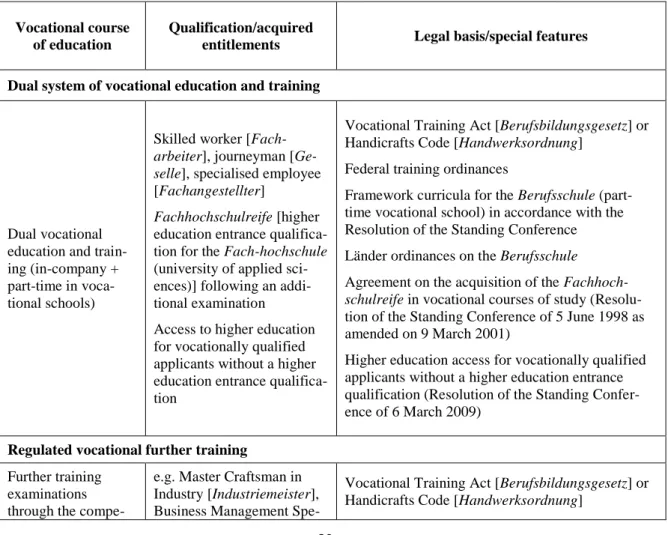
The following table lists the different courses of education and the main places of learning in the vocational education and training system. The subsequent sections describe in detail the basic and further vocational education and training systems which build upon each other.
Table 3: Overview of courses of education and qualifications in vocational education and train ing
Vocational course of education
Qualification/acquired
entitlements Legal basis/special features
Dual system of vocational education and training
Dual vocational education and train ing (in-company + part-time in voca tional schools)
Skilled worker [Fach arbeiter], journeyman [Ge selle], specialised employee [Fachangestellter]
Fachhochschulreife [higher education entrance qualifica tion for the Fach-hochschule
(university of applied sci ences)] following an addi tional examination Access to higher education for vocationally qualified applicants without a higher education entrance qualifica tion
Vocational Training Act [Berufsbildungsgesetz] or Handicrafts Code [Handwerksordnung]
Federal training ordinances
Framework curricula for the Berufsschule (part time vocational school) in accordance with the Resolution of the Standing Conference Länder ordinances on the Berufsschule
Agreement on the acquisition of the Fachhoch schulreife in vocational courses of study (Resolu tion of the Standing Conference of 5 June 1998 as amended on 9 March 2001)
Higher education access for vocationally qualified applicants without a higher education entrance qualification (Resolution of the Standing Confer ence of 6 March 2009)
Regulated vocational further training
Further training examinations through the compe
e.g. Master Craftsman in Industry [Industriemeister], Business Management
Spe-Vocational Training Act [Berufsbildungsgesetz] or Handicrafts Code [Handwerksordnung]
tent authorities (chambers)
cialist [Fachwirt], Commer cial Specialist [Fachkauf mann]
Access to higher education for vocationally qualified applicants without a higher education entrance qualifica tion
Federal training ordinances
The attendance of training courses is not obligatory. Training courses to prepare for the further training examination are offered by private educational providers.
Higher education access for vocationally qualified applicants without a higher education entrance qualification (Resolution of the Standing Confer ence of 6 March 2009)
Vocational education in schools
Fully qualifying vocational training at the Berufsfachschule
(full-time vocational school) under the Vocational Training Act [Berufsbildungs gesetz]
Skilled worker [Fach arbeiter], journeyman [Ge selle], specialised employee [Fachangestellter]
Fachhochschulreife [higher education entrance qualifica tion for the Fach-hochschule
(university of applied sci ences)] following an addi tional examination Access to higher education for vocationally qualified applicants without a higher education entrance qualifica tion
Vocational Training Act [Berufsbildungsgesetz] or Handicrafts Code [Handwerksordnung]
Federal training ordinances
Framework curricula for the Berufsschule
Regulations for the Berufsfachschule
Agreement on the acquisition of the Fach
hochschulreife in vocational courses of study (Res olution of the Standing Conference of 5 June 1998 as amended on 9 March 2001)
Higher education access for vocationally qualified applicants without a higher education entrance qualification (Resolution of the Standing Confer ence of 6 March 2009) State-certified assistant Training in assistant occupations in the Berufsfachschule (full-time vocational school) Fachhochschulreife and/or Allgemeine Hochschulreife
(general higher education entrance qualification) fol lowing additional examina tion
Access to higher education for vocationally qualified applicants without a higher education entrance qualifica tion
Ordinances regulated under Land law
Fachoberschule/ Berufsoberschule
Fachhochschulreife Fachgebundene Hochschul reife (higher education en trance qualification restrict ed to a specified field of study)
Allgemeine Hochschulreife
(general higher education entrance qualification)
Ordinances regulated under Land law
As well as the ability to study, the professional ability to act is also developed.
Berufliches Gymna-sium/Fach
gymnasium
Allgemeine Hochschulreife
Ordinances regulated under Land law
In addition to the tasks of the general education
Gymnasium, these include work-related disciplines and specialisations such as economics, technology, 29
professional information technologies, nutrition, agricultural science, and health and social issues, which may be chosen instead of general education subjects as a second subject with an intensified requirement level and which are also examination subjects in the Abitur examinations.
Further vocational training at Fachschulen/Fachakademien
Further training at a
Fachschule/Fach akademie
e.g. State Certified Techni cian [Staatlich geprüfter Techniker], Certified Busi ness Administrator [Be triebswirt]
Fachhochschulreife follow ing an additional examina tion
Access to higher education for vocationally qualified applicants without a higher education entrance qualifica tion
Ordinances regulated under Land law
Framework Agreement on Fachschulen, Decision of the Standing Conference dated 03.03.2010 Agreement on the acquisition of the Fach
hochschulreife in vocational courses of study (Res olution of the Standing Conference of 5 June 1998 as amended on 9 March 2001)
Higher education access for vocationally qualified applicants without a higher education entrance qualification (Resolution of the Standing Confer ence of 6 March 2009)
Transitional sector between general education schools and vocational education
Basic vocational training year at a
Berufsfachschule
(full-time vocational school), with some practical in-company training
(full-time school/ cooperative)
Basic vocational training Crediting as the first training year in the event of transi tion into a dual vocational education and training course regulated by Land law
Framework Agreement on Berufsfachschulen (Res olution of the Standing Conference of 28 February 1997 as amended on 7 December 2007)
Curricula are regulated by Land law
Acquisition of a subject-specific basic vocational training, promotion of the professional ability to act
Pre-vocational train ing year at a Berufss chule (part-time vocational school) or through education providers
Parts of the basic vocational training, where applicable the secondary general school certificate
Pre-vocational school study course, regulated by Land law
Preparation for entering vocational training or em ployment
Vocational prepara tion scheme through education providers
Basic vocational qualifica tion, where applicable the secondary general school certificate
Social Security Code [Sozialgesetzbuch] III Section 51
Preparation for starting vocational training or facili tating professional insertion
Social Security Code [Sozialgesetzbuch] III Section 54 a Introductory training in companies and at a Berufsschule (part time vocational school)
Parts of the first year of training for a training occu pation, where applicable qualification modules under the Vocational Training Act [Berufsbildungsgesetz]
In-company introductory training serves to impart and deepen the basic foundations enabling young people to act in a professional ability.
Where in-company introductory training is imple mented as vocational training preparation under the Vocational Training Act [Berufsbildungsgesetz], Sections 68 to 70 of the Vocational Training Act apply.
2.4.1.
In-company initial and further vocational education and training
2.4.1.1. Dual system of vocational education and training
A core element of vocational education and training in Germany is training within the dual sys tem. About two thirds of the young people of any one age cohort undergo vocational education in the dual system, taking two to three-and-a-half years, depending on the occupation. It is de
scribed as a dual system because training is carried out in two places of learning: in companies
and in a Berufsschule (part-time vocational school). The aim of vocational education and train
ing is to impart, within a structured course of training, the vocational skills, knowledge and abilities necessary to practise a skilled occupation in a changing professional world. Additional ly, it is intended to provide the necessary professional experience. Those successfully complet ing the training are immediately entitled to perform skilled work in one of presently 344 recog nised training occupations.
Compulsory full-time schooling must be completed before commencing vocational education and training. There are no other formal prerequisites for access to training in the dual system; training in the dual system is generally open to everyone. The training is based on a training contract under private law between a training company and the trainee. The trainees spend three or four days a week in the company and up to two days or in blocks of one or several weeks at the Berufsschule. The training companies assume the costs of the on-the-job training and pay the trainee a traini
![Table 1: Number of participants in education institutions in the 2010/11 school year (Quantitative data taken from: Bildung in Deutschland 2012 [Education in Germany 2012], p](https://thumb-us.123doks.com/thumbv2/123dok_us/478464.2556601/20.892.99.755.286.602/participants-education-institutions-quantitative-bildung-deutschland-education-germany.webp)