A Framework Enabling the Cross-Platform
Development of Service-based Cloud
Applications
By:
Fotis Gonidis
A thesis submitted in partial fulfillment of the requirements for the degree of Doctor of Philosophy
The University of Sheffield
Faculty of Engineering
Department of Computer Science
December 2015
The University of Sheffield
Faculty of Engineering
Department of Computer Science
A Framework Enabling the Cross-Platform
Development of Service-based Cloud
Applications
By:
Fotis Gonidis
A thesis submitted in partial fulfillment of the requirements for the degree of Doctor of Philosophy
December 2015
Abstract
Among all the different kinds of service offering available in the cloud, ranging from compute, storage and networking infrastructure to integrated platforms and software services, one of the more interesting is the cloud application platform, a kind of platform as a service (PaaS) which integrates cloud applications with a collection of platform basic services. This kind of platform is neither so open that it requires every application to be developed from scratch, nor so closed that it only offers services from a pre-designed toolbox. Instead, it supports the creation of novel service-based applications, consisting of micro-services supplied by multiple third-party providers. Software service development at this granularity has the greatest prospect for bringing about the future software service ecosystem envisaged for the cloud.
Cloud application developers face several challenges when seeking to integrate the different micro-service offerings from third-party providers. There are many alternative offerings for each kind of service, such as mail, payment or image processing services, and each assumes a slightly different business model. We characterise these differences in terms of (i) workflow, (ii) exposed APIs and (iii) configuration settings. Furthermore, developers need to access the platform basic services in a consistent way. To address this, we present a novel design methodology for creating service-based applications. The methodology is exemplified in a Java framework, which (i) integrates platform basic services in a seamless way and (ii) alleviates the heterogeneity of third-party services. The benefit is that designers of complete service-based applications are no longer locked into the vendor-specific vagaries of third-party micro-services and may design applications in a vendor-agnostic way, leaving open the possibility of future micro-service substitution.
The framework architecture is presented in three phases. The first describes the abstraction of platform basic services and third-party micro-service workflows,. The second describes the method for extending the framework for each alternative micro-service implementation, with examples. The third describes how the framework executes each workflow and generates suitable client adaptors for the web APIs of each micro-service.
Acknowledgements
Carrying out a research work and writing the PhD thesis may become a lifelong experience, which to a certain extend has the potential to shape the way you think, react and face the challenges in your life. Above all though, it is a journey through uncharted routes to a destination, which is not clear and by no means visible when you set off. You have a direction but you are not aware of where exactly you will end up and which path you need to follow to reach your goal. And it is this factor of the “unknown” that makes this journey so unique, full of surprises, mystery and unexpected encounters.
Actually, when you start your PhD there is one thing known and certain, that is the emotional fluctuations. There are days, when you are excited and full of motivation, followed by days of disappointment and frustration. There are moments you feel that you found your way to your destination followed by ones that you loose it again. Nevertheless, when you reach the end of your journey, there is only one feeling left, that is fulfilment. You feel that you have fulfilled the promise to yourself, which is to accomplish the assignment you undertook when you started this journey. And it is this feeling, which gives value to all the good and bad moments you have been through. Carrying out a research work and writing the PhD thesis is primarily a lonely process. Nevertheless, it would be unfair if I didn’t mention that throughout my personal journey there were several people who were always standing next to me and supporting me with their own unique way. And it is thanks to those people that I am in position now to present this thesis. However, the gratitude I feel for those people cannot fit within the limits of this section. Therefore, I would prefer to express my deep gratitude personally and with a special way to each one of those persons.
Greeks, with Protagoras (c. 485 – c. 415 B.C.) being the first, say that to every thesis an equal thesis is opposed
Table of Contents
Chapter 1 Introduction ... 1
1.1 Motivation for the research work ... 6
1.2 Aim of the thesis ... 9
1.3 Standardisation and Intermediation as solution approaches ... 10
1.4 Bird eye view of SCADeF (Service-based Cloud Application Development Framework) ... 11 1.5 Thesis Objectives ... 12 Theoretical objectives ... 12 1.5.1 Technical objectives ... 13 1.5.2 Experimental objectives ... 13 1.5.3 Thesis contributions ... 13 1.5.4 1.6 Thesis Outline ... 14
PART A Literature review on cross-platform development of cloud applications ... 19
Chapter 2 Background on cloud computing and cloud platforms ... 21
2.1 Evolution of cloud computing ... 22
Virtualisation technique ... 23 2.1.1 Client-Server architecture ... 23 2.1.2 Grid Computing ... 24 2.1.3 Service-oriented Computing ... 24 2.1.4 Early commercial cloud products ... 25
2.1.5 Cloud computing, why now and not then? ... 25
2.1.6 2.2 Cloud computing in three service models ... 26
2.3 Cloud platforms ... 28
Early cloud platform offerings ... 28
2.3.1 Evolution of cloud platforms ... 29
2.3.2 2.4 Cloud applications ... 30
2.5 Summary ... 32
Chapter 3 Survey of cloud platforms ... 33
3.1 Cloud platforms characteristics ... 34
Cloud platforms reports ... 35 3.1.1
Cloud platform framework of features ... 37
3.1.2 3.2 Cloud platforms comparison ... 41
3.3 Classification of Cloud Platforms ... 43
3.4 Determining the target cloud platform category of this research work ... 48
3.5 Cloud application platforms and platform basic services ... 48
3.6 Summary ... 51
Chapter 4 Related work on the field of cross-platform development of service-based cloud applications ... 53
4.1 Standardisation approach ... 55
Cloud Standardisation efforts ... 55
4.1.1 Positioning of the cloud standards based on the cloud computing service 4.1.2 model….. ... 58
Standardisation approach with respect to cross-platform development of cloud 4.1.3 applications ... 59
4.2 Intermediation approach ... 61
Position of the research work with respect to the cloud application lifecycle .. 62
4.2.1 Clustering of work promoting cloud platform agnostic applications ... 65
4.2.2 Library-based solutions ... 66
4.2.3 Middleware solutions ... 73
4.2.4 Model-driven Engineering (MDE) based solutions ... 83
4.2.5 Positioning of the related work with respect to the cloud computing service 4.2.6 levels…. ... 91
Focus of the presented research work ... 93
4.2.7 PART B The Service-based Cloud Application Development Framework (SCADeF) . 99 Chapter 5 High-level architecture of the SCADeF framework ... 101
5.1 Variability points across the platform basic service providers ... 103
5.2 Solution Direction ... 105
5.3 Requirements of the SCADeF framework ... 107
Support of workflow modelling capabilities ... 108
5.3.1 Automating the execution of the workflow ... 108
5.3.2 Addressing the API variability ... 109
5.3.3 Automatic generation of the client adapters ... 109
5.3.4 Generic nature of the framework ... 109 5.3.5
Distinct user roles ... 110
5.3.7 Management of the platform basic services and the configuration variables 110 5.3.8 5.4 High-level architecture of the SCADeF framework ... 111
Platform Service Workflow Description ... 113
5.4.1 Platform Service API Description ... 115
5.4.2 Modelling and Execution Flow of the Development Framework ... 116
5.4.3 5.5 Summary ... 118
Chapter 6 Modelling Stage of the Platform Service Workflow ... 121
6.1 The cloud payment service example ... 122
6.2 Platform Service Modelling Phase ... 123
Study the Workflow of the Platform Service Providers ... 123
6.2.1 Build the Platform Service Connector ... 130
6.2.2 6.3 Vendor Implementation Phase ... 135
Build Provider Connectors ... 135
6.3.1 6.4 Summary ... 136
Chapter 7 Execution Stage of the Platform Service Workflow ... 139
7.1 The Platform Service Execution Controller (PSEC) ... 140
7.2 PSEC sequence of execution ... 141
7.3 Design patterns used in the SCADeF framework ... 144
7.4 Summary ... 146
Chapter 8 Modelling Stage of the Platform Service API ... 147
8.1 API variability example ... 148
8.2 High-level overview of the API abstraction mechanism ... 149
8.3 The e-mail service example ... 150
8.4 Platform Service Modelling Phase ... 151
Analysis of the API of the platform basic service providers ... 153
8.4.1 Build Platform Service Reference API ... 156
8.4.2 8.5 Vendor Implementation Phase ... 159
Build the Provider-Specific API ... 159
8.5.1 8.6 Configuration Settings ... 161
Classification of the configuration settings ... 161
8.6.1 Service Description File including the configuration settings ... 163 8.6.2
8.7 Summary ... 165
Chapter 9 Execution Stage of the Platform Service API ... 167
9.1 Execution Phase ... 168
API Client Generator ... 169
9.1.1 Code generation of the configuration settings ... 173
9.1.2 9.2 Alternative design approach ... 174
9.3 Limitations of the current approach ... 177
Design Issue 1: Missing parameters ... 177
9.3.1 Design Issue 2: Missing operations ... 180
9.3.2 Design Issue 3: Handling the response of a service operation ... 180
9.3.3 9.4 Summary ... 181
PART C Conclusion and Future Work ... 183
Chapter 10 Conclusion – Future Work ... 185
10.1 Summary of the thesis ... 185
10.2 Fulfillment of the Contributions ... 187
10.3 Future Work ... 194
Incorporating billing and recommendation capabilities into the SCADeF 10.3.1 framework ... 194
Construction of a complete development environment to support the creation 10.3.2 of service-based cloud applications. ... 195
Enhance the functionality of the SCADeF framework with additional platform 10.3.3 basic services and providers ... 195
Measure the performance of the SCADeF framework ... 196
10.3.4 Investigating the use of ontologies as enablers for the homogenisation of the 10.3.5 service description of the platform basic service providers ... 196
Extending the scope of the SCADeF framework beyond the cloud application 10.3.6 platforms ... 197
10.4 List of publications by the author ... 198
APPENDIX: A Payment Service Providers ... 201
A.1 Spreedly ... 202
A.2 Braintree ... 203
A.3 Viva Payment ... 204
A.6 Stripe ... 207
A.7 PayPal Express Checkout ... 208
A.8 AuthoriseNetSIM ... 209
A.9 Chargify ... 210
APPENDIX: B Service Description Editor ... 211
B.1 Add new platform basic service provider ... 211
B.2 Add operations to the new service provider ... 213
APPENDIX: C Example of Auto-generated source code ... 215
List of acronyms ... 217
Figure 1: Representative examples in the evolution of the programming style ... 2
Figure 2: Bird eye view of the SCADeF framework ... 11
Figure 3: History of cloud computing ... 22
Figure 4: The 3 service models of cloud computing according to NIST ... 26
Figure 5: A Cloud Platform ... 28
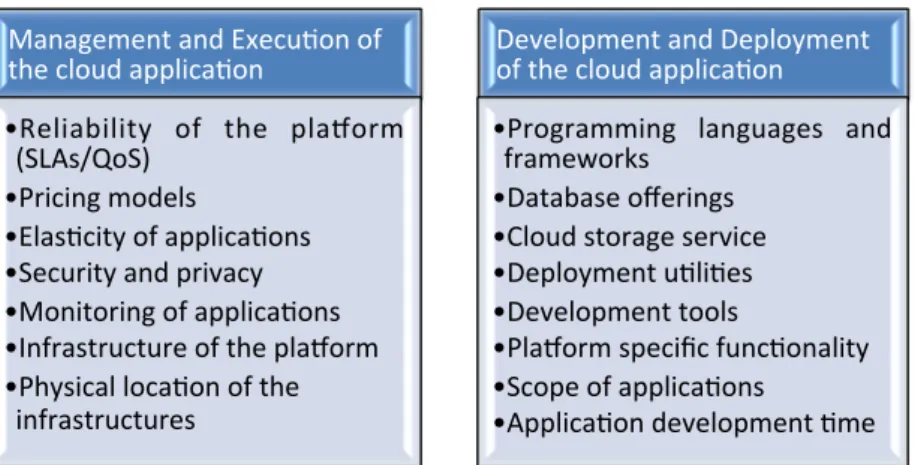
Figure 6: Cloud platform framework of features ... 37
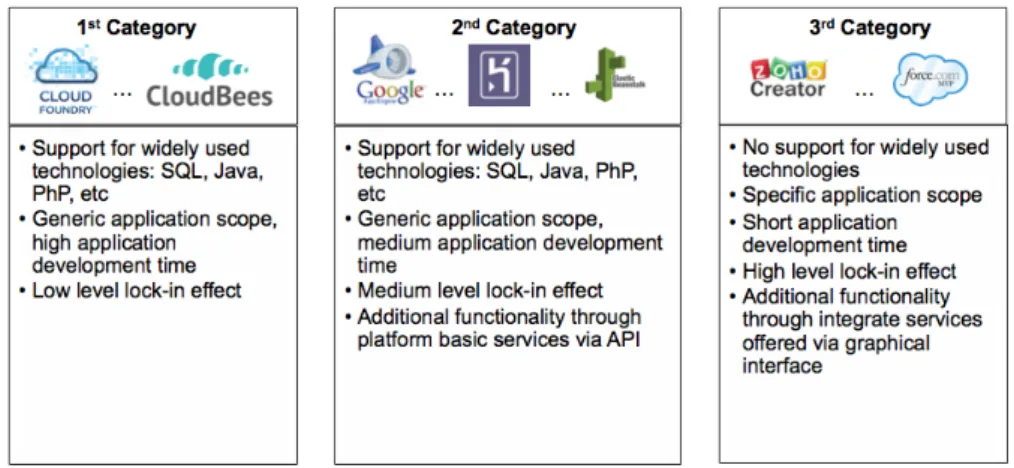
Figure 7: Classification of Cloud platforms ... 46
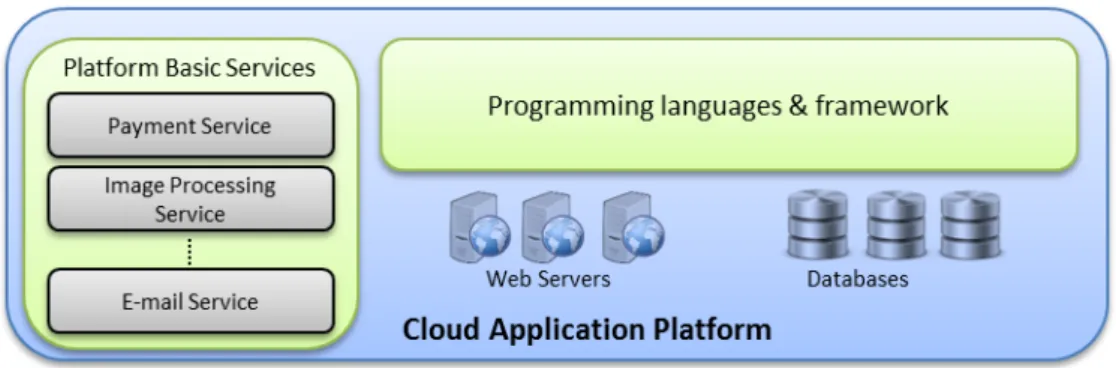
Figure 8: Cloud application Platform ... 49
Figure 9: Service-based cloud applications ... 50
Figure 10: Cloud computing standards classification ... 59
Figure 11: Aspects during the cloud application lifecycle ... 62
Figure 12: Simplified view of jClouds blobstore service internal design ... 70
Figure 13: MDE approach in developing cloud portable applications ... 84
Figure 14: Positioning of the work with respect to the three levels of cloud computing ... 92
Figure 15: Example of micro-service approach using the Heroku platform ... 96
Figure 16: Conceptual View of the Development Framework ... 106
Figure 17: Interaction between the Service-based Cloud Application and the Platform Basic Services ... 108
Figure 18: Modelling and Execution Stage of the SCADeF framework ... 111
Figure 19: High-level architecture of the SCADeF framework ... 113
Figure 21: The task flow of the SCADeF framework ... 117 Figure 22: Simplified view of the payment process ... 122 Figure 23: Simplified view of the payment process including the payment service provider ... 122 Figure 24: “Transparent redirect” Payment Process ... 125 Figure 25: State machine diagram of the “transparent redirect” payment process ... 125 Figure 26: “Server to server” payment process ... 127 Figure 27: State machine diagram of the “server to server” payment process ... 127 Figure 28: “Hosted payment pages” payment process ... 128 Figure 29: State machine diagram of the “hosted payment page” payment process . 129 Figure 30: State machine diagram of the abstract payment process ... 129 Figure 31: Reference Meta-Model ... 130 Figure 32: Role of the CloudActions and the CloudMessages ... 131 Figure 33: Cloud Payment Service Connector ... 133 Figure 34: Cloud Payment Service Provider Connector ... 136 Figure 35: Platform Service Execution Controller ... 140 Figure 36: Payment service execution flow ... 143 Figure 37: Factory Pattern ... 144 Figure 38: Front Controller ... 145 Figure 39: Template Method ... 145 Figure 40: Overview of the API service description mechanism ... 150 Figure 41: E-mail Platform Service ... 151 Figure 42: Mapping of the provider specific API to the Reference API ... 152
Figure 44: Configuration settings ... 162 Figure 45: Code generation process ... 170 Figure 46: Components involved in the code generation process ... 171 Figure 47: Code generation sequence diagram ... 172 Figure 48: Callback mechanism for passing additional parameters ... 179 Figure 49: Add new platform basic service provider ... 212 Figure 50: Add Information related to the new service provider ... 212 Figure 51: Add information related to the operations of the service provider ... 213 Figure 52: E-mail service interface ... 215 Figure 53: Postmark implementation ... 216
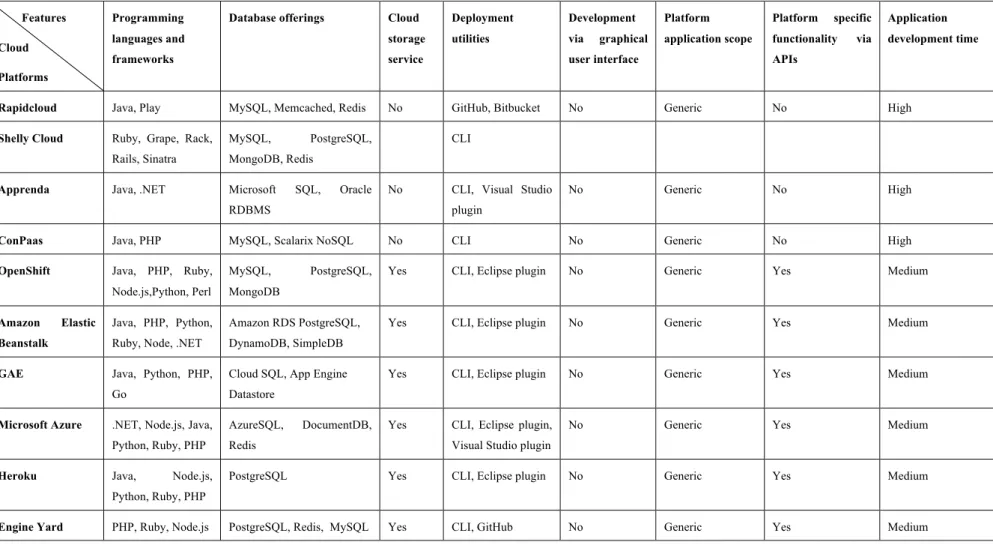
Table 1: Cloud platforms with respect to the application development features ... 44 Table 2: Summary of Middleware solutions ... 81 Table 3: Summary of Model-driven engineering based solutions ... 90 Table 4: Requirements of the SCADeF framework ... 107 Table 5: API variability in the "SendE-mail" operation of the e-mailing service ... 148 Table 6: API variability in the "chargeCard" operation of the cloud payment service
... 149 Table 7: List of mailing operations supported by the service providers ... 154 Table 8: Send e-mail operation parameters ... 155 Table 9: Bounce operation parameters ... 156 Table 10: Search operation parameters ... 156 Table 11: Create mailing list operation parameters ... 156 Table 12: Reference API ... 157
Listing 1: Code generation template [178] ... 85 Listing 2: Payment service states description file ... 134 Listing 3: Reference API captured in the Service Description File ... 158 Listing 4: Mapping of provider specific API to the Reference API ... 160 Listing 5: Configuration settings captured in the Service Description File ... 164 Listing 6: Part of the Google Authentication configuration settings ... 173 Listing 7: Additional parameters included in the Service Description File ... 178
Chapter 1
Introduction
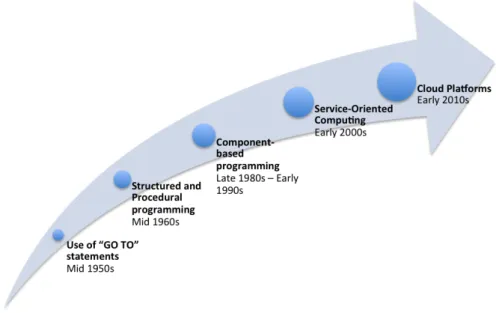
Since the early years of electronic computers and modern computing in the middle of the 20th century [1] several paradigms shifts have taken place to shape the field of software application development and empower developers to produce code faster and better (Figure 1). During the 1960s, software was characterised by complex and tangled control structure, which was mainly a result of the use of “GO TO” statements [2]. As Dijkstra specifically points out, the rampant use of the “GO TO” statements made it extremely complicated for programmers to follow the execution flow of the program and thus understand and maintain the software [3]. This style of programming has been widely known as “spaghetti code” [2].
In response to the need for structured and less complex code, structured and procedural programming appeared in the late 1960s and during the 1970s. These paradigms eliminated the “GO TO” statements and made the code more readable [4]. At the same time software engineering principles were introduced and adopted during software development, such as reusability, the separation of concerns, and modularity [2]. Modularity imposes that the computer programs are built from distinct units of code called modules. Each module implements a concrete task and exposes a well-defined interface via which it communicates with the rest of the computer program. Modularisation reduced development time since separate groups could work in parallel on each module and improved the maintainability of the software by enabling developers to better understand the software systems [5].
Introduction
Nevertheless, software continued to grow in size and to become more complex. Therefore, alternative development paradigms gained popularity to cope with this complexity and attempted to shift the software development from statement-oriented coding to system building by connecting various components [6]. In other words, as noted by Nierstrasz et al. [7], “applications can be largely constructed rather than programmed”. This paradigm, which was known since the late 1960s [8], is component-based software development. Components are highly reusable units of software functionality and can act as the building blocks of software systems [9]. At the same time the use of global variables is discouraged. Programmers could create better applications by reusing tried-and-tested software components.
Figure 1: Representative examples in the evolution of the programming style
From around 2000, the widespread use of Internet protocols such as the Hypertext Transfer Protocol (HTTP) [10] and generic data transfer formats, such as the Extensible Mark-up Language (XML) [11], paved the way for Service-Oriented Computing (SOC) [12]. This paradigm shift decouples component-based software systems into distributed collections of services. The service, which is the core concept of the SOC, is considered to be an autonomous, reusable, and portable unit of software, accessed through a standard web Application Programming Interface (API). Applications could now be built rapidly out of collections of services, which were offered by various providers.
In recent years a new computing paradigm has emerged and attempts to shape the way software applications are developed, namely cloud computing. This paradigm shift has decoupled software services from the platform and hardware resources on which they run, creating a highly distributed web of services, platform, and infrastructure. The continuous emergence of new computing paradigms is evidence of human ingenuity in attempting to satisfy the demand for increasingly complex software systems, for as Wirth says [4]:
“Our society depends to an ever increasing degree on computing techniques.” Keeping this in mind, and having as motivation our continuous striving to empower developers to produce code faster and better, this thesis looks to exploit cloud computing, and cloud platforms in particular, to enhance the software development process. Specifically, it proposes a development framework, which will enable the developers to create uniform software applications out of distributed, heterogeneous software services, independently of the concrete provider`s implementation.
The following paragraphs introduce the reader to the field of cloud computing, and cloud platforms and emphasise their role in the development of software applications. Cloud computing refers to a “virtually infinite” number of IT resources, which can be provisioned on-demand automatically, a feature originally introduced by Grid Computing, are charged on a pay-per-use basis, and can be scaled elastically according to the demand [13]. Application developers leverage the development resources provisioned by cloud providers in order to build software applications rapidly and with low-cost. Furthermore, Independent Software Vendors (ISVs) see an opportunity to develop and launch their software products through major cloud providers, such as Amazon [14] and Google [15] and thus reach a large number of potential customers [16]. Large organisations and companies exploit cloud computing offerings in order to minimise their IT infrastructure expenses. Instead of owning and maintaining an underutilised data centre, they can lease and be charged only for the resources they actually use. Likewise, small and medium enterprises can reduce drastically their upfront capital costs [17]. End users can access their data and the applications online from anywhere around the world by using web-based
Introduction
Customer Relationship Systems (CRM) and Enterprise Resource Planning (ERP) systems.
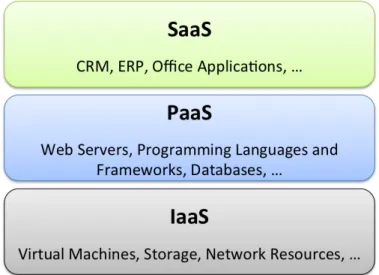
Due to the wide range of capabilities involved, which affect a broad target group ranging from large companies to individual users, cloud computing is further divided into three service models [18]:
! Software as a Service (SaaS): SaaS provides complete software applications such as CRM and office solutions for companies and end users who are not necessarily involved in the IT industry.
! Platform as a Service (PaaS): PaaS offers programming resources such as web servers, run-time containers, and databases and aims at the software developers who seek to reduce the time and effort needed to develop applications.
! Infrastructure as a Service (IaaS): IaaS refers to low-level hardware resources such as compute, storage, and network resources and mainly targets large organisations and companies.
Due to the wide range of advantages that cloud computing offers to its end users, spanning the whole IT industry, its popularity has grown continuously, and it has already reached a certain maturity [19] and mainstream adoption [20]. Particularly, Gartner [21], a leading research and market analysis company, names cloud computing as one of the top 10 strategic technology trends for 2015 [22].
PaaS has received particular attention, due its great appeal to software developers who attempt to harness the offered benefits throughout the whole lifecycle of the application development. The research firm IDC [23] estimated a compound annual growth rate of 30% for the cloud platform offerings which will reach $22 billion by 2019 [24].
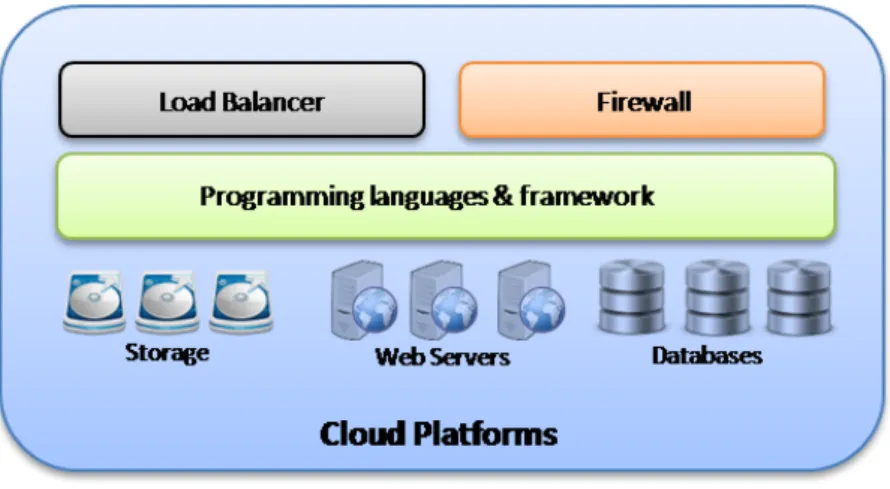
In its basic model a cloud platform provides developers with the programming resources required to build and deploy software applications, also referred to as cloud applications. Such resources include several programming languages, such as Java and PHP, databases such as MySQL [25], and a selection of web servers, such as Apache Tomcat [26] and Microsoft IIS [27]. A detailed description of cloud platforms and cloud applications is provided in the Section 2.3 and 2.4 of the next Chapter.
Due to the popularity of cloud platforms, new offerings have been constantly launched, providing additional capabilities such as monitoring, logging and reporting tools.
Apart from the resources offered to assist software engineers in the application development process, certain cloud platform providers offer additional functionality, which can be directly integrated into the application. Example of such cloud platforms are Heroku [28], OpenShift [29] and Engine Yard [30] . The functionality is provided in the form of many independently-functioning software components which can be accessed by the application using the Representational State Transfer protocol (REST) [31].
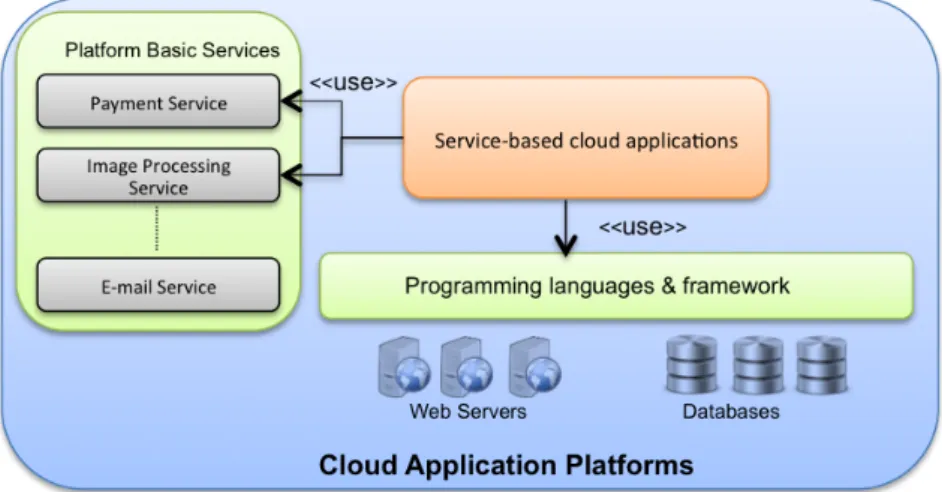
The additional functionality, which is provided by certain cloud platforms, is referred to in this thesis as a platform basic service. Examples of platform basic services are the e-mail service, the authentication service, and the payment service. Instead of building applications that offer similar services from scratch, software developers can leverage these platform basic services in order to reduce the development effort and time. Cloud applications that are based on platform-basic services will, in this thesis, be referred to as service-based cloud applications. The particular category of platforms which offer the platform basic services is also known as cloud application platforms (CAP) [32] and this term is adopted for the rest of this thesis1.
In parallel with the proliferation of the cloud application platforms and the platform basic services another software development approach has emerged and gains momentum, namely the micro-services [33]. The micro-services are defined as small and independently deployed services that work together [33]. Their key characteristic is that the communication between the services is achieved via network calls rather than library calls, via an exposed API.
Thus, software applications can be built as a combination of collaborating micro-services. The benefit of such an approach is that the application can leverage various technologies. Each service can be built using the appropriate technology and tools
1 The terms platform basic service, cloud application platform and service-based cloud application are further clarified in the Sections 3.6 of Chapter 3.
Introduction
without affecting the rest of the application. Furthermore, the application becomes more resilient since if one micro-service fails it can be replaced without cascading the failure to other components. Likewise, scaling and deployment can be managed more efficiently since they are restricted to particular micro-services. On the other hand micro-services may cause efficiency issues especially across the interfaces using network protocols.
A closer consideration of the micro-service architecture and the CAPs may reveal a strong connection between the two fields. Particularly, the notion of the platform basic services, which are offered via the CAPs, can be correlated with the concept of micro-services. As it has already been described both concepts refer to autonomous pieces of reusable software, which expose certain functionality via an API, and can be accessed through networks calls. As a result, the service-based cloud applications, which refer to applications built on CAPs and using a number of platform basic services can be considered as a realisation of the micro-services software development paradigm.
1.1
Motivation for the research work
The growing appeal of platform basic services to software developers becomes evident from the ever-increasing number of such services being offered by cloud application platforms. Indicatively, it is mentioned, that Heroku, one of the leading cloud application platforms, now counts almost 150 platform basic services [34]. These services may be provided either natively by the owners of the platform, or through the agency of ISVs, whose products are hosted by the platform. An increasing number of providers have led to the outcome that multiple providers offer the same category of platform basic service. For example, the e-mail service is offered by the following providers: SendGrid [35] via Heroku and OpenShift platform, Mailgun [36] via Engine Yard and Heroku, Postmark [37] via Heroku. Likewise, there are several providers implementing the payment service such as: Spreedly [38] and Stripe [39] offered via Heroku1. Although the various providers may offer the same category of service, they often differentiate themselves in several
features such as the pricing, the quality of the product and the provided functionality. Therefore, application developers can choose from a wide range of available options the one, which best meets the requirement at hand.
The existence of a multitude of platform basic service providers should be seen as a positive thing for the consumers, since it increases market competition and thus forces the providers to strive for more quality products and cheaper prices. However, in order for the cloud platform consumers to harness the benefits stemming from the pluralism of the providers, they need to be able to deploy seamlessly the ones which each time better meet the requirements at hand. In reality, this cannot be achieved out of the box due to the heterogeneity among the platform basic service providers which adds to the already existing heterogeneity among the cloud platform offerings. The heterogeneity lies primarily in the resources that the platforms offer. For example, certain programming languages and frameworks, such as the popular JavaEE [40] framework, is only supported by certain cloud platforms such as OpenShift. Likewise, diversity may arise in the provided databases. A detailed list of the differences, which may be encountered across the platform offerings, is stated in chapter 3.
Particularly, in the case of the cloud application platforms, an additional level of heterogeneity arises among the providers who offer platform basic services. Specifically, the following variability issues, thoroughly discussed in Chapter 4, may arise:
! The differences in the workflow: For a specific kind of service, different providers may adopt a different workflow in order to complete an operation. For example, in the case of the payment service various implementations exist that support completing a purchase request, and these can follow different workflows. ! The differences in the web API: As explained earlier in this Section, the
consumers access the platform basic services via their exposed API. Depending on the concrete provider, the expected parameters in the API may change. For example, in the case of the e-mail service, SendGrid, Mailgun, and Postmark expose a different API for the operation “send e-mail”.
Introduction
! Management of the configuration and authentication variables: In order to configure a service and authenticate the user, several variables may be required. Indicatively, the Google authentication service requires among others the following variables: a) the redirect URL, b) the client ID, c) the scope. The number and the type of the settings vary according to the provider. Considering the large number of platform basic services out of which a service-based cloud application may be composed, the management of the settings may become a time consuming and strenuous process.
The heterogeneity among the platform basic service providers may create an uncertainty to the software developers, willing to leverage platform basic services, regarding the optimal provider to be used. In turn, this may reduce the trust towards the cloud platform providers and becomes a hindrance to their wider adoption. Representatively, Gigaom research [41], a major technology market analysis company, states that despite the steady annual growth of the PaaS market, it still enjoys a slower adoption rate compared to the IaaS and SaaS market [42]. Among the reasons behind this is the confusion that IT managers experience with heterogeneous PaaS interfaces and technologies.
To challenge this current state of affairs, we believe that software developers should be empowered to create their applications without having to deal with all the inconsistencies across different cloud platforms. In other words, to the extent that this is possible, the underlying technologies that power each platform should be made transparent to the users. Therefore, applications can be built in a platform agnostic manner and only at the deployment stage the target platform is selected.
There are multiple benefits associated with granting cloud applications the ability to be deployed across multiple cloud platforms. Software developers are not required each time to cope with the peculiarities and the proprietary technology of each cloud platform. Instead, the application is only developed once and then it is deployable across multiple platforms. This fact further insulates the developers against the deficiencies of particular cloud platforms, by giving them the freedom to switch to another platform offered by a different provider. For example, a provider may fail to meet the pre-determined service level agreements (SLAs) either by reducing the
quality of the offered service, or increasing the price or even by terminating unexpectedly the services offered [43]. In such a case the software developers will be able to deploy the same applications on a different cloud platform and thus minimise the disruption caused to the users of these applications. Eventually, the ability to deploy a cloud application securely and robustly across multiple cloud platforms will promote a wider adoption of the PaaS offerings by the software developers.
1.2
Aim of the thesis
To this end the aim of this research work is to propose a methodology and build a development framework which enables the creation of cloud platform agnostic applications. Recapitulating the famous slogan invented by Sun Microsystems [44],
“Write once, run everywhere.” [45]
,which refers to the fact that Java applications can run on any device with the Java Virtual Machine [46] installed, the target of this research work is to empower software developers to code their cloud applications once and deploy them on any cloud platform. Essentially, developers should remain focused on the creation of the application and not on the process of learning the peculiarities and specific technology of each target platform.
However, although such a vision sounds highly appealing, its feasibility remains disputed. The large diversity across cloud platform offerings does not allow the engineering of a solution that abstracts over the whole variety of the platform specific technologies. The field of cloud platforms can be ranged between offerings, which provision the basic development resources offerings, which provide additional platform basic services, and platforms which follow a concrete high-level development paradigm based on graphical interfaces. Chapter 3 analyses the heterogeneity among the cloud platforms and draws the requirements that a platform needs to meet in order to be accommodated by the solution proposed in this research work. Essentially, this thesis focuses on the design of service-based cloud applications, namely those cloud applications, which are based on platform basic services.
Introduction
Specifically, this thesis proposes the Service-based Cloud Application Development Framework (SCADeF), which aims to provide the tools and the methodology to support:
i. The consistent integration of different categories of platform basic services with a service-based cloud application.
ii. The seamless use of the various platform basic service providers in a manner that is transparent and technology-agnostic to the software engineer.
Such a vision entails the alleviation of the three variability points across platform basic services, namely: (i) the differences in the workflow, (ii) the differences in the web APIs of the various providers and (ii) the management of the configuration and the authentication variables. Essentially, software developers shall focus on building the functionality of the application and then will be able to choose automatically the concrete platform basic service provider which implements this functionality.
1.3
Standardisation and Intermediation as solution approaches
Towards enabling the development of platform agnostic cloud applications, two approaches have become prominent, namely standardisation [47] and intermediation [48]. The first involves the definition of a common set of standards adopted by all cloud providers. This set of standards could include well-defined APIs, which enable the uniform access to the platform basic services, and standard formats to store and retrieve data from the databases. An example of the standardisation approach is the Cloud Data Management Interface (CDMI) [49] which puts forwards a common HTTP interface in order for the consumer to access cloud file storage services. CDMI is supported by major IT companies such IBM [50] and Hewlett Packard [51].
The second approach, intermediation, involves the introduction of an intermediate layer which decouples application development from any specific platform provider technologies. An example of a widely adopted intermediation approach is the Java Database Connectivity (JDBC) [52] driver technology, which grants Java uniform access to any kind of database by hiding the specific underlying implementation.
While standardisation seems an efficient approach to enable cross-platform development of cloud applications, the establishment of a standard is a strenuous and time-consuming process, which requires the consensus of major stakeholders1 and thus lies beyond the scope and the capabilities of this research work. Therefore, in this thesis work the intermediation approach is adopted.
1.4
Bird eye view of SCADeF (Service-based Cloud Application
Development Framework)
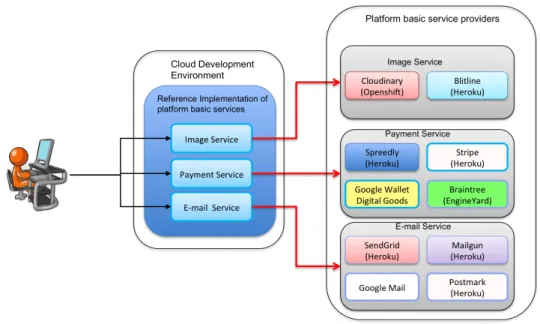
Figure 2 shows a high-level view of the SCADeF framework, the proposed solution. SCADeF mediates between the software developers and the platform basic service providers. The developers create their applications using the high level functionality offered by the framework, which then undertakes the tasks to integrate the application with the concrete service providers. As seen from Figure 2, the framework supports a number of different platform basic services and providers. For each category it provides a reference implementation, which is exposed to the developer, and the specific implementation of each supported provider. When a platform basic service is required, the reference implementation is used while the specific vendor implementation remains transparent.
Figure 2: Bird eye view of the SCADeF framework
1
Introduction
SCADeF adopts a three phase process in order to support additional platform basic services and concrete providers:
1. Platform Service Modelling Phase: During this phase, the abstract functionality of a platform basic service, which is exposed to the application developers, is modelled.
2. Vendor Implementation Phase: During this phase, the concrete implementation of each of the service providers is mapped to the abstract functionality defined in the previous step.
3. Execution Phase: During this phase, the development framework will undertake the tasks to mediate between the application and the concrete providers.
The whole process of supporting a platform basic service provider with SCADeF and the mediation between the application and the concrete providers remains transparent to the software developer. The latter focuses on building the functionality of the application and is not distracted from the specific implementations of the various service providers. Therefore, the proposed framework facilitates the seamless use of platform basic services and providers offered by different cloud application platforms and with this respect aims to contribute to the cross-platform development of the cloud applications.
1.5
Thesis Objectives
This Section presents the aims and objectives for the work described in this thesis, as well as a summary of contributions, and a synopsis of the rest of the thesis report.
Theoretical objectives 1.5.1
1. Introduce and explain the concept of the cloud application platform and the service-based cloud application as a specialisation of the concepts cloud platform and cloud application respectively.
2. Survey the existing cloud platform offerings and classify them according to their application development and deployment features.
3. Identify the variability issues which need to be addressed in order to enable the cross-platform development of service-based cloud applications.
4. Propose a methodology to alleviate the variability issues.
5. Examine certain means such as the use of XML templates and ontologies in order to capture the differences in the web APIs of the platform basic service providers.
Technical objectives 1.5.2
1. Experiment with a number of cloud platforms and platform basic services in order to extract the requirements of the development framework.
2. Design the architecture to support the cross-platform development of service-based cloud applications.
3. Implement the development framework based on the architecture. 4. Provide the toolset for:
i. The administrator of the development framework to be able to add platform basic services and their respective providers to the framework. ii. The user of the development framework to be able to make use of it
during the development of the service-based cloud application. Experimental objectives
1.5.3
1. Experiment with a set of real case platform basic services and a respective number of providers implementing those services.
2. Validate the overall approach of the development framework and demonstrate its capability to contribute to the cross-platform development of service-based cloud applications.
Thesis contributions 1.5.4
The main contributions of the thesis are listed below:
C1: Clarification of the notions of cloud applications platforms and platform basic services and a subsequent exemplification of how these notions could be leveraged to accelerate the cloud-based development process and lead to the creation of service-based cloud applications.
C2: The formulation of a methodology which enables the design of service-based cloud applications independent of the concrete platform basic service providers.
Introduction
C3: The design of the Service-based Cloud Application Development Framework (SCADeF) to support the above methodology.
C4: The construction of a toolset to enable the operation of SCADeF by the software developers.
C5: Manifestation of how the micro-service architectural style could be applied in the field of cloud computing with the use of cloud application platforms and platform basic services.
1.6
Thesis Outline
PART A: Literature review on cross-platform development of cloud applications Chapter 2: This chapter presents a selected overview of the field of cloud computing.
Its aim is to introduce the reader to the concepts, which will be used throughout the rest of the thesis. It provides a definition of cloud computing followed by a brief review of the technologies that led to this novel paradigm, namely virtualisation, grid, and distributed computing as well as the SOC. Next, it breaks down the term cloud computing into the three service models: IaaS, PaaS and SaaS. The remainder of the chapter focuses on the PaaS level and attempts to provide a concise definition of the term cloud platform as well as defining the author’s notion of a cloud application, which will be used throughout the rest of the thesis.
Chapter 3: The chapter presents an analytic survey of current cloud platforms. The scope of the survey is to examine the available cloud platform offerings and analyse them based on a certain framework of features. The purpose of this survey is to allow the categorisation of the platforms into certain groups, where the platforms in each group expose similar characteristics. This supports the goal to narrow down the research focus onto a specific group, which will benefit most from the framework proposal. According to the analysis of the survey, three clusters can be defined:
2. The second group offers additional functionality in the form of platform basic services.
3. The third group adopts a different development paradigm, which relies on web-based graphical environment.
This thesis focuses on the second group namely, the cloud application platforms. The remaining of the chapter further clarifies the terms of the cloud application platform and the applications, which are deployed on them namely, the service-based cloud applications.
Chapter 4: Chapter 4 surveys the field of cross-platform development of cloud applications. The scope of this chapter is to illustrate the approaches followed by the related work on the field. Specifically, two approaches are considered: (i) standardisation and (ii) intermediation. The latter one is further divided into three sub-categories: a) Library-based solutions, b) Model-driven engineering based solutions and c) middleware solutions. The role of the chapter is two-fold:
1. It aims to identify potential gaps in the area of the cross-platform development of cloud application, which are not covered by the existing work.
2. It pinpoints weaknesses stemming from the methodologies and the tools adopted by the related work.
The combination of the outcome of the two aims leads to the precise contextualisation of this research work.
PART B: The Service-based Cloud Application Development Framework (SCADeF)
Chapter 5: This Chapter describes the high level architecture of the proposed SCADeF framework, which aims to facilitate the cross-platform development of the service-based cloud applications. Particularly, the framework addresses the variability issues encountered when dealing with multiple platform basic services and providers. These are the:
Introduction
1. The differences in the workflow required completing the operations of the service providers.
2. The differences in the API exposed by the various service providers. 3. The management of the configuration and authentication variables
required by each provider.
In order to address these issues, as stated in Section 1.4, SCADeF consists of two parts. The first one, the Platform Service Workflow part, addresses the first variability issue, namely the differences in the workflow across the various platform basic service providers. Likewise, the second part, the Platform Service API, aims to alleviate the differences in the APIs as well as in the various configuration and authentication variables required by the service providers.
For each of the two parts SCADeF defines three phases. During the first one, the Platform Service Modelling Phase, the abstract functionality of the platform basic service is modelled. Subsequently, during the Vendor Implementation Phase the concrete implementation of each supported provider is infused. The Execution Phase is responsible for executing the workflow, which was defined during the first two phases, and generating the API client adapter required to interact with each concrete provider. Therefore, as seen in Figure 2 the application developer is able to access the required platform basic service providers by only interacting with the reference implementation provided by the SCADEF framework. The Chapters 6-9 describe in details the process of adding a new platform basic service and concrete provider to SCADEF.
Chapter 6: This Chapter focuses on the Platform Service Workflow part, namely the one that addresses the first variability issue regarding the differences in the workflow across the various platform basic service providers. The first step towards addressing the workflow variability is to define a reference workflow, which abstracts the provider specific ones. For that reason a Reference Meta-Model is provided, including the concepts required to build the reference workflow. The result is the Platform Service Connector (PSC), which contains the abstract functionality of the platform basic service. Subsequently, the
implementation of each concrete provider is built and mapped on the abstract one contained in the.
Chapter 7: After having created the abstract functionality for each platform basic service supported by the SCADeF framework and having included the concrete provider implementation, Chapter 7 describes how the functionality is executed. Specifically, the aim of the framework is to undertake the task of executing the workflow, which has been defined during the Platform Service Modelling and the Vendor Implementation Phase. For that reason the Platform Service Execution Controller is constructed to manage the execution of each state contained in the workflow. Therefore, the details of the execution of the operations defined in the platform basic services remain transparent to the application developers.
Chapter 8: A similar process to the description of the platform service workflow is defined for the description of the Platform Service API part. Chapter 8 focuses on the second variability point, which is associated to the differences in the API across the platform basic service providers. Similar to Chapter 8, this Chapter describes the way the Reference API is constructed. The Reference API describes the functionality offered by the platform basic service and is unique for each category of service supported by SCADeF. The next step is to map each vendor specific API to the reference one. Therefore, the application developers interact only with the Reference API while the vendors’ specific APIs remain transparent.
Chapter 9: After having defined the Reference API and having mapped the provider’s specific ones, Chapter 9 focuses on the Execution Phase during which the API client adapters are generated. They contain the source code required to invoke the operations offered by the platform basic service providers. The API client adapters are generated automatically using a code generator technique. Thus the application developers access only the Reference API defined in the previous Chapter and they are not required to manually implement the web calls in order to invoke the operations of the service providers. The outcome of the generation is a set of interfaces with the
Introduction
operations offered by the platform basic service and the respective implementation of the specific providers supported by the SCADeF framework. The software developers access only the service interfaces while the concrete implementation remains transparent. This contributes to the initial aim of this research work, which is to “hide” the providers’ implementation from the software developers.
PART A: Conclusion and future work
Chapter 10: This Chapter concludes the research thesis. Specifically, it summarises the research work and states how contributions, which were defined in Section 1.5 have been fulfilled. Furthermore, the Chapter recommends future work to be carried out as continuation of this research thesis.
PART A Literature review on cross-platform development of cloud applications
PART A
Literature review on cross-platform development of
cloud applications
Chapter 2 – Background on cloud computing and cloud platforms Chapter 3 – Survey of cloud platforms
Chapter 4 – Related work on cross-platform development of cloud applications
PART A
Chapter 2
Background on cloud computing and
cloud platforms
Cloud computing is still an evolving field and new offerings are constantly launched, while the terms and concepts around this paradigm are still being shaped. To this end, the Chapter attempts to provide background information on the field of cloud computing and the concepts which are involved, such as cloud platforms and cloud applications. Cloud computing has not been developed from ground up but has rather evolved from previous well-established computing paradigms. In order for the reader to understand the underpinnings of this new paradigm, a brief history of its evolution is provided and a comparison with previous computing models, such as the grid and SOC is made. The aim of the comparison is to pave the way for clarifying the notions of cloud platforms and cloud applications.
As mentioned in the Introduction, the research topic of this thesis is the cross-platform development of cloud applications. The topic involves two core terms: (i) the cloud platforms and (ii) the cloud application. Therefore, after having introduced the field of cloud computing the chapter aims at introducing the field of cloud platforms and providing the author’ notion of the cloud application, which will be adopted throughout the rest of the thesis.
Particularly, Section 2.1 attempts a short history of the evolution of cloud computing and provides the relevant information in order for the reader to gain a deeper view on how core concepts of this thesis, such as cloud platforms and applications have been evolved. To this end it examines previous computing paradigms, such as grid and
Background on cloud computing and cloud platforms
SOC. In Section 2.2 the three service models, as defined by the National Institute of Standards and Technology (NIST) [18], are introduced namely: the IaaS, the PaaS and the SaaS. The second half of the Chapter focuses on the terms of cloud platform and cloud application. Thus, Section 2.3 attempts to illustrate the field of cloud platforms by mentioning specific characteristics and major providers such as the Google App Engine (GAE) and Heroku.
Finally, Section 2.4 describes the notion of cloud application. The term is often used by different parties to denote applications which are deployed in all three levels of cloud computing (SaaS, PaaS, IaaS) [53], [54]. However, in the context of this research thesis a cloud application refers to those applications which are developed using the resources offered by the cloud platforms and are subsequently deployed on them.
2.1
Evolution of cloud computing
While cloud computing has emerged as a revolutionary computing paradigm, it does not actually constitute a novel technology, but it has rather evolved from previous established computing paradigms. This Section, as shown in Figure 3, presents a brief timeline of cloud computing and attempts to compare it with previous computing paradigms.
Historically, the term cloud computing was first envisaged by the computer scientist McCarthy and dates all the way back to 1961 [55] [56] :
“If computers of the kind I have advocated become the computers of the future, then computing may someday be organized as a public utility just as the telephone system is a public utility… The computer utility could become the basis of a new and important industry.”
McCarthy was the first one to envision computing being ubiquitous and easily available to the public.
Virtualisation technique 2.1.1
In 1967 IBM developed the CP-67 virtual machine operating system, one of the first attempts at virtualising mainframe operating systems [1]. Particularly, CP-67 was a hypervisor which enabled the sharing of memory across virtual machines and at the same time provided each user with a dedicated virtual memory space. Virtualisation is a technology which abstracts over the hardware resources and thus allows sharing of the physical resources, such as processing power, storage and networks [57]. While virtualisation has been applied since the 1960s in mainframe computing, it has only been in recent years that it has become a widespread concept in other kinds of computing, thanks to advances in computing power and high-speed networks. Thus, virtualisation constitutes an essential element of cloud computing, which decouples the allocation of the physical resources from their geographical location; and includes the notions of rapid elasticity and resource pooling. [58].
Client-Server architecture 2.1.2
In the early 1990s the client-server computing model emerged and became part of the mainstream [59]. In this computing paradigm a client initiates a request to the server and the latter processes the request and responds with the result [60]. Essentially, it relies on the distributing computing model, which promotes the communication of the various system components via message exchange [59]. The client-server model may be considered as the evolution of the mainframe systems model, which was characterised by centralised computing and restricted access [59] [61]. Cloud computing is still based on the client-server model, but there are certain differences as noted in [58] and [62]. First, cloud computing implements a management layer which
Background on cloud computing and cloud platforms
monitors the workload and is able to alleviate traffic congestion by deploying and releasing additional resources as needed. Furthermore, via cloud computing the services are offered on demand and they are highly configurable. In addition cloud computing adopts a business model based on the pay-per use approach.
Grid Computing 2.1.3
In the mid-1990s another model of computing emerged as an evolution of distributed computing, namely the Grid [63]. Grid computing denotes the large-scale sharing of resources across virtual organisations usually required by compute and data intensive scientific and engineering applications [64]. Cloud computing is sometimes considered to have been a development arising from the grid [58], [65]. However, there are significant differences between the two paradigms. Grid computing mainly focuses on the collaboration among the users in order to share resources for scientific and research purposes, while cloud computing rather targets the business and web-based applications adopting a pay-per-use policy. Additionally, while grid computing focuses on the sharing of virtualized infrastructure resources, cloud computing introduces two additional levels, namely the SaaS and the PaaS. Furthermore, grid computing aims to combine existing computing resources to provide high performance computer (HPC) capabilities to those without access to expensive HPC machines. On the other hand cloud computing leverages virtualisation techniques to enable a single physical server to be allocated to many users concurrently [58].
Service-oriented Computing 2.1.4
Moving to the late of 1990s and early 2000s a new computing paradigm arose which became known as (SOC). The goal of SOC was to push forward the rapid, cost-efficient and easy development of distributed applications as composition of services [66]. A service in this context was a packaged software component capable of being re-used in multiple applications and most importantly it was self-describing, such that it could be discovered and integrated automatically with other similar services [67]. Thus, service-based applications [68] were developed from a combination of loosely-coupled services, which each exposed a well-defined interface, hiding at the same time their underlying implementation. Cloud computing exploits the principles of
SOC in order to offer its resources to the public in a similar way. Thus cloud resources, such as storage, computation, and message queuing may be offered in the form of services via standardised technologies, such as the Web Service Description Language (WSDL) [69] and the Simple Object Access Protocol (SOAP) [70] or the REST [31]. At the same time, widely explored concepts in the domain of SOC, such as service governance and SLAs are also leveraged by cloud providers [70]. On the other hand, the emergence of the cloud computing paradigm has brought about a number of concepts which were hitherto not extensively explored, such as the pay-per-use business model and automatic resource scaling [67].
Early commercial cloud products 2.1.5
In 2002 Amazon launched the Amazon Web Services (AWS), a suite of cloud-based services, which offered computation and storage resources. Cloud computing, in the form which is known today, started after 2006 when Amazon launched the Elastic Compute Cloud (EC2) [72], which allowed small companies to rent virtual machines [73]. Google and Microsoft followed shortly afterwards with the release of their own cloud services, namely the GAE [74] in 2008 and the Microsoft Azure [75] in 2009 respectively.
Cloud computing, why now and not then? 2.1.6
From the above, it is clear that cloud computing has evolved from a number of previous well-established computing paradigms and has exploited technologies which were already established. Then why did cloud computing become widespread only the last couple of years? According to [13] it is the new technology trends and business models, such as the effortless use of credit cards to purchase online services, which has promoted the provisioning of cloud resources. Furthermore, enterprises and organisations have ascertained that their IT resources were historically largely underutilised and they could reduce their costs by renting the resources they actually need [65]. Last but not least the advances in the networking technology offered by the Internet have made feasible the sharing of cloud resources.
Background on cloud computing and cloud platforms
Thus, nowadays cloud computing has turned into a significant paradigm serving a wide range of consumers from large enterprises to individual end users. However, there are still barrier to uptake such as security, privacy and interoperability.
2.2
Cloud computing in three service models
While cloud computing initially referred to the provision of low-level hardware resources such as compute and storage, it evolved also to include the sharing of additional IT resources, such as run-time programming environments for software developers and complete software products for end users, such as software for CRM. Due to the wide range of heterogeneous resources, which are covered under the umbrella term of cloud computing, the latter is divided into certain service models. The most established classification, shown in Figure 4, is provided by NIST, which proposes the following three service models of cloud computing [18]:
Figure 4: The 3 service models of cloud computing according to NIST
! Infrastructure as a Service (IaaS): IaaS provides the consumers with low-level IT resources, such as processing, storage and networks, which the latter can use to install and run any arbitrary software including operating systems and applications. Thus IaaS allows enterprises and developers to expand their IT resources on demand. However, consumers’ access is limited to the operating systems, storage and the deployed applications and they do not have control of the underlying infrastructure. Example of IaaS offerings are: Amazon Elastic Compute (EC2) [72] and Google Compute Engine [76] which offer virtual
machines as well as Amazon Simple Storage [77] and Microsoft Azure Storage [78] which provide dynamically scalable storage solutions.
! Platform as a Service (PaaS): Cloud providers in the PaaS level offer software programming capabilities such as run-time programming environments, libraries, databases and software tools. Software developers exploit these capabilities in order to create their applications, which are then deployed on the cloud infrastructure. Similar to the IaaS level, consumers’ control is restricted to the deployed applications while they are restrained from accessing the underlying infrastructure such as the servers and the operating systems. Some representative examples of PaaS offerings are: GAE [74], a platform to develop and deploy applications in several programming languages such as Java, Python and Go. Heroku [28], is another major platform which offers programming resources and third party services, such e-mail service and payment service. Zoho Creator [79] offers a web-based programming environment for rapid and specific purpose application development such as the creation of CRM applications.
! Software as a Service (SaaS): In the SaaS level providers make available complete software applications, which are executed on their infrastructure, via a web-browser or a desktop program interface. This model signals a shift from the traditional way that software applications were distributed, installed and upgraded on the consumers’ own IT platforms. Rather consumers can directly access an application online via a web client and are charged on a pay-per-use basis. At the same time SaaS providers can use a shared application codebase to serve multiple customers via a multi-tenancy architecture [43], which may also occur in the databases. Furthermore, the process of maintaining and upgrading the software is handled entirely by the provider and remains transparent to the consumers. Similar to the IaaS and PaaS level, consumers only control the software application and they do not have access to the unde