Open Research Online
The Open University’s repository of research publications
and other research outputs
Linked knowledge sources for topic classification of
microposts: a semantic graph-based approach
Journal Item
How to cite:
Varga, Andrea; Cano Basave, Amparo Elizabeth; Rowe, Matthew; Ciravegna, Fabio and He, Yulan (2014).
Linked knowledge sources for topic classification of microposts: a semantic graph-based approach. Journal of Web
Semantics: Science, Services and Agents on the World Wide Web, 26 pp. 36–57.
For guidance on citations see FAQs.
c
2014 Elsevier B.V.
Version: Accepted Manuscript
Link(s) to article on publisher’s website:
http://dx.doi.org/doi:10.1016/j.websem.2014.04.001
Copyright and Moral Rights for the articles on this site are retained by the individual authors and/or other copyright
owners. For more information on Open Research Online’s data policy on reuse of materials please consult the policies
page.
Linked Knowledge Sources for Topic Classification of Microposts:
A Semantic graph-based approach
Andrea Vargaa, Amparo E. Canob, Matthew Rowec, Fabio Ciravegnaa, Yulan Heb
aOrganisations, Information and Knowledge Group, The University of Sheffield, UK bSchool of Engineering and Applied Science, Aston University, UK cSchool of Computing and Communications, Lancaster University, UK
Abstract
Short text messages a.k.a Microposts (e.g. Tweets) have proven to be an effective channel for revealing information about trends and
events, ranging from those related to Disaster (e.g. hurricane Sandy) to those related to Violence (e.g. Egyptian revolution). Being informed about such events as they occur could be extremely important to authorities and emergency professionals by allowing such parties to immediately respond.
In this work we study the problem of topic classification (TC) of Microposts, which aims to automatically classify short messages based on the subject(s) discussed in them. The accurate TC of Microposts however is a challenging task since the limited number
of tokens in a post often implies a lack of sufficient contextual information.
In order to provide contextual information to Microposts, we present and evaluate several graph structures surrounding concepts present in linked knowledge sources (KSs). Traditional TC techniques enrich the content of Microposts with features extracted only
from the Microposts content. In contrast our approach relies on the generation of different weighted semantic meta-graphs extracted
from linked KSs. We introduce a new semantic graph, called category meta-graph. This novel meta-graph provides a more fine grained categorisation of concepts providing a set of novel semantic features. Our findings show that such category meta-graph
features effectively improve the performance of a topic classifier of Microposts.
Furthermore our goal is also to understand which semantic feature contributes to the performance of a topic classifier. For this reason we propose an approach for automatic estimation of accuracy loss of a topic classifier on new, unseen Microposts. We introduce and evaluate novel topic similarity measures, which capture the similarity between the KS documents and Microposts at a conceptual level, considering the enriched representation of these documents.
Extensive evaluation in the context of Emergency Response (ER) and Violence Detection (VD) revealed that our approach outper-forms previous approaches using single KS without linked data and Twitter data only up to 31.4% in terms of F1 measure. Our main findings indicate that the new category graph contains useful information for TC and achieves comparable results to previously used semantic graphs. Furthermore our results also indicate that the accuracy of a topic classifier can be accurately predicted using the enhanced text representation, outperforming previous approaches considering content-based similarity measures.
Keywords: linked knowledge sources, semantic concept graphs, topic classification
1. Introduction
Social media posts, and in particular Microposts collected from Twitter, have been found to contain useful information for many applications including disaster detection [1], seasonal
mood level changes [2], tracking influenza rates [3], box-office
revenue forecast [4], political elections [5], stock market pre-diction [6], etc. For instance, during the widespread protest in Egypt in 2013, Microposts were found to provide early warn-ing signals of violent events; such events were reported much
faster than traditional media sources1. The real-time
identifica-tion of such events could be extremely important to authorities and emergency professionals by allowing such parties to imme-diately respond.
Email address:[email protected](Andrea Varga)
1http://irevolution.net/2013/07/07/twitter-political-polarization-egypt/
However, the classification of such messages poses unique challenges, due to the special characteristics of the messages i) the limited length of Microposts (up to 140 characters),
re-stricting the contextual information necessary to effectively
un-derstand and classify them; ii) the noisy lexical nature of
Micro-posts, where new terminology and jargon emerges as different
events are discussed; iii) the large topical coverage of Microp-ost.
Existing approaches have addressed these challenges by proposing the use of social knowledge sources (KSs). These sources provide additional textual data on a growing number of topics, which can alleviate the sparsity of Microposts’s con-tent ([7, 8, 9, 10, 11, 12]). Furthermore these topic classifiers
typically enhance the lexical(e.g. bag-of-words(BoW))
rep-resentation of text by incorporating additional contextual
in-formation about Microposts in the form ofsemantic (
entities(BoE)) features extracted from the content of Microp-osts only. Unlike these approaches, recently in [13] we pro-posed a TC framework which generates contextual information from graph structures surrounding concepts in multiple comple-mentary linked KSs. Among the several useful graph structures
defined in KSs ([8]), such as theresource meta graphproviding
course grained classification of concepts by their type, or the
category meta graphwhich groups similar concepts together by
their topic, our original framework exploited theresource
meta-graphfor context generation. Moreover, in [14] we also
stud-ied different content-based topic similarity (also called domain
similarity or dataset similarity [15]) measures, which quantify the similarity between the KS data and Twitter data, serving as a proxy for the performance of a topic classifier on Twitter
data. These content based features correspond to simpleBoW
andBoEfeatures derived from the Micropost content only.
Unfortunately, current approaches still present some limita-tions. The majority of the approaches model the entities using very generic concept types. For example, in the case of the
entity Obama, the generic classPerson is considered. When
detecting Microposts related to thewartopic, however, a more
fine grained categorisation of this entity, such as President of
United States(Presidents of the United States), could be more useful.
Further, the use of fine grained information in KSs provided
by thecategory meta-graphhas been exploited for many other
problems, such as document classification [8], entity disam-biguation [16], and semantic relatedness [17], and shown that it carries rich semantic information. However, to date no study
has been conducted to investigate the usefulness of this
cate-gory meta-graphgraph structure for TC.
In this paper we thus present an extension of our TC
frame-work [13], which exploits this new semantic graph, called
cate-gory meta-graph, providing a more fine grained classification of concepts based on their topics. We introduce a set of novel se-mantic features derived from this graph, and present a
compar-ative evaluation against those obtained from theresource
meta-graph.
Furthermore our goal is also to understand which semantic feature contributes to the performance of a topic classifier. For this reason we propose an algorithm for automatic estimation of accuracy loss of a topic classifier. We introduce novel topic similarity measures, which in contrast to our previous content-based similarity measures ([14]), aim to measure the similar-ity between the KS documents and Microposts at a conceptual level, considering the enriched representation of these docu-ments.
To evaluate the usefulness of exploiting this new category
meta-graph for both TC and topic similarity, we present an extensive analyses of our extended framework using a ground truth data in the Emergency Response (ER) and Violence De-tection (VD) domains.
The main research questions we investigate are the follow-ing:
• How does the performance of a topic classifier vary using different concept graphs? Which concept graph provides
the most useful semantic features for TC of Microposts?
• Are there differences in the roles (generalisation patterns) of the concept graphs in the different TC scenarios?
• Can we predict the performance of a topic classifier? Which topic similarity measure provides best estimate on the performance of a topic classifier?
1.1. Contributions
To address the above research questions, we present an ap-proach which facilitates the exploitation of multiple semantic meta-graphs from linked KSs for TC of Microposts. In partic-ular, in contrast to our previous work ([13]), in this paper our
main focus is to understand the differences between the diff
er-ent semantic concept graphs, and preser-ent a comparative
evalu-ation of these graphs at different stages of our three-stage
ap-proach. The main stages of our approach can be summarised
as follows: i) context modelling; ii) topic classification and
iii)topic similarity analysis.
Thecontext modellingstage enriches the text using different concept abstraction techniques. For this reason we extract var-ious semantic features about entities appearing in the text from two distinct concept graphs built from linked KSs.
The second stagetopic classificationinvolves the creation of
statistical TC models, which incorporate the various semantic features obtained in the context modelling step. In this stage we
investigate two different scenarios: the Twitter only scenario in
which we build a topic classifier on Twitter data only, and the cross-source TC case where we make use of the information from multiple linked KSs. This allows us to analyse which con-cept graph provides better semantic features for TC, and also
whether the role of the semantic features differ according to the
TC scenarios. In particular, we investigate whether the same semantic features which account for modelling the specificity of the topic in the Twitter only scenario, serve the same role in the cross-source scenarios.
The final stagetopic similarity analysis uses the enhanced
representation of the documents (in both the KSs and Twit-ter) following context modelling to provide an estimate on the performance of the topic classifier on new, unseen Micropost data. This allows us to analyse which semantic concept graph is better suited to measure the topic similarity between KS doc-uments and Microposts for TC. In this stage, we also investigate whether this novel representation of the documents provides a better measure for topic similarity than our previous content based statistical measures ([14]).
The main contributions of this paper are four fold:
• We introduce a novel set of semantic features derived from
thecategory meta-graphof KSs;
• We present a systematic comparison of different semantic
concept graphs for TC of Microposts;
• We present an analysis of the different roles of semantic
concept graphs on ground truth data in the VD and ER domains;
• We propose a novel set of topic similarity measures for estimating the performance of a topic classifier.
The remainder of this paper is structured as follows: Sec-tion 2 provides an overview of the employed linked KSs, and explains their relevance for TC of Microposts; Section 3 presents the related work on TC. Section 4 then provides an overview of the original TC framework employed in this work,
and describes its extension for the newly introducedcategory
meta-graph. Section 5 continues by introducing a novel set of topic similarity measures. Next, Section 6, presents the gold standard datasets used in our experiments, and Section 7 de-scribes the baseline models employed. After that, in Section 8 a comparative evaluation of the extended TC framework and new topic similarity measures are discussed. This is followed by a discussion on the shortcomings of our approach and pos-sible future extensions in Section 9. Finally, conclusions are drawn in Section 10.
2. An overview of DBpedia and Freebase Linked Knowl-edge Sources
The Linked Open Data (LOD) cloud2 consists of a large
number of interlinked KSs, covering a range of different
top-ics. Among these KSs, DBpedia3 ([18]) and Freebase4 ([19])
constitute some of the largest datasets built in a collaborative manner. The main advantages of these KSs are: i) they pro-vide plentiful amount of data on a growing number of topics, ii) they contain factual information about a large number of en-tities, covering these topics. This semantic information is also structured according to their own KS ontology.
Exploiting these KSs can thus be useful to support topic clas-sification of Microposts, as a KS’s data can be used to pro-vide additional labelled data to train supervised topic
classi-fiers of Microposts. For example, for the topicviolencewe can
consider DBpedia’s violence category (i.ehttp://dbpedia.
org/page/Category:Violence). This category provides a
large number of resources associated with it (e.g. <http://
dbpedia.org/page/Counter-terrorism>). Each of such
resources include a short description of its content (the ab-stract). This data can then be used for enhancing the lexical
feature representation for theviolencetopic. Further, the rich
semantic information within a KS ontology can be used to gen-erate violence-related features at the graph level. The same approach can be described for the representation of an entity
(e.g. http://dbpedia.org/page/Barack_Obama). An
en-tity’s representation extracted from these KSs can therefore pro-vide additional contextual information. This information can be used to enhance a Micropost representation mentioning the en-tity.
To provide context for our motivating example, we first present statistics of the KSs used in this paper (i.e. DBpedia and Freebase), summarised in Table 1.
2http://lod-cloud.net 3DBpedia, http://dbpedia.org 4Freebase, http://frebase.org
The first KS, DBpedia (dbKS), is derived from Wikipedia5.
In DBpedia each resource is harvested from a Wikipedia article
which is semantically structured into a set of DBpedia (dbOwl)6
and YAGO2 (yago)7 ontologies, with the provision of links
to external knowledge sources such as Freebase, OpenCyc8,
and UMBEL9. The Wikipedia articles are furthermore grouped
into categories, which are represented using the SKOS
vocab-ulary10. The DBpedia dump version 3.8 classifies 2.35
mil-lion resources into DBpedia’s ontology classes (dbOwl). These
classes comprises 359 distinct classes, and 740,000 SKOS
cat-egories (dbCat), which form a subsumption hierarchy and are
described by 1,820 different properties. Conversely, theyago
ontology ([20]) is a much bigger and fine grained ontology. It contains over 447 million facts about 9.8 million entities which are classified into 365,372 classes, and 104 manually defined properties.
Semantic Features DBpedia (dbKS) Freebase (fbKS)
dbOwl dbCat yago fbOnt
Resource 2.35×10⁶ 447×106 3.6×10⁶
Property(P) 1,820 104 7,000
Class(Cls) 359 NA 365,372 1,450
Category(Cat) NA 740,000 NA NA
Table 1: Statistics aboutdbOwl,dbCat,yago,fbOntKS ontologies.
In contrast to DBpedia, Freebase (fbKS) is a large online
knowledge base which users can edit in a similar manner to Wikipedia. In Freebase, resources are also harvested from mul-tiple sources such as Wikipedia, ChefMoz, NNDB and
Mu-sicBrainz11 along with data individually contributed by users.
These resources are semantically structured into Freebase’s
own ontologies (fbOnt), which consist of 1,450 classes and
more than 7,000 unique properties.
In summary, these different KS ontologies (i.e.dbOwl,yago,
fbOnt) provide a rich source of semantic information about en-tities in many domains and across topics. Further, in these KSs
each entity resource is related to different ontological classes
or concepts which can provide additional contextual informa-tion for that resource. This contextual informainforma-tion allows us to exploit various semantic structures of these resources.
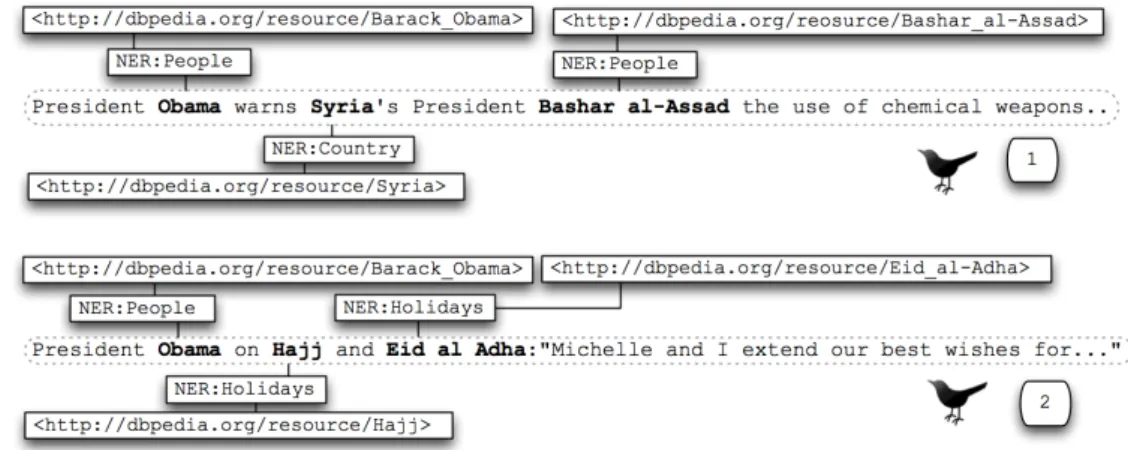
Consider the two Micropost examples displayed in Figure 1.
In these examples, the entityObamais mentioned in two diff
er-ent contexts, each of them corresponding to different roles this
entity plays (for e.g. presidentin Microposts (1); andhusband
in Micropost (2)). In such cases, the role of this entity is defined by the contextual information provided on the content of each Microposts.
5Wikipedia, http://wikipedia.org 6http://wiki.dbpedia.org/Ontology
7http://www.mpi-inf.mpg.de/yago-naga/yago/ 8OpenCyc, http://sw.opencyc.org/
9UMBEL, http://www.umbel.org/ 10http://www.w3.org/2004/02/skos/
11Freebase Datasources, http://wiki.freebase.com/wiki/Data sources
Figure 1: Tweets exposing different contexts involving the same entitiy.
In this paper, our main goal is to exploit this semantic
contex-tual information about entities. In particular, we study different
semantic graph structures defined in linked KSs, and provide a comparative evaluation of their usefulness for TC of Microp-osts. Section 4 introduces our approach and the semantic meta-graphs exploited in this work.
In addition, we explore the role of the semantic features
de-rived from these different semantic graphs in the representation
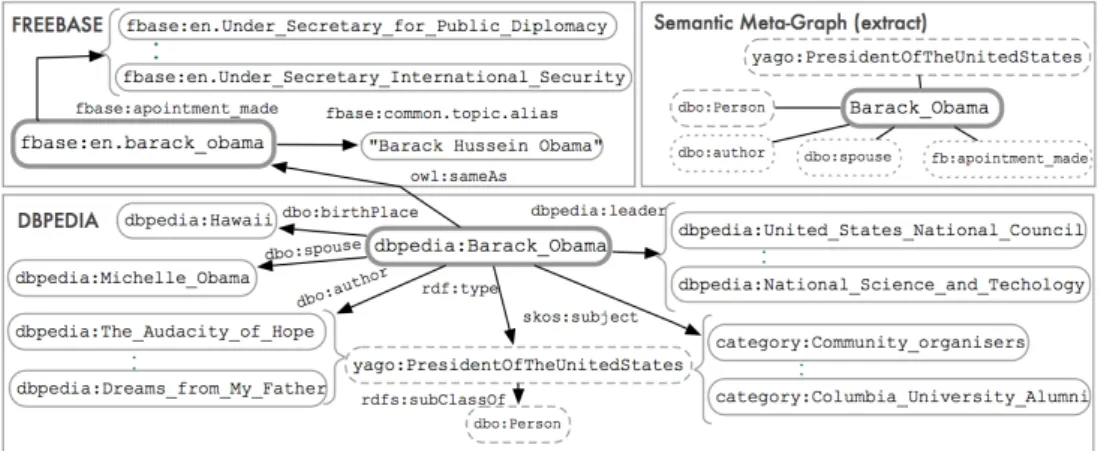
of a topic. For example, looking at the Micropost in Figure 1,
and the semantic representation of the resourceBarack Obama
in Figure 2, we can observe that the semantic features derived
aboutObama’s resource (Barack Obama) can be indicative of
the topicwar. Our aim is thus to investigate whether the
dif-ferent semantic structures of a KS can aid in identifying which semantic features are more representative of this topic. For this
reason, Section 5 introduces different metrics for analysing
dif-ferent semantic feature-based topic similarity measures.
3. Related Work
We classify the related approaches into two main strands:
re-search pertaining to generictopic detection approachesand the
use of KSs for linking topicsto Microposts.
3.1. Topic Detection in Twitter
The closest task to our multi-label topic classification task is
topic detectionwhich aims to assign a set of topics or labels to a given Micropost. Recent approaches for topic detection on
Twitter stream can be classified into: descriptive
characterisa-tion of Microposts,topic models, andclassification models.
The first approach, descriptive characterisation of topics,
employs variouslexical (bag-of-word),syntactic(hashtags) and
semantic features(named entities) extracted from the content of Microposts.
Kwak et al. [21] utilised words, phrases and hashtags as in-dicators for trending topics in Twitter. Laniado and Mika. [22]
proposed different hashtag-based metrics for identifying
com-munity interests and trending topics in Twitter. Their study re-vealed that a great proportion of hastags (more than 50%) can
be associated to Freebase concepts. Out of these, 40% were found to correspond to named entities. Other work has shown, however, that hashtags can be ambiguous and their meaning can
differ geographically [23, 24].
The second approach is based ontopic models, which rely
on the popular probabilistic Latent Dirichlet Allocation (LDA) model introduced in [25]. Zhao et al. [26] proposed an ex-tended version of the LDA model, called TwitterLDA, which aims to detect the topics of short messages using only unla-belled data. Their approach relies on distinguishing between background word (words which occur in every topic), and con-tent words (words specific to a topic). Experiments compar-ing TwitterLDA with traditional news media (e.g. New York Times) showed promising results outperforming various other topic models. Mehrotra et al. [27] proposed various pooling schemas for improving the performance of the original LDA model for topic classification. These pooling strategies aim to aggregate Microposts into longer documents (called ”macro-documents”), which are more suitable for training LDA based models. The evaluated pooling strategies were: author-wise pooling (pooling Microposts according to an author), score wise pooling (pooling Microposts according to a burst-score), temporal pooling (pooling Microposts which are posted during major events by a large number of users), hashtag-based pooling (pooling Microposts according to a hashtag).
Experi-mental results on three different datasets suggest that
hashtag-based pooling leads to drastically improved topic modelling over unpooled schemes.
Ramage et al. [28, 29], on the contrary, utilised annotated data for topic modelling. Ramage et al. [28] introduced the LabelledLDA model, which extends the original LDA model by defining a one-to-one correspondence between LDA’s
la-tent topics and social media tags. Experimental results on
a credit attribution problem, extracting tag-specific snippets from del.icio.us, showed promising results, outperforming su-pervised classifiers such as Support Vector Machines.
Ramage et al. [29] further performed an extrinsic evalua-tion of the LabelledLDA model on a user recommendaevalua-tion task. In this case, the Microposts were classified according 4
Figure 2: Deriving a semantic meta-graph from multiple linked LOD KSs.
to several dimensions including, e.g., style, substance, status, and other social characteristics of posts. Experimental results showed promising results, achieving a performance compara-ble to those obtained using term frequency-inverse document frequency (TF-IDF) feature vectors built on tokenised Microp-osts.
The third approach, classification models, is based on
dis-criminative machine learning algorithms. Lin et al. [30] pro-posed to combine a language model with a supervised classi-fier for predicting the hashtags characterising a Twitter post. The features used for classification consisted of the
perplex-ity of the unseen Microposts. Tao et al. [31] studied different
topic-dependent and topic-independent features for topic clas-sification. The topic-dependent features aimed to capture the relevance of the features to a topic (using keyword-based (lex-ical) and semantic-based relevance features). While the topic-independent features exploited various syntactic (e.g. has hash-tag) and semantic (number of entities, number of distinct entity types) Microposts characteristics. Experimental results in the context of microblog search revealed that the topic-dependent features (the semantic relevance features) play an important role in this task, outperforming approaches which do not consider them.
3.2. Semantic Linking using Social Knowledge Sources In this section we review the approaches which rely on the use of Knowledge Sources (DBpedia or Freebase) for semantic linking.
In light of the classification we used in Cano et al. [13], we distinguish between two main groups: approaches exploiting
local features, and approaches exploiting thelink structure of KSs.
In the first class of approaches, Genc et al. [9] proposed a model for mapping Microposts to the most similar Wikipedia
articles, employing a simple BoW representation for the text
content. Their approach comprises two steps: mapping Mi-croposts to Wikipedia pages; and computing the semantic dis-tance between Microposts. For the computation of semantic distance, a new measure is proposed, which approximates the
distance between Microposts by the link distance measure com-puted between the corresponding Wikipedia pages. Experimen-tal results showed that this new distance measure outperforms the String Edit Distance ([32]) and Latent Semantic Analysis ([33]).
Song et al. [34] proposed a probabilistic approach for map-ping the terms within Microposts to the most likely resources in Probase KS ([35]). These resources were furthermore used as additional features in a clustering algorithm, achieving superior
results to the simpleBoWapproach.
Shin et al. [36] proposed a graph-based approach for detect-ing persistent topics (PT) from Microposts, which correspond to topics of long-term, steady interest to a user. For their graph based approach they introduced two novel scoring functions that measure the properties inherent to PT terms: regularity and topicality. They allow to distinguish between terms that repre-sent persistent topics, and terms which appear in static docu-ments. Experimental results showed that this approach outper-formed other existing alternatives (including LDA and keyword extraction models).
Mu˜noz Garc´ıa et al. [10] proposed an unsupervised approach for assigning topics to entities within Microposts written in
Spanish. Their approach first employs the Sem4TagsPOS
tag-ger ([37]) for assigning POS tags to a Micropost. Following this process, a list of key phrases are identified, and the cor-responding topics (DBpedia resource URIs) assigned to them. This topic recognition phase further exploits only local
meta-data, such asBoW features extracted from the keywords and
contextual information in the form of neighbouring words to the keyword.
Vitale et al. [38] proposed a clustering-based approach which
enriches theBoWrepresentation of the Micropost using named
entities extracted by the proposed Tagme system. The main idea behind Tagme is to assign the most likely topic to an en-tity, by taking into account the similarity between the topics returned by Tagme and Wikipedia categories for top-few cat-egories. Experimental results showed that incorporating these
newBoEfeatures into topic classification significantly
outper-formed approaches usingBoWfeatures only.
P. N. Mendes and Sheth. [39] proposed the Topical Social Sensor system, which allows users to subscribe to hashtags and DBpedia concepts to receive updates regarding these topics. Their approach relies on linking a Micropost to DBpedia con-cepts derived from the entities contained in it. One of the main applications of the system is to detect the peak of a topic defined a priori.
Recently, in Varga et al. [14], we studied the similarity
be-tween linked KSs and Twitter using different content-based
similarity measures. Their approach employs BoW andBoE
features extracted from multiple linked KSs (such as DBpedia and Freebase). Experimental results demonstrated that these KSs contain complementary information for TC of Microposts, with the lexical features achieving the best performance.
For the second class of approaches, exploiting the link struc-ture of KSs, Michelson and Macskassy [40] proposed a model that discovers topics of interest of Twitter users based on their Microposts. Their approach relies on first extracting and disam-biguating the entities mentioned within a Micropost. Following this process, a sub-tree of Wikipedia categories is retrieved for each entity and the most likely topic assigned.
Milne and Witten. [7] proposed an approach for assigning Wikipedia resources to key concepts within Microposts. In their approach a Wikipedia article is considered as a concept. Following this representation, a machine learning approach
is presented, which employs different Wikipedia n-gram and
Wikipedia link-based features.
Xu and Oard [41] proposed a clustering-based approach
which maps terms in Microposts to Wikipedia articles. To
achieve this, their approach leverages the linking history of Wikipedia and the terms’ textual context information to disam-biguate the terms’ meaning.
Recently, in Cano et al. [13], we demonstrated that exploit-ing the semantic information about entities from DBpedia and Freebase is beneficial. In particular, incorporating additional semantic information about entities in terms of properties and concepts can further improve the performance of a topic classi-fier against the approach using Twitter data only.
There is little work on classifying blogposts into topics ([42]). Husby and Barbosa [42] demonstrated that selecting data from Freebase using distant supervision, in addition to in-corporating features about named entities is beneficial for TC.
Although previous work have focused on exploiting the se-mantic information from linked KSs for TC, the majority of these approaches still exploit a single KS. There is only little work which exploits multiple, linked KSs ([13, 14]). In Varga et al. [14], we presented an approach which makes use only of the data within KSs, ignoring the semantic information about entities present in KSs. In Cano et al. [13], we exploited a
specific semantic graph defined in KSs (calledresource
meta-graph) which groups entities together by their types. In contrast to our previous work, in this paper we focus on
understand-ing the usefulness of different semantic graphs defined in KSs.
For this reason we extended our previous framework ([13]) by
exploiting semantic information from these different semantic
meta-graphs, and examined their usefulness for TC and mea-suring topic similarity.
In particular, our framework proposes novel weighting strate-gies for the explored semantic graphs. These weights can fur-ther be used to filter on KS semantic features relevant to a
Mi-cropost. This feature selection strategy also largely differs from
state-of-the-art feature selection techniques (Forman et al. [43]) used in text classification, as they typically make use of the scores obtained for the features based on the text content only (e.g. occurrences of a feature in training positive- and negative-class training examples separately).
4. Framework for Topic Classification of Microposts
We now describe an extension of our TC framework pro-posed in [13]. This extension exploits a new type of semantic
graph structure defined in KSs, named category meta-graph,
and employs a novel set of semantic features derived from this graph for TC.
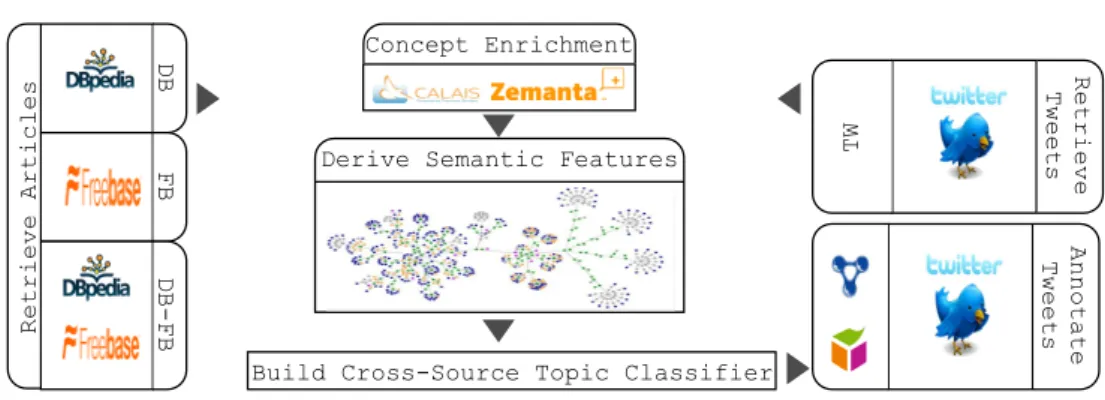
As depicted in Figure 3, our framework makes use of mul-tiple linked KSs (from LOD) for TC of Microposts. The main stages of this framework can be summarised as follows: 1) dataset collection and content modelling
2) context modelling
2.1) dataset enrichment
2.2) semantic feature derivation from different semantic
meta-graphs
3) construction of a topic classifier based on the semantic fea-tures obtained.
4.1. Dataset Collection and Content Modelling
In the first stage of our framework, data collection, data
from both Twitter and KSs is retrieved. The Twitter dataset comprises a set of topically annotated Microposts. Conversely, the KSs dataset is build from a set of articles relevant to a given topic extracted from multiple, linked LOD KSs. This study considers two linked KSs (from LOD), namely DBpedia (DB) and Freebase (FB), which are applied both independently and as a merged KS. Therefore we consider three cross-source
scenarios for the use of these KS articles: i)DB- from DBpedia
only; ii)FB- from Freebase only; and iii)DB-FB- from both
DBpedia and Freebase.
Having the documents selected from both KS and Twitter, a
simpleBoWrepresentation is employed for modelling the
con-tent of these documents. This allows these datasets to be repre-sented based on what is discussed in these documents. In order to capture the importance of each word mentioned in these doc-uments, the TF-IDF weighting schema is applied.
4.2. Context Modelling
The second step of our framework aims to enrich the repre-sentation of both KS and Twitter documents using information about the entities and concepts mentioned in these documents. 6
In order to achieve this, two main steps are first performed: (i) entity extraction - employing the OpenCalais12 and
Ze-manta13 services for extracting the named entities in the
doc-uments; and (ii)semantic mapping- where the obtained named
entities are mapped to their KS resource counterpart if it ex-ists14.
Following this process, differentsemantic meta-graphs are
exploited from the different KSs, and a set of semantic features
derived, leveraging the rich semantic information about entities described in these semantic meta-graphs. This stage comprises
two steps: (i)semantic meta-graph constructionand (ii)
seman-tic feature creation. In the following subsections we discuss each of these steps.
4.2.1. Semantic Meta-Graphs Construction
The mapping of entities to DBpedia and Freebase URIs al-lows the incorporation of rich semantic representations into a topic classifier. In particular, the presented DB and FB KSs provide a rich source of structured information about concepts. Figure 2 presents an overview of the semantic features
ex-tracted for the entity Obama. Similar to our previous work
([13]), rather than focusing on the<subject, predicate, object>
instances associated with a resource, we focus on each triple’s semantic structure at a meta-level, and for that we introduce
two semantic meta-graphs: the resource meta-graphand the
category meta-graph.
The first proposed in our original framework ([13]),resource
meta-graph, exploits semantic information about an entity’s KS
resource. The second is the category meta-graph which
ex-ploits the semantic information extracted from the Wikipedia categories to which an entity belongs. This second graph can be effectively considered as a subset of the first one, as it groups similar entities belonging to the same topic under the same
label. Thecategory meta-graphthus categorises entities into
more granular taxonomies.
We define these semantic meta graphs as follows:
Definition(Resource Meta Graph). is a sequence of tuples G:=(R,P,Cls,Y)where
• R,P,Clsare finite sets whose elements are resources,propertiesandclasses;
• Yis the ternary relationY⊆R×P×Clsrepresenting a hy-pergraph with ternary edges. The hyhy-pergraph of a Resource Meta GraphYis defined as a tripartite graphH(Y)=hV,Di
where the vertices areV=R∪P∪Cls,and the edges are: D={{r,p,cls} |(r,p,cls)∈Y}.
A resource meta-graph provides information regarding the set of ontologies and properties used in the semantic definition
of a given resource. The meta-graph of a given entity ecan
be represented as the sequence of tuplesG(e)=(R,P,Cls,Y0), which is the aggregation of all resources, properties and classes
12OpenCalais, http://www.opencalais.com 13Zemanta, http://zemanta.com
14Following this process, the percentage of entities without a deferenced URI
is 35% in DBpedia, 40% in Freebase, and 36% in Twitter.
related to this entity. In addition, we introduce two further no-tations:R(cls)={e1, . . . ,en}for referring to the set of all entity resources whoserdf:typeis classcls; andR0(cls)={e1, . . . ,em} for denoting the set of entity resources whose types are
special-isations ofcls’s parent type (i.e. resources whoserdf:types are
siblings ofcls).
Definition (Category Meta Graph). represents a qualified subset of the resource meta graph G in which all classes are of type dbCat:concept (skos:Concept). We define it as follows: Gcat:=(R,P,Cat0,Y)where Cat’ is a finite set whose elements
are classes of type dbCat:concept.
Class Category
dbOwl:Person dbCat:Presidents of the United States
dbOwl:Author dbCat:Obama family
dbOwl:OfficeHolder dbCat:Harvard Law School alumni
yago:LivingPeople dbCat:Democratic Party Presidents of the United States
yago:President dbCat:United States presidential candidates, 2012 Table 2: Top 5 features extracted from the DBpedia KS for the entityObama
of type Person.
For the sake of comparison, Table 2 and Table 3 present the top few class and category features derived from these graphs
for two different entity types (Obamaof type Person, andSyria
of type Country). As we can observe, thedbCatfeatures group
entities by topic, while the dbOwl features group entities by
type15.
Class Category
dbOwl:Place dbCat:Countries of the Mediterranean Sea
dbOwl:PopulatedPlace dbCat:Arabic-speaking countries and territories
yago:Country dbCat:Eastern Mediterranean countries
yago:YagoGeoEntity dbCat:Member states of the United Nations yago:MiddleEasternCountries dbCat:Western Asian countries
Table 3: Top 5 semantic features extracted from the DBpedia KS for the entity
Syriaof type Country.
In light of the proposed three KS cross-source scenarios we
construct three differentresource meta-graphs: (i) one fromDB
using thedbOwlandyagoontologies; (ii) one fromFBusing
the fbOnt ontology; and (iii) another one fromDB-FB using the joint ontologies. For the joint scenario we use the
con-cepts from dbOwlontology together with the the classes
ob-tained after mapping theyagoandfbOntontologies16. For the
category meta-graphswe derived a concept graph only from DBpedia, given that there is no category structure defined in Freebase. The three category meta graphs in this case
corre-spond to (i) one fromDBusing the dbCatcategories; (ii) one
fromFBusing thedbCatcategories obtained after mapping the
FB URIs to DB URIs (iii) another one fromDB-FBusingdbCat
categories.
15Further statistics about these semantic features are provided in Table 5. 16The mapping of Freebase entity classes to the most likely Yago classes
was done by a combined element and instance based technique (www.l3s.
de/~demidova/students/master_oelze.pdf ([44]) and is available at
http://iqp.l3s.uni-hannover.de/yagof.html). 7
Concept Enrichment DB FB DB-FB Retrieve Articles TW Retrieve Tweets
Derive Semantic Features
Build Cross-Source Topic Classifier
Annotate
Tweets
Figure 3: Architecture of cross-source TC framework using semantic features derived from semantic meta-graphs.
4.2.2. Semantic Feature Creation
Once a semantic meta graph has been constructed for a given
entity, three main features can be derived from it: class,
cate-goryandpropertyfeatures. Among these features theclassand
categoryfeatures are particular to a semantic meta-graph:class
being extracted from theresource meta-graph, andcategory
be-ing derived from thecategory meta-graph; while theproperty
features are common to both meta-graphs.
We now describe each semantic feature as follows:
• Semantic class features (Cls): Extracted from the
re-source meta-graph, this feature set consists of all
the classes an entity refers to. This set captures
fine-grained information about this entity. For
ex-ample, for Barack Obama these features would be
yago:PresidentsOfTheUnitedStates, fbOnt:/book/author,
yago:LivingPeople, and dbOwl:Person. Our main
intu-ition is that the relevance of an entity to a given topic could be inferred from an entity’s class type. For
exam-ple, the classyago:PresidentsOfTheUnitedStates could be
considered more relevant to the topic violence, than the
classyago:Singer.
• Semantic category features (Cat): Extracted from the
category meta-graph, this feature set captures the
Wikipedia categories an entity is related to. Similar
to the semantic classes, these categories provide addi-tional fine-grained information about entities, as enti-ties about similar topics are grouped together in cate-gories. For example, for Barack Obama these category
features would be dbCat:American political writers,
db-Cat:People from Honolulu, Hawaii.
• Semantic property features (P): Common to both
seman-tic meta-graphs, this feature set captures all the properties an entity is associated with. Our intuition is that given a context, certain properties of an entity may be more in-dicative of this entity’s relevance to a topic than others. For example, given the role of Tahrir Square in the
Egyp-tian revolution, properties such as dcterms:subjectcould
be more topically informative thangeo:geometry. The
rel-evance of a property to a given topic can be derived from
the semantic structure of a KS graph by considering the approach proposed in Subsection 4.3.1.
4.3. Supervised Topic Classifier Creation
The final stage of the framework aims to build supervised
topic classifiers corresponding to the different cross-source
sce-narios, which make use of the generated KS semantic features. The Support Vector Machine (SVM) ([45]) with polynomial kernel was selected as a base classifier, which we detail in Sec-tion 8.
For incorporating the presented KS semantic features into
a topic classifier, this framework employs different weighting
strategiesfor the semantic features and feature combinations,
as well as differentsemantic augmentation strategies for
ex-tending the initial feature spaces of both KS and Twitter docu-ments. In this section we review these two strategies -originally
proposed in ([13]) - and present their adoption for thecategory
meta-graph.
4.3.1. Semantic Feature Weighting Strategies
The goal of the feature weighting strategies is to capture the importance of the semantic features for a given topic, based on the structure of the KS ontologies.
In the following we present an overview of the weighting
strategies applied for the different semantic features derived
from theresource meta-graphandcategory meta-graph:
• Semantic Feature Frequency (W-Freq): This weighting
strategy provides a light-weight approach for weighting
the different semantic features f (ontological class,
cat-egory and property features) derived for entities. This weighting function aims to enrich the feature space of a
document (i.e KSs’ article, or Tweet) x by considering
all the semantic meta-graphs extracted from the entity re-sources appearing in this document.
Formally, the frequency of a semantic feature f in a given
documentxwith Laplace smoothing can be defined as
fol-lows: W−Freqx(f)= Nx(f)+1 P f0∈FNx(f0)+|F| (1)
whereNx(f) is the number of times feature fappears in all
the semantic meta-graphs associated to documentx; andF
is the semantic feature’s vocabulary. This weighting func-tion captures the relative importance of a document’s se-mantic features against the rest of the corpus; while the normalisation prevents bias toward longer documents.
While theW-Freq(semantic feature frequency) weighting
function depends on the occurrences of features in a par-ticular document, other generalised weighting information can be derived from a KS’s semantic structure to charac-terise a semantic meta-graph. To derive a weighted seman-tic meta-graph the following W-SG weighting strategy is proposed.
• Class/Category-Property Co-Occurrence Frequency (
W-SG): The rationale behind this weighting strategy is to
model the relative importance of a propertyp(e.g.dbOwl:
leader) to a given class cls (yago:President) or category
cat (dbCat:United States presidential candidates, 2012), together with the generality of the property in a KS’s graph.
This weighting function computes how specific and how
general apropertyis to a givenclassorcategorybased on
a set of semantically related resources derived from a KS’s graph.
In particular, given the semantic meta-graph of an entity e (i.e. G(e)), the relative importance of a propertyp∈G(e)
to a given class cls ∈ G(e) in a KS graph GKS can be
computed by first defining the specificity of p tocls as
follows:
specificityKS(p,cls)=
Np(R(cls))
N(R(cls)) (2)
where Np(R(cls)) is the number of times property p
ap-pears in all resources of typeclsin the KS graphGKS, and
N(R(cls) is the number of resources of type c inGKS. This
measure captures the probability of the property p being
assigned to an entity resource of typecls.
For example for the Obama entity, considering the
dbOwl:leader property andyago:President class, the
speci-ficity value ofdbOwl:leader in the DBpedia graphGDBis
computed as follows:
specificity DB(dbOwl:leader,yago:President)
={|<?heado f state,dbOwl:leader,?leader>,
<?heado f state,rd f :type,yago:President>∈ GDB|}/ {|<?heado f state,rd f :type,yago:President>∈ GDB|} (3) As indicated in Equation 2, the computation of the
speci-ficity value is independent of the entityeand differs
ac-cording to the KS graph from which it is derived17. Higher
specificity values indicate that the property poccurs
fre-quently in resources of the given classcls.
17It might be worth mentioning that for each entity resource the specificity
values for the properties are the same, capturing in this way the generalisation of the property for the same concept type.
Conversely, the generality measure captures the
speciali-sation of a propertyp to a given classcls, by computing
the property’s frequency within other semantically related
classesR0(cls). The generality measure of a propertypto
a classclsin a KS graphGKS is defined, as follows:
generalityKS(p,cls)=
N(R0
(cls))
Np(R0(cls))
(4)
whereN(R0(cls) is the number of resources whose type is
eitherclsor a specialisation ofcls’s parent classes. This
measure captures the relative generalisation of a property
p to a broader set of specialised sibling classes derived
from cls, and its computation is independent of the
en-titye. In this case the generality of propertydbOwl:leader
given the classyago:President for theDBgraph is
com-puted as:
generality DB( dbOwl:leader, yago:President )=
{|<yago:President, rdf:subClassOf, ?parent>,
<?group,rd f :subClassO f,?parent>
<?agroup,rd f :type,?group>
∈ G DB|}/
{|<yago:President, rdf:subClassOf, ?parent>,
<?group,rd f :subClassO f,?parent>
<?agroup,rd f :type,?group>
<?agroup,dbOwl:leader,?leader>∈ G DB|}|} (5) Higher generality values indicate that a property spans over multiple classes, and is less specific to a given class
cls. These two measures (generality and specificity) of a
propertypto a given classclsare combined as follows:
W-SG(p,cls)=specificity(p,cls)×generality(p,cls) (6)
4.4. Incorporating Semantic Features into TC’s Feature Space
This section provides an overview of the semantic augmen-tation strategies supported by the TC framework proposed in
[13], and presents its extension to thecategory meta-graph.
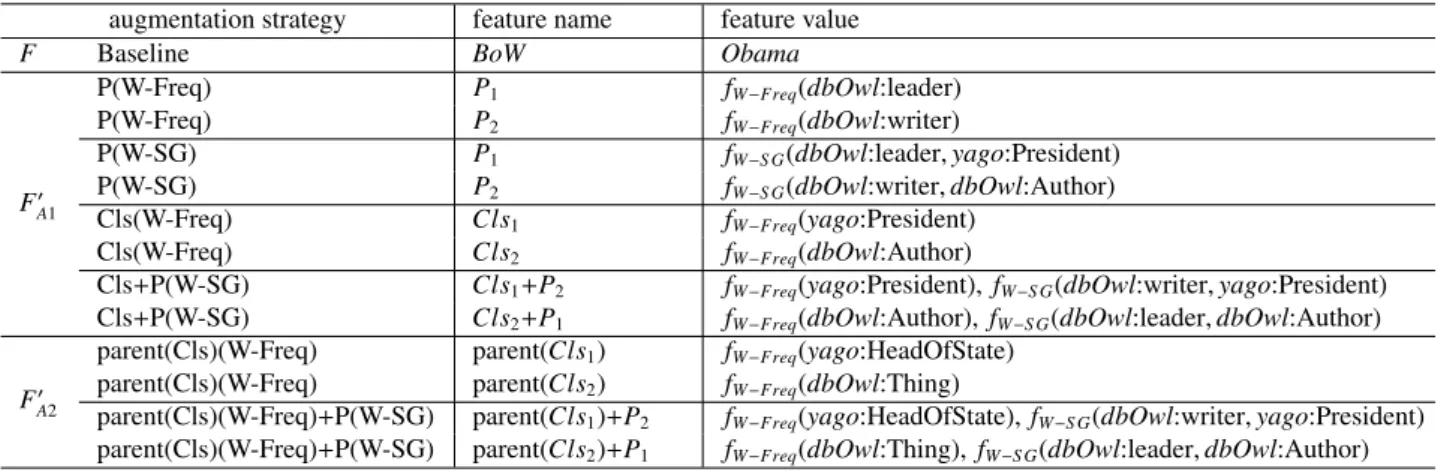
Ex-amples for the various semantic features, feature combinations and semantic augmentation strategies employed for the entity
Obamaare provided in Table 4.
4.4.1. Semantic augmentation
This strategy (FA10 ) augments the initial lexical features (e.g
BoWandBoEfeatures) of the datasets with additional semantic
information extracted for the entities appearing in them.
In the case of theresource meta-graph, for bothCls andP
features, the original lexical feature set F has been extended
with a set of unique Cls (including for e.g. dbOwl:Author)
andP(including for e.g. dbOwl:writer) features derived from
this graph. In this case, the expanded feature space vocabu-lary size becomes|F0A1
Cls|=|F|+|Fcls|for theClsfeatures and |F0A1
P| = |F|+|Fp|for the Pfeatures, where|Fcls|denotes the
augmentation strategy feature name feature value
F Baseline BoW Obama
F0 A1
P(W-Freq) P1 fW−Freq(dbOwl:leader)
P(W-Freq) P2 fW−Freq(dbOwl:writer)
P(W-SG) P1 fW−S G(dbOwl:leader,yago:President)
P(W-SG) P2 fW−S G(dbOwl:writer,dbOwl:Author)
Cls(W-Freq) Cls1 fW−Freq(yago:President)
Cls(W-Freq) Cls2 fW−Freq(dbOwl:Author)
Cls+P(W-SG) Cls1+P2 fW−Freq(yago:President),fW−S G(dbOwl:writer,yago:President)
Cls+P(W-SG) Cls2+P1 fW−Freq(dbOwl:Author),fW−S G(dbOwl:leader,dbOwl:Author)
F0 A2
parent(Cls)(W-Freq) parent(Cls1) fW−Freq(yago:HeadOfState)
parent(Cls)(W-Freq) parent(Cls2) fW−Freq(dbOwl:Thing)
parent(Cls)(W-Freq)+P(W-SG) parent(Cls1)+P2 fW−Freq(yago:HeadOfState),fW−S G(dbOwl:writer,yago:President)
parent(Cls)(W-Freq)+P(W-SG) parent(Cls2)+P1 fW−Freq(dbOwl:Thing),fW−S G(dbOwl:leader,dbOwl:Author)
Table 4: Example semantic augmentation strategies for the entityObamausing semantic features derived fromresource meta-graph. The first column stands for the augmentation strategies used to incorporate semantic features into a TC classifier, the second column provides example features to which the augmentation strategies are applied, while the third column gives examples of possible values for each such feature.
As possible semantic features two different features are considered:P1,P2corresponding to top semantic property features, andCls1,Cls2referring to top semantic class features forObama. These features are considered alone as well as in combination (for e.g.Cls1+P2). For the sake of completeness, in the first row, the
original feature space denoted byF, consisting ofBoWfeatures, is also presented. For this feature representation no augmentation strategy is applied. For the semantic features further two different augmentation strategies are presented:F0
A1extending theFfeatures with semantic features, andF
0
A2augmenting the Ffeatures with semantic features derived from the class hierarchies of KSs (e.g. considering the parent classes of a class (parent(Cls))). For both augmentation strategies two different weighting strategies are presented: W-Freq corresponding to the semantic feature frequency weighting, and W-SG corresponding to the class-property co-occurrence weighting. When these strategies are applied for the feature combinations (e.g.Cls1+P2), two additional features are added to the TC classifier (e.g. fW−Freq(yago:President),fW−S G(dbOwl:writer,yago:President)).
total number of unique class features added and|Fp|denotes the
total number of unique property features added. Furthermore,
for the combinedCls+Pfeature set this augmentation strategy
creates the novel feature setF0
A1Cls+P, in which the feature setF
is expanded with the properties’ < p,cls >tuple features
de-rived from the semantic meta-graphs. In this case, the size of the expanded feature set is:|F0A1
Cls+P|=|F|+|Fp| × |Fcls|(see the Cls1+P2andCls2+P1examples in Table 4).
Similarly, for the category meta-graph, the expanded
fea-ture set becomes |F0A1
Cat| = |F|+|Fcat| for theCat features,
and|FA10
P| = |F|+|Fp|for theP features. In this case,|Fcat|
refers to the total number of unique category features and|Fp|
denotes the total number of unique property features derived
from this graph. Furthermore, for the combine Cat+ P
fea-ture set this augmentation strategy creates the novel feafea-ture set
F0
A1Cat+P, in which the feature setF is expanded with the
prop-erties’ < p,cat >tuple features derived from this semantic
meta-graph. In this case, the size of the expanded feature set is:|F0
A1Cat+P|=|F|+|Fp| × |Fcat|.
4.4.2. Semantic augmentation with generalisation
This augmentation strategy (FA20 ) aims to further improve the
generalization of a TC by exploiting the subsumption relation among classes within the DBpedia or Freebase ontologies.
In the case of the resource meta-graph, the feature setF is
enhanced with the set of parent classes ofclswherecls∈Cls.
Therefore the size of the enhanced feature set F0
A2Cls is
com-puted as |F0
A2Cls| = |F| +|Fparent(cls)|, where |Fparent(cls)|
de-notes the total number of unique parent classes of cls.
Sim-ilarly, the enhanced feature set F0
A2Cls+P which uses theCls+P
features is built by adding the < p,parent(cls) >tuple
fea-tures. The size of the F0A2
Cls+P is therefore: |F 0
A2Cls+P| = |F|+
|Fp| × |Fparent(cls)|, where|Fparent(cls)|denotes the total number of
uniqueparent(cls) classes derived from this graph.
When applying this strategy over thecategory meta-graph,
however, the subsumption relations among the SKOS cate-gories are considered. In this case, the expanded feature set size for theCatfeatures is|F0A2
Cat|= |F|+|Fparent(cat)|, and for the
combinedCat+Pfeatures is|FA20
Cat+P|=|F|+|Fp| × |Fparent(cat)|
features. In this case |Fparent(cat)| stands for the number of
unique parent SKOS classes ofcat, and|Fp|denotes the number
of unique properties extracted from thiscategory meta-graph.
The following section introduces a set of metrics we pro-posed for analysing the relevance of these semantic features to the performance of a topic classifier.
5. Measuring Topic Similarity
In the previous section we presented different semantic
fea-tures extracted from two semantic meta-graphs, which can be used to enhance the representation of documents with addi-tional contextual information. While feature expansion can be beneficial in some cases, in others it rather undermines the per-formance of a topic classifier. In order to understand the rele-vance of the proposed semantic features to the performance of
a topic classifier, in this section we study different topic
simi-larity (also called domain simisimi-larity [15]) measures which can provide an estimate of the usefulness of these structures for TC. Designing such topic similarity measures can be extremely important for a cross-source topic classifier, as they could help in providing an estimation of usefulness of a KS graph to pre-viously unseen lexical data. One such example could be, the
application of our model to a different genre, longer posts e.g.
blogposts or Facebook comments. Another situation could be, 10
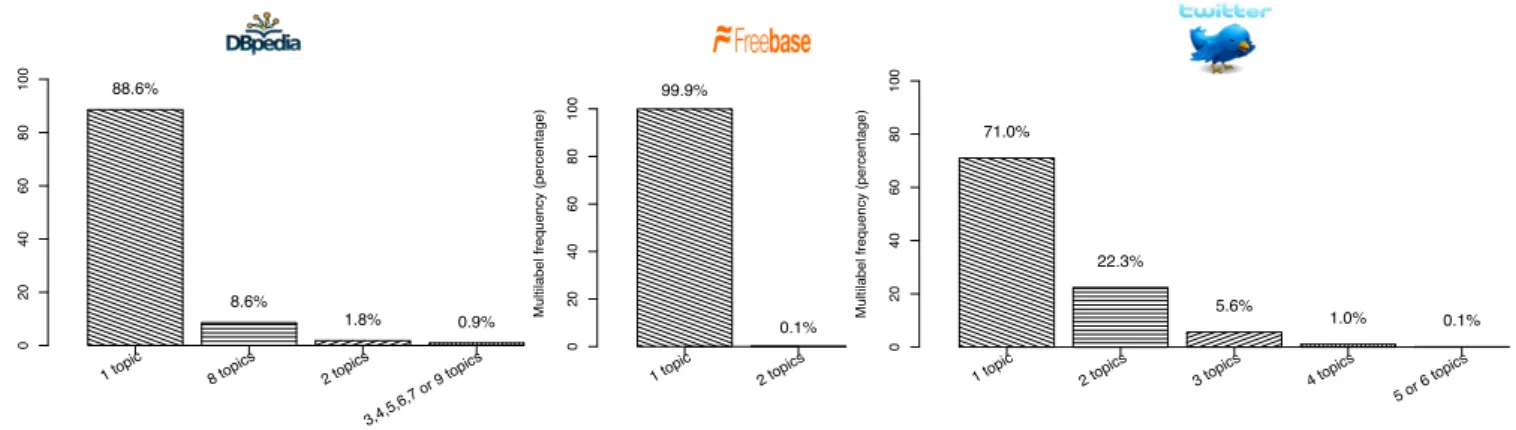
Multilabel frequency (percentage) 0 20 40 60 80 100 88.6% 8.6% 1.8% 0.9%
1 topic 8 topics 2 topics
3,4,5,6,7 or 9 topics
Multilabel frequency (percentage)
0 20 40 60 80 100 99.9% 0.1% 1 topic 2 topics
Multilabel frequency (percentage)
0 20 40 60 80 100 71.0% 22.3% 5.6% 1.0% 0.1%
1 topic 2 topics 3 topics 4 topics
5 or 6 topics
Figure 4: The multi-label distribution of the three gold standard datasets: DBpedia, Freebase and Twitter datasets. The numbers on the x axis represent the number of topics assigned to a document, raging from 1 topic to 9 topics. The numbers on the y axis correspond to the percentage of documents labelled with different topics ([14]).
in building a topic classifier for a new topic (e.g. Politics), in which case we want to have an a priori estimate of the similarity between KS data and Twitter data.
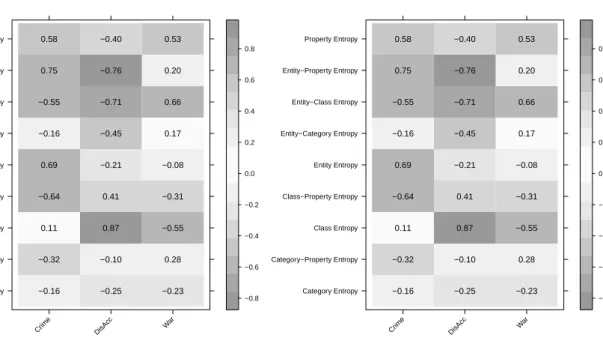
In light of the semantic features (f ={Cls,P,Cat}) and
fea-ture combinations (f ={Cls+P,Cat+P}) introduced in Section
4.2.1, we thus propose a set of entropy-based measures for topic similarity.
Entropy is an information theoretic measure which defines a
probability distribution p18 over a random variable X,
captur-ing the dispersion of the variable f among the different classes
in a given dataset T: HT(f) = −Pf∈X p(f) logp(f). In our context, we introduce this measure, as it allows to capture the semantic ambiguity and uninformativeness of a topic based on
the entities mentioned in the documents and the KS structure19.
That is, entities that are evenly distributed over multiple KS
concepts/categories will have high entropy and thus topics
men-tioning these entities are less focused (more ambiguous) in the subject(s) they discuss.
A summary of the proposed measures can be given as fol-lows:
1. Topic-Class bag entropy (Class Entropy) : We took the
class bag for each topic derived from theresource
meta-graphsand measured the entropy of that class bag, captur-ing the dispersion of classes used for a particular topic. In
this context,low entropyindicates a focused topic, while
high entropyindicates an unfocused topic, which is more random in the subjects that this topic discusses. We define this measure as follows:
HT(Cls) = −P|jCls=1T|p(clsj) logp(clsj), where p(clsj)
de-notes the conditional probability of a conceptclsj, within
the topic’s concept bagClsT.
18In this paper we used the shorthand notationpforPr
p(X=f). We reserve
the capitalPfor the property features.
19Compared to previous content-based similarity measures (e.g. cosine),
these measures can explicitly measure the informativeness of a topic by cap-turing the dispersion of the entities among different KS classes/categories ac-cording to the various semantic meta-graphs presented.
2. Topic-Category bag entropy(Category Entropy): We
con-structed the category bag for each topic derived from the
category meta-graphs and measured the entropy of that category bag, capturing the dispersion of categories used
for a particular topic. In this context,low entropyindicates
a focused topic, whilehigh entropyindicates an unfocused
topic, which is more random in the subjects that this topic discusses. We define this measure as follows:
HT(Cat)=−P|jCat=1T|p(catj) logp(catj), wherep(catj)
de-notes the conditional probability of a categorycatj, within
the topic’s category bagCatT.
3. Topic-Property bag entropy(Property Entropy): We
con-sidered the property bag for each topic derived from the KS graphs and measured the entropy of that property bag, capturing the dispersion of properties used for a
partic-ular topic. In this context, low entropy indicates a
fo-cused topic, while high entropy indicates an unfocused
topic which is more random in the subjects that this topic discusses. We define this measure as follows:
HT(P) =−P|jP=T1|p(pj) logp(pj), wherep(pj) denotes the
conditional probability of a propertypj, within the topic’s
property bagPT.
4. Topic-Entity bag entropy (Entity Entropy): We took the
entity bag for each topic extracted by the named entity recogniser and measured the entropy of that entity bag, capturing the dispersion of entities used for a particular
topic. In this context, low entropy indicates a focused
topic, while high entropy indicates an unfocused topic
which is more random in the subjects that this topic dis-cusses. We define this measure as follows:
HT(Ent) = −P|jEnt=1T|p(ej) logp(ej), where p(ej) denotes
the conditional probability of an entity ej, within the
topic’s entity bagEntT.
5. Entity-Class entropy (Entity-Class Entropy): We
com-puted this measure for each topic, by considering the class bags for each entity mentioned in a topic, based on the
ex-tractedresource meta-graphs. This measure captures the
dispersion of the entities in each class. That is,low entropy
indicates that the topic is less ambiguous, consisting of
en-tities belonging to few classes, whilehigh entropyrefers to
higher ambiguity at the level of entities.
HT(Cls|E) = −P
|ET|
j=1p(ej)HT(Cls|E = ej), where p(ej)
denotes the conditional probability of an entityej within
the topic’s entity bag ET, and HT(Cls|E = ej) refers to
topic class entropy given the entityej.
6. Entity-Category entropy(Entity-Category Entropy): In an
analogy with the Entity-Class entropy, we computed this measure for each topic, by considering the category bags for each entity mentioned in a topic based on the extracted
category meta-graphs. In this case,low entropyindicates that the topic is less ambiguous, consisting of entities
be-longing to few categories, while high entropy refers to
higher ambiguity at the level of entities.
HT(Cat|E) = −P
|ET|
j=1 p(ej)HT(Cat|E = ej), where p(ej)
denotes the conditional probability of an entityej within
the topic’s entity bag ET, and HT(Cat|E = ej) refers to
topic category entropy given the entityej.
7. Entity-Property entropy(Entity-Property Entropy):
Simi-larly, we took the property bag for each entity mentioned in a topic based on the extracted KS graphs. In this
con-text,low entropyindicates that the topic is less ambiguous,
consisting of entities being associated to few properties,
whilehigh entropyrefers to higher ambiguity at the level
of entities.
HT(P|E) = −P
|ET|
j=1p(ej)HT(P|E = ej), where p(ej)
de-notes the conditional probability of an entityejwithin the
topic’s entity bag ET, and HT(P|E = ej) refers to topic
property entropy given the entityej.
8. Class-Property entropy (Class-Property Entropy): We
measured this by taking the property bag for each class
appearing in each topic derived from the resource
meta-graphs. In this context,low entropyindicates that a topic is less ambiguous, few properties spanning over multiple
classes, whilehigh entropyreveals high property diversity.
The corresponding measure is defined as follows:
HT(P|Cls) = −P|jCls=1T|p(clsj)HT(P|Cls = clsj), where
p(clsj) denotes the conditional probability of a classclsj
within the topic’s class bagClsT, and HT(P|Cls = clsj)
refers to topic property entropy for the classclsj.
9. Category-Property entropy(Category-Property Entropy):
Similarly, we computed the category property entropy for
each topic. In this context, low entropy indicates that a
topic is less ambiguous, few properties spanning over
mul-tiple categories, whilehigh entropyreveals high property
diversity. The corresponding measure is defined as fol-lowed:
HT(P|Cat) = −P|jCat=1T|p(catj)HT(P|Cat = catj), where
p(catj) denotes the conditional probability of a category
catj within the topic’s class bag CatT, and HT(P|Cat =
catj) refers to topic property entropy for the categorycatj.
Considering that our aim is to estimate the performance of a topic classifier on a new unseen test dataset, we furthermore
define theentropy difference (DE) measure for capturing the
differences between a training dataset (Ttrain) - used to train a topic classifier-, and a test dataset (Ttest) - used to test a topic
classifier. LetTtrain andTtest be the probability distributions
estimated from the training and test datasets. For instance,
given theCritopic, and the cross-source topic classifier built
on DBpedia KS data, theTtraintraining dataset corresponds to a
dataset collected for theCritopic from DBpedia, while theTtest
dataset corresponds to the dataset collected from Twitter. Ac-cording to the above entropy measures, for each semantic
fea-ture (e.g. f =P) and feature combination (e.g. f =Cat+P)20,
we define the entropy difference measure as follows:
DE(f,Ttrain,Ttest)=|HTtrain(f)−HTtest(f)|. (7)
Intuitively, having features (e.g. Clsor Cat) with low DE
values means that the features have similar values with respect to the training and test datasets. It is also expected that the lower the DE values are, the better the performance of a topic classifier.
These measures will be examined in Section 8 by correlating
them with the performance of different topic classifiers. Our
approach was evaluated in the Emergency Response and Vio-lence Detection domains. The following section introduces the datasets in which the proposed framework and topic similarity metrics were tested.
6. Dataset
Our experiments make use of a Twitter dataset and two KSs datasets previously introduced in ([13, 14]). These datasets be-long to the Emergency Response (ER) and Violence Detection (VD) domains. This section provides a brief description of these datasets.
The Twitter dataset was derived from Abel et al. [46]. It comprises Microposts collected over a period of two months starting in November 2010. Some of the notable Emergency events discussed in these messages are “Mexican drug war”, “Egyptian revolution” and “Indonesia Volcano Eruption”. This
dataset was annotated with 17 OpenCalais topics21. Each of
these topics consists of 1,000 randomly selected Tweets exclud-ing re-tweets.
This resulted in a collection of 10,189 Tweets22, which were
manually re-annotated by two annotators, achieving an inter-annotator Kappa score of 71.25%. The final dataset is a multi-labelled dataset, consisting of Tweets annotated with up to 6
20For clarity we mention here that for the feature combinations (e.g. f = Cat+P) we employ the conditional entropy measure (e.g.HTtrain(f =P|Cat)),
as this provides a natural way for capturing the relationships among multiple semantic features.
21The full list of topics include: Business & Finance, Disaster &
Acci-dent, Education, Entertainment & Culture, Environment, Health & Medical & Pharma, Hospitality & Recreation, Human Interest, Labor, Law & Crime, Pol-itics, Religion & Belief, Social Issues, Sports, Technology & Internet, Weather and War & Conflict.
22For each given topic (e.g. Cri) then the number of positive instances is
1,000 and the number of negative instances is 9,189. 12