HYDROLOGY - TUTORIAL 2 TRAPEZOIDAL CHANNELS In this tutorial you will
• Derive equations associated with flow in a trapezoidal channel. • Derive equations for optimal dimensions.
• Solve slope of bed using Chezy and manning formulae. • Solve questions from past papers.
TRAPEZOIDAL SECTION
This topic occurs regularly in the Engineering Council Exam. The trapezoidal section is widely used in canals to accommodate the shape of boats and reduce the erosion of the sides.
BEST DIMENSION Figure 1
The channel dimensions that give the maximum flow rate for a fixed cross sectional area is the one with the least amount of friction. This means that it must have the minimum wetted surface area and hence the minimum wetted perimeter P. If this value is then used in any formulae for the flow rate, we will have the maximum discharge possible. Using the notation shown on the diagram we proceed as follows.
Area A = (B + b) hb from which B = (A/ hb) – b = (A/ hb) – hb/tanθ Wetted Perimeter P = B + 2hb /sinθ
Substitute for B ⎟ ⎠ ⎞ ⎜ ⎝ ⎛ − + = + − = tanθ 1 sinθ 2 h h A sinθ 2h tanθ h h A P b b b b b
For a given cross sectional area the minimum value of P occurs when dp/dhb = 0 ⎟ ⎠ ⎞ ⎜ ⎝ ⎛ − + − = tanθ 1 sinθ 2 h A dh dP 2 b b
Equate to zero and ⎟
⎠ ⎞ ⎜ ⎝ ⎛ − = tanθ 1 sinθ 2 h
A b2 and substitute for A
⎟ ⎠ ⎞ ⎜ ⎝ ⎛ − = ⎟ ⎠ ⎞ ⎜ ⎝ ⎛ + tanθ 1 sinθ 2 h h tan h B b b b2 θ ⎟⎠ ⎞ ⎜ ⎝ ⎛ − = ⎟ ⎠ ⎞ ⎜ ⎝ ⎛ + tanθ 1 sinθ 2 h tan h B b b θ ⎟ ⎠ ⎞ ⎜ ⎝ ⎛ − = tanθ 1 sinθ 1 h 2 B b or B=2hbK where ⎟ ⎠ ⎞ ⎜ ⎝ ⎛ − = tanθ 1 sinθ 1 K
It can be shown that when this is the case, the bottom and sides are both tangents to a circle of radius hb. When θ = 90o K = 1 and when θ = 45o K = √2 -1 = 0.414 and in fact K is almost a linear function such that K ≈θ/90
WORKED EXAMPLE No.1
Calculate the dimensions of a trapezoidal channel with sides at 45o if it must carry 2.5 m3/s of water with minimum friction given that C = 50 in the Chezy formula and the bed has a gradient of 1 in 1000 SOLUTION
The Chezy formula is uo = C (RhS) ½ or Q = A C (RhS) ½ b b 0.828h tan45 1 sin45 1 h 2 B ⎟= ⎠ ⎞ ⎜ ⎝ ⎛ − = b = hb/tan 45o = hb A = (B + b) hb = (0.828 hb + hb) hb = 1.828 hb2 b b b b 0.828h 2.828h 3.656h sin45 1 h 2 B P ⎟= + = ⎠ ⎞ ⎜ ⎝ ⎛ + = Rh = A/P = 0.5 hb Q = 2.5 = 1.828 hb2 x 50(0.5 hb/1000)1/2 0.000748 = hb4 (0.5 hb/1000) 0.748 = 0.5 hb5 hb = 1.084 m B = 0.828 hb = 0.897 m
SELF ASSESSMENT EXERCISE No.1
1. Calculate the dimensions of a trapezoidal channel with sides at 60o to the horizontal if it must carry 4 m3/s of water with minimum friction given that C = 55 in the Chezy formula and the bed has a gradient of 1 in 1200.
(hb = 1.334 m B = 1.541 m)
2. Calculate the dimensions of a trapezoidal channel with sides at 30o to the horizontal if it must carry 2 m3/s of water with minimum friction given that C = 49 in the Chezy formula and the bed has a gradient of 1 in 2000.
(hb = 1.053 m B = 0.564 m)
CRITICAL DEPTH
It requires a lot of Algebra to get to the critical values. Start as before hs = hb + uo2/2g Rearrange to make u the subject 2
{
(
s b)
}
o 2g h h u = − Q = Auo Q2 = A2uo2 A = (B + b)hb Q2 = (B + b)2hb2 uo2 Substitute for uo
(
s b)(
)
2 b2 2 h b B h h 2 Q = − + gWe cannot differentiate this expression because b is a function of h so we make a substitution first. b = hb/tan θ
(
)
2 b 2 b b s 2 h tanθ h B h h 2 Q ⎟ ⎠ ⎞ ⎜ ⎝ ⎛ + − = g(
)
2 2 b b b s tanθ h Bh h h ⎟⎟ ⎠ ⎞ ⎜⎜ ⎝ ⎛ + −= Now we need to multiply out.
(
)
⎟⎟ ⎠ ⎞ ⎜⎜ ⎝ ⎛ + + − ⎟⎟ ⎠ ⎞ ⎜⎜ ⎝ ⎛ + + = ⎟⎟ ⎠ ⎞ ⎜⎜ ⎝ ⎛ + + − = tanθ 2Bh θ tan h h B tanθ h 2Bh θ tan h h h h B tanθ 2Bh θ tan h h B h h 2 Q 4b 2 5 b 3 b 2 s 3 b 2s 4 b s 2 b 2 3 b 2 4 b 2 b 2 b s 2 gNow differentiate with respect to hb to find the maximum flow rate for a given specific energy head. tanθ 8Bh θ tan 5h h 3B tanθ h 6Bh θ tan h 4h h h 2B 2gdh 2QdQ 3b 2 4 b 2 b 2 s 2 b 2s 3 b s b 2 b − − − + + =
For maximum Flow rate equate dQ/dhb to zero.
tanθ 8Bh θ tan 5h h 3B tanθ h 6Bh θ tan h 4h h h 2B 0 3 b 2 4 b 2 b 2 s 2 b 2s 3 b s b 2 + + − − − =
We can simplify by substituting back hb/tan θ = b
2 b 2 b 2 2 b 2 s b s b 2 s b 2h h 4b h h 6Bbh h 3B h 5b h 8Bbh 2B 0= + + − − −
(
2B h 4b hh 6Bbh) (
h 3B 5b 8Bb)
h 0= b 2 s+ 2 s+ s − 2b 2+ 2+(
2B h 4b hh 6Bbh) (
h 3B 5b 8Bb)
0 2 2 b s s 2 s 2 + + − + + =Rearrange to get the critical depth
(
(
2 2)
)
s s 2 2 c b h Ch 8Bb 5b 3B 6Bb 4b 2B h h = + + + + = =(
)
(
)
(
(
)
)(
)
(
(
3B 5b)
)
4b 2B b) (B 5b 3B b B 4b 2B 8Bb 5b 3B 6Bb 4b 2B C 2 2 2 2 + + = + + + + = + + + + =(
)
(
)
s c h 5b 3B 4b 2B h + + = or s(
(
)
)
hc 4b 2B 5b 3B h + + =If B = 0 we have a Vee section
5 4h h h s c b = = as before. If b = 0 we have a rectangular section
3 2h h h s c b = = as before.
There are computer programs for making the calculations such as the one at http://www.lmnoeng.com/Channels/trapezoid.htm
To find the critical velocity flow rate substitute s
(
(
)
)
hc 4b 2B 5b 3B h + + = into 2{
(
s c)
}
c 2 o u 2g h h u = = −(
)
(
)
⎩⎨⎧(
(
)
)
⎟⎟⎭⎬⎫ ⎠ ⎞ ⎜⎜ ⎝ ⎛ − + + = ⎭ ⎬ ⎫ ⎩ ⎨ ⎧ ⎟⎟ ⎠ ⎞ ⎜⎜ ⎝ ⎛ − + + = = 1 4b 2B 5b 3B 2gh h h 4b 2B 5b 3B 2g u u2o 2c c c c(
)
(
)
= ⎧⎩⎨ ⎛⎝⎜⎜(
+(
) (
−+)
+)
⎠⎞⎟⎟⎫⎬⎭ ⎭ ⎬ ⎫ ⎩ ⎨ ⎧ ⎟⎟ ⎠ ⎞ ⎜⎜ ⎝ ⎛ − + + = 4b 2B 4b 2B 5b 3B 2gh 1 4b 2B 5b 3B 2gh uc c c(
)
⎭⎬⎫ ⎩ ⎨ ⎧ ⎟⎟ ⎠ ⎞ ⎜⎜ ⎝ ⎛ + + = 4b 2B b B 2gh uc cIf B = 0 we have a Vee section
⎭ ⎬ ⎫ ⎩ ⎨ ⎧ = 2 gh u c c as before.
If b = 0 we have a rectangular section we have uc =
{ }
ghc as before. To find the critical flow rate substitute use Qc = A uc A = (B + b)hc(
)
⎭⎬⎫ ⎩ ⎨ ⎧ ⎟⎟ ⎠ ⎞ ⎜⎜ ⎝ ⎛ + + + = 4b 2B b B 2gh b)h (B Qc c c(
)
⎭ ⎬ ⎫ ⎩ ⎨ ⎧ ⎟⎟ ⎠ ⎞ ⎜⎜ ⎝ ⎛ + + + = 4b 2B b B 2g b)h (B Qc 3/2c If B = 0 we have a Vee section⎭ ⎬ ⎫ ⎩ ⎨ ⎧ = 2 g bh
Qc 3/2c as before in a slightly different form If b = 0 we have a rectangular section we have Q Bh3/2 g
c
c = as before. Summary for trapezoidal section
The critical depth is c
(
(
)
)
hs 5b 3B 4b 2B h + + =The critical velocity is
(
)
⎭ ⎬ ⎫ ⎩ ⎨ ⎧ ⎟⎟ ⎠ ⎞ ⎜⎜ ⎝ ⎛ + + = 4b 2B b B 2gh uc c
The critical flow is
(
)
⎭ ⎬ ⎫ ⎩ ⎨ ⎧ ⎟⎟ ⎠ ⎞ ⎜⎜ ⎝ ⎛ + + + = 4b 2B b B 2g b)h (B Qc 3/2c
The major problem exists that solving with these formulae requires a value for b and this depends on the answer itself.
WORKED EXAMPLE No. 2
A canal has a trapezoidal section with a base 5 m wide and sides inclined at 50o to the horizontal. It is required to have a depth of 2 m, what would the flow rate be if the specific energy head is a minimum? Calculate the depth, flow rate and mean velocity for this condition. What is the Froude Number?
SOLUTION
For minimum specific energy, the flow and depth must be critical so hc = 2 m. b = 2/tan50o = 1.678 B = 5
(
)
⎭⎬⎫ ⎩ ⎨ ⎧ ⎟⎟ ⎠ ⎞ ⎜⎜ ⎝ ⎛ + + + = 4b 2B b B 2g b)h (B Q 3/2 c c = 52.89m /s 713 . 16 678 . 6 2g .678)2 6 ( 3/2 = 3 ⎭ ⎬ ⎫ ⎩ ⎨ ⎧ ⎟ ⎠ ⎞ ⎜ ⎝ ⎛ A = (B + b)hc = 6.678 x 2 = 13.356 m2 uc = Qc/A = 3.96 m Fr = uc/√(ghc) = 0.89WORKED EXAMPLE No. 3
A channel has a trapezoidal section with a base 0.5 m wide and sides inclined at 45o to the horizontal. It must carry 0.3 m3/s of water at the critical depth. Calculate the depth and mean velocity.
SOLUTION
There is no simple way to solve this problem because of the complexity of the formula.
(
)
⎭⎬⎫ ⎩ ⎨ ⎧ ⎟⎟ ⎠ ⎞ ⎜⎜ ⎝ ⎛ + + + = 4b 2B b B 2g b)h (B Q 3/2 c c where b = hc/tanθEvaluate and plot Qc for various values of hc and we get the following graphs.
From the graph we see that when Qc = 0.3 m3/s, hc = 0.275 m A = (0.5 + 0.275)(0.275) = 0.213 m2 uc = Qc/A = 1.41 m/s
Figure 2
SELF ASSESSMENT EXERCISE No.2
1. A channel has a trapezoidal section with a base 2 m wide and sides inclined at 60o to the horizontal. It must carry 0.4 m3/s of water with the minimum specific energy head. Calculate the depth and mean velocity for this condition.
(0.157 m and 1.22 m/s)
2. A canal has a trapezoidal section with a base 4 m wide and sides inclined at 40o to the horizontal. It is required to have a depth of 1.5 m, what would the flow rate be if the specific energy head is a minimum? Calculate the flow rate and mean velocity for this condition.
WORKED EXAMPLE No. 4
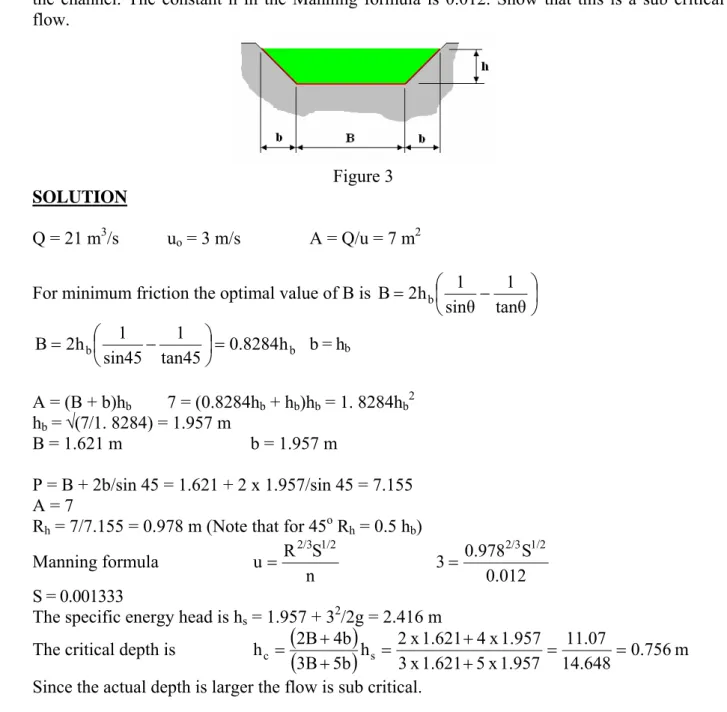
An open channel has a trapezoidal cross section with sides inclined at 45o to the vertical. The channel must carry 21 m3/s with a velocity of 3 m/s with minimum friction. Determine the smallest slope of the bed for these conditions and the corresponding depth and dimensions of the channel. The constant n in the Manning formula is 0.012. Show that this is a sub critical flow.
Figure 3 SOLUTION
Q = 21 m3/s uo = 3 m/s A = Q/u = 7 m2
For minimum friction the optimal value of B is ⎟ ⎠ ⎞ ⎜ ⎝ ⎛ − = tanθ 1 sinθ 1 h 2 B b b b 0.8284h tan45 1 sin45 1 h 2 B ⎟= ⎠ ⎞ ⎜ ⎝ ⎛ − = b = hb A = (B + b)hb 7 = (0.8284hb + hb)hb = 1. 8284hb2 hb = √(7/1. 8284) = 1.957 m B = 1.621 m b = 1.957 m P = B + 2b/sin 45 = 1.621 + 2 x 1.957/sin 45 = 7.155 A = 7
Rh = 7/7.155 = 0.978 m (Note that for 45o Rh = 0.5 hb) Manning formula n S R u 1/2 2/3 = 0.012 S 978 . 0 3 1/2 2/3 = S = 0.001333
The specific energy head is hs = 1.957 + 32/2g = 2.416 m
The critical depth is
(
(
)
)
0.756m14.648 11.07 1.957 x 5 1.621 x 3 1.957 x 4 1.621 x 2 h 5b 3B 4b 2B hc s = = + + = + + =
SELF ASSESSMENT EXERCISE No. 3 These are exam standard questions.
1. An open channel has a trapezoidal section with sides inclined at 45o to the vertical. The channel must carry 20 m3/s of water with a mean velocity of 2.5 m/s. Determine the smallest slope of the bed possible and the corresponding depth and dimensions of the channel. The constant n in the Manning formula is 0.012. Show that this is a sub critical flow.
u = (R2/3S1/2)/n
(Answer S = 0.000845, h = 2.1, B = 2.1 m and b = 2.1 m.)
2. A channel has a trapezoidal section 5 m wide at the bottom. The sides slope at 1 metre up for each 2 horizontal. The bed has a slope of 1/3600 and n in the manning formula is 0.024.
Calculate the flow rates corresponding to mean velocities of 0.3 and 0.6 m/s. (Ans. 0.549 m3/s and 4.81 m3/s)