https://doi.org/10.5194/amt-13-1227-2020 © Author(s) 2020. This work is distributed under the Creative Commons Attribution 4.0 License.
Unsupervised classification of vertical profiles of dual
polarization radar variables
Jussi Tiira1and Dmitri Moisseev1,2
1Institute for Atmospheric and Earth System Research/Physics, Faculty of Science, University of Helsinki, Helsinki, Finland 2Finnish Meteorological Institute, Helsinki, Finland
Correspondence:Jussi Tiira ([email protected])
Received: 9 August 2019 – Discussion started: 20 August 2019
Revised: 21 January 2020 – Accepted: 2 February 2020 – Published: 13 March 2020
Abstract.Vertical profiles of polarimetric radar variables can be used to identify fingerprints of snow growth processes. In order to systematically study such manifestations of precipi-tation processes, we have developed an unsupervised classi-fication method. The method is based onk-means clustering of vertical profiles of polarimetric radar variables, namely reflectivity, differential reflectivity and specific differential phase. For rain events, the classification is applied to radar profiles truncated at the melting layer top. For the snowfall cases, the surface air temperature is used as an additional in-put parameter. The proposed unsupervised classification was applied to 3.5 years of data collected by the Finnish Me-teorological Institute Ikaalinen radar. The vertical profiles of radar variables were computed above the University of Helsinki Hyytiälä station, located 64 km east of the radar. Using these data, we show that the profiles of radar variables can be grouped into 10 and 16 classes for rainfall and snow-fall events, respectively. These classes seem to capture most important snow growth and ice cloud processes. Using this classification, the main features of the precipitation forma-tion processes, as observed in Finland, are presented.
1 Introduction
Globally, the majority of precipitation during both winter and summer originates from ice clouds (Field and Heyms-field, 2015). At higher latitudes winter precipitation occurs in the form of snow, which can have a dramatic impact on human life (Juga et al., 2012). There are a number of chal-lenges in remote sensing of winter precipitation or ice clouds, i.e., quantitative estimation of ice water content or
precip-itation rate (von Lerber et al., 2017), identification of dan-gerous weather conditions, etc. To address these challenges, advances in identifying and documenting the processes that take place in ice clouds are needed.
There are several pathways by which ice particles grow, such as vapor deposition, aggregation and riming. Occur-rence of these processes depends on environmental condi-tions. Interpretation of radar observations is based on our un-derstanding of the link between microphysical and scattering properties of hydrometeors. By identifying particle types in observations, we may conclude what processes took place. Currently, dual-polarization radar observations are used in fuzzy logic classification to identify the dominant hydrom-eteor type present in a radar volume (e.g., Chandrasekar et al., 2013; Thompson et al., 2014). Such methods work very well for classification of hydrometeors of summer precipita-tions and some features of winter precipitation types. The main challenge is the lack of distinction in dual-polarization radar variables between some ice particle habits. For exam-ple, large low-density aggregates and graupel may have sim-ilar radar characteristics. Furthermore, these methods per-form classification on radar volume by volume basis, with-out taking into account surrounding observations. Recently, a modification for the hydrometeor classifiers was proposed to make the algorithms aware of the surroundings by in-corporating measurements from neighboring radar volumes (Bechini and Chandrasekar, 2015; Grazioli et al., 2015b). This step has greatly improved classification robustness, but it aims to identify particle types instead of fingerprints of mi-crophysical processes.
In the past 10 years, a number of studies reported sig-natures of ice growth processes in dual-polarization radar
observations. Kennedy and Rutledge (2011) have reported bands of increased values of specific differential phase,Kdp,
and differential reflectivity, ZDR, in Colorado snowstorms.
These bands took place at altitudes where ambient air tem-perature was around −15◦C and their occurrence was at-tributed to growth of dendritic crystals. Andri´c et al. (2013) have implemented a simple steady-state single-column snow growth model to explain the main features of the bands. It was also observed that the occurrence ofKdp bands can be
linked to heavier surface precipitation (Kennedy and Rut-ledge, 2011; Bechini et al., 2013). Moisseev et al. (2015) have advocated that theKdp bands occur only in
precipita-tion systems with high enough cloud-top heights, where a large number of ice crystals can be generated by either het-erogeneous or homogeneous ice nucleation. Using a larger dataset, Griffin et al. (2018) have shown that theKdp bands
can be linked to formation of ice by homogeneous ice nucle-ation at cloud tops. Furthermore, it was shown that theKdp
bands can be linked to onset of aggregation (Moisseev et al., 2015), which tends to occur more frequently in environments with higher water vapor content (Schneebeli et al., 2013). In addition to the above-listed studies, different aspects of these bands were presented by Trömel et al. (2014), Oue et al. (2018), and Kumjian and Lombardo (2017). Besides Kdpbands in the dendritic growth zone, several studies (e.g.,
Grazioli et al., 2015a; Sinclair et al., 2016; Kumjian et al., 2016; Giangrande et al., 2016) have reported Kdp
observa-tions in the temperature region where Hallett–Mossop (H– M; Hallett and Mossop, 1974) rime-splintering secondary ice production takes place (Field et al., 2016). Sinclair et al. (2016) have shown that such observations can be used to test representation of the secondary ice production in numerical weather prediction models. Other dual-polarization observa-tions that show notable features are high-ZDR regions
sur-rounding the cores of snow-generating cells (Kumjian et al., 2014) and at the top of ice clouds which can be linked to the presence of planar crystals and further to the presence of su-percooled liquid water, providing very favorable conditions for their growth at these temperatures (Williams et al., 2015; Oue et al., 2016).
As presented above, the fingerprints of snow growth pro-cesses can occur in the form of bands in stratiform clouds, ei-ther embedded in the precipitation or on top of a cloud, or in the form of convective generating cells. To identify and docu-ment such features, a classification method that uses vertical profiles of dual-polarization radar observations can be used. In this study, we have developed such an unsupervised classi-fication method based onk-means clustering of vertical pro-files of polarimetric radar variables, namely reflectivity, dif-ferential reflectivity and specific difdif-ferential phase. The pro-posed classification is applied to 3.5 years of data collected with the Finnish Meteorological Institute Ikaalinen radar.
The paper is structured as follows. Section 2 describes po-larimetric radar and temperature data and their preprocess-ing. The unsupervised classification method is presented in
Sect. 3. Section 4 is dedicated to the analysis and interpreta-tion of the classificainterpreta-tion results and Sect. 5 presents the con-clusions.
2 Data
In this study, we use vertical profiles of polarimetric radar observables of precipitation over the Hyytiälä forestry sta-tion in Juupajoki, Finland, collected using Ikaalinen weather radar, hereafter IKA. The radar is located 64 km west from the station. The measurements were performed between January 2014 and May 2017, partly during the Biogenic Aerosols – Effects on Clouds and Climate (BAECC; Petäjä et al., 2016) field campaign which took place at the measure-ment site in 2014.
The classification training material includes all precipita-tion events from this period, where, after preprocessing (see Sect. 2.2), there were no major data quality problems identi-fied. Since synoptic conditions may be similar even in cases where there are gaps in observed precipitation, we define any two precipitation events to be separate from each other if a continuous gap in reflectivity between them exceeds 12 h. See Sect. 4 for more discussion. During the observation pe-riod, we identified 74 snow and 123 rain events that meet these conditions. Generally, the full temporal extent of an event includes radar profiles in which precipitation has not reached the ground. A list of the precipitation events is given in the Supplement.
In order to link features identified in vertical profiles of radar variables to precipitation processes, information on the ambient temperature is needed. For this purpose we use ver-tical profiles of temperature from the National Center for Environmental Prediction (NCEP) Global Data Assimilation System (GDAS) output for Hyytiälä interpolated to match the temporal and vertical resolution of the vertical profiles of radar variables used in this study. The original temporal res-olution of the NCEP GDAS data over Hyytiälä is 3 h, and the vertical resolution is 25 hPa between the 1000 and 900 hPa levels and 50 hPa elsewhere.
2.1 Vertical profiles of dual-polarization radar observables
The radar profiles are extracted from IKA C-band radar range height indicator (RHI) measurements. IKA performs RHI scans directly towards Hyytiälä station every 15 min. The values of the radar profiles above Hyytiälä are estimated as horizontal medians over a range of 1 km from the station. The medians are taken over constant altitudes using linear spatial interpolation between the rays. The target bin size of the height interpolation is 50 m.
In this investigation, vertical profiles of equivalent reflec-tivity factor, Ze, differential reflectivity,ZDR, and specific
The Kdp values were computed using the Maesaka et al.
(2012) method as implemented in the Python ARM Radar Toolkit (Py-ART; Helmus and Collis, 2016). The method assumes that propagation differential phase, φDP, increases
monotonically with increasing range from the radar. In this study, we mainly focus on precipitation processes typically occurring in stratiform precipitation, where negativeKdp is
not important. The Maesaka et al. (2012) algorithm should be avoided when studying precipitation events with lightning activity, where negative Kdp may occur due to
electrifica-tion (Caylor and Chandrasekar, 1996). NegativeKdphas also
been reported during events of conical graupel which have been linked to observations of generating cells (Oue et al., 2015). The total fraction of profiles analyzed in this study where conical graupel appear or which represent strong con-vective cells with a possibility for lightning activity is ex-pected to be marginal, as discussed further in Sect. 4. 2.2 Radar data preprocessing
Prior to training or using the polarimetric radar vertical pro-file data for the classification, noise and clutter filtering is applied to the binned profiles, which is followed by normal-ization and smoothing. Additionally, there are different pre-processing procedures for rain and snow events that allow ambient temperature to be taken into account in the classi-fication. This section describes the mentioned preprocessing steps in more detail.
2.2.1 Profile truncation
This paper focuses on identifying, characterizing and inves-tigating the frequencies of different types of vertical struc-tures of dual-polarization radar variables specifically from the perspective of detecting, documenting and studying ice processes. Therefore, before the classification, vertical pro-files of radar variables are truncated at the top of the melting layer (ML), if one is present. Cases where melting layer sig-natures were not identified and surface air temperature was 1◦C or lower are placed in the snowfall category and inves-tigated separately.
Following Wolfensberger et al. (2015), who have used gra-dient detection on a combination of normalizedZH andρhv
for ML detection, we combineρhvand standardizedZeand
ZDRinto a melting layer indicator:
IML= ˆZeZˆDR(1−ρhv). (1)
The same standardization ofZeandZDRis used here as in
classification, as described in Sect. 3.1. In this study, instead of gradient detection, we use peak detection on smoothed IMLto find the ML. Peaks are defined as any sample whose
direct neighbors have a smaller amplitude and are found in three steps.
1. Peak detection is performed with thresholds for absolute peak amplitude and prominence (HIML, as described
be-low), with chosen values of 2 and 0.3, respectively. The SciPy (version 1.3; Virtanen et al., 2020) implementa-tion of the peak detecimplementa-tion algorithm1is used here. 2. Median ML height,h˜ML, is computed as the weighted
median of the peak altitudes,hi, using the product of
peak absolute amplitude and HIML as weights. Peaks above a chosen height threshold ofhthresh=4200 m are
ignored in this step.
3. Step 1 is run again, this time only considering data within h˜ML±1hML with a chosen 1hML value of
1500 m. If multiple peaks exceed the threshold values within a profile, the one with the highest amplitude is used.
The ML top heighthML,topis estimated as the altitude
cor-responding to the 0.3HIML upper contour of the peak. Peak prominence,H, is a measure of how much a peak stands out from the surrounding baseline value and is defined as the dif-ference between the peak value and its baseline. The base-line is the lowest contour base-line of the peak encircling it but containing no higher peak (Virtanen et al., 2020).
It should be noted that in steps 2 and 3, the analysis height is limited to reflect the climatology of temperature profiles on the measurement site. In step 2, we assume the ML to be always below hthresh, and in step 3 we expect melting
layer height not to change more than1hMLduring an event.
Such use of domain knowledge allows more robust ML de-tection in situations whereIML has high values elsewhere.
This may occur in the dendritic growth layer (DGL), for ex-ample, where the crystals can be pristine enough to cause a significant increase inZDRand a decrease inρ.
Sensitivity of the retrieved hML,top is tested for small
changes in peak detection parameters discarding inconsis-tent values. A moving window median threshold filter is ap-plied on time series ofhML,topin order to discard rapid
high-amplitude fluctuations caused by noise inZDR, for example.
A rolling triangle mean with a window size of five profiles, corresponding to 1 h, is used for smoothing. Finally, linear interpolation and constant extrapolation is applied tohML,top
on a per-precipitation-event basis to make the estimate con-tinuous. This robust, albeit fairly complex, procedure pro-duces a smooth estimate for melting layer top height. The results from the ML detection were analyzed manually and the events with errors were discarded. In 90 % of events in the original dataset, the ML was detected without errors.
The analysis of rain profiles is limited to a layer from 1hmargin=300 m to 10 km abovehML,top. The purpose of
the margin1hmarginis to prevent properties of the melting
layer from leaking to the clustering features. The truncation described in this section has no effect on the height bin size.
Table 1.Standardization of radar variables,[a, b] → [0,1]. Rainfall Snowfall a b a b Ze, dBZ −10 38 −10 34 ZDR, dB 0 3.1 0 3.3 Kdp, ° km−1 0 0.25 0 0.11
2.2.2 Absence of melting layer
Cutting the rain profiles at the top of the melting layer effec-tively provides information about the ambient temperature at the profile base. As temperature is a key factor driving the ice processes, such information should also be included in the classification process when there is no ML present. In order to introduce corresponding information on ambient temper-ature at the profile base, we use surface tempertemper-ature as an extra classification parameter for events with snowfall on the surface. While it would be possible to use whole temperature profiles from soundings or numerical models as classification parameters, we feel that this may not be feasible for many potential key use cases of the classification method. With the wide availability of surface temperature observations in high temporal resolution and in real time, presumably this choice makes the classification method more accessible, especially for operational applications.
The analysis of snow profiles is limited to a layer between 0.2 and 10 km above ground level.
3 Classification method
The unsupervised classification method used in this study is based on clustering of dual-polarization radar observations, namely vertical profiles ofKdp,ZDRandZe. Feature
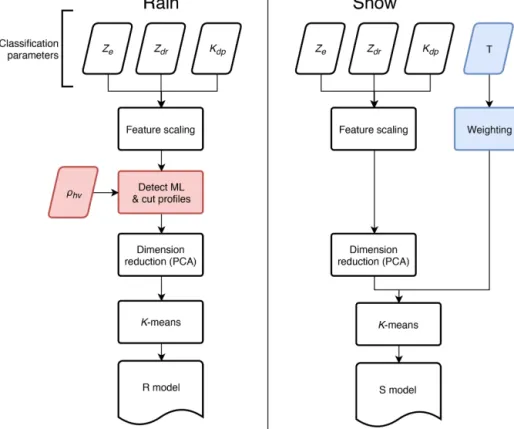
extrac-tion is performed by applying principal component analy-sis (PCA) on standardized profiles. Clustering is applied to the principal components of the profiles using thek-means method (Lloyd, 1982). A flowchart of the whole process is shown in Fig. 1.
While the core method is identical for processing of all radar profiles, information on temperature is included in a slightly different way based on if it is raining or snowing on the surface. These differences are explained in Sect. 2.2.1 and 2.2.2 and highlighted in Fig. 1: for rain events, the pro-files are cut at the top of the melting layer, and for events without a ML surface temperature is included as an extra classification variable. Using this approach, information on profile base ambient temperature is included in the classifi-cation process, and the analysis is limited to ice processes.
3.1 Feature extraction
The vertical resolution of the interpolated data is 50 m with bins from 200 m to 10 km altitude for snow events and from 300 m to 10 km above the melting layer top for rain events. Thus, with the three radar variables, each profile is described by a vector of 588 and 582 dimensions for snow and rain events, respectively. In this study, we apply PCA to standard-ized profiles of the polarimetric radar variables to extract fea-tures for the clustering phase.
A standardization of the preprocessed polarimetric radar data is performed to allow adequate weights for each vari-able in clustering. This was done separately for the snow and rain datasets in order to account for seasonal differences in the average values. We used standardization similar to that of Wolfensberger et al. (2015), normalizing typical ranges of values[a, b] → [0,1], with the additional condition that the standardized variables should have approximately equal vari-ances. The valuesa, bused in this study are listed in Table 1. The values of the standardized variables are not capped, but values greater than 1 are allowed when the unscaled values exceedb. Without the standardization, the dominance of each variable in classification would be determined by their vari-ance.
The number of components explaining a significant por-tion of the total variance for the two training datasets was de-termined considering the scree test (Cattell, 1966), the Kaiser method, and the component and cumulative explained vari-ance criteria. However, these criteria alone would allow such a low number of components that the inverse transformation from principal component space to the original would result in unrealistic profiles. Thus, the number of components was increased such that, visually, the inverse transformed pro-files presented the significant features in the original propro-files, up to the point where adding more components seemed to start explaining trivial features such as noise. For both rain and snow profile classification, the first 30 components are used as features. The high number of significant components suggests that reducing the dimensionality of radar observa-tions is not trivial. An advantage of using PCA over simply sampling the profiles is that the former interconnects data from different heights and radar variables such that the com-ponents effectively represent features in the profile shapes, while sampling would rather be driven by absolute values at the individual sampling heights.
With snow profile classification, a proxy of the surface temperature, P (Ts)=aTs, where a is a scaling parameter,
is used as an additional feature. Thus, essentially,σTs within a cluster is decreased with increasinga. In this study, the value of a was determined in an iterative process during the clustering phase, described in Sect. 3.2, such that, over the clusters, median(2σTs)≈3
◦C. Thus, assumingT sis
nor-mally distributed within a given cluster, approximately 95 % of the values ofTswould be typically within a range of 3◦C
Figure 1.Vertical profile clustering method for creating classification models for rain and snow events.
from the cluster mean. A value ofa=0.75 was used in this study.
3.2 Clustering
In the present study, the widely used k-means method was chosen for clustering. The algorithm is known for its speed and easy implementation and interpretation. Limitations of the method include the assumption of isotropic data space, sensitivity to outliers (Raykov et al., 2016) and the possibil-ity to converge into a local minimum which may result in counterintuitive results. In our analysis, the anisotropy of the data space is partly mitigated by the PCA transformation. Af-ter the transformation, there is still anisotropy, but the transi-tions in density of the data points in PCA space are smooth (not shown), such that the k-means method seems to pro-duce clusters of meaningful sizes and shapes. The problem of local minima is addressed using the k-means++ method (Arthur and Vassilvitskii, 2007) to distribute the initial clus-ter seeds in a way that optimizes their spread. Thek-means++ is repeated 40 times and the best result in terms of the sum of squared distances of samples from their closest cluster center is used for seeding.
3.3 Selecting the number of classes
An important consideration in using k-means clustering is the choice of number of clusters, k. A good model should
explain the data well while being simple. Several methods exist for estimating the optimal number of classes. Neverthe-less, often domain- and problem-specific criteria have to be applied for the best results.
The optimal number of clusters depends on variability in the data and correlations between different variables. The more variability and degrees of freedom, the more clus-ters are generally needed to describe different features in a dataset. Since one important use case for the method is ice process detection, particular attention is paid in separation of fingerprints of different processes between classes. An opti-mal set of classes would maximize this separation without in-troducing too many classes to make their interpretation com-plicated.
As the problem of the number of classes is complex, it is difficult to find an unambiguous quantitative measure for evaluating the correct number of classes. Attempts to create a scoring function for optimizing the separation of ice pro-cesses alone did not yield satisfactory results, but were rather used to support the manual selection process.
Silhouette analysis (Rousseeuw, 1987), which is a method for measuring how far each sample is from other clusters (separation) compared to its own cluster (cohesion), was also considered for selectingk. The metric, silhouette co-efficients, takes values between−1 and 1. The higher the value, the better the profile represents the cluster it is as-signed to. A profile withs=0 would be a borderline case
be-tween clusters, and negative values indicate that the profiles might have been assigned to wrong clusters. Silhouette score s=1
k
Pk
i=1si can generally be used for choosingk.
Unfor-tunately, when applied to the radar profile clustering results, s decreases almost monotonically with increasing k in the ranges ofkanalyzed and thus did not prove very useful for this purpose. Rather, in this study, we calculate s for each profile classification result individually as a measure of how well the profile represents the class it is assigned to.
The process of selecting the number of rain and snow pro-file clusters, kR andkS, respectively, was as follows. First,
the k-means clustering was repeated 12 times for eachkin [5,21]with 40k-means++ initializations. This is where the above-described silhouette analysis was performed for each set of clusters and the stability of the initialization process was analyzed for eachk. Between the 12 repetitions, the clus-tering converges to identical results for each kR<12 and
kS<10. With higher values of k, there are multiple
solu-tions to the clustering problem with only minor differences between them. Moreover, the properties of the cluster cen-troids are not highly sensitive tok. Clustering performed with k=k0andk=k0+1 would typically result in sets of clusters
sharingk0−1 tok0very similar centroids.
This stability of the clustering results makes it convenient to selectkmanually. In the second stage, we analyzed each separate clustering solution for differences between the clus-ters from the point of view of snow processes and surface precipitation. Specifically, an important criterion was to sep-arate the typical Kdp signatures of dendritic growth (e.g.,
Kennedy and Rutledge, 2011) and the H–M process (Field et al., 2016) into different classes. On the other hand, the use of an unsupervised classification method should also allow us to discover previously undocumented features in the radar profiles if they are present in the data in significant numbers. The goal in this step is to find as many significant unique fingerprints with as lowkas possible by manual evaluation. Significant differences between clusters in this context in-clude variations in profile shapes and altitudes of charac-teristics such as peaks, clear differences in echo-top heights or differences of cluster centroidTs of more than 3◦C. The
most common trivial difference between a pair of clusters was a difference in the intensity of polarimetric radar vari-ables while the shapes of the cluster centroid profiles were almost identical. Altitude differences between fingerprints of overhanging precipitation were also considered trivial.
During this process, allowing some profile classes with only trivial characteristics was inevitable in order to include others with significant unique fingerprints. For this reason, some classes likely reflect natural variability of the same mi-crophysical process rather than unique processes and need to be combined. However, the optimal way of combining the classes may depend on the application. Thus, we present the classes uncombined in this paper.
In snow profile clustering, Ts as an extra classification
parameter adds a significant additional degree of freedom.
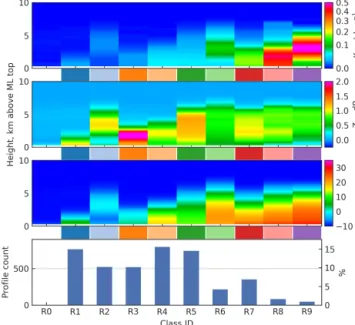
Figure 2.Class centroid profiles of the R model. Profile counts per class are shown at the bottom omitting the count for low-reflectivity class R0. Between the panes, each class has been assigned a color code.
Thus, a larger number of snow profile classes are needed to meet the criteria described above. In clustering, there is a distinguishable separation between clusters representingTs
close to 0◦C and around−10◦C. The vast majority of pro-files belong to the warmer group.
Taking all the mentioned considerations into account, we chose to use 10 and 16 classes for rain and snow profiles, respectively. In 12 of the snow profile class centroids,Ts> −5◦C. In this paper, the rain and snow profile classification models are termed the R model and S model, respectively.
In this section we have described our approach for opti-mizing the number of classes with the main criteria of sep-arating the main profile characteristics and the fingerprints of ice processes into individual classes. It should be noted, however, that there is a large spectrum of research problems and operational applications where an unsupervised profile classification method such as the one described in this paper could be potentially useful. The optimal number of classes may depend on the application.
4 Results
Class centroids of rain and snow profile classes are shown in Figs. 2 and 3, respectively. The centroid profiles of dual-polarization radar variables are inverse transformed from cor-responding centroids in PCA space. Classes are numbered in the ascending order by the value of the first principal compo-nent in the class centroids. By definition, the first compocompo-nent has the largest variance and therefore has the biggest
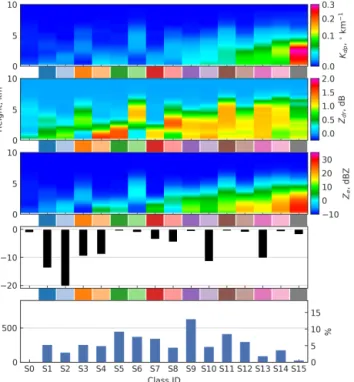
influ-Figure 3. Class centroid profiles of the S model. The top panel shows class centroid surface temperatures. Profile counts per class are shown at the bottom omitting the count for low-reflectivity class S0. Between the panes, each class has been assigned a color code.
ence on the clustering and classification results. The value of this component is strongly correlated with intensities ofKdp
andZe.
A number of class centroids in both classification models display distinct features in dual-polarization radar variables often linked to snow processes, such as peaks and gradients inKdpandZDR. Such features and their connection to other
characteristics in the vertical structure of the profiles and fi-nally to the precipitation processes are discussed in this sec-tion.
As a general pattern in Figs. 2 and 3 we see that the high-est values of ZDRare associated with low echo tops while
the highest Kdp values occur in deeper clouds. This is in
line with the previously reported findings (Kennedy and Rut-ledge, 2011; Bechini et al., 2013; Moisseev et al., 2015; Schrom et al., 2015; Griffin et al., 2018) that echo tops in the DGL are associated with highZDRand lowKdpin the layer,
whereas high Kdp in the DGL with low ZDR is associated
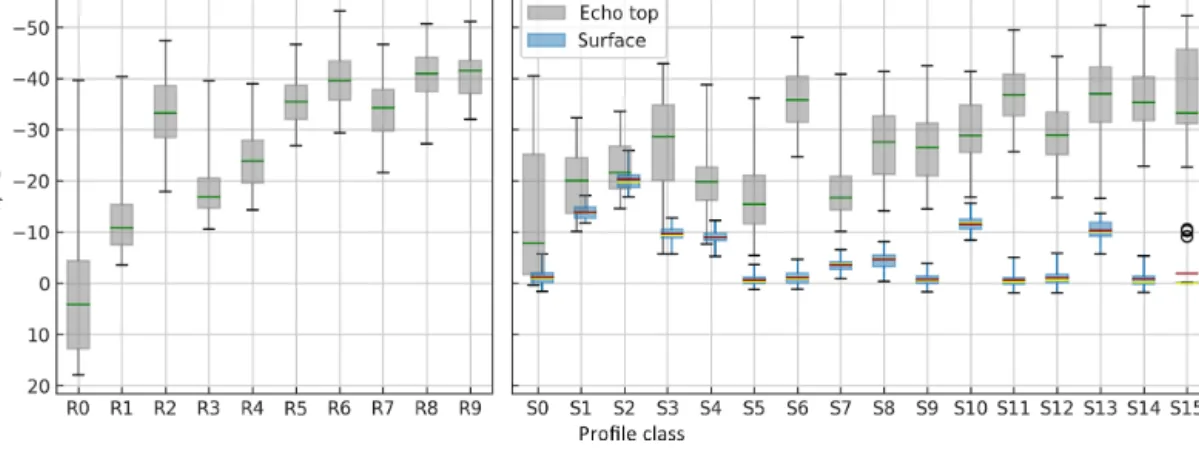
with echo tops inT <−37◦C where homogeneous freezing occurs. Using the NCEP GDAS model output, we analyzed the echo top temperatures,Ttop, of each vertical profile radar
observation. The results, grouped by profile class, are visu-alized in Fig. 4. It should be noted that in the summer cold echo tops may be caused by strong updrafts in convection, whereas during the winter, echo tops colder than approxi-mately −37◦C are a more unambiguous indication of ho-mogenous freezing. Inspecting the class centroids in Figs. 2
and 3, and comparing them to echo top heights in Fig. 4, it is evident thatKdplayers, especially elevated ones, are strongly
associated with high echo tops.
The clustering results expose a prominent seasonal differ-ence inKdpintensity: consistently lower values are present in
snow events. There are four rain profile classes in contrast to only two snow profile classes with peak cluster centroidKdp
exceeding 0.1◦km−1. They represent total fractions of 13 % and 4 % of rain and snow profiles, respectively. Correspond-ing to this difference, in Figs. 2 and 3, as well as in Figs. 7 and 8 introduced later,Kdpis visualized in different ranges in
relation to rain and snow profiles. The seasonal differences in ZDRandZeintensities are less prominent. HighKdp in the
summer may be linked to higher water content during the season. Additionally, the seasonal variability of vertical mo-tion could impact theZDRandKdpenhancements.
Convection in the summer, especially in the presence of hail, is linked to extreme values of radar variables and high echo tops (Voormansik et al., 2017), which may also have a small contribution to the seasonal differences (Mäkelä et al., 2014). However, convective rainstorms are of short duration and thus typically present in just a couple of profiles per con-vective cell. Therefore, their impact on the class properties is expected to be limited. Manual analysis revealed that classes R6 and R9 have the highest and R5 the lowest fractions of profiles measured in convective cells. Further details of this analysis are presented in Sect. 4.2.
Class frequencies are presented in the bottom panels of Figs. 2 and 3. Classes S0 and R0 represent very low values ofZethroughout the column, i.e., profiles with very weak or
no echoes. Therefore their frequencies depend merely on the subjective selection of observation period boundaries and are thus omitted in the figures. Boundaries of the precipitation events are partly based on these two 0 classes. Events are considered independent and separate if between them there are profiles classified as S0 or R0 continuously for at least 12 h.
With respect toKdp intensity, classes in the R model can
be divided into four categories: R0 through R3 with negli-gibleKdp, low-Kdp classes R4 and R5 with max(Kdp,c)≈
0.04◦km−1, high-Kdpclasses R6 and R7 with max(Kdp,c) >
0.11◦km−1, and classes R8 and R9 representing extreme values(max(Kdp,c)≈0.5◦km−1). The subscript “c” denotes
a class centroid value as opposed to values in individual pro-files. The peak Kdp,c of both R6 and R9 is at 3 km,
cor-responding to class mean GDAS temperatures of−16 and −18◦C, respectively. Essentially, these two classes represent clearKdpfeatures in the DGL.
Classes R7 and R8 feature considerableKdp in 2–3 km
thick layers right above the ML, with centroid values slightly below 0.2◦km−1 and around 0.4◦km−1, respectively. Es-sentially, both classes representKdp signatures in both the
DGL and temperatures favored by the H–M process. Sinclair et al. (2016) found that the typicalKdp values for the H–M
Figure 4.Cloud-top temperature distributions by class (gray) with the green line marking the medians. For S classes, surface temperature distribution is also shown (blue) with red lines marking the class centroid and yellow lines marking the median. Boxes extend between the first and the third quantiles, and whiskers cover 95 % of the data.
Figure 5.The class S13 centroid is visualized in the three rightmost panes. Individual class member profiles are marked with thin lines. The pane on the left shows corresponding NCEP GDAS temperature profiles. The areas between the first and the third quantiles are shaded, radar data is in blue and GDAS is in gray.
onset of aggregation. Based on this, it can be argued that R7 is a more likely indicator of H–M than R8.
Classes R3 and R4 were found to often coexist in precipi-tation events. Both are characterized by lowKdpand a layer
ofZDRin the DGL. In Fig. 4, we see that the echo tops are
lower for the R3 profiles, typically in the DGL. Therefore, we would expect growth of pristine crystals in low num-ber concentrations and consequently with no significant ag-gregation. This would explain why peak ZDR values from
3 to 5 dB are common in relation with R3. Profiles classi-fied as R4, on the other hand, have slightly higher echo tops (T <−20◦C), which are expected to result in higher num-ber concentrations, leading to aggregation. The R4 profiles are characterized by much lowerZDRvalues.
In the S model (Fig. 3), classes S0 through S3 represent profiles with low values of all three radar variables, each with max(Ze,c) <0 dBZ, max(ZDR,c) <1 dB and max(Kdp,c) <
0.01◦km−1. These four low-reflectivity classes represent different surface temperatures, which is likely a major driver for the separation of these classes in the clustering process. Classes S4 and S5 represent low echo top profiles with high ZDR, with class centroid surface temperatures of−9.0 and −0.6◦C, respectively. Further analysis of NCEP GDAS tem-perature profiles reveals that, across the board, there is an in-version layer present where radar profiles are classified as S4, typically with temperatures below −10◦C within the low-est kilometer. This corresponds well with the bump inZDR,c
close to the surface, suggesting possible growth of pristine dendrites within a strong inversion layer. In contrast, there is no inversion in connection with profiles belonging to S5, and the enhancement inZDR occurs already at 2 to 3 km above
the surface, where the median NCEP GDAS temperature for S5 profiles is roughly between−18 and−10◦C. S5 is the second most common class in S-model classification results.
Figure 6.Comparing classes R5(a, b, c)and S11(d, e, f)shows evident similarities. Individual class member profiles are marked with thin blue lines and the areas between the first and the third quantiles are shaded with blue.
Classes S6 and S8 represent situations where precipitation is detached from the surface. These types of profiles are typi-cally present in association with approaching frontal systems before the onset of surface precipitation. The most frequent class of the S model is S9 covering 13 % of the profiles. It represents moderate values of polarimetric radar variables and cloud-top height. The most extreme values of reflectiv-ity andKdpvalues in the S model are represented by classes
S14 and S15. For both classes,Kdp,cpeaks above 3 km,
sug-gesting dendritic growth in the member profiles. Values of ZDR,c are significantly lower compared to other high echo
top classes with weaker Kdp,c. Class S15 can be seen as a
more extreme variant of S14 with much strongerKdp,cand
Ze,c. In addition, S15 represents lower values of ZDR near
the DGL, having slightly elevated values in the bottom 3 km instead. These differences are likely due to even higher ice number concentrations in S15 profiles, which lead to more intense aggregation.
Comparing class centroidTsand class frequencies in Fig. 3
it can be seen that most snowfall occurs at Ts≈0◦C.
Fur-ther analysis of GDAS temperature profiles for the snow events revealed that typically cold surface temperatures (Ts<
−6◦C) are heavily contributed to by strong inversion layers. The centroid and members of S13 are visualized in Fig. 5, along with the member GDAS temperature profiles. The pro-file class is characterized by a thick layer of considerableKdp
from 2 to 3 km to the surface, andTs≈ −10◦C. As seen in
the left panel of Fig. 5, S13 represents conditions whereT typically falls below−10◦C close to the surface. This find-ing suggests that a second DGL may occur in a strong inver-sion layer.
Using the double-moment Morrison microphysics scheme (Morrison et al., 2005), Sinclair et al. (2016) showed that Kdp at the−8 to −3◦C temperature range can be used for
identifying the H–M process. Such fingerprints are present in particular in profiles classified as R7 or S12. However, man-ual analysis of the profile data revealed that both of these classes represent a mixture of fingerprints indicating H–M, dendritic growth or the co-presence of both processes. In sev-eral events, there were continuous time frames of profiles classified as either R7 or S12 during which the altitude of theKdpsignal was changing from profile to profile between
the DGL and 0◦C level and was occasionally bimodal. One example of such a time frame is shown in Fig. 7 and dis-cussed further in Sect. 4.1.1. Some bimodality is also present in the centroidKdp,cof both classes, suggesting that the
el-evatedKdp,c values in the H–M region cannot be explained
solely by sedimenting planar crystals generated aloft but are contributed by the H–M process.
While there are no classes with clear-cutKdp,cpeaks at
al-titudes corresponding to temperatures preferred by the H–M process in either rain or snow profile classification, there are, in contrast, several classes with strong elevatedKdp,clayers.
The proposal of Sinclair et al. (2016) thatKdpfingerprints of
the H–M process are not very pronounced may explain the tendency of the classification method not to produce more pure H–M classes. Nevertheless, R7 and S12 can be used as indicators for conditions where H–M may occur.
Despite the differences in the classification methods for rain and snow profiles, there are prominent similarities be-tween the two models and profile classes therein. Archetypal classes such as high echo tops in the presence of elevatedKdp
layers (R6, R9, S14, S15) or highZDRin shallow
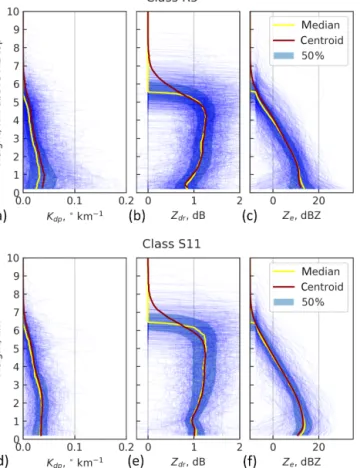
precipita-tion (R3, S4, S5) exist in both classificaprecipita-tion models. Frequent classes R5 and S11, visualized side by side in Fig. 6, can be considered direct counterparts of each other. The vertical structure of polarimetric radar variables above the ML in R5 match strikingly well with S11. The two classes are charac-terized by weakKdpand typical values ofZDRslightly above
1 dB aloft, decreasing towards the altitude corresponding to 0◦C. Presumably, this indicates the presence of aggregation. 4.1 Case studies
In Figs. 2 and 3, each class is assigned a color code (between the panels). This color coding is used in Figs. 7 and 8 to mark classification results in a rain and a snow case, respectively.
Figure 7. Classification analysis of a rain case with silhouette scores. The automatically detected melting layer is marked with a dashed line, the solid lines show the NCEP GDAS temperature con-tours and the colors between the panes denote classification results.
Note that the same set of colors is used for denoting rain and snow profile classification, but they should not be confused with each other.
4.1.1 12 August 2014
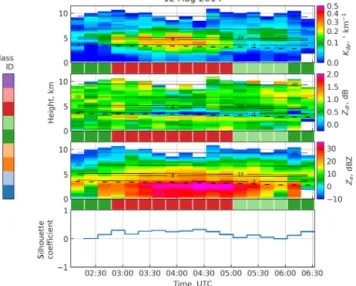
In Fig. 7, rain profile classification has been applied to a precipitation event from 12 August 2014. During this event, echo tops repeatedly exceed 10 km. Only the parts of the pro-files above the melting layer top are analyzed here, since ev-erything below that level is invisible to the classifier. The first two and the last two profiles shown in the figure are charac-terized by lowZeand lowKdp, whileZDRhas values around
1 dB. These profiles are classified as R5 (dark green). Be-tween 02:30 and 03:00 UTC, a significant increase in Kdp
occurs, followed by an increase in reflectivity and decrease inZDR. The temperature (altitude) of the downward increase
inKdp varies from the−20◦C level to closer to the ML. In
this phase, there is also a small increase inZDRin the DGL
whenever the increase inKdp also occurs in the DGL. This
phase in the event is sustained until around 05:00 UTC and is classified as R7 (dark red). It is followed by approximately an hour of a weaker elevatedKdp layer at around 4 to 6 km
altitude with profiles classified as class R6 (light green). The silhouette coefficient is positive throughout the event indicat-ing good confidence of the classification results. The silhou-ette of the profiles classified as R6 is not very high, though, which is likely due to lower values of Ze compared to the
class centroid.
Similar analysis of more rain events in the dataset reveals that, similar to the 12 August event, R7 typically coincides with an increase inKdpin the DGL, H–M layer or both, often
Figure 8.Classification analysis of a snow case with silhouette scores. Solid lines show the NCEP GDAS temperature contours and the colors between the panes denote classification results.
with varying altitude. Without in situ observations or analysis of Doppler spectra, it is not trivial to tell whether this vari-ability is due to co-presence of dendritic growth and H–M or simply fall streaks. Class R6, on the other hand, is more spe-cific to aKdp fingerprint in the DGL. The more infrequent
profiles with clearKdp bands above the DGL are typically
also classified as R6 or R9. 4.1.2 15–16 February 2014
Classification results for 15–16 February 2014 are shown in Fig. 8. The event has a clear structure of an approach-ing frontal system. Between 17:00 and 18:00 UTCZeis very
low, corresponding to class S0, which is marked with white color between the panels. Between 18:00 and 21:00 UTC, the event starts with overhanging precipitation, classified as S6 (light green). This is followed by light precipitation with echo tops at roughly 7 to 8 km and relatively highZDRnear
the echo top, decreasing downwards. This corresponds well with class S11 (dark brown). After 23:30 UTC, The echo top height is decreased to roughly 6 km,ZDR is decreased and
Kdpsignals appear close to ground level. The increase inKdp
occurs within the−8 to−3◦C temperature range, suggest-ing the presence of the H–M process. Indeed, Kneifel et al. (2015) report needles, needle aggregates and rimed particles on the surface at the measurement site during this period and favorable conditions for rime splintering. Further, using the Weather Research and Forecast (WRF) model, Sinclair et al. (2016) showed that secondary ice processes are needed to explain the observed number concentrations during this time period. The corresponding profiles are classified as S12 (light
brown). Within this case study, two profiles, marked with dark purple, are classified as S9, likely due to the momen-tary absence of any strongKdporZDRsignals.
4.2 Statistics
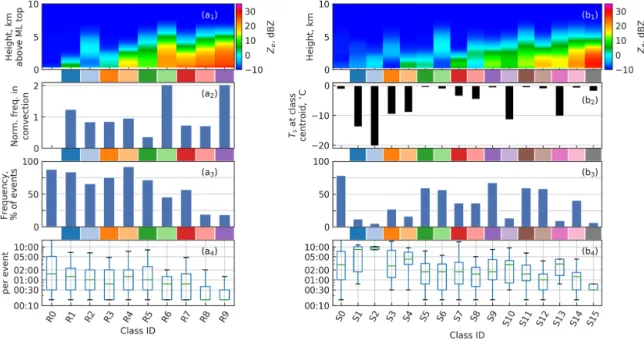
Frequency statistics of the profile classes are presented in Fig. 9. We analyzed a subset of rain events as either con-vective or stratiform using a number of sources of publicly available satellite and numerical model data. Out of 70 events analyzed, 15 were convective and 55 stratiform. Panel (a2) in
Fig. 9 shows the ratios of the number of profiles in convec-tive cases per class to the expected value in uniform distri-bution. On average, twice as many profiles are classified as R6 and R9 in convective situations compared to their aver-age frequencies. Both classes are characterized by high echo tops and elevated Kdp bands. On the other hand, classes
R7 and R8, also representing high Kdp values, but closer
to the melting layer than R6 and R9, appear in lower-than-average frequency in convective situations. Class R5 is most pronouncedly characteristic for stratiform events, with fre-quency in convective events roughly one-third of the average value.
Panels (a3) and (b3) of Fig. 9 show the fractions of
in-dependent precipitation events in which each class occurs. With rain events, this frequency correlates inversely with Kdp,c. Rain profiles classified as R8 and R9, which
repre-sent the strongestKdpsignatures, occur in 20 % and 19 % of
the events, respectively, with at least one of the two occurring in 25 % of the events. Classes R6 and R7, representing more modest Kdp features, occur in 45 % and 57 % of cases,
re-spectively, and the rest of the classes between 67 % and 92 % of the cases.
With snow events, the likelihood of a given class occur-ring within an event correlates not only with peakKdp,cbut
also with surface temperature. Any class representing low Kdp values and surface temperature close to 0◦C occurs in
more than half of the snow events.
The per precipitation event class persistence is visualized in the bottom panels of Fig. 9. Profile classes representing the highest values ofZeat the surface, namely R6–R9, S12,
S14 and S15, are short-lived, whereas snow profile classes characterized by cold surface temperatures are the most per-sistent. Profiles classified as R0 or S0 omitted, the median durations of rain and snow events in the dataset are 5.5 and 11.5 h, respectively. This difference explains why S classes are on average more persistent than R classes.
5 Conclusions
A novel method of dual-polarization radar profile classifi-cation for investigating vertical structure of snow processes in the profiles was presented in this paper. The method is based on clustering of PCA components of vertical profiles
ofKdp,ZDRandZeand surface temperature. It was applied
to vertical profile data extracted from C-band RHI scans over Hyytiälä measurement station in southern Finland. We ap-plied separate versions of the method based on if surface precipitation type was rain (R model) or snow (S model). In the R model, profiles are truncated at the melting layer top, and in the S model surface temperature is used as an additional classification feature. The content of the vertical profile classes was manually interpreted.
In the present investigation, some class centroids resem-bled textbook examples of previously documented snow pro-cess fingerprints, while others may represent a mixture of dif-ferent conditions. If temperature profiles from either sound-ings or numerical models are available, the interpretation can be done in the absence of surface crystal type reports. No-tably, this is prerequisite in cases of rainfall when direct ob-servations of crystal types cannot be performed at the sur-face.
The year-round variability in the vertical structure ofKdp,
ZDR and Ze can be described using a total of 26 profile
classes: 10 and 16 in the presence and absence of the ML, respectively. One of the main goals of this study was to associate profile classes with snow processes for their au-tomated identification. It should be noted, though, that the profile classification is not based on expressly selected char-acteristics of radar fingerprints of the processes, but rather the general, complete structure of the profiles. Nevertheless, some profile classes seem to be strong indicators of specific processes or their combinations within the vertical profiles. From both classification models we can identify a total of seven archetypes with the following characteristics.
1. Profiles have a strongKdp peak in the DGL, while the
peak inZDRis not pronounced. This archetype appears
in deep precipitation systems with homogeneous freez-ing at the cloud top. It is associated with intensified den-dritic growth leading to aggregation and high precipita-tion rate. (Classes R6, R9, S14, S15)
2. There is aKdpsignature between the DGL and the 0◦C
level, possibly due to simultaneous occurrence of den-dritic growth and secondary ice production. Homoge-neous freezing occurs at the cloud top. (R7, R8, S12) 3. Profiles are characterized by high echo tops,
negligi-ble Kdp, and ZDR>1 dB, which decreases closer to
the melting level due to aggregation. Typically, Ze<
20 dBZ. (R5, S11)
4. The cloud top is between the−30 and−20◦C levels, and there is only a weakZDRband present at the−15◦C
level.Zeis moderate at roughly 20–30 dBZ, andKdpis
weak. (R4, S9)
5. ZDR is typically higher than 1.5 dB at the cloud to at
around −15◦C and is associated with the growth of pristine planar crystals in low number concentrations.
Figure 9.Statistics on frequency of each profile class. Classes are identified by class centroidZe(a1, b1)and class centroidTsfor snow profile classes(b2), with color codes between the panels and class IDs at the bottom. Panel(a2)has the ratios of the number of profiles in convective cases per class to the expected value in uniform distribution. In (a4, b4), the class frequencies are given as percentage of events(a3, b3)and total durations(a4, b4)within events.
No Kdp is present, and low values of Ze indicate the
absence of aggregation. (R3, S5)
6. The radar echo is detached from the surface either due to snow particles not having reached the surface yet or because they are sublimating due to a dry layer. (R2, S3, S6, S8)
7. Zeis weak throughout the profile. (R0, S0–S2)
In addition to these archetypes found in both summer and winter storms, there are S classes representing situations where strong inversions interfere with snow processes. No-tably, we found indications of dendritic growth in strong in-version layers, manifested as class S13. As the colder arctic air mass seldom occurs in southern Finland,Ts<−10◦C can
usually be attributed to a strong lower-level inversion. Such inversions may have an important effect on the frequency of occurrence of some ice processes. Further, this implies that temperature information near the surface is necessary in order to determine whether a low altitudeKdp signature in
the winter is an implication of the H–M process or dendritic growth.
Our approach to the classification problem is pro-nouncedly data-driven. This way, if the training material rep-resents the climatology of ice processes and their radar sig-natures, as was the aim in this study, the resulting classes will reflect the statistical properties of this climatology. Hand picking the training material, on the other hand, would intro-duce human bias into the class boundaries.
However, there are possible drawbacks in the data-driven approach. The typical radar fingerprints of the H–M process were found to be much more scarce than those of dendritic growth, and often less pronounced. This negatively affects how the typical fingerprints of the H–M process are repre-sented in the classes. This could be enhanced by introducing a larger fraction of H–M profiles in the training data.
Another disadvantage in the data-driven approach is that covering a meaningful collection of unique fingerprints re-quires a large number of clusters, some of which do not rep-resent unique microphysical processes. This problem may be mitigated to some extent by further optimizing the scaling of the radar variables such that the clustering would be less driven by differences in the intensities of the signatures in contrast to their shapes. Another way to address this issue is to simply combine classes that seem to represent the same processes, in like manner of the archetypes presented above. Reducing the number of classes by simply choosing a smaller kin thek-means clustering would reduce the amount of man-ual work involved in defining the class boundaries at the cost of decreased detail and accuracy in separating the processes. With a smallerk, the clustering would be driven by more general features of the profiles such as the overall shape and intensity of the polarimetric radar variables, whereas espe-cially the typical characteristics of the H–M process finger-prints involve a higher level of detail.
The classification method presented in this study should be considered a starting point in studying vertical profiles of radar variables using unsupervised classification. As such,
there is a vast range of potentially useful opportunities for further development of the method. The method is built on reasoned use of well-known, proven algorithms such as PCA andk-means. We showed that this combination of machine learning algorithms allows both identification of known fin-gerprints and a more explorative approach in studying the characteristics of a regional climatology of precipitation pro-cesses. Limitations of thek-means method include the spher-ical shape and similar area occupied by the clusters, which involve a risk of suboptimal separation of the microphysi-cal processes to different classes. In this study, we addressed these limitations by allowing a rather large number of ini-tial classes and combining similar ones by identifying the archetypes based on known fingerprints of the processes. An-other possible approach would be to explore the numerous alternative clustering methods for a more optimal separation of the precipitation processes. A comprehensive comparison of such methods, however, is outside the scope of this study. In the present classification method, ambient temperature is known only at the profile base. Compared to the use of full temperature profiles, this simplifies the method and, per-haps even more importantly, the requirements for the input data. However, future studies should investigate if the use of full temperature profiles allows more accurate separation of precipitation processes into different classes.
The unsupervised nature of the classification method is ex-pected to allow extension of its application to the detection of ice processes not covered in this study. Recently, Li et al. (2018) showed that certain combinations ofZe,ZDRandKdp
signatures can potentially be used for detecting heavy riming. Furthermore, the process is frequently observed in Finland, highlighting the potential of using an unsupervised method for its identification.
It should be noted that wind shear effects induce differen-tial advection of hydrometeors at different altitudes, affect-ing the gradients in the vertical profiles of radar variables (Lauri et al., 2012). Therefore caution should be used in inter-preting microphysical processes corresponding to class cen-troid profiles. The wind shear effects are difficult to correct for using vertical profile or RHI radar observations due to the limitations in horizontal sampling. Such adjustments be-come more viable if classification is performed on profiles extracted from volume scans, which will be investigated in future work.
The ability to describe a climatology of vertical structure of dual-polarization radar variables and, further, precipita-tion processes using a finite number of classes has evident potential in improving quantitative precipitation estimation. We anticipate that automated detection of ice processes may allow the development of adaptive relation for snowfall rate S=S(Ze), in which the parameters could be chosen based
on the profile classification result. AdaptiveS(Ze)relations,
in turn, have potential in improving the vertical profile of re-flectivity correction methods. Future work will be devoted to
investigating the use of unsupervised profile classification in such applications.
Data availability. The FMI radar and surface temperature data are available from the Finnish Meteorological Institute (2019) open data portal: https://en.ilmatieteenlaitos.fi/open-data-sets-available (last access: 1 October 2019).
Supplement. The supplement related to this article is available on-line at: https://doi.org/10.5194/amt-13-1227-2020-supplement.
Author contributions. The study was designed by both authors. JT implemented and ran the classification and made the figures. JT wrote the manuscript, with contributions from DM. Both authors discussed the results and commented on the manuscript.
Competing interests. The authors declare that they have no conflict of interest.
Acknowledgements. We would like to thank the personnel of Hyytiälä station and Matti Leskinen for their support in field ob-servation.
Financial support. This research has been supported by the Academy of Finland’s Center of Excellence (CoE) (grant no. 307331). The research of Jussi Tiira has been supported by the Doctoral Programme in Atmospheric Sciences (ATM-DP, University of Helsinki).
Open access funding provided by Helsinki University Library.
Review statement. This paper was edited by S. Joseph Munchak and reviewed by two anonymous referees.
References
Andri´c, J., Kumjian, M. R., Zrni´c, D. S., Straka, J. M., and Mel-nikov, V. M.: Polarimetric Signatures above the Melting Layer in Winter Storms: An Observational and Modeling Study, J. Appl. Meteorol. Clim., 52, 682–700, https://doi.org/10.1175/JAMC-D-12-028.1, 2013.
Arthur, D. and Vassilvitskii, S.: k-means++: The advantages of careful seeding, 1027–1035, Society for Industrial and Applied Mathematics, 2007.
Bechini, R. and Chandrasekar, V.: A Semisupervised Ro-bust Hydrometeor Classification Method for Dual-Polarization Radar Applications, J. Atmos. Ocean. Tech., 32, 22–47, https://doi.org/10.1175/JTECH-D-14-00097.1, 2015.
Bechini, R., Baldini, L., and Chandrasekar, V.: Polarimetric Radar Observations in the Ice Region of Precipitating Clouds at C-Band
and X-Band Radar Frequencies, J. Appl. Meteorol. Clim., 52, 1147–1169, https://doi.org/10.1175/JAMC-D-12-055.1, 2013. Cattell, R. B.: The Scree Test For The Number Of Factors, Multivar.
Behav. Res., 1, 245–276, 1966.
Caylor, I. and Chandrasekar, V.: Time-varying ice crystal orientation in thunderstorms observed with multiparame-ter radar, IEEE T. Geosci. Remote Sens., 34, 847–858, https://doi.org/10.1109/36.508402, 1996.
Chandrasekar, V., Keränen, R., Lim, S., and Moisseev, D.: Re-cent advances in classification of observations from dual polarization weather radars, Atmos. Res., 119, 97–111, https://doi.org/10.1016/j.atmosres.2011.08.014, 2013.
Field, P. R. and Heymsfield, A. J.: Importance of snow to global precipitation: IMPORTANCE OF SNOW TO PRECIPITATION, Geophys. Res. Lett., 42, 9512–9520, https://doi.org/10.1002/2015GL065497, 2015.
Field, P. R., Lawson, R. P., Brown, P. R. A., Lloyd, G., Westbrook, C., Moisseev, D., Miltenberger, A., Nenes, A., Blyth, A., Choularton, T., Connolly, P., Buehl, J., Crosier, J., Cui, Z., Dearden, C., DeMott, P., Flossmann, A., Heyms-field, A., Huang, Y., Kalesse, H., Kanji, Z. A., Korolev, A., Kirchgaessner, A., Lasher-Trapp, S., Leisner, T., McFar-quhar, G., Phillips, V., Stith, J., and Sullivan, S.: Chap-ter 7. Secondary Ice Production – Current State of the Sci-ence and Recommendations for the Future, Meteorol. Monogr., 58, 7.1–7.20, https://doi.org/10.1175/AMSMONOGRAPHS-D-16-0014.1, 2016.
Finnish Meteorological Institute: The Finnish Meteorological In-stitute’s open data, available at: https://en.ilmatieteenlaitos.fi/ open-data, last access: 1 October 2019.
Giangrande, S. E., Toto, T., Bansemer, A., Kumjian, M. R., Mishra, S., and Ryzhkov, A. V.: Insights into riming and aggregation processes as revealed by aircraft, radar, and disdrometer obser-vations for a 27 April 2011 widespread precipitation event: In-sights into Riming and Aggregation, J. Geophys. Res.-Atmos., 121, 5846–5863, https://doi.org/10.1002/2015JD024537, 2016. Grazioli, J., Lloyd, G., Panziera, L., Hoyle, C. R., Connolly, P.
J., Henneberger, J., and Berne, A.: Polarimetric radar and in situ observations of riming and snowfall microphysics dur-ing CLACE 2014, Atmos. Chem. Phys., 15, 13787–13802, https://doi.org/10.5194/acp-15-13787-2015, 2015a.
Grazioli, J., Tuia, D., and Berne, A.: Hydrometeor classification from polarimetric radar measurements: a clustering approach, Atmos. Meas. Tech., 8, 149–170, https://doi.org/10.5194/amt-8-149-2015, 2015b.
Griffin, E. M., Schuur, T. J., and Ryzhkov, A. V.: A Polarimet-ric Analysis of Ice Microphysical Processes in Snow, Using Quasi-Vertical Profiles, J. Appl. Meteorol. Clim., 57, 31–50, https://doi.org/10.1175/JAMC-D-17-0033.1, 2018.
Hallett, J. and Mossop, S. C.: Production of secondary ice particles during the riming process, Nature, 249, 26–28, https://doi.org/10.1038/249026a0, 1974.
Helmus, J. J. and Collis, S. M.: The Python ARM Radar Toolkit (Py-ART), a Library for Working with Weather Radar Data in the Python Programming Language, Journal of Open Research Software, 4, e25, https://doi.org/10.5334/jors.119, 2016. Juga, I., Hippi, M., Moisseev, D., and Saltikoff, E.: Analysis
of weather factors responsible for the traffic “Black Day” in
Helsinki, Finland, on 17 March 2005, Met. Apps, 19, 1–9, https://doi.org/10.1002/met.238, 2012.
Kennedy, P. C. and Rutledge, S. A.: S-Band Dual-Polarization Radar Observations of Winter Storms, J. Appl. Meteorol. Clim., 50, 844–858, https://doi.org/10.1175/2010JAMC2558.1, 2011. Kneifel, S., von Lerber, A., Tiira, J., Moisseev, D., Kollias, P., and
Leinonen, J.: Observed relations between snowfall microphysics and triple-frequency radar measurements: Triple Frequency Sig-natures of Snowfall, J. Geophys. Res.-Atmos., 120, 6034–6055, https://doi.org/10.1002/2015JD023156, 2015.
Kumjian, M. R. and Lombardo, K. A.: Insights into the Evolv-ing Microphysical and Kinematic Structure of Northeastern U.S. Winter Storms from Dual-Polarization Doppler Radar, Mon. Weather Rev., 145, 1033–1061, https://doi.org/10.1175/MWR-D-15-0451.1, 2017.
Kumjian, M. R., Rutledge, S. A., Rasmussen, R. M., Kennedy, P. C., and Dixon, M.: High-Resolution Polarimetric Radar Observa-tions of Snow-Generating Cells, J. Appl. Meteorol. Clim., 53, 1636–1658, https://doi.org/10.1175/JAMC-D-13-0312.1, 2014. Kumjian, M. R., Mishra, S., Giangrande, S. E., Toto, T., Ryzhkov,
A. V., and Bansemer, A.: Polarimetric radar and aircraft observations of saggy bright bands during MC3E: SAGGY BRIGHT BANDS, J. Geophys. Res.-Atmos., 121, 3584–3607, https://doi.org/10.1002/2015JD024446, 2016.
Lauri, T., Koistinen, J., and Moisseev, D.: Advection-Based Adjust-ment of Radar MeasureAdjust-ments, Mon. Weather Rev., 140, 1014– 1022, https://doi.org/10.1175/MWR-D-11-00045.1, 2012. Li, H., Moisseev, D., and von Lerber, A.: How Does
Rim-ing Affect Dual-Polarization Radar Observations and Snowflake Shape?, J. Geophys. Res.-Atmos., 123, 6070–6081, https://doi.org/10.1029/2017JD028186, 2018.
Lloyd, S.: Least squares quantization in PCM, IEEE T. Informa. Theory, 28, 129–137, https://doi.org/10.1109/TIT.1982.1056489, 1982.
Maesaka, T., Iwanami, K., and Maki, M.: Non-negative K DP esti-mation by monotone increasing8DP assumption below melting layer, in: Extended Abstracts, Seventh European Conf. on Radar in Meteorology and Hydrology, 3 June 2012, Toulouse, France, 2012.
Moisseev, D. N., Lautaportti, S., Tyynela, J., and Lim, S.: Dual-polarization radar signatures in snowstorms: Role of snowflake aggregation, J. Geophys. Res.-Atmos., 120, 12644–12655, https://doi.org/10.1002/2015jd023884, 2015.
Morrison, H., Curry, J. A., and Khvorostyanov, V. I.: A New Double-Moment Microphysics Parameterization for Application in Cloud and Climate Models. Part I: Description, J. Atmos. Sci., 62, 1665–1677, https://doi.org/10.1175/JAS3446.1, 2005. Mäkelä, A., Enno, S.-E., and Haapalainen, J.: Nordic
Light-ning Information System: Thunderstorm climate of Northern Europe for the period 2002–2011, Atmos. Res., 139, 46–61, https://doi.org/10.1016/j.atmosres.2014.01.008, 2014.
Oue, M., Kumjian, M. R., Lu, Y., Jiang, Z., Clothiaux, E. E., Verlinde, J., and Aydin, K.: X-Band Polarimetric and Ka-Band Doppler Spectral Radar Observations of a Graupel-Producing Arctic Mixed-Phase Cloud, J. Appl. Meteorol. Clim., 54, 1335– 1351, https://doi.org/10.1175/JAMC-D-14-0315.1, 2015. Oue, M., Galletti, M., Verlinde, J., Ryzhkov, A., and Lu, Y.: Use of
Shal-low Arctic Mixed-Phase Clouds, J. Appl. Meteorol. Clim., 55, 403–424, https://doi.org/10.1175/JAMC-D-15-0168.1, 2016. Oue, M., Kollias, P., Ryzhkov, A., and Luke, E. P.: Toward
Ex-ploring the Synergy Between Cloud Radar Polarimetry and Doppler Spectral Analysis in Deep Cold Precipitating Sys-tems in the Arctic, J. Geophys. Res.-Atmos., 123, 2797–2815, https://doi.org/10.1002/2017JD027717, 2018.
Petäjä, T., O’Connor, E. J., Moisseev, D., Sinclair, V. A., Man-ninen, A. J., Väänänen, R., von Lerber, A., Thornton, J. A., Nicoll, K., Petersen, W., Chandrasekar, V., Smith, J. N., Win-kler, P. M., Krüger, O., Hakola, H., Timonen, H., Brus, D., Lau-rila, T., Asmi, E., Riekkola, M.-L., Mona, L., Massoli, P., En-gelmann, R., Komppula, M., Wang, J., Kuang, C., Bäck, J., Vir-tanen, A., Levula, J., Ritsche, M., and Hickmon, N.: BAECC A field campaign to elucidate the impact of Biogenic Aerosols on Clouds and Climate, B. Am. Meteorol. Soc., 97, 1909–1928, https://doi.org/10.1175/BAMS-D-14-00199.1, 2016.
Raykov, Y. P., Boukouvalas, A., Baig, F., and Little, M. A.: What to Do When K-Means Clustering Fails: A Simple yet Principled Alternative Algorithm, PLOS ONE, 11, e0162259, https://doi.org/10.1371/journal.pone.0162259, 2016.
Rousseeuw, P. J.: Silhouettes: A graphical aid to the interpretation and validation of cluster analysis, J. Comput. Appl. Math., 20, 53–65, https://doi.org/10.1016/0377-0427(87)90125-7, 1987. Schneebeli, M., Dawes, N., Lehning, M., and Berne, A.:
High-Resolution Vertical Profiles of X-Band Polarimetric Radar Ob-servables during Snowfall in the Swiss Alps, J. Appl. Meteorol. Clim., 52, 378–394, https://doi.org/10.1175/JAMC-D-12-015.1, 2013.
Schrom, R. S., Kumjian, M. R., and Lu, Y.: Polarimetric Radar Signatures of Dendritic Growth Zones within Colorado Winter Storms, J. Appl. Meteorol. Clim., 54, 2365–2388, https://doi.org/10.1175/JAMC-D-15-0004.1, 2015.
Sinclair, V. A., Moisseev, D., and von Lerber, A.: How dual-polarization radar observations can be used to verify model representation of secondary ice, J. Geophys. Res.-Atmos., 121, 10954–10970, https://doi.org/10.1002/2016JD025381, 2016. Thompson, E. J., Rutledge, S. A., Dolan, B., Chandrasekar, V.,
and Cheong, B. L.: A Dual-Polarization Radar Hydrometeor Classification Algorithm for Winter Precipitation, J. Atmos. Ocean. Tech., 31, 1457–1481, https://doi.org/10.1175/JTECH-D-13-00119.1, 2014.
Trömel, S., Ryzhkov, A. V., Zhang, P., and Simmer, C.: Investigations of Backscatter Differential Phase in the Melting Layer, J. Appl. Meteorol. Clim., 53, 2344–2359, https://doi.org/10.1175/JAMC-D-14-0050.1, 2014.
Virtanen, P., Gommers, R., Oliphant, T. E., Haberland, M., Reddy, T., Cournapeau, D., Burovski, E., Peterson, P., Weckesser, W., Bright, J., van der Walt, S. J., Brett, M., Wilson, J., Millman, K. J., Mayorov, N., Nelson, A. R. J., Jones, E., Kern, R., Larson, E., Carey, C. J., Polat, ˙I, Feng, Y., Moore, E. W., VanderPlas, J., Laxalde, D., Perktold, J., Cimrman, R., Henriksen, I., Quin-tero, E. A., Harris, C. R., Archibald, A. R., Ribeiro, A. H., Pe-dregosa, F., van Mulbregt, P., and SciPy 1.0 Contributors: SciPy 1.0: fundamental algorithms for scientific computing in Python, Nat. Methods, 17, 261–272, https://doi.org/10.1038/s41592-019-0686-2, 2020.
von Lerber, A., Moisseev, D., Bliven, L. F., Petersen, W., Harri, A.-M., and Chandrasekar, V.: Microphysical Properties of Snow and Their Link to Ze–S Relations during BAECC 2014, J. Appl. Me-teorol. Clim., 56, 1561–1582, https://doi.org/10.1175/JAMC-D-16-0379.1, 2017.
Voormansik, T., Rossi, P. J., Moisseev, D., Tanilsoo, T., and Post, P.: Thunderstorm hail and lightning detection parameters based on dual-polarization Doppler weather radar data, Met. Apps, 24, 521–530, https://doi.org/10.1002/met.1652, 2017.
Williams, E. R., Smalley, D. J., Donovan, M. F., Hallowell, R. G., Hood, K. T., Bennett, B. J., Evaristo, R., Stepanek, A., Bals-Elsholz, T., Cobb, J., Ritzman, J., Korolev, A., and Wolde, M.: Measurements of Differential Reflectivity in Snowstorms and Warm Season Stratiform Systems, J. Appl. Meteorol. Clim., 54, 573–595, https://doi.org/10.1175/JAMC-D-14-0020.1, 2015. Wolfensberger, D., Scipion, D., and Berne, A.: Detection and
characterization of the melting layer based on polarimet-ric radar scans, Q. J. Roy. Meteor. Soc., 142, 108–124, https://doi.org/10.1002/qj.2672, 2015.
![Table 1. Standardization of radar variables, [a, b] → [0, 1]. Rainfall Snowfall a b a b Z e , dBZ − 10 38 − 10 34 Z DR , dB 0 3.1 0 3.3 K dp , ° km −1 0 0.25 0 0.11](https://thumb-us.123doks.com/thumbv2/123dok_us/470418.2555528/4.918.138.395.140.251/table-standardization-radar-variables-rainfall-snowfall-dbz-dr.webp)