Robotic Force Estimation:
A Machine Learning Approach
Von der Fakulẗ
at f̈
ur Mathematik und Informatik
der Technischen Universiẗ
at Bergakademie Freiberg
genehmigte
DISSERTATION
zur Erlangung des akademischen Grades
Doktor-Ingenieur
(Dr.-Ing.)
vorgelegt von
M.Sc. Erik Berger
geboren am 28. Oktober 1985 in Grimma
Gutachter: Prof. Dr.-Ing. habil. Bernhard Jung, Freiberg, Deutschland
Prof. Dr.-Ing. Heni Ben Amor, Tempe, USA
Versicherung
Hiermit versichere ich, dass ich die vorliegende Arbeit ohne unzul̈assige Hilfe Dritter und ohne Benutzung anderer als der angegebenen Hilfsmittel angefertigt habe; die aus fremden Quellen direkt oder indirekt ̈ubernommenen Gedanken sind als solche kenntlich gemacht.
Bei der Auswahl und Auswertung des Materials sowie bei der Herstellung des Manuskripts habe ich Untersẗutzungsleistungen von folgenden Personen erhalten: Die Betreuer der vorliegenden Dissertation, Bernhard Jung und Heni Ben Amor, gaben Hinweise f̈ur die ̈Uberarbeitung fr̈uherer Versionen des Manuskripts. Teile des dargestellten Materials entstanden im Rahmen von mir betreuter studentischer Qualifizierungsarbeiten von Christian P̈onisch, David M̈uller und Daniel Eger Passos. Weitere Personen waren an der Abfassung der vorliegenden Arbeit nicht beteiligt. Die Hilfe eines Promotionsberaters habe ich nicht in Anspruch genommen. Weitere Personen haben von mir keine geldwerten Leistungen f̈ur Arbeiten erhalten, die nicht als solche kenntlich gemacht worden sind.
Die Arbeit wurde bisher weder im Inland noch im Ausland in gleicher oder ̈
ahnlicher Form einer anderen Pr̈ufungsbeḧorde vorgelegt. Freiberg, den 2. Mai 2018
Acknowledgement
If a machine is expected to be infallible, it cannot also be intelligent.
—Alan Turing
I would like to thank my advisers Bernhard Jung and Heni Ben Amor for their ex-traordinary mentorship. Whether via scientific or philosophic debates, they managed to keep me focused for years of research. Preserving the motivation for writing this thesis owes a lot on their encouragement. I would also like to thank my former col-league and friend David Vogt who was willing to support me for more than a decade. His constructive criticism and expertise in graphic design was from immense value. A special thank is addressed to my friend Lars Kafurke who helped distracting me whenever I needed a break.
I am deeply thankful to the support of my amazing wife Mandy who gives me mental strength and energy to achieve my goals. Our beloved children are frequently surprising me with their learning capabilities and inspired quite a lot of my research. Finally, I want to thank my parents, grand-parents, parents-in-law and siblings for their general support and unconditional trust in all situations of life.
Contents
Previous Publications vii
Mathematical Notation ix
Acronyms x
List of Figures xii
List of Tables xiv
1 Introduction 1
1.1 Biological Motivation . . . 2
1.1.1 Learning from Experience . . . 2
1.1.2 The Reafference Principle . . . 4
1.1.3 Sensory-Motor Dependencies . . . 6
1.2 Methodology . . . 7
1.3 Contributions . . . 9
1.4 Thesis Outline . . . 10
2 Related Work on Machine Learning 12 2.1 Machine Learning Fundamentals . . . 12
2.2 Preprocessing . . . 13
2.2.1 Normalization and Discretization . . . 13
2.2.2 Information-Theoretic Sensor Selection . . . 14
2.2.3 Dimensionality Reduction . . . 15
2.3 Force Estimation in Robotics . . . 16
2.4 Artificial Neural Networks . . . 17
2.4.1 Historical Perspective . . . 18
2.4.2 General Applicability . . . 18
2.4.3 Deep Neural Network Architectures . . . 21
2.4.4 Temporal Delays . . . 23 2.5 Conclusion . . . 24 3 Mathematical Foundations 26 3.1 Information Measure . . . 26 3.1.1 Shannon Entropy . . . 26 3.1.2 Mutual Information . . . 28 3.1.3 Transfer Entropy . . . 32
3.1.4 Summary . . . 36
3.2 Artificial Neural Networks . . . 37
3.2.1 Neurons . . . 38
3.2.2 Connections . . . 40
3.2.3 Learning . . . 41
3.2.4 Long Short-Term Memory . . . 48
3.2.5 Summary . . . 50
3.3 Conclusion . . . 51
4 A Machine Learning Approach: Behavior-Specific Proprioception Models 52 4.1 Behavior-Specific Proprioception Models . . . 52
4.2 Learning BSPMs . . . 54
4.2.1 Data Acquisition . . . 54
4.2.2 Sensor Selection . . . 56
4.2.3 Model Learning . . . 59
4.3 Summary . . . 61
5 Inferring Guidance Information in Human-Robot Collaboration 63 5.1 Eager F-BSPM Learning . . . 64
5.1.1 Data Acquisition: Behavior Examples . . . 64
5.1.2 Feature Space . . . 65
5.1.3 Learning a Probabilistic Model . . . 67
5.1.4 Stability Parameter Estimation . . . 68
5.1.5 Evaluation . . . 69
5.1.6 Conclusion . . . 72
5.2 Lazy I-BSPM Learning . . . 74
5.2.1 Data Acquisition: Behavior Examples . . . 74
5.2.2 Interpolation . . . 75
5.2.3 Scaled Feature Space . . . 79
5.2.4 Behavior Parameter Estimation . . . 80
5.2.5 Evaluation . . . 82
5.2.6 Usability Analysis . . . 85
5.2.7 Conclusion . . . 86
5.3 Summary . . . 88
6 Augmenting Robotic Proprioception with Virtual Force Sensors 89 6.1 Lazy V-BSPM Learning . . . 90
6.1.1 Data Acquisition: Behavior Examples with Context Labels . . . 91
6.1.2 Proprioceptor Selection . . . 92
6.1.3 Phase Estimation . . . 94
6.1.4 Torque Estimation . . . 95
6.1.5 Evaluation . . . 96
6.2 Deep Learning V-BSPM . . . 100
6.2.1 Data Acquisition: Behavior Examples with Context Labels . . . 101
6.2.2 Iterative Proprioceptor Selection . . . 104
6.2.3 Deep Learning Classifier . . . 105
6.2.4 Fill Level Classification . . . 107
6.2.5 Evaluation . . . 109
6.2.6 Conclusion . . . 113
6.3 Summary . . . 114
7 Force/Torque-Estimation and Perturbation Detection in Physical Human-Robot Interaction 116 7.1 Data Acquisition: Regular and Perturbed Behavior Examples . . . 117
7.2 Proprioceptor Selection . . . 118
7.3 Learning Neural Networks . . . 120
7.3.1 F-BSPM Learning . . . 121
7.3.2 V-BSPM Learning . . . 123
7.4 Virtual Force Sensor and Perturbation Detection . . . 125
7.5 Evaluation . . . 126 7.6 Conclusion . . . 128 8 Conclusion 130 8.1 Main Contributions . . . 130 8.2 Future Directions . . . 133 8.3 Concluding Remarks . . . 134 Bibliography 135
Previous Publications
This thesis contains and extends material from the author’s own publications:
[1] Erik Berger, David Vogt, Christian P̈onisch, Heni Ben Amor, and Bernhard Jung. Cooperative human-robot manipulation tasks. IEEE/RSJ International Confer-ence on Intelligent Robots and Systems (IROS), Workshop on Beyond Robot Grasping - Modern Approaches for Learning Dynamic Manipulation, 2012
[2] Erik Berger, David Vogt, Heni Ben Amor, and Bernhard Jung. Behavior adaptation in cooperative human-robot transportation tasks. IEEE International Conference on Robotics, Automation (ICRA), Workshop on Semantics, Identification, and Control of Robot-Human-Environment Interaction, 2013
[3] Erik Berger, David Vogt, Nooshin Haji-Ghassemi, Bernhard Jung, and Heni Ben Amor. “Inferring guidance information in cooperative human-robot tasks”. In:
Humanoid Robots (Humanoids), 2013 13th IEEE-RAS International Conference on. IEEE. 2013, pp. 124–129
[4] Erik Berger, Mark Sastuba, David Vogt, Bernhard Jung, and Heni Ben Amor. “Dynamic mode decomposition for perturbation estimation in human robot interaction”. In: Robot and Human Interactive Communication, 2014 RO-MAN: The 23rd IEEE International Symposium on. IEEE. 2014, pp. 593–600
[5] Erik Berger, David M̈uller, David Vogt, Bernhard Jung, and Heni Ben Amor. “Transfer entropy for feature extraction in physical human-robot interaction: Detect-ing perturbations from low-cost sensors”. In: Humanoid Robots (Humanoids), 2014 14th IEEE-RAS International Conference on. IEEE. 2014, pp. 829–834
[6] Erik Berger, Mark Sastuba, David Vogt, Bernhard Jung, and Heni Ben Amor. “Estimation of perturbations in robotic behavior using dynamic mode decomposition”. In: Advanced Robotics 29.5 (2015), pp. 331–343
[7] Erik Berger, Steve Grehl, David Vogt, Bernhard Jung, and Heni Ben Amor.
Learning to estimate forces for safe tool usage. IEEE/RSJ International Conference on Intelligent Robots and Systems (IROS), Workshop on Safety for Human-Robot Interaction in Industrial Settings, 2015
[8] Erik Berger, Steve Grehl, David Vogt, Bernhard Jung, and Heni Ben Amor. “Experience-based torque estimation for an industrial robot”. In: Robotics and Au-tomation (ICRA), 2016 IEEE International Conference on. IEEE. 2016, pp. 144–149
[9] Erik Berger, David Vogt, Steve Grehl, Bernhard Jung, and Heni Ben Amor. “Estimating perturbations from experience using neural networks and information transfer”. In: Intelligent Robots and Systems (IROS), 2016 IEEE/RSJ International Conference on. IEEE. 2016, pp. 176–181
This thesis proposes a novel concept for enhancing robotic behavior with pro-prioceptive models. These models can be used for force estimation based on standard sensors commonly available on modern robotic systems, without the need for dedicated force sensors. The humanoid robot applications described in Chapter 5 are based on material from the authors own articles [1, 2, 3, 4, 5, 6]. Chapter 6 significantly expands the findings of references [7] and [8] which focus on the augmentation of virtual force sensors to the proprioception of an industrial robot arm. The most recent publication [9] combines multiple proprioception models to extend the functionality of state-of-the-art force-torque sensors and is in the core of Chapter 7.
Mathematical Notation
Symbol Description
x A vector.
𝑥𝑖 The 𝑖th element of x.
X A matrix.
X𝑖,𝑗 The element contained in the 𝑖th row and the𝑗th column ofX. x(𝑖) The 𝑖th row vector ofX.
x[𝑖] The 𝑖th column vector ofX.
𝑋 A scalar.
̃
X A submatrix ofX.
X′ Data projected into a low-dimensional feature space.
̂
X A sequence of runtime data in matrix notation.
̂
X′ Runtime data projected into a low-dimensional feature space. 𝒳,𝒴,𝒵 Various discrete random variables or processes.
𝐻(𝒳) The Shannon entropy of 𝒳.
𝐻(𝒳,𝒴) The joint entropy of 𝒳 and 𝒴.
𝐻(𝒳 |𝒴) The conditional entropy of𝒳 given𝒴.
𝐼(𝒳;𝒴) The mutual information between 𝒳 and 𝒴.
𝐼(𝒳;𝒴|𝒵) The conditional mutual information between𝒳,𝒴 given 𝒵.
𝐼(𝒳;𝒴;𝒵) The multivariate mutual information between𝒳,𝒴 and 𝒵.
𝐼(𝒳 + 1;𝒴|𝒳) The transfer entropy from𝒴 to the future of 𝒳.
𝒩 A set of neurons.
{ℐ,ℋ,𝒪} ∈ 𝒩 The input, hidden and output layer.
𝒞 A set of directed connections.
W The connection weights.
Acronyms
ANN Artificial Neural Network
BSPM Behavior-Specific Proprioception Model CEC Constant Error Carrousel
CEE Cross Entropy Error
CMI Conditional Mutual Information CNN Convolutional Neural Network CNS Central Nervous System
DMD Dynamic Mode Decomposition DTW Dynamic Time Warp
EUD Euclidean Distance
F-BSPM Behavior-Specific Proprioception Model in Forward Mode FNN Feed Forward Neural Network
FT Force-Torque
GDMD General Dynamic Mode Decomposition GP Gaussian Process
GPR Gaussian Process Regression
I-BSPM Behavior-Specific Proprioception Model in Inverse Mode LLE Locally Linear Embedding
LSTM Long Short-Term Memory MAE Mean Absolute Error MC Manifold Charting
MLP Multi-Layer Perceptron
MMI Multivariate Mutual Information MRE Mean Relative Error
MSE Mean Squared Error PC Principal Component
PCA Principal Component Analysis PFS Phase Feature Space
RMSE Root Mean Square Error RNN Recurrent Neural Network
SDMD Sparsity-Promoting Dynamic Mode Decomposition SDTW Subsequence Dynamic Time Warping
SLP Single-Layer Perceptron SUS System Usability Scale TCP Tool Center Point TE Transfer Entropy TFS Torque Feature Space
List of Figures
1.1 The envisioned robotic applications of this thesis . . . 1
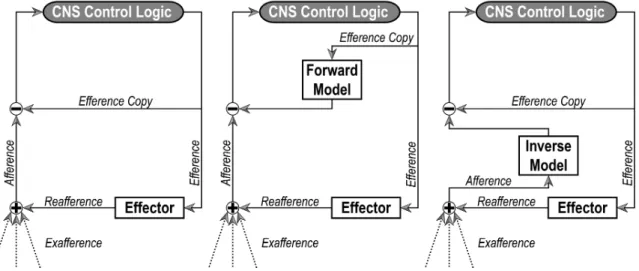
1.2 The concept of efference copy . . . 5
2.1 Overview of the GoogLeNet architecture . . . 21
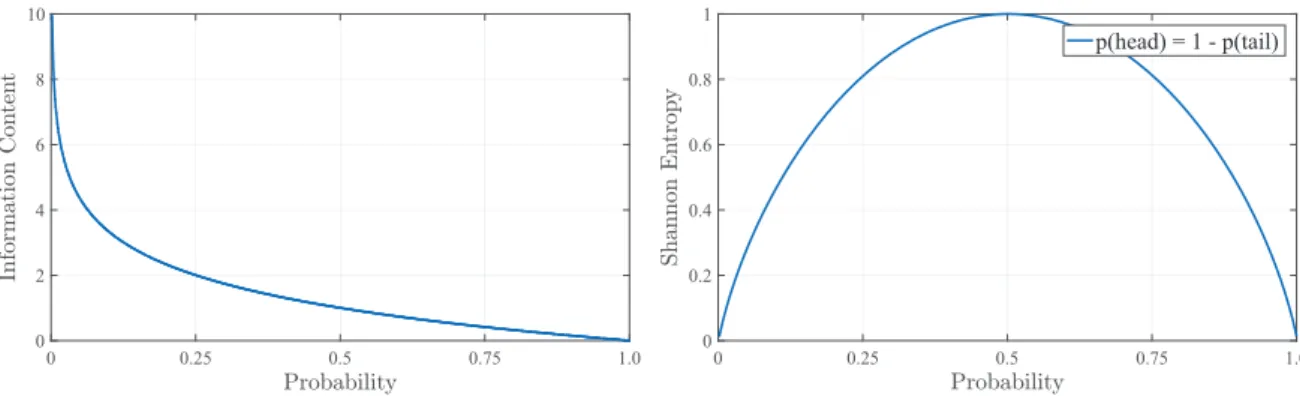
3.1 Distinction between probability, information content and Shannon entropy 27 3.2 Relations between two partially dependent processes . . . 28
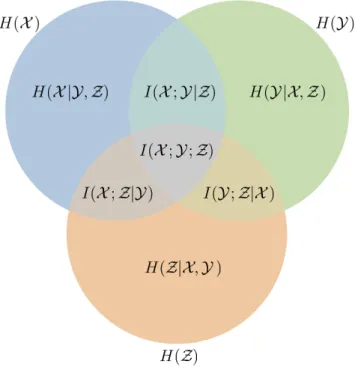
3.3 Relations between three partially dependent processes . . . 31
3.4 Interconnected neurons are utilized to structure ANNs . . . 37
3.5 The most common activation functions of neurons . . . 39
3.6 Connection types of neurons in ANNs . . . 41
3.7 Generalizability vs. overfitting in ANNs . . . 43
3.8 A demonstration of the gradient descent technique . . . 45
3.9 An explanation of the unfolding in time procedure . . . 47
3.10 The structure of LSTM memory blocks . . . 49
4.1 A comparative view on the F-BSPM and I-BSPM . . . 53
4.2 An overview of the V-BSPM . . . 53
4.3 A target process with regard to simultaneous processes . . . 56
4.4 Different information-theoretic measures between simultaneous processes 57 4.5 Lazy and eager learning techniques . . . 60
4.6 An overview about the proposed BSPM approach . . . 61
5.1 A NAO robot is following the human guidance . . . 63
5.2 Dimensionality reduction of joint angles during walking . . . 66
5.3 Stability parameter prediction using the F-BSPM . . . 67
5.4 The human directly guides the robot . . . 70
5.5 Perturbation detection utilizing F-BSPM predictions . . . 71
5.6 The human guides the robot during a transportation task . . . 72
5.7 Overview of the presented eager F-BSPM . . . 73
5.8 The influence of the SDMD regularization parameter 𝛾 . . . 77
5.9 GDMD is applied to a NAO robot’s walking behavior . . . 78
5.10 The first PC is normalized and discretized . . . 80
5.11 The PC trajectories are scaled by means of TE . . . 83
5.12 Certain I-BSPMs detect a variety of extrinsic perturbations . . . 84
5.13 The setup and usability analysis of a conducted I-BSPM user study . . 86
6.1 The robotic arm which is augmented with tool usage capabilities . . . . 90 6.2 The TE between the time/torque measurements and the proprioceptors 93 6.3 The phase and subsequent torque estimation step of the V-BSPM . . . 97 6.4 Overview of the presented lazy V-BSPM . . . 99 6.5 A mobile robot platform is equipped with a robotic arm . . . 100 6.6 A water extraction station is utilized by the mobile robot platform . . . 102 6.7 The FT values at the robot’s TCP when lifting different weights . . . . 103 6.8 CMI and MMI are utilized for an iterative proprioceptor selection . . . 105 6.9 The influence of proprioceptor selection on the LSTM learning curve . 107 6.10 The categorical probability distribution of the trained LSTM . . . 108 6.11 The LSTM classification capabilities compared to a short-term memory 110 6.12 The influence of input variables on the LSTM learning curve . . . 111 6.13 The influence of the LSTM block size on the learning curve . . . 112 6.14 Overview of the presented neural network based V-BSPM . . . 113 7.1 A human coworker is handing over different shapes to the robot . . . . 117 7.2 The TE between the proprioceptors and time/FT measurements . . . . 119 7.3 A comparison of different ANN architectures . . . 120 7.4 The F-BSPM predictions for different ANN architectures . . . 122 7.5 The influence of proprioceptor selection on recurrent F-BSPM predictions124 7.6 The F-BSPM predictions compared to the V-BSPM approximations . . 126 7.7 The amount and direction of extrinsic forces . . . 128 7.8 Overview of the presented combination of F-BSPM and V-BSPM . . . 129
List of Tables
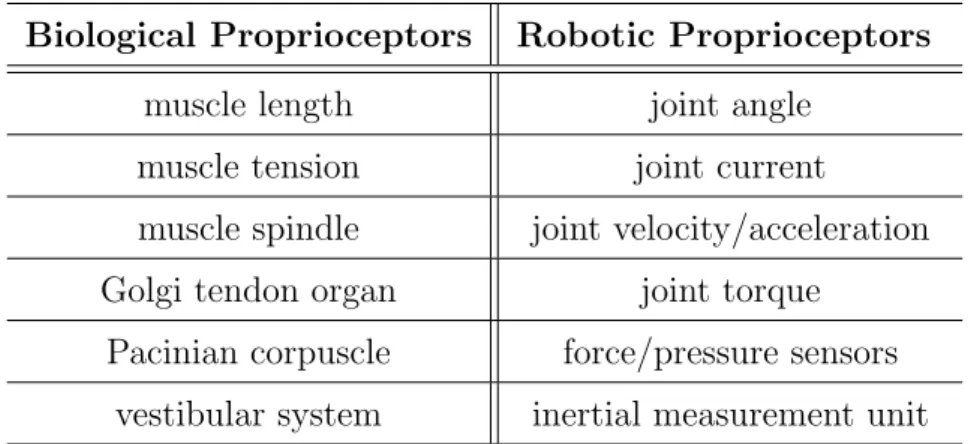
1.1 A comparison of biological and robotic proprioceptors . . . 3
2.1 A summary of deep learning architectures . . . 22
3.1 20 repetitions of tossing a manipulated coin . . . 29
3.2 The probabilities resulting from Table 3.1 . . . 30
3.3 20 repetitions of tossing a predictable coin . . . 34
3.4 The probability distributions resulting from Table 3.3 . . . 34
5.1 The MRE resulting from different interpolation schemes . . . 79
5.2 The I-BSPM MAE for different sensor groups and PCA/TE permutations 85 6.1 The V-BSPM MAE for different noise and proprioception groups . . . . 98
6.2 The classification error for different inputs and RNN architectures . . . 110
1 Introduction
Fig. 1.1:The proposed machine learning approach enables different robot platforms to generate ac-curate force estimates for physically demanding tasks.
An important vision of research in robotics and artificial intelligence is the devel-opment of robot capabilities which allow to flexibly support humans under changing environmental conditions. Examples are robotic assistants that can help to trans-port heavy objects, utilize custom tools or explore unstructured environments (see Figure 1.1). However, close-contact of this kind requires significant sensing capabili-ties in order to ensure safe and meaningful physical interactions with humans or the environment. Here, humans often rely on force feedback during physical activities.
In order for a robot to engage in similar activities, it needs to be able to sense external forces. This usually requires special purpose sensors which induce several drawbacks such as increased costs and reduced payload. Furthermore, such sensors often return noisy non-zero readings when the robot executes a motor task. Hence, it is difficult to distinguish regular from perturbed behavior execution based on these sensors only. In contrast, humans are capable to estimate forces by utilizing prior proprioceptive experiences. These estimates can then be used to adapt the behavior in an adequate manner.
This thesis presents a machine learning approach which generates experience-based models of robotic proprioception. During training, the robot executes a behavior while gathering information about the fluctuations of its proprioceptive sensors and the corre-sponding forces. Sensors which are strongly correlated to these forces are then utilized to learn behavior-specific proprioceptive models. As a result, the approach estimates forces without the need of special purpose sensors. The amount and direction of the de-tected forces can then be utilized to adapt the robot’s behavior by appropriate reaction rules.
1.1 Biological Motivation
During the learning of any new skill, sport, or art, it is usually necessary to become familiar with some proprioceptive tasks specific to that activity. Without the appropriate integration of proprioceptive input, an artist would not be able to brush paint onto a canvas without looking at the hand as it moved the brush over the canvas; it would be impossible to drive an automobile because a motorist would not be able to steer or use the foot pedals while looking at the road ahead; a person could not touch type or perform ballet; and people would not even be able to walk without watching where they put their feet. [10]
Humans are able to recognize and compensate unexpected extrinsic perturbations during behavior execution. For example, performing the same lifting behavior for sim-ilar shaped but different weighted objects requires the adaptation of muscle tensions. In contrast, most robots are still explicitly programmed to perform the same behavior over and over again. While this may be sufficient for various industrial settings, real world applications are a much greater challenge. Here, changing environmental condi-tions can have long-term consequences on a continuously executed behavior which also restricts the complexity of reasonable analytical models.
In contrast, the sense of self or proprioception allows humans to learn and adapt a skill by becoming familiar with the particular task. Here, no analytical model is required to adapt the walking gait to environmental constraints, apply an adequate amount of forces to surroundings or to estimate the weight of a lifted object. In-stead, experience about the own body gathered during previous behavior executions is generalized with regard to the actual state of the body.
1.1.1 Learning from Experience
Various species are able to imitate a demonstrated behavior. For example, human children learn walking through the haptic influence of their parents [11] and further try to imitate close to all observed behaviors. Bandura and Walters [12] also found that such kind of imitation learning is a crucial factor for the cognitive development of children. Different configurations of body characteristics, environmental conditions and task situations inhibit the behavior from being copied directly. Therefore, applying such kind of imitation learning to humanoid robots [13] usually requires direct task transfer and an additional optimization process. For example, haptic interaction is used by Ben Amor et al. [14] to teach a small sized humanoid robot various complex motor skills, e.g., standing-up and walking. Without the stabilizing assistance of the human interactant a successful execution of the recorded motion is not possible. Hence, inside a physical simulation, the motion is optimized and transferred to the robot afterwards. However, the main advantage of this data-driven method is that it starts from a ’bootstrapped’ motion which is already close to an optimal solution.
Similar to this, a being which aims to solve a task for unknown environmental condi-tions rarely begins from scratch. In most of the cases the individual has an initial idea
Tab. 1.1: Biological proprioceptors compared to robotic sensors with related functionality.
Biological Proprioceptors Robotic Proprioceptors
muscle length joint angle
muscle tension joint current
muscle spindle joint velocity/acceleration
Golgi tendon organ joint torque
Pacinian corpuscle force/pressure sensors vestibular system inertial measurement unit
which is obtained from previously behavior executions and similar situations. Develop-ing such cognitive capabilities requires to gather experience durDevelop-ing body-environment interaction [15]. In order to perform and evaluate such interactions an idea about the sensory-motor integration of the body need to be given. More precisely, this means a mapping fromproprioception to visual and haptic stimuli.
Proprioception refers to the sense of the (1) relative position of one’s own parts of the body and (2) strength of effort being employed in movement [16]. For example, (1) humans are able to locate their limbs without the need of visual feedback and (2) produce the needed strength to hold objects. For this, muscle lengths and tensions are compared to previous experienced sensations which allow estimating the actual position, movement and exerted forces. Following Sherrington [17], proprioception is distinguished from interoception and exteroception. Exteroception refers to senses that provide information originating outside the body, such as sight and hearing while interoception provides information about the stretching of internal organs and pain.
In humans, proprioceptive receptors orproprioceptors are able to recognize compres-sion, traction and elongation of muscles where body movement is usually needed to activate them. These are sensors which gather information about the own body config-uration and allow to have a sense of self. The most relevant biological proprioceptors are summarized in the left column of Table 1.1. The muscle spindles [18] recognize variations in the muscle length while the so called Golgi tendon organ [19] measures changes of tension. Similar to this, the Pacinian corpuscles [20] are mechanorecep-tors which measure pressure and are primarily contained in the skin. In contrast, the vestibular system provides the main contribution to body orientation and balance which also contributes to the measurement of body movement. This makes it diffi-cult to separate the vestibular information from the proprioception and vice versa. State-of-the-art robotic systems provide access to a rich set of sensor readings. The right column of Table 1.1 summarizes commonly used robotic proprioceptors which are related to the biological ones.
In the real world a motor skill is never executed twice in exactly the same way. One way to accommodate such uncertainties is to get familiar with behavior-specific sensor feedback. Utilizing proprioceptive information, this thesis aims to apply the
benefits of experience based learning to implement adaptive robotic behavior. More precisely, a novel machine learning approach is presented for deriving behavior-specific proprioceptive models from previous behavior executions. During training, the behav-ior is executed several times with different task parametrizations or may be subjected to different extrinsic perturbations. For example, a pick-and-place operation may be executed with objects of different weights or a tool may be used with different forces being applied to external objects. During execution of each behavior example, the proprioceptors are continuously experienced. The resulting time series of sensor read-ings serves as training data of the robot’s proprioception. This experience is used to estimate the proprioceptive state or the executed action of a robot.
1.1.2 The Reafference Principle
The fundamental idea behind the reafference principle is introduced in the research of Steinbuch about the tactile recognition of objects [21]. Here, the central observation is that humans are capable to identify objects by grasping them while a passive collision with the object is insufficient for accurate object recognition. More precisely, the hy-pothesis is that the human brain combines knowledge about the executed motion with its consequences on the sensor perception which Steinbuch referred to as ’Bewegidee’ [21, p. 30].
This idea is further refined by Charles Bell [22] and his observations of how humans perceive a stable world from the images of the eye. He demonstrates that the brain utilizes information about the active eye movement (the eye muscles) to predict changes in the image received by the retina. By combining both, the human brain is able to stabilize the images. Furthermore, he enhanced the former concept by the idea that copied actuator commands are used to predict changes in the sensor perception. This idea is proven by Helmholtz who utilizes the acquired knowledge to describe the functionality of visual object localization [23].
The reafference principle, introduced by Holst and Mittelstaedt [24], describes the concept of a prediction correction procedure. They also formulate a basic model which is simplified illustrated in Figure 1.2 left. Here, an effector command (efference), e.g., a signal to an actuator or muscle, is received from the Central Nervous System (CNS). Thisefference is duplicated and stored asefference copy. Next, the efference generates an action which is executed by the effector. During this action execution, the sensory receptors make measurements referred to as afference. Here, the values contained in the afference originate from two different sources: reafference and exafference. A reaf-ference occurs due to regularintrinsic fluctuations which are caused by the execution of the efference and depend on the corresponding action and the properties of the system. In contrast, the exafference determines the influence of the surrounding world and is triggered by extrinsic perturbations.
The main problem is that the system’s sensory receptors measure the sum of both and cannot differentiate between them. Instead, the afference is compared with the previously created efference copy. More precisely, the difference between afference and
Fig. 1.2:Different processing models for an effector command (efference). Here, an efference is re-ceived from the CNS. First, a copy of this efference is created. Next, the effector performs the action contained in the efference resulting in an afference which contains the sensor perception at the effector. Left: In the basic approach, extrinsic perturbations are detected by comparing the efference copy with the afference where a deviation between both cause the control logic contained in the CNS to generate a new efference which is fed back to the circulation. Middle: In contrast, the forward model predicts the afference from the efference copy to allow handling different afference/efference spaces. Right: Similar to this, the inverse model transforms the afference to an estimate of the performed efference.
efference copy determine the exafference. A successful action execution is confirmed when the exafference is zero. Otherwise, a new efference which compensates the exaf-ference is created by the control logic and consequently compensates the corresponding extrinsic perturbations. Broadly speaking, the effector is controlled by comparing the setpoint (efference) with the actual value (afference) in a feedback-loop. This is close to PID controller approaches developed in the field of automation and control technol-ogy [25]. Here, the desired setpoint of a process is compared to the actually measured process value where the controller adapts the process based on proportional, integral, and derivative terms in a feedback loop. Therefore, properties such as dimensionality and value-range of the efference motor commands and the sensor afference are assumed to be identical in the basic approach (see Figure 1.2 left).
However, as first taken into account by Roger Wolcott Sperry [26] and his studies about the optokinetic reflex these properties can also differ. In more detail, when following a moving object the efference of the eye muscle generates an afference which is an image perceived at the retina. Hence, efference and afference have different dimensionality and ranges of values. Therefore, motor commands need to be mapped to the corresponding sensor pattern or vice versa. There are two different model-based methods which can be applied to unify the efference and afference spaces: a forward (see Figure 1.2 middle) and an inverse model (see Figure 1.2 right).
A forward model predicts the expected intrinsics from the efference copy and conse-quently converts motor commands to the particular sensor perception. The difference between the actual perception and the predicted one is used as an estimate of the extrin-sic perturbation. This has the advantage that the extrinextrin-sic perturbation is measured in the sensor space what therefore allows to implement very specific control rules.
In contrast to such a kind of predictor, the inverse model utilizes the total afference to generate an estimate of the executed efference. The difference between estimated efference and efference copy is used to derive the extrinsic perturbation which therefore is measured in the effector space. Hence, an inverse model is more similar to a controller where extrinsic perturbations correspond to effector commands which can be directly applied to compensate them. Inspired by this, Kawato [27] proposed internal forward and inverse models for the application in robotics. In particular,forward models make use of the robot’s measured proprioception and the actuator command to predict the expected proprioception while inverse models generate an actuator command which causes a desired change in the robot’s proprioception.
As mentioned above, some actuator command may have an influence on the par-ticular sensor perception, e.g., image stabilization benefits from actuator commands of the eyes rather than the fingers or arms. An adequate mapping therefore requires knowledge about the sensory-motor integration of the system. More precisely, what consequences does an action performed by the motors have on the perception received by the particular sensor? To solve this question, one could implement an accurate analytical model which takes into account kinematic structure, mass distribution and the dynamics of the system. The complexity of the resulting model and its missing adaptation capabilities actually restricts applications to rigid systems with just a few joints. For example, most of todays robotic arms support direct and inverted kinemat-ics but cannot automatically adapt to changing environmental conditions. Hence, an automatic extraction of such sensory-motor dependencies is discussed in the following.
1.1.3 Sensory-Motor Dependencies
The adequate selection of motor commands and sensors which are relevant to learn the particular task is a core component of the presented machine learning approach. For example, a forward model usually makes use of locally connected muscles which are close to the effector or the particular sensor. Such local correlations are sufficient for a subset of motion sequences but not for more complex tasks which may involve various distal dependencies. To illustrate this, the sense of balance is considered in the following. For humans the main contribution to the prediction of balance is given by the vestibular system in the ears while distal dependencies to the muscles in the eyes, neck, legs, arms and the visual perception are also relevant. A popular example of how the visual perception can disturb the sense of balance is the simulator sickness [28]. Here, the eyes perceive a moving world that cannot be measured by the vestibular sensor system. These contradictory perceptions result in incompatible predictions which are the cause for the sickness.
In this context it is important to note that, in addition to motors (i.e. muscles), also sensors (e.g. visual perception) can contain relevant information and therefore can be used as input to predict other sensors (e.g. balance). Hence, actuator commands and sensor readings can be used as input for the computational model developed in this thesis. Here, the behavior-specific selection of inputs, whether originating from the
actuator or sensory system, is referred to as sensor selection. A major advantage of utilizing only the relevant subset of sensors is the decreased complexity of the model. In robotic behaviors, such sensory-motor dependencies might be complex and far from obvious. A common solution is to execute a behavior several times under varying con-ditions while recording the sensory and motor system. The recorded set of behavior examples represents the training data which is utilized to detect sensory-motor depen-dencies. In the presented approach, statistical methods such as information theory and dimensionality reduction are applied to extract behavior-specific sensory-motor dependencies.
Furthermore, a major challenge is to distinguish statistical correlations from spurious correlations. Correlations describe a statistical relationship, whether causal or not, between two processes that are beneficial for prediction purposes. In contrast, spurious correlations describe wrong correlations which are inferred by coincidence or unknown background processes and are only correct for a limited number of observations. To avoid learning from spurious correlations, the number and heterogeneity of behavior examples contained in the training data are crucial. A common solution to this problem can be achieved by recording an independent validation data set. The validation data can be used to evaluate the accuracy of the learned model where the usage of spurious correlations usually results in large prediction errors.
1.2 Methodology
This thesis is a study of force-estimation with Behavior-Specific Proprioception Mod-els (BSPMs) which allows robots to flexibly interact with their environment. The biological motivation of the proposed methodology is given by the reafference principle which was introduced above. This concept describes how experience about previous behavior executions enables natural beings to distinguish between self-generated and environmental influences. In order to achieve similar capabilities on a robot, the pro-posed machine learning approach builds on data-driven methods related to the fields of imitation learning and information theory.
First, a behavior which consists of a sequence of motor commands is repeatedly demonstrated and stored together with available proprioceptive readings. The result-ing trainresult-ing data therefore contains behavior-specific information about sensory-motor dependencies. By means of statistical methods, this information helps to uncover si-multaneous and time delayed correlations in the behavior of the robot. Sensors with a strong proprioceptive correlation are automatically selected for model learning. Here, machine learning algorithms are applied to infer BSPMs which can be configured in three different modes:
∙ A Behavior-Specific Proprioception Model in Forward Mode (F-BSPM) predicts the reafference or intrinsic proprioception.
∙ A Behavior-Specific Proprioception Model in Inverse Mode (I-BSPM) estimates an executed efference or behavior parameter configuration.
∙ In contrast, a Behavior-Specific Proprioception Model in Virtual Mode (V-BSPM) augments the proprioception by combining available information to avirtual sen-sor which is not addressed in the original formulation of the reafference principle. For this, machine learning algorithms examined in this thesis include: lazy learners, probabilistic models, classical neural networks and deep learning techniques. Further-more, different preprocessing methods such as principal component analysis, autoen-coders, transfer entropy and mutual information are examined.
As a result, BSPMs enable a robot to distinguish between intrinsic sensor readings from extrinsic perturbations without the need of special purpose sensors. In particular, intrinsic fluctuations are caused by regular behavior execution while extrinsic pertur-bations are induced by application of external forces. Robotic applications examined in this thesis include:
∙ Make robotic walking behaviors robust against being pushed or pulled by an adversary or forces exerted by a collaborator during joint transportation tasks. ∙ Calculate quantitative estimates of forces applied by the interaction with external
objects during tool usage.
∙ Accurately classify an object’s weight which is being lifted under rough environ-mental conditions.
∙ Implement pick-and-place operations which safely detect the influence of inten-tional physical human-robot interactions and unintended collisions.
Here, the deviation between predicted and measured proprioception is attributed to the influence of extrinsic perturbations. In the absence of external stimuli, this difference is about zero while fluctuations in the proprioception originate from behavior-specific intrinsics only. As emphasized earlier, human perception such as the sense of balance relies on the combination of various information sources and therefore is less sensitive to errors. This is also a main advantage of the presented BSPM approach. For instance, when affected by noise or even defect, a single special purpose sensor would result in failure. Instead, multiple sensors are combined to one higher level of functionality. Con-sequently, negative effects which occur partially can be compensated by the combined information and still result in meaningful estimates of extrinsic perturbations.
The estimated amount and direction of extrinsic perturbations is then used to per-form an appropriate behavior adaption where the robot’s reaction rules depend on the particular field of application. The generalizability of the approach presented in this thesis is shown in a variety of applications involving physically interacting robots. For instance, one application utilizes prediction-correction schemes in physical human-robot collaboration on a humanoid human-robot platform. Here, the human-robot iteratively cor-rects its behavior configuration and consequently compensates extrinsic perturbations. Other applications, implemented on an industrial robotic arm, aim on force feedback for tool-usage, physical human-robot interaction and state classification tasks. The basic idea is that providing a robot with accurate force sensing capabilities enables it to safely interact with human participants and technical equipment.
1.3 Contributions
This thesis investigates how proprioceptive feedback can be used for robotic force es-timation using a machine learning approach. In doing so, various conceptual, method-ological and application-oriented contributions to the state of the art are presented. Conceptual Contributions
The main contributions of this thesis are Behavior-Specific Proprioception Models (BSPMs) which generate estimates of the expected proprioception from prior expe-rience. In contrast to classical learning of motion commands, these models enable robots to flexibly interact with their environment by adding expected sensations to the received feedback. Here, safe and meaningful physical interactions require distinguish-ing self-generated sensations from environmental influences. Motivated by propriocep-tive models in humans, different BSPM variants are proposed to equip robots with a proprioceptive sense of self.
In particular, an F-BSPM predicts the behavior-specific intrinsic proprioception. This allows estimating the amount and direction of external forces in the space of the particular proprioceptor for a concrete situation. In contrast, an I-BSPM estimates high-level behavior parameters from the measured proprioception. By comparing this estimate with the executed behavior, extrinsic perturbations can be detected in be-havior space. Furthermore, V-BSPMs augment robotic proprioception with virtual sensors. These sensors are generated by combining available but usually hidden infor-mation from the robot’s proprioceptors. As will be shown, the force estimates of these models significantly increase the interaction capabilities of different robot platforms. Methodological Contributions
The main methodological contribution is the operationalization of the BSPM approach via data-driven machine learning techniques. For this, behavior-specific proprioceptive experiences are acquired from demonstrations. Here, the wear and tear of the robot and the effort spent by the user is reduced by learning from only a few training ex-amples. To further increase the practical applicability of the proposed approach, no expert knowledge about the particular robot platform, e.g., kinematic chains or mass distribution, is required. Instead, various information-theoretic measurements are ap-plied to automatically identify the most relevant sensor readings for force estimation of a specific behavior. To the best knowledge of the author, this is the first time that such information-theoretic measurements are applied in the context of sensor selection in robotic proprioception.
Furthermore, this thesis compares advantages and disadvantages of various lazy and eager machine learning approaches. The precision of lazy learners such as time series alignment algorithms usually depends on a large number of training examples. This thesis introduces a novel interpolation technique which extracts the underlying dynam-ics of a behavior by utilizing methods from the field of fluid dynamdynam-ics. Here, a small
set of training examples is sufficient to accurately interpolate sensor readings for so far unknown situations. In contrast, eager learning has the possibility to generalize outputs for arbitrary inputs. Here, the information-theoretic sensor selection method is crucial for learning efficiency. Furthermore, several techniques reaching from statis-tical methods over classical neural networks up to modern deep learning techniques are compared.
Application-Oriented Contributions
The BSPM approach is applied to different robot platforms which do not possess ded-icated force sensing capabilities to fulfill various physically demanding tasks. Here, proprioceptors, behavior parameter configurations and context descriptions can be se-lected as learning target of the corresponding proprioceptive model. Hence, the pre-sented machine learning approach in general is applicable to any kind of sequential quantity, i.e., regression for continuous values or classification of discrete labels.
One platform is the humanoid NAO robot where the BSPM approach is applied to make walking robust against extrinsic forces which are triggered by the environment rather than the behavior execution itself. As a result, the biped robot can stabilize its walking gait and follow the guidance of a human interactant.
Furthermore, an industrial robotic arm learns to estimate torque values during the usage of a custom tool and classifies weight even more precisely than a special purpose sensor. During performing a pick-and-place task this robot is also enabled to accurately detect collisions with the environment and a human interactant. The resulting force estimates and interaction capabilities are comparable to the usage of state-of-the-art force-torque sensors.
1.4 Thesis Outline
Chapter 2 presents the fundamental concepts and basic terms of machine learning which are widely used in the field of robotics and computer science. Furthermore, related work on data preprocessing, force estimation and neural networks is introduced.
Chapter 3 introduces the mathematical background for detecting sensory-motor dependencies. For this, measures in the field of information theory, which allow detecting correlations within huge data sets, are examined. In particular, mutual information and transfer entropy are introduced and evaluated on the basis of a simple example. Furthermore, the fundamentals of biologically inspired neural networks to state-of-the-art deep learning technologies are introduced.
Chapter 4 introduces the new concept of BSPMs to equip robots with accu-rate force estimation capabilities. Here, one goal is to distinguish self-geneaccu-rated forces from perturbations which originate from the surrounding environment.
Chapter 5 gives a comparative depiction of the F-BSPM and I-BSPM approach for the application on a humanoid robot. Here, the goal is to infer guidance infor-mation during human-robot collaboration from the robot’s integrated sensors. The direction of guidance is then used to adapt the robotic behavior in an adequate manner.
Chapter 6 introduces two applications which implement V-BSPMs to augment the proprioception of an industrial robot arm with accurate force sensing capabilities. Here, force related context descriptions are manually assigned to training examples which are then approximated during runtime. In particular, the robot learns to accurately perceive and distinguish torque values applied to a wrench and to estimate the weight of a self-contained water extraction station.
Chapter 7 presents an application that combines multiple BSPMs to accu-rately detect extrinsic perturbations from force-torque measurements. To this end, a state-of-the-art force-torque sensor is trained in combination with an industrial robotic arm. During runtime, this special purpose sensor is replaced by its virtual counterpart which further allows to distinguish intrinsic fluctuations from extrinsic perturbations.
Chapter 8 concludes this thesis by highlighting the most important findings and contributions made. Finally, some promising directions for future research are given.
2 Related Work on Machine Learning
In this chapter, the fundamental concepts and basic terms of machine learning are introduced. Next, the benefits of data preprocessing for efficient model learning and runtime application are highlighted. Furthermore, several proprioception based appli-cations for adaptive systems which focus on the use of neural network architectures are discussed. In turn, the general applicability, current research and promising directions of Artificial Neural Networks (ANNs) are given. Finally, it is presented how this thesis extends previous work.
2.1 Machine Learning Fundamentals
The field of machine learning is a combination of different disciplines such as statis-tics, information theory and optimization. As noted by Carbonell, Michalski, and Mitchell [29] it is usually applied to simulate human learning, explore novel learning techniques or to implement learning capabilities in artificial systems. In this thesis, the term ’machine learning’ is utilized in the context of the latter and therefore allows a system to ’learn without being explicitly programmed’ [30].
A major advantage of machine learning is its general applicability across domains. Beside well-known implementations for recommender systems [31] and self-driving cars [32], machine learning is widely spread in other fields of research such as geol-ogy [33], medicine [34] and physics [35]. For all of these applications the basic idea is to train a mapping with ground truth information. This ground truth is usually given by a set of training data which contains information about input variables and their corresponding output. Here, the output is distinguished between regression and
classification applications. In particular, regression approximates a function which returns real numbers while classification identifies a specific group membership. How-ever, depending on the particular type of training data, there are mainly three learning methods to be distinguished [36]:
∙ Unsupervised learning algorithms are trained to find hidden structures from input data without a predefined output. For this, output patterns are extracted during training and recognized for similar inputs during run-time, e.g., clustering. ∙ Reinforcement learning assigns a reward value to a sequence of input samples.
The reward value can be understood as a simplified output, e.g., good-bad. ∙ Supervised learning techniques continuously generate discrete output estimates
from the input variables and are also in the core of the presented machine learning approach.
Machine learning is further divided into lazy and eager learning algorithms [37]. Here, lazy learning is the comprehensive term for approaches where data processing is delayed until a query is made to the system. Once received, an answer is gener-ated by a combination of the training data. The answer and intermediate results are discarded after this process. More precisely, lazy learner techniques fit real-time data to the training data, e.g., k-nearest neighbors, locally weighted regression or spline interpolation. This allows generating an answer for unknown situations from familiar ones. In the context of this thesis a novel interpolation scheme from fluid dynamics, the so called Dynamic Mode Decomposition (DMD) [38], is utilized. For example, this method is applied to generate a highly accurate stability model of a humanoid robot’s walking gait (see Section 5.2). In contrast to that, eager learning algorithms generate an abstract model during a training phase. For example, Artificial Neural Networks (ANNs) learn to approximate the input/output function and discard the training data afterwards. Future requests are answered by generating a reply from the generated model.
Consequently, lazy learning requires less computational power than training an eager algorithm but usually have greater storage requirements. Furthermore, the response time of a lazy learner depends on the amount of training data while eager learning utilizes a compact model which usually replies in constant time. This thesis makes use of both eager and lazy algorithms to evaluate pros and cons of the presented BSPM approach in real world applications. Here, learning an accurate model usually involves the preprocessing of training data.
2.2 Preprocessing
The efficiency of machine learning algorithms primarily depends on the quality of the training data where a sufficient amount of heterogeneous training samples for the particular task need to be given. Here, sensor selection and dimensionality reduction techniques help to single out the most important features. To apply these techniques it is important that the data is in a useful scale and a unified format. This is usually achieved by performing two subsequent steps: normalization and discretization.
2.2.1 Normalization and Discretization
At present, robotic systems can acquire a rich set of sensor readings. These include joint angles, force-torque values or motor currents which rely on diverse measurement units. Depending on its particular position, the same kind of sensor can further have varying measuring ranges. For example, a humanoid robot’s knee joint usually has a range of 90∘ while the shoulder has about 270∘. This is solved by means of normalization [39] where the most popular methods are: min-max and z-score scaling. More precisely, min-max normalization linearly transforms a value𝑥 to the scaled value ̂𝑥, which is in a range of [0,1], by
̂
𝑥= 𝑥−𝑥𝑚𝑖𝑛
𝑥𝑚𝑎𝑥−𝑥𝑚𝑖𝑛
Here, 𝑥𝑚𝑖𝑛 and 𝑥𝑚𝑎𝑥 determine the possible minimum and maximum boundaries of
the original data. In order to apply min-max normalization on robotic sensor streams,
𝑥𝑚𝑖𝑛 and 𝑥𝑚𝑎𝑥 of the particular sensor device need to be contained in the training
data. Otherwise, larger or smaller real-time values would exceed the boundaries which requires to recalculate the normalization for all values and consequently to rerun the learning phase. One could also argue to utilize the particular hardware device limits to fix 𝑥𝑚𝑖𝑛 and 𝑥𝑚𝑎𝑥 only once. This requires a fair degree of knowledge about the
robot’s hardware. In contrast, the z-score scaling introduced by Larsen and Marx [40] normalize the data based on the mean ̄𝑥 and standard deviation 𝜎
̂
𝑥= 𝑥−𝑥̄
𝜎 .
Here, the particular sensor limits are not relevant to normalize the data. The authors also prove that data which follows any Gaussian distribution is transformed into a standard normal one.
Unfortunately, a wide variety of sensors return measurements in a noisy continuous space. For example, common force sensors return real numbers and are still prone to error. Therefore, they measure varying non-zero readings even if in rest. In turn, such slightly different values make a probability analysis less efficient. This problem is addressed by several quantization techniques which discretize the continuous space.
A popular method is the so called binning [41]. Here, the continuous space is por-tioned to a discrete one with a fixed number of uniform states. However, a further problem is that different sensors have distinct and even irregular frame rates. This is particularly critical for time dependent machine learning approaches which are trained with time-discrete sets of data. Hence, training and runtime data need to be acquired with identical frame rates or need to be synched by means of timestamps and interpo-lation schemes.
Finally, the preprocessed training data is analyzed for feature detection purposes. More precisely, information-theoretic measures or dimensionality reduction methods are applicable to select the important parts of the training data.
2.2.2 Information-Theoretic Sensor Selection
The use of information theory in sensor management was first proposed by Hintz [42] and found several applications in robotics.
In particular, Manyika and Durrant-Whyte [43] utilize information-theoretic mea-sures to implement a data fusion and sensor management framework. Here, multiple sonar sensors of a mobile robot are analyzed and selected depending on their actual attention level. As a result the framework increases the overall navigation capabilities of the robot.
Moreover, Liu, Reich, and Zhao [44] present an information-driven vehicle tracking approach. They utilize a mobile platform which is equipped with an acoustic sensor network. This allows estimating the distance and direction to a given target. Here, mutual information is used to extract collaboration between the different sensors and
the target position. According to the authors, their approach is more energy efficient since less relevant sensors can be switched off temporarily.
Similar to this, Dame and Marchand [45] apply mutual information to avisual servo-ing task. More precisely, they control a six degree of freedom robotic arm from image data only. In contrast to other techniques, mutual information is insensitive to changes of lighting. This makes it suitable for detecting similar visual features which are used to align images under varying environmental conditions. As shown by the authors, the accuracy of the visual servoing approach benefits from the usage of mutual information and is also robust against large illumination variations.
Another possible technique to detect important correlations is to apply dimension-ality reduction methods. In contrast to information theory, dimensiondimension-ality reduction methods do not rely on the selection of raw data. Instead, the complete data is prepro-cessed to a compact representation which maintains the more important parts stronger than the less relevant.
2.2.3 Dimensionality Reduction
Dimensionality reduction involves a mapping from high-dimensional input points to low-dimensional manifolds and vice versa. This allows increasing the efficiency of the corresponding lazy or eager learning technique.
For example, Ciocarlie, Goldfeder, and Allen [46] applies dimensionality reduction for grasps performed by a robotic hand. Here, the grasp is controlled by a highly reduced configuration space which is built upon Principal Component Analysis (PCA). More precisely, PCA extracts the latent structure of training data based on eigenanalysis of covariances and applies a linear mapping between the different dimensionalities. The generalizability of the generated low-dimensional configuration space is shown by the implementation of a grasp planner which is applied to significantly different hands.
Similar to this, Artemiadis and Kyriakopoulos [47] utilize PCA to generate a low-dimensional embedding from high-low-dimensional electromyographic signals. These sig-nals are measured at the upper limb of a human and therefore represent muscle syn-ergies and motion primitives. A three-dimensional projection to Cartesian coordinates is then utilized for the continuous control of a robotic arm. The overall approach is implemented in the context of a human-robot teleoperation interface.
In contrast, Bitzer, Howard, and Vijayakumar [48] make use of a nonlinear extension to PCA based on Gaussian processes. Here, inherent structures are extracted from the training data and used as compact state representation. These states are then utilized to learn policies which enable a humanoid robot to solve bi-manual reaching tasks.
Following Hinton and Salakhutdinov [49], also ANNs are a promising technique for reducing the dimensionality of data efficiently. In particular, an autoencoder network contains multiple layers with a small central layer. These autoencoders are trained to reconstruct high-dimensional inputs where the central layer is used as low-dimensional representation. According to Hinton and Salakhutdinov and similar to previous find-ings, the accuracy of autoencoders increase with their depth and can even outperform
the accuracy of PCA.
However, Ben Amor [50] compared a number of dimensionality reduction techniques used to extract relevant manifolds from motion data. As proven by the author, PCA does not achieve the highest accuracies but generalizes well for various motions and sig-nificantly different dimensionality while requiring less computational effort than most other methods.
2.3 Force Estimation in Robotics
Robot platforms, which assist or replace humans in physically demanding tasks, need precise force sensing capabilities. As noted by Haddadin, De Luca, and Albu-Scḧaffer [51], safe and efficient interaction further requires to detect and handle colli-sions for the entire robot platform. Instead of utilizing a large number of special purpose sensors, this can be achieved by generating force estimates from the robot’s integrated proprioceptors. For example, industrial robot manipulators such as the UR5 utilize an-alytical machine learning approaches to estimate forces acting at the end-effector. Such analytical approaches are usually built upon an accurate mathematical representation of the system dynamics.
For example, Stolt et al. [52] utilize the robot’s control loop architecture during performing assembly tasks. In particular, the robot’s joint position control errors are utilized for force estimation at its gripper. As stated by the authors, the accuracy of these estimates depends on a task-specific modification of the control loop mechanism. This requires an adequate configuration of an empirically determined scaling parameter. Furthermore, unknown environmental constraints, e.g., friction, decrease the accu-racy of the force estimates when the robot is not moving. Erhart, Sieber, and Hirche [53] present a related impedance-based control architecture for a cooperative robot-robot transportation task. Here, both robots and the rigidly grasped object are considered as a closed kinematic chain where position/orientation of the end-effectors and the in-ertia/mass of the object need to be known. Given an accurate configuration, undesired forces within the closed kinematic chain can be limited by real-time adaptation of the end-effectors.
Wahrburg et al. [54] estimate contact forces for a redundant robotic manipulator. The redundant joints of the robot allow reaching the same end-effector position with different joint-configurations which influences the quality of the force estimation. Here, the momentum is analyzed from the robot’s joint angles/speeds, motor torques and the manipulator dynamics. This enables the robot to find an optimal joint configuration for a given end-effector position.
In general, the quality of such analytical approaches depends on an accurate con-figuration and precise knowledge about system dynamics. The required amount of expert-knowledge is even intensified for more complex nonlinear systems which is a major limitation of analytical approaches. In contrast, humans do not rely on such precise mathematical models and instead learn to approximate highly nonlinear sys-tem dynamics from prior experience. Similar to this, data-driven machine learning
approaches involve a training phase where the task is demonstrated to the robot. The acquired training data is then utilized to learn an abstract model which approximates the system dynamics.
For instance, Coloḿe et al. [55] learn an inverse model of the robot dynamics where only the inertia matrix of the robot needs to be given. Here, locally weighted projection regression [56] is utilized to map desired joint positions/velocities to the required motor torque commands for a predefined trajectory. Comparing the predicted torque values with the actually applied ones allows extracting the amount and direction of external forces. This enables a robotic arm to measure the weight attached to its end-effector. However, only a single trajectory is learned while the generalizability to other end-effector positions is not proven by the authors.
He et al. [57] utilize a learning procedure for physical human-robot interaction in re-habilitation. Here, neural networks are trained to approximate the unknown dynamics of the robot and to adapt the behavior with regard to the forces applied by the human interaction partner. However, the approach is verified inside a simulated environment while its validity in real world applications still needs to be proven.
Schr̈oder-Schetelig, Manoonpong, and Ẅorg̈otter [58] present a dynamic walking application on a biped robot platform. The motor commands are used as input to the forward model which predicts the intrinsic acceleration during walking. The robot’s actual acceleration is then compared with the predictions made and used to control the upper body component. This allows compensating external forces which originate from altered terrain and consequently stabilizes the walking gait.
To summarize, data-driven approaches are capable to learn robot dynamics without the need of expert-knowledge about the particular robot but are usually restricted to manual sensor selection, a single trajectory and are demonstrated for only one specific robot platform. In contrast, this thesis presents a data-driven approach which is appli-cable to a wide range of robot platforms, provided sufficient access to proprioceptive sensors is given. The approach has been applied to different behaviors, e.g., walking, tightening, lifting, and is also flexible to environmental conditions such as different lifting positions or force sources. Here, the most relevant proprioceptors are selected automatically which increases the efficiency of the utilized model learning techniques, e.g., neural networks.
2.4 Artificial Neural Networks
The presented machine learning approach is based on the fundamental idea of giving a robotic system the ability to learn from previous demonstrations. A common technique to learn from a set of training data in a supervised fashion are ANNs. This is due to several advantages over lazy and other eager learning approaches:
∙ They are able to approximate the underlying linear or nonlinear function con-tained in the training data.
∙ They can easily handle a huge amount of training data and can be scaled to any number of input variables.
∙ Once training is finished, the network’s computational demand is independent from the particular input and respond in constant time.
Hence, ANNs are a promising technique for the implementation of the presented BSPM approach. In the following, a historical perspective to the field of ANNs is given. Next, the general applicability of ANNs in various fields of research is examined. Finally, several state-of-the-art deep neural architectures up to the extraction of indefinite tem-poral delays are discussed.
2.4.1 Historical Perspective
Such ANNs found their first practical application by the research of Rosenblatt and its definition of perceptrons in 1957 [59][60]. The perceptron was actually planned to be implemented directly in a custom-built neurocomputer, the so called Mark 1 per-ceptron [61]. This machine utilizes 400 photocells (input neurons) which are randomly connected to output neurons. The generated estimates are used for image recognition, e.g., to classify numbers. For evaluation purposes it was, in parallel, implemented as software which therefore was finished even earlier then the hardware version. This perceptron contains exactly one layer of adaptable weights and is also referred to as Single-Layer Perceptron (SLP). Furthermore, SLPs contain the basic building blocks: neurons, connections and weights and therefore are still the base of nowadays ANN research.
However, after a period of growth the research was abruptly slowed down after in 1969 Minsky and Papert published a precise mathematical analysis about SLPs [62]. They proved that a SLP is not capable of representing nonlinear functions as the XOR problem. Hence, they forecasted that the entire field of research is a dead end. In 1986 Rumelhart, Hinton, and Williams [63] disproved these negative evaluations. For this, they proposed Multi-Layer Perceptrons (MLPs) which are capable of solving also nonlinearly separable problems. The main advantage of MLPs is that they can have an unlimited number of layers which are hidden from the outside. With an increasing number of such hidden layers the network structure gets deeper and more complex. The challenges and improvements arising from organizing and learning such structures are referred to asdeep learning [64]. A detailed explanation of SLPs, MLPs and deep neural network architectures is given in Section 3.2. Starting from the functional discoveries of MLPs, the field of ANNs are almost grown and found applications in many fields of research.
2.4.2 General Applicability
A common application of ANNs is to forecast a sequence of successively measured points in time. Such kind of time series data can be found in different fields of application such as mathematical finance, econometrics and earthquake prediction.
For example, Zhang and Hu [65] present an ANN based approach to forecast the exchange rate of the British pound and the US dollar. Based on a huge set of financial data, they examined the effects of the network configuration and the amount of training samples on the prediction accuracy. As a result, they found that the prediction accuracy benefits from an increase of input variables and a large number of training samples.
Osman, Awad, and Mahmoud [66] make use of ANNs for short-term load forecast-ing for the Egyptian Unified System. Such predictions are essential for electric power system planning and are strongly depending on the actual weather, temperature and seasonal variations. In contrast to previous approaches, the authors utilize a correla-tion based seleccorrela-tion scheme of actual weather data. By utilizing this subset of input variables for the ANN results in accurate predictions and makes the approach robust against rapid temperature changes.
Panakkat and Adeli [67] are using seismicity indicators to forecast location, time of occurrence and the magnitude of earthquakes. A large seismic data of Southern Cali-fornia is preprocessed by (1) dividing into subregions or (2) splitting it into temporal subsets. For (1) seismicity indicators are derived from the magnitude of the largest earthquake while (2) make use of the latitude and longitude of the epicenter. These indicators are used as the input variables of an ANN where (2) is found to produce more accurate results than (1). According to the authors, the final indicators produce the best results in regions with intense seismic activity since also more seismic data is available.
Even if located in very different fields of research, all of these applications came to very similar conclusions where the crucial factors for accurate and robust forecasting of ANNs rely on
∙ the availability and selection of relevant input variables ∙ and the amount and heterogeneity of training samples.
Similar to the introduced applications, robotic platforms are also providing time series sensor readings such as joint angles, motor currents or force-torque values. There-fore, data acquisition and input selection schemes are also at the core of the proposed machine learning approach.
Besides applications related to time series prediction, ANNs are also widely applied to control robotic behavior [68]. For example, Velagic, Osmic, and Lacevic [69] present a motion controller for mobile robots. Here, the goal is to follow a given trajectory while feedback is obtained from the robot’s odometry. The position errors are used as input variables of a MLP and are mapped to the velocity which fixes the particular position errors. However, the results are only demonstrated inside a simulation while applicability and validity still has to be proven in real world experience.
Tsai, Huang, and Lin [70] apply ANNs to control the balancing of a two-wheeled robotic platform. They decompose the overall vehicle system into two adaptive MLP controllers where (1) regulates the yaw motion and (2) balances roll and pitch. (1) makes use of potentiometer measurements while (2) utilize a gyroscope and a tilt sensor as input data. The overall system allows maintaining the human body on the
footplate without falling and is even taken into account two-dimensional friction. Due to an inconvenient reaction time, the proposed approach is limited to low velocities.
Another application presented by Kumar et al. [71] makes use of an ANN for the adaptive control of robot manipulators. For this, they determine the robot’s dynamics by means of force, position and redundant joint subspaces. The given dynamics is then used to preset the parameters of a MLP where the errors of force, position and velocity are used as input. In their experiments they apply the presented approach on a simulated two link robotic manipulator with known and unknown dynamics. The authors show that by utilizing knowledge about the robot’s dynamics can increase the learning curve but requires quite a lot expert knowledge and intense user effort.
Similar to these applications, the proposed machine learning approach makes use of sensor readings to generate an adequate reaction. Concluding from the drawbacks of the presented applications this thesis aims on the implementation of self-adaptable behaviors in
∙ real world applications,
∙ with a constantly low reaction time
∙ and without the need of expert knowledge.
In order to equip robots with accurate interaction capabilities they need to perceive their environment [15]. Hence, a common problem in computer vision is the detection of patterns, e.g., detecting faces or finding objects in the environment.
The first rotation invariant face detection approach was introduced 1998 by Rowley et al. [72]. By splitting the image into small sized windows a first MLP is utilized to determine the orientation angle of faces. The derotated image window is preprocessed by means of lighting and contrast before send to another framework of MLPs. These return a value in range between plus one (face) and minus one (no face). However, for rotations within the image plan the accuracy of the proposed approach is about 80% which was a major advance at that time.
Viola and Jones [73] achieve similar accuracies but further allow to detect arbitrary objects