1050
IEICE TRANS. INF. & SYST., VOL.E91-D, NO.4 APRIL 2008
PAPER
Modeling
Network
Intrusion
Detection
System
Using Feature
Selection
and Parameters
Optimization
Dong Seong KIM•õa) and Jong Sou PARK•õb), Members
SUMMARY Previous
approaches
for modeling
Intrusion
Detectio
System
(IDS)
have been on twofold:
improving
detection
model(s)
in term
of (i) feature
selection
of audit
data through
wrapper
and filter
methods
an
(ii)
parameters
optimization
of detection
model
design,
based
on classific
tion,
clustering
algorithms,
etc. In this paper,
we present
three approac
to model
IDS in the context
of feature
selection
and parameters
optimiz
tion: First,
we present
Fusion
of Genetic
Algorithm
(GA)
and Support
Vec-tor Machines
(SVM)
(FuGAS),
which
employs
combinations
of GA and
SVM through
genetic
operation
and it is capable
of building
an optimal
detection
model
with only selected
important
features
and optimal
param
ters value.
Second,
we present
Correlation-based
Hybrid
Feature
Selectio
(CoHyFS),
which
utilizes
a filter
method
in conjunction
of GA for featur
selection
in order
to reduce
long training
time. Third,
we present
Simulta
neous
Intrinsic
Model
Identification
(SIMI),
which
adopts
Random
Forest
(RF) and shows
better intrusion
detection
rates and feature
selection
re
sults, along
with no additional
computational
overheads.
We show
the ex
perimental
results
and analysis
of three approaches
on KDD 1999
intrusio
detection
datasets.
key words: intrusion
detection
system,
genetic
algorithm,
support
vector
machines,
filter method,
random
forest,
feature
selection,
parameters
opti-mization,
network
security
1. Introduction
As the amount of information which is interconnecting
within networks has been increased tremendously, network
security is becoming more essential. Among many security
methods for protecting network systems such as firewalls
and access control, Intrusion Detection System (IDS) plays
a vital role in network security field. The main purpose of
IDS is to inspect all inbound and outbound network activity
and identify suspicious patterns that may indicate a network
or system attack from someone attempting to compromise
a system. IDS should guarantee high detection rates with
minimum overheads to figure out intrusion detection model
and process audit data. Previous approaches for modelin
IDS have been on twofold: improving detection model(
in terms of (i) parameters optimization of detection mode
design, based on classification, clustering algorithms, etc.
and (ii) feature selection of audit data through wrapper and
filter methods. First, the former case, many studies have
been proposed on intrusion detection model based on
vari-ous kinds of classification algorithms, clustering algorithms,
and soft computing techniques, including Artificial Neural
Networks (ANN), Hidden Markov Model (HMM) [1],
Sup-port Vector Machines (SVM) [6]-[8], [17], etc. The works
has focus on optimization of parameters in their approaches.
For instance, in case of ANN, it is essential to optimize the
number of hidden layers, threshold functions so as to
min-imize the classification error (i.e. intrusion detection rates).
Second, the latter case, many studies have tried to figure
out important features or feature sets in order to not only
minimize overhead of detection model but also maximize
detection rates. In terms of feature selection, several
re-searches have proposed identifying important intrusion
fea-tures through wrapper and filter approaches. The wrapper
method exploits a machine learning algorithm to evaluate
the goodness of features or feature set. It provides better
performance of selecting suitable features, since it employs
performance of learning algorithm as an evaluation
crite-rion. On the other hand, the filter method does not use any
machine learning algorithm to filter out the irrelevant and
redundant features rather it utilizes the underlying
charac-teristics of the training data to evaluate the relevance of the
features or feature set by some independent measures such
as distance measure, correlation measures, consistency
mea-sures [3], [4]. Even though a number of feature selection
techniques have been utilized in the fields of data-mining,
however, there are very few analogous studies on intrusion
detection paradigm [15], [17], [20], [29].
The above context, in this paper, we present three
approaches to model IDS: (i) Fusions of GA and SVM
(FuGAS) (ii) Correlation-based Hybrid Feature Selection
(CoHyFS) and (iii) Simultaneous Intrinsic Model
Identifi-cation (SIMI). First, FuGAS employs combinations of GA
and SVM through genetic operation and it is capable of
building an optimal detection model with only selected
im-portant features and optimal parameters value of intrusion
detection model. FuGAS has two main problems: long
training time to build intrusion detection models, and
un-stable feature selection results. Second, CoHyFS utilizes
a filter method in conjunction of GA for feature selection
in order to reduce long training time. In addition, CoHyFS
shows stable feature selection results. However, CoHyFS
shows a small degradation in detection rates and is
com-plicated to implement. Third, SIMI utilizes Random
For-est (RF), which has been shown similar or better intrusion
detection rates, comparable to FuGAS and CoHyFS, along
with no additional computational overheads. The
experi-mental results on KDD 1999 intrusion detection datasets
show the feasibility and comparisons of three approaches
Manuscript received February 26, 2007.
Manuscript revised August 30, 2007.
The authors are with the Network and Embedded Security
Lab, Korea Aerospace University, Republic of Korea.
a) E-mail: [email protected]
b) E-mail: [email protected]
DOI:10.1093/ietisy/e91-d.4.1050
2.1 Fusion of GA and SVM (FuGAS)
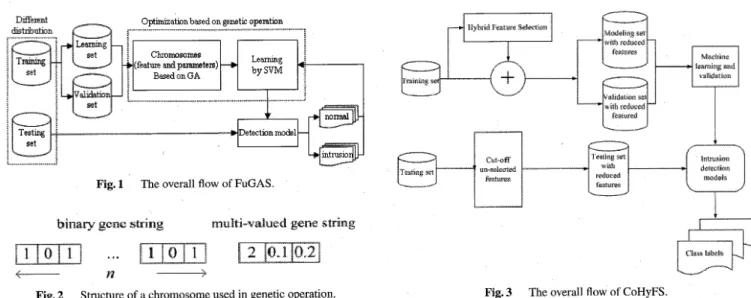
In this section, we illustrate the Fusion of GA [5], [22], [23] and SVM, named FuGAS. The previous researches on fea-ture selection and parameters optimization in IDS have been performed in a separated way. In other words, feature selec-tion and parameters optimization of detection model were separately performed. This causes inconsistency to figure out best intrusion detection model. FuGAS performs both feature selection and parameters optimization through ge-netic operation. The overall flow of FuGAS is depicted in Fig. 1. There are two dataset: training set and testing set. The training set is again separated into two set: learning set and validation set. The learning set is used to build detection models. The validation set is used to test the built detection models. And the testing set has additional instances, which are not appeared in the training set. The testing set is used to evaluate whether built detection models are able to cope with novel instances.
The features of audit data and parameters value of a kernel function in SVM are encoded as chromosomes, as depicted in Fig. 2.
In Fig. 2, a chromosome consists of two parts: The first part, expressed as n bits, represents total number of features of audit data and expressed a binary gene string. •e1•f repre-sents that the feature is selected, on the other hands, •e0•f rep-resents that the feature is not selected. The second part represents parameters value of kernel function in SVM, ex-pressed as multi-valued gene string. •e2•f means RBF kernel function, •e0.1•f means a starting value, •e0.2•f means ending value. In the example, the granularity is •e0.005•f. It rep-resents that the value changes 0.005 for each GA iteration. These values are changeable according to the experimental setting.
Fig. 1 The overall flow of FuGAS.
Fig. 2 Structure of a chromosome used in genetic operation.
(i.e. detection rates in IDS, mostly common in GA) obtained
from SVM. The SVM is used to evaluate the performance
of a detection model represented by a chromosome.
In
SVM, n-way cross-validation is used to prevent over-fitting
problems [26], and the detection rates from n tests are
aver-aged to obtain a fitness function value (i.e. detection rates).
This procedure is iterated until it satisfies pre-defined fitness
function value or it reaches to final iteration (i.e. final
gen-eration in GA). As the result of itgen-eration, in FuGAS, it is
cable of obtaining the optimal set of features as well as the
optimal parameters for a kernel function in SVM.
2.2
Correlation Based Hybrid Feature Selection (CoHyFS)
Figure 3 illustrates the overall flow of CoHyFS. There are
two dataset: Training set and testing set. In CoHyFS,
train-ing dataset is segregated into three sets: feature-selection
set, model building set, and validation dataset.
Feature-selection dataset is passed through the Correlation-based
Hybrid Feature Selection process, which results in a set of
selected features. The model building dataset is then used
to build the intrusion detection models, using the selected
features. And the intrusion detection models are evaluated
by the validation set. The intrusion detection models are
again evaluated by testing dataset to verify whether the
in-trusion detection models are able to cope with novel attacks
and normal patterns.
CoHyFS also utilizes GA to generate feature subset and
to figure out important features. It adopts different strategy
in order to decrease the training and testing time, compared
to FuGAS, described in Sect. 2.1. CoHyFS only encodes
features into a chromosome. The structure of a chromosome
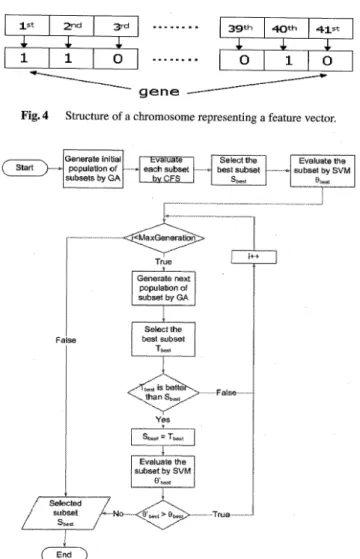
representing a feature vector is depicted in Fig. 4.
The structure of a chromosome is simple than that
of it in FuGAS.
In FuGAS, both features and
parame-ters' value are encoded as a chromosome. This causes the
1052 IEICE TRANS. INF. & SYST., VOL.E91-D, NO .4 APRIL 2008
Fig. 4 Structure of a chromosome representing a feature vector .
Fig. 5 A flow chart of correlation-based hybrid feature selection.
computational overheads in GA iteration in terms of training and testing time, due to cross validation in FuGAS. CoHyFS accordingly only focus on figuring out important features, based on correlation based hybrid feature selection, depicted in Fig. 5.
CoHyFS is a crafted combination of Correlation based Feature Selection (CFS) [18] and SVM. GA is used to gen-erate subsets of features from given feature set. The algo-rithm takes full feature set as input and returns the optimal subset of feature after being evaluated by CFS and SVM. Each chromosome represents a feature vector. The length of the chromosome is 41 genes, in the dataset, where each gene (bit) may have values 1 or 0 which indicates whether corresponding feature is included or not in the feature vec-tor, respectively. Like every stochastic algorithm, the initial population of chromosomes is generated randomly. Merit of each chromosome is calculated by CFS. The chromosome having highest merit, ƒÁbest represents the best feature subset, Sbest in population. This subset is then evaluated by SVM classification algorithm, and the value is stored in ƒÆbest which represents metric of evaluation. Here we have chosen intru-sion detection rates as a metric (a fitness function value in FuGAS) although a complex criterion such as a combination
Fig. 6 The overall flow of SIMI.
of detection rate and false positive rate or a rule based crite-rion like [30] could be used. Then, genetic operations, selec-tion, crossover and mutation, are performed and a new pop-ulation of chromosomes is generated. In each generation, best chromosome or feature subset is compared by previous best subset, Sbest. If newer subset is better than previous one, it is assigned as the best subset. This subset is then evaluated by SVM. If new detection rate is higher than previous one, this value is to Įbest and algorithm goes forward. Otherwise, the Sbest is returned as the optimal subset of features. The al-gorithm stops if better subset is not found in next generation or when maximum number of generation is reached.
2.3 Simultaneous Intrinsic Model Identification (SIMI)
In this section, we present simultaneous intrinsic model identification (SIMI) depicted in Fig. 6. SIMI performs fea-ture selection and parameter optimization simultaneously without any additional overheads, non-likely to FuGAS
and CoHyFS. SIMI adopts Random Forest (RF) which
is a stage-of-the-art data mining algorithm comparable to SVM [32].
The preprocessed network audit data is divided into two datasets; training and testing set. The training set is fur-ther separated into learning set and validation set. Although we do not need to perform cross-validation to get a balanced estimate of generalization error since RF is robust against over-fitting [32], [33], we adopt n-fold cross validation to minimize that. The learning set is used to generate classi-fiers and aggregate their results based on RF and find out variable importance of each feature of network audit data and optimal parameters for RF simultaneously. These clas-sifiers can be considered as detection models in IDS. The validation set is used to compute detection rates according to estimating error rates which is Out-Of-Bag (OOB) errors in RF. Feature selection is performed by eliminating the irrele-vant features which are low ranked in the ranking of variable importance. In other words, we only select top m numbers of important feature and optimize both of mtry and ntree. In next steps, therefore, only important features that have more effect on classification and optimal parameters are used to build detection models and evaluate by testing set with re-spect to detection rates. Our approach enables one to iden-tify intrinsic model through this procedure.
We have used the KDD 1999 intrusion detection dataset.
The dataset contains a total of 24 attack types that fall into
four main categories [12]: DoS (Denial of Service), R2L
(unauthorized access from a remote machine), U2R
(unau-thorized access to root privileges) and probing. The data was
preprocessed by extracting 41 features from the tcpdump
data in the 1998 DARPA datasets and we have labeled them
as f1, f2, f3, f4 and so forth. We have only used DoS type of
attacks, since in [31] pointed out that it is not suitable to use
U2R and R2L in KDD 1999 dataset to show the
generaliza-tion of experiments. It doesn't mean that our approach can
not deal with dataset, which has small number of instances.
We chose only DoS type of attacks out of 4 types of attacks
to show the validation of 3 approaches. In machine learning
field, it's necessary to use enough data instance, for instance,
at least more than 1000 samples a dataset.
3.2 FuGAS
We performed 10-fold cross validation with 2500
sam-ples to reduce over-fitting problem [26]. After completing
cross validation (in other word, learning and validation), we
perform classification using testing set (corrected.gz) with
2000 samples to evaluate detection model constructed
dur-ing learndur-ing phase. We estimate how well this model copes
with novel attacks since there are 14 new attacks in
test-ing set which are not included in traintest-ing set. In the
exper-imental results, the detection rates designate the accuracy
of classification. For GA, we used tournament method for
selection process, and set the probability of mutation and
crossover, Pm=0.015 and Pc=0.8, respectively.
The result of cross validation is depicted in Fig. 7. The
detection rates monotonously increase when all of three
kernel functions are used in learning phase. While GA
was executed for 20 generations, the learning process using
SVM with neural kernel function [16], [17], [29] achieved
the highest detection rates among the kernel function
com-pared.
We figured out the number of selected features and
optimal parameters in SVM, respectively. These features
can be considered as most important features to detect DoS
type attacks. The optimal parameters are different
accord-ing to the kernel function in SVM. Most of the
classifica-tion problems using SVM, radial kernel is selected and has
showed a good performance, however, in our experiments,
it indicates that neural kernel function for SVM shows
bet-ter results. The reason why is that, according to no free
lunch theorem [26] on machine learning, there is no superior
kernel function in general, and the performance of a
ker-nel function rather depends on applications. In addition,
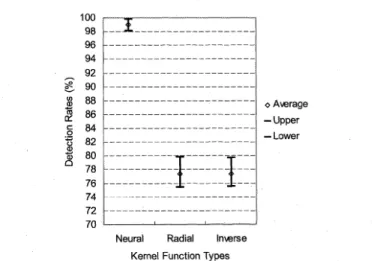
Fig. 8 shows that FuGAS guarantees the stability for
detec-tion rates. In case of detecdetec-tion model using neural kernel
Fig. 7 The results of cross-validation: detection rates versus generations of GA execution.
Fig. 8
Detection
rates for each kernel function with feature selection
in
testing phase.
function can provide at least 98% detection rates. And it
also shows the possibility that can cope with novel attacks
since it shows detection rates more than 98% during
test-ing phase. Because testtest-ing set includes 14 additional
at-tack types which are not included in training set. In other
words, our method has the potential of detecting previously
unknown DoS types of attacks. And FuGAS provides higher
detection rates than the approaches that only adopt SVM for
IDS [8], [28]-[30].
However, there are two main problems in FuGAS,
First, it consumes long time to perform training and
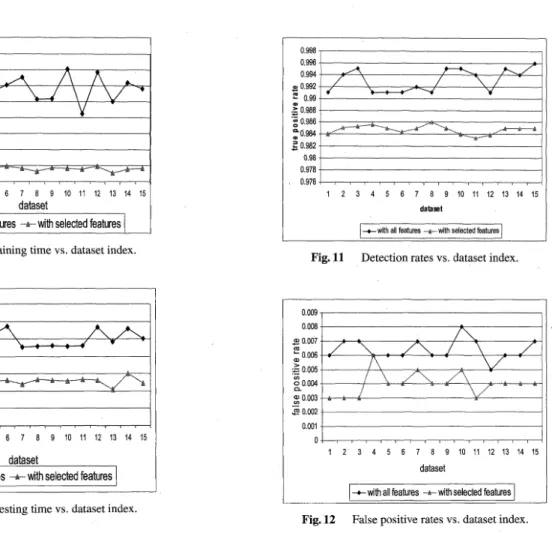
test-ing. Refering Figs. 9 and 10, it takes more time to perform
training and testing with all features. FuGAS uses whole
features as well as parameter values. Second, the selected
features are not stable and only feature set are selected. For
instance, assuming that feature set, {f1, f4, f5} are selected,
we can not figure out which feature, among three feature, is
more important than others.
3.3
CoHyFS
For CoHyFS, we have used open source WEKA [13] library
for SVM and CFS algorithm. For implementing our
algo-rithm, we have modified several classes of WEKA library
1054
IEICE TRANS. INF. & SYST., VOL.E91-D, NO.4 APRIL 2008
Fig. 9 Model training time vs. dataset index.
Fig. 10 Model testing time vs. dataset index.
such as •gweka.attributeSelection.GeneticSearch•h.
For feature selection in CoHyFS, we have selected a data set randomly from 15 datasets and applied our algo-rithm which was described in previous section. We have ap-plied 10 fold cross validation to achieve low generalization error and to determine the intrusion detection rate. The op-timal subset selected has shown 99.56% detection rate. The indices of feature selected are f1, f6, f12, f14, f23, f24, f25, f31, f32, f37, f40 and f41. The dimension of feature vector is reduced from 43 to 12 that is a significant gain while the detection rate is above 99%.
The Figures from 9 to 12 show the comparisons be-tween different performance indicators. Figure 9 shows that the dramatic reduction of model building time with reduced
features as expected because the feature selection process has cut the 70% of total number of features. Testing time depicted in Fig. 10 also accedes with model training time, compared to FuGAS.
For selected features, though the detection rate is lower than that of having full features the decrement is very small, in other words, around 0.83% in average (see Fig. 11). But the significant performance enhancement was achieved in the reduction of false positive rate (see Fig. 12), which is 37.5% in average. For all above experiments, we used poly-nomial kernel of exponent 1 and c=1 that are default value for SVM in WEKA. If we optimize SVM in more, the in-trusion detection rates would be improved. It is notewor-thy that we have not taken any measure of optimizing the
Fig. 11 Detection rates vs. dataset index.
Fig. 12 False
positive
rates vs. dataset
index.
kernel and SVM parameters as our main goal is to
investi-gate that how hybrid feature selection reduced the
compu-tational resource while maintaining the detection and false
positive rate within tolerable range.
Enhancement of detection rate and optimization
be-tween false positive and detection rate can be improved
fur-ther by parameter tuning, exploiting better kernel function
and improving classification algorithm [10], [16].
3.4 SIMI
In order to evaluate SIMI, RF version (R 2.2.0) and MDS
algorithm in open source R-project [34] is used to perform
several experiments. There are only two parameters in RF
to be optimized; the number of variables in the random
sub-set at each node (mtry) and the number of trees in the
for-est (ntree). To get the bfor-est classification rates, that is, the
best detection rates, it is essential to optimize both two
pa-rameters. This is considered as parameters optimization.
Fortunately, we could get the optimal value of mtry
us-ing tuneRF() function provided in randomForest package of
R-project and it turned out miry=6. In case of ntree, there
is no specific function that figures out the optimal value of
it. Thus, we got the optimal value of ntree by choosing the
ntree value that has high and stable detection rates. We
as-sume that 350 trees are enough to be the maximum value
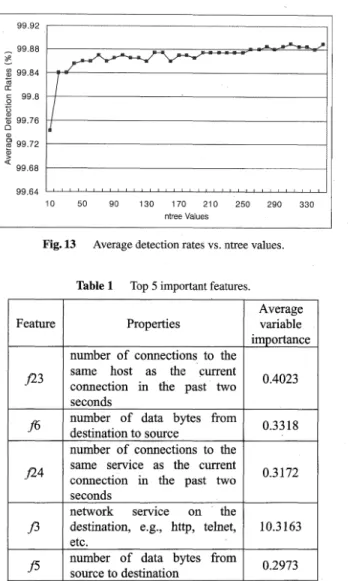
to evaluate our approach and detection rates are determined
Fig. 13 Average detection rates vs. ntree values.
Table 1 Top 5 important features.
by equation •g1-OOB errors•h. The experimental results for determination of the optimal value of ntree are described in Fig. 13.
According to Fig. 13, average detection rates of RF turned out the highest value when ntree=310. As the re-sult of experiments, we set two optimized parameter values;
mtry=6, nhree=310. After optimizing two parameters,
feature selection of network audit data was carried out em-ploying the feature selection algorithm supported by RF. We ranked features thorough the average variable importance of each feature as the results of 10-fold with 2000 samples. As the results, feature important of each individual feature were decided. The importance value of each feature varies and we rank features with respect to their average importance values of cross validation experiments.
We partially show the top 5 important features and their properties in Table 1. Our approach showed reasonable con-text information for each important feature. For instance, f23 represents •gnumber of connections to the same host as the current connection in the past two seconds•h property and f6 represents •gnumber of data bytes from destination to source•h and so on.
Then, we carried out several times of experiments with
Fig. 14 Detection rates and total number of selected features.
Table 2 The comparison between our approach and previous ap-proaches.
elimination of irrelevant features and measure detection, rates. The experimental results are depicted in Fig. 14.
3.5 Comparison and Discussion
In Table 2, we present comparison results. SIMI showed higher detection rates than others. Even though the detection rates is slightly high than others, SIMI only used selected
important features and training and testing time is faster than
others. Although both FuGAS and CoHyFS have showed
•g optimal feature set•h, they didn't show the numeric value as the variable importance of each feature. SIMI is able to get individual feature importance so that only important in-dividual features can be used. We need to calculate compu-tational complexity and compare it to other approaches. But this is out of scope of this paper because both FuGAS and CoHyFS utilize GA [31].
4. Conclusions
In this paper, we have present three approaches to model lightweight Intrusion Detection System. FuGAS employed a fusion of GA and SVM, which perform both feature selec-tion and parameters optimization and showed better detec-tion rates than the approaches, only adopts SVM. FuGAS,
1056 IEICE TRANS. INF. & SYST., VOL.E91-D, NO .4 APRIL 2008
however, have additional computational overhead due to training and testing time. To cope with this, CoHyFS have
been proposed, which is based on a filter method in conjunc-tion with GA. CoHyFS shows a little degradation in detec-tion rates but the degradation is marginal and showed faster training and testing time with stable important feature sets . Both FuGAS and CoHyFS showed the implication to IDS, it has still room for further enhancement so that SIMI has been proposed. SIMI showed that IDS based on RF is eas-ily built without additional overhead compared to FuGAS and CoHyFS. We carried out several experiments on KDD 1999 dataset and the results showed that feature selection and parameters optimization are able to help one to model and implement IDS.
Acknowledgements
The authors are grateful to anonymous reviewers for their invaluable comments to revise the manuscript. We would like to thank Sang Min Lee, Khaja M. Sazzad, and Ha-Nam Nguyen for their help. This work was supported by the Ko-rea Research Foundation Grant funded by the Korean
Gov-ernment (MOEHRD) (KRF-2007-013-D00095). References
[1] D. Ourston, S. Matzner, W. Stump, and B. Hopkins, •gApplications of hidden Markov models to detect multi-stage network attacks,•h Proc. 36th Hawaii Int. Conf. on System Sciences, p. 334, 2003.
[2] M.A. Hall, •gCorrelation-based feature selection for discrete and nu-meric class machine learning,•h Proc. 17th Int'l Conf. on Machine Learning, pp. 359-366, 2000.
[3] M. Dash, H. Liu, and H. Motoda, •gConsistency based feature selec-tion,•h Proc. Fourth Pacific Asia Conf. on Knowledge Discovery and Data Mining (PAKDD), pp. 98-109, Kyoto, Japan, 2000.
[4] H. Almuallim and T.G. Dietterich, •gLearning Boolean concepts in the presence of many irrelevant features,•h Artif. Intell., vol.69, nos. 1-2, pp. 279-305,1994.
[5] J.H. Holland, Adaptation in Natural and Artificial Systems, Univer-sity of Michigan Press, Ann Arbor, 1975.
[6] M. Fugate and J.R. Gattiker, •gAnomaly detection enhanced classifi-cation in computer intrusion detection,•h Lecture Notes in Computer Science, vol.2388, Springer-Verlag, Berlin Heidelberg, 2002. [7] B. Nguyen, •gAn application of support vector machines to anomaly
detection,•h Research in Computer Science-Support Vector Ma-chine, Report, Fall 2002.
[8] W. Hu, Y. Liao, and V. Vemuri, •gRobust support vector machines for anomaly detection in computer security,•h Proc. Int. Conf. on Ma-chine Learning and Applications 2003, pp. 168-174, CSREA Press, 2003.
[9] J. Cannady, •gArtificial neural network for misuse detection,•h Proc. 1998 National Information System Security Conf, pp. 443-456, Arlington, Oct. 1998.
[10] O. Chapelle, V. Vapnik, O. Bousquet, and S. Mukherjee, •gChoosing multiple parameters for support vector machines,•h Machine Learn-ing Journal, vol.46, pp. 131-159, 2002.
[11] K. Duan, S.S. Keerthi, and A.N. Poo, •gEvaluation of simple perfor-mance measures for tuning SVM hyperparameters,•h Neurocomput-ing, vol.51, pp. 41-59, 2003.
[12] KDD Cup 1999 Data, http://kdd.ics.uci.edu/databases/kddcup99/ kddcup99.html
[13] Open Source WEKA Project, http://www.cs.waikato.ac.nz/ml/weka/ index.html
[14] H. Liu and L. Yu, •gToward integrating feature selection algorithms for classification and clustering,•h IEEE Trans . Knowl. Data Eng., vol.17, no.3, pp. 1-12, 2005.
[15] A.H. Sung and S. Mukkamala, •gIdentifying important features for intrusion detection using support vector machines and neural net-works,•h Proc. 2003 Int. Symposium on Applications and the Internet Technology, pp. 209-216, IEEE Computer Society Press, 2003 . [16] D. Kim, H.-N. Nguyen, S.-Y. Ohn, and J. Park, •gFusions of GA and
SVM for anomaly detection in intrusion detection system ,•h Lecture Notes in Computer Science, vol.3498, pp. 415-420
, Springer Verlag, 2005.
[17] V. Vapnik, The Nature of Statistical Learning Theory, Springer, Berlin Heidelberg, New York, 1995.
[18] U. Fayyad and K. Irani, •gMulti-interval discretization of continuous attributes as pre-processing for classification learning,•h Proc . 13th Int. Join Conf. on Artificial Intelligence, pp. 1022-1027, 1993. [19] W.H. Press, B.P. Flannery, S.A. Teukolsky, and W.T. Vetterling,
Nu-merical recipes in C, Cambridge University Press, Cambridge, 1988. [20] S. Chebrolu, A. Abraham, and J.P. Thomas, •gData reduction and
data classification in an intrusion detection system ,•h Proc. South Central Information Security Symposium, Texas , USA, 2004. [21] M. Sabhnani and G. Serpen, •gOn failure of machine learning
algo-rithms for detecting misuse in KDD intrusion detection data set ,•h Journal of Intelligent Data Analysis, vol.8, no.4, pp. 403-415, 2004 . [22] D.E. Goldberg, Genetic Algorithms in Search, Optimization &
Ma-chine Learning, Addison Wesley, 1989.
[23] M. Mitchell, Introduction to genetic Algorithms, 5th printing, MIT Press, 1999.
[24] Z. Michalewicz, Genetic Algorithms+Data structures=Evolution Programs, 3 re rev. and extended ed., Springer-Verlag, 1996. [25] N. Cristianini and J.S. Taylor, An introduction to support vector
ma-chines and other kernel-based learning methods, Cambridge Univer-sity Press, 2000.
[26] R.O. Duda, P.E. Hart, and D.G. Stork, Pattern Classification, 2nd ed., Wiley Interscience Inc., 2001.
[27] T. Joachims, •gMaking large-scale SVM learning practical,•h in Ad-vances in Kernel Methods-Support Vector Learning, ed. B. Scholkopf, C. Burges, and A. Smola, chapter 11, MIT Press, 1999. [28] M. Fugate and J.R. Gattiker, •gAnomaly detection enhanced classi-fication in computer intrusion detection,•h LANL Tech Report, LA-UR-02-1149, 2002.
[29] D. Kim and J. Park, •gNetwork-based intrusion detection with sup-port vector machines,•h ICOIN 2003, Lecture Notes in Computer
Sci-ence, vol.2662, Springer-Verlag, 2003.
[30] S. Mukkamala, G. Janoski, and A. Sung, •gIntrusion detection using neural networks and support vector machines,•h Proc. IEEE Int. Joint Conf. on Neural Networks, pp. 1702-1707, 2002.
[31] B. Rylander, Computational Complexity and the Genetic Algorithm, Ph.D. Thesis, University of Idaho, 2001.
[32] L. Breiman, •gRandom forest,•h Mach. Learn., vol.45, pp. 5-32, 2001. [33] L. Breiman, J.H. Friedman, R.A. Olshen, and C.J. Stone,
Classifica-tion and Regression Trees, Chapman and Hall, New York, 1984. [34] The R Project for Statistical Computing, http://www.r-project.org/
Computer Engineering from Korea Aerospace University, Republic of Korea in 2003, 2008, re-spectively. And he was a visiting research asso-ciate in University of Maryland at College Park in 2007. His research interests are in all area of network security, ubiquitous computing secu-rity.
Jong Son Park received the M.S. degree in Electrical and Computer Engineering from North Carolina State University in 1986. And he received his Ph.D in Computer Engineering from The Pennsylvania State University in 1994. From 1994-1996, he worked as an assistant Pro-fessor at The Pennsylvania State University in Computer Engineering Department and he was president of the KSEA Central PA, Chapter. He is currently a full professor in Computer Engi-neering Department, Korea Aerospace Univer-sity. His main research interests are information security, embedded system and hardware design. He is a member of IEEE and he is an executive board member of the Korea Institute of Information Security and Cryptology and Korea Information Assurance Society.