Mastering Project Time
Management, Cost
Control, and Quality
Mastering Project Time
Management, Cost
Control, and Quality
Management
Proven Methods for Controlling
the Three Elements that
Define Project Deliverables
Executive Editor: Jeanne Glasser Levine Operations Specialist: Jodi Kemper Cover Designer: Chuti Prasertsith Managing Editor: Kristy Hart Senior Project Editor: Lori Lyons Copy Editor: Karen Annett Indexer: Erika Millen
Proofreader: Gill Editorial Services Compositor: Nonie Ratcliff Manufacturing Buyer: Dan Uhrig © 2015 by Randal Wilson Pearson Education, Inc. Old Tappan, New Jersey 07675
For information about buying this title in bulk quantities, or for special sales opportuni-ties (which may include electronic versions; custom cover designs; and content particular to your business, training goals, marketing focus, or branding interests), please contact our corporate sales department at [email protected] or (800) 382-3419. For government sales inquiries, please contact [email protected] . For questions about sales outside the U.S., please contact [email protected] . Company and product names mentioned herein are the trademarks or registered trade-marks of their respective owners.
All rights reserved. No part of this book may be reproduced, in any form or by any means, without permission in writing from the publisher.
Printed in the United States of America First Printing May 2015
ISBN-10: 0-13-383975-3 ISBN-13: 978-0-13-383975-3 Pearson Education LTD.
Pearson Education Australia PTY, Limited. Pearson Education Singapore, Pte. Ltd. Pearson Education Asia, Ltd.
Pearson Education Canada, Ltd.
Pearson Educacion de Mexico, S.A. de C.V. Pearson Education—Japan
Pearson Education Malaysia, Pte. Ltd.
Nolan, Garrett, and Carlin, for their support
and patience through this project.
Contents-at-a-Glance
Introduction . . . .1
Part I
Project Time Management . . . .13
Chapter 1 Planning Schedule Management . . . .15
Chapter 2 Project Activity Requirements . . . .39
Chapter 3 Project Activity Sequencing . . . .75
Chapter 4 Resource Estimating . . . .113
Chapter 5 Project Activity Duration Analysis . . . .139
Chapter 6 Develop the Project Schedule . . . .153
Chapter 7 Control Project Schedule . . . .181
Part II
Project Cost Management . . . .201
Chapter 8 Plan Cost Management . . . .203
Chapter 9 Estimate Project Costs . . . .221
Chapter 10 Develop Project Budget . . . .249
Chapter 11 Control Project Costs . . . .265
Part III
Project Quality Management . . . .283
Chapter 12 Plan Quality Management . . . .285
Chapter 13 Conduct Quality Assurance . . . .301
Chapter 14 Control Project Quality . . . .319
Appendix A Change Control Process . . . .343
Bibliography . . . .347
Contents
Introduction . . . .1
The Triple Constraint . . . 2
Managing Change Requirements. . . 4
Managing Time, Cost, and Quality . . . 7
Managing Project and Product Scope . . . 7
Time Management . . . 8
Cost Management. . . 9
Quality Management . . . 9
What Does the Customer Really Want? . . . 10
Part I
Project Time Management . . . .13
Chapter 1 Planning Schedule Management. . . .15
1.1 Introduction . . . 15
1.2 Tools for Schedule Management Planning. . . 16
Minimum Requirements . . . 17
Plan Structures . . . 18
Project Management Office (PMO) . . . 23
1.3 Information Gathering for the Schedule Management Plan . . . 24
Project Charter . . . 24
Project Manager’s Experience . . . 25
Organizational Past Projects. . . 26
Subject Matter Experts. . . 27
1.4 Schedule Management Plan Applications . . . 28
Tactical Tool for Project Managers . . . 28
Communications Tool for the Project Staff. . . 29
Strategic Tool for the Organization . . . 30
1.5 Summary . . . 31
1.6 Review Questions. . . 33
1.7 Key Terms . . . 34
1.9 Case Study (Use for Part I, Chapters 1–7) . . . 35
RE Construction—Custom Pebble Beach Home . . . 35
1.10 Case Study Questions and Exercise . . . 37
Questions. . . 37
Exercise . . . 38
Chapter 2 Project Activity Requirements . . . .39
2.1 Introduction . . . 39
2.2 Information-Gathering Guidelines . . . 40
What Information Is to Be Gathered?. . . 41
Who Is Gathering Information?. . . 42
Reliability of Information . . . 44
Information Accuracy . . . 49
Information Sources . . . 50
2.3 Activity Information Based on Project Structure . . . . 51
Linear (Traditional Sequential Process Development) . . . 52
Incremental (Traditional Progressive Stage Development) . . . 53
Iterative (Features Addition Development, Waterfall, Agile). . . 55
Adaptive (Learn and Build Development, Agile) . . . 58
Extreme (Exploratory Development) . . . 59
2.4 Define Activities . . . 62
Project Deliverable Decomposition. . . 63
Define Activity Requirements . . . 65
Work Breakdown Structure (WBS) . . . 68
2.5 Summary . . . 71
2.6 Review Questions . . . 72
2.7 Key Terms . . . 73
2.8 PMBOK® Connections (Fifth Edition) . . . 73
2.9 Case Study Questions and Exercises (Use Case Study from Chapter 1). . . 74
Questions. . . 74
Chapter 3 Project Activity Sequencing . . . .75
3.1 Introduction . . . 75
3.2 Work Activity Definition . . . 77
Conceptual Planning. . . 77
Project Development . . . 80
Testing and Validation . . . 80
Reactive and Proactive Response. . . 82
Customer/Project Team Evaluation. . . 84
Project Closure . . . 85
3.3 Work Activity Dependencies. . . 87
Activity Information . . . 88
Dependency Determination . . . 94
3.4 Work Activity Sequencing Tools . . . 96
Precedence Diagramming Method . . . 97
3.5 Summary . . . 108
3.6 Review Questions. . . 109
3.7 Key Terms . . . 110
3.8 PMBOK® Connections (5th Ed.) . . . 111
3.9 Case Study Questions and Exercises (Use Case Study from Chapter 1). . . 111
Questions. . . 111
Exercises . . . 111
Chapter 4 Resource Estimating . . . .113
4.1 Introduction . . . 113
4.2 Types of Resources . . . 116
Direct and Indirect Resources . . . 117
Project Resources . . . 118
Contracted Resources. . . 121
4.3 Resource Requirements . . . 122
Organizational Resources . . . 123
Project Resources . . . 124
4.4 Resource Estimating Methods . . . 128
Determinate Estimating. . . 128
Alternatives Analysis . . . 129
Delphi Method . . . 129
Published Data Estimating. . . 129
4.5 Resource Estimating by Project Structure . . . 132
Linear and Incremental . . . 132
Iterative and Adaptive . . . 133
Extreme. . . 134
4.6 Summary . . . 135
4.7 Review Questions. . . 136
4.8 Key Terms . . . 137
4.9 PMBOK® Connections (5th Ed.). . . 137
4.10 Case Study Questions and Exercise (Use Case Study from Chapter 1). . . 138
Questions. . . 138
Exercise . . . 138
Chapter 5 Project Activity Duration Analysis . . . .139
5.1 Introduction . . . 139
5.2 Duration Estimating Methods . . . 140
Subject Matter Expert Estimating (Delphi) . . . 140
Analogous Estimating . . . 142
Parametric Estimating . . . 143
Three-Point Estimating . . . 144
Contingency Estimating (Reserve Analysis) . . . 147
5.3 Summary . . . 149
5.4 Review Questions . . . 150
5.5 Key Terms . . . 150
5.6 PMBOK® Connections (Fifth Edition) . . . 151
5.7 Case Study Questions and Exercise (Use Case Study from Chapter 1). . . 151
Questions. . . 151
Exercise . . . 151
Chapter 6 Develop the Project Schedule. . . .153
6.1 Introduction . . . 153
6.2 Information for Schedule Development. . . 154
Project Charter . . . 155
Project Deliverable Specifications . . . 155
Work Breakdown Structure . . . 156
Activity Information Checklist . . . 156
Organizational Influences. . . 157
Customer Scheduling Requirements. . . 159
External Factors . . . 160
6.3 Schedule Structuring Techniques. . . 161
Activity Disposition. . . 162
Activity Hierarchy. . . 163
Critical Path Method . . . 164
Theory of Constraints . . . 166
Critical Chain Method . . . 167
Resource Loading . . . 169
Scenario Analysis. . . 171
6.4 Schedule Documentation Tools . . . 173
Software Tools . . . 173 Schedule Management . . . 175 Schedule Communication . . . 176 6.5 Summary . . . 177 6.6 Review Questions. . . 178 6.7 Key Terms . . . 178
6.8 PMBOK® Connections (5th Ed.) . . . 179
6.9 Case Study Questions and Exercise (Use Case Study from Chapter 1). . . 179
Questions. . . 179
Exercise . . . 180
Chapter 7 Control Project Schedule . . . .181
7.1 Introduction . . . 181
7.2 Schedule Control Information . . . 183
Schedule Baseline. . . 183
Work Activity Monitoring. . . 185
Earned Value Analysis . . . 187
Milestone Analysis . . . 192
7.3 Schedule Control Techniques . . . 192
Contingency Control . . . 193
Schedule Crashing . . . 193
Resource Contracts. . . 194
Change Control. . . 195
7.4 Summary . . . 197
7.5 Review Questions. . . 199
7.6 Key Terms . . . 199
7.7 PMBOK® Connections (5th Ed.). . . 200
7.8 Case Study Questions and Exercise (Use Case Study from Chapter 1). . . 200
Questions. . . 200
Exercise . . . 200
Part II
Project Cost Management . . . .201
Chapter 8 Plan Cost Management . . . .203
8.1 Introduction . . . 203
8.2 Information for Planning Costs. . . 205
Cost Definitions . . . 205
Project Charter . . . 209
Statement of Work . . . 209
Project Manager’s Experience . . . 210
Subject Matter Experts. . . 210
Project Structures . . . 211
8.3 Develop the Cost Management Plan . . . 211
Components of the Plan . . . 212
8.4 Cost Management Plan Applications . . . 213
Organizational Strategic Planning . . . 214
Tool for Manager’s Tactical Use . . . 214
8.5 Summary . . . 216
8.6 Review Questions. . . 217
8.7 Key Terms . . . 218
8.8 PMBOK Connections (5th Ed.) . . . 218
8.9 Case Study (Use for Part II, Chapters 8–11) . . . 218
Mass Brothers Automotive—IT Infrastructure Upgrade . . . 218
8.10 Case Study Questions and Exercises. . . 220
Questions. . . 220
Chapter 9 Estimate Project Costs . . . .221
9.1 Introduction . . . 221
9.2 Project Cost Requirements . . . 223
Statement of Work . . . 224
Work Breakdown Structure . . . 224
Activity Information Checklist . . . 225
Scope Statement . . . 226
9.3 Cost Estimating Tools . . . 227
Cost Management Plan . . . 228
Cost Constraints . . . 232
Analogous Cost Estimating . . . 234
Parametric Cost Estimating . . . 234
Rough Order-of-Magnitude Estimating . . . 235
Subject Matter Experts. . . 236
Three-Point Cost Estimating . . . 236
Top-Down and Bottom-Up Estimating. . . 239
Contingency Cost Estimating. . . 240
9.4 Estimating Based on Project Structures . . . 242
Linear and Incremental . . . 242
Iterative and Adaptive . . . 243
Extreme. . . 244
9.5 Summary . . . 245
9.6 Review Questions. . . 246
9.7 Key Terms . . . 247
9.8 PMBOK® Connections (5th Ed.) . . . 247
9.9 Case Study Questions and Exercises (Use Case Study from Chapter 8). . . 248
Questions. . . 248
Exercises . . . 248
Chapter 10 Develop a Project Budget . . . .249
10.1 Introduction . . . 249
10.2 Purpose of a Project Budget . . . 250
Budget at Completion . . . 251
Project Budget Baseline . . . 252
Communicate Project Status . . . 254
Organizational Planning . . . 254
10.3 Budget Methods . . . 255
Cost Aggregation Method . . . 256
Time-Phased Method . . . 256
Top-Down Budgeting. . . 257
Analogous Budgeting . . . 259
Funding Limit Reconciliation . . . 260
10.4 Summary . . . 261
10.5 Review Questions. . . 262
10.6 Key Terms . . . 263
10.7 PMBOK® Connections (5th Ed.) . . . 263
10.8 Case Study Questions and Exercises (Use Case Study from Chapter 8). . . 264
Questions. . . 264
Exercises . . . 264
Chapter 11 Control Project Costs. . . .265
11.1 Introduction . . . 265
11.2 Cost Control Data . . . 266
Monitor Costs . . . 267
Cost Analysis Tools . . . 269
11.3 Cost Control Techniques. . . 272
Integrated Change Control . . . 272
Contingency Control . . . 273
Contract Control. . . 274
Procurement Review and Approval . . . 276
Control Verification . . . 276
11.4 Summary . . . 277
11.5 Review Questions. . . 279
11.6 Key Terms . . . 280
11.7 PMBOK® Connections (5th Ed.) . . . 280
11.8 Case Study Questions and Exercises (Use Case Study from Chapter 8) . . . 281
Questions. . . 281
Part III
Project Quality Management . . . .283
Chapter 12 Plan Quality Management . . . .285
12.1 Introduction . . . 285
12.2 Components of a Quality Management Plan . . . 286
Establish Quality Monitoring . . . 287
Determine Analysis Methodologies . . . 288
Establish Quality Metrics . . . 288
Plan Quality Assurance. . . 289
Determine Cost of Quality . . . 289
Integrate a Change Control Process . . . 290
Determine Quality Controls. . . 290
12.3 Tools for Quality Management Planning . . . 291
Statistical Sampling. . . 291
Design of Experiments . . . 292
Benchmarking. . . 292
Subject Matter Expert Meetings . . . 293
Brainstorming . . . 294
12.4 Summary . . . 294
12.5 Review Questions. . . 295
12.6 Key Terms . . . 296
12.7 PMBOK® Connections (5th Ed.) . . . 296
12.8 Case Study (Use for Part III, Chapters 12–14) . . . 297
Lewton Telecom—Engineering Prototype Project . . . 297
12.9 Case Study Questions and Exercises. . . 298
Questions. . . 298
Exercises . . . 299
Chapter 13 Conduct Quality Assurance . . . .301
13.1 Introduction . . . 301
13.2 Project Quality Assurance Data . . . 302
Quality Management Plan . . . 303
Organizational Quality Standards. . . 303
Industry Quality Standards. . . 305
Customer Quality Standards . . . 305
13.3 Quality Assurance Tools . . . 307
Quality Audits . . . 308
Process Analysis . . . 308
13.4 Quality Assurance Results . . . 312
Continuous Improvement . . . 313 Process Capability. . . 313 Change Requests . . . 313 13.5 Summary . . . 314 13.6 Review Questions. . . 315 13.7 Key Terms . . . 316
13.8 PMBOK® Connections (5th Ed.) . . . 316
13.9 Case Study Questions and Exercises (Use Case Study from Chapter 12). . . 316
Questions. . . 316
Exercises . . . 317
Chapter 14 Control Project Quality . . . .319
14.1 Introduction . . . 319
14.2 Establish What to Control . . . 320
Statement of Work . . . 321
Customer Specifications. . . 321
Workmanship Performance Reports . . . 322
Organizational Requirements. . . 323
Project Risk Register . . . 324
14.3 Quality Control Tools and Techniques . . . 324
Inspections . . . 325
Statistical Sampling. . . 326
Design Review . . . 327
Seven Basic Quality Tools . . . 328
14.4 QC Results . . . 334
Quality Improvements . . . 335
Updates to Project Schedule and Budget . . . 335
Verification of Deliverable Quality . . . 336
Project Process Updates . . . 336
Organizational Process Updates. . . 337
14.5 Summary . . . 337
14.7 Key Terms . . . 340
14.8 PMBOK® Connections (5th Ed.) . . . 341
14.9 Case Study Questions and Exercises (Use Case Study from Chapter 12) . . . 341
Questions. . . 341
Exercises . . . 341
Appendix A Change Control Process . . . .343
Bibliography . . . .347
About the Author
Randal Wilson
, MBA, PMP, serves as Visiting Professor of
Proj-ect Management, Keller Graduate School of Management, at the
Elk Grove, California DeVry University campus. His teaching style
addresses Project Management concepts using not only academic
course guidelines and text, but includes in-depth discussions in
lec-tures using practical application from industry experience.
Mr. Wilson is currently Operations and Project Manager at
Parker Hose and Fittings. He is responsible for five locations across
Northern California and Nevada, as well as project management of
redesigns and renovation of existing facilities and construction of new
facilities.
Mr. Wilson was formally in the telecommunications industry as
Senior New Product Introduction Engineer at REMEC, Inc., Senior
New Product Introduction Engineer with Spectrian Corp., and
Asso-ciate Design Engineer with American Microwave Technology. He
also served as Senior Manufacturing Engineer at Hewlett Packard.
He is a certified Project Management Professional (PMP) of the
Project Management Institute. He acquired an MBA with
concen-tration in General Operations Management from Keller Graduate
School of Management of DeVry University and a Bachelor of
Sci-ence in Technical Management with concentration in Project
Man-agement from DeVry University in Fremont, California.
1
Introduction
Organizations will structure their operations based on strategic
objectives and through acquisitions and management of resources.
They will conduct daily work activities to produce products that will
accomplish goals consistent with their strategic objectives. To be
effective in structuring the organization and in acquiring and
manag-ing resources to perform daily activities, the project manager requires
a management structure to design, organize, and manage resources to
accomplish daily objectives. Management will be most concerned
about the type of resources that will be selected—the cost of resources,
materials, equipment, and facilities as well as the time to set up the
operation and conduct daily work activity. Establishing an operation is
typically an enormous amount of work. Further, once completed,
management has the task of overseeing all resources to conduct daily
work activities to manage three primary concerns: the cost incurred to
conduct the operation and produce daily deliverables or products, the
amount of time it takes to produce products, and the overall quality of
the products when completed.
The operation is considered successful when it can produce
prod-ucts that can be sold at a market value that is higher than the cost to
create the product—therefore, the products are profitable and
bene-ficial to the organization. Part of this cost includes the amount of time
it takes to create the product and whether the quality is acceptable
within the marketplace at the price being offered. Operations
manag-ers, therefore, are given an operations budget for each department to
manage all purchases to stay on budget and secure profit margins.
Operations managers also have a schedule of deliveries for products
and need to manage resources to ensure products are being created
within a specific time frame to ensure quality and throughput are
maintained, which can also influence profitability. Managers need to
utilize quality controls to ensure products are being maintained to a
quality expectation of customers within the marketplace, which will
also ensure ongoing sales and profitability.
Projects are similar to the structure of an operation; managers
acquire resources to produce a deliverable where time, cost, and
deliverable quality have to be managed to be successful. Project
man-agers have the same responsibility as functional manman-agers, but they
are focused on a specific project to manage specific work activities for
a single, unique deliverable. The exception with projects is that they
are unique and typically performed only one time, so project
manag-ers have to go through all the tasks of designing and organizing a
proj-ect structure that will only be conducted once and, therefore, have
only one shot at effectively managing time, cost, and quality for one
project deliverable. Organizations hire professional project managers
to oversee projects because project management tools and techniques
are typically used to ensure projects are managed for success. In the
world of project management, project managers are primarily focused
on designing a system of management plans that address all the
aspects required to manage the “big three”: time, cost, and quality.
The Triple Constraint
As project managers assess the resources, materials and
equip-ment, and facilities requirements, time, cost, and quality are the big
three items they must consider not only in the selection, but also in
the management of all resources throughout the project life cycle.
This ensures a project is completed on schedule, on budget, and
meeting the customer’s expectations of quality. An important aspect
of managing time, cost, and quality for project work activities is the
interconnection of these three elements. Any change to one of these
elements has an effect on one or both of the others, which introduces
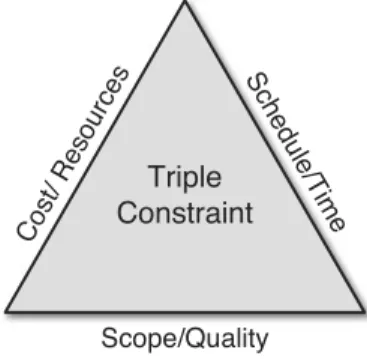
constraints the project manager must manage. This is called the
triple
constraint
(see Figure I.1 ).
The triple constraint imposes a project management dilemma.
Not only does the project manager have to manage each component
of the triple constraint, but he also has to assess any changes to one
and how it affects the other two.
Cost/ Resources
Schedule/Time
Scope/Quality
Triple Constraint
Figure I.1 Triple constraint
Case Application
A project manager is overseeing a construction project in which the
design of a custom, single-family home requires expensive
custom-made windows that will need to be installed within a specific time
frame of construction. The windows were designed in advance of
the project, and orders were placed to ensure they will be
com-pleted and delivered to the jobsite when required. The project
budget included the cost of the custom windows as approved by
the homeowners. The project manager also selected a
manufac-turer that would be capable of producing the quality that the
home-owners required. Shortly before the windows were to be delivered
to the jobsite, the manufacturer notified the project manager they
were running behind schedule because of a delay in receiving
exotic materials required in the custom windows. The windows
would be two weeks late. The project manager reviewed the
proj-ect schedule and determined that this would increase the duration
of that segment of project work activity, which would in turn create
other problems on the jobsite. Therefore, the windows would need
to be installed as originally scheduled. The project manager
com-municated this to the manufacturer, and the manufacturer said
an expedite fee could be paid that would push the windows up in
In this example, the project manager had the typical dilemma of
making choices to manage the three elements of the triple constraint
to maintain a project schedule, budget, and level of quality. A change
in one element had an impact on one or two of the other elements,
which formed a constraint. Decisions then had to be made to manage
the triple constraint.
To manage the triple constraint, the project manager must
under-stand the overall scope of each work activity. He must also underunder-stand
changes that may be allowed or elements of the triple constraint that
cannot change. These changes or elements can force the decisions
as to which changes will actually be made, which might affect one or
both of the other two elements. In most cases, the project manager
does have to consider some form of change, and the second important
aspect of managing the triple constraint is the consideration and
man-agement of changes that will be required.
Managing Change Requirements
One of the aspects of managing projects that many project
man-agers wish they did not have to contend with is the reality of changes
that need to be made throughout the project life cycle. In most cases,
the assessment of change requires the project manager to evaluate the
the manufacturer’s schedule, ensuring they would be at the jobsite
when required. A second option was that the manufacturer had a
lesser-quality window that was already in stock and could be
deliv-ered on time. The project manager had to decide how to manage
the triple constraint of staying on schedule, evaluating a potential
budget increase, and managing quality for this particular situation.
To keep the project on schedule, the project manager had the
choice to pay a higher price to expedite the correct windows to be
on the jobsite when needed or reduce the quality of the windows
to ensure the schedule was maintained. The homeowners elected
to pay the higher price to maintain the higher-quality windows and
to stay on schedule.
effects on the triple constraint and the best course of action allowed
by either the schedule, budget, or customer demands. The project
manager must be informed as to the importance of certain
compo-nents of the triple constraint that might be more important and
oth-ers that might be less important, allowing him the flexibility to make
changes and decisions based on this knowledge. If a particular project
has been designed in which the customer requirement is the project
deliverable being available for delivery to the customer within a
spe-cific time frame, based on spespe-cific customer requirements, then the
project has a high priority of schedule and possibly a lesser priority of
cost or quality. In other cases, a project might have an open window
of deliverability, but the quality of the product has to be maintained to
specific customer requirements; therefore, the schedule and possibly
the cost can fluctuate to manage the customer’s demand for quality.
A project manager must understand the scope of the project as
it relates to the triple constraint and specific requirements that need
to be met for cost, schedule, or quality so that he knows how to make
changes and project decisions based on hard requirements that have
to be met within the triple constraint. The focus then shifts to the
management and control of change. This is a common problem seen
on many projects; the project manager, although excellent at
manag-ing normal daily work activities, faces serious challenges in managmanag-ing
changes that may be required. One of the biggest risks on a project is
the project manager causing problems due to a lack of experience or
development of critical tools and techniques to manage and control
change.
Project managers are successful in managing project work activities
because they have an arsenal of tools and techniques as well as proven
processes that will be selected at the beginning of the project and
uti-lized throughout the project life cycle to ensure various elements of
managing the triple constraint are performed correctly. One of the
most important processes the project manager can have is a change
management system that outlines an organized and specific course of
events required to effectively manage change within a project
environ-ment. A sample template of a change control process can be found
in Appendix A, “Change Control Process.” Using a tool such as the
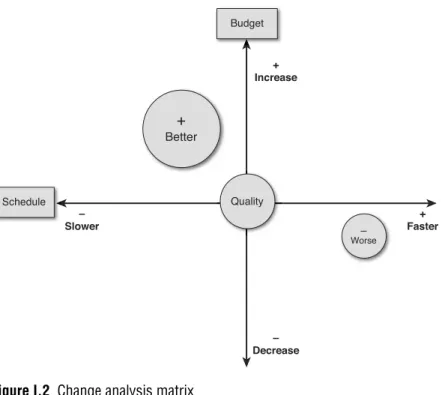
change analysis matrix shown in Figure I.2 , you can see an illustration
of the effects that change can have within the triple constraint. The
circle represents the deliverable and its associated quality (better
qual-ity = bigger circle; less qualqual-ity = smaller circle) and changes in slowing
or speeding up the schedule as well as increases or decreases in budget
and how each potentially can affect the other two. For instance, an
action that might be needed to improve quality may slow the schedule
and cost more. Likewise, something required to speed up the schedule
can reduce quality and cost less (see Figure I.2 ).
Budget Schedule + Increase – Decrease + Faster – Slower Quality Worse – Better +
Figure I.2 Change analysis matrix
If change is required to manage the triple constraint, it must be
done efficiently and effectively to ensure the change is carried out
without causing other problems within the work activity and to ensure
that the change made was effective in accomplishing the goal of the
change. All too often, project managers make changes but do not carry
out the second component of monitoring and measuring the effects of
the change to ensure it has accomplished what it was designed to do. In
other cases, changes are made that clearly accomplish the immediate
goal but have adverse effects on other work activities or components
of the project that create more problems than the changes originally
solved. Project managers need to ensure they are using a
compre-hensive and proven change management plan to make certain that
changes to the project are evaluated, approved, and controlled. In
addition, project managers should ensure that others within the
orga-nization who might have an expert assessment or managerial approval
are included so that changes are appropriate. The ultimate goal in
managing change reverts to the project manager’s requirement to
manage the triple constraint and keep a project on schedule, within
budget, and at the expected quality.
Managing Time, Cost, and Quality
In managing the triple constraint, project managers will discover
other aspects of the project that have time, cost, and quality
associ-ated but are not directly involved in a work activity task or element of
a project deliverable. Areas such as managing the project and
prod-uct scope can introduce challenges in managing the triple constraint.
Other areas, such as the cost of quality, the project manager’s time
management system, and the management of risk, introduce areas of
influence to the triple constraint the project manager must manage.
These are difficult areas to quantify at the beginning of the project
but nonetheless will be present throughout the project life cycle. The
project manager should simply be aware of their existence and, when
possible, design aspects of these influences into the schedule,
bud-get, and quality management plan to ensure they are accounted for
in some way.
Managing Project and Product Scope
The project manager has an incredible task at the beginning of a
project to understand the overall project scope as well as the product
scope to determine the boundaries of what the project is intending to
accomplish as well as the specific requirements in developing a
proj-ect deliverable. In some cases, the projproj-ect manager will find the
project drifting off into tangents that were not originally required but
are utilizing resources and causing certain aspects of work activity to
fall behind schedule. The project manager must understand the
importance of managing the scope of the project to ensure the triple
constraint does not have to be managed because of unnecessary work
that was not originally part of the project. The project manager also
has to monitor the development of a project deliverable to ensure
unnecessary additions to the deliverable—that were not originally
required and that can increase costs and delay the schedule—are
dis-covered and addressed through a change control process.
Time Management
One of the first components of developing an overall project
man-agement plan is to decipher all the individual components required
as work activities to develop an overall project schedule. Once all
the individual work activities have been identified, other elements,
such as the project budget and quality management plan, can then be
developed. Because the project manager develops a project
sched-ule based on individual work activity durations, she needs to consider
other factors that will influence both the work activity durations and
the overall success of completing a project on schedule, such as the
following:
• Time management of the project manager
• Time management of the project staff
• Time management of unrelated project activities
Depending on his organizational skills, a particular project
man-ager might be very good at managing work activity schedules but
struggle with his own time management for various reasons. In some
cases, a project manager’s disorganization can influence the schedule
of a project. For example, a project manager is responsible for critical
tasks in the project and does not complete them on time. This could
include the management of various meetings required for the project
and throughout the organization, critical communications with
proj-ect staff and other organizational human resources staff, or the
prepa-ration of critical documentation that is required either on the project
or for other departments within the organization. All these can affect
a project schedule if they’re not completed on time.
Another important aspect that project managers can struggle
with is the management of project staff. This can include the timely
direction of tasks that need to be performed, reports that need to
be generated, or the inclusion to meetings where critical information
from certain project staff will be required for project updates. The
project manager must be good at managing project staff to ensure this
does not become an influence to the overall project schedule. Project
managers and project staff can sometimes be caught up in unrelated
activities within the organization and external to the organization that
can put the project work activity schedule at risk. Project managers
must be aware that their number-one priority is the management of
project work activities to stay on schedule. They must manage other
nonrelated activities to ensure they do not influence the primary
proj-ect schedule.
Cost Management
Much like the influences of time management, costs can be
incurred throughout the project life cycle that the project manager
simply did not consider as part of direct work activity costs but that
do influence the project budget. Most of the project costs directly
related to work activities are part of the budget baseline of estimates;
however, added costs that happen throughout the project life cycle
do occur, and the project manager must address these types of costs
and their effect on the triple constraint and project budget. Other
costs that are not related directly to the project work activity may
include the price of quality and certain elements of risk or uncertainty
that can introduce added expenses. This book addresses these added
expenses so that the project manager is aware of not only the direct
costs involved in estimating a project budget, but also the added
costs to consider when evaluating all the costs in developing a project
budget.
Quality Management
One of the most important aspects of the triple constraint that
project managers need to address is ensuring quality expectations are
being met in producing the deliverable required at each work activity
throughout the project life cycle to guarantee the completed project
deliverable will be acceptable to the customer. This book also
intro-duces several areas in which information can be gathered to define
what quality requirements and expectations will be required for a
project deliverable. At times, a project deliverable has been
com-pleted, but a customer refuses acceptance based on certain aspects of
form, fit, or function that do not meet his requirements.
The first step in managing quality is to make sure the project
manager understands the customer’s expectations. Customers do not
always express all the specific requirements at the beginning of a
proj-ect, which can be a challenge to the project manager and project team
completing a project deliverable. Project managers and other project
staff should be proactive in making sure they understand as much
detail of the project deliverable, from a quality standpoint, as possible
at the beginning to avoid quality expectation issues when the project
is completed. It is also important for the project manager to
under-stand the difference between a customer’s quality expectations and a
customer’s quality requirements.
What Does the Customer Really Want?
When the project manager sets out to design a project that will
produce a project deliverable, it is standard practice to review
docu-ments and communication outlining customer requiredocu-ments at the
beginning of a project. These documents should contain specific
characteristics required by the customer. Documents such as a
state-ment of work (SOW) or customer specification are typically used at
the beginning of a project and should outline exactly what a customer
is asking of the organization. But these documents might not always
articulate exactly what the customer really wants. Therefore, the
proj-ect manager has to expand the scope of understanding customer
qual-ity and must be proactive with soliciting as much information from the
customer as she can to discern a more detailed quality expectation.
Customers can outline what the “requirements” might be for
a specific project deliverable in the form of an SOW or
specifica-tion. In some cases, however, customers might have assumptions
about a particular level of quality, or items that might be included
as “industry-standard and normal to this type of project deliverable,”
and the organization misinterprets unwritten quality expectations or
does not understand them at all. Project managers and those assessing
the initial statement of work at the beginning of a project might not
be aware of these types of assumptions or certain industry standards,
and these quality expectations will not be included as requirements.
It is incumbent on the project manager and project staff to engage in
communication outlining as much detail as possible and in some cases
asking for details of various characteristics of a project deliverable that
may stimulate the customer to articulate other expectations that can
now be documented as requirements. The most important
compo-nent in developing and approving a project is to understand what the
customer really wants. In most cases, this is simply the organization’s
ability to effectively communicate with a customer to develop a
com-prehensive and accurate project deliverable requirement.
As the project manager begins the process of developing the
proj-ect schedule, budget of estimates, and quality management plan, it is
imperative she begin with as much detailed information as possible
to make these project artifacts accurate, which will allow her to
effec-tively manage the triple constraint. Success in completing a project
on schedule, on budget, and at the customer’s expected quality starts
with accurate information at the beginning of the project. Project
managers should acquire as much accurate and relevant information
as possible to define the project deliverable to ensure project success
at completion. This book explores the details involved in gathering
information, analyzing work activity details, and developing
compre-hensive and accurate project schedules, budgets, and quality
manage-ment processes using various tools and techniques.
A
AC (actual cost), 188 accuracy of information, 49 - 50 , 228 level of, 213 activities, 39 - 40 , 65 - 68 activity information, 88 - 94activity information checklist, 67, 92 - 94 , 156 , 225
baseline information, 214 project charters, 88 - 91 SOW (statement of work), 88 WBS (work breakdown structure), 91 - 92 burst activities, 102 closing, 85 - 87 defining activity requirements, 65 - 68 overview, 62 - 63 project deliverable decomposition, 63 - 65 WBS (work breakdown structure), 68 - 70 dependencies activity information, 88 - 94 dependency determination, 94 - 96 overview, 87 dependency matrix, 99 disposition, 162 duration analysis analogous estimating, 142 - 143 contingency estimating, 146 - 149 349
Index
overview, 139 - 140 parametric estimating, 143 - 144subject matter expert estimating, 140 - 142 summary, 149 - 150 three-point estimating, 144 - 146 hierarchy, 163 identification tree, 64 - 65 information gathering, 40 - 41 accuracy of information, 49 - 50 information-gathering teams, 42 - 44 reliability of information, 44 - 49 sources, 50 - 51 type of information to be gathered, 41 - 42 labeling, 100 - 101 merge activities, 102 monitoring, 185 - 187 parallel activities, 102 project activity requirements
activity definition, 62 - 70 information gathering, 40 - 51 project structures, 51 - 62 summary, 71 - 72
project activity sequencing
overview, 75 - 77 PDM (precedence
diagramming method), 96 - 108
summary, 108 - 109
work activity definition, 77 - 87 work activity dependencies,
87 - 96
serial activities, 101
work activity monitoring, 185 - 187 activity hierarchy, 163
activity-on-node, 99 - 100 actual cost (AC), 188 adaptive structure, 22 , 58 - 59 cost estimating, 243 - 244 resource estimating, 133 - 134 administrative costs, 230 Agile, 21 , 22 , 55 - 59 alternatives analysis, 129 analogous estimating, 142 - 143 budgeting, 259 - 260 cost estimating, 234
analysis methodologies for quality management, 288
applications of cost management plans, 213 - 214
organizational strategic planning, 214
tool for manager’s tactical use, 214 - 216
approval, 82 , 276
assurance, quality. See QA (quality assurance)
audits (quality), 307 - 308 availability, 127 , 159
B
BAC (budget at completion), 189 , 251 - 252
backward pass, 105 baselines, 183 - 184
activity baseline information, 214 project budget baseline, 252 , 268 benchmarking, 292 - 293
Beta Distribution (PERT) formula, 239
bottlenecks (resource), 90 bottom-up estimating, 240 brainstorming, 294
budget at completion (BAC), 189 , 251 - 252
budget development . See also cost estimating
budget methods, 255 - 261
analogous budgeting, 259 - 260 cost aggregation method, 256 funding limit reconciliation,
260 - 261 overview, 255 - 256
time-phased method, 256 - 257 top-down budgeting, 257 - 258
overview, 249 - 250
purpose of project budget, 250 - 255
BAC (budget at completion), 251 - 252 communication of project status, 254 management of triple constraint, 252 - 254 organizational planning, 254 - 255
project budget baseline, 252
schedule/budget updates, 335 - 336 summary, 261 - 262
buffering (schedule), 167 - 169 burst activities, 102
business needs, developing, 343
C
capability, 126 - 127
capital equipment resources, 119 cause-and-effect diagrams, 328 - 329 CCM (critical chain method),
167 - 169
change analysis matrix, 6 change control process, 195 - 196 ,
343 - 345
change analysis matrix, 6 change management, 4 - 7 , 84 integrated change control, 272 - 273 quality management, 290
change requests for QA (quality assurance), 313 - 314
charters. See project structures charts check charts, 186 - 187 , 329 - 330 control charts, 270 - 271 , 332 - 333 flowcharts, 330 - 331 histograms, 332 check charts, 186 - 187 , 329 - 330 checklists, activity information
checklist, 156 closing
activities, 85 - 87 procurements, 86 - 87 projects, 85 - 87
Communicate phase (change control process), 344 communication
change control process, 344 communication of project status, 254 schedule communication, 176 schedule management plans, 29 - 30 conceptual planning, 77 - 79 conducting changes, 344 constraints, 124 - 126 cost, 232 - 233 triple constraint, 2 - 4 contingency control, 193 , 273 - 274 contingency estimating, 146 - 149 , 240 - 241 contingency funds, 208 - 209 contracted resources, 121 contracts contract control, 274 - 275 cost management, 206 cost management plans, 215 fixed-price contracts, 274 - 275 fixed-price incentive-fee
contracts, 275
resource contracts, 194 - 195 time and materials contracts, 275 control. See project schedule
control; QC (quality control) control charts, 270 - 271 , 332 - 333 control thresholds, 213
control verification, 276 - 277
controlling, 83 . See also cost control cost aggregation method
budgeting, 256
cost analysis tools, 269 - 271 cost control
contingency control, 273 - 274 contract control, 274 - 275 control verification, 276 - 277 cost analysis tools, 269 - 271 cost monitoring, 267 - 269
integrated change control, 272 - 273 overview, 265 - 267
procurement review and approval, 276 summary, 277 - 279 cost definitions, 205 - 209 cost estimating analogous estimating, 234 bottom-up estimating, 240 contingency cost estimating,
240 - 241
cost constraints, 232 - 233 cost management plans, 228 - 233
cost classifications, 229 - 230 documentation, 230 - 232 measurement definitions,
228 - 229
estimating based on project structures, 242 - 244 adaptive structure, 243 - 244 extreme structure, 244 incremental structure, 242 - 243 iterative structure, 243 - 244 linear structure, 242 - 243 overview, 221 - 223 parametric estimating, 234 - 235 project cost requirements,
223 - 227
activity information checklist, 225 -226
overview, 223 - 224 scope statement, 226 - 227 SOW (statement of work), 224 WBS (work breakdown
rough order-of-magnitude estimating, 235 - 236 subject matter experts, 236 summary, 245 - 246 three-point estimating, 236 - 239 top-down estimating, 240 cost management, 216 - 217 applications, 213 - 214 organizational strategic planning, 214
tool for manager’s tactical use, 214 - 216
budget development
budget methods, 255 - 261 overview, 249 - 250 purpose of project budget,
250 - 255 summary, 261 - 262 cost control contingency control, 273 - 274 contract control, 274 - 275 control verification, 276 - 277 cost analysis tools, 269 - 271 cost monitoring, 267 - 269 integrated change control,
272 - 273 overview, 265 - 267 procurement review and
approval, 276 summary, 277 - 279
cost estimating
analogous estimating, 234 bottom-up estimating, 240 contingency cost estimating,
240 - 241
cost constraints, 232 - 233 cost management plans,
228 - 233
estimating based on project structures, 242 - 244 overview, 221 - 223 parametric estimating,
234 - 235
project cost requirements, 223 - 227
rough order-of-magnitude estimating, 235 - 236 subject matter experts, 236 summary, 245 - 246 three-point estimating,
236 - 239
top-down estimating, 240
cost management plans, 228 - 233
components, 212 - 213 cost classifications, 229 - 230 development, 211 - 212 documentation, 230 - 232 measurement definitions, 228 - 229
information for planning costs
cost definitions, 205 - 209 project charters, 209
project manager’s experience, 210
project structures, 211 SOW (statement of work),
209 - 210
subject matter experts, 210 - 211
overview, 9 , 201, 203 - 205 summary, 216 - 217
cost management plans, 228 - 233 components, 212 - 213 cost classifications, 229 - 230 development, 211 - 212 documentation, 230 - 232 measurement definitions, 228 - 229 cost monitoring, 267 - 269 cost of quality, 289 - 290
cost performance index (CPI), 188 cost variance (CV), 188
CPI (cost performance index), 188 critical chain method, 167 - 169 critical path, 106 - 108 , 164 - 165 currency formats, 229
customer evaluation, 84 - 85
customer quality standards, 305 - 306 customer requirements, 10 - 11 , 313
QC (quality control), 321 - 322 scheduling, 159 - 160
customer-level cost constraints, 233 CV (cost variance), 188
D
decomposition decision tree, 63 - 64 defining activities activity requirements, 65 - 68 conceptual planning, 77 - 79 customer/project team evaluation, 84 - 85 overview, 62 - 63 project closure, 85 - 87 project deliverable decomposition, 63 - 65 project development, 80 testing and validation, 80 - 82 WBS (work breakdown structure), 68 - 70 deliverables, 79 objectives, 78 deliverables defining, 79
project deliverable specifications, 155 - 156
quality, verifying, 336 Delphi method, 140 - 142
published data estimating, 129 - 130 resource leveling, 130 - 132
dependencies (work activity) activity information, 88 - 94
activity information checklist, 92 - 94
project charters, 88 - 91 SOW (statement of work), 88 WBS (work breakdown
structure), 91 - 92
dependency determination, 94 - 96 overview, 87
design of experiments (DOE), 292 design review, 327 - 328
determinate estimating, 128 - 129 development
budget development . See also cost estimating
budget methods, 255 - 261 overview, 249 - 250
purpose of project budget, 250 - 255
summary, 261 - 262
business needs, 343
cost management plans, 211 - 212 project development, 80 project schedule development,
153 - 154
information for schedule development, 154 - 161 schedule documentation tools,
173 - 176
schedule structuring techniques, 161 - 172 summary, 177 - 178
diagrams . See also charts cause-and-effect diagrams, 328 - 329 check charts, 329 - 330 flowcharts, 330 - 331 interrelationship diagraphs, 311 mind-mapping diagrams, 310 network diagrams, 164 - 165 , 311 Pareto diagrams, 331 scatter diagrams, 333 - 334 tree diagrams, 309 - 310 diagraphs, interrelationship, 311 direct costs, 206 , 229 direct resources, 117 - 118 discretionary dependencies, 95 - 96 documentation, 213
cost management plans, 230 - 232 schedule documentation tools,
173 - 176
schedule communication, 176 schedule management,
175 - 176
software tools, 173 - 175
DOE (design of experiments), 292 dropped baton, 167 duration analysis analogous estimating, 142 - 143 contingency estimating, 146 - 149 overview, 139 - 140 parametric estimating, 143 - 144
subject matter expert estimating, 140 - 142
summary, 149 - 150
three-point estimating, 144 - 146
E
EAC (estimate at completion), 189 earned value analysis (EVA),
187 - 191 , 269
earned value (EV), 188
elevating system constraints, 166 estimate at completion (EAC), 189 estimate to completion (ETC), 189 estimating
costs
analogous estimating, 234 bottom-up estimating, 240 contingency cost estimating,
240 - 241
cost constraints, 232 - 233 cost management plans,
228 - 233
estimating based on project structures, 242 - 244 overview, 221 - 223 parametric estimating,
234 - 235
project cost requirements, 223 - 227
rough order-of-magnitude estimating, 235 - 236 subject matter experts, 236 summary, 245 - 246 three-point estimating, 236 - 239 top-down estimating, 240 duration analogous estimating, 142 - 143 contingency estimating, 146 - 149 parametric estimating, 143 - 144
subject matter expert estimating, 140 - 142 three-point estimating,
144 - 146
estimate at completion (EAC), 189 estimate to completion (ETC), 189 resources
adaptive project structure, 133 - 134 alternatives analysis, 129 contracted resources, 121 Delphi method, 129 determinate estimating, 128 - 129 direct resources, 117 - 118 extreme project structure,
134 - 135
incremental project structure, 132 - 133
indirect resources, 117 - 118 iterative project structure,
133 - 134
linear project structure, 132 - 133
organizational resources, 123 overview, 113 - 117
project resources, 118 - 120 , 124 - 127
published data estimating, 129 - 130
resource leveling, 130 - 132 resource requirements, 122 summary, 135 - 136
ETC (estimate to completion), 189 EV (earned value), 188
EVA (earned value analysis), 187 - 191 , 269
Excel, 173
excessive multitasking, 167 expected cost, 238
expedite fees, 207 - 208 experiments, design of, 292 exploiting system constraints, 166 Exploratory Development, 22 ,
59 - 62
external dependencies, 96
external factors for project schedule development, 159 - 160
extreme structure, 22 , 59 - 62 cost estimating, 244
F
facilities resources, 119 - 120 Features Addition Development,
21 , 55 - 57 fees expedite fees, 207 - 208 penalty fees, 208 regulatory fees, 207 - 208 FF (Finish to Finish), 98 financial resources, 120 Finish to Finish (FF), 98 Finish to Start (FS), 98 fixed-price contracts, 274 - 275 fixed-price incentive-fee contracts,
275 float/slack calculation, 105 - 107 flowcharts, 330 - 331 forward pass, 103 - 105 FS (Finish to Start), 98 functional tests, 81
funding limit reconciliation, 260 - 261
G
gathering data, 343 Goldratt, Eliyahu, 166
A Guide to the Project Management Body of Knowledge (PMBOK®), Fifth Edition , 204
H
hierarchy of activities, 163 histograms, 332
historical derivative budgets, 259 historical information for budgets,
259
human resources, 119
I
identifying system constraints, 166 Implement phase (change control
process), 344 incremental structure, 21 , 53 - 55 cost estimating, 242 - 243 resource estimating, 132 - 133 indirect costs, 206 , 229 - 230 indirect labor, 230 indirect materials, 230 indirect resources, 117 - 118 industry quality standards, 305 information technology, 120 inspections, 81 , 325 - 326
integrated change control, 272 - 273 interrelationship diagraphs, 311 iterative structure, 21 , 55 - 57 cost estimating, 243 - 244 resource estimating, 133 - 134
J-K-L
labeling activities, 100 - 101 labor rates, 207LCL (lower control limit), 271 Learn and Build Development, 22 ,
58 - 59 level
of accuracy, 213 , 228 of precision, 213 , 228 life cycle models. See project
structures
linear structure, 20 - 21 , 52 - 53 cost estimating, 242 - 243 resource estimating, 132 - 133 loading resources, 169 - 170 lower control limit (LCL), 271
M
management of triple constraint, 252 - 254
managerial influences in project schedule development, 158 mandatory dependencies, 95 materials resources, 120 matrices
activity dependency matrix, 99 change analysis matrix, 6
Measure phase (change control process), 344 - 345
measurement definitions, 228 - 229 meetings
status meetings, 185 , 268 subject matter expert meetings,
293 merge activities, 102 metrics, quality, 288 , 307 Microsoft Excel, 173 Microsoft Project, 175 milestone analysis, 192 mind-mapping diagrams, 310 monitoring, 82 - 83 costs, 267 - 269 quality, 287 work activity, 185 - 187 Most Likely estimates, 237 multitasking, 167
N-O
network diagrams, 164 - 165 , 311 objectives, defining, 78 operations, 1 - 2 Optimistic estimates, 237organizational influences on project schedule development, 157 - 159 organizational past projects,
gathering information from, 26 organizational planning
budget development, 255 QC (quality control), 323 - 324 strategic planning, 214
organizational process updates, 337 organizational quality standards,
303 - 304 organizational resources, 123 organizational-level cost constraints, 232 overhead expenses, 229
P
padding (schedule), 167 - 169 parallel activities, 102 parametric estimating, 143 - 144 , 234 - 235 Pareto diagrams, 331 Parkinson’s law, 168past projects, gathering information from, 26
paths
activity paths, 101 - 102 project critical path, 107 - 108 project path analysis, 103 - 107 PDM (precedence diagramming method) activity labeling, 100 - 101 activity paths, 101 - 102 activity relationships, 98 - 99 activity-on-node, 99 - 100 overview, 96 - 98
project critical path, 107 - 108 project path analysis, 103 - 107 penalty fees, 208
performance measurement, 213 PERT (Program Evaluation and
Review Technique), 144 - 145 , 239 Pessimistic estimates, 237
plan structures. See project structures
planned value (PV), 187 - 188 plans
budgets. See budget development conceptual planning, 77 - 79 cost management plans, 228 - 233
components, 212 - 213 cost classifications, 229 - 230 development, 211 - 212 documentation, 230 - 232 measurement definitions, 228 - 229
project plans, creating, 79 quality management plans,
285 - 286
analysis methodologies, 288 benchmarking, 292 - 293 brainstorming, 294 change control process, 290 cost of quality, 289 - 290 DOE (design of
QA (quality assurance), 289 quality controls, 290 - 291 quality metrics, 288 quality monitoring, 287 statistical sampling, 291 - 292 summary, 294 - 295
schedule management plans
applications, 28 - 31
information gathering, 24 - 28 minimum requirements, 17 - 18 overview, 15 - 16
plan structures, 18 - 23 PMO (project management
office), 23 - 24 summary, 31 - 33
PMO (project management office), 23 - 24
precedence diagramming method. See PDM (precedence diagramming method)
precision, level of, 213 , 228 predecessor relationships, 94 - 95 predictive structure, 20 - 21 process analysis, 308 - 311 interrelationship diagraphs, 311 mind-mapping diagrams, 310 network diagrams, 311 tree diagrams, 309 - 310 process capability (QA), 313 process updates
organizational process updates, 337
project process updates, 336 - 337 procurements
closing, 86 - 87
procurement action reports, 268 - 269
review and approval, 276 Program Evaluation and Review
Technique (PERT), 144 - 145 , 239 Progressive Stage Development, 21 ,
53 - 55
Project (Microsoft), 175 project activities. See activities
project activity duration analysis analogous estimating, 142 - 143 contingency estimating, 146 - 149 overview, 139 - 140
parametric estimating, 143 - 144 subject matter expert estimating,
140 - 142
summary, 149 - 150
three-point estimating, 144 - 146 project activity requirements
activity definition activity requirements, 65 - 68 overview, 62 - 63 project deliverable decomposition, 63 - 65 WBS (work breakdown structure), 68 - 70 information gathering, 40 - 41 accuracy of information, 49 - 50 information-gathering teams, 42 - 44 reliability of information, 44 - 49 sources, 50 - 51 type of information to be gathered, 41 - 42 overview, 39 - 40 project structures adaptive structure, 58 - 59 extreme structure, 59 - 62 incremental structure, 53 - 55 iterative structure, 55 - 57 linear structure, 52 - 53 overview, 51 - 52 summary, 71 - 72
project activity sequencing overview, 75 - 77 PDM (precedence diagramming method) activity labeling, 100 - 101 activity paths, 101 - 102 activity relationships, 98 - 99 activity-on-node, 99 - 100
overview, 96 - 98
project critical path, 107 - 108 project path analysis, 103 - 107
summary, 108 - 109 work activity definition, 77
conceptual planning, 77 - 79 customer/project team
evaluation, 84 - 85 project closure, 85 - 87 project development, 80 testing and validation, 80 - 82
work activity dependencies
activity information, 88 - 94 dependency determination,
94 - 96 overview, 87
project charters, 24 - 25 , 88 - 91 , 209 project deliverable specifications,
155 - 156
project schedule development, 155
project closure, 85 - 87
project cost management. See cost management
project cost requirements, 223 - 227 activity information checklist, 225 overview, 223 - 224
scope statement, 226 - 227 SOW (statement of work), 224 WBS (work breakdown structure),
224 - 225
project critical path, 107 - 108 project deliverable decomposition,
63 - 65
project deliverable specifications, 155 - 156
project development, 80
project management office (PMO), 23 - 24
project manager’s experience, cost management plans, 210
project plans, creating, 79 project process updates, 336 - 337 project resources, 118 - 120 , 124 - 127
availability, 127 capability, 126 - 127 constraints, 124 - 126
project risk register, 324 project schedule control. See
schedule control
project schedule development. See schedule development
project scope, 7 - 8 , 157
project scope statement, 226 - 227 project structures
adaptive structure, 58 - 59 cost management plans, 211 extreme structure, 59 - 62 incremental structure, 53 - 55 iterative structure, 55 - 57 linear structure, 52 - 53 overview, 51 - 52 schedule management, 18 - 23 adaptive structure, 22 extreme structure, 22 incremental structure, 21 iterative structure, 21 linear structure, 20 - 21 stages of development, 19 - 20
project time management. See time management
project-level cost constraints, 232 - 233
Propose phase (change control process), 343 - 344
proposing change, 343 publicizing changes, 344
published data estimating, 129 - 130 purchases, cost management,
206 - 207 PV (planned value), 187 - 188
Q
QA (quality assurance) change requests, 313 - 314 continuous improvement, 313 customer quality standards,305 - 306
industry quality standards, 305 organizational quality standards,
303 - 304
process analysis, 308 - 311 interrelationship diagraphs, 311 mind-mapping diagrams, 310 network diagrams, 311 tree diagrams, 309 - 310 process capability, 313 quality audits, 307 - 308 quality management plans, 303 quality