SecureKeeper: Confidential ZooKeeper using Intel SGX
Stefan Brenner
TU Braunschweig, Germany [email protected]Colin Wulf
TU Braunschweig, Germany [email protected]David Goltzsche
TU Braunschweig, Germany [email protected]Nico Weichbrodt
TU Braunschweig, Germany [email protected]Matthias Lorenz
TU Braunschweig, Germany [email protected]Christof Fetzer
TU Dresden, Germany [email protected]Peter Pietzuch
Imperial College London, UK [email protected]
Rüdiger Kapitza
TU Braunschweig, Germany [email protected]
ABSTRACT
Cloud computing, while ubiquitous, still suffers from trust issues, especially for applications managing sensitive data. Third-party coordination services such as ZooKeeper and Consul are fundamental building blocks for cloud applica-tions, but are exposed to potentially sensitive application data. Recently, hardware trust mechanisms such as Intel’s Software Guard Extensions (SGX) offer trusted execution environments to shield application data from untrusted soft-ware, including the privileged Operating System (OS) and hypervisors. Such hardware support suggests new options for securing third-party coordination services.
We describe SecureKeeper, an enhanced version of the ZooKeeper coordination service that uses SGX to pre-serve the confidentiality and basic integrity of ZooKeeper-managed data. SecureKeeper uses multiple small enclaves to ensure that (i) user-provided data in ZooKeeper is al-ways kept encrypted while not residing inside an enclave, and (ii) essential processing steps that demand plaintext ac-cess can still be performed securely. SecureKeeper limits the required changes to the ZooKeeper code base and re-lies on Java’s native code support for accessing enclaves. With an overhead of 11%, the performance of SecureKeeper with SGX is comparable to ZooKeeper with secure commu-nication, while providing much stronger security guarantees with a minimal trusted code base of a few thousand lines of code.
CCS Concepts
•Security and privacy→Distributed systems security;
Keywords
Cloud Computing, Intel SGX, Apache ZooKeeper
Permission to make digital or hard copies of all or part of this work for personal or classroom use is granted without fee provided that copies are not made or distributed for profit or commercial advantage and that copies bear this notice and the full citation on the first page. Copyrights for components of this work owned by others than the author(s) must be honored. Abstracting with credit is permitted. To copy otherwise, or republish, to post on servers or to redistribute to lists, requires prior specific permission and/or a fee. Request permissions from [email protected].
Middleware’16, December 12 - 16, 2016, Trento, Italy
© 2016 Copyright held by the owner/author(s). Publication rights licensed to ACM. ISBN 978-1-4503-4300-8/16/12. . . $15.00
DOI:http://dx.doi.org/10.1145/2988336.2988350
1.
INTRODUCTION
Cloud computing has become ubiquitous due to its bene-fits to both cloud customers and providers [1]. Using public cloud resources, however, requires customers to fully trust the provided software and hardware stacks as well as the cloud administrators. This forms an inhibitor when sensi-tive data must be processed [2, 3].
With Software Guard Extensions (SGX), Intel recently re-leased a new technology [4] for addressing trust issues that customers face when outsourcing services to off-site loca-tions. Based on an instruction set extension, it allows the creation of one or more trusted execution environments— calledenclaves—inside applications. Thereby, the plaintext of enclave-protected data is only available for computation inside the CPU, and it is encrypted as soon as the data leaves the CPU. This way enclave-residing data is even guarded against unauthorized accesses by higher privileged code and attackers with administrative rights and physical access.
While enclaves were originally designed to host tailored code for specific tasks, e.g. digital rights or password man-agement [5], Baumann et al. [6] proposed Haven that ex-ecutes unmodified legacy Windows applications inside en-claves. Theseapplication enclaves are convenient for secur-ing entire legacy applications but have two significant draw-backs: (i) current SGX-capable CPUs restrict the maximum memory footprint of all enclaves to 128 MB. If an applica-tion has a larger memory footprint, an SGX-specific form of in-memory paging between trusted and untrusted memory is required, which requires costly re-encryption of enclave pages with a substantial performance overhead; and (ii) by placing whole applications and associated system support in-side an enclave, the resulting large trusted code base (TCB) poses a risk of including security relevant vulnerabilities [7]. Based on these observations, we argue that application enclaves that contain entire applications are a poor fit for legacy services if tailored solutions are easy to implement and integrate. In particular, this applies to existing data-handling services that receive, store and return data on be-half of clients while performing limited data processing. Ex-amples include simple key-value stores [8], web servers [9– 11], and, as highlighted in this paper, coordination services such as ZooKeeper [12]. For such services, data confiden-tiality and basic integrity can be preserved using small spe-cialized enclaves, which can be integrated with the original code base with only few changes.
ZooKeeper is a crucial building block for many distributed applications, e.g. used as naming service, for configuration management, general message exchange and coordination tasks. It therefore manages sensitive application informa-tion, i.e., including access tokens and credentials when used for configuration management. Albeit typically not user fac-ing, ZooKeeper constitutes a key component in public cloud infrastructures that must be secured against attacks, espe-cially data theft carried out by insiders.
As a data-handling service, ZooKeeper features a simple file system like API, with some data processing functional-ity. Thus, data managed by ZooKeeper can be processed in an encrypted state most of the time and only occasionally plaintext access is necessary. This functionality needs to be factored out and executed under the protection of SGX. In contrast to application enclaves, this way all data handling code that does not perform data processing is removed from the TCB. For ZooKeeper, this includes the entire Operating System (OS), the Java runtime environment as well as most of the original service implementation itself. Furthermore, as data stays encrypted most of the time, it can be stored outside of enclaves, only adding to the memory footprint of the enclave when required. This leads to substantially smaller enclaves, staying within the bounds of the 128 MB limit of total enclave memory resulting in good performance.
We describe SecureKeeper, an SGX-based ZooKeeper
extension that demonstrates how a complex data-handling service can be secured using SGX. SecureKeeper preserves confidentiality and provides basic integrity of service data, even against privileged code and attackers with physical access. These security guarantees are enforced through a minimally-invasive integration of two enclave types: (i) an entry enclaveis instantiated for each client and responsible for protecting the client-replica connection and the data se-curity of the ZooKeeper data store; (ii) acounter enclaveis instantiated only once at the leader replica of the ZooKeeper cluster, and handles special write requests ofsequential no-des that perform data processing. Clients do not need to know the key used by enclaves for encryption towards the ZooKeeper data store. This also allows the exclusion of clients due to misbehaviour.
Based on this design, the remaining ZooKeeper code base and any system software can be excluded from the TCB. Se-cureKeeper therefore features a small TCB of 3795 Source Lines of Code (SLOCs) apart from the trusted system sup-port provided by the Intel SGX SDK [13]. Besides its small TCB, SecureKeeper only changesthreelines of the original ZooKeeper code base, making it easily upgradeable to future ZooKeeper versions. The memory demand of the enclaves stays within small bounds, which avoids costly SGX-specific paging with a high client load.
We compare SecureKeeper to ZooKeeper with and with-out secure communication between replicas and clients on a cluster of SGX-capable Intel Skylake machines. SecureKee-per only adds an average SecureKee-performance overhead of 11.2% to ZooKeeper when secure communication is enabled, while enforcing stronger security guarantees.
In the next section, we describe the background and de-sign considerations that led to the dede-sign of SecureKeeper. After that, we introduce its design in Section 4, followed by implementation details in Section 5. We present evalu-ation results in Section 6 and discuss the obtained security
Replica3,L
Replica2
Replica1 Replica4 Replica5
Client2
Client1 Client3 Client4 Client5 Client6 Client7 Client8
Agreement Agreement
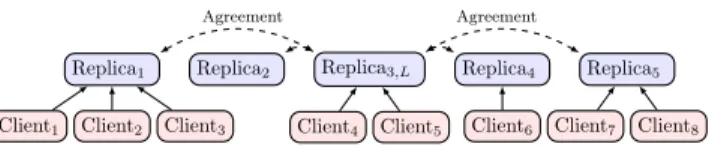
Figure 1: General architecture of ZooKeeper. guarantees and limitations in Section 7. Finally, we discuss related work in Section 8 and draw conclusions in Section 9.
2.
BACKGROUND
To motivate the design of SecureKeeper, we first give a brief introduction to Apache ZooKeeper thereby discussing its nature as a data-handling service, second we provide essential details of SGX and finally outline an SGX-aware threat model.
2.1
Data handling in Apache ZooKeeper
Apache ZooKeeper [12] is a coordination service, allowing distributed applications the easy implementation of coordi-nation primitives. Such primitives may be naming, configu-ration management, leader election, group membership, bar-riers and distributed locks. This exposes ZooKeeper to han-dle potentially sensitive application data, especially when used for distributed configuration management.
As shown in Figure 1, ZooKeeper is implemented as a fault-tolerant service, typically featuring at least three repli-cas. Clients connect to one of these and switch over to an-other in case it crashes. ZooKeeper-managed data is orga-nized hierarchically as a tree that is accessed via a simple file system like Application Progamming Interface (API). This data tree is composed of znodes, resembling a mixture of folders and files: znodes can have payload data and other child znodes at the same time.
ZooKeeper globally orders allwrite requestsvia the leader replica (markedLin Figure 1) using the ZAB [14] agreement protocol. Additionally, ZooKeeper guarantees FIFO order-ing ofall requests ofone client, allowing replicas to answer read requests from clients connected to them directly.
Most operations provided by ZooKeeper are dedicated to-wards data handling: In order to retrieve and change the payload of a znode, the GET and SET operations are used. New znodes can be created using theCREATEoperation, and deleted viaDELETE. Also it is possible to access a list of chil-dren of a specific znode using theLS(getChildren) operation. An exception to the data handling nature of ZooKeeper builds a variant of theCREATEoperation that instantiates a sequential node. Here data-centric processing is required: If a new sequential node is created, a sequence number is added to the user-provided znode name. This sequence number is monotonically increasing and managed by the parent znode, thus the name of the new znode depends on the internal state of the parent znode.
Since all operations are executed affecting one specific znode in the data tree of ZooKeeper, request messages will usually contain a path to that znode. The payload of a znode will usually be contained in the GET response, and theSET andCREATErequests. TheLSoperation is the only operation that contains paths in the response message – the paths of all child znodes. Application data managed by ZooKeeper comprises the payload as well as the pathnames of znodes. In many cases, the pure existence of a certain path steers processing in a distributed application.
In summary, ZooKeeper primarily performs data handling for clients with the exception of sequential nodes, were ac-tual data processing takes place. Furthermore, payload and path information are relevant to security considerations.
2.2
Intel SGX in a nutshell
SGX [4] is a processor instruction set extension that al-lows the creation of so calledenclaves. The enclave memory range Enclave logical range (ELRANGE) is an isolated range inside an application’s address space which is confidentiality and integrity protected by the CPU package. Pages of the ELRANGE are backed by the Enclave Page Cache (EPC): a reserved range of system memory of at most 128 MB, used to store all enclave pages.
Basic protection model. SGX prevents tojmp or
di-rectlycallto the ELRANGE, instead the enclave must be
entered explicitly. Once inside the enclave, the CPU can execute arbitrary code, except for a few instructions that are prohibited inside enclaves. The enclave is allowed to access data outside the ELRANGE, however, it cannot exe-cute untrusted code. Even privileged code is prevented from reading and altering enclave memory: illegal accesses result in CPU exceptions and read access to enclave memory will always return0xFF.
Confidentiality of enclave memory is protected by trans-parent memory encryption done by the CPU, i.e., plaintext is only available inside the CPU package. Valid interaction with an enclave is possible via Enclave calls (ecalls) to en-ter an enclave and Outside calls (ocalls) to call out of the enclave. An ecall comprises an explicit entering of the en-clave and switching to a trusted stack located inside the ELRANGE, as well as moving call parameters into the en-clave and calling the according trusted function’s code. Re-turning from an ecall and ocall, equally, requires switching the stack back, moving return values or parameters out of the ELRANGE and an explicit enclave exit.
Memory management. If enclave applications do not fit into the 128 MB of EPC, a special form of EPC-paging must be done. Enclave pages residing in the EPC can be moved out to normal system RAM, similar to paging mem-ory to disk. However, as enclave pages are encrypted by the CPU, first a re-encryption happens to protect the contents of the pages removed from EPC. Then, the page can be migrated to normal RAM and afterwards, is qualified for being paged to disk if required. The procedure of EPC pag-ing involves a mechanism that prevents replaypag-ing paged-out enclave pages by generating a so called “version array” that is required to migrate the page back to EPC later and only works once. EPC paging allows enclave applications to use more than 128 MB of memory, however, implies a significant performance impact as we discuss later.
System limitations. As enclaves can be only operated in user space, SGX-based applications still depend on the
underlying operating system to cooperate. For example,
memory management of the EPC memory is done com-pletely by the untrusted operating system. Hence, SGX nat-urally cannot prevent denial of service attacks by privileged code. The in-memory state of enclaves is protected against replay attacks, as it is managed by SGX, even if paged out to normal system memory. For persistent state and in the context of application or OS restarts no specific protection is provided.
Intel SDK provided system support. Beside SGX-aware hardware, additional system software support for life-cycle management of enclaves and memory management to handle the EPC is required to operate SGX-enabled applica-tions. Intel offers an Intel SGX SDK to handle these tasks, and on top, provides an interface definition language called Enclave Description Language (EDL) that allows the spec-ification of the ecalls and ocalls an enclave should support. The Intel SGX SDK also comprises a tool called “Edger8r” which is a code generator supporting developers on the re-curring task of writing stubs for ecalls and ocalls as well as parameter passing between the enclave and the untrusted code. Enclaves are finally compiled and linked together with the generated code to a shared object, which is loadable by the Intel SGX SDK as an enclave.
2.3
An SGX-aware Threat Model
We assume a typical threat model for SGX enclaves, specifically in an untrusted cloud environment [6, 15]: an attacker has full – even physical – control over the server hardware and software environment. This includes that the attacker can control the OS and all code invoked prior to the transfer of control into the SGX enclave. The attacker’s goal is to break confidentiality or integrity of code running in the SGX enclave.
Availability threats, such as crashing an enclave, are not of interest: by design, the hosting OS is able to stop execution of enclaves at any time. Nevertheless, from a fault-tolerance point of view, SecureKeeper – analogous to ZooKeeper, can tolerate a limited number of node crashes.
We do not consider side-channel attacks [16] and assume that enclaves do not possess any security relevant vulner-abilities that may lead to leakage of data or breach its in-tegrity. The latter can be addressed by applying software-hardening techniques that are orthogonal to our approach. We also fully trust the design and correct implementation of the CPU package and the SGX instruction set extension including all cryptographic operations done by SGX.
Finally, clients can read, modify and delete service-provided data and therefore are considered to be trusted in this regard.
3.
DESIGN CONSIDERATIONS
The design of SecureKeeper is determined by (i) security considerations but also (ii) performance and (iii) applicabil-ity aspects play an important role.
Two basic design variants are compared: using an appli-cation enclave, which hosts whole ZooKeeper instances, and tailored enclaves, as featured by SecureKeeper, used to only protect ZooKeeper-specific sensitive data and its processing. Application enclaves are attractive for complex legacy ap-plications because they can instantly profit from the SGX-provided security guarantees without additional changes. As a downside, such large enclaves pose a security trade-off (Section 3.2) and may lead to substantial performance degradation (Section 3.3).
3.1
Protecting ZooKeeper data
ZooKeeper as a coordination service is the backbone of many distributed applications, storing essential and sensi-tive data for their operation. As detailed in Section 2.1, this data is split into path and payload tuples, stored in a tree-like hierarchical database. At least the plaintext of the
0 100 200 300 400 500 0 5 10 15 20 sta rt of w or k load sta rt of clus ter Memor y Usa g e [MB] Run Time [s] Leader Follower 1 Follower 2
Figure 2: Memory usage of ZooKeeper over time.
path and the associated payload information must always be inaccessible to external entities to enforce confidential-ity and additionally guarded to ensure integrconfidential-ity. Thus, this data either needs to be put under the protection of an en-clave or stored and processed in an encrypted form. The former is straightforward when using application enclaves, the latter is possible for most core functions with the excep-tion of sequential nodes that require local processing (see Section 2.1). As a consequence, SecureKeeper takes a mid-dle ground and stores and processes data in encrypted form where feasible and redirects plaintext processing to enclaves (see Section 4).
3.2
Security considerations
Since ZooKeeper is implemented in Java, an application enclave software stack would comprise the library OS, an en-tire Java Virtual Machine (JVM) and the whole ZooKeeper codebase. The library OS of Haven alone comprises millions of code lines [6]. In addition, OpenJDK itself is composed of roughly 4.5 million SLOCs, and was subject to several remote exploitable vulnerabilities in the recent past [17–20]. Furthermore, ZooKeeper is a complex service with several thousand lines of code (see Section 6.4). From a security point of view, such a large TCB is at odds with basic secu-rity considerations [7], and therefore a tailored enclave ap-proach, as implemented by SecureKeeper, is more attractive due to its smaller TCB.
In addition, the number of possible ecalls and ocalls com-posing the enclave interface is of security relevance. Fewer interface functions with a limited number of well defined pa-rameters decrease the attack surface of the enclave. For a hosted system with an application enclave, the application-specific user interface calls and the ocalls that implement system call functionality must be protected. The latter are generic, thus hard to validate, and they have to be guarded by additional checks [6]. In case of tailored enclaves, the interface depends on the provided functionality. For Secure-Keeper, we aim for a narrow and minimal interface, enabling a targeted and context-specific parameter validation.
3.3
Resource and performance considerations
Another important aspect is the memory consumption of
the JVM and ZooKeeper. As mentioned in Section 2.2,
the EPC size is limited to 128 MB, and memory require-ments beyond this amount require costly paging from se-cure SGX memory to untrusted memory after reencryption of the data. Figure 2 shows the memory usage of an
un-modified ZooKeeper instance. For this measurement, we
applied a realistic workload according to the original Zoo-Keeper paper [12] to our test cluster which is described in Section 6: asynchronousGETandSETrequests with a 70:30
100 1,000 10,000 100,000 1,000,000 92 256 1 8 64 L3 c ache EP C T housan d P a g e A c c e sse s / s
Allocated Enclave Memory [MB] random read
random write
Figure 3: Performance impact of enclave memory size on random reads and writes on a Xeon E3-1230 v5 CPU.
0 50,000 100,000 150,000 200,000 1MB 4MB 16MB 102MB 512MB 3GB0 5 10 15 20 25 30 R eque sts / s N ormed di ff e renc e
Size of enclave memory range native
SGX
normed diff.
Figure 4: Performance of a key-value store in an enclave for a randomized request pattern.
ratio. The measurement proves that a standard ZooKeeper instance easily exceeds the EPC memory limit, even in idle state. After starting the above workload, the memory usage of ZooKeeper increases significantly. Even though we only add four standard-sized nodes to the initially empty Zoo-Keeper instance and repeatedly callGETandSETusing four clients, the memory demand rises to more than 400 MB.
To form an intuition regarding the impact of EPC paging, we measure the performance of random reads and writes
with variable enclave sizes. Figure 3 shows the
perfor-mance of accessing single bytes from random pages of a large buffer allocated inside the enclave. By measuring the maxi-mum possible page accesses per second, we find two turning points, as visible in the figure: the first when reaching the L3 cache limit at 8 MB; the second when exceeding the limit of the EPC. As can be seen from the figure, users cannot use the complete 128 MB of the EPC, which we assume is due to the overhead of SGX management data structures. Overall, the performance decreases 5.5×when exceeding the L3 cache, and decreases another 200×when the EPC is ex-hausted, i.e. the paged-EPC is more than 1000×slower than the L3 cache.
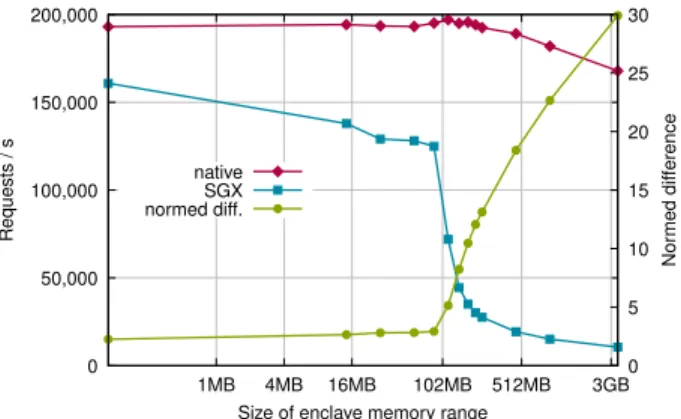
We also implemented a key-value store (KVS) that we ex-ecute inside an enclave to obtain a more realistic intuition regarding the performance impact of EPC paging on a real application. We increase the size of the enclave that runs the KVS and limit the maximum number of key-value pairs stored. We then measure the throughput of the KVS by ran-domly accessing key-value pairs from a remote machine and
Atomic Broadcast Cnt. Encl. Request Processor Replicated Database Replica2,L
Entry Encl.4 Read
Txn Txn Atomic Broadcast Cnt. Encl. Request Processor Replicated Database Entry Encl.2 Entry Encl.1 Entry Encl.3 Replica1 Read Txn Txn Atomic Broadcast Cnt. Encl. Request Processor Replicated Database Entry Encl.d Entry Encl.5 Entry Encl.6 Replica3 Read Txn Txn Trusted C Code
Trusted Java Code Untrusted Java Code
Client1 Client2 Client3 Client4 Client5 Client6
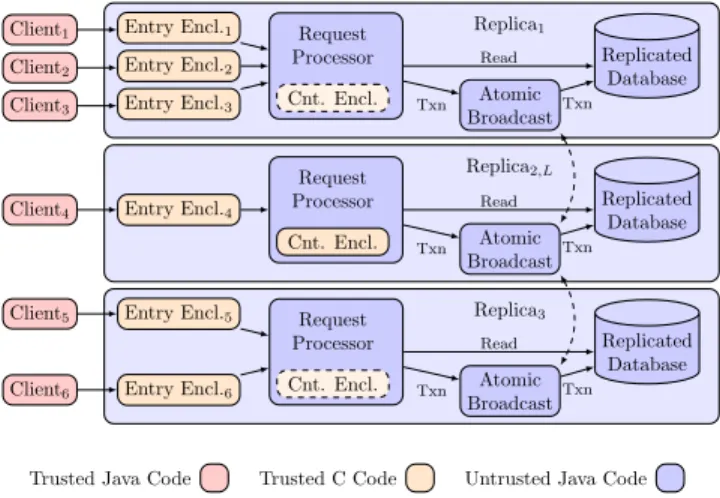
Figure 5: Architecture of SecureKeeper.
find a similar behavior as previously in Figure 3. Essentially, this leads to random memory access to the enclave memory range, which is indicated on the x-axis of Figure 4. As soon as the size of the enclave holding the KVS reaches the EPC limit and the EPC paging starts, the performance drops sig-nificantly. The measurements of this experiment are shown in Figure 4, starting at 102 MB a huge performance impact can be seen, which is also visualized as normalized difference between native and SGX in the figure. We explain the dif-ference to Figure 3 with pages that were initially allocated (e.g., stack pages) but never used and after being paged out once, never paged in again.
In summary, EPC paging starts with an enclave memory size larger then 92 MB and reduces the performance of code running inside an enclave significantly. Additionally, an un-modified ZooKeeper instance uses 120 MB in idle state and more than 400 MB of RAM for a realistic workload on a small data set of znodes. These insights support our design decision to implement SecureKeeper using tailored enclaves and only move critical code sections into enclaves as well as aiming at a low memory footprint when processing data.
3.4
Execution Environment Considerations
As our approach uses SGX enclaves, integrated via Java Native Interface (JNI) into ZooKeeper, SGX support is re-quired on all replicas. In addition, access to so called archi-tectural enclaves from the Intel SGX SDK and the Intel SGX driver is required in order to successfully launch and attest enclaves. The use of hardware virtualization technology is orthogonal to using SGX.
4.
SECUREKEEPER
Next, we present the design of SecureKeeper that is driven by the earlier outlined security considerations and the goal to craft an efficient solution taking advantage of current SGX-equipped CPUs.
4.1
Basic architecture of SecureKeeper
Figure 5 illustrates how our design integrates into the orig-inal ZooKeeper architecture. For each client we have an in-dividual enclave running on the replica as long as the client is connected to which we call entry enclave. This enclave maintains the client connection and the encryption of all messages between the client and the enclave.
As we did not want huge changes at the client side, we de-signed the client-to-replica communication as a simple con-nection encryption alike Transport Layer Security (TLS). TLS encrypted connections have recently been added to Zoo-Keeper, thus, the client infrastructure for this already exists. However, for SecureKeeper the endpoint of this secure con-nection is located inside the entry enclave. The entry enclave uses standard cryptographic functions to decrypt the mes-sages from and to the client with a client-specific session key. Only if this enclave has been remotely attested by the Se-cureKeeper administrator, the secure key for all encryption towards ZooKeeper is given to the enclave. This key is the same for all enclaves and also the only state held by the en-claves apart from the session key for the client connection. Vice versa if a client can establish a secure connection based on a previously out-of-band received public key, he can trust the entry enclave.
Since the entry enclave exists once per client, there is no need for the enclave to distinguish multiple clients, which helps keeping the enclave’s code base low. However, it needs to be able to “understand” the messages exchanged, i.e., be able to serialize and deserialize them. This is required in order to encrypt the sensitive fields of a message towards ZooKeeper with a secret key shared by all enclaves.
Our approach also allows to exclude specific, previously trusted, clients from the cluster in the future, as the clients never see the encryption key used by the enclaves to protect all data stored in the ZooKeeper data store.
In order to support the demands of the aforementioned sequential nodes (see Section 2.1), we designed thecounter enclave. Even though this enclave is only used on the cur-rent ZooKeeper leader replica, it exists once on each replica. This is due to the fact, that on failure ZooKeeper may need to elect a new cluster leader, and thus, a previous follower replica may become new leader. Inside this enclave, the en-crypted path and the plaintext sequence number determined by ZooKeeper is merged together into one ciphertext. We describe the implementation details of the counter enclave in Section 4.4 and the consequences regarding our security goals in the discussion section (see Section 7).
All other components of ZooKeeper are untrusted and will always only see the encrypted path names of znodes and the encrypted payload. However, we exploit that they can han-dle the ciphertext as a blackbox, i.e. the same as plaintext.
4.2
General Message Processing
All messages from clients to the SecureKeeper cluster must pass through the entry enclaves for processing and re-encryption. By this, all sensitive information is encrypted before being stored in the untrusted ZooKeeper database.
We distinguish two notions of encryption: Between clients and the entry enclaves we applytransport encryptionto the whole messages (cf. TLS). After processing the message, the entry enclaves encrypt sensitive parts towards the Zoo-Keeper database; we call thisstorage encryption.
In general, for all requests from a client we first decrypt
the transport encryption hull. Then, we deserialize the
plaintext message and determine which fields contain sensi-tive information. This usually affects the payload field of the znode and its path name (see Section 4.3). However, not all messages contain both: While SETrequests always contain a path and a payload and result in an empty response, the GETrequests contains only the znode path and the response
message will contain the respective payload. After all sensi-tive fields have been encrypted, we serialize the message and forward it to the untrusted ZooKeeper message processing pipeline. Special treatment is required for creating sequen-tial nodes, involving the counter enclaves (see Section 4.4).
Responses are basically implemented the same but in re-verse order: First the message gets deserialized. Then, we decrypt all fields that contain previously encrypted sensi-tive data. Finally, we apply the transport encryption and forward the buffer to the client via the ZooKeeper message processing pipeline.
ZooKeeper response messages do not contain the opera-tion type of the request they belong to. Hence, in order to determine the operation of a request, we store the opera-tion and request ID for each request. For this purpose we maintain a FIFO queue inside the entry enclaves, because the ordering of all requests of one client always guarantees that the responses arrive in the same order as the requests.
4.3
Path and Payload Encryption
ZooKeeper allows storage of arbitrary data in the payload field of each znode. Since ZooKeeper is never processing this data, it is considered as a blackbox by ZooKeeper and we can just encrypted it.
The encryption of path names of znodes must be done transparently to ZooKeeper. Firstly, the encrypted path must be a valid ZooKeeper path, i.e., it must not contain illegal characters. Also, ZooKeeper must be able to operate on the encrypted path names in all cases. Individual path elements are encrypted separately, retaining the hierarchy of znodes in order to support thegetChildrenoperation.
In our design we split paths at each slash (/) and process the chunks one after another We first encrypt each chunk the same as for payload encryption. As an Initialization Vector (IV) we compute a hash of the path starting from the top level hierarchy until (and including) the current chunk. This ensures that we never reuse the same IV1The IV and
the Keyed-Hash Message Authentication Code (HMAC) of the current chunk are both concatenated with the encrypted chunk, and form the encrypted version of this chunk.
We have to include the current chunk’s plaintext in the computation of the hash that we use as IV, because other-wise all child nodes of one parent would use the same IV. However, the decryption of a path clearly requires knowl-edge of the used IV which is not available from the request message ofLS requests, as we need to decrypt the paths of the children of the requested znode. Hence, we have to ap-pend the IV that we used to the encrypted chunk in order to support theLSoperation, even though for most operations this would not be required.
We need to tie the encrypted payload of a znode to one distinct znode path. This is due to the ZooKeeper database residing in the untrusted execution environment. The at-tacker could mix and switch payloads and znode names arbitrarily otherwise. For example, an attacker could set the admin password (if for example stored as payload of a
node/admin-credentials) to the password of his own
non-privileged user. The binding is done by appending the hash of the znode path to the payload before payload encryp-tion. By this, a specific payload is only valid for one specific znode path, and the entry enclave can easily validate this
1
assuming no SHA256 collisions.
constraint when processing the response from ZooKeeper before forwarding it to the client.
4.4
Supporting Sequential Nodes
During creation of a znode with the sequential flag set in the request message, ZooKeeper will append a monoton-ically increasing number to the given znode name. After the sequential node has been created, it is stored in the ZooKeeper database the same as any other node, and is in-distinguishable from regular znodes. If we applied the path encryption as described above for sequential nodes, Secure-Keeper would try to decrypt the whole pathname later on. In the case of sequential nodes the path decryption would fail, as it would contain the sequence number appended to the given name. If we divided the pathname from the se-quential number using an escape character we would change the behaviour of ZooKeeper and violate assumptions of ex-isting applications regarding ZooKeeper’s behaviour.
In order to solve this problem, we introduce the counter enclave running once on the ZooKeeper leader replica. The counter enclave decrypts the previously encrypted pathname by the entry enclave, appends the given sequence number and encrypts the whole altered path again. This only hap-pens during the creation of sequential nodes, all other oper-ations will just bypass the counter enclave.
A flag in the payload field marks whether or not a node was created with the sequential flag, which is required for the verification routine. If a node was created as a sequential node, the verification must compare the hash of the znode path without the sequence number to the hash stored in the payload section. This in turn forms a problem to our binding of paths and payload: If the inputs to the counter enclave get replayed, it is possible to forge the sequence number appended to a certain node. We discuss this, and the sub-sequent integrity properties in the discussion in Section 7.
4.5
Deployment and Key Management
In our design, entry enclaves are not intended to commu-nicate with each other. This reduces complexity, and thus, the TCB of the enclaves according to our security goals. In general, all entry enclaves are equivalent and use the same secret key for cryptography towards ZooKeeper. This is re-quired in order to allow one client’s entry enclave to decrypt data created by a different client’s entry enclave.
The above design prevents the clients from requiring the key used for encryption towards ZooKeeper, and allows in-dividual session keys for each client connection. However, it is important that entry enclaves verify valid clients and block any communication if the client seems malicious.
This is a common problem of all SGX applications and can be solved easily using bidirectional TLS certificate ver-ification. In order for this to work, a special deployment and bootstrapping procedure is required. The storage en-cryption key will be provided to the entry enclave only after successful remote attestation [21]. Once the key is received, the correct entry enclave can seal the key and store it per-sistently on the replica. Other entry enclaves on the same replica can unseal this secret without another remote attes-tation, as only valid entry enclaves will be able to get the same sealing key. This remote attestation and sealing must be done at least once for each replica.
The TLS private key and the public key of the clients, or the Certificate Authority (CA) key that signed the clients
e n c l a v e { t r u s t e d {
p ub l i c s i z e _ t e c _ r e q u e s t (
[in, out, size= b u f f e r _ s i z e ] char * buffer , s i z e _ t msg_len , s i z e _ t b u f f e r _ s i z e , int id ) ;
p ub l i c s i z e _ t e c _ r e s p o n s e (
[in, out, size= b u f f e r _ s i z e ] char * buffer , s i z e _ t msg_len , s i z e _ t b u f f e r _ s i z e , int id ) ;
}; };
Listing 1: EDL interface of entry enclave. keys must be provided to the entry enclaves in the same way. Thus, the entry enclaves can verify correct clients and prove their identity to the clients via TLS.
5.
IMPLEMENTATION DETAILS
In our implementation description we describe i.) the in-tegration of enclaves into the code base of ZooKeeper and ii.) the cryptographic operations inside the enclaves.
5.1
Enclave Integration
SecureKeeper is implemented with minimal changes to the Java code of ZooKeeper. Basically, we are intercepting the message processing pipeline (for requests and responses) of ZooKeeper and forward byte buffers of the messages to the entry enclave. The enclave then applies processing to these buffers and hands them back to the request processor where the message will walk through the remaining stages as usual. From ZooKeeper’s perspective, the whole message is encrypted before entering the enclave, and is returned from the enclave in decrypted form, such that ZooKeeper is able to process the message without noticing the encrypted path and payload field. The counter enclave is integrated into the message processing pipeline in the same way but at a position that is only executed on the leader replica.
To integrate both types of our enclaves with ZooKeeper, a transition between Java and C-code is required. This is im-plemented using JNI which allows the transition from Java to a JNI interface written in C followed by an entry into the enclave also written in C. In the ZooKeeper code base we added a Java class that wraps all this, and offers an API that can be conveniently used from the message processing pipeline of ZooKeeper.
From the JNI code we call the enclave’s ecalls which are defined by a EDL file that is used to generate the code implementing the ecalls stub code. As shown in Listing 1 the interface of the entry enclave comprises two ecalls that handle the request messages from a client and the response messages from ZooKeeper respectively. Both ecall signa-tures comprise a pointer to the buffer and the length of this buffer, as well as the length of the message which is different from the buffer length as we describe below. In addition to the generated code, the Intel SGX SDK libraries for crypto-graphic operations and a specializedstdlibfor enclaves are linked to the final enclave shared object file. The counter enclave is only required for the creation of sequential nodes, so its EDL interface is similar but comprises only one ecall. Byte buffers containing the transport encrypted message from the clients have to traverse the path through the JNI interface and via the generated code as an ecall to the
en-clave. Unfavorably the message length usually increases in-side the enclave due to appending the HMAC and the path’s hash to the payload and the Base64 encoding. A decrease of message length inside the enclave is not a problem, as the used buffer is larger than required. However, if the length of the message increases inside the enclave, the buffer can not trivially be copied to the outside.
Even though the Intel SGX SDK supports copying buffers in and out of enclaves, increasing a buffer inside an enclave and copying the larger buffer out is currently not supported. This is due to the fact that the enclave is not allowed to ex-ecute code outside an enclave, and thus, can not allocate an untrusted memory range outside. An allocation inside the enclave does not help, as the memory range will not be available outside of the enclave. One approach would be to allocate a large buffer outside, and allow memory manage-ment of this buffer only by the enclave.
In our case we can predict the amount of additional mem-ory that will be required inside the enclave. Thus, we allo-cate a slightly larger buffer before executing the ecall, and by this, allow the enclave to append additional data to the buffer. Using an additional length parameter, we indicate the number of bytes actually used for the message in the buffer. By this approach we achieve efficient resource usage, and avoid the usage of a memory allocator for untrusted memory in the enclave at the same time.
5.2
Enclave Cryptography
For cryptographic operations inside the enclaves we use library support as provided by Intel SGX SDK. Amongst others, it supports AES-GCM-128 encryption which is suit-ing our purposes best, as it is considerably secure and of-fers additional integrity protection of the ciphertext. As we used the cipher for both, the transport and the storage en-cryption, all ciphertext is integrity protected by the HMAC which we always append in the end and verify during the decryption. By appending the HMAC to the ciphertext, the size of the payload field increases by a constant overhead. This requires us to update the metadata of the according znode, such that it reflects the correct size of the payload.
The concatenation of the encrypted chunk and the HMAC may contain invalid characters if interpreted by ZooKeeper as a Java String. Thus, we encode the whole chunk with a Base64 encoding scheme variant for URL applications, to also avoid the “/”-character in the encrypted path names. Using this encoding causes an increase of the encrypted pathnames of about 33%, which we discuss in Section 6.2.
6.
EVALUATION
In this section we evaluate the performance of SecureKee-per and compare it against a vanilla ZooKeeSecureKee-per cluster and a version that provides TLS encryption between clients and the replicas as a baseline. All experiments were performed on a cluster of four identical machines2, where one machine simulates clients while the three remaining machines host ZooKeeper replicas.
6.1
Methodology
In general, the evaluation is along the lines of the origi-nal ZooKeeper paper [12]. For each experiment we compare SecureKeeper against a vanilla ZooKeeper and ZooKeeper
2
0 20,000 40,000 60,000 80,000 100,000 120,000 140,000 0 100 200 300 400 500 600 700 800 900 1,000 R eque sts/s Client Threads Vanilla-ZK TLS-ZK SecureKeeper
(a)Synchronous requests.
20,000 40,000 60,000 80,000 100,000 120,000 140,000 160,000 180,000 2 4 6 8 10 12 14 16 R eque sts/s Client Threads Vanilla-ZK TLS-ZK SecureKeeper (b)Asynchronous requests.
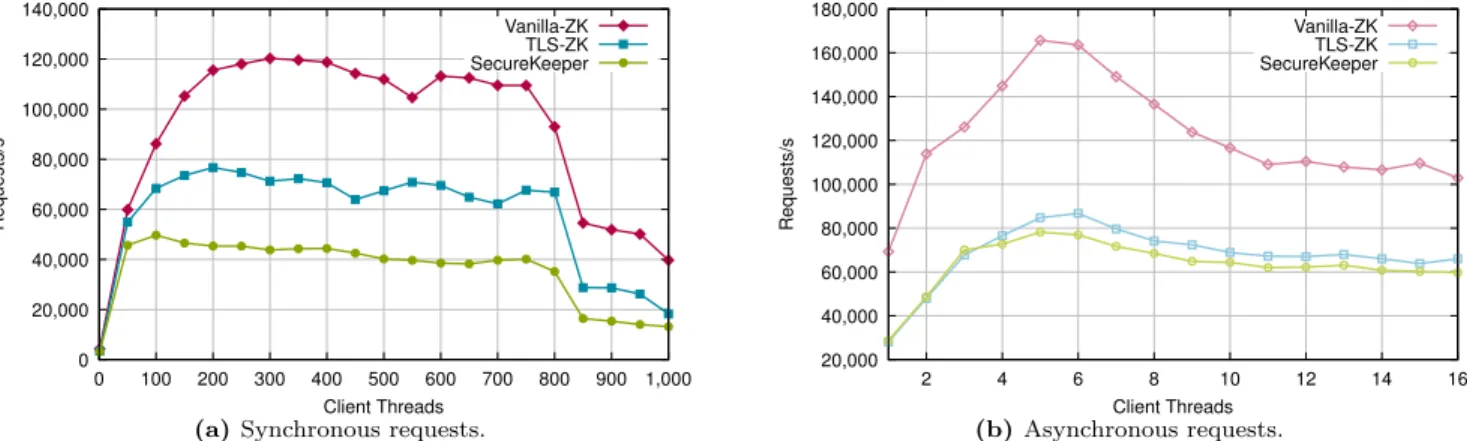
Figure 6: Throughput of 70:30 mixedGETandSETrequests for various number of clients and 1024 Byte payload.
0 50,000 100,000 150,000 200,000 250,000 300,000 350,000 400,000 450,000 0 500 1,000 1,500 2,000 2,500 3,000 3,500 4,000 4,500 R eque sts/s Payload [Byte] Vanilla-ZK sync TLS-ZK sync SecureKeeper sync Vanilla-ZK async TLS-ZK async SecureKeeper async
Figure 7: Throughput of sync. and async. GETrequests. with TLS enabled3. The three variants are denoted as
Se-cureKeeper,Vanilla-ZK andTLS-ZK in all graphs. The ex-periments are performed using only asynchronous and again
using only synchronous requests. Also we experimented
with a wide range of typical payload sizes between 0 and 4096 Bytes. Our evaluator uses various numbers of client threads connected to ZooKeeper replicas issuing requests as fast as possible. We explicitly distribute the clients equally on all replicas, in order to get most stable and reliable re-sults. Only for the fault-tolerance experiment we must allow clients to randomly choose a replica from a list of all replicas (see Section 6.3).
We determine the optimal number of threads (i.e., number of connections) for throughput measurements for a realistic workload, according to the original ZooKeeper paper [12], consisting of a 70:30 mix of GETandSET requests by grad-ually increasing the number of clients: For asynchronous requests the maximum performance is reached with 5 client threads (see Figure 6b) and 200 pending requests (simul-taneous unanswered requests in flight). In contrast, syn-chronous requests perform best between 200 to 400 client threads (see Figure 6a). As the maximum throughput for synchronous requests is reached at a number of 300 client threads, we consistently used this number for all other syn-chronous experiments. 3https://issues.apache.org/jira/browse/ ZOOKEEPER-2125, accessed 5/10/2016. 10,000 20,000 30,000 40,000 50,000 60,000 70,000 0 500 1,000 1,500 2,000 2,500 3,000 3,500 4,000 4,500 R eque sts/s Payload [Byte] Vanilla-ZK sync TLS-ZK sync SecureKeeper sync Vanilla-ZK async TLS-ZK async SecureKeeper async
Figure 8: Throughput of sync. and async. SETrequests.
6.2
Throughput of SecureKeeper
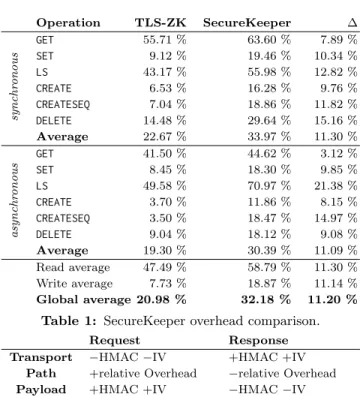
In Figure 7 we show the throughput of GET, and in Fig-ure 8 the throughput of SETrequests. These are answered by the replica the client is connected to directly, in contrast to SET requests, that are forwarded to the leader replica and passed through the agreement protocol. Initially, for bothGETandSETwe create one znode for each client thread and then continuously read and write their payload with the GET andSET respectively. As can be seen from the graphs, the performance of SecureKeeper is close to the TLS-based ZooKeeper variant with an average overhead for all mea-sured payload sizes of 7.89% and 10.34% for synchronous requests and 3.12% and 9.85% for asynchronous requests. While the encryption overhead is more visible for low pay-load sizes, with increasing paypay-load size the throughput of SecureKeeper and TLS-ZK converges. This behavior is due to the constant encryption and enclave entering overhead for each message which gets insignificant for higher payload sizes. The details of the encryption overhead are illustrated in Table 2 and detailed below.
Figures 9a and 9b show the performance for creating zno-des in ZooKeeper. We distinguish the creation of regular andsequential nodes here, as we have a second enclave en-try on the leader replica for the latter (see Section 4.4). For all three variants the throughput is a bit lower than theSET throughput, as the internal ZooKeeper state size increases with the growing number of znodes. The overhead ofCREATE requests compared to TLS-based ZooKeeper is 9.76% for regular and 11.82% for sequential nodes with synchronous
10,000 15,000 20,000 25,000 30,000 35,000 40,000 45,000 0 500 1,000 1,500 2,000 2,500 3,000 3,500 4,000 4,500 R eque sts/s Payload [Byte] Vanilla-ZK TLS-ZK SecureKeeper (reg.) SecureKeeper (seq.)
(a)Synchronous requests.
10,000 15,000 20,000 25,000 30,000 35,000 40,000 45,000 0 500 1,000 1,500 2,000 2,500 3,000 3,500 4,000 4,500 R eque sts/s Payload [Byte] Vanilla-ZK TLS-ZK SecureKeeper (reg.) SecureKeeper (seq.) (b)Asynchronous requests. Figure 9: Throughput ofCREATErequests.
0 50,000 100,000 150,000 200,000 250,000 300,000 350,000 0 10 20 30 40 50 60 70 80 90 100 R eque sts/s Payload [Byte] Vanilla-ZK sync TLS-ZK sync SecureKeeper sync Vanilla-ZK async TLS-ZK async SecureKeeper async
Figure 10: Throughput of sync. and async.LSrequests.
requests. Asynchronous requests show an overhead of 8.15% for regular and 14.97% for sequential nodes.
We also evaluated theLSorgetChildrenoperation, listing all child nodes for a specific znode. Listing the children of a znode leads to the decryption of all paths of all child nodes of the znode in question. With our approach the high num-ber of path decryption operations has a notable impact on the throughput of theLSoperation depending on the num-ber of child nodes. The results are illustrated in Figure 10.
Synchronous LS requests have an overhead of 12.82% and
asynchronous requests 21.38%.
We also evaluatedDELETErequests, however, as both the request and response messages do not contain payload in
this case, we omit plotting a graph. Compared to
TLS-based ZooKeeper, the overhead of synchronous DELETEs is 15.16% and for asynchronous requests 9.08%.
Table 1 summarizes our evaluation for all operations and for both synchronous and asynchronous requests. We pro-vide the overhead of SecureKeeper and TLS-based Zoo-Keeper compared to vanilla ZooZoo-Keeper in percent, as well as the delta of these numbers. Finally, the table summarizes the overall overhead of our approach as a global average value of 11.20%.
The added confidentiality and integrity guarantees of our approach clearly do not come at no cost when compared
with vanilla ZooKeeper. However, our evaluation shows
that the throughput of SecureKeeper is scaling and perform-ing similar to TLS-enabled ZooKeeper. The payload and path encryption cause the length of exchanged messages be-tween clients and replicas to increase compared to vanilla
Operation TLS-ZK SecureKeeper ∆ syn ch ron ous GET 55.71 % 63.60 % 7.89 % SET 9.12 % 19.46 % 10.34 % LS 43.17 % 55.98 % 12.82 % CREATE 6.53 % 16.28 % 9.76 % CREATESEQ 7.04 % 18.86 % 11.82 % DELETE 14.48 % 29.64 % 15.16 % Average 22.67 % 33.97 % 11.30 % a sync h ro no us GET 41.50 % 44.62 % 3.12 % SET 8.45 % 18.30 % 9.85 % LS 49.58 % 70.97 % 21.38 % CREATE 3.70 % 11.86 % 8.15 % CREATESEQ 3.50 % 18.47 % 14.97 % DELETE 9.04 % 18.12 % 9.08 % Average 19.30 % 30.39 % 11.09 % Read average 47.49 % 58.79 % 11.30 % Write average 7.73 % 18.87 % 11.14 % Global average 20.98 % 32.18 % 11.20 %
Table 1: SecureKeeper overhead comparison.
Request Response
Transport −HMAC−IV +HMAC +IV
Path +relative Overhead −relative Overhead
Payload +HMAC +IV −HMAC−IV
Table 2: Comparison of encryption overhead. ZooKeeper. This increase is essentially due to the HMACs and IVs used for the decryption and encryption operations. Also, messages are lengthened due to the Base64 encoding of the path, as well as the added hash of the znode path to the payload field. Finally, in our approach there is a con-stant overhead due to the enclave entries and exists, which is clearly not required for TLS-based ZooKeeper. Hence, in general the throughput of our approach is below, though close to, TLS-based ZooKeeper.
Table 2 provides an overview of the message length changes due to our approach. As can be seen, the transport encryption between clients and the entry enclave, causes a constant decrease of the length of requests and a constant increase for the responses. For path encryption the differ-ence in length depends on the “depth” of the path (i.e., the number of slashes in the path): for each chunk of the path, we apply an individual encryption step, that adds an HMAC and IV (see Section 4.3). Paths in requests (specifying which node the operation is applied to) will be increased in length for each request. For response messages the contained paths
0 10,000 20,000 30,000 40,000 50,000 60,000 0 500 1,000 1,500 2,000 2,500 3,000 3,500 4,000 4,500 R eque sts/s Payload [Byte] Vanilla-ZK SSL SecureKeeper
Figure 11: Throughput of synchronousGETandSET oper-ations, performed using the YSCB benchmark suite.
will get the same amount shorter (only in the case of the
getChildren operation). Finally, the overhead due to the
encryption of the payload is exactly the same as for the transport encryption, as we use the same cipher.
In addition to measurements with our own workloads, we also performed throughput experiments using the YCSB benchmark suite. We compiled a mixed workload of syn-chronous read and write requests, and used 35 threads to connect to our ZooKeeper cluster. Then, for various differ-ent payload sizes, we performed 500k operations each. As can be seen from the results in Figure 11, all three variants scale similarly well and SecureKeeper’s performance is very close to the TLS variant. The lower baseline of the YCSB benchmark compared to our own, is due to YCSB not able to perform a warmup phase as we do with our evaluator for all experiments. In addition, with YCSB we have much higher client-side CPU load during the measurement, which requires us to decrease the number of simultaneous clients.
6.3
Fault Tolerance
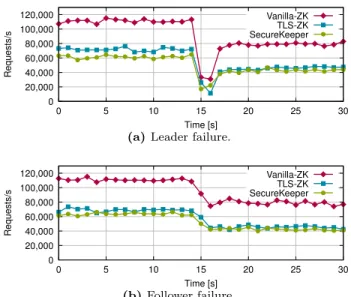
As ZooKeeper can tolerate replica faults, we evaluated the capability of our system to maintain the fault-tolerance properties of original ZooKeeper. In order to achieve this, we simulated faults of replicas while a constant client load is applied. In all cases we measured the total throughput of all clients on the cluster executing asynchronousGETandSET requests with a fixed payload size of 1024 Bytes every 250 ms and visualize it grouped by timeslots of 1 s. We executed separate experiments for a failure of the leader replica and a failure of one of the follower replicas. After starting a clean cluster, we let the system warmup for a few seconds and inject the fault after 30 s from the cluster start. Then, we keep the cluster running without restarting the replica for another 30 s. We explicitly distribute the clients equally on all replicas in the previous experiments for improving stability of the results. In contrast, for fault tolerance we provide each client with a list of all replicas and let the client choose one replica randomly. Otherwise, automatic failover of clients to another replica is not possible.
As can be seen from Figure 12, most importantly, in all cases SecureKeeper shows the same fault-tolerance as vanilla ZooKeeper. Also, in all cases, the missing replica reduces the total throughput by approximately one third. However, on a leader failure, a leader election is executed by ZooKeeper, which causes the total throughput to drop to zero for a cer-tain amount of time until a new leader has been elected.
0 20,000 40,000 60,000 80,000 100,000 120,000 0 5 10 15 20 25 30 R eque sts/s Time [s] Vanilla-ZK TLS-ZK SecureKeeper
(a)Leader failure.
0 20,000 40,000 60,000 80,000 100,000 120,000 0 5 10 15 20 25 30 R eque sts/s Time [s] Vanilla-ZK TLS-ZK SecureKeeper (b)Follower failure.
Figure 12: Fault-tolerance behavior of ZooKeeper variants.
Component Language SLOC
trus
te
d (De-)Serialization C 2514
Counter and entry enclave C 985
SDK-generated code C 572 Total trusted 4071 un tr us te
d ZooKeeper Server Java 33851
Enclave interfaces Java 154
Enclave management C 296
SDK-generated code C 262
Total untrusted 34563
Total SecureKeeper 4783
Total 38634
Table 3: Size of code base of SecureKeeper components. After the leader election has finished, throughput remains at about two thirds as expected, as still the cluster runs without a third replica.
6.4
Size of Code Base
Table 3 compares the size of the original ZooKeeper code base to SecureKeeper. The overall TCB of SecureKeeper comprises about 4,000 SLOCs. More than 62% of this code is used for (de)serialization of messages and taken from the original ZooKeeper C bindings. The remainder of the trusted code base implements parameter passing and glue code for the message flow through the enclaves. The total amount of trusted code of SecureKeeper is roughly 12% of the complete ZooKeeper code base, while we added less than 100 SLOCs to the ZooKeeper client code base. We could not measure the size of the code base of the Intel SGX SDK-provided libraries, such as thelibstdand the cryptographic library, but we mention their binary size in Section 6.5.
The untrusted code of SecureKeeper comprises creation, initialization and maintenance of the enclaves, parameter passing across the enclave boundary and the JNI interface. Only three lines of the original ZooKeeper code base have been changed, all others have been added, thus, we call our approach minimally-invasive to ZooKeeper.
6.5
Memory Consumption
The total memory footprint of an enclave composed EPC memory and SGX-internal metadata depends on the enclave
code, one stack region for each thread and the heap. Each enclave thread maintains its own stack (default 64 KB), and SGX data structures holding thread metadata and state. The enclave code is basically the compiled and signed shared object which is copied to the ELRANGE during the enclave creation using the Intel SGX SDK API. Finally, configura-tion of the heap size can be done with an enclave configu-ration file that is used by the SGX signer tool of the Intel SGX SDK.
The largest and most significant component of enclave memory consumption is the heap and code of the enclave. Due to the cryptographic operations, the heap must be able to hold the largest possible message twice as source and des-tination of the encryption or decryption is the same size. In addition the list of request types requires space for all pend-ing requests, which can be up to 200 requests in our ex-periments, but should be negligible as the size of one entry is only a few bytes. In total, based on the above outlined constraints and our enclave shared object size of 436 KB, the required memory for each of our entry enclaves is about 580 KB. This allows more than 150 enclaves to fit into the
EPC ofeach ZooKeeper replica without EPC paging.
The counter enclaves memory layout is essentially the same, except for the heap size, which can be a lot smaller
because we only process the path of znodes. Hence, the
counter enclave with a binary size of 325 KB requires an additional amount of 397 KB memory on the leader replica. As a result, we can keep the enclave memory consump-tion below the EPC threshold of 92 MB for each replica, even for high client loads. If necessary, the memory footprint could be further decreased by co-locating multiple or even all clients to one enclave. However, this would increase the code complexity of the entry enclave, i.e. for client session man-agement and add additional synchronization points, which could harm performance. Lastly, enclaves as of this version of SGX cannot dynamically increase their ELRANGE al-located memory size, thus a conservative allocation for the maximum number of clients has to be performed upfront at service startup time.
7.
DISCUSSION
In this section, we discuss the security guarantees that Se-cureKeeper provides and other guarantees that are beyond a minimally-invasive integration with SGX. Furthermore, we explore the general applicability of the proposed methodol-ogy to other services.
7.1
Confidentiality and Integrity Guarantees
Our approach ensures the confidentiality of all user-provided data stored in the ZooKeeper database. This com-prises the plaintext payload and path names of all znodes. However, operation types, the znode tree structure, as well as node access frequencies and access times are still visible. In this regard, SecureKeeper provides similar protection as filesystem-level encryption [22].
As mentioned, SecureKeeper ensures the integrity of plain znodes and their associated path names. This is achieved by secure authenticated communication between clients and entry enclaves, and also data encryption once znodes are passed to Zookeeper for further processing. This is imple-mented by an HMAC over the encrypted payload of a znode, which is verified during decryption. Any modification to the
payload—be it purposeful or accidental—can be detected during the verification before the data is passed to the client. Another aspect of integrity is the link between the znode path and the payload. As we encrypt a hash of the path name with its associated payload, the path is bound to the payload. This enables the entry enclave to detect whether a payload belongs to a certain path name or not, before the data is forwarded to the client. Thus, an attacker cannot exchange the payload of a node for that of another node.
This approach, however, does not suffice for sequential nodes. Here the counter enclave receives untrusted input from the ZooKeeper base code in the form of an incremented counter value stored in the metadata of the associated par-ent node. The passed value can be validated to be a num-ber, but it may be arbitrarily chosen by the outside code. A malicious attacker can choose the tail part of sequential node path names that stands for the sequential node number according to the format convention. In this limited scope, SecureKeeper is susceptible against naming attacks, i.e. no new znode payload information can be crafted nor existing payload information can be modified but only overwritten by payloads with the same sequential node path name prefix. We considered protective measures but all of them lead to a system design that has to be resilient to rollback attacks of externalized state or even resilient to Byzantine faults [23]. Both aspects, as outlined next, would require substantial architectural changes and, since the primary goal of Secu-reKeeper is the protection of confidentiality, we do not con-sider this issue as severe and leave this as a direction for future work that may result in an entirely different service architecture.
7.2
Replay and Denial of Service Attacks
There are two kinds of replay attacks that can be dis-tinguished: first, the communication between a client and the entry enclave may be replayed, but this can easily be prevented using replay-safe encrypted communication (i.e. TLS); second, the inputs provided to the enclaves from the untrusted ZooKeeper data store may be stale and/or re-played, which leads to the clients reading stale values. SGX itself offers no means to prevent replay attacks regarding state that is external to enclaves, be it volatile or persis-tent [6, 24]. One option would be the use of a Byzantine fault-tolerant agreement protocol [23], but this requires sig-nificant changes to the ZooKeeper architecture, which is in-compatible with the design goals of SecureKeeper.
7.3
Wider Applicability of the Approach
The general idea of SecureKeeper is the minimally-invasive integration of SGX to achieve confidentiality and integrity under the above outlined restrictions. Despite the complexity of ZooKeeper as a replicated and fault-tolerant coordination service, this is possible due to the fact that
ZooKeeper performs only limited data processing. Thus,
it can be assumed that other services that mostly handle data but do not process it can be protected similarly. Sim-ple KVS and blob storage may be a good fit because they access data by a unique identifier. If a query API beyond an exact match needs to be supported, e.g. range queries, further enclave support may be needed. This could be ad-dressed, however, by storing keys or a subset of keys inside an enclave, which only would require hosting a fraction of
the service state in the enclave and thus limit performance degradation (see Section 3).
8.
RELATED WORK
There have been a number of approaches targeting the protection of applications from unauthorized access. Many of these solutions so far rely on additional system software layers in the absence of appropriate commodity hardware
support. Examples are NGSCB [25, 26] and Proxos [27],
which feature the idea of an untrusted and a trusted operat-ing system, runnoperat-ing on the same machine isolated by a vir-tual machine monitor. As a consecutive step several systems proposed a trusted virtualization layer guarding the appli-cations from unauthorized operating system access [28, 29]. All of these approaches come attached with a much larger TCB and if performant typically feature a more coarse-grained partitioning than what SecureKeeper requires.
There has been a large number of systems that uti-lized trusted hardware to partition software in trusted
and untrusted parts. Previous examples are secure
co-processors[30] and Trusted Platform Modules (TPMs) [31], both offering protection from certain types of physical ac-cess. While on the one hand, secure co-processors offer quite limited performance due to thermal problems and are rather expensive, they are primarily used in niche markets. Nev-ertheless, with TrustedDB [32] there exists an approach for splitting a database between an untrusted commodity sys-tem and a secure co-processor.
On the other hand, TPMs are too restricted in their ca-pabilities, e.g. remote attestation, to be useful in complex shared environments. Basing on the functionality of the TPM a number of systems aimed to achieve trusted exe-cution with a small additional TCB [33, 34]. However, they either suffer from the bad performance of the TPM chip [33] or require a larger TCB (i.e., a virtualization layer) and pro-tect systems at a more coarse-grained level.
ARM TrustZone [35] distinguishes only two levels of trust: a secure world and a non-secure world. In essence one has to trust the complete code of the secure world which might include substantial system code. To achieve a more fine-grained trust scheme, Santos et al. [36] proposed so called trustlets hosted by a managed runtime inside the secure world. In principle SecureKeeper could be deployed on-top of this framework, but TustZone offers no memory encryp-tion and so far it is mainly supported by embedded systems. As previously described, SGX features fine-grained de-ployment of trusted execution environments (TEEs), so a single application can even host multiple enclaves. So far this has been marginally exploited due to the lack of freely available system software and hardware. Baumann et al. [6] proposed Haven, a system that enables execution of unmodi-fied legacy applications inside an enclave. This was achieved by porting a library OS to the enclave and the shielding of system calls that need to be processed by the untrusted host operating system. The consequence of this convenient way to execute legacy applications on top of SGX is, as outlined in detail in Section 3, a considerable performance overhead, and, more importantly, a rather large TCB. VC3 [15] took a different direction by focusing on the secure execution of MapReduce applications. Only the actual data processing tasks are executed inside enclaves while the framework is kept unchanged in the untrusted environment. To protect the execution inside the enclave, compiler-based hardening
techniques have been applied. Finally, the distribution of data is integrity-protected, in order to ensure a malicious host cannot exclude data from a computation without be-ing detected. While SecureKeeper shares the fine-grained partitioning using SGX with VC3, it targets the protection of confidentiality of ZooKeeper as a networked-service. So far neither Haven nor VC3 has been evaluated on top of production hardware, which SecureKeeper has.
Strackx et al. [37] proposed to use of SGX to implement the idea of an inverted cloud. Instead of maintaining huge clusters with machines on low load, mini providers are used. The cloud provider takes CPU power from those mini pro-viders and executes work on them. This leads to the effect, that computing resources can be used more efficiently. How-ever, their work focuses more on conceptual level and does neither address ZooKeeper nor data-handling services.
While the previously mentioned related work focused on generic approaches towards securing applications from unau-thorized access, there are systems that specifically target to secure the processing of sensitive data, e.g. in scope of databases or a file system.
One option is to move query processing to the client side [38, 39] or an intermediate proxy [40]. While this can ef-fectively preserve data confidentiality, it demands data stor-age and query processing at the client side [38, 39]. In a preliminary workshop paper, we proposed the ZPP [40], a trusted proxy intercepting requests between clients and Zoo-Keeper replicas. Compared to this work, SecureZoo-Keeper fol-lows a different direction by integrating secure data process-ing into ZooKeeper itself. The result is a much leaner TCB as we do not rely on a trusted network stack and need no trusted operating system underneath. It offers better perfor-mance as an additional hop that was demanded by putting a physical machine in between the clients and the ZooKeeper instance can be avoided.
Popa et al. [41] proposed the execution of queries over en-crypted data. However, the proposed query support is lim-ited and the approach incurs a large performance penalty.
9.
CONCLUSION
Trust issues still impede the use of cloud infrastructures when sensitive data needs to be process. In this paper we showed how ZooKeeper, a central component of complex distributed workloads, can be efficiently secured using SGX. The resulting SecureKeeper demonstrates how tailored en-claves can be integrated minimal-invasively to ensure confi-dentiality of all managed user data and integrity for plain znodes. Due to its lightweight integration of enclaves the induced performance overhead is comparable to using Zoo-Keeper with TLS encryption enabled.
Acknowledgments
This project received funding from the European Union’s Horizon 2020 research and innovation programme under the SERECA (Grant agreement No. 645011) and the Secure-Cloud (Grant agreement No. 690111) project.
References
[1] IDC, Worldwide Cloud IT Infrastructure Market Growth Expected to Accelerate [...] http://www.idc. com/getdoc.jsp?containerId=prUS25576415, 2015.
[2] K. R. Jayaram, D. Safford, U. Sharma, V. Naik, D. Pendarakis, and S. Tao, Trustworthy Geographically Fenced Hybrid Clouds, Middleware, 2014.
[3] S. Pearson and A. Benameur,Privacy, Security and
Trust Issues Arising from Cloud Computing, Cloud-Com, 2010.
[4] F. McKeen, I. Alexandrovich, A. Berenzon, C. V.
Rozas, H. Shafi, V. Shanbhogue, and U. R. Sava-gaonkar,Innovative Instructions and Software Model for Isolated Execution, HASP, 2013.
[5] M. Hoekstra, R. Lal, P. Pappachan, V. Phegade, and J. Del Cuvillo,Using Innovative Instructions to Create Trustworthy Software Solutions, HASP, 2013. [6] A. Baumann, M. Peinado, and G. Hunt,Shielding
Ap-plications from an Untrusted Cloud with Haven, OSDI, 2014.
[7] Synopsys, Inc., Open Source Report 2014, http : / / go . coverity. com / rs / 157 LQW 289 / images / 2014 -Coverity-Scan-Report.pdf, 2014.
[8] Spotify AB, Sparkey, https : / / github . com / spotify / sparkey-java.
[9] Apache HTTP Server Project,Apache HTTP Server,
https://httpd.apache.org/, 2016.
[10] Eclipse Foundation,Jetty, http : / / www . eclipse . org / jetty/, 2015.
[11] W. Reese,Nginx: the High-Performance Web Server
and Reverse Proxy,Linux Journal, vol. 2008, no. 173, 2008.
[12] P. Hunt, M. Konar, F. Junqueira, and B. Reed,
ZooKeeper: Wait-Free Coordination for Internet-Scale Systems, USENIXATC, 2010.
[13] Intel Software Guard Extensions (Intel SGX) SDK, https://software.intel.com/sgx-sdk.
[14] F. P. Junqueira, B. C. Reed, and M. Serafini, Zab: High-performance broadcast for primary-backup sys-tems, DSN, 2011.
[15] F. Schuster, M. Costa, C. Fournet, C. Gkantsidis, M.
Peinado, G. Mainar-Ruiz, and M. Russinovich,VC3:
Trustworthy Data Analytics in the Cloud Using SGX, SOSP, 2015.
[16] Y. Xu, W. Cui, and M. Peinado, Controlled-channel
attacks: Deterministic side channels for untrusted op-erating systems, IEEE, 2015.
[17] CVE-ID: CVE-2016-0494. http://cve.mitre.org/cgi-bin/cvename.cgi?name=CVE-2016-0494, 2016. [18] CVE-ID: CVE-2016-0687.
http://cve.mitre.org/cgi-bin/cvename.cgi?name=CVE-2016-0687, 2016. [19] CVE-ID: CVE-2016-3427.
http://cve.mitre.org/cgi-bin/cvename.cgi?name=CVE-2016-3427, 2016. [20] CVE-ID: CVE-2016-3443.
http://cve.mitre.org/cgi-bin/cvename.cgi?name=CVE-2016-3443, 2016. [21] I. Anati, S. Gueron, S. Johnson, and V. Scarlata,
In-novative Technology for CPU Based Attestation and Sealing, HASP, 2013.
[22] M. Halcrow, eCryptfs: An enterprise-class encrypted filesystem for linux, Proceedings of the 2005 Linux Symposium, 2005.
[23] M. Castro, B. Liskov,et al.,Practical Byzantine fault tolerance, vol. 99, 1999.
[24] J. Beekman, J. Manferdelli, and D. Wagner, Attesta-tion transparency: Building secure internet services for legacy clients, 2016.
[25] A. Carroll, M. Juarez, J. Polk, and T. Leininger, Mi-crosoft Palladium: A Business Overview, Microsoft Content Security Business Unit, 2002.
[26] M. Peinado, Y. Chen, P. England, and J. Manferdelli, NGSCB: A Trusted Open System, Information Secu-rity and Privacy, 2004.
[27] R. Ta-Min, L. Litty, and D. Lie,Splitting Interfaces: Making Trust Between Applications and Operating Systems Configurable, OSDI, 2006.
[28] X. Chen, T. Garfinkel, E. C. Lewis, P. Subrahmanyam, C. A. Waldspurger, D. Boneh, J. Dwoskin, and D. R. Ports, Overshadow: A Virtualization-based Approach to Retrofitting Protection in Commodity Operating Systems, ASPLOS, 2008.
[29] J. Criswell, N. Dautenhahn, and V. Adve, Virtual
Ghost: Protecting Applications from Hostile Operating Systems, ASPLOS, 2014.
[30] Lindemann, M. and Perez, R. and Sailer, R. and van
Doorn, L. and Smith, S.W., Building the IBM 4758
secure coprocessor,Computer, 2001.
[31] Trusted Computing Group,Trusted Platform Module
Main Specification. version 1.2.
[32] S. Bajaj and R. Sion,TrustedDB: A Trusted Hardware Based Database with Privacy and Data Confidential-ity, SIGMOD, 2011.
[33] J. M. McCune, B. J. Parno, A. Perrig, M. K. Reiter, and H. Isozaki, Flicker: An Execution Infrastructure for TCB Minimization, EuroSys, 2008.
[34] F. Zhang, J. Chen, H. Chen, and B. Zang,CloudVisor: Retrofitting Protection of Virtual Machines in Multi-tenant Cloud with Nested Virtualization, SOSP, 2011.
[35] ARM Limited,ARM Security Technology - Building a
Secure System using TrustZone Technology, 2009.
[36] N. Santos, H. Raj, S. Saroiu, and A. Wolman, Using
ARM Trustzone to Build a Trusted Language Runtime for Mobile Applications, ASPLOS, 2014.
[37] R. Strackx, P. Philippaerts, and F. Vogels,Idea: To-wards an Inverted Cloud, Engineering Secure Software and Systems, 2015.
[38] P. Williams, R. Sion, and D. Shasha,The Blind Stone Tablet: Outsourcing Durability to Untrusted Parties, NDSS, 2009.
[39] R. A. Popa, E. Stark, S. Valdez, J. Helfer, N. Zel-dovich, and H. Balakrishnan, Building Web Applica-tions on Top of Encrypted Data Using Mylar, NSDI, 2014.
[40] S. Brenner, C. Wulf, and R. Kapitza, Running
Zoo-Keeper Coordination Services in Untrusted Clouds, HotDep, 2014.
[41] R. A. Popa, C. M. S. Redfield, N. Zeldovich, and
H. Balakrishnan,CryptDB: Protecting Confidentiality with Encrypted Query Processing, SOSP, 2011.