The Role of Financial Instruments in Improving
Access to Finance
Combined Microcredit in Hungary
*Györgyi Nyikos**
Access to financing is certainly one of the most important components for the creation, sur-vival, performance and growth of SMEs. The combined microcredit is a unique financial de-velopment tool where micro-credit and non-repayable assistance can be requested within one construction (other type of combined microcredit is delivering both micro-insurance and micro-credit products). The paper analyses the Hungarian practice using this financial in-strument, both looking at the empirical evidences and seeking for answer to the question, whether this form of support is effective, useful or not. Operating under conditions of eco-nomic uncertainty, fiscal deficit and consequent budgetary pressures, and encouraged by the early performance and leverage effects of financial instruments, policymakers see con-siderable value in supporting the further development of FIs and for their use in both exist-ing and new policy-related areas of activity.
I. Introduction
Microcredit is receiving increasing attention in the consequences of the financial and economic crisis and several Member States have introduced it with-in their operational programmes (OPs) as well. The combined microcredit (micro-credit and non-re-payable assistance together) is a new unique tool, which is completely in line with the priority of us-ing synergies and integrated approach in the field of economic development. Few studies evaluate the combined microcredit, which can become one of the new products to provide a more comprehensive re-sponse to existing market failures often leading to a lack of access to financial services for excluded pop-ulations.
The paper focuses on the Hungarian experiences using micro-credit in the 2007-2013 financial period, with attention also on the specific framework of EU cohesion policy. The primary source of data is on one
hand information from the Managing Authority for Economic Development OP and the intermediary body, on the other hand from the Fejér Enterprise Agency (FEA), particularly the result of a survey car-ried out by the FEA. The paper explores also the leg-islation on the new financial instruments (FI) pro-posed for the 2014-2020 programming period and re-sponds to the question, if the new tools can be able to achieve the top priority in practice: Supporting SME competitiveness. The paper uses sources of in-formation based on desk research (studies, evalua-tion, official documents and adopted regulation) and experiences from managing and implementing op-erational programmes and projects.
The findings showed that to enhance the impact of microfinance and to make the efficient use of the sources available, it is crucial to strengthen comple-mentarities and synergies between different instru-ments. The use of FIs complementing with the more traditional delivery instruments (grants and support services) can be a solution. The Hungarian experi-ence shows a strong need for using combined micro-credit which indicates that the tool can meet primar-ily the need of access to finance for those excluded from conventional financing. However, providing the adequate mix of access to finance and guidance is crucial. Financing needs to be complemented by
* Based on a presentation made on the 2nd joint EU Cohesion Policy Conference Challenges for the New Cohesion Policy 2014-2020 4th- 6th February 2015 Riga, Latvia.
** Associate professor, cohesion policy expert, Hungary, National University of Public Service/Permanent Representation of Hun-gary.
intelligent support services tailored to the needs of businesses at their different stages of development and for the beneficiaries1/final recipients2–
especial-ly for micro-entrepreneurs - the “one stop shop” for the access to different sources is the best solution. Providing this is not so easy for the institutional sys-tem because of the different regulations (State aid, different funds…etc.), but necessary for the simplifi-cation and reduction of the administrative burden.
II. Microfinance and Cohesion Policy
Cohesion policy was and is at the heart of the EU de-velopment, and will be the main investment mecha-nism for the delivery of the Europe 2020 targets in the next decade.
The ideas and aspirations behind micro-finance are not new. Today, micro-finance is a field that has received an increased policy attention and donor in-terest. These issues have been studied worldwide and are well known in less developed countries as well as in EU development policy.3
Microcredit4aims at people (micro-entrepreneurs)
who wish to enter into business but face obstacles in accessing traditional banking services due to banks’ lending conditions and it could help to start up a new enterprise. However microcredit can be useful even in the EU Member States also to encourage new busi-nesses, self-employment and stimulate economic growth.5
The using of the cohesion policy sources for mi-crocredit is not a completely new phenomenon. It started already in the 2000-2006 programming peri-od when several initiatives were launched (e.g. EQUAL MFI in Germany, specific of Global Grants in Spain, regional ESF programme in Tuscany). In the 2007-2013 period some Member States set up micro-credit schemes using FIs from the start; but others have had to introduce them following the economic and financial crisis. FIs6 have attracted interest
be-cause of their revolving character meaning that FIs invest on a repayable basis, as opposed to grants which are non-repayable investments. FIs are defined also in Financial Regulation as measures of “ finan-cial support provided from the budget in order to ad-dress one or more specific policy objectives by way of loans, guarantees, equity or quasi-equity investments or participations, or other risk-bearing instruments, possibly combined with grants”.
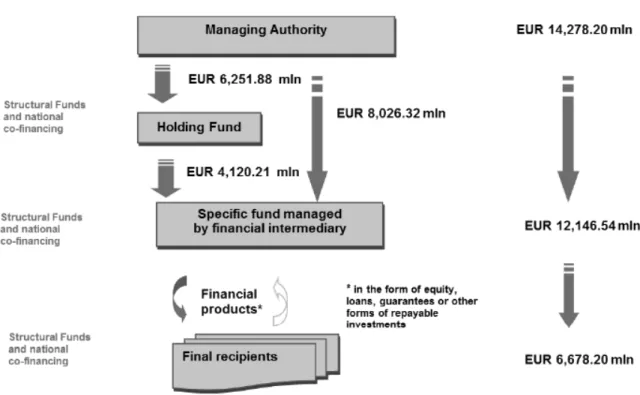
Their use has been promoted because of the added value of revolving instruments compared to that of grants in terms of the efficiency of use of public re-sources. The revolving nature allows for a much greater efficiency in the allocation of public capital and the long-term sustainability of public invest-ment. Secondly, by unlocking other public sector funding and private sector resources through co-fi-nancing and co-investment, FIs aim to increase the overall capital available. Additionally the private sec-tor participation enables policymakers to make use of private sector skills and expertise in areas such as identifying investment, decision-making, manage-ment of commercial operations and the ability to achieve returns. Repayable assistance can also act as incentive for better quality investments as invest-ments need to be economically viable to be able to repay the assistance provided (seeFigure 1).
The specific regulatory provisions on the setting up and implementation of FIs in the programming period 2007-2013 are the following7:
– Art. 44 and Art. 78(6)-(7) of Council Regulation (EC) No 1083/2006 as well as Art. 55(8) of Council Regulation (EC) No 1198/2006 on financial engi-neering instruments;
– Art. 43-46 of Commission Regulation (EC) No 1828/2006 and Art. 34-37 of Commission Regula-tion (EC) No 498/2007.
1 A public or private body and, for the purposes of the EAFRD Regulation and of the EMFF Regulation only, a natural person, responsible for initiating or both initiating and implementing operations; and in the context of State aid schemes, the body which receives the aid; and in the context of financial instruments it means the body that implements the financial instrument or the fund of funds as appropriate.
2 A legal or natural person receiving financial support from a financial instrument (CPR Art 2 (12).
3 EU manages the Microfinance Programmes within the 9th Euro-pean Development Fund (EDF) in ACP (African, Caribbean and Pacific), worth €15 million. A further investment of €15 million is foreseen in the 10th EDF.
4 Microcredit is defined as a loan of up to €25 000; but in reality many businesses need even smaller amounts of capital in some cases as little as €1 000 to set up their business, with the majority being around €5 000. See Commission Staff Working Paper, ‘Microcredit for European small businesses’, 2004, p. 5. 5 Report on Implementation of the European Progress Microfinance
Facility, COM/2011/0195 final.
6 Financial instruments are the term used in preference to financial engineering instrument (FEIs) for the next programming period. 7 Additionally four COCOF notes on financial engineering
instru-ments from 2007 (COCOF/07/0018/01), 2008 (COCOF 08/002/03) 2011 (COCOF 10/0014/004) and 2012 (COCOF 10/0014/05) form an important part of the framework as they provide COM interpre-tation and clarification on the applicable provisions.
www.lexxion.eu
An FI can be complicated and require specialist man-agement teams: A usual manman-agement structure in-volves a cascade system whereby a Managing
Author-ity (MA) selects a holding fund manager. The fund manager is responsible for launching a ‘call of inter-est’ looking for possible financial intermediaries who
Figure 1: Operational Programmes Contributions used in the Financing of the FEIs and Investments made by the FEIs at the End of 2013
Source: Summary Report 2014, European Commission (from data until end of 2013).
Figure 2: Institutional Set-up of the Hungarian JEREMIE-type Programmes Source: Author’s compilation.
will then reach final recipients on the ground (see
Figure 2).
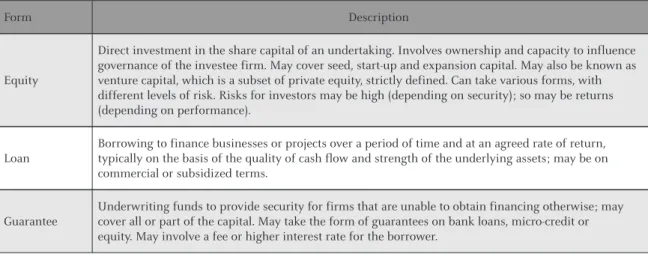
There are three principal forms of FI used in 2007-13 cohesion policy programmes: Equity, loans and guarantees (seeTable 1).
The JEREMIE8 initiative taps into Structural
Funds to promote the use of FEIs and improve ac-cess to finance for SMEs. Several Member States – also Hungary - have also taken this opportunity to launch microcredit schemes at national and region-al level within their OPs. The Member States have followed 2 main different organizational models: Some of them used national development organiza-tions(e.g. see Figure 1. on the Hungarian institution-al model; Germany: Mikrokreditfonds by Germany GLS bank; Lithuania: Entrepreneurship Promotion Fund by INVEGA; Spain: Microcredit Initiative IN-CYDE)and several MAs have called upon the exper-tise of the European Investment Fund (EIF) to man-age these instruments.
Eligibility of expenditures within microcredit schemes imply adhering to detailed rules on the EU definition of microenterprises10,de minimis, the
pos-sibility of financing working capital in early stages or as part of the expansion of a business activity, and spending before the end of 2015.11Companies in
dif-ficulty and firms supported by other EU Funds should be excluded, as well as certain sectors. Micro-credit schemes also need to comply with proper
mon-itoring and evaluation requirements, and not to un-derestimate the required reporting and administra-tive burden. However it was a legal problem that these requirements were not clearly at that start in the legislation and the Commission via COCOF9 guid-ance tried to give clarifications and explanations about the proper implementation.
The fund size should neither be over proportion-ate12nor below the critical mass, therefore needs a gap-assessment to be carried out, supported by a proper ex-ante evaluation of the SMEs’ financing needs. In reality competition could arise between grants and loans, or between loans at market rates or at reduced interest rates: Generally, a mix of non-re-imbursable grants and FIs is welcome, but coordina-tion between different funding sources and pro-grammes must mitigate any distortions.
8 Joint European Resources for Micro to Medium Enterprise. 10 Commission Recommendation 2003/361/EC of 6 May 2003. 11 Article 45, Commission Regulation (EC) No 1828/2006 of 8
December 2006.
9 Four COCOF notes on financial engineering instruments from 2007 (COCOF/07/0018/01), 2008 (COCOF 08/002/03) 2011 (COCOF 10/0014/004) and 2012 (COCOF 10/0014/05) form an important part of the framework as they provide COM interpreta-tion and clarificainterpreta-tion on the applicable provisions.
12 MAs is usually tempted to make oversized allocations to financial instruments for the purpose of increasing ‘absorption’ and avoid-ing N+2/N+3 automatic decommitments.
Table 1: FIs by Specific Fund-type Classification
Form Description
Equity
Direct investment in the share capital of an undertaking. Involves ownership and capacity to influence governance of the investee firm. May cover seed, start-up and expansion capital. May also be known as venture capital, which is a subset of private equity, strictly defined. Can take various forms, with different levels of risk. Risks for investors may be high (depending on security); so may be returns (depending on performance).
Loan
Borrowing to finance businesses or projects over a period of time and at an agreed rate of return, typically on the basis of the quality of cash flow and strength of the underlying assets; may be on commercial or subsidized terms.
Guarantee
Underwriting funds to provide security for firms that are unable to obtain financing otherwise; may cover all or part of the capital. May take the form of guarantees on bank loans, micro-credit or equity. May involve a fee or higher interest rate for the borrower.
Source: Michie, R. and Wishlade, F. (2011). Between Scylla and Charybdis: Navigating financial engineering instruments through
Structural Fund and State aid requirements, IQ-Net Thematic Paper, 29(2), European Policies Research Centre, University of Strathclyde, Glasgow.
The European Commission have also published a European Code of Good Conduct13as a mandatory requirement for microcredit provision in order to support the microcredit sector itself in increasing quality and moving towards sustainability. Unfortu-nately, this document was also not available at the start of the 2007-2013 period.
III. The Hungarian Case – the Use of the
Combined Microcredit
During the early 1990s, after the political changes in Hungary, the number of micro and small enterpris-es rapidly increased, mainly due to people who had been made redundant by the closing of factories es-tablishing their own enterprises. The Hungarian gov-ernment aimed to strengthen this newly created SME sector due to its potential to provide employment and economic development. The first entrepreneurship promotion projects were implemented within the framework of the PHARE14 programme. The pro-gramme was providing financing with beneficial in-terests (on the level of the prevailing central bank prime rate) for micro entrepreneurs excluded from traditional banking services without any discrimina-tion on gender, racial, or other basis and was operat-ed by non-profit foundations. PHARE requiroperat-ed also the setting up of a Local Enterprise Agencies (LEA) network.
In the 2004-2006 Hungarian OPs there were no FIs, but in the 2007-2013 programming period the situation changed.
At the start of the programming period during the OP development process 3 documents15analysed the market and evaluated the necessity of the use of FIs. They stated that the financial sector’s contribution to the financing of SMEs was still limited. The prin-cipal factors behind the market insufficiencies were also familiar in other EU Member States: Informa-tion asymmetry due to short business history, and the economies of scale problem arising from the high fixed unit costs of financial service providers. The SME development strategy 2007-201316 based on
these documents summarised the existing financial constraints.
Consequently in the 2007-2013 programming pe-riod the total amount of FIs set up in percentage of the ERDF support is around 6%. FIs are financed mainly by the Economic Development Operational Programme (EDOP).17The financial allocation of the EDOP 4th priority (financial instruments) was
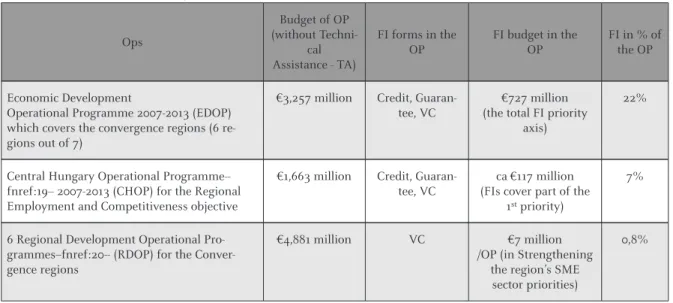
in-creased by 3% in 2009 through an OP modification. The concrete forms of FI include credit, guarantee and capital as well. In 2007 the Hungarian govern-ment decided to implegovern-ment JEREMIE without the European Investment Fund (EIF) acting as a holding fund, but with the newly created Venture Finance Hungary Plc.Table 2shows how the FIs are used in the following OPs in Hungary.
ERDF support between 2007-2013 amounted to €14,44 1 million. The total amount of FI in percent-age of the total ERDF support was around 6%. The allocation among OPs was as follows:
– EDOP: 5% of the total ERDF support. – CHOP: 0.7% of the total ERDF support. – RDOPs 0.3% of the total ERDF support.
Microcredit was the earliest started18FEI in
Hun-gary, with the aim of the programme to develop mi-cro enterprises that have no or not enough access to commercial bank loans. Since the start the main pa-rameters of the programme were changed 3 times as a reaction to the crises. As a consequence of the eco-nomic crisis in Hungary it became practically impos-sible for the SMEs to receive commercial bank loan even for the finance of their own (co-financing) part of the investment supported by grants. To tackle this problem, the objective was to develop the methods of micro-financing and to increase the amount of available resources.
As a possible solution in 2011 the already function-ing microcredit programmes were supplemented with a new combined microcredit plus grant scheme.
13 „European Code of Good Conduct for Microcredit Provision” European Union, 2011. ISBN 978-92-79-30654.
14 Programme of Community aid to the countries of Central and Eastern Europe (PHARE) was the main financial instrument of the pre-accession strategy for the Central and Eastern European countries.
15 EIF (2007): SME access to finance. Evaluation study //Ministry of Economy and Transport (2007): SME access to finance, analyses of market failures supporting the elaboration of the financial instruments of the Economic Development OP // Ministry of Economy and Transport (2007): SME development strategy. 16 Ministry of Economy and Transport (2007): SME development
strategy 2007-2013. <http://www.terport.hu/webfm_send/2733>. 17 Economic Development Operational Programme 2007-2013. CCI
number: 2007HU161PO001. <http://www.nfu.hu/umft_operativ _programok>.
18 The calls for tender for the banks and micro financing institutions were launched in October 2007, while the first contracts with the intermediaries were drawn up in December 2007. In January 2008 the first microcredit transactions were carried out.
In accordance with Article 43 (6) of the Implement-ing Regulation, "Enterprises, public private partner-ships and other projects …which are supported by fi-nancial engineering instruments, may also receive a grant or other assistance from an operational pro-gramme."19However, since the two streams of
fund-ing fall under separate operations20(and possibly
dif-ferent priority axis) separate accounts and records for each stream of financing must be maintained, to provide clear and independent audit trails for each operation. Whenever a final recipient benefits from grant assistance delivered through aid schemes or through any other type of operation financed under an OP and from investments provided by FEI, Arti-cle 54(5) of the General Regulation21as well as the
State aid rules regarding the accumulation of aid must be respected. In line with State aid guidelines, accumulation of different measures of assistance is possible, as long as they concern different identifi-able eligible costs. The combined microcredit in Hun-gary is functioning from the State aid point of view under thede minimisprinciple. Both calls for appli-cations (for grants and for loans) were published within the framework ofde minimisaid.22
The amount can then be used to buy equipment, ICT tools and basic infrastructure for start-up busi-nesses. Another interesting characteristic of the mechanism is that applying for a loan is a mandato-ry part of the scheme even if microenterprises have
enough of their own resources to cover the amount of the co-financing. Therefore, in combining a re-fundable microloan and a non-rere-fundable grant, this feature makes it a unique structure for providing mi-crocredit (seeFigure 5).
In the combined scheme the SMEs can get maxi-mum 45% of the tender project value or 10 million HUF grant, maximum 60% of the tender project val-ue or 20 million HUF microcredit and contribute with own resources to 10% of the total investment. The amount of grant cannot exceed that of repayable as-sistance and application requirements stipulate that
19 Regulation (EC) No 1828/2006 setting out rules for the implemen-tation of Council Regulation (EC) No 1083/2006 laying down general provisions on the European Regional Development Fund, the European Social Fund and the Cohesion Fund and of Regula-tion (EC) No 1080/2006 of the European Parliament and of the Council on the European Regional Development Fund (here-inafter: Implementing Regulation).
20 A project, contract, action or group of projects selected by the managing authorities of the programmes concerned, or under their responsibility, that contributes to the objectives of a priority or priorities; in the context of financial instruments, an operation is constituted by the financial contributions from a programme to financial instruments and the subsequent financial support pro-vided by those financial instruments (CPR Article 2 (9)) 21 Council Regulation (EC) No 1083/2006 of 11 July 2006 laying
down general provisions on the European Regional Development Fund, the European Social Fund and the Cohesion Fund and repealing Regulation (EC) No 1260/1999 (hereinafter: General Regulation).
22 Under Commission Regulation (EC) No 1998/2006.
Table 2: FIs in the OPs in Hungary
Ops Budget of OP (without Techni-cal Assistance - TA) FI forms in the OP FI budget in the OP FI in % of the OP Economic Development
Operational Programme 2007-2013 (EDOP) which covers the convergence regions (6 re-gions out of 7)
€3,257 million Credit, Guaran-tee, VC
€727 million (the total FI priority
axis)
22%
Central Hungary Operational Programme--fnref:19-- 2007-2013 (CHOP) for the Regional Employment and Competitiveness objective
€1,663 million Credit, Guaran-tee, VC
ca €117 million (FIs cover part of the
1stpriority)
7%
6 Regional Development Operational Pro-grammes--fnref:20-- (RDOP) for the Conver-gence regions
€4,881 million VC €7 million
/OP (in Strengthening the region’s SME sector priorities)
0,8%
applicants have to make 10% own contribution avail-able which cannot be financed by any other subsi-dized loan. In the decision process first the amount of the loan will be calculated where the amount of 10% own contribution will be automatically consid-ered and then the remaining gap can be covconsid-ered as grant in accordance with the conditions of the call.
The interest rate cap of the current credit products is 9% p.a., while throughout the programme the av-erage interest rate was at around 7% p.a. This com-bined microcredit product became a success product (seeTable 3).
An outstanding advantage of the combined prod-ucts is that they develop the financial attitude and business thinking of micro enterprises through the mandatory use of FIs.
The admission and assessment of loan applica-tions, the disbursement of loans and the manage-ment of loan accounts are carried out by the finan-cial intermediaries. Until the contracts are conclud-ed, intermediaries offer services to applicants under a one-stop-shop scheme, which enables the manag-ing authority to satisfactorily monitor both opera-tions and accelerates the decision-making process compared with earlier practice.
In the one-stop-shop system the SMEs applied to the financial intermediaries that granted the micro-credit part, while the State-owned body decided on the grant (evaluation and decision within 30 days). These 2 level institutional systems had to evaluate different aspects of the project and shared the risks. In order to facilitate co-operation between the in-dividual institutional actors, to ensure transparency and avoid duplication, the managing authority pub-lished procedural rules to be abided by financial in-termediaries, Venture Finance Hungary Plc. (MV
Zrt.) and Hungarian Economic Development Centre Plc (MAG Zrt).
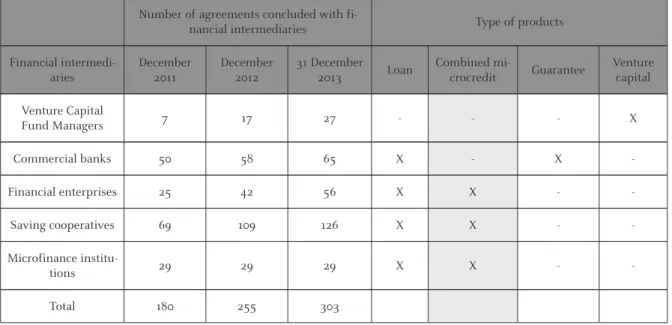
In order to implement the JEREMIE programme in Hungary a widespread external intermediary net-work was set up (seeTable 4). In line with the EU reg-ulations, the financial intermediaries must add their own funds to these refinancing funds in predeter-mined amounts. The rate of own funds in the case of financial institutions/financial enterprises owned by financial institutions is at least 25%, in the case of micro-financing organizations it is at least 10%. The financial intermediaries are attracted by the profit gained from the difference between the low source cost (the refinancing interest rate is 0.4%) and the in-terest paid by the clients. Profit-oriented financial companies receive the JEREMIE funding sources un-der the same conditions as non-profit foundations. However the operation has to be financed from these profits, because no management cost is eligible from the programme sources.
In the portfolios of banks, JEREMIE-products could not gain ground in the desired amount. This is partially due to the fact that the internal banking processes could not easily deal with these products, but also because of the bank were ruled out to be an intermediary for the most successful product, the combined microcredit.
Manyfinancial enterprisesstarted work providing JEREMIE-products. After 2011 they became primary promoters of the credit products and their role in the success of the combined microcredit product is re-markable as well. In the case of profit-oriented finan-cial enterprises, the maximum amount that may be granted is HUF 50 million, and, if the loan is com-bined with a non-refundable subsidy, this amount can reach HUF 20 million (€61,200). Local founda-Figure 3: Combined Microcredit - Project Structure/Financing
tions for enterprise promotionhave been dealing with corporate microcredits since their launch in the 90s. Initially, they were the number one intermediaries of the credit products; later the combined microcre-dit product became the key element of their portfo-lio. According to the rules of the programme the max-imum amount that may be granted by non-profit foundations is HUF 10 million (€30,600) (in Hungary this is the amount under which the commercial banks are unwilling to grant loans due to economic rea-sons).
After the amendments of the programmes and the implementation in 2011 SME support measures in
EDOP made the greatest progress in implementation, making the largest contribution to some of the im-portant core indicators related to the programme. All of the combined microcredit priority sources (EDOP-2.1.1/M; CHOP-1.2.1/M) were given to micro enterprises. This scheme is/was also open for start-up businesses. According to the data of the MA at 21.10.2014 the resource utilization of EDOP-2.1.1/M was 100%; and of CHOP-1.2.1/M 100%, too (see Fig-ure 4).
The use of FIs has been given special weight in the less developed regions; on the one hand because the size of the funds allocated to these territories exceeds
Table 3: The Existing Forms of FIs
OP FIs Short description Launching theprogramme
EDOP, CHOP
“New Széchenyi” Combined Micro Credit and Grant
For micro enterprises, for 120 months
Min HUF 1 million, max HUF 20 million (ca min €3,500, max €70,000)
10% own resources, 45% microcredit, 45% grant
2011 EDOP, CHOP “New Széchenyi” Credit (previously Micro Credit)
For micro and small enterprises, for 36/120 month (depending on the type of the credit,
e.g. investment or asset) Max. HUF 50 million (ca max €175,000)
2007
EDOP, CHOP
“New Hungary” Small and Medium Credit1
For small and medium sized enterprises, for 10 years
Min HUF 10 million, max HUF 100 million (ca min €35,000, max €350,000)
2008 (closed in 2012) EDOP, CHOP “New Hungary” Working Capital Loan
For small and medium sized enterprises, for 1-2 years
Min HUF 1 million, max HUF 200 million (ca min €3,500, max €700,000)
2008 (closed in 2010)
EDOP,
CHOP Portfolio guarantee Up to 80% 2007
EDOP,
CHOP Venture capital
Trough venture capital fund management firms, tasked with raising a fixed proportion of additional private funding to the resources committed by Venture Finance Hungary Plc. The
above-mentioned partners were selected by open tender in the second half of 2009.
2009
7 RDOPs Equity fund Venture capital in the regions. 2010
1 ...: together with the Hungarian Development Bank. At the end of 2008 in cooperation with MFB (Hungarian Development Bank) two new credit products were introduced targeting primarily medium-sized enterprises: The so-called SME investment credit (SME Credit) and the New Hungarian Working Capital Credit (UMFOR). However, these products became not as popular as expected mainly due to their
complex operational procedures. Source: Author’s compilation.
several times the funds earmarked for more devel-oped regions, on the other hand due to the fact that the typical financing problems of the SME sector have prevailed there.
However, if the sources are coming from public money especially from the EU budget besides the so-cial factor the sustainability and the effective and re-sponsible financial management are very important. In the context of FIs the principle ofeconomywould require inter alia that public resources allocated to FIs should be limited (in quantity) to the amounts and products (quality) necessary to meet the demand for such instruments, that such resources should be delivered in accordance with an investment strategy and delivery planning (timely)23consistent with the
objectives and assistance priorities of the relevant programme(s). The FIs and financial intermediaries have to be selected based on a transparent selection process. The principle of efficiencywould entail a demonstrable advantage of using FIs as compared to other forms of support, namely by leveraging addi-tional resources or producing higher results in sup-port of the objectives and assistance priorities of the relevant programmes, at a lower cost to the Union budget, by having a longer term impact on the Union budget through recycling of funds for further invest-ments and through better quality and sustainability of the actions supported. Finally, the principle of ef-fectiveness would require that support provided through FIs achieve the intended results indicators in a timely manner (within the programming peri-od), in line with the funding agreements and the ob-jectives of the programmes concerned. Micro-finance is in this case, by definition, no more a poverty alle-viation tool but rather an economic development tool.
The strength of a micro-finance institution is of-ten – also in Hungary - based on its close relationship with clients and distribution coverage within a geo-graphic region and it is also important from the grant-decision point of view. While the finance function is central to microcredit and grants, it is on its own how-ever usually not sufficient. Other functions such as capacity building and business support need to be integrated to accompany the financing. In Hungary it is building-up both the provision of trainings,
in-dividual consultations and the possibility to apply for a microcredit integrated in a one-stop-shop, there-by providing a simplification for the entrepreneur. However, as stated above, the combined microcred-it seems to be one of the most sought after call by the SMEs in Hungary and making the largest contribu-tion to some of the important core indicators related to the programme. Apparently the combined model reached a large number of final recipients through a good blending of private and public resources and adequate risk sharing between SMEs, financial inter-mediaries and public sector.
Looking at the results so far, the number of EDOP final recipients was the highest among micro enter-prises. The increase of the net revenues of the FI fi-nal recipients after the 2nd priority’s beneficiaries af-ter the project had been closed compared to the ini-tial status was 3.5%. Themicrofinance institutionsby paying out 41.179.002.280 HUF (approx. €135 mil-lion) from the 2007-2013 period sources (EDOP, CHOP) for 6783 projects created 7172 jobs total, from this the combined microcredit was 27.242.112.438 HUF (approx. €89,3 million) for 4559 projects with 4850 jobs (seeFigure 5).
Clearly the combined microcredit in Hungary is supporting and helping feminine beneficiaries (41%) and entrepreneurs working in rural territories (47%) also, therefore the “market” demonstrates that the combination has found its applications even in the problematic areas too.
The result of a survey carried out by the Fejér En-terprise Agency (FEA) with almost 392 respondents shows that the used combined microcredit con-tributed to retaining 452 jobs and creating 349 new jobs. The SMEs involved even indicated that during the next one year they are planning to hire 2270 new employees. It seems to be a high figure; hopefully they are not overoptimistic about the economic op-portunities. According to the given answers of the SMEs which used combined microcredit the plans and expectations are positive also, namely they are planning during the next 1 year further investments, technological developments, training and education, innovation or R&D expenditure, to purchase tangi-ble assets and to start a new activity (seeFigure 6).
To the question how the combined microcredit of FEA helped to improve the living conditions only 102 (26%) answered that it did not have an effect on the living conditions, all the other responders, 290 (74%) indicated improvement (significant or slight) in the
living conditions also beside the positive economic effects linked to the project(seeFigure 7).
Based on the results so far, in Hungary, microcre-dit has helped bring activities from the non-formal to the formal sector by financing small businesses. The combination of grants and loans allows to com-bine a static approach (investment oriented) for grants with a dynamic approach (cash flow orient-ed) for FIs and make the financial conditions better for access to sources, especially for micro-entrepre-neurs.
However, alsoseveral new audit riskshave been appeared linked to combined microcredit: The one was the declaration by Commission saying that com-bination of FEI (loans, guarantees) and grants for the same eligible expenditure item is irregular.24As de-scription of the deficiency the Commission indicates that:
a)The same eligible expenditure item received an in-vestment from a financial engineering instrument and a grant and at least one of the following ap-plies: the grant and the investment do not form part of two separate operations with separate eli-gible expenditure,
b)the two forms of support were used to pre-finance or reimburse one another;
c)the combination of the two forms of support result-ed in an over-financing of the expenditure item;
d)there are no separate accounts and records for each stream of financing for each operation;
e)maximum aid intensity allowed by State aid rules was not respected;
f) there is a double financing of the same eligible ex-penditure.25
The legislation in force allows the combination of FIs and grants as long as the State aid rules are respect-ed and the same eligible expenditure is not double financed in accordance with Article 54(5) of the Gen-eral Regulation. The regulation26 even recognizes that a final recipients operating in any of the three areas normally targeted by a fund may require grant in addition to repayable assistance. Using a mix of grant and loan to fund the same eligible expenditure item is not automatically double funding. But
obvi-24 Refering to Art. 14 GR 1083/2006 and Art. 10 GR 1198/2006, Art 60 (f) GR 1083/2006 and Art. 59 (f) GR 1198/2006 and Article 15 IR 1828/2006 and Art. 41 IR 498/2007 and State aid rules. 25 EGESIF_14-0015, European Commission, Guidelines for
deter-mining financial corrections to be made to expenditure co-financed by the EU under Structural Funds and the European Fisheries Funds for non-compliance with the rules applicable to financial engineering instruments for the 2007-2013 Program-ming Period, p. 13, <http://ec.europa.eu/regional_policy/sources/ docgener/informat/2014/guidelines_financial_corrections.pdf>, dated 06/06/2014.
26 1828/2006, Art 43(6) explicitly identifies enterprises as eligible final recipients of both loan and grants.
Table 4: Types of Financial Intermediaries and the Number of Agreements
Number of agreements concluded with
fi-nancial intermediaries Type of products
Financial intermedi-aries December 2011 December 2012 31 December 2013 Loan Combined mi-crocredit Guarantee Venture capital Venture Capital Fund Managers 7 17 27 - - - X Commercial banks 50 58 65 X - X -Financial enterprises 25 42 56 X X - -Saving cooperatives 69 109 126 X X - -Microfinance institu-tions 29 29 29 X X - -Total 180 255 303
ously there is a need for guidance and clarification in order to protect against double funding in the same investment.
Hungarian Case
In the Hungarian casethe expenditure related to one operation is financed by a grant, a loan and by own resources of the final recipient. Accordingly we have had to examine whether that combined micro loan facility is meeting or not the above listed conditions: Ad a) In the Hungarian case calls for repayable assis-tance and loan products were published separate-ly under separate priorities and in separate calls. Grants and loan transactions are managed by sep-arate organizations. Grants are managed by MAG Zrt. and loans are managed by the financial inter-mediaries accredited by MV Zrt. Two separate con-tracts are concluded with two separate financial mechanisms, one for the loan and another for the grant.
Ad b) The loan is approved first; whether or not grant can be awarded is decided on subsequently. If the loan application is rejected, it means the automat-ic rejection of the grant. Likewise, loans are dis-bursed first (which pre-supposes that the relevant application for grant has been approved and an
assistance document has been issued). Subse-quently, and subsequent to the implementation of the project, once the supporting accounting docu-ments and invoices submitted by the final recipi-ent have been checked and cleared and account-ing has been approved, the grant is disbursed. Ad c) Based on the calls for applications, the grant
cannot exceed 45% of the tender project value or HUF 10 million. Loan cannot exceed 60% of the tender project value or HUF 20 million. The amount of grant cannot exceed that of loan. Ap-plication requirements stipulate that applicants make 10% own contribution available which can-not be financed by any other subsidized loan. The financial module of the account management sys-tem automatically calculates the amount of the dis-bursable grant where the actual costs of the project are established based on the invoices submitted. The system automatically separates the amount of 10% own contribution (stating it as own contribu-tion) and then deducts the subsidized repayable assistance. The remaining amount can be dis-bursed as grant up to the approved sum specified in the sponsor's document.
Ad d) The investment is implemented on the basis of two separate priorities and two separate calls for applications, i.e. in two separate operations.
Figure 4: Combined Microcredit Grants and Loans
Ad e) A pre-condition for the award of both the loan and the grant is a declaration by the final recipi-ent on the small-amount assistance it received in the current fiscal year and the previous two years. Assistance/loan is awarded only after the entity providing the assistance has satisfied itself that the threshold value has not been exceeded. In conclusion, there is no double or over-financing of the same eligible expenditure or of the same piece of investment and all the other conditions for the combination of grants and loans are also met. The procedure employed ensures that the total eligible expenditure under the two schemes (FI and grants) never exceeds 100% of the investment.27
Conse-quently the Hungarian combined micro-loans com-ply with both EU and Hungarian legislative require-ments and the very process of processing the appli-cations rules out both over- and double financing. Al-so the Commission’s auditors agreed that the Hun-garian authorities have provided sufficient
justifica-tions to conclude that all the condijustifica-tions allowing re-ceipt of a grant and a repayable assistance falling un-der a FEI for the same physical piece of investment were met.
Another audit issue is concerning the selection procedure of financial intermediaries. The main is-sue is whether we have an obligation to use public procurement for selection of financial intermedi-aries or not. According to the cohesion policy regu-lation we have to follow “open, transparent, propor-tionate and non-discriminatory procedures, avoiding conflicts of interest”– which would allow for normal
27 In this context it should be noted that double financing does not occur as for the operational programme ERDF co-financing is provided on the basis of the public costs. This practically means that if there were two projects (one loan and one grant) both with €100 total eligible expenditure and with 45% financing rate the actual total ERDF contribution would amount to €76.5 (2X €45(public cost)*85% (ERDF co-financing) ) for the two projects. If the system was changed to the total cost system the ERDF contribution could potentially increase to €170 (2X €100(total cost)*85% (ERDF co-financing)).
Figure 5: Breakdown of the Combined Microcredit Beneficiaries
Source: Figures from the CREDINFO IT system, used by all local foundations for enterprise promotion (16) and by 14 financial enterprises and compiled by the author.
calls for proposals without public procurement. But the Commission is recently heavily hinting that we better use the public procurement rules. This is a dif-ferent interpretation that was applied in program-ming period 2007-2013 when numerous Member States selected the financial intermediaries in open tender procedures and not as a result of public pro-curement process. Naturally the managers of FEI (fi-nancial intermediaries) should be selected through
an open, transparent and non-discriminatory proce-dure. However, a public procurement procedure for the selection of financial intermediaries may in many ways potentially decrease efficiency of the im-plementation of FIs, because amendments to terms and conditions of FIs during the implementation-pe-riod (potentially 15 years) cannot be handled under inflexible service contract conditions and it could cause significant implementation issues for private
Figure 6: Rate of the Beneficiary SMEs Planning Different Future Development Activities
Source: Figures from the result of the survey by carried out by the FEA “Social Impact Assessment of Microcredit Questionnaire” and compiled by the author.
Figure 7: How the Combined Microcredit of FEA Helped to Improve the Living Conditions?
Source: Figures from the result of the survey by carried out by the FEA “Social Impact Assessment of Microcredit Questionnaire” and compiled by the author.
investors and final recipients. Hungary – as de-scribed before - is working with a widespread exter-nal intermediary network in the case of JEREMIE and with the use of public procurement it will be one winner only. Also the mandatory use of public pro-curement is legally questionable. Depending on the structure of the implementation mechanism the de-finition of the public procurement’s subject is not easily clarified, especially if the contracting author-ity is not the paying one and instead of services rather co-investments are the main element of the contract (as in the Hungarian case). However the main principles of public procurement can also be applied by using an open, transparent, proportion-ate and non-discrimination selection procedure as provided by the Common Provisions Regulation28
(CPR).
There is need for clarification on a lot of issues which are strongly affecting the implementation of FIs.
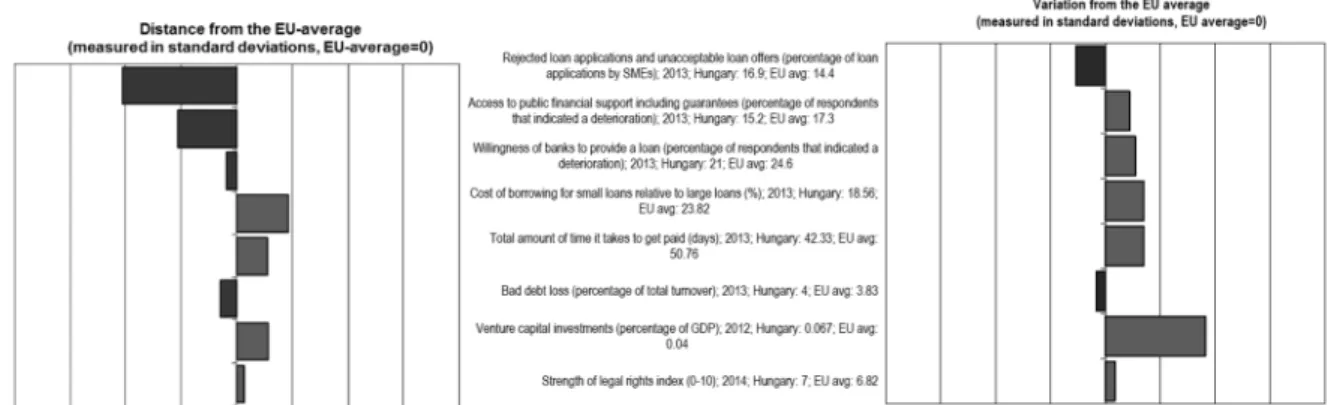
Based on the data until 2013 the Hungarian SME sector did not manage to fully recover from the ini-tial shock of the crisis in 2008 and has been sluggish since 2009. However the overall ranking of Hungary in access to finance for SMEs is in line with the EU average29mostly due to specific financing schemes. Despite all this, the financing situation for most SMEs remains difficult. Access to bank loans has gradually improved, but it has also become more ex-pensive.3028% of SMEs in Hungary reported that banks are less willing to grant loans, as against 26% for the EU. The 2014-2020 FIs, especially the com-bined micro-loan can help to improve this situation (seeFigure 8).
Hungary is planning to use 60% of the European Structural and Investment (ESI) Funds sources to support SMEs and also to provide the SMEs adequate access to funding even if the market actors are not sufficiently motivated to do that yet. The planned tools of the FIs are i) credit, leasing and factoring,ii)
combined products, iii) venture capital programmes
and iv) guarantee instruments.
IV. Cohesion Policy 2014-2020
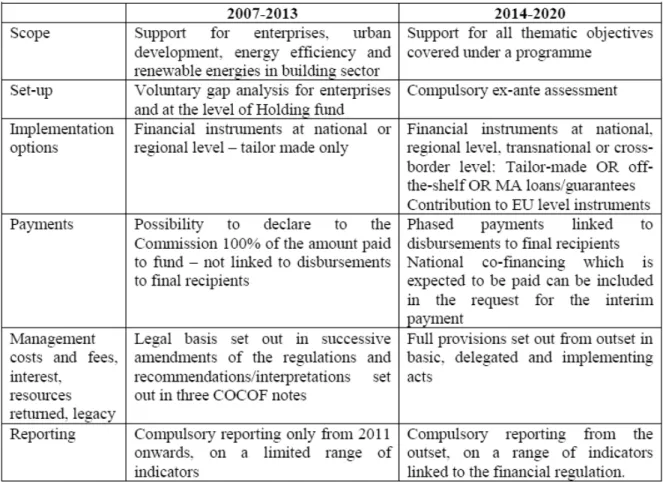
The new regulation puts increasing importance on the use of FIs which are to become more important in 2014-2020 as a more efficient alternative to tradi-tional grant based financing and aim to increase the flexibility, taking into account national and sector specificities, improve the coherence and consistency between instruments, raise visibility and transparcy, and to reduce the number of instruments to en-sure a sufficient critical mass in a context where the
28 Regulation (EU) No 1303/2013 of the European Parliament and of the Council of 17 December 2013 laying down common provi-sions on the European Regional Development Fund, the European Social Fund, the Cohesion Fund, the European Agricultural Fund for Rural Development and the European Maritime and Fisheries Fund and laying down general provisions on the European Re-gional Development Fund, the European Social Fund, the Cohe-sion Fund and the European Maritime and Fisheries Fund and repealing Council Regulation (EC) No 1083/2006 (CPR). 29 According to 2014 SBA Fact Sheets, <http://ec.europa.eu/
enterprise/policies/sme/facts-figures-analysis/performance-review/ files/countries-sheets/2014/hungary_en.pdf>.
30 While the interest rate differential between smaller loans of less than €1 million — mostly for SMEs — and larger loans remains smaller in Hungary than in the EU, this mark-up increased from 12 % in 2007 to almost 19 % in 2013.
Figure 8: Access to Finance for SME-s in Hungary (2011 versus 2013) Source: 2013, 2014 SBA Fact Sheets, European Commission.
amount of funding available is scattered across a large number of regions and recipients. The regula-tory texts on FIs for the 2014-2020 period show that the legislators have attempted to address many of the challenges that have arisen in this programming pe-riod in the regulatory provisions. These include a number of modifications that directly address issues raised by managing authorities and the European Court of Auditors.31
The specific provisions on FIs are set out in the Common Provisions Regulation and the delegated and implementing acts linked to the relevant articles of this regulation. Other relevant provisions for FIs
(e.g. information on priorities/measures, co-financ-ing, eligible expenditure etc.) can be found in the fund-specific regulations and applicable horizontal regulations (seeTable 5).
Any FI supported by the ESIF must be in compli-ance with the relevant programme, its objectives un-der priorities (and focus areas for EAFRD); eligibili-ty rules (under measures for EAFRD); expenditure related provisions; co-financing elements; monitor-ing and reportmonitor-ing requirements.
The regulation also frequently references the need to ensure compliance with State aid requirements and there is some clarification on management fees and costs (with further provisions to be included in the secondary legislation) as well as the use of revolv-ing resources.
While preparing their future OPs, Member States need to think about how to build up FIs. A greater use of FIs should be accompanied by quality
assess-31 For example revised provisions relating to theex-anteevaluations that must be undertaken before FIs are established in the OPs. It has been made clear thatex-anteevaluations will tie the findings related to market gaps more closely into the objectives and priorities of the OPs, and will include more information on what type of financial products should be put in place.
Table 5: Changes on FI Regulation Relating to the ERDF and ESF
Source: Financial Instruments in ESIF programmes 2014-2020 - A short reference guide for Managing Authorities, European Commission.
ments of SME financing gaps, reinforced attention to ensure added value and requirements for leverage from the private sector, more synergies between ESI Funds, as well as proper systems that allow compli-ance with EU rules. It will be also important to give due attention to consideration of economies of scale and critical mass, where relevant.
The CPR makes it clear that more types of combi-nation will be possible: Combicombi-nation of different pro-gramme contributions and different funds in one FI, combination of FIs and grants and other forms of as-sistance. Advantage of the combination of funds from different sources in one FI can be the achieve-ment of critical mass and economies of scale as well as a wider spectrum of policy objectives.
However, as Hungarians use to say, the devil lives in the details. The Commission intend to release guid-ance on different issues linked to FIs and after exam-ination of the first drafts these documents seem to be more restrictive than the regulation.
In the draft of “Guidance for Member States and Programme Authorities on Combination of Support from a FI with Other Support”32the Commission
pre-sented two types of combination of support: Within a FI operation (a single operation) and at the level of the final recipient (combination two separate opera-tions). One of the main critics of the Member States is that the Commission’s draft guidelines go beyond the scope of the regulatory provisions e.g. by limit-ing the grant-component amount only to the finan-cial costs, requiring all the capital to be covered by a FI only or by introducing an additional condition ex-cluding the possibility to pay any grant component directly to final recipients in the case of combining the grant with a FI33or by requiring that distinct
el-igible expenditure have to be defined for combina-tion of grants and FIs when the combinacombina-tion is done through two separate operations (point 3.1.2 of the draft of the Guidance) within the same priority ax-is...etc.
I do not share the Commission’s interpretation of CPR 37(7), according to which in case of combina-tion of FIs with grants, the combined product can-not be managed within one operation. The CPR us-es the term "including" for the specifications (inter-est rate subsidy, guarantee fee subsidy, technical sup-port), which does not exclude other cases such as grant or capital rebate to be used as a part of FI with-in a swith-ingle operation. In my with-interpretation grants can also be combined with FIs within one operation if
-in l-ine with the regulations - they (1) directly relate to the FI and (2) final recipients are the same. Accord-ing to the legal text the two types of combination can be separated on the basis of these two conditions and not on the basis of the form of support. Also the Com-mission’s restrictive interpretation that under the EU regulation national co-financing cannot be provided by the final recipient34is not really justified: CPR
Art. 38(9) explicitly allow providing national public and private contribution at the level of final recipi-ent.
Despite it was a clear intention of the legislator to make it possible to combine grants with loans or oth-er FIs in a simple way avoiding the need to artificial-ly split expenditure into sub-operations, I think that the draft guidelines do not provide any encourage-ment to use the simplest option and without proper legal basis try to restrict combination to only those cases where the option of covering the same expen-diture item explicitly provided by Art. 37(9) is not used. However, artificially splitting an investment in-to 2 parts with distinct eligible expenditure, one of them benefiting from a FI and the other from a grant is too complex, destroys transparency, creates audit risks and in several cases defeats the whole purpose of combination: It is no longer any real combination, but two separate streams for two separate sub-invest-ments.
Evidently, the main difference in the 2007-2013 and 2014-2020 regulation is that while in the 2007-2013 period we had short and limited rules and lately few guidance on FEIs which gave a lot of space for manoeuvre for the Member States, in the 2014-2020 period we will have more sophisticated regulation with several guidance on FIs which are not always in line with the current Member States practises. However one of the main issues is timing, because for the preparation of efficient FIs we need all the relevant information and documents in time. Above all enhancing of combined microcredit have
32 EGESIF_15_0012_00; European Comission, European Structural and Investment Funds, Draft: Guidance for Member States and Programme Authorities on Combination of support from a Finan-cial Instrument with other support; dated: 01/04/2015. 33 “The support is for the benefit of final recipients but it is not
directly paid to the final recipient”(point 3.1) - this condition derives neither from Art. 37(7) nor Art. 42(1)(a) of the CPR. 34 “the own contribution by the final recipient cannot be declared
as eligible expenditure under the financial instrument operation, because in accordance with Article 42(1)(a) eligible expenditure is the payment to the final recipient”.
to rely on increasing legal certainty for all parties through proper and timely rules on FIs and guidance by the European Commission.
V. Conclusion
The recent EU Budget Review as well as the new In-vestment Plan for Europe noted that FIs could pro-vide an important new financing mechanism for strategic investments by attracting co-investment from other public and private sector sources in order to achieve EU policy goals more efficiently. Within cohesion policy it is proposed that FIs are able to cov-er a widcov-er range of policy areas and that thcov-ere is a greater flexibility in relation to establishing and im-plementing FIs. However, before the launch of the next period’s FIs it is recommended to analyse the intermediary institutional system closely and the op-eration of the scheme’s built-in control mechanisms;
to closer coordinate control and monitoring activi-ties; and to further simplify the procedures.
Based on the positive experiences of the combined products, it is recommended to further strengthen the role of such products during the 2014-2020 pro-gramming period by introducing new combined schemes. In addition to policy and absorption goals this may foster entrepreneurial culture through the mandatory use of FIs. It would also recommended to include the non-refundable and the FI components of such combined schemes into one priority, which would give more flexibility for the fine-tuning the programme during its progress. But first of all we need clear situation about the regulatory environ-ment with clear guidelines also regarding the combi-nation of repayable FIs and grants in order to accel-erate its implementation. It would present unaccept-able risk for the Member States to establish a FI with-out the knowledge of the exact legal conditions at the start of the period.