Signed Networks in Social Media
Jure Leskovec
Stanford University
[email protected]
Daniel Huttenlocher
Cornell University
[email protected]
Jon Kleinberg
Cornell University
[email protected]
ABSTRACTRelations between users on social media sites often reflect a mixture of positive (friendly) and negative (antagonistic) interactions. In contrast to the bulk of research on social net-works that has focused almost exclusively on positive pretations of links between people, we study how the inter-play between positive and negative relationships affects the structure of on-line social networks. We connect our anal-yses to theories of signed networks from social psychology. We find that the classical theory of structural balance tends to capture certain common patterns of interaction, but that it is also at odds with some of the fundamental phenomena we observe — particularly related to the evolving, directed na-ture of these on-line networks. We then develop an alternate theory of status that better explains the observed edge signs and provides insights into the underlying social mechanisms. Our work provides one of the first large-scale evaluations of theories of signed networks using on-line datasets, as well as providing a perspective for reasoning about social media sites.
Author Keywords
signed networks, structural balance, status theory, positive edges, negative edges, trust, distrust.
ACM Classification Keywords
H.5.3 Information Systems: Group and Organization Inter-faces—Web-based interaction.
General Terms
Human Factors, Measurement, Design. INTRODUCTION
Social network analysis provides a useful perspective on a range of social computing applications. The structure of net-works arising in such applications offers insights into pat-terns of interactions, and reveals global phenomena at scales that may be hard to identify when looking at a finer-grained resolution. At the same time, there is an ongoing challenge in adapting such network approaches to the study of social computing: users develop rich relationships with one an-other in these settings, while network analyses generally
re-Permission to make digital or hard copies of all or part of this work for personal or classroom use is granted without fee provided that copies are not made or distributed for profit or commercial advantage and that copies bear this notice and the full citation on the first page. To copy otherwise, or republish, to post on servers or to redistribute to lists, requires prior specific permission and/or a fee.
CHI 2010, April 10 – 15, 2010, Atlanta, Georgia, USA Copyright 2010 ACM 978-1-60558-929-9/10/04...$10.00.
duce these complex relationship to the existence of simple pairwise links. It is a fundamental research problem to bridge the gap between the richness of the existing relationships and the stylized nature of network representations of these rela-tionships.
The main focus of our work here is to examine the inter-play between positive and negative links in social media — a dimension of on-line social network analysis that has been largely unexplored. With relatively few exceptions (e.g., [1,
15,16]), research in on-line social networks has focused on contexts in which the interactions have largely only positive interpretations — that is, connecting people to their friends, fans, followers, and collaborators. But in many settings it is important to also explicitly take negative relations into con-sideration, especially when studying interactions in social media: discussion lists are filled with controversy and dis-agreement, and social-networking sites harbor antagonism alongside amity. The richness of a social network in such cases generally consists of a mixture of both positive and negative interactions, co-existing in a single structure. We aim to develop a better understanding of the role that net-work structure plays when some links between people are positive while others are negative. For instance, in on-line rating sites such as Epinions, people can give both positive and negative ratings not only to items but also to other raters. In on-line discussion sites such as Slashdot, users can tag other users as “friends” and “foes”. Our approach here is to adapt and extend theories from social psychology to an-alyze these types of signed networks as they arise in social computing applications. These theories enable us to char-acterize the differences between the observed and predicted configurations of positive and negative links in on-line so-cial networks. We also use contrasts between the theories to draw inferences about how links are being used in particular social computing applications. In addition to insights into the applications themselves, our studies provide, to the best of our knowledge, some of the first large-scale evaluations of these social-psychological theories via on-line datasets.
Positive and negative links in on-line data. To carry out
such an investigation, we need two fundamental ingredients: (i) large-scale datasets from social applications where the sign of each link — whether it is positive or negative — can be reliably determined, and (ii) theories of signed networks that help us reason about how different patterns of positive and negative links provide evidence for the expression of dif-ferent kinds of relationships across these applications.
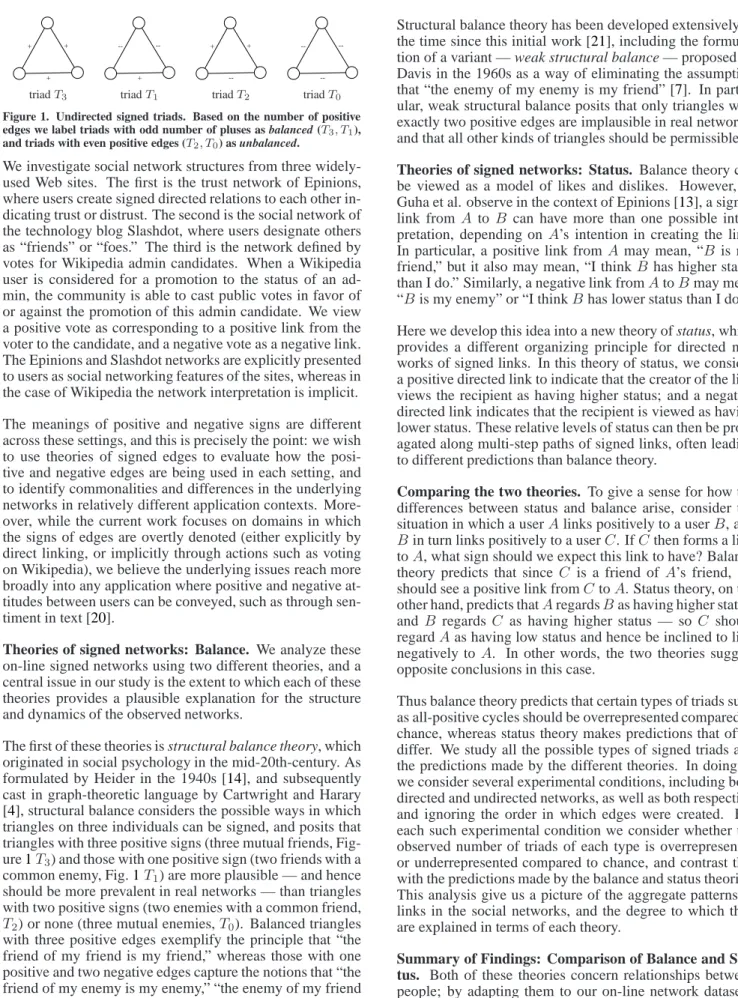
+ + + -- --+ + + ----
--triad𝑇3 triad𝑇1 triad𝑇2 triad𝑇0 Figure 1. Undirected signed triads. Based on the number of positive edges we label triads with odd number of pluses as balanced (𝑇3, 𝑇1), and triads with even positive edges (𝑇2, 𝑇0) as unbalanced.
We investigate social network structures from three widely-used Web sites. The first is the trust network of Epinions, where users create signed directed relations to each other in-dicating trust or distrust. The second is the social network of the technology blog Slashdot, where users designate others as “friends” or “foes.” The third is the network defined by votes for Wikipedia admin candidates. When a Wikipedia user is considered for a promotion to the status of an ad-min, the community is able to cast public votes in favor of or against the promotion of this admin candidate. We view a positive vote as corresponding to a positive link from the voter to the candidate, and a negative vote as a negative link. The Epinions and Slashdot networks are explicitly presented to users as social networking features of the sites, whereas in the case of Wikipedia the network interpretation is implicit. The meanings of positive and negative signs are different across these settings, and this is precisely the point: we wish to use theories of signed edges to evaluate how the posi-tive and negaposi-tive edges are being used in each setting, and to identify commonalities and differences in the underlying networks in relatively different application contexts. More-over, while the current work focuses on domains in which the signs of edges are overtly denoted (either explicitly by direct linking, or implicitly through actions such as voting on Wikipedia), we believe the underlying issues reach more broadly into any application where positive and negative at-titudes between users can be conveyed, such as through sen-timent in text [20].
Theories of signed networks: Balance. We analyze these
on-line signed networks using two different theories, and a central issue in our study is the extent to which each of these theories provides a plausible explanation for the structure and dynamics of the observed networks.
The first of these theories is structural balance theory, which originated in social psychology in the mid-20th-century. As formulated by Heider in the 1940s [14], and subsequently cast in graph-theoretic language by Cartwright and Harary [4], structural balance considers the possible ways in which triangles on three individuals can be signed, and posits that triangles with three positive signs (three mutual friends, Fig-ure1𝑇3) and those with one positive sign (two friends with a
common enemy, Fig.1𝑇1) are more plausible — and hence
should be more prevalent in real networks — than triangles with two positive signs (two enemies with a common friend,
𝑇2) or none (three mutual enemies,𝑇0). Balanced triangles
with three positive edges exemplify the principle that “the friend of my friend is my friend,” whereas those with one positive and two negative edges capture the notions that “the friend of my enemy is my enemy,” “the enemy of my friend is my enemy,” and “the enemy of my enemy is my friend.”
Structural balance theory has been developed extensively in the time since this initial work [21], including the formula-tion of a variant — weak structural balance — proposed by Davis in the 1960s as a way of eliminating the assumption that “the enemy of my enemy is my friend” [7]. In partic-ular, weak structural balance posits that only triangles with exactly two positive edges are implausible in real networks, and that all other kinds of triangles should be permissible.
Theories of signed networks: Status. Balance theory can
be viewed as a model of likes and dislikes. However, as Guha et al. observe in the context of Epinions [13], a signed link from 𝐴 to 𝐵 can have more than one possible inter-pretation, depending on 𝐴’s intention in creating the link. In particular, a positive link from𝐴 may mean, “𝐵 is my friend,” but it also may mean, “I think𝐵 has higher status than I do.” Similarly, a negative link from𝐴to𝐵may mean “𝐵is my enemy” or “I think𝐵has lower status than I do.” Here we develop this idea into a new theory of status, which provides a different organizing principle for directed net-works of signed links. In this theory of status, we consider a positive directed link to indicate that the creator of the link views the recipient as having higher status; and a negative directed link indicates that the recipient is viewed as having lower status. These relative levels of status can then be prop-agated along multi-step paths of signed links, often leading to different predictions than balance theory.
Comparing the two theories. To give a sense for how the
differences between status and balance arise, consider the situation in which a user𝐴links positively to a user𝐵, and
𝐵in turn links positively to a user𝐶. If𝐶then forms a link to𝐴, what sign should we expect this link to have? Balance theory predicts that since 𝐶 is a friend of 𝐴’s friend, we should see a positive link from𝐶to𝐴. Status theory, on the other hand, predicts that𝐴regards𝐵as having higher status, and 𝐵 regards𝐶 as having higher status — so𝐶 should regard𝐴as having low status and hence be inclined to link negatively to𝐴. In other words, the two theories suggest opposite conclusions in this case.
Thus balance theory predicts that certain types of triads such as all-positive cycles should be overrepresented compared to chance, whereas status theory makes predictions that often differ. We study all the possible types of signed triads and the predictions made by the different theories. In doing so we consider several experimental conditions, including both directed and undirected networks, as well as both respecting and ignoring the order in which edges were created. For each such experimental condition we consider whether the observed number of triads of each type is overrepresented or underrepresented compared to chance, and contrast that with the predictions made by the balance and status theories. This analysis give us a picture of the aggregate patterns of links in the social networks, and the degree to which they are explained in terms of each theory.
Summary of Findings: Comparison of Balance and Sta-tus. Both of these theories concern relationships between
they provide potentially informative perspectives on the link structures we find there.
Balance theory was initially intended as a model for undi-rected networks, although it has been commonly applied to directed networks by simply disregarding the directions of the links [21]. When we do this, we find significant align-ment between the observed network data and Davis’s notion of weak structural balance: triangles with exactly two posi-tive edges are massively underrepresented in the data relaposi-tive to chance, while triangles with three positive edges are mas-sively overrepresented. In two of the three datasets, triangles with three negative edges are also overrepresented, which is at odds with Heider’s formulation of balance theory. These findings are already intriguing, since it has traditionally been difficult to evaluate the predictions of structural balance the-ory on large network datasets. Rather, empirical investi-gations to date have generally focused on small networks where social relations can be observed through direct inter-action with the individuals involved (see e.g. [8]). The trou-ble with assessing structural balance at small scales is that one expects its predictions to be aggregate rather than abso-lute — that is, one expects to see certain kinds of triangles as statistically more abundant or less abundant in the data, and the significance of such biases towards certain kinds of triangles can stand out much more clearly when they are ac-cumulated over a large amount of data.
Ultimately, however, we would like to understand the net-works in these on-line systems as directed structures that evolve over time. When we view the network data in this way, our main conclusion is that the theory of status is more effective at explaining local patterns of signed links, and that it naturally extends to capture richer aspects of user behav-ior, including heterogeneity in their linking tendencies. For example in the case offered as an illustration above, where user𝐴links positively to user𝐵and user𝐵links positively to user𝐶, we find that negative links from𝐶to𝐴are mas-sively overrepresented relative to chance, with positive links correspondingly underrepresented.
Implications. There are several potentially interesting
im-plications of our results. First, the comparison of balance and status provides insights into ways in which people use linking mechanisms in social computing applications. In particular, there are important domains such as rating re-viewers on Epinions and voting for admins on Wikipedia in which such links appear, in aggregate, to be used more dom-inantly for expressions of status than for expressions of likes and dislikes.
The contrast between balance and status is also related to the distinction between undirected and directed interpretations of links. Our findings suggest that it is important to under-stand the roles of different theories in both undirected and directed representations of networks. Indeed, the theory of status only makes sense with directed links — since it posits a status differential from the creator of a link to its recipient — while the theory of balance has been applied in both undi-rected and diundi-rected settings (e.g., [21]). The fact that (weak) balance is broadly consistent with the undirected
representa-tion of our network data, while status is more consistent with the directed representation, shows that it possible for differ-ent theories to be appropriate to differdiffer-ent levels of resolution in the representation of a single network.
In the final part of the paper, we describe further structural investigations that provide insight into ways in which signed links are used in these applications. First, we find that as-pects of the theory of balance hold more strongly on the subset of links in these networks that are reciprocated — consisting of directed links in both directions between two users. This suggests that reciprocal link formation may fol-low a different pattern of use in these systems than unrecip-rocated link formation. However, it is important to note that such reciprocal relations account for only a small proportion of the links between people on these sites.
Second, we find a connection between the sign of a link and the extent to which it is embedded [12], i.e., with the two endpoints having links to many common neighbors. A link is significantly more likely to be positive when its two end-points have multiple neighbors (of either sign) in common. This observation is consistent with qualitative notions of so-cial capital [3,5] — users with common neighbors have rela-tions that are “on display” in a social sense, and hence have greater implicit pressure to remain positive. Indeed in the three different social applications that we study, this effect is strongest in the case of voting for Wikipedia admins, which is the setting that makes the relations most prominently visi-ble to users. This suggests some of the ways in which the presence of common neighbors, and more overt forms of public display, can have an effect on the use of signed links. These findings about aggregate structural properties also be-gin to address a broad and largely open issue, which is to understand the sources of individual variation in linking be-havior. While reciprocation and embeddedness are only two dimensions along which to explore such variation, we be-lieve that the definitions and analysis pursued here can help in framing further investigation of questions regarding indi-vidual variation.
RELATED WORK
There is by now a large and rapidly growing literature on the analysis of social networks arising in on-line domains [18]; as we noted at the outset, this line of work has almost exclu-sively treated networks as implicitly having positive signs only. For example, portions of our analysis can be viewed as variants on the problem of link prediction [17] and tie-strength prediction [10], but in each case adapted to take the signs of links into account.
Two recent papers in the analysis of on-line social networks stand out as taking the signs of links into account. Brzo-zowski et al. study the positive and negative relationships that exist on ideologically oriented sites such as Essembly [1], but with the goal of predicting outcomes of group votes rather than the broader organization of the social network. Kunegis et al. study the friend/foe relationships on Slash-dot, and compute global network properties [15], but do not evaluate theories of balance and status as we do here.
Epinions Slashdot Wikipedia Nodes 119,217 82,144 7,118 Edges 841,200 549,202 103,747 +edges 85.0% 77.4% 78.7% −edges 15.0% 22.6% 21.2% Triads 13,375,407 1,508,105 790,532
Table 1. Dataset statistics.
Symbol Meaning
𝑇𝑖 Signed triad, also the number of triads of type𝑇𝑖
Δ Total number of triads in the network
𝑝 Fraction of positive edges in the network
𝑝(𝑇𝑖) Fraction of triads𝑇𝑖,𝑝(𝑇𝑖) =𝑇𝑖/Δ
𝑝0(𝑇𝑖) A priori prob. of𝑇𝑖(based on sign distribution)
𝐸[𝑇𝑖] Expected number of triads𝑇𝑖,𝐸[𝑇𝑖] =𝑝0(𝑇𝑖)Δ
𝑠(𝑇𝑖) Surprise,𝑠(𝑇𝑖) = (𝑇𝑖−𝐸[𝑇𝑖])/ √
Δ𝑝0(𝑇𝑖)(1−𝑝0(𝑇𝑖)) Table 2. Table of symbols.
There are also large bodies of work involving negative rela-tionships in on-line domains that pursue directions different from our network focus here. One line of work focuses on norms to control deviant behavior in on-line communities (e.g. [6] and the references therein). In a different direction, a large body of recent work in sentiment analysis [20] has studied on-line textual data in which individuals can express both positive and negative attitudes toward one another, but without addressing the consequences for network structure. The datasets we study here have also been investigated by researchers for other purposes. Guha et al. study the trust network of Epinions [13]. Lampe et al. study the user rating mechanisms on Slashdot [16]. Burke and Kraut study the voting process that produces our Wikipedia signed network [2], but with the goal of modeling election outcomes. Finally, the notion of status plays a role in many lines of work in the social sciences, such as the role that behavior-status theory plays in social exchange theory [9,22]. How-ever, these notions are distinct from the ways in which we formulate definitions of status as a counterpart to balance in signed directed networks.
DATASET DESCRIPTION
As described above, we consider three large online social networks where links are explicitly positive or negative: (i) the trust network of the Epinions product review Web site, where users can indicate their trust or distrust of the reviews of others; (ii) the social network of the blog Slashdot, where a signed link indicates that one user likes or dislikes the com-ments of another; and (iii) the voting network of Wikipedia, where a signed link indicates a positive or negative vote by one user on the promotion to admin status of another. Table1gives statistics for all three datasets. Our networks have on the approximate order of tens to hundreds of thou-sand nodes, and less than a million edges. In each network the edges are inherently directed, since we know which user created the edge. In all networks the background proportion of positive edges is about the same, with roughly 80% of the edges having a positive sign.
ANALYSIS OF UNDIRECTED NETWORKS
We begin by analyzing the network data in an undirected representation, where we do not take the directions of links
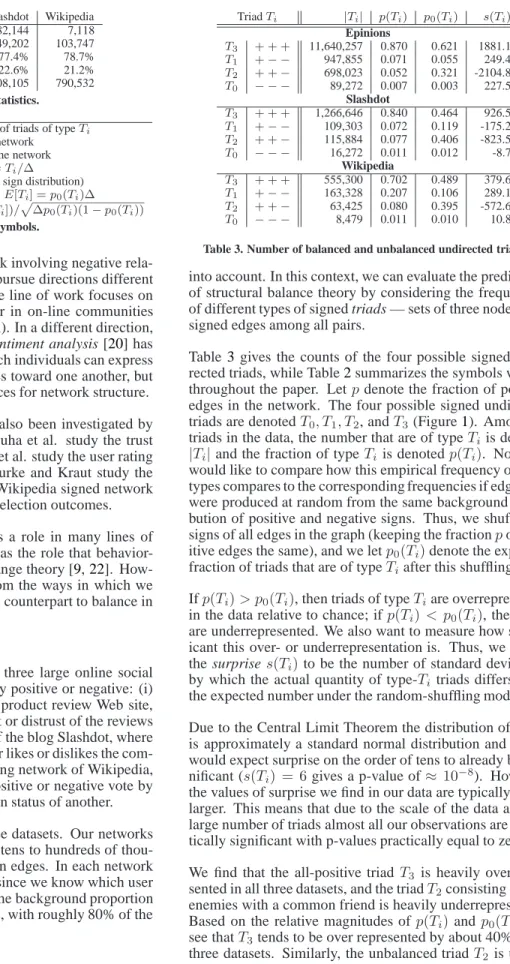
Triad𝑇𝑖 ∣𝑇𝑖∣ 𝑝(𝑇𝑖) 𝑝0(𝑇𝑖) 𝑠(𝑇𝑖) Epinions 𝑇3 + + + 11,640,257 0.870 0.621 1881.1 𝑇1 +− − 947,855 0.071 0.055 249.4 𝑇2 + +− 698,023 0.052 0.321 -2104.8 𝑇0 − − − 89,272 0.007 0.003 227.5 Slashdot 𝑇3 + + + 1,266,646 0.840 0.464 926.5 𝑇1 +− − 109,303 0.072 0.119 -175.2 𝑇2 + +− 115,884 0.077 0.406 -823.5 𝑇0 − − − 16,272 0.011 0.012 -8.7 Wikipedia 𝑇3 + + + 555,300 0.702 0.489 379.6 𝑇1 +− − 163,328 0.207 0.106 289.1 𝑇2 + +− 63,425 0.080 0.395 -572.6 𝑇0 − − − 8,479 0.011 0.010 10.8
Table 3. Number of balanced and unbalanced undirected triads.
into account. In this context, we can evaluate the predictions of structural balance theory by considering the frequencies of different types of signed triads — sets of three nodes with signed edges among all pairs.
Table 3 gives the counts of the four possible signed undi-rected triads, while Table2summarizes the symbols we use throughout the paper. Let𝑝denote the fraction of positive edges in the network. The four possible signed undirected triads are denoted𝑇0, 𝑇1, 𝑇2, and𝑇3(Figure1). Among all
triads in the data, the number that are of type𝑇𝑖is denoted
∣𝑇𝑖∣and the fraction of type𝑇𝑖 is denoted𝑝(𝑇𝑖). Now, we
would like to compare how this empirical frequency of triad types compares to the corresponding frequencies if edge signs were produced at random from the same background distri-bution of positive and negative signs. Thus, we shuffle the signs of all edges in the graph (keeping the fraction𝑝of pos-itive edges the same), and we let𝑝0(𝑇𝑖)denote the expected
fraction of triads that are of type𝑇𝑖after this shuffling.
If𝑝(𝑇𝑖)> 𝑝0(𝑇𝑖), then triads of type𝑇𝑖are overrepresented
in the data relative to chance; if𝑝(𝑇𝑖)< 𝑝0(𝑇𝑖), then they
are underrepresented. We also want to measure how signif-icant this over- or underrepresentation is. Thus, we define the surprise 𝑠(𝑇𝑖)to be the number of standard deviations
by which the actual quantity of type-𝑇𝑖 triads differs from
the expected number under the random-shuffling model. Due to the Central Limit Theorem the distribution of𝑠(𝑇𝑖)
is approximately a standard normal distribution and so we would expect surprise on the order of tens to already be sig-nificant (𝑠(𝑇𝑖) = 6gives a p-value of≈ 10−8). However,
the values of surprise we find in our data are typically much larger. This means that due to the scale of the data and the large number of triads almost all our observations are statis-tically significant with p-values pracstatis-tically equal to zero. We find that the all-positive triad 𝑇3 is heavily
overrepre-sented in all three datasets, and the triad𝑇2consisting of two
enemies with a common friend is heavily underrepresented. Based on the relative magnitudes of𝑝(𝑇𝑖) and𝑝0(𝑇𝑖), we
see that𝑇3tends to be over represented by about 40% in all
three datasets. Similarly, the unbalanced triad𝑇2is
under-represented by about 75% in Epinions and Slashdot and 50% in Wikipedia. These observations so far fit well into Heider’s original notion of structural balance.
However, the relative abundances of triad types𝑇1 (single
positive edge) and 𝑇0 (all negative edges) differ between
the datasets, and none of the datasets follow Heider’s theory in both having𝑇1overrepresented and𝑇0underrepresented.
Thus, the picture is more consistent with Davis’s weaker no-tion of balance, where𝑇2is viewed as implausible but there
is no a priori reason to favor one of𝑇1or𝑇0over the other.
ANALYSIS OF EVOLVING DIRECTED NETWORKS We now consider the networks in these systems as directed graphs, incorporating the fact that the links being created go from one user to another, with the sign of a link from𝐴to
𝐵being generated by𝐴. In the introduction, we discussed how the theories of balance and status offer competing inter-pretations for how we should expect such directed links to be signed. For example, as noted there, positive cycles — that is, directed triads with positive links from𝐴to𝐵 to𝐶
to𝐴— are underrepresented in the data. This conflicts with balance theory, but is consistent with status theory.
Timing and Diversity: Generative and Receptive Base-lines. Beyond just the directionality of links, there are
ad-ditional features of the data that we take into account when evaluating these models. First, links are created at specific points in time, so rather than thinking of directed triads as existing in a static snapshot of the network, we consider the order in which links are added to the network. Thus, we study how directed triads form, as follows. When a user𝐴
links to a user𝐵, suppose there is already a user𝑋 with the property that𝑋 has links to or from𝐴, and also to or from
𝐵. This means there is a two-step semi-path from𝐴to𝐵
through𝑋 (a path in which the directions of the edges do not matter), and the formation of the𝐴-𝐵link adds a short-cut to this path, producing a directed triad on𝐴,𝐵, and𝑋. Second, different users make use of positive and negative signs differently. At the most basic level, some users pro-duce links almost exclusively of one sign or the other, while others produce a relatively even mix of both positive and negative links. We will refer to the overall fraction of posi-tive signs that a user creates, considering all her links, as her generative baseline. Similarly, some users receive links that are almost exclusively of one sign or the other, while others receive a mix of signs. We will refer to the overall fraction of positive signs in the links a user receives as his receptive baseline. Given this, we should compare the abundance of positive and negative links to the generative and receptive baselines of the users producing and receiving these links. Once we incorporate these aspects of the data, we discover further mysteries — beyond just the scarcity of positive cy-cles — that seem to call for alternatives to balance theory. For example, consider the case of joint positive endorsement — a situation in which a node𝑋 links positively to each of two nodes𝐴and𝐵. Suppose that in this case,𝐴now forms a link to𝐵(i.e., triad𝑡9of Figure2); should we expect there
to be an elevated probability of the link being positive, or a reduced probability of the link being positive?
In fact, in our data, the question turns out to have a more subtle answer than either of these alternatives. The link that
is produced in this situation is more likely to be positive than the generative baseline of𝐴, but at the same time less likely to be positive than the receptive baseline of𝐵. Balance the-ory, of course, makes a much more naive prediction: since𝐴
and𝐵are both friends of𝑋, they should be friends of each other. Can status theory explain this dual and opposite pair of deviations from the baselines of𝐴and𝐵?
We now show that in fact it can, and explaining how this works forms the motivation for a theory of how status effects can influence the signs of directed links.
Formulating a Theory of Status
Since the phenomenon we are trying to capture is subtle but in the end familiar from everyday life, we begin with a hy-pothetical example to motivate the subsequent definitions.
A Motivating Example. Suppose we were to interview the
players on a college soccer team: for certain players𝐴, and certain teammates𝐵 of𝐴, we ask, “How do you think the skill of player𝐵compares to yours?” Suppose further that the players roughly agree on a ranking of each other by skill, which serves as an approximate (though not perfect) ranking of the team members by status. From the results of these interviews, we could produce a signed directed graph whose nodes are the players, and with a directed edge from𝐴to𝐵
if we asked𝐴for her opinion of𝐵. A positive link from𝐴to
𝐵would indicate that𝐴thinks highly of𝐵’s skill relative to her own, while a negative link would indicate that𝐴thinks she is better than𝐵.
If we were just given this signed directed graph, and knew nothing else about the soccer team, then we could still make inferences about the signs of links that we haven’t yet ob-served, using the context provided by the rest of the network. Suppose for example that we are about to ask player 𝐴’s opinion of another player 𝐵, but we don’t currently have
𝐴’s answer and hence don’t yet know the sign of the link from𝐴to𝐵. We can nonetheless make predictions about it from the links whose signs we do know, as follows. Suppose that we know from the data already collected that𝐴and𝐵
have each received a positive evaluation from a third player
𝑋. Here is a pair of facts we could conjecture about the link from𝐴to𝐵, given the positive links from𝑋 to𝐴and𝐵.
∙ Since 𝐵 has been positively evaluated by another team member,𝐵is more likely than not to have above-average skill. Therefore, the evaluation that𝐴gives𝐵 should be more likely to be positive than an evaluation given by𝐴
to a random team member.
∙ Since 𝐴 has been positively evaluated by another team member,𝐴 is also more likely than not to have above-average skill. Therefore, the evaluation that 𝐴gives 𝐵
should be less likely to be positive than an evaluation re-ceived by𝐵from a random team member.
There are several subtleties here. First, we’re using the indi-rection provided by a third party𝑋to make inferences about the relation between𝐴and𝐵, based on assumptions about status. Second, the context provided by𝑋causes the sign of the𝐴-𝐵link to deviate from a random baseline in different
directions depending on whether we’re looking at it from𝐴’s point of view or𝐵’s point of view. More precisely, since𝐵
has above-average skill,𝐴will likely give𝐵a higher evalu-ation than𝐴would give to a random team member. On the other hand, since𝐴has above-average skill,𝐵is less likely to receive a positive evaluation from𝐴than she would re-ceive from a random team member. Despite the complexity of these conclusions, they reflect genuine and natural prop-erties of status ordering among a group of people. They also agree with our observations about joint positive endorsement in the data mentioned above.
We turn now to the data, where we will find that the users of these on-line networks create signed links in ways that correspond closely to the behavior of the players on our hy-pothetical soccer team. But extracting this finding from the data will require formulating a sequence of definitions that captures the intuition suggested by this example.
Contextualized Links. The first portion of our definitions
capture the idea that we will evaluate the sign of a link cre-ated from𝐴to𝐵 in the context of𝐴and𝐵’s relations to additional nodes𝑋 with whom they have links. (For exam-ple, the node𝑋 in our example who jointly endorses𝐴and
𝐵.) Thus, we define a contextualized link (more briefly, a c-link) to be a triple(𝐴, 𝐵;𝑋)with the the property that a link forms from𝐴to𝐵after each of𝐴and𝐵already has a link either to or from𝑋. Overall there are sixteen different types of c-links, as the edge between𝑋and𝐴can go in ei-ther direction and have eiei-ther sign yielding four possibilities, and similarly for the edge between𝑋 and𝐵, for a total of
4⋅4 = 16. For each of these types of c-links we are inter-ested in the frequencies of positive versus negative labels for the edge from𝐴to𝐵. Figure2shows all the possible types of c-links, labeled𝑡1–𝑡16.
Now, for a particular type of c-link, we look at the set of all c-links(𝐴, 𝐵;𝑋)of this type, and ask: what fraction of the links from𝐴to𝐵 in this set are positive? Moreover, how does this fraction compare to what one would expect from the generative baselines of the nodes𝐴 and the receptive baselines of the nodes𝐵 that are involved in the creation of these𝐴-𝐵 links? If we can quantify the answer to this question in our data, we can look for effects like we saw in our motivating example — there, in the case of positive links from𝑋 to𝐴and𝐵, we believed the likelihood of a positive
𝐴-𝐵 edge should exceed the generative baseline of 𝐴but should lie below the receptive baseline of𝐵.
Let’s consider a particular type𝑡of c-link, and suppose that
(𝐴1, 𝐵1;𝑋1),(𝐴2, 𝐵2;𝑋2), . . . ,(𝐴𝑘, 𝐵𝑘;𝑋𝑘)is a list of all
instances of this type𝑡of c-link in our data. We define the generative baseline for this type𝑡to be the sum of the gen-erative baselines of all nodes𝐴𝑖. This quantity is simply the
expected number of positive edges we would get if we let each𝐴𝑖-𝐵𝑖 link form according to the generative baseline
of𝐴𝑖. We then define the generative surprise𝑠𝑔(𝑡)for this
type𝑡 to be the (signed) number of standard deviations by which the actual number of positive𝐴𝑖-𝐵𝑖edges in the data
differs above or below this expectation. In other words, if the context provided by the node𝑋and its links with𝐴and
𝑡1 𝑡2 𝑡3 𝑡4 A B X + + A B X + --A B X + + A B X + --𝑡5 𝑡6 𝑡7 𝑡8 A B X --+ A B X --A B X --+ A B X --𝑡9 𝑡10 𝑡11 𝑡12 A B X + + A B X + --A B X + + A B X --+ 𝑡13 𝑡14 𝑡15 𝑡16 A B X --+ A B X --A B X + --A B X --𝑡𝑖 count 𝑃(+) 𝑠𝑔 𝑠𝑟 𝐵𝑔 𝐵𝑟 𝑆𝑔 𝑆𝑟 𝑡1 178,051 0.97 95.9 197.8 ✓ ✓ ✓ ✓ 𝑡2 45,797 0.54 -151.3 -229.9 ✓ ✓ ✓ ∘ 𝑡3 246,371 0.94 89.9 195.9 ✓ ✓ ∘ ✓ 𝑡4 25,384 0.89 1.8 44.9 ∘ ∘ ✓ ✓ 𝑡5 45,925 0.30 18.1 -333.7 ∘ ✓ ✓ ✓ 𝑡6 11,215 0.23 -15.5 -193.6 ∘ ∘ ✓ ✓ 𝑡7 36,184 0.14 -53.1 -357.3 ✓ ✓ ✓ ✓ 𝑡8 61,519 0.63 124.1 -225.6 ✓ ∘ ✓ ✓ 𝑡9 338,238 0.82 207.0 -239.5 ✓ ∘ ✓ ✓ 𝑡10 27,089 0.20 -110.7 -449.6 ✓ ✓ ✓ ✓ 𝑡11 35,093 0.53 -7.4 -260.1 ∘ ∘ ✓ ✓ 𝑡12 20,933 0.71 17.2 -113.4 ∘ ✓ ✓ ✓ 𝑡13 14,305 0.79 23.5 24.0 ∘ ∘ ✓ ✓ 𝑡14 30,235 0.69 -12.8 -53.6 ∘ ∘ ✓ ∘ 𝑡15 17,189 0.76 6.4 24.0 ∘ ∘ ∘ ✓ 𝑡16 4,133 0.77 11.9 -2.6 ✓ ∘ ✓ ∘
Number of correct predictions 8 7 14 13
Figure 2. Top: All contexts(𝐴, 𝐵;𝑋). Red edge is the edge that closes the triad. Bottom: Surprise values and predictions based on the com-peting theories of structural balance and status.𝑡𝑖refers to triad con-texts above; Count: number of concon-texts𝑡𝑖;𝑃(+): prob. that closing red edge is positive;𝑠𝑔: surprise of edge initiator giving a positive edge;
𝑠𝑟: surprise of edge destination receiving a positive edge;𝐵𝑔: consis-tency of balance with generative surprise;𝐵𝑟: consistency of balance with receptive surprise;𝑆𝑔: consistency of status with generative sur-prise;𝑆𝑟: consistency of status with receptive surprise.
𝐵 had no effect on the sign of the𝐴-𝐵link being formed, so that each node𝐴𝑖simply drew the sign of her link to𝐵𝑖
according to her generative baseline, then we should expect to see a generative surprise of0for this type𝑡.
We set up the corresponding definitions for the nodes𝐵𝑖as
the recipients of the links. We define the receptive baseline for this type𝑡of c-link to be the sum of the receptive base-lines of all nodes𝐵𝑖, and we define the receptive surprise 𝑠𝑟(𝑡)to be the (signed) number of standard deviations by
which the actual number of positive𝐴𝑖-𝐵𝑖edges in the data
differs above or below this expectation.
Incorporating the Role of Status. Finally, we bring the role
of status into this theory. For this, it is useful to return once more to our motivating example. When a player𝑋 on our hypothetical soccer team gave positive evaluations to both𝐴
and𝐵, we concluded — in the absence of any further infor-mation — that𝐴and𝐵were likely to have above-average status. We would have concluded the same thing had𝐴and
𝐵 given negative evaluations to 𝑋. On the other hand, if
𝑋had evaluated𝐴and𝐵negatively, or had they evaluated
𝑋 positively, then we should have concluded that𝐴and𝐵
were more likely than not to have below-average status. This reasoning provides a way to assign status values to𝐴
and𝐵in any type of c-link, as follows. We first assign the node𝑋 a status of0. Then, if𝑋 links positively to𝐴, or
𝐴links negatively to𝑋, we assign𝐴a status of 1; other-wise, we assign𝐴a status of−1. We use the same rule for assigning a status of1 or−1 to𝐵. Thus we say that the generative surprise for type𝑡is consistent with status if𝐵’s status has the same sign as the generative surprise: in this case, high-status recipients𝐵receive more positive evalua-tions than would be expected from the generative baseline of the node𝐴producing the link. We say that the receptive sur-prise for type𝑡is consistent with status if𝐴’s status has the opposite sign from the receptive surprise: high-status gen-erators of links𝐴 produce fewer positive evaluations than would be expected from the receptive baseline of the node
𝐵receiving the link. Results
We now evaluate the predictions of these theories on the two networks, Epinions and Wikipedia, for which we have data on the exact order in which the links were created. We focus our discussion on Epinions, for which the data is an order of magnitude larger; the results are quite similar on the smaller Wikipedia dataset, with differences that we note below. We consider four theories to explain the signs of the links that are produced. The first two are the consistency of sta-tus with generative and receptive surprise, as just defined. The other two theories are the analogous forms of consis-tency with Heider’s original notion of balance. Specifically, we say that Heider balance is consistent with generative sur-prise for a particular c-link type if the sign of the generative surprise is equal to the sign of the edge as predicted by bal-ance. Analogously, we say that Heider balance is consistent with receptive surprise for a particular c-link type if the sign of the receptive surprise is equal to the sign of the edge as predicted by balance.
We find that the predictions of status with respect to both generative and receptive surprise perform much better against the data that the predictions of structural balance. Indeed, status is consistent with generative and receptive surprise on the vast majority of c-link types; as shown in Figure2, it is consistent on 14 and 13 types respectively. This includes the case of joint endorsement (type𝑡9in Figure2) — which
is in fact the most abundant type of c-link in the data — and also includes the natural counterpart of joint endorsement, in which𝐴and𝐵 each link negatively to𝑋 (type𝑡8). It also
includes the case of a positive cycle (type𝑡11), discussed
earlier as well.1
1On the Wikipedia dataset, the results for receptive surprise are almost identical; status is consistent with receptive surprise on all c-link types except for the same three exceptional cases as Epinions,
Structural balance is a much weaker fit to the data: balance is consistent with generative surprise for only 8 of the 16 types of c-links, and consistent with receptive surprise for only 7 of the 16. We also evaluated consistency of generative and receptive surprise with respect to Davis’s weaker notion of balance, with similar results. The one subtlety in evaluat-ing the data with respect to Davis balance is that Davis’s theory does not predict the sign of the𝐴-𝐵 edge in c-link types where the two existing edges with𝑋are both negative (𝑡6, 𝑡8, 𝑡14, and𝑡16): for these triads, either a positive or a
negative𝐴-𝐵 link would be consistent with Davis’s theory, and so no prediction can be made. Thus, we evaluate consis-tency of Davis balance with respect to generative and recep-tive surprise only on the remaining 12 c-link types; here, we find consistency in 6 and 7 of the 12 cases respectively. This too is much weaker than the predictions of status.
We also consider the structure of the cases in which status theory fails to make a correct prediction, analyzing the possi-ble strengthenings of the theory that this might hint at. First, we observe that one of the two c-link types where status is inconsistent with generative surprise is the configuration in which𝐴 and𝐵 each link positively to𝑋 (type 𝑡3). This
is one of the most basic settings for structural balance in Heider’s work: if two people each like a third party, then one should expect them to have positive relations. It thus suggests where users of these systems may be relying on balance-based reasoning more than status-based reasoning. We can get further insights from the cases where status the-ory is inconsistent with the data. In particular, the 16 c-link types can be divided into four groups of four each, based on whether𝐴has high or low status relative to𝑋, and whether
𝐵 has high or low status relative to𝑋. In looking at where status theory makes mistakes, it is almost exclusively on the c-link types where𝐴and𝐵are both posited to have low sta-tus relative to𝑋. This corresponds to the types𝑡2,𝑡3,𝑡14,
and𝑡15; we observe that with respect to generative surprise,
both of status theory’s mistakes occur on types of this form, and with respect to receptive surprise, two of status theory’s three mistakes occur on types of this form.
Even further, the mistakes of status with respect to genera-tive and recepgenera-tive surprise on these types constitute natural “duals” to each other. Note first that if we reverse both the direction and the sign of an edge, we preserve the status re-lation of the two endpoints (e.g. a positive link from𝐴to
𝑋 or a negative link from𝑋 to𝐴both suggest that𝐴has lower status than𝑋). With this in mind, we observe that if we take the types𝑡3 and𝑡15 on which status theory makes
its two mistakes with respect to generative surprise, and we reverse the directions and signs of both edges involving𝑋, we get the c-link types𝑡2and𝑡14— these are the other two
c-link types where𝐴and𝐵 have low status relative to 𝑋, and they are two of the three types on which status theory makes mistakes with respect to receptive surprise.
𝑡2, 𝑡14, and𝑡16, and one more: 𝑡4. We find this close alignment
quite surprising given the very different kinds of activities that the Epinions and Wikipedia links represent. On Wikipedia, status is also consistent with generative surprise on 12 of the 16 triad types, though here the types where there is inconsistency differ more from Epinions:𝑡14(as in Epinions),𝑡5,𝑡8, and𝑡16.
Epinions Count Probability
𝑃(+∣+) 38,415 0.969
𝑃(−∣+) 1,204 0.031
𝑃(+∣−) 1,192 0.692
𝑃(−∣−) 560 0.308
Wikipedia Count Fraction
𝑃(+∣+) 2,509 0.945
𝑃(−∣+) 145 0.055
𝑃(+∣−) 193 0.706
𝑃(−∣−) 80 0.294
Table 4. Edge reciprocation. Given that the first edge was of sign𝑋 𝑃(𝑌∣𝑋)give the probability that reciprocated edge is𝑌.
It is thus natural to conjecture that the use of signed links de-viates most strongly from status theory when𝐴is predicted to impute low status to both herself and𝐵. Now that this be-havioral asymmetry has been identified in the data, via our formulation of this theory, developing a more refined theory of status that takes this asymmetry into account is an inter-esting direction for further work.
RECIPROCATION OF DIRECTED EDGES
Thus far we have found that balance theory is a reasonable approximation to the structure of signed networks when they are viewed as undirected graphs, while status theory bet-ter captures many of the properties when the networks are viewed in more detail as directed graphs that grow over time. To understand the boundary between these two theories and where they apply, it is interesting to consider a particular subset of these networks where the directed edges are used to create symmetric relationships. This subset is the collec-tion of edges that are reciprocal: cases in which there are two nodes𝐴and𝐵such that𝐴links to𝐵 and𝐵also links to𝐴. (If the𝐵-𝐴link forms after the𝐴-𝐵link, we say that
𝐵reciprocates the link to𝐴.) In our data, only about 3-5% of the edges represent the reciprocation of an existing link, so this is far from being a dominant mode of link creation on these systems. But it is an interesting mode of link creation, in that it represents a directly mutual relationship between two individuals𝐴and𝐵, which is the setting in which bal-ance theory has been more relevant to our earlier analyses. Our findings for this type of linking suggest the following intuitively natural picture: in the relatively small portion of these networks where mutual back-and-forth interaction takes place, the principles of balance are more pronounced than they are in the larger portions of the networks where signed linking (and hence evaluation of others) takes place asymmetrically. In other words, users treat each other differ-ently in the context of back-and-forth interaction than when they are using links to refer to others who do not link back. We summarize the results in Table 4. First, we find that the reciprocation of positive𝐴-𝐵 edges is closely consis-tent with balance rather than status, while the reciprocation of negative edges seems to follow a hybrid of the two prin-ciples. Specifically, if𝐴links positively to𝐵, then balance predicts that𝐵should link positively to𝐴, while status pre-dicts that𝐵 has the higher status and should therefore link negatively to𝐴. For the two systems in which we have data on the order of edge creation — Epinions and Wikipedia — we find that the data clearly supports the balance
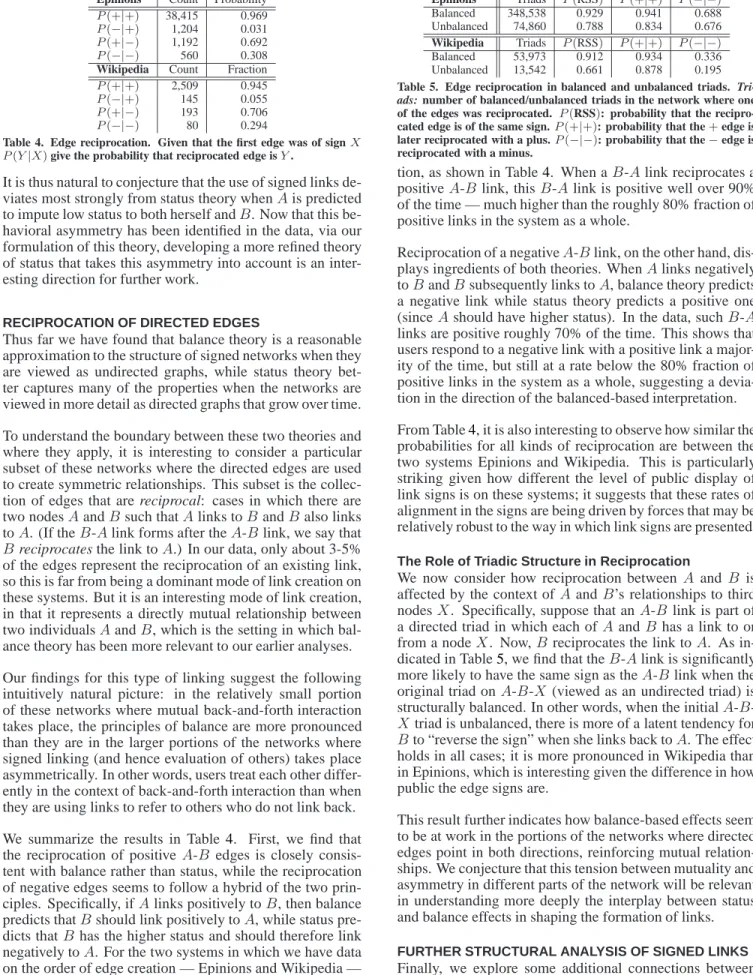
interpreta-Epinions Triads 𝑃(RSS) 𝑃(+∣+) 𝑃(−∣−) Balanced 348,538 0.929 0.941 0.688 Unbalanced 74,860 0.788 0.834 0.676 Wikipedia Triads 𝑃(RSS) 𝑃(+∣+) 𝑃(−∣−) Balanced 53,973 0.912 0.934 0.336 Unbalanced 13,542 0.661 0.878 0.195
Table 5. Edge reciprocation in balanced and unbalanced triads.
Tri-ads: number of balanced/unbalanced triads in the network where one
of the edges was reciprocated. 𝑃(RSS): probability that the recipro-cated edge is of the same sign.𝑃(+∣+): probability that the+edge is later reciprocated with a plus.𝑃(−∣−): probability that the−edge is reciprocated with a minus.
tion, as shown in Table4. When a𝐵-𝐴link reciprocates a positive𝐴-𝐵 link, this𝐵-𝐴link is positive well over 90% of the time — much higher than the roughly 80% fraction of positive links in the system as a whole.
Reciprocation of a negative𝐴-𝐵link, on the other hand, dis-plays ingredients of both theories. When𝐴links negatively to𝐵and𝐵subsequently links to𝐴, balance theory predicts a negative link while status theory predicts a positive one (since𝐴should have higher status). In the data, such𝐵-𝐴
links are positive roughly 70% of the time. This shows that users respond to a negative link with a positive link a major-ity of the time, but still at a rate below the 80% fraction of positive links in the system as a whole, suggesting a devia-tion in the direcdevia-tion of the balanced-based interpretadevia-tion. From Table4, it is also interesting to observe how similar the probabilities for all kinds of reciprocation are between the two systems Epinions and Wikipedia. This is particularly striking given how different the level of public display of link signs is on these systems; it suggests that these rates of alignment in the signs are being driven by forces that may be relatively robust to the way in which link signs are presented. The Role of Triadic Structure in Reciprocation
We now consider how reciprocation between 𝐴 and 𝐵 is affected by the context of 𝐴and𝐵’s relationships to third nodes𝑋. Specifically, suppose that an𝐴-𝐵 link is part of a directed triad in which each of𝐴and𝐵 has a link to or from a node𝑋. Now,𝐵 reciprocates the link to𝐴. As in-dicated in Table5, we find that the𝐵-𝐴link is significantly more likely to have the same sign as the𝐴-𝐵link when the original triad on𝐴-𝐵-𝑋 (viewed as an undirected triad) is structurally balanced. In other words, when the initial𝐴-𝐵
-𝑋 triad is unbalanced, there is more of a latent tendency for
𝐵to “reverse the sign” when she links back to𝐴. The effect holds in all cases; it is more pronounced in Wikipedia than in Epinions, which is interesting given the difference in how public the edge signs are.
This result further indicates how balance-based effects seem to be at work in the portions of the networks where directed edges point in both directions, reinforcing mutual relation-ships. We conjecture that this tension between mutuality and asymmetry in different parts of the network will be relevant in understanding more deeply the interplay between status and balance effects in shaping the formation of links. FURTHER STRUCTURAL ANALYSIS OF SIGNED LINKS Finally, we explore some additional connections between network structure and the signs of links, focusing on the
em-beddedness of edges and on the subgraphs consisting only of positive links and only of negative links. For these structural results, we analyze the networks as undirected graphs. Embeddedness of positive and negative ties
We begin by trying to characterize the parts of the network in which positive ties are more likely to occur. Roughly, we find that positive ties are more likely to be clumped together, while negative ties tend to act more like bridges between islands of positive ties.
We explore this issue in Figure3 by plotting the probabil-ity that an edge is positive as a function of its embeddedness , i.e., the number of common neighbors that its endpoints have [12], or equivalently, the number of distinct triads the edge participates in. For each dataset we plot two curves. In green, we show the results of a random-shuffling base-line — the sign probability we would get as a function of embeddedness if edge signs were determined randomly and independently with probability𝑝for each edge. As is clear, there is no dependence here between an edge’s sign and its embeddedness, so the green curve is approximately flat. However, in the real data (red) we see a completely different picture. Edges that are not well embedded (with endpoints having fewer than around 10 shared neighbors) tend to be more negative than expected based on the background prob-ability𝑝of positive ties. However, as an edge is more em-bedded (participating in more triads) it tends to be increas-ingly positive. That is, a link is significantly more likely to be positive when its two endpoints have multiple neighbors (of either sign) in common. These findings are consistent across all three datasets. This suggests that positive edges tend to occur in better embedded (densely linked) groups of nodes, while negative edges tend to participate in fewer tri-angles, which indicates that they act as connections between the well-embedded sets of positive ties.
As mentioned in the Introduction, this observation is not part of the formulation of balance theory (and does not follow from it), but it is consistent with the notion from social-capital theory of embedded edges being more “on display” [3,5]. Moreover, among our three datasets, this phenomenon is most pronounced for the Wikipedia voting data. This is also the only one of the three sites where the social relations are explicitly displayed to a broad set of users — thus putting the relations even more highly on display. Thus these results are particularly well explained in terms of implicit pressure to remain positive.
All-Positive and All-Negative Networks
To explore further the different roles played by positive and negative links in these networks, we study the sub-networks composed exclusively of the positive links and exclusively of the negative links. That is, we define the all-positive network to be the subgraph consisting only of the positive links, and the all-negative network to be the subgraph consisting only of the negative links. We also compare these to randomized baselines, in which we first randomly shuffle the edge signs in the full network, and then extract the positive and all-negative networks from these shuffled versions.
Size Clustering Component Nodes Edges Real Rnd Real Rnd Epinions:− 119,090 123,602 0.012 0.022 0.308 0.334 Epinions:+ 119,090 717,027 0.093 0.077 0.815 0.870 Slashdot:− 82,144 124,130 0.005 0.010 0.423 0.524 Slashdot:+ 82,144 425,072 0.025 0.022 0.906 0.909 Wikipedia:− 7,115 21,984 0.028 0.031 0.583 0.612 Wikipedia:+ 7,115 81,705 0.130 0.103 0.870 0.918
Table 6. Networks composed of only positive (negative) edges. Real: network induced on the positive (negative) edges. Rnd: network where edge signs are randomly permuted. Clustering: fraction of closed tri-ads (closed tritri-ads divided by number of length 2 paths) Component: fraction of nodes in the largest connected component.
Table 6 summarizes several structural properties of these networks and their randomized variants. First, we consider the amount of clustering, defined as the fraction of𝐴-𝐵-𝐶
paths in which the𝐴-𝐶 edge is also present (thus forming a “closed”triad𝐴-𝐵-𝐶). In all three datasets, we find that the all-positive networks have significantly higher cluster-ing than their randomized counterparts, and the all-negative networks have significantly lower clustering. This further reinforces the observation that positive edges tend to occur in clumps, while negative edges tend to span clusters. Interestingly, both the all-positive and all-negative networks are less well-connected than expected, in the sense that their largest connected components are smaller than those of their randomized counterparts. While this may seem initially counter-intuitive, one possible interpretation is as follows. The giant components of real social networks are believed to consist of densely connected clusters linked by less embedded ties [11,19]. The all-positive and all-negative networks in the real (rather than randomized) datasets are each biased to-ward one side of this balance: the all-positive networks have dense clusters without the bridging provided by less embed-ded ties, while the all-negative networks lack a sufficient abundance of dense clusters to sustain a large component. We also consider the fraction of nodes that are outliers with respect to in- and out-degree in the all-positive and all-negative networks — with degrees exceeding twice the mean for the network. (For reasons of space, these numerical results are not shown in the table.) These outlier fractions remain largely unchanged when the edge signs are randomized, with two exceptions that each hint at interesting conclusions for the effects of displaying signed edges to users. First, the frac-tion of outliers for positive in-degree is higher than expected on Wikipedia, where edge signs are more public. This sug-gests a possible tendency for an excess of users to conform to already positive voting outcomes. Second, the fraction of outliers for negative out-degree is lower than expected on Epinions and Slashdot, where edge signs are less pub-lic. This is a bit more surprising; it suggests that despite the less public nature of the signs, there are fewer people who are prolific in their negative evaluations — either because the dynamics of these sites suppresses this type of people, or because they are not attracting people who engage in it. CONCLUSION
Social networks underlying current social media sites often reflect a mixture of positive and negative links. Here we have investigated two theories of signed social networks — balance and status. Balance is a classical theory from
0.65 0.7 0.75 0.8 0.85 0.9 0.95 1 0 10 20 30 40 50
Fraction of plus edges
Number of common neighbors Network Randomized 0.65 0.7 0.75 0.8 0.85 0.9 0.95 1 0 10 20 30 40 50
Fraction of plus edges
Number of common neighbors Network Randomized 0.65 0.7 0.75 0.8 0.85 0.9 0.95 1 0 10 20 30 40 50
Fraction of plus edges
Number of common neighbors Network Randomized
(a) Epinions (b) Slashdot (c) Wikipedia
Figure 3. Embeddedness of positive ties in the network. More embedded edges tend to be more positive.
cial psychology, which in its strongest form postulates that when considering the relationships between three people, ei-ther only one or all three of the relations should be positive. Status is a theory of directed signed networks which postu-lates that when person𝐴makes a positive link to person𝐵, then𝐴is asserting that𝐵 has higher status — with a neg-ative link from𝐴analogously implying that𝐴 believes𝐵
has lower status. These two theories make different predic-tions for the frequency of different patterns of signed links in a social network. On networks derived from Epinions, Slashdot, and Wikipedia, we find that each model predicts certain kinds of social relationships, and that there is strong consistency in how the models fit the data across these three relatively different settings. Moreover, differences in results between the datasets highlight some interesting aspects of how the sites present information.
We have discussed the central interpretations of our findings, and here we briefly review some of the most salient. When the networks are viewed as undirected graphs, we find strong evidence for a weak form of structural balance, observing that in all three datasets triangles with exactly two positive signs are massively underrepresented in the data relative to chance, while triangles with three positive edges are over-represented. We further find that a link is significantly more likely to be positive when its two endpoints have multiple neighbors (of either sign) in common — a finding that con-nects balance with notions from the theory of social capital. This is particular pronounced for Wikipedia, where the signs of edges are also the most publicly prominent.
When the networks are viewed as directed graphs, on the other hand, incorporating the fact that each link is created by one individual to point to another, we find that many of the basic predictions of balance theory no longer apply. Instead, the signs of directed links closely follow the predictions of the theory of status we develop, in which inferences about the sign of a link from𝐴to𝐵can be drawn from the mutual relationships that𝐴and𝐵have to third parties𝑋. The signs and directions of these relationships to𝑋 provide informa-tion about the status levels of𝐴and𝐵, which in turn accu-rately predict the deviations in the sign of their interaction from broader background distributions. Investigating differ-ent contexts for links, and the differences between one-way and reciprocated links, sheds further light on the subtle ways in which users of these systems draw on behaviors rooted in both balance and status when they link to one another. REFERENCES
1. M. J. Brzozowski, T. Hogg, G. Szab ´o. Friends and foes: ideological social networking. Proc. ACM CHI, 2008.
2. M. Burke and R. Kraut. Mopping up: Modeling wikipedia promotion decisions. Proc. CSCW, 2008. 3. R. S. Burt. The network structure of social capital.
Research in Organizational Studies, 22:345–423, 2000. 4. D. Cartwright, F. Harary. Structure balance: A
generalization of Heider’s theory. Psych. Rev. 63(1956). 5. J. S. Coleman. Social capital in the creation of human
capital. American Journal of Sociology, 94(1988). 6. D. Cosley, D. Frankowski, S. Kiesler, L. Terveen, J.
Riedl. How oversight improves member-maintained communities. Proc. CHI, 2005.
7. J. A. Davis. Clustering and structural balance in graphs. Human Relations, 20(2):181–187, 1967.
8. P. Doreian and A. Mrvar. A partitioning approach to structural balance. Social Networks, 18:149–168, 1996. 9. M. H. Fisek, J. Berger, R. Norman. Participation in
heterogeneous and homogeneous groups: A theoretical intergration. American Journal of Sociology, 97(1991). 10. E. Gilbert, K. Karahalios. Predicting tie strength with
social media. Proc. ACM CHI, 2009.
11. M. Granovetter. The strength of weak ties. American Journal of Sociology, 78:1360–1380, 1973.
12. M. Granovetter. Economic action and social structure: The problem of embeddedness. American Journal of Sociology, 91(3):481–510, Nov. 1985.
13. R. V. Guha, R. Kumar, P. Raghavan, A. Tomkins. Propagation of trust and distrust. Proc. WWW, 2004. 14. F. Heider. Attitudes and cognitive organization. Journal
of Psychology, 21:107–112, 1946.
15. J. Kunegis, A. Lommatzsch, C. Bauckhage. The Slashdot Zoo: Mining a social network with negative edges. Proc. WWW, 2009.
16. C. Lampe, E. Johnston, P. Resnick. Follow the reader: Filtering comments on Slashdot. Proc. CHI, 2007. 17. D. Liben-Nowell, J. Kleinberg. The link-prediction
problem for social networks. J. American Society for Information Science and Technology, 58(2007). 18. M. E. J. Newman. The structure and function of
complex networks. SIAM Review, 45:167–256, 2003. 19. J.-P. Onnela, J. Saramaki, J. Hyvonen, G. Szabo,
D. Lazer, K. Kaski, J. Kertesz, and A.-L. Barabasi. Structure and tie strengths in mobile communication networks. Proc. Natl. Acad. Sci. USA, 104(2007). 20. B. Pang and L. Lee. Opinion Mining and Sentinment
Analysis. Now Publishers, 2008.
21. S. Wasserman, K. Faust. Social Network Analysis: Methods and Applications. Camb. U. Press, 1994. 22. D. Willer. Network Exchange Theory. Praeger, 1999.