Social Distance Games
Simina Brˆ
anzei
and
Kate Larson
School of Computer Science
University of Waterloo, Canada
{sbranzei, klarson}@cs.uwaterloo.caAbstract
In this paper we introduce and analyze social distance games, a family of non-transferable utility coalitional games where an agent’s util-ity is a measure of closeness to the other mem-bers of the coalition. We study both social wel-fare maximisation and stability in these games using a graph theoretic perspective. We use the stability gap to investigate the welfare of sta-ble coalition structures, and propose two new solution concepts with improved welfare guar-antees. We argue that social distance games are both interesting in themselves, as well as in the context of social networks.
1
Introduction
Game theory provides a rich mathematical framework for analysing interactions among self interested parties. Coalitional games study the dynamics of players that interact to accomplish more together than they would individually. The central questions in coalitional game theory are how the players should cooperate and how the payoffs should be divided among the members of a coalition.
In recent years there has been growing interest in the field and many new classes of games have been formalised. One of the main driving forces behind the development of new games was the emergence of the internet, with applications such as internet architecture, routing, peer-to-peer systems, and viral marketing. As Scott Shenker famously said, “The Internet is an equilibrium, we just need to identify the game” [Nisan et al., 2007]. Another important line of research that contributed to the development of coalitional games was inspired from social and economic networks ( [Easley and Kleinberg, 2010], [Jackson, 2008]). Social networks influence all aspects of everyday life, such as where people live, work, what music they listen to, and with whom they interact. Early work on social networks was done by Milgram in the 1960’s and his experiments indicated that any two people in the world are connected by a path of average length six. This idea is also known as thesix degrees of separation hypothesis. Since then,
researchers observed that many natural networks, such as the web, biological networks, networks of scientific collaboration, exhibit the same properties as the web of human acquaintances. The emergence of online com-munities such as Facebook, MySpace, and LinkedIn has enabled a much more detailed analysis of real networks. Research in network formation focuses on how the structure of the network influences the behaviour of the players, what type of equilibria arise, which players are influential, and which networks are efficient. The study of network formation games has in turn led to important theoretical concepts and new analysis tools.
In this paper we formulate a model of interaction on social networks using coalitional game theory and the no-tion of social distance. Our game captures the idea that social networks exhibit homophily, and so the agents pre-fer to maintain ties with other agents who are close to them. Using social distance games, we study the prop-erties of efficient and stable networks, relate them to the underlying graphical structure of the game, and give an approximation algorithm for finding optimal social wel-fare. We use the stability gap to investigate the welfare of stable coalition structures, and propose two new solu-tion concepts with improved welfare guarantees.
2
The Model
In this section we introduce social distance games and key concepts from the literature. We assume the reader is familiar with basic graph theoretic notions including shortest path, complete graph, and induced subgraph.
Our utility formulation is based on the concept of so-cial distance, which is the number of hops required to reach one node to another, and has become famous since Milgram’s study on six degrees of separation. The utility function reflects the principle of homophily, that simi-larity breeds connection and people tend to form com-munities with similar others [McPherson et al., 2001]. Homophily has been repeatedly observed in many real world networks, such as marriage, friendship, work, and voluntary organizations.
Definition 1. Asocial distance gameis represented as a simple unweighted graph G= (N, E)where
• The utility of an agentxi in coalitionC⊆N is u(xi, C) = 1 |C| X xj∈C\{xi} 1 dC(xi, xj)
where dC(xi, xj) is the shortest path distance be-tweenxi andxjin the subgraph induced by coalition
C on the graph G. Ifxi andxj are disconnected in C, thendC(xi, xj) =∞.
The inverse social distance can be viewed as the simi-larity of a player with the other members of the coalition, and it indicates the centrality of the player in that coali-tion.
A singleton agent always receives zero. To be consis-tent, we define the similarity of an agent to himself as zero, and so when computing the utility of an agent in a coalitionC, we divide by the size of C.
Our utility formulation is a variant of closeness cen-trality, is well defined on disconnected sets, and normal-ized in the interval [0,1]. Moreover, it is related to sev-eral other classical measures from network analysis, such as degree, closeness, betweenness, and eigenvector cen-trality [Gomezet al., 2003], all of which are used to de-termine how a node is embedded in the network. Our main goal is to understand the dynamics generated by homophily driven communities, and so this utility func-tion has a number of desirable properties that reflect the sociable nature of the agents.
Property 1. An agent prefers direct connections over indirect ones.
In general, the agent prefers a connection by a factor inversely proportional with the distance to that connec-tion.
Property 2. Adding a close connection positively affects an agent’s utility.
Moreover, our improvement function reflects dimin-ishing returns. An additional friend benefits everyone, but the added benefit depends on how many friends the agent already has.
Property 3. Adding a distant connection negatively af-fects an agent’s utility.
Property 3 states that agents who want to be central in their coalition experience loss in social status because of distant connections.
Property 4. All things being equal, agents favour larger coalitions.
2.1
Background
Let a coalition structure,P, be a partition of the agents into disjoint coalitions. The set of agents, N, is known as thegrand coalition, and we denote its size by|N|=n.
Definition 2. The social welfareof coalition structure
P = (C1, . . . , Ck)is SW(P) = k X i=1 X xj∈Ci u(xj, Ci)
Figure 1: In the grand coalition,u(x0) =16(1 + 1/2 + 3·
1/3) = 0.41,u(x1) = 16(1/2 + 4·1) = 0.75. In partition ({0,3},{1,2,4,5}),u(x0) =u(x3) =12,u(x1) = 14(1 + 2· 1/2) = 1 2,u(x2) =u(x4) = 1 4(1 + 2·1/2) = 1 2,u(x5) = 3 4.
Denote the utility of agentxiin partitionPasu(xi, P) or, when the context is clear, as u(xi). Figure 1 is an
example of a social distance game.
The main notion of stability that we study in this pa-per is thecore solution concept.
Definition 3. A coalition structureP = (C1, . . . , Ck)is in the coreif there is no coalitionB⊆N such that∀x∈
B,u(x, B)≥u(x, P) and for somey∈B the inequality is strict: u(y, B) > u(y, P). If all the inequalities are strict then P is in the weak core.
If coalition structureP is in the core, thenP is resis-tant against group deviations. No coalition can deviate and improve the utility of at least one member, while not degrading the other ones. If B exists, then it is called a blocking coalition.
Finally, we introduce the graph theoretic notion of di-ameter on simple graphs.
Definition 4. The diameterof a graphGis the longest shortest path between any two vertices of G.
We assume coalitions are connected, since a discon-nected coalition can improve everyone’s utility by split-ting into its connected components, and that the input graph is connected, since disconnected graphs can be an-alyzed componentwise. We emphasize a coalition is de-fined on the subgraph it induces on the original graph.
3
Social Welfare
We are interested in understanding the properties of social welfare maximising structures in social distance games. These structures can be viewed as the best out-comes for the society overall. The next properties follow immediately from the definition of the model.
Property 5. On complete graphs, the grand coalition is the only welfare maximising coalition structure.
Property 6. The welfare of any coalition structure is bounded by n−1.
Note that the upper bound is only attained by the grand coalition on complete graphs.
From Property 5, the grand coalition is welfare-maximising on complete graphs. However, the grand coalition is still welfare maximising on complete bipar-tite graphs (such as a star), which can be significantly sparser. In addition, complete bipartite graphs have di-ameter two, and thus the grand coalition is both optimal and gives utility at least 1/2 to each agent.
3.1
An Approximation of Optimal Welfare
Finding the optimal welfare partition can be shown to be NP-hard on social distance games via a reduction from Partition into Triangles. In this section we give an algorithm to approximate optimal welfare within a factor of two. The algorithm decomposes the graph into connected components, such that each component has diameter less than or equal to two, and no component is a singleton. We call this type of partition a diameter two decomposition of the graph.
Theorem 1. Diameter two decompositions guarantee to each agent utility at least1/2.
Proof. LetGbe a graph,P a diameter two decomposi-tion ofG,C a coalition inP, and xi∈C an agent. Let
a and b the number of agents in distance one and two fromxi, respectively. The diameter ofCis at most two, hence|C|=a+b+ 1. The utility ofxi inC is:
u(xi, C) =a+b/2
|C| =
2a+b
2(a+b+ 1) (1)
Cis not a singleton, thusxihas at least one direct neigh-bour in C, and so a ≥ 1. Using Equation 1, we get
u(xi)≥1/2.
The diameter two decomposition is an approximation of optimal welfare that satisfies at the same time a notion of fairness: every agent is guaranteed to receive more than half of their best possible value. In general, welfare maximising and core stable partitions do not necessarily ensure that every agent receives at least 1/2.
Algorithm 1Fair Approximation of Optimal Welfare
1: T ←Minimum-Spanning-Tree(G);
2: k←1;
3: while |T| ≥2do
4: xk←Deepest-Leaf(T);
5: Ck ← {Parent(xk)};
6: for ally∈Children(Parent(xk))do
7: Ck←Ck∪ {y};
8: end for
9: // Remove vertices Ck and their edges fromT
10: T ←T −Ck;
11: k←k+ 1;
12: end while
13: // If the root is left, add it to the current coalition
14: if |T|= 1 then
15: Ck ←Ck∪ {Root(T)};
16: end if
17: return(C1, . . . , Ck);
Algorithm 1 finds a diameter two decomposition of the graph. Let T be a minimum spanning tree of G. Iter-atively remove stars from T, starting from the bottom leaves. In each iterationi, letxi be a leaf of maximum
depth. Placexi andP arent(xi), the parent ofxi, in the same coalitionCi, together with all the direct children of P arent(xi). The tree remains connected after each such
removal, since otherwise there must have been a leaf of greater depth thanxi. In the last iteration,k, there may be only one node left, namely Root(T), the root of the tree. In that case, add Root(T) to coalition Ck. Note that Root(T) is still distance at most two from all the nodes in Ck. The algorithm has runtimeO(n).
Corollary 1. The optimal welfare partition attains at leastn/2, where nis the number of vertices.
4
The Core
Group stability is an important concept in coalitional games. No matter how many desirable properties a coali-tion structure satisfies, if there exist groups of agents that can deviate and improve their utility by doing so, then that configuration can be easily undermined. We investigate properties of the core in social distance games.
Property 7. On complete graphs, the grand coalition is the only core stable coalition structure.
There exist social distance games for which the core is empty, such as the game in Figure 1. The grand coalition is blocked by {1,2,4,5}, partition ({0,3},{1,2,4,5}) is blocked by {1,2,3,4,5}. Similar examples exist for the weak core. However, if the graph is a tree, the weak core always exists and can be found in polynomial time.
Theorem 2. Algorithm 1 returns a weak core partition when the graph is a tree.
4.1
Core Partitions are Small Worlds
A small world network is a graph in which most nodes can be reached from any other node using a small num-ber of steps through intermediate nodes [Jackson, 2008]. Small worlds in classical random graphs have an aver-age path length of O(ln(n)), while scale-free networks have a path length ofO(ln(n)/ln(ln(n))). Most real net-works display the small world property, and examples range from genetic and neural networks to the world wide web [Barabasi and Oltvai, 2004]. In this model, core stable partitions divide the agents into small world coalitions, regardless of how wide the original graph was. We obtained an upper bound of 14 on the diameter of any coalition in the core. The tight bound is likely even lower.
Theorem 3. The diameter of any coalition belonging to a core partition is bounded by the constant 14.
Proof. LetCbe a coalition belonging to a core partition. Denote |C| = c, D the diameter of C, and x0, y two
agents with dC(x0, y) = D. Divide C into sets (C0 = {x0}, C1, . . . , CD), withCi={z∈C|dC(x0, z) =i}, and defineA=C0∪C1∪. . .∪CbD 4c,B=Cb D 4c+1∪. . .∪Cb D 2c, Γ =CbD 2c+1∪. . .∪Cb34Dc, and ∆ =Cb34Dc+1∪. . .∪CD, where |A|=α, |B|=β, |Γ|=γ, |∆|=δ, andα+β+ γ+δ=c.
Let x1 ∈ C1. Agent x0 is connected to all of C1,
and so it is connected to x1. C is in the core, thus
x0, x1 obtains utility 1/2. Observe that agents x0 and
x1 prefer B, Γ, and ∆ to be small, because the agents
in those sets are distant and contribute to decreasingx0
andx1’s utility. 1 2 ≤max{u(x0), u(x1)} ≤ 1 c α+ β bD 4c + γ bD 2c + δ b3D 4 c ! ≤1 c α+ β (D−4)/4 + γ (D−4)/2 + δ 3(D−4)/4
DenoteD0=D−4 and assumeD≥8: 1 2 ≤ 1 c α+4β D0 + 2γ D0 + 4δ 3D0 or equivalently, α+β+γ+δ≤2α+8β D0 + 4γ D0 + 8δ 3D0 (2)
Similarly, let xD ∈ CD. Agent xD can be directly connected only to agents inCD andCD−1. There must
exist a path fromx0 to xD that passes through CD−1,
thus there isxD−1∈CD−1 neighbour ofxD. Then
1 2 ≤max{u(xD), u(xD−1)} ≤ 1 c δ+ γ D−1− b3D 4 c + + β D−1− bD 2c + α D−1− bD 4c !
UseD0 to get simplified (coarser) bounds: 1 2 ≤max{u(xD), u(xD−1)} ≤ 1 c δ+ 4γ D0 + 2β D0 + 4α 3D0 or equivalently, α+β+γ+δ≤2δ+8γ D0 + 4β D0 + 8α 3D0 (3)
Summing Inequalities 2 and 3:
2− 12 D0 (β+γ)≤ 8 3D0(α+δ) that is: (D0−6)(β+γ)≤4 3(α+δ) (4) Finally, take the ”perspective” of the middle agents. LetxbD
2c+1∈Cb D
2c+1. There is a path fromxb D
2c+1 to
x0 that passes throughCbD
2c, thus there exists xb D 2c ∈ CbD 2c connected toxb D 2c+1. 1 2 ≤max{u(xbD2c), u(xb D 2c+1)} ≤ 1 c β+γ+4α D0 + 4δ D0 that is, α+β+γ+δ≤2β+ 2γ+8α D0 + 8δ D0 if and only if (D0−8)(α+δ)≤D0(β+γ) (5) Multiplying Inequalities 4 and 5, we get (D0−8)(D0−
6)≤ 4
3D0. Solving for integerD0and taking into account
thatD≥8, it follows thatD0≤10, and soD≤14.
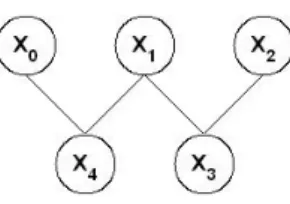
Figure 2: The core and welfare maximising parti-tions do not coincide. The core is ({x0, x1, x2, x3, x4}).
Welfare is maximised by ({x0, x1, x4},{x2, x3}) and
({x0, x4},{x1, x2, x3})
5
Stability Gap
We observed from the empty core game in Figure 1 that maximum welfare partitions are not always stable, and from Figure 2 that stable partitions do not necessarily maximise welfare. We analyse the loss of welfare that comes from being in the core using the notion of stabil-ity gap [Brˆanzei and Larson, 2009]. The worst case and best case performance of a core member are measured by the minimum and maximum stability gap, respectively. The stability gap parallels the prices of anarchy and sta-bility [Nisan et al., 2007] and is defined for games with non-empty cores.
LetP∗be a welfare maximising coalition structure and
PC a member of the core. In the best case, PC is also a welfare maximiser. Since it is possible that no core member attains the welfare ofP∗, the quantity
Gapmin(G) = SW(P
∗)
minP∈Core(G)SW(P)
measures the worst case ratio. We show the worst case bound for the stability gap of social distance games is Θ(√n). In order to get the bound, we use a few lemmas.
Lemma 1. If an agent has utility greater than 1/2 in a coalition, then all its direct neighbours from the same coalition have utility at least 1/4.
Lemma 2. IfP is a partition in the core andx,y two agents adjacent in G, then at least one of x, y attains utility greater than or equal to 1/2in P.
Corollary 2. The welfare of any non-singleton coalition in a core stable partition is at least 1/4of the maximum possible for that coalition.
Theorem 4. Let G= (N, E)be a game with nonempty core. Then Gapmin(G)is in worst case Θ(
√
n).
Proof. Let partitionP∗be welfare maximising andP= (C1, . . . , Ck, S1, . . . , Ss) in the core, where ci ≥ 2, i =
1, k, and |Sj| = 1, j = 1, s. Let Ti, Di, and Fi denote the sets of agents inCiwith utilities strictly greater than
1/2, equal to 1/2, and strictly less than 1/2, respectively. Denote ti=|Ti|,di=|Di|,fi=|Fi|, andci=|Ci|. The
sets Ti, Di, and Fi are disjoint, Ti is non-empty, and
Ti∪Di∪Fi=Ci.
From Lemmas 1 and 2, each singletonSi can only be
ci−1
ci , ∀xij ∈ Ti ⊂Ci. Thus each suchxij can be con-nected (inG) to at mostci−1 singletons, because other-wisexij and the singletons would form a blocking
coali-tion. The number of singletons, s, satisfies the inequal-ity: s≤Pk
i=1ti(ci−1). With Corollary 2 this gives:
Gapmin(G)≤SW(P∗) SW(P) = SW(P ∗) Pk i=1SW(Ci, P) <Pkn i=1ci 4 = 4n n−s
Considernfixed and find an upper bound fors, which in turn gives an upper bound for n4−ns. Observe that each agent in coalition Ci has at mostci−2 singletons connected to it, thusCihas at mostci(ci−2) singletons:
s≤ k X i=1 ci(ci−2)≤ k X i=1 c2i ≤( k X i=1 ci)2= (n−s)2
From s < n and s ≤ (n−s)2, it follows that s ≤
n−√n+ 1/2, and so: Gapmin(G)≤ 4n n−s ≤ 4n √ n−1/2 ∈O( √ n) To complete the proof, we give a Θ(√n) example. Let
Gbe such thatN =C∪S,C={x1, . . . , xc}is a clique,
S ={y1, . . . , ys} an independent set, with|C| =c and |S| =s. In addition, each agent y ∈S is connected to exactly one x∈ C, and each x∈ C has exactly c−2 direct neighbours in S, which we denote asS(x). Thus
s=c(c−2), and son=c2−c. Note that whilencannot
be any integer, there are arbitrarily largenof this form. Solving forcgives
c= r n+1 4 + 1 2 (6)
The optimal welfare partition, P∗, is such that each agentx∈Cforms a coalition with its setS(x). Agentx
has utility cc−−21, while each agent inS(x) gets 1/2. Thus,
SW(P∗) =c c−2 c−1 +c(c−2)1 2 = (c−2)c(c+ 1) 2(c−1) Partition P∗ is not stable because C is blocking, but
P = (C,{y1}, . . . ,{ys}) is in the core. Each agent in C
gets c−1
c , while everyone inS obtains zero: SW(P) =X
x∈C c−1
c =c−1
Using Equation 6, Gapmin(G) =
(c−2)c(c+1) 2(c−1)2 ≈
√
n−1∈
Θ(√n).
Better bounds for the gap can be obtained depending on the underlying graph model. Here we consider dense graphs, which are common in social networks, and show their stability gap is small.
Theorem 5. The stability gap of every graph with m
edges, where m≥ 1 −ε2 2 n2− 1 −ε 2 n (7) is at most 14 −ε, whereε∈[0,1].
Proof. For ε= 0, the inequality simply states that the number of edges is non-negative. For ε= 1, it requires that the graph is complete: m≥ n(n2−1).
We observe that the singletons in the core form an in-dependent set, since otherwise they could organize them-selves into coalitions and improve their welfare by doing so. Letαbe the the independence number of the graph. From the fact that a graph with independence number
α has at most m ≤ n2 − α2
edges, it follows that α
satisfies the inequality α ≤ 1 2 +
q 1
4+n(n−1)−2m
From Inequality 7, we get that α≤εn, and so any core configuration has at most εn singletons. From Corro-lary 2, the welfare of the remaining (1−ε)n agents is at least 1−4εn, and so the gap is bounded as follows: Gapmin(G)< (1 n
−ε)n/4 = 4 1−ε.
The Erd˝os-R´enyi random graph model is perhaps the best known and widely studied method for generating random graphs [Diestel, 2005].
Theorem 6. The expected stability gap of graphs gen-erated under the Erd˝os-R´enyi G(n, p) graph model is bounded by 4
1−2 log(n)/n wheneverp≥1/2.
Proof. It is known that the expected independence num-ber of G(n,1/2) graphs isα≤2 log(n), and in general,
G(n, p) graphs have α ≤ 2 log(n) whenever p ≥ 1/2. Then the gap can be bounded as follows: Gapmin(G)<
n
(n−2 log(n))/4 = 4 1−2 log(n)/n.
6
Alternative Solution Concepts
From Theorem 4, the stability gap can be as high as Θ(√n). In this section we consider several variations of the core with improved social support.
6.1
Stability Threshold
Recall that an agent achieves his best possible utility in a coalition with his direct neighbours and no-one else. Moreover, the improvement function satisfies diminish-ing returns, and so the higher an agent’s utility, the harder it is to improve it. The stability threshold is de-scriptive of situations where agents naturally stop seek-ing improvements once they achieved a minimum value. This is a well-known assumption observed experimen-tally as a form of bounded rationality: choosing out-comes which might not be optimal, but will make the agents sufficiently happy.
We analyse stability for a threshold ofk/(k+1), which is equivalent to an agent forming a coalition with k of his direct neighbours. In this case, there can be at most
least 1/2 in the core, since otherwise the singletons can block with that agent.
Theorem 7. Let G = (N, E) be an induced subgraph game with nonempty core of threshold k/(k+ 1). Then Gapmin(G)≤4if k= 1, and Gapmin(G)≤2kif k≥2.
6.2
The “No Man Left Behind” Policy
From Corollary 2, the core guarantees average utility greater than 1/4 to every non-singleton coalition. Thus the reason for which the core welfare can be low is because there exist networks in which many agents are left alone in equilibrium.
Here we view the formation of core stable structures as a process that starts from the grand coalition and stabi-lizes through rounds of coalitions splitting and merging. While the search for equilibrium can begin from any partition, we observe that initializing with the grand coalition is natural in many situations. For example, at the beginning of any joint project, a group of people gather to work on it. However, as the project progresses, they may form subgroups based on the compatibilities and strength of social ties between them. We formulate a simple social rule that agents have to follow when merg-ing or splittmerg-ing coalitions. That is, whenever a new group forms, it cannot leave behind any agent working alone. We call this rule the “No Man Left Behind” policy. The “No Man Left Behind” code of conduct is well known in the army and refers to the fact that no soldier can be left alone in a mission or abandoned in case of injury.
Theorem 8. LetGbe a game which is stable under the “No Man Left Behind” policy. Then Gapmin(G)<4.
7
Discussion and Related Work
This paper is a step in the direction of understanding network interactions from the perspective of coalitional game theory. We formulated an intuitive mathematical model, analysed its welfare and stability properties, gave an approximation of the optimal welfare, and showed that core stable structures have small world characteristics. We studied the efficiency of the core and studied two solution concepts with improved welfare guarantees. This work can be extended in several ways. We would like to look at power indices and see how the degree and position of a node in the network are correlated with the welfare of that node in the equilibrium. It would be interesting to characterize the extent to which a node contributes to social welfare or to stabilizing the game, and to identify stabilizers in existent networks. It also remains to be determined whether stable structures are small worlds under general utility functions that reflect homophily.
Social distance games are a compact model that can be placed in the general context of hedonic games [Bogomol-naia and Jackson, 2002]. Alonet al. [Alonet al., 2010] propose a graph-based model and uncover the relation-ship between the existence of Nash equilibrium and the graph’s diameter. Bloch and Jackson [Bloch and Jack-son, 2004] analyse network formation games among
play-ers whose payoffs depend on the structure of the network, using the stability notions of Nash equilibrium and pair-wise stability. In their formulation, players derive utility from forming links to other agents in the network, but have to pay explicitely for maintaining those links. Jack-son and Wolinski [JackJack-son and Wolinski, 1996] study a model in which agents are researchers working on several common projects, and the utility of an agent is a function of the number of projects they collaborate on. Aadithya et al.[Aadithyaet al., 2010] propose efficient algorithms for computing a Shapley value-based network centrality. Finally, there exists a rich body of literature investigat-ing the small world phenomenon and the properties of the networks in which it occurs [Kleinberg, 2000].
References
[Aadithyaet al., 2010] K. Aadithya, B. Ravindran, T. Michalak, and N. Jennings. Efficient computa-tion of the shapley value for centrality in networks. In
WINE, 2010.
[Alonet al., 2010] N. Alon, M. Feldman, A. D. Procac-cia, and M. Tennenholtz. A note on competitive dif-fusion through social networks. Inform. Process. Lett., 110(6):221–225, 2010.
[Barabasi and Oltvai, 2004] A-L. Barabasi and Z. N. Oltvai. Network biology: understanding the cell’s functional orga-nization. Nat. Rev. Genet., 5:101–113, 2004.
[Bloch and Jackson, 2004] F. Bloch and M. Jackson. The formation of networks with transfers among players. J. Econ. Theory, 2004.
[Bogomolnaia and Jackson, 2002] A. Bogomolnaia and M. O. Jackson. The stability of hedonic coalition structures. Games Econ. Behav., 38(2):201–230, 2002. [Brˆanzei and Larson, 2009] S. Brˆanzei and K. Larson.
Coali-tional affinity games and the stability gap. InIJCAI, 2009. [Diestel, 2005] R. Diestel, editor. Graph Theory.
Springer-Verlag, Heidelberg, 2005.
[Easley and Kleinberg, 2010] D. Easley and J. Kleinberg, ed-itors. Networks, Crowds, and Markets: Reasoning about a Highly Connected World. Cambridge Univ. Press, 2010. [Gomez et al., 2003] D. Gomez, E. Gonzalez-Aranguena,
C. Manuel, G. Owen, M. del Pozo, and J. Tejada. Cen-trality and power in social networks: a game theoretic ap-proach. Math. Soc. Sci., 46(1):27–54, 2003.
[Jackson and Wolinski, 1996] M. O. Jackson and A. Wolin-ski. A strategic model of social and economic networks.J. of Econ. Theory, 71:44–74, 1996.
[Jackson, 2008] M. Jackson, editor. Social and Economic Networks. Princeton Univ. Press, 2008.
[Kleinberg, 2000] J. Kleinberg. The small-world phe-nomenon: An algorithmic perspective. STOC, 2000. [McPhersonet al., 2001] M. McPherson, L. Smith-Lovin,
and J. Cook. Birds of a feather: Homophily in social net-works.Annu. Rev. Sociol., 27:415–444, 2001.
[Nisanet al., 2007] N. Nisan, T. Roughgarden, E. Tardos, and V. Vazirani, editors.Algorithmic Game Theory. Cam-bridge Univ. Press, 2007.