www.gov.uk/defra
Environmental Reporting Guidelines:
Including mandatory greenhouse gas emissions
reporting guidance
© Crown copyright 2013
You may re-use this information (not including logos) free of charge in any format or medium, under the terms of the Open Government Licence. To view this licence, visit or write to the Information Policy Team, The National Archives, Kew, London TW9 4DU, or e-mail:
PB 13944
Contents
Introduction ... 1
Who is this document for? ... 1
Benefits of reporting ... 1
Legal framework for reporting ... 2
Principles for accounting & reporting environmental impacts ... 3
Chapter 1: Steps in reporting your environmental impacts ... 5
Step 1: Determine the boundaries of your organisation. Do you need to report on all parts of your organisation? ... 6
Step 2: Determine the period you should collect data ... 7
Step 3: What are the key environmental impacts for your organisation ... 7
Step 4: Measuring ... 8
Step 5: Reporting ... 10
Action i: Intensity ratios/normalisation factors ... 12
Action ii: Setting a base year ... 13
Action iii: Setting a target ... 15
Action iv: Assurance and verification ... 15
Action v: Your upstream supply chain ... 17
Action vi: Your downstream impacts ... 18
Action vii: Business continuity & environmental risks ... 18
Recommendations ... 19
Climate Ready ... 20
Chapter 2: Guidance on mandatory reporting requirements for quoted companies ... 22
Is my company required to report? ... 22
What period should I collect data for? ... 23
What must my company report? ... 24
Must I report all my emissions? ... 25
Comply or explain ... 28
Must I use a particular methodology for my calculations? ... 29
Must I show emissions over time? ... 30
Intensity ratios ... 31
Should I get my emissions data verified? ... 32
Example corporate GHG report ... 33
Who will enforce mandatory reporting requirements? ... 34
Chapter 3 – Voluntary greenhouse gas reporting ... 35
Chapter 4: Water ... 44
Why this matters to business ... 44
What to measure and what to report ... 44
Metrics/ Normalisation factors ... 46
What to measure and what to report in your supply chain ... 46
Chapter 5: Waste ... 48
Why this matters to business ... 48
What to measure and what to report ... 48
Metrics/ Normalisation factors ... 50
Chapter 6: Resource Efficiency and Materials ... 51
Why this matters to business ... 51
What to measure and what to report ... 53
Normalisation factors ... 55
Why this matters to business ... 57
What to measure and report ... 58
Chapter 8: Biodiversity and Ecosystem Services ... 62
Why should this matter to business ... 62
What to measure and report ... 64
Annexes ... 68
Annex A: Organisational boundary ... 68
Annex B: Process Emissions ... 73
Annex C: GHG Emissions from Use of Refrigeration, Air Conditioning Equipment and Heat Pumps ... 75
Annex D: Heat, Steam and CHP ... 83
Annex E: Supply chain emissions ... 85
Annex F: Intensity ratios ... 94
Annex G: Emission reduction actions ... 95
Annex H: Example reporting format ... 99
Annex I: Water ... 107
Annex J: Waste ... 112
Annex K: Resource efficiency and materials ... 116
Annex L: Emissions to air, land and water ... 120
1
Introduction
Who is this document for?
This document is designed to help:• companies in complying with the greenhouse gas (GHG) reporting regulation, a requirement from the Climate Change Act 2008; and
• all organisations with voluntary reporting on a range of environmental matters, including voluntary GHG reporting and through the use of key performance indicators (KPIs).
Benefits of reporting
There are direct benefits to your organisation in the measuring and reporting of environmental performance as it will benefit from lower energy and
resource costs,1 gain a better understanding of exposure to the risks of climate change and demonstrate leadership, which will help strengthen your green credentials in the marketplace. You should find it helpful to use
environmental KPIs to capture the link between environmental and financial performance.
Investors, shareholders and other stakeholders are increasingly requesting better environmental disclosures in annual reports and accounts. The number of organisations that are seeking information from their suppliers on
environmental performance is increasing too. Organisations of all sizes are increasingly expected to measure and report on their environmental
performance or risk losing out to competitors who do record their
environmental performance. A 2 provided robust evidence that environmental management systems generally delivered cost savings and new business sales for the majority of the study’ssmall and medium sized enterprises.
1 2011 report for Defra by Oakdene Hollins. The study estimated that the UK savings
opportunities associated with no cost / low cost from resource efficiency activities were estimated at a total of around £23billionin 2009. Resource Efficiency Study
2
Many businesses are finding that their environmental risks are material to their operations and supply chains, or are likely to become so. This may take the form of physical risks from climate change, or business risk from volatile energy and commodity prices. Equally some are finding that early action to address such risks can generate new business opportunities.
(NCC). Natural capital refers to the elements of nature that produce value (directly and indirectly) to people, such as the stock of forests, rivers, land, minerals and oceans. It includes both living and non-living aspects of nature. The NCC is working with businesses (including land owners and managers) to explore the development of corporate natural capital accounting. As part of that work, the NCC is considering the scope for corporate natural capital accounting guidance which would relate to the guidance contained here.
Legal framework for reporting
The Companies Act 2006 (Strategic Report and Directors’ Reports)
Regulations 2013 requires quoted companies to report on greenhouse gas (GHG) emissions for which they are responsible. Quoted companies, as defined by the Companies Act 20063, are also required to report on
environmental matters to the extent it is necessary for an understanding of the company’s business within their Annual Report 4, including where appropriate the use of key performance indicators (KPIs).5 If the Annual Report does not contain this information, then it must point out the omissions.
Some public bodies are required or may need to consider reporting GHG or environmental issues under other legislation or commitments, for example:
3 A quoted company is defined in section 385(2) of the Companies Act 2006 as a company
that is UK incorporated and whose equity share capital is listed on the Main Market of the London Stock Exchange UK or in an EEA State, or admitted to trading on the New York Stock Exchange or Nasdaq.
4 The Companies Act 2006 (Strategic Report and Directors’ Report) Regulations 2013 will
create a new structure for annual reports. Companies will be required to report on the impact of the company on the environment within a new section - the strategic report.
5 Environmental Key Performance Indicators (KPIs) are quantifiable measures that reflect the
environmental performance of an organisation in the context of achieving its wider goals and objectives. The focus is on ‘key’ measures i.e. those most important to an understanding of an organisation. You probably already collect a lot of data required to report on environmental KPIs, either because it is calculated from standard organisational data, such as utility bills, or because of existing regulatory requirements.
3
• Government departments, non-ministerial departments, agencies and Non-Departmental Public Bodies must report as a minimum certain GHG emissions in their Annual Reports as part of their statements on sustainability performance.6
• Local authorities in England have been requested by Government to measure and report their GHG emissions from their own estate and operations.7
The Environment Agency and the Institute of Chartered Accountants in England & Wales have published and those preparing and auditing annual financial statements to help them in
understanding what is required to be reported and how this relates to the latest statutory financial accounting and reporting standards8.
You can use this guidance to report your environmental impacts alongside social impacts and community involvement in an integrated report. Integrated reporting communicates material information about how your organisation’s strategy, governance, performance and prospects, in the context of its
external environment, lead to the creation of value over the short, medium and long term. Further detail on integrated reporting can be found at
Principles for accounting & reporting
environmental impacts
The following principles should be applied when collecting and reporting on environmental impacts9:
6 HM Treasury, Public Sector Annual Reports: Sustainability Reporting Guidance For 2011-12
Reporting
7 Via a letter to local authorities, see:
https://www.gov.uk/sharing-information-on-greenhouse-gas-emissions-from-local-authority-own-estate-and-operations-previously-ni-185
8 Environmental reporting and annual financial reports –
www.environment-agency.gov.uk/environmentalfinance
9 Drawn from accounting principles and the internationally-recognised Greenhouse Gas
Protocol Corporate Accounting and Reporting Standard from the World Resources Institute and World Business Council for Sustainable Development, known as the “GHG Protocol Corporate Standard”.
4
Relevant: Ensure the data collected and reported appropriately reflects the environmental impacts of your organisation and serves the decision-making needs of users—both internal and external to your organisation.
Quantitative: KPIs need to be measurable. Targets can be set to reduce a particular impact. In this way the effectiveness of environmental policies and management systems can be evaluated and validated. Each chapter provides the details for that subject area. Quantitative information should be
accompanied by a narrative, explaining its purpose, impacts, and giving comparators where appropriate.
Accuracy: Seek to reduce uncertainties in your reported figures where practical. Achieve sufficient accuracy to enable users to make decisions with reasonable confidence as to the integrity of the reported information.10 Completeness: Quantify and report on all sources of environmental impact within the reporting boundary that you have defined. Disclose and justify any specific exclusions.
Consistent: Use consistent methodologies to allow for meaningful
comparisons of environmental impact data over time. Document any changes to the data, changes in your organisational boundary, methods, or any other relevant factors.
Comparable: Companies should report data using accepted KPIs rather than organisations inventing their own versions of potentially standard indicators. The narrative part of a report provides the opportunity for a company to discuss any tensions which exist between providing comparable data and reporting company-specific KPIs. Use of accepted KPIs will aid you in
benchmarking your organization and will aid users of your report to judge your performance against that of your peers.
Transparent: This is essential to producing a credible report. Address all relevant issues in a factual and coherent manner, keeping a record of all assumptions, calculations, and methodologies used. Internal processes, systems and procedures are important and the quantitative data will be greatly enhanced if accompanied by a description of how and why the data are
collected. Report on any relevant assumptions and make appropriate references to methodologies and data sources used. There is more on transparency in Step 5 on reporting.
5
Chapter 1: Steps in reporting your
environmental impacts
This section covers the steps to take when considering your environmental impacts and which KPIs to report on. For simplicity we have laid this out into 5 key steps and 7 supporting actions.
As a starting point you should work through steps 1 – 5 in order to report on your key environmental impacts.
Step 1 Determine the boundaries of your organisation. Step 2 Determine the period for which you should collect data
Step 3 Determine the key environmental impacts for your organisation Step 4 Measure
Step 5 Report
We recommend you develop and report at least 3 KPIs associated with your key environmental impacts.
You should then consider actions i – vii (below) which provide you with information to help you develop your environmental strategy.
Action i Intensity ratios Action ii Setting a base year Action iii Setting a target
Action iv Verification & assurance Action v Your upstream supply chain Action vi Downstream impacts
6
Working through these steps will enable you to present a summary of your environmental findings in relation to your organisation’s activities and what you did to improve your performance. You should be clear how any targets reflect regulations or international standards. Provision of a narrative description of your actions, highlighting any key developments for the year and giving specific case studies relevant to your organisation will help provide a more comprehensive view of your organisation’s environmental
performance and strategy.
Step 1: Determine the boundaries of your
organisation. Do you need to report on all parts
of your organisation?
Define the operations on which you are going to report, i.e. set your
organisational boundary. If you have a simple organisational structure and own 100% of the assets that you operate, it is straight-forward: you would report on the impacts from everything that you own and operate. However, for organisations with more complex structures in which some entities may be part-owned, or owned but not operated and vice versa, a different approach is needed that should be applied consistently throughout the organisation.
Boundaries are described below with more detail given in Annex A.
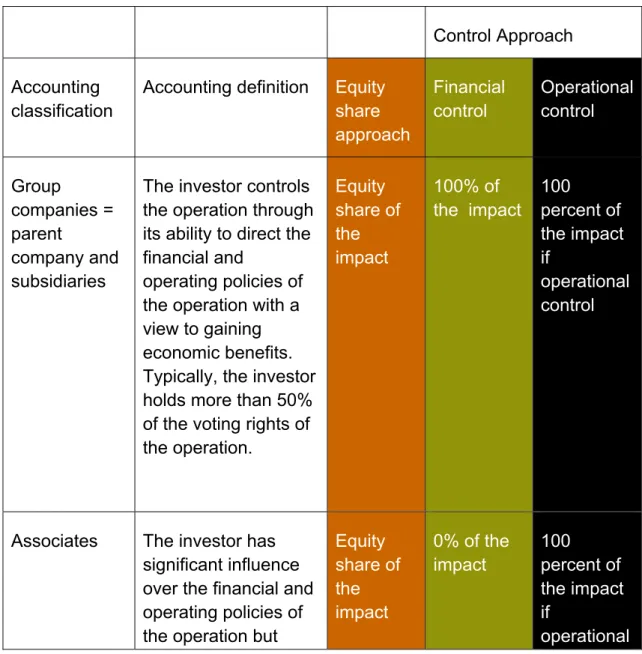
Financial control boundary
Your organisation reports on all sources of environmental impact over which it has financial control. Your organisation has financial control over an
operation if your organisation has the ability to direct the financial and operating policies of the operation with a view to gaining economic benefits from its activities.
Operational control boundary
Your organisation reports on all sources of environmental impact over which it has operational control. Your organisation has operational control over an operation if your organisation or one of its subsidiaries has the full authority to introduce and implement its operating policies at the operation.
7
Your organisation accounts for GHG emissions from operations according to its share of equity in the operation.
Climate Change Reporting Framework
The Framework (CCRF) sets out an approach to boundary setting that seeks to align with the boundaries used for financial reporting. Although it has been written for reporting climate impacts, it can be used for reporting other
impacts. GHG emissions from entities that you operate but are not included in the consolidated financial statement are reported separately according to the CCRF. This approach has the advantages of providing a comprehensive set of data that aligns with other reporting practices.
The next step is to identify all of the reporting units that are within the boundary. A reporting unit can be all or part of a subsidiary company, joint venture, investment, facility, etc. Reporting units should be selected to represent the smallest practical building blocks to allow data to be reported. Other impacts associated with your organisation’s activities lie outside of the boundary e.g. your supply chain. Further information regarding this can be found under actions v and vi in this chapter.
Step 2: Determine the period you should collect
data
Your reporting period should be for 12 months and should ideally correspond with your financial year because this allows for easier comparison of your financial performance with other aspects of your performance. Where they are different though, the majority of your environmental reporting year should fall within your financial year.
Step 3: What are the key environmental impacts
for your organisation
The next step is to understand which environmental issues are key and to do this you need to understand the extent of the impacts of your organisation. The “polluter pays principle” assigns responsibility to those parties that directly cause the pollution or use a natural resource. Using this model, emissions
8
caused or resources used directly by your organisation fall under your direct responsibility; all other impacts are indirect (see Actions v and vi).
Your Key Performance Indicators
Through understanding your own organisation’s operations you should have a clear understanding of where your main environmental impacts occur. These are likely to fall into one or more of six categories:
• Greenhouse gases
• Water
• Waste
• Materials and resource efficiency
• Biodiversity/ecosystem services
• Emissions to air, land and water
Not all six will be relevant (material) to your organisation. You should identify which are and explain why they are relevant and how they are defined. There are UK and EU regulations covering these issues and, in general, for any KPI of interest to your organisation you need to ensure that you are also
complying with any relevant legislation.
Step 4: Measuring
There are a number of ways to collect and manage data at a corporate level. This could include direct entry of data by operational staff onto secure internet or intranet databases; or standard spreadsheet templates completed and emailed to a central point where data can be processed. Using a standardised reporting format is recommended to ensure that data received from different business units and operations is comparable. Ideally, environmental reporting should be integrated into your existing reporting processes.
Your efforts to collect the best quality data should be focused on the most important sources. This assessment might be based on:
• Magnitude or size
9
• Potential ability to influence impacts
• Importance to your business
• Importance to stakeholders
Where possible, it is better to use primary data to calculate your KPIs. However, in some cases data may not be available or of sufficient quality in which case secondary data, such as industry-average figures, proxy data and extrapolation, may need to be used. This is acceptable where:
• you are transparent about your approach; and
• the data used is adequate to support the objectives for which you are measuring and reporting.
You should establish a quality management system to provide a systematic process for preventing and correcting errors in your organisation’s
environmental data11.
If you do estimate data, we recommend that you are transparent about the estimation technique used and apply quality measures such as comparing your estimated data to historical data to ensure that it falls within a reasonable range.
The six environmental impact categories (above) form the subject chapters of this guidance and provide specific guidance on measuring and reporting.
Environmental Management Systems
The most widely used form of ensuring good data management is by the use of an Environmental Management System (EMS). EMSs help all types and sizes of organisations to meet their own environmental and sustainability targets. If you have an accredited EMS, you should state the type and whether it covers your entire organisation or just part in your reporting. Three types of formal environmental management systems are recognised in the UK:
12
11 For further practical advice on data collection at a corporate level, please refer to Chapter 6
of the GHG Protocol: A Corporate Accounting and Reporting Standard (Revised Edition) or Section 3 of the Institute of Environmental Management and Assessment (2005)
10
Some of the other step-by-step systems that exist are the Green Dragon Environmental Standard, Steps to EMS (STEM), IEMA’s Acorn Scheme and Eco Campus.
EMS objectives and targets can be used to show a company’s progress against stated plans and goals, including:
• quantitative targets based on outcomes, such as reduction of emissions or incidents;
• quantitative or qualitative objectives in terms of inputs, such as completion of management system initiatives by a planned date;
• annual progress measured against a commitment to continuous improvement; or
• case studies providing evidence of programmes planned across a specified period.
Alternative approaches to undertaking a structured assessment of an organisation’s environmental performance are available from the Sustainable Development .
Step 5: Reporting
Transparency is essential to producing a credible report. You should present your information in a balanced and transparent fashion. Celebrate success but also avoid glossing over negative environmental impacts or poor performance against targets.
1. Your report should summarise how you have carried out each of the steps listed above and the outcome from each.
Be clear about:
12 http://www.iema.net/ems for information on ISO 14001, EMAS and BS 8555
11
• why you have collected the data;
• how you have gone about it, such as the assumptions, methodologies, and reference data used;
• to which parts of your organisation the data relates.
You should explain if you are not reporting data for some sources of
environmental impacts within your chosen reporting boundary, whether they are from a geographical area, type of equipment or activity.
Trends in impacts should be clear to the reader. Use units consistently. Give:
• progress against targets, whether improvements or set-backs have occurred and how these are being tackled;
• information relating environmental performance to financial
performance. This should include environmental expenditures, e.g. more efficient production processes, recycling facilities, the
reclamation/ rehabilitation of land to a more natural state, or investment in projects in the local community.
2. Explain how you are managing your impacts i.e. EMAS, ISO 14001 and who has responsibility for this.
3. Identify the risks and opportunities that arise from your impact on the environment and from the environment’s impact on you through, for example, climate change. Be clear whether your organisation has been subject to any environmental fines. The date, location, reason and amount of fine should be stated.
4. Explain internal processes to manage and report risk. Develop a plan or strategy that addresses these risks and opportunities and fits with your business strategy or is integrated with it and report on this plan. Explain how the information you have gathered is used to support corporate decision making. Use case histories to illustrate your actions and approach.
12
Action i: Intensity ratios/normalisation factors
When presenting the detail of your KPIs, they should be expressed inabsolute terms but it is also helpful if you use a normalising factor in reporting your data. Environmental impacts data can be normalised by dividing the impact you are reporting on (whether tonnes of waste or emissions) by an appropriate activity metric (e.g. units produced, Full Time Equivalent staff) or financial metric (£ million turnover). The resulting normalised data is called an intensity ratio. Two commonly used normalising factors are turnover and production output; but there are others which may be relevant, for example companies with offices or retail operations may normalise to floor space. Normalising your data is useful because it facilitates:
• Comparison over time
• Comparison across different organisation sectors and products
This allows stakeholders to know how much environmental impact companies have relative to a given amount of goods and/or services produced.
Normalised data can be particularly helpful in demonstrating environmental improvements in a growing organisation.
An activity ratio is suitable when aggregating or comparing across
organisations that have similar products. A financial ratio is suitable when aggregating or comparing across organisations that produce different
products. We recommend you use the intensity ratio that is most relevant to your organisation and will provide the most context to users of this
information. If your organisation has many varied organisational operations e.g. a travel company which owns its own planes and also owns its hotels you should consider calculating separate activity ratios for each activity i.e. one for the planes and one for the hotels.
When reporting, the simplest method is to present data on a clear and
transparent like-for-like basis. So if the product lines are much the same and output has increased, then a normalised approach, with the factor in number of units or weight, as appropriate, will be sufficient especially if backed up with absolute figures in order to understand the scale of the impact as well as the direction of change. If a ‘value of output’ measure has to be used, then it should be a volume measure (i.e. adjusted for relevant price changes).
13
Action ii: Setting a base year
To maintain meaningful and consistent comparison of your data and KPIs over time, you will need to set targets and choose and report on a base year. A base year gives you a point against which you can compare your current data and you should choose the earliest year for which you have data. Your base year may be13:
• a fixed or single base year
• an average of a range of years in order to smooth out year-on-year fluctuations
• a rolling base year
A base year is an important benchmark and you should explain the reasons behind your choice. It is recommended that if you set a fixed base year, you also determine your base year recalculation policy. The following are
instances when you might need to recalculate a single base year:
Structural changes that have a significant impact on the organisation’s base year figures, such as the transfer of ownership or control of relevant activities or operations from your organisation to another. While a single structural change might not have a significant impact on the base year figure, the cumulative effect of a number of minor structural changes can result in a significant impact. Structural changes include:
• Mergers, acquisitions, and divestments
• Outsourcing and insourcing of relevant activities
• Changes in calculation methods or improvements in the accuracy of factors, such as emission factors, or activity data that result in a significant impact on the base year figures.
• Discovery of significant errors, or a number of cumulative errors that are collectively significant.
Develop a base year recalculation policy
13
The implications of these different options are discussed in chapters 5 and 11 of the GHG Protocol Corporate Standard and are applicable to other environmental impacts other than GHG emissions.
14
You will probably not want to recalculate your fixed base year to take account of every change in circumstances. So you will need to determine your policy and set a threshold over which a recalculation is triggered under different scenarios. In determining your threshold for the different scenarios, you should take into account the cumulative effect on your base year figure of different changes. You may wish to recalculate data for all years between the base year and the reporting year or just the prior year and the reporting year following a base year recalculation.
In some circumstances, it may be simpler to roll your base year forward to your current reporting year following very large structural changes or mergers. Once your organisation has developed its policy on how it will recalculate base year figures for your KPIs, you should apply this policy in a consistent manner.
Determine whether the base year needs to be recalculated
Update your base year in line with the criteria below and when the changes meet your significance threshold.If you acquire a facility which existed in your base year, recalculate your base year if the emissions were not included in your base year figures and will be included in your current year’s figures. For outsourcing, recalculate your base if the figures from the outsourced activity were included in your base year figures and will not be included anywhere in your current year’s figures. If you acquire/dispose of a facility from another company, you recalculate your base year to include/exclude respectively the figures from the new facility at the level they were in your base year.
You should not recalculate your base year where you acquire (or insource) and divest (or outsource) operations that did not exist in your base year. Transfer of ownership/ control of relevant activities, including changes in leased status, should be treated in the same way as acquisitions and disposals.
You do not need to recalculate base year to take account of economic growth or decline, changes in production output or product mix, and closures and openings of operating units owned or controlled by your organisation. Changes in methodologies, improvements in the accuracy, or discovery of previous errors would trigger a recalculation.
15
If a recalculation of the base year is required for a structural change which occurred in the middle of the reporting year, it is recommended that base year figures are recalculated for the entire year not just the period from the
structural change onwards. If it is not possible to recalculate in that reporting year due to lack of data, recalculation can be carried out in the following year.
Action iii: Setting a target
Once you have your data, set a target. There are a number of good business reasons to do this such as improving cost and resource efficiency. It is important to obtain senior management commitment to the target as this will establish internal accountability for your targets; create an incentive system, and provide resources to meet your target. You should set a target date that will drive strategic change within your business.
There are two types of target:
• an absolute reduction target which compares absolute figures in the target year to the base year;
• an intensity target based on an appropriate normalising factor (e.g. water consumption per tonne of product, CO2e emissions per Full Time Equivalent staff member).
An absolute target is designed to achieve actual reductions in environmental impact. Organisational growth has to be decoupled from the environmental impact in order to achieve an absolute target. In contrast, an intensity target can drive resource efficiency and relative environmental impact, but the total resource use/impact may actually increase even if an intensity target has been reached due to increases in organisational activity e.g. production.
Action iv: Assurance and verification
Assurance and verification of reported sustainability and environmental data is a component of a responsible reporting approach. There is a reputational risk in disclosing misleading data and assurance provides a check on the value and authenticity of the data in the public domain. While there are many methodological approaches to sustainability/ environmental assurance, the key components of a robust assurance statement, are that it should:
• Clearly reflect the scope of matter material to both your company and your stakeholders
16
• Transparently review the quality of your disclosures
• Provide clear conclusions on data quality and processes
• Be conducted by a qualified, independent third party reviewer
• Meet the requirements of a recognised standard
• Be easily understood and jargon free.
There are two internationally-recognised standards for the verification of sustainability reports that are ideally used together as they complement one another.
• International Audit and Assurance Standards Board’s ISAE3000 “Assurance engagements other than audits or reviews of historical financial information’.
• AA1000AS14 from AccountAbility (the Institute of Social and Ethical AccountAbility). AA1000AS is a free, open source set of principles which addresses sustainability and CSR aspects of reports.
GHG emissions reports CDP also the verification process.
There is no statutory requirement to have your environmental information audited. The statutory auditor of the financial statements is not required to verify environmental information in the strategic or directors’ reports within the annual report, but an auditor will be required to consider:
• whether the information is consistent with the financial statements15; and
• whether the information is materially incorrect or materially inconsistent with the financial statements based on the knowledge acquired by the auditor in the course of performing the audit16; and
15 S496 Companies Act 2006 and ISA (UK and Ireland) 720 Section B. 16 ISA (UK and Ireland) 720 Section A (Revised October 2012).
17
• the need to qualify their report if they become aware of such an
inconsistency or apparent misstatement, and that matter is unresolved. In addition, whilst they are not required to consider whether the
strategic and directors’ reports comply with the relevant laws and regulations, if they become aware of any material non-compliance (which might include becoming aware of failure to provide material environmental data), then they would need to discuss the matter with management and those charged with governance.17
Where your company publishes a separate environmental or sustainability report, your auditor is not required to read it although they may consider it as contributing to a knowledge of the business18.
Action v: Your upstream supply chain
The indirect environmental impact of your supply chain may be greater than your own impact. Engaging with your supply chain can provide you with
valuable information to inform a strategic assessment of where, in your supply chain, the most significant environmental impacts are occurring.
There is no single, quantifiable measure that you can use as a KPI for the effect of your upstream supply chain on the environment but you can use the environmental information that your suppliers’ report in order to make better procurement decisions. The following is an example of a process that can be used to determine the impacts upstream in the supply chain:
• Identify companies from which goods and services are purchased.
• Categorise your expenditure into sector groupings.
• Assess the typical environmental impacts and risks for each sector.
• Determine where to focus your efforts. Clearly some suppliers, even suppliers in the same sector, have more significant environmental impacts than others. It is important to prioritise your suppliers in a way that takes into account both the amount of money you spend with them and relative environmental impact.
17 ISA (UK and Ireland) 250 Section A.
18 ICAEW & Environment Agency (2009) Turning questions into answers: Environmental
18
• Engage with your suppliers. Encourage your suppliers to report on the key impacts.
• Influence purchasing decisions with the information gathered. Improvements In your suppliers’ environmental performance will be more likely if they know that their environmental performance is a factor in your organisation’s buying decisions.
• Consider post-contract supplier development to focus on engaging suppliers in continuous improvement in environmental management.
Action vi: Your downstream impacts
Whilst identifying key performance indicators for downstream environmental impacts is beyond the direct scope of this guidance, there are some issues that you should consider, for example, water use in washing machines, electricity use of TVs, etc. In some cases there are specific legal
requirements associated with managing the end-of-life phase of products e.g. batteries, electrical equipment and cars. You should consider disclosing information on both the financial risks represented by any liabilities associated with managing end-of-life disposal, and narrative disclosures on level of
engagement with those organisations involved in the recycling or reuse of the particular products.
Action vii: Business continuity & environmental
risks
The compelling and growing evidence on climate change points to the need for drastic and urgent action to reduce emissions of greenhouse gases. But this alone will not suffice: substantial changes to our climate are already unavoidable. Even with urgent greenhouse gas emissions reductions, scientists expect that the world will face rising temperatures and, in many places, increasingly frequent and severe weather impacts due to climate change.
These changes will have profound effects on many aspects of our lives in the UK. For example, there is a greater threat of droughts, floods and heatwaves, with extreme weather events becoming more frequent. Sea levels are rising and, in the future, the rate of rise will accelerate; some familiar species will disappear and new alien species will arrive—for better or worse. The
19
international impacts are likely to affect food security, migration patterns, natural ecosystems, production and supply.
These changes will only emerge erratically over the coming years and decades, but they require action now. For the business sector, this means managing those risks and discovering new opportunities, to maintain a competitive edge. Forward planning rather than reacting to extreme weather events as they occur is essential. This process of adjusting to the changes in our climate is called adaptation and should be part of any strategy on climate change.
There are three elements of adaptation:
• to reduce exposure to the risk of damage;
• to develop the capacity to cope with unavoidable damages;
• to take advantage of new opportunities.
Effective adaptation to climate change requires sound risk management and strengthening business resilience.
Recommendations
1. Include an evaluation of climate risks in your company’s overall assessment of business risks.
2. Cover the following areas in your climate risk evaluation:
• supply chains;
• assets;
• operations;
• markets;
• regulatory compliance
3. Focus your climate adaptation strategies on actions that fit within broader sustainability strategies and that deliver savings (in resource use and running costs) in their own right.
20
4. Include actions you have taken on climate change adaptation in your annual report.
The level and type of response will depend largely on the exposure of your business: whether responding to direct risks to core operations, or indirect risks via supply chain or other dependencies. You will need to utilise expertise across your organisation—among sustainability, procurement, business continuity and environment managers - to develop your adaptation strategy.
The impacts of climate change will be widespread and affect networks on which you rely. Explore how you can work with external partners to contribute to increased climate resilience. Partners with a mutual interest in ensuring climate security could include suppliers, customers, other local businesses, local authorities, and others in your sector.
Being ready for climate change is also about making sure you identify new ways and better ways to do business. There will be demands for new products and services; the demand for some existing products will grow. Customers will want to be confident that you will be able to deliver whatever the weather. Taking a lead in the development of new climate adaptation technologies and expertise could also open up new markets for UK firms internationally. Financial institutions, for example, are at the centre of efforts to evaluate climate vulnerability and act on the risk to investments it poses. Some major banks have undertaken research to support investment
managers to incorporate climate-related risks in assessments of investment portfolios.
Climate Ready
The Environment Agency has a role to provide advice and support to businesses, public sector and other organisations in England to help them adapt to a changing climate. Its aim is to help key sectors increase their resilience to climate risks. Organisations based in Scotland should contact Adaptation Scotland or the Scottish Environment Protection Agency (SEPA) for advice. The Environment Agency is working closely with Defra as part of Climate Ready—the Government's national programme for adaptation. The Environment Agency has information and tools to help business adapt. Sign up to their Climate Ready e-bulletin. For more information on the risks the UK faces from climate change and the actions underway in Government visit the website.
21
The report provides further details and case studies of how FTSE 100 companies have adapted to climate risks.
22
Chapter 2: Guidance on mandatory
reporting requirements for quoted
companies
Under the Companies Act 2006 (Strategic and Directors’ Reports) Regulations 2013 quoted companies are required to report their annual emissions in their directors’ report.
This section specifically applies to those companies affected by the regulation. It sets out both the requirements of the regulation and also outlines additional information that is likely to be useful to data-users.
Is my company required to report?
Quoted companies in this respect are those that are UK incorporated and whose equity share capital is officially listed on the main market of the London Stock Exchange; or is officially listed in a European Economic Area; or is admitted to dealing on either the New York Stock Exchange or NASDAQ. Companies within the scope of the regulation must adhere to its requirements. If you are a company or organization not affected by these regulations you are recommended to report voluntarily in line with the voluntary accounting & reporting guidance in the following chapter of this document. Quoted
companies may also choose to report in line with that guidance in addition to meeting the regulatory requirements.
When will my company have to start reporting?
The requirement comes in to place for company reporting years ending on or after 30 September 2013. You will need to check what reporting year yourDetermine whether you are a quoted company required to report within the terms of the regulation. Check with your finance director or company secretary if you are unsure.
23
company uses. This refers to the year-end date, not the date of publication of the directors’ report.
Your usual
financial year
Your first reporting year under the
regulation
1 January to 31 December
1 January 2013 to 31 December 2013
1 April to 30 March 1 April 2013 to 30 March 2014
1 October to 30 September
1 October 2012 to 30 September 2013
Depending on your financial year, your company might be required to report data on emissions that occurred before the regulation was made. If you do not have the information necessary to meet the regulatory requirement in the first reporting year, you must either:
• provide an estimation instead, based on extrapolating data that you do have, or use generic data that is not specific to your company. You are required to disclose your methodology and this would form part of your methodology; or
• explain why you are unable to provide 12 months’ data19.
What period should I collect data for?
You should ideally report on emissions for the period corresponding with your company’s financial year. You may report emissions for a different twelve month period to your financial year but you must state in the directors’ report if
19 See Companies Act 2006 (Strategic Report and Directors’ Reports) Regulations 2013
24
you have done so20. For example, company A historically reports emissions
data on a calendar year basis whereas their financial year is April to March. In this example company A could either continue to report emissions on a calendar basis or switch to reporting emissions on a financial year. If you report emissions for a different period to your financial year, the majority of your emission reporting year should still fall within the period in directors’ report.
What must my company report?
Under the regulations quoted companies are required to report on their greenhouse gas emissions from activities for which they are responsible. Many companies have established reporting practices using GHG accounting accounting approaches cover emissions from activities for which they are responsible. The next step is to consider the requirements of the directors’ report as this is the context in which greenhouse gas emissions information must be reported. The directors’ report contains information relating to operations21 covered by the consolidated financial statement. That includes their operations both in the UK and abroad.
If companies consider that reporting emissions from activities for which they are responsible means that they will:
• Not report on GHG emissions from certain operations covered by the consolidated financial statement; or
• Report on GHG emissions from operations that are not included in this statement
20 See Companies Act 2006 (Strategic Report and Directors’ Reports) Regulations 2013
paragraph 19.
21Please note that the term “operations” is used here as a generic term to denote any kind of
business activity, irrespective of its organizational, governance, or legal structures.
Quoted companies may use a reporting time period that does not
25 they must make this clear.
Readers of the emissions data should have a clear understanding of the operations for which emissions data has been reported and if and how this differs from operations within the consolidated financial statement.
For example, you may conclude that you have responsibility for the GHG emissions of one of your associate undertakings, hence include them in your inventory even though you do not consolidate but equity account for that associate in your consolidated accounts: you must explain this. Alternatively you may consolidate a subsidiary for the purposes of preparing financial statements but conclude that you are not responsible for the greenhouse gas emissions from that subsidiary (because for example, the GHG-emitting activities have been outsourced and are under the control of a third party). In those circumstances you may exclude the GHG emissions from the directors’ report but you must explain why.
Must I report all my emissions?
You are required to quantify and report on emissions of the following greenhouse gases22 - carbon dioxide (CO2), methane (CH4), nitrous oxide
(N2O), hydrofluorocarbons (HFCs), perfluorocarbons (PFCs) and sulphur
hexafluoride (SF6). (But see later guidance for a discussion of materiality.)
You are not required to give individual figures for emissions of each of the GHGs listed. Indeed few companies will emit all of the GHGs listed. However, you must state in your directors’ report the annual quantity of GHG emissions
22 As defined in section 92 of the Climate Change Act 2008
Quoted companies must report on emissions from activities for which they are responsible.
26 in tonnes23 of carbon dioxide equivalent24 (CO
2e) from the following emission
sources25:
a) the combustion of fuel, e.g.:
• Stationary combustion: combustion of fuels in stationary equipment such as boilers, furnaces, burners, turbines, heaters, incinerators, engines, flares, etc.
• Mobile combustion: combustion of fuels in transportation devices such as automobiles, trucks, buses, trains, airplanes, boats, ships, barges, vessels, etc.
b) the operation of any facility
This category is not limited to emission sources that are permanent or land-based or stationary. This category would also include emission sources that are: mobile; temporary e.g. mobile offices; and marine-based e.g. oil
production platforms. The following types of sources of emissions should be considered when identifying emissions on which to report26:
• Process emissions: emissions from physical or chemical processes such as CO2 from the calcination step in cement manufacturing, CO2
from catalytic cracking in petrochemical processing, PFC emissions from aluminum smelting, etc.
• Fugitive emissions: intentional and unintentional releases such as equipment leaks from joints, seals, packing, gaskets, as well as fugitive emissions from coal piles, wastewater treatment, pits, cooling towers, gas processing facilities, etc.
c) a separate figure giving the annual quantity of emissions in tonnes of carbon dioxide equivalent resulting from the purchase of electricity, heat, steam or cooling by the company for its own use.27
23 Tonnes or metric tons
24The Climate Change Act 2008 says a “tonne of carbon dioxide equivalent means one metric
tonne of carbon dioxide or an amount of any other greenhouse gas with an equivalent global warming potential (calculated consistently with international carbon reporting practice).”
25 See Companies Act 2006 (Strategic Report and Directors’ Reports) Regulations 2013
paragraph 15(2).
26 This list is taken from page 41 of the GHG Protocol Corporate Accounting and Reporting
Standard.
27 See Companies Act 2006 (Strategic Report and Directors’ Reports) Regulations 2013
27
In the case of companies that are lessees of an emission source, they should decide if they have responsibility for that emission sources e.g. electricity28 use within the building. This determines whether
companies must report emissions associated with the electricity29, rather than their method of payment. (Refer to earlier section on “What must my company report” for a discussion on boundaries of reporting). If you decide that you do have responsibility for emissions either as a lessee or as a lessor, but cannot get the consumption data necessary to calculate the emissions, then you may either estimate the emissions or state that emissions from the building are excluded and explain why (see the section on “Comply or explain”).
The totals arrived at from the above are similar respectively to scopes 1 and 2 of the GHG Protocol Corporate Standard and the direct emissions and energy indirect emission categories of ISO 16064-1.
You are not required to report on other emissions associated with inputs into your company (such as emissions from your supply chain) or emissions linked with outputs from your company (such as emissions from your products when they are used by your customers). However, you should consider reporting these separately to give a wider picture of your organisation to investors and shareholders (See the recommendations on scope 3 emissions in the
following chapter on voluntary reporting).
Having established the activities for which you are responsible, you may also wish to consider whether particular emissions are material to the total of your company emissions. Materiality will depend on the circumstances of your individual company. It will be influenced by issues such as the size and nature of an operation. It is for you to judge whether an emission is material or not.
28 Or heat, steam or cooling.
29 Electricity traders would not report the emissions from electricity that they bought for re-sale
within this category, although they could report these emissions as a separate, optional information item. See the voluntary accounting and reporting guidance for how to account for emissions associated with the use of electricity, heat, steam or cooling generated by another organisation, which you do not pay for. This is more likely to occur with heat where the generating organisation has surplus heat that it passes to another organisation rather than waste it.
28
The ‘characteristics of materiality aim to provide a ‘workable filter on
information, allowing investors to see major trends and significant events’30 and eliminate ‘immaterial clutter’ and ‘unnecessary or duplicative detail that obscures major trends and events’31. In considering which emissions are material to your company, you may wish to consider whether the collection and reporting of certain emissions or operations would provide additional value for users in the context of your company’s overall emissions data and management.
Comply or explain
You must make every reasonable effort to acquire all material data to comply with the regulations. However, there may be circumstance where you find it difficult to compile all necessary data in a timely manner to comply with reporting requirements, e.g. because of significant restructuring or
acquisitions by your company in the run up to producing your directors’ report. Should you be in the situation where you cannot report on all material
emissions for which you have responsibility, you must state what is omitted and explain why in your directors’ report32. It is recommended that you set
out the steps you are taking to acquire the information.
30 Climate Change Reporting Framework – Edition 1.1 September 2012. Climate Disclosure
Standards Board.
31
ibid
32 See Companies Act 2006 (Strategic Report and Directors’ Reports) Regulations 2013
paragraph 15(4).
Quoted companies must report on all material emissions of the 6 Kyoto gases from direct sources and from purchased electricity, heat, steam and cooling.
Quoted companies must state in their directors’ report if they have omitted any material emissions.
29
Must I use a particular methodology for my
calculations?
There is no prescribed methodology under the regulations, but for effective emissions management and transparency in reporting it is important that you use robust and accepted methods. It is recommended that you use a widely recognized independent standard, such as:
•
• The WRI / WBCSD
• UK Government’s Environmental Reporting Guidance (2013 version) There are also reporting approaches and programs based on or drawn from the Greenhouse Gas Protocol,
including:
•
•
CDP has developed a list of commonly cited methodologies, protocol and standards33. There may be existing methodologies developed by certain sectors, such as those for the petroleum industry34. Companies within those
sectors may wish to consider using sectoral methodologies where appropriate.
You may use relevant information from other domestic and international regulatory reporting processes to fulfill your mandatory reporting obligations in your directors’ report. Data from the following may be useful:
• Climate Change Agreements (CCA)
• The EU Emissions Trading Scheme (EU ETS)
33 Guidance for companies reporting on climate change on behalf of investors & supply
chain members 2013See Q7.2
34The International Petroleum Industry Environmental Conservation Association(IPIECA)
30
• The Carbon Reduction Commitment Energy Efficiency Scheme (CRC Energy Efficiency)
• Reporting or disclosure schemes in other countries
If you have used data compiled in fulfillment of other regulatory requirements, then state this as one of the methodologies that you have used to make your report.
If you decide to use information from regulatory schemes, you need to consider whether additional data is needed to satisfy these GHG reporting requirements. Data under other schemes may only cover some of your organisation’s GHG emissions and only give part of the required information. For example the CRC Energy Efficiency scheme only applies to certain emissions in the UK and only covers carbon dioxide, so the electricity figure calculated under CRC Energy Efficiency would be different to one calculated under the UK Government’s voluntary reporting guidelines or GHG Protocol Corporate Standard. You will need to consider where the data you have collected needs to be supplemented with additional information.35
You must state in your directors’ report the methodology or methodologies used36.
Must I show emissions over time?
Reporting of previous years’ emissions with your latest information provides readers with the ability to see trends in your emissions over time.
With the exception of the first mandatory reporting year, you must repeat the emissions data disclosed in your previous report alongside information on
35 Methane and nitrous oxide are emitted in small amounts when fuel is combusted to
generate electricity. Companies that have already calculated their emissions from purchased electricity using the CRC Energy Efficiency’s emission figures should decide whether
emissions of these gases are material and therefore warrant recalculation.
36 See Companies Act 2006 (Strategic Report and Directors’ Reports) Regulations 2013
paragraph 16.
Quoted companies must state what methodology or methodologies they have used for calculating their GHG emissions.
31
emissions from your present year37. In effect you will have a rolling one year
comparator for your data.
If you have been voluntarily reporting your greenhouse gas emissions for a number of years, you will have information that could be helpful to readers to understand trends and how your company is managing emissions. You may wish to report information beyond the minimum mandatory requirement of the previous year to give readers a longer emissions history.
If companies have undergone structural changes since the previous reporting period, they may wish to re-calculate the previous year’s emission figures.
calculating past emission figures. This is not a regulatory requirement, but, if you have done so, please make this clear in your report.
Intensity ratios
Your directors’ report must also express your emissions by way of an intensity ratio or ratios38. Intensity ratios compare emissions data with an appropriate business metric or financial indicator, such as sales revenue or square metres of floor space. This allows comparison of performance over time and with other similar types of organisations. The voluntary reporting guidance in the next section provides further advice on intensity ratios and the measurements that may be appropriate.
Companies must state at least one intensity ratio that relates to their annual emissions i.e. for the entire company39. However, they may provide additional metrics either covering all or part of the company at their discretion.
37 See Companies Act 2006 (Strategic Report and Directors’ Reports) Regulations 2013
paragraph 18.
38 See Companies Act 2006 (Strategic Report and Directors’ Reports) Regulations 2013
paragraph 17.
39 See Companies Act 2006 (Strategic Report and Directors’ Reports) Regulations 2013
paragraph 17.
Quoted companies must state the emissions disclosed in their previous year’s directors’ report alongside their current year’s data.
32
Should I get my emissions data verified?
There is no requirement in the regulations for emission data to beindependently verified or assured so the statutory auditor of the financial statement does not need to assure or verify environmental information provided in the directors’ report. However the auditor will be required to:
• consider whether the information is consistent with the financial statements40; and
• consider whether the information is apparently materially incorrect based on, or materially inconsistent with, the knowledge acquired by the auditor in the course of performing the audit41; and
• consider the need to qualify their report if they become aware of such an inconsistency or apparent misstatement, and that matter is
unresolved. In addition, whilst they are not required to consider whether the directors’ report complies with the relevant laws and regulations, if they become aware of any material non-compliance (which might include becoming aware of failure to provide material emissions data) then they would need to discuss the matter with management and those charged with governance.42
Whilst assurance is not a regulatory requirement it is recommended as good practice. Independent verification/assurance on the accuracy, completeness and consistency of GHG emissions data will be beneficial to both internal decision-making and for external stakeholders.
40 S496 Companies Act 2006 and ISA (UK and Ireland) 720 Section B. 41 ISA (UK and Ireland) 720 Section A (Revised October 2012). 42 ISA (UK and Ireland) 250 Section A.
Quoted companies must express their annual emissions using at least one intensity ratio related to their activities.
33
Example corporate GHG report
The table below shows the data-points that are required under the regulation. Companies are not required to use this format. Note that in the first year of reporting companies are not required to give a comparison year 43, so this table shows a second year of reporting.
Methodology
We have reported on all of the emission sources required under the
Companies Act 2006 (Strategic Report and Directors’ Reports) Regulations
43 See Companies Act 2006 (Strategic Report and Directors’ Reports) Regulations 2013
paragraph 18.
Global GHG emissions data for period 1 April 2014 to 31 March 2015 Tonnes of CO2e
Current reporting
year Comparison year
Emissions from:
2014-2015 2013-2014 Combustion of fuel & operation
of facilities 18,100 11,700
Electricity, heat, steam and
cooling purchased for own use 14,500 15,100 Company’s chosen intensity
measurement:
Emissions reported above normalised to per tonne of product output
34
2013. These sources fall within our consolidated financial statement. We do not have responsibility for any emission sources that are not included in our consolidated statement.
We have used the GHG Protocol Corporate Accounting and Reporting Standard (revised edition), data gathered to fulfil our requirements under the CRC Energy Efficiency scheme, and emission factors from UK Government’s GHG Conversion Factors for Company Reporting 2014.
Who will enforce mandatory reporting
requirements?
The regulations are made under the Companies Act 2006. The Conduct Committee of the Financial Reporting Council is responsible for monitoring compliance of company reports and accounts with relevant reporting
requirements of that Act. The Committee has the power to enquire into cases where it appears that relevant disclosures have not been provided. The Committee also has the power to apply to the court under section 456 of the Act for a declaration that the annual report or accounts of a company do not comply with the requirements and for an order requiring the directors to prepare a revised report and/or set of accounts.
As far as possible, however, the Conduct Committee operates by agreement with companies whose reports it reviews and, to date, has achieved its objectives without recourse to court. The Committee exercises its functions with regard to the principles of good regulation including proportionality, consistency and targeting. It raises concerns with companies where there is evidence of apparent substantive non-compliance. It also responds to well informed complaints.
35
Chapter 3 – Voluntary greenhouse gas
reporting
The guidance in this chapter is based on an internationally-recognised standard from the World Resources Institute and World Business Council for Sustainable Development: the GHG Protocol Corporate Accounting and Reporting Standard and so corresponds with many widely used national and international voluntary schemes such as the
, and the Climate Disclosure Standards Board’s Protocol team: the Corporate Value Chain (Scope 3) Standard. This is
referred to as the
Some organisations already report emissions data for regulatory schemes such as the EU Emissions Trading System, Climate Change Agreements or the CRC Energy Efficiency Scheme. These schemes only cover some of an organisation’s GHG emissions, whereas this guidance covers an
organisation’s total GHG emissions (also known as its corporate carbon footprint).
Please review the section on principles in the general guidance on collecting and reporting environmental impact data. You should use these principles as a yardstick when assessing whether your inventory is fit for purpose.
What emissions should I report?
A number of gases contribute to climate change. The Kyoto Protocol – the international agreement addressing climate change - covers six main GHGs: carbon dioxide (CO2), methane (CH4), hydrofluorocarbons (HFCs), nitrous
oxide (N2O), perfluorocarbons (PFCs) and sulphur hexafluoride (SF6).
Different activities emit different gases, for example, burning fossil fuels releases carbon dioxide, methane and nitrous oxide into the atmosphere, while producing aluminium releases carbon dioxide and perfluorocarbons. Annex B has a list of the GHGs produced by different manufacturing processes.
GHG emissions can be reported in terms of the metric tonnes of gas emitted or in metric tonnes of carbon dioxide equivalent (CO2e). This gives the global
36
warming effect of the mass of GHG in terms of what mass of carbon dioxide would produce the equivalent effect.
There are a number of other greenhouse gases not covered by the Kyoto Protocol that enter the atmosphere because of human activities. There are relatively few organisati organisation, but they should be reported separately from the gases listed under the Kyoto Protocol.
Organising your data
The Scopes
A widely-accepted approach is to identify and categorise emissions-releasing activities into three groups know term from
Scope 1 (Direct emissions): Emissions from activities owned or controlled by your organisation that release emissions into the atmosphere. They are direct emissions. Examples of scope 1 emissions include emissions from combustion in owned or controlled boilers, furnaces, vehicles; emissions from chemical production in owned or controlled process equipment.
Scope 2 (Energy indirect): Emissions released into the atmosphere associated with your consumption of purchased electricity, heat, steam and cooling. These are indirect emissions that are a consequence of your
organisation’s activities but which occur at sources you do not own or control.
44
Scope 3 (Other indirect): Emissions that are a consequence of your actions, which occur at sources which you do not own or control and which are not classed as scope 2 emissions. Examples of scope 3 emissions are business travel by means not owned or controlled by your organisation, waste disposal which is not owned or controlled, or purchased materials or fuels.
44 A company may use electricity, heat, steam or cooling generated by another organisation,
but does not pay for it. This is most likely to occur with heat where the generating organisation has surplus heat that it passes to another organisation rather than waste it. In these cases, the heat (or electricity, steam, cooling) should be treated as purchased for the purposes for GHG emissions accounting. This is aligned with the approach in the GHG Protocol Corporate Standard (page 25) and ISO 14064-1 (section 2.9).
37
The graphic below shows the three scopes. You draw the blue circle according to the approach that you have decided to use to report your
emissions (for example financial control, operational control or equity share). All other sources of emissions are defined with reference to that circle. Understanding scope 2 is fairly straightforward: these are emissions that occur when the electricity (or heat, steam and cooling) that you bought was generated45. Deciding if emissions from a vehicle, office or factory that you use is Scope 1 or Scope 3 is more difficult. It depends on how you draw that blue circle. In deciding how to report the emissions, ask yourself:
• If I have chosen to use a control approach, do I control it? If the answer is yes, it is your Scope 1. If the answer is no, it is Scope 3.
• If I have chosen to use the equity share approach, do I own or part-own it? If the answer is yes, it is your Scope 1. If the answer is no, it is your Scope 3.
It becomes more complicated is in some leasing situations. In these cases, look at the
45 This is electricity that was bought for your own consumption rather than electricity