PNNL-
22443
Prepared for the U.S. Department of Energyunder Contract DE-AC05-76RL01830
Global Threat Reduction
Initiative (GTRI)
PNNL GTRI Convert
Program
Program Management Plan
National Nuclear Security Administration (NNSA) SectorOffice of Global Threat Reduction (NA-21) Account
PNNL-22443
Global Threat Reduction Initiative
(GTRI)
PNNL GTRI Convert Program
Program Management Plan
April 2013
The contents of this Program Management Plan pertain to the following
PNNL project numbers:
Global Threat Reduction Program Convert—64154
Fuel Characterization—62501
B&W Contracting (Capital Procurement)—63240
B&W Contracting (Engineering Services)—63644
M&O Assignments (Labor)—56392
M&O Assignments (Dislocation)—56393
M&O Assignments (Travel)—56394
Prepared for
the U.S. Department of Energy
under Contract DE-AC05-76RL01830
Approvals
Submitted:Joe Cleary, Program Manager Date PNNL GTRI Convert Program
Approvals:
_____________________________________________________ _____________________________ Keith Freier, Account Manager Date
NNSA Office of Global Threat Reduction (NA-21)
Dave Higby, PMO Director (Acting) Date PNNL Chemical, Biological, and Nuclear Surety (CBNS)
Cheryl Thornhill, Technical Group Manager Date PNNL Nuclear Systems Design, Engineering and Analysis
_____________________________________________________ _____________________________
Juai Jao, Manager Date
NSD Project Controls
_____________________________________________________ _____________________________ Jami Prigge, Technical Group Manager Date
Engineered Systems
_____________________________________________________ _____________________________ Shelly Grohs, Technical Group Manager Date
Nonproliferation Systems Integration
_____________________________________________________ _____________________________ Chad Painter, Technical Group Manager Date
Engineering Mechanical & Structural Materials
_____________________________________________________ _____________________________ Michael Spradling, Technical Group Manager Date
_____________________________________________________ _____________________________ Darrell Herling, Technical Group Manager Date
Energy Materials
_____________________________________________________ _____________________________ Dean Paxton, Technical Group Manager Date
Transportation and Industrial Materials
_____________________________________________________ _____________________________ Drue A. Collins, ES&H Engineer Date
Worker Safety and Health Services
_____________________________________________________ _____________________________ Richard M. Pierson, NSD Radiation Engineer Date
Radiation Protection Division
PMP Revision History
Revision
Number Comments Revision Date Effective Date 0.0 Initial GTRI Convert Program Management
Distribution
M Brady Raap D Burkes J Cleary J Gintner D Hatch K Heaton C Lavender S Maple T Mitchell D Paxton M Pereira M Robershotte D Senor C Weber B Wenrich K Freier D Higby C Thornhill J Jao J Prigge S Grohs C Painter M Spradling D Herling D Collins R Pierson P GirgisAcronyms and Abbreviations
ATR Advanced Test Reactor B&W Babcock & Wilcox
B&W NOG-L B&W Nuclear Operations Group—Lynchburg BCR baseline change request
CBNS Chemical, Biological, and Nuclear Surety CR Continuing Resolution
DOE U.S. Department of Energy
DOE-HQ U.S. Department of Energy—Headquarters EPR electronic prep and risk
ERICA Electronic Records and Information Capture Architecture ES&H environment safety and health
FD fuel development
FFC fuel fabrication capability FinPlan financial plan
FY fiscal year
GTRI Global Threat Reduction Initiative
HDI “How Do I?” (PNNL’s Standards-Based Management System) HEU highly enriched uranium
HFIR High Flux Isotope Reactor HPRR high performance research reactor INL Idaho National Laboratory IOPs integrated operations system IR information release
IRE Institute for Radioelements LEU low enriched uranium
LEU-Mo low enriched uranium-molybdenum
MITR Massachusetts Institute of Technology Reactor MURR Missouri University Research Reactor
NA-21 NNSA Office of Global Threat Reduction NBSR National Bureau of Standards Reactor NNSA National Nuclear Security Administration NRC Nuclear Regulatory Commission
NSD PNNL’s National Security Directorate NTL national technical lead
PM project manager
PMB performance management baseline PMI project management integrator PMO project management office PMP Program Management Plan
PNNL Pacific Northwest National Laboratory POC point of contact
PWP Project Work Plan QA quality assurance QC quality control RC reactor conversion
RDM Risk Determination Matrix
RERTR Reduced Enrichment for Research & Test Reactors RIDS Records Inventory and Disposition Schedule RPL PNNL’s Radiochemical Processing Laboratory SAR safety analysis report
STARS Standard Accounting and Reporting System TOR technical oversight representative
TREAT Transient Reactor Test facility U-Mo uranium-molybdenum
U.S. HPRR U.S. High Performance Research Reactor WBS work breakdown structure
Contents
Approvals ... iii Distribution ... v Acronyms and Abbreviations ...vii 1.0 Introduction ... 1.1 1.1 GTRI Convert Mission, Goals, and Objectives ... 1.1 1.2 Organization ... 1.3 1.3 Plan Purpose and References ... 1.5 2.0 Scope of Work ... 2.1 2.1 Monolithic Base Fuel Qualification (Project 62501) ... 2.2 2.2 Out of pile Testing and Codes, Material Properties Characterization (Project 62501) ... 2.2 2.3 Process Baseline Development (Project 62501) ... 2.3 2.4 Process Optimization and Demonstration, Foil Rolling Optimization Studies (Project
62501) ... 2.3 2.5 Fuel Fabrication, Babcock & Wilcox Contracting (Projects 63240 and 63644) ... 2.3 2.6 Fuel Fabrication Capability Project Management (Project 64154) ... 2.4 2.7 US HPRR Reactor Conversion Project Management (Project 64154) ... 2.4 2.8 Mo-99 (Project 64154) ... 2.4 2.9 M&O Assignments ... 2.5 2.10 Deliverables and Program Milestones ... 2.5 2.11 Program Budget... 2.6 3.0 Roles and Responsibilities ... 3.1 3.1 PNNL GTRI Convert Program Manager ... 3.1 3.2 DOE-HQ Project Management Integration Lead ... 3.2 3.3 Fuel Fabrication Capability National Technical (Pillar) Lead ... 3.3 3.4 Fuel Characterization Project Manager ... 3.3 3.5 Fuel Fabrication B&W Contracting Project Manager/TOR ... 3.4 3.6 Process Optimization and Demonstration, Foil Rolling Optimization Project Manager 3.5 3.7 Mo-99 DOE-HQ Management Support M&O ... 3.5 4.0 Environment, Safety and Health ... 4.1 5.0 Contracts ... 5.1 6.0 Reporting Requirements ... 6.1 6.1 Contracts Reporting... 6.1 6.2 Monthly Financial Status Reporting ... 6.1 6.3 U.S. HPRR Monthly Schedule Status Reporting ... 6.2 7.0 Change Control ... 7.1 7.1 U.S. HPRR Baseline Change Control ... 7.1
8.0 Quality Assurance and Control ... 8.1 8.1 Software Use in Analysis ... 8.2 9.0 Risk Management ... 9.1 9.1 Technical Risk ... 9.1 9.1.1 Sample Receipt ... 9.1 9.1.2 Experimental Work ... 9.2 9.2 Significant and/or Complex Capital Expenditures ... 9.2 9.3 Receipt of Funding During the FY ... 9.2 9.4 Price Anderson Amendments Act ... 9.3 9.5 Foreign Travel ... 9.3 9.6 Conflict of Interest ... 9.3 9.7 Risk Register ... 9.3 10.0Communications ... 10.1 10.1 Internal Communications ... 10.1 10.2 External Communications ... 10.1 10.3 Information Release ... 10.1 10.4 Handling Official Use Only Information ... 10.2 11.0Training and Qualifications ... 11.1 11.1 Foreign Travel Training ... 11.1 11.2 RPL Access Training ... 11.1 11.3 Radiological Worker I ... 11.1 12.0Records Management ... 12.1 13.0Oversight Activities ... 13.1 14.0Project Closeout ... 14.1 15.0References ... 15.1 Appendix A Software Quality Planning ... A.1 Appendix B Risk Determination Matrices ... B.1
Figures
Figure 1.1. NA-21 DOE-HQ Organizational Chart ... 1.3 Figure 1.2. PNNL NA-21 Account Organization ... 1.4 Figure 1.3. PNNL GTRI Convert Organizational Chart ... 1.4 Figure 2.1. DOE-HQ G2 WBS to WBS Code Mapping ... 2.2 Figure 9.1. Risk Management ... 9.1
Tables
Table 2.1. Project Deliverables and Milestones ... 2.5 Table 9.1. PNNL GTRI Convert Program Significant Risks ... 9.4
1.0 Introduction
1.1 GTRI Convert Mission, Goals, and Objectives
The National Nuclear Security Administration (NNSA) Global Threat Reduction Initiative (GTRI) strategic mission1 includes efforts to reduce and protect vulnerable nuclear and radiological material at civilian sites around the world. Converting research reactors from using highly enriched uranium (HEU) to low enriched uranium (LEU) was originally started in 1978 as the Reduced Enrichment for Research and Test Reactors Program under the U.S. Department of Energy (DOE) Office of Science. In 2004, the NNSA established the GTRI by combining five existing programs, including the Reduced Enrichment for Research and Test Reactors Program, under one combined threat reduction initiative to focus on
one common mission. Within this strategic mission, the GTRI has three goals that provide a
comprehensive approach to achieving this mission: 1) convert research reactors from using HEU to LEU, 2) remove or dispose of excess nuclear and radiological materials, and 3) protect nuclear and radiological material from theft and sabotage. The GTRI Convert mission seeks to minimize and, to the extent possible, eliminate HEU in civilian applications throughout the world through the conversion of research reactors. Once that need is eliminated, remaining HEU fresh and spent fuel can be removed or disposed of by GTRI’s Remove activities. Attainment of the Convert objectives will permanently reduce the availability and affiliated transactions of HEU materials, thus eliminating a substantial threat to
proliferation. GTRI’s Convert mission is comprised of two sub-programs: the GTRI Reactor Conversion Program and the Mo-99 Capability Development Project.
The GTRI Reactor Conversion Program’s goal is to eliminate the global inventory of approximately 1,000 kg of HEU annually by converting research reactors to use LEU-based fuel, while at the same time ensuring the viability and sustainability of important civilian nuclear research and development programs of those facilities undergoing conversion. In order to accomplish this goal, the GTRI Convert mission has defined specific objectives to complete the conversion of approximately 200 domestic and international civilian research reactors to use LEU fuels by 2030. Of these 200, 33 are in the U.S. and the rest are in foreign countries. Most of these U.S. reactors have already converted, except for the five U.S. high performance research reactors (HPRRs) that require new fuel. These five reactors and one critical assembly are part of a group of approximately 27 research reactors worldwide that cannot be converted using existing commercially available LEU fuels. Development of a new fuel is part of the GTRI Convert mission and funding requirement.
The goal of the United States High Performance Research Reactor (U.S. HPRR) Program is to eliminate approximately 250 kg of HEU annually by converting the five high performance research reactors and one critical assembly while maintaining their viability and sustainability. The objective for the U.S. HPRR Program is to convert three U.S. Nuclear Regulatory Commission (NRC) licensed HPRRs by 2025 two DOE regulated HPRRs, and one associated critical assembly by 2030. The objective
requires a new, high density, low enriched fuel to be qualified for use in these reactors, as well as the establishment of a capability to fabricate the qualified fuel. Fuel provided for conversions includes the fuel elements required to accomplish steady-state operations, but not to maintain operation.
The U.S. HPRR Program has been divided into three primary technical pillars:
• fuel development (FD)—develop and qualify a new, high density low enriched uranium-molybdenum (LEU-Mo) fuel and associated technologies that meets performance requirements of the HPRRs – the objective of the FD pillar is to develop a replacement LEU fuel that meets the following basic
requirements:
○ provide a fuel that has similar operational parameters to those provided by the HEU fuel currently used and not incur major changes to the reactor structure without significantly compromising the reactor’s current reactivity and operation
○ demonstrate the integrity and performance of the fuel through testing
○ provide a fuel that meets the reactor requirements and has an acceptable safety margin
• fuel fabrication capability (FFC)—establish a cost-effective and efficient fuel fabrication capability that can be transferred to a commercial fuel fabricator that will provide LEU-Mo fuel to U.S. HPRRs upon conversion
– the objective of the FFC pillar is to:
○ provide LEU-Mo fabrication capability to support the conversion of the five U.S. HPRRs and one critical assembly
○ provide initial loadings to support conversions
○ transfer fabrication knowledge and processes to a commercial fuel fabrication entity ○ fabricate and produce the fuel in the most cost effective and efficient manner ○ establish future procurement of LEU-Mo fuel.
• reactor conversion (RC)—assist reactors with feasibility studies and operational analyses
(performance and safety) to enable the safe and effective conversion of reactors to the new LEU-Mo fuels
– the objective of the RC pillar is to:
○ develop feasibility studies to evaluate if conversion can be accomplished without loss of performance required to carry out existing reactor missions
○ work with reactor operators to clearly define operational and safety requirements of LEU fuel to match behavior of the existing HEU cores as closely as reasonable
○ perform the operational and safety analyses to support licensing of the conversion to LEU fuels.
The Mo-99 Capability Development Project is motivated by efforts to phase out U.S. exports of HEU for medical isotope production and also to increase the reliability of medical isotope supplies. The strategy for developing reliable non-HEU based Mo-99 supplies includes international conversion from HEU to LEU along with encouraging the development of domestic Mo-99 supplies that will use LEU.
• Mo-99:
○ convert Mo-99 targets worldwide from HEU to LEU
○ promote several new domestic sources of Mo-99 production via cooperative agreements with industry partners.
1.2 Organization
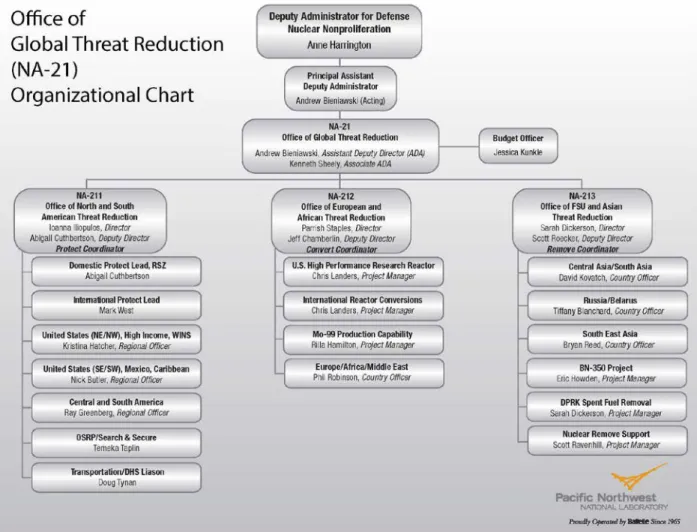
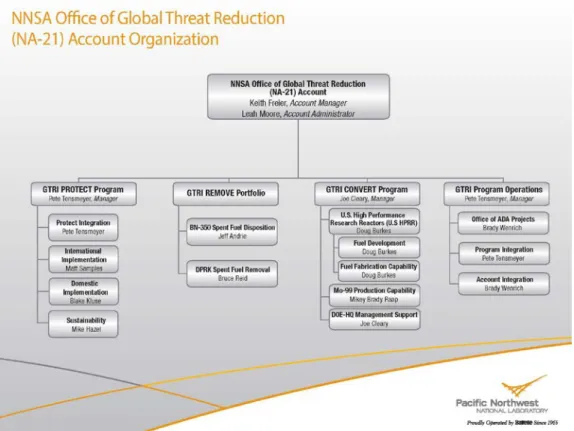
The Pacific Northwest National Laboratory (PNNL) GTRI Convert Program is one of three program areas aligned with the NNSA Market Sector under the NNSA Office of Global Threat Reduction (NA-21) Account, along with the Protect and Remove programs.
Shown below are the NA-21 U.S. Department of Energy—Headquarters (DOE-HQ) organization chart, the PNNL NA-21 Account organization chart, and the PNNL GTRI Convert organization chart in Figures 1.1, 1.2, and 1.3.
Figure 1.2. PNNL NA-21 Account Organization
1.3 Plan Purpose and References
The purpose of this Program Management Plan (PMP) is to address the planning requirements and guidelines necessary for the efficient execution of the PNNL GTRI Convert Program. This PMP provides overall guidance for the management of the program and for the development of any subordinate plans. Source documents addressed in this plan include:
• DOE’s NNSA GTRI Strategic Plan, Program Management Plan (PMP), and the Convert Portfolio Plan (CPP). Other important documents from HQ include the 2013 rev 0 versions of the GTRI U.S. HPRR Conversion Program Project Execution Plan, GTRI Convert Work Packages, Quality
Assurance Program Document, Risk Management Plan, and Scope document
• Global Threat Reduction Initiative (GTRI) PNNL Program Implementation Guidelines, National Nuclear Security Administration (NNSA) Sector, Office of Global Threat Reduction Initiative (NA-21) Account, dated April 2013 including all reference documents therein
• “How Do I...?” Project Management subject area.
This PNNL GTRI Convert PMP is subordinate to the PNNL GTRI Program Implementation
Guidelines document, which takes precedence in the event of any contradictions or omissions within this plan.
The NNSA GTRI Strategic Plan explains the convert, remove and protect (three pillars) objectives, key steps, and performance metrics in general. The DOE PMP provides details on GTRI’s structure and management processes and expectations for all technical pillars. The Convert Portfolio Plan narrows the scope from the three technical pillars to only the Conversion Program and then further defines the sub-components of the Convert Portfolio, which are the Reactor Convert Program and the Mo-99 Program.
2.0 Scope of Work
GTRI is responsible for the conversion of reactors worldwide from HEU to LEU; in addition, they have been tasked with conversion of Mo-99 targets from HEU to LEU. The Mo-99 Program is also promoting several new sources of Mo-99 production via cooperative agreements with industry partners. Besides the Mo-99 Program, the PNNL GTRI Convert Program includes the U.S. HPRR Conversion Program. The plan is to convert to LEU-Mo fuel the five U.S. HPRRs and one critical assembly, which are listed below:
• the Massachusetts Institute of Technology Reactor (MITR)
• the Missouri University Research Reactor at the University of Missouri–Columbia (MURR)
• the National Bureau of Standards Reactor at the National Institute of Standards and Technology in Maryland (NBSR)
• the Advanced Test Reactor (ATR) and the associated critical assembly (ATR-C) both at Idaho National Laboratory (INL)
• the High Flux Isotope Reactor (HFIR) at Oak Ridge National Laboratory. This U.S. HPRR Program includes:
• developing, testing, and qualifying the new monolithic LEU fuel
• establishing a commercial supply of the new fuel
• assisting reactor operators with safety and conversion analysis
• procuring fabrication equipment for the fuel supplier
• procuring the initial conversion fuel.
The PNNL U.S. HPRR scope comes in the form of unique fuel performance analysis and expertise, unirradiated and irradiated fuel and material characterization, contracting and technical services support, and advanced fabrication research and development. Work scope conducted at PNNL is essential to furthering the GTRI mission and typically contributes to GTRI activities on the critical path.
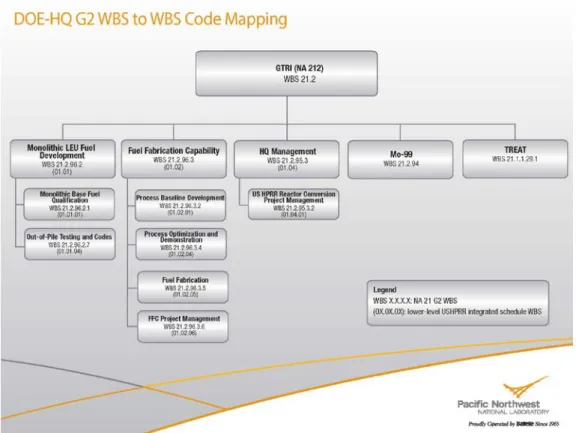
There are two work breakdown structure (WBS) systems for U.S. HPRR. One is the DOE-HQ G2 system with WBS elements in the 21 series. There is also a lower level WBS used for the U.S. HPRR integrated schedule as identified by the (0X.0X.0X) numbers in Figure 2.1. The cross walk between the two systems is shown in Figure 2.1. Note: Only the scope areas where PNNL has work are included. For the Mo-99 Program, which is separate from U.S. HPRR, only the G2 system WBS is used.
Figure 2.1. DOE-HQ G2 WBS to WBS Code Mapping
2.1 Monolithic Base Fuel Qualification (Project 62501)
PNNL provides input to the FD pillar in support of qualification of the monolithic base fuel form based on certain areas of expertise. Activities performed early in FY 2013 included the AFIP-7, Surface Science Characterization, and Base Fuel Qualification Characterization reports.
2.2 Out of pile Testing and Codes, Material Properties
Characterization (Project 62501)
A key part of the USHPRR Program under the fuel development pillar is the Fuel Thermo-Physical Characterization Project. The Fuel Thermo-Physical Characterization Project is a “special project.” The project charter is to ready PNNL facilities and processes for the receipt of unirradiated and irradiated LEU-Mo fuel element samples and to perform analysis to support the GTRI Conversion Program. PNNL’s support for the program will include establishment of post irradiation examination processes unique to the DOE laboratories that include thermo-physical properties and ultimately supporting submission of the base fuel qualification to the NRC and revisions to U.S. HPRR safety analysis reports (SARs) to enable conversion from HEU to LEU fuel.
As part of the out-of-pile testing codes scope of work, PNNL has been tasked to provide three correlations for determining the mechanical properties of U-Mo fuel:
1. The mechanical properties of depleted uranium plus 10 weight percent molybdenum alloy have been evaluated by high temperature compression testing.
2. The thermo-physical properties (heat capacity, thermal diffusivity) of irradiated U-Mo fuel plates as a function of temperature and burnup.
3. Characterization of off-gas resulting from melting U-Mo fuel plates as a function of time, temperature and burnup.
2.3 Process Baseline Development (Project 62501)
PNNL will characterize as-cast U-Mo samples in support of the Process Baseline Development effort. In particular, optical microscopy, scanning electron microscopy (SEM), and energy dispersive
spectroscopy / wavelength dispersive spectroscopy (EDX/WDX) will be utilized to investigate variations in composition and other metallographic features. Micro hardness measurements will be conducted to determine if (and to what extent) transformation/decomposition has occurred during solidification, as well as assist in drawing conclusions from any of the metallographic observations.
2.4 Process Optimization and Demonstration, Foil Rolling
Optimization Studies (Project 62501)
The Foil Rolling Optimization Project provides research and development support to the GTRI FFC pillar. In particular, the project focuses on optimization of foil rolling processes, which include the U-10Mo Zr hot co-rolled and bare U-U-10Mo hot/cold rolling foil fabrication processes. In addition, the project identifies and investigates the feasibility of novel Zr diffusion barrier application methods to bare U-10Mo fuel foils, such as energetic pulse joining, co-extrusion, and chemical plating. In addition, existing PNNL capabilities are deployed to reduce the backlog of examination from other DOE
laboratories on unirradiated U-Mo samples in support of the overall LEU-Mo characterization program as well as provide an active feedback loop on fabrication process development work.
2.5 Fuel Fabrication, Babcock & Wilcox Contracting (Projects 63240
and 63644)
A key area of the fuel fabrication capability pillar is the Babcock & Wilcox (B&W) Contracting Project. This project is designed to adapt existing B&W capabilities to provide fabrication capabilities to manufacture LEU-Mo fuel types from the point of receipt of LEU-Mo coupons from the Y-12 National Security Complex to finished fuel elements ready for use in the reactor. LEU-Mo fuel represents a new fuel type that has not been commercially manufactured. The manufacture of this fuel poses new design considerations and challenges. To transition from production of HEU fuels to LEU fuels and meet near term milestones, it is necessary to develop this capability in two phases: 1) establish a limited LEU production facility that shares equipment and space with the existing HEU production line, and 2)
establish a full LEU production facility the with capability to manufacture all LEU fuel needed to support the ongoing needs of the MURR, MITR, NBSR, ATR, and HFIR reactors that are the last remaining U.S. reactors currently utilizing HEU fuel. The project serves as the contracting vehicle between GTRI and B&W Nuclear Operations Group-Lynchburg (B&W NOG-L). Contracts will support engineering, equipment specification, licensing approval, facility upgrade, equipment procurement, installation, equipment startup, and qualification.
2.6 Fuel Fabrication Capability Project Management (Project 64154)
The FFC national technical lead (NTL) is appointed by NA-212 GTRI Program Management to establish and guide the technical direction and accomplishment of FFC-related scope. In particular, it is the FFC NTL responsibility to oversee the establishment of a baseline fuel fabrication process,
development of high quality demonstration products, maturing the baseline and alternative technologies, and managing the contracts and transition to a commercial contractor.
2.7 US HPRR Reactor Conversion Project Management
(Project 64154)
PNNL serves as the project management integrator (PMI) for the U.S. HPRR Conversion Programs. This role involves the integration of the scope, schedule, and budgets for the eight national laboratories that participate in the program. The PNNL team manages the schedule and actual cost/commitments for each of the laboratories. Risk management planning and maintenance is also a major role of the DOE-HQ management integration team. Programmatic documentation such as fiscal year (FY) work packages, scope documents, risk management plans, QA documentation, functional and operational requirements and project execution plans are also maintained by this team. In February 2013, NA-212 asked PNNL to provide the same level of support to a new TREAT conversion project. Work on this project has just recently commenced and is all project management work.
2.8 Mo-99 (Project 64154)
The Mo-99 International Program provides assistance to international research reactors and isotope production facilities to convert from the use of HEU targets to LEU targets. The Mo-99 Domestic Program provides assistance to accelerate the establishment of reliable, commercial production of non-HEU-based Mo-99 in the U.S.
PNNL’s specific scope is summarized below:
• technical services
– provide program management/controls support to the Mo-99 Project
– assist in the development/management of the project performance baseline and maintenance of the integrated project schedule
– provide support to the GTRI headquarters team in preparing the Mo-99 monthly executive report – integrate project schedule status for the national laboratories and managing the Mo-99 SharePoint
site.
– provide management and oversight of the independent technical review contract, to support the Mo-99 domestic projects
– provide technical expertise through a contract with Yamasato Fujiwara Higa for participation in the annual Mo-99 topical meeting
– perform semi-annual technical reviews of the four cooperative agreement partners – provide additional technical review support as required
• Institute for Radioelements (IRE) conversion support
– provide contract management support to the GTRI Mo-99 Program
– collaborate to convert medical isotope production facility located in Fleurus, Belgium, from using HEU targets to LEU targets
– manage the contract that provides support to the conversion of the production medical isotopes at the IRE facility.
2.9 M&O Assignments
PNNL staff members occasionally have the opportunity to serve in M&O assignments at DOE-HQ. One or more could support GTRI Convert. The subaccounts for M&O assignments include
56392 (labor), 56393 (dislocation), and 56394 (travel).
2.10 Deliverables and Program Milestones
A list of PNNL GTRI Convert Program FY 2013 deliverables and milestone schedule activities (Table 2.1) identifying the work that will be performed in each respective area is shown below.
Table 2.1. Project Deliverables and Milestones
PNNL’s Radiochemical Processing Laboratory (RPL) Receives for Irradiated Fuel Samples April 2013
Initiate Sample Preparation / Segmentation of irradiated LEU-Mo fuel samples March 2013
Issue Foil Rolling Optimization Final Report March 2014
Demonstrate feasibility of alternative Zr application methods November 2013
Complete RPL Sample Segmentation (2 thermal, 2 STA_MS) September 2013
Complete procurement of foil cleaning diamond polisher for B&W NOG-L December 2013
Complete RPL Laser Flash Analysis (3 segments) September 2013
Complete installation of the Cold Rolling Mill at B&W NOG-L May 2014
Complete installation of the vacuum anneal furnace at B&W NOG-L May 2014
RPL Complete Thermo-physical Examination of Post Irradiated Fuel ** (4 Segments) September 2013
Issue final report on irradiated LEU-Mo fuel samples provided by INL December 2013
Issue report on interrupted rolling tests February 2014
Complete procurement of UT system for B&W NOG-L June 2014
Complete PNNL Material Properties support closeout April 2014
Issue final report on alternative Zr application methods May 2015
RPL Cell cleanout – Project Closeout*** April 2014
Issue final report on complex fuel fabrication alternatives October 2015
** 4 Segments (2 Thermal, 1 high flux, 1 low flux) (2 STA-MS, 1 high flux, 1 low flux) additional 4 segments may be analyzed pending release of funding from INL
2.11 Program Budget
The budget is approved on an FY basis via the individual DOE NA funding authorizations. Funds are identified by project and by laboratory, and are provided through the authorized financial plan system. PNNL will manage and complete the agreed upon project work scope within the project funding provided.
No work is to begin unless it is both authorized via an approved project work plan (PWP) and funding has been received at the laboratory through the client’s authorized financial plan.
At the start of a FY, it is possible that the NNSA’s overall budget has not been approved by Congress, therefore, funding is authorized under a “Continuing Resolution” (CR). When this is in effect, full funding is not necessarily initially provided to the laboratories to complete the work scope identified in the approved project task sheets. During these times, the program and project managers and task leads will work closely with the financial specialist to make sure that work progresses as smoothly as possible. It should be noted that large dollar-value commitments may be affected because of this reduced funding situation.
3.0 Roles and Responsibilities
The roles, responsibilities, and lines of authority for management and staffing positions at PNNL that directly or indirectly support the PNNL GTRI Convert Program are described below.
The project management office (PMO) is responsible for making sure that project performance is high quality and that the risks associated with the project work are being managed effectively.
Line management of program team members is responsible for providing the staff needed to accomplish the work of the program. Line managers are also responsible for making sure that high quality service is provided to the program.
The PNNL GTRI Convert program manager, in coordination with the Chemical, Biological, and Nuclear Surety (CBNS) PMO, is responsible for expert delivery of all program activities in full
compliance with customer requirements and expectations. The NA-21 account manager will be the single PNNL point of contact (POC) for all program-wide related issues, concerns, and expected performance objectives and strategies, and is the principle POC between DOE-HQ and PNNL for program activities in support of NA-21.
The PNNL GTRI Convert program manager, project managers (PMs), and other PNNL-assigned staff members are accountable to the NA-21 account manager and the CBNS PMO director for completion of assigned work on time, on budget, and in accordance with customer expectations. They are responsible for complying with all applicable laboratory policies, standards, and procedures.
All roles listed below are PNNL staff members. The cross cutting GTRI support positions (contracts manager and specialists, financial specialist, project controls lead and professionals, and program
administrator) are included in the PNNL Program Implementation Guidelines document.
3.1 PNNL GTRI Convert Program Manager
The PNNL GTRI Convert program manager is responsible and accountable for successful execution of the PNNL GTRI Convert Program. Specific duties and responsibilities include, but are not limited to, the following:
• report to the DOE-HQ NA-212 director and deputy director for the successful execution of PNNL activities in support of the GTRI Convert mission
• report to the NA-21 account manager and CBNS PMO director for day-to-day execution of PNNL GTRI Convert activities
• develop business opportunities in support of the GTRI Convert mission
• serve as the principle PNNL POC for all PNNL GTRI Convert programmatic activities
• manage resource needs for the program and coordinate with other programs and organizations to provide resources
• coordinate with line managers for program resource needs and staff development opportunities
• establish and maintain program management systems, policies, and procedures in accordance with PNNL policy, DOE-HQ program requirements, and “How Do I?” (HDI—PNNL’s Standards-Based Management System)
• provide lead program integration and management support to DOE-HQ for all elements of the PNNL GTRI Convert Program
• provide support in the development of NA-212 program management systems, policies, procedures, and other DOE-HQ management infrastructure
• coordinate and respond to NA-212 program requests for information
• provide training and mentoring to program staff members and make sure that staff members understand all relevant GTRI Convert policies and procedures
• integrate with other programs to be sure of consistency and efficiency of management processes and approaches
• oversee development and maintenance of program management documentation and reporting
• oversee and track PNNL project performance within the program
• communicate with DOE NA-21 and NA-212 GTRI program management on a regular basis regarding progress and status of work
• track total program and individual project spending to make sure that budget requirements are maintained
• review and approve all GTRI Convert Program travel requests
• communicate problems, suggestions, and issues to PNNL’ National Security Directorate (NSD) management and DOE GTRI management, as needed, for resolution.
3.2 DOE-HQ Project Management Integration Lead
PNNL serves as the PMI for the U.S. HPRR Conversion Program. This role involves the integration of the scope, schedule, and budgets for the eight national laboratories that participate in the program. The PNNL team manages the schedule and actual cost/commitments for each of the laboratories. Risk
management planning and maintenance is also a major role of the HQ management integration team. This team is responsible for the following:
• develop and maintain the USHPRR integrated schedule
• update continuously the lifecycle budget information for the USHPRR projects (i.e. reconcile budget with G2 funding changes)
• develop and maintain detailed spend plans by WBS and by laboratory for the program
• develop and maintain the program SharePoint site
• obtain cost and commitment information from each laboratory at a level lower than what is reported in G2, and provide the results to HQ in a monthly report
• develop a monthly schedule status report
• develop and maintain the USHPRR scope document
• maintain the FY work packages for HQ
• develop and maintain the risk management plan for the program, including the monthly detailed schedule risk analysis that interfaces directly with the P6 schedule
• develop and maintain a program execution plan for the program.
3.3 Fuel Fabrication Capability National Technical (Pillar) Lead
The FFC NTL is appointed by NA-212 GTRI program management to establish and guide the technical direction and accomplishment of FFC-related scope. In particular, it is the FFC NTL responsibility to oversee the establishment of a baseline fuel fabrication process, development of high quality demonstration products, maturing the baseline and alternative technologies, and managing the contracts and transition to a commercial contractor. Other specific duties of the FFC NTL include, but are not limited to, the following:
• hold biweekly and monthly conference calls with the performing team (made up of multiple national laboratories and commercial entities) and fabrication product stakeholders
• generate, submit, and follow-through on any baseline change request (BCR) to the DOE-HQ PMI and the NA-212 GTRI program manager for necessary approvals
• compile, summarize, and submit results (in report form) to the NA-212 GTRI program manager, and disseminate the results to the U.S. HPRR community and international community as appropriate
• guide the transition of fuel fabrication technology from the DOE National Laboratory complex to a commercial fuel fabrication contractor (i.e., B&W NOG-L)
• oversee the scope and overall coordination of any new fuel fabrication contract regardless of which laboratory actually places the contract
• integrate with the GTRI FD and RC pillars to be sure of consistency with a consolidated GTRI plan and approach to qualify and deploy a LEU-Mo fuel.
Note: The FFC NTL also serves as the PNNL U.S. HPRR lead supervising the work of the fuel characterization, fuel fabrication B&W contracting/technical oversight representative (TOR), and process optimization and demonstration, foil rolling optimization PMs listed in Sections 3.4, 3.5, and 3.6 below.
3.4 Fuel Characterization Project Manager
The Fuel Characterization PM is responsible for the successful execution of all PNNL monolithic base fuel qualification, out-of-pile testing and codes, and irradiated fuel characterization activities. The PM is directly responsible for individual project performance and expert delivery in accordance with
NA-21 and PNNL policies and procedures, and within approved scope, schedule, budget, and quality. Specific duties and responsibilities include, but are not limited to, the following:
• manage the resource needs for the project and coordinate with other projects, programs, and organizations to provide resources, opportunities, and availabilities
• integrate with other projects and programs to be sure of consistency and efficiency of management processes and approaches
• coordinate and respond to NA-21 program requests for project information
• provide training and mentoring to project staff and make sure that staff understand and follow all relevant program policies and procedures
• develop and maintain all project management documentation and reporting, including PWPs, monthly reports, and performance metrics, financial reporting, and ad-hoc project management reporting to DOE-HQ via the PNNL GTRI Convert program manager
• oversee and track project performance
• track total project and individual sub-project spending to make sure that budget requirements are maintained
• oversee and coordinate all project activities to make sure that work is performed in accordance with approved PWPs
• communicate problems, suggestions, and issues to the PNNL GTRI Convert program manager, as needed, for resolution
• provide periodic reporting of progress, schedule, and costs to the PNNL GTRI Convert program manager.
3.5 Fuel Fabrication B&W Contracting Project Manager/TOR
The Fuel Fabrication B&W Contracting PM/TORis assigned by the FFC NTL to oversee and manage work scope and contracts with B&W NOG-L. The B&W contracting PM/TOR specific duties and responsibilities include:
• develop statements of work and associated documentation required to meet the contractual requirements in support of FFC Project and task objectives in accordance with the FFC approved work scope and within established DOE/NNSA, NA-21, and PNNL GTRI contracting guidelines
• make sure that the risks associated with the contracting action required are properly identified
• work with the FFC NTL to request the necessary purchase requisition to initiate contracting mechanism
• work with the contracting officer to award the contract action, monitor contractor performance, review and approve deliverables for payment, and identify actions required to address scope or schedule issues
• track total project and individual project spending to make sure that budget requirements are maintained
• communicate problems, suggestions, and issues to the FFC NTL, as needed, for resolution.
3.6 Process Optimization and Demonstration, Foil Rolling
Optimization Project Manager
The Process Optimization and Demonstration, Foil Rolling Optimization PMis responsible for the successful execution of all PNNL activities directly attributable to FFC research and development work scope conducted at PNNL. The PM is directly responsible for individual project performance and expert delivery in accordance with NA-21 and PNNL policies and procedures, and within approved scope, schedule, budget, and quality. Specific duties and responsibilities include, but are not limited to, the following:
• manage the resource needs for the project and coordinate with other projects, programs, and organizations to provide resources, opportunities, and availabilities
• integrate with other projects and programs to be sure of consistency and efficiency of management processes and approaches
• coordinate and respond to FFC NTL requests for project information
• provide training and mentoring to project staff and make sure that staff understand and follow all relevant program policies and procedures
• develop and maintain all project management documentation and reporting, including PWPs, monthly reports, and performance metrics, financial reporting, and ad-hoc project management reporting to DOE-HQ via the FFC NTL
• oversee and track project performance
• track total project and individual sub-project spending to make sure that budget requirements are maintained
• oversee and coordinate all project activities to make sure that work is performed in accordance with approved PWPs
• communicate problems, suggestions, and issues to the FFC NTL, as needed, for resolution
• provide periodic reporting of progress, schedule, and costs to the FFC NTL.
3.7 Mo-99 DOE-HQ Management Support M&O
The DOE-HQ management support M&O is responsible to provide direct program management support to the DOE Mo-99 Program in Washington D.C., and
• provide program management and technical integration support to the Mo-99 program manager
• assist in the development and improvement of project lifecycle plans, action plans, and management processes in support of NA-212
• assist NNSA in maintaining relationships and cooperative agreements with domestic and international partners within NA-212
• assist the Mo-99 program manager and project leads with integration and maintenance of the overall integrated performance management baseline (PMB)
• assist the Mo-99 program manager in developing program performance measures and evaluating program performance throughout the project’s lifecycle
• assist in development of the Mo-99 monthly executive report and coordinate monthly executive reviews with the NA-212 office director and assistant deputy director
• recommend funding authorization changes for Mo-99 Program activities
• assist in the preparation of budget requests for FY funding utilizing the G2 project management system
• make sure that all required monthly updates are made to the G2 project management system
• initiate BCRs and implement them into the PMB once they are approved
• review technical progress and closeout reports and compare them against PMB to make sure that ongoing work is consistent with the agreed upon project objectives
• assist in the development and maintenance of the Mo-99 risk register
4.0 Environment, Safety and Health
The Fuel Characterization Project (62501) will perform out-of-pile characterization of irradiated fuel samples and the Foil Rolling Optimization Project will perform characterization and development work with unirradiated fuel samples. This involves operation of specific test equipment and working with radioactive materials. The project will characterize both unirradiated (consisting of U isotopes 235 and 238 and Mo) and irradiated fuel samples (consisting of multiple U and Pu isotopes, fission products, and Mo). See the Project Execution Plan (U.S. Department of Energy 2013) for specific environment safety and health (ES&H) details.
All work will be performed within integrated operations system (IOPs) and in accordance with the ES&H policies and procedures described in HDI management systems description
5.0 Contracts
All procurements and subcontracts will be handled as indicated in the HDI Purchasing Goods and Services subject area. Refer to the GTRI PNNL Program Implementation Guidelines document dated April 2013, for specific program guidance.
6.0 Reporting Requirements
6.1 Contracts Reporting
According to the direction of the DOE-HQ GTRI PMP, all participating laboratories are required to post the awarded contract information (statements of work and signed task orders) on the G2
Management System. Documents containing classified information cannot be posted to the G2. Information contained within G2 is considered originator controlled and for official use only (OUO). Authorized users of the system may use the posted information within the scope of their official duties. However, the information may not be extracted, copied, or redistributed outside of NA-21 without permission of the DOE-HQ project manager.
The contracts administrator will forward the awarded signed subcontracts to the PNNL GTRI administrator to be entered into the G2. The signed subcontracts must be posted to G2 within two weeks of receipt of the signed subcontract.
Any PNNL-contracted deliverables received will be reviewed and authorized by the PNNL PM or TOR and released for payment if deliverable and invoice are accurate and complete. The TOR will approve invoices electronically, which will return them to the contracting officer for processing by accounts payable. Completed contract deliverables must be posted to G2 within two weeks of receipt and approval.
6.2 Monthly Financial Status Reporting
The program financial specialist is required to prepare and submit an element of cost report on all projects funded through NA-21 to the DOE-HQ budget officer by the tenth working day of each month addressing costs, amount accrued, and commitments through the previous month. All cost and
commitment information shall be provided using cumulative FY data reported by the laboratories to DOE-HQ each month. Refer to the DOE-HQ GTRI PMP for additional information on cost reporting requirements. The report summarizes total cumulative cost and commitments of each project and breaks the cost out into the following cost and commitment elements:
• laboratory labor
• laboratory travel
• laboratory equipment
• laboratory contract costs (unburdened)
• laboratory contract fees
• laboratory unburdened commitment
• laboratory commitment overhead
• Standard Accounting and Reporting System (STARS)-allowed indirect commitment.
element in the financial monthly reports should contain only the total unpaid portion of all commitments through the reporting period. Commitments for contracts that are either in the planning or formative stages should not be reported until the contract has been awarded. Laboratory commitment overhead represents the estimated laboratory fees on the unpaid portion of awarded contracts. STARS-allowed indirect encumbrances are all additional fees reported in STARS above the burdened commitment amount.
6.3 U.S. HPRR Monthly Schedule Status Reporting
Monthly, the DOE-HQ management support staff issues a cost and schedule status request to all laboratories. For the schedule, this request is to provide start dates, percent complete, and finish dates for in-progress and upcoming schedule activities. It is issued the last week of every calendar month and input is due on the second working day of the next month. For activities projecting to be complete after the baseline finish date, a variance explanation is required. Once all data has been collected from each performer (usually by the tenth working day of the month), it is uploaded to G2.
The U.S. HPRR SharePoint site is a vehicle for requesting and reporting cost and schedule status. A monthly report providing the overall status of the program will be issued to the DOE-HQ client by the fifth working day of each month.
7.0 Change Control
The project work packages are considered living documents, and the project will update as work scope, schedule, and budget changes necessitate. Generally, project changes fall within the three levels listed below.
• Project manager-approved change
– These administrative or other changes within the project’s tasks do not materially impact the project baseline, project risk profile, or electronic prep and risk (EPR) risk mitigation permit. Such changes will be approved by both the task leaders and the PM.
• PMO-approved change
– These changes affect documents previously approved by the PMO (e.g., PMP or EPR risk mitigation permit) and PNNL GTRI Convert program manager. Such changes include technical performance, quality of products or services, and discoveries of new risks. PMO-approved changes do not materially impact the customer-approved project baseline thresholds or contract terms and conditions. These internal changes will be approved by the PM, program manager, and PMO. These changes often include revisions to internal milestones or deliverables, the technical approach, risk mitigation actions, etc. These changes will be identified and documented by the PM in the PMP and/or the EPR system.
• Customer-approved change
– These changes affect the customer-approved program baseline and/or contract terms and conditions or are requested by the customer. The PMO and PNNL GTRI Convert program manager will concur with these changes, and they will be approved by the customer through a revised project work authorization. Once approved, the PM will incorporate the change in the PMP and the EPR system.
Any change identified that requires funding/budget changes or updates to activity scope or
deliverables listed in the approved project documentation will be coordinated and approved through the PM and client. The PM will coordinate all proposed changes with affected individuals and organizations prior to implementation, including work performed by other laboratories. Approved changes will be documented and maintained in the project files and if applicable will initiate updates to EPR, risk determination matrix, PMP, and project task sheets per the approach listed above.
Changes should not be implemented simply because activities cost more or less than planned or schedule dates have been missed. The PMs will work closely with the program management and/or financial specialist to determine when it is appropriate to implement changes to the project
documentation.
7.1 U.S. HPRR Baseline Change Control
Baseline change control consists of establishing a PMB and maintaining the baseline to make sure that it accurately reflects current program planning. The U.S. HPRR Conversion Program PMB will define the cost, schedule, and scope commitment to which GTRI will execute the program and measure
entire program. It is important to note that U.S. HPRR PMB is an integrated summary level baseline that integrates the details from nine national laboratories, five reactor stakeholders, and the primary fuel fabricator. It is expected that each laboratory and key stakeholders have developed their own lower level resource loaded schedule prior to submitting schedule and cost information to be included in the
integrated schedule.
GTRI and the U.S. HPRR Conversion Program have established formal change control process that documents, reviews, and formally dispositions all PMB changes. Changes are presented in a form that clearly defines and validates the driver (cause) of the change and assesses all impacts (effects). All changes to the PMB are formally requested, documented, approved, and maintained using the baseline change control procedure.
The following is a summary of the baseline change control process. At any time, any project participant can request that changes be made to the PMB. Changes are documented on the BCR page of the U.S. HPRR SharePoint site. The following information is recorded for each proposed change:
• log number • log date • originator’s organization • WBS number – title • BCR title • BCR description
• reasons for change/impacts if not changed
• is it a scope impact?
• is it a budget impact?
• Is a FinPlan change required?
o If “Yes” then identify where funds are recommended to come from G2 WBS/Lab and where they need to be moved to G2 WBS/Lab
o If “No” but funding is coming from another source that detail should be discussed in the BCR description above
• pillar lead approval and date
• PMI approval and date
• GTRI Convert DOE-HQ Program Manager approval and date
• date changes have been incorporated into the PMB
• attachments (any supporting information to help define scope, logic, or budget changes). After submittal of a BCR, the pillar lead and the PMI will review the details to make sure that sufficient information has been provided to effectively make changes to the PMB. Once a month— normally the first week of each month—a change control board consisting of the DOE-HQ Convert
program manager, the pillar leads, and the PMI review each of the proposed changes and make decisions as to whether to proceed with the proposed changes. If a change is agreed to, the PNNL project
management support team will make the necessary changes to budget and schedule as well as any scope documentation that may have changed. After initial changes have been made, the modifications are discussed and reviewed with the responsible pillar lead before the change is considered final.
Some, but not all, BCRs generated require funding changes. If the BCR is requesting new funding or is proposing that funding be moved between laboratories, then a financial plan (FinPlan) change request is required. Those BCRs that meet these criteria are submitted for approval at the monthly GTRI Convert FinPlan change meeting, which is normally scheduled for the last week of the month. If approved, a formal FinPlan change is submitted by the GTRI Convert program manager in G2.
7.2 Mo-99 Baseline Change Control
The project work packages are considered living documents that the project will update as work scope, schedule, and budget changes necessitate. Generally, any change identified that requires funding/budget changes or updates to activity scope or deliverables listed in the approved project documentation will be coordinated and approved through the PM and client. Approved changes will be documented and maintained in the work package and project BCR log, and could necessitate updates to the EPR, risk determination matrix, and PMP.
Baseline change control consists of establishing a PMB and maintaining the baseline to make sure that it accurately reflects current project planning. The Mo-99 Project PMB defines the scope, schedule, and cost commitment to which GTRI Convert will execute the Mo-99 Project and measure performance.
The Mo-99 Project has a formal change control process that documents, reviews, and formally dispositions all PMB changes. Changes are tracked in a change log that clearly defines and validates the driver (cause) of the change and assesses all impacts (effects). All changes to the PMB will be formally requested, documented, approved, and maintained using the baseline change control procedure.
Baseline changes at the summary-level WBS (G2 level) require formal authorization by the GTRI assistant deputy administrator through the GTRI Program BCR and FinPlan process. Types of baseline changes include:
• execution year funding changes
• baseline schedule changes
• baseline scope changes
• baseline metric changes.
Baseline changes at the PNNL detailed-level WBS will be documented using the baseline change control log. Change requests will be reviewed, validated, and approved by the PM and procurement officials. Changes to the PNNL work package are managed through a resubmission of the work package for review, validation, and approval by the GTRI Convert program manager.
8.0 Quality Assurance and Control
In addition to the DOE-HQ QA plan and those actions prescribed in the Project Execution Plan (U.S. Department of Energy 2013), the Characterization project issued and is executing to a QA plan, which prescribes the QA approach and quality control (QC) activities.
The Characterization Project QA plan provides a graded approach recognizing that only some of the prescribed scope is quality-effecting. Specifically, the information that may be reported and used as part of the base fuel qualification by the NRC will be subject to applicable provisions of ASME NQA-1-2000. All other work (other than base fuel qualification) is included in the QA plan; however, QA controls will be applied at the discretion of the PM to the extent necessary to mitigate cost and schedule risk.
The PNNL GTRI Convert program manager will make sure that staff members conduct their project activities in a manner to be sure of the integrity, repeatability, and customer satisfaction with project products/solutions, services, and processes. Project staff will provide the level of detail in analyses, documentation, and actions necessary to comply with project quality requirements and the customer’s expectations commensurate with the laboratory’s QA program.
The Fuel Thermo-Physical Characterization Project QA plan implements the laboratory’s QA program through HDI’s management system (https://hdi.pnl.gov/standard/5q/5q00t010.htm).
The key areas of the QA plan include but are not limited to:
• identifying and controlling items and materials affecting scientific or design results
• using equipment of known accuracy for process monitoring and data collection
• documenting calculations, analyses, tests, and software required to substantiate results and processes used to develop products/solutions
• maintaining records of documentation necessary to substantiate results and processes of project activities.
The thermo-physical property examination scope of this project is conducted according to applicable ASME NQA-1 standards because the results of this work could be referenced in a NRC NUREG and/or specific research/test reactor SARs. Depending on the extent of the alternate fuel design output, such as drawings and specifications, may have to be delivered to the client. Control of measuring and test equipment may require calibration to NIST traceable standards. The PM and QA engineer will plan strategic performance of QA surveillances to be sure of early detection of quality issues. These surveillances are expected to be performed:
• prior to issuing major procurements (>$100,000)
• prior to or concurrent with issuance of project procedures
• during first use of a quality effecting procedure
• during ad-hoc surveillances at the discretion of the PM.
All work other than the thermo-physical property examination of post irradiated fuel is considered for information only. This work is not necessarily subject to NQA-1, but is covered in the overall QA plan.
Typically, this work is subject to peer review and release through the laboratory’s Electronic Records and Information Architecture (ERICA) system.
8.1 Software Use in Analysis
It is possible that a finite element analysis code, such as COMSOL, may be utilized to model and verify results obtained during execution of program projects. A multiple-polynomial regression code, such as that available in Excel™, may also be utilized to analyze and interpret results obtained during execution of this work. Software specific to microscopes in both RPL and 3410 will be utilized to capture and analyze images of the fuel samples. A quality assurance plan will either qualify the program to support the conclusion or provide alternate design verification (alternate calculations, peer review, testing). This plan will be reviewed by the PNNL software QA subject matter expert.
Appendix A of this PMP defines the quality assurance-related requirements and activities that will be followed during the course of software development and deployment on this project.
9.0 Risk Management
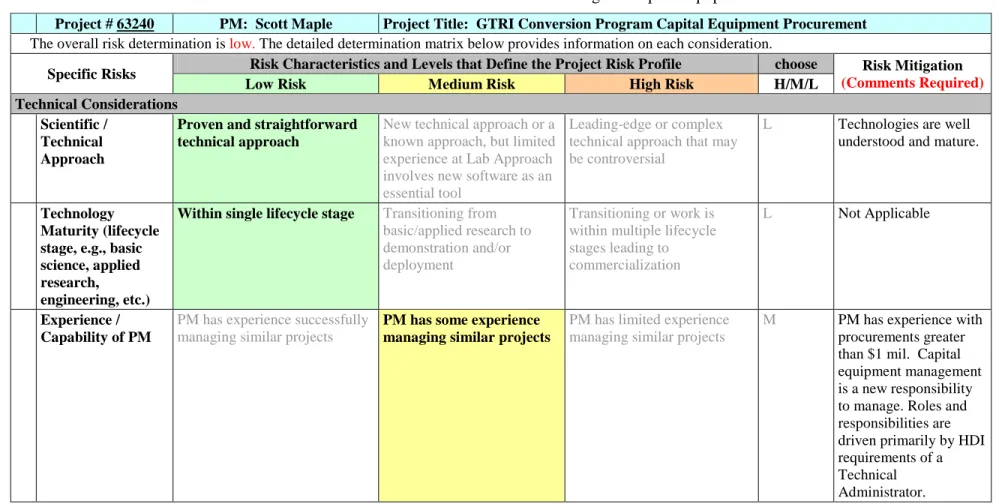
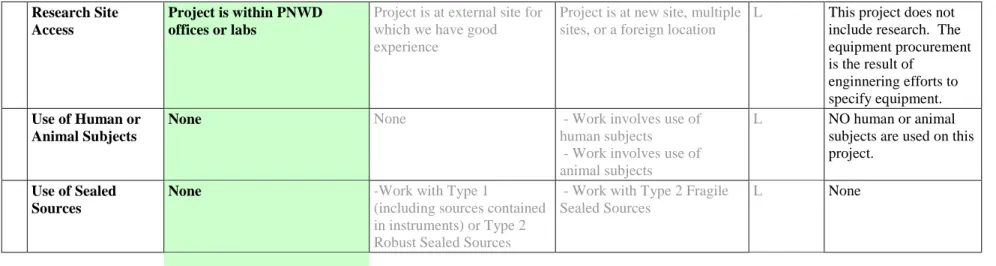
All work will be performed in accordance with applicable requirements defined in HDI. Project risks were initially evaluated using the EPR assessment tool and the risk determination matrix system. The risk determination matrices (RDA) for projects 62501 and 63240/63644 are included in Appendix B. Project 64154 has had it’s EPR updated recently (April 2013) and the RDA form is no longer being utilized, therefore, review of the 64154 risks will have to be obtained by going directly to the 64154 EPR., A further assessment and evaluation of risks is taken using a graded approach to the following risk process (Figure 9.1).
Figure 9.1. Risk Management
The following is a general discussion of various high level GTRI Convert risks by risk category. Detailed information on the six most significant risks is provided in the risk register that follows in Section 9.8.
9.1 Technical Risk
9.1.1
Sample Receipt
The success of the projects under this program is dependent upon receipt of samples from other laboratories. Failure to receive the material could prevent completion of planned work. If planned work cannot be completed, the consequences are three-fold: 1) delay in completion of the work—if individual tasks are on critical path for the program, then the schedule delay can impact overall success at the national level, 2) inability to perform the work can result in an increase in FY carryover and increased cost to complete the work in future years, and 3) inability to perform the work also impacts the availability of staff and facility resources that could be redeployed for other funded work.
In order to minimize this risk, the FFC NTL will establish periodic communications with the external collaborators to convey the critical path as determined by the PM. Projected or actual schedule slippage outside of parameters noted in Section 2.8 that are directly caused by delay in deliverable of samples will be elevated through the PMO director and NA-21 account manager for appropriate action with the DOE client or other laboratory management.
9.1.2
Experimental Work
The Fuel Thermo-Physical Characterization Project will perform out-of-pile characterization of both unirradiated and irradiated fuel samples, and the Foil Rolling Optimization Project will perform process development studies as well as performing out-of-pile characterization of unirradiated fuel samples. These activities involve operation of specific test equipment and working with radioactive materials. The project will utilize the new hot cells in the RPL basement; it is likely that conducting this work will require some minor facility modifications associated with those cells. The projects will also utilize equipment in the 3410 and APEL facilities. Samples for use on these projects will be shipped from different laboratories to PNNL. For some cases involving unirradiated fuel only, it may be necessary to transfer material from one PNNL facility (e.g., 3410) to another PNNL facility (e.g., RPL). Radioactive mixed waste will consist of both solid and liquid forms as a result of the multiple sample preparation and characterization processes, and will be properly disposed of at the completion of the projects. All work will be performed in accordance with both the ES&H policies and procedures described in HDI
management systems description and specific workspace IOPs protocols.
9.2 Significant and/or Complex Capital Expenditures
The B&W Contracting Project involves the procurement of services and equipment for B&W NOG-L. These procurements are anticipated to total in the tens of millions over the lifecycle of the project. If these contracts cannot be placed with B&W NOG-L, the three-fold consequences identified in Section 9.1.1 will be realized.
In order to minimize this risk, senior and experienced PNNL contracts personnel are assigned to contracts managed under this project. The technical administrator for the contracts is TOR-3 certified with significant construction management experience. Project controls personnel at the U.S. HPRR level will assist with deliverables tracking.
9.3 Receipt of Funding During the FY
Delays in receipt of funding, especially early in the FY, may delay the start of work or establishment of new contracts if laboratory expenses and contractually committed funds exceed the amount of
uncommitted carryover. If the availability of adequate resources is scope limited, then the three-fold consequences identified in Section 9.1.1 will be realized—especially in the case of large contractual commitments. GTRI requires no more than an annually specified uncommitted carryover from one FY to the next, which contributes to this risk. In order to minimize this risk, PNNL GTRI Convert projects produce a spend forecast and spending plan by which the uncommitted carryover is tracked.
9.4 Price Anderson Amendments Act
Project scope will address characterization of U-Mo alloy fuels for use in research and test reactors. Characterization activities will be performed on both unirradiated and irradiated fuel samples. Large irradiated samples will be limited to hot cells and shielded analytical laboratory cells. Smaller samples (thereby limiting dose) will be utilized for work in the shielded modular hot cells, shielded glove boxes, and/or microscopes. For unirradiated fuel samples, preparation activities that could create exposure will be conducted in fume hoods and/or glove boxes. All efforts will be performed in accordance with workspace IOPs procedures and controls.
9.5 Foreign Travel
There occasionally may be international travel on the GTRI Convert Program. Work may be presented at international conferences and/or seminars in non-sensitive countries. All foreign travel will be conducted in accordance with PNNL policies on foreign travel. For detailed information relating to foreign travel, see the PNNL GTRI Program Implementation Guidelines Document, dated April 2013.
9.6 Conflict of Interest
PNNL routinely reviews documents and license requests for the NRC. While these reviews are rarely associated with research and test reactors, one of the major deliverables associated with this scope is a correlation that could appear in a NRC NUREG and research and test reactor SARs. Should PNNL be asked to review any information associated with the NUREG or research and test reactor SARs, the participation in this scope should be disclosed.
9.7 Risk Register
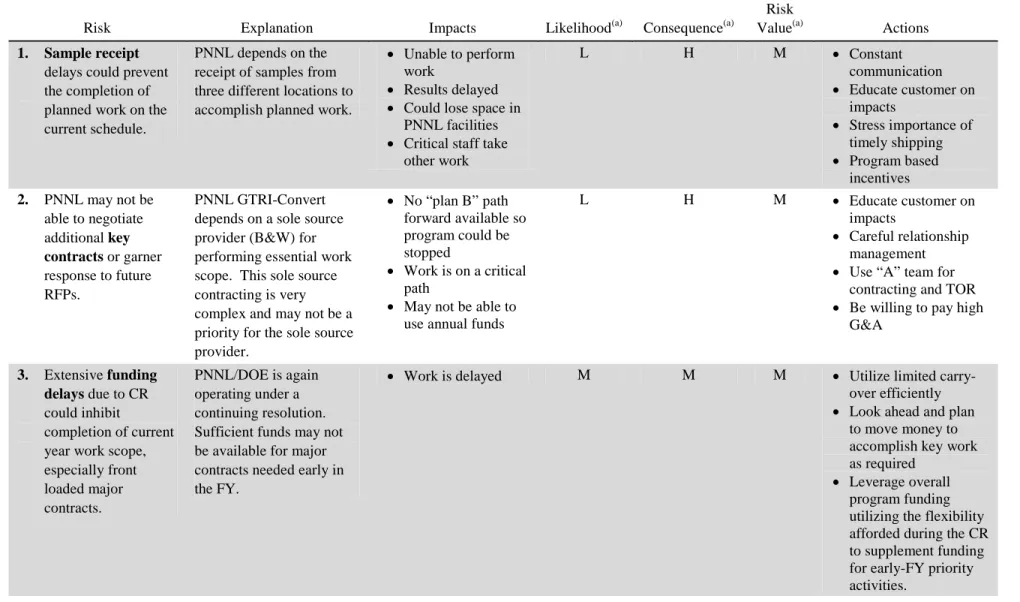
The PNNL GTRI Convert Program risk register follows. This is a listing of significant risks to the PNNL Convert Program that clearly states the risk event; provides a contextual explanation of the risk; and includes the impacts should the risk occur, qualitative assessments of the likelihood, consequence, risk value, and the risk handling actions being taken to lessen the likelihood or reduce the consequences of each significant risk.
9.4
Table 9.1. PNNL GTRI Convert Program Significant Risks
Risk Explanation Impacts Likelihood(a) Consequence(a)
Risk
Value(a) Actions
1. Sample receipt delays could prevent the completion of planned work on the current schedule.
PNNL depends on the receipt of samples from three different locations to accomplish planned work.
• Unable to perform
work
• Results delayed
• Could lose space in
PNNL facilities • Critical staff take
other work L H M • Constant communication • Educate customer on impacts • Stress importance of timely shipping • Program based incentives 2. PNNL may not be able to negotiate additional key contracts or garner response to future RFPs. PNNL GTRI-Convert depends on a sole source provider (B&W) for performing essential work scope. This sole source contracting is very complex and may not be a priority for the sole source provider. • No “plan B” path forward available so program could be stopped • Work is on a critical path
• May not be able to
use annual funds
L H M • Educate customer on
impacts
• Careful relationship management
• Use “A” team for
contracting and TOR • Be willing to pay high
G&A
3. Extensive funding
delays due to CR could inhibit
completion of current year work scope, especially front loaded major contracts. PNNL/DOE is again operating under a continuing resolution. Sufficient funds may not be available for major contracts needed early in the FY.
• Work is delayed M M M • Utilize limited
carry-over efficiently
• Look ahead and plan
to move money to accomplish key work as required
• Leverage overall
program funding utilizing the flexibility afforded during the CR to supplement funding for early-FY priority activities.