POLICY
RESEARCH
WORKING
PAPER
2444
"Seize
the State,
In a decade of transition, fearof a leviathan state is giving
Seize the Day
way to increased focus onoligarchs who "capture the
State Capture, Corruption,
state." In the captureand Influence in Transition
economy, the policy and legalenvironment is shaped to the captor firm's huge advantage,
Joel S. Hellman
at the expense of the rest ofGeraint Jones
the enterprise sector. This hasDaniel Kaufmann
major implications for policy.The World Bank
World Bank Institute
Governance, Regulation, and Finance Division
and
Europe and Central Asia Region
Public Sector Group
and
European Bank of Reconstruction and Development
Office of the Chief Economist
September 2000
Public Disclosure Authorized
Public Disclosure Authorized
Public Disclosure Authorized
Summary findings
The main challenge of the transition has been to redefine State capture, influence, and administrative corruption how the state interacts with firms, but little attention has are all shown to have distinct causes and consequences. been paid to the flip side of the relationship: how firms Large incumbent firms with formal ties to the state tend influence the state-especially how they exert influence to inherit influence as a legacy of the past and tend to on and collude with public officials to extract enjoy more secure property and contractual rights and advantages. Some firms in transition economies have higher growth rates. To compete against these influential been able to shape the rules of the game to their own incumbents, new entrants turn to state capture as a advantage, at considerable social cost, creating what strategic choice-not as a substitute for innovation but to
Hellman, Jones, and Kaufmann call a "capture economy" compensate for weaknesses in the legal and regulatory in many countries. In the capture economy, public framework. When the state underprovides the public officials and politicians privately sell underprovided goods needed for entry and competition, "captor" firms public goods and a range of rent-generating advantages purchase directly from the state such private benefits as
"a la carte" to individual firms. secure property rights and removal of obstacles to The authors empirically investigate the dynamics of the improved performance-but only in a capture economy. capture economy on the basis of new firm-level data Consistent with empirical findings in previous research from the 1999 Business Environment and Enterprise on petty corruption, administrative corruption-unlike Performance Survey (BEEPS), which permits the both capture and influence-is not associated with unbundling of corruption into meaningful and specific benefits for the firm.
measurable components. The focus of reform should be shifted toward
They contrast state capture (firms shaping and channeling firms' strategies in the direction of more affecting formulation of the rules of the game through legitimate forms of influence, involving societal "voice," private payments to public officials and politicians) with transparency reform, political accountability, and influence (doing the same without recourse to payments) economic competition. Where state capture has distorted and with administrative corruption ("petty" forms of reform to create (or preserve) monopolistic structures bribery in connection with the implementation of laws, supported by powerful political interests, the challenge is rules, and regulations). They develop economywide particularly daunting.
measures for these phenomena, which are then subject to empirical measurement utilizing the BEEPS data.
This paper-a product of the Governance, Regulation, and Finance Division, World Bank Institute; the Public Sector Group, Europe and Central Asia Region; and the Office of the Chief Economist, European Bank of Reconstruction and Development-is part of an empirical project on governance in transition. Copies of the paper are available free from the World Bank,1818 H StreetNW,Washington, DC 20433. Please contactDiane Billups, room J3-131, telephone 202-473-5818, fax 202-334-8350, email address [email protected]. For an electronicversion ofthis paper and related research papers and governance data, visit www.worldbank/wbi/governance/. Policy Research Working Papers are also posted on the Web at www.worldbank.org/research/workingpapers. The authors may be contacted at [email protected] or [email protected]. September 2000. (44 pages)
The PolPy Research Working Paper Series disseminates the findings of work in progress to encourage the exchange of ideas about
development issues. An objective of the series is toget the findings out quickly, even if the presentations are less than fully polished. The papers carry the names of the authors and should be cited accordingly. The findings, interpretations, and conclusions expressed in this
paper are entirely those of the authors. They do not necessarily represent the view of the World Bank, its Executive Directors, or the countries they represent.
State Capture, Cormption and Influence in Transition
Joel S. Hellman', Geraint Jones
2and Daniel Kaufmann'
September,
2000
The first draft of this paper was presented
at the ABCDE 2000 Conference
Washington, D.C., April 18th- 20th, 2000
'The World
Bank and
2The World
Bank and M.I.T. Department
ofEconomics.
Contacts:
[email protected], [email protected]/[email protected], [email protected]
The authors are indebted to Jean Paul Azam, Simon Johnson, Janos Kornai, Jean Jacques Laffont, Andrei Shleifer, Kenneth Sokoloff, Alex Sundakov and Christopher Woodruff, and, from within the World Bank, , Harry Broadman, Sanjay Pradhan, Francesca Recanatini and Randi Rytermnan for insightful comments and suggestions. The contribution of seminar participants at Harvard University, at the annual RECEP/CEPR conference in Moscow, and at the World Bank's ABCDE and WDR 2001 conferences are gratefully acknowledged. This paper is an output of a joint research project on governance, corruption and influence in transition initiated in 1998, which included the design and implementation of the Business Environrment and Enterprise Survey (BEEPS), by the World Bank Institute and the Office of the Chief Economist at the European Bank for Reconstruction and Development.
'f only want to drawyour attention straightaway to the fact thatyou ha veyourselves formed this verg state, to a large extent through political and quasi-political structures underyour control. So perhaps what one should do least of all is blame the mirror. "
Vladimir Putin's opening remarks to a roundtable of 21 of Russia's leading oligarchs (Washington Post, July 29, 2000)
1. Introduction
In designing reform strategies in the initial stages of transition in Eastern Europe aud the former Soviet Union, the dominant challenge was to reduce and reorient the state's role in the economy. In particular, the strategies of liberalization and privatization were intended to change the way in which the state interacts with firms, shifting from command methods to market mechanisms. Throughout the transition, little attention has been paid to the flipside of this relationship, namely the ways in which firms exert influence on the state. Yet in the context of weak states and underdeveloped civil societies, such forms of influence have had a powerful impact on the pace and direction of reforms, on the design of economic and political institutions and, ultimately, on the general quality of governance in the transition countries. After only a decade of transition, the fear of the lehiathan state has been replaced by a new concern about powerful oligarchs who manipulate politicians, shape institutions, and control the media to advance and protect their own empires at the expense of the social interest.
From a political economy perspective, our understanding of the main obstacles in the path of transition has generally been guided by an image of the state as a "grabbing hand" discriminating against firms with low bargaining power to maximize the private interests of politicians and bureaucrats.' Yet a recognition that powerful firms have been able to capture the state and collude with public officials to extract rents through the manipulation of state power suggests that there are other dimensions of the relationship between the state and firms that could further enrich our understanding of the political constraints on the reform process. By analyzing the dynamics of the capture economy, we can build a stronger foundation for incorporating the political constraints on reform into the development of feasible strategies to
advance the transition.
In addition, a focus on the ways in which firms interact with the state has important implications for our understanding of the dynamics of corruption. Existing studies tend to treat corruption as a generic, one-dimensional phenomenon without distinguishing between forms of extortion in which rents are monopolized by public officials and forms of influence and collusion between firms and public officials in which the rents are shared.' Yet surely the roots of these relationships differ, as well as their consequences for the firm and for the
IThe
'grabbing hand' image of the state was proposed and developed by Shleifer and Vishny (1998). The view of bribery as the costly outcome of bureaucratic harassment is elaborated in Kaufmann and Wei (1999). Previous studies focusing on corruption to get around red tape regulations tended to portray corruption as an efficient informal deregulatory devise (the 'grease' argument, see Leff 1964; Huntington 1978; and Liu 1986), in contrast with the recent bureaucracy-induced 'sand' argument and evidence suggesting that bribery does not alleviate administrative harassment.2Some studies of corruption do recognise different forms of the problem - most commonly, grand versus petty corruption -- although the emphasis has tended to be on the overall level of corruption and not the nature of relationship between the state and the firm. Existing studies also tend to assume, often implicitly, that all forms of corruption are highly correlated and that the causes and consequences of different forms of corruption are roughly similar. See, for example, Ades and di Tella (1997), Kaufmann (2000), and Wei (1999).
broader econornic environment. Unbundling the concept of corruption in transition
economies should provide a richer basis for our analysis of the problem and for policy advice.
This paper is an initial step to investigate empirically what characterizes different types of
relationships between firms and the state, and how they affect the performance of the firm,
the state's role in the economy, and the development of a dynamic enterprise sector. We
distinguish between three types of relationships marked by different distributions of rents
between the firm and the state. - state capture, influence and administrative corruption. State
capture is defined as shaping
the
formation
of the basic
rules of the game (i.e. laws, rules, decrees and
regulations) through illicit and non-transparent private payments to public officials.' Influence
refers to the firm's capacity to have an impact on the formation of the basic rules of the game
without
necessary recourse to private payments to public officials (as a result of such factors as
firm size, ownership ties to the state and repeated interactions with state officials).
Administrative corruption is defined as piivate payments to public officials to distort the
prescribed implementation
of official rules and policies.
Capture, influence and administrative corruption are examined from two perspectives - the
firm level and the country level. First, we attempt to measure and compare the extent of these
different phenomena across the transition countries. Then, we seek to determine the factors at
the firm level that shape the degree of the firm's influence on the state and its propensity to
engage in capture. Finally, we assess the private costs and benefits of different forms of
influence to the firm and contrast them with the social costs at the country level.
The analysis of capture, corruption and influence is based on data from the 1999 Business
Environment and Enterprise Performance Survey (BEEPS), a firm-level survey commissioned
joindy by the EBRD and the World Bank to assess obstacles in the business environment
across 22 transition economies.
4The survey data allow us to unbundle the measurement of
influence and corruption into specific components, as well as to examine a number of key
questions regarding state capture for the very first time. Moreover, the BEEPS survey offers
significant methodological improvements over existing governance and corruption indices in
that it relies on the direct experience of firms rather than external assessments and, wherever
possible, uses cardinal estimates of the extent of corruption.
53Of course, firms are not the only organizations that can capture the state. However, we are primarily interested in the relationship between firms and the state as a foundation for understanding the political dynamics of economic reform.
4 TI'he BEEPS is the first stage of a world-wide survey of firms on the obstades in the business environment conducted by the World Bank in co-operation with the European Bank for Reconstruction and Development (EBRD), Inter-American Development Bank and the Harvard Institute for International Development. It is expected that over 80 countries will be included in the survey encompassing countries at all levels of development. An earlier version of the World Business Environment Survey, comprising 69 countries, was carried out 1996 and presented in the World Bank's World Development
Report 1997 (www.worldbank.org/wbi/governance). Some of the data from the BEEPS were first published in the EBRD's
Transition Report (1999). For a full description of the survey and the main results, see Hellman, Jones, Kaufmann and Schankerman (2000).
5Until recently, most empirical studies of corruption have tended to rely on cross-country indices of corruption based mostly upon the assessments of extemal experts or foreign investors. Such indicators did not disaggregate corruption into different forms and relied on generic questions about the extent of corruption. Without reliable measures of state capture, as distinct from other forms of corruption, empirical research has concentrated by default on conventional forms of administrative corruption, such as bribery to get around red tape. For an analysis of existing governance and corruption indicators worldwide, see Kaufmann, Kraay and Zoido-Lobaton (1999b). While world-wide comparative indices are mostly unidimensional proxies for corruption, in-depth diagnostic survey tools have been developed to unbundle corruption and measure other governance dimensions (World Bank Institute and ECSPE, 1999). However, these country specific diagnostics do not lend themselves to cross-county comparative indices for large groups of countries.
An analysis of the BEEPS data suggests a starkly contrasting picture of the nature of interactions between firms and the state across the transition countries. In one group of countries, which we refer to as capture economies, public officials appear to have created a private market for the provision of normally public goods (e.g. the security of property and contract rights) and rent-seeking opportunities which a relatively small share of firms can obtain either through influence or state capture. While such advantages bring substantial private gains to the individual firms, they generate significant negative externalities for the rest of the economy. In the other group of countries, this market for concentrated advantages to individual firms through state capture and influence is quite limited, though present. In these countties, capture appears to have few direct benefits to those firms who engage in it while producing a much more limited impact on the operations of other firms in the economy.. Beyond the variation across the transition economies, we can identify and differentiate among captorfirms (i.e. firms that make private payments to public officials to affect the rules of the game) and influential firms (i.e. firms that have influence on those rules without recourse to private payments to public officials). We find clear distinctions between the profiles of these two groups of firms. Influential firms tend to be the classic incumbents inherited from the previous communist system. They are generally large, state-owned firms with a higher than average market share in their own sectors, reasonably secure property rights and close formal and informal ties with the state. Captor firms tend to have the opposite profile: they are likely to be
de
novo6private
firms with less secure property rights and weaker ties to the state facing stronger competitive pressures from incumbent firms.Our analysis suggests that while influence tends to be inherited from the past -- by particular state and privatized enterprises -- other firms choose to engage in state capture as a strategy to compete against these influential incumbents. Captor firmns seek to purchase advantages a la carte directly from the state, including, but not limited to, individualized protection for their own property and contract rights in environments where the state continues to under-provide public goods necessary for effective entry and competition.
Comparing enterprise performance over time, we find that influential and captor firms grow at a substantially faster rate than other firms, controlling for country-wide determinants and for other firn-level characteristics. Yet these private gains to capture are only realized in high capture economnies, i.e. where state officials have created a sufficiently extensive private market for key under-provided public goods and other rent-generating advantages and thus share some portion of the rents associated with state capture. In contrast, in countries with more limited levels of state capture, those firms that engage in state capture perform worse than other firms. Starting from a lower level of property rights security, captor firms are also shown to gain much greater improvements in the security of their property and contract rights over
t1e, especially in capture economies.
Despite these substantial private gains to captor and influential firms, we demonstrate that the social costs of capture and influence for all other firms in the transition economies can be considerable. Average firm growth rates are systematically lower for firms in high versus low capture economies, despite the concentrated gains to captor firms. Moreover, the success of captor firms in securing individualized protection for their property rights appears to weaken overall progress in strengthening the security of property and contract rights for all other
firms. The private gains to capture and influence seem to generate considerable negative externalities for other firms, especially in high capture economies.
Whereas de novo firms have been the driving force of growth and a major constituency for further structural reforms in the most advanced transition economies, in the capture economy, these firms have strong incentives to engage in state capture in an effort to compete against influential incumbent firms. This can lead to a potential vicious circle in which a small share of dynamic firms gain concentrated advantages that further undermine the state's provision of necessary public goods and weaken economic growth.7
While this paper is empirically-oriented and does not formalize a conceptual model .of the complex interaction between firms and the state, we advance an approach that moves beyond the 'grabbing hand' model, recognizing the ways in which firms exert influence on the state and identifying the private and social costs and benefits associated with different methods of influence. We also explore the determinants of state capture, at the firm level focusing on the initial conditions faced by the firm (especially security of property rights), and at the country-wide level emphasizing the progress made in the process of political liberalization.
The rest of the paper is organized as follows: Section 2 discusses the BEEPS survey. Section 3 outlines the empirical approach to measuring corruption, state capture and influence. Section 4 examines the micro-level determinants of these interactions between the state and the firm. Section 5 considers the private gains to the firm resulting from these interactions. Section 6 discusses the social costs of state capture in terms and firm performance and section 7 examines the link between state capture and reduced security of property rights that underlies the negative impact of the capture economy on firm performance. Section 8 presents a brief discussion of the origins of the capture economy in terms of social and political liberalization. Section 9 concludes. An appendix presents some additional results together with information on the sample composition of the BEEPS, and a summary table of all the variables used in the empirical analyses.
7For a multiple equilibria model of the unofficial economy in transition which underscores the nexus between governance variables and the provision (or lack thereof) of key public goods, see Johnson, Kaufmann and Shleifer (1997).
2. The Survey
The BEEPS questionnaire for the transition economies was developed jointly by the World
Bank' and the Office of the Chief Economist at the EBRD.
9The survey was conducted on
the basis of face-to-face interviews with high level firm managers or owners in site visits
during the period June through August 1999 in the following countries:
10Albania, Armenia, Azerbaijan, Belarus, Bulgaria, Croatia, Czech Republic, Estonia, Georgia,
Hungary, Kazakhstan, Kyrgyzstan, Latvia, Lithuania, Moldova, Poland, Romania, the Russian
Federation, the Slovak Republic, Slovenia, Ukraine, Uzbekistan.
In each country, between 125 and 150 firms were interviewed with the exception of three
countries where higher samples were used: Poland (246), Russia (552) and Ukraine (247). The
sample was structured to be fairly representative of the domestic economies with specific
quotas placed on size, sector, location, and export orientation.11
By unbundling forms of influence and types of corruption and examining them from the
firm-level perspective, the BEEPS provides a number of important advantages. First, it allows us to
explore whether firms with heterogeneous characteristics interact differently with the state.
Second, it provides an opportunity to investigate the types of "services" for which firms
engage the state through bribe payments and influence. Third, it provides a micro-economic
perspective on the costs and benefits to firms associated with different forms of influence and
corruption. Lastly, it allows us to investigate the factors that make firms influential and
determine their propensity to engage in different forms of corruption.
8The team at the World Bank comprised Daniel Kaufmann, Homi Kharas, Syamm Khemani, Guy Pfefferman, Andy Stone and Geeta Batra. We are also grateful to Randi Ryterman for contributing to the BEEPS questionnaire.
9The team at the EBRD comprised Steven Fries, Joel Hellman and Mark Schankerman.
10 In all countries (except Latvia and Albania) the survey was conducted by local staff of an international survey firm to ensure consistency of training and approach across countries.
I The sample was heavily weighted towards privately owned firms, though there were quotas for state-owned firms and firms with foreign ownership. However, no attempt was made to construct a representative sample across these ownership strata and the quotas were designed only to ensure representation.
3. Measuring Capture, Corruption and Influence
12The BEEPS survey includes questions to measure three distinct, but potentially overlapping,
types of interactions between the firm and the state:"
3* administrative
corrmption:
the extent to which firms make illicit and non-transparent private
payments to public officials in order to alter the prescribed implementation of
administrative regulations placed by the state on the firm's activities.
* state capture:
the extent to which firms make illicit and non-transparent private payments to
public officials in order to influence the formation of laws, rules, regulations or decrees by
state institutions.
* influence: the extent to which firms have influence on the formation of laws, rules,
regulations and decrees by state institutions without recourse to illicit and non-transparent
private payments to public officials.
The key distinction between these three types of interactions is the source of the rents and the
rough distribution of those rents inherent in each relationship. Through administrative
corruption, rents deriving from the discretionary capacity of the state to regulate the activities
of firms should accrue primarily to corrupt public officials. This is the closest equivalent to
corruption associated with the "grabbing hand" state. Through state capture, rents deriving
from the capacity of firms to encode private advantages in the rules of the game as a result of
bribes to public officials are shared by firms and the corrupt officials. Through influence,
rents deriving from the capacity of firms to encode advantages for themselves in the basic
rules of the game as a result of their enhanced leverage should accrue primarily to the firm.
Of course, there is considerable scope for overlap across these three types of interactions
between the firm and the state and the exact distribution of rents cannot be so neatly
deciphered in reality. Moreover, some firms are likely to engage simultaneously in all types of
interactions with the state. Some firms can even avoid such interactions with the state
altogether, though the survey suggests that such firms are in the rnminority
across the transition
econormies.
Recognizing the limitations, the BEEPS survey was designed to disentangle these
interactions to investigate potential differences in the roots and consequences of these
relationships both at the firm level and at the country level.
Administrative Corruption
12 The empirical measures presented in this section and their graphical depiction can be downloaded at
lttp:/fworldbaink.o0-rwwbi/2overnianice.siovdata/capdata.xls. For a more detailed depiction of the characteristics of the sample and variable characteristics, see tables Al and A2 .n the Appendix of this paper.
13 For more detail on this unbundling of corruptior into separate and measurable components, see Heilman, Jones, Kaufmann and Schankerman (2000).
14 Tfhe concept of regulatory capture, upon which this concept is based, is not limited to a relationship based on illicit
transactions. Regulations could be devised to the benefit of the regulated at the expense of social welfare due a number of factors that have nothing to do with corruption, such as asymmetric information or collective action problems. We are interested in making a sharper distinction between capture as a form of corruption and influence. A vast literature on regulatory capture emerged from the work of Stigler in the early seventies, including Stigler(1971), Peltzman(1976), Laffont and Tirole (1993), among others (see bibliographical references for details). While today's theory of regulation focuses more on the characteristics and benefits of competition in a world of private sector involvement in infrastructure, in earlier years the emphasis was on the likelihood and costs of regulatory capture in particular sectors (such as those regarded as 'natural monopohes' in infrastructure).
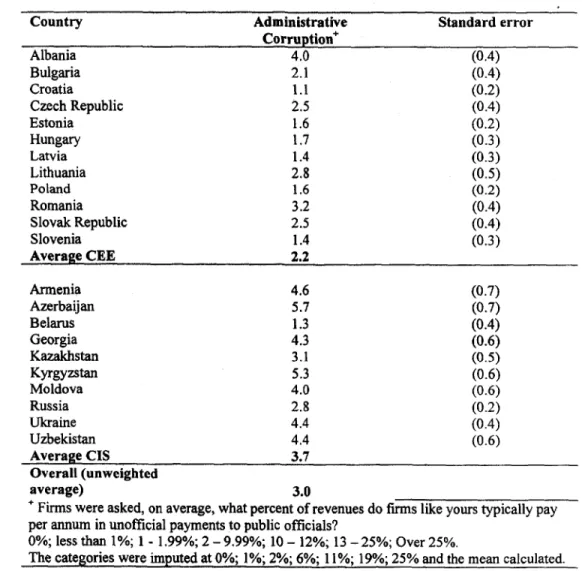
Methods of measuring and comparing levels of administrative corruption across countries are alteady well-established. The BEEPS survey follows the convention of previous surveys around the world which ask firn managers to estimate the propordon of annual revenues typically paid by "firms like yours" in unofficial payments to public officials "in order to get things done."'5 The survey stipulates a range of "services" for which such bribes could be paid, including connection to public services, to obtain licenses and permuits, to deal with taxes and tax collection, to deal with customs/imports. Table 1 presents unweighted country averages of the cumulative bribes paid by firms in administrative corruption.
Table 1: Measuring Administrative Corruption'
6Country
Administrative Standard errorCorruption+ Albania 4.0 (0.4) Bulgaria 2.1 (0.4) Croatia 1.1 (0.2) Czech Republic 2.5 (0.4) Estonia 1.6 (0.2) Hungary 1.7 (0.3) Latvia 1.4 (0.3) Lithuania 2.8 (0.5) Poland 1.6 (0.2) Romania 3.2 (0.4) Slovak Republic 2.5 (0.4) Slovenia 1.4 (0.3) Average CEE 2.2 Armenia 4.6 (0.7) Azerbaijan 5.7 (0.7) Belarus 1.3 (0.4) Georgia 4.3 (0.6) Kazakhstan 3.1 (0.5) Kyrgyzstan 5.3 (0.6) Moldova 4.0 (0.6) Russia 2.8 (0.2) Ukraine 4.4 (0.4) Uzbekistan 4.4 (0.6) Average CIS 3.7 Overall (unweighted average) 3.0
+ Firms were asked, on average, what percent of revenues do firms like yours typically pay per annum in unofficial payments to public officials?
0%; less than 1%; 1 - 1.99%; 2 - 9.99%; 10 - 12%; 13 -25%; Over 25%,
The categories were imputed at 0%; 1%; 2%; 6%; 11%; 19%; 25% and the mean calculated.
15 The question was posed in terms of firm revenues rather that profits since estimates of revenues are more reliable. In addition the question was posed indirectly in terms of "firms like yours" to reassure respondents that their responses would not be attributable directly to their firm. We take total payments as a proxy for administrative corruption since evidence from the BEEPS suggests that the majority of bribe payments are for this purpose.
16 This measure of administrative corruption differs from the "bribe tax" presented in EBPD (1999), although both werc based on the BEEPS. The measure used in this paper includes the responses of all firms, whereas the measure presented in EBRD (1999) presents the average bribes as a share of revenues, among firms that reported paying bribes.
The results suggest considerable variation in the level of administrative corruption across transition economies ranging from less than 2 per cent of annual revenues in a number of Central European countries to over 5 per cent in some CIS countries. Yet there is considerable variation within each region as well. Within the CIS, the high regional average is driven by the very high levels of administrative corruption in the Caucasus countries and Kyrgyzstan. Other CIS countries fall within ranges more comparable to Eastern Europe. State capture
Measuring state capture as a form of corruption distinct from the above is more complex as there are few existing indicators in the empirical literature on corruption. One key measurement problem is that the extent to which a set of state institutions is captured is not necessarily a function of the number of firms that engage in state capture. In an extreme case, a single powerful monopoly could generate a much higher level of state capture than a larger nurnber of less powerful firms competing to buy off state officials. To compare state capture across firms and across countries, we therefore need both to identify the number of firms that engage in it and to measure the extent of the impact on all firms from the capture of the state
by
a subset of those firms. Consequently, we use two measures of state capture: 1) an impact measnure of the extent of the capture economy defined as the share of firms in each country which report a direct impact on their business from the purchase of laws, decrees and regulations by firms through private payments to public officials, and 2) a behamioral measure that identifies captor firms, i.e. those that report having made private payments to public ,officials for the purpose of influencing the contents of laws, decrees or regulations.17'ro construct an index of the capture economy, firmns were asked to assess the extent to which :he following six types of activities have had a direct impact on their business:'8
* the sale of Parliamentary votes on laws to private interests; * the sale of Presidential decrees to private interests;
* Central Bank mishandling of funds;
* the sale of court decisions in criminal cases; * the sale of court decisions in cornmercial cases;
40 illicit contributions paid by private interests to political parties and election campaigns.
Table 2 presents the percentage of firms in each country which responded that the respective form of state capture has had a significant impact on their business. By averaging across all of the categories an aggregate index of the extent of the capture economy is presented.
17 7f course, the impact measure of state capture is based on the speculation of firms that other firms are engaging in
6nproper behavior and thus less reliable than the behavioral measure. The empirical analysis of the effects of state capture on firm-level performance below will be based on the more reliable behavioral measure. However, we believe that the impact measure still provides a useful relaive indicator of perceptions of the irnpact of state capture across countries.
'T'he decision to include the sale of court decisions to private interests and the mishandling of Central Bank funds as elements of state capture requires some explanation. Courts are generally seen as institutions that implement existing laws as opposed to making them, though the prccedent-setting function of courts can blur these boundaries. In the transition countries, where legal systems are still in the nascent stages of development, courts can be seen as playing a more formative role in the development of the legal framework. As regards the Central Bank, the institution's role in setting monetary policy and creating the regulatory framework for the developing financial system also blurs the distinction between the formation a:nd implementation of rules. While recognizing the difficulty of drawing concrete boundaries within any particular institution, we have chosen to incorporate these institutions within the category of state capture as a result of the unique nature of the transition period. Yet it is important to note that removing these components from the index of state capture does not change substantially the ranking of countries on state capture presented in table 2.
The index of the capture economy, defined as the unweighted average of the 6 component indices, suggests a sharp division of the transition countries imto two groups." The low capture group includes: Albania, Armenia, Belarus, Czech Republic, Estonia, Hungary, Kazakhstan, Lithuania, Poland, Slovenia and Uzbekistan. This is an unusual combination of countries as it incorporates the most advanced and the least advanced reformers on both political and economic transition in the sample. It should not be surprising that the most advanced reformers have the lowest levels of state capture as their progress in liberalizing the economy, strengthening bureaucratic accountability and promoting political contestability nmght be expected to place some, albeit stll imperfect, constraints on the extent to which individual firms can capture the state.
Table 2: Measuring the capture economy (% of firms affected by 'purchase of...
Parliamentary Presidential Central Criminal Commercial Party Capture Classification20 legislation decrees Bank Courts Courts Finance Economy
Country IndexX Albania 12 7 8 22 20 25 16 Low Armenia 10 7 14 5 6 1 7 Low Azerbaijan 41 48 39 44 40 35 41 High Belarus 9 5 25 0 5 4 8 Low Bulgaria 28 26 28 28 19 42 28 High Croatia 18 24 30 29 29 30 27 High Czech 18 11 12 9 9 6 11 Low Republic Estonia 14 7 8 8 8 17 10 Low Georgia 29 24 32 18 20 21 24 High Hungary 12 7 8 5 5 4 7 Low Kazakhstan 13 10 19 14 14 6 12 Low Kyrgyzstan 18 16 59 26 30 27 29 High Latvia 40 49 8 21 26 35 30 High Lithuania 15 7 9 11 14 13 11 Low Moldova 43 30 40 33 34 42 37 High Poland 13 10 6 12 18 10 12 Low Romania 22 20 26 14 17 27 21 High Russia 35 32 47 24 27 24 32 High Slovak 20 12 37 29 25 20 24 High Republic Slovenia 8 5 4 6 6 11 7 Low Ukraine 44 37 37 21 26 29 32 High Uzbekistan 5 4 8 5 9 4 6 Low Overall 21 18 23 18 18 20 20 (unweighted average)
* Firms were asked whether corruption in each dimension had no impact; minor impact; significant impact; very significant impact on their business. The table reports the proportion of firms reporting significant or very significant impact of state capture in each dimension.
+ Calculated as the unweighted average of the six component indices.
t9 This division is not intended to imply that there are no interestng differences between the countries in the two groups but is rather a simple reflection of a tendency in the data that will be used for framing some of the uncontrolled results in the paper. Albania is defined as the borderline low-capture country and Romania the borderline high-capture country.
0 The use of the descriptive term low' does not imply that state capture does not exist in these countries. Indeed the BEEPS shows that the phenomenon is present across the transition economies, although in those that we describe as 'low' the impact is significantly more limited.
A prion the low capture index for some of the least advanced reformers, such as Belarus and Uzbekistan, might appear puzzling. A likely explanation is that in such countries the private sector remains small, imnportant elements of the command system are still in operation, and the political regimes are highly authoritarian. In countries with such a severe imbalance between the power of the state and the private sector, the extent of state capture by the private sector can only be minimal (and indeed the concept may have little meaning in this context).
The gap separating countries with a low and high state capture index is considerable. In the high capture econornies, more than a quarter of the firms surveyed reported a significant impact of state capture on their business. This group includes: Azerbaijan, Bulgaria, Croatia, Georgia, Kyrgyzstan, Latvia, Moldova, Romania, Russia, Slovakia and Ukraine. Most of these countries could be considered partial reformers both in terms of their political and econornic transitions. They have generally made significant advances in liberalization and privatization with much less progress in concomitant institutional reforms to support a proper legal and regulatory framework. Though most have adopted the basic rules of democratic elections, there remain concerns in nearly all of these countries regarding the concentration of political power and linitations on political competition. Capture might be expected to thrive in an environment of partial econornic reformns and concentrated political power, though the
determinants
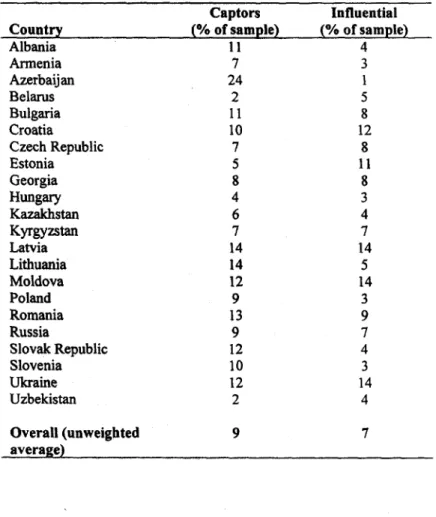
of the capture economy will be addressed in greater detail below.21In contrast to this impact measure of the extent of state capture, the BEEPS survey also attempted to elicit whether firms directly engaged in making illicit private payments to public officials to influence the content of laws, decrees or regulations. This allows us to identify captorfirms and contrast their characteristics and performance with other firms both within and across countries.2 2 Table 3 lists the share of all firns in each country that can be classified as captor firms. As expected, captor firms are a minority in all countries, though again the variation is considerable across the transition countries.
Influence
The measure of influence is based on the firm's own assessment of their capacity to affect the content of laws, rules, regulations or decrees emanating from various state institutions that would have a substantial impact on their business.' The question made no reference to any
21 On the links between partial reforms and the capacity of powerful firms to concentrate gains as a result of the associated market distortions, see Hellman (1998).
22 The captor firms were identified on the basis of the following question: "How often do firms like yours nowadays need to make extra, unofficial payments to public officials to influence the content of new laws, decrees and regulations?". Firms responding sometimes or more frequently were classified as captors. As discussed above, there is no theoretical reason to believe that the behavioral measure of state capture, constructed as the share of firms engaging in this activity, should be necessarily related in any systematic manner to the impact measure, constructed as the share of firms that have been direcdy affected. However a sirnple correlation of the two measures reveals a correlation coefficient of 0.69, which lends some additional confidence to the measurement of state capture as used in this paper. Nevertheless, the less than perfect correlation between the two measures is consistent with the observation that the nature of state capture varies from country to country and thus there is a variance in the cross-country 0ennMesfn of cahm, defined as the ratio of the capture economy index to the proportion of captor firms (ie. the economy-wide state capture impact per captor firm). The calculated measure of concentration of capture is presented in the appendix table A3 and will be analyzed further in forthcoming research. 23 The influential firms were identified on the basis of the following question: "When a new law, rule regulation of decree is being discussed that could have a substantial impact on your business, how much influence does your firm typically have at the national level of government to try to influence the content of that law, rule regulation or decree?" The question was
private payments to public officials or other explicit forms of corruption. Firms that reported
some influence or more on any of the branches of government listed - executive, legislature,
ministries or regulatory agencies - were classified as influential. The share of influential firms
as a percentage of the sample in each country is listed in Table 3. Influential firms make up a
small minority of firms in every transition country, though there is still considerable variation
across countries.
One might expect some overlap between state capture and influence as both represent efforts
to shape the content of the legal and regulatory framework, although through different
methods. However, a cross-tabulation of captor firms and influential firms across the entire
sample reveals surprisingly little overlap. Of the 343 captor and influential firms .in the
sample, only 21 firms report that they engage in both state capture and have influence on the
formation of state policies. This suggests that capture and influence are alternative strategies
of interacting with the state for a small share of firms with the capacity to have an impact on
shaping the legal and regulatory environment.
Table 3: Captor and Influential firms
Captors
Influential
Country
(% of sample)
(% of sample)
Albania
11
4
Armenia
7
3
Azerbaijan
24
1
Belarus
2
5
Bulgaria
11
8
Croatia
10
12
Czech Republic
7
8
Estonia
511
Georgia
8
8
Hungary
4
3
Kazakhstan
6
4
Kyrgyzstan
7
7
Latvia
14
14
Lithuania
14
5
Moldova
12
14
Poland
9
3
Romania
13
9
Russia
9
7
Slovak
Republic
12
4
Slovenia
10
3
Ukraine
12
14
Uzbekistan
2
4
Overall
(unweighted
9
7
average)asked separately for the executive, legislative, ministry and regulatory branches of government. A firm that reported influence in any of these branches was classified as influential.
4. The determinants of capture, corruption and influence
What factors affect the propensity of firms to enter into these different types of relationships with the state? To what extent are these choices determined by charactenstics of the firm or features of the broader political economy environment? By investigating the different profiles of firms that engage in state capture and influence, we might gain insights into how these relationships with the state differ.
Econometric Results
We present the results of separate regressions to explore the characteristics that affect the propensity of any given firm to engage in administrative corruption, state capture or influence, as defined above. Controlling for country fixed effects, we examine the impact of the firm's size, origins, market power, bureaucratic recourse, and security of property and contract rights.
Si,e:i' Larger firms would be expected to wield greater influence and be more likely to engage m state capture as they have more bargaining power with the state and control more resources. Smaller firms, in contrast, might be more vulnerable to the grabbing hand of the state and thus more likely to be targets of administrative corruption.
Qnftns..25 The ownership and origins of the firm - i.e. state-owned, privatized or
de novo
-determine, to some extent, the formal ties between the firm and the state as well as the extent of repeated interactions between firm managers and public officials. State-owned and privatized firms might be expected to retain considerable access to and ties with public officials, enhancing their influence on the state. As new players on the market, de novo firms, in contrast, are less likely to be influential, while possibly more likely to invest in state capture as a substitute for more formal ties of influence to the state. Such firms might also be expected to pay higher levels of administrative corruption.
Market
pover.2
6 Firms with greater market power would be expected to be more influential and more likely to engage in state capture, though it is difficult to separate the direction of causality since influence and capture are also likely to enhance the firm's market power.2 7 In the BEEPS survey, market power is measured by the inelasticity of demand for the firm's :major product line. Respondents were asked to state the likely response of their customers toa significant price increase in their main product line. Firmns with less market power are more
likely to be subjected to demands for bribes in the context of administrative corruption.
Firms were divided into small, medium and kge based on the number of employees. Small firms had less than 50 employees, medium sizcd firms had between 50 and 500 and large firms were those with more than 500.
25 Firms were divided into de novo, puivatiZed and state owned De novo firms are those which were private from the time of start-up with no state-owned predecessor, privatized firms are those which were formnerly state owned and state owned firms are those in which the state retains majority ownership.
26 Firms were asked, "if you were to raise your prices of your main product line 10% /above their current level (after allowing for any inflation and assuming that your competitors maintained their current prices), which of the following would best clescribe the result? Many of our customers would buy from our competitors instead (I); Our customers would continue to buy from us, but at much lower quantities (2); Customers would continue to buy from us, but at slightly lower quantities (3); Customers would continue to buy from us in the same quantities as now (4).
27 In addition, we include this variable since its exclusion potentially biases the coefficient of the insecurity of property rights
Bureaucratic recourse.," Some firms have better access to public officials than others and can use that access to ensure fair treatment against transgressions. The BEEPS survey asked firms to assess whether, if some public official acts against the rules, they can go to another public official to get fair treatment without recourse to private payments to that public official. Firms that have sufficient access to defend themselves against such transgressions could be described as having greater bureaucratic recourse. Bureaucratic recourse should be expected to be positively associated with greater influence. Firms that engage in state capture might be expected to have lower levels of bureaucratic recourse as their interactions with public officials tend to be based on private payments. Firms with less bureaucratic recourse should also be more prone to administrative corruption.
Insecuriy ofproperty and contract rights9
Firms with
insecure propertyrights, especially as a result
of discretionary interventions in their affairs by bureaucrats, might be tempted to seek individualized protection through state capture. In contrast, firms with more secure property rights rmight be expected to wield greater influence on the state, given their longer time horizon and greater leverage over the state. The survey asked firms to evaluate the security of their property and contract rights both today and three years ago to examine changes over time. In the regressions reported below we use the insecurity of such rights three years ago as proxy for the firn's "initial conditions".
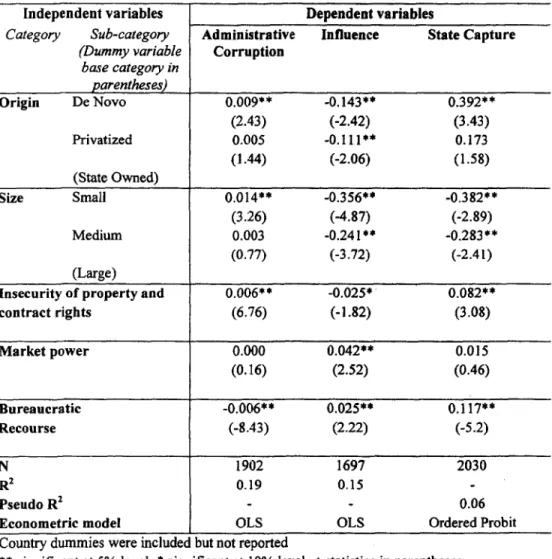
Table 4 presents the econometric evidence on the determinants of influence, capture and administrative corruption. Country fixed effects are included in each regression though the results are not shown. Comparing the results across the regressions confirms that different types of firms in transition economies have incentives to enter into different types of relationships with the state.
As expected, larger firms with their greater command over resources are more likely both to have influence on the state and to engage in state capture, but pay less bribes as a share of their annual revenues for administrative corruption than small firms. Large firms would appear to have a wider range of options in their interactions with the state. Administrative corruption, in contrast, is highly regressive having the greatest impact on small firms.30
2 Firms were asked, "How often is the following statement true? If a government agent acts against the rules I can usually go to another official or to his superior and get the correct treatment without recourse to unofficial payments." Never (I);
Seldom (2); Sometimes (3); Frequently (4); Mosdy (5); Always (6).
29 Firms were asked "To what degree do you agree with this statement, now and three years ago? I am confident that the legal system will uphold my contract and property rights in business disputes" Always (1); Mostly (2); Frequently (3); Sometimes (4); Seldom (5); Never (6).
The effects of the firm's origins on the nature of its relationship with the state show an
interesting pattern. Again as expected, state-owned firms are more likely to be influential than
either ptivatized or de
novofirms, perhaps as a result of their stronger formal ties to the state,
legacies of previous state ownership and more frequent interactions with public officials. In
sharp contrast, captor firms are more likely to be de novo
firms or privatized firms (though this
latter variable is only borderline significant).
Similarly,
ie now firms pay higher levels ofadministrative corruption than either state firms or privatized firns. New entrants are thus
more likely to engage in corruption, though larger new entrants are more likely to engage in
state capture, while smaller new entrants face greater administrative corruption.
Table 4: The determinants of state capture, administrative corruption and influence
Independent
variables
Dependent
variables
Category Sub-category Administrative Influence
State Capture
(Dummy variable Corruption base category in parentheses)
Origin
De Novo
0.009**
-0.143**
0.392**
(2.43)
(-2.42)
(3.43)
Privatized
0.005
-0.11
**0.173
(1.44)
(-2.06)
(1.58)
(State
Owned)
Size
Small
0.014**
-0.356**
-0.382**
(3.26)
(4.87)
(-2.89)
Medium 0.003-0.241**
-0.283**
(0.77)
(-3.72)
(-2.41)
(Large)
Insecurity of property and 0.006**
-0.025*
0.082**contract rights
(6.76)
(-1.82)
(3.08)
Market power
0.000
0.042**
0.015
(0.16)
(2.52)
(0.46)
Bureaucratic
-0.006**
0.025**
0.1 17**
Recourse
(-8.43)
(2.22)
(-5.2)
N
1902
1697
2030
R
20.19
0.15
-Pseudo R2 - - 0.06Econometric
model
OLS
OLS
Ordered
Probit
Country
dummies
were included
but not reported
** significant
at 5% level;
*significant
at 10%
level. t-statistics
in parentheses.
Market power, as measured by the inelasticity of demand for the firm's major product line
does increase its influence, while having no significant impact on the propensity to engage in
state capture or on the levels of administrative corruption paid by the firm. Thus, firms with
limited competition can turn their market power into influence over the state without
necessarily resorting to various forms of state capture." Similarly,
firms with greater access to
public officials, or what we tefer to as bureaucratic recourse, are also more likely to have
greater influence. By contrast, it is precisely those firms that lack access to public officials
who can protect them against transgressions by other officials that tend to engage in state
capture, arguably as a defensive strategy to purchase protection from other public officials.
Lower bureaucratic recourse also increases bribes for administrative
corruption.
Finally, the results on the insecurity of property rights follow the same pattern of variation
across different types of relationships with the state. State capture appears to be a strategy of
firms which started with less secure property and contract rights than influential firms.
3 2Such
msecurity also incteases their exposure to administrative
corruption.
The different profiles of influential and captor firms are striking. Influential firms appear to be
the classic incumbent firms inherited ftom the socialist system. They are large, usually
state-owned with good access to public officials and a dominant position in their own market. They
began the transition from a more secure position with a much higher degree of security of
property and contract rights. Captor firms, in contrast, tend to be larger new entrants to the
market with weaker formal ownership ties to the state and less access to public officials. They
begin the transition with less secure property and contract rights and do not have as strong a
position in their markets as the influential incumbent firms.
Furthermore, the captor firms also report greater barriers to competition than influential
firms. Table 5 compares the share of captor, influential and other firms that perceive
anti-competitive barriers as a significant obstade to their business. Across the sample, captor firms
face a greater threat of anti-competitive
barriers. The difference is particularly stark when we
compare the perceptions of captor firms in low and high capture economies
331We also added a variable measuring the firm's market share in its dominant product line but these results were not significant in any of the regressions.
32 To assert that the initial security of property rights are also a cause of influence is clearly implausible, but for symmetry we indude this variable as a control in the determinarits of influence. Our hypothesis is that a high level of 'initial influence'
would be a cause of security of property tights in future periods, but unfortunately we do not have the variables to test this
and the results are merely suggestive of the relationship between influence and the security of property rights. 33 Captor firms also report somewhat lower levels of market share than other firms in the sample.
Table 5: Anti-competitive Barriers
% of firms that report anti- Low Capture Countries High Capture Countries competitive barriers+ Captor firms 0.46 0.73 (0.05) (0.03) Influential firms 0.32 0.56 (0.06) (0.04) Other 0.38 0.51 (0.01) (0.01)
Standard errors in parentheses
Firms were asked how problematic are anti-competitive practices by the govermnent or private enterprises? No obstacle; Minor obstacle; Moderate Obstacle; Major Obstacle. Firms reporting moderate or major obstacles are classified as facing anti-competitive barriers.
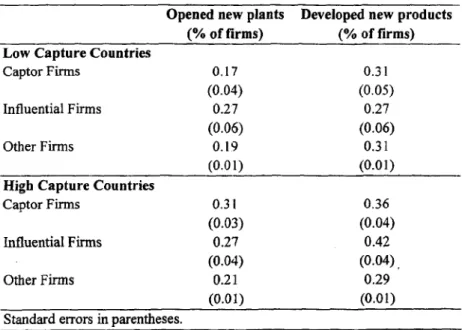
Though it mnight be assumed that firms invest in state capture to extract rents ftom the state as a substitute for innovation in the market, the evidence suggests instead that state capture and econornic innovation are complementary, at least in high capture states. Table 6 compares the propensity of captor firns versus other firns to engage in such innovative activities as opening new plants and developing new products. In high capture economies, captor firms are significantly more likely to innovate.3 4 Yet there is a clear distinction between the behavior of captor firms in low and high capture economies.
Table 6: Market Innovation
Opened new plants Developed new products (% of firms) (% of firms) Low Capture Countries
Captor Firms 0.17 0.31 (0.04) (0.05) Influential Firms 0.27 0.27 (0.06) (0.06) Other Firms 0.19 0.31 (0.01) (0.01)
High Capture Countries
Captor Firms 0.31 0.36 (0.03) (0.04) Influential Firms 0.27 0.42 (0.04) (0.04) Other Firms 0.21 0.29 (0.01) (0.01)
Standard errors in parentheses.
34 However, if we further divide the population of captor firms into de nave captors and captors derived from state firms, we
These results suggest that state capture is a strategy adopted by a small share of relatively dynamic de novo firms entering a market in which they face serious competitive barriers from influential incumbent firms. Given the conventional portrayal of so-called "oligarchs" who buy off state officials to extract rents, one might expect captor firms to report fewer competitive barriers. Part of an explanation of this anomaly lies in the particular structute of the BEEPS sample which is weighted towards small and medium sized enterprises. Therefore the captor firms being sampled are also biased towards smaller and medium sized enterprises. In addition, the large enterprises sampled were weighted towards state-owned firms, which as shown above, are more likely to be influential rather than captor firms. As a result, the sample contained only a small share of firms that might be characterized as part of the .typical oligarch's business group. This selection bias underestimates the share of large firms that might be expected to engage in state capture, which would also be more likely to erect barriers to entry than face barriers to entry.
There is a high share of small and medium sized enterprises among the captor firms in the BEEPS sample which suggests that state capture is not a strategy used exclusively by powerful oligarchs, but is more pervasive across different levels of the economy and the state in transition countries." Indeed, the captor firms in the BEEPS sample might be more appropriately seen as "embryonic oligarchs," i.e., new firms that are engaging in state capture as a strategy of entry in an effort to establish their own dominance in the face of influential incumbent firms.3 6 The fact that in high capture economies such embryonic oligarchs also appear to be among the most dynamic new firms in the might explain why, once entrenched, state capture is so difficult to remedy.
35 The question remains as to what level of government or types of government decisions these smaller firms are actually capturing. In the transition economies, many regulations with direct impact on firms are not made at the highest levels of government, but are in the purview of local officials, who may be subject to capture from smaler firms. (The fallacy that state capture only applies to the largest firms at the highest levels of govemment is similar to the fallacy that monopoly power is related to the size of the firm or market it operates in. Even if the relevant market is small, monopoly power can nevertheless exist. Tirole (1988) gives the example of a single doctor with a rural practice. In the same way the relevant market for state capture and influence may be at the national or local level, all that is required is for some state official to have the power to influence the operating environment of the firm and its competitors.) If we assume that the smaUer firms that engage in capture do so at lower levels of government, the results are not implausible. Unfortunately it is not possible to test this assumption. (and indeed, this assumption also suggests another interpretation if we assume that firms are more likely to admit to lower level forms of corruption).
36 In addition, it has been common practice in the transition economies for managers of large firms to register de novo firms
on the basis of their existing enterprises, as a means of diverting assets and reducing transparency. As a result, many small, de
5. The private gains to capture, corruption and influence
If these alternative relationships between the firm and the state entail different distributions of
rents, then we should see differential effects on firm performance associated with these
relationships. The BEEPS survey ptovides the first opportunity to measure and compare the
costs and benefits to those firms that actively engage in state capture, adrninistrative
corruption and influence, as well as the externalities to other firms in each country that are not
engaged in such relationships. As a result, we can assess both the private and the social costs
and benefits of different types of interactions between firms and the state.
As suggested above, measuring firm performance in transition economies is particularly
difficult given the incentives for firms to under-report profits and the lack of international
accounting standards in most countries of the region. Moreover, as a result of well-known
corporate governance problems, managers mnight
be able to extract private gains as a result of
corrupt activities that would not be reflected in the firm level performance.
37Such pnrvate
gains to managers cannot be measured. As a proxy of for firm performance, we use actual
and expected future real growth in sales and investment, though the inherent liritations of
these measures should be kept in mind.
To illustrate the performance differences, we first compare the unconditional means of the
actual growth of sales and investmnent
over the past three years between firms that engage in
state capture, influence and administrative
corruption and all other firms. We also include data
on expected growth in these variables over the next three years to determine whether any
costs or benefits on previous performance are perceived to be sustainable in the future. Table
7 compares the unconditional performance means for captor firms, influential firms and firms
subject to administrative corruption.
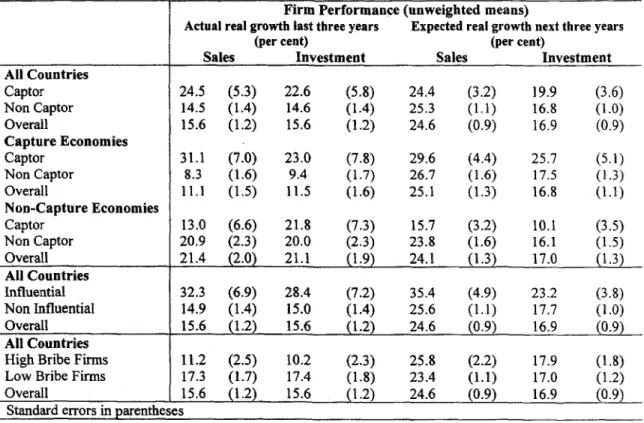
On average, captor firms demonstrate a considerably higher rate of real sales growth over the
past three years than other firms, as well as higher rates of investment and employment. State
capture does appear to yield private benefits to the firmn.
It is interesting to note that the
extent of their advantage over other firmns
recedes in expected performnance
suggesting some
uancertainty
about the gains to capture over time.
Yet the gains to state capture would appear to be highly dependent on the nature of the
broader environtnent in which they operate. If we divide the transition countries into high and
low capture economies according to their scores on the capture economy index defined
above, the pattern of gains to capture looks rather different. Where there is a significant
market for state capture, i.e. where the state is willing to sell customized packages of public
goods and legislation to individual firms, the gains to those firms actively engaging in capture
would appear to be substantial. Captor firms grew nearly four times as fast as other firms in
high capture environments with similarly substantial differences in investment levels. Though,
again, the gap between captors and other firnms narrows considerably on perceptions of
expected
growth rates.
In sharp contrast, captor firmns
in low capture countries, where states provide a broader range
of public goods for the market arid the legislative process is more subject to institutional
37 These corporate governance problems have been investigated recently by Black et al (1999). To the extent that growth insales represent gains that accrue to the firm, whether or not they are subsequently appropriated by managers, the results of