Preparation, Crystal Structures and Properties of Two
Modifications of UCr6P 4
W olfgang Jeitschko* and Reinhold Brink
Anorganisch-Chem isches Institut der Universität Münster, W ilhelm -Klemm-Straße 8, D -W -4400 Münster
Z. Naturforsch. 47b, 192-1 9 6 (1 9 9 2 ); received September 5, 1991
Tin Flux, Crystal Structure, Magnetic Properties, Structural R elationships
U C r6P4 was prepared from a tin flux in tw o forms at low (a) and high (ß) temperatures
(880 °C and 1000 °C), respectively. The crystal structures o f both m odifications were deter mined from single-crystal data. a -U C r6P4: P6m 2 (N o. 187), a = 698.5(3) pm , c = 350.8(1) pm,
Z = 1, R = 0.052 for 18 variable parameters and 410 structure factors; /?-UCr6P4: Pmmn (N o.
59), a = 698.6(1) pm, b = 350.85(4) pm, c = 1196.1(2) pm, Z = 2, R = 0.047 for 21 variables and 656 structure factors. Although the lattice constants o f both m odifications are closely re lated, the two forms can be transformed into each other only by a very sluggish, reconstructive phase transformation. Nevertheless, both structures have very similar coordination polyhedra. The U atom s have 6 P neighbours in trigonal prismatic arrangement. H a lf o f the Cr atom s
have tetrahedral, the other half square pyramidal P coordinations. As is typical for phosphides with high metal content, all metal atoms additionally have many metal neighbours. The P at om s are located in trigonal prisms o f metal atom s with tw o or three additional metal atom s outside the rectangular faces o f the prisms. Both m odifications o f U Cr6P4 show relatively high,
alm ost temperature independent paramagnetism, as is frequently observerd for intermetallic phases o f uranium.
D uring the investigations o f ternary systems
lanthanoid(Ln)-transition metal(T)-phosphorus
num erous phosphides were found with a metal: phosphorus ratio close to or at exactly 2:1. Exam ples are the series Ln2F e12P7, Ln2C o12P7 [1, 2], Ln2N i12P7 [3], Ln2R h12P7 [4]~LnFe5P3 [5]", LnC o5P3
[6-8], LnNi5P3 [9, 10], LnCo8P5 [11, 12], Ln6Ni20P13
[13], LnC o3P2 [8, 14, 15], Ln5C o19P]2 [8, 16], Ln5R u19P12 [17], LnNi4P2 [18], and Ln3N i7P5 [19], A few corresponding actionoid transition metal phosphides have also been reported: Th6C o20P13
[20], U6R h20P]3 [21] and U M n4P2 [22], Here we give a detailed account of our work on two m odifica tions o f U C r6P4. Preliminary reports about their crystal structures were given before [23, 24],
Sample Preparation and Properties
Both m odifications of U C r6P4 were prepared from the elemental com ponents using tin as a flux [25, 26], Starting materials were small platelets of uranium (Merck, “nuklearrein”), chromium pow der (150 mesh, nominal purity 99.99%), red phos phorus in the form of small pieces (Höchst A G , K napsack, “ultrapure”), and granules of tin
(Rie-* Reprint requests to W. Jeitschko. V erlag der Z eitschrift für N a tu rfo rsch u n g , D -W -7400 T übingen
0932 - 0 7 7 6 /9 2 /0 2 0 0 - 0192/$ 01.00/0
del-de Haen, “reinst”). The best results were achieved by preparing first U P2 (with about 10% excess of phosphorus) by reaction of the com po nents in evacuated silica tubes for 20 h at 450 °C. The excess (white) phosphorus was separated from the m ain product by a tem perature gradient in the furnace. The resulting UP2 sample was crushed to a powder under argon and not allowed to contact air prior to the reactions. A ppropriate am ounts o f U P2 were then reacted with chrom ium powder and red phosphorus in a tin flux. The atomic ratios U :C r :P :S n varied between 4 :1 9 :9 :6 8 and 5 :1 7 :8 :7 0 . The samples were placed in alumina containers, which were sealed in evacuated silica tubes and slowly heated (50 °C/h) to 450 °C, where they were held for about 10 h to allow reaction of the excess phosphorus. They were then annealed for ten days at tem peratures between 880 and 1000 °C. The tin-rich matrix of the samples was dissolved in moderately diluted (1:1) hydrochloric acid. The G uinier powder patterns showed the samples annealed at 1000 °C to be single phase /?-UCr6P4. The samples annealed at 880 °C consist ed o f the a m odification with m inor am ounts of the ß m odification.
Both m odifications crystallize in the form of black needles with metallic lustre. They are stable in air and only very slowly attacked by hot concen trated hydrochloric acid.
M agnetic susceptibility measurements were made with a F araday balance between liquid
ni-This work has been digitalized and published in 2013 by Verlag Zeitschrift für Naturforschung in cooperation with the Max Planck Society for the Advancement of Science under a Creative Commons Attribution-NoDerivs 3.0 Germany License.
On 01.01.2015 it is planned to change the License Conditions (the removal of the Creative Commons License condition “no derivative works”). This is to allow reuse in the area of future scientific usage.
Dieses Werk wurde im Jahr 2013 vom Verlag Zeitschrift für Naturforschung in Zusammenarbeit mit der Max-Planck-Gesellschaft zur Förderung der Wissenschaften e.V. digitalisiert und unter folgender Lizenz veröffentlicht: Creative Commons Namensnennung-Keine Bearbeitung 3.0 Deutschland Lizenz.
Zum 01.01.2015 ist eine Anpassung der Lizenzbedingungen (Entfall der Creative Commons Lizenzbedingung „Keine Bearbeitung“) beabsichtigt, um eine Nachnutzung auch im Rahmen zukünftiger wissenschaftlicher Nutzungsformen zu ermöglichen.
W. J e its c h k o - R . B rink • Two M o d ificatio n s o f U C rfiP4 193
trogen and room tem perature as described earlier
[21]. Both modifications show alm ost tem pera ture-independent param agnetism. At room tem perature the susceptibility o f the /^-modifications is
X = 4.3(±0.1)x 10~3 cm3/mol; it increases to / =
4.7( ±0.1)x 10“ 3 cm3/mol at 77 K. The values for the low tem perature modification are about 10% higher, but could not be determ ined accurately be cause the sample contained the high tem perature modification as a second phase. The m agnitude of these susceptibilities is considerably higher than the Pauli paramagnetism o f ordinary metals and similar to that o f “heavy fermion systems” [28],
Structure Determinations
Indices for the interpretation o f the G uinier powder data could be assigned on the basis o f the single-crystal data and the intensities calculated [29] from the refined structure. Lattice constants were refined by least-squares fits using a-q u artz
(a = 491.30 pm, c = 540.46 pm) as standard. They are listed in Table I together with other data o f the structure determ ination.
Needle-shaped single-crystals o f both U C r6P4
modifications were investigated in Weissenberg cameras. In both cases the needle axes turned out to be the short axes, as is usually the case. The crystals had the Laue symmetries 6/m m m and mmm and the structures were eventually deter mined in the space groups P6m2 (No. 187) and Pmmn (No. 59), respectively. Intensity d ata were
collected with a four-circle diffractom eter. The po sitions o f the uranium atom s were obtained from the Patterson syntheses; those o f the other atom s were found on difference Fourier maps. F o r the full-matrix least-squares refinements atomic scat tering factors [30] were used, corrected for anom al ous dispersion [31], Weights reflected the counting statistics. Parameters accounting for isotropic sec ondary extinction were refined and applied to the calculated structure factors. To check for devia tions from the ideal compositions, we refined oc cupancy param eters together with the therm al p a rameters, while the scale factors were held con stant. N o significant deviations from the ideal occupancies were observed. In the final cycles the ideal occupancies were assumed. The correct handedness o f the crystal used to determ ine the structure of the hexagonal crystal was found by re fining both enantiom orphic settings. The residual value for the correct setting was lower by 4 relative % (0.052 V5. 0.054). The final residuals, positional param eters and interatom ic distances are given in Tables I - I I I . The anisotropic thermal param eters and structure factor tables are available [32, 33]*.
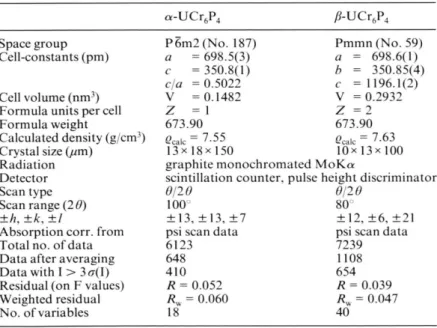
* Further details may be obtained from: Fachinform a-tionszentrum Karlsruhe, Gesellschaft für w issen schaftliche Information m bH , D -7514 Eggenstein-Leopoldshafen 2, by quoting the Registry N o. C SD 55861, the names o f the authors and the journal citation. a -U C r6P4 /?-UCr6P4 Space group P 6m 2 (N o. 187) Pmmn (N o. 59) Cell-constants (pm) a = 698.5(3) a = 698.6(1) c = 350.8(1) b = 350.85(4) c/a = 0.5022 c = 1196.1(2) Cell volume (nm 3) V = 0 .1 4 8 2 V = 0.2932
Formula units per cell Z = 1 Z = 2
Formula weight 673.90 673.90
Calculated density (g/cm 3) ^ c a lc —7.55 0 c a lc = 7 ' 6 3
Crystal size (//m) 13* 18* 150 10x 13x 100
Radiation graphite m onochrom ated M o K a
Detector scintillation counter, pulse height discriminator
Scan type 0/20 0/20
Scan range (2 0) 1 0 0° 80°
±h, ±k, ±1 ± 1 3 , ± 1 3 , ± 7 ±1 2, ±6, ± 2 1
Absorption corr. from psi scan data psi scan data
Total no. o f data 6123 7239
D ata after averaging 648 1108
D ata with I > 3er(I) 410 654
Residual (on F values) R = 0.052 R = 0.039
Weighted residual /?w = 0.060 /?w = 0.047
N o. o f variables 18 40
Table I. Crystallographic data for the low {a)- and high (/^-tem peratu re m odification o f U C rT \.
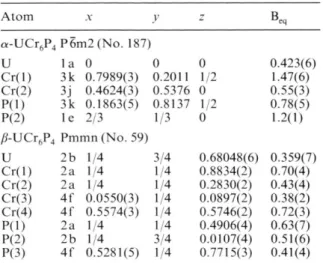
194 W. J e its c h k o - R . B rink • T w o M odifications o f U C r6P4 Table II. A tom ic parameters for a- and /?-UCr6P4. The
last colum n lists the equivalent isotropic thermal pa rameter Bea(x 100 in units o f nm2). Standard deviations in the positions o f the last listed digit are given in paran-theses throughout this paper.
Atom X y z Bec a -U C r6P4 P6m 2 (N o. 187) U 1 a 0 0 0 0.423(6) C r(l) 3k 0.7989(3) 0 . 2 0 1 1 1 / 2 1.47(6) Cr(2) 3j 0.4624(3) 0.5376 0 0.55(3) P (l) 3k 0.1863(5) 0.8137 1 / 2 0.78(5) P(2) 1 e 2/3 1/3 0 1.2(1) /?-UCr6P4 Pmmn (N o. 59) U 2b 1/4 3/4 0.68048(6) 0.359(7) C r(l) 2a 1/4 1/4 0.8834(2) 0.70(4) Cr(2) 2a 1/4 1/4 0.2830(2) 0.43(4) Cr(3) 4 f 0.0550(3) 1/4 0.0897(2) 0.38(2) Cr(4) 4 f 0.5574(3) 1/4 0.5746(2) 0.72(3) P(D 2a 1/4 1/4 0.4906(4) 0.63(7) P(2) 2b 1/4 3/4 0.0107(4) 0.51(6) P(3) 4 f 0.5281(5) 1/4 0.7715(3) 0.41(4) Discussion
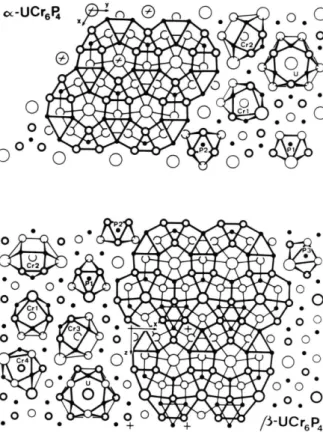
The structures and coordination polyhedra of the two modification of U C r6P4 are shown in Fig. 1. Both represent new structure types, and al though both structures have much in common, the phase transform ation taking place somewhere be tween 880 and 1000 °C must be o f the sluggish, re constructive type as opposed to the displacive, fer- roic type, because the connectivity of the atom s is different. The high-tem perature (/?) modification for a given com position can usually be described with a smaller num ber o f positional parameters. U C r6P4 represents one of the few exceptions from this rule.
In both m odifications of U C r6P4 all atom s are placed on m irror planes, which extend perpendicu lar to the short axes. In both structures the U a t oms have six P neighbours forming trigonal prisms at (average) distances of 285.6 pm and 284.7 pm in the a- and /^-modification, respectively. These coordination polyhedra are augmented by twelve Cr atom s at average distances of 326.0 pm and 323.7 pm. Two U atom s a translation period above and below at (the same distances in both structures of) 350.8 pm complete these coordina tion polyhedra, although these interactions can hardly be considered as bonding. Two types o f dif ferent coordinations for the Cr atom s occur in
Table III. Interatomic distances (pm) in a- and /?-UCr6P4. All m eta l-m eta l and m etal-p h osp h oru s di
stances shorter than 360 pm are listed. The shortest P - P distances are all greater than 300 pm. Standard devia tions are all less than 0.5 pm in the a - and less than 0.6 pm in the /^-modification. a -U C r6P4 y?-UCr6P4 U: 6 P (1) 285.6 U: 4P(3) 283.5 6C r(l) 299.9 2P(1) 287.0 2 U 350.8 2 C r(l) 299.5 6Cr(2) 352.2 4Cr(4) 304.8 2Cr(4) 333.5 C r(l): 2P(1) 234.8 2Cr(3) 347.8 2P(2) 237.4 2 U 350.8 2C r(l) 277.2 2Cr(2) 352.0 4C r(2) 279.1 2 U 299.9 C r(l): 2P(2) 232.3 2C r 350.8 2P(3) 235.9 4Cr(3) 277.9 Cr(2): 4P(1) 242.9 2Cr(3) 281.9 1 P(2) 247.1 2U 299.5 2 Cr(2) 270.4 2C r(l) 350.8 4 C r (l) 279.1 2 Cr(2) 350.8 Cr(2): 4P(3) 243.0 2U 352.2 1P (1) 248.3 2Cr(3) 268.4 P d ): 2 C r(l) 234.8 4Cr(4) 279.1 4C r(2) 242.9 2 Cr(2) 350.8 2 U 285.6 2U 352.0 P(2): 6C r(l) 237.4 Cr(3): 2P(2) 241.4 3 Cr(2) 247.1 2P(3) 242.3 1 P(2) 244.6 1 Cr(2) 268.4 1 Cr(3) 272.5 2C r(l) 277.9 lC r (l) 281.9 2Cr(3) 287.6 1U 347.8 2Cr(3) 350.8 Cr(4): 2P(1) 234.4 1 P(3) 236.4 1P (1) 237.1 2 Cr(4) 262.8 lC r(4) 269.1 2Cr(2) 279.1 2 U 304.8 1U 333.5 2Cr(4) 350.8 P(D: 4Cr(4) 234.4 2Cr(4) 237.1 1 Cr(2) 248.3 2 U 287.0 P(2): 2 C r(l) 232.3 4Cr(3) 241.4 2Cr(3) 244.6 P(3): lC r (l) 235.9 lC r(4) 236.4 2Cr(3) 242.3 2Cr(2) 243.0 2 U 283.5
W . J e its c h k o - R . B rink • T w o M o d ificatio n s o f U C r6P4 195
Fig. 1. Crystal structures and coordination polyhedra o f the low (a)- and high (/?)-temperature m odifications o f U Cr6P4. A tom s connected by thick and thin lines are
separated from each other by half a translation period o f the projection direction.
both structures. H alf o f the Cr atom s (the C r(l) a t oms in the a- and the C r(l) and Cr(4) atom s in the /^-modification) have four P neighbours forming a distorted tetrahedron (at average distances of 236.1 pm, 234.1 pm and 235.4 pm), the other half has five P neighbours forming a distorted square pyramid (with average distances o f 243.7 pm, 244.1 pm, and 242.4 pm for the Cr(2) atom s o f the
a - and the Cr(2) and Cr(3) atom s o f the ^-m odification, respectively). The average C r - P distances are larger for the C r atom s with five P neighbours than the average C r - P distances o f the Cr atom s with four P neighbours, as it should be for these strong interactions. In addition both types of Cr atom s have ten m etal neighbours with C r - C r distances ranging between 262.8 pm and 350.8 pm and C r - U distances between 299.5 pm and 352.2 pm. The larger ones o f these distances can hardly be counted as bonding interactions,
these neighbouring atom s ar “needed”, however, to com plete the coordination polyhedra.
As is usually observed for phosphides with high m etal content the phosphorus atom s have six m et al neighbours forming trigonal prisms (Fig. 2). In phosphides with a m etal: phosphorus ratio o f ex actly 2:1 the phosphorus atom s have three addi tional metal neighbours outside the rectangular faces o f the prisms, thus increasing the coordina tion num ber to nine. In U C r6P4 the metal p h o s phorus ratio is slightly lower and therefore in both m odifications one quarter of the P atom s is coordi nated to nine metal atom s, while the others have only eight close metal neighbours.
oc-UCr6F2
/3-UCr6P4
Fig. 2. Arrangement o f the trigonal metal prisms around the phosphorus atom s in the two m odifications o f U C r6P4. A tom s connected by thick and thin lines are
separated from each other by half a translation period o f the projection direction. Large and small circles: U and Cr; filled circles: P.
We thank Dipl.-Ing. U. Rodewald and Dr. M. H. Möller for the collection o f the single-crys- tal diffractom eter data. The magnetic susceptibili ties were determined by Dipl.-Phys. T. V om hof and D r. M. Reehuis. We are also grateful for gen erous gifts of ultrapure red phosphorus (Hoechst A G, W erk Knapsack) and silica tubes (Dr. G. Hö- fer, Heraeus Quarzschmelze). This w ork was sup ported by the Deutsche Forschungsgemeinschaft and the Fonds der Chemischen Industrie.
196 W. J e its c h k o - R . B rink • T w o M o d ificatio n s o f U C r6P4 [1] W. Jeitschko, D. J. Braun, R. H. Ashcraft, and R.
Marchand, J. Solid State Chem. 25, 309 (1978). [2] M. Reehuis and W. Jeitschko, J. Phys. Chem. Solids
50, 563(1989).
[3] W. Jeitschko and B. Jaberg, Z. Anorg. Allg. Chem. 4 6 7 ,9 5 (1 9 8 0 ).
[4] J.-Y. Pivan, R. Guerin and M. Sergent, C. R. Acad. Sei. Ser. 11299,533(1984).
[5] W. Jeitschko, U . Meisen, and U. D. Scholz, J. Solid State Chem. 55, 331(1984).
[6] V. N . D avydov and Yu. B. Kuz'ma, D opov. Akad.
N auk. Ukr. R SR Ser. A: Fiz. Mat. Tekh. Nauk. 1981,81 (1981).
[7] U . Meisen and W. Jeitschko, J. Less-Comm on Met. 102, 127(1984).
[8] U . Jakubow ski-R ipke and W. Jeitschko, J.
Less-C om m on Met. 136,261 (1988).
[9] W. K. Hofm ann and W. Jeitschko, J. Solid State Chem. 51, 152(1984).
[10] J. V. Badding and A. M. Stacy, J. Solid State Chem. 6 7 ,3 5 4 (1 9 8 7 ).
[ 11 ] U. M eisen and W. Jeitschko, Z. Kristallogr. 167, 135(1984).
[12] M. Reehuis, W. Jeitschko, E. Mörsen, and W. Mül-ler-Warmuth, J. Less-Com m on Met. 139,359 (1988). [13] R. Madar, P. C haudouet, E. Dhari, J. P. Senateur, R. Fruchart, and B. Lambert, J. Solid State Chem. 56 ,3 3 5 (1 9 8 5 ).
[14] W. Jeitschko and U . Jakubowski, J. Less-Com m on Met. 1 1 0 ,339(1985).
[15] S. I. Chikhrii, S. V. Orishchin, and Yu. B. K uz’ma, Izv. Akad. N auk SSSR, N eorg. Mater. 25, 1380 (1989).
[16] W. Jeitschko and E. J. Reinbold, Z. Naturforsch.
40b, 900(1985).
[17] V. G hetta, P. C haudouet, R. Madar, J. P. Senateur, and B. Lam bert-Andron, J. Less-Com m on Met.
146, 299(1989).
[18] S. I. Chikhrii, S. V. Orishchin, and Yu. B. K uz’ma, D opov. Akad. N auk. Ukr. RSR, Ser. A 1986, 81. [19] S. I. Chikhrii, S. V. Orishchin, Yu. B. K uz’ma, and
T. G lovyak, Sov. Phys. Crystallogr. 34, 681 (1989). [20] E. Ganglberger, Z. Kristallogr. 128,438 (1969). [21] V. G hetta, P. C haudouet, R. Madar, J. P. Senateur,
and B. Lam bert-Andron, Mater. Res. Bull. 22, 483 (1987).
[22] W. Jeitschko, L. J. Terbüchte, E. J. R einbold, P. G. Pollmeier, and V. V om hof, J. Less-Com m on Met.
161, 125(1990).
[23] R. Brink and W. Jeitschko, Z. Kristallogr. 174, 27 (1986).
[24] R. Brink and W. Jeitschko, Z. Kristallogr. 178, 34 (1987).
[25] P. Jolibois, C. R. Acad. Sei. 150, 106 (1910). [26] R. Rühl and W. Jeitschko, Inorg. Chem. 21, 1886
(1982).
[27] W. Jeitschko and M. Reehuis, J. Phys. Chem. Solids
48, 667(1987).
[28] F. Steglich, J. Phys. Chem. Solids 50, 225 (1989). [29] K. Y von, W. Jeitschko, and E. Parthe, J. Appl.
Crystallogr. 10, 73(1977).
[30] D. T. Cromer and J. B. M ann, A cta Crystallogr. A 24, 321 (1968).
[31] D. T. Cromer and D. Libermann, J. Chem. Phys.
53, 1891 (1970).
[32] R. Brink, D iplom arbeit, U niv. Münster (1985). [33] R. Brink, Dissertation, U niv. Münster (1989).