University of Tennessee, Knoxville
Trace: Tennessee Research and Creative
Exchange
Doctoral Dissertations Graduate School
8-2017
Understanding Frontline Employees’ Work
Attitude and Behavior: Combining the Theory of
Implicit-beliefs and the Job Demands-Resources
(JD-R) model
Sun-Hwa Kim
University of Tennessee, Knoxville, [email protected]
This Dissertation is brought to you for free and open access by the Graduate School at Trace: Tennessee Research and Creative Exchange. It has been accepted for inclusion in Doctoral Dissertations by an authorized administrator of Trace: Tennessee Research and Creative Exchange. For more information, please [email protected].
Recommended Citation
Kim, Sun-Hwa, "Understanding Frontline Employees’ Work Attitude and Behavior: Combining the Theory of Implicit-beliefs and the Job Demands-Resources ( JD-R) model. " PhD diss., University of Tennessee, 2017.
To the Graduate Council:
I am submitting herewith a dissertation written by Sun-Hwa Kim entitled "Understanding Frontline Employees’ Work Attitude and Behavior: Combining the Theory of Implicit-beliefs and the Job Demands-Resources ( JD-R) model." I have examined the final electronic copy of this dissertation for form and content and recommend that it be accepted in partial fulfillment of the requirements for the degree of Doctor of Philosophy, with a major in Retail, Hospitality, and Tourism Management.
Sejin Ha, Major Professor We have read this dissertation and recommend its acceptance:
Hejin Lim, Jeremy Whaley, Russell L. Zaretzki
Accepted for the Council: Dixie L. Thompson Vice Provost and Dean of the Graduate School (Original signatures are on file with official student records.)
Understanding Frontline Employees’ Work Attitude and Behavior:
Combining the Theory of Implicit-beliefs and the Job
Demands-Resources (JD-R) model
A Dissertation Presented for the Doctor of Philosophy
Degree
The University of Tennessee, Knoxville
Sun-Hwa Kim August 2017
ii
Copyright © 2017 by Sun-Hwa Kim. All rights reserved.
iii
ACKNOWLEDGEMENTS
I would like to express the deepest appreciation to my committee members who were so patient with me. Dr. Sejin Ha, who embodied the figure of a kind professor, provided support and installed mental stimulation in regards to my research. Without her guidance, this study would not have been possible and I would have lost my motivation.
I would like to thank Dr. Heejin Lim who inspired me to take pride in my research; her enthusiasm for research efforts will have a significant affect to my future projects. I am also thankful for Dr. Jeremy Whaley, gave me tremendous support when it was most needed. I would like to acknowledge Dr. Russell Zaretzki, who helped me to earn a Master’s Degree in Business Analytics and Statistics.
Also, I am thankful to Dr. Kiwon Lee, Dr. Younkyoung Kim, Dr. Michelle Childs, and Dr. James Williams who supported me tremendously. Their understanding and generosity would be remembered.
Thank you Eunsook Park, Nayong Lee, and Ran Huang who listened to my complaints; their support was greatly appreciated. I would like to remember my friend Dehlia Laurenson who would be happy for me in heaven. Finally, I express my deepest appreciation to my mom and my sister for their endless love and scarifies.
iv
ABSTRACT
Despite vast research regarding the JD-R model, little is known about the roles of personal resources within it. Therefore, a nomological model that builds on the JD-R model and integrates implicit-belief (from the theory of implicit-beliefs) as a personal resource is proposed to understand frontline employees’ (FLEs’) attitudes and behavior in the context of the hospitality and retail industries. Data are collected in two phases−a pilot test and a main test. A sample of 168 FLEs in the hospitality and retail industries are hired for the pilot test. Using exploratory factor analysis (EFA), the pilot test confirms the dimensionalities of constructs and refines the measurement items.
The main test uses 701 FLEs and performs confirmatory factor analysis (CFA) and structural equation modeling (SEM). The CFA results confirm that the data fit a hypothesized measurement model. Structural equation modeling (SEM) is performed to estimate the relationships between antecedents (supervisor support, customer workload, and implicit-beliefs), mediators (engagement and burnout), and FLE job outcomes (service performance, satisfaction, and turnover intentions).
Overall, the SEM analysis results support the hypothesized model. Specifically, findings demonstrate that (a) supervisor support affects engagement and burnout, and customer workload influences burnout, (b) engagement and burnout clearly influence job
outcomes, and (c) the entity theory of implicit-beliefs determines FLE burnout and satisfaction. However, entity theory does not determine engagement, performance, and turnover intentions. These results advance understanding of how job demands and
v
resources affect FLEs in the hospitality and retail industries, showing how supervisor support and customer workload influence engagement and
burnout, how FLEs respond to burnout and engagement, and what type of role personal resources play concerning FLEs at work.
This research contributes to the body of FLE research, in the context of hospitality and retail, by incorporating the theory of implicit-beliefs and various job outcome
variables. It also shows the possible utility of the theory of implicit-beliefs, which has not previously been used to explain FLEs’ attitudes and behavior. The findings suggest that managers need to foster their interpersonal skills and design workflows to fit FLEs’ characteristics.
vi
TABLE OF CONTENTS
CHAPTER I. Introduction ... 1
Overview ...1
Problem Statement ...3
Purpose of the Study ...5
Significance of the Study ...7
Definitions of Terms ...8
CHAPTER II. Literature Review ... 10
Overview ...10
Frontline Employee Research ...10
Definition of FLE ... 10
Research streams in FLE research ... 11
Relationships among the three components in FLE research ... 14
Theoretical Framework ...15
The job demand-resource (JD-R) model... 15
Customer workload as JD ... 20
Supervisor support as JR ... 21
Engagement... 22
Burnout ... 22
FLEs organizational attitude and behavior ... 23
The theory of implicit-beliefs ... 25
Incremental theory vs. entity theory ... 26
Hypotheses Development ...30
The effects of supervisor support in the JD-R model ... 30
The effects of customer workload in the JD-R model ... 31
The effects of implicit-beliefs in the JD-R model ... 32
The effects of engagement and burnout on FLEs’ job effectiveness ... 34
The relationships among service performance, job satisfaction, and turnover ... 36
Competing Model Development ...37
CHAPTER III. Methods ... 40
Overview ...40
Overall procedure...40
Research population ...41
Measurement development ...41
Procedure to develop survey ... 41
Selection of JD-R variables ... 42
CHAPTER IV. Analysis and Result ... 49
Pilot Test ...49
Procedure ... 49
Sample profile ... 50
vii
Main test...53
Structural Equation Model ... 53
Preparation ... 53
Confirmatory factor analysis (CFA) ... 57
Structural model and hypothesis testing ... 61
Competing model testing ... 63
Proposed vs. competing model ... 66
CHAPTER V. Discussion ... 70
Overview ...70
Supervisor support ... 71
Customer workload ... 72
Implicit-beliefs ... 73
Engagement and burnout ... 76
Job outcomes ... 77
CHAPTER VI. Conclusion ... 78
Overview ...78 Theoretical contribution ...78 Practical implications ...79 Limitations ...81 Future research ...82 REFERENCES ...84 APPENDICES ...109
APPENDIX A: IRB Approval ...111
APPENDIX B: Consent Statement ...113
APPENDIX C: Intital Survey Form ...116
VITA...128
viii
LIST OF TABLES
Table 1. Review JD-R model research ...17
Table 2. Characteristics of incremental and entity theorists ...29
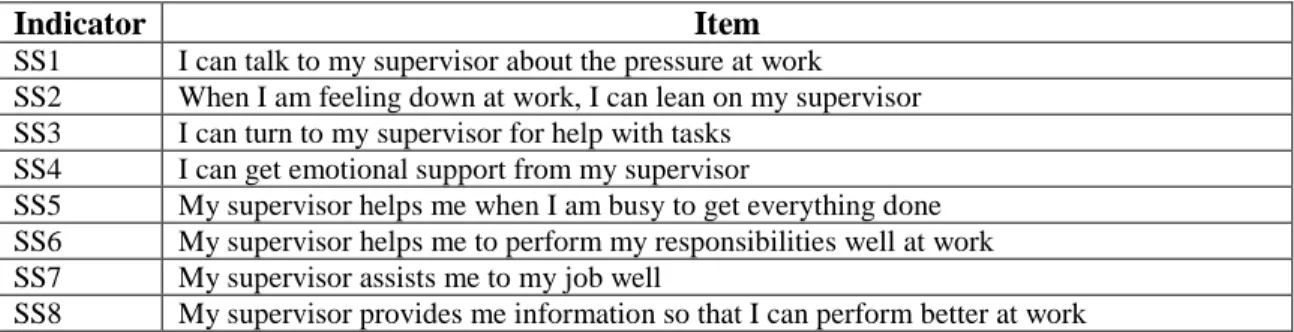
Table 3. Supervisor support items ...43
Table 4. Customer workload items ...43
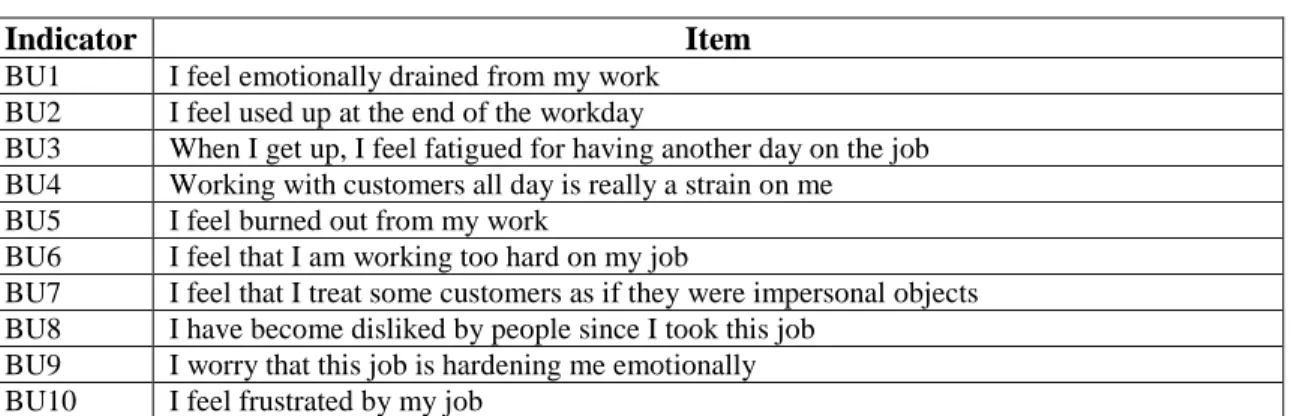
Table 5. Burnout items ...44
Table 6. Job engagement items ...45
Table 7. Job satisfaction items ...45
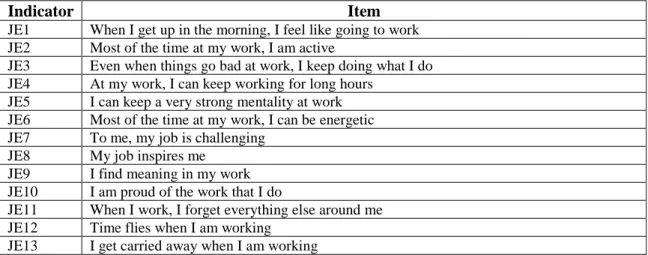
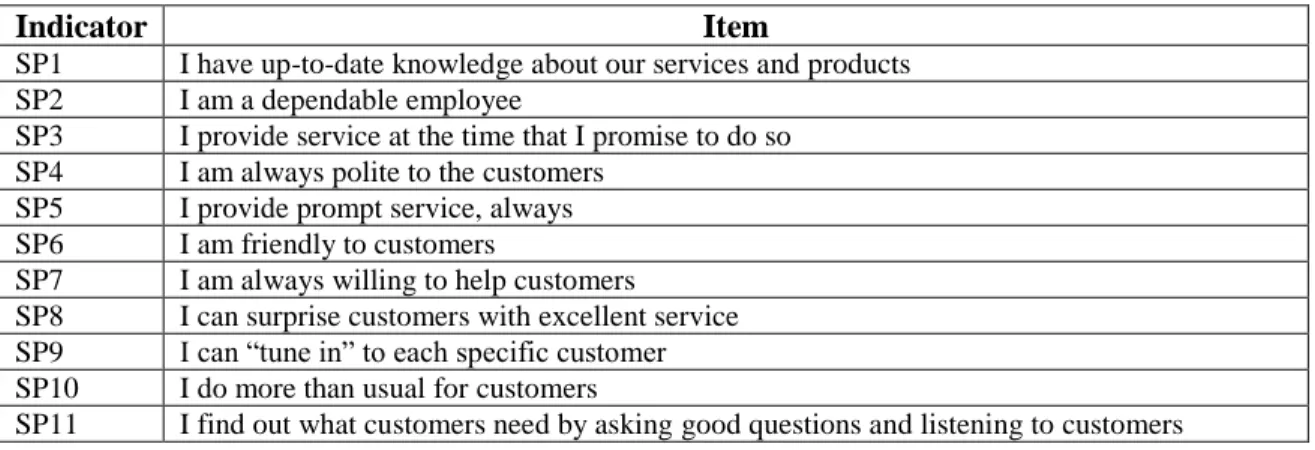
Table 8. Service performance items...46
Table 9. Turnover intention items ...46
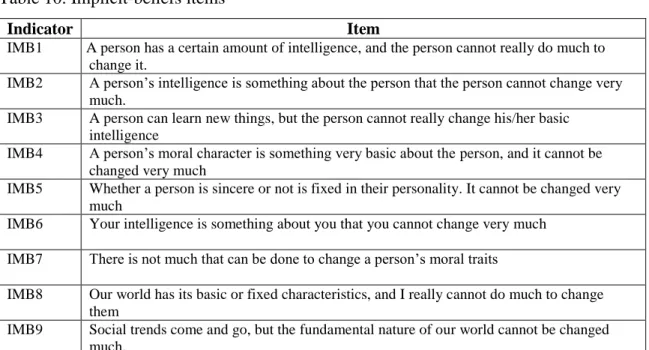
Table 10. Implicit-beliefs items ...47
Table 11. Reliability and factor loading ...52
Table 12. Demographic characteristics of respondents ...55
Table 13. Final measurement items ...60
Table 14. Measurement reliability and validity ...61
Table 15. Results of SEM analysis ...64
Table 16. Comparison of models ...67
ix
LIST OF FIGURES
Figure 1. Conceptualized relationships among the three components ...14
Figure 2. The early JD-R model (adapted from Demerouti et al., 2001) ...16
Figure 3. Research model ...38
Figure 4. Competing model ...39
Figure 5. Research model with ML estimates ...68
Figure 6. Competing model with ML estimates ...69
1
CHAPTER I
INTRODUCTION
Overview
Frontline employees (FLEs), workers whose roles are focused on dealing with customers daily and regularly (Slåtten & Mehmetoglu, 2011) are the faces of their organizations (Sergeant & Frenkel, 2000). This notion implies that the quality of service provided by FLEs will determine customer satisfaction and the organization’s profit, in that the higher the service quality provided by FLEs, the higher the customer satisfaction and thus the greater the financial performance a company achieves in the market (Chi & Gursoy, 2009; Heskett, Jones, Loveman, Sasser, & Schlesinger, 2008; Heskett &
Schlesinger 1994). Particularly, the roles of FLEs are crucial for service-centered
businesses in, for example, the hospitality (Liao & Chuang, 2004; Singh, 2000) and retail industries, where the interactions of FLEs with customers are more direct and frequent than in other industries (Hartline, Maxham, & McKee, 2000; Schneider & Bowen, 1999).
Empirical evidence has confirmed the importance of FLE performance by
demonstrating that effective FLEs contribute to their organizations in various ways, such as through proactive behavior (e.g., service recovery efforts, customizing service, and providing superior service quality; Babakus, Yavas, Karatepe, & Avci, 2003; Bell & Menguc, 2002; Bettencourt & Gwinner, 1996), affective attitudes (e.g., organizational citizenship, commitment, and sharing the values of the company; Bell & Menguc, 2002; Hartline, Maxhan, & McKee, 2000; Lichtensten, Netemeyer, & Maxham, 2010), and
2
fostering a positive culture (e.g., generating innovative ideas for company improvement; Lages & Piercy, 2012).
Despite the importance of FLEs for success in business (Chi & Gursoy, 2009), achieving effective FLE management is still a major challenge for the hospitality and retail industries, as shown in the industry statistics. First, a survey conducted by NewVoiceMedia reported that 49% of customers had switched to a different business because of bad service by FLEs (Hyken, 2016). Second, compared to the 46.1% average turnover rate across all private sectors in the U.S., for the hospitality and retail segments the rates were 72.9% and 53.3% in 2016, respectively (U.S. Bureau of Labor Statistics, 2017). Specifically, the rate of quits (voluntary terminations of employment by
employees) is very high in both industries. In 2016, the annual quits rates for the
accommodation and food services segment, as well as the retail segment, were 53.5% and 35.2%, respectively, compared to an average of 27.9% across all private sectors (U.S. Bureau of Labor Statistics, 2017). These figures, together with the fact that nearly 33% of revenue in the hospitality sector is spent on labor costs (lodgingmagazine.com, n. d.),
draw attention to the critical and longstanding question: How can a business hold on to
valuable FLEs for the long term?
The high turnover rate of FLEs has a detrimental effect on organizations for two primary reasons. First, it brings a high cost in time and money because a company must go through the hiring (e.g., recruitment and selection) and training processes again for new FLEs (Koys, 2001). For example, the estimated annual turnover costs for each FLE in the hospitality and retail industries are nearly $6,000 and $3,500, respectively (Hinkin
3
& Tracey, 2000; Stock & Bhasin, 2015). Second, high turnover leads to poor service performance because FLEs with less knowledge and experience do not perform as well as FLEs with knowledge of the customers and the service process (Schneider & Bowen, 1985; Staw, 1980). Accordingly, managers need a better understanding of what factors affect FLEs’ performance and satisfaction at work.
Problem Statement
Despite the considerable attention given to FLEs by practitioners as well as researchers, much remains to be studied about FLEs (Malhotra & Mukherjee, 2004). Largely, extant research on FLE can be categorized according to three research focuses
that examine (1) the effects of organization-related factors on FLEs’ performance (e.g.,
Bettencourt & Brown, 1997; Liao & Chuang, 2007), (2) the effect of customers on FLEs’ performance (e.g., Rupp & Spencer, 2006; Singh, 2000), and (3) the effect of FLEs’
individual differences on FLEs’ performance (e.g., Bettencourt, Gwinner, & Meuter, 2001; Silva, 2006).
Two major problems have been identified in previous studies which will guide the direction of current and future research. First, much research has examined the three aforementioned factors separately; very few studies have taken an inclusive approach that integrates all three components (i.e., organization, customer, and individual
characteristics) simultaneously. This study aims to address this issue by taking the factors predicting employee burnout and engagement, and thus organizational consequences, comprehensively, based on the Job Demand-Resources model (hereafter the JD-R model;
4
Bakker & Demerouti, 2007; Demerouti, Bakker, Nachreiner, & Schaufeli, 2001). Second, among the three factors, the first two (i.e., organizational and customer factors) have been of predominant interest in the literature, while FLEs’ individual differences (personal resources) have been largely ignored (Xanthopoulou, Bakker, Demerouti, & Schaufeli, 2007; Schaufeli & Taris, 2014). Specifically, research investigating the functions of individual characteristics is mostly limited to the Big Five personality traits (John & Srivastava, 1999). This calls for further research into other potentially influential personal characteristics. This study intends to fill this void by focusing on an understudied
personal trait: an individual’s implicit-belief, based on the theory of implicit-beliefs (Dweck, 1986).
Additionally, the literature around each theory includes some issues that are still to be addressed. First, while the JD-R model has been tested and confirmed in various organizational contexts (Bakker & Demerouti, 2007; Demerouti et al., 2001), research findings on the relationship between the demands of the job and the resources available remain inconsistent (Bakker, Demerouti, & Verbeke, 2004). Some findings supported the dual processes of the JD-R model (i.e., both job demands and resources independently influence employees’ organizational behavior; e.g., Demerouti et al., 2001; Xanthopoulou et al., 2007) and others supported an interactive model for the JD-R process (i.e., job demands and resources interact with each other; e.g., Bakker et al., 2010). Second, the outcomes explained by the JD-R model were limited to engagement and emotional exhaustion (Bakker & Demerouti, 2007); other aspects of employees’ performance, such
5
as service performance, job satisfaction, and quitting intentions also deserve empirical investigation.
Lastly, as an emerging theoretical concept in the psychology and human resource management fields, an implicit-belief, the crux of the theory of implicit-beliefs, is
receiving growing attention in research (Murphy & Dweck, 2016). However, to my knowledge, no attempt has been made to consider FLEs’ implicit-beliefs as a personal resource at work, or the effects of implicit-beliefs on FLEs’ organizational attitudes and behavior. Addressing these research voids will make a substantial contribution to the literature.
Purpose of the Study
The primary objective of this study is to develop a nomological model that delineates the relationships between key antecedents, mediators (FLE job stress and engagement levels), and job outcomes within the hospitality and retail contexts. Specifically, building on the JD-R model, this model includes job demands, job
resources, and personal resources as key antecedents that influence FLEs’ attitudes and behavior at work. These three are measured in terms of customer workload, supervisor support, and implicit-beliefs, respectively. In addition, as outcome variables, this model explores burnout (as a job stress factor), engagement (as a job engagement factor), service performance, job satisfaction, and turnover intentions, where the latter three capture the FLEs’ attitudes and behavior at work.
6
Further, this study examines how FLEs’ personal resources (i.e., the individual differences between the FLEs) influence FLE organizational attitudes and behavior. The personal resource of focus is implicit-belief (belief in either incremental or entity theory; Dweck, 1986). Briefly, incremental theory is a belief system in which pre-dispositional characteristics, such as intelligence, can be changed by effort. On the other hand, entity theory is a belief system in which innate qualities such as intelligence or morality are fixed and cannot be changed by effort (Dweck & Leggett, 1988). This study tries to understand how FLEs’ organizational attitudes and behavior are linked to their implicit-beliefs.
Updating and extending previous research on the JD-R model (Demerouti et al., 2001) and the theory of implicit-beliefs (Dweck, 1986), this dissertation aims to explain the organizational attitudes and behavior of FLEs in the hospitality and retail contexts. Based on the literature review and the theoretical underpinnings that will be presented in Chapter 2, this study intends to examine:
a) how supervisor support (job resources) and customer workload (job demands)
affect FLE burnout and job engagement levels, which, in turn, influence service performance, job satisfaction, and turnover intentions,
b) how implicit-beliefs affect engagement and burnout, which, in turn, influence
service performance, job satisfaction, and turnover intentions, and
c) how implicit-beliefs directly predict service performance, job satisfaction, and
7
Significance of the Study
This study will make contributions concerning the effective management of FLEs, both practically and academically. Practically, FLEs play a crucial role in hospitality and retail businesses because customers evaluate companies based on the quality of service provided by their FLEs. Therefore, in order for firms to remain competitive, they need to fully understand their FLEs: what influences FLEs’ organizational attitudes and behavior, and how they cope with and respond to job demands and resources. Understanding the effects of job demands and job resources, in association with personal resources, is likely to provide managers with guidelines for developing effective retention strategies and for motivating FLEs to perform better at work. This study aims to help practitioners
understand their FLEs better for the sake of strong human resources management. Understanding the individual differences between FLEs and the impacts of these differences on job performance, practitioners may be able to personalize their responses to FLE needs, thereby reinforcing FLEs’ performance. For example, entity-minded FLEs may be more vulnerable to burnout than incremental-minded FLEs when handling customer complaints, because they may perceive the complaint as a reflection of their failure to perform, causing them to feel ashamed. Managers could therefore redesign workflows to team-up entity-minded FLEs with incremental-minded FLEs, as the latter may be more immune to customer complaints through believing that their service can be improved, even if they may have failed on the present occasion.
In terms of theory, this study contributes to the literature of the JD-R model and the theory of implicit-beliefs by testing their core notions within the hospitality and retail
8
industry contexts. Developing a nomological model that integrates organizational and personal factors, this study answers research calls for an extension of the JD-R model (Schaufeli & Taris, 2014). To my knowledge, this study is the first study that introduces the theory of implicit-beliefs (Dweck, 1986) to the study of FLEs’ organizational attitudes and behavior. There is a research call for the use of this theory in business literature (Murphy & Dweck, 2016); however, so far, the theory has been primarily used in educational psychology, and has only recently surfaced in explaining consumer behavior (e.g., Mathur, Chun, & Maheswaran, 2016).
Definitions of Terms
In this study, terms and constructs of importance are defined as follows.
Burnout: A state of mental weariness (Schaufeli & Bakker, 2004) that requires prolonged counteractive measures in response to the chronic emotional and interpersonal stressors of a job (Maslach, Schaufeli, & Leiter, 2001).
Customer workload: The extent to which frontline employees divide their attention among a relatively large number of customers during any given shift or day (Bakker et al., 2010)
Frontline employees: Workers who have daily or regular contact with customers in their work role (Slåtten, & Mehmetoglu, 2011)
Implicit-beliefs theory: Lay beliefs about the malleability of personal attributes (e.g., ability, intelligence, and personality) that affect behavior (Dweck, 1986).
9
Job engagement: The investment of an individual’s complete self into a role (Rich, Lepine, Crawford, 2010).
Job demands: Aspects of the job that require prolonged cognitive and/or emotional effort or skills (Bakker & Demerouti, 2014).
Job resources: The physical, psychological, social, and organizational aspects of a job that either reduce job demands or stimulate learning and development (Schaufeli & Bakker, 2004).
Job satisfaction: The level of contentment an FLE feels regarding his or her work, resulting from an assessment of their job experiences (Tett & Meyer, 1993). Personal resources: Psychological characteristics or aspects of the self that are generally
associated with an ability to impact one’s environment (Schaufeli & Taris, 2014). Service performance: FLEs’ performance serving and helping customers (Liao &
Chuang, 2004).
Supervisor support: Aspects of an FLE’s interpersonal relationships with supervisors at work that are helpful or are intended to be helpful (Sarason, Pierce, & Sarason. 1990).
Turnover intention: The subjective and conscious likelihood that an individual will voluntarily leave the organization within a relatively limited time frame (Fried, Shirom, Gilboa, & Cooper, 2008).
10
CHAPTER II
LITERATURE REVIEW
Overview
This chapter consists of three sections, which provide the theoretical and conceptual frameworks of this dissertation. The first section reviews FLE literature, including a discussion of the major research streams concerning FLEs and the roles of FLEs in association with their organizations and customers. The second section discusses the theoretical frameworks of this study by presenting: (a) the Job Demands and
Resources (JD-R) model (Demerouti et al., 2001), (b) the variables used in this study, and (c) an overview of the theory of implicit-beliefs and its applications in research. The third section develops research hypotheses and stipulates the conceptual model of this study.
Frontline Employee Research
Definition of FLEThere is no fixed definition for “frontline employees.” Instead, the term has been used in a general sense by researchers to refer to those who encounter customers in their primary work-role (Slåtten & Mehmetoglu, 2011). When Berry (1981) introduced the term “frontline employees” for the first time, he defined it as meaning those who work at the boundary of a service organization, such that they have customer contact and provide customer service (Singh, Brady, Arnold, & Brown, 2017). In a similar vein, Slåtten and Mehmetoglu (2011) defined “frontline employees” as those who, in their work roles,
11
have daily or regular contact with customers. These definitions lay out an essential characteristic of FLEs; their main role in an organization is to have contact with customers.
Terms such as “customer-contact employees” (e.g., Chebat & Kollias, 2000) and “boundary spanner employees” (e.g., Stamper & Johlke, 2003) have been used
synonymously with “frontline employees” (e.g., Zablah, Franke, Brown, & Bartholomew,
2012) in FLE literature. Subjectively, “frontline employees”is used in this dissertation
over the other terms because it has been frequently used in recently published studies. In this study, “frontline employees” are defined as those who encounter customers directly by providing service in the hospitality and retail industries.
Research streams in FLE research
Three primary research streams have been identified within FLE literature: (1) how organizational factors influence FLEs’ attitudes and behavior at work, (2) how customers impact FLEs’ attitudes and behavior, and (3) how FLE personal characteristics play a role in attitudes and behavior.
The effects of organizational factors. FLEs’ attitudes and behavior are linked to
various factors in an organization. For example, supervisors who frequently communicate with their FLEs influence job satisfaction by promoting the development of FLEs’
affective feelings toward their jobs (Johlke & Duhan, 2000). Furthermore, in any cohort, one co-FLE influences another FLE’s perceptions of the work environment, job
satisfaction, and job performance (Babin & Boles, 1996). Aspects of the organization’s culture, such as service climate (Johnson, 1996) and leadership (Sergeant & Frenkel,
12
2000), are important as well, because they facilitate positive relationships between FLEs and organizational resources (Salanova, Agut, & Peiró, 2005). For example, an
organization that emphasizes customer service (i.e., service climate) tends to provide more service training (a job resource), which in turn increases FLEs’ engagement and service performance (Clark, Hartline, & Jones, 2009; Salanova et al., 2005). Similarly, FLEs who perceive their leadership to be supportive tend to be more satisfied with their jobs and more committed to the company (Sergeant & Frenkel, 2000).
Organizational activities such as training and benefits affect FLE attitudes and behavior. FLEs who perceive organizational activities positively exhibit positive attitudes and behavior toward the organization, which lead to a good provision of service and higher customer satisfaction (Sergeant & Frenkel, 2000). Training, rewards, autonomy, and empowerment positively influence FLEs’ levels of satisfaction, performance,
commitment, and service recovery (Babakus et al., 2003; Lee, Nam, Park, & Lee, 2006).
The effects of customers. Customers have both positive and negative impacts on FLEs. Some argue that meeting customers’ desires and needs induces negative emotions and burnout in FLEs (e.g., Rafaeli et al., 2012; Rupp & Spencer, 2006), which decrease FLEs’ job satisfaction and service performance, and increase turnover intentions (e.g., Sliter, Sliter, & Jex, 2010; Zapath-Phelan, Colquitt, Scott, & Livingston, 2009). Accumulating evidence shows that when FLEs feel mistreated by customers, burnout increases, thereby lowering satisfaction and performance (Grandey, 2000). However, some contend that the influence of customers on FLE attitudes and behavior may not always be as negative as those results would suggest. For example, Price and Arnould
13
(1999) argue that “commercial friendship” can take place between customers and FLEs. When FLEs and customers feel bonded through this relationship, they can both be satisfied (Price & Arnould, 1999).
The effects of FLE personal characteristics. Concerning FLEs’ individual
differences, previous studies have mainly focused on the Big Five personality traits. Results have shown that conscientiousness (i.e., a personality trait of being careful or vigilant) has a positive effect on engagement and service performance (e.g., Brown et al., 2002); stability (i.e., a personality trait of being emotionally stable and less reactive to stress) has a positive effect on commitment (e.g., Silva, 2006), while neuroticism (i.e., a personality trait of focusing on negative emotions) has a positive (negative) effect on burnout (engagement; e.g., Barrick & Mount, 1991; Kim, Shin, & Swanger, 2009).
Other notable personality traits that have been investigated are flexibility, self-efficacy, and customer orientation. Gwinner, Bitner, Brown, and Kumar (2005) asserted that FLEs’ flexibility (i.e., ability to cope with changes in circumstances) helped them to create a “wow” factor by customizing each service encounter. Karatepe et al. (2006) identified self-efficacy (i.e., one’s belief in one’s ability to succeed in a situation) as an important predictor of FLE attitudes and behavior. FLEs with high levels of self-efficacy show higher job satisfaction because the feeling of confidence makes their job more enjoyable and attractive. Customer orientation (i.e., the degree to which FLEs try to help customers and to satisfy customer needs; Saxe & Weitz, 1982) can operate as a work-value (i.e., a service-oriented work-value) in FLEs (Deshpand, Farley, & Webster, 1993). As a work-value, FLEs’ customer orientation decreases job stress (Zablah et al., 2012) and
14
increases job satisfaction (Donavan, Brown, & Mowen, 2004) and service performance (Cross, Brashear, Rigdon, & Bellenger, 2007; Liao & Chuang, 2004)
Relationships among the three components in FLE research
There are three vital factors that influence FLEs’ attitudes and behavior: the organization, the customers, and the other FLEs. FLEs function as middlemen who stand between the organization and customers. FLEs who are satisfied with the company provide better service to customers and give back to the company by being proactive servers (e.g., through commitment and good service performance). The more the satisfied customers become loyal to the company, the more the company achieves financial gain through their business. The opposite is also possible; unsatisfied FLEs can exhibit negative attitudes and behavior toward the company and customers. The resulting unsatisfied customers will leave the company, eventually leading to the failure of the business. Figure 1 depicts the conceptualized relationships discussed in FLE research.
Figure 1. Conceptualized relationships among the three components
Organization 1 FLE Customer
y
2
y
3
15
Theoretical Framework
For this study, the JD-R model (Demerouti et al., 2001) and the theory of implicit-beliefs (Dweck, 1986) provide the foundations for understanding (a) how job demands and resources influence FLEs’ organizational attitudes and behavior, and (b) how FLEs’ personal characteristics play a role in the development of FLE attitudes and behavior at work. This study considers job demands and job resources as organizational resources and FLE’s individual characteristics (i.e., implicit theories) as a personal resource.
The job demand-resource (JD-R) model
This model builds on the assumption that every occupation has unique factors in two categories: (a) job demands, the “organizational aspects of the job that require sustained cognitive or emotional effort or skills,” and (b) job resources, the
“organizational aspects of the job that either reduce job demands or evoke personal learning and/or development” (Schaufeli & Bakker, 2004, p. 296). Briefly, job demands include workload, time pressure, and shift work, while job resources include feedback, rewards, and job control. The original JD-R model posits a dual-process in which job demands affect strain while job resources separately determine engagement. It is noteworthy that the original model did not fully deal with job outcomes; subsequent research has integrated job outcomes (e.g., performance, health problems) into the model (Bakker, Demerouti, De Boer, & Schaufeli, 2003; Schaufeli & Taris, 2014). Figure 2 depicts this version of the JD-R model (Demerouti et al., 2001).
16
Figure 2. The early JD-R model (adapted from Demerouti et al., 2001)
Job demands (JDs). JDs are defined as the aspects of a role that require cognitive and emotional efforts from FLEs (Bakker, Demerouti, & Schaufeli, 2003). Generally, JDs are associated with negative outcomes such as health impairment and burnout. For
example, customer interaction, one of the major job demands in hospitality and retail (Kim, Shin, & Swanger, 2009), heightens burnout, increases turnover intentions, and results in the inferior service performance of FLEs (Hakanen, Schaufeli, & Ahola, 2008). Research has provided evidence that JDs predict burnout across different professions and sectors (Hakanene et al., 2008). In principle, when JDs increase, the cognitive and/or emotional costs to FLEs also increase to accommodate the level of the demands
(Schaufeli & Bakker, 2004). The greater the effort required, the greater the cost to a FLE (Demeroti et al., 2001).
Job resources (JRs). JRs are defined as the assets around a FLE’s job that enable
FLEs to achieve their work goals and which stimulate personal growth (Xanthopoulou et al., 2007). Positive outcomes, such as satisfaction, engagement, and commitment,
Job demands
Job resources
Strain
Engagement
17
accompany JRs (Bakker & Demerouti, 2007), because JRs stimulate FLEs’ positive emotions, which increase their energy to meet JDs. For example, a manager’s feedback (JR) stimulates an FLE’s learning, thereby increasing their job performance (Janssen & Yperen, 2004).
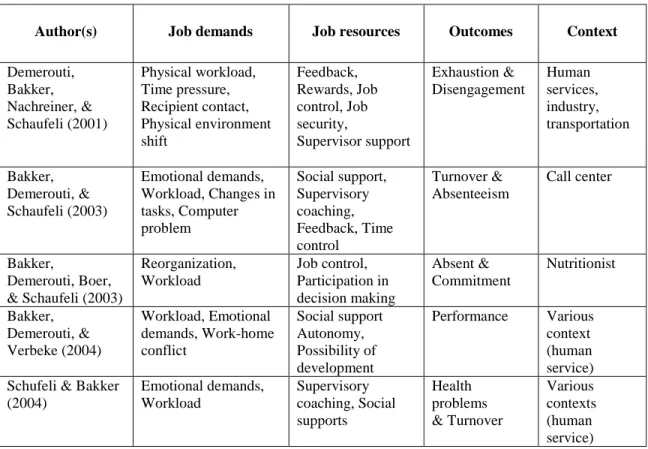
The key JDs and JRs are variable depending on organizational characteristics and environments (Zablah et al., 2012). A review of JD-R research indicates that workload and emotional demands are common JDs and that supervisor support is the most common JR. Table 1 shows the JDs, JRs, outcomes, and contexts examined in the select JD-R model research.
Table 1. Review JD-R model research
Author(s) Job demands Job resources Outcomes Context
Demerouti, Bakker, Nachreiner, & Schaufeli (2001) Physical workload, Time pressure, Recipient contact, Physical environment shift Feedback, Rewards, Job control, Job security, Supervisor support Exhaustion & Disengagement Human services, industry, transportation Bakker, Demerouti, & Schaufeli (2003) Emotional demands, Workload, Changes in tasks, Computer problem Social support, Supervisory coaching, Feedback, Time control Turnover & Absenteeism Call center Bakker, Demerouti, Boer, & Schaufeli (2003) Reorganization, Workload Job control, Participation in decision making Absent & Commitment Nutritionist Bakker, Demerouti, & Verbeke (2004) Workload, Emotional demands, Work-home conflict Social support Autonomy, Possibility of development Performance Various context (human service) Schufeli & Bakker
(2004) Emotional demands, Workload Supervisory coaching, Social supports Health problems & Turnover Various contexts (human service)
18 Table 1. Continued
Author(s) Job demands Job resources Outcomes Context
Bakker, Demerouti, & Euwema (2005) Workload, Emotional demands, Physical -demands, Work-home inference Autonomy, Social support, Feedback, Quality of the relationship with the supervisor Burnout Higher education Mauno, Kinnunen, & Ruokolainen (2007)
Job insecurity, Time demands, Work-to-family conflict Control, Organization-based Self-esteem, Management quality
Engagement Health care
Xantropoulou et al. (2007) Emotional demands, Workload, Emotional dissonance Autonomy, Social supports, Supervisory coaching, & Professional development Burnout & Engagement Engineering Hakanen,
Schaufeli, & Ahola (2008) Workload, Work environment, Interactions, Emotional demands Support, Professional contacts
Commitment Health care
Babakus, Yavas, & Ashill (2009)
Role ambiguity Role conflict Role overload
Social support Job
performance & Turnover Banks (FLEs) Xanthopoulou, Bakker, Demrouti, & Schaufeli (2009) NA Job Resources: Autonomy, Coaching, Team climate Personal resources: efficacy, Self-esteem, Optimism Engagement An electrical engineering and electronics company Crawford, Lepine, & Rich (2010) Workload, Job responsibility, Emotional demands, Resource inadequacies, Role conflict, Role overload, Time urgency, Job responsibility Social support, Autonomy, Feedback, Development opportunity, Work-role fit, Job variety, Recovery, Positive work climate
NA N/A
(meta-analysis study)
Fernet, Austin, & Vallerand (2012)
Emotional exhaustion Control, Autonomy Commitment Education (teachers)
19
Personal resources (PRs). PRs are defined as the psychological characteristics or aspects of self that are associated with the ability of an individual to impact their
environment (Schaufeli & Taris, 2014). As work outcomes often result from personal characteristics, the significant role of PRs on FLEs has begun to be recognized (Schaufeli & Taris, 2014). Nevertheless, attempts to find out how PRs operate within the JD-R model are still scarce (Bakker, Demerouti, & Sanz-Vergel, 2014; Ellingson, Tews, & Dachner, 2016; Schaufeli & Taris, 2014)
PRs usually take two roles in the JD-R model; they can function as mediators or as direct predictors. First, PRs mediate the relationships between JRs and engagement (Bakker & Demerouti, 2008). Research that conceptualizes PRs as mediators argues that employees with abundant job resources are more likely to develop PRs such as self-efficacy or optimism, which in turn positively affect engagement (Schufeli & Taris, 2014). Xanthopoulou, Bakker, Demerouti, and Schaufeli (2007). Llorens, Schaufeli, Bakker, and Salanova (2007) found that PRs (e.g., optimism, self-efficacy and
organizational self-esteem) mediated the effects of JRs on engagement. Even though the effects of PRs have been demonstrated only with respect to engagement within the JD-R model, this study understands that the effects of PRs on burnout are conceptually similar to those of JRs, because resources buffer the impact of JDs on burnout and therefore minimize it (Bakker et al., 2010).
As a direct predictor, PRs stimulate the personal development of FLEs at work, like JRs (Xanthopoulou, Bakker, Demerouti, & Schaufeli, 2009). The notion of PRs as a direct predictor is that PRs can affect both FLEs’ perceptions of JDs and JRs, as well as
20
their attitudes and behavior. For example, emotional and mental competencies directly predict burnout and engagement among teachers (Lorente et al., 2008), in that more competent teachers report less burnout and more engagement at the end of each semester. Similarly, self-efficacy, optimism, and self-esteem positively influence engagement (Xanthopoulou, Bakker, Demerouti, & Schaufeli, 2009). The PRs’ influence is explained with the idea that an employee’s self-efficacy (PR) may foster a positive-self-evaluation, therefore motivating the FLE to pursue their goals by engaging more (Bakker &
Demerouti, 2008).
In applying the JD-R model to explain the behavior of FLEs in hospitality and retail environments, the present study identifies focal constructs that are representative of the constructs of the JD-R model. Particularly, customer workload and supervisor support are examined to capture JDs and JRs, respectively. Additionally, engagement and burnout are examined as mediators of the two facets of FLE performance. Lastly, job satisfaction, service performance, and turnover intentions are measured to capture FLEs’ effectiveness within the organization.
Customer workload as JD
Customer workload (CW) is defined as the extent to which a frontline employee divides his/her attention between customers during work (Bakker et al., 2010). Since CW is physically, emotionally, and mentally demanding (Lee & Ashforth, 1996), it is often linked to negative consequences, such as burnout and high turnover intentions (Singh, 2000). Furthermore, the negative impacts of CW on FLEs are deemed more severe in the hospitality and retail fields than in other industries because in these fields FLEs interact
21
with many customers every day, which is an emotionally and mentally demanding task (Zablah et al., 2012). Therefore, CW is a significant detrimental factor of FLEs’ work in the hospitality and retail industries, as evidenced by the report that FLEs who experience a severe CW account for 43% of the turnover among FLEs in hotels (Karatepe et al., 2008).
Supervisor support as JR
Supervisor support (SS) is defined as the functions of an interpersonal relationship with a supervisor at work that are helpful or are intended to be helpful (Sarason et al., 1990; Stroebe, 2000). Literature holds that SS helps FLEs to cope with JDs and improves their attitude and behavior (Barbin & Boles, 1996), while lowering stress (Nielsen, Randall, Yarker, & Brenner, 2008). Prior research also found that SS significantly reduces job stress and thereby promotes job engagement (Yang et al., 2015). By providing emotional support (e.g., listening sympathetically or caring for employees) or instrumental support (e.g., providing the information needed to complete a task; Fenlason & Beehr, 2003), supervisors can mitigate burnout in FLEs (Malecki &
Demaray, 1994). For example, manager support significantly moderates the effect of JDs on burnout (Bakker & Demerouti, 2007). In fact, Woerkom, Bakker, and Nishii (2016) found that FLEs with high JDs tend to seek SS to buffer their burnout. SS not only helps FLEs to cope with JDs positively and to improve their performance (Barbin & Boles, 1996), but also has the strongest effect in reducing burnout (Nielsen, Randall, Yarker, & Brenner, 2008).
22
Engagement
Engagement is defined as a positive work-related state of mind (Bakker, Hakanen, Demerouti, & Xanthopoulou, 2003), and is characterized by vigor, dedication, and absorption (Schaufeli & Bakker, 2004). “Vigor” consists of “high levels of energy and mental resilience while working, the willingness to invest effort in one’s work, and persistence in the face of difficulties.” “Dedication” is characterized by “a sense of
significance, enthusiasm, inspiration, pride, and challenge” (Schaufeli & Bakker, 2004, p. 295). “Absorption” means being fully concentrated on one’s work, whereby time passes quickly and one has difficulty detaching oneself from work (Schaufeli & Bakker, 2004, p. 295).
In a meta-analysis study, Crawford, LePine, and Rich (2010) confirmed that the relationship between engagement and JRs is constantly positive and leads to positive organizational outcomes (Schaufeli & Bakker, 2004). For instance, engaged FLEs contribute to the company in several ways, including positively affecting financial return (Xanthopoulou et al., 2014), providing a positive service culture (Slanova, Agut, & Peiró , 2005), and taking on extra tasks (Gierveld & Bakker, 2005).
Burnout
Burnout is defined as a state of mental weariness (Schaufeli & Bakker, 2004) caused by emotional and interpersonal stressors on the job (Maslach, Schaufeli, & Leiter, 2001). It is often associated with exhaustion, cynicism (or depersonalization), and
reduced professional efficacy (Maslach & Jackson, 1986; Schaufeli et al., 2002).
23
contact with others” (Schaufeli et al., 2002, p. 72). “Cynicism” refers to “an indifferent or distant attitude to work and people, along with a lack of personal accomplishment” (Schaufeli & Bakker, 2004, p. 294). “Professional efficacy” describes feelings of
occupational accomplishment (Demerouti et al., 2001; Schaufeli & Bakker, 2004), which are diminished when an FLE feels burnout.
According to Maslach and Schaufeli (1993), employees tend to feel more negative emotions, such as burnout, when they face an uncontrollable work environment. Based on this understanding, FLEs in the hospitality and retail industries are more likely to be exposed to burnout because their jobs are often beyond their control as they interact with customers and respond to their unique needs and desires. Burnout plays an important role in predicting the impact of JDs on FLEs’ work outcomes (Singh, Goolsby, & Rhoads, 1994). Overall, the higher the level of burnout, the lower the level of FLE satisfaction and performance; the higher the level of burnout, the higher the turnover (Singh et al., 1994).
FLEs organizational attitude and behavior
Job satisfaction (SA). Job satisfaction is defined as “a positive emotional state
resulting from the appraisal of one’s job or job experiences” (Locke, 1976, p. 1304) and has been linked to job performance (Judge, Thoresen, Bono, & Patton, 2001). Although conventional logic would suggest that higher SA levels lead to higher job performance, this does not necessarily hold true; several prior studies have shown an insignificant relationship between the two (e.g., Chebat & Kollias, 2000). SA can be broken down into five dimensions (Koeske, Kirk, Koeske, & Rauktis, 1994): satisfaction with work,
24
Satisfaction in each of these areas is associated with job outcomes such as turnover intentions, absenteeism, and commitment (Judge & Watanabe, 1994; Tett & Meyer, 1993), in that satisfied FLEs are likely to engage more in their jobs and to provide a better service than unsatisfied ones (Eagly & Chaiken, 1993; Malhotra & Mukherjee, 2004). Therefore, SA antecedes FLEs’ service performance and turnover (Saari & Judge, 2004).
Service performance (SP). FLEs’ SP is defined as their activity serving and helping customers (Liao & Chuang, 2004). SP consists of two parts: in-role and extra-role performance. In-extra-role performance represents the extent to which an FLE meets their given role-requirements and is characterized by “proficiency” (Griffin, Neal, & Parker, 2007). Extra-role performance describes the extent to which FLEs take on self-initiated tasks in response to customer needs (Griffin et al., 2007).
SP is critical for customer satisfaction because SP by FLEs plays an important role in the formation of customer perceptions of service quality. Therefore, the factors that make FLEs perform better have been of great interest to the industries and to academics. A number of factors contribute to good service performance. Liao and Chuang (2004) suggested that FLEs’ personalities and HR practices can lead to superior SP. Zablah, Franke, Brown, and Bartholomew (2012) argued that a customer-oriented work culture led to good SP among FLEs by enforcing a high standard of service.
Turnover-intention (TO). TO is defined as the subjective and conscious likelihood that an individual will voluntarily leave the organization within a relatively limited period of time (Fried et al., 2008). Knowing the importance of TO to any given
25
company, a vast amount of literature has been devoted to finding determinants of TO (Cotton & Tuttle, 1986). Empirical studies on service workers have revealed that TO is influenced by affective attachment (Mowday, Steers, & Porter, 1979), SA (Barak, Bissly, & Levin, 2000), commitment, and supervisor support (Arthur, 1994; Bakker &
Demerouti, 2007). Maertz, Griffeth, Campbell, and Allen (2007) as well as Dawley, Houghton, and Bucklew (2010) found that supervisor support and job satisfaction negatively influence FLEs’ TO.
The theory of implicit-beliefs
The theory of implicit-beliefs (Dweck, 1986) guides this dissertation to propose and examine a personal resource that has not yet been explored, but is expected to be important in FLEs’ job performance. “Implicit-beliefs” describes one’s psychological attitude (Dweck, 1986). Rooted in the theory of personality (Kelly, 1995) and social perception theory (Heider, 1958), the theory of implicit-beliefs states that people typically use one of two ways to formulate their views on something: some believe it to be malleable and improvable (i.e., incremental belief) while others view it as a fixed entity (i.e., entity belief). Research has shown that the different implicit views emphasize the processing of different information, goal choices, and attributions, which
subsequently lead to different cognitive, affective, and behavioral responses (Dweck, Chiu, & Hong, 1995; Dweck & Leggett, 1988). The theory has been used mainly in educational psychology to explain students’ academic performances and behavior, but has recently gained increased attention across various domains including marketing and management (e.g., Yorkston, Numers, & Matta, 2010).
26
Per this theory, individuals are regarded as either incremental theorists (having a “growth” mindset) or entity theorists (with a fixed mindset). An incremental theorist is one who believes that individuals’ pre-dispositional qualities, like intelligence and morality, can be changed or improved by individual effort and/or by applying strategies (Dweck et al., 1995), while an entity theorist is one who believes that individuals’ innate qualities cannot be changed by effort (Dweck & Leggett, 1988; 1995). Thus, the primary difference between the two mindsets lies in the views held concerning innate qualities or characteristics: incremental theorists view them as adaptive while entity theorists
consider them maladaptive (Dweck et al., 1995). Research has demonstrated that the two groups are also different in terms of various cognitive and behavioral patterns.
Incremental theory vs. entity theory
Cognitive patterns. The central concept, in terms of the cognitive patterns of implicit-beliefs, is relatively simple: whether one believes self-attributes, such as intelligence, are stable and immutable or not (Cury, Ellito, Fonseca, & Moller, 2006). Entity theorists, who believe that individuals’ characteristics are fixed, think that individual effort or learning to improve these self-attributes cannot change the qualities (Murphy & Dweck, 2009). Conversely, incremental theorists believe that self-attributes are malleable and expandable (Dweck & Leggett, 1988), such that ones’ lay dispositions can be improved or changed as one learns and attempts to improve them.
Research has examined and confirmed this psychological phenomenon. For example, Hong, Chiu, Dweck, Lin, and Wan (1999) found that “effort” was much more focused among incremental theorists than among entity theorists. Along a similar vein, Chiu et al.
27
(1997) revealed that entity theorists expected trait-related behaviors to be consistent across situations, whereas incremental theorists tended not to predict consistent behaviors across different situations. These results are consistent with other research findings that found that entity theorists had greater stability in their attitudes than incremental theorists (Petrocelli, Clarkson, Tormala, & Hendrix, 2010).
Goal (or motivation) patterns. There are two types of goals related to implicit-beliefs: performance-oriented goals (or achievements) and learning-oriented goals (or mastership) (Dweck, 1986; Dweck & Leggett, 1988). Typically, entity theorists focus on achievements or performance-oriented goals (Hong et al., 1999) because they believe there are finite psychological resources available to conduct a task (Elliott & Dweck, 1988). Incremental theorists, however, emphasize learning-oriented or mastership goals based on the belief that ones’ malleable abilities can be improved through effort (Elliott & Dweck, 1988). For them, learning is more valuable than achievements.
A considerable amount of research has demonstrated different goal patterns as functions of either entity or incremental theory (Grant & Dweck, 2003). Greene and Miller (1996) found that incremental theorists focus on their learning when applying new strategies, rephrasing materials in their own words to learn new concepts, whereas entity theorists tend to memorize answers from study guides to achieve good scores. Robins and Pals (2002) found a similar result that incremental theorists focus on learning and
increasing their ability levels, while entity theorists adhere to performance goals.
Behavioral patterns. The different behavioral patterns between incremental and entity theorists become more pronounced in the face of challenges (Hong et al., 1999).
28
Entity theorists, in comparison to incremental theorists, are more influenced by perceived failure or challenging situations (Hong et al., 1999; Robins & Pals, 2010). When
undesirable outcomes are anticipated from a challenging situation, entity theorists tend to withdraw themselves from it or to surrender to the challenge to hide their incapability or incompetency (Dweck & Leggett, 1988). Such cognitive processes can ultimately overwhelm them (Chiu et al., 1997), leading them to select tasks in such a way as to avoid failure or negative assessment (Bandura & Dweck, 1985; Dweck, 1986; Elliott & Dweck, 1988).
On the contrary, neither unfavorable outcomes (e.g., failure) nor challenging situations affect incremental theorists (Dweck & Leggett, 1988). Instead, they actively take on new challenges by persisting and investing effort, or by using effective strategies (Robins & Pals, 2010). Thus, they often perform well on difficult tasks. In their 2006 study, Cury et al. found that, relative to entity theorists, incremental theorists achieved higher math scores as the math problems became more difficult, demonstrating that the incremental theorists persisted in difficult math exercises despite the increasing difficulty of the problems. A consistent pattern can also be found in previous studies on academic performance (Blackwell et al., 2007) and self-esteem maintenance (Nussbaum & Dweck, 2008).
Affective patterns. Affective patterns are salient among entity theorists when failure occurs or a setback is predicted (Dweck, 1986). Because entity theorists tend to attribute negative performance not to a lack of effort, but to lack of ability, they are more likely to have negative feelings such as helplessness or anxiety when they fail a task or
29
when a setback occurs (Dweck et al., 1995;Robins & Pals, 2002). On the other hand, incremental theorists feel more positive in the same situations. For example, Ommundsen (2001) found that when facing sport competition, entity theorists feel more anxiety, while incremental theorists feel more satisfaction at the prospect of a challenge. Similarly, Miller, Burgoon, and Hall (2007) reported that entity and incremental theorists displayed negative emotions (e.g., anger) and positive emotions (e.g., respect), respectively,
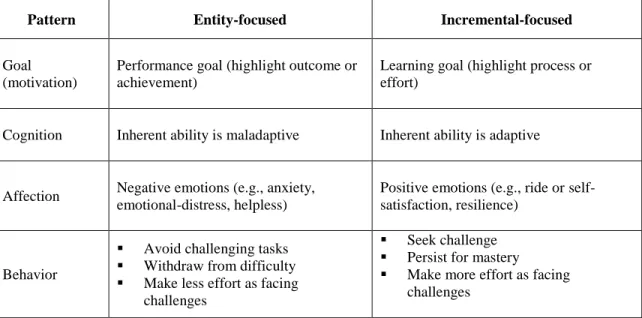
regarding self-improvement through physical activity. Table 2 briefly summarizes the characteristics of incremental and entity theorists. Importantly, “goals” and “cognitive patterns” refer to general tendencies, whereas “affective patterns” and “behavioral patterns” apply relatively. For example, when entity FLEs fail to meet service performance, they have more helplessness and anxiety than incremental FLEs.
Table 2. Characteristics of incremental and entity theorists
Pattern Entity-focused Incremental-focused
Goal (motivation)
Performance goal (highlight outcome or achievement)
Learning goal (highlight process or effort)
Cognition Inherent ability is maladaptive Inherent ability is adaptive
Affection Negative emotions (e.g., anxiety, emotional-distress, helpless)
Positive emotions (e.g., ride or self-satisfaction, resilience)
Behavior
Avoid challenging tasks Withdraw from difficulty Make less effort as facing
challenges
Seek challenge Persist for mastery
Make more effort as facing challenges
30
Hypotheses Development
The effects of supervisor support in the JD-R modelSupervisor support (SS) is a critical factor that motivates FLEs (Bakker & Demerouti, 2007) and is an antecedent of employee engagement (Saks, 2006). In other words, FLEs who positively perceive SS at work may become more engaged in their jobs because they feel psychological safety (Kahn, 1990), due to the supportive supervisors (May, Gilson, & Harter, 2004). When FLEs perceive that they are being cared for, they are more likely to respond favorably toward the company (Saks, 2006). On the other hand, a lack of SS is linked to burnout (Schaufeli, Leiter, & Maslach, 2009). JD-R model research has confirmed that employees perform better in, and are more satisfied with a well-resourced working environment (Bakker et al., 2003), and that engagement mediates the relationship between JRs and job performance, promoting low turnover rates and high levels of commitment (Hu, Schaufeli, & Tris, 2011).
In the contexts of hospitality and retail, SS is critical to FLEs’ engagement (Edomondson & Boyer, 2013) because customer-contact can be stressful for FLEs as they must accommodate the various needs and desires of customers (Kim et al., 2008). Also, FLEs in those industries often undertake heavy workloads and experience job-conflicts between what customers want and what they are supposed to do, per their company (Zablah et al., 2012). In helping FLEs cope with such difficulties, the emotional and instrumental supports of supervisors are important. Specifically, supervisors’
emotional support may be instrumental in releasing FLEs’ stress and in helping them to regain strength to focus on their work. Furthermore, instrumental support can help FLEs
31
to meet customers’ expectations while fulfilling company requirements. For example, hotel guests frequently request early check-in and late check-out, which can create conflicts between customers and FLEs when the hotel is fully booked. In these cases, SS can help FLEs to cope with the situation and to resolve the conflict without discomforting the customer or the FLE him/herself. In summary, SS influences FLEs’ job outcomes through their levels of engagement; therefore, hypotheses 1a and 1b are presented.
H1a. There is a positive relationship between a FLE’s perception of supervisor support and job engagement.
H1b. There is a negative relationship between a FLE’s perception of supervisor support and burnout.
The effects of customer workload in the JD-R model
Despite there being various kinds of JDs, research has widely agreed that CW is a
critical JD that affects FLEs’ job engagement negatively and burnout positively (Bakker
et al., 2014; Lee & Ashforth, 1996). In an extended model of the antecedents and
consequences of FLEs’ performance, Singh (2000) identified two consistently significant pathways: (1) role stressors (role ambiguity and role conflict) → burnout → lower service quality, and (2) role stressors → burnout → lower commitment → higher turnover. A similar path (JDs → burnout → negative job outcomes) has also been confirmed in a study by Hu, Schaufeli and Taris (2011).
JD-R research has dealt with burnout and engagement as exact opposites. They are contradictory in that higher burnout reduces engagement (Cole, Walter, Bedeian, & O’Boyle, 2012). Also, in a longitudinal study, van Vegchel et al. (2004) tested the effects of JDs (i.e., emotional demands and workload) on burnout, and found that JDs positively
32
influenced burnout. It is apparent that burnout mediates the relationships between JDs and negative FLE outcomes.
FLEs in the hospitality and retail industries may not be able to avoid CW because it is a part of their work (Suan & Basurdin, 2016); therefore, burnout from CW appears inevitable in these jobs. If FLEs were to experience burnout from CW, it is likely that they would change their work attitudes on the floor. They would avoid taking
responsibility and detach themselves from work (Bakker et al., 2004). In the hospitality and retail settings, excessive workload demands from customers could cause fatigue and stress among FLEs and lead to them not smiling at customers even though they are requested to do so. Hypotheses 2a and 2b are as follows:
H2a. There is a negative relationship between a FLE’s perception of customer workload and job engagement.
H2b. There is a positive relationship between a FLE’s perception of customer workload and burnout.
The effects of implicit-beliefs in the JD-R model
Individual differences in FLEs’ implicit-beliefs, as a PR, may affect burnout and engagement. Concerning the role of PRs in performance, Lorente, Salanova, Martinez, and Schaufeli (2008) found that the competencies of teachers determine their levels of burnout and engagement. Likewise, Xanthopoulou et al. (2009) reported that PRs (self-efficacy, optimism, and self-esteem at work) predict engagement.
According to the theory of implicit-beliefs, entity theorists are more vulnerable to negative emotions such as anxiety and helplessness (Dweck et al., 1995); incremental theorists experience less, if any, of these emotions than their counterparts, due to their
33
belief in improvement (Dweck & Leggett, 1988). These emotional patterns imply that entity FLEs should experience more burnout than incremental FLEs. Furthermore, entity theorists focus on achievement-goals while incremental theorists focus on learning-goals. As such, it is expected that entity FLEs will engage more in their work in the first instant, compared to incremental FLEs, perceiving that higher levels of engagement will lead to the achievements that they aim for. On the other hand, incremental FLEs may be less engaged in their work because, for them, there is always more time. The implications of believing entity theory have been largely neglected in research, which generally
emphasizes the favorable aspects of incremental theory (Janssen & Yperen, 2004; Joo & Park, 2010); thus, this study focuses particularly on the entity theory of implicit-beliefs. Hypotheses 3a and 3b are presented.
H3a. There is a positive relationship between a FLE’s entity theory and job engagement.
H3b. There is a positive relationship between a FLE’s entity theory and burnout.
Ample evidence supports the notion that individual differences between FLEs determine their job effectiveness. For example, Liao and Chuang (2004) found that conscientiousness (an achievement-oriented trait) is related to higher
service-performance. In meta-analysis research (Barrick & Mount, 1993), conscientiousness has been consistently associated with high job performance. Previous studies have also confirmed that personal characteristics such as self-efficacy, competitiveness, conscientiousness, and instability have significant effects on FLEs’ levels of job
performance and satisfaction (e.g., Brown, Mowen, Donavan, & Licata, 2002; Karatepe et al., 2006). As the characteristics described by conscientiousness and entity theory are
34
similar—for example, being achievement-driven and conscious of others’ evaluations— this study conceptualizes that entity FLEs will show better service performance than their counterparts.
However, job satisfaction and turnover intention are expected to increase by believing incremental theory. Job satisfaction may increase because incremental FLEs experience less stress (or negative emotions in general). Experiencing less negative emotions may help FLEs to feel more satisfaction with their jobs. Furthermore,
incremental theorists tend to take on more challenges than entity theorists. This tendency may encourage them to take more chances in terms of transferring to potentially better jobs. On the other hand, entity FLEs tend to have more certainty in their attitudes (Petrocelli et al., 2010), once they perceive that there are no failures or setbacks; thus, they can be more loyal to their company by exhibiting lower turnover-intentions. Therefore, hypotheses 4a, 4b, and 4c are postulated.
H4a. There is a positive relationship between a FLE’s entity theory and service performance.
H4b. There is a negative relationship between a FLE’s entity theory and job satisfaction.
H4c. There is a negative relationship between a FLE’s entity theory and turnover intention.
The effects of engagement and burnout on FLEs’ job effectiveness
Studies have suggested positive relationships between engagement and various factors of job effectiveness, such as low turnover (Saks, 2006), high satisfaction (Yeh, 2013), and better performance (Bakker & Bal, 2010). Engagement can be a motivational construct that helps FLEs to attain high levels of performance (Salanova et al., 2005). As
35
such, it is beneficial for a company to stimulate engagement among its FLEs to improve their work effectiveness (Demerouti & Cropanzano, 2010). Engaged FLEs are important in service encounters because they are self-initiated in anticipating customer needs (Griffin, Neal, & Parker, 2007). For example, engaged FLEs go the extra mile by, for example, suggesting new items a customer might like or identifying opportunities for better service-delivery (McKenizie, Podsakoff & Ahearne, 1998).
Burnout is the most significant work-problem recognized by HR managers (Wilkie, 2017). In contrast to engagement, burnout lowers performance and satisfaction (Low, Cravens, Grant, & Moncrief, 2001) and increases turnover (Singh et al., 1994). This occurs because burnout is derived from stress and is therefore strongly related to negative emotions (Bakker et al., 2004).
In hospitality and retail environments, FLE burnout is pivotal for two reasons. First, the company’s service performance consists of FLEs’ service performance, so the FLEs determine customer satisfaction and customer loyalty to the company (Liao & Chuang, 2004). One failed service-encounter by a burnt-out FLE may have a prolonged effect on the company’s revenue generation. Second, burnout influences engagement; that is, FLEs who feel burnout are less engaged in their work, as they must try to balance their emotions with their work (Grandey, 2000). More importantly, the negative effects of burnout may spillover to other FLEs, including engaged FLEs, as they interact with each other at work. Either way, the influence of burnout on FLEs and the business is negative. Given that most hospitality and retail businesses operate 24 hours a day, 365 days a year,
36
FLEs in these fields are vulnerable to burnout. When this happens, engagement is at risk as well. Hypotheses 5a–5c, 6a–6c, and 7 are presented.
H5a. There is a positive relationship between job engagement and service performance.
H5b. There is a positive relationship between job engagement and job satisfaction.
H5c. There is a negative relationship between job engagement and turnover intention.
H6a. There is a negative relationship between burnout and service performance. H6b. There is a negative relationship between burnout and job satisfaction. H6c. There is a positive relationship between burnout and turnover intention. H7. There is a negative relationship between burnout and engagement. The relationships among service performance, job satisfaction, and turnover
Despite the consensus that satisfied employees perform better (Petty, McGee, & Cavender, 1984), there is evidence suggesting a reverse relationship: performance → satisfaction (Christen, Lyer, & Soberman, 2006). This relationship is derived from the notion that performance leads to valued outcomes that satisfy employees (Judge, Thorese, Bono, & Batton, 2001). For example, Christen et al (2006) explained that as job
performance improves, job satisfaction increases. In comparing attitudes between FLEs in banks and professionals in hospitals, Shore and Martin (1989) found that performance leads to satisfaction for FLEs in banks, yet satisfaction leads to performance for hospital professionals. Also, Judge et al. (2001) argued in their meta-analysis study that
performance causes satisfaction in non-professional occupations. It is possible that FLEs in the hospitality and retail industries—generally FLEs in these industries are considered