A COMPARATIVE ANALYSIS OF THE NEW
BEHAVIOURS AND TERMS INTRODUCED IN THE
UNDERSTATEMENT PENALTY TABLE IN SECTION
223 OF THE TAX ADMINISTRATION ACT
Submitted in (partial) fulfilment of the requirements for the degree of
MASTER’S DEGREE IN COMMERCE (TAXATION)
(FACULTY OF COMMERCE)
RHODES UNIVERSITY
by
Kim Doolan
ABSTRACT
The Tax Administration Act became effective on the 1 October 2012 and in Chapter 16 introduced the understatement penalty regime which replaced section 76 of the Income Tax Act. The understatement penalty is calculated by applying a percentage in terms of the table included in section 223 of the Tax Administration Act to the shortfall in tax giving rise to the imposition of the penalty. There are five behaviours reflected in the understatement penalty table in section 223, namely, “substantial understatement”, “reasonable care not taken in completing return”, “no reasonable grounds for tax position taken”, “gross negligence” and “intentional tax evasion”. “Substantial understatement” is the only behaviour defined in the Tax Administration Act. Section 222(1) of the Tax Administration Act requires SARS to impose the penalty reflected in the table in the event of an “understatement”, unless the “understatement” results from a “bona fide inadvertent error”. The term “bona fide inadvertent error” is not defined in the Tax Administration Act; neither is the term “obstructive”. The Memorandum on the Objects of the Tax Administration Laws Amendment Bill confirmed that guidance would be developed in this regard for the use of taxpayers and SARS officials. This guidance has not yet been released. Media reports express the view that the lack of definition of the behaviours is problematic for both SARS and taxpayers as the table is new and there is still room for interpretation and understanding of the meaning of each of the behaviours.
The primary goal of this study was is to obtain a better understanding of the meaning of the new behaviours and terms introduced in the understatement penalty table. In addressing this main goal, the penalty tables and behaviours in legislation in New Zealand were compared to South Africa’s understatement penalty. The similarities and differences between the understatement penalty imposed in terms of Chapter 16 of the Tax Administration Act and the additional tax previously imposed in terms of section 76 of the Income Tax Act were also discussed to determine whether this would be of assistance in enabling a better understanding of the meaning of the behaviours and terms in section 223. Guidance on the interpretation of the various behaviours and terms was developed and a definition was proposed for the meaning of “bona fide inadvertent error” and “obstructive” to assist in the objective and consistent application of the understatement penalty table in relation to each shortfall identified.
The proposed definition for “bona fide inadvertent error” is as follows: “An honest mistake made or simple oversight, which the taxpayer was not aware of, despite taking reasonable care and displaying a prudent attitude while making a genuine attempt to comply with all applicable tax obligations.” The definition for “obstructive” is proposed as: “Deliberately interfering with, causing difficulties (impeding) or delays in, or preventing the progress of a SARS audit or review.”
KEYWORDS: Bona fide inadvertent error; Gross negligence; Intentional tax evasion; Obstructive; Penalty behaviour characteristics; Reasonable care; Reasonable grounds; Tax Administration Act; Understatement penalty.
Declaration
I declare that the Dissertation/Thesis entitled, A Comparative Analysis of the New Behaviours and Terms Introduced in the Understatement Penalty Table in Section 223 of the Tax Administration Act, which I hereby submit for the degree, Master’s Degree Commerce (Taxation) at Rhodes University, is my own work. I also declare that this thesis/dissertation has not previously been submitted by me for a degree at this or any other tertiary institution and that all the sources that I have used or quoted have been indicated and acknowledged by means of complete references.
A c k n o w le d g e m e n ts
I wish to thank my supervisor, Prof Stack, for her guidance and assistance. Her efficient turnaround time and attention to detail on drafts was also greatly appreciated.
Table o f Contents
Abstract ii
Table of Contents 1
List of Tables 3
CHAPTER 1 Introduction...4
1.1 Introduction and background... 4
1.2 Goals of the research...7
1.3 Overview of the methodological approach... 7
1.4 Thesis structure... 8
CHAPTER 2 Comparison of Chapter 16 o f the Tax Administration Act and the now repealed section 76 o f the Income Tax Act....10
2.1 Introduction... 10
2.2 Chapter 16 of the Tax Adminstration Act...11
2.2.1 The shortfall...12
2.2.2 The understatement penalty... 13
2.2.3 The understatement penalty table... 13
2.2.4 Remittance, objection and appeal... 13
2.3 Introduction of the new behaviours and term s... 14
2.3.1 Substantial understatement... 14
2.3.2 Reasonable care not taken in completing return...15
2.3.3 No reasonable grounds for tax position taken... 16
2.3.4 Gross negligence... 17
2.3.5 Intentional tax evasion... 18
2.3.6 Obstructive... 19
2.3.7 Bona fide inadvertent error... 19
2.4 The problem with the current level of understanding of the understatement penalty provisions....21
2.5 Comparison with the now repealed section 76 of the Income Tax Act... 22
2.5.1 When to impose and discretion to impose penalties... 22
2.5.2 How the penalties are calculated...24
2.5.3 Onus of proof... 25
2.5.4 Dispute process... 25
2.5.5 Penalalties on estimated assessments... 26
2.5.6 Penalties on assessed losses... 26
2.5.7 Remission of the penalty... 27
2.5.7.1 Extenuating circumstances...28
2.5.7.1.1 Using a tax agent... 29
2.5.7.1.2 Personal circumstances... 30
2.5.7.1.3 Conduct and other miscellaneous defences... 31
2.6 Conclusion...33
CHAPTER 3 Guidance from the penalty system in New Zealand and other Jurisdictions 36 3.1 Introduction...36
3.2 The penalty provisions in New Zealand... 37
3.2.1 Lack of reasonable care... 41
3.2.1.1 Bona fide inadvertent error...43
3.2.1.2 Reasonable person in the same circumstances... 48
3.2.1.3 Person other than natural persons... 51
3.2.1.4 Application of the reasonable care standard to various tpes of taxpayers and situations . 53 3.2.1.4.1 Using a tax agent... 53
3.2.1.4.2 Relying on information provided by a third party...54
3.2.1.4.3 Arithmetical errors and repitition of errors... 55
3.2.1.4.4 Relying on a revenue official... 55
3.2.1.4.5 Complexity of the law ... 56
3.2.2.2 Timing of the tax position...57
3.2.2.3 Errors of fact or mistake... 58
3.2.2.4 Meaning of relevant authorities... 58
3.2.2.5 Meaning of at least as likely as not, correct... 59
3.2.2.6 Use of a tax advisor... 60
3.2.3 Gross carelessness...60
3.2.3.1 Recklessness for the purposes of "gross negligence" and the difference between "gross negligence" and "reasonable care not taken"... 61
3.2.4 Abusive tax position and evasion...64
3.2.4.1 Recklessness sufficient for "intentional tax evasion" and testing for recklessness... 66
3.2.4.2 Inference and balance of probabilities...66
3.2.4.3 Dominant purpose... 68
3.2.4.4 Similar act... 69
3.2.5 Obstructive behaviour...71
3.2.5.1 Meaning of obstructive... 71
3.3 Conclusion...74
CHAPTER 4 Guidance on the interpretation o f the various behaviours and terms...81
4.1 Introduction... 81
4.2 Guidance on the interpretation of "reasonable care not taken" and "bona fide inadvertent error" ..81
4.3 Guidance on the interpretation of "no reasonable grounds for the tax position taken"...90
4.4 Guidance on the interpretation of "gross negligence"... 91
4.5 Guidance on the interpretation of "intentional tax evasion"...93
4.6 Guidance on the interpretation of "obstructive"...95
4.7 Conclusion...96
CHAPTER 5 Conclusion....99
5.1 Introduction... 99
5.2 Summary of the findings... 100
5.3 The research questions... 105
5.4 Key contributions...109
References ... 110
Appendices ... 118
Appendix A - Recommended changes to be made to Chapter 16 of the SARS Short Guide to the Tax Administration Act (SARS: 2 0 1 3 )_________________ 118
List o f Tables
Table 1-1: Understatement penalty table, 2011... 5
Table 3-1: New Zealand Penalty table, 2013... 41
Table 3-2: Comparison of the terms used in South Africa and New Zealand...74
Table 4-1-1: Natural persons... 82
Table 4-1-2: Persons other than natural persons... 85
Table 4-2: Use of an advisor decision tree for natural persons and persons other than natural persons ... 85
Table 4-3: Arithmetical error... 86
Table 4-4: Relying on a revenue official ... 87
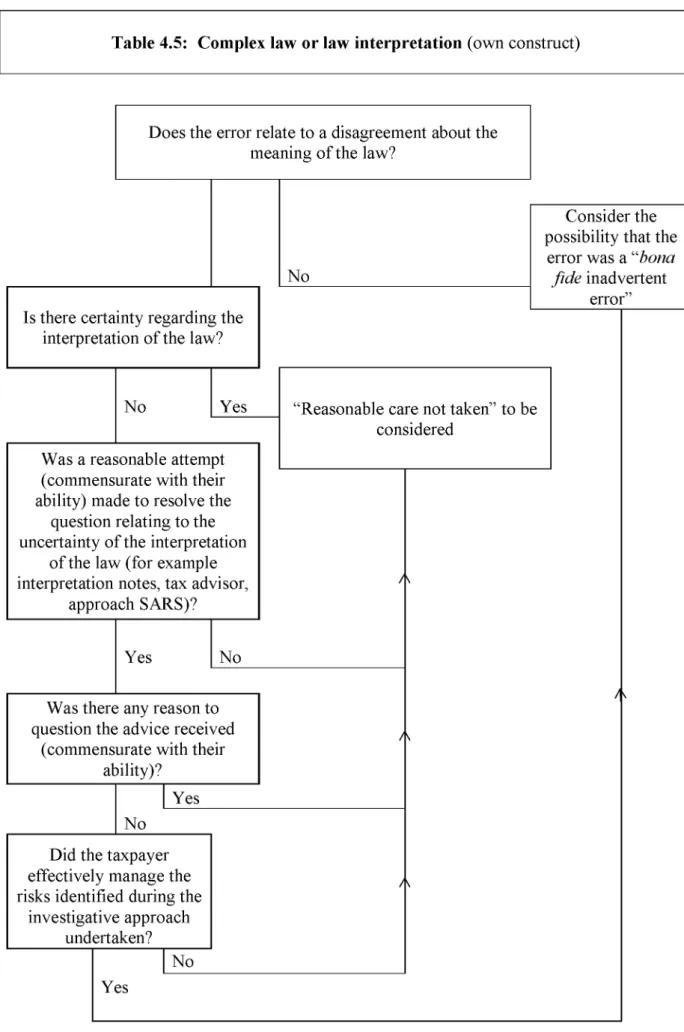
Table 4-5: Complex law or law interpretation...88
Table 4-6: Destruction of records ... 89
Table 4-7: Specific employee is to blame ... 89
Table 4-8: "No reasonable grounds for the tax position taken" decision tree for natural persons and persons other than natural persons ... 90
Table 4-9: "Gross negligence" decision tree for natural persons and persons other than natural persons ... 91
Table 4-10: "Intentional tax evasion" decision tree for natural persons and persons other than natural persons...93
Table 4-11: Increased penalty for "obstructive" behaviour decision tree for natural persons and persons other than natural persons...96
CHAPTER 1
Introduction
1.1 Introduction and background
The Tax Administration Act, 28 of 2011 (the Tax Administration Act) became effective on the 1 October 2012 and introduced the understatement penalty regime which replaced section 76 of the Income Tax Act, 58 of 1962 (the Income Tax Act). Section 76(1) of the Income Tax Act made provision for a penalty equal to twice the tax chargeable on the omission or understatement of taxable income. In terms of section 76(2)(a) the Commissioner for the South African Revenue Service (SARS) had the power to remit the additional tax imposed in terms of section 76(1), or any part thereof, as he may deem fit, provided that there was no intent to evade taxation and if there was intent to evade taxation, he must be satisfied that there were “extenuating circumstances”. Goldswain (2001b: 133 - 134), in his article entitled: The general meaning o f “extenuating circumstances ” fo r the purposes o f section 76(2)(a) o f the Income Tax Act, confirmed that some of the “extenuating circumstances” that have influenced the level of the penalty imposed in terms of section 76 were: conduct, character, attitude, behaviour, negligence and carelessness. It is noteworthy that these “extenuating circumstances” also appear in the understatement penalty table set out in section 223 of the Tax Administration Act.
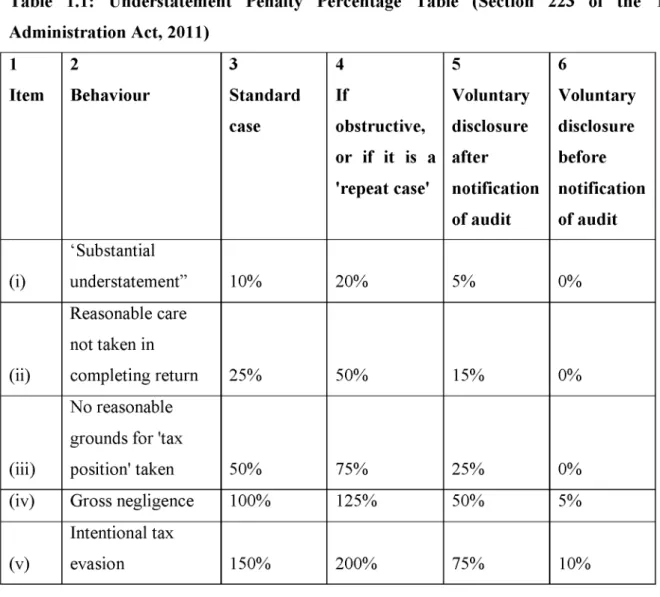
Chapter 16 of the Tax Administration Act deals with the imposition of an understatement penalty. The understatement penalty is calculated by applying a percentage in terms of the following table included in section 223 of the Tax Administration Act to the shortfall in tax giving rise to the imposition of the penalty:
Table 1.1: Understatement Penalty Percentage Table (Section 223 of the Tax Administration Act, 2011) 1 Item 2 Behaviour 3 Standard case 4 If obstructive, or if it is a 'repeat case' 5 Voluntary disclosure after notification of audit 6 Voluntary disclosure before notification of audit (i) ‘Substantial understatement” 10% 20% 5% 0% (ii) Reasonable care not taken in completing return 25% 50% 15% 0% (iii) No reasonable grounds for 'tax
position' taken 50% 75% 25% 0%
(iv) Gross negligence 100% 125% 50% 5%
(v)
Intentional tax
evasion 150% 200% 75% 10%
Section 222(1) of the Tax Administration Act requires SARS to impose the penalty reflected in the table in the event of an “understatement”, unless the “understatement” results from a bona fide inadvertent error. The term “bona fide inadvertent error” is not defined in the Tax Administration Act, nor is the term “obstructive”. The Memorandum on the Objects of the Tax Administration Laws Amendment Bill (SARS, 2013: 40) confirms that, due to the broad range of possible errors, a proposal to define the term “bona fide inadvertent error” has the potential to inadvertently exclude deserving cases and include undeserving cases. It goes on to confirm that SARS will, however, develop guidance in this regard for the use of taxpayers and SARS officials. This guidance has not yet been released.
The Tax Administration Act defines “understatement” in section 221 as any prejudice to SARS or the fiscus as a result of a default in rendering a return, an omission from a return, an incorrect statement in a return, or if no return is required, the failure to pay the correct
amount of “tax”. SARS has no discretion to reduce the percentage where it has been determined that a taxpayer falls within a particular behavioural category (Louw: 2013). SARS bears the onus in terms of section 102(2) of the Tax Administration Act of proving “the facts on which SARS based the imposition of an understatement penalty . . .”.
The percentage penalty levied as a result of an understatement is determined based on the behaviour of the taxpayer which gave rise to the “understatement”. There are five behaviours reflected in the table, namely, “substantial understatement”, “reasonable care not taken in completing return”, “no reasonable grounds for tax position taken”, “gross negligence” and “intentional tax evasion”. Numerous authors (Gad & Solomon: 2012; Vanek: 2012; and Khaki: 2012) express the view that the lack of definition of the behaviours is problematic for both SARS and taxpayers as the table is new and there is still room for interpretation and understanding of the meaning of each of the behaviours.
There are similarities between the penalty provisions in the now repealed section 76 of the Income Tax Act and Chapter 16 of the Tax Administration Act, which will make a comparison of the two sets of provisions and their impact on a defaulting taxpayer relevant.
As the application of the new penalty provisions in relation to the type of taxpayer behaviour have not been subject to interpretation by the courts in South Africa, an analysis of similar provisions in New Zealand may be of assistance. The tax office of New Zealand has a penalty system which has been in operation for longer than that of South Africa, with behaviours or penalty categories that are similar to the behaviours detailed in the table in South Africa. This makes a comparison between the countries useful.
The New Zealand Inland Revenue Department (Inland Revenue) has issued Interpretation Statements, namely Interpretation Statements IS0053 issued in October 2005, IS0055 issued in October 2005, IS0060 issued in August 2004, IS0061 issued in December 2005 and IS0062 issued in November 2006, which provide a detailed interpretative explanation of the shortfall penalty system included in legislation in New Zealand. The shortfall penalty behaviours have also been subject to interpretation by the New Zealand courts. The Inland Revenue published an explanation of shortfall penalties entitled: What are shortfall penalties? on 4 September 2013 confirming that a shortfall penalty is applied as a percentage of a tax shortfall (deficit or understatement of tax), resulting from certain actions on the part
of the taxpayer. The law divides these actions into five categories of fault or breach, with a specified penalty for each category. The breaches can be summarised as follows: “lack of reasonable care”, “unacceptable tax position”, “gross carelessness”, “abusive tax position” and “evasion”.
1.2 Goals of the research
The primary goal of this research is to obtain a better understanding of the meaning of the new behaviours and terms introduced in the table in section 223 of the Tax Administration Act, namely, “substantial understatement”, “reasonable care not taken in completing return”, “no reasonable grounds for tax position taken”, “gross negligence”, “intentional tax evasion”, “obstructive” and in section 222, the term “bona fide inadvertent error”. This goal will be addressed as follows:
1) to provide a comprehensive comparison between the understatement penalty imposed in terms of Chapter 16 of the Tax Administration Act and the additional tax previously imposed in terms of section 76 of the Income Tax Act to determine whether the repealed legislation may be of assistance in understanding the meaning and application of the new behaviours and terms;
2) to explain in detail and compare the new behaviours and terms with the penalty tables and behaviours in legislation in New Zealand, which deals extensively with the meaning of “reasonable care”, “gross carelessness” and “evasion”, to enable a better understanding of the meaning of the behaviours and terms; and
3) to propose a definition for the meaning of “bona fide inadvertent error” and “obstructive”, and develop guidance on the interpretation of the various behaviour categories.
1.3 Overview of the methodological approach
An interpretative research approach will be adopted for the present research as it seeks to understand and describe (Babbie & Mouton: 2009). The research methodology to be applied can be described as a doctrinal research methodology. This methodology provides a systematic exposition of the rules governing a particular legal category, analyses the relationships between the rules, explains areas of difficulty and is based purely on documentary data (McKerchar: 2014).
The documentary data to be used for the research consists of:
• South African legislation pertaining to additional tax and the understatement penalty, specifically the repealed section 76 of the Income Tax Act and chapter 16 of the Tax Administration Act;
• legislation, tax rulings and guidelines relating to the determination, imposition and calculation of penalties and the specific behaviours listed on the penalty tables or systems in South Africa and New Zealand;
• relevant case law; and
• writings of experts in the field of taxation.
The research is conducted in the form of an extended argument, supported by documentary evidence. The validity and reliability of the research and the conclusions will be ensured by:
• adhering to the rules of the statutory interpretation, as established in terms of statute and common law;
• placing greater evidential weight on legislation, case law which creates precedent or which is of persuasive value (primary data) and the writings of acknowledged experts in the field;
• discussing opposing viewpoints and concluding, based on a preponderance of credible evidence; and
• the rigour of the arguments.
All the documentary data is in the public domain. There are therefore no ethical issues concerning their use. Interviews will not be conducted and opinions will only be considered in their written form.
1.4 Thesis structure
The remaining chapters of this thesis are structured as follows. Chapter 2 introduces a discussion of the legislation relating to the understatement penalty imposed in Chapter 16 of the Tax Administration Act and the new behaviours and terms introduced in the understatement penalty table in section 223 and provides a comprehensive comparison between the understatement penalty imposed in terms of Chapter 16 of the Tax
Administration Act and the additional tax previously imposed in terms of the repealed section 76 of the Income Tax Act. Chapter 3 analyses the penalty system in operation in New Zealand and compares the penalty system to the understatement penalty system currently in operation in South Africa. Chapter 4, based on an analysis of “extenuating circumstances” referred to in section 76(2)(a) of the Income Tax Act and the penalty system in operation in New Zealand, proposes a definition for the meaning of “bona fide inadvertent error” referred to in section 222 of the Tax Administration Act and guidance on the interpretation of the various behaviour categories introduced in the table in section 223 of the Tax Administration Act, namely “reasonable care not taken in completing return”, “no reasonable grounds for the tax position taken”, “gross negligence”, “intentional tax evasion” and “obstructive” is developed. Chapter 5 concludes the thesis with a summary of its goals and the findings of the research in relation to these goals.
CHAPTER 2
Comparison of Chapter 16 of the Tax
Administration Act and the now
repealed section 76 of the Income Tax
Act
2.1 Introduction
The primary goal of this research is to obtain a better understanding of the meaning of the new behaviours and terms introduced in the table in section 223 of the Tax Administration Act, namely, “substantial understatement”, “reasonable care not taken in completing return”, “no reasonable grounds for tax position taken”, “gross negligence”, “intentional tax evasion”, “obstructive” and “bona fide inadvertent error”.
This chapter introduces a discussion of the legislation relating to the understatement penalty imposed under Chapter 16 of the Tax Administration Act and the new behaviours and terms introduced in the understatement penalty table in section 223. It will be demonstrated that the lack of definition in the Tax Administration Act and the delay in the issuance of the comprehensive guidance by the South African Revenue Service (SARS) has resulted in uncertainty regarding the new understatement penalty regime, which could create a risk of subjectivity and inconsistent application of the understatement penalty table by SARS officials.
In addition, this chapter seeks to provide a comprehensive comparison between the understatement penalty imposed in terms of Chapter 16 of the Tax Administration Act and the additional tax previously imposed in terms of section 76 of the Income Tax Act to determine whether the repealed legislation may be of assistance in understanding the meaning and application of the new behaviours and terms, as well as in developing guidance for the use of SARS officials. Of particular interest is the “extenuating circumstances” referred to in section 76(2)(a) of the Income Tax Act and specifically whether the legislation, court decisions and guidance already in existence can be inferred to any of the behaviours and
terms detailed in the understatement penalty table in section 223 of the Tax Administration Act.
2.2 Chapter 16 of the Tax Administration Act
Part A of Chapter 16 of the Tax Administration Act comprises sections 221 to 224 and deals with the imposition of an understatement penalty.
Section 221 of the Tax Administration Act sets out the definitions of the terms in the chapter namely, “repeat case”, “substantial understatement”, “tax”, “tax position” and “understatement”. These definitions are as follows:
A “repeat case” is defined as: “A second or further case of any of the behaviours listed under items (i) to (v) of the understatement penalty percentage table reflected in section 223 within five years of the previous case.”
A “substantial understatement” is defined as: “A case where the prejudice to SARS or the fiscus exceeds the greater of five percent of the amount of ‘tax’ properly chargeable or
refundable under a tax Act for the relevant tax period or R1 million.”
“Tax” means: “Tax as defined in section 1, excluding penalties and interest.” “Tax” as defined in section 1 for the purposes of the Tax Administration Act: “.. .includes a tax, duty, levy, royalty, fee, contribution, penalty, interest and any other moneys imposed under a tax Act.”
A “tax position” means: “An assumption underlying one or more aspects of a tax return, including whether or not
-(a) an amount, transaction, event or item is taxable; (b) an amount or item is deductible or may be set-off;
(c) a lower rate of tax than the maximum applicable to that class of taxpayer, transaction, event or item applies; or
Section 222(1) of the Tax Administration Act provides that an understatement penalty is chargeable in the event of an understatement. An “understatement” is defined (also in section 221) as: “Any prejudice to SARS or thefiscus as a result of
-(a) a default in rendering a return; (b) an omission from a return;
(c) an incorrect statement in a return; or
(d) if no return is required, the failure to pay the correct amount of ‘tax’.”
SARS has issued guidance in the form of the SARS Short Guide to the Tax Administration Act (SARS: 2013) (the SARS Short Guide), the purpose of which is to provide assistance to taxpayers in understanding their obligations and entitlements under the Tax Administration Act. The SARS Short Guide is not a binding general ruling, interpretation note, practice note or other official publication as referred to in the Tax Administration Act, and therefore does not constitute law, but is useful for guidance purposes.
2.2.1 The shortfall
The SARS Short Guide (SARS, 2013: 78) confirms that: “An understatement penalty may only be imposed if the fiscus is prejudiced by the taxpayer’s conduct in reporting and that the fiscus will be prejudiced if there is a shortfall.” The shortfall on which the applicable percentage from the understatement penalty table is applied is defined in section 222(3) of the Tax Administration Act as: “. t h e sum of:
a) the difference between the amount of “tax” properly chargeable for the tax period and the amount of “tax” that would have been charged if the “understatement” were accepted;
b) the difference between the amount properly refundable for the tax period and the amount that would have been refundable if the “understatement” were accepted; and c) the difference between the amount of an assessed loss or any other benefit to the
taxpayer properly carried forward from the tax period to a succeeding tax period and the amount that would have been carried forward if the “understatement” were accepted, multiplied by the tax rate determined under subsection (5).”
Section 222(5) states that: “The tax rate is the maximum rate of tax applicable to the taxpayer, ignoring an assessed loss or any other benefit brought forward from a preceding tax period to the tax period.”
If an understatement results in a difference under both (a) and (b) above, section 222(4) states that “. t h e shortfall must be reduced by the amount of any duplication between the paragraphs.”
2.2.2 The understatement penalty
In terms of section 222(2) of the Tax Administration Act the understatement penalty is the amount resulting from applying the applicable understatement penalty percentage in accordance with the understatement penalty table to each shortfall determined in relation to each understatement in a return.
2.2.3 The understatement penalty table
The understatement penalty table is set out in section 223 of the Tax Administration Act. The SARS Short Guide (SARS, 2013: 79) states that, once an applicable behaviour is identified, SARS must consider the conduct of the taxpayer and determine whether the taxpayer made a voluntary disclosure before or after being notified of an audit, the taxpayer was obstructive when engaging with SARS officials, or it is a repeat case. If the case is not defined by any of the above, it is a standard case. The rate of the penalty escalates with increasing culpability and obstructiveness.
2.2.4 Remittance, objection and appeal
“Substantial understatement” is the only behaviour where specific rules exist that permit the remission of the penalty imposed. These rules are reflected in section 223(3) of the Tax Administration Act and permit the penalty imposed to be remitted if “ .S A R S is satisfied that the taxpayer:
(a) made full disclosure of the arrangement that gave rise to the prejudice to SARS or the fiscus by no later than the date that the relevant return was due; and
(b) was in the possession of an opinion by an independent registered tax practitioner that -(i) was issued by no later than the date that the relevant return was due;
(ii) was based upon full disclosure of the specific facts and circumstances of the arrangement and, in the case of any opinion regarding the applicability of the substance over form doctrine or the anti-avoidance provisions of the tax Act, this requirement cannot be met unless the taxpayer is able to demonstrate that
all of the steps in or parts of the arrangement were fully disclosed to the tax practitioner, whether or not the taxpayer was a direct party to the steps or parts in question; and
(iii) confirmed that the taxpayer’s position is more likely than not to be upheld if the matter proceeds to court.”
These are extremely narrow grounds upon which a penalty may be remitted. Taxpayers not in the possession of an opinion by a registered tax practitioner would not qualify for remission, even if full disclosure of the arrangement is made before or on the date the relevant return is due.
Section 224 of the Tax Administration Act states that the imposition of an understatement penalty under section 222 or a decision by SARS not to remit an understatement penalty under section 223(3) is subject to objection and appeal.
2.3 Introduction of the new behaviours and terms 2.3.1 Substantial understatement
The SARS Short Guide (SARS, 2013: 79) confirms that, if no other behaviour defines the facts of a case, then an understatement penalty will be triggered if there is a “substantial understatement”. “Substantial understatement” is the only behaviour defined in the Tax Administration Act and is also the only behaviour where specific rules exist that permit the remission of the penalty imposed.
At present, if the taxpayer’s behaviour at the time of the default is considered to be “substantial understatement”, an understatement penalty of 0 percent is levied should the taxpayer make voluntary disclosure of the “understatement” before notification of an audit or investigation, 5 percent should the taxpayer make voluntary disclosure of the “understatement” after notification of an audit or investigation, 10 percent should it be a standard case and 20 percent should the SARS official deem the taxpayer to be “obstructive” or if the taxpayer is a repeat offender.
As stated above, a “substantial understatement” is defined as a case where the prejudice to SARS or the fiscus exceeds the greater of five percent of the amount of tax properly
chargeable or refundable under a tax Act for the relevant tax period or R1 million. Van Zyl (2014: 913) submits that, to be classified as “substantial”, the “shortfall” in tax paid must exceed the greater of the two limits as stated in the definition, and since this involves mere mathematical calculations, it will be quite easy for SARS to discharge the burden of proof in this regard.
It is submitted that since “substantial understatement” is based on the size of an “understatement” as opposed to the lack of or existence of a specific behaviour, the issuing of guidelines and/or an international comparison to obtain a better understanding of the term will not provide further guidance. The meaning has been clearly defined in the Tax Administration Act.
2.3.2 Reasonable care not taken in completing return
The SARS Short Guide (SARS, 2013: 80) states that, as “reasonable care” is not defined, the ordinary meaning must apply. A taxpayer must take reasonable care in keeping records and providing complete and accurate information to SARS. Reasonable care means that a taxpayer is required to take the degree of care that a reasonable, ordinary person in the circumstances of the taxpayer would take to fulfil his or her tax obligations. It means, for example, that a taxpayer must try his or her best to lodge a correct tax return. The reasonable care standard does not mean perfection, but refers to the effort required commensurate with the reasonable person in the taxpayer’s circumstances.
At present, if the taxpayer’s behaviour at the time of the default is considered to be “reasonable care not taken in completing return”, an understatement penalty of 0 percent is levied should a taxpayer make voluntary disclosure of the “understatement” before notification of an audit or investigation, 15 percent should a taxpayer make voluntary disclosure of the “understatement” after notification of an audit or investigation, 25 percent should it be a standard case, and 50 percent should the SARS official deem the taxpayer to be “obstructive” or the taxpayer is a repeat offender.
Van der Walt (2013) poses the question: how much effort should actually go into the completion of a tax return before a taxpayer can be said to have met the “reasonable care” yardstick? Van der Walt (2013) also points out that the SARS Short Guide gives limited
“man on the Clapham bus” test. Van Zyl (2014: 914) submits that van der Walt has correctly pointed out that the guideline merely restates the well-known “man on the Clapham bus” test and confirms that this refers to a hypothetical reasonable person, used by the courts in English law where it is necessary to decide whether a party has acted as a reasonable person would, for example, in a civil action for negligence. The man on the Clapham bus is a reasonably well educated and intelligent but nondescript person, against whom the defendant’s conduct can be measured.
It is clear that the SARS Short Guide (SARS, 2013: 80) gives limited content to what is expected of a taxpayer in order to have met the “reasonable care” taken standard set by the understatement penalty table.
2.3.3 No reasonable grounds for tax position taken
The definition of “tax position” needs to be considered when interpreting the behaviour “no reasonable grounds for the tax position taken”. A “tax position”, as stated above, means an assumption underlying one or more aspects of a tax return, including whether an item or amount, transaction, event or item is taxable, an amount or item is deductible or may be set off, a lower rate of tax than the maximum applicable to that class of taxpayer, transaction, event or item applies or an amount qualifies as a reduction of tax payable.
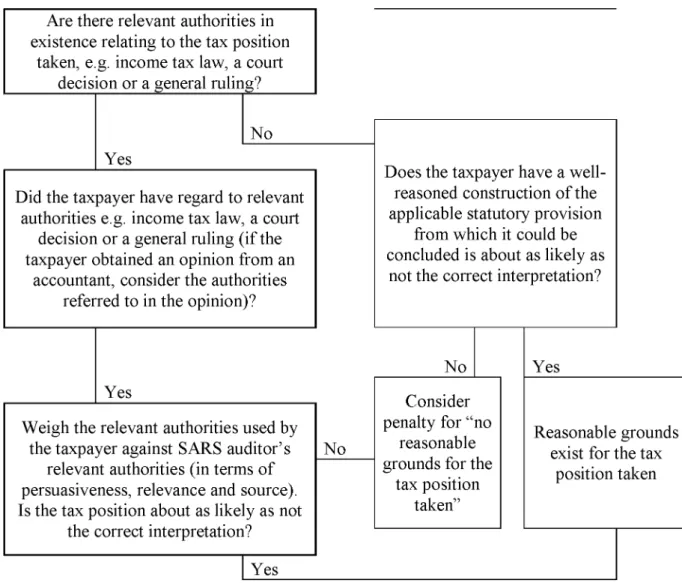
The SARS Short Guide (SARS, 2013: 80) confirms that, where an underpayment of tax occurs due to a taxpayer’s interpretation of the application of a tax Act, an understatement penalty is payable if the taxpayer does not have a reasonably arguable position. A taxpayer’s interpretation of the application of the law is reasonably arguable if, having regard to the relevant authorities, for example an income tax law, a court decision or a general ruling, it would be concluded that what is being argued by the taxpayer is at least as likely as not, correct. Should a shortfall arise because of a substantive disagreement concerning the application of a taxation provision, this understatement penalty will be imposed if the taxpayer’s position is not based on reasonable grounds. The purpose is not to levy a penalty when SARS disagrees with a position adopted by a taxpayer but to attach a penalty where a taxpayer assumes a position unreasonably. As there is an inherent risk in assuming a tax position, taxpayers are expected to adopt a sensible approach in the process of adopting a tax position and also to have considered the integrity of the tax position taken.
At present, if the taxpayer’s behaviour at the time of the default is considered to be “no reasonable grounds for the tax position taken”, an understatement penalty of 0 percent is levied should a taxpayer make voluntary disclosure of the “understatement” before notification of an audit or investigation, 25 percent should a taxpayer make voluntary disclosure of the “understatement” after notification of an audit or investigation, 50 percent should it be a standard case, and 75 percent should the SARS official deem the taxpayer to be “obstructive” or the taxpayer is a repeat offender.
Van Zyl (2014: 916) expresses the opinion that it seems that the burden is on SARS to prove, objectively and without taking the personal circumstances of the taxpayer into account, that the taxpayer did not have a reasonable or rational argument regarding the interpretation or application of a tax Act. This may seem to be an easy task, but it remains to be seen what SARS will have to do in order to (in effect) disprove that what is being argued by the taxpayer is at least as likely as not correct.
It is submitted that the SARS Short Guide (SARS, 2013: 80) does not provide an adequate explanation of what a SARS official is expected to prove or take into account in determining whether the taxpayer did not have a reasonably arguable position in the interpretation of the application of the Tax Administration Act.
2.3.4 Gross negligence
The SARS Short Guide (SARS, 2013: 80) confirms that, “gross negligence” essentially means doing or not doing something in a way that, in all the circumstances, suggests or implies complete or a high level of disregard for the consequences. The test for gross negligence is objective and is based on what a reasonable person would foresee as being conduct which creates a high risk of a tax shortfall occurring. Gross negligence involves recklessness but, unlike evasion, does not require an element of mens rea, meaning wrongful intent or “guilty mind”, or intent to breach a tax obligation.
At present, if the taxpayer’s behaviour at the time of the default is considered to be “gross negligence”, an understatement penalty of 5 percent is levied should a taxpayer make voluntary disclosure of the “understatement” before notification of an audit or investigation, 50 percent should a taxpayer make voluntary disclosure of the “understatement” after
percent should the SARS official deem the taxpayer to be “obstructive” or the taxpayer is a repeat offender.
Van Zyl (2014: 917) is concerned that, taking the SARS Short Guide (SARS, 2013: 80) definition of “gross negligence” into account, the “reasonable person” referred to in this regard is a reasonable person in the position of the taxpayer. The risk exists of inconsistent application by SARS officials due to a lack of comprehensive guidelines and should be addressed expediently, especially in light of the high percentage penalty imposed for this type of behaviour.
It is clear that there is insufficient information in the SARS Short Guide (SARS, 2013: 80) to enable a SARS official to understand exactly what is required to prove that that the taxpayer acted with “gross negligence”, as well as what processes or built in controls put in place by a taxpayer could prevent SARS from imposing the penalty for “gross negligence”.
2.3.5 Intentional tax evasion
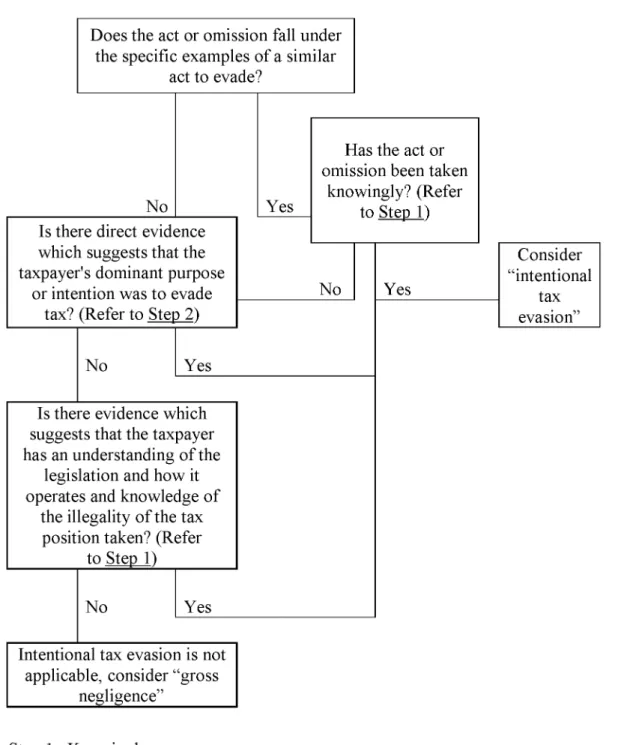
The SARS Short Guide (SARS, 2013: 81) states that: “The most severe penalty is reserved for cases where a taxpayer has acted with the intention to evade tax. To evade tax includes actions that are intended to reduce or extinguish the amount that should be paid, or which inflate the amount of a refund that is correctly refundable to the taxpayer. Intentional tax evasion can exist where a taxpayer makes a false statement in a return, and can also exist where a person does not file a return. The most important factor is that the taxpayer must have acted with intent to evade tax. Intention is a wilful act that exists when a person’s conduct is meant to disobey or wholly disregard a known legal obligation, and knowledge of illegality is crucial. Whether SARS acts on or accepts a false declaration is irrelevant. If SARS does not accept the declaration, but audits the taxpayer and determines the correct tax position, the original intent to evade tax is not excused. Since the application of tax law to a particular taxpayer may be complex, it may be that a genuine misunderstanding of the practical application of a taxing provision does not indicate intentional tax evasion. If the taxing provision is uncertain, for instance if there are conflicting judgements on the issue, and the taxpayer applies a reasonable interpretation, it is doubtful that intent to evade could be established and that the more appropriate behavioural category would be whether the taxpayer had taken a tax position on unreasonable grounds or, at worse, that the taxpayer has
been grossly negligent. This is an area that is also influenced by the nature of the actions that underlie an understatement and circumstances of the taxpayer.”
At present, if the taxpayer’s behaviour at the time of the default is considered to be “intentional tax evasion”, an understatement penalty of 10 percent is levied should a taxpayer make voluntary disclosure of the “understatement” before notification of an audit or investigation, 75 percent should a taxpayer make voluntary disclosure of the “understatement” after notification of an audit or investigation, 150 percent should it be a standard case, and 200 percent should the SARS official deem the taxpayer to be “obstructive” or the taxpayer is a repeat offender.
The SARS Short Guide (SARS, 2013: 81) acknowledges that, intention may, at times, be difficult to distinguish from an act that is grossly negligent. It is questioned whether the SARS Short Guide (SARS, 2013: 81) has provided adequate guidance to enable a SARS official to correctly and consistently prove that that the taxpayer has acted with “intentional tax evasion”.
2.3.6 Obstructive
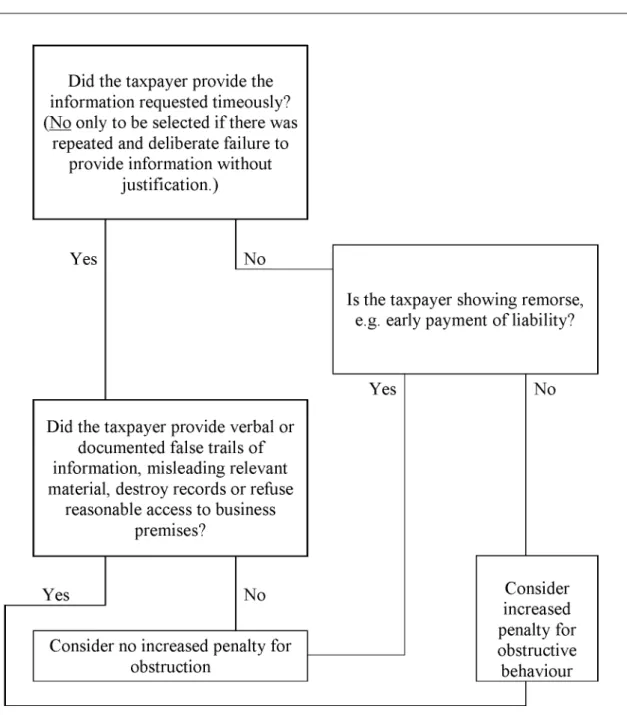
The SARS Short Guide (SARS, 2013: 79) confirms that SARS must determine whether the taxpayer was “obstructive” when engaging with the SARS official. If SARS determines the taxpayer to be “obstructive”, the penalty percentage could increase by 50 percent, depending on the behaviour identified.
Determining whether a taxpayer was “obstructive” is a subjective decision based on the SARS official’s dealings and feelings with regard to the taxpayer. It can be argued that the lack of guidelines could result in inconsistent application by SARS officials.
2.3.7 Bona fide inadvertent error
Section 222(1) of the Tax Administration Act was revised to take account that no understatement penalty is payable if the “understatement” results from a “bona fide inadvertent error”. The statement “bona fide inadvertent error” has not been defined in the Tax Administration Act nor does the SARS Short Guide (SARS, 2013) offer any guidance on the term. The Memorandum on the Objects of the Tax Administration Laws Amendment Bill
(SARS, 2013: 40) (the Final Memorandum) confirms that SARS will develop guidance in this regard. This guidance has not yet been released.
The Draft Explanatory Memorandum on the Objects of the Tax Administration Laws Amendment Bill (SARS, 2013: 13) states that in order to determine whether an understatement was caused by a “bona fide inadvertent error”, SARS will have regard to the circumstances in which the error was made, but also other factors, including the taxpayer’s knowledge, education, experience and skill, the size or quantum, the nature and frequency of the error, whether similar errors were made previously. In respect of errors relating to the interpretation of tax laws, SARS will have regard to the complexity of the provisions, whether the taxpayer tried to understand the provisions, including consulting the relevant explanatory memoranda or making reasonable enquiries and whether the taxpayer relied on information (correct or misleading) which came from a reputable source and a reasonable person in the same circumstances would find the information complex.
Haupt (2014: 994) expresses the opinion that this places the bar too high and, as a result this interpretation did not find its way into the Final Memorandum (SARS, 2013: 40), which confirms that, due to the broad range of possible errors, a proposal to define the term “bona fide inadvertent error” has the potential to inadvertently exclude deserving cases and include
undeserving cases.
Van Zyl (2014: 906) states that, in light of the mandatory nature of the understatement penalty, it is of the utmost importance to understand what the “bona fide inadvertent error” exception means. The lack of comprehensive guidelines regarding the process to identify and rule out a “bona fide inadvertent error” may prove to be to the detriment of taxpayers due to possible inconsistent application and even possible abuse of this new exception. If comprehensive guidelines regarding the process to identify and rule out a “bona fide inadvertent error” are not issued and applied consistently and properly by SARS, the “bona fide inadvertent error” exclusion might prove to be of little value.
Van Zyl and Haupt have attempted to define the term “bona fide inadvertent error” as follows: Van Zyl (2014: 910) explains that, the Free Dictionary by Farlex, 2014 confirms “bona fide ” is a Latin phrase that means “in good faith”, and thus means sincere or genuine. Haupt (2015: 1025) confirms that, the correct meaning of the term can be found in the Collins
English Dictionary which defines “inadvertent” as “failing to act carefully or considerately; inattentive, resulting from heedless action; unintentional”. Clarity is required to prevent inconsistent application or abuse, as confirmed by Van Zyl.
2.4 The problem with the current level of understanding of the understatem ent penalty provisions
The application of the new penalty provisions in relation to the type of taxpayer behaviour has not yet been subject to interpretation by the courts in South Africa. Numerous authors (Gad & Solomon: 2012; Vanek: 2012; and Khaki: 2012) express the view that the ambit of the various categories of behaviour in the table linking the penalty to the type of behaviour is not clear and the lack of definition of the behaviours is problematic for both SARS and taxpayers as the table is new and there is still room for interpretation and understanding of the meaning of each of the behaviours. These authors also found that the lack of definition of the types of behaviour result in the penalties raised in respect of the behaviours being subjective and dependant on the person assessing the return.
The understatement penalty table allows SARS to impose penalties of up to 200 percent. In light of these high penalty percentages, it is necessary to understand what hurdles SARS must overcome first before it can slot a taxpayer into these categories in the understatement penalty table (Van Der Walt: 2013).
The restructuring of the penalties was intended to make matters clearer for the taxpayer and to place less reliance on the discretion of an individual SARS employee. There are still some uncertain areas with respect to the table of behaviours and relevant penalties. Guidance may be found in the SARS Short Guide (SARS, 2013) but it seems that in practice this process is still dependent on the individual SARS employee making the assessment. It is therefore still a subjective decision due to the nature of the behaviours described (Khaki: 2012).
The new penalty regime can be severe and taxpayers and SARS are already arguing about into which categories of understatement a particular offence falls (Surtees: 2014).
Van Zyl (2014: 919) claimed that the understatement penalty regime is a very sharp new “sword” due to its mandatory nature and the current lack of guidance from SARS. Van Zyl
(2014: 920) confirms that a lot of uncertainty still clouds the application of the new understatement penalty regime and submits that by honouring its undertaking to issue guidance SARS will contribute positively to ensure that all of its officers apply the same principles consistently in ruling out a “bona fide inadvertent error” and in determining the correct understatement penalty in terms of the understatement penalty table.
The commentary provided by the South African Institute of Tax Practitioners (SAIT) dated 5 August 2013 on the draft Tax Administration Laws Amendment Bill, 2013 recommended that the term “bona fide inadvertent error” should be defined in the Tax Administration Act or the examples mentioned in the Explanatory Memorandum should be incorporated into the Tax Administration Act. The SAIT also suggested that a matrix (decision-tree) be compiled and be distributed to SARS officials, taxpayers and tax practitioners to ensure consistency of decisions taken when the discretion of the Commissioner is exercised in determining an understatement penalty and to remove the differences in interpretations.
It appears that the current level of understanding of the meaning of the new terms and behaviours discussed above and application of the understatement penalty table is not sufficient. Without guidance, the understatement penalty table is exposed to subjectivity and inconsistent application by SARS officials. This has the potential to create negative perceptions about the fairness of the tax system and expose taxpayers to unnecessary costs.
The SARS Short Guide (SARS, 2013: 78) confirms that the previous open-ended discretion to impose “additional tax” of up to 200 percent imposed in terms of section 76 of the Income Tax Act has been replaced with the understatement penalty framework that is aimed at ensuring consistent treatment of taxpayers in comparable circumstances. The penalty will be determined by locating each case within a table that assigns a percentage to objective criteria. It is submitted that at present, the aim of the understatement penalty framework cannot be achieved.
2.5 Comparison with the now repealed section 76 of the Income Tax Act 2.5.1 When to impose and the discretion to impose the penalties
In terms of section 222(1) of the Tax Administration Act, an “understatement” is defined (in section 221) as: “.. .any prejudice to SARS or the fiscus as a result of
-(a) a default in rendering a return; (b) an omission from a return;
(c) an incorrect statement in a return; or
(d) if no return is required, the failure to pay the correct amount of “tax”.”
Section 76(1) of the Income Tax Act provided that: “A taxpayer shall be required to pay in addition to the tax chargeable in respect of his taxable income
-(a) if he makes default in rendering a return in respect of any year of assessment, an amount equal to twice the tax chargeable in respect of his taxable income for that year of assessment; or
(b) if he omits from his return any amount which ought to have been included therein, an amount equal to twice the difference between the tax as calculated in respect of the taxable income returned by him and the tax properly chargeable in respect of his taxable income as determined after including the amount omitted;
(c) if he makes an incorrect statement in any return rendered by him which results or would if accepted result in the assessment of the normal tax amount which is less than the tax properly chargeable, an amount equal to twice the difference between the tax as assessed in accordance with the return made by him and the tax which would have been properly chargeable.”
The provisions relating to when to impose a penalty are similar under both the Tax Administration Act and the Income Tax Act in that, section 76(1)(a) of the Income Tax Act and section 221 of the Tax Administration Act both refer to a default in rendering a return, section 76(1)(b) of the Income Tax Act and section 221 of the Tax Administration Act both refer to an omission from a return and section 76(1)(c) of the Income Tax Act Income Tax Act and section 221 of the Tax Administration Act both refer to an incorrect statement in a return. The two sections differ in that section 221 of the Tax Administration Act provides for the situation where no return is required and section 76 of the Income Tax Act does not.
The Tax Administration Act does not define an “omission” from a return referred to in section 221. This is in contrast to section 76 of the Income Tax Act where subsections 5, 6 and 7 set out the circumstances under which a taxpayer was deemed to omit an amount from his return for the purposes of section 76(1)(b). The section provided as follows:
“(5) Any taxpayer who in determining their taxable income, deducts, sets off, disregards or excludes any impermissible amount under the provisions of the Income Tax Act, or shows any amount as an expenditure or loss which he has in fact not expended or lost, shall be deemed to have omitted the amount from his return.
(6) Any taxpayer who wilfully fails to disclose in any return made by him any facts which should be disclosed and the disclosure of which would result in the taxation of the taxpayer’s taxable income on an amount which is higher than the amount declared on the return, shall be deemed to have omitted the difference between the two amounts from his return.
(7) If in any year of assessment in which the determination of the taxable income of the taxpayer does not result in an assessed loss, he is entitled to the set-off of a balance of assessed loss from the previous year of assessment and such balance is less than it would have been had it been calculated on the basis of the returns rendered by him, he shall for the purposes of this section be deemed to have omitted from his return for the first-mentioned year of assessment an amount equal to the difference between the amount at which such balance is finally determined and the amount at which it would have been determined on the said basis.”
It is suggested that the imposition of an understatement penalty under the Tax Administration Act and additional tax under the Income Tax Act are both mandatory penalties. This is made clear by the use of the words “must pay” in section 221 of the Tax Administration Act and “shall be required” in section 76(1) of the Income Tax Act. There is a clear discrepancy with regard to SARS’ discretion to remit the penalty imposed under the two Acts. Haupt (2012: 720) confirms that: “Section 76 of the Income Tax Act gave the Commissioner the power to remit any portion of the additional tax, with the proviso that he could not remit if he was satisfied that the taxpayer intended to evade tax, unless he was satisfied that there were “extenuating circumstances”.” The inconsistencies between the remission of the penalties are discussed in more detail under paragraph 2.5.7 below.
2.5.2 How the penalties are calculated
The understatement penalty is the amount resulting from applying the applicable understatement penalty percentage in accordance with the understatement penalty table to each “shortfall” determined in relation to each “understatement” in a return. This is confirmed in section 222(2) of the Tax Administration Act. The SARS Short Guide (SARS,
2013: 79) states that, once an applicable behaviour is identified, SARS must consider the conduct of the taxpayer and determine whether the taxpayer made a voluntary disclosure before or after being notified of an audit, the taxpayer was obstructive when engaging with SARS officials, it is a repeat case or if the case is not defined by any of the above, it is a standard case. The rate of the penalty escalates with increasing culpability and obstructiveness.
Section 76(1) of the Income Tax Act stated that the additional tax imposed will be equal to twice the taxes chargeable on his taxable income for that year of assessment. Effectively, a straightforward penalty of 200 percent was imposed.
2.5.3 Onus of proof
According to the now repealed section 82 of the Income Tax Act, the burden of proof that any amount is exempt from or not liable to any tax chargeable, subject to any deduction, abatement or set-off or to be disregarded or excluded in terms of the Eighth Schedule shall be upon the person claiming such exemption, non-liability, deduction, abatement or set-off, or that such amount must be disregarded or excluded, and upon the hearing of any appeal from any decision of the Commissioner, the decision shall not be reversed or altered unless it is shown by the appellant that the decision is wrong. The taxpayer had to prove the existence of mitigating and extenuating circumstances and motivate the reduction of the 200 percent maximum penalty under section 76 of the Income Tax Act.
Section 102(2) of the Tax Administration Act, on the other hand, confirms that the burden of proving whether an estimate under section 95 is reasonable, or the facts on which SARS based the imposition of an understatement penalty under Chapter 16, is upon SARS.
2.5.4 Dispute process
Section 224 of the Tax Administration Act provides that the imposition of an understatement penalty imposed under section 222 or a decision by SARS not to remit an understatement penalty under section 223(3) is subject to objection and appeal. Similarly, section 76(2)(b) of the Income Tax Act stated that the decision of the Commissioner not to remit part or the whole of the additional tax imposed was subject to objection and appeal by the taxpayer.
There is a discrepancy with regard to section 76(2)(c) of the Income Tax Act, which envisaged the Commissioner and the taxpayer reaching an agreement on the amount of additional tax to be paid either before or after an assessment was issued and if an agreement was reached, the amount agreed upon was not subject to any objection and appeal. There is no similar provision for this in the Tax Administration Act.
2.5.5 Penalties on estimated assessments
According to section 76(3) of the Income Tax Act, in cases where the taxpayer's taxable income or any part thereof was estimated by the Commissioner in terms of section 78 of the Income Tax Act or determined from accounts rendered by the taxpayer, additional tax was calculated as discussed above under sections 76(1)(a) - (c). Similarly, section 223(2) of the Tax Administration Act provides that an understatement penalty is chargeable where an assessment is based on an estimate under section 95 or an assessment agreed upon with the taxpayer under section 95(3).
2.5.6 Penalties on assessed losses
Silke (2008: 912) stated that the liability for additional tax for assessed losses under the Income Tax Act does not extend beyond the first year of assessment in which the taxable income is determined. For example, if the taxable income in the first year of assessment, including the omitted income of a previous year, does not give rise to any payment of tax, no additional tax is payable. This was confirmed by section 76(7) of the Income Tax Act which stated that where a taxpayer had in the past overstated the assessed loss to which he or she was actually entitled, additional tax was calculated on the difference between the balance of the assessed loss as properly determined and the larger overstated assessed loss in a year of assessment in which the determination of the taxable income does not result in an assessed loss.
By contrast, a “shortfall” as defined by the Tax Administration Act specifically includes the difference between the amount of an assessed loss or any other benefit to the taxpayer properly carried forward from the tax period to a succeeding tax period and the amount that would have been carried forward if the “understatement” were accepted, multiplied by the tax rate determined under subsection (5).
This is an area of concern for both taxpayers and tax practitioners. Van Manen (2014) argues that taxpayers who find themselves in assessed loss positions have regularly been taken aback by SARS levying the penalties where timing errors have occurred. While an uncorrected error made by a taxpayer still in an assessed loss position will result in an understatement in a future year of assessment, by definition, an understatement cannot occur in the year of assessment. SARS, however, levies penalties on shortfalls resulting from the difference between the balance of an assessed loss corrected for an error and an assessed loss affected by an error.
2.5.7 Remission of the penalty
“Substantial understatement” is the only behaviour where specific rules exist that permit the remission of the penalty imposed. In terms of section 223(3), the penalty may be remitted if SARS is satisfied that the taxpayer:
(a) made full disclosure of the arrangement that gave rise to the prejudice to SARS or the fiscus by no later than the date that the relevant return was due; and
(b) was in the possession of an opinion by an independent registered tax practitioner that -(i) was issued by no later than the date that the relevant return was due;
(ii) was based upon full disclosure of the specific facts and circumstances of the arrangement and, in the case of any opinion regarding the applicability of the substance over form doctrine or the anti-avoidance provisions of the tax Act, this requirement cannot be met unless the taxpayer is able to demonstrate that all of the steps in or parts of the arrangement were fully disclosed to the tax practitioner, whether or not the taxpayer was a direct party to the steps or parts in question; and
(iii) confirmed that the taxpayer’s position is more likely than not to be upheld if the matter proceeds to court.
The SARS Short Guide (SARS, 2013: 80) confirms that the purpose of the remission is to recognise where a taxpayer took particular care before preparing a return. It is argued that the present power of SARS to remit the understatement penalties is very limited. By contrast, section 76(2)(a) of the Income Tax Act granted the Commissioner the power to remit the additional tax imposed in terms of section 76(1) of the Income Tax Act, or any part thereof, as he may deem fit, provided that there was no intent to evade taxation and if there
circumstances”. These “extenuating circumstances” were to be provided by the taxpayer. The Tax Administration Act does not envisage extenuating circumstances.
2.5.7.1 Extenuating circumstances
Goldswain (2001b: 133), in his article entitled: The general meaning o f “extenuating circumstances ” fo r the purposes o f section 76(2)(a) o f the Income Tax Act, explains that the general meaning of the phrase “extenuating circumstances” is broader than that used in criminal law and incorporates the often-used phrase “mitigating circumstance”. It even extends to circumstances that arise subsequent to the default act or omission. The state of mind of the defaulting taxpayer at the time that the act or omission was committed, and even subsequently, is vital. It should be established from the taxpayer’s ipse dixit (subjective test) and be weighted and tested against the probabilities and inferences drawn from the established facts (objective factors). Goldswain (2001b: 133) is of the opinion that the extent of the penalty will normally not be determined by a single factor and that, as a general proposition, the greater the number of prevailing “extenuating circumstances” that can be identified in in favour of the taxpayer, the larger the remission of the penalty will be. It is submitted that this supports the SAIT (SAIT, 2013) proposition that a matrix (decision-tree) should be compiled, which should take into account all the surrounding facts and circumstances of the taxpayer before a decision is taken in determining the understatement penalty to be imposed.
Goldswain (2001b: 133 - 134) compiled a list of what the courts regard as “extenuating circumstances”, which emerged from the cases analysed in his articles. Some of the “extenuating circumstances” which have influenced the level of the penalty imposed in terms of section 76 of the Income Tax Act which could assist in the development of guidance for the new behaviours and terms introduced in Chapter 16 of the Tax Administration Act are:
• reliance on tax advisor, bookkeeper, accountant or member of staff; • personal circumstances: lifestyle, financial means;
• ignorance of the law; • illiteracy, naivety;
• conduct, character, attitude, behaviour; • negligence, carelessness; and
In addition, in the South African case of Grundling v the State (20616/14) [2015] ZASCA 129, the Supreme Court of Appeal confirmed that in their view, both the Regional Magistrates Court and the Gauteng Division of the High Court did not accord sufficient weight to the appellant’s mitigating circumstances when sentencing was decided. The mitigating and aggravating factors presented by the appellant and the counsel for the State may be of assistance in understanding the meaning and application of the new behaviours and terms in Chapter 16 of the Tax Administration Act.
2.5.7.1.1 Using a tax agent
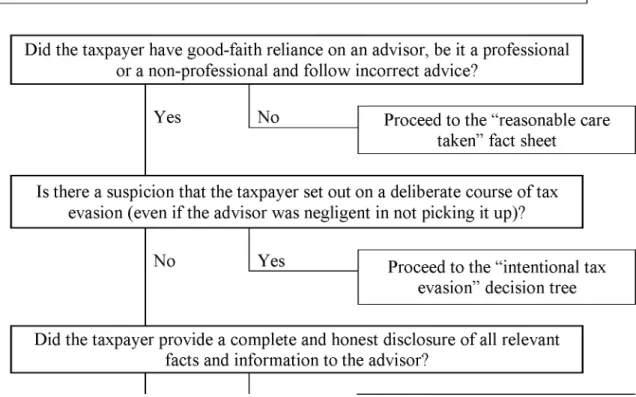
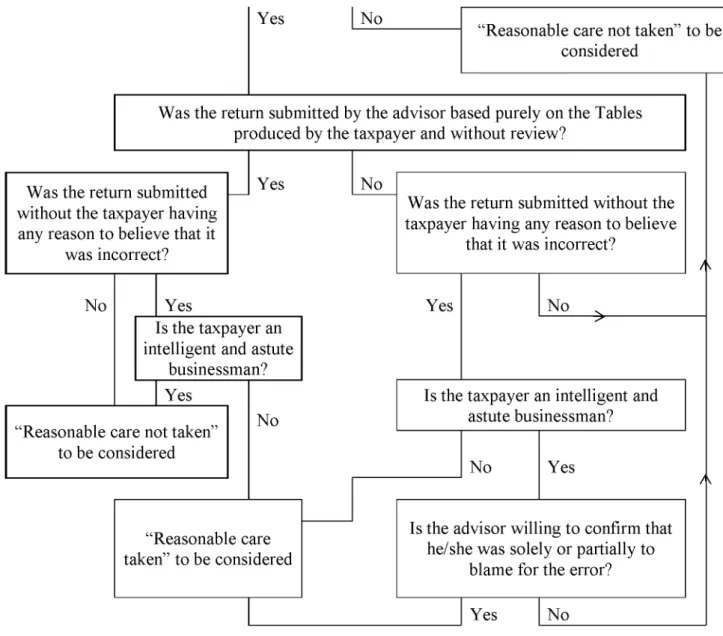
Goldswain (2001a: 151 - 152) in his article entitled: Reliance on professional and non professional advisors or staff as a defence to the imposition o f penalties in income tax
matters, explains that based on an analysis of the relevant case law, the reliance on advisors, be it an accountant, bookkeeper or even a member of staff, can be taken into account as either a complete defence against the imposition of penalties or be regarded as an “extenuating circumstance” for the purposes of remission of penalties, provided that the taxpayer has submitted complete and honest information to the advisor, has not set out on a course of tax evasion, is not an astute businessman who has the ability to determine that the information submitted by the advisor was incorrect and the return submitted by the advisor was not purely based on figures produced by the taxpayer and without review.
At present, the SARS Short Guide (SARS, 2013: 80) specifically confirms that if the taxpayer uses an adviser to complete a return and the advisor does not exercise reasonable care, the taxpayer is liable to pay an understatement penalty. It is submitted that this is a severe approach and should be removed from the SARS Short Guide.
It is proposed that the SARS Short Guide (SARS, 2013: 80) should be updated as follows to reflect Goldswain’s (2001a: 151 - 152) findings discussed above: “Where the taxpayer makes use of an advisor and provides incomplete or inaccurate information to the advisor, or does not detect an error made by the advisor which a reasonable person in their circumstances would have detected, or had reason to believe the advice provided was not correct, an understatement penalty should be considered.”