A 109.10
84
Farmer Cooperative Theory:
Recent Developments
United States Department of Agriculture Agricultural Cooperative Services ACS Research Report Number 84WAITE MEMORIAL BOOK COLLECTION DEPT. OF AG. AND APPLIED ECONOMICS
1994 BUFORD AVE. - 232 COB UNIVERSITY OF MINNESOTA
preface
By the late 1970's, it had become clear to the cooperative community that existing theories of farmer cooperation had failed to address adequately many of the critical issues facing farmer cooperatives. The environment in which these organizations and their patron-members operated had grown much more complex than in the 1950's and 1960's, when most of the
previous theories about the behavior of farmer cooperaUves were developed. Hence, there was a need for new theoretical work to guide empirical,
problem-oriented research aimed at finding ways to improve performance of individual cooperatives, and the cooperative system as a whole.
Beginning in 1980, the Agricultural Cooperative Service (ACS) in the U.S. Department of Agriculture played a critical role in fostering a new round of work on cooperative theory by funding research at several land-grant universities. Some results of that research have already appeared in the report, Cooperative Theory: New Approaches, edited by Jeffrey S. Royer (ACS Service Report No. 18). This report is companion to the earlier publication, and attempts to synthesize the results of the ACS-sponsored "Cooperative Theory Project" as well as other recent developments in the theory of farmer cooperation.1
Many people provided helpful reviews of this report, including James Shaffer, Larry Hamm, V. James Rhodes, Ronald Cotterill, Jeffrey Royer, Michael Turner, Hugh Moore, Kenneth Duft, David Cobia, and David Holder. Any remaining errors of fact or interpretation are solely those of the author.
contents
HIGHLIGHTS ... iv
WHY STUDY COOPERATIVE THEORY? ... 1
Organization of the Report .... : ... 1
Role of Theories and Economic Models ... 1
DEVELOPMENTS IN COOPERATIVE THEORY THROUGH 1980 ... 2
The Cooperative as a Form of Vertical Integration ... 2
The Cooperative as a Firm ... 3
The Cooperative as a Coalition ... 8
RECENT DEVELOPMENTS IN COOPERATIVE THEORY ... 8
Reasons for the Resurgence ... 8
Approaches Used ... 9
Extensions of the "Cooperative as a Firm" Approach ... 9
Analyses of Cooperatives in the Planning Sector ... 12
The Cooperative as a Nexus of Contracts ... 14
The Cooperative as a Coalition ... 19
SUMMARY, CONCLUSIONS, AND IMPLICATIONS ... 22
Implications of Recent Theoretical Research ... 22
Cooperative Goals and Governance ... 22
Cooperative Finance ... 22
Improving System Coordination ... 23
Public Policy Toward Cooperatives ... 23
Implications for Future Research ... 24
NOTES ... 25
REFERENCES ... 28
iv
The 1980's witnessed a resurgence of research by agricultural
economists on the theory of agricultural cooperation. The renewed interest
cooperative theory resulted from the recognition that existing theories failed .
address many of the challenges facing agricultural cooperatives today. The
challenges include the need for cooperatives to compete with very large, oft
conglomerate, investor-owned firms (IOF's); the necessity of raising large
amounts of equity capital to capture economies of size; the dilemmas in
serving a highly heterogeneous group of members, whose interests
sometimes conflict; and the difficulties of dealing in increasingly risky markets:,
In addition, the growth and consolidation of cooperatives raised many
;1
questions for public policy, such as whether large cooperatives posed antitru ;
problems; whether cooperatives could improve market coordination, thereby
substituting for Federal income- and price-support programs; and whether
large, multi-division cooperatives really behaved any differently from IOF's.
In attempting to address these issues, economists have extended
previous models that viewed the cooperative as a firm; developed new
approaches that model the behavior of cooperatives in highly concentrated
industries (lithe planning sector"); analyzed the cooperative as a coalition of
various participants, such as farmers, managers, board members, and input
suppliers; and modeled the cooperative as a set of explicit and implicit
contracts among these partiCipants. In carrying out these analyses, theorists
have adapted many approaches originally developed for the analysis of
investor-owned firms, such as applications of game theory, agency theory,
behavioral theories of the firm, and the theory of contestable markets.
The recent work has shown that the structure of cooperatives offers them
opportunities and creates challenges for them different from those present in
IOF's. Consequently, cooperatives may perform differently than IOF's, both as
individual economic entities and in their effect on the wider economy. Whether
an individual cooperative realizes its potential for improving economic
performance and farmer welfare, however, depends critically on the co-op's
structure and practices.
The theoretical work has also demonstrated that setting operational goals
for a cooperative involves striking delicate balances. For example, a co-op
needs to balance the goal of increasing its net margin with the goal of offering
members attractive prices. Attempting simply to maximize the cooperative's
net margin does not maximize members' welfare, nor does focusing solely on
providing members with favorable prices. Similarly, when the cooperative has
a heterogeneous membership, the co-op needs to balance benefits among
various members to preserve the membership base. In some instances,
differential pricing of goods and services to members is necessary to prevent
those with better market opportunities from abandoning the cooperative, which
could leave the remaining members worse off. Striking such delicate balances
is one of the key responsibilities of the board of directors.
Another area of theoretical work has been the implications of the
patron-owner relationship for cooperative finance. The lack of ability to "float stock"
constrains the equity base of cooperatives and prevents the emergence of a
secondary market for cooperative equity certificates. The absence of such a
market has a number of implications for cooperative investments and governance, including the reluctance of cooperatives to undertake projects with long gestation periods and the need for cooperatives' boards of directors to playa much more active role -in the governance of their organizations than do IOF boards of directors.
Theory also suggests that potential exists for improving the performance of the entire cooperative system, not just individual cooperatives. For
example, in some cases there is theoretical justification for more collaboration and less competition among cooperatives. Such collaboration could reduce total system costs and improve returns to farmers. But both theoretical work and common observation highlight several factors that can block such collaboration, such as the vested interests of current managers, patron-owners, and board members, and the belief by some members that
competition is the only way of ensuring control over management. Hence, any move to increase collaboration among cooperatives will have to address these issues. The theoretical work also shows that in some circumstances
cooperative members would be better off taking collective action via the cooperative, but that incentives exist for them to behave independently, acting as free riders. An example is the lack of patron commitment to a cooperative that is acting as a competitive yardstick. To capture the potential for improved coordination, cooperatives need to develop mechanisms to increase member commitment, such as contracts with members that have significant penalties for nonperformance. The development of such mechanisms needs to be coupled with actions aimed at strengthening member control, however; otherwise, such actions might simply remove membership pressure on the management and the board to perform their duties effectively.
The recent theoretical research also reaffirms that there are often valid justifications for public policies to support cooperatives, particularly because of their effects on competition in highly concentrated markets and their potential to improve market coordination. The recent work cautions, however, that the public should not grant carte blanche to cooperatives, as certain types of cooperative structures may behave similarly to an IOF conglomerate. In particular, theory suggests that cooperatives that follow a closed membership policy and make heavy use of unallocated retained earnings are more likely to pose antitrust problems.
Areas warranting additional theoretical research include further analyses of cooperative-IOF joint ventures and analyses of how cooperatives can effectively collaborate to counterbalance increasing IOF concentration in certain segments of the agricultural economy. In addition, the theoretical work outlined in this report generates many new hypotheses that deserve empirical investigation. Testing these hypotheses may be one of the most fruitful areas for further cooperative research.
r
Farmer Cooperative Theory:
Recent Developments
John M. Staatz, Associate Professor
Department of Agricultural Economics Michigan State University
WHY STUDY COOPERATIVE THEORY? Recently the CEO of a major California
cooperative spoke on "Agricultural Cooperatives: Are They Still Relevant?" (Allewelt). The question is heretical to many in the cooperative community, yet it is one that is increasingly heard. The answer ultimately depends on what, if anything, is unique about farmer cooperatives, and what advantages they offer member-patrons in dealing with today's complex and rapidly changing business environment.
Cooperative advocates have discussed their unique features ever since the days of the Rochdale pioneers. In the 1920's, two schools of thought developed in the United States regarding the justification for, and
function of, farmer cooPeratives. One school, identified with Aaron Sapiro, argued that the major function of farmer cooperatives was to unify farmers on a commoditywide basis so that they could exert market power and raise total returns to agriculture. By contrast, followers of Edwin Nourse contended that cooperatives should function as "competitive yardsticks." They should not try to monopolize
commodity markets but simply add enough competition to the system to give farmers a basis on which to judge the performance of investor-owned agribusinesses. Since the 1940's, academicians, particularly economists, have drawn on Sapiro's and Nourse's ideas as well as general economic theory to develop formal models of cooperatives' behavior. These models highlight how the unique features of farmer cooperatives affect their business practices and examine the implications of those practices for patron-members and society at large.
Between the mid-1940's and the mid-1960's, cooperative theorists focused particularly on the nature of the relationship between the cooperative and its member-patrons and the implications of that
relationship for how the cooperative priced its goods and services, for how those pricing and output decisions affected market competition, and for the appropriate rules for governing the cooperative. After the mid-1960's, research on cooperative theory fell off
Notes and references carried at end of text.
dramatically. The environment in which cooperatives and their members operated, however, continued to evolve rapidly, posing new problems and opportunities for cooperatives, many of which were not addressed by existing theories of farmer cooperation. In response to these new challenges, there has been a resurgence during the 1980's of theoretical work on farmer cooperatives. A key element in this resurgence has been financial and intellectual support offered by the Agricultural Cooperative Service (ACS). Since 1980, researchers have explored the basic nature of farmer cooperation, the theoretical benefits and limits to cooperative enterprise, and the implications of these for cooperative members, managers, and public policy. This report describes and evaluates the recent theoretical developments; examines some of their implications for cooperative decisionmaking, management practices, and public policy; outlines remaining areas of conflict and gaps in the theory of agricultural cooperation; and discusses topics for future research.
Organization of the Report
Although this report briefly mentions some recent work by European theorists, it focuses primarily on the North American agricultural economics literature since 1980.2 It also concentrates almost exclusively on the literature concerning agricultural marketing and supply cooperatives. It does not review the voluminous, and in many ways parallel, literature on the theory of the labor-managed firm (including the agricultural
production cooperative) or on the theory of agricultural bargaining cooperatives (which is similar to the theory of labor unions) and mentions only briefly work on the theory of consumer cooperatives.]
Role of Theories and Economic Models
Before proceeding, it is useful to say a few words about the nature and purpose of economic theories and models. All models and theories of behavior are by definition abstractions and simplifications of reality. The purpose of a theory is to simplify the complexity of
the real world so that the key elements determining how something works can be identified and the interrelationships among those elements can be understood.
The aim of cooperative theory is therefore to develop models that help us understand how
cooperatives do or potentially could operate in the real world. Such models and theories have the ultimate purpose of aiding cooperative managers, directors, extension personnel, and those involved in establishing public policy toward cooperatives, in the process of problem solving. By outlining the relationships among key variables that help determine cooperative behavior and performance, theory can provide guidance in:
1. Assessing problems and opportunities facing cooperatives;
2. Developing and evaluating alternative strategies, such as different pricing arrangements; and
3. Anticipating probable outcomes of alternative courses of action.
Because all theories are by definition
simplifications of reality, the test of the usefulness of a theory does not lie in whether the theory faithfully represents the real world, for no theory or model will or should. Rather, the tests of usefulness lie in whether the crucial elements of the behavior and relationships affecting the problem at hand have been correctly identified, whether important elements have not been assumed away, and whether extraneous elements have been ignored. (For more details, see Condon.) This implies that different models will assume different things away depending on what problem the model is built to address. Certain elements of reality may be crucial for particular problems but irrelevant to others. For example, models of a cooperative's pricing behavior are likely to differ depending on whether the cooperative has a dominant market share or whether it operates as a small firm in a large industry. Similarly, models may differ depending on whether the
cooperative has a federated or centralized structure. Although conceptually one can imagine one grand theory of cooperation that would address all issues faced by all types of farmer cooperatives, such a theory would likely be so complex as to negate the main advantage of theory-the simplification of reality to facilitate analysis. Therefore, rather than to seek a single model of cooperatives' behavior, it is more realistic to seek several models, each addressing different aspects. In this perspective, the different
theoretical approaches outlined in this report should
be;
viewed as largely complementary rather t h a n ' competing.DEVELOPMENTS IN COOPERATIVE THEORY THROUGH 1980
Economists studying cooperative theory through 1980 tended to view the farmer cooperative in three distinct ways: (1) as a form of vertical integration by otherwise independent firms, (2) as an independent business enterprise, which could be analyzed as a variant of the investor-owned firm (IOF), and (3) as a coalition of firms, in which there was "a revocable substitution of collaboration for independent competition"(Sosnick, p. 2; Staatz, 1984). From the 1940's through the early 1960's, much of the debate in cooperative theory focused on whether cooperatives represented purely a form of vertical integration by farmers, that is, simply an extension of the member firms, or whether cooperatives could legitimately be analyzed as organizations having scope for
decisionmaking independent of their member firms. This debate was often phrased in terms of whether cooperatives were really "firms." While it may seem odd that economists would debate whether to call multimillion dollar organizations "firms," the real debate wasn't simply one of terminology. Rather, it was over whether management of the cooperative simply implemented the member-patrons' desires or whether it pursued goals of its own, causing the cooperative to act as a firm that was in some ways independent of the members.
The CooperatIve as a Form of Vertical Integration
As far back as 1922, advocates of farmer cooperatives such as Nourse were arguing that farmer cooperatives were simply extensions of the members' farm firms. Emelianoff, in 1942, was the first to analyze formally the cooperative as a form of vertical integration. He argued that because a cooperative operated at cost, it did not incur profits or losses itself; only its member firms incurred profits or losses. Therefore, the cooperative was not an acquisitive unit and hence not a firm. Emelianoff's views were further developed by Robotka and formalized into a model of cooperative output and pricing decisions by Phillips.
Phillips argued that the cooperative simply represented a jointly owned plant operated by
independent member firms. Throughout his analysis, Phillips assumed that member firms dealt exclusively with the cooperative. Therefore, he did not address the broader question of how a firm determines its degree of participation in the cooperative:
"When a group of individual firms form a
cooperative association, they agree mutually to set up a plant and operate it jointly as an integral part of each of their individual firms (or households in the case of a consumer cooperative). The cooperative has no more economic life or purpose apart from that of the
participating economic units than one of the individual plants of a large multi-plant firm" (Phillips, pp. 74-75).
Two separate issues need to be distinguished: Whom was the cooperative set up to serve and how does it make its output and pricing decisions? Phillips did not distinguish these issues as separate, concluding that since the cooperative was set up solely to serve its members, its decisions could be modeled as if the cooperative were one plant of a multiplant firm. Many years earlier economists had developed rules for how an IOF operating several different plants should set output levels in each plant to maximize profits, and Phillips argued that the optimal output and pricing rules for the members of a cooperative could be determined by simply extending this basic theory.
Phillips' proposed pricing and output rule involved all the member firms producing at a point where their marginal costs of production were equal to the marginal revenue the cooperative received from an additional unit of output. Among the problems with this proposed solution is that members would not have an incentive to produce at that level if the cooperative plant faced either increasing or decreasing marginal costs. In those cases, the marginal cost faced by the member would diverge from that faced by the cooperative as a whole. For example, if a processing cooperative faced increasing marginal costs, the per-unit margin would fall for each additional unit of raw
product the cooperative processed. The individual member would only take into account how this decrease in per-unit margins affected his or her profits, not those of the other members of the cooperative and hence would have an incentive to expand production beyond the optimum level for the cooperative as a whole. The member would therefore not bear the full marginal cost of his or her actions on the cooperative. (For details, see Sexton, 1984b, pp. 64-69.) Furthermore, following the Phillips rule requires that each member know the equilibrium outputs of all other members to determine how much to produce.
Phillips argued that to achieve an optimum level of production, each member must share the benefits and costs of the joint plant in direct proportion to the member's share of the total business conducted through the cooperative. Similarly, the benefits and costs of individual departments should be allocated among the members in direct proportion to .1heir use of those departments (pp. 76-78).
Such a view seems consistent with the cooperative principle of service at cost. It assumes, however, that:
1. All costs of cooperative activity should be borne by members because they accrue all the benefits of that activity,
2. All the benefits from one department of a cooperative accrue solely to the direct users of that department,
3. All activities of the cooperative in one time period generate benefits only in that time period, and
4. Overhead costs can be allocated among departments in a nonarbitrary manner.
In raising the issue of sharing costs and benefits of the cooperative in proportion to use, Phillips helped spark the debate over "equal versus equitable treatment" of members of a cooperative. The issue has become more pointed in recent years with the growing diversity of cooperative members. Phillips clearly came down on the side of those who advocated differential treatment of members based on their degree of patronage.
In keeping with his "theory of proportions," Phillips also advocated that voting in cooperatives be proportional to patronage. He argued that since costs and benefits in cooperatives should ideally be
distributed proportionately, the rule of person, one-vote in cooperatives "had no scientific basis" (pp. 86-87). The argument over proportional voting continues today, with some contending that it is necessary to put control of the cooperative in the hands of those who , really use it. Others, however, see proportional voting
as threatening the basic tenet of democratic control.
The Cooperative as a Firm
Stephen Enke, writing about consumer cooperatives in 1945, was the first to analyze the cooperative formally as a separate type of business firm. He pointed out that on a day-to-day basis the
cooperative manager had to choose what to maximize (total sales, level of the patronage refund, profits, etc.).
3 II
I
I 1 '1' II! , ,Enke traced the consequences for the cooperative and for society as a whole of choosing alternative goals. Enke's work represented the beginning of a long and often muddled debate about what cooperatives should or did seek to maximize.4 Often this debate confused what was desirable with what was feasible and did not distinguish shortrun outcomes from longrun outcomes.
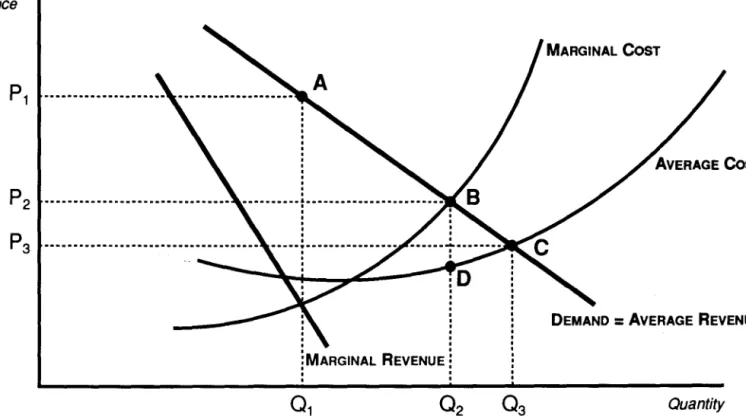
Enke analyzed the situation of a cooperative that was operating either as a monopolist or in monopolistic competition (fig. I). In other words, the cooperative had some influence over the price it could charge for its goods and services. (The cooperative's ability to vary its prices without losing all of its patrons is indicated by the downward-sloping demand curve in figure 1.)
The cooperative also had some fixed investments, such
as a store of a given size.' Enke concluded that in situation the welfare of both the cooperative mem and society as a whole was maximized if the
cooperative manager sought to maximize the sum of cooperative's "profits" (producer surplus) and the members' benefits from lower prices (consumer surplus).6 This was achieved at the point where the cooperative's marginal cost curve intersected its ; demand curve (point B). At that point, the decrease
i"*J
member-patron benefits that would result from the f~in the cooperative's "profits" from a unit increase in
,1:;
outpu~
would be just offset by the increase inmembe~
benefits (as measured by consumer surplus) that would;i result from the lower prices that accompanied expandcMIoutput (Cotterill, pp. 188-90).J~
Figure 1 - Alternative Shortrun Goals for a Supply or Consumer Cooperative Operating In Monopolistic Competition Price
f>1 -... -_._-•...•...••....•....•....
·
lMARGINAL REVENUE·
·
Point A - Maximization of cooperative'S profit (analogous to IOF's goal of profit maximization)
Point B - Maximization of sum of consumer and producer surpluses (Enke's solution)
Quantity
Point C - Minimization of member price consistent with covering costs ("zero surplusn
solution - e.g., Helmberger-Hoos)
Source: Enke, p. 149. Similar figures are also pr:esented in Kaarlehto (1956), p. 283; LeVay, p.12; and Cotterill, p. 189.
I
r
Enke's model emphasized that to maximize member benefits, the cooperative manager had to balance the benefits members received as owners of a profitable enterprise with the benefits they received as patrons of an establishment that offered favorable prices. Going too far in one direction or the other, that is, running the cooperative in a manner that simply maximized profits as a separate entity or running it in a way that simply minimized prices to members, would reduce total member benefits. Enke's work thus emphasized an important implication of the unique owner-patron relationship in cooperatives-the need to balance benefits derived as stockholders with those derived as patrons.
There is a problem, however, with the managerial goal that Enke proposed: Under most circumstances members would not want to patronize the cooperative at the level that would maximize total member benefits. At point B in figure 1, the cooperative would generate a per-unit net margin equal to BO. If this were rebated to members in proportion to their patronage, they would likely interpret the refund as a reduction in the price, which would give them an incentive to expand their patronage beyond the welfare-maximizing point B. If the cooperative does not impose some limit on
patronage, the only stable patronage point (equilibrium) is point C, at which point the cooperative earns no net margin. Point C, however, is not the
welfare-maximizing point. Point B would be a stable
equilibrium only if the members regarded the patronage refund as a windfall gain or if the cooperative faced constant marginal costs of production. In the latter case, the marginal cost and average cost curves would coincide, as would points B and C.'
Enke's work initially was ignored by theorists working in the area of agricultural cooperatives. Most of the early work on the agricultural cooperative as a firm emerged in reaction to the writings of Emelianoff, Robotka, and Phillips, which generated much critical discussion in professional journals. Critics of the "cooperatives as vertical integration" approach attacked the narrow definition of the firm used by Emelianoff, Robotka, and Phillips, and hence the implied locus of decisionmaking within the cooperative, and the existence and stability of the cooperative equilibrium posited by Phillips.
Emelianoff and his followers had argued that because cooperatives do not accumulate capital and seek profit for their own account, they did not meet the classical definition of a firm. The critics countered by describing the cooperative as a "going concern," an
entity to which participants delegate entrepreneurial functions to gain the advantages of joint action. These authors argued that such revocable delegation of
deci~ionmaking authority resulted in hired managers making most of the cooperative's day-to-day decisions. Managers pursued certain objectives (for example, maximizing the cooperative's net margins or sales), and the pricing and output decisions of the cooperative resulted from the pursuit of those objectives.
HeImberger and Hoos, whose work became the standard model in cooperative theory for nearly 20 years, argued that the agricultural cooperative could be modeled as a separate firm, using tools from the standard neoclassical theory of the investor-owned firm.
HeImberger and Hoos explained that the theory of the profit-maximizing firm needed to be modified before it was applied to cooperatives because, the authors argued, cooperatives did not try to maximize their own profits but rather those of their farmer-members. Cooperatives did this by operating on a zero-profit basis and returning all their "surplus" (net margins) to the members. HeImberger and Hoos assumed that in an agricultural processing cooperative, the manager would try to maximize member benefits by maximizing the average per-unit cooperative surplus (or "pay price") to the farmer. For a supply cooperative, the analogous goal would be to minimize the price of the good or service sold by the cooperative, subject to meeting per-unit costs of production. This would be achieved by operating at point C in figure 1.
HeImberger and Hoos developed models of both shortrun and longrun behavior by an agricultural processing cooperative. In the shortrun model, the cooperative took the amount of output supplied by the members as given. In the longrun model, output could be varied depending on whether the cooperative adopted an open- or closed-membership policy. Hence, unlike Phillips, HeImberger and Hoos addressed the question of when it would be in the interest of current members to limit further membership in the cooperative. The general conclusion was that it would be in the interest of existing members to expand membership whenever expansion would allow the cooperative to capture economies of size, thereby reducing per-unit processing costs' On the other hand, if the cooperative were facing increasing marginal costs, expanding the volume moving through the plant would increase per-unit costs, and it would be in the interest of existing members to restrict membership to prevent this from happening'
Even if it were in the interest of existing members to limit membership, others might want to join the
cooperative if it offered better prices than alternative market outlets. Hence, there can exist a potential conflict of interest between existing members and
potential members of the cooperative. Heimberger and Hoos claimed that how this conflict was resolved depended on who controlled the cooperative. A cooperative dominated by a manager intent on expanding the volume of business might opt for
expanding membership, while an organization firmly in the hands of farmer members might restrict it.
Although HeImberger and Hoos discussed this polen conflict, they did not attempt to model the bargainin " process among members, the board, and management;
settle the matter. :
Heimberger and Hoos assumed that farmer-members acted as price takers, that is, an individual member could not influence the price the cooperative' offered. Consequently, each farm-firm had a well-defined supply curve, which showed the amount of ra product the firm would be willing to sell to the '
Figure 2 -
Heimberger and Hoos Model of Cooperative Price and Output Determination
In the Long Run-Open and Closed Membership
Raw productprice, Pm
Source: HeImberger and Hoos (1962), p. 289.
Notes: Sc
=
Aggregate supply curve for closed-membership cooperativeSo
=
Aggregate supply curve for open-membership cooperativeLRNR
=
Longrun net returns functionVolume of raw product handled, M
The net revenue function, as defined by HeImberger and Hoos, shows for each level of output of the cooperative the maximum per-unit amount (or 'Pay price") the cooperative can offer for the raw product and still cover all processing costs. The net revenue function is thus analogous to the cooperative's demand function for the raw product, based on the assumption that the cooperative strives to just break even.
cooperative at various prices. The individual firms' supply curves could be summed to yield an aggregate supply curve, showing how much raw product members would supply at different prices. The intersection of the cooperative's net revenue function with its supply function determined amount of output handled by the cooperative and the price paid to members for their raw product (fig. 2). In the long run, the equilibrium output and price depended on whether the cooperative
followed an open- or closed-membership policy. A closed-membership cooperative would restrict membership so that the aggregate supply curve would intersect the longrun average net revenue curve at its maximum (P mc in figure 2). If the cooperative followed an open-membership policy, members would enter as long as they found it profitable to do so, shifting the aggregate supply curve outward (to, say, So in figure 2), resulting in a larger output and a lower raw-product price (P mo) than would obtain in a closed-membership cooperative.
HeImberger and Hoos' assumption that farmer-members are price takers faces the same problem that arose with the Enke model, namely, whether a supply function for members of a marketing cooperative (or, equivalently, a demand function for members of a supply cooperative) can be unambiguously defined. If the initial price paid by the cooperative results in a net margin for the organization and if the margin is rebated to the members in proportion to their patronage, the members will probably interpret the rebate as part of the payment for their product. They will therefore have an incentive to expand their production further (Cotterill, p. 192). Only if the cooperative sets its prices in a way that results in a net margin equal to zero is the problem eliminated. HeImberger and Hoos assumed that the cooperative's manager knew its net revenue function, which specified the price the cooperative should pay for any given quantity of raw product to set the
cooperative's net margin to zero and thus overcome the indeterminacy problem. It is highly questionable, however, whether cooperative managers really know in advance their firms' net revenue functions with such precision. 10
The basic Helmberger-Hoos model was applied and extended in several ways during the 1960's and 1970's. HeImberger used the model to analyze how the presence of cooperatives would affect market outcomes in different market structures. His general conclusion was that a monopsonistic processing cooperative that followed an open-membership policy would generate
outputs and price levels closer to those that would prevail under perfect competition than would an IOF operating under the same conditions. This conclusion reinforced the view common in United States antitrust policy, at least through 1980, that cooperative
"monopolies" did not threaten consumers if
membership in the cooperative remained open because an open-membership cooperative cannot limit supply. Heimberger showed, however, that if the cooperative had a closed membership, the equilibrium output would be smaller and the equilibrium price would be higher than those obtained under an IOF. Hence, the question of open membership became critical in evaluating the impact of cooperative monopolies on the general public. Later, the basic Helmberger-Hoos model was extended to supply cooperatives (Youde, 1966, 1968), consumer cooperatives (Mather), and multiproduct processing cooperatives (see HeImberger, Campbell, and Dobson, pp. 558-59). A variant of the model served as a key part of Sunkist's successful defense against charges that the cooperative had illegally monopolized the California and Arizona citrus market in the late 1970's (Mueller, HeImberger, and Paterson).
A distinguishing feature of the Helmberger-Hoos approach was its assumption that the cooperative pursued a single objective. The model did not address how that goal was set. Rather, it simply assumed that the goal had been set and that once set, all the
cooperative's resources were devoted to achieving it. Hence, the model did not try to analyze conflict within the cooperative about what the goal(s) of the
organization should be.
Most theorists of the 1960's and early 1970's continued to base their models on this sort of centralized goal setting, although not all agreed with HeImberger and Hoos on what the cooperatives were trying to maximize. Most authors also continued to assume, as did both Phillips and Helmberger-Hoos, that all members faced similar if not identical cost functions, and hence there would be little conflict among the members about what goals the cooperative ought to pursue. The most ambitious attempt to build a general model of the cooperative as a firm that maximizes a single objective was the work of Carson, who presented a model of a "generalized welfare-maximizing firm" (or "G-firm"). This firm maximized a "generalized welfare function," which is basically a weighted sum of the "utility" (well-being) of the firm's stockholders. Because stockholders were free to buy and sell goods and services to and from the firm, farmer cooperatives, consumer cooperatives, the investor-owned firm, and
the worker-managed firm each represented a special case of the G-firm.
The Cooperative as a Coalition
Early models of the farmer cooperative as a form of vertical integration portrayed a very diffuse
decisionmaking process within the organization. The cooperative as such made no decisions; only the individual member-firms made decisions. In contrast, most models of the "cooperative as a firm" developed in the 1960's and early 1970's saw decisionmaking in the cooperative as being completely centralized, presumably in the hands of the manager. Both types of models generally assumed a homogeneous membership and thus abstracted from intraorganizational goal conflicts. By doing so, these models could show that the maximizing activities of the individual farmer-members or of the cooperative's manager led to a unique and optimum (in terms of member welfare) set of prices and outputs for the cooperative.
As early as the 1950's, however, several authors (for example, Kaarlehto, Ohm, Trifon) pointed out that heterogeneity of the membership, differences of opinion between the membership and the management over the appropriate goals for the organization, information costs, and the nature of the collective action itself could each prevent such a stable outcome. In these situations, the cooperative's behavior would result from a bargaining process that reflected the
r~lative power of the different participants. These authors argued that the cooperative should be viewed as a coalition of participants (different groups of farmers, management, board members, input suppliers, lenders, and nonmember customers), each of whom had its own objectives and who participated in the organization as long as it felt its objectives were being met.
Authors who have viewed the cooperative as a coalition have focused on situations in which conflicts could arise (1) among farmer-members of the
cooperative and (2) between the farmer-members and the other participants in the cooperative, such as management. Authors who addressed interfarmer conflicts (such as Kaarlehto, Ohm, Trifon, and Pichette) focused primarily on situations in which individual members did not bear the full marginal cost or receive the full marginal return for their actions and hence had an incentive to act in ways that were inconsistent with the longrun welfare of the cooperative or of some of its members. This was often reflected in conflicts between current and potential members over whether to expand
n
membership in the cooperative, an issue also touched ii upon by HeImberger and Hoos. Conflicts between :~
farmer-members and other cooperative participants,
'rl
such as management, have be~n more widely discussed~by European theorists (see Eschenburg and Ollila) thari:~ by their North American counterparts (an exception is' Perrault). Both groups of authors have focused on the d_: types of outcomes likely to be generated by the
bargaining processes necessary to maintain the
cooperative coalition. Their work presaged some of the' more recent theoretical work discussed below.
RECENT DEVELOPMENTS IN COOPERATIVE THEORY
Renewed interest in North America in the theory of farmer cooperation grew out of the perceived inadequacy of existing theory to address many of the issues facing cooperatives. These issues arose largely because of changes in the market environment facing cooperatives and in the structure of the cooperatives themselves.
Reasons for the Resurgence
Growth in the size of major entities in the economy (firms, labor unions, etc.) led to renewed interest in the role that cooperatives play in concentrated markets, particularly when the
cooperatives themselves are very large. Some of the questions that arose included whether farmer cooperatives could effectively compete with multinational conglomerates, especially given cooperatives' constraints on raising equity capital; whether large cooperatives themselves posed antitrust problems; whether large cooperatives could improve systemwide coordination in the economy, including possibly replacing expensive government income- and price-support programs; and whether, with the
increased integration of rural markets, cooperatives had lost their main reason for existence.
As cooperatives became larger lmd more diverse in their operations, often through mergers, the
membership of individual cooperatives became increasingly heterogeneous. This raised questions about whether one cooperative could serve a highly diverse group of members, each of whom had differing expectations of the organization. The issue was often phrased in terms of whether one cooperative could serve both large and small farmers. For example,
should a cooperative price its services differentially aJ1long its members based on their volume of
patronage? The issue applied equally well, however, to a cooperative whose members produced competing products, such as butterfat and vegetable oil, or whose members produced the same product in competing regions of the country (for example, dairy farmers in Wisconsin and Texas, both producing cheese for the national market).
Growth in the average size of cooperatives also implied increased reliance on hired management to handle many of the major decisions facing the cooperative and raised issues of member control. Increasingly, researchers felt uncomfortable with models that assumed that all decisionmaking power resided with the members or that management
altrUistically sought to maximize members' well-being with no concern for its own welfare. Furthermore, as large, increasingly conglomerate cooperatives began recruiting more managerial personnel from investor-owned firms and business schools, questions arose as to whether cooperatives' practices were really any
different from those of IOF's.
During the 1970's, the shift to floating exchange rates, the integration of financial and agricultural commodity markets, and changes in the agricultural trade policies of several major countries, such as the EEC and the USSR, all contributed to much greater instability in agricultural markets. This instability further drew into question previous models of
cooperative decisionmaking, which were all variants of the theory of firm decisiorunaking under certainty.
While researchers increasingly recognized that existing theories of farmer cooperation did not adequately address these questions, they also recognized that over the previous 20 years there had been impressive advances in several areas related to the theory of the investor-owned firm that possibly could be extended to the theory of the farmer cooperative. These included theories of decisiorunaking under uncertainty, behavioral theories of the firm (for example, Simon, Cyert and March), agency theory (Jensen and
Meckling), transaction-cost economics (Williamson), the theory of contestable markets (Baumol, Panzar, and Willig), and applications of game theory to firm
decisiorunaking (Shubik). Research to investigate these areas gained increasing support, particularly from USDA's ACS.lI
Approaches Used
Recent work in cooperative theory falls into four categories: (1) extensions of the traditional work on the cooperative as a firm, including analysis of the impact of cooperatives on price and output levels in highly concentrated industries; (2) analyses of
cooperatives in what Galbraith has termed "the planning sector," including investigation of the behavior of large, conglomerate cooperatives; (3) models that analyze the cooperative as a special set of implicit and explicit contracts between farmer-members, managers, and other employees; and (4) further work on the
cooperative as a coalition. The approaches, particularly the last three, are highly complementary, often
addressing the same issue from different perspectives. Indeed, many of the researchers whose work is
described in this part of the report analyze cooperatives using more than one approach.
Extensions of the "Cooperative
as a
Finn" ApproachSeveral authors have continued to extend the "cooperative as a firm" approach, building models that assume that the cooperative seeks to maximize a single objective. These models trace the consequences of choosing different objectives (net margins, "pay price," etc.) for the cooperative's market behavior, focusing particularly on the implications of this behavior for cooperative finance and antitrust issues. In general, the findings of recent work on the cooperative as a firm reinforce those of earlier theoreticians such as Enke, HeImberger and Hoos, and Kaarlehto. For example, Royer (1982) argues that ideally the goal of a
cooperative firm should be to maximize total members' welfare, which is achieved when the sum of members' profits from their farm operations plus cooperative net margins are at a maximum. This is the same goal that Enke posited for consumer cooperatives, and while desirable as a goal for the cooperative, it faces the problem outlined above of not being a stable shortrun outcome unless a quota is imposed on the members' purchases from or sales to the cooperative.
Analyses of Firm-Level Decisions. Cotterill
focuses on developing a theory that links cooperatives' product pricing and finance decisions. His approach differs from some of the earlier theoretical work in that he does not focus on what goals the cooperative should
ideally pursue, but rather on what types of goals it can
achieve and sustain given how its members and
'Ii :i
competitors react to various pricing and financing rules. For example, Cotterill examines how different rules for allocation of joint costs among products in a
multiproduct cooperative can affect the competitive position of the cooperative in the various markets in which it operates (pp. 200-201). By allocating a lower percent of joint costs to products in more competitive markets, the cooperative might be able to expand market share in that market at the expense of only small losses in a less competitive market whose products now have to bear a higher proportion of the joint costs. The final outcome depends, of course, on how the
cooperative's competitors react to its pricing and cost-allocation decisions. Cotterill's emphasis on
identifying sustainable or stable outcomes is similar to some of the game-theoretic approaches to cooperative theory discussed below.
Cotterill stresses that the financial performance of a "competitive yardstick" cooperative cannot be
evaluated independently of its performance in the product market because the return to the cooperative's investments accrues to members (and nonmembers) largely through more favorable product prices, not improved cash-flow to the cooperative itself .
. Therefore, the worth of an investment by a competitive yardstick cooperative must be evaluated in terms of the consumer and producer surpluses it generates to both members and nonmembers through more favorable prices (from both the cooperative and its competitors), not just by increased net earnings of the cooperative. Cotterill's work thus reinforces the basic finding of Enke, namely the need to balance the returns members receive from their cooperative as owners of a profitable enterprise with the benefits derived as patrons of an organization that offers favorable prices and forces its competitors to do so as well.
An implication of this work is that cooperatives that act as competitive yardsticks should not evaluate potential investments simply using measures, such as the internal rate of return, based on how the investment affects the cooperative's cash-flow. The evaluation of cooperative investments is more complex due to the organization's integrated nature. Cotterill defines the "global value" of a cooperative as the amount of money members would pay rather than do without the
cooperative (p. 216). The effect of an investment on the cooperative's global value has two components: (1) the return on investment as measured by the
cooperative's net margin and (2) the increased cash-flow to members that results from the more favorable prices they payor receive as a result of the
cooperative's activities. The first component includes
4
benefits members may receive when the cooperative'1
dominates a particular market and is thereby able toil~
earn substantial net margins through strength in '~ purchasing and seIling and ability to develop new .. ~ products and services. The second component, which .'~ Cotterill calls the "security value" of the cooperative, "~ includes benefits members derive from more favorable1
prices offered both by the cooperative and by IOF's thattJ are forced to compete. Evaluating cooperativeinvestments solely on the basis of their impact on the q
>,1 cooperative's net margin ignores the security value of '4 the cooperative and may lead either to underinvestment '1
.,
in the cooperative or to a choice of investments that do d not maximize member benefits. This suggests that in evaluating prospective investments, cooperative
'"
managers and board members should look not only a t · how the investment will affect the cooperative's net margins but also how it will affect competition in the . , industry. Only when the cooperative has no
"competitive yardstick" effect on the economy does the' cooperative's cash-flow alone provide an unbiased measure of the worth of an investment to the cooperative (Cotterill, pp. 216-17).12
Some of the "cooperative as a firm" analyses (Cotterill, Lopez and Spreen) also examine what constitutes "optimum" output and pricing levels for a cooperative and reach a familiar conclusion: If the cooperative faces a U-shaped average cost curve, such as shown in figure 1, and if members take the patronage refund into account when making their sales or
purchase decisions, only the "zero-surplus" solution (point C) emerges as a stable equilibrium. I' Lopez and Spreen label this point the "myopic equilibrium," arguing that if members could, through some
mechanism such as member quotas, limit demand for the cooperative's services to Q2, their welfare would increase. They argue that the failure to achieve such an equilibrium voluntarily represents a prisoner's
diIemma.14 If the longrun average cost curve is L-shaped, however, marginal cost equals average cost, and consequently the welfare-maximizing solution corresponds with the zero-surplus solution, leading to a stable welfare-maximizing solution.
Cotterill (p. 195) goes on to analyze the conditions under which it would be in the current members' interest to restrict membership, again reaching conclusions similar to those of HeImberger and Hoos. His work verifies that when average costs of production for the cooperative are rising, it pays current
members to restrict membership, but such restrictions come at the expense of nonmembers, including the publiC at large.15 If, in this situation, nonmembers want to join the cooperative, it is because they perceive a benefit from doing so. But because increased volume in the cooperative would raise its average cost of
production, per-unit net margins would fall, hurting current members. 16 If, on the other hand, the
cooperative is operating in a range where its average costs of production fall with increasing volume (that is, where there are economies of size), both new and old members would benefit from expanding the
membership.
Lopez and Spreen, who build a model of a processing cooperative, address a similar issue, namely when it makes sense from the point of view of current members to buy raw product from nonmembers. They conclude that so long as the cooperative can earn an after-tax net margin on nonmember business (after having served all the members) and does not rebate the net margin to nonmembers, members are better off if the cooperative expands its nonmember business. For example, the cooperative might buy from nonmembers in order to expand volume enough to capture economies of size in processing. This can be particularly important when the cooperative is competing with large-volume IOF's. There is a danger, however, in relying too heavily on nonmember trade. If left unchecked, the cooperative members may have an incentive to rely increasingly on nonmember trade, retaining the cooperative surplus earned on that trade as profits for the original members. As original members retire, the remaining members have an incentive to restrict new membership, as an expansion of membership would dilute each remaining member's share of the profits earned on nonmember business. As this attrition continues, the organization is gradually converted from a cooperative into an investor-owned firm. McGregor discusses theoretically how this process can occur and documents how it has occurred in production
cooperatives for plywood in the United States and for agricultural products in the South Pacific. There is thus a theoretical justification for placing limits on the amount of nonmember business all cooperatives (not just Capper-Volstead cooperatives) can conduct as well as restrictions on the terms under which it is conducted. Unrestricted nonmember business can threaten the cooperative nature of the enterprise.
Analyses of the Impact of Cooperatives on
Market Performance. Cotterill uses his firm-level
models to analyze the impact of cooperatives on
industrywide performance in various market structures. He concludes, as did HeImberger, that in monopoly and oligopoly situations, openmembership cooperatives that pay aU refunds in cash play an important competitive yardstick role in moving price and output levels closer to those that would obtain under perfect competition. Cotterill argues that if the cooperative, on the other hand, has a closed membership, retains all net margins as unallocated reserves, or issues an allocated patronage refund that is only redeemed after a long period, it will not enhance competition. His analysis shows that such a cooperative, operating in an oligopolistic market in which the other firms are restricting output to jointly maximize profits, will price its goods and services at the same level as the other oligopolists. Hence, the
presence of the cooperative in the market will not change the behavior of the other firms at all.
Why won't such a cooperative enhance
competition? If the cooperative retains all net margins as unallocated reserves (perhaps investing them in activities outside the particular subsector in which they are earned), then the farmer-members whose business generates those margins will not have any incentive to expand their patronage with the cooperative. (See the discussion of the "hunter cooperative" in the next section.) Similarly, if all patronage refunds are redeemed as cash only after many years, the members are likely to ignore the patronage refunds in making their current patronage decisions, basing those decisions almost entirely on the cooperative's cash price.
Cotterill argues that even if the cooperative does rebate net margins to members in cash, if the cooperative follows a closed-membership policy, the rebate will not induce much more production and hence will not threaten the competing firms' market shares.
These conclusions are based on the assumption that the main way in which the market share of the cooperative increases is through attracting new
members. If the market share does not change, then the other firms in the market have no incentive to change their pricing behavior. Under some circumstances, however, cooperatives' ,market share may increase even if the existing cooperative has a closed membership. The most obvious way is if farmers who are currently nonmembers organize another cooperative to try to duplicate the original cooperative's success.
Even if a second cooperative is not formed, the original cooperative may increase its market share. If, for example, members of the cooperative, in response to their share of supernormal profits, expand their
production of products handled by the cooperative by 11
reallocating resources from other activities or by buying out their neighbors who currently patronize the competing IOF's, the market shares of the other firms in the industry will be threatened. Consequently, they are likely to offer more attractive prices to farmers to win back their patronage. The analysis also assumes that unallocated retained earnings are used only in ways that competitors view as nonthreatening. If the
unallocated retained earnings simply substitute in the cooperative's financial structure for allocated equities, the cooperative may be able to retire existing allocated equities earlier than would otherwise be possible. Such retirement would increase current returns to members, thereby inducing them to increase their patronage. If one relaxes the assumption that the output of the cooperative is sold in perfectly competitive markets, Cotterill's conclusions also may not hold. If the cooperative has a significant share of the output market and members are free to expand output in response to higher prices, an oligopolistic cooperative may "break the market" for the processed product, causing its IOF competitors to withdraw. This appears to have
occurred in the United States processed fruit and vegetable markets during the late 1970's (Staatz, 1984, pp. 294-96).
Despite these caveats, Cotterill's work represents an important theoretical advance in that it provides a framework to analyze the impact of large cooperatives' membership policies and financing practices have on market performance. Viewing cooperatives' pricing and financing decisions together also sheds new light on the alleged tax advantages of cooperatives (Cotterill, pp.222-23). Because of the patron-owner relationship, the benefits of cooperative ownership are distributed to the members via patronage, in the form of lower prices or as patronage refunds. Such benefits are taxed as ordinary income. In contrast, many of the benefits of IOF ownership take the form of capital gains in the value the stock, which, prior to the 1986 tax reform in the U.S., were taxed at a substantially lower rate than ordinary income. Cotterill shows that under quite plausible tax rate assumptions, cooperatives were actually disadvantaged relative to IOF's prior to the 1986 reform.
Cotterill also addresses why cooperatives may want to use unallocated retained earnings when they face a risky market environment (pp. 250-51). When the market is risky, the cooperative's returns will fluctuate from year to year. Management can draw on unallocated reserves to smooth out patronage refunds over time. This gives a steadier return to members,
makes investment in the cooperative appear less risky to them, and hence increases their willingness to invest· in the organization. The increased willingness to invest in the cooperative for a given interest rate reduces the . cost of capital to the cooperative, thereby allowing it to' expand more rapidly.17
Competition Among Cooperatives. Another issue'
theorists have investigated recently is competition among cooperatives (Cotterill; Rhodes, 1983, 1987a). Such competition is common, even when the
cooperatives involved are owned by the same farmers, resulting in the farmer-owners' competing against themselves. Cotterill and Rhodes show that in industries where diseconomies of scale are not significant and where the minimum efficient scale of operation is large relative to the size of the market, farmers would often be better served if their
cooperatives colluded or merged rather than engaged in head-to-head competition. Such collusion or
consolidation would allow more efficient use of facilities and the capturing of scale economies, which could be passed on to the farmer-members. As Rhodes (1987a) points out, however, there are often pressures from within the competing cooperatives that encourage such competition. These include a desire to "keep management on its toes," the vested interests of management and board members who might lose their positions if a merger occurred, the vested interests of farmers whose handling costs to the cooperative might increase dramatically if operations were consolidated (particularly important for bulky items like milk), and support for competition by those farmers who reside in the overlapping areas of the competing cooperatives. These farmers, for whose patronage the rivals are competing, often benefit from cutrate prices, etc., that result from the competition, while members in nonoverlapping areas bear the costs. Rhodes suggests that such situations may be amenable to analysis using bargaining models such as those discussed below. Analyses of Cooperatives In the Planning Sector
John Kenneth Galbraith, in his book The New
Industrial State, divides the economy into a "planning sector," composed of large firms that possess market power, and a "market sector," composed of smaller firms that operate as price takers in competitive markets. Galbraith argues that planning-sector firms are forced by the "technological imperatives" of modem large-scale production to make huge fixed investments in plant and equipment. These make the
firms extremely vulnerable to economic fluctuations. To protect themselves, the planning-sector firms try to control their environment by administering prices, influencing the political system to ensure favorable regulatory treatment and macroeconomic stability, and
SO on. Three authors (Rhodes, Sexton, and Shaffer)
have attempted to extend earlier theoretical work on the effects of cooperatives on concentrated markets to include discussion of the role of large cooperatives in the planning sector.
Theory o/Contestable Markets. Previous
analyses, such as that of Heimberger, compared the price and output levels that cooperatives would generate in concentrated markets with those that would prevail under perfect competition. Rhodes (1983, 1987b) and Sexton (1984a) extend this type of analysis by using concepts from the recently developed theory of
contestable markets (Baumol, Panzar, and Willig). This theory stresses that it is not the degree of market concentration per se that determines market
performance, but the nature of the costs in the industry and the barriers to entry and exit. Hence, an industry with a high degree of market concentration may perform well if it is "contestable," that is, if barriers to entry are low enough that the threat of entry from competing firms disciplines the behavior of firms presently in the industry.
Rhodes and Sexton show that cooperative entry or the threat of entry into a broad range of concentrated market structures can playa powerful role in forcing IOF's to behave more competitively. They point out that the threat of entry by a cooperative may be more effective in improving the market performance of incumbent firms than the threat of entry by an IOE A potential IOF entrant decides whether to enter the market based on an evaluation of the likely post-entry market conditions, for example, whether the incumbent firms will retaliate by offering farmers more favorable prices. A farmer cooperative, on the other hand, bases its decision on pre-entry conditions. If the incumbent firms do not retaliate, the cooperative captures a substantial net margin, which it rebates to members. If the incumbents do react 'by offering farmers more favorable prices, the cooperative's members benefit directly. Either way, the farmer-members gain. The incumbent firms can deter cooperative entry by offering farmers more favorable prices and cutting profit
margins, but this simply means that these firms are forced to act in a more competitive manner, which obviates the need for a cooperative (Sexton, 1984a, pp. 283-356). Hence, the mere threat of cooperative entry
may serve an important competitive yardstick function. Rhodes (1987b, p. 110) states that historically this effect has "been greatest in those markets of moderate
barriers-where the rewards have been worth seeking and have not been so protected that cooperatives could not achieve them."
Rhodes (1983) argues that because cooperatives rebate net margins to members, in certain oligopolistic industries, large regional cooperatives may eventually tend to dominate the market. Concentrated industries often are characterized by high profit margins. If lOP competitors do not cut their prices in response to the entry of a cooperative, the cooperative earns a substantial net margin, which it rebates to members. The rebates attract new members, increasing the cooperative's market share. Faced with the option of cutting their prices substantially to compete with the cooperative, the IOF's may simply prefer to withdraw gradually from the industry and redeploy their capital in other, higher return sectors of the economy. Rhodes suggests that this phenomenon explains the expansion of several large midwestern supply cooperatives during the 1970's, when the petroleum and agrochemical industries in the United States were operating under the price umbrella of the oil oligopoly.
The Hunter Cooperative. While cooperatives
may often reinforce competition, Rhodes (1987c) argues that in some large cooperatives the relationship between the members and management is very similar to that which exists between an IOF and its customers. In such cooperatives, the preceding arguments may not hold. He describes what he calls the "hunter cooperative," an organization that aggressively seeks new activities based solely on the criterion of relative profitability, with little attention to members' current activities. It is an organization that, in Enke's terms, focuses purely on the maximization of producer surplus rather than on striking a balance between the benefits derived from producer surplus and those derived from consumer surplus. In other words, the hunter cooperative seeks profit simply at the level of the cooperative rather than attempting to improve vertical coordination between the farm and the rest of the marketing chain. While there are probably no cooperatives that operate continuously as pure hunter cooperatives, many cooperatives may exhibit hunter behavior from time to time.
Rhodes argues that such organizations are often disloyal to their members in the sense that the capital contributed by current members is used to finance entry into new activities from which the current members do not benefit. For example, retained earnings from cherry
13 I