Non-Blocking Steal-Half Work Queues
D a n n y H e n d l e r T e l - A v i v U n i v e r s i t y N i r S h a v i t T e l - A v i v U n i v e r s i t y AbstractThe non-blocking work-stealing algorithm of Arora et al. has been gaining popularity as the multiprocessor load bal- ancing technology of choice in both I n d u s t r y a n d Academia. At its core is an ingenious scheme for stealing a single item in a non-blocking m a n n e r from an array based deque. In recent years, several researchers have argued t h a t stealing more t h a n a single item at a time allows for increased sta- bility, greater overall balance, and improved performance.
This paper presents StealHalf, a new generalization of the Arora et al. algorithm, t h a t allows processes, instead of stealing one, to steal up to half of the items in a given queue at a time. The new algorithm preserves the key prop- erties of the Arora et al. algorithm: it is non-blocking, a n d it minimizes the n u m b e r of CAS operations t h a t the local process needs to perform. We provide analysis that proves t h a t the new algorithm provides better load distribution: the expected load of any process throughout the execution is less t h a n a constant away from the overall system average.
1 Introduction
The work-stealing algorithm of Arora et al. [2] has been gaining popularity as the multiprocessor load-balancing tech- nology of choice in both I n d u s t r y and Academia [1, 2, 5, 7]. The scheme allows each process to m a i n t a i n a local work queue, a n d steal an item from others if its queue becomes empty. At its core is an ingenious scheme for stealing an individual item in a non-blocking m a n n e r from a b o u n d e d size queue, minimizing the need for costly CAS (Compare- and-Swap) synchronization operations when fetching items locally.
Though stealing one item has been shown sufficient to optimize computation along the "critical path" to within a constant factor [2, 4], several authors have argued t h a t the scheme can be improved by allowing multiple items to be stolen at a time [3, 8, 9, 12]. Unfortunately, the only imple- m e n t a t i o n algorithm for stealing multiple items at a time, ° T h i s w o r k w a s s u p p o r t e d in p a r t b y a g r a n t f r o m S u n M i c r o s y s - terns. C o n t a c t a u t h o r : h e n d l e r d @ p o s t . t a u . a c . i l
Permission to make digital or hard copies of all or part of this work for personal or classroom use is granted without fee provided that copies are not made or distributed for profit or commercial advantage and that copies bear this notice and the fifll citation on the first page. To copy otherwise, or repubfish, to post on servers or to redistribute to lists, requires prior specific permission and/or a fee.
PODC 2002, July 21-24, 2002, Monterey, California, USA. Copyright 2002 ACM 1-58113-485-1/02/0007...$5.00.
due to Rudolph et al. [12], requires the local process owning the queue to use a strong synchronization operation (CAS or some other form of m u t u a l exclusion) f o r every push or pop. Since the local process' operations are far more fre- quent, this makes the Rudolph et al. algorithm significantly less effective t h a n t h a t of Arora et al.
This state of affairs leaves open the question of design- ing an algorithm that, like Arora et al., does not use costly synchronization operations in every step, yet allows stealing multiple items at a time, thus achieving the stability, bal- ance, a n d improved performance of algorithms like Rudolph et al.
1.1 The New Algorithm
This paper presents a new work-stealing algorithm, Steal-
Half, a generalization of the Arora et al. algorithm, t h a t allows processes to steal up to half of the items in a given queue at a time. Our StealHalf algorithm preserves the key properties of the Arora et al. algorithm: it is non-blocking and it minimizes the n u m b e r of CAS operations t h a t the local process needs to perform. We provide a performance analysis showing t h a t our algorithm improves on Arora et al. by providing an overall system balance similar to the Rudolph et al. scheme: the expected load of any process throughout the execution is less t h a n a constant away from the overall system average.
In our algorithm, as in the Arora et al. algorithm, each process has a local work queue. This queue is actually a deque, allowing the local process to push a n d pop items from the bottom, while remote processes steal items from the top. The Arora et al. algorithm is based on a scheme t h a t allows the local process, as long as there is more t h a n one item in the deque, to modify the b o t t o m counter without a CAS operation. Only when the top a n d b o t t o m are a distance of 1 or less apart, so t h a t processes potentially overlap on the single item that remains in the deque, does the process need to use a CAS operation to perform consensus. This consensus is necessary because the inherent uncertainty [6] regarding a single read or write operation to the top a n d b o t t o m counters can affect whether the last item to be stolen is still there or not. This yields an algorithm where for any
1
monotonic sequence of k pushes or k pops, the n u m b e r of 1A m o n o t o n i c s e q u e n c e is a s e q u e n c e of local o p e r a t i o n s t h a t m o n o t o n i c a l l y e i t h e r i n c r e a s e s or d e c r e a s e s t h e b o t t o m c o u n t e r . W e define t h e s y n c h r o n i z a t i o n c o m p l e x i t y in t e r m s of m o n o t o n i c se- q u e n c e s since one c a n n o t m a k e c l a i m s in n o n - m o n o t o n i c s i t u a t i o n s w h e r e t h e e x e c u t i o n p a t t e r n of t h e u n d e r l y i n g a p p l i c a t i o n c a u s e s t h r a s h i n g b a c k a n d f o r t h on a single l o c a t i o n .
CAS operations is O(1).
In order to steal more t h a n one item at a time, say half of the n u m b e r of items in a deque, one must overcome a much greater uncertainty. Since a stealing process might remove up to half of the items, there are now m a n y values of the b o t t o m counter, say, up to half of the difference between top and bottom, for which there is a potential overlap. Thus, eliminating the uncertainty regarding reading a n d writing the counter requires consensus to be performed for half the items in the deque, an unacceptable solution from a perfor- mance point of view, since it would yield an algorithm with O(k) synchronization complexity.
The key to our new algorithm is the observation that one can limit the uncertainty so t h a t the local process needs to perform a consensus operation (use a CAS), only when the n u m b e r of remaining items in the deque (as indicated by the difference between top a n d bottom), is a power of two! The scheme works so that as the distance between the b o t t o m a n d top counters changes, it checks a n d possibly updates a special half-point counter. The uncertainty regarding a sin- gle read or write exists just as in the Arora et al. algorithm, only now it happens with respect to this counter. W h a t we are able to show is t h a t missing the counter u p d a t e can only affect locations beyond the next power-of-two at any given point. For any monotonic sequence of k pushes or k pops, our algorithm uses only O(logk) CAS operations, slightly worse t h a n Arora et al., b u t exponentially better t h a n the O(k) of the Rudolph et al. scheme.
Like the Arora et al. scheme, our StealHalf algorithm is non-blocking: the slowdown of any process cannot prevent the progress of any other, allowing the system as a whole to make progress, independently of process speeds. Like Arora et al., the non-blocking property in our algorithm is not intended to guarantee fault-tolerance: the failure of a process can cause loss of items. Arora et al. claim t h a t their empirical testing on various benchmarks shows that the non-blocking property contributes to performance of work stealing, especially in multiprogrammed systems [2].
In our algorithm, the price for unsuccessful steal op- erations is a r e d u n d a n t copying of multiple item-pointers, whereas in the Arora algorithm only a single pointer is copied redundantly. However in our algorithm, successful stems transfer multiple items at the cost of a single CAS, whereas in the Arora et al. scheme a CAS is necessary for each stolen item.
1.2
Performance Analysis
Mitzenmacher [9] uses his differential equations approach [10] to analyze the behavior of work stealing algorithms in a dynamic setting, showing t h a t in various situations stealing more t h a n one item improves performance. Berenbrink et al. [3] have used a markov model to argue that a system that steals only one item at a time can slip into an instable state from which it cannot recover, allowing the n u m b e r of items to grow indefinitely. This implies that no m a t t e r how much buffer space is allocated, at some point the system may overflow. Treating such overflow situations requires the use of costly overflow mechanisms [5]. Berenbrink et al. [3] further show t h a t an Arora-like scheme t h a t allows stealing, say, half of the items, will prevent t h a t system from slipping into such an instable state. Rudolph et. al [12], and later Luling and Monien [8], prove t h a t in a load balancing scheme t h a t repeatedly balances the work evenly among r a n d o m pairs of local work queues, the expected load of each process
will vary only by a constant factor from the load of any other process and t h a t the overall variance is small.
The algorithm we present is generic, in the sense t h a t one can change the steal initiation policy to implement a variety of schemes including those of [2, 3, 12]. We choose to analyze its behavior in detail under a steai-attempt pol- icy similar to [12]: ever so often, every process p performs the following operation, which we call
balancing initiation:
p flips a biased coin to decide if it should a t t e m p t to balance its work-load by stealing multiple items, where the proba- bility of a t t e m p t i n g is inversely proportional to its load. If the decision is to balance, then p randomly selects another process a n d a t t e m p t s to balance load with it. Our main The- orem states that our algorithm maintains properties similar to those of R u d u l p h et al. We provide it here since the proof provided by Rudolph et al. t u r n s out to be incomplete, a n d also because there are significant differences between the al- gorithms. As an example, the Rudolph et al. algorithm is symmetric: a process can both steal-items-from a n d insert- items-to the deque of another process. In our algorithm, however, a process can only steal items.
Assume A~ is a time period where no deque grows or shrinks by more t h a n u items (through pushing or popping). Let
Lp,t
denote the n u m b e r of items in process p's deque at time t; also, letAt
denote the average-load at time t. T h e n if all processes perform balancing initiation every A~ time, there exists a constant c~, not depending on the n u m b e r of processes or the application, such that:'v'p,t : E[Lp,t] < oluAt
The existence of such Au is a n a t u r a l assumption in most systems, and can be easily m a i n t a i n e d with slight protocol modifications in others. In contrast, it can easily be shown, that if one steals a single item at a time as in the Arora et al. scheme, even if steal-attempts are performed every A1, there are scenarios in which the system becomes instable.
In summary, we provide the first algorithm for stealing multiple items using a single CAS operation, without requir- ing a CAS for every item pushed or popped locally.
An outline of the algorithm is presented in Section 2; the analysis is presented in Section 3; finally, correctness claims are presented at Section 4.
2 The StealHalf algorithm
As noted earlier, the key issue in designing an algorithm for stealing multiple items is the need to minimize the use of strong synchronization operations both when performing local operations a n d when stealing multiple items.
A first a t t e m p t at an algorithm might be to simply let a process steal a range of items by repeatedly performing the original code of stealing a single item for every item in the group. This would make the algorithm a steal-many algorithm 2 b u t at a very high cost: to steal k items, the thief would have to perform k synchronization operations. The algorithm presented here, utilizes an
extended deque
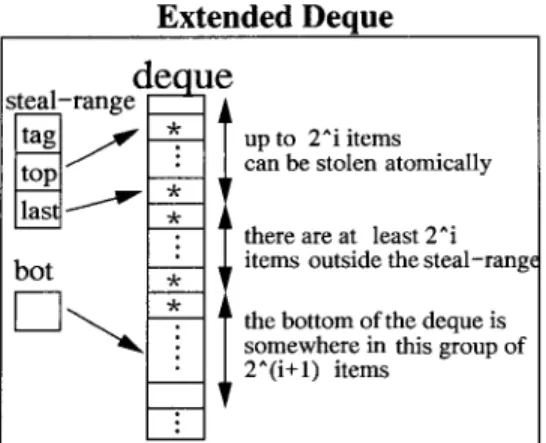
data structure, a variant of the deque of [2] depicted in Figure 1, to achieve synchronization at a low cost. Theextended
deque
differs from the deque of [2] in two ways: (1) it is implemented as a cyclic array, a n d (2) it contains a member- structure, calledsteaIRange,
which defines the range of items that can be stolen atomically by a thief-process.2Obviously with this technique the items-group is not stolen atomically.
E x t e n d e d D e q u e
deque
steal-range 1
tag J *. ' up to 2^i items top I can be stolen atomically last j.--w" * I'
: ' there are at least 2"i bot * items outside the steal-range
: the bottom of the deque is somewhere in this group of 2^0+1) items
Figure 1: The extended deque
The algorithm allows stealing about half the items of the victim in a single synchronization operation. It does this by always m a i n t a i n i n g the invariant t h a t the n u m b e r of items in every process p's steaIRange is approximately half the n u m b e r of total items in p's deque. Process p's steaIRange
is u p d a t e d by any process t h a t succeeds in stealing items from p's deque, and also by p itself. To keep the n u m b e r of synchronization operation performed by a local process p as low as possible, p updates its steaIRange when pushing or popping an item t o / f r o m its deque, only if at least one of the following events occur:
• The n u m b e r of items in p's deque crosses a 2 i bound- ary, for some i E N;
• A successful-steal operation from p's deque has oc- curred since the last time p modified its own steal- Range.
2.1
Data structures
Each process owns an extended deque structure, which it shares with all other processes. In this structure: deq is an array t h a t stores pointers or handles to items, which are generated a n d consumed dynamically. It has D E Q _ S I Z E
entries. The range of occupied entries in deq includes all the entries in the range: [ t o p . . . bOt)DEQ_SIZE 3. As noted, it is implemented as a cyclic array.
The steaIRange member-structure extends the age struc-
ture from [2]. It contains the following fields:
• tag - as in [2], a time stamp on the u p d a t i n g of the
steaIRange structure. A tag is required in order to
overcome the A B A problem inherent to the C A S prim- itive. 4 As in [2], the b o u n d e d tag algorithm of [11] can be used.
• top - as in [2], the pointer to the top-most item in the
deque. ~ 3[a - " - b)m d e n o t e s t h e h a l f - o p e n e n t r i e s - r a n g e , f r o m e n t r y a u p - t o e n t r y b ( i n c l u d i n g a b u t n o t b), m o d u l u s m . 4 A s s u m e a p r o c e s s p r e a d s a v a l u e A f r o m l o c a t i o n m , a n d t h e n p e r f o r m s a s u c c e s s f u l CAS o p e r a t i o n , w h i c h m o d i f i e s t h e c o n t e n t s of m . P r o c e s s p ' s C A S s h o u l d i d e a l l y s u c c e e d o n l y if t h e c o n t e n t s of m w a s n o t m o d i f i e d since it r e a d v a l u e A. T h e p r o b l e m is, t h a t if o t h e r p r o c e s s e s m o d i f i e d m ' s v a l u e t o v a l u e B a n d t h e n b a c k a g a i n t o A in t h e i n t e r i m - t h e C A S o p e r a t i o n still s u c c e e d s . T o o v e r c o m e t h i s p r o b l e m , a t a g field is a d d e d t o t h e s t r u c t u r e . 5 N o t e , t h a t b e c a u s e t h e e x t e n d e d d e q u e is cyclic, t h e i t e m p o i n t e d to b y top is n o t n e c e s s a r i l y t h e i t e m s t o r e d a t t h e t o p - m o s t d e q u e - e n t r y .
The item pointed at by top is invariably the first item of the stealRange.
• steaILast - points to the last item to be stolen. The
items that would be stolen next (unless the streal- Range structure would be modified by the local process before the next steal) are in the range
[ t o p . . . steaILast]D~Q_~lZE 6. The stealLast variable
can assume the special value null, which indicates there are no items to steal. The stealRange structure is mod- ified via C A S operations.
The bot field points to the entry following the last entry containing an item. Since the extended deque is cyclic, bot
may be smaller t h a n top. If bot and top are equal, the ex- tended deque is empty. I n addition to the shared extended- deque structure, each process has a static a n d local struc- ture, called prevSteaIRange, of the same type as steaIRange.
It is used by the local process to determine whether a steal has occurred since the last time the process modified the stealRange.
2.2
High-level extended-deque methods description
We specify the algorithm in a generic manner, t h a t allows "plugging-in", in a modular way, components t h a t allow flexibility in regard to the conditions/policy t h a t control when a steal-attempt is initiated.
2.2.1
Balancing initiation code
The code t h a t appears in figure 2 should be performed by every process periodically, throughout the computation.
IF ( s h o u l d B a l a n c e O )
P r o c e s s * v i c t i m = r a n d o m P r o c e s s O ; TryToSteal(victim);
Figure 2: steal-initiation code
The shouldBalance m e t h o d determines the policy regard-
ing when to initiate a steal a t t e m p t 7. Many policies are conceivable, a few of which are:
Try to steal only when the local deque is empty: this is the scheme implemented by Arora et al. [2], a n d we call it: steal-on-empty.
Try to steal probabilistically, with the probability de- creasing as the n u m b e r of items in the deque increases: this scheme was suggested by Rudolph et al. [12], a n d we call it probabilistie balancing s
Try to steal whenever the n u m b e r of items in the deque increases/decreases by a constant factor from the last time a steal-attempt was performed: this is the policy suggested in [3]. 6[a • • • b]m d e n o t e s t h e closed a r r a y - r a n g e , f r o m e n t r y a u p - t o e n t r y b ( i n c l u d i n g b o t h a a n d b), m o d u l u s m . 7 T h i s c a n b e i m p l e m e n t e d as i n l i n e d c o d e r a t h e r t h a n as a m e t h o d , if t h i s c o d e s h o u l d b e p e r f o r m e d v e r y o f t e n . S T h e s c h e m e , as d e s c r i b e d , is a l w a y s p r o b a b i l i s t i c in t h e s e n s e t h a t t h e v i c t i m p r o c e s s is s e l e c t e d a t r a n d o m . T h e probabilistic balancing s c h e m e a d d s y e t a n o t h e r p r o b a b i l i s t i c f a c t o r .
Steal-initiation policies can vary significantly with re- spect to the extent they make the system balanced, b u t obviously none can guarantee t h a t the system is balanced, if balancing is not a t t e m p t e d frequently enough. Conse- quently, we have to make some reasonable assumptions re- garding the frequency at which the steal-initiation code is performed.
Let Au be a time-period small enough, such that it is guaranteed that no process p changes its load by more t h a n u items during that period, by generating/consuming items (thefts notwithstanding). In the analysis we prove, that if the
probabilistie balancing
policy is employed, and the steal- initiation code is performed once every Au period, then the expected n u m b e r of deque-items ofany
process p atany
time during the execution is no more t h a n o~ times the total average, where a~ is a constant that does not depend on the n u m b e r of processes or the dynamic p a t t e r n of item generation/consumption 9.
Not every steal-initiation policy can guarantee this prop- erty, though. It can easily be shown, that under the
steal-
on-empty
policy, where only a single item is stolen at a time, a system can grow unbalanced beyond any bound, even if the steal-initiation code is performed every A1 time period! The balancing initiation code can be performed period- ically by the system or by an application, or it can be im- plemented as a signal-handler.2.2.2 pushBottom code
A high-level pseudo-code of
pushBottom
is shown in Figure 3.RETIJRN_CODE pushBottom(Item *e) { IF deq is full
return DEQ_FULL deq[bot] = e
increment hot in a cyclic manner
IF (deq length now equals 2"i for some i) Try to CAS-update the stealRange to
contain max(1,2"(i-1)) items
ELSE IF (stealRange != prevStealRange)
Try to CAS-update the stealRange to contain max(1,2"i) items, where the current length of the deque is in
the range [ 2~(i+I) ,2~(i+2) )
IF CAS was performed successfully
prevStealRange = stealRange
Figure 3: pushBottom pseudo code
The
pushBottom
operation is performed by the local pro- cess p, whenever it needs to insert a new item into its local deque. If the deque is not full, the new item is placed in the entry pointed at bybot,
andbot
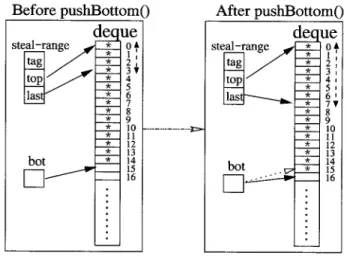
is incremented in a cyclic manner. However, if following the insertion of the new item the length of p's deque becomes 2 i for some i > 0, then p tries to CAS-update itssteaIRange
to contain the topmost 2 i-1 items 1°. This is to make sure the length of thesteal-
Range
is not much less t h a n half the total n u m b e r of items in the deque 11Process p has to update the
steaIRange
even if the deque- length isnot
a power of 2, if another process has succeeded9 O b v i o u s l y , A ~ itself does d e p e n d on t h i s p a t t e r n . 1°or 1, if i = 0 .
1aWe a c t u a l l y p r o v e in t h e full p a p e r t h a t for a n y p r o c e s s p, a t a n y t i m e , t h e l e n g t h of p ' s stealRange is a t l e a s t ~ ' t h of t h e l e n g t h of p ' s d e q u e . B e f o r e p u s h B o t t o m 0 d e ( bot |e 0¢ 4 5 6 7 8 9 10 . . . 11 12 13 14 15 16 A f t e r p u s h B o t t o m O
dequ(
ste~
o
!i'
4 , 5 , 6 'y o
12 13 bot . ~ 1514Figure 4:
The extended deque before and after a pushBot-
tom.
Right afterpushBottom
inserts a new item into the deque, it checks whether the deque length reaches a power- of-2 b o u n d a r y (in the above Figure, the 16'th item was added), in which casesteaIRange
is expanded to contain the first half of the deque-elements.in stealing items from p since the last time p u p d a t e d its stealRange. Process p can identify this by comparing the current value of its
steaIRange
with the last value it wrote to it - which is stored at its localprevStealRange.
If the values differ, p tries to set the length of itssteaIRange
(by a CAS) to bemax(l,
2/), where 2 T M _<len(deq)
< 2/+2.If p performed a successful CAS,
prevStealRange
is up- dated with the value it wrote.Figure 4 depicts the state of an extended deque before and after the 16'th item is pushed into it. Since subse- quent to the push the deque contains a power-of-2 n u m b e r of items,
pushBottom
tries (and in this case succeeds) to expandstealRange.
It is easily seen (and is proven in our analysis) that immediately after every successful CAS oper- ation performed bypushBottom,
assuming that the pushed item is not the first item in the deque 12, the following holds:2 • len(stealRange) < len(deq) < 4 • len(steaIRange)
2.2.3 popBottom code
A high-level pseudo-code of
popBottom
is presented in Fig- ure 5. ThepopBottom
operation is performed by the local process p whenever it needs to consume another deque-item.• Section 1:
In section 1 a process performs some pre- checks to make sure the method may proceed. It first checks whether the deque is empty, in which case the method returnsnull;
it next checks whether the length of thedeque
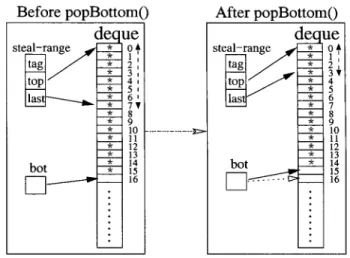
is 2 i for some i _> 0. If this is indeed the case, then the m e t h o d tries to CAS-update itssteal-
Range
to contain the topmost 2 i-2 items 13. This is done in order to m a i n t a i n the invariant t h a t the length ofstealRange
neve~ exceeds half the total n u m b e r of 12If t h e p u s h e d i t e m is t h e first i t e m of t h e d e q u e , t h e n t h e l e n g t h s of b o t h t h e d e q u e a n d t h e steaIRanye r i g h t a f t e r t h e C A S e q u a l 1.I t e m * p o p B o t t o m O {
S e c t i o n 1
IF deq is empty r e t u r n n u l l
IF (deq length n o w equals 2"i for some i) Try to CAS-update the stealRange to contain max(l,2^(i-2)) items
E L S E IF (stealRange != prevStealRange)
Try to CAS-update the stealRange to contain max(l,2*i) items, where the current length of the deque
is in the range ( 2 ^ ( i + 1 ) ... 2~(i+2) ]
IF CAS was p e r f o r m e d s u c c e s s f u l l y p r e v S t e a l R a n g e = stealRange E L S E IF a CAS was attempted but f a i l e d
r e t u r n ABORT;
S e c t i o n 2
Decrement bot in a cyclic m a n n e r Item *e = deq[bot]
oldStealRange = t h i s - > s t e a l R a n g e
IF oldStealRange does not contain bot r e t u r n e (no n e e d to synchronize) E L S E IF oldStealRange is empty
{
bot=O (the last item - e - was already stolen
b y another process) r e t u r n n u l l
} E L S E {
Try to CAS-update the stealRange to be empty IF s u c c e e d e d
r e t u r n e (e was not stolen so far) E L S E
r e t u r n n u l l (the last item - e - was already
stolen b y another process)
} }
Figure 5: popBottom pseudo code
items in the deque, unless there's a single item in the deque.
As in
pushBottom,
p has to CAS-update thestealRange
even if the deque-length is
not
a power of 2, if an- other process has succeeded in stealing items from p since the last time p u p d a t e d its stealRange. Process p can identify this by comparing the current value of itsstealRange
with the last value it wrote to it - which is stored atprevSteaIRange.
If the values differ, p tries to set the length of itsstealRange
to bemax(1,2i),
where T +1 <
len(deq) _<
T +2.If
popBottom
performed a successful CAS, it updatesprevSteaIRange
with the value it wrote. If however a CAS was a t t e m p t e d a n d failed,popBottom
returns a special value ABORT, indicating this situation. Note, t h a t this can only h a p p e n if a successful steal has oc- curred concurrently with the method's execution. 14.• Section 2:
Section 2 is very similar to its steal-one [2] counterpart: it pops the b o t t o m - i t e m e off the deque, and then readssteaIRange.
If this read doesnot
in- clude e, then the method returns e a n d exits, as no 1 4 A n a l t e r n a t i v e i m p l e m e n t a t i o n is t o r e t r y a g a i n a n d a g a i n i n a l o o p , u n t i l t h e m e t h o d s u c c e e d s in u p d a t i n g stealRange.Before popBottom0
d~ue
steal-range 4 o 4 * 1v f
.
2:
~---=-t / * 3 , [ t o o l s * 4 , I--'-"t * 5 , I l a s f l ~ * 6, t . _ _ J ~ * 7 1 bot * 8 * 9 * 10 ... l ~ * 11 * 12 * 13 * 14 * 15 16After popBottomO
deque
s t e ~ a J 7 8 9 10 11 12 13 bot 14 16Figure 6:
The extended deque before and after a popBottom.
Just before
popBottom
pops the b o t t o m - m o s t item from the deque, it checks whether the deque length is exactly at a power-of-2 b o u n d a r y (in the above Figure, the 16'th item is about to be popped), in which casestealRange
is being shrank to contain the first quarter of the deque-elementsother process may have stolen e; otherwise, there are 2 possibilities:
- stealRange
is empty - e was stolen by another pro- cess during the method's execution. The m e t h o d returnsnull.
- e is the one-and-only item in the deque, in which case the method tries to CAS-update stealRange with an empty range value. If it succeeds - it returns e as its result, otherwise it returns
null.
Figure 6 depicts the state of an extended deque before a n d after the 16'th item is popped off it. Since prior to the pop the deque contains a power-of-2 n u m b e r of items,
popBottom
tries to shrinkstealRange
(and in this case suc- ceeds). It is easily seen (and is proven in our analysis) t h a t immediately after every successful CAS operation performed bypopBottom
the following inequalities hold 152 * len(steaIRange) _< len(deq) _< 4 * len(steaIRange)
2.2.4 tryToSteal code
The
try ToSteal
m e t h o d is the method t h a t actually a t t e m p t s to perform a steal. It is called by a local process p, after the steal-initiation policy has determined t h a t a steal-attempt should be made a n d a victim process has been selected. The pseudo-code oftryToSteal
is shown in Figure 7.The method receives 2 parameters: d - a pointer to the victim process' extended-deque, a n d
pLen -
the n u m b e r of items in p's deque, a n d returns the n u m b e r of items actually stolen. It first readsd.stealRange
a n d computes its length, 1 5 T h e b e l o w i n e q u a l i t i e s h o l d , u n l e s s t h e n u m b e r o f i t e m s i n t h e d e q u e a f t e r t h e p o p is 0 o r 1. I f t h e p o p e m p t i e s t h e d e q u e , t h e n t h e l e n g t h s o f b o t h t h e d e q u e a n d t h e steal_Range a f t e r t h e o p e r a t i o n a r e 0; i f a s i n g l e i t e m is l e f t i n t h e d e q u e a f t e r t h e p o p , t h e l e n g t h s a r e b o t h 1.based on which the method can determine whether it is cer- tain that the victim has more items t h a n p has; if this is not the case - the method returns 0 without stealing any item.
Otherwise, about half of the guaranteed difference be- tween the sizes of the 2 deques is copied to p's deque, and then p tries to CAS-update the victim's stealRange. The length of the new steaiRange is set to be
m a x ( l ,
2i-2), where the length of the victim's deque before the theft was in the range: [2 i . . . 2i+1). As we prove in our analysis, this guar- antees t h a t the new steaiRange has length t h a t is at most half, and at least one eighth the remaining n u m b e r of items. If the CAS fails, the steal-attempt has failed also, a n d the method returns 0; otherwise - the steal-attempt has suc- ceeded, a n d the method proceeds to update p'sbot and steal-
Range
to reflect the new n u m b e r of items in the deque. Note the following:• If another process q succeeds in stealing items from p's deque concurrently to p's successful steal-attempt, then p might fail in u p d a t i n g its own
steaIRange,
b u t it would still manage to update itsbot
a n d complete the steal successfully.• Although
tryToSteal
can be performed within a signal- handler, it is required that no local operations (namelypushBottom
orpop Bottom ) are
performed concurrently withtryToSteal's
execution.u n s i g n e d int *tryToSteal(ExDeque d, int p L e n ) {
rangeLen = length of d.oldStealRange
oldLen = length of d.deque
IF p L e n > 2*rangeLen -2 return 0 (no need to steal)
numToSteal = rangeLen - pLen/2
Copy first numToSteal items to the bottom of local deq
newSRLen = max(l, 2"(i-2)) [where 2"i <= oldLen < 2"(i+i)]
CAS-update d.stealRange to contain n e w S R L e n items
IF CAS was performed successfully
{
update local bot to insert stolen items to the deque newDeqLen = new number of items at the local deque
newSRLen=max(l,2"i) [where 2"(i+2)> newDeqLen >=2"(i+i)]
CAS-update local stealRange to contain newSRLen items
IF CAS was performed successfully prevStealRange = stealRange return numToSteal; ) ELSE return 0; )
Figure 7: tryToSteal method pseudo-code
3 Analysis
In our analysis, we investigate the properties of the StealHalf algorithm under the probabilistic balancing policy, aiming to show that under reasonable assumptions, it keeps the system balanced. The probabilistic balancing policy we employ is very similar to the one described in [12], with the following main differences:
1. In [12], a process initiating load-balancing can either steal items from or insert items to a randomly selected process, whereas in our scheme the initiating process
can only steal items. We therefore call the former scheme
symmetric
probabilistic balancing a n d the lat- terasymmetric
probabilistic balancing.2. The model presented in [12] is synchronous in the sense t h a t it assumes t h a t c o m p u t a t i o n proceeds in time- steps a n d t h a t all processes a t t e m p t load-balancing in the beginning of every time-step, whereas in the asyn- chronous model we investigate this cannot be assumed. [12] supplies a proof t h a t symmetric probabilistic balanc- ing keeps the system well balanced. It t u r n s out, however, that this proof is incomplete. In the analysis presented in this section, we therefore supply an alternative proof for the symmetric case and then extend it also for asymmet- ric probabilistic balancing and specifically for the SteaiHalf algorithm. For lack of space, some of the proofs are omitted.
3.1
Notation
Wherever possible, we follow the notation of [12].
To simplify the analysis, we assume t h a t an execution is composed of a series of time-steps. In the beginning of each time-step, all processes flip biased coins to determine whether or not they should a t t e m p t balancing (in other words, they perform the
balancing initiation code),
and ac- cording to the result a t t e m p t or do not a t t e m p t balancing. LetLp,t
denote the n u m b e r of items inp's
work-pile in the beginning of step t; also, letAt
denote the average sys- tem workload in the beginning of step t, namely:At - ~ p e P Lp,~
[Pl
Process p decides to perform a
balancing attempt
at time t with probability: _e_ for some constant 1 > # > O. W h e n Lp,t 'Lp,t
equals O, we define - - - to be 1. I f p does decide to bal- Lp,t ance at time t, then it randomly selects another process q to balance with and tries to communicate with q to that effect. We denote this event byselect(p, q, t)
and therefore we have:1
p ( s ~ t ( p , x , t ) ) = ~
, - - .L p , t n -- 1
If at time t any one of the processes p or q selects the other in
a balancing attempt,
we denote this event by:select(p, q, t),
namely:
select(p, q, t) de] ~
= select(p, q, t) V selec~(q,p, t).
If at time t, there are a few processes that initiate a
balancing attempt
with process p, then only one of them gets selected randomly. If process q is the one, we say t h a tq approaches p at time t
a n d we denote this event byap-
proaches(q,p,t).
If process q is the only process initiating abalancing attempt
with p at time t, thenapproaches(q,p,t)
also holds. If at time t,
approaches(q,p,t)
a n d p does not ini- tiate abalancing attempt
at time t, then p a n d q balance at time t. We denote a balancing event between p and q at time t by:balance(p, q, t).
If at timet, approaches(q,p,t)
a n dap-
proaches(p,q,t),
then p a n d q balance at time t. If at time t,approaches(p,q,t)
a n dapproaches(q,r,t),
where p ¢ r, then q decides between p a n d r with equal probability. We denote this event bydecide(q,x,t).
Finally, if at time t bothde-
cide(p,q,t)
anddecide(q,p,t)
hold, thenbalance(p, q, t)
holds. The changes in the work-pile size of any process p at time step t come from two sources: items which are addedor consumed due to the code executed by p at t h a t step, and items a d d e d as a result of balancing operations. Let
contrib[p, t]
denote the change in the size of p's work-pile at time-step t which is a result of a balancing operation.In Section 3.2 we analyze s y m m e t r i c probabilistic bal- ancing. In Section 3.3 we analyze asymmetric probabilistic balancing in general, and the StealHalf algorithm in partic- ular.
3.2 Symmetric probabilistic balancing analysis
In the following we investigate the relationship between
p's
work-pile size in the beginning of t i m e - s t e p t, and the ex-
pectance of
contrib[p, t].
L e m m a 3.1
For all p and t we have:
P(select(p,x,t))
= 1 -- (1 # 1 1)(1 # 1--
Lp,---~ n -
Lx,t n - 1 )"
P r o o f
select(p, q, t) gel ~
= select(p, q, t) V
select(q, p,
t).
Consequently we have:
P(select(p, q, t)) = 1 - P(-~select(p, q, t)) =
(1 - P(-~se~ect(p,
q, t) )P(-~se~ect(q,p, t) ) ).
Finally note, t h a t for all different pairs of processes x, y and for all t:
tt 1
P(-~select(x, y, t)) = 1 -- ~
* n -- 1"
Q.E.D.
L e m m a 3.2
Let hi, 1 < i < n be n positive real-numbers,
then the following holds:
~
n
- ~ > n - - "
i=1 a i -- ( 2 i = l a i ) / n
P r o o f We actually have to prove that16:
ai
aj
i = 1 j = l
Note t h a t for every two positive real-numbers a, b we have:
a b
+ - > 2. (1)
a
By using inequality 1 we get:
( ~
hi)
~ = n + -aj
1 E (aj. -q- ~ ) > n + 2 * ( ~ ) = n . 2i = 1 j = l l<i~j_<n
Q.E.D.
The following l e m m a states t h a t
P(select(p,q,t))
andP(balanee(p, q, t)
differ only by a constant factor.1 6 T h i s l e m m a is a c t u a l l y a r e p h r a s i n g o f t h e a r i t h m e t i c / h a r m o n i c m e a n i n e q u a l i t y . S i n c e t h e p r o o f is v e r y s h o r t , we p r o v i d e it f o r t h e s a k e o f p r e s e n t a t i o n - c o m p l e t e n e s s .
L e m m a 3.3
For every step t, and for every two processes
p and q,
2 ~ P ( s e l e c t ( p , q, t)) < P(balance(p, q, t)) < P(select(p, q, t)).
Proof outline: p
and q can balance at step t only if at least one of t h e m selects the other at t h a t step. ConsequentlyP(balance(p, q, t)) < P(select(p, q, t)).
As for the other direction, note t h a t if all the following
conditions hold, it is g u a r a n t e e d t h a t
balance(p, q, t)
holds:C1:
select(p,q, t)
holds;C2: No other process r selects p or q at t i m e t, namely:
Vr ~ p, q : -~select(r, p, t) A -~select(r, q, t).
C3: Neither of p, q select another process r at time t, or the
following holds:
p[q]
selects q[p], q[p] selects a differentprocess r, b u t q[p] decides to balance with
p[q]
r a t h e rt h a n with r. In other words:
(Vr # p, q : (-~select(p, r, t) A select(q, r, t))
O R3r : [(select(p, q, t) A select(q, r, t) A decide(q, p,
t))] O R3r : [select(q,p, t) A select(p, r, t) A decide(p, q,
t)] Consequently we have:P(balance(p, q, t)) > P(select(p, q, t)) *
P ( C 2 ) * P ( C 3 ) .In the full proof we show t h a t P ( C 2 ) ~ e~ and 1 and thus o b t a i n the result.
P ( C 3 ) > T h e o r e m 3.4
Let Lp,t = h A t , a > 1, then:
E[contrib(p,
t)] = - f l ( a ) . P r o o f Clearly - - L p , ~E[contrib(p,t)]
= EP[balance(p,x,t)]L~'t 2
x 6 P , x ~ p (2)Let P~- denote the set of processes whose work-pile size
is larger t h a n
h A t
at the beginning of t i m e - s t e p t, and letP ~ = P - P~+. We get:
E[eontrib(p,t)]
= ~ c p +P[balance(p,x,t)]L~'~Le,'
+ ~ z e p z P[balance(p, x,
t)]n*'*~ Le't
(3) Note, t h a t the s u m m a t i o n over P~+ contains only positive summands, whereas the s u m m a t i o n over P~- contains only non-positive summands. Consequently, we can use L e m m a 3.3 (for each s u m m a t i o n separately) to get:
L z , t - - L p , t
E[contrib(p,t)]
< ~ & + P [ s e l e e t ( p , x , t ) ]
2
+ 2~ E ~ p j
P[select(p, x,
t)]L~,,~Lp,,
(4)
We now b o u n d each sum separately from above. We s t a r t with the positive summands. By using L e m m a 3.1 we get:
E ~ e p 2 . ( l _ ( l _ t~ ~-~-y)(1- t~ ~_~_y))~_~_~_~2i =
L p , t L ~ , t
By multiplying and re-arranging we get: L~,t
= E
2(ntt--1) Lp,t
x e P~ rp
Lp,t
2 ( n - 1) L~,t x e P a +#2
1
1
+ E 2 ( n : ~ ) 2 ( ~ . tLp,t )"
We now bound A, - B and C:
A = 2(~-1)L~,~ ~ c P 2 - L = ' t ~ < - - 2 ( n - - 1 ) L p , t E x e P
L~,t
= 2 ( n - - 1 ) a A t t~
n A t
----
2a(n-- 1) < 1.~n
B is positive and so - B is bound by 0 from above. As for C:
#2
#2
C < 2 ( n _ 1 ) 2 ( 1 + 1 + . . . + 1 ~ , < _ / < - -
- - - - n "
IP2-1
Combining the upper bounds for A, - B and C we get:
- Lp,t
< 2. (5)E
P[balance(p, x,
t)] L~,t 2 -xe Pa +
Now, we b o u n d the negative summands. First, note that
IPa+l _< a n- and so IP~I _> n(l - 2)"
Again, by multiplying and re-arranging s u m m a n d s we get the same A, - B and C components, and we b o u n d t h e m from above. A and C can be bounded by 1 and ~- respee-
n
tively, in exactly the same w a y it was done for the positive summands; as for B:
Lp,t _
# s A t
1
B - - E 2(n p--1) L=,t 2 ~ - - - i ) E
L~,t
(6)zEP~- zEP~-
• I
Noting that the average work-pile length for processes in
P j is not more than At~ and using L e m m a 3.2 we get:
S _> _ _ n ( 1 - ~-)
At
By substituting this upper bound for S in Equation 6 we get:
B_> (2(---(-(-(-(-(-(-(-(~_ " ' # s A t 1)
~(n(1
~ ) ) _ > _ 1 # ( 1 ~ - ~ ) s = e ( s ) .Combining the upper bounds on
A, B
and C, we get:Lx,t
Lp,t
E
P[balance(p,x,
t)]2
xEPZ
- a ( s ) .
(7)
Finally, substituting the upper bounds of Equations 5 and 7 in Equation 4 concludes the proof of the theorem.
Q.E.D. We now consider the effect of symmetric probabilistic balancing, when balancing attempts are performed at a cer-
tain frequency. We define the
balancing quantum as
the timeduration of each time-step. If the
balancing quantum
is A,1
we say that the
balancing frequency
is ~.We say that a load-balancing algorithm with balancing
quantum A is
locally-bounding,
if there is a constant s, in-dependent of the number of processes, such that for any execution the following is guaranteed:
Vp, t : E[Lp,t] < s A t .
We also say that the work-queues system is
s-locally
bounded
at time t, if the following inequalities hold during at time t:Vp : Lp,t < s A t .
As noted earlier, the difference between
Lp,t
andLp,t+A
comes from two sources: from the effect of a balancing op- eration that may or may not take place at that time-step
(and its contribution is denoted by
contrib[p,
t]), and fromwork-items that are generated
a n d / o r consumed by p in its application execution during that time-step.
We denote by A~ a time-quantum small enough, such that the application execution (balancing operations notwith- standing) does not change the length of any work-pile by more than u items.
The following theorem proves that symmetric probabilis-
tic balancing with frequency 1 for any integer u, is a
lo-
cally bounding
scheme.T h e o r e m 3.5
Assume symmetric probabilistic balancing is
employed with balancing-frequency 1
~ , then there is a con-
stant s u , not depending on the number of processes or the
application, such that if the system starts s~-locally
bounded- then the following inequalities hold:
Vp, t : E[Lp,t] < swAt.
P r o o f According to Theorem 3.4, there is a constant c,
not depending on the number of processes, such that:
(/3 > 1) A
(Lp, t > / 3 . At) ~ E[contrib(p,
t)] <-c/3.
(8)2.~ is the constant we are seeking.
We show that s~ = - U
Note, that if L(p, t) >
omAt
at the beginning of an executionquantum, then
E[contrib(p,
t)] < - 2 u .During a A~ time-quantum of execution,
Lp,t
can growby at most u items. During that period, the system average
can decrease by at most u items, so during this period
( L p , t -
At)
can grow by at most 2u items. Q.E.D.C o r o l l a r y 3.6
Assume symmetric probabilistic balancing
is employed with balancing-frequency ~,1
then there is a
constant s u , not depending on the number of processes or
the application, such that if the system starts imbalanced and
runs long enough - it eventually becomes s~-locally
bounded3.3 StealHalf probabilistic balancing analysis
The scheme described in [12] is symmetric in the sense that a balancing operation between two processes p, q can take place if either one of them initiates it. This is not the case
for the StealHalf algorithm since it only allows stealing items and does N O T support insertion of items• In other words, if at time t, Lp,t < Lq,t, then only p can initiate a balancing operation at that time with q, a n d not vice-versa. In the following we prove t h a t asymmetric probabilistic balancing also possesses the nice property of being locally bounding.
The following lemma states t h a t P(select(p,q,t)) a n d
P(balance(p,q, t) differ only by a constant factor also for asymmetric probabilistic balancing•
L e m m a 3.7 For every time step t, and for every two pro- cesses p and q such that Lp,t <: Lq, t it holds that:
1 P(se~ect(p,q,t)) < P(balance(p,q,t)) < P(selee~(p,q,t)). 2e 2
The proof is almost identical to the proof of Lemma 3.3. Next, Theorem 3.8, corresponding to Theorem 3.4, is derived for the asymmetric case.
T h e o r e m 3.8 Let Lp4 = olAf, v~ > 1, then it holds for asymmetric probabilistic balancing that:
E[contrib(p, t)] = -~(o~).
Proof outline: Note, t h a t Equation 4 holds also for asym- metric balancing; however, unlike the symmetric case, where we have to consider balancing initiation by all possible process- pairs which include p - for asymmetric balancing, when we consider balancing operations at time t t h a t affect p, we only have to consider the following e v e n t s :
1. se~ect(p,x,t), for x E P 2 2. seleel(x,p,t), for x E P~-
The proof's structure is similar to the proof of Theorem 3.5 (the corresponding theorem for the symmetric case).
Based on Theorem 3.8, the following theorem, corre- sponding to Theorem 3.5, is proven for the asymmetric case. The proof is almost identical.
T h e o r e m 3.9 Assume asymmetric probabilistic balancing is employed with balancing-frequency ~ , 1 then there is a constant a , , not depending on the number of processes or the application, such that if the system starts a t - l o c a l l y b o u n d e d - then the following inequalities hold:
Vp, t : E[Lp,t] < c~uAt.
The following theorem states t h a t the StealHalf algo- r i t h m maintains the following invariant for all processes p at all times: at least one eighth the number of items in p's deque can be stolen atomically.
T h e o r e m 3.10 Under StealHalf load balancing (for all poli- cies) the following holds:
Vp, t : L e n ( s t e a I R a n g e ( p , t ) ) > Len(deq(p, t) ) 8
The proof proceeds by enumerating the statements which potentially modify either Len(deq)) or L e n ( s t e a l R a n g e ) ) and showing t h a t the invariant is m a i n t a i n e d after each o n e
of them is executed. It is rather technical and for lack of space is not provided here; still, let us explain an interesting scenario t h a t is encountered in the course of the proof, that of consecutive successful steals from the same process.
Before first steal
d ~ ° stea~ U --~ ." im ~ 31 63 ~o, A , T
z>--i i
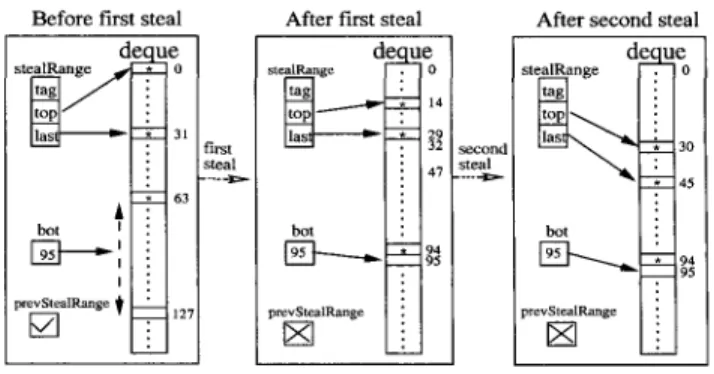
p r e ~ a l R a n g e ~ ...2__ 12 A f t e r f i r s t s t e a l t I R a g d kq~ eo s ~ n e first : 32 steal : 41 bot ~ 94 95 prevStealRange : s e c o n d A f t e r s e c o n d s t e a l d ~..~ e stealRange : 0 ~ 30 ~ 45 hot : prevSt~lRarlge :Figure 8: A scenario of 2 consecutive steals. In the first steal-operation, 14 items are stolen (out of the 32 items which can be stolen atomically). In the second steal, all of the 16 items in the stealRange are stolen. A x / s i g n in the prevStealRange box indicates t h a t it's equal to the steal- Range; an X sign indicates it is different from the stealRange
Figure 3.3 shows a scenario where two consecutive steal- operations are performed on process p's deque, while in the meantime p is not performing any operation on its deque. Initially, p's stealRange contains 32 items, b u t the first thief only steals 14 of them (which is what it needs to balance with p). W h e n the thief looks at bot, it equals 95, b u t before the steM's CAS operation completes, it may change within the range [64..127]. To make sure t h a t after the steal stealRange would not contain more t h a n half the remaining items, the thief sets the new length of stealRange to be one eighth of 128 ~_ 16. the maximal possible value of bot plus 1, namely -g-
In the second steal shown at Figure Figure 3.3, the thief steals all of the 16 items in the stealRange, a n d again sets the new length of stealRange to contain ~s 2-s = 16 items. This is correct, since this time prevStealRange differs from stealRange, a n d so the local process p cannot change bot without performing a CAS.
Remember t h a t Theorem 3.9 above assumes synchrony, in the sense t h a t processing proceeds in time-steps, a n d all
p r o c e s s e s perform balancing-initiation in the beginning of every time-step. Additionally, it assumes t h a t up to half the items of any process can be stolen atomically.
Contrary to this, the StealHalf algorithm's setting is en- tirely asynchronous, a n d though the balancing frequency of every process is guaranteed, processes perform their balancing- initiation operations in separate times; additionally, the Steal- Half algorithm can only guarantee t h a t at least one eighth of a process' items can be stolen atomically. The modifica- tions required in the above proof to prove t h a t StealHalf is a locally bounding scheme are straightforward. They are not brought here for lack of space, b u t are to appear in the full paper.
4 Correctness
In the full paper we prove the following theorem which shows t h a t our algorithm has the same non-blocking property as t h a t of Arora et al: the collective progress of processes in accessing the extended-deque structures is guaranteed. T h e o r e m 4.1 The StealHalf algorithm on a collection of extended-deques, with operations pushBottom, popBottom, and tryToSteal, is non-blocking.
We note t h a t b o t h algorithms are not fault tolerant in the sense t h a t process failures, though non-blocking, can cause the loss of items.
In [13], Shavit and Touitou formally define the semantics
of a pool d a t a structure. A pool is an unordered queue,
a concurrent d a t a structure t h a t allows each processor to perform sequences of push a pop operations with the usual semantics. In the full p a p e r we provide the proofs of the key l e m m a t a necessary to prove the following theorem:
T h e o r e m 4 . 2 extended-deques, and try ToSteal, structure.
The SteaIHalf algorithm on a collection of with operations pushBottom, popBottom, is a correct implementation of a pool data
We define the complexity of our algorithm in terms of the total number of synchronization operations necessary by an- alyzing it for monotonic sequences of p u s h B o t t o m and pop- B o t t o m operations. We do so since one cannot make claims in situations where the execution p a t t e r n of the underly- ing application causes thrashing back and forth on a single deque entry. For a given deque, a monotonic sequence is one
in which all operations are either pushBottom or popBottom
but not both, with a possible interleaving of tryToSteal op-
erations. We prove the following:
T h e o r e m 4.3 For any monotonic sequence of length k by process p during which m successful steal attempts are per- formed on p's extended deque, p performs at most O ( l o g ( k ) +
m) CAS operations on the extended deque.
5 Acknowledgments
We would like to t h a n k Dave Detlefs, Maurice Herlihy, Vic- tor Luchangco, and Mark Moir for their helpful comments on earlier drafts of our algorithm. Though he denies it and has m a n a g e d to conveniently lose all evidence, we believe Dave Detlefs came up with a steal-half algorithm very similar to ours in the context of his work on Sun's Parallel Garbage Collection [5].
References
[1] ACAR, U. A.,
BLELLOCH,
G. E., AND BLUMOFE, R. D.The d a t a locality of work stealing. In ACM Symposium
on Parallel Algorithms and Architectures (2000), pp. 1- 12.
[2] ARORA, N. S., BLUMOFE, R. D., AND PLAXTON, C. G. T h r e a d scheduling for m u l t i p r o g r a m m e d multiproces-
sors. Theory of Computing Systems 34, 2 (2001), 115-
144.
[3] BERENBRINK, P., FRIEDETZKY, T., AND GOLDBERG, L. A. The n a t u r a l work-stealing algorithm is stable. In Proceedings of the 42th IEEE Symposium on Foun- dations of Computer Science (FOCS) (2001), pp. 178- 187.
[4]
BLUMOFE, R., AND LEISERSON, C. Scheduling multi-t h r e a d e d computations by work stealing. In Proceed-
ings of the 35th Annual Symposium on Foundations of Computer Science, Santa Fe, New Mexico. (November 1994), pp. 356-368.
[5] FLOOD, C., DETLEFS, D., SHAVIT, N., AND ZHANG, C. Parallel garbage collection for shared m e m o r y mul-
tiprocessors. In Usenix Java Virtual Machine Research
and Technology Symposium (JVM '01) (Monterey, CA, Apr. 2001).
[6] HERLIHY, M. Wait-free synchronization. ACM Trans-
actions On Programming Languages and Systems 13, 1
(Jan. 1991), 123-149.
[7] LEISERSON, AND PLAAT. P r o g r a m m i n g parallel appli-
cations in cilk. SINEWS: SIAM News 31 (1998).
[8] LULING, R., AND MONIEN, B. A d y n a m i c d i s t r i b u t e d load balancing algorithm with provable good perfor-
mance. In A C M Symposium on Parallel Algorithms and
Architectures (1993), pp. 164-172.
[9] MITZENMACHER,
M. Analysis of load stealing modelsbased on differential equations. In A CM Symposium on
Parallel Algorithms and Architectures (1998), pp. 212- 221.
[10] MITZENMACHER,
M. The power of two choices in ran-domized load balancing. IEEE Transactions on Parallel
and Distributed Systems 12, 10 (2001), 1094-1104. [11] M o I a , M. Practical implementations of non-blocking
synchronization primitives. In Proceedings of the 16th
Annual ACM Symposium on Principles of Distributed Computing (August 1997), pp. 219-228.
[12] RUDOLPH, L., SLIVKIN-ALLALOUF, M., AND UPFAL, E. A simple load balancing scheme for t a s k allocation
in parallel machines. In A CM Symposium on Parallel
Algorithms and Architectures (1991), pp. 237-245.
[13] SHAVIT,
N., AND TOUITOU, D. Elimination trees andthe construction of pools and stacks. Theory of Com-