European Online Journal of Natural and Social Sciences 2015; www.european-science.com Vol.4, No.1 Special Issue on New Dimensions in Economics, Accounting and Management
ISSN 1805-3602
A Study on the Relation between Different Dimensions of Emotional Intelligence
and Employees’ Creativity
Seyed Mehdi Khadem1, Mehdi Fallah2*, Darush Rahmati3, Mahmod Ajorloueii4
1Public Management, Tarbiat Modares University,Tehran, Iran; 2Public Management, Islamic Azad University, Young Researchers Club, Naragh, Iran; 3Business Management, Allameh Tabatabai University, Tehran, Iran; 4Criminal Law and Criminology, Arak Branch, Islamic Azad University,
Arak, Iran
*Email: [email protected] Abstract
This paper is aimed at explaining the relation of emotional intelligence and its dimensions such as problem-solving, happiness, independence, stress tolerance, self-actualization, self- awareness, realism, interpersonal relations, optimism, self- esteem, impulse control, flexibility, accountability, empathy, and self- presentation with employee creativity in Iran Khodro Company in 2013. The statistical population comprises 260 employees of this company. By using Jersey and Morgan table and simple random sampling method, 152 persons were selected as sample. Data were gathered by using questionnaires. Reliabilities of Bar-On Emotional Intelligence Questionnaire and Randsip Creativity Questionnaire were respectively estimated as 0.89 and 0.92 by Cronbach's alpha method. Also, content validity was used to test the questionnaires validity and so it was approved by the related experts. Data obtained from the questionnaires was analyzed through SPSS software in two descriptive (frequency, frequency percentage, mean, standard deviation) and inferential (Pearson correlation coefficient, Friedman ranking test, and Shapiro- Wilk test) sections. The results revealed that there is a significant relation between emotional intelligence dimensions and employee creativity. Also, the dimensions of emotional intelligence in Iran Khordo Co. were ranked by Friedman ranking test and independence had the highest rank.
Keywords: Creativity, emotional intelligence, problem solving, independence, self- esteem Introduction
All organizations require novel thoughts and ideas for survival. New thoughts and ideas breathe life into the organization and release it from death. To survive in today variable and turbulent world, any organization must turn to innovation and creativity and provides new responses to the environment changes and influences them besides knowing them and being influenced by them (Pourkiani & Balalzadeh, 2008).
Nowadays, creativity constitutes the important part of the organizational life because global rapid changes have transformed the organizations so much that organizations and managers must find new ways for their measures to be compatible with global changes and developments. However, intense competitions and customer taste and needs have made organization affairs unpredictable. In such circumstances, new thoughts and methods must be achieved to retain the organization relationship with customers, keep market share, fulfill customer needs, reach a proper share of the global market, and success in the competition with clients, and so on (Feizi, 2006).
Today’s world is full of complications which have brought about numerous problems for the organizations in the field of growth and abundant challenges for managers as planners, organizers, and leaders of humans. This problem is more evident in our country due to particular problems and constraints. Our current industry represents low ability of the organizations in coping with organizational problems. The role of emotional intelligence and creativity as two important effective
Seyed Mehdi Khadem, Mehdi Fallah, Darush Rahmati, Mahmod Ajorloueii
factors on efficiency and effectiveness is a matter of magnitude and is effective on the organization development, increase in products and services quality, success in the competitions, increase in employee motivation, job satisfaction, cost reduction, resources waste, diversity of products, reduction of administrative bureaucracy, and activism encouragement, and it warrants more research (Sabunchi, 2007).
One of the superior features of human thought is creativity. Creativity is an inherent feature of humans, yet its emergence involves training. Tolerance believes that for survival, humans need to develop and use the creative power of persons. Creativity is the most important gun of human through which he can eliminate mental pressures of daily life (Hosseini, 2006).
Scholars have defined creativity by various interpretations. Sometimes one definition indicates only one dimension of creativity process; for example, Herbert Fox believes that "creativity process refers to any thinking process that solves a problem in a novel and useful manner". Also George Seidel maintains that "ability to link issues, regardless of the area or filed, is among bases of using mind creatively". Erich Fromm believes that "creativity is the ability to see (be informed) and respond" (Pir Khayefi, 2005).
Emotional intelligence refers to the ability of controlling emotional inclinations, understanding the most private feelings of others, proper behavior in human relations with others, self- control, Passion, enthusiasm and perseverance. Since advent of emotional intelligence issue, it has been studied in different areas. In fact, researchers have always tried to show the relation of this factor with important effective factors on occupational and organizational success (Bar-On, 2005).
New sciences have proved that the foundation of many important decisions, the most active organizations, and the most successful and satisfying lives is emotional intelligence not logical intelligence (Trinidad & Johnson, 2002). Multiple studies have shown that emotional intelligence improves job performance (Bar-On, 2002). Also it has been proven that the role of personality features in taking entrepreneurship decisions and improving quality of innovative decisions is remarkable (Bryce, 2002).
Studies carried out regarding the impact of emotional intelligence on the organizational results reveal that people who have higher emotional intelligence show higher job performance (Abraham, 1999). Also it is stated that emotional intelligence is a key for effective performance and success in the organizational changes. Accordingly, emotional intelligence training programs in the organizations help employees to have better coordination and more motivation for optimal performance which will highly influence efficiency and profitability of the organization (Diggins, 2004). Proponents of emotional intelligence believe that emotional intelligence has more capability to predict personal performance compared to general intelligence (Salovey & Mayer, 1990). Also, Goleman maintains that high emotional intelligence improves general quality of life and personal and social success (Goleman, 1998).
Emotional intelligence theory provides a new vision about prediction of effective factors on success. In fact, emotional intelligence determines failure in people with high IQ and also unexpected success of persons with moderate IQ. That is, people with moderate general intelligence and high emotional intelligence are further more successful than those with high general intelligence and low emotional intelligence. So, emotional intelligence predicts people success in life and their method of coping with stresses. According to Bar-On, emotional intelligence is comprised of five main dimensions and 15 factors. As persons have more components, they enjoy higher emotional intelligence (Rostami, 2004).
According to Bar-On, five main dimensions of emotional intelligence are namely, intrapersonal dimension, compatibility, general mood, interpersonal dimension, and impulse control. Intrapersonal dimension specifies person capabilities to know and control emotions. Compatibility Openly accessible at http://www.european-science.com 393
Special Issue on New Dimensions in Economics, Accounting and Management
dimension refers to flexibility and problem- solving and realism; general mood refers to joy and optimism; interpersonal dimension refers to the person ability to be compatible with others and social skills, and finally impulse control focuses on ability of tolerating tension and controlling stress (Touranlu, et al., 2007). Since this paper has used Bar-On 15-factor model, these factors are briefly explained in the following (Jalali, 2001).
Problem- solving: ability of recognizing and defining problems and creating and applying effective solutions.
Happiness: ability of feeling satisfaction with life, oneself, and others.
Independency: ability of self-leadership, intellectual and practical self- control, and escaping from emotional dependencies.
Mental pressure tolerance: ability to tolerate unpleasant events and stressful conditions and severe emotions.
Self- actualization: ability of recognizing inherent potentials of the activities that the person can do, wants and enjoy them.
Self- awareness: person awareness of his own feelings and understanding these feelings. Realism: ability of evaluating the relation between emotional experience and existing realities.
Interpersonal relations: ability of creating and retaining mutual satisfying relations.
Optimism: ability of paying attention to the brighter aspects of life and keeping positive attitude even when feelings exist.
Self- esteem: self-awareness, accepting and respecting oneself.
Impulse control: ability of resistance against stresses or temptations and controlling emotions.
Flexibility: ability of accepting emotions, thoughts, and behaviors of the person in different conditions.
Accountability: ability of introducing oneself as a useful and cooperative member in the social group.
Empathy: ability of being aware of others' feelings and appreciating those feelings.
Self-presentation: expressing feelings, beliefs, thoughts, and logical defense of one's own rights.
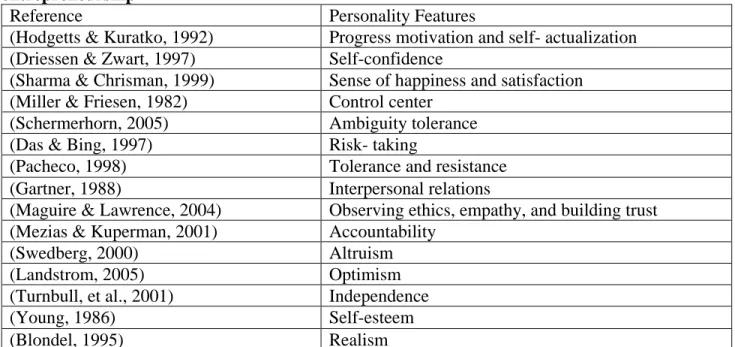
However, some research has been carried out in this regard which is mainly related to the personality features and success factors of entrepreneur. Since creativity is a subset of entrepreneurship, these backgrounds help us. Table 1 mentions some of them.
Amiri (2010) in a paper titled as "A study on the relation between emotional intelligence and organizational entrepreneurship (case study: staff of Shiraz Executive Organizations) showed that emotional intelligence and its different dimensions (problem- solving, happiness, independency, mental pressure tolerance, self- actualization, emotional self-awareness, realism, interpersonal relations, optimism, esteem, impulse control, flexibility, accountability, empathy and self-presentation) have a positive significant correlation with organizational entrepreneurship (Amiri, 2010).
Irani and colleagues (2010) in a paper titled as "The relation of intellectual beliefs, self-esteem, and progress motivation with entrepreneurship among students of Tehran Payam-e Noor University indicated that intellectual beliefs, self-esteem, and progress motivation have a positive relation with entrepreneurship among students of Tehran Payam-e Noor University (Irani, et al., 2010).
Seyed Mehdi Khadem, Mehdi Fallah, Darush Rahmati, Mahmod Ajorloueii
Table 1. Research background regarding the relation between personality features and entrepreneurship
Reference Personality Features
(Hodgetts & Kuratko, 1992) Progress motivation and self- actualization (Driessen & Zwart, 1997) Self-confidence
(Sharma & Chrisman, 1999) Sense of happiness and satisfaction (Miller & Friesen, 1982) Control center
(Schermerhorn, 2005) Ambiguity tolerance (Das & Bing, 1997) Risk- taking
(Pacheco, 1998) Tolerance and resistance
(Gartner, 1988) Interpersonal relations
(Maguire & Lawrence, 2004) Observing ethics, empathy, and building trust (Mezias & Kuperman, 2001) Accountability
(Swedberg, 2000) Altruism
(Landstrom, 2005) Optimism
(Turnbull, et al., 2001) Independence
(Young, 1986) Self-esteem
(Blondel, 1995) Realism
As shown in table 1, many effective characteristics on entrepreneur success exist in the set of emotional intelligence factors (Bar-On 15-factor model).
Therefore, since proper stages are required for orientation towards entrepreneurship in the organizations, the main question of this paper is whether there is a significant relation between emotional intelligence and creativity of employees in Iran Khodro Company. Subordinate questions of this paper are presented as following.
Q1: is there any relation between problem- solving and creativity of employees in Iran Khodro Company?
Q2: is there any relation between sense of happiness and creativity of employees in Iran Khodro Company?
Q3: is there any relation between independency and creativity of employees in Iran Khodro Company?
Q4: is there any relation between mental pressure tolerance and creativity of employees in Iran Khodro Company?
Q5: is there any relation between self- actualization and creativity of employees in Iran Khodro Company?
Q6: is there any relation between self-awareness and creativity of employees in Iran Khodro Company?
Q7: is there any relation between realism and creativity of employees in Iran Khodro Company?
Q8: is there any relation between interpersonal relations and creativity of employees in Iran Khodro Company?
Q9: is there any relation between optimism and creativity of employees in Iran Khodro Company?
Q10: is there any relation between self-esteem and creativity of employees in Iran Khodro Company?
Special Issue on New Dimensions in Economics, Accounting and Management
Q11: is there any relation between impulse control and creativity of employees in Iran Khodro Company?
Q12: is there any relation between flexibility and creativity of employees in Iran Khodro Company?
Q13: is there any relation between accountability and creativity of employees in Iran Khodro Company?
Q14: is there any relation between empathy and creativity of employees in Iran Khodro Company?
Q15: is there any relation between self- presentation and creativity of employees in Iran Khodro Company?
Q15: is there any significant difference among dimensions of emotional intelligence in Iran Khodro Company?
Methodology
The statistical universe comprises 260 employees of Iran Khodro Company which includes all staff. By using Jersey and Morgan table and simple random sampling method, sample size was estimated 152 for a 260-person universe. Albeit 160 questionnaires were distributed and finally 150 questionnaires were collected and sample size was reduced to 150. This paper is an applied research in terms of objective and a descriptive- correlative research in terms of data collection.
Variables studied in this paper that have been derived from research literature are namely, emotional intelligence and employee creativity. Among dimensions of emotional intelligence, problem- solving, sense of happiness, independency, mental pressure tolerance, self- actualization, self- awareness, realism, interpersonal relations, optimism, self-esteem, impulse control, flexibility, accountability, empathy, and self- presentation are studied in this paper. To gather emotional intelligence data, a 90-questions questionnaire in the form of 15 dimensions based on Bar-On model (Bar-On, 1999) and five-point Likert scale (including very high, high, average, low, and very low) have been used.
Also to measure employees' creativity, Randsip Creativity Questionnaire published in 1979 was used. This questionnaire contains 50 questions and its measurement scale is five-point Likert scale (including very high, high, average, low, and very low).
To measure reliability, a sample questionnaire containing 40 questions of both organizational entrepreneurship and employee creativity questionnaires was pre-tested and then reliabilities of Bar-On Emotional Intelligence Questionnaire and Randsip Creativity Questionnaire were respectively estimated as 0.89 and 0.92 by SPSS software and Cronbach's alpha method. These numbers indicate that the applied questionnaires have required reliability. To measure validity of the questions, content validity (face validity) was used and so the questionnaires were approved by the related experts.
Research Findings
Findings of Demographic Features
Findings of frequency distribution table revealed that male employees constitute 86.4% and female employees constitute 13.6% of the selected sample size. 65% of employees are single and 35% of them are married.
Most of them have associate degree (58.3%), and 26% of them have Bachelor of Science. 15% of the employees have diploma and lower degrees. The age of the respondents ranges from 24 to 47 and the most frequency pertains to the employees who are 34. Age distribution mean is 36.16 and standard deviation is 4.17. Also 62.7% of the employees have work experiences between 10 to 20 years.
Seyed Mehdi Khadem, Mehdi Fallah, Darush Rahmati, Mahmod Ajorloueii
Normality Test
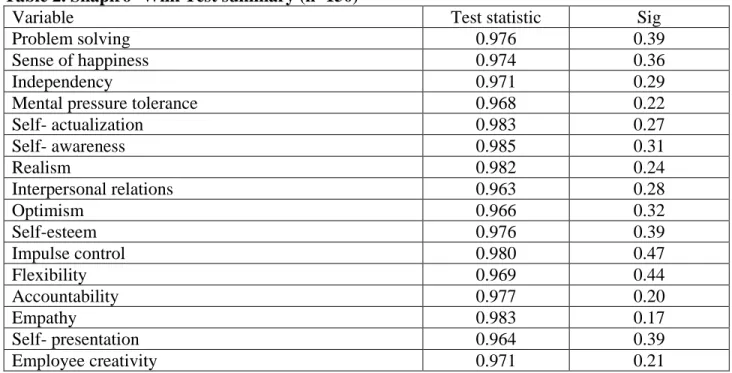
Table 2. Shapiro- Wilk Test summary (n=150)
Variable Test statistic Sig
Problem solving 0.976 0.39
Sense of happiness 0.974 0.36
Independency 0.971 0.29
Mental pressure tolerance 0.968 0.22
Self- actualization 0.983 0.27 Self- awareness 0.985 0.31 Realism 0.982 0.24 Interpersonal relations 0.963 0.28 Optimism 0.966 0.32 Self-esteem 0.976 0.39 Impulse control 0.980 0.47 Flexibility 0.969 0.44 Accountability 0.977 0.20 Empathy 0.983 0.17 Self- presentation 0.964 0.39 Employee creativity 0.971 0.21
To test normality of the research variables, Shapiro- Wilk test was used. As shown in the above table, the test significance level is greater than 0.05 at all distributions. In the other words, scores at all variables follow normal distribution.
Hypothesis testing
Hypothesis 1-16: as shown in table 3.
Table 3. Correlation between emotional intelligence dimensions and employee creativity
Variable Correlation Coefficient Sig. Result
Emotional intelligence 0.576 0.007 + Problem solving 0.561 0.003 + Sense of happiness 0.546 0.006 + Independency 0.588 0.007 + Mentalpressure tolerance 0.586 0.005 + Self- actualization 0.538 0.005 + Self- awareness 0.567 0.008 + Realism 0.561 0.002 + Interpersonal relations 0.519 0.007 + Optimism 0.561 0.006 + Self- esteem 0.525 0.004 + Stress control 0.544 0.003 + Flexibility 0.568 0.004 + Accountability 0.576 0.002 + Empathy 0.565 0.006 + Self- presentation 0.550 0.001 +
Special Issue on New Dimensions in Economics, Accounting and Management
First to sixteenth hypotheses indicating the relation of emotional intelligence and its dimensions (problem- solving, sense of happiness, independency, mental pressure tolerance, self- actualization, self- awareness, realism, interpersonal relations, optimism, self- esteem, impulse control, flexibility, accountability, empathy, and self- presentation) with employee creativity revealed that there is a relation between emotional intelligence dimensions and employee creativity at a 99% confidence level.
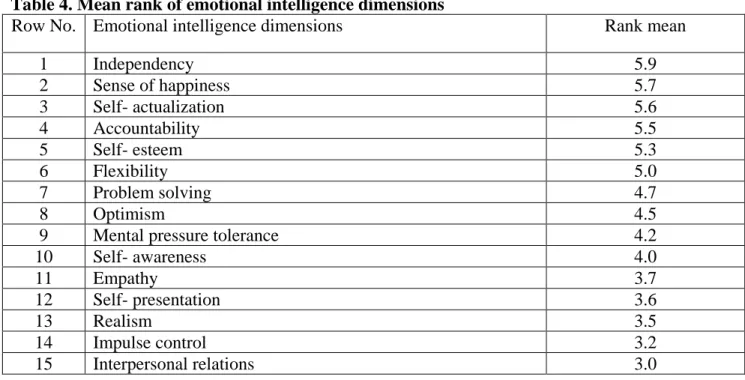
Hypothesis 7: to investigate the seventeenth hypothesis indicating "there is a significant different among emotional intelligence dimensions in Iran Khodro Company", we refer to table 4. Table 4. Mean rank of emotional intelligence dimensions
Row No. Emotional intelligence dimensions Rank mean
1 Independency 5.9 2 Sense of happiness 5.7 3 Self- actualization 5.6 4 Accountability 5.5 5 Self- esteem 5.3 6 Flexibility 5.0 7 Problem solving 4.7 8 Optimism 4.5
9 Mental pressure tolerance 4.2
10 Self- awareness 4.0 11 Empathy 3.7 12 Self- presentation 3.6 13 Realism 3.5 14 Impulse control 3.2 15 Interpersonal relations 3.0
The results of Friedman test showed that there is a significant difference among emotional intelligence dimensions. As shown in table 4, independency has the highest rank and interpersonal relation has the lowest rank.
Conclusion
The organization survival depends upon their power of reconstruction; this reconstruction occurs through coordinating goals with the current situation and improving the methods of actualizing these goals. Global rapid developments in science and technology, industry, management and in general values and criteria have made many successful organizations and companies in the world to direct their goals, inclinations, and interests towards creativity and innovation. In fact, 20th century and particularly two last decades can be regarded as years of the accelerated expansion of creativity and innovation. In such an era titled as "knowledge age", "age of change", "age of discontinuity", and "age of creativity", organizations and companies must prepare themselves to manage global rapid changes and deep transformations and turn to creativity and innovation.
The results of this paper reveal that there is a direct significant relation between emotional intelligence as one of the most important characteristics and employee creativity. That is, as persons have higher emotional intelligence, they have more creativity. The research findings indicate that there is a direct relation between 15 dimensions of emotional intelligence (problem- solving, sense of happiness, independency, mental pressure tolerance, self- actualization, self- awareness, realism, Openly accessible at http://www.european-science.com 398
Seyed Mehdi Khadem, Mehdi Fallah, Darush Rahmati, Mahmod Ajorloueii
interpersonal relations, optimism, self- esteem, impulse control, flexibility, accountability, empathy, and self- presentation) and employee creativity.
With regard to the results of this paper, below points are suggested to Iran Khodro Company. Since emotional intelligence is acquisitive and a part of emotional intelligence is evolved by experience, practice, and endeavor, it can be increased through training. So holding educational courses to make the employees familiar with the concept of emotional intelligence and its effect on people life is suggested.
Since emotional intelligence is not fixed and it can be improved by training, holding educational courses and workshops is suggested to improve personal and social capabilities, develop emotional controls, practice empathy, develop effective listening skills, and evaluate feelings of others with emphasis on self- management and relations management skills.
It is suggested to identify persons with high levels of interpersonal relation and employ them in the project works and group activities in which personal and social capabilities are applied more so as to reveal the impact of emotional intelligence on people success and create a motivation to increase and develop self- awareness and self- management skills.
With regard to the relation between problem solving and employee creativity, organizations are suggested to train intuitive and logical problem solving methods to the employees.
It is suggested to provide employees with facilities that make them satisfied.
Employees must be guided towards self- leadership and self- control and they must be independent in taking decagons.
Identifying effective factors on employee creativity growth and removing or strengthening them by managers.
Holding educational courses regarding creativity growth methods.
Managers are suggested to create suggestions system and think tank and gather and study ideas, successful and unsuccessful experiences, innovations, new solutions and strategies in this regard.
It is suggested to increase creativity and innovation by using below approaches:
Brain monitoring, compulsory relation, imaginative trip, full of ideas questions, imitation of nature, parallel thinking, creating the core of research and invocation in the organization.
References
Abraham, R. (1999). Emotional Intelligence in Organizations: A Conceptualization, Genetic, Social, and General Psychology Monographs, 125 (2), 209-24.
Amiri, Y. (2010). A study on the relation between emotional intelligence and organizational entrepreneurship (case study: employees of Shiraz Executive Organizations)", the First International Conference on Management, Innovation, and Entrepreneurship (February 16 and 17, 2011 – Shiraz).
Bar-on, R. (1999). The Emotional Quotient Inventory (EQ-I): A test of emotional intelligence, Torento, Canada, Multi-Health
Bar-On, R. (2002). Bar-On EQ-i:S technical manual. Toronto: Multi-Health Systems.
Bar-On, R. (2005). The Bar-On model of emotional-social intelligence, Psicothema,18 (1), 13-25. Blondel, D.(1995). Efficiency criteria for intermediaries involved in the innovation process.
International Journal of Technology Management, 10 (4-6), 478–488.
Special Issue on New Dimensions in Economics, Accounting and Management
Brice J. (2002). The Role of Personality Dimensions and Occupational Preferences on the formation of Entrepreneurial Intentions. Mississippi: The Mississippi State University Press.
Diggins, C. (2004). Emotional Intelligence: The key to effective performance and to staying ahead of the pack at times of organizational change, Human Resource Management International Digest, 12 (1), 33-5.
Driessen, M. P. & Zwart, P. S. (1997). The Role of the Entrepreneur in Small Business Success: The Entrepreneurship Scan.
Feizi, T. (2006). Principles of Organization and Management, Publication of Payam-e Noor University.
Gartner, W.B. (1988). Who is an entrepreneur? is the wrong question. American Journal of Small Business, 12 (4), 11-31.
Goleman, D. (1998). Working with emotional intelligence. New York: Bantam
Goleman, D. (2001).An EI-based Theory of Performance", in Cherniss, C. and Goleman, D. (Eds). The Emotionally Intelligent Workplace: How to select for, Measure,and Improve Emotional Intelligence in Individuals, Groups, and Organizations Francisco,San, Jossey-Bass,San, pp: .27-44.
Hodgetts, R. M. & Kuratko, D. F. (1992). Effective Small Business Management, 4thed, Harcourt Brace Jovanovich, San Diego, FL. http://www.geocities.com
Hosseini, A.Z. (2006). Creativity management and creativity in management, Rahyaft Journal, No. 26.
Irani, Z., Bayat, Sh., & Alibazi, H. (2010). The relation of intellectual beliefs, self esteem, and progress motivation with entrepreneurship ability in the students of Tehran Payam-e Noor University, the First International Conference on Management, Innovation, and Entrepreneurship (February 16 and 17, 2011 – Shiraz).
Jalali, S.A (2001). Emotional Intelligence, Educational Evaluation Supplement, Quarterly Journal of Education, No. 69 & 70.
Landstrom, H.( 2005). Pioneers in Entrepreneurship and Small Business Research New York: Springer.
Leonidas A. Zampetakis, Panagiotis B, Vassilis & S. Moustakis. (2009). Day-to-day entrepreneurship within organizations: The role of trait Emotional Intelligence and Perceived Organizational Support. European Management Journal, 27, 165– 175
Maguire, S., Hardy, C., & Lawrence, T. B. (2004). Institutional entrepreneurship in emerging fields: HIV/AIDS treatment advocacy in Canada. Academy of Management Journal, 47(5), 657– 679.
Mezias, S. J., & Kuperman, J. C. (2001). The community dynamics of entrepreneurship: The birth of the American film industry, 1895–1929. Journal of Business Venturing, 16(3), 209–233. Miller, D. & Friesen, P.H. (1982). Innovation in conservative and entrepreneurial firms: two models
of strategic momentum, Strategic Management Journal, 1,1-25.
Pacheco, C. D. (1998). Enterprise and Education, Leeds Business School, Leeds, BA Business Administration Dissertation.
Pir Khayefi, A. (2005). Creativity: Bases and Methods of Research, Tehran, Hezareye Qoqnus, p. 32.
Pour Kiani, M., & Balalzadeh, M. (2008). The role of employees empowerment in creativity and innovation, the First National Conference on Creativity, TRIZ, and Innovation Engineering and Management in Iran.
Seyed Mehdi Khadem, Mehdi Fallah, Darush Rahmati, Mahmod Ajorloueii
Rostami, N. (2004). A study on the relation between religious situation and emotional intelligence in pre-university students of Tehran in the academic year 2004-2005, Quarterly Journal of Educational Innovations, No. 10, 3rd year.
Sabunchi, R. (2007-2008). The relation between organizational culture and organizational structure in the Physical Education Organization, M.A. thesis, Islamic Azad University, Science and Research Branch.
Salovey, P. & Mayer, J.D. (1990). Emotional intelligence, Imagination, Cognition, and Personality, 9 (3), 185-211.
Schermerhorn, J. (2005). Management, 8th editions, New York: John Willy and sons, Inc.
Sharma, P., & Chrisman, J. J. (1999). Toward a reconciliation of the definitional issues in the field of corporate entrepreneurship. Entrepreneurship Theory and Practice, 23(3), 11– 27.
Swedberg, R. (2000). The social science view of entrepreneurship: Introduction and practical applications. In R. Swedberg (Ed.), Entrepreneurship: The social science view (pp. 7–44). Oxford, New York: Oxford University Press.
Thilam, L., & Kirby, S. (2002). Is emotional intelligence advantage? The Journal of Social Psychology, 142 (1), 133-145.
Touranlu Sayadi, H., Jamali, R., & Mirghafuri, H. (2007). A study on the relation between religious beliefs and emotional intelligence of students, Quarterly Journal of Religious Novel Thought, 3 (11), 145-172.
Trinidad, D. R., & Johnson, C. A. (2002). The association between emotional intelligence and early adolescent tobacco and alcohol use. Personality and Individual Differences, 32, 95-105. Turnbull, A., Williams. S. Paddison, A., & Fahad, G. (2001). Entrepreneurship Education, Does it
Work? In Anderson, A.R., Jack, S.L. (Eds), Enterprise and Organizational Environments. Adm. Sci. Q, 31
Young, Dennis R. (1986). Entrepreneurship and the Behavior of Nonprofit Organizations: Elements of a Theory. In S. Rose-Ackerman, The Economics of Nonprofit Institutions: Studies in Structure and Policy, New York: Oxford University Press.