Automatic Milking and Grazing
- Factors and Stimuli Affecting Cow Motivation to Visit
the Milking Unit
Ewa Wredle
Faculty of Veterinary Medicine and Animal Science Department of Animal Nutrition and Management
Uppsala
Doctoral thesis
Swedish University of
Agricultural Sciences
Uppsala 2005
Acta Universitatis Agriculturae Sueciae
2005: 116
ISSN 1652-6880 ISBN 91-576-6915-5 © 2005 Ewa Wredle, Uppsala
Abstract
Wredle, E. 2005. Automatic milking and grazing – Factors and stimuli affecting cow motivation to visit the milking unit. Doctor’s dissertation.
ISSN 1652-6880, ISBN 91-576-6915-5
When automatic milking is combined with grazing the cows are given a unique opportunity to choose between being indoors or outdoors. Concerns have been raised about achieving sufficient number of milkings per day since the cows’ motivation to be milked is low and cows are expected to go to milking voluntarily. The overall aim was therefore to examine how management routines affect cow motivation to visit the milking unit several times a day.
First it was hypothesised that distance to pasture and level of supplements affects the milking frequency. The results demonstrated that cows with a shorter distance to pasture had a higher milking frequency during the first part of the grazing season and a higher milk yield compared with cows pasturing further from the barn. One important finding was that cows on the distant pasture changed their behaviour as the grazing season progressed and almost ceased to walk to their pasture area. A high level of silage supplements compared with a buffer feed offered in the barn had no affect on the milk yield. Also there was no affect on the number of milkings during the first part of the grazing season but during the latter part, cows with a high level of silage had a lower number of milkings.
It was also hypothesized that it is possible to strengthen the cows’ perception of a feed reward in the milking unit by training the cow to respond to a conditioned stimulus, an acoustic signal. Most of the cows learnt to approach the milking unit following the signal when they were in an enclosed area of the barn, close to the milking unit. However, when receiving the signal out on pasture the response to the signal was variable and comparatively low. Finally, the hypothesis that enhanced sensory stimulation during milking by feeding or stroking the cows’ abdomen affects the level of the oxytocin and cortisol during milking was tested. Feeding during milking increased the plasma oxytocin level and milk production whereas brushing during milking depressed the milking-related release of cortisol, possibly inducing an anti-stress effect.
Keywords: automatic milking, grazing, motivation, milking frequency, acoustic stimuli, sensory stimuli, learning
Author’s address: Ewa Wredle, Department of Animal Nutrition and Management, SLU, Kungsängens Research Centre, SE-753 23, Uppsala, Sweden.
“Shoot for the moon.
Even if you miss, you’ll
land among the stars.”
Les Brown
Contents
Introduction, 9 Aims of the thesis, 11
The overall aim, 11
The specific hypotheses, 12
Materials and methods, 12
Experimental design and treatments, 12
The grazing behaviour study, 12 The learning studies, 13 The sensory stimulus study, 14
Animals, 14
Housing, feeding and pasture areas, 14 Registrations, 16
Behaviour observations, 16
Sampling and data collection, 16 Analyses, 17
Results, 17
Effect of distance and feeding level, 17
Milking frequency and milk yield, 18 Behaviour, 18
Comments and evaluation of the experiment, 19
Heifers’ response to acoustic signals after a training period in an experimental setting, 20
Comments and evaluation of the experiment, 20
Cows’ response to acoustic signals after training in an AM barn, 21
Comments and evaluation of the experiment, 21
Sensory stimulation during milking, 22
Milking related release of hormones, 22 Milk production, 22
Behaviour, 22
Comments and evaluation of the experiment, 22
General discussion, 23
Distance to pasture affects production and behaviour, 23
Milking frequency and milk yield, 23 Grazing behaviour, 24
Lying behaviour, 25
Pasture and supplement allowance, 25
Restrictions on pasturing time, 27
More factors that affect the cows’ choice of location and activity, 27
Synchronization of behaviour, 27 Location of drinking water, 28 Weather conditions, 29
Enhanced stimulation during milking, 29
Production, 30
Hormonal response, 30 Behaviour, 31
Can acoustic signals bring cows to the milking unit? 31 Why all the fuss about milking frequency? 33
Implications of the results, 34
Conclusions, 35
Populärvetenskaplig sammanfattning, 36 References, 39
Appendix
Papers I
–
IV
I. Spörndly, E. & Wredle, E. 2004. Automatic milking and grazing – effects of distance to pasture and level of supplements on milk yield and cow behaviour.
Journal of Dairy Science 87: 1702–1712.
II. Wredle, E., Rushen, J., de Passillé, A.M. & Munksgaard, L. 2004. Training cattle to approach a feed source in response to auditory signals. Canadian Journal of Animal Science 84: 567–574.
III. Wredle, E., Munksgaard, L. & Spörndly, E. 2005. Training cows to approach the milking unit in response to acoustic signals in an automatic milking system during the grazing season. Submitted.
IV. Wredle, E., Uvnäs-Moberg, K., Bruckmaier, R. & Svennersten-Sjaunja, K. 2005. Can feeding or brushing during milking increase milk production and modify the release of oxytocin, ACTH and cortisol? Manuscript.
List of abbreviations
ACTH adrenocorticotrophic hormone AM automatic milking
CP crude protein d day
DM dry matter DP distant pasture
DP+S distant pasture + silage ECM energy corrected milk GI gastrointestinal h hour ME metabolisble energy Min minutes MJ megajoule MU milking unit
NDF neutral detergent fibre NP near pasture
NTS nucleus of the solitary tract PVN paraventricular nucleus SON supraoptical nucleus
Introduction
When Neil Armstrong took the first step on the moon he said the famous words “that’s one small step for man, one giant leap for mankind”. If farmers changing from conventional milking to a system with automatic milking (AM) have similar thoughts is more than I know. However, switching from conventional milking to an AM system certainly involves significant changes for both the herdsman and the cows. With conventional milking parlours, the farmer brings the whole herd to be milked at regular times, usually twice a day. In contrast, in AM systems cows are expected to individually approach and enter the milking unit (MU) and are milked one at a time throughout the day and night. The requirement for individual visits may be a problem since cows usually act in groups (for review see Phillips, 1993) and much of their behaviour is socially facilitated. Thus, cows’ behaviour is to a great extent influenced by the behaviour of group mates even though certain differences between breeds have been observed (Boissy & Le Neindre, 1990). Experiments carried out early in the AM history have reported that cows’ motivation to be milked is weak and variable between cows and that the motivation to eat is much stronger than that to be milked (Prescott, Mottram & Webster, 1998; Ceballos & Weary, 2002). This knowledge has resulted in feed rations to increase cow motivation to visit the MU in all AM systems. However, for some cows the concentrate offered in the MU is not sufficient to stimulate voluntary visits to the barn frequently enough when high quality pasture is available. Many farms record decreased milking frequencies during the grazing season. To counteract this decrease the farmers spend a great deal of time fetching cows (van Dooren, Spörndly & Wiktorsson, 2002). It has been observed in a Danish on-farm study, that the labour input for fetching cows ranged between 5 and 55 min per day on different farms during pasturing (Munksgaard & Krohn, 2004). One of the reasons for dairy farmers to invest in AM systems is that it allows more frequent milking without requiring extra labour from the stockman (Hogeveen, Heemskerk & Mathijs, 2004). It is a well-known fact that milk yield increases with more milkings per day (review Erdman & Varner, 1995) and this is of great importance when farmers decide to invest in an AM system. Therefore, it is important to study whether additional stimuli besides feed in the MU can attract the cows to visit the MU more often during pasturing.
A simple way to solve problems associated with grazing is to exclude grazing from the management routine. However, grazing cows during the summer is a common practise among dairy farmers and many have chosen to continue with grazing after introducing AM because of the advantages with grazing. Summer can be seen as a recovery period and one of the beneficial effects of grazing is that the exercise leads to improved hoof and leg health (Gustafsson, 1993). It is well known that cows with impaired locomotion spend less time eating and more time lying, leading to decreased feed intake and thereby a loss in milk production (Manson & Leaver, 1989). In an AM system, it is even more important that the cows’ locomotion is good since pain when walking increases the time between milkings (Grove et al., 2004). It has been suggested that poor locomotion could be
a result of always housing cows indoors and never turning out to pasture (Hillerton et al., 2004). Further advantages with grazing are decreased aggression (O’Connell, Giller & Meany, 1989) and stereotypies (Redbo, 1990) in the herd. In addition to improved animal welfare and health, pasture reduces feed costs. In an economic analysis from a Danish survey among farms with AM, it was concluded that the reduced feed expenses made it economically more favourable to offer 12-h grazing than only an exercise paddock. Farm economy was even more improved when the cows had access to 24-h grazing (Raun & Rasmussen, 2001). So it can be concluded that grazing has benefits making it worthwhile to consider also in combination with AM systems.
AM combined with grazing gives the cows a unique opportunity to choose between being indoors or outdoors. There are many external factors and stimuli that can influence cows’ motivation for choosing location and activity in a management routine with grazing and AM. What the cow actually chooses depends on the external stimuli present and the animal’s physiological state (internal stimuli) (Fraser & Broom, 1990; Toates, 1998). For example, it is not unusual that farms have pasture areas situated far from the barn (van Dooren, Spörndly & Wiktorsson, 2002) and perhaps only a small field adjacent to the barn. Thus, the distance between the barn and pasture area is an environmental factor that possibly influences the cows’ motivation to move back and forth and as a consequence has an impact on the milking frequency. Other factors that likely affect motivation to choose the MU or pasture include access to silage supplements, water and shade, the location of the other cows in the herd, and temperatures indoors and outdoors.
External factors and stimuli may also affect the physiological state of the animal. For example, a certain stimuli may influence various hormones (Jensen & Toates, 1993). A hormone of special interest in this context is the pituitary hormone, oxytocin, which is the hormone that induces milk ejection (for review see Bruckmaier & Blum, 1998). The milking-related release of oxytocin can vary in response to different types of sensory stimulation such as hand milking (Gorewit
et al., 1992), suckling (Lupoli et al., 2001) and feeding during milking (Svennersten et al., 1995). This might have consequences over and above milk removal. In addition to being the hormone that triggers milk ejection, oxytocin has been observed to have other capacities, for instance being involved in maternal behaviour (Argiolas & Gessa, 1991) and metabolism (Björkstrand et al., 1995). New findings further suggest that oxytocin might induce an anti-stress affect such as lowering cortisol levels and blood pressure (Uvnäs-Moberg, 1998). Such effects have been reported in rats, where stroking the abdomen lowered blood pressure (Kurosawa et al., 1995). In dairy cows, stroking the abdomen with a brush decreased heart rate (unpublished, Munksgaard & Herskin, 2004) and milking and feeding simultaneously increased oxytocin and lowered cortisol concentrations compared to milking alone (Johansson et al., 1999; Johansson, Redbo & Svennersten-Sjaunja, 1999). The possibility of an anti-stress effect due to the management routines such as enhanced sensory stimulation during milking, by feeding or stroking with a brush might therefore attract the cows to visit the milking unit.
The motivation to perform a certain behaviour can also be influenced by external stimuli that are associated with the presentation of food, i.e. a conditioned stimuli such as an acoustic signal that acts as a cue for feed. This can be the case when using classical conditioning, where the animal associates one event, (a signal) with another event (feed). However, another type of associative learning where the animal associates one event with another is operant conditioning (also called instrumental conditioning or trial and error learning). When operant conditioning is used, the association occurs between a behaviour and its consequence. This means that the animal is rewarded when it performs the desirable behaviour (for review see Domjan, 2003). A simplified distinction between the two learning types is that in classical conditioning feed is delivered independently of the animal’s behaviour whereas in operant conditioning, the animal’s behaviour causes feed to appear.
In an experiment with cows, an acoustic signal in the shape of an alarm bell has been used successfully to condition a herd of cows to enter a milking parlour following the alarm (Kiley-Worthington & Savage, 1978). Since cattle have a pronounced behavioural synchrony, it seems feasible to train a whole herd to approach a milking parlour. However, AM systems are built upon regular milking of the individual cow, so cows must be encouraged to behave more individualistically. Perhaps it is possible to improve continuity of cow flow to the MU by providing the cows with individual stimuli, for example an acoustic signal that could remind and strengthen the individual cow’s perception of a concentrate reward during milking and thereby increase the motivation to visit the milking unit.
Aims of the thesis
The overall aim of the present thesis was to
• Investigate how management routines and environmental factors affect the cows’ motivation to visit the MU, general behaviour and performance when automatic milking is combined with grazing.
• Examine the possibility to use an acoustic signal as a conditioned stimulus to increase the cows’ motivation to visit the milking unit.
• Examine if enhanced sensory stimulation during milking influences the endocrine response and milk production.
The specific hypotheses advanced were
• A long distance between barn and pasture diminishes the cows’ willingness to move between pasture and barn and thereby affects the number of visits to the MU and consequently milk production.
• A high level of supplementary roughage in the barn increases the cows’ motivation to leave pasture to visit the milking unit and consequently milk production.
• Cows can be trained by operant and classical conditioning to approach a feed source after receiving an acoustic signal.
• Cows can be trained to visit a MU individually in response to an acoustic signal in a commercially-managed AM barn during the grazing season.
• Enhanced sensory stimulation during milking through feeding increases the milking-related release of oxytocin, decreases cortisol levels, and increases milk yield
• Enhanced sensory stimulation during milking by stroking of the abdomen with a brush increases the milking-related release of oxytocin, decreases the release of cortisol, and increases milk yield
Materials and methods
The research included in this thesis is based on four studies, three performed at Kungsängen Research Centre, Swedish University of Agricultural Sciences and one performed at the Foulum Research Centre, Denmark. Two studies (Papers I
and III) were carried out during the grazing season in a barn equipped with an automatic milking system whereas the other studies (Papers II and IV) were performed indoors during the winter period. The experimental procedures are described in detail in Papers I–IV.
Experimental design and treatments
The grazing behaviour study
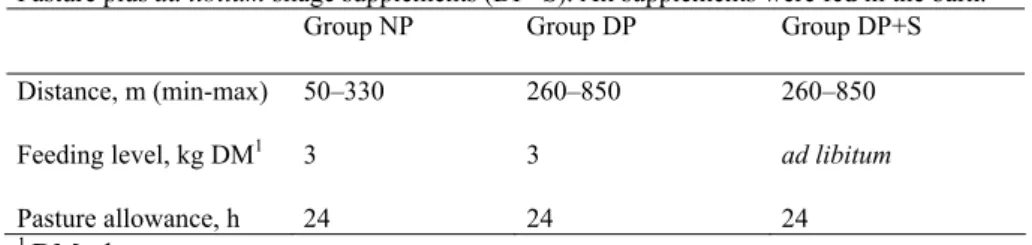
In this experiment (Paper I), 45 cows were assigned to three different treatments, which differed with respect to the distances between the barn and pasture and to the level of supplementary grass silage offered in the barn (see table 1). The two treatment groups “Distant Pasture” and “Distant Pasture plus ad libitum silage” grazed together in the same pasture. The experiment was conducted from pasture turnout on 16 May until 31 August.
Table 1. Description of treatments in experiment 1 with different distances to pasture and level of supplements in the barn, Near Pasture (NP), Distant Pasture (DP) and Distant Pasture plus ad libitum silage supplements (DP+S). All supplements were fed in the barn.
Group NP Group DP Group DP+S
Distance, m (min-max) 50–330 260–850 260–850
Feeding level, kg DM1 3 3 ad libitum
Pasture allowance, h 24 24 24
1 DM=dry matter
The learning studies
In two different studies, dairy heifers or cows were trained to approach a feed source in response to an acoustic signal. This signal emanated from a small device attached to the collar of each animal. In the first study (Paper II), 10 heifers were trained by operant conditioning in a small experimental area to approach a feed source following an acoustic signal. A further eight heifers were trained by classical conditioning to perform the same task.
In the second learning study (Paper III), 10 cows were trained by operant conditioning indoors in the AM barn to approach the milking unit following an acoustic signal. A small box emitting a short acoustic signal was attached to the collar (see Fig. 1) of each of the experimental cows. When training was completed, the effect of the signal was evaluated during the grazing season under practical management conditions. During the evaluation, the cows received an individual signal after 8 h had passed since the previous milking. The cows received another signal after 10 h if they still had not visited the MU. The signal was activated regardless of whether the cows were indoors or outdoors. Five cows (Group 1) were trained and evaluated at the beginning of the pasture season, i.e.
June–July and the other five cows (Group 2) at the end of the grazing season, i.e.
August–September.
Fig. 1. The small box emitting an acoustic signal was attached to the collar of each experimental cow.
The sensory stimulus study
Twelve cows were subjected to a 2 × 2 factorial experiment (Paper IV) with different types of sensory stimulation during milking; stroking of the cows’ abdomen with a hard brush (yes/no), or provision of 2.1 kg concentrate (yes/no). The cows were given the concentrate treatment at the same time as pre-stimulation was begun. The treatment abdomen brushing began at the start of pre-stimulation of the teats and continued until the milking cluster was removed. The cows received the treatments in a balanced order and each treatment was carried out during five milkings.
Animals
Swedish Red and White breed dairy cows were used in the studies included in Papers I, III and IV. Experimental cows were mainly in mid- and late lactation with lactation numbers ranging from 1 to 5. The average milk production measured as energy corrected milk (ECM) (Sjaunja et al., 1990) in the herd was 9500 kg ECM during the studied years. Danish Friesian heifers with an average age of 16 month were used in the first training study (Paper II).
Housing, feeding and pasture areas
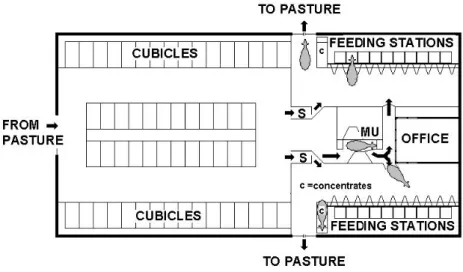
The research farm where the grazing experiments (Papers I and III) were carried out was equipped with a DeLaval Voluntarily Milking System (DeLaval VMS™, Tumba Sweden). The barn layout is presented in Fig. 2. The AM barn was a loose-housing system including a resting area with 54 cubicles, two separate but identical feeding areas, each with one concentrate feeder and 10 roughage feeding stations. From the resting area the cows could reach the feeding areas via one of two selection gates or through the milking unit. The gates to the pasture area were located in both feeding areas and were open 24 h per day allowing for continuous grazing throughout the grazing season. The cows that were due to be milked could not go to the pasture without passing the milking unit. Two different pasture areas were used during the grazing experiments. One area adjacent to the barn, pasture “Near”, and one farther from the barn, pasture “Distant”. The layout of barn and the pasture areas is shown in Fig. 3.
Fig. 2. Layout of the AM system in the experimental barn
Fig. 3. Layout of the barn (X) and the Near and Distant pasture areas with locations of drinking water (W) and cow track to the pasture areas (---).
In the study concerning sensory stimuli (Paper IV), cows were housed in a conventional system with individual tie-stalls. In the first learning study (Paper
Roughage feeding and concentrate allowance were controlled on an individual level in all experiments with the exception of the first learning study (Paper II) where the heifers were offered a total mixed ration ad libitum on a group level. In the AM barn, cows received a small amount of concentrate (0.5 kg) in the milking unit. The rest of the concentrate ration, which was based on the cows’ milk yield immediately before the start of each experiment, was supplied in the concentrate stations.
Registrations
Behaviour observations
In the grazing study (Paper I), behaviour observations were conducted on 30 of the 45 cows in the herd, 10 from each treatment group. Instantaneous time-sampling observations were made on each cow every 15 min during 6-h periods evenly distributed over the day and night. Altogether seven 24-h cycles were observed. Location (feeding or resting area, cow track and pasture), position (standing or lying) and behaviour (grazing, walking, eating in the barn, other) were recorded.
In both learning studies, the animals’ response, approach/no approach, following the signal and control periods (no signal) was recorded. The latency to approach the feed source following a signal or control period was also recorded. In the second learning study (Paper III), cows were also marked with white paint and video recordings were made in the barn to register the cows’ location and behaviour upon receiving a signal.
In the stimuli study (Paper IV), recordings of individual cow behaviour were made from 05.30 to 09.30 during the last day of each treatment, with instantaneous direct observation of each cow at 5-min intervals.
Sampling and data collection
Detailed descriptions of sampling and analyses are described in Papers I-IV.
During the grazing experiments, sward height was measured with a Massey plate meter (Holmes, 1974), and sward was sampled twice weekly in early season and once weekly later in the season in both pasture areas.
In the experiments carried out in the AM barn, milk yield, milking frequency, milking interval, milk flow, passages through the milking unit and selection gates, and feed intake indoors were recorded automatically by the AM system (Papers I
and III). In the barn with tie-stalls (Paper IV), milk yield was recorded at each milking daily during the experiment using a Tru-Test milk meter (GM Tru-Test, DK-2840 Holte, Denmark). Milk flow curves were recorded with Tru-test milk meters and by visual readings of accumulated milk in the meter every 30 s (Rasmussen et al., 1990). Sampling of milk for analyses of protein, fat and lactose content was performed during 24-h periods in the AM barn before the initiation of the experiment and at the beginning and end of each experimental period. In the
tie-stall barn (Paper IV), a milk sample was collected from the Tru-test meter on the last day of each treatment for analyses of the milk composition, samples were taken one time during each treatment period.
Blood sampling was performed on the last day in each treatment period on all cows in the sensory stimuli study (Paper IV). The cows were fitted with a semi-permanent cannula in the jugular vein four days prior to blood collection. Samples were taken during the morning milking, –15 and –1 min before milking. Thereafter, samples were taken when the cluster was attached (time 0), and every min thereafter for 8 min and at 10, 12, 14, 16, 30 and 60 min after the onset of milking.
Analyses
Herbage samples were analysed according to the Swedish standard method (Spörndly, 2003) to determine metabolisable energy (ME), neutral detergent fibre (NDF) and crude protein (CP). In addition, dry matter (DM) content was determined in silage samples.
The fat, protein and lactose contents were analysed using a mid-infrared spectroscopic technique (MilkoScan FT 120, Foss Electric, Hilleröd, Denmark). Plasma was analysed for oxytocin concentrations using the radioimmunoassay according to Schams (1983). Cortisol was analysed with an enzyme immunoassay as described by Sauerwein, Duersch & Meyer (1991) and EDTA-stabilised plasma samples were assayed for adrenocorticotropic hormone (ACTH) using a modified version of the time- resolved fluoro-immunometric assay (TRIFMA) initially developed for human blood samples by Dobson et al. (1987).
Statistical methods and models are described in detail in each paper. Analyses of variance were performed with a standard General Linear Model for milking parameters, whereas the Mixed procedure was used for hormone analyses, both using the statistical analysis system SAS 8.2 (2001). Chi-square and Fisher’s exact test were used in the learning studies (Paper II and III).
Results
Effects of distance and feeding level (Paper I)
The results in this experiment were analysed for two periods where the first period covered the first half of the grazing season and the second covered the latter part of the grazing season.
There was sufficient herbage of good quality in both pasture areas throughout the grazing season, with a sward height of approximately 12 cm and with metabolisable energy of 10.6 MJ/kg DM.
Milking frequency and milk yield
The hypothesis that a long distance to pasture would lessen the cows’ motivation to move between pasture and barn and thereby affect the number of milkings and milk production was confirmed. As shown in table 2, cows grazing at the near pasture had a markedly higher milk yield compared with cows in the treatment group distant pasture at the same level of silage supplements throughout the grazing period. During the first period, cows grazing at near pasture also had a much higher milking frequency and considerably more visits to the barn compared with cows grazing at distant pasture. Our hypothesis that a high level of supplements would increase the visits to the MU was not confirmed. On the contrary, during the latter part of the season cows in group distant pasture with ad libitum silage had a much lower milking frequency than cows in groups with a low level of silage supplements on distant and near pasture.
Primiparous cows had a greater number of visits to the barn and number of daily milkings compared with multiparous cows. No difference in milk production was found between first lactating and older cows.
Table 2. Milk yield, number of milkings and number of visits to the barn for cows exposed to the treatments Near Pasture (NP), Distant Pasture (DP) and Distant Pasture plus Silage (DP+S).
Treatment groups
Period
NP DP DP+S
Milk yield (ECM kg) 1 30.5a 26.8b 28.0ab
2 26.9a 22.7b 25.6ab
Milkings, no/d 1 2.5a 2.3b 2.3b
2 2.5a 2.5a 2.1b
Visits to barn, no/d 1 6.1a 4.9b 4.3b
2 5.4a 4.6ab 3.9b
Behaviour
There were no differences in the time spent outdoors or any other behaviour variable for the two treatment groups that grazed together at the distant pasture. Cows in the treatment near pasture spent significantly (P<0.001) more time outdoors compared with cows in both groups grazing at the distant pasture. Despite these differences, the distance did not affect the time spent grazing, which was approximately 20% for both pasture areas during the first half of the grazing season. The cows at near pasture continued to graze at the same level throughout the pasture season whereas the time cows at the distant pasture grazed dwindled to 9% (P< 0.01) during the latter part of the grazing season. There was a remarkable increase in the time the cows in both treatment groups at the distant pasture spent in the cow track during the second half of the grazing season compared with the first; from 8% during the first part of the grazing season to 32% during the second half. Animals in the treatment group near pasture spent only 4% of their time in the cow track during both periods.
Cows in all treatment groups spent 10 to 11 h each day lying down. However, there was a large difference in where the cows in the two treatment groups choose to lie down. Averaged over the seven observation days, cows in the group near pasture spent 80% of their total lying time on pasture. Cows in groups on the distant pasture spent 29% of their total lying time on the pasture during the first part of the season. Towards the end of the grazing season, both groups on the distant pasture spent almost no lying time on pasture and about half of their total lying time in the cow track in close vicinity of the barn.
Comments and evaluation of the experiment
In Scandinavia, there is large variation in quantity and quality of pasture during the grazing season. Therefore, the different treatments were run simultaneously to ensure that the pasture conditions were comparable during this experiment (Paper
I). However, cows in both treatment groups on the distant pasture grazed together and shared the same feeding area in the barn. It is possible that competition and social facilitation influenced the results and effects could have been different if the two groups had been separated physically and visually. Conversely, running the treatments simultaneously for a longer period gave us the opportunity to measure long-term effects of the treatments. If we had performed the treatments consecutively, it would not have been possible to separate the results of treatment from the effects of season.
The first weeks on pasture were used as a habituation time for the cows to find their way out to pasture and back to the barn. For the cows at the distant pasture area, the habituation took longer than for cows grazing near the barn. During the first week after pasture turnout, cows on the distant pasture needed training to find the way to their pasture area and so were herded along the cow track to the pasture area. After the first week, the animals were left to find their own diurnal rhythm. During this time, the milk production parameter was measured automatically but unfortunately we did not register the cows’ behaviour during the habituation period. This would have given us valuable information about the actual grazing time of cows on the distant pasture.
The cow track is another factor that could have had an impact on the results for the treatment groups at the distant pasture. First of all, the cow track to the distant pasture ran along the near pasture paddock. Cows on their way to the distant pasture walked past the cows grazing in the near pasture area, which created an obstacle on the way to the grazing area. The problem was most evident in the beginning of the experimental period. The cows were also forced to walk by a farm building to reach the distant pasture. It was not possible for the cows to see their pasture area from the barn and they could not see if there were other cows grazing there.
Heifers’ response to acoustic signals after a training period in an
experimental setting (Paper II)
The first learning study was carried out in a small experimental setting and included four different experiments where the animals were trained in two different ways to approach a feed bowl following an acoustic signal. Operant conditioning training resulted in eight of ten heifers approaching the feed bowl much more often following a signal than in the control periods with no signal, which confirmed our hypothesis. Of the eight animals, six approached the feeder during some of the control periods. However, the mean latency to approach the feeder was much shorter after a signal compared with control periods. To test the animals’ memory we conducted another test session 27 d later on four of the first heifers that were trained. The results showed that all heifers approached the feed bowl more often following a signal than during control periods (P<0.05). The mean latency to approach the feeder after a signal was even faster than during the first test session.
The heifers were also tested to see if they could transfer their learning to a location other than where they were trained but none of the heifers succeeded during the test session.
Our hypothesis that cows can be trained by classical conditioning to approach a feed source following a signal was not confirmed. None of the heifers approached the feeder to any greater extent after a signal compared with control periods. However, some showed a tendency to visit the feed bowl more often following a signal.
Comments and evaluation of the experiment
In the experiment reported in Paper II, it was clear that by using operant conditioning, cattle could be trained to approach a feed source after hearing a signal issuing from their collar. Operant conditioning has also been used by other researchers, who have succeeded in training cattle to respond to auditory stimuli (e.g. Albright et al., 1966; Murphey & Duarte, 1983). There is, however, a great difference between those authors’ experiments and the present experiment. In our study, the signal came from the collar on the heifer whereas the cattle in the other experiments were trained to approach the feed source from where the auditory stimuli was sounding. Hence, the reward was at the same site from where the auditory stimuli was sounding. It seems likely that it is easier for the animals to approach the location from where the signal is actually sounding than to hear the signal from one place (i.e. the collar) and respond by moving to another location (i.e. the feed bowl).
We also used classical conditioning in an attempt to obtain the same results as with operant conditioning. During training, the heifers were tied up close to the feeder to ensure that every given signal was rewarded. However, it seemed that this procedure made it difficult for the animals to connect the signal to the reward. Later, when they were let loose during the test session, the animals had difficulties to understand that they were supposed to approach the feeder after the sounding of
a signal. This might have been avoided if we had begun with a small experimental area for the training and enlarged it as the training sessions progressed instead of tying up the cows. It is also possible that the learning process is slower with classical conditioning and perhaps a longer period of training is needed for the animals to learn to respond to the signal.
Cows’ response to acoustic signals after training in an AM barn
(Paper III)
In this experiment, dairy cows were trained in the AM barn during the grazing season to approach the milking unit in response to an acoustic signal sounding from a box attached to the collar. During training, which took place in the waiting area and one feeding area closed by gates, the cows visited the MU after almost every signal and 8 out of 10 cows learnt to respond to the signal. There was, however, a gradual decrease in visits during control periods when there was no acoustic signal.
During the evaluation periods, July and September, respectively, the results for the cows that had learnt to respond to the signal demonstrated that a correct response, defined as entering the MU or the waiting area after a signal within the stipulated time, ranged between 15 to 75% for the individual cow when indoors. The corresponding correct response when the animals were outdoors ranged between 0 and 33%. Thus, when the signal was given while the cow was in the barn, there was a higher probability (P<0.01) for a correct response compared with outdoors. The number of correct responses to a signal was at the same level throughout the first evaluation period (July), with a group average of 44% during the first week and 45% during the last week. For cows evaluated in September, a correct response following a signal decreased from 48% in the first week to 28% in the last week of the evaluation period. The behaviour observations showed that cows making a correct response generally found the MU occupied and ended up in the waiting area. Two cows were never rewarded during the entire evaluation period and in total, the cows were rewarded for a correct response for only 16% of all correct responses.
Comments and evaluation of the experiment
The experiment indicated that it is possible to train cows by operant conditioning in an applied setting. The fact that the cows already were familiar with the AM system may have had an affect on the results both during the training and evaluation periods. They were accustomed to receiving concentrate in the MU so they visited the MU after almost every signal during training. However, the animals gradually learnt the meaning of the signal, which is shown by the decrease in visits during control periods. The hypothesis that the signal could act as a reminder was partly confirmed as the experiment demonstrated that some of the cows often responded to the signal. The likelihood of a correct response was very low when the cows received the signal outdoors. This could be a consequence of the differences between the training context and the context during the evaluation period (Domjan, 2003). Thus, to obtain a good response outdoors it may be
necessary to train the cows from the cow track and the pasture area. The training could be divided in steps and as a first step to train the cows indoors close to the MU. The next step would be to train a distance from the MU, then outside adjacent to the barn and later on, farther from the barn.
Sensory stimulation during milking (Paper IV)
Milking related release of hormones
In this study the cows received enhanced sensory stimulation during milking by feeding or stroking of the abdomen with a brush. Our hypotheses that the two stimuli would affect the levels of oxytocin and cortisol were partly confirmed but in different ways for the two types of stimuli. Overall, there was a large variation among cows in the milking-induced release of oxytocin, ACTH and cortisol. Basal oxytocin concentrations were similar in all treatments and ranged from 7.1 to 8.8 pg/ml. Milking gave a noticeable rise in plasma oxytocin above basal levels, (time –15). When milking was combined with feeding, the oxytocin concentrations during the time interval 0 to 5 were higher compared with milking alone. All treatments showed a marked increase from basal levels of plasma ACTH. Milking alone gave the expected increase in plasma cortisol. When milking was combined with brushing there was a considerable decrease in cortisol levels during the first 3 min of milking and the expected milking-related release was depressed. Further, cortisol levels were significantly (P<0.05) lower 60 min after the start of milking compared with basal level.
Milk production
There was a positive effect of feeding during milking with a considerably higher milk yield whereas brushing had no effect on milk yield. The milking time (machine-on time) was longer for treatment with feed (P<0.05). Milk flow (kg/min), peak flow rate and peak flow time did not differ between treatments. Further, the different stimuli had no affect on milk composition.
Behaviour
The cows’ behaviour was observed in the time interval from 30 min before milking to 90 min after milking. There was no difference between treatments in the cows’ behaviour before milking. Nor had the different treatments any effect in the frequency of standing, lying and ruminating during the 90 min period after milking. However there was a tendency (P=0.11) that cows fed during milking were lying and ruminating more compared to milking without feeding. Stroking with a brush had no effect on the behaviours standing, lying or ruminating.
Comments and evaluation of the experiment
A factor that could have had an impact on the result is that during sampling time for blood collection and registrations from the Tru-test meter, 3 to 4 people were around the cow. We could though, not from the plasma levels conclude that the cows were suffering from stress. The levels of ACTH, which rise during stress situations (Stephens, 1981) increased at the beginning of milking. However,
milking dairy cows stimulates the release of cortisol, which is required for maintenance of lactation (Tucker, 2000) and the regulator for cortisol release is ACTH. The cows in our experimental barn are used to being handled and it is not likely that the cows were made anxious by having many people around them. In the present experiment there was a large variation in plasma levels between cows and blood samples were taken only once in each treatment. These factors could have affected the results from the experiment.
General discussion
The challenge for farmers combining grazing with AM is two-fold. On one hand, the cows must visit the MU sufficiently often every day to avoid a drop in milk production. On the other hand, the cows should graze enough to cover a large part of their energy requirement with high quality pasture. The challenge is to balance the quantity, quality and location of pasture with the quantity, quality and location of feeding supplements and other stimuli that may increase the cows’ motivation to visit the MU. This means that the farmer must be flexible and interested in cow management. The research included in this thesis demonstrates that both environmental and management routines have an affect on the cows’ willingness to visit the MU, being in the barn and being at pasture.
Distance to pasture affects production and behaviour
Milking frequency and milk yield
In our experiment (Paper I), cows with the pasture area 260 m from the barn had fewer visits to the barn and fewer milkings during the first part of the season compared with cows grazing near the barn, indicating that the distance had a negative affect on their motivation to walk between pasture and barn. In a survey of 25 farms in the Netherlands where an analysis was performed on farms with no fetchings, the number of milkings decreased as the distance increased with 0.18 fewer milkings per km (van Dooren, Spörndly & Wiktorsson, 2002).Conversely, Ketelaar-de-Lauwere et al. (2000) did not find any affects of distances up to 350 m on the number of visits to the MU or the number of milkings. This is in agreement with another experiment where distance to pasture did not influence the number of milkings when distances less than 150 m versus more than 500 m were compared during 8-day experimental periods (van Dooren, Heutinck & Biewenga, 2004).
During the first half of the season (Paper I), milk yield, both in kg of milk and kg of ECM, was lower for the group grazing at the distant pasture and with limited silage supplements. Judging from the number of visits to the MU and the behaviour observations performed it seems reasonable to assume that the cows at the distant pasture in our study walked at least twice a day back and forth between barn and pasture. The average of the minimum and maximum distances between barn and pasture indicated that cows at the distant pasture walked approximately 2
km farther a day than cows near the barn, presuming that the cows walked twice a day to the pasture and back to the barn. This means that the cows at the distance pasture had a higher energy requirement for walking, although walking in the cow track was likely low-intensive exercise. The increase in energy demand for walking 2 km/d is around 5% of maintenance corresponding to approximately 0.5 kg of milk according to NRC (2001). The lower milk yield cannot be explained solely by the cows at the distant pasture having a higher energy requirement. An additional explanation for a lower milk yield is the fact the cows grazing at the farther distance had a difficult habituation following their pasture turnout. This could have led to a low intake of herbage, especially for the cows in the group without ad libitum silage supplements, leading to a decrease in the milk production as early as in the first week after pasture turnout. In total, the difference of milk yield between the treatments near and distant pasture could be a consequence of the troublesome habituation of moving between the barn and the pasture area and the higher requirement of energy as the cows walked a longer distance daily.
In Paper I, an explanation for cows curtailing their walking to pasture distant could be attributed to the condition of the cow track, which became very muddy after some days of heavy rainfall in mid-season. After this period the cows on distant pasture had almost ceased to walk to pasture and instead, lingered and rested in the cow track. Even though the cow track dried up the cows did not resume grazing at the same level as earlier. One consequence of cows staying in the cow track instead of walking to the distant pasture was that they were as close to the barn as the cows in the group grazing near the barn. This could be an explanation why the number of milkings did not differ between cows on near pasture and cows on distant pasture during the latter part of the season.
Grazing behaviour
Besides milk production and milking frequency, the distance also had an impact on the cows’ motivation to walk to the pasture area. The location of the distant pasture area made it impossible for the cows to see the pasture where they were heading (Fig. 2). Larkin & McFarland (1978) suggested that animals might be more prepared to work for feed if they actually can see it. Perhaps the cows would have made the effort to walk at a minimum 260 m to reach the grass if they had seen the pasture area when they came outside the barn. Hence, it is likely that the long distance per se in our experiment was not a problem, rather the fact that the cows could not see the pasture area from when they came out from the barn. In fact, it has been demonstrated that cows spend as much as 8 h per day walking, including time walking while grazing. In addition, walking time always exceeded the time of grazing by 10 to 15% (Ruckebush & Bueno, 1978). In an experiment carried out over 2.5 years, the daily walking distance for cows with access to pasture was reported to range from 2.0 to 3.4 km (Krohn & Munksgaard, 1992). Cows with the pasture area near the barn spent most of their time outdoors and to a much greater extent than cows on the distant pasture. It is however interesting to note that the time spent grazing was the same for cows on both pasture areas,
about 20%, corresponding to almost 5 h daily during the first half of the grazing season. Time spent grazing depends on many factors including the quality and quantity of the pasture (Phillips & Leaver, 1986). Even though the grazing time in our study was quite low, it is within the range of 2 to 5 h daily in a conventional milking system, reported earlier (Krohn & Munksgaard, 1992) whereas another experiment described grazing time up to 12 h/d (Rook & Yarrow, 2002). The great differences between conventional milking and automatic milking make it difficult to compare grazing times among experiments conducted in the two very different systems. However, in a study by Ketelaar-de Lauwere et al. (1999) cows with access to pasture 24 h had a foraging time 5.7 to 6.3 h. Since this also includes time in feeding area, grazing time agrees with our results. During the latter part of the grazing season (Paper I), cows on the distant pasture markedly reduced their grazing time, grazing only 7 to 9% per 24 h. The finding that cows ceased to walk to a distant pasture is in accordance with the results reported by Ketelaar-de-Lauwere et al. (2000) where cows on “far” pasture (360 m from barn) spent more time grazing the first period they were on that pasture area but grazing decreased when they were on “far” pasture the last period.
Lying behaviour
In our study we also found that distance to pasture had an affect on where the cows were lying. The amount of time dairy cows spend lying down is considered to have a great impact on their comfort and welfare. Usually cows at pasture lie down for 9.6 to 11.8 h per day (Singh et al., 1993; Krohn & Munksgaard, 1993) and if they have a choice they prefer lying on pasture rather than in cubicle (Krohn & Munksgaard, 1992; Ketelaar-de Lauwere et al., 2000). The total time lying for the cows in our experiment (Paper I), corresponds well to data mentioned above, and was 10 to 11 h per 24 h. However, distance to pasture had a great impact on where the cows chose to lie down. Based on averages from all seven observation days, cows on the near pasture area spent 80% of their total lying time on pasture whereas the corresponding figure for the two groups on the distant pasture was approximately 25%. This is in agreement with Ketelaar-de Lauwere et al. (2000) where cows on the “far” pasture area spent less time lying on pasture.
Pasture and supplement allowance
The amount of pasture herbage is an important factor that might influence cow motivation to move between the pasture and barn. In addition, the quality of pasture affects the grazing behaviour (Ruckebush & Bueno, 1978). The cows in our study (Paper I) had a high pasture allowance with a sward height of approximately 12 cm throughout the grazing season. During the first half of the grazing season, the pasture herbage enticed the cows to walk the longer distance to pasture, even for the group with ad libitum silage available in the barn. Nevertheless, the cows visited the barn 4.3 to 4.9 times a day and were milked 2.3 times daily during the first half of the season. But, the high level of silage supplements did not increase the cows’ motivation to visit the MU nor had it an affect on milk production in either of the grazing periods. On the contrary, the milking frequency was lower compared with the cows in the other group at distant pasture that only were offered a low level of roughage supplements. Bargo et al.
(2003) pointed out that milk production is not affected when cows are offered silage supplements at high pasture allowance and in our study the pasture allowance was high throughout the experimental period. In a Dutch experiment the amount of supplements had no affect on number of milkings or milk yield (van Dooren, Heutinck & Biewenga, 2004).
During the latter pasturing period (Paper I), cows with a high level of supplements had considerably fewer milkings than cows with limited silage supplements. This could be a consequence of cows offered only 3 kg DM were hungrier and passed through the MU more often to obtain feed. Interestingly, cows that had ad libitum
silage supplements did not increase their silage intake during the second half of the season, although they only spent about 9% of the time grazing. On the contrary, during period 1, their silage intake was 7.2 kg DM and this decreased to 5.7 kg DM during the latter part of the season. One explanation for this could be the fact that the cows’ concentrate ration was the same throughout the experiment and was not decreased as the cows progressed in their lactation stage.
It has been reported that the grazing time is not affected by supplementary silage at high sward heights (Phillips & Hecheimi, 1989) and this was also the case in our study (Paper I). Results from the earlier mentioned Dutch experiment reported contradicting results from two different years. During the first year, cows on a low supplement level had the lowest grazing time whereas during the second year cows with a high level of supplements had the lowest grazing time (van Dooren, Heutinck & Biewenga, 2004).
In the study reported in Paper I, the sward height was high throughout the grazing season indicating a high herbage allowance during the entire experiment. Therefore, we could not see an affect on the cows’ motivation to move between pasture and barn because of decreased sward heights. In a small behavioural study, a 50% decrease in grazing time as sward height decreased was observed in grazing cows with ad libitum access to a mixed ration in the barn while no such decrease was observed for cows without the mixed ration supplements (Salomonsson & Spörndly, 2000). In an experiment by Ketelaar-de Lauwere et al. (2000) where cows were supplemented with maize silage, the time cows spent in the pasture area decreased with lower sward height. In the same experiment, cows entered the MU more frequently at lower sward heights and were thus milked more often. Although the sward height (Paper I) did not decrease as the season progressed, the pasture was no longer a fresh feed and the cows did not seem to find it worth the effort to walk to the distant pasture. According to Phillips (1993), the grazing intensity increases when fresh pasture is offered to cattle. The fact that the herd was not rotated to new grazing areas may also have contributed. For the cows on the distant pasture the motivation of moving out to pasture from the barn or the cow track adjacent to the barn was too low. This was the case not only for the cows with ad libitum silage supplements but also for cows in the group offered only 3 kg DM silage. Even though they only received 3 kg DM silage per day they stayed in the cow track rather than walking to pasture. It was probably too
complicated and laborious making the long walk not worthwhile even though there was sufficient high quality herbage.
Restrictions on pasturing time
Cows in the experiments with grazing (Papers I and III), had unrestricted access to the pasture area, that is, 24-h grazing. Nevertheless, the cows had 2.3 to 2.5 milkings/d and this was also seen in another experiment conducted at our experimental farm with 24-h grazing (Spörndly & Wredle, 2005). During the indoor period before the cows were let out on pasture the milking frequency was 2.4 to 2.7 milkings/d. This period was just a few years after the introduction of AM in the experimental barn and the number of milkings per d during the indoor period gradually increased during the years. However, the number of visits to the MU and as a consequence the number of milkings have been shown to be higher with restricted compared with unrestricted grazing, 2.8 milkings/d and 2.3 milkings/d, respectively (Ketelaar-de Lauwere et al., 1999). In the restricted treatment the cows were kept indoors between 17.30 h to 05.30 h.
Not only the number of milkings but the behaviour of the cows might change if pasturing time is restricted. The results from an on-farm study on seven Danish farms, showed that when cows had access to pasture only a few hours daily they stayed outdoors for 85% of the available time. When pasture was available for more hours, the average time spent outdoors was 40 to 60% of the available time (Munksgaard & Krohn, 2004). In our experiment with 24-h grazing (Paper I), the cows spent 45 to 68% of the time outdoors. Cows that were housed overnight were observed to decrease their grazing time compared to cows that had access to pasture day and night (Phillips & Leaver, 1986). Cows in Paper I and III, had a long grazing period in the evening, which in many cases ended when it became dark, around 23.00. This is in accordance with studies on cows milked in a conventional system where intensive evening grazing bouts have been measured (Rook, Huckle & Penning, 1994; Rook & Huckle, 1996) but also cattle living under unrestricted conditions have demonstrated grazing peaks at dawn and dusk (Hancock, 1953). Dusk and dawn have been suggested to be the most important grazing period for cows (Rook & Huckle, 1996). It could therefore be expected that during grazing peaks the motivation to be milked is low and the AM system not used during these periods.
More factors that affect the cows’ choice of location and activity
Synchronization of behaviour
When a cow sees other cows grazing she will most likely be motivated to start grazing through the process of social facilitation and grazing has been shown to be considerably more synchronized than ruminating (Rook & Huckle, 1996). Grazing was clearly synchronized in our experiment (Paper I) especially during evenings when about 60% of the cows were grazing at the same time and cows that were trained to visit the MU following an acoustic signal (Paper III), had a low percentage of correct responses when they were outdoors. This could be a
consequence of cows being reluctant to leave the herd mates and walk back to the barn alone.
We further observed that when a few cows moved out to pasture, other cows that were standing/idling in the barn exit or in the cow track were encouraged to move and this was especially obvious for cows grazing on the distant pasture. Moreover, cows left the pasture area and entered the barn more or less in very close succession; this latter finding is in agreement with the study by Ketelaar-de Lauwere et al. (1999). On many occasions (Paper I), the distant pasture emptied of animals in just a few minutes. This was noticed especially when cows left the pasture during the night. Cows at the near pasture exhibited a different behaviour pattern when moving between barn and pasture. Interestingly, these cows seemed to be more independent and on many occasions, moved back and forth between barn and pasture without company of herd mates. This independent behaviour pattern was also observed in a pilot study conducted at the same experimental barn where cows walked alone in 51% of the passages between barn and pasture area near (Bergman, 2004). A possible explanation is that the cows could see the pasture area near as soon as they walked out of the barn and thus could see other cows at pasture. It was as though the pasture area near become a part of the barn area.
Winter and Hillerton (1995) also described a de-synchronisation of feeding and lying patterns in an AM system and management routines can influence the degree of synchronization of the cows’ behaviour. Many authors (i.e. O’Connell et al., 1989; Miller & Wood-Gush, 1991; Krohn & Munksgaard, 1992) have found that cows behave less synchronised indoors. According to Miller & Wood-Gush (1991) it was only when fresh food was given in the morning that synchronization in behaviour indoors was seen. When fresh silage was supplied to the cows (Paper
I and III) especially early in the morning, there was a peak in attendance in the feeding area. This led to a peak of cows queuing in front of the MU. Similar finding were observed by Ketelaar-de Lauwere et al. (1999) where cows left pasture and walked to the feeding place in the barn when fresh roughage was supplied in the morning. The cows learnt to expect that roughage feed was supplied in the morning, as a consequence the whole herd left pasture, and returned to the barn. Even though it is not a desirable situation to have the whole herd returning to the barn at the same time resulting in cows queuing to be milked, it surely limits the number of cows requiring fetching.
Location of drinking water
The impact of drinking water availability is not included in the present thesis. However, the location of drinking water is considered to be an important issue and can be discussed briefly. Some farmers offer water only in the barn to maintain a milking frequency of more than 2 milkings/d also during the grazing season. This practise is followed by many farmers in for example Sweden, the Netherlands (van Dooren, Spörndly & Wiktorsson 2002) and Denmark (Munksgaard & Krohn, 2004). This may not be a problem in countries with moderate ambient temperatures but a recent study showed that cows given the opportunity to drink
water at the pasture consumed 55% of their water intake out in the field during the period they were on a distant pasture and 67% of their intake when grazing near the barn (Spörndly & Wredle, 2005). Thus, to a high degree the cows preferred to drink while grazing.
In contrast, cows whose access to water was restricted to the AM barn had a high intake of water the first 30 min after they had entered the barn from pasture (Spörndly & Wredle, 2005). Similar finding were reported by Ketelaar-de Lauwere et al. (1999) where cows that had access to pasture 24 h were recorded at drinking troughs in the barn within 10 min after entering the barn in 35% of the cases. However as much as 34.5% of the cows left the barn without drinking and thus had to wait until they entered the barn the next time to have access to drinking water. In the experiment by Spörndly & Wredle (2005) the milking frequency did not differ between cows with water in the barn only and for cows offered water both in the barn and in the field, 2.40 and 2.39 milkings per day, respectively. This indicated that it is possible to maintain a similar milking frequency even if the cows have drinking water at pasture. Taking animal welfare into consideration, there seems to be no reason for not offering the cows water at pasture. Other stimuli are therefore recommended to motivate the cows to the barn.
Weather conditions
One factor that influences the cows’ choice whether to be indoors or outdoors is weather conditions. Heavy rainfall (Arnold, 1985) often disrupts and decreases the grazing time. This was the case in our experiment, (Paper I) where the animals were observed to be indoors most of the time during a period of heavy rainfall. This was especially true for cows grazing at the distant pasture. Cows grazing near the barn often walked out to pasture during lighter showers whereas cows on the distant pasture remained in the barn also during drizzle. The grazing season weather during the studies reported in Paper I & III was not very hot. However, Ketelaar-de Lauwere et al. (1999) reported that during the days with high temperatures the cows stayed indoors in the shade during the day but they stayed outdoors during the night, leading to low numbers of milkings during the night. If the pasture area offers shade, the animals are likely to spend more time outdoors and it is possible that the number of milkings will decrease. Conversely, if the animals do not find shade they will seek it in the barn with the consequence of less grazing but with increased milking frequency.
Enhanced stimulation during milking
The primary reason for offering, at least a small amount of concentrate, in AM systems is to motivate the cows to visit the MU, thus, the concentrate is used as a lure. Other types of reward may also generate a strong motivation to visit the milking unit. It has been suggested that customary playing of music during milking has a positive affect on cows’ voluntary visits to a holding area and milking compartments (Uetake, Hurnik & Johnson, 1997).
In the study reported in Paper IV we observed that enhanced sensory stimulation performed either as feeding during milking or as brushing of the abdomen (increased touch sensation) influenced the endocrine pattern in dairy cows and consequently milk production and behaviour. However, it was obvious that the two types of stimuli affected the animal in different ways. In the feeding situation the milking-induced release of oxytocin was elevated. In the brushing situation, the milking-related release of cortisol was markedly depressed. The effects of these responses are open to speculation. It is well known that for complete milk removal oxytocin levels only need to reach a threshold level and concentrations above have no importance for milk ejection (Gorewit & Sagi, 1984; Schams et al., 1984). It is, however, important that oxytocin concentrations are elevated during the entire milking (Bruckmaier, Schams & Blum 1994). When cows are milked and fed or stroked with a brush simultaneously, more sensory information is sent to the brain compared with milking alone (or feeding/brushing alone) which can influence the endocrine response.
Production
The results from Paper IV further indicated that milking combined with feeding render production benefits. When the cows were milked and fed simultaneously, the release of oxytocin was higher during the first 5 min and milk yield was higher than when milked alone. This is partly in agreement with earlier findings (Brandsma, 1978; Samuelsson, Wahlberg & Svennersten 1993; Svennersten et al., 1995; Johansson et al., 1999) where milk yield was increased through routine milking and feeding at the same time. In those studies, milk flow was also higher and udder evacuation improved. Better udder emptying was not indicated in our study (Paper IV), since there were no differences in the fat content in last milk fraction. It is therefore possible that the enhanced production could be a result of oxytocin’s galactopoietic effect.
Hormonal response
The reason for an increased milk yield when feed was supplied during milking (Paper IV) might have an endocrinal explanation, which also could partly explain the results in the earlier studies. Milking induces a vagal activation in ruminants (Andersson, Kitchell & Persson, 1958) and this can result in a release of gastrointestinal (GI) hormones both in cows (Svennersten et al., 1989) and monogastrics (Eriksson et al., 1994). The enhanced activities in the GI tract might thereby improve the nutritional uptake and as a result have a positive effect on milk yield. One pathway for the feeding related release of oxytocin is activation of sensory nerves in the oral mucosa. These fibres project directly to the nucleus of the solitary tract (NTS), which is linked to the paraventricular nucleus (PVN), and thereby oxytocin is released (Sofroniew, 1983). Thus, when milking was combined with feeding in our study resulting in a higher milk yield, both vagal efferent and afferent pathways might have been involved in the higher concentrations of oxytocin. It can also be hypothesised that oxytocin might act as a hormone in other ways. A positive correlation between raised oxytocin levels and milk production has been indicated in cows (Samuelsson, Wahlberg & Svennersten, 1993). Further it has been demonstrated that administration of
oxytocin in rats increases the levels of growth hormone, which in dairy cows is an important galactopoietic hormone (Björkstrand, 1995). Interestingly, it has been observed that oxytocin might influence the synthesis in milk secretion cells (Lollovier & Marnet, 2005).
New findings further suggest that oxytocin is involved in an anti-stress pattern by lowering cortisol levels and blood pressure (Uvnäs-Moberg, 1998). Since a similar pattern has been observed when massaging the abdomen of rats (Kurosawa et al., 1995; Ågren et al., 1995) and in cows (unpublished, Munksgaard & Herskin, 2004), it has been argued that this type of sensory stimulation increases oxytocin. In our experiment (Paper IV), milking in combination with feeding gave higher oxytocin levels during the first 5 min while stroking the abdomen with a brush did not influence oxytocin secretion. Instead, the milking-related release of cortisol was markedly depressed. In other studies, oxytocin has been observed to decrease cortisol levels (Pettersson et al., 1999). However, in our study, the oxytocin levels during brushing were not as high as during feeding and it is possible that the depressed cortisol concentrations have another explanation. It has been discussed that increased oxytocin levels and decreased cortisol levels represent two different aspects of a psycho-physiological anti-stress pattern, which is coordinated by oxytocin into the central nervous system (Uvnäs-Moberg, 1998; Johansson et al., 1999; Johansson, Redbo & Svennersten-Sjaunja, 1999). It possibly reflects an anti-stress pattern with a lowering of milking-related cortisol secretion. It is possible that brushing induces some facets of this anti-stress pattern in dairy cows. It can be speculated that brushing generates a sense of well being and when performed in the milking unit could attract the cows to milking.
Behaviour
There were no differences between treatments in the total time cows ruminated. However, cows that were milked and fed simultaneously had a tendency to lie down and ruminate more compared to when they were only milked. This finding is in agreement with an experiment by Johansson, Redbo & Svennersten-Sjaunja (1999) where cows were lying and ruminating more when fed during milking. It has been shown that oxytocin has a sedative effect (Uvnäs-Moberg et al., 1994) and since milking in combination with feeding gave a higher level of oxytocin during the first 5 min (Paper IV), the differences in behaviour might be due to the enhanced oxytocin concentrations.
Stroking with the brush had no impact on any of the behaviour parameters we measured. In rats, stroking the abdomen decreased blood pressure and cortisol concentrations in the blood and induced calmer animals. Although the cows had lowered cortisol concentrations with brushing combined with milking, we did not observe any affects on the behaviours that were measured.
Can acoustic signals bring cows to the milking unit?
A totally different type of stimulus is the acoustic signal used in both Papers II
and III. There is no doubt that an animal can form an association between an auditory signal and feed. The first learning study (Paper II) indicated that by using