Logging and Recovery in Adaptive Software
Distributed Shared Memory Systems
Angkul Kongmunvattana and Nian-Feng Tzeng
Center for Advanced Computer Studies
University of Southwestern Louisiana
Lafayette, LA 70504
Abstract
Software distributed shared memory (DSM) improves the programmability of message-passing machines and work-station clusters by providing a shared memory abstract (i.e., a coherent global address space) to programmers. As in any distributed system, however, the probability of software DSM failures increases as the system size grows. This pa-per presents a new, efficient logging protocol for adaptive software DSM (ADSM), called adaptive logging (AL). It is suitable for both coordinated and independent checkpoint-ing since it speeds up the recovery process and eliminates the unbounded rollback problem associated with indepen-dent checkpointing. By leveraging the existing coherence data maintained by ADSM, our AL protocol adapts to log only unrecoverable data (which cannot be recreated or trieved after a failure) necessary for correct recovery, re-ducing both the number of messages logged and the amount of logged data.
We have performed experiments on a cluster of eight Sun Ultra-5 workstations, comparing our AL protocol against the previous message logging (ML) protocol by implement-ing both protocols in TreadMarks-based ADSM. The exper-imental results show that our AL protocol consistently out-performs the ML protocol: Our protocol increases the exe-cution time slightly by 2% to 10% during failure-free execu-tion, while the ML protocol lengthens the execution time by many folds due to its larger log size and higher number of messages logged. Our AL-based recovery also outperforms ML-based recovery by 9% to 17% under parallel applica-tion examined.
1. Introduction
Parallel programming under the message-passing paradigm on distributed memory systems, like workstation clusters, has been known to be difficult because it in-volves interprocess communication operations and requires explicit data partitioning. Software distributed shared memory (DSM) simplifies parallel programming tasks
by providing a shared memory abstract (i.e., a coherent global address space) to programmers, making cluster computing attractive. This shared memory abstraction spans across memory modules at interconnected nodes. Memory coherence is maintained through manipulating a virtual memory protection mechanism, which is readily available in most, if not all, commodity microprocessors, without any extra hardware. Software DSM performance is dictated by the number of messages exchanged and the amount of data transfer over the networks. In most cases, memory consistency models and coherence enforcement protocols play a significant role on both the communi-cation frequency and the load of communicommuni-cation traffic. Software DSM often adopts a relaxed memory consistency model [1], which makes several optimizations possible. The basic version of software DSM, dubbed Basic DSM (BDSM), uses write-invalidate (WI) and multiple-writer (MW) protocols for enforcing its memory coherence [3]. To improve performance further, state-of-the-art software DSM also employs write-update (WU) and single-writer (SW) protocols as alternatives. This advanced version of software DSM, referred to as Adaptive DSM (ADSM), adapts its coherence enforcement protocols according to shared memory access patterns of the application pro-grams [2, 15]. While faster processors, higher network bandwidth, and more sophisticated protocols continue to improve software DSM performance and scalability, the probability of system failures also increases as the system size grows. Hence, a mechanism for supporting fast crash recovery in software DSM is required [20], giving rise to
recoverable software DSM systems.
Message logging is a popular technique for providing BDSM with fault-tolerant capability [7, 14, 16, 17, 19]. This technique is attractive because it allows independent checkpointing without any domino effect and improves the crash recovery speed when coordinated checkpoint-ing is employed [9]. While those earlier loggcheckpoint-ing proto-cols work well under BDSM, they cannot be directly ap-plied to ADSM. This is because ADSM maintains its co-herence enforcement data differently from BDSM.
Specif-ically, BDSM always keeps a summary of modifications made to each shared memory page (known as diff), while ADSM creates diff only when the MW protocol is used for enforcing the coherence of shared memory pages. Although a message logging protocol without leveraging any coher-ence enforcement data maintained by software DSM was considered [19], several later studies have shown that such a naive implementation is undesirable due to its high over-head during the failure-free execution [7, 16].
In this paper, we propose a new, efficient logging pro-tocol, called adaptive logging (AL), for ADSM. Our AL protocol closely tracks the adaptation of coherence enforce-ment for each shared memory page and only records in-formation indispensable for recovery, insuring correct re-covery with minimum overhead. To assess the impacts of our AL protocol on ADSM performance, we have imple-mented our AL protocol in TreadMarks-based ADSM [15] and conducted an experimental study. We also implemented an earlier message logging (ML) protocol [19] separately in TreadMarks-based ADSM for comparison. Our experiment has been conducted on a cluster of eight Sun Ultra-5 work-stations. Results demonstrate that our AL protocol consis-tently outperforms the ML protocol: Our protocol increases the execution time merely by 2% to 10% during failure-free execution, while the ML protocol lengthens the execution time from threefold to more than eightfold (i.e., 280% to 840%) due to its large log sizes. Our recovery also per-forms better than ML-based recovery by 9% to 17% under parallel applications examined.
The outline of this paper is as follows. Section 2 pro-vides basic background pertinent to this work and details on some related work. Our adaptive logging protocol along with the checkpointing and recovery techniques is described in Section 3. Section 4 presents our experimental setup and parallel applications used in this study. Performance results of our proposed protocol are demonstrated in Section 5. We conclude this paper in Section 6.
2. Pertinent Background
2.1 Software DSM
Software DSM creates a shared memory image on top of parallel systems with physically distributed processing nodes, such as distributed memory multiprocessors and workstation clusters. These processing nodes (i.e., proces-sors) are connected via high-speed networks, such as the fast Ethernet, ATM, or VIA. A group of processes run on such nodes to execute a parallel application program, and they enforce memory coherence through explicit message exchange. The memory coherence enforcement protocols are often devised under the notion of relaxed memory con-sistency models [1], aimed at low coherence traffic and good performance. To this end, release consistency [10] (i.e., one of the least restrictive relaxed memory consistency
models) is a favorite choice because it does not guarantee that shared memory is consistent all of the time, but rather making sure consistence only after synchronization opera-tions (i.e., locks and barriers). In essence, release consis-tency ensures a synchronized program to see a sequentially consistent execution through the use of two synchronization primitives: acquire for a process to get access to the shared variable, and release for a process to relinquish an acquired variable, permitting another process to acquire the variable. In a synchronized program, a process is allowed to use a shared data only after acquiring it, and the acquired data may then be accessed and modified before being released (and subsequently acquired by another process). Each pro-cess is also permitted to update the shared data multiple times locally, but all the updates have to be completed be-fore the release is performed.
Lazy release consistency (LRC) [13] is an efficient soft-ware implementation of the release consistency model. It postpones coherence enforcement until the acquire is per-formed (by another process). Instead of sending coher-ence information to all other processes at a release, LRC al-lows coherence information to be piggybacked on the lock grant message sent to the process at which acquire is per-formed, reducing the number of messages needed for en-forcing memory coherence. LRC also avoids sending mes-sages unnecessarily to those processes which do not require coherence information. As a result, LRC-based software DSM generally involves fewer messages and less data ex-changed than other software DSM implementations. There are several basic memory coherence enforcement protocols available under LRC implementation. Each protocol de-mands a different amount of resources (i.e., memory) and generates a different traffic amount (i.e., messages) over the networks, yielding different performance gains for different shared memory access patterns. We explain each protocol under the context of LRC as follows:
Multiple-Writer Protocol (MW)alleviates the thrashing
problem due to falsely shared data (i.e., reduces traffic over the network) by allowing each process to concur-rently modify non-overlapping parts of its local copy of the same shared memory page. Since these mod-ifications have to be accumulated and merged at the next synchronization point, it consumes a significant amount of memory and induces extra computation.
Single-Writer Protocol (SW) has very low protocol
overhead but permits only one writable copy of any shared memory page at any given time. Although LRC-based SW allows multiple read-only copies to co-exist with one writable copy, it often creates an ex-cessive amount of data transfer on write-write false sharing data.
Write-Update Protocol (WU)enforces memory
coher-ence by updating all copies of modified shared mem-ory pages at a synchronization point. Modification in-formation is piggybacked with synchronization mes-sages. With the MW protocol, only the summary of modifications is sent, instead of a whole memory page (as in the SW protocol). In both cases, the WU proto-col often sends a substantially large amount of data to processes that do not need them.
Write-Invalidate Protocol (WI) invalidates all other
copies of shared memory pages that have been mod-ified. Invalidation is performed at a synchronization point. Only the processes that actually need the up-to-date copy of these pages will request for the upup-to-dates, optimizing the data transfer amount at the expense of memory access miss latency.
In the basic implementation of software DSM, called BDSM, the consistency of shared memory pages is enforced by MW and WI protocols, which optimize both the data transfer amount and the number of message exchange [3]. Past research in message logging for software DSM is based on this BDSM implementation, where two static coher-ence enforcement protocols, MW and WI, are applied to all shared memory pages [7, 14, 16, 19]. While BDSM works well on several applications, recent studies have shown that flexibility on selecting a coherence enforcement protocol for each shared memory page can improve software DSM performance significantly [2, 15]. Next, we explain such an adaptive approach in detail.
2.2 Adaptive DSM (ADSM)
ADSM refers to an LRC-based software DSM system with multiple basic protocols employed [2, 15], and it dynamically determines the protocol operations for each shared memory page during run-time, according to both data transfer amounts and shared memory access patterns. Such adaptation in ADSM allows great flexibility and im-proves software DSM performance on a wide range of ap-plications because it selects appropriate coherence enforce-ment protocols for each shared memory page, reducing co-herence enforcement overhead [2, 15]. The sharing patterns can be classified as follows:
Migratory Datarefers to shared memory pages that are
guarded by lock synchronization primitives, permit-ting only one processor to access the protected data at a time. The ownership of these shared pages is trans-ferred from one processor to another at lock release and acquire, hence the name migratory. Consistency of shared memory pages in this class is enforced by the SW protocol because no more than one processor
may modify these pages at a time. The WU protocol is applied only at lock acquire where access patterns are well-predicted; otherwise, the WI protocol is used.
One Producer/Multiple Consumers Datarefers to shared
memory pages that are repeatedly modified by the same processor, and subsequently consumed by other processors. Shared memory pages in this category are guarded with barrier synchronization primitives and are managed by SW and WU protocols. This is appro-priate since the same processor always holds the own-ership of these pages. While the use of an update pro-tocol at the barrier causes a substantial amount of data transfer, it reduces memory miss idle time for well-predicted access patterns, improving software DSM performance.
Falsely Shared Datarefers to shared memory pages that
are modified by multiple processors at different parts of their contents at the same time. Shared memory pages in this case are enforced by the MW and WI pro-tocols. Without the MW protocol, simultaneous access to the same shared memory page is not permitted and the page will bounce among a group of processors that wish to access it, leading to a thrashing problem. The invalidation protocol is applied both at the lock acquire and at the barrier, and therefore, each processor will re-ceive data only when it is needed, minimizing the data transfer amount and coherence traffic.
Coherence protocol adaptation in LRC-based software DSM was considered first by Dwarkadasetal:[8], who
in-troduced a hybrid protocol based on the integration of WI and WU protocols. Their simulation results demonstrated that the benefits of WI and WU protocols can be combined, reducing the data transfer amount as well as the number of memory access misses and of messages exchanged. Later on, Amzaetal:[4] studied the benefits of software DSM
protocols that adapt between SW and MW protocols. They used the write granularity and the false sharing effect to se-lect the protocols. Specifically, the SW protocol was used with little or no write-write false sharing data, whereas the MW protocol was employed for falsely shared data. They concluded that the adaptive protocols consume less mem-ory than the MW protocol and generate lower communica-tion traffic than the SW protocol. Recently, Monnerat & Bianchini [15] and Amzaetal:[2] investigated the
adapta-tion between SW and MW protocols, and between WI and WU protocols. They explored adapting these protocols in response to the changes of shared memory access patterns. Their results demonstrated the benefits of adaptive proto-cols in software DSM, leading to substantial performance improvement. These adaptive protocols serve as a basis of our study. Next, we summarize earlier work on message logging for software DSM.
2.3 Related Work
Message logging has its root in message-passing systems and has been studied extensively [6, 9, 11, 12, 18]. While it is possible to apply these protocols directly to LRC-based software DSM [19], a system resulting from this direct ap-plication is undesirable because of high overhead during failure-free execution [7, 16].
The study on message logging for software DSM has been attempted by researchers [17, 19]. In particular, Suri, Janssens, and Fuchs proposed a logging technique for LRC-based software DSM with MW and WI protocols employed (i.e., BDSM) [19]. Their technique logs every incoming message related to the state of shared data and does not leverage coherence data maintained by BDSM. Unfortu-nately, this technique has been proven to cause excessive overhead, hampering BDSM performance [7, 16]. Costa
et al: considered a vector clock logging technique [7] in
which the logged data are kept in volatile memory of the sender process, leveraging the coherence data present in BDSM. Such a logging technique consequently keeps much less data, but it cannot handle multiple failures. A logging technique obtained through refining the technique proposed in [19] by logging only the contents of lock grant messages (i.e., the list of dirty pages) is known as reduced-stable log-ging (RSL) [16]. Simulation results indicated that RSL utilized less disk space for the logged data than the tech-nique given in [19]. Recently, lazy logging has been de-vised [14], and experimental results have shown that lazy logging causes lower execution overhead than RSL because of the significantly reduced log size and number of accesses to stable storage.
While all these earlier message logging protocols work well under BDSM, only those which do not rely on coher-ence data maintained by BDSM can be applied to ADSM, an adaptive multi-protocol software DSM, but those logging protocols always yield high overhead and are thus unde-sirable. We propose an efficient logging protocol, which tracks closely the adaptation of coherence enforcement, for ADSM in the next section, and compare the execution over-head of our adaptive logging protocol with that of a previous approach in Section 5.
3. Proposed Adaptive Logging
3.1 Motivation
Traditionally, logging protocols for software DSM are proposed for unbounded rollback recovery of independent checkpointing techniques [7, 14, 16, 17, 19]. Without mod-ifications, these logging protocols can also speed up the re-covery of coordinated checkpointing techniques [9].
An efficient logging protocol for software DSM lever-ages existing coherence data maintained by software DSM itself [7, 14, 16]. Such a logging protocol requires to un-derstand coherence enforcement protocols adopted by each
software DSM system. In particular, prior logging proto-cols are designed for software DSM that manages all of its shared memory pages using the MW and WI proto-cols (i.e., BDSM), and therefore, those logging protoproto-cols assume that the sender process always maintains a copy of diff (i.e., a summary of modifications) for each shared memory page in its memory. As software DSM contues to improve its performance by implementing an in-creasingly sophisticated memory coherence protocol, this assumption no longer holds true. ADSM, for example, em-ploys a wide range of coherence enforcement protocols and manages each shared memory page according to its access patterns [2, 15]. This improvement renders the assumption made by earlier logging protocols obsolete since the sender process then no longer always maintains the coherence data in its memory. While a trivial approach is to resort to a logging protocol that makes no use of coherence data main-tained by software DSM [19], we demonstrate that such an approach is undesirable due to its excessive overhead dur-ing failure-free execution (see Section 5 for experimental results), and thus, there is a need to devise a suitable log-ging protocol for ADSM.
3.2 Protocol Description
Our adaptive logging (AL) protocol aims at providing low-overhead crash recovery capability to ADSM. It logs only the coherence data that is truly necessary for correct recovery (i.e., cannot be retrieved or reconstructed during recovery) in ADSM. In addition, our AL protocol also cre-ates a volatile log of such coherence data at the sender pro-cess that is not maintained by ADSM. Coherence-related messages in ADSM can be classified as follows:
Write-Invalidation Message (WIM) refers to a
mes-sage that contains a list of dirty pages (i.e., write-invalidation notice), and that exclusively utilizes by the WI protocol. This type of messages is sent only at a synchronization point and is typically small (less than 2KB). At a lock acquire, WIM is referred to as a lock grant message since it not only contains a write-invalidation notice, but also allows a receiving process (i.e., an acquirer) to enter the critical section. At a bar-rier, the barrier manager receives WIM from all partic-ipating processes, as check-in messages, and sends out WIM to all processes as check-out messages.
Write-Update Message (WUM)refers to a message that
carries either a summary of modifications (i.e., a diff) or an up-to-date copy of shared memory pages, and that is solely used by the WU protocol. This type of messages is also sent only at a synchronization point. Its size is usually larger than that of WIM since it con-tains either diffs or copies of whole memory pages. At
a lock acquire, a lock grant message is piggybacked with diffs when the MW protocol is selected; oth-erwise, it is piggybacked with up-to-date copies of shared memory pages when the SW protocol is used. At a barrier, the barrier manager also receives WUM from all other processes as check-in messages, and sends out WUM to every process as check-out mes-sages.
Memory-Update Message (MUM)refers to a message
that delivers either a summary of modifications (i.e., a diff) or an up-to-date copy of a shared memory page. This type of messages is used for updating a local copy of an invalid shared memory page, and therefore, only pages managed by the WI protocol incur MUM. The size of MUM ranges from a few bytes to 8KB (equal to the size of a shared memory page), depending on the coherence protocol selected (i.e., a diff for MW and a whole page for SW).
For a logging protocol that does not take advantage of coherence data maintained by software DSM [19], all these coherence-related messages must be logged by the receiver, referred to as the message logging (ML) protocol. Such a naive implementation tends to induce an excessive log size, hampering ADSM performance (as will be demonstrated in Section 5). On the contrary, our AL protocol leverages ex-isting coherence data maintained by ADSM and logs only WIM, keeping logging overhead low during failure-free ex-ecution. Since only WIM is logged and WIM is typically smaller than WUM and MUM, our AL protocol signifi-cantly reduces both the frequency of disk accesses and the amount of logged data. Logging WIM alone, however, can-not guarantee correct crash recovery because WUM and MUM for a shared memory page under the SW protocol do not create a copy of coherence data, and therefore, it is nec-essary for our AL protocol to produce a volatile log for such data at the sender process. Although the total size of our volatile log may be large, it has little impact on ADSM per-formance because such a volatile log is created and swapped out later whenever memory space runs short (and such a volatile log is never paged in again till the time of recov-ery). By contrast, coherence data created and maintained in memory by ADSM tend to be accessed and modified fre-quently, critical to overall performance. Whenever memory consumption of ADSM reaches a pre-set threshold, its stor-age reclamation routine will clean up the coherence data. Such a process involves a large amount of data transfer and many communication messages. We therefore overlap our garbage collection of the volatile log, which requires no in-terprocess communication, with the ADSM storage recla-mation process, hiding extra overhead altogether.
In summary, our AL protocol leverages coherence data maintained by ADSM to reduce the number of message and
w(z) acq w(x) w(y) rel
inv(y,z) page(x) acq logged(x) r(x) r(y) logged(y) w(x) page(y) rel w(z) acq inv(y,z) page(x) r(x) r(y) page(y) w(x) rel logged(x) logged(upd(x,1)) logged(upd(x,2)) w(z) diff(z) P1 P2 P3 Legend w(x) w(y) w(z) r(x) r(y) --> write to page x --> write to page y --> write to page z --> read from page x --> read from page y
logged(upd(x,1)) logged(upd(x,2))
--> logged that up-to-date copy of x sent from P1 --> logged that up-to-date copy of x sent from P2
logged(y)
logged(x) --> logged contents of page x
--> logged contents of page y
inv(y,z) page(x) page(y) acq rel --> lock acquire --> lock release
--> invalidate page y and z --> up-to-date copy of page x --> up-to-date copy of page y
diff(z) --> diff of page z
Figure 1. A Snapshot of Adaptive Logging and ADSM Protocols in Action.
the amount of coherence data to be logged. While it creates a volatile log whenever necessary, the volatile log so cre-ated has little impact on memory resource and ADSM per-formance because it is not accessed till the recovery time. Experimental results show that our AL protocol increases the execution time slightly, by 2% to 10% for parallel appli-cations examined, as will be shown in Section 5. Next, we exemplify a snapshot of ADSM and our AL protocol.
Example
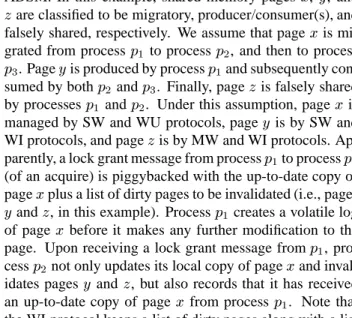
Figure 1 depicts a snapshot of adaptive logging in ADSM. In this example, shared memory pagesx,y, and zare classified to be migratory, producer/consumer(s), and
falsely shared, respectively. We assume that pagexis
mi-grated from processp
1 to process p
2, and then to process p
3. Page
yis produced by processp
1and subsequently
con-sumed by bothp 2 and p 3. Finally, page zis falsely shared by processesp 1and p
2. Under this assumption, page x is
managed by SW and WU protocols, pagey is by SW and
WI protocols, and pagezis by MW and WI protocols.
Ap-parently, a lock grant message from processp
1to process p
2
(of an acquire) is piggybacked with the up-to-date copy of pagexplus a list of dirty pages to be invalidated (i.e., pages yandz, in this example). Processp
1creates a volatile log
of page xbefore it makes any further modification to the
page. Upon receiving a lock grant message fromp 1,
pro-cessp
2not only updates its local copy of page
xand
inval-idates pages yandz, but also records that it has received
an up-to-date copy of pagex from processp
1. Note that
the WI protocol keeps a list of dirty pages along with a list of processes that modified those pages, so no extra record has to be kept for our recovery protocol (which utilizes the
same dirty page list). When processp
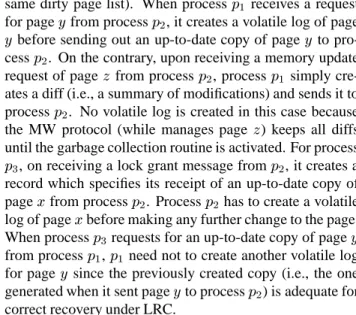
1 receives a request
for pageyfrom processp
2, it creates a volatile log of page y before sending out an up-to-date copy of pagey to
pro-cessp
2. On the contrary, upon receiving a memory update
request of pagez from processp
2, process p
1 simply
cre-ates a diff (i.e., a summary of modifications) and sends it to processp
2. No volatile log is created in this case because
the MW protocol (while manages page z) keeps all diffs
until the garbage collection routine is activated. For process
p
3, on receiving a lock grant message from p
2, it creates a
record which specifies its receipt of an up-to-date copy of pagexfrom processp
2. Process p
2has to create a volatile
log of pagexbefore making any further change to the page.
When processp
3requests for an up-to-date copy of page y
from processp 1,
p
1need not to create another volatile log
for pagey since the previously created copy (i.e., the one
generated when it sent pageyto processp
2) is adequate for
correct recovery under LRC.
3.2.1 Checkpointing
As we have mentioned earlier, our AL protocol is suit-able for both coordinated and independent checkpointing since it speeds up the recovery process and avoids the unbounded rollback problem associated with independent checkpointing. Periodically, a checkpoint is created to limit the amount of work that has to be repeated after a failure. Under a coordinated checkpointing scheme, a checkpoint is taken at the selected synchronization points, where all processes exchange messages (i.e., barrier). For indepen-dent checkpointing, each process indepenindepen-dently creates a checkpoint on stable storage. The difference between co-ordinated and independent checkpointing lies in how to re-construct a globally consistent state of execution. Specifi-cally, a globally consistent state can be rebuilt by combining the checkpoints of every process under a coordinated check-pointing technique, whereas the logged data is needed for a failed process in reconstructing a globally consistent state of execution under an independent checkpointing technique. While coordinated checkpointing may do without logging, the logged data speed up recovery by eliminating synchro-nization messages and reducing memory miss idle time dur-ing the crash recovery process. The selection of checkpoint-ing techniques for ADSM, however, is beyond the scope of this paper.
In both cases, a checkpoint consists of all local variables and shared memory contents, the state of execution, and all local internal data structures used by ADSM. All such in-formation is needed at the beginning of a crash recovery process to avoid restarting from the (global) initial state. While the first checkpoint flushes all shared memory pages to stable storage, our incremental checkpointing incorpo-rates into the subsequent checkpoints, only those pages that have been modified since the last checkpoint. Specifically,
our checkpointing protocol relies on coherence information and memory update logs to identify and selectively flush the changes to the shared memory pages into stable storage, reducing failure-free overhead.
3.2.2 Recovery
Our AL-based recovery is activated after a failure occurs and is detected. It reconstructs the execution prior to the failure by restarting from the most recent checkpoint and replaying the log of events. The log of events for our AL-based recovery contains lists of dirty pages to be invalidated or updated at each synchronization point. For ML-based re-covery, the log of events includes all messages received at synchronization points and at memory misses. There is no orphan process created under either AL or ML protocols be-cause all three message types (i.e., WIM, WUM, MUM) in ADSM are sent out only in response to request messages from other processes. During recovery, there will be no re-quest for WIM since the recovery process can read a write-invalidation notice from its local logged data. The messages requesting for WUM and MUM do not create any orphan process because such requests do not change the status of shared memory pages at the receiving process, and there-fore, it is unnecessary for surviving processes to rollback and “unreceive” these requests. As a result, no orphan pro-cess is created.
Since our AL protocol guarantees that all shared mem-ory pages needed for memmem-ory update operations during re-covery are readily available from the sender process(es), the recovery process can overlap such update requests with disk access operations and also benefits from light traffic over the network during the time of recovery, tolerating disk access latency. This is not possible in ML-based recovery because all of its logged data are then stored on the local disk. Both recovery techniques, however, benefit from the elimination of synchronization messages and the reduction of memory miss idle time. Experimental results demonstrate that AL-based recovery consistently outperforms ML-AL-based recov-ery by 9% to 17% under parallel applications examined. Next, we present the implementation of our AL protocol and AL-based recovery in ADSM.
3.3 Implementation
Figure 2 demonstrates a pseudo code of the ADSM rou-tines involved in our logging and crash recovery processes.
3.3.1 Failure-Free Execution
During failure-free execution, at a lock acquire, the sender process creates a volatile log of each shared memory page that is piggybacked with the lock grant message un-der the WU protocol. The receiver process records incom-ing coherence information as a list of up-to-date and dirty
Manager of Memory Page(s) Barrier
if (in_recovery)
read list of dirty pages from log; invalidate the pages and/or send request for the up-to-date copy;
else
if (barrier_manager)
flush log to stable storage;
wait for all other processes to check-in;
invalidate or update local copy of page(s) correspondingly; send barrier release messages
piggybacked with list of dirty pages and/or up-to-date copy of pages;
record the pages that have received an up-to-date copy with an id of sender process;
else
send check-in message to barrier manager;
flush log to stable storage;
wait for barrier release message; invalidate or update local copy
of page(s) correspondingly;
endif
record the pages that have received an up-to-date copy with an id of sender process;
endif
if (receive_page_request)
send an up-to-date copy of that page to requesting process;
log contents of an up-to-date copy of that page;
endif
Lock Acquire
if (in_recovery)
read list of dirty pages from log; invalidate the pages and/or send
request for the up-to-date copy;
else
send lock request to lock manager;
flush log to stable storage;
wait for lock grant message; invalidate or update local copy
of page(s) correspondingly;
endif
record the pages that have received an up-to-date copy with an id of sender process;
Lock Manager
if (receive_lock_request) send lock grant message
piggybacked with list of dirty pages for pages under WI protocol and an up-to-date copy of pages for pages under WU protocol;
log contents of those up-to-date copies of pages;
endif
Note: Bold fonts refer to ADSM protocol operations, while italic ones refer to operations of our Adaptive Logging and AL-based Recovery Protocols.
Figure 2. Pseudo Code for Adaptive Logging and AL-based Recovery Protocols.
pages, and then proceeds to lock acquire and coherence en-forcement routines. Each process also produces a volatile log of shared memory pages it sends out upon receiving a page request message. While a list of shared memory page status has to be flushed to stable storage whenever a process sends a lock grant message to another process, the volatile logs need not to be flushed since the sender process can recreate them even after a process failure occurs.
At a barrier, the producer process of the pro-ducer/consumer pages creates a volatile log of shared mem-ory pages it sends to the consumer process(es). This volatile log is created right after the barrier check-in messages have arrived and actual shared memory pages have been sent off. Upon the arrival of these updates, each process produces a list of pages being updated, and then, incorporates it in a list of dirty pages, once additional coherence information pig-gybacked with a barrier release message has arrived. As in the case of migratory shared data, this list of shared memory page status is flushed to disk at the next synchronization.
3.3.2 Recovery Process
When a failure is detected, the in recovery flag is set and coherence enforcement information (i.e., write-invalidation notice and the list of pages to be updated) is read from the local disk, eliminating the need to produce synchroniza-tion messages again. Once the recovery process passes the synchronization point (either a lock or a barrier), it han-dles memory misses as in the case of failure-free execution. Specifically, a page fault during the recovery process then generates a memory update request to the manager of that shared memory page, and updates its local copy of the page with up-to-date data (i.e., a diff for MW page or a whole page for SW page) received from the manager.
4. Experimental Methodology
For accurate assessment of logging overhead and crash recovery performance, we have integrated message logging (ML) and our adaptive logging (AL) into TreadMarks-based ADSM [2, 15]. We measured the execution time of ADSM without logging protocol incorporated, and utilized it to quantify performance overhead caused by the ML and our AL protocols. As in earlier work, no checkpointing is done in the experiments since the goal is to measure the overhead of logging, and crash recovery performance is obtained by running parallel applications completely to the end and then rolling back node 0, which then begins the recovery process from the log [14, 19].
Our experimental platform is a network of eight SUN Ultra-5 workstations running Solaris 2.6. Each machine contains a 270MHz UltraSPARC-IIi processor, a 256 KB secondary cache, and a 64 MB memory. We also allo-cated 2G bytes of each local disk for virtual memory pag-ing (i.e., swap space). The size of a virtual memory page is 8K bytes. The network for connecting these machines is a 100Mbps, full-duplex fast Ethernet switch. ADSM imple-mentation is based on TreadMarks, a state-of-the-art soft-ware DSM [3]. TreadMarks adopts the UDP/IP protocol for interprocess communication, uses the SIGIO signal for delivering request messages, and relies on the virtual mem-ory trap (SIGSEGV) for invoking the memmem-ory coherence enforcement mechanism. All message logs are stored in non-volatile storage (i.e., local disk) for recovery.
Program Data Size Synchronization 3D-FFT 100 iterations on2 7 2 7 2 7 data barriers CG 200 iterations on14000 2
sparse matrix barriers IS 175 ranking of2
15
keys locks and barriers MG 200 iterations on2 7 2 7 2 7 grid barriers SOR 100 iterations on5K5K input barriers
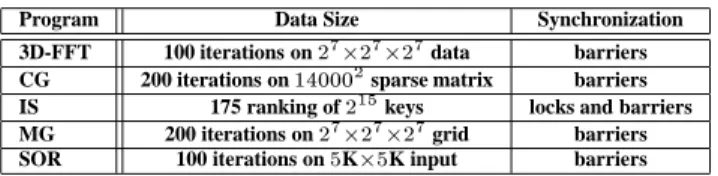
Table 1. Applications’ Characteristics.
In this study, we employ five parallel applications as benchmark programs, among which 3D-FFT, Conjugate Gradient (CG), Integer Sort (IS), and Multigrid (MG) come
from the NAS benchmark suite [5]. SOR implements a red-black successive over-relaxation and is distributed together with TreadMarks. These applications have been selected in several previous studies of software DSM, e.g., [2, 14, 15, 19]. Table 1 lists application characteristics, including the data size used and the types of synchronization employed.
5. Experimental Results
The performance comparison of two logging protocols, message logging (ML) and our adaptive logging (AL), is made with respect to performance of ADSM without any logging protocol incorporated. We measured disk usage, memory overhead, and total execution time to quantify the overhead of each logging protocol using those five paral-lel application programs. The crash recovery speeds of the ML-based and our AL-based recovery are also presented.
5.1 Disk Consumption
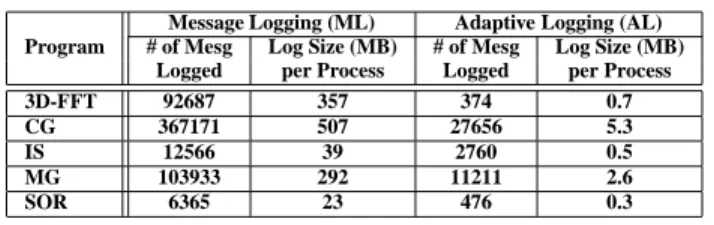
Table 2 provides data on disk consumption for each of the five applications under ML and our AL protocols. It shows both the number of message logs and the amount of logged data incurred by each protocol when incorporated in ADSM. As can be seen, the AL protocol logs only a small amount of data, ranging from 0.3MB to 5.3MB, whereas the ML protocol produces a much larger total log size, ranging from 23MB to 507MB. This is because our AL protocol leverages the coherence data maintained by ADSM. In par-ticular, the AL protocol does not store data that can be re-trieved from the sender process during recovery, while ML simply keeps all incoming data that affect the shared mem-ory status.
Message Logging (ML) Adaptive Logging (AL) Program # of Mesg Log Size (MB) # of Mesg Log Size (MB)
Logged per Process Logged per Process 3D-FFT 92687 357 374 0.7 CG 367171 507 27656 5.3
IS 12566 39 2760 0.5
MG 103933 292 11211 2.6
SOR 6365 23 476 0.3
Table 2. Disk Consumption of Logged Data.
The ML protocol also leads to a larger number of mes-sages logged, ranging from 6365 to 367171 mesmes-sages, while our AL protocol keeps considerably fewer messages, rang-ing from 374 to 27656 messages. All incomrang-ing messages that change the state of shared memory in ADSM are logged under the ML protocol, whereas the AL protocol selects to keep only those messages that are necessary for correct re-covery. Messages logged under the ML protocol in ADSM include a write-invalidation notice at each synchronization point (i.e., lock and barrier), a summary of modifications (i.e., diff), and an up-to-date copy of each shared memory page. By leveraging the coherence data of ADSM, the AL protocol requires to log only write-invalidation notices since both diff and update data can be retrieved from the sender
process during recovery. This substantial reduction in both the number of messages logged and the total size of logged data is due to the fact that the arrival of write-invalidation notices is not as frequent as the arrival of diff and update messages, and the size of a write-invalidation notice is typ-ically smaller than a diff or an update.
5.2 Memory Overhead
The total log size reduction of the AL protocol comes with higher memory overhead under the SW protocol (i.e., under the MW protocol, shared memory pages of ADSM have a summary of modifications stored in the memory of the sender process). For shared memory pages under the SW protocol, our AL protocol creates a volatile log of a shared memory page at the sender process before it sends out such an up-to-date copy of a shared memory page to another process. From our experiment, additional ory overhead due to our AL protocol is a fraction of mem-ory overhead due to coherence enforcement protocols of ADSM. For example, the AL protocol introduces only 1% additional memory overhead under CG and MG (which use the MW protocol), it is about 11% under 3D-FFT and IS (which adopt the SW protocol), and it amounts to roughly 33% under SOR (which also utilizes the SW protocol). It should be noted that, while our AL protocol gives rise to additional memory overhead on top of that overhead due to ADSM coherence enforcement, the additional memory overhead caused by our AL protocol has little impact on ADSM performance. This is because the AL protocol uti-lizes memory solely for recording update messages (sent out to other processors) which are never read nor modi-fied again, until the recovery process. When more room is needed later to hold such messages, the memory contents are simply swapped out to disks and never swapped back into memory again, unlike the coherence data maintained by ADSM, which are read and modified frequently to realize coherence enforcement, and which are swapped back into memory whenever such references are needed, contributing to execution overhead. The volatile log of our AL protocol thus leads to little penalty in ADSM performance, as will be demonstrated in the next subsection.
While there is no immediate need to do a garbage col-lection on the volatile log of our AL protocol (since it does not affect ADSM performance), we limit our volatile log size to avoid it from growing unbounded. Garbage collec-tion associated with our AL protocol is not expensive, as we minimize the impact of garbage collection overhead by in-tegrating our garbage collection for the volatile log with the storage reclamation routine of ADSM, which requires ex-cessive message exchange among processors. The cleanup process of our volatile log is therefore overlapped with in-terprocess communications existing in the storage reclama-tion routine of ADSM, adding no overhead to ADSM.
5.3 Total Execution Time
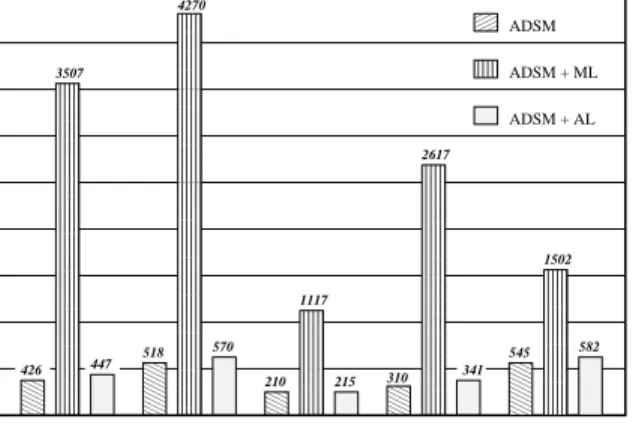
Figure 3 depicts the impacts of the ML protocol and our AL protocol on ADSM performance in terms of the total execution time. The total execution time of ADSM without any logging protocol incorporated serves as a performance baseline for comparison. From the data obtained, our AL protocol leads to slight execution time overhead, ranging from 2% to 10% only. This low overhead results directly from a small log size and a low disk access frequency. By contrast, the ML protocol increases the execution time dras-tically by many folds for every application. Such high over-head is due to recording indiscriminately every incoming message that changes the state of shared memory pages, like a write-invalidation notice, which piggybacked with a lock grant or a barrier synchronization message, a sum-mary of modifications (i.e., a diff), or an up-to-date copy of each shared memory page. By leveraging the coherence data maintained by ADSM, our AL protocol causes only slight execution time overhead and makes the inclusion of fault-tolerant capability in ADSM feasible and attractive.
00 00 00 00 11 11 11 11 000 000 000 000 000 000 000 000 000 000 000 000 000 000 000 000 000 000 111 111 111 111 111 111 111 111 111 111 111 111 111 111 111 111 111 111 00 00 00 00 00 00 00 11 11 11 11 11 11 11 000 000 000 000 000 000 000 000 000 000 000 000 000 000 000 000 000 000 000 000 000 000 111 111 111 111 111 111 111 111 111 111 111 111 111 111 111 111 111 111 111 111 111 111 00 00 00 11 11 11 000 000 000 000 000 000 111 111 111 111 111 111 00 00 00 00 11 11 11 11 000 000 000 000 000 000 000 000 000 000 000 000 000 000 111 111 111 111 111 111 111 111 111 111 111 111 111 111 00 00 00 00 00 00 00 11 11 11 11 11 11 11 000 000 000 000 000 000 000 000 111 111 111 111 111 111 111 111 00 00 11 11 000 111 CG IS MG SOR 2500 3000 3500 4000 4500 2000 1500 1000 500 0 3507 ADSM ADSM + ML 426 447 4270 1117 2617 1502 518 210 310 545 570 215 341 582 ADSM + AL 3D-FFT
Total Execution Time (seconds)
Figure 3. Impacts of Logging Protocols on ADSM Performance.
5.4 Recovery Performance
Figure 4 shows the performance of ML-based recovery and our AL-based recovery after node 0 fails and is rolled back to start recovery from the initial state. We employ the crash recovery time of ADSM without any logging proto-col (i.e., Re-Execution) as a performance baseline in this comparison. According to the data presented, ML-based re-covery and our AL-based rere-covery are able to save consid-erably execution time during the recovery process, in most parallel applications examined. Specifically, ML-based re-covery reduces the rere-covery time by 40% for 3D-FFT, by 28% for CG, by 33% for IS, and by 28% for MG; it slightly increases the recovery time for SOR (i.e., 10% increase), where the computation to communication ratio is very high. This stems from the fact that without the checkpointing pro-tocol incorporated, all computation has to be repeated. In
the case of SOR, the overhead of reading logged data from a local disk in ML-based recovery outweights the benefits due to synchronization message elimination and memory miss idle time reduction. For our AL-based recovery, it con-sistently outperforms ML-based recovery, reducing the re-covery time by 52% in 3D-FFT, by 42% in CG, by 49% in IS, and by 45% in MG, when compared with re-execution. It does not shorten the recovery time of SOR. Our AL-based recovery also benefits from synchronization message elimi-nation and memory miss idle time reduction (due to lighter traffic over the network during recovery).
00 00 00 00 00 00 00 00 00 00 00 00 00 00 00 00 00 00 00 00 00 00 11 11 11 11 11 11 11 11 11 11 11 11 11 11 11 11 11 11 11 11 11 11 000 000 000 000 000 000 000 111 111 111 111 111 111 111 000 000 000 000 000 000 000 000 000 000 000 000 000 000 000 000 000 000 000 000 000 000 000 000 000 000 111 111 111 111 111 111 111 111 111 111 111 111 111 111 111 111 111 111 111 111 111 111 111 111 111 111 000 000 000 000 000 000 000 000 000 000 111 111 111 111 111 111 111 111 111 111 00 00 00 00 00 00 00 00 00 00 00 11 11 11 11 11 11 11 11 11 11 11 000 000 000 000 111 111 111 111 00 00 00 00 00 00 00 00 00 00 00 00 00 00 00 00 11 11 11 11 11 11 11 11 11 11 11 11 11 11 11 11 000 000 000 000 000 000 111 111 111 111 111 111 00 00 00 00 00 00 00 00 00 00 00 00 00 00 00 00 00 00 00 00 00 00 00 00 00 00 00 00 11 11 11 11 11 11 11 11 11 11 11 11 11 11 11 11 11 11 11 11 11 11 11 11 11 11 11 11 000 000 000 000 000 000 000 000 000 000 000 000 000 000 000 000 111 111 111 111 111 111 111 111 111 111 111 111 111 111 111 111 00 00 11 11 000111 3D-FFT CG IS MG SOR 100 0 200 300 400 500 600 426 518 210 310 545
Re-Execution ML-based Recovery AL-based Recovery
255 204 373 300 141 107 224 171 599 550
Recovery Time (seconds)
Figure 4. Recovery Performance Shown using Normalized Execution Time.
6. Conclusions
We have dealt with a new, efficient logging protocol for adaptive software DSM, called ADSM, in this paper. The experimental outcomes demonstrate that our adaptive logging (AL) protocol incurs low failure-free overhead, roughly 2% to 10% of ADSM normal execution time, and that our AL-based recovery reduces the recovery time by 42% to 52%, except for SOR (whose computation to com-munication ratio is very high). This results directly from taking advantage of coherence data managed by ADSM so as to keep only information nonexistence for ADSM coher-ence but indispensable for fast and correct recovery. Our AL protocol and AL-based recovery are readily applicable to arrive at recoverable ADSM systems effectively.
Acknowledgements
The authors would like to thank Luiz Rodolpho Monnerat, Ri-cardo Bianchini, and the TreadMarks group at Rice University, for helping us with understanding their adaptive software DSM imple-mentation. This work was supported in part by NSF under Grants CCR-9803505 and EIA-9871315.
References
[1] S. Adve and K. Gharachorloo. Shared Memory Consistency Models: A Tutorial. Computer, 29(12):66–76, Dec. 1996.
[2] C. Amza, A. L. Cox, S. Dwarkadas, L.-J. Jin, K. Rajamani, and W. Zwaenepoel. Adaptive Protocols for Software Dis-tributed Shared Memory. Proceedings of the IEEE, pages 467–475, March 1999.
[3] C. Amza, A. L. Cox, S. Dwarkadas, P. J. Keleher, H. Lu, R. Rajamony, W. Yu, and W. Zwaenepoel. TreadMarks: Shared Memory Computing on Networks of Workstations. Computer, 29(2):18–28, February 1996.
[4] C. Amza, A. L. Cox, S. Dwarkadas, and W. Zwaenepoel. Software DSM Protocols that Adapt between Single Writer and Multiple Writer. In Proc. of the 3rd IEEE Symp. on High-Performance Computer Architecture (HPCA-3), pages 261–271, February 1997.
[5] D. Bailey, J. Barton, T. Lasinski, and H. Simon. The NAS Parallel Benchmarks. Technical Report RNR-91-002, NASA, January 1991.
[6] A. Borg, J. Baumbach, and S. Glazer. A Message System Supporting Fault-Tolerance. In Proc. of the 9th ACM Symp. on Operating Systems Principles (SOSP’83), pages 90–99, October 1983.
[7] M. Costa, P. Guedes, M. Sequeira, N. Neves, and M. Cas-tro. Lightweight Logging for Lazy Release Consistent Dis-tributed Shared Memory. In Proc. of the USENIX 2nd Symp. on Operating Systems Design and Implementation (OSDI), pages 59–73, October 1996.
[8] S. Dwarkadas, P. J. Keleher, A. L. Cox, and W. Zwaenepoel. Evaluation of Release Consistent Software Distributed Shared Memory on Emerging Network Technology. In Proc. of the 20th Annual Int’l Symp. on Computer Architecture (ISCA’93), pages 244–255, May 1993.
[9] E. N. Elnozahy and W. Zwaenepoel. On the Use and Imple-mentation of Message Logging. In Proc. of the 24th Annual Int’l Symp. on Fault-Tolerant Computing (FTCS-24), pages 298–307, June 1994.
[10] K. Gharachorloo, D. E. Lenoski, J. Laudon, P. Gibbons, A. Gupta, and J. L. Hennessy. Memory Consistency and Event Ordering in Scalable Shared-Memory Multiproces-sors. In Proc. of the 17th Annual Int’l Symp. on Computer Architecture (ISCA’90), pages 15–26, May 1990.
[11] D. B. Johnson and W. Zwaenepoel. Sender-based Message Logging. In Proc. of the 17th Annual Int’l Symp. on Fault-Tolerant Computing (FTCS-17), pages 14–19, July 1987. [12] T. T-Y. Juang and S. Venkatesan. Crash Recovery with
Little Overhead. In Proc. of the 11th Int’l Conf. on Dis-tributed Computing Systems (ICDCS-11), pages 454–461, May 1991.
[13] P. J. Keleher, A. L. Cox, and W. Zwaenepoel. Lazy Release Consistency for Software Distributed Shared Memory. In Proc. of the 19th Annual Int’l Symp. on Computer Architec-ture (ISCA’92), pages 13–21, May 1992.
[14] A. Kongmunvattana and N.-F. Tzeng. Lazy Logging and Prefetch-Based Crash Recovery in Software Distributed Shared Memory Systems. In Proc. of the 13th Int’l Parallel Processing Symp. (IPPS’99), pages 399–406, April 1999. [15] L. R. Monnerat and R. Bianchini. Efficiently Adapting to
Sharing Patterns in Software DSMs. In Proc. of the 4th IEEE Symp. on High-Performance Computer Architecture (HPCA-4), pages 289–299, February 1998.
[16] T. Park and H. Y. Yeom. An Efficient Logging Scheme for Lazy Release Consistent Distributed Shared Memory Sys-tems. In Proc. of the 12th Int’l Parallel Processing Symp. (IPPS’98), pages 670–674, March 1998.
[17] G. G. Richard III and M. Singhal. Using Logging and Asyn-chronous Checkpointing to Implement Recoverable Dis-tributed Shared Memory. In Proc. of the 12th Int’l Symp. on Reliable Distributed Systems (SRDS-12), pages 58–67, October 1993.
[18] R. E. Strom and S. Yemini. Optimistic Recovery in Dis-tributed Systems. ACM Trans. on Computer Systems, 3(3):204–226, August 1985.
[19] G. Suri, B. Janssens, and W. K. Fuchs. Reduced Over-head Logging for Rollback Recovery in Distributed Shared Memory. In Proc. of the 25th Annual Int’l Symp. on Fault-Tolerant Computing (FTCS-25), pages 279–288, June 1995. [20] K.-L. Wu and W. K. Fuchs. Recoverable Distributed Shared Virtual Memory. IEEE Trans. on Computers, C-39(4):460– 469, April 1990.