Performance Management System: An Automated Approach through
RFID Technology
Kamran Ahsan, Jibran Khan, Khurram Iqbal and Muhammad Talha
Federal Urdu University of Arts, Science and Technology, Karachi, PAKISTAN
Available online at: www.isca.in, www.isca.me
Received 13th March 2013, revised 24th September 2013, accepted 23rd October 2013
Abstract
RFID (Radio frequency identification) is a technology used to identify the objects on the behalf of the tags as a part of this identification resource. RFID has been implemented for different purposes in many organizations including the offices and educational institutes for the attendance marking purposes. This research develops Activity Monitoring Management System using the RFID technology for the purpose of monitoring employee’s activity at every location within organizational setting. This research develops a methodology to track the activity of the moving objects or humans in an educational organization. The system makes use of the RFID Readers and RFID Antennas to constantly read the RFID tags assigned to humans in the institute at specific time interval. The paper contains the description of the system with the design and functionality implementation steps thoroughly defining the system uniqueness and different way to utilize RFID technology.
Keywords: Cloud computing, automated movement monitoring, RFID, mobile tracking.
Introduction
Organization of all kind use time and attendance system to record when employee start and finish work. It helps an organization to monitor the time of the employee and having full control on the employee working hours. Computer system makes attendance easy for an organization or company to maintain the working duration information and tracking of the human assets. Advancement in every technology helped the attendance management system owners to adapt the automatic attendance systems such as Bio-metric systems, Punch card attendance systems, RFID1 attendance system, pin code attendance systems etc. These all systems are just alternatives and likeness of user or customer who is using it.
Automated attendance system lessens the burden of the organization by replacing the manual attendance system with automated system. With this system time and attendance tracking has become easier and simpler as well as quicker and also more accurate. There are different kinds of leaves and holidays that employees are entitled to in organization. It has become easier to track all kinds of leaves and absence. Automated system tracks absences and the time of employee more accurately. Now who have not worked their time cannot get their pay. It reduces the administrative burden in which time and attendance was recorded manually. This is much faster system as compare to manual system retrieving the record is much simpler. The attendance tracking software makes the program to work accordance with the unique needs and requirement of the company. Data cannot be easily stolen. This automated system does not obligate anyone it can as flexible or as strict as the management want.
These automated systems cannot give best output in complex
settings and cannot monitor performance, for example, educational settings. Educational institutions run various activities such classes, labs, seminars, conferences, meetings, research and so on and so forth. This research use RFID1 technology to work and evaluate performance of the students and teachers we monitor their performance.
RFID Technology
RFID1, a technology similar in theory to bar-code identification, With RFID, the electromagnetic or electrostatic coupling in the RF portion of the electromagnetic spectrum is used to transmit signals. But one of the key differences between RFID and bar code technology is RFID1 eliminates the need for line-of-sight reading that bar coding depends on. Also, RFID scanning can be done at greater distances than bar code scanning. High frequency RFID systems (850 MHz to 950 MHz and 2.4 GHz to 2.5 GHz) offer transmission ranges of more than 90 feet, although wavelengths in the 2.4 GHz range are absorbed by water (the human body) and therefore has limitations. Barcode is lower in cost but it has limited memory.
The basic unit of RFID system is tags. RFID tags2 come in three general varieties: passive, active or semi-passive (also known as battery-assisted). Passive tags require no internal power source (they are only active when a reader is nearby to power them), whereas semi-passive and active tags require a power source, usually a small battery.
Active, semi-passive and passive RFID tags2 are making RFID technology more accessible and prominent in our world. These tags are less expensive to produce, and they can be made small enough to fit on almost any product.
Complexity of RFID Technology
Reader2 works in between the computer application and tag. It can be either connected to the system with wire or wireless. RFID Reader2 consists of logical components including: Reader API, communications, Event Management, Antenna Sub-system. A reader (now more typically referred to as an RFID interrogator) is basically a radio frequency (RF) transmitter and receiver, controlled by a microprocessor or digital signal processor. The reader, using an attached antenna, captures data from tags, then passes the data to a computer for processing. An RFID reader’s function is to interrogate RFID tags2. The means of interrogation is wireless and because the distance is relatively short; line of sight between the reader and tags is not necessary. A reader contains an RF module, which acts as both a transmitter and receiver of radio frequency signals. The transmitter consists of an oscillator to create the carrier frequency; a modulator to impinge data commands upon this carrier signal and an amplifier to boost the signal enough to awaken the tag. The receiver has a demodulator to extract the returned data and also contains an amplifier to strengthen the signal for processing. A microprocessor forms the control unit, which employs an operating system and memory to filter and store the data. The data is now ready to be sent to the network. The basic unit of RFID system is tags2 and tags have its own unique identification number system by which Identification numbers are detected. These numbers are stored in the tags using their internal memory and it is not customized manually. The other information on the tags can be either read-only or rewrite able. Tag2 memory may also contain other read-only information about that tag like manufacturing date and etc. RFID Antennas2 generates magnetic field for getting acknowledgement from tags. The reader generates query (trigger) through electromagnetic high-frequency signals (this frequency could be up to 50 times/second) to establish communication for tags. This signal field might get large number of tags data which is a significant problem for handling bulk of cards and their data. This problem can overcome by applying filters on the data which is required. This filter is applied on the software level of the system and information system is used to supply this data to data repository or use any other software procedures to control data according to the need and system capability. This piece of software works as a middle layer between user application and reader because the reader normally does not have the capability to handle bulk data at once; it has the job to supply reading data to user application for further process. This buffering capability may supply data from reader to information system interface (user interface) directly or may provide and use some routine to save into database for later exploit; it is depend on user requirement.
System Specification
System follows the specification including: Analysis and feasibility of RFID systems and technology, Human Monitoring System, Tracking interface and control system and Application Development.
System Implementation: Implementation process includes, analyzing the RFID technology3 with respect to the domain, Accomplish milestones and prepare deliverables, Feasibility of the system and the human tracking build up, System development at different layers, Observations of the system access control.
System Features: Features of the system includes: Human tracking and movement detection system which will be fully automated decreasing manual overhead, centralized control system, Fast access of data; cost level decreases, Disaster management, fire control planning and Benchmark for other RFID systems3 development.
Survey Report
The survey done before the development of the system ensures the requirements of the system. The questions ask in this connection are as under.
Do you want the system to record the attendance of the student and the administrative staff automatically?
Do you want the system to calculate the overall strength of the students, teachers and administrative staff regularly/monthly? Do you want the system to categorize the number of students, teacher and the administrative staff in any particular area? Do you want the system to categorize the number of students, teacher and the administrative staff in any particular area? Do you want the system to categorize the number of students in particular area with respect to semester and batch?
Do you want the system to calculate the absence of the students and staff automatically?
Do you want the system to make the report of the presence, absence and strength of persons?
Do you want the system to track the duration of the persons? Do you want the system to work better in security point of view?
Do you want the system to make the punctuality report of student, teacher and administrative staff?
Do you want the student to find the location of the student, teacher and the administrative staff?
Do you want the system to categorize the time duration with respect to location of persons?
Do you want the system to note the activity of the persons? Were you familiar with RFID technology before?
Do you want the system to calculate the entrance and the exit time?
Which one of the following you prefer to use as an attendance management system?
Do you want RFID system to be implemented in Federal Urdu University of Arts Science And Technology?
Are you agreed to be tracked and monitored every time in university?
These survey questions get the following results which are shown as a form of ‘YES’, ‘NO’ and ‘No Answer’:
questions get ‘NO’ as their answer. However, only one question (13) gets ‘No Answer’ for its response.
AMM System: AMMS (Activity Monitoring Management System) is a complete system with different levels utilizing the RFID technology in a different way from other RFID solutions4.
Figure-1 Survey Results
Figure-2
RFID provides the opportunity and feature to automate the attendance system and is different from Biometric and Punch card system in terms of distance marking. RFID helps to read the Tags id from a good distance and get the information from the tag. By connecting the RFID Reader with software application, helps to get the information required to process the details of the entity. The application has 2 phases. One is the Desktop application which is the main application where the readings and data management is done. Second is a Web-based application to generate reports on the searching criteria. The RFID Reader is the device used in our system as just to read the tag of the entity even it is registered in the device itself or in the software.
Figure-2 shows, once the tag id is fetched and now in control of the software application it is then processed in the database. If the tag id is registered then the application marks the presence of that tag id and if not then it simply puts it in the Tag ID5 UI control of the opened form. This is all done in the desktop part of the System. The constant detection of the tag in the field of antennas creates a complete log in the database. The system provides uniqueness here by using this log and generating the reports on the behalf of minute to minute detection of the tags of different people. Using the antennas the tag is continuously checked within its field reporting the database about the tag presence or not. Coming to the overall log in the end, it helps to search activity reports of the entities and decide upon them what monthly, daily, weekly result or event can be searched as a custom range of time and date.
Cloud Computing for AMM System
Cloud6 simply refers to internet means everything deployed on the internet6. Not require any knowledge of the system but just using the services and pay for it. It provides a very simple User Interface to publish the services and data in limited amount of time. The application we have developed resides on the cloud platform owned by Microsoft known as Windows Azure7. Windows Azure7 provides an independence of development tool or language and therefore, increases the opportunity to be used for any kind of application. Windows Azure providing the special one-click publishing in Visual Studio to host web services or Websites in few seconds is the most important advantage of switching the application as cloud based. Windows Azure7 provides a user profile along with some credentials used for hosting the web applications as a package which is included in the publishing process in Visual Studio. The database can be easily hosted in the Windows Azure7 database server known as SQL Azure7 which resembles the SQL Server8 properties. The SQL script is imported generated from local SQL Server by just setting the “Script for Database Engine Type” property to SQL Azure while converting the database schema into a SQL script.
Design of the AMM System
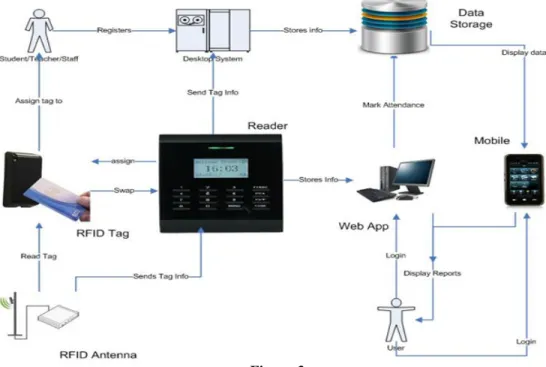
Figure 3 shows the component based structure of the system with real images of the entities involved. It clearly defines the working model of the AMM System.
The entities in the system can be any person from the insititute and must posses a Tag id which will be read by the antenna of the RFID device and send to the system for further processing and attendace marking.
Figure-3
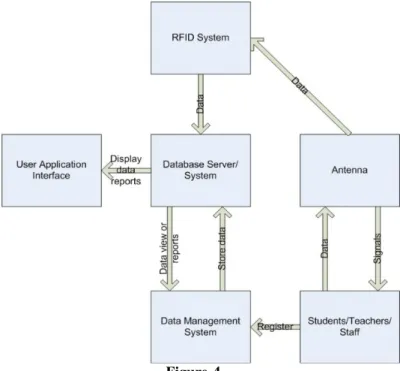
The figure-4 shows the data flow structure of the most upper level of the system with components working inside the system with processes and relations between the entities involved. The upper level data flow diagram also known as DFD defines the system as the brief system flow. The entities or objects involved in the system are defined component based but not in descriptive manner. The level grows higher when the data flow diagram is defined more in detail by exploring more inner components of the entities or objects.
Figure 5 shows the Data flow diagram of the AMM system which is the deeper level and exploring the components of the system and hardware structure. The system flow diagram shown above describes the working and data flow of the applications inside the AMM system including Web application, Desktop application and the mobile applications. The processes are defined in more description and the form of the data communication between the system entities.
The AMM system diagrams create a mock-up design of the entire system before the system and its applications development. The designing and mockup work before the actual technical implementation helped the planning and development processes achievement.
Figure-4 Components of AMM
Figure-5 Technical flow of AMM
Applications
The System is used for tracking human activities inside an organization. The system consist of 3 different parts which includes the Desktop application for Data Entry of basic information related to the institute, Web Application for reports of the activity inside the institute and the Mobile applications using cross-platforms9 and native platforms al
reports on most commonly used smart phones.
Figure-6 Desktop Application
Figure-7 Web Application
Desktop Application: The desktop part of the complete system helps to manage the basic information and data of the institute such as Student bio-data, teacher’s data, administrative staff data, time tables, lectures management, room’s management and much more information which is required to be involved in the The System is used for tracking human activities inside an different parts which includes the Desktop application for Data Entry of basic information related to the institute, Web Application for reports of the activity inside the institute and the Mobile applications
and native platforms also for viewing reports on most commonly used smart phones.
The desktop part of the complete system helps to manage the basic information and data of the institute data, teacher’s data, administrative staff data, time tables, lectures management, room’s management and much more information which is required to be involved in the
reports generation. The desktop application is also used for easily registering the students, teachers and staff members and assigning them their RFID tag ID and record it in the system. Once the system is running and the reader detects the card of any person, it notes the time and marks it into the database forming a kind of log which is later used in generating reports on the web application. Figure6 above shows the main view of the application from where navigation can be done to desired module.
Web Application: The web application part of the system provides an interface to generate reports on the base of user requirements to collect relevant data. It helps the respective user to see the more improved version of the readings done by the RFID reader inside the attendance premises. Separately display the reports of Students, Teachers and Administrative staff members. The great options of searching techniques provide easy to generate the desired reports and download the data in readable form. The main login window layout of the application running on Windows Azure Cloud is shown in
Reports: This application generates comprehensive reports. Some of the example codes given below can provide the understanding of the reports generated by RFID application: Response.ContentType="application/pdf"; Response.Add Header("content-disposition","attachment; filename=AdminStaffAttendance.pdf"); Response.Cache.SetacheabilityHttpCacheability.NoCache); StringWritersw = newStringWriter(); HtmlTextWriterhw = newHtmlTextWriter(sw); GridView1.AllowPaging = false; GridView1.DataBind(); GridView1.RenderControl(hw); GridView1.HeaderRow.Style.Add("width", "15%"); GridView1.HeaderRow.Style.Add("font GridView1.Style.Add("text-decoration", "none"); GridView1.Style.Add("font-family","Arial,Helvetica,sans serif;"); GridView1.Style.Add("font-size", "8px"); StringReadersr = newStringReader(sw.ToString()); DocumentpdfDoc = newDocument(PageSize.A4, 10f, 10f, 10f, 0f); HTMLWorkerhtmlparser = newHTMLWorker(pdfDoc); PdfWriter.GetInstance(pdfDoc, Response.OutputStream); pdfDoc.Open(); htmlparser.Parse(sr); pdfDoc.Close(); Response.Write(pdfDoc); Response.End();
Using an external library known as iTextsharp which is available as a dll file for NET Applications, helps you to download the complete data of the Grid
The code simply opens a string
document type. The data is then read by the String
reports generation. The desktop application is also used for ng the students, teachers and staff members and assigning them their RFID tag ID and record it in the system. Once the system is running and the reader detects the card of any person, it notes the time and marks it into the database hich is later used in generating reports on the web application. Figure6 above shows the main view of the application from where navigation can be done to desired
The web application part of the system erate reports on the base of user requirements to collect relevant data. It helps the respective user to see the more improved version of the readings done by the RFID reader inside the attendance premises. Separately display ers and Administrative staff members. The great options of searching techniques provide easy to generate the desired reports and download the data in readable form. The main login window layout of the application running on Windows Azure Cloud is shown in Figure 7.
This application generates comprehensive reports. Some of the example codes given below can provide the understanding of the reports generated by RFID application: Response.ContentType="application/pdf"; disposition","attachment; filename=AdminStaffAttendance.pdf"); Response.Cache.SetacheabilityHttpCacheability.NoCache); StringWritersw = newStringWriter(); HtmlTextWriterhw = newHtmlTextWriter(sw); GridView1.HeaderRow.Style.Add("width", "15%"); GridView1.HeaderRow.Style.Add("font-size", "10px"); decoration", "none"); family","Arial,Helvetica,sans-size", "8px"); StringReadersr = newStringReader(sw.ToString()); DocumentpdfDoc = newDocument(PageSize.A4, 10f, 10f, 10f, HTMLWorkerhtmlparser = newHTMLWorker(pdfDoc); PdfWriter.GetInstance(pdfDoc, Response.OutputStream);
Using an external library known as iTextsharp which is available as a dll file for NET Applications, helps you to download the complete data of the Grid View in a pdf format. Writer class and defines a document type. The data is then read by the String Reader Class
from the data grid and written in the PDF writer document by the String Writer Class. It is written until the response is not completed and then it closes the document once the response is completed.
Mobile Application: The Mobile application is shown as picture below in Figure 8 showing the report categories and a comprehensive search view which is present to add custom filters of search.
Mobile applications for the activity monitoring management system is the smart part of the complete system or a replicate part of the web application making it more mobile and accessible through the most famous Smartphone’s vendor such as Windows Phone, Android, iOS10 devices and Blackberry Playbook. The mobile applications11 are also the reports viewer for the user by simply selecting from the search filters which are same as in the web application.
The Mobile application11 covers all major platforms i Smartphone world with extensive amount of searching criteria. The Student reports along with Teachers and Staff reports can be viewed on mobile by providing the search filters of desired requirements. The data will be displayed in a decent form with complete details of the searched entity.
The search on Students, Teachers and Administrative Staff can be performed by following criteria. Searching by name, Semester (Student)/Employee Code (Teacher and Staff), Search by Location, Search by custom range of date and time along with to-date search which gives the data from the date and time selected to the current day and time. The RFID implementation helped to create the distance monitoring, security
from the data grid and written in the PDF writer document by the String Writer Class. It is written until the response is not and then it closes the document once the response is
The Mobile application is shown as picture below in Figure 8 showing the report categories and a comprehensive search view which is present to add custom
Mobile applications for the activity monitoring management system is the smart part of the complete system or a replicate part of the web application making it more mobile and accessible through the most famous Smartphone’s vendor such devices and Blackberry are also the reports viewer for the user by simply selecting from the search filters which are
covers all major platforms in Smartphone world with extensive amount of searching criteria. The Student reports along with Teachers and Staff reports can be viewed on mobile by providing the search filters of desired requirements. The data will be displayed in a decent form with
The search on Students, Teachers and Administrative Staff can be performed by following criteria. Searching by name, (Teacher and Staff), Search ate and time along date search which gives the data from the date and time selected to the current day and time. The RFID implementation helped to create the distance monitoring, security13 based
attendance systems14 and opening wide opportunities deployed on Mobile and Web platforms for reporting purposes which separates RFID from other systems like Bio
and Finger Print17 verification methods.
Conclusion
The research was done to explore the RFID technology and its features and components which help to create different types of applications at enterprise level. RFID is one taking over other attendance marking hardware devices such as Bio
Fingerprint verification, Punch card attendance system devices and others with its distance tracking and monitoring of the object. RFID provides an important feature of distance reading with its Antennas known as access points also. The paper defines the system developed by us using the RFID technology with its complete work-flow, design a
idea of what can be achieved using this technology in future helping to create applications for Hospitals, military, educational organizations and especially for security purposes. RFID can be extensively used for security purpo enhancing the implementation of the application and technology utilization.
Acknowledgment
This research is funded by Federal Urdu University of Arts, Science and Technology. This research carried out under the Mini Research Project grant. We would
Department of Computer Science, Federal Urdu University of Arts, Science and Technology for providing their technological environment as a test bed for this study.
Figure-8 Mobile Application
and opening wide opportunities to be deployed on Mobile and Web platforms for reporting purposes which separates RFID from other systems like Bio-metric15, 16
verification methods.
The research was done to explore the RFID technology and its components which help to create different types of applications at enterprise level. RFID is one taking over other attendance marking hardware devices such as Bio-metric, Fingerprint verification, Punch card attendance system devices stance tracking and monitoring of the object. RFID provides an important feature of distance reading with its Antennas known as access points also. The paper defines the system developed by us using the RFID technology flow, design and functionality to give an idea of what can be achieved using this technology in future helping to create applications for Hospitals, military, educational organizations and especially for security purposes. RFID can be extensively used for security purposes by enhancing the implementation of the application and technology
This research is funded by Federal Urdu University of Arts, Science and Technology. This research carried out under the Mini Research Project grant. We would also like to thanks Department of Computer Science, Federal Urdu University of Arts, Science and Technology for providing their technological environment as a test bed for this study.
References
1. Kamran Ahsan, Hanifa Shah and Paul Kingston, RFID Applications: An Introductory and Exploratory Study, IJCSI,7, 1-7 (2010)
2. Khaing Thanda Swe and Myo Hein Zaw, Advancement of Digitized Identification System with Biometric Techniques, Res. Intl. Jrnl. Sci andTech, 2, 1-3 (2013) . 3. Ononiwu G. Chiagozie, Okorafor G. Nwaji, Radio
Frequency Identification (RFID) based attendance system with automatic door unit. SAVAP, 2(2), 168-175 (2012) 4. J. Uddin, M. B. I. Reaz, M. A. Hasan, A. N. Nordin, M. I.
Ibrahimy, M.A.M. Ali, UHF RFID antenna architectures and applications, Sci. Res. Essays, 5, 1033-1045 (2010) 5. Charles Mutigwe and Farhad Aghdasi, Research Trends
in RFID Technology, Interim, 1, 1-15 (2007)
6. Mladen A. Vouk, Cloud Computing – Issues, Research and Implementations, CIT, 4, 235-246 (2008)
7. Rabi Prasad Padhy, Manas Ranjan Patra, Suresh Chandra Satapathy, and Marty Humphrey, Windows Azure PAAS Cloud: An overview, IJCA, 1, 109-120 (2012)
8. Dr. Samrat O Khanna, Mijal A Mistry, Information Management System using LINQ over ADO.Net, IJARCSSE, 2, 1-3 (2012)
9. John Lyle, Salvatore Monteleoney, Shamal Faily, Davide
Pattiy and Fabio Ricciatoz, Cross-platform access control for mobile web applications. POLICY, 1, 1-6 (2012) 10. Paul Daniels, Developing iPhone apps for language
learning, JALT CALL SIG, 6(2), 143-146 (2010)
11. Josh Dehlinger and Jeremy Dixon, Creating next generation applications and services for mobile devices: challenges and opportunities, PIMRC, 1, 1-4 (2007) 12. Dieter Fox, Ken Fishkin and Matthai Philipose, Mapping
and Localization with RFID Technology, IRS-TR-03-014, 1, 2-7 (2003)
13. Karl Koscher, Ari Juels, Tadayoshi Kohno, EPC RFID Tags in Security Applications: Passport Cards, Enhanced Drivers Licenses, and Beyond, CCS, 1, 1-10 (2009) 14. Nurbek Saparkhojayev and Selim Guvercin, Attendance
Control System based on RFID-technology, IJCSI, 9,
227-228 (2012)
15. Karine Pellerin, Increasing Accuracy in Multimodal Biometric Systems, Communications of the ACM, 47(1), 35-40 (2004)
16. O. Shoewu, O.A. Idowu, Development of Attendance Management System using Biometrics, PJST, 13(1), 300-307 (2012)
17. Chitresh Saraswat and Amit Kumar, An Efficient Automatic Attendance System using Fingerprint Verification Technique, IJCSE, 2, 264-269 (2010)