ORGANIZATIONAL CAPABILITIES, ORGANIZATIONAL STRUCTURE, AND THEIR DYNAMICS: THREE ESSAYS ON BOUNDARY CHOICE AND CAPABILITY
DEVELOPMENT IN ENTRY DECISIONS
BY LIHONG QIAN
DISSERTATION
Submitted in partial fulfillment of the requirements
for the degree of Doctor of Philosophy in Business Administration in the Graduate College of the
University of Illinois at Urbana-Champaign, 2011
Urbana, Illinois
Doctoral Committee:
Professor Rajshree Agarwal-Tronetti, Chair
Associate Professor Glenn P. Hoetker, Director of Research Associate Professor Janet E. L. Bercovitz
Professor Joseph T. Mahoney Professor Steven T. Sonka
i ABSTRACT
One recent development in the organizational economics approach to strategy management concerns the integration of the organizational capabilities view and the transaction costs theory. My dissertation takes on this task focusing on transaction costs economics, dynamic capabilities, and temporal dimensions in the evolution of an industry. Essay one provides a constructive literature review on recent works and develops a framework to facilitate further integrative efforts in our inquiry into the firm boundary question. Essay two studies a firm’s boundary choice for a given value-chain activity when entering a new industry, asking: what are the main and moderating effects of transaction hazards and pre-entry organizational capabilities on the choice between internalization and external development of a value-chain activity? Essay three examines a firm’s technology
management and industry entry strategies when facing an emerging radical technology, asking how non-redeployable complementary assets embedded in an incumbent’s existing capabilities and boundaries affect managers’ decision-making in the face of uncertainties.
I further enhance the theoretical coherence across the three essays by employing the same empirical setting for hypotheses testing: the nascent U.S. biofuels industry. I collect secondary data about boundary choice and primary data about managerial decision-making. I triangulate data from archival sources, surveys, and interviews to operationalize variables. The dissertation’s research questions center on the non-redeployability of firm assets (specific asset and non-redeployable capabilities in essay one, specific asset and industry life cycle in essay two, and non-redeployable complementary assets and R&D investment as well as industry entry in essay three). Findings of the dissertation shed light on the fundamental implications of non-redeployability of firm assets on a range of strategic issues related to firm boundary choice, R&D investment, and industry entry, contributing to the evolving science of strategic organization.
ii ACKNOWLEDGEMENTS
Submitting a dissertation may be the most important highlight of one’s doctoral study, but looking back, I realize there have been so many more rewarding moments along my journey. This is not possible without the people I have interacted with and learned from in the University of Illinois at Urbana-Champaign.
My foremost thanks go to Rajshree Agarwal, for her many roles in my life in the last few years, on top of being my dissertation chair. Rajshree is my angel investor, as she sees and brings out potentials of mine, and is willing to take risks on me. I still remember the time when I was struggling with data collection for my dissertation. Although Rajshree was initially concerned about mine doing survey, as I had no relevant training at all, she fully supported my decision and helped to obtain an external research grant. Rajshree is my coach as she sees into details of my academic training. For example, in order to make sure I was at my best for presentation at the CCC conference, Rajshree watched me practicing for more than three times and helped to revise my slides. Rajshree is my mentor, as she guides my intellectual development. While writing our co-authored paper, Rajshree was not only fully engaged in revising the draft, but also pushed me to understand why and how the revision was done in a certain way. To me, Rajshree is also a friend, who is always open, supportive and inspiring. Having such a friend at my back as I am embarking on an academic career, I consider myself lucky.
I would like to thank Glenn Hoetker for being the director of research on my dissertation committee. I am grateful to Glenn for his valuable knowledge and guidance throughout my doctoral studies. Working with Glenn teaches me how important and rewarding it is to conduct research in a rigorous manner, whether it is about theorizing, testing or presenting. When I was preparing for my job market, Glenn helped to go over every detail of my presentation slides, and pushed me to think through the logic between every two slides. Taking Glenn’s methodology class and co-authoring
iii with Glenn on projects have also helped to hone my research skills, and built my confidence in doing independent research.
I would like to express my appreciation to Janet Bercovitz for serving on my committee and providing support and valuable insights on my dissertation. I am particularly thankful for Janet’s encouragement in the course of my dissertation writing. She continuously advises me to ask “what do I think” in doing research, helping me to realize that being an academic should be primarily about intrinsic interest in pursuit for knowledge. I will always be motivated by Janet’s
encouragement.
I would like to thank Joe Mahoney. I am indebted to Joe for his thought-provoking
comments, valuable insights, constant support, and never-ending encouragement. The experience of interacting with Joe has a richness of depth far surpassing all ability of language to express and making it a privilege, an honor, and a joy to learn from him. He is a great role model for me as an educator. Joe teaches me how important it is for a researcher to diligently read and rigorously think. I have also learned from Joe that academic research is not about abstract concepts or complicated logic, but the ability to explain these concepts and logic in a simple and concrete way. I will always remember Joe’s story about chemistry professor vs. finance professor for human asset specificity and property rights partitioning, and his bakery story for the disconnection between cost reduction and revenue creation. I am also honored to work with Joe on a project that has fundamentally shaped my knowledge and thinking. As a Chinese saying goes, “he who teaches me for one day will be my mentor all my life”.
I would like to express my appreciation to Steve Sonka for serving on my dissertation committee and providing valuable insights on my dissertation. Steve is the one who introduced me into the biofuels industry, which turns out to be a fascinating setting for my research. I am grateful to Steve for his expertise in the biofuels industry, without which I could not have finished my survey
iv research timely. Steve encourages me to think about alternative explanations, boundary conditions and practical implications for my research, reminding me of one important role of academic research – creating useful knowledge.
I would like to thank many other faculty members at Illinois. I am indebted to Raj
Echambadi for his continuous help with my job market preparation and dissertation data analysis. Raj’s help has ensured that my writing does not go on a wrong path. I thank Anju Seth for her wisdom and help in my earlier years of doctoral training. My gratitude also goes to Doug Miller for his advice and his confidence in me on our ABIE project. I would like to thank Deepak Somaya, Jovan Grahovac, and Steve Michael for providing valuable comments and suggestions. I would like to thank Kevin Fertig for helping me with my teaching.
I am grateful to Amy Ware for taking care of the administrative issues. I would also like to thank administrative staff in the Department of Business Administration, including J.E. Miller, Julie Monroe, Claudia Gaston, and Margo Robbins.
My stay at Illinois was also pleasant thanks to my fellow doctoral students. I would like to thank Pao-Lien Chen for many great conversations and suggestions that I got from her as a senior student. I would like to thank Jinyu He, Yong Li, Denisa Mindruta, Marko Madunic, and Barclay James, who greatly helped me in my adjustment to the PhD program. I also want to thank all the other doctoral students for their teamwork spirit and kind help when needed. They are: Shawn Riley, Guzel Tulegenova, Sai Lan, Chih Liu, I-Chen Wang, Mahka Moeen, Seth Carnahan, Shweta
Gaonkar, John Mawdsley, Amit Jain, Grace Su, Sandra Corredor, and Jeff Savage. I enjoyed all the help or discussions we had on various topics and had lots of fun being a member of such an energetic group.
I am deeply indebted to my husband, Yong, for being there with me all the time along this journey. His support, comfort and tolerance have made my doctoral life so much easier and
v wonderful. I am deeply grateful to my parents, my sister, my lovely nephew and all my other family members. Their selfless sacrifice and consistent support in all these past years have been the main reason that I am able to continue to seek my career goal in the academic area.
Last but not least, this project has been financially supported by the National Research Initiatives Competitive Grant Program by the U.S. Department of Agriculture. Similarly, I thank the Academy for Entrepreneurial Leadership for its support through the Graduate Scholars Fund. The content of this dissertation is solely my responsibility and does not represent the official views of these institutions.
vi TABLE OF CONTENTS
CHAPTER 1 INTRODUCTION...1
CHAPTER 2 ESSAY 1: WHEN CAPABILITIES MEET TRANSACTION……..…...8
CHAPTER 3 ESSAY 2: CONFIGURATION OF VALUE-CHAIN ACTIVITIES: THE EFFECT OF PRE-ENTRY CAPABILITIES, TRANSACTION HAZARDS, AND INDUSTRY EVOLUTION ON DECISIONS TO INTERNALIZE ...46
CHAPTER 4 ESSAY 3: R&D INVESTMENT AND INDUSTRY ENTRY: INCUMBENT’S NON-REDEPLOYABLE COMPLEMENTARYASSETS ...90
CHAPTER 5 CONCLUSION ...121
REFERENCES ...130
1 CHAPTER 1
INTRODUCTION
One recent development in the organizational economics approach to strategy management concerns the integration of the organizational capabilities view and the transaction costs theory. Along this line, great efforts have been made in pursuit of a better explanation of the firm boundary question (Langlois and Foss, 1999; Williamson, 1999; Madhok, 2002). Scholars have found empirical evidence for the important role of firm capabilities in its boundary choice, especially the comparative productive capabilities (Walker and Weber, 1984; Argyres, 1996; Leiblien and Miller, 2003; Hoetker, 2005; Jacobides and Hitt, 2005). Including simultaneously variables measuring transaction costs and comparative capabilities in an additive manner in one equation accounts for the comparative
approach to a firm’s boundary choice, but cannot capture the dynamic interactions between a firm’s boundary choice and its capability development (Argyres and Zenger, 2008).
Dynamic interaction between a firm’s capability development and its boundary choice can occur in a variety of ways, such as possible constraint by a firm’s prior capability development on its current choice set of boundaries (Argyres and Liebeskind, 1999), possible real options value
embedded in a certain boundary choice (Kang, Tan and Mahoney, 2009), and potential capability development facilitated by a chosen governance structure (Wang and Barney, 2006). To better understand these dynamic interactions is not only theoretically important, but also empirically relevant (Argyres and Zenger, 2008). My dissertation takes on this task by emphasizing the organizational economics approach to strategy management. More specifically, it focuses on transaction costs economics, dynamic capabilities, and temporal dimensions in the evolution of an industry.
2 Presence of dynamic interrelationships between a firm’s boundary and capability
development adds complexity to empirical testing on a firm’s boundary choice, requiring a more complete theoretical framework that can capture these interrelationships. Essay one of my dissertation answers this call. This essay provides a constructive literature review on recent works that attempt to integrate the firm capability view and the transaction costs theory, and develops a framework to facilitate further integrative efforts in our inquiry into the firm boundary question. To this end, I first identify challenges in an effort to integrate the firm capability view and the
transaction costs theory in explaining firm boundary, including issues related to unit of analysis, endogeneity, operationalization of theoretical constructs, and research design. To address these challenges, I further develop a theoretical framework that consists of two typologies of firm capabilities. The first typology emphasizes the functions of some firm capabilities (e.g., productive, transactional, and integrative capabilities) in reducing various costs (e.g., production, transaction, and organizational costs) involved in a transaction. The second typology focuses on characteristics (e.g., complementarity and specialization) of firm capabilities that may lead to value creation. I then illustrate how these two typologies of firm capabilities can help address the four challenges in empirical studies of firm boundary choice that strive to integrate the firm capability approach with the transaction costs theory.
As discussed in the first essay, a variety of attributes of firm capabilities (e.g., functions of firm capabilities and characteristics of firm capabilities related to value creation potential and value appropriation) can affect a firm’s boundary choice. The sources of variations for these attributes can be both internal and external. While the strategy management literature focuses largely on the internal part, the industry evolution (Gort and Klepper, 1982) has made many observations about patterns of industry-level capability development over an industry’s life cycle. Thus, the industry evolution literature provides a perspective that complements the existing organizational economics
3 approach to the firm boundary question, warranting integration among these multiple literature streams. The industry evolution literature helps to bring out the temporal dimensions in the firm boundary question and point our attention to the important implications of the interaction between firm evolution and industry evolution.
Building upon the typologies developed in essay one of this dissertation, essay two studies a firm’s boundary choice for a given value-chain activity when entering a new industry, asking how the intertwined relationships among firm capabilities and transaction characteristics are moderated by industry evolution. The temporal dimensions highlighted in this study include the differential timings of entry as related to the evolution of an industry, as well as the associated comparative dynamics between a focal firm’s capabilities and the suppliers’. In particular, I consider the impact of a firm’s pre-entry experiences, industry evolution, and the transaction hazards, asking: what are the main and moderating effects of transaction hazards and pre-entry organizational capabilities on the choice between internalization and external development of a value-chain activity?
To answer this question, I classify transaction hazards into two types – transient and
enduring – where the notion of transient transaction hazards is derived from the integration between the transaction costs theory and the industry evolution literature. Furthermore, I deconstruct a firm’s entry experience into two types – the firm and value-chain activity levels – where firm level pre-entry experience relates to a diversifying entrant that has routines and integrative capabilities; activity level pre-entry experience exists if a diversifying entrant or founders of a start-up had related
experience in a given value-chain activity before entering the focal industry. This classification of firm capabilities is derived from the integration of the firm capability view and the industry evolution literature.
Not only will pre-entry capabilities matter for a firm’s configuration of value-chain activities upon entering an industry, the firm’s boundary choice at entry and capability development
post-4 entry will also impact its decision-making about choosing a future technology trajectory and entering an emerging industry. Essay three examines a firm’s technology management and industry entry strategies when facing an emerging radical technology, asking how non-redeployable complementary assets embedded in an incumbent’s existing capabilities and boundaries affect managers’ decision-making in the face of uncertainties. The temporal dimensions here include the path-dependence of those strategic choices and the managerial decision-making when faced with uncertainty.
More specifically, the third essay of my dissertation proposes that the timing of R&D investment and that of industry entry are driven by related but differential incentives and constraints underpinning these two strategies (Conner, 1988). Building upon studies from the technology management literature (e.g., Rothaermel, 2001a, 2001b; Rothaermel and Hill, 2005; Schilling, 1998, 2002; Tripsas, 1997), the industry evolution literature (e.g., Klepper and Simon, 2000; Mitchell, 1991; Bayus and Agarwal, 2004), as well as works on technology evolution (e.g., Fleming and Sorenson, 2001; Fleming, 2002), I ask the following research question: how do an incumbent’s
non-redeployable complementary assets differentially affect managers’ decisions about timing of R&D investment and industry entry. On the one hand, non-redeployable assets incur sunk costs and lead to value loss if the firm tries to redeploy such assets. Both investing in R&D of a radical technology and producing under the new technology regime are subject to potential profit loss due to the non-redeployability of an incumbent’s current complementary assets. On the other hand, real options value embedded in these two strategic decisions tend to differ, in that R&D investment in a radical technology may provide greater flexibility but require less resource commitment than the industry entry. Thus, the trade-off between potential value loss due to non-redeployable assets and potential value creation due to real options plays out differently in these two strategic decisions, suggesting that an incumbent’s non-redeployable complementary assets can exert different impacts on these two decisions.
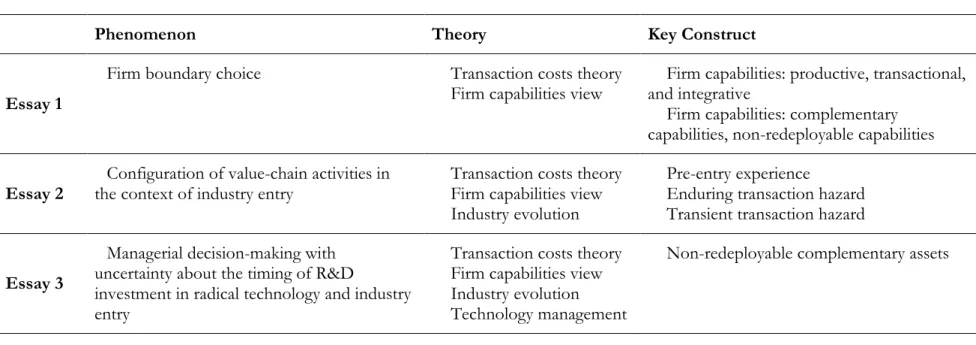
5 Table 1.1 presents an overview of the three essays of my dissertation, highlighting the
different but closely linked phenomena, theories, and constructs from each essay. One common theoretical construct throughout the dissertation is the redeployable or non-redeployable assets. When an exchange partner invests in assets that cannot be easily redeployed to alternative uses without losing economic value, this exchange partner incurs high asset specificity and is likely to be subject to high transaction costs (Williamson, 1985). When a firm configures its value-chain activities in a certain way upon entering an industry, it commits itself to a specific path of capability
development, facilitating or constraining its future strategic choices by such commitment
(Ghemawat, 1991). If a firm’s prior investments are irreversible or non-redeployable, and external technological changes are likely to devalue these investments, then sunk costs occur and the firm’s option to abandon will decrease (Dixit and Pindyck, 1994).
Whether an asset is generic or specific to a transaction influences an exchange partner’s boundary choice (as emphasized in the transaction costs theory, Williamson, 1985); whether capability development is reversible or irreversible has implications for a firm’s competitive advantage (as emphasized in the capability view of the firm, Ghemawat, 1991); and whether an uncertain investment has high or low real options value of abandonment affects managerial
decision-making ex ante (as emphasized in the real options theory, Dixit and Pindyck, 1994). Though independently developed in three literature streams, these distinctions of firm assets (i.e., generic vs. specific, reversible vs. irreversible, and flexible vs. sunk costs) can be boiled down to one
fundamental distinction: redeployable vs. non-redeployable assets, or the main construct of my dissertation. Table 1.2 summarizes these closely related but separately developed constructs.
I further enhance the theoretical coherence across the three essays by employing the same empirical setting for hypotheses testing: the nascent U.S. biofuels industry, which is currently undergoing development of new generational technologies. I collect secondary data about boundary
6 choice and primary data about managerial decision-making. I triangulate data from archival sources, surveys, and interviews to operationalize variables. In particular, for essay two, I examine a firm’s boundary choice for four key value-chain activities that complement bioethanol production: (1) feedstock procurement, (2) technology development, (3) bioethanol marketing and distribution, and (4) co-product marketing and distribution. A firm’s boundary choice is identified when it first starts bioethanol production. For essay three, I use a representative sample of the biofuels industry (bio-ethanol and biodiesel) in the U.S. I collect data through a large sample survey, asking managerial personnel in charge of the biofuels business to provide information about their anticipated R&D investment in the next generation production technology. I also ask them about their expectations regarding entry into the new industry defined by the new technology.
In conclusion, the next three essays of this dissertation build upon the organizational economics approach to strategy management, integrating transaction costs theory, dynamic capability view, real options theory, and industry evolution, as well as the technology management literature. The dissertation’s research questions center on the non-redeployability of firm assets (specific asset and non-redeployable capabilities in essay one, specific asset and industry life cycle in essay two, and non-redeployable complementary assets and R&D investment as well as industry entry in essay three). Findings of the dissertation shed light on the fundamental implications of non-redeployability of firm assets on a range of strategic issues related to firm boundary choice, R&D investment, and industry entry, contributing to the evolving science of strategic organization.
7 TABLES AND FIGURES
Table 1.1 Overview of the Three Dissertation Essays: Phenomenon, Theory, and Key Constructs
Phenomenon Theory Key Construct
Essay 1
Firm boundary choice Transaction costs theory
Firm capabilities view and integrative Firm capabilities: productive, transactional, Firm capabilities: complementary
capabilities, non-redeployable capabilities
Essay 2 the context of industry entry Configuration of value-chain activities in Transaction costs theory Firm capabilities view Industry evolution
Pre-entry experience
Enduring transaction hazard Transient transaction hazard
Essay 3
Managerial decision-making with uncertainty about the timing of R&D
investment in radical technology and industry entry
Transaction costs theory Firm capabilities view Industry evolution Technology management
Non-redeployable complementary assets
Table 1.2 Redeployable vs. Non-redeployable Assets
Transaction Costs Theory Capability View of the Firm Real Options Synthesis in My Dissertation Generic asset Specific asset Reversible investment Irreversible investment Flexible assets Sunk costs Redeployable assets Non-redeployable assets
8 CHAPTER 2
ESSAY 1: WHEN CAPABILITIES MEET TRANSACTION…… INTRODUCTION
Recently, the capability view of the firm has been used to address the firm boundary question that was predominantly studied with the transaction costs theory from both a theoretical perspective (e.g., Langlois and Foss, 1999; Madhok, 2002; Jacobides and Winter, 2005; Jacobides, 2008) and an empirical perspective (e.g., Walker and Weber, 1984; Argyres, 1996; Leiblein and Miller, 2003; Hoetker, 2005; Jacobides and Hitt, 2005). Revisiting the empirical findings from several of these works (Walker and Weber, 1984; Leiblein and Miller, 2003; Jacobides and Hitt, 2005), which have included both transaction costs variables and firm capabilities variables, shows surprisingly mixed empirical evidence for the transaction costs variables. Measuring transaction costs with demand volume uncertainty and technological uncertainty, Walker and Weber (1984) only received partial support for their predictions based upon the transaction costs theory. Leiblein and Miller (2003) did not find significant, direct effects of asset specificity on production integration; they even found a significantly negative effect between demand uncertainty and production integration. Jacobides and Hitt (2005) also found mixed support for their transaction costs-based hypotheses, and in some of their models, the predictions even became the opposite. Interestingly, however, measures of firm capabilities in these studies all turn out to be significant and consistent with their theoretical predictions: e.g., if a firm has strong productive capabilities, it is more likely to internalize production.
A puzzle then arises: compelling empirical evidence has been found for the effect of transaction costs or transaction-specific characteristics elsewhere in the research literature on firm boundary choice, but why do the variables measuring transaction costs only receive marginal or even
9 contradictory evidence when firm capabilities variables are also included in the same model? To put it more strongly, does it mean that the organizational capability perspective can substitute the transaction costs theory in predicting firm governance choice? Or does the former provide a better explanation of firm boundary choice than the latter? Less pointedly, do transaction costs and firm capabilities influence firm governance independently (Riordan and Williamson, 1985)? What are the possible boundary conditions for these two theoretical perspectives in predicting a firm’s boundary choice? Under what conditions does the capability view provide better explanations? And under what conditions does transaction costs theory matter more?
Furthermore, the above-mentioned empirical studies (Walker and Weber, 1984; Leiblein and Miller, 2003; Hoetker, 2005; Jacobides and Hitt, 2005) on firm boundary choice have paid particular attention to productive capabilities (e.g., supplier production advantage derived from difference in manufacturing process, difference in scale of production and annual savings to make a component in Walker and Weber, 1984; production experience in related technologies in Leiblein and Miller, 2003; labor productivity and operating margin in Jacobides and Hitt, 2005). Other types of firm capabilities have been marginally referenced, such as transactional capabilities (Hoetker, 2005) and integrative capabilities (Helfat and Campo-Rembado, 2010), but empirical evidence on these other types of firm capabilities are rather limited. Therefore, compared to the ample evidence found for the transaction costs theory-based analysis, we have only found limited evidence on the role of firm capabilities in explaining and predicting firm boundary choice. Empirical studies with the firm capability perspective are still emerging, which further constrains efforts to develop a coherent theory. This insufficient work sparks the following research question: in what ways can the firm capability view and the transaction costs theory be complementary and congruent in providing better understanding about the firm boundary question?
10 This essay of the dissertation aims to address this question by more closely examining the intertwined relationships among firm capabilities, transaction costs, and governance choice. To this end, I will first discuss some challenges in our efforts to integrate the capability view and the transaction costs theory in explaining and predicting firm boundary. Then, I propose a theoretical framework in order to identify how the capability view can complement the transaction costs theory. This framework consists of two typologies of firm capabilities. The first typology emphasizes the functions of firm capabilities (e.g., productive, transactional and integrative capabilities) in reducing various costs involved in a transaction (e.g., production, transaction and organizational costs). The second typology focuses on characteristics of firms’ capabilities (e.g., complementarity and
specialization) that may lead to value creation and/or appropriation. I then make propositions on empirical implementations and theoretical interpretations for research inquiries into the firm boundary question.
CHALLENGES OF INTEGRATING CAPABILITY VIEW & TRANSACTION COSTS THEORY
Attempting to join the firm capability view and the transaction costs theory in order to explain and predict firm boundary is not without challenges. The first challenge relates to the unit of analysis. While the transaction costs theory treats individual transaction as the unit of analysis, the capability approach may involve different units of analysis. Measures of transaction costs are transaction-specific, but measures of firm capabilities often require consideration of multiple
transactions or activities. A case in point is a firm’s integrative capabilities, which reside in interfaces across activities, not within an individual transaction. This has two implications: one, empirical studies that try to integrate these two theoretical perspectives need to carefully design the
11 capability view can supplement the transaction costs theory in the analysis of firm governance by additionally considering those factors across transactions or activities.
A second challenge is related to the issue of endogeneity. Transaction costs are often measured with factors that are assumed to be exogenous to a firm’s governance choice, such as technological and demand uncertainties. Firm capabilities, however, can be endogenous to the governance choice. For example, a firm can achieve economies of scope by integrating an activity, and thus enhancing productive capabilities. Thus, it is difficult to distinguish the firm’s choice to integrate because of its high productive capabilities from the firm’s choice to integrate in order to enhance productive capabilities. Therefore, differing from a transaction costs theory-based empirical study that can be done with a cross-sectional design, a capability view-based empirical study is supposed to account for potential endogeneity by designing a longitudinal dataset or using laggard measures of firm capabilities.
The endogeneity issue becomes even more complicated when a focal transaction itself is a capability-development activity. Such a transaction is influenced not only by characteristics of the transaction (e.g., level of uncertainty in acquiring capability from external providers), but also characteristics of firm capabilities (e.g., the discrepancy between a firm’s extant capabilities and the targeted capabilities) (Capron and Mitchell, 2004, 2009). In this case, there is a need to distinguish between the extent to which the focal transaction pertains to capability development and the extent to which it is subject to transaction hazards.
As a matter of fact, any transaction may involve a certain level of capability development, though the degrees may differ. This poses a third challenge to the operationalization of transaction costs, especially the measurement of asset specificity, in an empirical study that attempts to integrate the transaction costs theory and the capability view. One needs to distinguish asset specificity from
12 the value-creation potential of the new capabilities to be developed with a certain governance
structure. This challenge, however, has not yet been adequately addressed in extant empirical studies. Among the several empirical studies reviewed here (Walker and Weber, 1984; Leiblein and Miller, 2003; Hoetker, 2005; Jacobides and Hitt, 2005), only Leiblein and Miller (2003) specifically
hypothesize and measure asset specificity as one of the explanatory variables. But even in this study, the main effect of asset specificity on firm integration decision is not found.
The non-significant result for asset specificity or non-inclusion of asset specificity variable at all in the abovementioned empirical studies suggest possible confounding effects between the construct of asset specificity and the construct of firm capabilities. These two constructs have been originally developed independently in two theoretical perspectives, and the intertwined relationships between these two can be set aside for use in different research questions. But when one construct is introduced to explain a question that is largely in the domain of the other construct, clarification of these two constructs is needed. This is particularly the case for the firm capability construct, as it is being introduced to the firm governance question that is traditionally studied with the transaction costs theory. This constitutes another challenge to such empirical studies.
I contend that there are conceptual overlaps between these two theoretical constructs, which further complicates empirical specifications, particularly the theoretical implications drawn from such empirical studies. For example, the “comparative advantage” argument developed in Jacobides and Hitt (2005) suggests that firms with comparatively stronger productive capabilities are more likely to integrate an associated production stage. The advantage derived from comparatively stronger productive capabilities may actually be the sources of asset specificity, as the focal firm can achieve greater economic value than the partners who do not possess comparative advantages. Thus, it is possible that the productive capabilities underpinning the comparative advantages are just one
13 special case of asset specificity.12
The relationships between firm capabilities, transaction costs, and boundary choices become more complicated if we take a longitudinal perspective. Boundary choice at time T0 can increase or
decrease transaction costs for a boundary choice at time T1. Argyres and Liebeskind (1999) point to
the possibility of “governance inseparability” over time or across transactions, suggesting that boundary choice for one transaction is not only subject to concurrent transaction costs, but also constrained by previous commitments to transaction partners and relevant stakeholders. Breaking such commitments may impose unexpected costs not captured by transaction costs per se, but such costs are undoubtedly significant in a firm’s decision calculus. Boundary choice at time T0 may also
increase or decrease production costs or productive capabilities at time T1. For example, firms that
choose to internalize a transaction at time T0 are more likely to gain learning-by-doing benefits than
firms that largely rely on external suppliers. Rational expectations about potential learning benefits and productive capabilities improvement in the long term may also influence a firm’s boundary decision at T0. Development offirm capabilities is also a longitudinal process, involving transaction
costs and boundary choices. Mahoney and Qian (2010) further argue that heterogeneity in firm capabilities and transaction costs can be traced to the same origin, i.e., market frictions. Firms develop capabilities in an environment with positive transaction costs. Heterogeneity in firm capabilities depends on various market frictions (Itami and Roehl, 1987) and require long-term, path-dependent learning processes (Nelson and Winter, 1982), making them difficult to be imitated (Dierickx and Cool, 1989).
Significant findings for the comparative productive capabilities variables in Jacobides and Hitt (2005) may reflect predictions based upon asset specificity.
1 Argyres and Zenger (2008: 11) even suggest that the “notion of transaction-specific assets is very close to, if not identical to, the notion of firm-specific assets used in resource- and knowledge-based views of the firm.” 2 However, I do not argue here that these two constructs are equivalent. Some firm capabilities do not constitute asset specificity and vice versa.
14 Complexities among firm capabilities, transaction costs, and firm boundary choices have different implications for theoretical development and empirical studies. The following example illustrates these different implications. Suppose at time T0 a newly established firm with zero stock
of firm capabilities starts to develop its capabilities. This firm may choose a certain governance structure subject to the magnitude of transaction costs at time T0. The process of capability
development continues, and by time T1, the firm has already accumulated a unique profile of
capabilities, such as productive, integrative, and transactional capabilities. Suppose this firm needs to make a boundary choice at time T1. To examine such a boundary decision, a typical empirical study
that attempts to integrate the capability view and the transaction costs theory may treat firm capabilities and transaction-specific characteristics independently, adding corresponding variables into the regression model. This approach is valid for a cross-sectional study, but interpretations of results from such a research design for the purpose of theoretical advancement should be careful. Statistically significant findings for firm capability variables and insignificant transaction costs variables do not necessarily negate the explanatory power of the transaction costs theory, as the underpinning transaction costs might have already been captured by the firm capability variables.
In short, this section contends that the capability view complements the transaction costs theory when it comes to the firm boundary question, for the capability perspective can potentially extend beyond a single transaction as the unit of analysis, augment operationalization of asset specificity, and enrich finer-grained empirical testing. Empirical studies in this regard need to pay particular attention to two issues. One issue is the extent to which a measure of firm capabilities (e.g., comparative advantages) is different from a measure of asset specificity. The second issue is the longitudinal design of dataset or measurement that can tease out the intertwined relationships between firm capabilities and transaction costs.
15 Figure 2.1 presents a simplified illustration of the key takeaways of this section. It uses two time periods to depict the longitudinal aspects of the intertwined relationships between firm capabilities and transaction costs. Transaction costs are regarded as the fundamental driving forces of capability development and boundary choice. Both firm capabilities and transaction costs affect a firm’s boundary decision. The oval with a solid line represents empirical studies that use the
transaction costs theory as the primary tool. The oval with a dash reflects the relationships between firm capabilities and boundary choice that have been proposed by extant empirical studies reviewed in the beginning of this essay of the dissertation. These extant empirical studies often take an additive approach by placing the dashed oval on top of the solid oval--without explicitly addressing the interrelationships between firm capabilities and transaction-specific characteristics--or the bold double-head arrow in Figure 2.1. Some even go further and suggest the dashed oval can be
independent of the solid oval.
As discussed above, a more productive approach is to integrate the constructs and
relationships between each oval. Such an approach needs first to identify those mechanisms through which various firm capabilities and transaction-specific characteristics interact for the phenomenon under research. Once these mechanisms are identified and the potential confounding effects are teased out, then a cross-sectional study designed in an additive way is still valid, but interpretation of results from such an approach should not be overstated to the extent that the fundamental effects of transaction costs are neglected. These are challenging tasks. As a first step, the next section develops two typologies of firm capabilities that potentially interact with transaction specifics in determining firm boundary along two dimensions. The first typology emphasizes the functions of firm
capabilities (e.g., productive, transactional and integrative capabilities) in cost minimization (e.g., production, transaction and organizational costs), and the second typology focuses on characteristics
16 (e.g., complementarities and specialization) of firm capabilities that may lead to value creation and/or appropriation3
TWO TYPOLOGIES OF FIRM CAPABILITIES RELATED TO BOUNDARY CHOICE .
What are the key attributes that differentiate transactions and how do these attributes impact the governance structure reside at the centre of the transaction cost economics research (Williamson and Masten, 1999). Discriminating attributes of transactions and dimensions of governance
structures, and achieving alignment between these two, is a general approach to the firm boundary question. This approach can be extended to situations where firm capabilities enable value creation / appropriation and cost minimization.
Matching Functions of Capability with Cost Minimization
“How should firm A, with its preexisting strengths and weaknesses, organize transaction X?” asks Williamson (1999: 1103). In Hoetker’s (2005) answer, relational capability of a focal firm with its suppliers reduces the adverse impact of uncertainties on their transactional relationships and further reduces transaction costs. Using a resource-based approach, Leiblein and Miller (2003) maintain that vertical integration enables a firm to leverage firm-specific, valuable, and difficult-to-imitate capabilities. Jacobides and Hitt’s (2005) answer weighs comparative productive capabilities of a focal firm against external specialized suppliers. They claim that firms are more likely to carry out a value chain activity internally if it possesses production cost advantages in that activity, even if the comparative advantages are potentially replicable or short-lived.
Just as in the case that there are various types of capabilities in a firm, answers to
Williamson’s (1999) call speak to different “preexisting strengths and weaknesses.” While Hoetker
3 Mahoney and Qian (2010) suggest that value creation and cost minimization are two intertwined aspects of the firm boundary question, and simultaneous consideration of these two objects is required for more complete understanding about a firm’s boundary choice. This suggestion fits well with the purpose of this essay, as these two aspects align with the two typologies of firm capabilities developed here.
17 (2005) refers to relational capability that works towards reducing transaction costs more than
production costs, Jacobides and Hitt (2005) explicitly address the influence of productive capability that leads to lower production costs. It is therefore important to identify those capabilities that are relevant to better explain and predict the mechanisms through which firm capabilities influence its boundary choice for a specific transaction. From an organizational economics view, boundary choice is a function of three sets of costs, i.e., production costs, transaction costs, and internal organization costs4
Production Costs and Productive Capabilities
. Each type of costs corresponds to a different set of firm capabilities, a typology of which will be developed in this section.
Differences between a buyer’s production costs and those of an external supplier indicate efficiency differentials between in-house production and market contracting mode. It is empirically difficult to directly compare the levels of production costs of a buyer and a supplier or to gauge the impact of production costs differences on the buyer’s governance choice, especially when that choice can only be observed ex post.
There has been debate about the extent to which comparative production costs determine boundary choice, as well as the sources of production costs differentials. Stigler (1951) regards scale economies to be the source of production costs differentials, and develops a life-cycle theory of vertical integration. In this theory, firms in young industries tend to be vertically integrated, but as industry grows, specialized suppliers can be sustained by a large scale of output. Williamson (1975) submits that production costs differentials derived from scale economies are insufficient for vertical integration, as buyers can also achieve economies of scale by producing in-house and selling extras to customers, absent transaction costs (e.g., economic hold-up problems that might otherwise occur).
4Comparatively, transaction costs have been the most focused in the organizational economies. As Langlois and Foss (1999: 201) put it, “the field has indeed focused precisely on the comparative transaction costs of alternative organizational structures, including, paradigmatically, the choice between firms and markets”.
18 Economies of scale, however, are only one potential source of production costs differentials. The resource-based view and the capability perspective extend beyond the scale economies,
emphasizing the concept of firm-specific capabilities. With a shift of focus from scale economies to firm capabilities, Williamson’s (1975) critique of Stigler (1951) is no longer applicable. It is not the economies of scale per se, but the productive capabilities underpinning scale economies and production costs that may affect a firm’s vertical integration. Firms can improve productive capabilities by accumulating production experience, achieving scale economies, and coordinating with other complementary assets (Teece, 1982, 1986). Differentials along these multiple dimensions across firms represent their different levels of production costs. With the help of the micro-analytic lens provided by the capability approach, empirical studies examining effects of production costs on boundary choice become feasible.
Walker and Weber (1984) are among the earliest empirical studies that explicitly examine the influence of production costs on the make-or-buy decision, aside from transaction costs. This study overcomes the difficulty in directly comparing production costs by using a structural equation modeling approach, where three indicators (advantage in manufacturing process, advantage in scale of operations, and annual savings to make a component) represent the latent factor, the supplier’s production advantages. Furthermore, to capture the comparative nature of production advantages between supplier and buyer, their model also includes the influence of buyer’s production
experience on the level of supplier production advantages. This experience is indicated by similarity of extant production equipments to those required by producing the new component, and buyer’s production technology expertise. Walker and Weber (1984) find that comparative production costs are the strongest predictor of make-or-buy decisions. Transaction hazard measured by volume uncertainty and supplier competition have statistically significant but substantively small effects.
19 Argyres (1996) presents qualitative evidence that distinguishes the explanatory powers of these two perspectives in different contexts. Argyres (1996) examines the role of transaction
characteristics and firm capabilities in several activities (e.g., product design, mold making, assembly, etc.) of a large firm, and finds that for some activities, asset specificity alone determines the make-or-buy decision, while for some other activities, firm capabilities or a combination of the two serve as the better explanation. This study further finds that the similarity of the knowledge base associated with different activities and the time required to develop knowledge are possible mechanisms through which capabilities operate. Firms tend to outsource an activity if suppliers have superior capabilities. However, when in-house development of capabilities is perceived to be value-creating in the long run, firms may choose to tolerate high in-house production costs in the short run, despite low transaction costs. It is easy to understand that high transaction costs coupled with strong in-house productive capabilities are most likely to lead to internalization, and low transaction costs with superior supplier productive capabilities lead to outsourcing. What makes it more interesting is the case where neither transaction costs nor productive costs advantage dominates the make-or-buy decision. Argyres (1996) finds that for one activity, the sample firm retains in-house production over time, but for different reasons at different time periods. Initially, transaction costs consideration determines the internalization choice, but later, capability differentials dominate the decision-making.
So far, we have seen evidence pointing to the role of productive capabilities in shaping firm governance. But this current evidence is based upon single-firm (Argyres, 1996) or single-corporate division analysis (Walker and Weber, 1984), and is derived from qualitative data. Whether these findings can be generalized to other contexts is still a question. More empirical evidence is needed.
Leiblein and Miller (2003) present an empirical study based upon a cross-sectional analysis of production decisions in a large sample pooled from the semiconductor industry. They find that
firm-20 specific capabilities have a statistically significant effect on firms’ vertical integration decisions, independent of the effects of asset specificity, demand uncertainty and ex ante small number situations. This study uses previous production experience in similar products with similar process technology as the proxy for productive capabilities of a given firm, with an implication that previous production experience constitutes a firm’s competence that can be leveraged across value chain activities (Quinn and Hilmer, 1994; Barney, 1999).
A firm’s competence does not, however, necessarily lead to comparative efficiency. The outsourcing literature has provided many examples where firms may still choose to outsource activities at which they have accumulated substantial experiences (Quinn and Hilmer, 1994). One important reason for these outsourcing decisions is the comparative efficiency of the external suppliers. In order to more correctly examine the effect of firm capabilities on its integration
decisions, a better-designed empirical study needs to go beyond absolute firm productive capabilities to include whether these capabilities are also better than potential external suppliers (Jacobides and Winter, 2005). A flipside to this argument is that even if a firm does not have much previous related experience in carrying out an activity, it may still choose to internalize production if the capabilities of potential external suppliers are even poorer.
To take into account the possible comparative efficiency, Jacobides and Hitt’s (2005) study proposes a “comparative advantage” theory of vertical scope. Building upon the belief that there is variation in productive capabilities across firms, Jacobides and Hitt (2005) maintain that a firm’s superior productive capability in one value chain activity is associated with more vertical integration of that activity, but less with vertical integration of a downstream activity. Superior productive capabilities of a firm are measured as labor productivity and operating margins in a focal value chain activity for a sample of mortgage banks. Although Jacobides and Hitt (2005) try to distinguish a
21 “comparative advantage” view of vertical integration from an “absolute advantage” or “unique and rare resource” view of vertical integration, the empirical measures for productive capabilities are actually similar to operationalization in Leiblein and Miller (2003). Also, empirical measures cannot capture the implications of comparative advantage of a firm in a focal value chain activity relative to potential external suppliers. To decide whether or to what extent a firm possesses comparative advantage in productive capabilities, information about potential external suppliers’ productive capabilities is needed.
Hoetker (2005) addresses this issue by examining supplier selection strategies with a sample of notebook manufacturers and their sourcing decisions for innovative flat-panel displays. The unit of analysis in this study is not the focal firm that is making the sourcing decisions. Instead, a buyer-supplier dyad is created between every manufacturer and all potential buyer-suppliers, including internal suppliers. By doing so, this approach captures comparative productive capabilities between a given firm (represented by the indicator of internal supplier) and all potential suppliers, as well as
comparative productive capabilities across external suppliers. Findings show that firms are more likely to choose a supplier if this supplier has greater technological capabilities. More explicit interpretation of this finding is that if the internal supplier of a manufacturer possesses stronger technological capabilities, then this manufacturer is likely to choose internal sourcing and, if otherwise, an external supplier. If a manufacturer chooses among several external suppliers, it is more likely to choose the supplier with greater technological capabilities.
In summary, these research efforts to incorporating productive capabilities have provided empirical evidence about firm boundary choice, in addition to the traditional theorizing based upon transaction costs. Statistically significant results for variables of productive capabilities in these empirical studies show that the capability view can contribute to better understanding about a firm’s
22 boundary choice. Firms do take into account production costs in their decision-making calculus for integration choices. In making integration decisions, firms try to seek superior external resources and capabilities, or to leverage superior internal resources and capabilities, aside from the efforts to economize transaction costs. These empirical studies also have limitations, however, as the
transaction costs variables and the productive capabilities variables are simply joined in an additive manner, assuming independent effects of these variables on firm boundary choice. This may not be the case due to possible endogenous interrelations between transaction costs and firm capabilities. The story of productive capability differentials is not sufficiently nuanced and misses the analytical complexity involved in a fuller understanding of the intertwined relationships between firm
capabilities and transaction costs. Indeed, it is the high transaction costs due to contractual hazards and concerns about economic holdup that underpin the persistence of the differential productive capabilities (Riordan and Williamson, 1985; Williamson, 1975).
Transaction Costs and Transactional Capabilities
Not only are firms heterogeneous in productive capabilities, but also in their capabilities of governing transactions. In dealing with even the same type of transactions, firms may encounter different magnitudes of transaction costs. Underpinning such differentials are firm capabilities that pertain to transaction governance. Transactional capabilities are a firm’s abilities to overcome transaction costs derived from asset specificity, uncertainty, or other factors that may lead to
opportunistic tendencies. Initiating, negotiating, and implementing a transaction require a large set of firm capabilities, such as capabilities in selecting attractive external suppliers, specifying contractual conditions, and particularly enforcing and managing contract non-compliance (e.g., Doz and Hamel, 1998; Leiblein and Miller, 2003; Hoetker, 2005). Transactional capabilities exert impact on
23 integration decisions ex ante by reducing transaction costs or on transaction governance ex post by enabling communications, monitoring, and controls of transaction partners.
Several studies have incorporated the notion of transactional capabilities into the traditional transaction costs theory of the firm. Argyres and Mayer (2007) provide qualitative evidence about how firms may learn to contract with even the same partner over time. Mayer and Bercovitz (2008) find that prior relationships between two firms create an inter-organizational inertia lag that leads firms to use the same level of contingency planning in current exchanges as they used in prior contracts. These studies emphasize the constraining rather than enabling aspects of past governance choices, which reduce a firm’s capabilities in economizing transaction costs related to current governance choices.
While Mayer and Bercovitz (2008) highlight a firm’s inabilities to choose an optimal
governance structure, Dyer’s (1996) comparative study highlights the firm’s capabilities in reducing transaction costs. Dyer (1996) finds significant difference between U.S. and Japanese automakers’ usage of mixed governance structures. While U.S. automakers rely largely on markets and hierarchies to facilitate exchange, Japanese automakers rely on hybrid governance structures or alliances. Dyer (1996) attributes Japanese automakers’ competitive advantages to their abilities in circumventing transaction costs with self-enforced safeguards, such as information sharing, reputation, trust, and credible commitment. Reducing transaction costs up front lowers the incurrence of transaction costs and changes the comparative dynamics among efficiencies of different governance structures. Such differences may be due to institutional settings of two different countries or firm-specific strategies, which we on focus here.
Findings from Mayer and Bercovitz (2008) and Dyer (1996) suggest there are at least two types of transactional capabilities. One is partner-specific transactional capabilities, which are
24 specifically developed through past transactions with that same partner. Partner-specific
transactional capabilities are multifaceted. For example, there has been ample evidence5
General transactional capabilities are applicable to many transactions in which a firm is likely engaged For example, a firm experienced in risk management and price hedging strategies is less likely to be subject to the adverse effect of volume or price fluctuation uncertainties than a firm largely exposed to such uncertainties. Put differently, uncertainties in volume or demand impose less risk on firms equipped with such transactional capabilities, regardless of the transaction partners. General transactional capabilities can be developed from a firm’s previous transaction experiences, which aid in the development of routine-based capabilities such as standard contractual safeguards, inter-firm coordination mechanisms, and contract enforcing schemes. Leiblein and Miller (2003)
showing that inter-firm trust or past relationships with a specific partner facilitates ex post coordination if an unanticipated contingency occurs (Uzzi, 1997). Such relationships facilitate mutual understanding of each other (Gulati, 1995; Gulati and Singh, 1998), reduce the occurrence of opportunism (Parkhe, 1993), and enhance a firm’s inter-firm coordination skills or relational capabilities (Dyer and Singh, 1998; Mitchell and Singh, 1996). Mayer and Argyres (2004) specifically study how firms may learn to contract with each other within repeated transactions, and suggest that firms with superior contract design capabilities (Argyres and Mayer, 2007) are more likely to use the market to organize a marginal transaction than those with weaker contract design capabilities. Contracts play an
important role as repositories of knowledge about how to collaborate and contract. Learning from such repositories not only facilitates future transaction governance with the same exchange partner, but also exchange across transactions in which the focal firm may be engaged. This relates to the second type of transactional capabilities, i.e., general transactional capabilities.
5 Given the extant ample evidence on the role of past transactions or experiences with a partner, I will skip literature review of individual papers that primarily examine the relationships between past relations and integration decisions, but provide summary findings based upon these studies.
25 find that a firm’s general sourcing experience -- measured as the number of unique relationships with external suppliers over the last 5 years -- is negatively related to the likelihood of integration.
Both theoretical and empirical studies reviewed thus far in this section suggest that firms with strong transactional capabilities are more likely to choose external suppliers or partnerships than internal governance. In addition, conceptual distinction between partner-specific transactional capabilities and general transactional capabilities has only been partially operationalized in the empirical literature, where the lingering questions include: to what extent can transactional capabilities accumulated through repeated transactions with one exchange partner be transferred across partners?
A mirror concept of transactional capabilities is the organizational capabilities that enable communication and coordination within a firm, which will be discussed next.
Organizational Costs and Integrative Capabilities
Williamson’s (1975) original organizational failures framework, including human factors (bounded rationality and opportunism) and environmental factors (uncertainty and small numbers), depicts key concepts concerned with comparative governance assessment. Factors leading to failures of market are also mirrored within an organization (Mahoney, 2005). While market exchanges are subject to transaction costs, internalization of these exchanges may also lead to greater bureaucracy and lower incentives. As integration decisions depend upon the comparative efficiency of different governance structures, the tradeoff between external market failures and internal organizational costs (Coase, 1988) plays an important role in assessment and decision-making. An even more intriguing question is whether and to what extent variations in internal organization costs are responsible for observed variations in organizational form (Masten, Meehan and Snyder, 1991: 5)?
26 Although the transaction costs theory relies on assessment of comparative efficiency of different governance choices, empirical studies on governance choice are constrained by data availability, as researchers cannot directly observe and measure transaction costs or internal organization costs of a sample of firms that have already chosen a certain governance structure (Masten et al., 1991). The problem of measuring market transaction costs has been solved by using observable characteristics of the transaction (Williamson, 1979), such as asset specificity, uncertainty, and complexity. Predictions of organizational form are mostly based upon these observable
transaction characteristics.
This large volume of empirical studies on governance forms, however, is mainly focused on market transaction costs; internal organizational costs are much less studied. Difficulties in directly observing or measuring organizational costs are a primary reason. But similar to the empirical studies on measuring transaction costs, a solution can be achieved by using observable characteristics of the internal organization of a transaction. Masten et al. (1991) develop a two-stage, regression estimation procedure to differentiate the effects of market organization costs and internal organization costs on governance choice, measuring organizational costs as the costs of planning, directing, and oversight of integrated tasks or components. Organizational costs are found to be decreasing with skilled human assets, which are also found to be positively related to the likelihood of a make decision. This empirical result provides indirect evidence showing that factors that reduce internal organizational costs are associated with internalization choice, and suggests the need as well as the feasibility to include those factors in empirical studies based upon the transaction costs theory. Though Masten et al.’s (1991) methodology has not been picked up widely in the transaction costs literature, their measures of internal organizational costs and related observable factors have broad implications for empirical studies. In order to obtain a better assessment of the comparative efficiency of governance
27 structures, factors leading to internal organizational costs need to be identified and distinguished from those associated with market transaction costs.
Firms differ in their capabilities in managing communication and coordination within the organization. This essay of the dissertation maintains that these firm capabilities are appropriate proxies for internal organizational costs of a potential transaction to be internalized. For example, the M-form elaborated in Williamson (1975) touches upon such heterogeneous firm capabilities, in that managerial capabilities residing in multi-division coordination and control economizes on bounded rationality and attenuates opportunistic behaviors across divisional managers. Other things being equal, when deciding whether to pull a transaction into the firm boundary, the expected costs of integrating that transaction with the firm’s extant system of activities will be negatively related to the likelihood of integration. For example, Argyres and Liebeskind (1999: 49) coin the phrase “governance inseparability” to refer to the situation in which a firm’s past governance choices significantly influence the range and types of governance mechanisms that it can adopt in future periods. Governance inseparability arises due to contractual commitment and/or changes in the bargaining power of the other parties, and imposes governance costs on the firm when it intakes a new transaction (Argyres and Liebeskind, 2002). Firms with different prior commitments face different governance choice constraints, which will further result in greater or lesser organizational costs for a new transaction.
In order to overcome such organizational costs, firm capabilities to smooth the integration process become important. The innovation and technology development literature has developed concepts that depict such firm capabilities. Henderson and Clark (1990) are among the first to distinguish architectural innovation from component innovation. Although this study is not directly related to the quest of firm boundary choice, the concept of architectural knowledge among product
28 components can be applied and actually has been extended to multiple contexts. Henderson (1994) defines internal integrative competence as a firm’s ability to exchange information across boundaries within the firm, and suggests that such integrative capabilities cannot diffuse easily across an industry. Iansiti and Clark (1994: 565-566) further consider such capabilities as “skill in internal integration, such as the capability for coordination, leadership and organizational routines that ensure efficient communication between organizational subunits.” Helfat and Raubitschek (2000) extend the component-architecture concept to the context of value chain activities, suggesting that firms can possess capabilities in integrating knowledge across different stages of a value chain6
Despite the importance of a firm’s integrative capabilities in its architectural structures (e.g., system of products, system of value chain activities), few empirical studies have examined the ex ante influence of these firm capabilities on the boundary choice of the firm. Available empirical evidence is limited, indirect, and mixed. Ohanian (1994) finds that established mills tend to remain vertically-integrated over time in the U.S. pulp and paper industry, which may imply that firms with
capabilities in managing vertical integration are more likely to choose internalization for a
transaction. In the early U.S. auto industry, Argyres and Bigelow (2007) observe that the number of firms that internalize standard components is nearly four times more than the number of firms that outsource unique components. Bigelow and Argyres (2008) distinguish de alio entrant from de novo
. Development of integrative capabilities, however, is costly and takes time (Nelson and Winter, 1982; Dierickx and Cool, 1989). Firms without such integrative capabilities are unable to develop them immediately before the integration of a targeted transaction. Therefore, possession of integrative capabilities constitutes advantages for firms by reducing internal organizational costs.
6 Integrative capabilities in this essay of my dissertation are within a firm boundary, though firms may also develop skills in technology or knowledge transfer across firm boundaries (Mayer and Salomon, 2006). We relate a firm’s capabilities in communication and coordination across firm boundaries to governance capabilities discussed in the previous section.
29 entrant in the auto industry and find that entrants with prior experience in other industries are less likely to choose internal engine production. If vertical integration itself can be a proxy for integrative capabilities, then these studies provide mixed findings. On the one hand, vertically-integrated firms are more likely to remain integrated as new transactions arise (Ohanian, 1994; Argyres and Bigelow, 2007). On the other hand, firms diversifying from prior related industries may choose external suppliers over internalization (Bigelow and Argyres, 2008).
Theoretical work on this topic is also scarce. Helfat and Campo-Rembado (2010) are among the first to theoretically explore the relationships between integrative capabilities and a firm’s
integration choice. Within an industry context with successive “systemic” innovations and inter-dependence across stages of production, Helfat and Campo-Rembado (2010) propose that firms with integrative capabilities are likely to integrate new production stages. Although in their model they argue that the reason firms should remain vertically integrated is to maintain innovative capabilities over multiple cycles of technological innovation, this proposal also has implications for the role of integrative capabilities by reducing internal organizational costs. Management of
interfaces across successive innovations may incur lower costs within firm boundary if the firm possesses integrative capabilities.
In summary, empirical studies on the influence of internal organizational costs on a firm’s integration decision are rather limited, largely due to difficulties in measuring such costs. The concept of integrative capabilities (e.g., Helfat and Raubitschek, 2000; Helfat and Campo-Rembado, 2010), which are able to facilitate communication and coordination across components, can be a partial solution. Current mixed empirical evidence (Ohanian, 1994; Argyres and Bigelow, 2007; Bigelow and Argyres 2008) challenges future studies to develop better measurement of integrative