P R O C E E D I N G S
Open Access
Compression of next-generation sequencing
quality scores using memetic algorithm
Jiarui Zhou
1,2, Zhen Ji
2*, Zexuan Zhu
2, Shan He
3From
2013 International Conference on Intelligent Computing (ICIC 2013)
Nanning, China. 28-31 July 2013
Abstract
Background:The exponential growth of next-generation sequencing (NGS) derived DNA data poses great
challenges to data storage and transmission. Although many compression algorithms have been proposed for DNA reads in NGS data, few methods are designed specifically to handle the quality scores.
Results:In this paper we present a memetic algorithm (MA) based NGS quality score data compressor, namely MMQSC. The algorithm extracts raw quality score sequences from FASTQ formatted files, and designs compression codebook using MA based multimodal optimization. The input data is then compressed in a substitutional manner. Experimental results on five representative NGS data sets show that MMQSC obtains higher compression ratio than the other state-of-the-art methods. Particularly, MMQSC is a lossless reference-free compression algorithm, yet obtains an average compression ratio of 22.82% on the experimental data sets.
Conclusions:The proposed MMQSC compresses NGS quality score data effectively. It can be utilized to improve the overall compression ratio on FASTQ formatted files.
Background
DNA sequencing provides fundamental data for many research areas e.g. genomics, bioinformatics, and biology [1]. Rapid progress has been made for DNA sequencing technol-ogies, especially the high-throughput next-generation sequencing (NGS), in the last few years. Newly proposed high efficiency methods significantly stimulate the produc-tion and usage of NGS data [2]. However the exponential growth of NGS data poses huge challenge to data storage and transmission [3]. Thereby efficient compression algo-rithms are required.
General-purpose compression algorithms e.g. gzip and bzip2 usually fail to obtain satisfactory results on NGS data, because they are designed for ordinary plain text or binary files. To achieve higher compression ratio, many specialized methods are proposed. For instance, Cox et al. [4] proposed a Burrws-Wheeler
transform based compression algorithm for large scale DNA sequence databases. Jones et al. [5] presented Quip, a high efficient reference-based NGS data com-pression tool relying on external reference genomes or light-weight de novo assembly to generate reference sequences from the target data. Popitschet al. [6] pro-posed the NGC tool for SAM format files compression. Hach et al. [7] proposed SCALCE by introducing locally consistent parsing in data encoding. More com-prehensive review on NGS data compression can be found in [8,9].
Typically, raw NGS data includes a series of sequen-cing records (called reads). Each record consists of three major components: a metadata containing the read name, platform, and other useful information; a DNA sequence read obtained from one fold of the oversam-pling; and a quality score sequence estimating accuracies of the corresponding DNA bases. Existing algorithms usually focus on the compression of DNA sequence reads, and utilize conventional methods e.g. Huffman coding and run-length encoding (RLE) to compress quality scores [10]. Quality score data is considered * Correspondence: [email protected]
2Shenzhen City Key Laboratory of Embedded System Design, College of Computer Science and Software Engineering, Shenzhen University, Shenzhen, 518060, China
Full list of author information is available at the end of the article
© 2014 Zhou et al.; licensee BioMed Central Ltd. This is an Open Access article distributed under the terms of the Creative Commons Attribution License (http://creativecommons.org/licenses/by/4.0), which permits unrestricted use, distribution, and reproduction in any medium, provided the original work is properly cited. The Creative Commons Public Domain Dedication waiver (http:// creativecommons.org/publicdomain/zero/1.0/) applies to the data made available in this article, unless otherwise stated.
more important than the metadata, and usually occupies similar or even more space than the DNA sequences. It may pose bigger challenges for compression than DNA sequence reads, due to the larger alphabet size. By intro-ducing compressor specific for NGS quality scores, the overall compression ratio of NGS data can be further improved.
In this paper, we propose a memetic algorithm (MA) based NGS quality scores compression algorithm, namely MMQSC. The algorithm consists of three major parts: a Huffman coding based preprocessing is conducted in the first place, followed by MA based encoding codebook design. Finally, quality score data is compressed by using the codebook. MA is widely known as a synergy of popu-lation-based evolutionary algorithm and local search or individual learning procedures. MAs are capable of sol-ving various complex optimization problems more effec-tively than their conventional counterparts [11]. In this work, the self-adaptive differential evolution combining with neighborhood search (SaNSDE) [12], and Davies, Swann, and Campey with Gram-Schmidt orthogonaliza-tion (DSCG) [13], or SaNSDE-DSCG for short, are intro-duced to MMQSC, to optimize the NGS quality scores compression codebook, with which most repetitive short score segments are identified and represented with much shorter encoding.
In conventional MAs, each individual represents a candidate solution of the entire problem, i.e., compres-sion codebook. Its optimization is highly complex, because the codebook consists of hundreds of quality score symbols. Multimodal optimization tries to find all or most of the multiple solutions within a popula-tion in a single simulapopula-tion run [14]. Based on multi-modal optimization, the MMQSC uses an individual to represent only a single specific code vector, and com-poses codebook with the entire evolution population. Thereby computational complexity distributed to each individual’s fitness evaluation is significantly reduced.
The proposed MMQSC obtains promising performance on NGS quality scores stored in the widely used FASTQ format [15]. Experimental results on five representative NGS data sets show that MMQSC obtains better com-pression ratio than other state-of-the-art methods. Particu-larly, MMQSC is a reference-free algorithm for lossless compression, yet obtains an average compression ratio of 22.82%, i.e., 1.81 bits per quality value (BPQ) on the experimental data sets.
The remainder of this paper is organized as follows: Section II describes details of the proposed MMQSC compression algorithm. Section III presents the experimental results of MMQSC on the five real-world NGS data sets. Finally, a conclusion is provided in Section IV.
Methods
SaNSDE and DSCG based memetic algorithm for multimodal optimization
MA is introduced whereby the concept of “meme”, which was coined by Dawkins [16], is employed within an evolutionary computation framework to improve search efficiency. Typically, MA utilizes a population-based global optimization as fundamental framework, and introduces separate local searches or ‘memes’ embedded in each generation of the global evolution to refine the population [17]. The procedure of a canonical MA framework is illustrated in Algorithm 1 [18].
In MAs both global search and local search strategies can be selected flexibly according to the target problem. Typically, NGS data consists of thousands or even millions of read entries, wherein each of them contains hundreds of quality score symbols. Finding a codebook for compres-sing such data is naturally a high-dimensional optimiza-tion problem. Differential evoluoptimiza-tion (DE) [19] is capable of solving large scale problems effectively. In this paper, a high performance DE variant namely the SaNSDE is uti-lized as the global optimizer. Particularly, SaNSDE uses three self-adaptive mechanisms to select mutation strate-gies and control parameter values. By introducing neigh-borhood search in the optimization process, SaNSDE obtains higher performance than conventional algorithms. Moreover, the widely-used local search strategy DSCG is introduced to increase convergence speed. DSCG is a gra-dient-based optimizer that searches solution space in a greedy manner. Combining the exploration of SaNSDE and exploitation of DSCG, the proposed MA obtains pro-mising performance on quality scores compression code-book design.
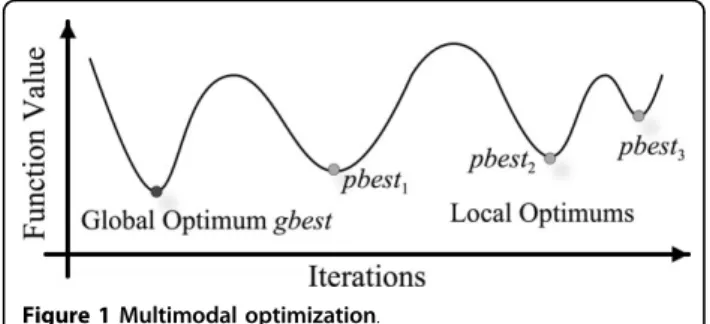
As shown in Figure 1, multimodal optimization searches for not only the global best solutiongbest(as single-objective optimization), but also all the local opti-malpbesti, i= 1, 2, 3... Multimodal optimization has been
used in a wide range of applications, because it can locate all or most of the optimal solutions in a single simulation run. Fitness sharing [20] is introduced in the proposed SaNSDE-DSCG to conduct multimodal optimization.
Given a raw fitness valuefR(xi), whereinxiis the
candi-date solution of individualpsi. Fitness sharing transforms
it into shared fitnessfS(xi) using following equation:
fS(xi) =fR(xi)×τi (1)
in which:
τi=j∈|ps|,j=i(1− di,j
ε )α (2)
whereεis the niching radius, parameteracontrols the shape of the sharing function, distancedi,jis defined as:
di,j= distxi,xj if distxi,xj ≤ε 0 otherwise (3)
wheredist(xi,xj) is the Manhattan distance betweenxi
andxj. If evolution population is gathering in the same
optimal region, its shared fitness values will deteriorate significantly to disperse the individuals. By utilizingfS(xi)
to guide the search process, SaNSDE-DSCG is capable of finding all optimums effectively.
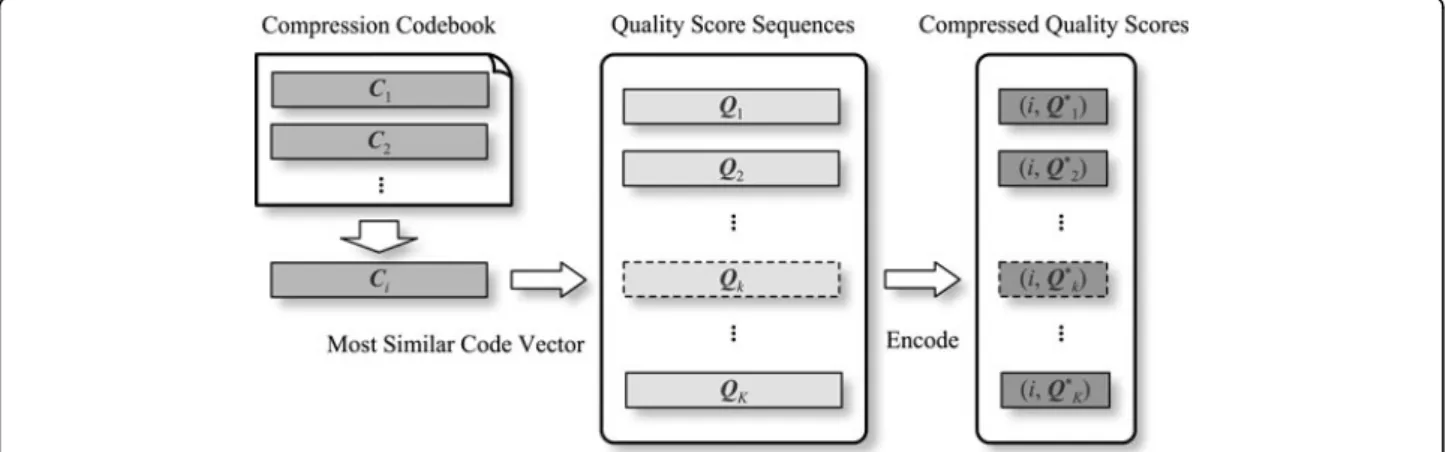
Compression codebook design using SaNSDE-DSCG As shown in Figure 2, a NGS quality score sequence is compressed by substituting original scores with the index of its most similar code vector in the codebook, and their corresponding symbol differences.
Given a quality score sequence Q =“CCCGFF’and code vectorC =“CCGHFFC”. Sequence Qis encoded as {i,Q*}, wherei is in the index ofC, andQ* records the symbol differences as:
Q= C C C G − F F −
C= C C ∧ G H F F C
Q∗=U U (I, ”C”) U D U U D
(4)
in which Udenotes symbol matching (unchanged), I stands for insertion (marked with “∧”), Dfor deletion
(marked with“−”), andS for substitution. For insertions and substitutions, the original symbol should also be recorded (for instance “C” on the third quality score). This matching process is conducted by using dynamic programming (DP).
Data size of the original P-dimensional sequence is LO = 8 × P, because raw quality scores are stored in 8
bits ASCII format. On the other hand, each difference type in {U, I, D, S} takes 2 bits to represent. Thereby the encoded data size is:
LC=log2(M)+ 2×P∗+ 8×R (5)
whereMis the number of code vectors in a codebook, P* denotes length of the symbol differences sequence (i. e. Q*), and R is the number of all original symbols recorded for insertions and substitutions. Given the example above, original quality score sequence takes LO = 48 bits of storage, while the encoded data uses
only about 24 bits. Usually the encoding process makes LC smaller than LO, i.e., conducts compression. The
more the code vector is similar to the original quality score sequence, the higher compression ratio is achieved. That is, quality of the codebook decides the overall compression performance.
In this paper, we utilize the proposed SaNSDE-DSCG to optimize compression codebook design. During the initialization, code vectors in the codebook are generated randomly, and encoded as individuals to form an evolution population. In each fitness evalua-tion, input candidate solution xi = [xi,1, xi,2,...,xi,N] is
mapped into code vector Ci = “s1 s2 ... sN“ using the
following equation:
sn=S[xn],n= 1, 2,. . .,N (6)
where characters setSincludes all unique symbols in the original quality score sequences, variable Nis the predefined code vector length. This mapping is
conducted because candidate solutions consist of con-tinuous values, while code vectors are discrete symbol strings. The Ci is then matched to all quality score
sequences, and calculates the corresponding encoded data size. Raw fitness value ofxiis defined as:
fR(xi) = k∈K
LC(Ci,Qk) (7)
in which K is the total number of quality score sequences,LC(Ci, Qk) denotes encoded data size on the
kth sequence Qkusing code vectorCi. SmallfR(xi)
indi-cates thatCiis more similar to the original score data,
i.e., obtains higher compression ratio. Shared fitness fS(xi) is then calculated accordingly.
It is noted that accurate symbol differences information, e.g. mismatched symbol positions, is not necessary for fit-ness values calculation. In most cases the approximate Levenshtein distance [21] is good enough to guild the codebook optimization process. Moreover, calculation of Levenshtein distance requires much less computational resources than the DP based matching algorithm. By utiliz-ing Levenshtein distance in fitness evaluation, we can achieve similar optimization performance in a relatively high speed. Approximate size of encoded data can be cal-culated as:
LC=log2(M)+ 2×Pk+ 4×lev(Ci,Qk) (8)
in which Pk is the length of Qk, and lev(·) denotes
Levenshtein distance between the two input sequences. It’s value is multiplied by 4, because there is a half chance (I andS) in {U, I, D, S} needs to record the original quality score. Accurate matching information is obtained only after the codebook design process for actual sequences compression.
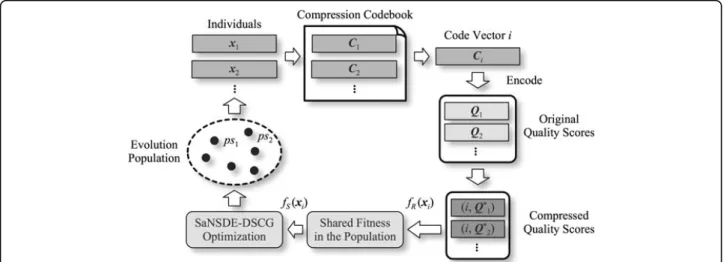
Procedure of the SaNSDE-DSCG based compression codebook design algorithm is illustrated in Figure 3. In
conventional single-objective optimization based design algorithms, the entire compression codebook is encoded in each individual in the evolution population. Typically, an individual in such methods is constructed by con-necting all code vectors in the codebook from end to end, i.e. xi’ = {C1,C2,...,CM} [22]. Optimal codebook is
obtained by searching the global best solution. Dimen-sionality of solution space isM ×N, and the algorithm calculates encoded data size (Equ. (8)) forM ×N× |ps| time in each generation of the evolution optimization. Its computational complexity is too high to be applied on large NGS data. In contrary, MMQSC searches the solution space by using multimodal optimization, wherein each individual is utilized to represent one spe-cific code vector, and the entire evolution population is utilized to compose the optimal compression codebook. MMQSC evolves each individual to make the code vec-tor more representative to original quality score sequences, and accordingly the optimal codebook as a whole can compress input data more effectively. More-over, dimensionality of solution space in MMQSC is reduced to N, because individualxi and corresponding
code vectorCihave the same length. In each generation
of the evolution optimization, the encoded data size is calculated for onlyM×Ntimes.
The MMQSC algorithm
The proposed MMQSC algorithm consists of three major parts: Huffman coding based preprocessing, SaNSDE-DSCG based codebook design, and quality score data compression. Details of SaNSDE-DSCG optimization algo-rithm and its application on compression codebook design have been discussed in the previous sections.
During the preprocessing, raw quality score sequences are extracted from target FASTQ file, and undergo a Huffman coding. Each sequence is then converted into a
symbol string by mapping every 6 bits of the encoded binary data to readable ASCII character:
ht=chr(33 +int(huff(Qk)[t×6∼(t+ 1)×6])) (9)
in whichhtis thetth symbol in converted stringHk=
“h1h2...hT“, functionhuff(·) denotes Huffman coding,
int(·) converts binary data to corresponding integer value, andchr(·) maps integer number into ASCII character. Offset value 33 is added to the input number inchr(·) to ensure exported character is readable. In the majority of casesHkconsists of fewer symbols than original sequence
Qk. Thereby dimensionality of code vectors is reduced,
and the codebook design problem is simplified.
The SaNSDE-DSCG is conducted afterward on the encoded sequences. After optimization, MMQSC maps individuals in the evolution population into code vectors using Equ. (6) to construct a compression codebook. This codebook is then utilized to compress the input data, wherein accurate symbol differences information is obtained by using DP based matching algorithm.
Procedure of the MMQSC algorithm is demonstrated in Algorithm 2. It is worth noting that the codebook design process can also be conducted in an offline man-ner. That is, a universal compression codebook obtained from representative NGS quality score data sets is uti-lized to encode all input sequences. The time-consum-ing optimization process is performed for only one time. Successive compressions, which are usually conducted repeatedly, require much less computational time. Results and discussion
Five representative NGS data obtained from various spe-cies, and also of different read numbers and file sizes, are selected to evaluate the overall performance of MMQSC. Details of the data sets are summarized in Table 1. All data are downloaded in FASTQ format from the National Center for Biotechnology Information - Sequence Read Archive (NCBI-SRA) database [23].
In SaNSDE-DSCG optimization, the compression codebook size M is used as the number of individuals, i.e., |ps|. The value is decided as:
M= (log2(
K 10 ))
2 (10)
The length of code vectors, i.e. dimensionality of solu-tion space, is calculated using the following equasolu-tion:
N= 1
2×(mink∈KPk+ maxk∈KPk) (11)
Parameters setting for SaNSDE-DSCG based multimo-dal optimization is listed in Table 2 in which |S| is the number of unique symbols in the original quality scores, and FEs denotes the maximum fitness evaluation calls of the optimization.
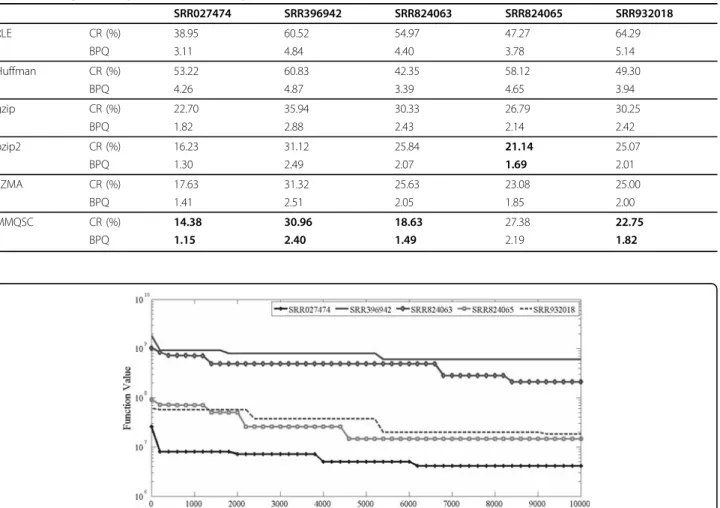
Five widely used compression algorithms including the RLE, Huffman coding, gzip, bzip2, and Lempel-Ziv-Markov chain algorithm (LZMA) are utilized for comparison with the proposed algorithm. All algo-rithms are compared in terms of compression ratios (CR) and bits per quality value (BPQ). The BPQ is defined as follows: BPQ= k∈Kmini∈MLC(Ci,Qk) k∈KPk (12) Compression results of all algorithms on the NGS data sets are summarized in Table 3.
Results in Table 3 show that, the proposed MMQSC obtains better performance than the counterpart repre-sentative algorithms. Particularly, MMQSC obtains aver-age compression ratio of 22.82%, resulting in an over 77.18% size reduction in the quality score data. The average 1.81 BPQ result is much smaller than the origi-nal 8 BPQ in ASCII format. Moreover, performance of MMQSC remains stable in the experimental data sets, indicating that the algorithm has good robustness on different types of NGS data.
Convergence trace of codebook optimization processes on experimental data sets is illustrated in Figure 4, in which y-axis, labeled as function value, is the optimal shared fitness value in SaNSDE-DSCG optimization. The figure shows that by combining SaNSDE and DSCG in an MA framework to conduct multimodal search, compression codebook is optimized effectively. Particularly, DSCG increases convergence speed in the early stage of optimization. Premature convergence is successfully prevented by using the high performance SaNSDE algorithm.
Table 1 NGS data sets for MMQSC performance evaluation.
Data Species Number of Reads Number of Bases File Size (MB)
SRR027474 Marine metagenome 28,109 3,580,544 9.2
SRR396942 Homo sapiens 1,199,786 250,755,274 602
SRR824063 Caenorhabditis elegans 711,156 142,231,200 348
SRR824065 Caenorhabditis elegans 64,492 12,898,400 32
Conclusions
This paper presents MMQSC, a MA based NGS quality scores compression algorithm. The MMQSC utilizes Huffman coding to preprocess raw quality score sequences stored in FASTQ format. To obtain higher performance, a SaNSDE and DSCG based MA is pro-posed to optimize the compression codebook design. The Levenshtein distance is used in fitness evaluations to esti-mate encoded data size, and improves computation speed. After the codebook optimization, a DP based matching algorithm is conducted to obtain accurate sym-bol differences information. This information, as well as the optimized codebook, is utilized to compress input quality score data. Experimental results on five NGS data show that the proposed MMQSC obtains higher compression ratio than counterpart state-of-the-art
algorithms. Particularly, MMQSC reduces about 77% of the storage space on the experimental data sets.
Competing interests
The authors declare that they have no competing interests.
Authors’contributions
JRZ and ZJ conceived and designed the study. JRZ, ZXZ, and SH performed the experiments. JRZ and ZXZ wrote the paper. ZJ, ZXZ, and SH reviewed and revised the manuscript. All authors read and approved the manuscript. Algorithm 1 - Canonical memetic algorithm framework
1: BEGIN
2: Initialize:Randomly generate an initial population |ps|; 3: whilestopping criterion is not satisfieddo
4: Evolve population |ps| using global optimization; 5: foreach individualpsiin |ps|do
6: Improvepsiusing local searches;
7: end for 8: end while 9: END
Table 2 Parameters setting for SaNSDE-DSCG optimization.
Parameter Population Size Dimension Range ε a FEs
Value M N (0, |S|) 0.1 ×N 50 1E+4
Table 3 Compression performance on experimental NGS data sets.
SRR027474 SRR396942 SRR824063 SRR824065 SRR932018 RLE CR (%) 38.95 60.52 54.97 47.27 64.29 BPQ 3.11 4.84 4.40 3.78 5.14 Huffman CR (%) 53.22 60.83 42.35 58.12 49.30 BPQ 4.26 4.87 3.39 4.65 3.94 gzip CR (%) 22.70 35.94 30.33 26.79 30.25 BPQ 1.82 2.88 2.43 2.14 2.42 bzip2 CR (%) 16.23 31.12 25.84 21.14 25.07 BPQ 1.30 2.49 2.07 1.69 2.01 LZMA CR (%) 17.63 31.32 25.63 23.08 25.00 BPQ 1.41 2.51 2.05 1.85 2.00 MMQSC CR (%) 14.38 30.96 18.63 27.38 22.75 BPQ 1.15 2.40 1.49 2.19 1.82
Algorithm 2 - Procedure of MMQSC algorithm 1: BEGIN
2: Preprocessing:
3: Obtain raw quality score sequences {Q1,Q2,...,QK} from target FASTQ file;
4: Conduct Huffman coding, convert input sequences into {H1,H2,...,HK}; 5: Compression Codebook Design:
6: Randomly generate evolution population |ps|; 7: whilestopping criterion is not satisfieddo 8: Evolve population |ps| using SaNSDE;
9: Calculate raw fitness values for |ps| using Equ. (7); 10: Calculate shared fitness values using Equ. (1); 11: foreach individualxiin |ps|do
12: Improvexiusing DSCG;
13: Calculate raw fitness valuefR(xi) using Equ. (7);
14: Calculate shared fitness valuefS(xi) using Equ. (1);
15: end for 16: end while
17: Construct optimal compression codebook using |ps|; 18: Quality Scores Compression:
19: Obtain accurate symbol differences information using DP based matching;
20: Encode each quality score sequenceQkwith corresponding code vector
index and symbol differences information as (i,Qk*); 21: END
Acknowledgements
This work was supported in part by the National Natural Science Foundation of China Joint Fund with Guangdong, under Key Project U1201256, the National Natural Science Foundation of China, under grant 61171125, in part by the NSFC-RS joint project under Grants IE111069 and 61211130120, in part by the Guangdong Foundation of Outstanding Young Teachers in Higher Education Institutions under grant Yq2013141, in part by the Guangdong Natural Science Foundation, under grants S2012010009545, in part by Science Foundation of Shenzhen City, under Grants
JCYJ20130329115450637, ZYC201105170243A and KQC201108300045A, and in part by Program for New Century Excellent Talents in University, under grant 004549.
Declarations
Publication charges for this article have been funded by the National Natural Science Foundation of China (61171125).
This article has been published as part ofBMC BioinformaticsVolume 15 Supplement 15, 2014: Proceedings of the 2013 International Conference on Intelligent Computing (ICIC 2013). The full contents of the supplement are available online at http://www.biomedcentral.com/bmcbioinformatics/ supplements/15/S15.
Authors’details
1
College of Biomedical Engineering and Instrument Science, Zhejiang University, Hangzhou, 310027, China.2Shenzhen City Key Laboratory of Embedded System Design, College of Computer Science and Software Engineering, Shenzhen University, Shenzhen, 518060, China.3School of Computer Science, University of Birmingham, Birmingham, B15 2TT, UK.
Published: 3 December 2014
References
1. You ZH, Yin Z, Han K, Huang DS, Zhou XB:A semi-supervised learning approach to predict synthetic genetic interactions by combining functional and topological properties of functional gene network.BMC Bioinformatics2010,11:343.
2. Bonfield JK, Mahoney MV:Compression of FASTQ and SAM format sequencing data.PloS One2013,8:59190.
3. Li H, Homer N:A survey of sequence alignment algorithms for next-generation sequencing.Briefings in Bioinformatics2010,11:473-483. 4. Cox AJ, Bauer MJ, Jakobi T, Rosone G:Large-scale compression of
genomic sequence databases with the Burrows-Wheeler transform.
Bioinformatics2012,28:1415-1419.
5. Jones DC, Ruzzo WL, Peng X, Katze MG:Compression of next-generation sequencing reads aided by highly efficientde novoassembly.Nucleic Acids Research2012,40:171.
6. Popitsch N, von Haeseler A:NGC: lossless and lossy compression of aligned high-throughput sequencing data.Nucleic Acids Research2013, 41:27.
7. Hach F, Numanagic I, Alkan C, Sahinalp SC:SCALCE: boosting sequence compression algorithms using locally consistent encoding.Bioinformatics 2012,28:3051-3057.
8. Zhu Z, Zhang Y, Ji Z, He S, Yang X:High-throughput DNA sequence data compression.Briefings in Bioinformatics2013, bbt087.
9. Giancarlo R, Rombo SE, Utro F:Compressive biological sequence analysis and archival in the era of high-throughput sequencing technologies.
Briefings in Bioinformatics2013, bbt088.
10. Janin L, Rosone G, Cox AJ:Adaptive reference-free compression of sequence quality scores.arXiv Preprint2013, arXiv:1305.0159. 11. Moscato P, Cotta C, Mendes A:Memetic algorithms.New Optimization
Techniques in EngineeringNew York: Springer; 2004, 53-85. 12. Yang Z, Tang K, Yao X:Self-adaptive differential evolution with
neighborhood search.Proceedings of IEEE Congress on Evolutionary Computation: 1-6 June 2008Hong Kong; 2008, 1110-1116.
13. Nguyen QH, Ong YS, Lim MH:A probabilistic memetic framework.IEEE Transactions on Evolutionary Computation2009,13:604-623.
14. Singh G, Deb K:Comparison of multi-modal optimization algorithms based on evolutionary algorithms.Proceedings of Genetic and Evolutionary Computation Conference: 8-12 July 2006Seattle; 2006, 1305-1312. 15. Cock PJ, Fields CJ, Goto N, Heuer ML, Rice PM:The Sanger FASTQ file
format for sequences with quality scores, and the Solexa/Illumina FASTQ variants.Nucleic Acids Research2010,38:1767-1771.
16. Dawkins R:The Selfish Gene.UK: Oxford University Press; 2006. 17. Huang DS, Du JX:A constructive hybrid structure optimization
methodology for radial basis probabilistic neural networks.IEEE Transactions on Neural Networks2008,19:2099-2115.
18. Chen X, Ong YS, Lim MH, Tan KC:A multi-facet survey on memetic computation.IEEE Transactions on Evolutionary Computation2011, 15:591-607.
19. Storn R, Price K:Differential evolution-a simple and efficient heuristic for global optimization over continuous spaces.Journal of Global Optimization1997,11:341-359.
20. Sareni B, Krahenbuhl L:Fitness sharing and niching methods revisited.
IEEE Transactions on Evolutionary Computation1998,2:97-106. 21. Gooskens C, Heeringa W:Perceptive evaluation of Levenshtein dialect
distance measurements using Norwegian dialect data.Language Variation and Change2004,16:189-207.
22. Huang DS:Radial basis probabilistic neural networks: model and application.International Journal of Pattern Recognition and Artificial Intelligence1999,13:1083-1101.
23. Leinonen R, Sugawara H, Shumway M:The sequence read archive.Nucleic Acids Research2011,39(suppl 1):19-21.
doi:10.1186/1471-2105-15-S15-S10
Cite this article as:Zhouet al.:Compression of next-generation
sequencing quality scores using memetic algorithm.BMC Bioinformatics
201415(Suppl 15):S10.
Submit your next manuscript to BioMed Central and take full advantage of:
• Convenient online submission
• Thorough peer review
• No space constraints or color figure charges
• Immediate publication on acceptance
• Inclusion in PubMed, CAS, Scopus and Google Scholar
• Research which is freely available for redistribution
Submit your manuscript at www.biomedcentral.com/submit