COPYRIGHT AND CITATION CONSIDERATIONS FOR THIS THESIS/ DISSERTATION
o
Attribution — You must give appropriate credit, provide a link to the license, and indicate if
changes were made. You may do so in any reasonable manner, but not in any way that
suggests the licensor endorses you or your use.
o
NonCommercial — You may not use the material for commercial purposes.
o
ShareAlike — If you remix, transform, or build upon the material, you must distribute your
contributions under the same license as the original.
How to cite this thesis
Surname, Initial(s). (2012). Title of the thesis or dissertation (Doctoral Thesis / Master’s
Dissertation). Johannesburg: University of Johannesburg. Available from:
UNIVERSITY OF JOHANNESBURG
FACULTY OF ENGINEERING AND THE BUILT ENVIRONMENT
DEPARTMENT OF MINING ENGINEERING
A DISSERTATION SUBMITTED IN FULFILLMENT OF THE REQUIREMENTS FOR THE
DEGREE OF MASTER OF TECHNOLOGY IN EXTRACTION METALLURGY
The Impact of Section 54 of the MHSA on
Coal Mines Stoppages
Date:
Student’s name
Supervisor
CoSupervisor
Work No.
: 15 April, 2020 Final
: Mr. Ntabiso Ndiweni
: Prof. Steven Rupprecht
: Prof. Hendrik Grobler :
[email protected]
I
DECLARATION
I, Ntabiso Ndiweni declare that this dissertation is my personal effort. External sources used herein have been quoted and referenced. I wish to submit this dissertation, for the Degree of Master of Technology in Extraction Metallurgy (MTECH) to the University of Johannesburg, Republic of South Africa.
Ntabiso Ndiweni
II
ABSTRACT
The enforcement of Section 54 notices by the Department of Mineral and Resources (DMR) Inspector of Mines (IOM) on South African coal mines has been used as a primary tool to reduce the health and safety risk of mine employees. The resultant reduction of accidents in the mining industry is in itself a positive impact. However, the resultant stoppages triggered by the application of Section 54 instructions have resulted in certain cases with unintended impacts. There also remains a material difference between the Department of Labour Inspectors and the IOM. The main difference being the enforcement guidelines; the guideline for the Inspector from the Department of Labour has a clause instructing the Inspector of possible economic consequences in exercising their duties if they do not sparingly enforce the law. The DMR, as well as the Mine Health and Safety Act (MHSA) , fail to caution the IOM in their enforcement of the law.
Unintended consequences are resulting from the frequent issuing of Section 54 instructions on South African coal mines. A number of shortcomings in the process, mainly around the appropriateness of Section 54 notices and up until 2016 the mines chose not to act against the DMR, i.e. go to court on the implementation of Section 54 stoppages in disputable cases.
As a comparison to the DMR’s approach regarding Section 54 instructions, approaches made in North America, Europe, and Australasia are reviewed.
The second question of the dissertation is around the current effectiveness of Section 54 instructions in reducing mine fatalities. Most respondents indicate that Section 54 stoppages are the most effective tool that the IOM can implement. Almost all persons acknowledge the DMR’s contribution to promoting health and safety. Further, from the questionnaire and interviews, many of the respondents believe that Section 54 stoppages are fairly applied and that all parties understand the application of Section 54 instructions.
III
The majority of the respondents are of the opinion that the IOMs have the technical knowledge and experience to administer mine standards, yet the minority highlighted that the IOMs personnel lack experience, at times abuse their powers, have unrealistic expectations and enforce the regulation in an inconsistent manner.
Although the majority of the respondents are of the belief that mine safety and risk could be managed without the use of Section 54 instructions, many respondents stated that they would like to see more visits from the DMR to enforce standards and to assist and collaborate with the mines to achieve best practice in mine standards and procedures. The above response suggests that the DMR has a role to play in promoting adherence to standards and best practices. The research also indicates that a significant number of respondents are not sure if the mine properly enforces their standards , which supports the importance of the DMR in promoting adherence to mine standards.
The dissertation identifies the failure to comply with legislation and mine standards as the major reason for Section 54 stoppages and notes that the resultant impact of Section 54 notices is the loss of production.
Between 2005 and 2016 a sharp decline in South Africa’s mining-related fatalities has occurred. However, since litigation measures were taken in 2016 against the DMR, it appears that Section 54 instructions cannot alone bring the mining industry to its 2020 target of Zero Harm.
IV
ACKNOWLEDGEMENT
Acknowledgment goes to many people that are not mentioned in this dissertation like the training managers from collieries and participants who answered the questionnaires. These many people’s contributions are genuinely acknowledged.
Anyhow, this group of people has to be mentioned, without the time and wisdom of Professor SM Rupprecht, this work would not have been accomplished, many thanks go to him and his family who sacrificed their quality time to make space for me to consult.
To my wife who encouraged me and followed up on my progress, I say thank you.
Above all else, I thank my God who gives wisdom and ability to accomplish anything worthwhile in His eyes.
TABLE CONTENTS
DECLARATION ... I ABSTRACT ... II ACKNOWLEDGEMENT ... IIV LIST OF FIGURES ... IVI LIST OF TABLES ... IVI LIST OF ABBREVIATIONS………..VII
1 CHAPTER 1: INTRODUCTION ... 1
Chapter overview ... 1
Background ... 1
1.2.1 Minerals Act of 1991 and the Mines and Works Act of 1956 ... 2
1.2.2 The number of South African. Mining Fatalities ... 2
1.2.3 Chamber of Mines comments on Section 54 stoppages ... 5
Problem statement ... 14
Objectives of the research ... 14
The main research questions ... 15
The significance and justification of the study ... 15
The locality of the research ... 16
Research methodology ... 17
Applicability of the Research... 18
Outline of the dissertation ... 18
2 CHAPTER 2: LITERATURE REVIEW ... 19
Chapter Overview ... 19
The impact of Section 54s ... 19
Cost implications of Section 54s ... 25
The Relevance of Section 54s ... 26
Litigation ... 30
DMR records on Section 54 issued over a five-year period ... 33
II
2.6.2 Misuse of Section 54s notices ... 36
International Review of relevant literature ... 37
2.7.1 Introduction ... 37
2.7.2 North America ... 38
2.7.3 Europe ... 39
2.7.4 Australia ... 41
2.8.2 Lessons from International Literature ... 43
3 CHAPTER 3: RESEARCH METHODOLOGY ... 46
Chapter Overview ... 46
Research Population ... 47
Research sample and location ... 47
Validity and Reliability ... 48
Data Analysis ... 48
Ethical Consideration ... 48
Methodology ... 49
3.7.1 Data capture and dependability... 49
3.7.2 Analysis of data ... 51
3.7.3 Results and discussion ... 51
Chapter Summary ... 51
4 CHAPTER 4: RESEARCH OUTCOMES ... 52
Chapter Overview ... 52
Interviews and Results from the Questionnaire ... 52
4.2.1 Results from Platinum Mine ... 52
4.2.2 Financial Implications from Section 54 Stoppages ... 54
4.2.3 Interviews ... 58
4.2.4 Results from the Questionnaire ... 61
Research Outcomes ... 78
5 RESEARCH RESULTS AND INTERPRETATION ... 81
Chapter Overview ... 81
Literature review ... 81
Analysis of Questionnaire ... 86
III
5.3.2 Knowledge of Section 54 stoppages... 87
5.3.3 Capacity of DMR to administer, implement and enforce mine standards ... 88
5.3.4 Morale and remuneration ... 90
5.3.5 Community and investment ... 90
Chapter Summary ... 91
6 CONCLUSIONS AND RECOMMENDATIONS ... 92
CONCLUSIONS ... 92
RECOMMENDATIONS AND WAY FORWARD ... 96
7 REFERENCES ... 99
IV
LIST OF FIGURES
Figure 1: South African Mining Industry Fatalities 2004 to 2016 (COM, 2017b) 3
Figure 2: Number of fatalities by industry 2007 to 2018 (adapted from DMR, 2018) 3
Figure 3: DMR Enforcement Pyramid (DMR, 2011) 7
Figure 4: Section 54 transgressions reported for November 2016 (DMR, 2017) 9
Figure 5: Section 54 Instructions issued for 2017 (DMR, 2019) 10
Figure 6: Section 54 instruction issued total closure vs partial closure (DMR, 2019) 11
Figure 7: Coalfields of South Africa (Snyman, 1998) 16
Figure 8: Section 54s Issued in Mpumalanga DMR region 2011 – 2015 33
Figure 9: Section 54s issued in Gauteng DMR Region 2012 to 2016 34
Figure 10: Work category of questionnaire respondents 46
Figure 11: Mine Personnel Expectation of the DMR 64
Figure 12: Financial impacts of Section 54 instruction 69
Figure 13: Effect of Section 54s on employee morale 70
Figure 14: Response to whether Section 54s affect a workers’ remuneration 71
Figure 15: Response to “Has Section 54 notices affected investment?” 72
Figure 16: Response to “Has Section 54 notices affected community projects” 75
Figure 17: Response to “Are Section 54 notices positive or negative to the mining industry?”
77
LIST OF TABLES
Table 1: South Africa mine fatalities 2005 to 2018 ... 4
Table 2: Impact of Section 54s on gold mine revenue (Pearton, 2015)... 12
Table 3: Platinum mini-survey – January 2015 to the end of June 2016 (COM, 2017b) ... 13
Table 4: List of collieries used for interviews and case studies ... 17
Table 5: S Colliery Section 54 Stoppages………...55
Table 6: T Colliery Section 54 Stoppages………...57
Table 7: Question and Response regarding collaboration amongst DMR,Employers and Labour………61
Table 8: Questions and Responses regarding knowledge of Section 54………...62
Table 9: Questions and Responses regarding capacity to implement mine standards……...63
Table 10: Questions and Responses regarding enforcement and implementation of Section 54s……….65
Table 11: Impacts of Section 54 instructions………..68
Table 12: Employee Job Category response to - Does Section 54s effect employee morale………70
Table 13: Employee Job Category response to - Does Section 54s affect investment……...74
Table 14: Employee Job Category response to - Does Section 54s affect Community Projects……….76
V
LIST OF ABBREVIATIONS
AMMSA Association of Mine Managers of South Africa CEO Chief Executive Officer
CIOM Chief Inspector of Mines COM Chamber of Mines COP Code of Practice
DMR Department of Minerals and Resources g/t Grams per tonne
GDP Gross domestic product
HDSA Historical Disadvantaged South African IOM Inspector of Mines
LDV Light-Duty Vehicle LRA Labour Relations Act
M Metre
m3 Cubic metres
MCSA Minerals Council South Africa (previously COM) MHSA Mine Health and Safety Act
MHSA Mine Health and Safety Act MHSC Mine Health and Safety Council
MPRDA Mineral and Petroleum Resources Development Act No. 28 OF 2002 MQA Mining Qualification Authority
MSHA Mine Safety and Health Agency
NEMA National Environmental Management Act No. 107 of 1998 No. Number
NPA National Prosecuting Authority NUM National Union of Mineworkers
OHSA Occupational Health and Safety Act No. 85 0f 1983 Oz Ounce
PAJA Promotion of Administrative Justice Act
R Rand
S.A. South Africa
SAQA South African Qualification Authority SHE Safety, Health, and Environment SPL Social Labour Plan
SPSS Statistical Package for the Social Sciences
VI
TMM Trackless Mobile Machinery UASA United Association of South Africa UCT University of Cape Town
1
1
CHAPTER 1: INTRODUCTION
Chapter overview
This chapter provides an introduction, background, and objectives of this dissertation. An introduction to the research problem provides the background of the importance of the research. An outline of the research problem and objectives are then presented, as well as the outline of the dissertation.
Background
Section 54 notices under the Mine Health and Safety Act (MHSA), No. 29 of 1996 are issued when there is a failure to comply by the employers or management in South African mines. When standards, procedures or codes of practice (COP) are not complied with, an Inspector of Mines (IOM) from the Department of Minerals and Resources (DMR), is likely to issue Section 54 stoppage notice. In terms of the MHSA, an IOM only needs a “reason to believe that an occurrence, practice or condition at a mine endangers, or may endanger, the health or safety of a person at a mine" to issue a Section 54.
The IOM may give any instruction necessary to protect the health and safety of a person at that mine. An IOM’s instruction may result in the following scenarios:
• Halt the operations at the mine or part of a mine.
• Halt any act or practice at the mine or part of a mine.
The employer must take steps, as set out in the instruction, or rectify the occurrence, practice or condition” (DMR, 2018).
2
In addition, the MHSA has Section 55 which is another provision for the IOM to direct the mines to comply. Tools to enforce compliance by an IOM are discussed in detail in Figure 3. Briefly, the difference between a Section 54 and 55 is that a Section 55 instruction from the IOM requires a mine owner to rectify an adverse situation within a given timeframe without stopping (i.e. Section 54) an operation or an act.
1.2.1 Minerals Act of 1991 and the Mines and Works Act of 1956
The Acts before the MHSA namely the Minerals Act of 1991 under Section 27(1) and the Mines and Works Act No. 27 of 1956 under Section 3(1) did provide the Mines Inspectorate authority to implement mine stoppages for substandard acts that could affect the safety of persons (RSA, 1991; RSA, 1956). However, no literature has been found to quantify any stoppages or any general outcry from mine operators that may have been affected by stoppages enforced by the Mines Inspectorate prior to the introduction of Section 54 notices/stoppages.
1.2.2 The number of South African. Mining Fatalities
The South African mining fatalities have decreased over the years. In 1956 there were 816 mine fatalities, decreasing to 604 fatal accidents in 1991, and 246 mine fatalities in 2004. In 2004, the South African mining industry had a fatality rate three times as high as the United States of America (USA) and six times higher than other first world countries such as Canada and Australia (Figure 1). With such a high fatality rate, the Department of Mineral Resources (DMR) opted to utilise the vigorous enforcement of Section 54 as a means to address the abnormally high South African fatality rate. From 2007 to 2018 (Figure 2), the fatality numbers has shown a steady decline with the fatality numbers minimising at 73 fatalities in 2016 with a creep upwards in 2017 and 2018 recording 88 and 81 fatalities (Letsoalo, 2019) respectively, illustrating that Section 54 stoppages may have played a role in reducing mining-related fatalities over the past 12 years. However, questions remain whether Section 54s have served
3
their purpose and that some other intervention is required to progress South Africa’s safety record to an international benchmark of fewer than 0,10 fatalities per 1 million hours worked.
Figure 1: South African Mining Industry Fatalities 2004 to 2016 (COM, 2017b)
Figure 2: Number of fatalities by industry 2007 to 2018 (adapted from DMR, 2018)
Notably, in 2017, only 1% of the Section 54s issued resulted in total mine closure, 99% of all Section 54 instructions were for partial closure with most of the total closures associated with small privately-operated mines. Transgressions included no occupational hygiene documentation, employees without medical certificates, no personal protective equipment
4
provided to employees, no mandatory COP, and no legal appointments in place. Thus, indicating the DMR has been cognisant of mining industry complaints that total mine stoppages should be reduced.
Section 54s issuance was increased from 2005 when there were 200 fatalities (DMR, 2018), since then there has been a noticeable decline in the number of mining fatalities as indicated in Table 1.
Table 1: South Africa mine fatalities 2005 to 2018
South African mine fatalities from 2005 to 2018
Gold Coal Platinum Others TOTAL
2005 105 2005 16 2005 47 2005 32 200 2006 114 2006 20 2006 40 2006 26 200 2007 114 2007 15 2007 53 2007 37 219 2008 85 2008 20 2008 36 2008 29 170 2009 81 2009 18 2009 41 2009 27 167 2010 62 2010 12 2010 34 2010 19 127 2011 51 2011 12 2011 37 2011 23 123 2012 53 2012 11 2012 28 2012 20 112 2013 37 2013 7 2013 27 2013 22 93 2014 44 2014 9 2014 16 2014 15 84 2015 33 2015 5 2015 21 2015 19 78 2016 30 2016 4 2016 28 2016 11 73 2017 39 2017 10 2017 27 2017 12 88 2018 38 2018 9 2018 9 2018 20 76
5 1.2.3 Chamber of Mines comments on Section 54 stoppages
The Minerals Council of South Africa (MCSA) (previously known as the Chamber of Mines (COM, 2016) in 2016 commended the coal mining industry’s safety performance. Remarks by MCSA President, Roger Baxter state: - “We commend the coal industry for its continued improvement in safety performance. The then Minister of Mineral Resources Mosebenzi Zwane congratulated 16 companies for operating without any fatalities for a period of more than 12 months at the annual announcement of safety statistics in Pretoria in January this year. Five of these companies were coal-mining companies including Exxaro, Sasol, Total Coal South Africa, Kuyasa Mining and Coal of Africa. The performance of these companies indicates that the industry’s goal of Zero Harm1 is achievable.”
The MCSA (COM, 2016) has highlighted that there have been instances of inappropriate issuance of Section 54 instructions since 2007. These cases of inappropriate issuance of Section 54 have affected the economic viability of many operations resulting in job losses. The MCSA makes an example of a recent Labour Court judgment against DMR officials in which the Labour Court points out that Section 54 stoppage should be proportional to the possible harm it is issued to prevent (COM, 2016).
According to the MCSA, Section 54 stoppages did cost the South African mining industry R4.8 billion in 2015 (COM, 2016). The MCSA observed that marginal producing shafts in the Rustenburg area were further burdened by Section 54 stoppages and lost production
1The enforcement of Section 54 is part of the overall strategy of creating a mining industry with “zero harm”
(Africa, 2018) but, like any good intention, there are good and bad impacts. “Zero harm” is a collective strategy by the South African mining industry to ensure a zero fatality rate by December 2020 (Mining Review Africa, 2019)
6
days. The MCSA’s Platinum Leadership Forum, a forum made up of CEOs of platinum mining companies, developed a proposed guideline incorporating the following:
• Reducing Section 54 stoppage time.
• Encouraging the use of Section 55 by the IOM since Section 55 instructions avoid stoppages.
• Encourage more interactions with organised labour.
• Focus on training and scaling out small non-compliance issues from Section 54 stoppage instructions. The proposed guideline was shared with the Chief Inspector of Mines in September 2016, and the MCSA reports that no comments were received from the Chief Inspector of Mines.
Figure 3 shows the DMR Enforcement Pyramid, which is an enforcement guideline. In the same guideline, an IOM has a number of tools at his/her disposal to use in the enforcement of MHSA. The issuance of Section 54s appears to be the enforcement tool of choice by IOM, as it is an enforcement tool that stops work. Hence, there is an immediate response by management to rectify non-compliance issues to resume production as soon as possible.
7 Figure 3: DMR Enforcement Pyramid (DMR, 2011)
The Enforcement Pyramid gives an assortment of tools at the IOMs disposal to enforce the MHSA as it would apply for different situations as the IOM visits mines. The Enforcement Pyramid tools are:
• Information and Education which entails documents from DMR being sent to stakeholders and meetings with stakeholders.
• Withdrawal of approvals given in terms of MHSA, such as permissions or exemptions granted to the mines by the DMR. Depending upon the identified shortcomings in health and safety standards, such approvals can be modified or
8
withdrawn. These approvals usually deal with temporarily removing an onerous piece of legislation that hinders effective mining at a particular mine.
• Orders to comply, this is when an IOM issues a Section 55 written instruction to the employer and does not stop operations but specifies what needs to be rectified within a specified time determined by the IOM.
• Section 54 stoppage, IOM instructs the employer to stop operations or to stop acts or act, until certain conditions set by the IOM have been met.
• Administrative fine, this fine is issued by the IOM to the employer of a mine. This fine is only issued to the employer and not the workers and is for legal breaches that are not referred to the prosecuting authority.
• Statutory certificate suspension, in this instance an IOM may recommend that the Chief Inspector of Mines suspends or cancels an individual’s certificate issued in terms of the MHSA if that individual has acted or is acting in a way that endangers the health and safety of themselves or others.
• Prosecution, in situations where an IOM believes an individual has committed an offence he/she will refer the matter to the National Prosecuting Authority (NPA) for prosecution.
• Rights suspension or cancellation, this is when a right, such as a mining right, is cancelled by the Minister of Minerals and Resources in terms of the MPRDA, 2002. The mining right can be cancelled in terms of MPRDA if the mine does not comply with the MHSA, as compliance with the MHSA is one of the conditions for the granting of the right.
There are various transgressions that lead to the issuance of Section 54s. Figure 4 shows an analysis of different transgressions that were issued by the IOMs in November 2016. The
9
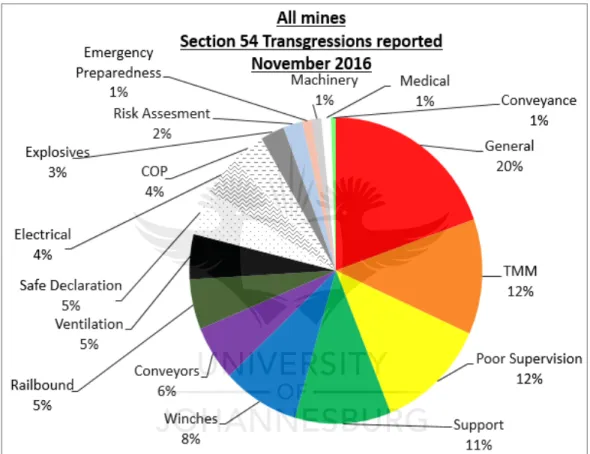
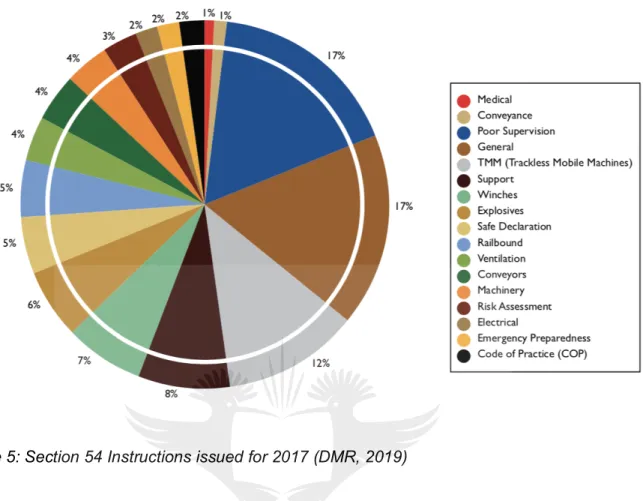
transgressions that top the list fall under “General”, “Trackless Mobile Machinery” (TMM), “Poor Supervision” and “Support”. Transgressions under the “General” category can be described as poor housekeeping, for example, partial flooding of roadways or workplaces. The areas of transgression found in November 2016 are very similar to the top four areas of Section 54s that were issued for 2017 (see Figure 5).
Figure 4: Section 54 transgressions reported for November 2016 (DMR, 2017)
Figure 5 depicts the main areas where Section 54s were issued. The category of “General” (17%), “Poor Supervision” (17%), “TMM” (12%), “Support” (8%), and “Winches” (7%) representing the top five (61%).
10 Figure 5: Section 54 Instructions issued for 2017 (DMR, 2019)
Figure 6 indicates the recent change by the DMR to provide less detail regarding the number of Section 54s issued. Figure 6 also indicates the preference in 2018 to use Section 55s, opting for partial mine closures instead of total closures and the administration of Section 54s. Total closures are 1%, representing predominantly small mines who were operating without legal documents as required by the MHSA, documents like workers medical surveillance or training records (DMR, 2019).
11 Figure 6: Section 54 instruction issued total closure vs partial closure (DMR, 2019)
The above change towards the issuance of Section 55s represent the mining industries reluctance to over regulate Section 54s which negatively impacted on the mines’ revenue. Table 2 displays data sourced from research conducted by Pearton (2015) on the impacts of Section 54 notices, and indicate some of the financial impacts that the South African mining industry has endured in the recent past.
12 Table 2: Impact of Section 54s on gold mine revenue (Pearton, 2015)
Description Value
Value per panel
Panel length (m) 30
Panel height (m) 1.2
Drilled length (m) 1.13
Volume per blast (m3) 40.6
Rock density (t/m3) 2.7
Tonnes per blast (t) 110
Recovered grade (g/t) 6.0
Gold recovered per blast (kg) 0.658
Gold price ($/oz) 1260
Exchange rate (R:$) 10.20
Value per blast (R) 271 766
Loss of Revenue – Section 54s
Blasts per year (per panel) 192
Revenue per year (per panel) (R’ million)
52.2
Lost blasts per Section 54 (per panel) 3
Lost in annual revenue per Section 54 R815 298 1.6%
Loss of Revenue – Blast Performance
1% failure of blasts as % of explosives R2718 106%
13
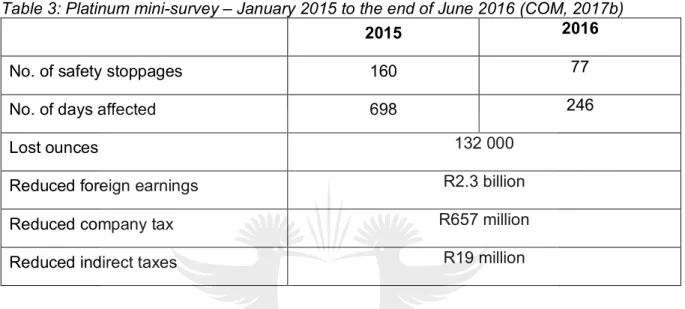
The MCSA as shown in Table 3, also researched the impacts of Section 54 on losses of revenue on four platinum mines operating in the North West province and one mine operating in the Limpopo province.
.
Table 3: Platinum mini-survey – January 2015 to the end of June 2016 (COM, 2017b)
2015 2016
No. of safety stoppages 160 77
No. of days affected 698 246
Lost ounces 132 000
Reduced foreign earnings R2.3 billion
Reduced company tax R657 million
Reduced indirect taxes R19 million
Since 2010, Health and Safety have been added in the Mining Charter. The Mining Charter was enacted with one goal to transform the mining industry in all aspects, which, as of the 2010 Mining Charter, includes Health and Safety as part of the transformation process. Section 54 can be seen as also a tool to manage the health and safety risk in mining. Certainly, the application of Section 54s has played a significant role in this transformation process in terms of health and safety, as the mining industry has seen a substantial reduction in fatalities that could have been a result of Section 54s and is discussed in more detail in Section 2.2 of this dissertation. The enforcement of Section 54 is part of the overall strategy of creating a mining industry with “zero harm” (Africa, 2018) but, like any good intention, there are good and bad impacts. Zero harm strategy is a leading indicator in the reduction of accidents, goals are set as “zero harm” and the industry leadership commits to the goal by doing risk assessments and putting efficient controls to mitigate mining hazards.
14
This dissertation will investigate the impacts, both positive and negative aspects of Section 54 mine stoppages.
Problem statement
The enforcement of Section 54 by the DMR Inspectorate on South African coal mines is used as a primary tool to eliminate or reduce the health and safety risk for mine employees. The resultant reduction of accidents in the mining industry is in its self a positive impact.
The resultant stoppages triggered by the application of Section 54s results in the loss of production and revenue at the mine, which result in losses in the South African economy due to the reduction in revenue and associated taxes, as well as other unintended impacts such as a reduction in social and community development.
Herbert Spencer (IZQuotes, 2019) said “every cause produces more than one effect”, which means the increased usage of Section 54s not only has reduced accidents on the mines but also has other effects on the mining industry. This dissertation has to find answers to that question.
Objectives of the research
The objective of the dissertation is to assess the negative impacts of Section 54 on the South African coal mines and the unintended consequences on the coal mines, its workforce, management, and other interested and affected parties.
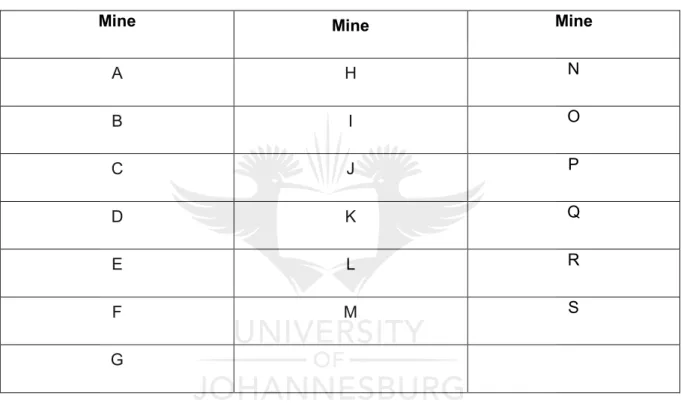
Case studies to gather quantitative and qualitative data was undertaken from collieries referred to as A, B, C, D, E, F, G, H, I, J, K, L, M, N, O,P,Q,R and S. In addition, data was gathered from the DMR Gauteng and Mpumalanga offices.
15
The main research questions
The research will answer the following question:
1. “What are the unintended consequences resulting from the frequent issuing of Section 54s on South African coal mines.”
A subsequent question is also raised:
2. “Are Section 54s still effective in reducing mine fatalities.”
The significance and justification of the study
Gloy (2014) has written a dissertation on Section 54 mine stoppages. In her dissertation, she examines the proportionality of the Department of Labour Inspector and the IOM from the DMR, as they enforce compliance with the Occupational Health and Safety Act (OHSA) and the MHSA respectively. Gloy (2014) observed that there is a difference between the Department of Labour Inspectors and the IOM. The main difference being the enforcement guidelines; the guideline for the Inspector from the Department of Labour has a clause instructing the Inspector of possible economic consequences in exercising their duties if they do not sparingly enforce the law. Neither the MHSA nor the guidelines caution the IOM in his/her enforcement of the Section 54.
The application of Section 54 has raised the attention to many other research bodies and academics; for example, Professor May Hermanus, former Chief IOM, has requested the mining industry stakeholders to have a debate on the effectiveness of Section 54 (Solomons, 2016).
16
In November 2016: “The Labour Court (Johannesburg) ruled that the DMR officials had ignored the notion of “proportionality” when it comes to issuing Section 54 notice, shutting AngloGold Ashanti’s Kopanang mine on the 17th October 2016. The mine lost R9.5 million per day owing to Section 54 orders that had been issued by an IOM (Stevens, 2016).
The locality of the research
The research is covering the South African coal mining industry focusing on the main producing areas of Witbank, Highveld, Ermelo, and Somkhele coalfields (Figure 7).
Figure 7: Coalfields of South Africa (Snyman, 1998)
Study Area
17
Research methodology
A combination of qualitative and quantitative research was undertaken. A literature review regarding Section 54s was undertaken to highlight some of the impacts that Section 54 have on the South African mining industry as a whole. In addition to the literature review, several interviews and case studies were conducted with the following collieries as shown in Table 4.
Table 4: List of collieries used for interviews and case studies
Mine Mine Mine
A H N B I O C J P D K Q E L R F M S G
Additional data was gathered from the DMR Gauteng and Mpumalanga offices to enable quantitative information to be collected and analysed. Further interviews with key stakeholders enabled qualitative data to be sourced and analysed.
18
Applicability of the Research
The research intends to investigate the impacts Section 54 stoppages in the South African coal industry and analyse them to determine if there are any unintended consequences, of which if these unintended consequences exist, recommendations can be made to key stakeholders of the mining industry; which are the DMR, MCSA and organised labour.
Outline of the dissertation
Chapter 1 provides an introduction, background, an outline of the study; its aims and applicability. Chapter 2 presents the literature review, which investigates the importance and impact of Section 54 mine closure on mine owners, mine employees, local communities, and the South African government. Chapter 3 of the dissertation deals with the research methodology, which is a mixed method of both qualitative and quantitative techniques. Chapter 4 examines and interprets the findings of the research and presents the unintended consequences that Section 54s have on the South African coal industry, Chapter 5 summarises the dissertation research findings and discussions. Chapter 6 provides recommendations and conclusions for the dissertation, and the dissertation finishes with a bibliography, an appendix, and a glossary, which are considered as supplementary materials.
19
2
CHAPTER 2: LITERATURE REVIEW
Chapter Overview
This chapter searches existing literature to support the problem statement, the objectives of the research, the main research question and the significance and justification of the study. The impact, relevance, and cost of Section 54s are investigated as well as understanding the proportionality when IOMs exercise their power to issue Section 54 notices. An international literature review has been undertaken to examine the similarities and differences between foreign mine Inspectorates and the South African DMR Inspectorate. The objective of the literature review of North American, European and Australasian experiences is to benchmark how mine officials apply their equivalent administrative actions of Section 54s in their respective countries.
The impact of Section 54s
Stewart (1995) stated that legislation is put in place with good intentions to address issues of health and safety on mines, but unfortunately, unintended impacts result in “reduced productivity”, “increased working costs” and “cause job losses”. Fundamentally, safety improvement is driven by safe mining methods, safe routines, and safe work execution. Key factors in achieving improved safety in mines are the use of the safest mining methods, work practices, and good engineering practice (Stewart, 1995). It therefore means from Stewart (1995), that good legislation should be geared to excellence in mining environments, practices, and adoption of new scientific discoveries.
The mining industry needs to keep alive collective commitments of creating an industry that does not harm the workers nor negatively impact on the health and safety of the workforce. Stewart and Malatji (2018) reminds the mining industry of two commitments; firstly the 2003 and 2013 MHSC milestones in which the mine owners, government and organised labour
20
committed to zero harm. Secondly, the CEOs of major companies have made a public commitment to zero harm in 2005. The mining industry has more tools at their disposal to manage mining risk and Section 54 administration is just one of those tools used to achieve the zero harm goal. It is incumbent for the MHSC to keep liaison amongst its stakeholders on what risk controls to be used so as to eliminate the over reliance of Section 54 mine stoppages
UASA (2011) states that although it has acknowledged that Section 54 prevents fatal accidents they still feel that Section 54s are applied recklessly, hence causing more harm to the economy. The UASA has calculated that on average a one-day Section 54 stoppage on a mine equates to R6 million revenue loss to a production section. The UASA (2011) further reported Anglo American Platinum in the last quarter of 2011 experienced at least one shaft closure every third day due to Section 54 mine stoppages. UASA Divisional Manager believed that Section 54s should be administered by balancing safety with profits for mine sustainability (UASA, 2011).
The suspension of the 2011 Enforcement Guidelines by the Labour Court has not helped in the lessening of the inconsistent application of Section 54s by the DMR Inspectorate. Since 2016 mine operators who would usually hold discussions with the DMR regarding Section 54 stoppages are now choosing to approach the courts for adjudication (UASA, 2011). This could be the same mine operators perceiving Section 54 as being applied un-proportionally.
McKay (2016) reported that the MCSA wants to see safety legislation applied so that a mine section is closed rather than the entire mine. Thus, address safety concerns while at the same time reduce the impact of safety stoppages. This type of Section 54 is described as partial closure (Figure 6). Even a better measure would be the issuances of Section 55s, which enables the IOM to issue an instruction to fix noncompliant matters rather than stop an entire
21
section or shaft with a Section 54 notice. The difference between Section 54 and 55 is described under 1.2 of this dissertation. “In most cases, the issuing of Section 55s, in the first instance, will resolve the safety issue, without harming production or the viability of the mining operation,” according to the MCSA and as reported by McKay (2016). It wants to ensure that Section 54s are “lifted expeditiously and that the DMR urgently completes an “enforcement policy” in order to ensure fairer and more appropriate application of the MHSA.
According to McKay (2016), “Section 54s enable the DMR to close the entire mine and shafts in the event of a safety breach, most seriously when there is a mine fatality. The notion behind the section is for remedial action to be undertaken to avoid a repeat. There is also an economic impact which acts as a negative incentive to improve safety.”
In December 2015, there was evidence that the DMR was taking a far stricter stance on safety when the DMR’s North West office issued a directive to shut every single one of the province’s platinum mines following underground fatalities at the mines of Royal Bafokeng Platinum and Impala Platinum (McKay, 2016).
• There does seem to be a regional bias in terms of how mine safety is vetted, for example in 2016 AngloGold Ashanti complained of mass audits being conducted by IOM on its West Wits mines. Peter Steenkamp, Chief Executive Officer (CEO) of Harmony Gold, confirmed this when he was quoted to state the following - “No, we haven’t had really seen an increase in the instances of stoppages owing to Section 54s. We have had some. But we mostly mine in the Free State province” (McKay 2016).
As reported by McKay (2016), the MCSA reported that the application of Section 54 mine stoppages cost the mining industry R4.84 billion in 2015. McKay also reported that in the period from 2012 to 2015 the mines reporting to the MCSA lost a total of R13.63 billion in
22
revenues due to Section 54 instructions. However, notably for the same period, the number of fatalities were reduced by 44%. Mackay (2016) concluded that the economic losses to the mines were being used as a deterrent to prevent mine fatalities, which equated to an average revenue loss of R13 million per Section 54 stoppage and excludes associated costs, such as wages without production and re-start costs. During this period, the typical length of a Section 54 stoppage averaged between five and 14 days, which meant an affected mine only achieved 22/23 workdays (out of 30/31 working days) in a month. For a marginal mine that requires 19 or 20 days per month to achieve breakeven the issuance of a Section 54 notice or instruction has a major impact on a mine’s profitability (McKay, 2016). Interestingly, the study didn’t question the integrity of Section 54 notices but questioned its application.
Financial losses are difficult to contain when Section 54 stoppages affect the entire operation, i.e. the entire mine is stopped for infringement instead of only stopping the offending section (McKay 2016). In the article, McKay (2016) advocated that the DMR should have an “enforcement policy” that will help in alleviating adverse financial impacts associated with the administration of Section 54. However, one must also note that fatal accidents have reduced from 615 in 1993 to 78 in 2015, providing a greater belief to the DMR and IOM that Section 54 is a useful tool to eliminate fatalities. A directive validated this belief in 2015 from the DMR North West office that stated that all platinum mines would be closed after fatal accidents at two of the platinum companies in the province. This directive was later withdrawn (McKay, 2016).
An example of the potential misuse of Section 54s was a rumour in 2015 that claimed that mines which were not receptive to issuing contracts to a Gupta company, JIC Mining, a company associated with the Gupta’s contracting company, were receiving unwarranted Section 54 mine stoppages (McKay, 2016).
23
McKay (2016) also reported that a platinum Chief Executive Officer remarked that the DMR’s IOMs lacked practical experience as in many instances where Section 54 was issued the Section 54s were later changed to Section 55s after representations were made to a local Principal IOM working for the DMR.
DMR was persuaded by the trade union United Association of South Africa (UASA) and the MCSA to review guidelines for issuing Section 54 after a report showed Section 54 mine stoppages cost the mines R4.6 billion in lost revenues in 2015 (Riddle, 2017). Riddle (2017) argues that many of the Section 54 instructions could have preferably been administered through Section 55s, which does not stop mine operations but instead requires the mine to rectify the substandard condition(s).
Section 54s have been recklessly issued, the Kopaneng gold mine being an example of such. In October 2016, where a Section 54 notice was issued in a section of the mine because of a single substandard condition. The resultant impact was that the Kopaneng mine lost R9.5 million per day and in such an instance a Section 55 notice would have been more appropriate and financial losses could have been avoided (Riddle, 2017).
The importance of good health and safety standards on mines cannot be underestimated, however, the effective use of Section 54 notices will also require appropriate training to both IOMs and mine employees so that fair administration of Section 54 notices can be adopted by the DMR (Riddle, 2017).
In the article “Is DMR deliberately sabotaging mining industry” by Jeffery (2017), Section 54 stoppages are viewed as symptoms associated with the history of the mining industry. Rising
24
operational costs and injurious legislation has seen the loss of at least 100 000 jobs in the South African mining industry in the last seven years. There seems to be an assumption by some people in the mining industry that mines will not stop dangerous operations on their own will unless forced to do so by IOM Section 54 stoppages. By 2015 about 60% of mining companies had seen steep increases in Section 54s stoppages in the previous four years (Jeffery, 2017) of which R13.6 billion was lost in revenue.
Some senior mining executives see prolonged Section 54s stoppages as “vindictiveness practice”, they point out the belief that standing against unfair Section 54 stoppages will result in “you get bullied”, “you get audited”, and “you get stopped to death” (Jeffery, 2017). Jeffery (2017) also highlights two court cases namely “Bert’s Bricks case in 2010” and “AngloGold Ashanti case in 2016” in which the companies challenged Section 54 stoppages on their works as examples were judgement picked up that the IOM enforcement of Section 54 had been irrational. Jeffery (2017) reported that in six months, AngloGold Ashanti in 2016 had lost R834m in revenues due to Section 54.
Weissenberg in 2016, as quoted by Jeffery (2017) points out that some Section 54s are petty, such as the issues of first aid boxes, faulty vehicle lights, and incomplete paperwork. Weissenberg further stated that Section 54 stoppages are a symptom of a “government that is hostile to the mining industry” because of the industry’s history of unfairly exploiting natural resources and poorly treating black workers, which makes the IOMs feel morally right to issue Section 54s. Meaning Section 54s are a symptom of unhealed wounds.
As illustrated later in Figure 6 and Figure 7, the Section 54 data provided by the DMR Gauteng and Mpumalanga offices confirm the surge in Section 54 issuances for mine stoppages. The surge in use of Section 54 notices is a tool that has a high financial impact and might be perceived by the recipients of such notices as a form of punishment. According to Karson
25
(2014), punishment fails to change behaviour but pushes people to avoid the source of punishment which would mean finding ways to avoid Section 54s and not dealing with the root cause of the mine failing to comply with health and safety standards. The surge of Section 54s can also be viewed as a means to force compliance. Forne (2016) stated that in enforcement by state agents there is a link between forced compliance and corruption. McKay (2018) reported that the minister of minerals and resources suspended an official in the Witbank DMR office for abusing Section 54 stoppages. The same IOM who had issued a Section 54 to a colliery asked for a payment of R50000 to lift the stoppage (McKay, 2018). The Witbank DMR office is situated in the coal mining region where the impacts of Section 54 stoppages are being studied.
Cost implications of Section 54s
Section 54s notices can result in the stoppage of an operation up to 14 days or more. This stoppage can have serious financial consequences for an operation. It is postulated that it is the cost implication that gains the attention of executives and senior management, thus increasing the safety awareness and compliance with mine standards. Preventive actions such as in-stope roof bolting and stope safety nets are initiatives that have been implemented in response to improve safety on the mines and reduce the financial impacts of Section 54s.
Findings from the MCSA in 2016 and reported in McKay (2016) revealed that Section 54s stoppages in 2015 resulted in the mining industry losing R4.84 billion in revenue. The financial impact of Section 54s undoubtedly impacts the mine’s bottom line and sometimes acts as a deterrent to unsafe acts on the mines. The projected cost on the mines excludes other costs, for example, wages paid to workers who will not be at work, care and maintenance during stoppages, and the cost of restarting operations.
26
An example of the impact of Section 54s stoppages can be provided by Tharisa Chrome Mine’s experience in 2015. Based on Tharisa’s Annual Report (Cyprus, 2015), Tharisa reported that all mining and production was stopped due to the issuance of a Section 54 notice by the IOM. The Tharisa experience demonstrates how Section 54 notices can impact on production and capital expenditure. The Tharisa annual report highlighted how the completion test, a requirement by lenders was delayed by 12 months due to a Section 54 stoppage.
Some views have been expressed within the mining industry that Section 54 stoppages are not necessarily helping to improve health and safety as the focus is on avoidance and not necessarily towards improving standards of health and safety. Also, it is claimed that stoppages affect the entire mine instead of being selectively applied to the offending workplace (Badenhorst, 2016).
The Relevance of Section 54s
There are two views regarding the issuances of Section 54s in the mining industry. On one side it is clear that Section 54s may have played a large part in the improvement of health and safety at underground mines. On the other side is the complaint that many Section 54s stoppages are inaccurately administered and come at the high price in the loss of production and revenue.
In the MCSA Integrated Annual Report (IAR) 2013/14 (2015) there is mention that the mining industry is at critical crossroads as Section 54 stoppages have become more of a challenge in 2014 than was the case the previous year. By 2016, Section 54 Instructions had gained the spotlight and the MCSA 2016 IAR (COM, 2016) commented on the appropriate application of
27
mine stoppages (Section 54s). The MCSA’s documentary on the “Appropriate Application of Section 54s” is provided below in italics. It is included in its entirety as it succinctly provides the feelings and frustration of a mining industry that was fed up with the inappropriate application of Section 54 notices.
“While the Chamber and its members recognise the important safety supervisory roles played by mines inspectors, we are also convinced that the inspectors’ applications of costly Section 54 work stoppages should be proportionate to the infraction. Unfortunately, this has not always been the case and has led to wholesale closures of mines where transgressions were confined to small parts of their operations.
The Chamber is committed to zero harm whereby every mineworker returns from work unharmed every day. Through tireless efforts by government, employers and employees, mine fatalities reduced from 615 in 1993 to 73 in 2016, an 88% reduction.
The Chamber supports appropriate Section 54 instructions that empower inspectors to close parts of, or entire mines, for health and safety reasons. However, the Chamber remains concerned about disproportionate Section 54 instructions that have been issued since 2007. These affect the viability of many mines and their ability to sustain jobs. A recent Labour Court judgment against DMR officials stated that a Section 54 instruction must be proportional to the harm or potential harm that it intends to prevent, quoting an author on law who said ‘... one ought not use a sledgehammer to crack a nut’. The inspector had inspected a small portion of the mine and instructed the whole mine to be closed.
The Chamber estimated that Section 54 instructions cost the industry some R4.8 billion in 2015. The Chamber’s concerns are particularly around the North West, Rustenburg area,
28 where inappropriate or disproportionate Section 54s are adding to the woes of a significant number of platinum producing shafts that are already loss-making. The primary drivers of this impact are the direct production days lost due to Section 54 stoppages and the indirect losses that result from the slow upliftment process and the subsequent start-ups.
While a number of companies are resorting to costly court action, the Chamber’s Platinum Leadership Forum (PLF) consisting of CEOs of platinum mining companies, developed a practical protocol to guide the appropriate application of Section 54 instructions.
The protocol contains proposals to deal with challenges that make Section 54 applications both ineffective in enhancing health and safety and that render them value destructive, such as:
a) Reducing the duration of Section 54 stoppages.
b) Assessing the applicability of Section 55 (an instruction that avoids stoppage of operations) versus Section 54 and/or other instruments.
c) Reducing the extent of Section 54 stoppages. d) Interacting appropriately with organised labour.
e) Assessing the applicability of training as remedial action. f) Limiting the impact of small defects and administrative issues.
The practical protocol has been shared and discussed with the Acting Chief Inspector of Mines since September 2016 with regular follow ups, though with no response as yet. During November 2016, this ‘disproportionality’ was challenged in the Labour Court by AngloGold Ashanti after its entire Mponeng mine was closed by an inspector who had found a few relatively minor localised infractions that posed no serious threats to the safety of employees in the small section of the Mponeng mine, or in the mine as a whole. In finding in favour of the company – that the inspector’s closure order, as well as the penalty imposed were
29 disproportionate – the Court established important legal principles. An inspector, the Court ruled, may only close an entire mine if he or she has objective reason to believe that occurrences and conditions identified, endangered, or may endanger, the health and safety of any person at an entire mine, and not only of a portion of the mine. It is hoped that this case will lead to greater clarity between mines, the DMR and its inspectorate.
A further legal challenge by another Chamber member, Sibanye, in the first month of 2017 was made on the basis that the closure of its Kroondal platinum mine in August 2016 was unwarranted. The company has lodged a claim against the Mineral Resources Minister and certain DMR inspectors in their personal capacities for an estimated production loss totaling R26 million.
In March 2017, the Chamber hosted a workshop aimed at empowering training and occupational health and safety (OHS) managers on the interpretation of Sections 54 and 55 of the MHSA. The Chamber has since tabled the workshop recommendation to the MHSC that this training be extended to other OHS managers, inspectors and organised labour's shop stewards. It is envisaged that Section 54/55 training will empower tripartite stakeholders to have a common understanding on the interpretation and implementation of Section 54s and 55s, thus building the much-needed trust in this area of mine health and safety”.
The MCSA (2016b) highlighted the industry’s concerns around Section 54s on what it described as haphazard Section 54 stoppages, as the stoppages were incorrectly administrated, and the duration of the stoppage was unnecessarily long. Hence, the industry is seeking a dialogue with the DMR’s inspectorate.
30
Section 54 stoppages contribute to production losses of platinum and gold. MCSA (2017c) revealed that 35% of Section 54 issued in 2015 in the mining industry should have been Section 55. At the MCSA workshop, it was stated that Section 55 is less severe as compared to Section 54, as it requires remedial action without the complete work stoppage required by Section 54. The significance of 35% of Section 54 will be discussed in Chapter 4. In this workshop, it is also mentioned that mines are hesitant to use legal actions for “unjust” Section 54 issuance because of “various reasons” and the fear of retribution by IOMs. The workshop further revealed a greater need for training on the understanding of Section 54 and Section 55 for mineworkers (safety representatives, miners, team leaders, shift bosses and mine managers), and the Mines Inspectorate. There was also a general agreement by the mining industry participants at the workshop that the mine operators should be more legally prepared with a court action to counter the surge of Section 54 stoppages and to coerce Mines Inspectorate in a dialogue on Section 54 issuance. Also, at the workshop, suggestions were made that the Mine Health and Safety Council (COM, 2017c) make mandatory training for all its stakeholders on the implementation of the MHSA.
Litigation
Creamer (2012) quoted the current minister of finance, Mr. Tito Mboweni as saying the application of Section 54 by the Inspectors of Mines is a “sledgehammer” practice that could result in “regulating the industry to death”.
Pavlovic (2017) summarises lessons learned from the judgement of AngloGold Ashanti Limited vs. Mbonambi and Others in 2016; in that the Inspectors of Mines instructions in terms of Section 54:
31
• The Inspectors of Mine’s judgement to issue Section 54 instruction must be impersonal.
• A mine employer can seek an urgent court interdict to lift a Section 54 instruction if the instruction has procedural unfairness in being administered by the Inspectors of Mines.
There is a noticeable change in the administration of Section 54 by DMR after the AngloGold Ashanti Limited, Labour Court judgement on the DMR in November 2016, to manage the negative impacts and also to lessen the risk of litigation from mines: -
• Total shut down of mines due to Section 54 by IOM has decreased and total stoppages mostly limited to small scale mines.
• Section 54 instructions have become isolated to limited work areas or acts of sub-standard.
• The statistical numbers of Section 54 issued by DMR disappeared from the public domain and have been replaced by percentages.
An example of how Section 54 stoppages may affect the viability of a mining operation is best described in an incident that took place in 2016 at Sibanye Platinum’s Kroondal mine. A Section 54 instruction from the Inspector of Mines to suspend operations for Kroondal’s five shafts in 2016 had to be reviewed by DMR and made lighter after the mine had drawn an affidavit to court warning that such a Section 54 would result in closure of the mine with a potential job losses of 9500 workers (McKay, 2016).
Cameron (2017) reported on comments made by Gideon du Plessis, General Secretary of Solidarity, that in certain instances sudden work stoppages due to Section 54 pose a safety risk in that seismic events can increase due to increasing pressures on the face that is caused
32
due to a pressure build up when the face is stopped over a period of time. Also, the same pressure can lead to major falls of rock at the re-start of work after Section 54 instruction has been lifted. Further risks can occur as more pressure is placed on workers to recoup the lost production. Gideon du Plessis, as quoted by Cameron (2017) continued to say that Lonmin’s CEO pointed out that Section 54 instructions do affect not only production but also disturbs routine safety protocols which endanger workers when work is re-started.
In the African Rainbow Minerals Sustainability Report (2017) it is reported that during the 2016 financial year African Rainbow Minerals lost R503 million and in 2017 financial year African Rainbow Minerals lost R335 million due to Section 54 stoppages, one of the company’s focus points for 2018 was to reduce Section 54 work interruptions.
The Mine Health and Safety Act No.72 of 1997 read in-conjunction with Act No.74 of 2008, reveals that when Section 54 of the MHSA was amended in 2008, sub-sections 7, 8, 9 and 10 were deleted. These sub-sections were there to allow the management and workers representatives to make representations before the Inspector of Mines could give the Section 54 instruction. Now Section 54 stoppages can be issued without any legal obligation for the IOM to listen to any representations. One can assume these sub-sections were deleted to speed up the issuance of Section 54 instructions to prevent immediate danger to the health and safety of workers or any other persons. However, Beech (n.d.) argue that the deleted subsections were there to help an Inspector of Mines to follow administrative fairness in the application of the law.
33
DMR records on Section 54 issued over a five-year period
The two biggest DMR Inspectorate regional offices, based on the number of mines, were chosen for personal interviews. The Mpumalanga regional office, which is also in the region of the dissertation and Gauteng regional office were used to discuss Section 54 issued over a five-year period (2011 to 2015). Since 2015 the DMR is not releasing Section 54 statistics. The reasons for this lack of transparency is unknown but may be a means to manage the public perception around Section 54s. For example, there was a perception that the DMR was issuing Section 54s to benefiting the politically-connected Gupta family-linked companies (McKay, 2016). Figure 8 indicates that Section 54 issuance from the Mpumalanga regional office from 2011 to 2015 increased by 91%, a clear indication that during this period the use of Section 54 as a tool to ensure MHSA compliance increased in the coal mines. Noting that this regional office predominantly monitors coal mines.
Figure 8: Section 54s Issued in Mpumalanga DMR region 2011 – 2015
The Gauteng regional office is not in the region of the study but was chosen to validate that Section 54 issuance as a MHSA compliance tool has increased throughout the South African
0 20 40 60 80 100 120 140 2011 2012 2013 2014 2015
Section 54 Issued In Mpumalanga DMR Region
Over 5 Years
34
mining industry. It suggests that the increase in Section 54 stoppages is a DMR Inspectorate policy. Figure 9 depicts the issuance of Section 54s in the Gauteng region from 2012 to 2016, noting that no records were available for 2012. From 2013 to 2016 the issuance of Section 54 to the mines in the Gauteng region increased by 3233%, a significant increase that shows an uncompromising application of Section 54. The increase is significant not only for the region but also for the South African mining industry as a whole.
Figure 9: Section 54s issued in Gauteng DMR Region 2012 to 2016
2.6.1
The Gloy dissertation on Section 54 mine stoppages
Gloy (2014) produced a Master's dissertation entitled “The use of Section 54 stoppage orders in terms of the Mine Health and Safety Act”. The dissertation reviews Section 54 notices in conjunction with similar notices in the Occupational Health and Safety Act (OHSA) and the National Environmental Management Act (NEMA). The Gloy dissertation was triggered by frustrations in the mining industry and mining employers regarding what they consider unfair
0 20 40 60 80 100 120 2012 2013 2014 2015 2016
Section 54 Issued In Gauteng DMR Region Over
5-Years
35
issuances of Section 54 notices by the IOM in the DMR. The findings of the Gloy’s dissertation do not discuss how Section 54s are scripted but rather on the inconsistency of its enforcement. In other words how the IOM exercise Section 54 notices at their discretion. Section 54 of the MHSA contains the phrase “reason to believe” which provides an IOM broad discretion. For example, if the IOM has reason to believe that a section or shaft is unsafe the IOM at his own discretion may implement a Section 54 notice, while another IOM may impose a Section 55 notice. Hence the need for a clear guideline that would bring consistency in the enforcement of the same section.
In the administration of the OHSA, as reported by Gloy (2014), the Department of Labour (2011) p.2 has an Enforcement Manual published in 2011 to systemise the issuing of stoppage notices. The 2011 p.2 Enforcement Manual contains this sentence “Inspectors must not serve prohibition notices lightly and without restriction, as prohibition notices can have serious financial implications for the employer or user”. Gloy (2014) points out that the Enforcement Manual has an interest in the health and safety of employees as well as avoidance to cause harm to the industry. In the NEMA the Department of Environmental Affairs balances compliance with economic growth, an example is the incorporation of compliance notices before a stoppage notice. This means the employer is given a warning or a chance to rectify the non-compliance issue before a stoppage notice is issued.
Gloy (2014) concludes the following:
• Section 54 stoppages have consequences that affect the environment as fewer finances decrease the ability of the mine to support or finance community projects that support sustainable environmental management such as disposal of domestic waste.
36
• Section 54 stoppages impact Section 100(2) (a) of the MPRDA, hence reduces the broad-based socioeconomic empowerment of Historical Disadvantaged South Africans (HDSA).
• Enforcement guideline in Mine Health and Safety Inspectorate requires improvement, as it does not incorporate a clause of observing economic sustainability when Section 54s are being enforced. Such a change in the guidelines would put Section 54 instructions in line within the OHSA and NEMA.
2.6.2
Misuse of Section 54s notices
Mining ENSight (2013) noted a practice whereby IOMs while using Section 54 powers were withdrawing statutory appointments on the mines and advising the mine employers to re-train such individuals as a condition for such Section 54 to be lifted. A mine employee whose competence certificate is withdrawn temporarily or permanently cannot perform duties acquired by the possession of a competency certificate which means that an IOM would have the ability to use a Section 54 notice to invariably influence an employer and employee relationship that is enshrined in the Labour Relations Act (LRA). The question in such circumstances is whether the IOM has acted in a justified, fitting and fair manner according to the LRA. Mining ENSight (2013) describes an IOM as a“creatures of statute”, meaning an IOM should only act within the confines of what the law empowers them to do. The use of Section 54 notices to influence LRA should be considered unlawful.
The article entitled “Is DMR deliberately sabotaging mining industry” by Jeffery (2017) reveals the following:-
• An IOM official was suspended from work after blackmailing a colliery with the use of Section 54 for personal financial gain.
37
• Industry unfriendly legislation has led to thousands of jobs being lost in the mining industry in the last seven years.
• Within four years preceding 2015 about 60% of mining companies experienced a rapid increase of Section 54s which saw R13.6 billion in revenue being lost during the same period.
• Protracted Section 54 stoppages turned profit-making mines into loss-making mines.
• Some senior mining executives view prolonged Section 54s stoppages as retribution.
Conflict is evident between the good intention of the enactment of Section 54 and its implementation. There is a need for training for both Inspectors of Mines and mine employees, to improve on the implementation of Section 54.
International Review of relevant literature
2.7.1 Introduction
An international literature review has been undertaken to examine the similarities and differences between foreign mine Inspectorates and the South African DMR Inspectorate. The objective of the literature review of North American, European and Australasian experiences is to benchmark how mine officials apply their similar administrative actions of Section 54s in their respective countries. Some of the specific instruments used in international administrative actions are policies, enforcement guidelines and issues of measuring standards as applied in ensuring health and safety compliance on mines. Further, the review investigates the administration and legislative provisions made by the various countries in terms of work stoppages.