ARTICLES
STRUCTURAL REFORM PROSECUTION
Brandon L. Garrett*
N what I call a structural reform prosecution, prosecutors secure the
cooperation of an organization in adopting internal reforms. No
scholars have considered the problem of prosecutors seeking structural
reform remedies, perhaps because until recently organizational
prosecu-tions were themselves infrequent. In the past few years, however, federal
prosecutors have adopted a bold strategy under which dozens of leading
corporations have entered into demanding settlements, including AIG,
America Online, Boeing, Bristol-Myers Squibb Co., Computer
Associ-ates, HealthSouth, KPMG, MCI, Merrill Lynch & Co., and Monsanto.
To situate the DOJ's latest strategy, I frame alternatives to the pursuit of
structural reform remedies as well as alternative methods prosecutors can
use to pursue structural reform. To better understand what the DOJ
ac-complished by choosing to pursue structural reform and then doing so at
the charging stage, I conducted an empirical study of the terms in all
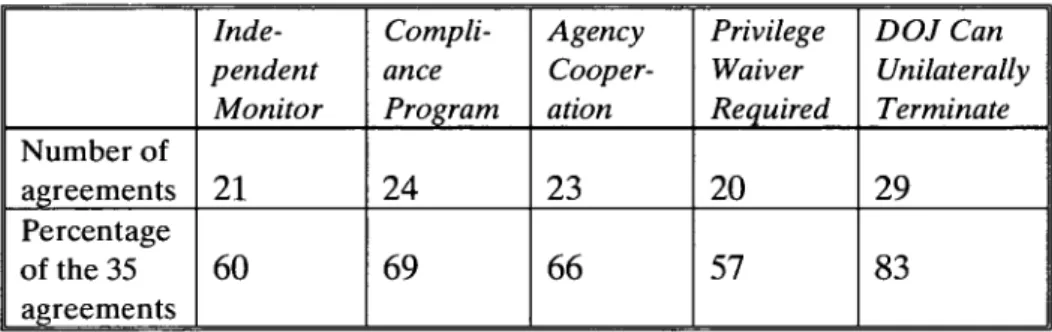
agreements the DOJ has negotiated to date. My study reveals imposition
of deep governance reforms, consistent with the purposes of the
Sentenc-ing Guidelines, but also some indications of overreachSentenc-ing, if perhaps not
abuse of prosecutorial discretion. I conclude by framing the issues that
such prosecutions raise where, given the breadth of prosecutorial
discre-tion and the deferential, limited nature of judicial review, the DOJ's
emerging structural regime for deterring organizational crime raises
im-portant questions for all actors involved and affected.
. Associate Professor, University of Virginia School of Law. I gratefully acknowl-edge invaluable comments from Ken Abraham, Kerry Abrams, Richard Bierschbach, Richard Bonnie, Samuel Buell, Julie Cohen, Anne Coughlin, Viet Dinh, Chris El-mendorf, Theodore Garrett, Rachel Harmon, Toby Heytens, Robert Hur, James Ja-cobs, Ed Kitch, Greg Klass, Jody Kraus, Donald Langevoort, The Honorable Gerard Lynch, Paul Mahoney, Greg Mitchell, Erin Murphy, Richard Myers, Jed Purdy, Dan Richman, Jonathan Rusch, George Rutherglen, David Sklansky, Dan Solove, Susan Sturm, George Yin, and David Zaring; participants at the University of Virginia School of Law and Georgetown University Law Center faculty workshops, the 2006 Junior Criminal Law Conference, and the Washington & Lee Works in Progress Con-ference; and research assistance from Michelle Morris, Richard Rothblatt, and Erin Montgomery.
854
Virginia Law Review
[Vol. 93:853
INTRO D U CTION ...
854
I.
STRUCTURAL REFORM AND PROSECUTORIAL DISCRETION ...861
A. The KPMG Prosecution Deferred ... 861
B. The Classic Civil Structural Reform Model ... 869
C. Alternatives to Structural Reform Prosecution ... 875
1. Prosecuting All Organizations
... 875
2. Prosecuting Individuals Not Organizations ... 882
3. Deferring to Private Litigation and Regulators ... 883
II.
THEDOJ's
NEW MODEL FOR STRUCTURAL REFORM
PRO SECUTIO N ...
886
A. The Making of the DOJ's Structural Approach ... 887
B. Empirical Analysis of the DOJ's Agreements ... 893
C. Alternative Stages to Pursue Structural Reform
P rosecutions ...
902
1. The Prevention Stage ...
903
2. The Charging Stage ...
904
3. The Plea Bargaining Stage ...
906
4. The Probation Stage ...
908
5. C ivil A ctions ...
910
III.
PROSECUTORS, COURTS, AND REMEDIAL DISCRETION ...913
A. Defining Abuse of Power in Organizational
P rosecutions ...
913
B . Judicial R eview ...
919
1. A pp roval ...
922
2. Im plem entation ...
925
3. Term ination ...
927
C. Rethinking Remedies for Organizational Crime ... 931
C O N CLU SIO N
... 936
APPENDIX
A: CHART OF POST-THOMPSON MEMO DEFERRED
AND NONPROSECUTION AGREEMENTS
(JAN. 20,2003-JAN.
2007) ...
938
APPENDIX B: PRE-THOMPSON MEMO DEFERRED AND
NONPROSECUTION AGREEMENTS (BEFORE JAN.
20,2003)
...
954
INTRODUCTION
In the past few years, federal prosecutions of organizations have
sharply accelerated under a new paradigm that I call "structural
re-form prosecution." Traditionally, federal prosecutors rarely
pur-sued entire organizations. Broad federal statutes and respondeat
Structural Reform Prosecution
superior standards allowed prosecutors to charge an entity with a
crime for the act of a single agent. Organizations feared the
catas-trophic punitive fines and severe reputational consequences of a
conviction-what one court described as a "matter of life and
death."
'But despite their substantial power, federal prosecutors
seldom exercised it, out of concern for the collateral consequences
to an organization and also the harm to employees, stockholders,
and the public. Recently, however, the Department of Justice
("DOJ") adopted a novel strategy by prosecuting large
organiza-tions far more often, but leveraging the prosecuorganiza-tions to secure
adoption of sweeping internal reforms.
2Without obtaining an
in-dictment, much less a conviction, the DOJ recently prevailed on
thirty-five leading corporations to enter into demanding
settle-ments, including AIG, America Online, Boeing, Bristol-Myers
Squibb Co., Computer Associates, HealthSouth, KPMG, MCI,
Merrill Lynch & Co., and Monsanto, as well as several public
enti-ties.'
This new settlement approach avoids the collateral
conse-quences of an indictment, while using the prosecution as a "spur
for institutional reform."' By entering into agreements with
organi-zations, prosecutors imposed rigorous requirements to promote
compliance. For example, in 2005, KPMG International agreed to
shut down its entire private tax practice, to cooperate fully in the
investigation of former employees, and to retain an independent
monitor-a former Securities and Exchange Commission ("SEC")
chairman-for three years, in order to implement an elaborate
compliance program.
5Such agreements became common as
prose-cutors initiated more organizational prosecutions than before in
re-United States v. Stein, 435 F. Supp. 2d 330, 381 (S.D.N.Y. 2006), appeal docketed, No. 06-4358 (2d Cir. Sept. 19, 2006).
2 Throughout this Article, I use "DOJ" to refer to federal prosecutors both at the
main office and the various U.S. Attorneys' Offices collectively. I do this only for convenience, because, as I will describe, the individual offices and line attorneys exer-cise substantial independence. I otherwise refer to individual U.S. Attorneys' Offices, the central office, divisions, or task forces separately.
'See infra Appendix A.
4
John Gibeaut, Junior G-Men, A.B.A. J., June 2003, at 46, 48 (quoting then-Assistant Attorney General Michael Chertoff).
'See infra Section I.A.
Virginia Law Review
[Vol. 93:853
sponse to post-Enron corporate fraud scandals.
6The agreements
form a part of the larger fabric of federal response to a perceived
breakdown in corporate culture that has also included passage of
the Sarbanes-Oxley Act and enhanced regulatory enforcement
tar-geting corporate fraud.
7Unlike those legislative and administrative responses, structural
reform prosecutions raise questions about the reach of federal
ex-ecutive branch power. The Senate Judiciary Committee questioned
tactics used by the DOJ, as did the American Bar Association and
the Committee on Capital Markets Regulation.
8Other critics of the
DOJ strategy with a different perspective, such as Ralph Nader,
called failures to convict organizations a "shocking" and
"system-atic derogation" of the DOJ's duty to seek justice.
9White collar
de-fense practitioners complained in the press that federal prosecutors
"exploit[] their virtually unchecked power to extract and coerce
ever greater concessions."'" Professor Richard Epstein stated that
"the agreements often read like the confessions of a Stalinist purge
trial."" All sides agree that for good or ill, federal prosecutors
ex-ercise vast discretion; Professor John C. Coffee, Jr. commented
6 See infra Section II.A.
7
See, e.g., Public Company Accounting Reform and Investor Protection Act of 2002, Pub. L. No. 107-204, 116 Stat. 745 (codified at 15 U.S.C. § 7201 (2000 & Supp. IV 2004)); John C. Coffee, Jr., Gatekeeper Failure and Reform: The Challenge of Fashioning Relevant Reforms, 84 B.U. L. Rev. 301, 303 (2004) (describing "perva-siveness of the sudden surge in financial irregularities in the late 1990s" and regula-tory responses).
'See Lynnley Browning, Justice Department Is Reviewing Corporate Prosecution Guidelines, N.Y. Times, Sept. 13, 2006, at C3; ABA Presidential Task Force on the Attorney-Client Privilege, http://www.abanet.orgfbuslaw/attorneyclient/home.shtml (last visited Feb. 3, 2007); Comm. on Capital Mkts. Regulation, Interim Report 13 (2006), http://www.capmktsreg.org/pdfs/11.30Committee Interim ReportREV2.pdf.
'Letter from Ralph Nader & Robert Weissman to Alberto Gonzales, Attorney Gen. (June 5, 2006), posted at Multinational Monitor Editor's Blog, http://multinationalmonitor.org/editorsblog/index.php?/archives/26-The-Boeing-DOJ-Debacle.html (July 6, 2006, 15:34 EST); see Michael Seigel, Corporate America Fights Back, Wash. Post, Feb. 26, 2007, at A15.
0
N. Richard Janis, Taking the Stand: Deputizing Company Counsel as Agents of the Federal Government: How Our Adversary System of Justice Is Being Destroyed, Wash. Law., Mar. 2005, at 32, 34, available at http://www.dcbar.org/for-lawyers/ resources/publications/washington lawyer/march_2005/stand.cfm.
" Richard A. Epstein, Op-Ed., The Deferred Prosecution Racket, Wall. St. J., Nov. 28, 2006, at A14.
Structural Reform Prosecution
that they have "something close to absolute power" when
negotiat-ing organizational settlements.'
2Some indications of overreaching already are apparent in
in-stances where prosecutors exacted seemingly unrelated terms,
al-though, as discussed below, what counts as an abuse is contested in
an area where prosecutors retain such broad discretion. In 2003,
the New York Racing Association ("NYRA"), a state-franchised
operation, agreed to install "video lottery terminals," or slot
ma-chines, at its race tracks. Federal prosecutors imposed this term
only because state officials hoped to use the revenue from the slot
machines to comply with a court ruling requiring adequate public
school funding.'
3Similarly, in 2004, MCI (the entity that replaced
WorldCom) entered into an agreement with state prosecutors in
Oklahoma to settle accounting fraud charges. State officials feared
that MCI might face bankruptcy if indicted, leading to job losses
and harm to state pension plans with MCI stock. The agreement
required MCI to create 1600 jobs over ten years in Oklahoma.
MCI was later fined when it did not create those jobs as promised.'
4Nor do prosecutors quickly relinquish their power. They retain
the authority to prosecute based on their unilateral decision that an
organization breached the agreement." The agreements typically
do not provide for judicial review of implementation or of any
al-leged breach, and they often require the organization's permanent
future cooperation.
This recent wave of structural reform prosecutions is not the first
time that the litigation process has been used to effect
organiza-tional change. Beginning in the 1960s and 1970s, private attorneys
general increasingly sought structural reform of public entities by
bringing lawsuits against government entities, including challenges
to school segregation, conditions in mental hospitals and prisons,
and housing discrimination. These lawsuits were "structural
re-form" cases because they sought more than cease-and-desist orders
by requiring ongoing judicial oversight of government institutions.
2John C. Coffee, Jr., Deferred Prosecution: Has it gone too far?, Nat'l L.J., July 25,
2005, at 13.
"See infra notes 262-63.
See Barbara Hoberock, MCI Coughs Up $280,000 Payment to State, Tulsa World, Mar. 31, 2005, at Al.
" See infra Section ll.B.
858
Virginia Law Review
[Vol. 93:853
Courts later restricted the scope of prospective remedies for
rea-sons of equitable restraint, federalism, comity, and
countermajori-tarian legitimacy, but over time, a consistent body of remedial law
emerged to guide government actors in a range of contexts.
The emerging approach towards structural reform prosecutions
knows no such bounds. Federal prosecutors, unlike civil rights
plaintiffs, operate as politically accountable public actors to whom
courts remain highly deferential. In the past, however, the DOJ
had not sought to reshape Fortune 500 companies, much less to
achieve "deterrence on a massive scale" of entire industries.
16We
should be examining these prosecutions carefully because of their
national importance and because structural reform is a new goal
for federal criminal law. Legal scholars have not critically
exam-ined this bold new prosecutorial mission.
17Nor have any scholars
explored the problem of structural reform of organizations through
criminal prosecutions, perhaps due to the traditional view that
structural reform occurred only in civil rights cases.
8Civil
struc-6 Memorandum from Larry D. Thompson, Deputy Attorney Gen., to the Heads of Dep't Components, U.S. Attorneys 1 (Jan. 20, 2003), http://www.usdoj.gov/dag/cftfl businessorganizations.pdf [hereinafter Thompson Memo].
17 Little scholarship to date has critically examined the DOJ's recent deferral strat-egy, and none treats the problem as one of structural reform of organizational crimi-nality. See Lawrence D. Finder & Ryan D. McConnell, Devolution of Authority: The Department of Justice's Corporate Charging Policies, 51 St. Louis U. L.J. 1 (2006) (suggesting that corporations try to negotiate more lenient terms and describing varia-tion between the agreements among different U.S. Attorneys' Offices); Benjamin M. Greenblum, Note, What Happens to a Prosecution Deferred? Judicial Oversight of Corporate Deferred Prosecution Agreements, 105 Colum. L. Rev. 1863, 1901 (2005) (proposing that courts act as fiduciaries for third parties affected by deferral agree-ments). The only additional commentary on recent structural efforts by the DOJ was written by current or former DOJ prosecutors and usefully explains DOJ policy and practice. See Christopher J. Christie & Robert M. Hanna, A Push Down the Road of Good Corporate Citizenship: The Deferred Prosecution Agreement Between the U.S. Attorney for the District of New Jersey and Bristol-Myers Squibb Co., 43 Am. Crim. L. Rev. 1043 (2006) (praising the DOJ's new approach); Christopher A. Wray & Robert K. Hur, Corporate Criminal Prosecution in a Post-Enron World: The Thompson Memo in Theory and Practice, 43 Am. Crim. L. Rev. 1095, 1095-98 (2006) (describing DOJ practice and its impact). Several pieces criticize recent deferred prosecution agreements but only regarding the specific subject of privilege waiver, an issue tangential to this project but discussed infra text accompanying notes 251-52. See, e.g., George Ellard, Making the Silent Speak and the Informed Wary, 42 Am. Crim. L. Rev. 985, 993 (2005).
" My hope is that this piece will begin to link criminal law structural reform scholar-ship to scholarscholar-ship on civil structural remedies. Professor James Jacobs, in his
land-Structural Reform Prosecution
tural reform litigation engendered an important literature
regard-ing the legitimacy and efficacy of such interventions." Similar
ques-tions should be asked again by courts, scholars, and practitioners
about structural reform in criminal cases. In this piece, I shed light
on why prosecutors chose to pursue structural reform, I provide an
empirical description of these structural reform efforts by
prosecu-tors, and I begin the project of exploring questions regarding their
clarity, scope, effectiveness, the alternatives, and the ability of
prosecutors and courts to police them.
This Article proceeds in three Parts. The first Part introduces the
structural reform prosecution by describing the KPMG case and
contrasting the classic civil structural reform model and its judicial
limits with the vast discretion of prosecutors. I discuss how
prose-cutors might decide to exercise their discretion without seeking to
accomplish structural reform at all. The DOJ could seek to impose
optimally deterrent fines, but the dire collateral consequences of
such an approach make it highly undesirable. Or the DOJ could
wholly cease prosecuting organizations and focus on prosecuting
individuals, deferring to civil litigation or federal regulatory actors
with expertise in governance reform. This approach, however,
would ignore direction from Congress to prosecute organizations.
'The DOJ instead reserved prosecution for serious cases and in
those cases sought structural reform remedies early to avoid the
harsh effects of an indictment.
mark book on civil RICO labor racketeering prosecutions, is one of the few to recog-nize a need for scholarship connecting the history of structural reform litigation in civil rights cases and in federal organized crime prosecutions. See James B. Jacobs, Mobsters, Unions, and Feds: The Mafia and the American Labor Movement 246 (2006).
'9See infra Section I.B.
Regarding the problem of overbroad and vague federal criminal law, see, for ex-ample, John Calvin Jeffries, Jr., Legality, Vagueness, and the Construction of Penal Statutes, 71 Va. L. Rev. 189, 244-45 (1985); Dan M. Kahan, Lenity and Federal Common Law Crimes, 1994 Sup. Ct. Rev. 345; Stephen F. Smith, Proportionality and Federalization, 91 Va. L. Rev. 879, 908-25 (2005). Regarding the unique problem of organizational punishment, see Jennifer Arlen, The Potentially Perverse Effects of Corporate Criminal Liability, 23 J. Legal Stud. 833 (1994); John C. Coffee, Jr.. "No Soul to Damn: No Body to Kick": An Unscandalized Inquiry into the Problem of Corporate Punishment, 79 Mich. L. Rev. 386 (1981); Robert Cooter, Prices and Sanc-tions, 84 Colum. L. Rev. 1523 (1984); Reinier H. Kraakman, Corporate Liability Strategies and the Costs of Legal Controls, 93 Yale L.J. 857 (1984).
Virginia Law Review
In Part II, I describe the current approach in which prosecutors
obtain structural reform settlements at the charging stage through
deferral or nonprosecution agreements. While the DOJ's current
deferred prosecution approach raises concerns about executive
power, it remains more complex than it first appears. I provide an
empirical study of the terms in agreements the DOJ has negotiated
to date (summarized in Appendices A and B) to assess how
prose-cutors have exercised their discretion in practice.
21This empirical
analysis shows that the DOJ, in the four years after adopting its
new policy in 2001, has by and large stayed true to its stated
mis-sion and consistently pursued compliance by negotiating the
ap-pointment of independent monitors and requiring compliance
pro-grams. Out of these agreements a consistent remedial approach
emerged. These agreements tracked the federal Organizational
Sentencing Guidelines, which already mitigate sentences for
or-ganizations with "effective" compliance programs. Yet the DOJ
also exercised broad discretion to include terms unrelated to
com-pliance and reserved for itself supervision of comcom-pliance and the
unilateral power to declare a breach. Further, several alternative
means to obtain structural reform were available, operating at later
stages of a criminal case with greater judicial oversight. As another
option, prosecutors could have sought parallel civil remedies. The
DOJ chose to depart from those more traditional means for
ob-taining compliance. Instead, the DOJ chose to seek structural
re-form at the charging stage, chiefly to minimize the dire
conse-quences of an indictment to an organization. Judicial review is also
very deferential at the charging stage, however, giving prosecutors
especially wide discretion.
In Part III, I explore issues raised by structural reform
prosecu-tions, beginning with a section framing what "prosecutorial abuse"
could mean in an area where prosecutors retain such broad
discre-tion. In the civil context, the legitimacy of structural reform was
questioned when private plaintiffs sought supervision of
govern-ment by courts. Those concerns do not apply here. I develop how
judicial review in the criminal context, unlike in civil cases, remains
quite deferential, for doctrinal and institutional reasons, and
par-ticularly at the charging stage. Other concerns in civil cases related
2 See infra Appendices A & B.
[Vol. 93:853
Structural Reform Prosecution
to the broad reach of remedies. Those concerns were over time
ad-dressed in some respects by judicial limits and in others by
com-mon acceptance of the effectiveness of certain remedies. Given a
limited role for judicial review, the DOJ itself may be the entity
with the greatest ability to shape its structural reform approach,
absent intervention by Congress. Already, organizations and
Con-gress
have created pressure
leading the DOJ to moderate its
ap-proach. If the DOJ, and perhaps regulators, organizations, courts,
or Congress, make
explicit an understanding that prosecutors now
pursue a structural reform approach, and then further clarify this
set of remedial practices, structural interventions may evolve
to-wards a more predictable crime deterrent.
I.
STRUCTURAL REFORM AND PROSECUTORIAL DISCRETIONProsecutors have long sought to combat organizational crime in
various forms, but, in a paradigm shift, they increasingly attempt to
reform institutions themselves rather than impose punitive fines
and imprisonment upon individual offenders. I first present the
story of the KPMG deferred prosecution to illustrate the scope of
these structural reform efforts. In the second Section in this Part, I
tie these efforts to the classic civil model for structural reform
liti-gation. Prosecutors now employ some of the same tools developed
by private attorneys general. Third, I explore the alternatives to
pursuing structural reform that prosecutors could have chosen and
suggest some reasons why they did not. I show how the structural
reform agenda
of prosecutors
was shaped by the substance of
fed-eral criminal law and the power and discretion of prosecutors in
our criminal system.
A. The KPMG Prosecution Deferred
One Assistant U.S. Attorney explained that what I term
struc-tural reform prosecutions provide "a way to get better results more
quickly.... We're getting the sort of significant reforms you might
not even get following a trial and conviction."
2 2The KPMG case
provides a vivid illustration of the injunctive terms federal
prosecu-"2 Vanessa Blum, Justice Deferred: The Feds' New Weapon of Choice Makes Com-panies Turn Snitch to Save Themselves, Legal Times, Mar. 21, 2005, at 1 (quoting the lead Assistant U.S. Attorney in the Computer Associates case).862
Virginia Law Review
[Vol. 93:853
tors obtain in agreements resolving the most high-profile corporate
prosecutions, and the successes and flaws of such settlements.
By 2005, it emerged that KPMG, one of the largest accounting
firms in the world, engaged in tax fraud that resulted in $2.5 billion
in evaded taxes by wealthy individuals. As early as 2001, the
Inter-nal Revenue Service ("IRS") investigated certain tax shelters and
issued summonses to KPMG, with which KPMG did not comply,
prompting the IRS to seek judicial enforcement in 2002.23 A Senate
Subcommittee began an investigation and at hearings in November
2003, KPMG employees were questioned.
2" By 2004, the IRS
re-ferred the case to the DOJ for possible criminal prosecution.
25In 2004, a criminal complaint was filed by the DOJ against
KPMG, "the largest criminal tax case ever filed."
26In 2004 and
2005, KPMG and prosecutors at the United States Attorney's
Of-fice for the Southern District of New York entered into lengthy
discussions. KPMG offered to cooperate and "clean house" to save
the company and avoid an indictment.
27The negotiations operated
at a high level, with executives meeting directly with the U.S.
At-torney."
On August 25, 2005, after the grand jury had been convened but
before an indictment had been issued, the DOJ and IRS
an-nounced that the criminal prosecution of KPMG would not go
forward, though prosecution of individual employees would
pro-ceed, because an agreement had been reached.
29U.S. Attorney
23 See United States v. KPMG, 316 F. Supp. 2d 30, 31-32 (D.D.C. 2004).
24 See United States v. Stein, 435 F. Supp. 2d 330, 380 (S.D.N.Y. 2006), appeal dock-eted, No. 06-4358 (2d Cir. Sept. 19, 2006).
25 See id. at 339.
26 See Press Release, Dep't of Justice, KPMG to Pay $456 Million for Criminal Vio-lations in Relation to Largest-Ever Tax Shelter Fraud Case (Aug. 29, 2005), http://www.usdoj.gov/opa/pr/2005/August/05-ag-433.html; Letter from David N. Kel-ley, U.S. Attorney, S. Dist. of N.Y., to Robert S. Bennett, Attorney for KPMG (Aug. 26, 2005), http://www.usdoj.gov/usao/nys/pressreleases/August05/kpmgdpagmt.pdf
[hereinafter KPMG Agreement]. 27See Stein, 435 F. Supp. 2d at 341.
See id. at 348.
21 See id. at 349; see also Sue Reisinger, Mr. Clean, Corp. Counsel, Nov. 2005, at 82,
available at http://www.law.com/jsp/ihc/PubArticlelHC.jsp?id=1131425800801. The DOJ had been intent on pursuing a trial, in part because of perceived evasion by KPMG in not turning over documents. Id. at 85. Ultimately, negotiations that in-cluded KPMG's new general counsel, former U.S. District Judge Sven Erik Holmes, produced an agreement. Id. at 87-88.
Structural Reform Prosecution
General Alberto Gonzales cited "the reality that the conviction of
an organization can affect innocent workers and others associated
with the organization, and can even have an impact on the national
economy.""
Though federal courts have statutory authority to reject the
de-ferral of a prosecution, District Judge Loretta A. Preska apparently
ratified it on August 29, 2005, after a hearing and without any
al-terations to the terms.
3The resulting deferred prosecution
agree-ment provided a remarkable blueprint for radical structural change
at KPMG.
The agreement begins with a detailed admission of wrongdoing,
stating that KPGM "[a]ssisted high net worth United States
citi-zens to evade United States individual income taxes on billions of
dollars in capital gain and ordinary income by developing,
promot-ing and implementpromot-ing unregistered and fraudulent tax shelters."
32The agreement provided for a payment of $456 million, including
fines and full restitution to the IRS.
33The provisions placed
"per-manent restrictions" on KPMG's tax practice, barring taking on
new private tax clients, terminating its tax and benefits practice,
preventing it from issuing advice and selling certain pre-packaged
tax products, and limiting work for individual clients.
4The
agree-ment is also "permanent" in that it requires continuing cooperation
with the DOJ, without any time limit.
The compliance reforms reached further. KPMG agreed to
"im-plement and maintain an effective compliance and ethics program
that fully comports with the criteria set forth in Section 8B2.1 of
the United States Sentencing Guidelines."
3Attorney General
Gonzales called this the "most important" part of the agreement,
311
Id.
at 89.3' See United States v. KPMG LLP, No. 1:05-CR-00903-LAP (S.D.N.Y. Aug. 29, 2005) (docket entries 1-4); see also KPMG Agreement, supra note 26, 9 11 (the
Agreement "must be approved by the Court, in accordance with 18 U.S.C. § 3161 (h)(2)").
32 KPMG Agreement, supra note 26,
1
2.13 Id. $1 3; see also Mark W. Everson, Comm'r, IRS, Statement Regarding KPMG Cor-porate Fraud (Aug. 29, 2005), http://www.irs.gov/newsroom/article/0,,id=146998,00.html
(noting importance of "blue chip firms like KPMG that, by virtue of their promi-nence, set the standard of conduct for others").
31 See KPMG Agreement, supra note 26,
91
6.3 Id.
91
16.864
Virginia Law Review
[Vol. 93:853
vital to "help prevent such wrongdoing in the future."
'The
Guide-lines, as discussed below, require a comprehensively defined series
of compliance protocols, risk analysis, training programs, and
au-diting.
Beyond those efforts, KPMG created "a permanent compliance
office and a permanent educational and training program relating
to the laws and ethics governing the work of KPMG's partners and
employees."
37The program paid "particular attention to practice
areas that pose high risks."
38The agreement added that
whistle-blowers shall be protected and rewarded, a hotline shall be created
to report noncompliance, and "KPMG shall take such additional
personnel actions for wrongdoing as are warranted."
39Further, the
agreement mandated that "KPMG shall take steps to audit the
Compliance & Ethics Program to ensure it is carrying out the
du-ties and responsibilidu-ties set out in this Agreement."' Thus the
compliance program itself was to be evaluated so that compliance
efforts would be continually improved. Such data collection tasks
KPMG with not only detection of employee wrongdoing but also
predicting and preventing future criminality among employees.
Overseeing these efforts, the agreement required KPMG to
permit the DOJ to appoint an "independent monitor" to serve for
three years.' Richard Breeden, a former SEC Chairman, received
the appointment (he previously served as a special master
oversee-ing SEC compliance at MCI/WorldCom). Once his term expired,
the IRS then was to monitor KPMG's tax practice for two more
years.
2Breeden was empowered to "review and monitor KPMG's
com-pliance with this Agreement," to "review and monitor KPMG's
maintenance and execution of the Compliance & Ethics Program,"
"Alberto R. Gonzales, U.S. Attorney Gen., Prepared Remarks at the Press Con-ference Regarding KPMG Corporate Fraud Case (Aug. 29, 2005), http://www.usdoj.gov/ag/speeches/2005/082905agkpgmcorpfraud.htm.
KPMG Agreement, supra note 26, 16.
38
Id.
3
Id. KPMG then created and described on its website a 24-hour whistleblower website and telephone hotline for employees. See KPMG's Ethics and Compliance Hotline, http://www.us.kpmg.com/news/index.asp?cid=2012 (last visited Mar. 6, 2007).40
KPMG Agreement, supra note 26, 16.
" See id. 18(e)(I). Up to two additional years may be added to the Monitor's term if, in its sole discretion, the DOJ finds KPMG breached the agreement. Id.42
Structural Reform Prosecution
and to "recommend such changes as are necessary to ensure
con-formity with the Sentencing Guidelines and this Agreement, and
that are necessary to ensure that the Program is effective."
3To
ac-complish those broad ends, he was invested with sweeping powers,
such as unrestricted access to information, including any
corre-spondence or email of KPMG employees, and inquisitorial powers,
including the right to call a meeting or interview any KPMG
part-ner, employee, or agent.
44In addition, "[t]he Monitor shall have the
authority to employ legal counsel, consultants, investigators,
ex-perts, and any other personnel necessary to assist in the proper
dis-charge of the Monitor's duties."
45Furthermore, "[t]he
compensa-tion and expenses of the Monitor, and of the persons hired under
his or her authority, shall be paid by KPMG."
4The Monitor had
the authority to "take any other actions that are necessary to
effec-tuate his or her oversight and monitoring responsibilities."
47Nei-ther the KPMG Monitor's reports, nor any of its oNei-ther actions,
have been made public.
In addition to the ways it reshaped corporate governance within
KPMG, the agreement had substantial effects on nonparties.
Nine-teen individual employees and former KPMG tax partners face
criminal charges and must argue that KPMG's admissions that the
relevant tax shelters were illegal and intended to assist clients in
breaking the law should not prejudice them or constitute a finding
as a matter of tax law.
'Further impeding their defense (and
em-powering their prosecution), the Monitor may interview any
cur-rent employee for any reason."
Several of those employees filed motions complaining that the
DOJ pressured KPMG to decline to pay for their criminal defense
as part of its effort to show its cooperation. District Judge Lewis
Kaplan ruled that the DOJ unconstitutionally pressured KPMG to
cut off legal defense payments, and though the indictments would
4' Id. T 18(a). "Id. T 18(b).
' Id. 18(c).
6 Id. 18(e)(VI). 41 Id.
18(d).
41 See Press Release, Dep't of Justice, Superseding Indictment of 19 Individuals Filed in KPMG Criminal Tax Fraud Case (Oct. 17, 2005), http://www.usdoj.gov/opa/ pr/2005/October/05 tax_547.html.
" KPMG Agreement, supra note 26, 18(b).
Virginia Law Review
not be dismissed, the defendants could file ancillary civil actions for
reimbursement.' Judge Kaplan, mincing no words, decried the
power the DOJ exercises in organizational cases, stating:
Justice is not done when the government uses the threat of
in-dictment-a matter of life and death to many companies and
therefore a matter that threatens the jobs and security of
blame-less employees-to coerce companies into depriving their
pre-sent and even former employees of the means of defending
themselves against criminal charges in a court of law.
5'
Judge Kaplan's rulings have continued to raise important issues for
scholars to consider concerning the effects of these far-reaching
agreements on employees. For example, Judge Kaplan recently
ex-cluded certain proffer statements made by two employees of
KPMG as involuntary, ruling that the employees cooperated with
prosecutors due to the threat that KPMG would not pay their legal
fees, which was itself the product of government coercion.
52Again
using strong language, Judge Kaplan complained that by "altering
the manner in which suspected corporate crime has been
investi-gated, prosecuted, and, when proven, punished," federal
prosecu-tors have used "the exertion of enormous economic power by the
employer upon its employees to sacrifice their constitutional
rights."
53The KPMG agreement may also have industry-wide effects.
Given KPMG's prominence in the industry, any reforms adopted
by the Independent Monitor may become established "best
prac-o See United States v. Stein, 435 F. Supp. 2d 330, 380 (S.D.N.Y. 2006), appeal dprac-ock- dock-eted, No. 06-4358 (2d Cir. Sept. 19, 2006).
5,Id. at 381-82 (footnotes omitted).
52 See United States v. Stein, 440 F. Supp. 2d 315, 326-38 (S.D.N.Y. 2006) (ruling that while some employees did not offer evidence that they cooperated due to cion, two offered "compelling" evidence that their proffers were the product of coer-cion).
13 Id. at 337. Judge Kaplan also noted "more than a little tension" between two DOJ
lines of argument: while the DOJ argued that these statements were uncoerced by the government, it simultaneously took the position that employees who make false statements to private attorneys representing their employer under investigation and cooperating with the DOJ may be obstructing justice. Id. at 337 & n.114.
Structural Reform Prosecution
tices" in the industry. The Monitor may thus wield tremendous
in-fluence."
The agreement may also create industry-wide effects in a
regula-tory manner. The agreement includes detailed factual findings
re-garding the criminality of particular tax shelters that had not
previ-ously been found illegal by a court nor been made illegal by an IRS
regulation. Some tax experts predict that, using those stipulated
findings, "[t]he IRS and Justice Department will attempt to use
KPMG's admissions as evidence in litigation with taxpayers on the
merits of the shelters."
5In that sense, the agreement does an end
run around time-consuming notice and comment rules." More
broadly, the process through which the agreement was reached
re-flects a collaborative approach by the DOJ, where the IRS was
in-timately involved from the investigation stage to the drafting and
implementation of the agreement.
A different kind of effect on industry may also have been
con-sidered in negotiations between KPMG and the DOJ. Proceeding
to trial against KPMG, a "big five" accounting firm (already
re-duced to a "big four" by the Andersen prosecution), might have
weakened the accounting industry, which the DOJ counts on to
audit corporations to prevent and detect corporate fraud.
57Indeed,
KPMG provides consulting on corporate compliance issues,
includ-ing on technology to improve compliance programs and auditinclud-ing.
58"' See Scott D. Michel & Kevin E. Thorn, Deferred Prosecution Agreements: Impli-cations for Corporate Tax Departments, 58 Tax Executive 49, 53-54 (2006).
"5 Id. at 52. The DOJ obtained similar factual admissions in the related German Bank HVB deferred prosecution agreement.
56 Raising additional questions regarding the KPMG tax shelters, nicknamed "Blips, Flip, Opis and SOS," a newly discovered IRS document indicates that there was sub-stantial debate within the IRS about whether such shelters had to be registered with the agency. See Lynnley Browning, Document Could Alter KPMG Case, N.Y. Times, Sept. 15, 2006, at C1. Nevertheless, the government's case also relies upon other re-lated frauds in addition to failure to register the shelters. See id. In an additional pos-sible blow to the case, a federal judge in Texas ruled that the IRS cannot retroactively apply 2003 rules regarding these tax shelters to prior conduct. See Lynnley Browning, Judge Rules a Tax Shelter In KPMG Case Is Legitimate, N.Y. Times, July 21, 2006, at C3.
" See Albert B. Crenshaw & Carrie Johnson, Regretful KPMG Asks for a Break, Wash. Post, June 17, 2005, at DI.
58 KPMG's website describes its corporate compliance consulting services, including an annual "integrity survey" of compliance at firms nationwide. See KPMG Home
Virginia Law Review
KPMG had every incentive to fully comply to protect its business
in the compliance industry and to distance itself from wrongdoing
employees.
The agreement ended on December 31, 2006, at which point the
DOJ consented to the dismissal of the criminal information, stating
that "monitorship
...
has been comprehensive and effective."
9Up
until that point, the DOJ, in its sole discretion, could have found
that KPMG breached the agreement,' and in that case, the DOJ
could have added up to five years to the agreement term or, at its
option, pursued a criminal proceeding. This would have nearly
cer-tainly resulted in conviction because the DOJ could have made full
use of all statements and admissions by KPMG obtained in the
agreement and through KPMG's cooperation with the DOJ and
the Monitor.
6'The indictment was dismissed by the court on
Janu-ary 2, and shortly thereafter, the individual defendants filed
mo-tions with Judge Preska to intervene and appear as amicus curiae
to vacate the dismissal order.
62The court accepted the filings,
which were contradictory: one former employee argued that it was
against public policy to allow the prosecution to be terminated
given KPMG's actions, while a group of former employees argued
that the entire agreement should be rescinded and the fines
re-turned, because the agreement provided the DOJ with
unconstitu-tional power over KPMG.
6 3Judge Preska rejected those
argu-ments, questioning whether the intervenors had standing as
nonparties to the deferred prosecution, noting that prosecutors
have exceedingly broad discretion when deciding to terminate a
prosecution, and affirming the dismissal of the indictment.
64Now
that the charges have been dismissed, the monitoring continues for
two more years supervised by the IRS, and the DOJ still reserves
Page, http://www.us.kpmg.com (last visited Mar. 6, 2007); KPMG's Audit Committee Institute, http://www.kpmg.com/aci/international.asp (last visited Mar. 6, 2007).
" Press Release, U.S. Attorney's Office, S. Dist. of N.Y., Statement on the Dismissal of Charges Against KPMG (Jan. 3, 2007), http://www.usdoj.gov/usao/nys/ pressreleases/January07/kpmgdismissalstatement.pdf [hereinafter Dismissal State-ment].
'o See KPMG Agreement, supra note 26, 10-12. 61 See id. 13.
62See United States v. KPMG LLP, No. 1:05-CR-00903-LAP, 2007 WL 541956 (S.D.N.Y. Feb. 14, 2007).
63 Id. at 8-9.
'4
Id.
at 14-16.Structural Reform Prosecution
the right to reinstate the charges or extend the time that the
moni-torship lasts should it determine that "KPMG has violated any
provision of the [Deferred Prosecution Agreement]."65
B. The Classic Civil Structural Reform Model
The KPMG example demonstrates the substantial power and
discretion prosecutors may exercise when, for the reasons just
de-scribed, they choose to pursue structural reform against an entity
rather than an indictment or conviction. Structural reform refers to
injunctive relief seeking to reform an institution, and its origins
were in civil rights litigation. Stepping back several decades to take
a longer view of the origins of the model, the structural reform
ideal's recent ascendance in criminal law follows its metamorphosis
since the 1960s in civil rights law, reflecting shifts in policy goals of
government and the public.
In civil rights law, structural reform litigation rose to assume
central importance given a need for deep institutional change
fol-lowing efforts to end segregation in the wake of Brown v. Board of
Education. As federal courts struggled to enforce decrees ordering
desegregation of schools, the school desegregation decree became
"[t]he prototype for the judiciary's new supervisory role" in the
1970s as the model was then extended from schools to diverse
ar-eas such as prisons, medical care, public housing, disability
assis-tance, and special education.' In his landmark article, Professor
Abram Chayes describes such efforts as fundamentally unlike
tra-ditional civil litigation "settling disputes between private parties
about private rights," but rather constituting a new form of "public
law litigation" involving multipolar disputes, institutional reform,
outside involvement of parties such as "masters, experts, and
over-sight personnel," and "a complex, on-going regime of performance
rather than a simple, one-shot, one-way transfer."
7In particular,
6" Dismissal Statement, supra note 59.
Colin S. Diver, The Judge as Political Powerbroker: Superintending Structural Change in Public Institutions, 65 Va. L. Rev. 43, 44 (1979).
67 Abram Chayes, The Role of the Judge in Public Law Litigation, 89 Harv. L. Rev.
1281, 1282, 1284, 1298 (1976).
Virginia Law Review
structural reform involved courts changing "the operation of
large-scale organizations."
'The legitimacy of the classic structural reform model in part was
analogized to the model of the prosecutor. Civil rights lawyers
were envisioned as "private attorneys general" that would define
and then vindicate the public interest,
69and were bolstered by
stat-utes providing for attorney's fees to reward successful litigation
under that rationale."
Professors Chayes, Owen Fiss, and others argued that courts
would inevitably move toward broad structural reform litigation
and that in appropriate circumstances, judges should exercise great
discretion, decoupling the remedy from the contours of the
consti-tutional right when designing and implementing a structural
rem-edy.
71A new body of remedial law developed. As courts and
spe-cial masters continued to seek the means to remedy problems like
school segregation, poor prison and mental hospital conditions,
and housing discrimination, new remedial norms took hold in each
particular context, which in turn helped to define the content of the
underlying constitutional rights."
As remedies matured during years of experience implementing
structural reform remedies, courts also limited the scope, duration,
and content of structural reform remedies. While the Court
ini-6 Owen Fiss, The Supreme Court, 1978 Term-Foreword: The Forms of Justice, 93 Harv. L. Rev. 1, 5 (1979).
69 See Flast v. Cohen, 392 U.S. 83, 119 (1968) (Harlan, J., dissenting) (describing ori-gins of the term "private attorneys-general"); Associated Indus. of New York State, Inc. v. Ickes, 134 F.2d 694, 704 (2d Cir. 1943) (first decision using the term); William B. Rubenstein, On What A "Private Attorney General" Is-And Why It Matters, 57 Vand. L. Rev. 2129 (2004).
'0 The Civil Rights Attorney's Fees Awards Act of 1976, 42 U.S.C. § 1988 (2000); S.
Rep. No. 94-1011, at 4-5 (1976) (explaining the Senate's intent to shift fees to reward civil rights lawyers acting as "private attorneys general").
7 See Abram Chayes, The Supreme Court, 1981 Term-Foreword: Public Law Liti-gation and the Burger Court, 96 Harv. L. Rev. 4, 45-46 (1982); Fiss, supra note 68, at 21-22; William Fletcher, The Discretionary Constitution: Institutional Remedies and Judicial Legitimacy, 91 Yale L.J. 635 (1982); Donald Horowitz, Decreeing Organiza-tional Change: Judicial Supervision of Public Institutions, 1983 Duke L.J. 1265, 1268.
72 See John C. Jeffries, Jr., The Right-Remedy Gap in Constitutional Law, 109 Yale L.J. 87, 110-13 (1999); Daryl J. Levinson, Rights Essentialism and Remedial Equili-bration, 99 Colum. L. Rev. 857, 873-82 (1999); David Zaring, National Rulemaking Through Trial Courts: The Big Case and Institutional Reform, 51 UCLA L. Rev. 1015, 1040 n.122 (2004) (noting a path dependency in adoption of structural remedies in certain contexts).
2007]
Structural Reform Prosecution
tially held that district courts could exercise broad discretion in
ex-ercising equitable powers," during a decades-long period of
re-trenchment beginning in the early 1970s, the Court narrowed the
scope of available structural remedies]
4The Court enacted
justi-ciability limits specific to actions seeking injunctive relief;
7 'empha-sized doctrines of federalism,
76comity, and local control;" urged
least restrictive remedies for civil rights violations;
79and
encour-aged lower courts to modify, narrow, and terminate consent
de-crees.
7Supreme Court Justices then disparaged overreaching in
structural reform remedies as "wildly
...
intrusive,"
9leaving courts
"enmeshed in
...
minutiae,"'" and "judicial overreaching... [that]
eviscerates a State's discretionary authority over its own programs
and budgets."
2Particularly in school desegregation decisions, the
Court instructed lower courts to limit the boundaries of remedies
that departed too far from the scope of the constitutional violations
"See, e.g., Milliken v. Bradley, 433 U.S. 267, 281 (1977) ("Once invoked, 'the scope of a district court's equitable powers to remedy past wrongs is broad."') (citation omitted); Griffin v. County Sch. Bd., 377 U.S. 218, 221 (1964); Brown v. Bd. of Educ. (Brown It), 349 U.S. 294, 300 (1955); see also Judith Resnik, For Owen M. Fiss: Some Reflections on the Triumph and the Death of Adjudication, 58 U. Miami L. Rev. 173, 178-79 (2003); David Rudovsky, Running in Place: The Paradox of Expanding Rights and Restricted Remedies, 2005 U. 111. L. Rev. 1199, 1209.
74 See, e.g., Brandon Garrett & James Liebman, Experimentalist Equal Protection, 22 Yale L. & Pol'y Rev. 261, 270-72 (2004); Paul Gewirtz, Remedies and Resistance, 92 Yale L.J. 585, 587 (1983); Jeffries, supra note 72, at 113.
" See City of Los Angeles v. Lyons, 461 U.S. 95, 112 (1983) (urging "restraint in the issuance of injunctions against state officers engaged in the administration of the States' criminal laws").76
See Missouri v. Jenkins, 515 U.S. 70, 112-13 (1995); Younger v. Harris, 401 U.S. 37, 53 (1971).
7' E.g., Milliken v. Bradley, 418 U.S. 717, 744-45 (1974).
7
1See, e.g., Jenkins, 515 U.S. at 83-90 (condemning, as beyond the district court's remedial powers, a plan to desegregate Kansas City schools by inducing white subur-ban children to transfer voluntarily).
" Frew v. Hawkins, 540 U.S. 431, 442 (2004); Local No. 93, Int'l Ass'n of Firefight-ers v. City of Cleveland, 478 U.S. 501, 529 (1986).
" Lewis v. Casey, 518 U.S. 343, 362 (1996).
Bell v. Wolfish, 441 U.S. 520, 562 (1979) (disapproving orders that "enmeshed [lower courts] in the minutiae of prison operations").
"2Jenkins, 515 U.S. at 125, 131 (Thomas, J., concurring); accord Lewis, 518 U.S. at 349 ("[Ilt is not the role of courts, but that of the political branches, to shape the insti-tutions of government in such fashion as to comply with the laws and the Constitu-tion.").
872
Virginia Law Review
[Vol. 93:853
and to terminate oversight when substantial compliance was
ob-tained.
83The consensus account describes that as courts defined and
lim-ited the scope of remedies, the structural reform era passed, such
that "[t]here are no contemporary examples of bold, Brown-like
reformist judicial enterprises."
'Scholars produced a substantial
body of literature critically examining concerns of
countermajori-tarian legitimacy, federalism, comparative institutional
compe-tence, and the need for coherent remedial limits for the classic
structural reform model.
85However, structural reform litigation still persists and succeeds
in new forms, such as in state courts, in challenges brought by
op-ponents of affirmative action,' in areas governed by statutes," and
in areas in which plaintiffs and government share incentives to
en-ter into experimentalist arrangements, such as in consent decrees
to resolve pressing public problems.' Rather than withering on the
See supra notes 79-80.
Myriam Gilles, An Autopsy of the Structural Reform Injunction: Oops... It's Still Moving!, 58 U. Miami L. Rev. 143, 145 (2003); accord Resnik, supra note 73, at 193; Carl Tobias, Public Law Litigation and the Federal Rules of Civil Procedure, 74 Cornell L. Rev. 270, 295 (1989) ("Institutional reform litigation generally has de-creased since the mid-1970s."); Russell L. Weaver, The Rise and Decline of Structural Remedies, 41 San Diego L. Rev. 1617, 1623-28 (2004).
" See, e.g., Ross Sandler & David Schoenbrod, Democracy by Decree: What Hap-pens When Courts Run Government (2003); Paul J. Mishkin, Federal Courts as State Reformers, 35 Wash. & Lee L. Rev. 949, 951 (1978); Edward L. Rubin & Malcolm M. Feeley, Judicial Policy Making and Litigation Against the Government, 5 U. Pa. J. Const. L. 617, 630-36 (2003); Susan P. Sturm, A Normative Theory of Public Law Remedies, 79 Geo. L.J. 1355, 1359 (1991); John Choon Yoo, Who Measures the Chancellor's Foot? The Inherent Remedial Authority of the Federal Courts, 84 Cal. L. Rev. 1121, 1122-24 (1996).
Gilles, supra note 84, at 145-46.
7 Statutes that permit injunctive remedies include the Americans with Disabilities Act ("ADA"), 42 U.S.C. § 12188(b)(2) (2000), the Individuals with Disabilities Edu-cation Act ("IDEA"), 20 U.S.C. § 1403 (2000), and 42 U.S.C. § 1437d(j) (2000) (per-mitting the Department of Housing and Urban Development to seek receivership of troubled housing projects). Regarding the persistence of such litigation, see, for ex-ample, Zaring, supra note 72, at 1033.
' See Diver, supra note 66, at 70-75 (identifying where various institutional actors have strategic incentives to cooperate in structural reform litigation); Brandon Garrett, Remedying Racial Profiling, 33 Colum. Hum. Rts. L. Rev. 41, 92-98 (2001); Charles F. Sabel & William H. Simon, Destabilization Rights: How Public Law Litiga-tion Succeeds, 117 Harv. L. Rev. 1015, 1019-20 (2004); Margo Schlanger, Civil Rights
Structural Reform Prosecution
vine, the structural reform model instead adapted as it was
re-shaped by judicial review, political realities, and practical
difficul-ties in implementation.
An emerging consensus regarding an "industry standard" or set
of "best practices" was central to the development of each area
where structural reform remedies were pursued. These practices
then provided a template for attorneys, institutions, experts, and
courts." Early disputes over the scope of remedies led to
experi-mentation until settled practices emerged that organizations could
rely on to structure their own governance and avoid litigation.
Thus, over time, not only did courts limit and clarify structural
re-form remedies, but a consensus emerged regarding a defined set of
the most effective remedial practices.
The new and previously unexamined brand of structural reform
litigation developed by prosecutors shares the ambitions, though
not the form, of the Chayesian model.'
0The KPMG example
illus-trates how in structural reform prosecutions it is prosecutors, and
not courts, who serve as the chief decisionmakers and create the
clearinghouse for "multilevel" bargaining among parties and
regu-lators.
1This structural reform litigation remains unsaddled with
the history of civil rights litigation and the remedial limitations that
federal courts elaborated to rein in private litigants seeking to
re-form public institutions. Here the paradigm is somewhat reversed,
with federal, public actors seeking to reform private institutions
(though also several local public institutions). The relevant "rights"
being vindicated are also of a very different character. Prosecutors
bring this modern wave of structural reform litigation in response
Injunctions Over Time: A Case Study of Jail and Prison Court Orders, 81 N.Y.U. L. Rev. 550, 554-55 (2006).
" See Garrett & Liebman, supra note 74, at 300-03; supra note 88; see also John C. Jeffries & George A. Rutherglen, Structural Reform Revisited, 95 Cal. L. Rev. (forthcoming 2007); see generally Zaring, supra note 72.
Abram Chayes did briefly note in his seminal article that "securities fraud and other aspects of the conduct of corporate business, bankruptcy and reorganizations, union governance, consumer fraud, housing discrimination, electoral reapportion-ment, environmental management-cases in all these fields display in varying degrees the features of public law litigation." Chayes, supra note 67, at 1284.
" See Diver, supra note 66, at 64-67, 77 (discussing civil structural reform litigation as a bargaining process with the judge acting as a power broker between the parties); Sabel & Simon, supra note 88, at 1019.
Virginia Law Review
to organizational crime and as government actors tasked with
de-fining law enforcement goals.
Structural reform in criminal cases, at first blush, appears
impos-sible. Injunctions are not technically available in criminal law. The
common law rule since the demise of the Star Chamber has been
that "equity will not enjoin a crime.",92 Only where a legislature
au-thorizes it by a civil statute, such as in the RICO statute or federal
fraud statutes, may courts enter civil injunctions.
93As I discuss in
Part II, civil RICO labor racketeering cases dating back to the
early 1980s provide an important early civil model for the recent
structural reform prosecutions, with similar provisions including
independent monitoring and compliance programs. Yet even in a
criminal case, prosecutors may, during pre-trial diversion or plea
bargaining, impose injunctive conditions as alternatives to
prosecu-tion, just as courts do during probation. There is a long-standing
practice of adopting programs to defer and ultimately withdraw
in-dividual prosecutions so long as the defendants comply with certain
conditions; a federal statute permits deferral of prosecutions
pur-suant to written agreements.
94When extending that approach to
organizations, however, none of the well-developed limitations
placed on civil structural remedies necessarily apply. After all,
prosecutors are public attorneys general. Further, as the following
Section explains, not only do civil remedial limits not apply to
prosecutors, but their discretion, resources, and power in the
criminal system permit far more expansive remedies than are
available in civil cases brought by private attorneys general.
SEC v. Carriba Air, 681 F.2d 1318, 1321 (11th Cir. 1982). For some time, courts could issue limited injunctions to prevent crimes to property or nuisance. See United States v. Dixon, 509 U.S. 688, 694 (1993); In re Debs, 158 U.S. 564, 593-94 (1895). The Supreme Court later insisted that jury trial rights be provided during contempt pro-ceedings and rejected "standardless" injunctions deeming behavior a public nuisance. See Bloom v. Illinois, 391 U.S. 194, 208 (1968).
" See 18 U.S.C. § 1964(a) (2000) ("The district courts of the United States shall have jurisdiction to prevent and restrain violations of section 1962 of this chapter by issuing appropriate orders ...."); James M. Fischer, Understanding Remedies § 27 (1999) (describing modern "legislative supremacy" approach to enjoining criminality). ' See 18 U.S.C. § 3161(h)(2) (2000); infra note 166. Prosecutors have pursued de-ferred prosecution in individual cases dating back to the "Brooklyn Plan" agreements with first-time juvenile offenders in the 1930s. See, e.g., Stephen J. Rackmill, Printzlien's Legacy, the "Brooklyn Plan," A.K.A. Deferred Prosecution, Fed. Proba-tion, June 1996, at 8, 8-15; see also infra notes 207-08.
2007]
Structural Reform Prosecution
875
C. Alternatives to Structural Reform Prosecution
The DOJ need not have pursued structural reform in the KPMG
case, nor did it often pursue structural reform in the past. Unlike
civil plaintiffs in the traditional structural reform litigation just
dis-cussed, prosecutors, federal prosecutors in particular, operate with
broad and often nearly unfettered discretion that provides them
with enhanced status in our criminal system." Prosecutors are
tasked with seeking justice in the criminal system by defining the
state's enforcement goals and deciding when to prosecute those
they deem deserving of criminal sanction." The DOJ can pursue
convictions or not prosecute organizations at all. This Section
ex-plores those alternatives to shed light on the dilemmas raised by
organizational prosecutions and why, in response, the DOJ decided
to pursue structural reform.
1. Prosecuting All Organizations
Rather than pursue structural reform, first, the DOJ could
prosecute organizations to obtain deterrent fines. Following
deter-rence theory, which provides an economic justification for
corpo-rate criminal liability, prosecutors should seek to impose an
opti-mal punishment based on the harm and the probability of
'5 See, e.g., Albert W. Alschuler, Sentencing Reform and Prosecutorial Power: A Critique of Recent Proposals for "Fixed" and "Presumptive" Sentencing, 126 U. Pa. L. Rev. 550, 563-64 (1978); Marc L. Miller, Domination and Dissatisfaction: Prosecu-tors as Sentencers, 56 Stan. L. Rev. 1211, 1252-59 (2004); see also United States v. Van Engel, 15 F.3d 623, 629 (7th Cir. 1993) ("The Department of Justice wields enormous power over people's lives, much of it beyond effective judicial or political review."). Whereas local prosecutors primarily enforce criminal violations, federal prosecutors can often handpick their cases. The DOJ brings very few corporate prosecutions and typically only in egregious cases. See Daniel C. Richman & William J. Stuntz, Al Capone's Revenge: An Essay on the Political Economy of Pretextual Prosecution, 105 Colum. L. Rev. 583, 608-12 (2005); Daniel Richman, Prosecutors and Their Agents, Agents and Their Prosecutors, 103 Colum. L. Rev. 749, 758-67 (2003) (describing the structure and discretion of U.S. Attorneys' Offices).
" See Standards for Criminal Justice: Prosecution Function & Defense Function Standard 3-1.2(c), at 4 (1993) ("The duty of the prosecutor is to seek justice, not merely to convict."); Model Code of Prof'l Responsibility EC 7-13 (1980) ("The re-sponsibility of a public prosecutor ... is to seek justice, not merely to convict."); An-thony V. Alfieri, Prosecuting Violence/Reconstructing Community, 52 Stan. L. Rev. 809, 843-47 (2000); William Simon, Ethical Discretion in Lawyering. 101 Harv. L. Rev. 1083, 1090, 1123-25 (1988).
876
Virginia Law Review
[Vol. 93:853
detection of the malfeasance.
9' In individual cases, by way of
con-trast, the DOJ now pushes for the most severe punitive sentence
and does not seek leniency.
98If punitive fines were imposed,
or-ganizations could then rationally decide what socially efficient
compliance measures to pay for. An important reason for a
fines-oriented approach is a lack of empirical evidence demonstrating
whether structural reforms such as compliance programs create
ef-fective remedies. The Sarbanes-Oxley Act, industry regulators, and
now the DOJ emphasize such reforms. Yet scholars raise
impor-tant questions about whether compliance programs have utility,
whether the move to excuse criminal liability may simply reward
"cosmetic compliance,
'""and whether firms may claim "good
cor-porate citizenship" in order to shift blame to lower-level
"way-ward" employees.
1" All of those concerns suggest cause for
skepti-cism regarding the current legislative, regulatory, and prosecutorial
focus on compliance, and, in particular, these questions should be
further explored now that the
DOJ
emphasizes compliance in
or-ganizational crime prosecutions.
To be sure, scholars point out that if prosecutors did seek
puni-tive fines, firms might still be reluctant to adopt optimal
precau-tions in response because doing so could also mean detecting and
making a record of misconduct for which they could then be held
' See A. Mitchell Polinsky & Steven Shavell, Punitive Damages: An Economic Analysis, 111 Harv. L. Rev. 869, 874-75 (1998); see also Guido Calabresi, The Costs of Accidents 26-30 (1970); Richard A. Posner, Economic Analysis of Law 165 (2d ed. 1977); Keith N. Hylton, Punitive Damages and the Economic Theory of Penalties, 87 Geo. L.J. 421, 421 (1998) (explaining principle of optimal deterrence).
'8 The DOJ more recently has added guidelines that prosecutors should seek "the most serious, readily provable offense" in individual prosecutions. Memorandum from John Ashcroft, Attorney Gen., to All Federal Prosecutors (Sept. 22, 2003), available at http://www.usdoj.gov/opa/pr/2003/September/03-ag_516.htm.
" William S. Laufer, Corporate Liability, Risk Shifting, and the Paradox of Compli-ance, 52 Vand. L. Rev. 1343, 1415 (1999).
'oId. at 1343 ("Given equivocal evidence of compliance effectiveness, the rise of the good corporate citizenship movement risks undermining the objectives and spirit of the corporate criminal law."); see also Kimberly D. Krawiec, Cosmetic Compliance and the Failure of Negotiated Governance, 81 Wash. U. L.Q. 487, 504-05 (2003). For a study suggesting that compliance programs can prevent misconduct, see Christine E. Parker & Vibeke Lehmann Nielsen, Do Corporate