Physician Recruitment Guidelines
Background: The Physician Recruitment Workgroup was convened in June, 2009 by the UVM Medical Group leadership team. The workgroup’s recommendations have been adapted to this working document to assist search committees with best practice recruitment tactics. Best practice recommendations have been divided into four phases: marketing/planning, screening, site visit, and assessment/offer.
Marketing and planning
Successful recruitment begins with successful planning. On an institutional basis, such planning starts with better marketing of our medical center, university, and region, with a goal of keeping UVM-COM/FAHC on the top of physicians’ minds nationwide. The UVM Medical Group (UVM-MG) leadership is completing production of a physician recruitment website, brochure and promotional video
Successful planning is also required on a departmental basis. Even in the absence of a specific recruiting need, each department should identify a physician development leader who can anticipate their department’s recruitment needs. Such leaders should identify and foster relationships with potential physician recruits among the top medical students, residents and fellows they encounter.
Physician development leaders should also create recruitment teams within their departments in advance of recruitment needs. Such teams can brainstorm what the department may need in the years to come and then can be quickly organized into a search committee once a specific need is identified. The workgroup recommends that recruitment teams consist of a diverse group of individuals in terms of age, gender, cultural background, job description and length of employment.
Once a specific recruitment need is identified, the department will need to work with both FAHC and UVM-COM to approve the requested positions. The workgroup recognizes that the
combined approval process is cumbersome. The workgroup created a checklist of steps that need to be completed throughout the recruitment process, which is listed in appendix A. As time saving measures while the FAHC business plan is under review, the workgroup recommends:
• Completion of UVM-COM steps #1(for tenure track recruitments) and #2 (for all recruitments)
• Building the search committee, which like recruitment teams should consist of a diverse group of individuals. Each search committee must be led by a chair, typically a physician director or another person with a strong working knowledge of what the department needs. The workgroup specifically recommends including search committee members from related departments (i.e an ED physician on a hospitalist search committee) and disciplines (i.e an OR nurse on a general surgeon search committee). The workgroup further recommends including a departmental liaison/HR manager in the search committee.
• Education of the search committee members on UVM-COM Affirmative Action/Equal Opportunity Employment (AA/EOE) guidelines with Dr, Karen Richardson-Nassif • Training the search committee members in best practice recruitment data with Dr. Steven
Grant
• Regular communication between FAHC and UVM departmental business managers regarding the status of approval and the timing of the next step
After approval of the positions by both FAHC and UVM-COM, the marketing focus can shift from the general level to one that is more specific to the position. The workgroup recommends:
• Establish a key contact person for each search that will review all applications
• Create an ad-template that meets UVM-COM AA/EOE guidelines, a position description and a contact person
• Place the ad in high-impact internet job postings, list serves, and journals, either in print and/or electronic format. Specific choices are best left to the search committee
• Market to appropriate candidates found in the central candidate data base, residency programs, the Freeman scholar program, and those found through professional contacts • Network through all means possible
Screening
The screening process begins once the key contact person receives applications. The workgroup identified several key principles to guide the applicant screening process:
• While we are always selling ourselves to candidates, remember that during the screening phase of recruitment that applicants are also selling themselves to us. The purpose of screening applicants is to determine which are talented enough to bring in for site visit. We as an organization must maintain our standards. In general, it doesn’t pay to
interview marginal applicants.
• Screening should be consistent for every applicant
• Maintain a file on every applicant that includes all relevant information such as their CV and letters of reference, as well as all direct contact, including e-mail discussions. • Always keep applicants in the loop as to where they are in the screening process, even if
it’s just to tell them that they are in a hold pattern while awaiting approval to interview from UVM. Every interaction with a candidate is an opportunity to make a positive impact.
Recommendations for successful screening are outlined in appendix B. Site Visit
Impressing candidates starts with travel arrangements and a well-thought out interview itinerary that meets their particular needs. The workgroup recommends the following steps when
planning an interview, which are detailed in appendix C.
Specific itineraries will vary depending on the nature of the position and the needs of the applicant. However, certain principles will apply to most candidates. The workgroup recommends the following steps when creating an itinerary. Please see appendix D.
Following the interview, the search committee chair should contact the candidate by e-mail to thank them for their time. Depending on the position a second interview may be required. Assessment and offer
The final phase of recruitment is making an offer to the top candidate(s). While the organization is again bound by the UVM-COM process, it is important to move quickly on highly-qualified candidates, who will likely have other offers on the table. Comparing candidates to one another is necessary to a point, but recruiting experts warn against turning comparison into a beauty contest. Great matches should be pursued aggressively and in general marginal matches shouldn’t be pursued simply because they were the best of a mediocre bunch.
The search committee should review the candidates and agree on their top choices. Once they have made a decision, it is appropriate for the Department Chair or appropriate physician director to give feedback to their first choice (s) and have further discussion on the potential position. While the position cannot be offered to the candidate pending UVM-COM approval, direct communication at this time will help to ensure that the candidate remains available.
• The UVM-COM steps necessary for hire are listed in appendix A.
The candidate’s recruitment is complete once the letter of intent and the contract are signed and returned. The candidate can then begin the on-boarding phase.
Appendix A
Recruitment procedures of UVM-COM/FAHC physicians
Includes all physician recruitments with an FTE of 75% or greater. All searches must follow this process, including those using a search firm. UVM “Target of Opportunity Hires” are managed on a case-by case basis.
FAHC:
1. Division or Department decision that a position is warranted. This information is discussed in detail with the Director, the Division Chief and the Department Chair. 2. Once the decision is made regarding the need for the position, further decisions need to
be made on how much of the FTE will be clinical, research, teaching, etc. Following these decisions a business plan needs to be made.
3. Business plan is created and presented to the Division Chief and the Department Chair for review, edits and sign off.
4. The signed business plan is presented to the VP who takes the position request to the approval committee.
5. If the committee approves the plan, the recommendation is sent to the FP President for final approval.
6. After approval, the information and business plan are sent to the UVM department assistant to begin the process on the UVM side.
UVM – COM:
1. Tenure Track recruitments require preliminary discussion with the Senior Associate Dean for Research and the Senior Associate Dean for Finance & Administration. 2. ALL recruitments require a draft of the Search Plan (with required attachments)
submitted to the Dean’s Office for approval by the Associate Dean for Faculty & Staff Development and Diversity. Please refer to the attached document “Diversity
Strategies…” when developing your plan. Search Committee membership should reflect diverse representation within the Committee as well as from collaborating units. Upon approval by the Associate Dean.
- Position Description
4. Dean’s Office approvals as appropriate:
- Sign off by Senior Associate Dean for Clinical Affairs (via approval of FAHC Business Plan)
- Sign off by Senior Associate Dean for Research
- Sign off by Associate Dean for Faculty & Staff Development and Diversity - Sign off by Senior Associate Dean for Finance & Administration
- Senior Associate Dean for Finance & Administration reviews with Dean to obtain signature on Recruitment Form
5. Dean’s Office submits entire packet to Waterman for approvals: - Sign off by FAB
- Sign off by Provost
6. Dean’s Office notifies Department of written approval from Provost.
7. Department initiates the search. Associate Dean for Faculty & Staff Development and Diversity attends first search committee meeting.
8. Applications are reviewed by the search committee and interviewees’ names are submitted to the Department Chair.
9. Department Chair completes and signs the “Interview Authorization Form” (prior to scheduling interviews) and submits to Dean’s Office for approval by the Associate Dean for Faculty & Staff Development and Diversity. This includes a description of search efforts to date, interviewee qualifications, and non-selection specifics for women and people of color.
10. Dean’s Office submits to Waterman for Provost’s approval. Dean’s Office notifies Department of written approval from Provost.
11. Interviews – Scheduled by Department. Search Committee selects finalists and presents to Department Chair.
12. Department Chair completes and signs the “Appointment Authorization Form” (prior to employment offer) and submits to Dean’s Office for approval by the Senior Associate Dean for Finance & Administration and Associate Dean for Faculty & Staff Development and Diversity. This includes the rank choices and the reasons for selection and non-selection of candidates.
13. Dean’s Office submits to Waterman for Provost’s approval. Dean’s Office notifies Department of written approval from Provost.
14. Once there is a basic understanding of the offer, and the offer matches with recruitment plan on COM Request for Position Form, the Chair sends a written Letter of Intent to the candidate.
15. While this letter is out to the candidate, the Director should be pulling together the basic contract, and e-mailing the “provider hiring” e-mail distribution list with the candidate’s information to start the hiring process.
16. Department Chair initiates UVM Appointment Letter (and payroll forms) and submits to Dean’s Office for approval by the Senior Associate Dean for Finance & Administration who reviews with the Dean and obtains signature. Letter is also signed by Provost and sent to candidate with personnel forms for completion, signature, and return to
Appendix B
Screening guidelines
• Establish a tracking system for all members of the committee to use when reviewing applications. Consider using a secured shared drive.
• Create a standard response to all applicants. The initial response upon receiving the application should include a statement thanking them for their application and a promise to review their application with follow up in a specified period of time. The initial response should occur within 24 hours of receiving the application.
• The specific timetable for review of the applications will depend on the nature of the position, but should be timely and consistent from candidate to candidate. A review within 1 week is ideal.
• Develop and apply an evaluation template for applications to determine who merits a phone screen. While most candidates will merit a phone screen, some will not meet the minimum job requirements upfront (i.e. not board eligible/certified). This level of review can typically be done quickly and communicated to the search committee electronically. • Notify any applicants who are not appropriate for the position.
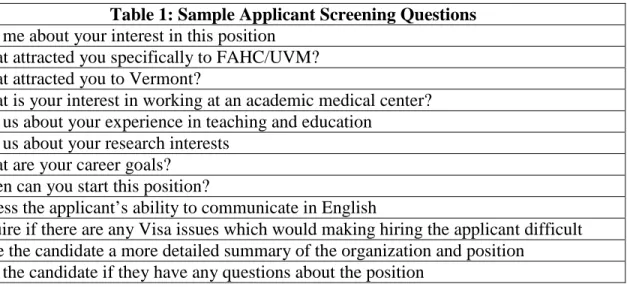
• Develop an evaluation template for phone screening the remaining applicants. Use the same questions for all candidates. Consider the following questions.
Table 1: Sample Applicant Screening Questions Tell me about your interest in this position
What attracted you specifically to FAHC/UVM? What attracted you to Vermont?
What is your interest in working at an academic medical center? Tell us about your experience in teaching and education
Tell us about your research interests What are your career goals?
When can you start this position?
Assess the applicant’s ability to communicate in English
Inquire if there are any Visa issues which would making hiring the applicant difficult Give the candidate a more detailed summary of the organization and position
Ask the candidate if they have any questions about the position
• Conduct phone screens. Phone screens should be completed either by the search committee chair or a person who understands position and can answer the applicant’s questions (i.e. the applicant may ask about the schedule, salary, etc). The workgroup recommends that the person completing the phone screening be an MD. In order to maintain consistency the workgroup recommends that the same MD do all of the phone screening, but more than one person may be required if the applicant pool is large. • At the end of the phone screen, the screener should document their overall impression of
the applicant, which they would then convey to the search committee along with the remainder of the screening evaluation template
• Review all phone screened candidates with the search committee. The workgroup recommends developing a rating system for the applicants. We favored a system that sorts the applicants into 3 groups: (A) move forward with site visit; (B) defer site visit upfront but consider interviewing later; (C) decline to offer a site visit
• Notify any applicants that do not merit a site visit
• Notify all applicants in groups A and B of their status and of the next steps that will need to be completed prior to offering them a site visit
• Complete the necessary UVM-COM steps to interview candidates in group A (see appendix B). These steps should be completed immediately and the progress should be followed closely via communication between the FAHC and UVM business managers or by the designed HR liaison
• While departments cannot schedule an interview until UVM-COM approval, the workgroup recommends that all high target applicants understand that they are being enthusiastically considered and that will be kept closely appraised as to their pending interview status. Remember that time kills all deals
Appendix C
Site visit planning guidelines
• Hotel arrangements scheduled either by the departmental FAHC business manager or HR liaison. The candidate may reserve anywhere from 1-3 nights, depending on their
particular circumstances.
• For an initial site visit, the workgroup recommends the Sheraton on Williston Road or Green Mountain Suites on Dorset Street. Both hotels give a FAHC rate. The Sheraton will also include a welcome basket for the applicant. A Bed and Breakfast is another option, if that happens to suite the candidate’s style.
• For a second site visit (which may be required for high-level positions) the workgroup recommends the Hilton in downtown Burlington or the Inn at Shelburne Farms. • Inquire prior to the site visit if the candidate would like assistance in arranging any
activities beyond the interview. The workgroup recommends specifically asking about a real estate tour, a visit to local schools or religious facilities, their dining preferences, and recreational activities such as outdoor sports or local events (i.e. Discover Jazz Festival). • Inquire if the candidate will be traveling with their spouse/partner/family. If so, they
should be included in the above activity plan.
• The workgroup recommends Coldwell-Banker as a real estate contact.
• Print material such as information on UVM-COM/FAHC can be mailed to the candidate before the interview or given to the candidate at the interview, depending on the
preference of the candidate.
• FAHC does employ a relocation director, Brenda Bouchard, who can be reached at 846-9560 or by e-mail: [email protected]
• Have the candidate provide you with a list of references and letters of recommendation prior to the interview. Letters of recommendation should be distributed to search
committee members and interviewers prior to the interview. References can be contacted by the search committee chair either before or after the interview.
Appendix D
Site visit itinerary guidelines
• Create an itinerary prior to the visit and e-mail it to the applicant for their review. This will give the applicant a chance to plan their day and to see who they will be meeting with, in case they would like to meet with someone who is not on their initial itinerary. • Be sure that everyone on the applicant’s itinerary is available to meet with the applicant
that day. Have a “Plan B” of alternative people lined up in case anyone on the initial itinerary suddenly becomes unavailable.
• Build in 15 minute “buffer times” into the day. This gives the candidate regular breaks (to use the restroom, etc) and allows extra time for interviews that begin late or run over their allotted time.
• Designate an official escort who will bring candidate from one meeting to the next. • Consider picking the candidate up from airport when they arrive in town. While this is
not always practical, it makes a great first impression.
• On the day of the interview, either pick the candidate up from the hotel or make
transportation arrangements for them. Do not leave it up to the candidate to make their own arrangements in getting to and from their hotel.
• Start the interview day with an icebreaker event. This is typically a casual meet-and-greet, often over coffee and a light breakfast, or perhaps over dinner the evening before. End the ice breaker event with a review of the day’s itinerary.
• Schedule formal slots with everyone who needs to meet and interview the candidate. While this will again vary widely with the position, consider not only department leaders and peers, but also physician colleagues in other departments, residents, nurses, and other ancillary staff. While not all search committee members need to participate in every interview, enough search committee members should participate so that they can adequately review the candidates.
• The workgroup did discuss sample interview questions but chose not to include them in the summary. They are available upon request.
• All candidates should have the opportunity to meet with an HR representative who can review the benefits package. The workgroup recommends using Meghan Fay-McCaffrey in Human Resources as resource (847-5797).
• Have a standard sample contract available for the candidate to review.
• Include a tour of hospital/practice site. The workgroup recommends that the tour be led by another physician who can then answer their questions and provide casual
introductions to colleagues, nurses, schedulers, etc.
• Conclude every interview with a closing or wrap up, which should typically be with the service director or Department Chair.