FEDERAL HIGHWAY ADMINISTRATION
INFORMATION-SHARING GUIDEBOOK
F
or
TRANSPORTATION MANAGEMENT
CENTERS, EMERGENCY OPERATIONS
CENTERS, AND FUSION CENTERS
NOTICE
This document is disseminated under the sponsorship of the department of transportation in the interest of information exchange. The United States Government assumes no liability for its contents or use thereof. This report does not constitute a standard, specification, or regulation.
The United States Government does not endorse products or manufacturers. Trade and manufacturers’ names appear in this report only because they are considered essential to the object of the document.
Technical Report Documentation Page 1. Report No.
FHWA-HOP-09-003
2. Government Accession No. 3. Recipient’s Catalog No. 4. Title and Subtitle
Information Sharing Guidebook for Transportation Management Centers, Emergency Operations Centers, and Fusion Centers
5. Report Date June 2010
6. Performing Organization Code 7. Author(s)
Nancy Houston, John Wiegmann, Robin Marshall, Ram Kandarpa, John Korsak, Craig Baldwin, Jeff Sangillo, Susan Knisely, Kevin Graham, Andrea Vann Easton
8. Performing Organization Report No.
9. Performing Organization Name and Address Booz Allen Hamilton
8283 Greensboro Drive McLean, Virginia 22102
HNTB Corporation
11414 West Park Place, Suite 300 Milwaukee, WI 53224
10. Work Unit No. (TRAIS)
11. Contract or Grant No. 12. Sponsoring Agency Name and Address
Federal Highway Administration, HOTO-1 U. S. Department of Transportation 1200 New Jersey Avenue SE Washington, D. C. 20590
13. Type of Report and Period Covered Final Report
14. Sponsoring Agency Code HOTO, FHWA
15. Supplementary Notes
Kimberly Vasconez, FHWA Team Leader, Emergency Transportation Operations, Contracting Officer’s Technical Representative (COTR)
16. Abstract
This guidebook provides an overview of the mission and functions of transportation management centers, emer-gency operations centers, and fusion centers. The guidebook focuses on the types of information these centers produce and manage and how the sharing of such information among the centers can be beneficial to both the day-to-day and emergency operations of all the centers. Challenges exist to the ability to share information, and the guidebook addresses these challenges and options for handling them. The guidebook also provides some les-sons learned and best practices identified from a literature search and interviews/site visits with center operators.
17. Key Words
Transportation Management Center, Traffic Management Center, Transportation Operations Center, Emergency Operations Center, Fusion Center
18. Distribution Statement No restrictions.
19. Security Classif. (of this report) Unclassified.
20. Security Classif. (of this page) Unclassified.
21. No. of Pages 144
22. Price
TABLE OF CONTENTS
Chapter 1. Introduction ... 1
1.1 The Information-Sharing Situation Today ... 3
1.2 The Potential Value of Sharing Transportation-Related Information ... 4
1.3 Guidebook Content ... 6
Chapter 2. Missions and Characteristics ... 7
2.1 Roles and Characteristics ... 7
2.2 Statistics, Locations, Jurisdictions ...11
2.3 Processes and Operations ...15
2.4 System Capabilities and Resources ...19
2.5 Information Managed and Exchanged ...24
2.6 Communications Links ...33
Chapter 3. Opportunities for Collaboration ... 37
3.1 Transportation-Related Information Managed/Used by TMCs ...39
3.2 Transportation-Relevant Information Managed/Used by EOCs ...56
3.3 Transportation-Relevant Information Managed/Used by FCs ...61
Chapter 4. Challenges and Options for Information Exchange ... 69
4.1 Center/Stakeholder Policies and Regulatory Issues ...69
4.2 Technical and Vulnerability Challenges ...76
4.3 General Options and Principles to Address the Challenges ...80
Chapter 5. Lessons Learned and Successful Practices ... 85
5.1 Lessons Learned ...85
5.2 Successful Practices ...89
5.3 TMCs, EOCs, and FCs Working Together ...96
Chapter 6. Summary – Assessing the Value of TMC/EOC/FC Information-Sharing ...101
Appendix A. References ...105
Appendix B. TMC and FC Locations ...109
Appendix C. FC Key Data Sources ...115
Appendix D. Funding and Responsibility Chart of U.S. DOT, U.S. DOJ, DHS/FEMA ..117
Appendix E. FC Interoperability Challenges ...123
Appendix F. Top Sites To Benefit From Collaboration ...125
Appendix G. Technical Considerations and Vulnerability Improvements ...129
LIST OF FIGURES
Figure 1-1: Centers’ Links ... 3
Figure 2-1: FC Intelligence Process...19
Figure 2-2: VEOC SITREP Extract ...29
Figure 3-1: Comparison of Typical TMC-EOC-FC Characteristics ...38
Figure 5-1: RISS Regional Centers ...93
Figure D-1: U.S. DOT, DHS, and U.S. DOJ Funding Diagram ... 119
LIST OF TABLES
Table 1-1: TMC Common Functional Areas ... 1Table 1-2: EOC Common Functional Areas... 2
Table 1-3: FC Common Functional Areas ... 2
Table 1-4: Common Information Types Across Centers ... 5
Table 2-1: Operations Management Center Descriptions ... 7
Table 2-2: FC Mission Areas ... 9
Table 2-3: FC Baseline Capabilities ...10
Table 2-4: Urban vs. Rural TMCs ...12
Table 2-5: Governmental Jurisdictions... 13
Table 2-6: EOC Categories ...14
Table 2-7: TMC Traffic Management ...16
Table 2-8: Illustrative EOC Functions and Processes ...17
Table 2-9: TMC Monitor Systems and Resources ...20
Table 2-10: TMC Inform Systems and Resources ...20
Table 2-11: TMC Control Systems and Resources ...21
Table 2-12: TMC Indirect Functions Systems and Resources ...22
Table 2-13: TMC Data Types and Sources ...25
Table 2-15: TMC Communications Summary ...34
Table 2-16: Available EOC Communications Capabilities ...35
Table 3-1: TMC Operational Information: Description and Potential Uses by EOCs and FCs ...39
Table 3-2: TMC Records and Logs Information: Description and Potential Uses by EOCs and FCs ...49
Table 3-3: TMC Physical Infrastructure Information: Description and Potential Uses by EOCs and FCs ...50
Table 3-4: EOC Situational/Operational Information: Description and Potential Uses by TMCs and FCs ...57
Table 3-5: EOC Records and Logged Information: Description and Potential Uses by TMCs and FCs ...60
Table 3-6: FC Operational Information: Description and Potential Uses by TMCs and FCs ...62
Table 5-1: Summary of Information-Sharing Methods by Surveyed Public Safety Entities....91
Table 5-2: Observed Best Practices for Emergency Integration ...97
Table B-1: FC and RIC Locations and Functions Supported ... 111
Table D-1: Primary Federal Funding Sources for TMCs, EOCs, and FCs ... 117
C
hapter
1.
INTRODUCTION
Transportation management centers (TMCs) exist in many large population and traffic con-centration areas across the country to manage and enhance the efficient operation, safety, and health of major metropolitan and regional transportation networks and corridors. TMCs perform a wide variety of transportation management functions, depending on the author-ity and capabilauthor-ity vested in the centers. Table 1-1 lists the most common TMC functional areas.
Table 1-1: TMC Common Functional Areas
TMC Common Functional Areas
Management of traffic control systems and assets Incident response and clearance functions Emergency response functions
Monitoring and surveillance of transportation network conditions Acquisition and communication of traffic information
The extent of the leading and supporting roles of TMCs in these functional areas varies depending on specific jurisdictional situations, incidents, or emergencies. TMCs are also sometimes referred to as traffic management centers or transportation or traffic operations centers (TOCs). While there is no standard definition for these terms, those referred to as
transportation rather than traffic may have a multi-modal focus—not just a roadway focus. Those centers referred to as operations rather than management centers may have a larger role in overall transportation operations, including incident management, through a more fully integrated team with law enforcement and other emergency responders as well as other proactive response functions such as operating a safety/service patrol.
Emergency operations centers (EOCs) exist in some form in virtually every State and local jurisdiction in the country. Their primary roles include management of and response to emergencies of all kinds that threaten or result in significant impact on public health and safety, infrastructure, commerce, and/or national security. EOCs typically are communica-tions centers and physical locacommunica-tions where responsible government officials, along with law enforcement, fire, emergency medical services (EMS), and infrastructure management authorities, gather to coordinate emergency response. EOCs usually define and tier coor-dination and leadership roles along jurisdictional lines, and full operations of these centers are “stood up” according to defined criteria for declaring emergency conditions.1 Table 1-2 lists the most common EOC functional areas.
1 Many EOCs continuously staff personnel to maintain preparedness and monitor alerts and developing condi-tions that may lead to declared emergencies. In emergencies, designated officials assemble and manage opera-tional decisions from or through the center.
Table 1-2: EOC Common Functional Areas
EOC Common Functional Areas
Communications management and coordination
Physical facility for assembly of responsible officials and staff
Emergency response decision-making and management of response functions Monitoring and surveillance of emergency situation and response activity
According to the Fusion Center Guidelines, a fusion center (FC) is a collaborative effort of two or more agencies that provide resources, expertise, and information to the center with the goal of maximizing their ability to detect, prevent, investigate, and respond to criminal and terrorist activity. Some forms of FCs address specific laws such as driver licensing, banking crime, or specific critical infrastructure elements. At the same time, some FCs also exist to synthesize information and focus on a much wider set of public safety and national security challenges (such as terrorism, major criminal activities, public health risks, major economic risks, critical infrastructure protection, and major natural hazards). Table 1-3 lists the most common FC functional areas.
Table 1-3: FC Common Functional Areas
FC Common Functional Areas
Aggregation and synthesis of safety and security-related information Assessment and reporting of safety and security threats
Monitoring and surveillance of critical infrastructure conditions
The three types of centers distinctly differ in their primary missions, and each center type acquires and processes information that is unique and may not be of common interest. However, significant actual and potential information exchange can benefit the cen-ters’ assessments, decision-making, and operations.
The potential benefits of TMC, EOC, and FC center-to-center information sharing are most apparent when addressing the centers’ common uses of various types of information about regional and local transportation networks. Categories of transportation information best suited for common use or exchange are those regarding configuration, operations status, and incidents on the transportation network. This guidebook addresses sharing2 of trans-portation information between centers and explores information-sharing logic, benefits, barriers, and solutions.
2 Many EOCs continuously staff personnel to maintain preparedness and monitor alerts and developing condi-tions that may lead to declared emergencies. In emergencies, designated officials assemble and manage opera-tional decisions from or through the center.
1.1 The Information-Sharing Situation Today
TMCs, EOCs, and FCs have established information-gathering and communications chan-nels that tap into external sources, as well as “owned” equipment and operations systems. They interconnect with partner agencies and with deployed assets (e.g., cameras, sensors, and control systems) via landline, wireless, and Internet links. Key external communica-tions links for TMCs and EOCs also include weather services, 911 centers, law enforcement dispatch systems (e.g., computer-aided dispatch [CAD] and similar systems), and the traffic reporting media.
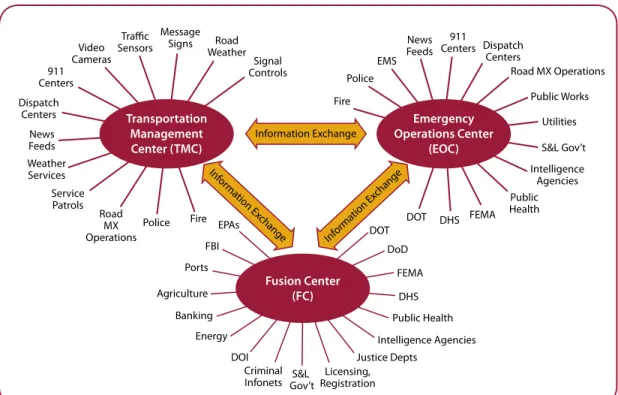
Communications links for the many variations of FCs are more difficult to characterize because they are very specific to the particular criminal, safety, or hazard focus of each center. FCs employ landline, wireless, and Internet links, and, where practical, integrated data systems. Often, the data and communication connections include law-enforcement-sensitive or classified information, so equipment for relaying information is specialized. Figure 1-1 characterizes the centers’ respective information sources, using linkages that are representative of the various centers researched.
Figure 1-1: Centers’ Links
Transportation Management Center (TMC) Fusion Center (FC) Traffic Sensors Message Signs Road Weather Video Cameras 911 Centers Dispatch Centers Weather Services Service Patrols Road MX Operations News Feeds Signal Controls Police Fire Emergency Operations Center (EOC) 911 Centers Dispatch Centers Road MX Operations News Feeds Police Fire EPAs Ports Agriculture Banking Energy DOI Criminal
Infonets Gov’tS&L RegistrationLicensing, Justice Depts FBI Utilities EMS S&L Gov’t Intelligence Agencies Intelligence Agencies Public Health Public Health FEMA FEMA DoD DOT DOT DHS DHS Information Exchange Information Ex change Information Ex change Public Works
Each EOC maintains seats and terminals dedicated for any local or regional agency that might be engaged in particular emergencies (e.g., police, fire, public works, transit, and intelligence agencies; EMS; TMCs; departments of transportation; and bridge, tunnel, and toll road authorities) and represents a functional area (e.g., transportation and mass care). Principal agencies involved in the specific FC missions jointly staff the FCs.
The trend in and importance of information sharing is on the rise today, as more resources have been invested in sophisticated intelligent transportation systems (ITS) and surveillance technologies, as major terrorist and natural emergencies have overstressed real-time com-munications, and as increasingly congested roadways lead to incidents that impede traffic flows and threaten lives and property. These incidents have clearly shown the high public costs of information gaps, preparedness deficiencies, and insufficient situational awareness by decision-makers.
While many kinds of information sharing can be logical and useful for TMC, EOC, and FC missions, achieving the sharing of information can require significant dedication and invest-ment in the proposition. Legitimate and significant technical and policy barriers to infor-mation exchange can come into play and must be resolved. This guidebook explores the following hurdles:
• Legal and privacy concerns related to surveillance and traveler information • Control and security of criminal and potentially litigious information • Prudent and appropriate release of information to the public domain
• Varying levels of concern between centers over security, reliability, and sustainability of specific information flows
• “Language” complexities, including data and message standards, geo-referencing systems, usage conventions
• Technical barriers in linking together legacy media, hardware, and systems (e.g., digital video feeds and multiple wireless standards and frequencies)
• Specific policies and mandates of participating agencies—regarding ownership of resources, mission priorities, and logical and physical access restrictions.
The communication and information-sharing barriers are classic problems—both compli-cated and frequently addressed by policy-makers and practitioners with irony and resig-nation. As the challenges that TMCs, EOCs, and FCs face continue to grow more complex, policy practices are becoming more sophisticated and improved technologies are facilitat-ing better ways to gather, process, properly synthesize, and share information.
1.2 The Potential Value of Sharing Transportation-Related
Information
TMCs, EOCs, and FCs similarly gather, process, and synthesize at least three basic kinds of information to make operational decisions or reach conclusions on actions needed: • Operational Information (Situational) – Critical for making fast and informed
operational decisions and for communicating accurate alerts and notifications on incidents, threats, and emergencies
• Recorded Information – Basis for operational assessments, investigation, planning, and after-action reporting
• Physical Infrastructure Information – Framework for setting and communicating priorities, determining risks, and deploying field resources.
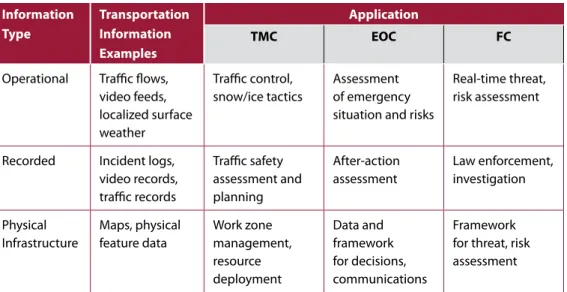
Table 1-4 presents these common information types and potential value to centers, charac-terized by transportation network examples.
Table 1-4: Common Information Types Across Centers
Information Type Transportation Information Examples Application TMC EOC FC
Operational Traffic flows, video feeds, localized surface weather Traffic control, snow/ice tactics Assessment of emergency situation and risks
Real-time threat, risk assessment
Recorded Incident logs, video records, traffic records Traffic safety assessment and planning After-action assessment Law enforcement, investigation Physical Infrastructure Maps, physical feature data Work zone management, resource deployment Data and framework for decisions, communications Framework for threat, risk assessment
Information handled by EOCs can assist and enhance fulfillment of TMC and FC missions. Most of the information handled by EOCs during incident operations falls in the real-time category—in the form of alerts and notifications and advance indications of needs for trans-portation support from the transtrans-portation representatives at the EOC. Those transtrans-portation representatives at the EOC will need to maintain contact with their TMC, if not co-located, to ensure they keep the EOC up to date on traffic conditions and other such real-time situ-ational information that can be supplied by the TMCs. Information coordinated by EOCs during and after emergency operations may also assist some FCs in their investigative and threat assessment roles.
Advanced FC information on threat assessment and critical infrastructure vulnerabilities would also assist TMCs and EOCs in planning and managing emergency preparedness, response, and recovery operations as well as inform potential future investments in trans-portation infrastructure.
Over the next 10 years, traffic and congestion challenges will continue to build rapidly in urban areas. Transportation managers will likely deploy more advanced traffic management and tolling technologies, and will no doubt integrate more multi-modal operations data to provide a more robust picture of the total transportation network in a region. Vehicle Infrastructure Integration (VII) or IntelliDriveSM initiatives will ultimately lead to more proac-tive control3 systems for transportation movements during emergencies. This evolution will likely enable TMCs to share more comprehensive “situational awareness” information to 3 Enabled by navigation systems, roadside dedicated short-range communications (DSRC), vehicle location, and speed data.
enhance EOC and FC operations. More fully integrated EOC voice and data communications systems will enable these centers to better and more quickly leverage outside information sources.
1.3 Guidebook Content
The purpose of this guidebook is to explore the possibilities, challenges, and logical ben-efits for increased information sharing between TMCs, EOCs, and FCs. The intent is to inter-est center managers and operators in new collaborative initiatives that may not have been considered and to provide information that may assist interested practitioners and policy-makers in pursuing those new initiatives.
The remainder of the guidebook includes the following chapters:
• Chapter 2. Missions and Characteristics – Describes the TMC, EOC, and FC characteristics, functions, and information handled
• Chapter 3. Opportunities for Collaboration – Describes the information exchange opportunities
• Chapter 4. Challenges and Options for Information Exchange – Describes the technical and policy challenges
• Chapter 5. Lessons Learned and Successful Practices – Provides lessons learned in practice
• Chapter 6. Summary – Assessing the Value of TMC/EOC/FC Information-Sharing.
California State Emergency Operations Center
California Emer genc y Management A genc y P repar edness D ivision
C
hapter
2.
MISSIONS AND CHARACTERISTICS
This chapter provides the current footprint, mission statement, and operational perspec-tives for TMCs, EOCs, and FCs. It also defines the following for each type of center: • Roles and characteristics• Statistics, locations, and jurisdictions • Processes and operations
• System capabilities and resources • Information managed and exchanged • Communications links.
2.1 Roles and Characteristics
The roles and characteristics of TMCs, EOCs, and FCs are distinctive yet related in many areas of responsibilities and incident management. Table 2-1 provides descriptions of TMCs, EOCs, and FCs, as defined by various relevant institutions.
Table 2-1: Operations Management Center Descriptions
Type of Center Description
Transportation Management Center
The Institute of Transportation Studies at the University of California-Berkley summarized the mission of a TMC as “the hub of a transportation management system, where information about the transportation network is collected and combined with other operational and control data to manage the transportation network and to produce traveler information. It is the focal point for communicating transportation-related information to the media and the motoring public, a place where agencies can coordinate their responses to transportation situations and conditions. The TMC links various elements of Intelligent Transportation Systems such as variable message signs, closed circuit video equipment, roadside count stations, etc., enabling decision makers to identify and react to an incident in a timely manner based on real-time data.”
Type of Center Description
Emergency Operations Center
The National Incident Management System4 defines EOCs as “The physical location at which the coordination of information and resources to support domestic incident management activities normally takes place. An EOC may be a temporary facility or may be located in a more central or permanently established facility, perhaps at a higher level of organization within a jurisdiction. EOCs may be organized by major functional disciplines (e.g., fire, law enforcement, and medical services), by jurisdiction (e.g., Federal, State, regional, county, city, tribal), or some combination thereof.”5
Fusion Center The Fusion Center Guidelines developed by the U.S. Department of Justice and U.S. Department of Homeland Security define an FC as “a collaborative effort of two or more agencies that provide resources, expertise, and information to the center with the goal of maximizing their ability to detect, prevent, investigate, and respond to criminal and terrorist activity.”6 The core function of a fusion center is the intelligence process. Simply stated, the “intelligence process” (or cycle) is an organized process by which information is gathered, assessed, and distributed.
2.1.1. TMC.Overview
TMCs are responsible for a variety of functions to improve traffic conditions on transpor-tation infrastructure, including highways, arterials, and transit, to increase efficiency and safety. In addition to personnel, ITS technologies located at the TMC and embedded in the infrastructure support TMC functions, some serving to support multiple functions. ITS rep-resents an additional area of core functionality of TMC operations. To make these improve-ments in line with long-term strategic planning, regional TMCs implement ITS, which are used to monitor and control traffic. However, each region faces different transportation issues, including variations in geography, congestion issues, and incidents. Current plan-ning for TMCs envisions their use as dispatch centers for local, regional, and State transpor-tation assets, such as safety/service patrols and road maintenance efforts, leading to a more operational role. Some TMCs and TOCs already function in these capacities.
2.1.2. EOC.Overview
EOCs coordinate information and resources to support domestic incident management activities. EOCs generally participate in both preparing for and responding to such inci-dents. For example, an EOC may support the evacuation of a community threatened by an incident such as a hazardous materials release or wildfire threat; response operations during a hurricane, tornado, or earthquake; and recovery activities following a flood, terrorist, or other malicious incident.
4 On February 28, 2003, the President issued Homeland Security Presidential Directive (HSPD)–5, Management of Domestic Incidents, which directs the Secretary of Homeland Security to develop and administer a National Incident Management System (NIMS). This system provides a consistent nationwide template to enable Federal, State, local, and tribal governments and private-sector and nongovernmental organizations to work together effectively and efficiently to prepare for, prevent, respond to, and recover from domestic incidents, regardless of cause, size, or complexity, including acts of catastrophic terrorism.
5 U.S. Department of Homeland Security, National Incident Management System, March 1, 2004. Page 129. 6 U.S. Department of Homeland Security and U.S. Department of Justice, Fusion Center Guidelines.
As noted in Section 2.1, the National Incident Management System (NIMS) definition recog-nizes that implementation of these centers may occur in a variety of ways based on several parameters, including:
• Persistence – Some operate on a continuous basis. Others are activated only in response to an incident; once the incident has been resolved, they are de-activated.
• Functional Discipline – In some implementations, an EOC may address a single functional discipline (e.g., law enforcement or medical services). In others, an EOC may address any combination of functional disciplines.
• Jurisdiction – EOCs may function at the Federal, State, regional, county, city, or tribal jurisdictional levels.
A combination of the persistence, functional, and jurisdictional parameters provides the basis for the implementation of a particular EOC. As with an EOC’s operating status (e.g., incident-driven or standing) or organization, the resources available to an EOC directly reflect the community’s particular needs and investment in emergency operations. Regardless of how an EOC is implemented, a functional transportation infrastructure (and current information on the condition of that infrastructure) is critical to the EOC’s ability to accomplish its mission of facilitating the community’s preparation for, response to, and recovery from adverse incidents.
2.1.3. FC.Overview
The formation of FCs resulted from the events of September 11, 2001, and the need, identified by the 9-11 Commission, to close the information-sharing gaps that have existed between the Federal government and States, primarily in the areas of homeland security and law enforcement. Missions among FCs vary and include, but are not limited to, three main areas—all-crimes, all-hazards, and counterterrorism, as presented in Table 2-2.
Table 2-2: FC Mission Areas
All Crimes Any crime or investigative support related to a single criminal act or larger
criminal enterprises and organized or destabilizing crimes (e.g., drug trade, gangs, terrorism, and organized crime).
All Hazards Identifying and prioritizing types of major disasters and emergencies,
beyond terrorism and crime that could occur within their jurisdiction. For this approach, fusion centers gather, analyze, and disseminate information that would assist the relevant responsible agencies (law enforcement, fire, public health, emergency management, critical infrastructure, etc.) with the prevention, protection, response, or recovery efforts of those incidents.7
Counterterrorism Practice, tactics, techniques, and strategies adopted to prevent or mitigate
specific terrorist acts.
7 Federal Emergency Management Agency, Draft Comprehensive Preparedness Guide 502: Considerations for Fusion Center and Emergency Operations Center Coordination, 2009, page 14.
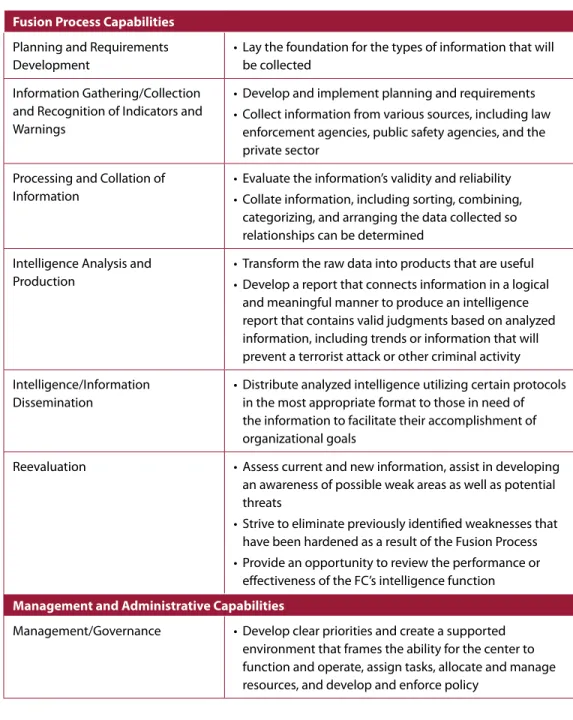
The Baseline Capabilities for State and Major Urban Area Fusion Centers outlines the major functional, management, and administrative capabilities of FCs. Fusion process capabilities outline the standards necessary to perform the steps of the Intelligence Process within an FC. Management and administrative capabilities enable the proper management and func-tioning of an FC. Table 2-3 shows the specific capabilities for each type.8
Table 2-3: FC Baseline Capabilities
Fusion Process Capabilities
Planning and Requirements Development
• Lay the foundation for the types of information that will be collected
Information Gathering/Collection and Recognition of Indicators and Warnings
• Develop and implement planning and requirements • Collect information from various sources, including law
enforcement agencies, public safety agencies, and the private sector
Processing and Collation of Information
• Evaluate the information’s validity and reliability • Collate information, including sorting, combining,
categorizing, and arranging the data collected so relationships can be determined
Intelligence Analysis and Production
• Transform the raw data into products that are useful • Develop a report that connects information in a logical
and meaningful manner to produce an intelligence report that contains valid judgments based on analyzed information, including trends or information that will prevent a terrorist attack or other criminal activity Intelligence/Information
Dissemination
• Distribute analyzed intelligence utilizing certain protocols in the most appropriate format to those in need of the information to facilitate their accomplishment of organizational goals
Reevaluation • Assess current and new information, assist in developing an awareness of possible weak areas as well as potential threats
• Strive to eliminate previously identified weaknesses that have been hardened as a result of the Fusion Process • Provide an opportunity to review the performance or
effectiveness of the FC’s intelligence function
Management and Administrative Capabilities
Management/Governance • Develop clear priorities and create a supported environment that frames the ability for the center to function and operate, assign tasks, allocate and manage resources, and develop and enforce policy
8 U.S. Department of Justice, Baseline Capabilities for State and Major Urban Area Fusion Centers: A Supplement to the Fusion Center Guidelines, September 2008.
Information Privacy Protections • Develop, publish, and adhere to a privacy and civil liberties policy
• Protect the rights of Americans throughout information-sharing efforts
• Balance information sharing with privacy at all levels of government, in order to maintain the trust of the American people
Security • Ensure appropriate security measures are in place for the facility, data, and personnel
Personnel and Training • Achieve a diversified representation of personnel based on the needs and functions of the center
Information Technology/ Communications Infrastructure, Systems, Equipment, Facility, and Physical Infrastructure
• Integrate technology, systems, and people
Funding • Establish and maintain the center based on funding availability and sustainability
According to the Government Accountability Office (GAO), the most frequently cited reason for establishing an FC was the need to share information among Federal, State, and local entities. At the State and local level, the enhancement of information sharing within their own jurisdictions and across the various disciplines was another reason for the establish-ment of centers.9 The inability for coordination and information sharing at these two levels resulted in a failure to “connect the dots” prior to September 11, 2001. Today, FCs consider themselves force multipliers to, and a support structure for, existing EOCs, which have the main responsibility of response during large-scale incidents and disasters, either man-made or natural.10 Because some incidents may have components that are law enforcement or security sensitive, some EOCs have taken extra steps to ensure they have people on staff with appropriate clearances to review such information. They may also have developed methods for handling such data such as a secure communications system and designating a part of their facility to meet the National Security Agency’s requirements of a Sensitive Compartmented Information Facility (SCIF).
2.2 Statistics, Locations, Jurisdictions
Each type of center manages a distinctive footprint in terms of size, geographic area, popu-lation served, and physical characteristics. This section defines the census and geographic distribution of each center and categorizes the types and jurisdictions of the various centers.
9 U.S. Department of Homeland Security, National Incident Management System, March 1, 2004, page 129. 10 Government Accountability Office, Homeland Security: Federal Efforts are Helping to Address Some Challenges Faced by State and Local Fusion Centers, April 2007.
2.2.1. TMCs
TMCs are regional information management centers that gather and maintain transpor-tation-related data. Across the United States, over 100 TMCs currently leverage their ITS resources to monitor, inform, and control drivers in a localized region. Each center has unique applications, resources, size, and functionality. State departments of transportation (DOTs), county and city governments, or other municipalities, often collaborating with other agencies and each center, can fund and operate such centers.
The TMC footprint can be categorized primarily by urban or rural geographies. A variety of sources identified at least 85 TMCS as operating in metropolitan areas. In 2004, there were 50 additional TMCs providing a range of transportation-related services in statewide/rural capacity.11 Table 2-4 defines the distinctions in these types of TMCs. It is also important to note that TMCs can be virtual in nature.
Table 2-4: Urban vs. Rural TMCs
Urban Urban TMCs often focus on freeways and traffic signal management and possibly
transit operations integration, with their key function revolving around the detection, response, and management of traffic incidents to keep traffic moving. They are frequently larger in size and more developed because of their substantial resources and funding. Because they have been operating longer, they have had the opportunity to establish working relationships with other agencies, including taking advantage of co-located facilities. Staff and management at urban TMCs often have specific job categories and responsibilities. Many TMCs in larger urban areas are integrating CAD and liaisons with local law enforcement to become immediately aware of police dispatches to an incident scene on a highway.
Rural Rural TMCs are often much smaller and have fewer resources accessible to them, even
though they are often responsible for a wider geographic area. Without an expansive ITS infrastructure, they focus on emergency services and rural transit service. Their smaller size results in a smaller, less-specialized staff and managers.
As each region faces different transportation issues, TMCs’ mission and goals correlate to the needs of a local region. TMCs do not typically exist in more rural areas or on tribal lands due to the lack of traffic congestion and a lack of technology resources such as fiber optic networks by which to share data and information. Some states, such as New Mexico, coordi-nate with tribal lands on ITS projects. TMCs may serve larger geographic boundaries includ-ing cities and metropolitan areas, regions, municipalities, or States. Appendix B provides a listing of major TMCs.
2.2.2. EOCs
EOCs are the “front line” of incident response. By necessity, their reach must extend suffi-ciently to provide an immediate response to the affected areas within their jurisdictions. At least one EOC covers a jurisdiction, with smaller jurisdictions most likely sharing an EOC and larger jurisdictions having multiple EOCs. Tribal lands may also have EOCs that are eligible 11 U.S. Department of Transportation, ITS Deployment Statistics, 2004, http://www.itsdeployment.its.dot.gov, accessed 2010.
for funding through the DHS. In the case of a small or sparsely populated State, the State EOC may cover every jurisdiction (cities, counties, or other jurisdictional entities) within that State. In contrast, a densely populated State with densely populated cities may have other EOCs in addition to the State EOC.
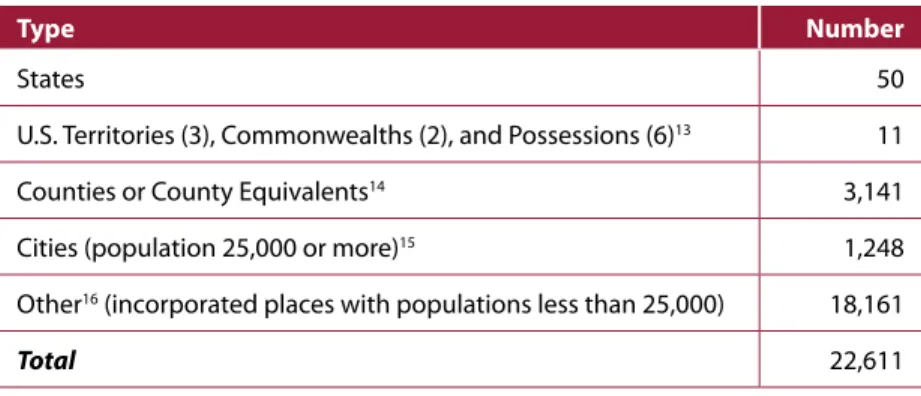
Every jurisdiction is covered by an EOC (or a combination of EOCs) that addresses the full array of functional disciplines. For example, a small city may not have its own EOC; however, it may have a fire station that fulfills the EOC function for response to a limited type of inci-dent (e.g., fires and similar emergencies within the jurisdiction), with other functional disci-plines being covered by a shared EOC (e.g., a county, State, or regional EOC that responds to hurricanes, floods, and earthquakes across the broader jurisdiction). Table 2-5 illustrates the various types and numbers of governmental jurisdictions across the United States and its territories, commonwealths, and possessions.
Table 2-5: Governmental Jurisdictions12
Type Number
States 50
U.S. Territories (3), Commonwealths (2), and Possessions (6)13 11 Counties or County Equivalents14 3,141 Cities (population 25,000 or more)15 1,248 Other16 (incorporated places with populations less than 25,000) 18,161
Total 22,611
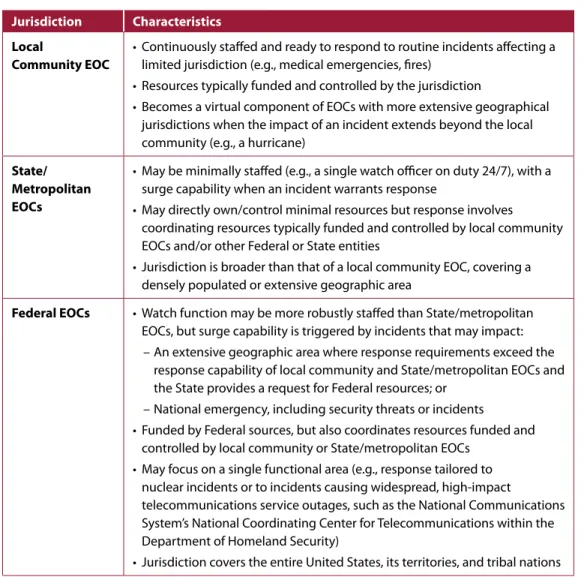
EOCs fall into three general geographic footprints, as presented in Table 2-6.
12 U.S. Census Bureau, County and City Data Book, 2007,
http://www.census.gov/prod/2008pubs/07ccdb/ccdb-07.pdf, accessed 2010.
13 R.G. Price, “Territories, Possessions, and Influenced Areas of the United States of America,” 2003, http://rationalrevolution.net/articles/territories.htm, accessed 2010.
14 The primary political divisions of most States are termed ‘‘counties.’’ In Louisiana, these divisions are known as ‘‘parishes.’’ In Alaska, which has no counties, the county equivalents are the organized ‘‘boroughs’’ and the ‘‘census areas’’ that are delineated for statistical purposes by the State of Alaska and the U.S. Census Bureau. In four States (Maryland, Missouri, Nevada, and Virginia), there are one or more cities that are independent of any county organi-zation and, thus, constitute primary divisions of their States. These cities are known as ‘‘independent cities’’ and are treated as equivalent to counties for statistical purposes. The District of Columbia has no primary divisions, and the entire area is considered equivalent to a county for statistical purposes [County and City Data Book, 2007].
15 The term ‘‘city’’ refers to incorporated places with a 2000 population of 25,000 or more [County and City Data Book, 2007]. The number of cities was obtained from the 2002 Census of Governments, Volume 1, Number 1, Government Organization, DC: U.S. Department of Commerce, Bureau of the Census, as provided by the National League of Cities [http://www.nlc.org/about_cities/cities101.aspx].
16 The number of incorporated places with a 2000 population of under 25,000 was obtained from the 2002 Census of Governments, Volume 1, Number 1, Government Organization, DC: U.S. Department of Commerce, Bureau of the Census, as provided by the National League of Cities [http://www.nlc.org/about_cities/cities101.aspx].
Table 2-6: EOC Categories
Jurisdiction Characteristics
Local
Community EOC
• Continuously staffed and ready to respond to routine incidents affecting a limited jurisdiction (e.g., medical emergencies, fires)
• Resources typically funded and controlled by the jurisdiction
• Becomes a virtual component of EOCs with more extensive geographical jurisdictions when the impact of an incident extends beyond the local community (e.g., a hurricane)
State/ Metropolitan EOCs
• May be minimally staffed (e.g., a single watch officer on duty 24/7), with a surge capability when an incident warrants response
• May directly own/control minimal resources but response involves coordinating resources typically funded and controlled by local community EOCs and/or other Federal or State entities
• Jurisdiction is broader than that of a local community EOC, covering a densely populated or extensive geographic area
Federal EOCs • Watch function may be more robustly staffed than State/metropolitan EOCs, but surge capability is triggered by incidents that may impact: – An extensive geographic area where response requirements exceed the
response capability of local community and State/metropolitan EOCs and the State provides a request for Federal resources; or
– National emergency, including security threats or incidents
• Funded by Federal sources, but also coordinates resources funded and controlled by local community or State/metropolitan EOCs
• May focus on a single functional area (e.g., response tailored to nuclear incidents or to incidents causing widespread, high-impact
telecommunications service outages, such as the National Communications System’s National Coordinating Center for Telecommunications within the Department of Homeland Security)
• Jurisdiction covers the entire United States, its territories, and tribal nations
In addition to these State and local EOCs, there are also EOCs at the Federal level including the National Response Coordination Center (NRCC) at the Federal Emergency Management Agency (FEMA). According to the National Response Framework (NRF), the NRCC is a multi-agency center that provides overall Federal response coordination for Incidents of National Significance and emergency management program implementation. In addition, the NRF envisions Federal-level EOCs being established when a large-scale incident requires the establishment of such a temporary EOC to manage the response activities.
2.2.3. FCs
Research suggests that there are significant differences among FCs and that, heretofore, there was no “one-size-fits-all” model, despite the issuance of the FC guidelines in January 2008 by the U.S. Department of Justice (DOJ) and U.S. Department of Homeland Security (DHS). The Baseline Capabilities for State and Major Urban Area Fusion Centers document released in September 2008 provides supplemental guidance to the centers on standard-ized capabilities. As of July 2009, DHS and DOJ recognize 72 FCs nationwide, and the DHS
Office of Intelligence and Analysis (I&A) has deployed over 36 intelligence operations specialists to the FCs to facilitate the two-way sharing of information and intelligence and to bridge the gap in information sharing among Federal, State, local, territorial, and tribal levels of government.17 In September 2009, DHS Secretary Janet Napolitano announced a realignment of I&A to create a new Joint Fusion Center Program Management Office (JFC-PMO) to strengthen DHS cooperation with FCs.18Appendix B provides a partial list of these centers and the functions they support.
The level of Federal, State, and local participation varies from FC to FC. The jurisdiction of an FC is limited only by the State or region that it serves. Jurisdictional cooperation between State FCs or between State FCs and Regional Intelligence Centers (RICs) provides an oppor-tunity for information sharing to a level only imagined a decade ago. RICs are defined as “multi-jurisdictional centers cooperatively developed within a logical geographical area that coordinate Federal, State, and local law enforcement information with other information sources to track and assess criminal and terrorist threats that are operating in or interacting with the region.”19 Statistically, law enforcement agencies lead the day-to-day operations of most FCs. Of those law enforcement entities involved in FC operations, State police are often cited as the main organization spearheading their efforts. However, since FCs vary in location and mission, the lines that determine a lead agency are not as clear as the desire for participating agencies to be partners in their mission.
2.3 Processes and Operations
This section provides insights into the day-to-day functions, processes, and operations as well as emergency modes across TMCs, EOCs, and FCs.
2.3.1. TMCs
Generally, full-scale TMC operations focus on four primary function classifications: • Monitor: Monitoring transportation infrastructure for traffic incidents/conditions • Inform: Disseminating information to the public and relevant agencies
• Control: Controlling and managing traffic including optimization of available infrastructure and assets, such as safety/service patrols, to decrease congestion and mitigate incidents
• Indirect: Managing overhead activities for the TMC.
17 See U.S. Department of Homeland Security, State and Local Fusion Centers, http://www.dhs.gov/files/programs/gc_1156877184684.shtm, accessed 2010.
18 See Testimony of Secretary Napolitano before the Senate Committee on Homeland Security and Governmental Affairs, “Eight Years after 9/11: Confronting the Terrorist Threat to the Homeland” (Written Testimony), September 30, 2009, http://www.dhs.gov/ynews/testimony/testimony_1254321524430.shtm, accessed 2010.
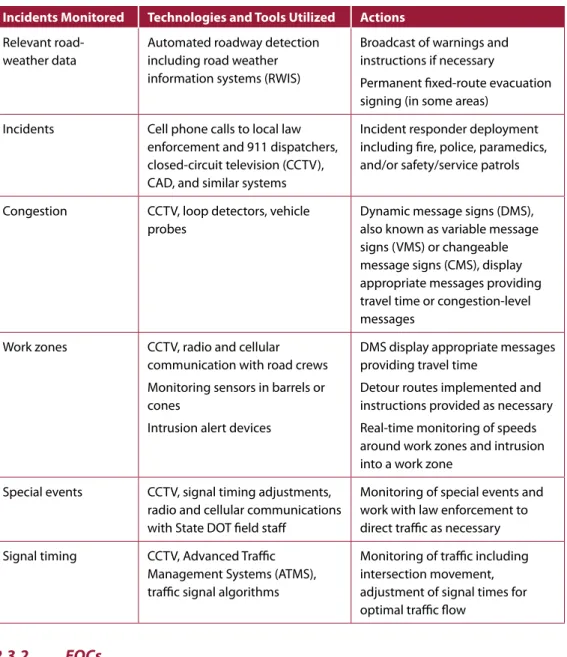
Across TMCs, these functions vary in terms of the extent to which and how they provide these services. Table 2-7 presents aspects of the incidents monitored, systems leveraged, and processes and operations of the TMC, revolving around the four primary functions.
Table 2-7: TMC Traffic Management
Incidents Monitored Technologies and Tools Utilized Actions
Relevant road-weather data
Automated roadway detection including road weather information systems (RWIS)
Broadcast of warnings and instructions if necessary
Permanent fixed-route evacuation signing (in some areas)
Incidents Cell phone calls to local law enforcement and 911 dispatchers, closed-circuit television (CCTV), CAD, and similar systems
Incident responder deployment including fire, police, paramedics, and/or safety/service patrols Congestion CCTV, loop detectors, vehicle
probes
Dynamic message signs (DMS), also known as variable message signs (VMS) or changeable message signs (CMS), display appropriate messages providing travel time or congestion-level messages
Work zones CCTV, radio and cellular communication with road crews Monitoring sensors in barrels or cones
Intrusion alert devices
DMS display appropriate messages providing travel time
Detour routes implemented and instructions provided as necessary Real-time monitoring of speeds around work zones and intrusion into a work zone
Special events CCTV, signal timing adjustments, radio and cellular communications with State DOT field staff
Monitoring of special events and work with law enforcement to direct traffic as necessary Signal timing CCTV, Advanced Traffic
Management Systems (ATMS), traffic signal algorithms
Monitoring of traffic including intersection movement, adjustment of signal times for optimal traffic flow
2.3.2. EOCs
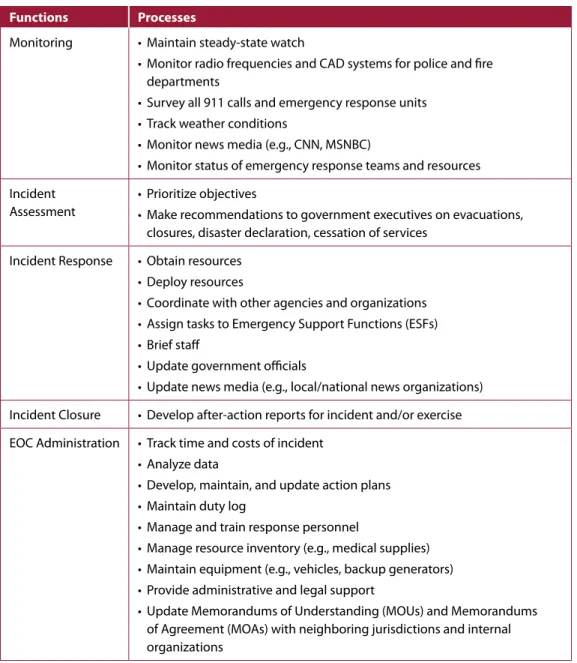
At the most fundamental level, EOCs perform five primary functions and one administra-tive function—monitoring the jurisdiction, receiving notification of an incident affecting the jurisdiction, assessing the incident to determine the appropriate response, responding to the incident, closing out the incident, and administering the organization. The jurisdic-tion’s emergency management plan defines who operates the EOC and how it is operated. At the Federal level, the NRF serves this purpose. EOCs are often organized around opera-tions, planning, logistics, finance, and administrative departments—key Incident Command
System (ICS) organizational elements—to fulfill the basic EOC functions. EOCs establish processes required to fulfill the five primary EOC functions and document the processes in standard operating procedures (SOPs). The SOPs define how the operations, planning, logis-tics, finance, and administration components interact and how the EOC as a whole works with external entities (e.g., Federal, State, and local government entities and the private sector). Table 2-8 provides a sample of the processes defined by the EOC SOPs and the EOC functions with which these processes are associated.
Table 2-8: Illustrative EOC Functions and Processes
Functions Processes
Monitoring • Maintain steady-state watch
• Monitor radio frequencies and CAD systems for police and fire departments
• Survey all 911 calls and emergency response units • Track weather conditions
• Monitor news media (e.g., CNN, MSNBC)
• Monitor status of emergency response teams and resources Incident
Assessment
• Prioritize objectives
• Make recommendations to government executives on evacuations, closures, disaster declaration, cessation of services
Incident Response • Obtain resources • Deploy resources
• Coordinate with other agencies and organizations • Assign tasks to Emergency Support Functions (ESFs) • Brief staff
• Update government officials
• Update news media (e.g., local/national news organizations) Incident Closure • Develop after-action reports for incident and/or exercise EOC Administration • Track time and costs of incident
• Analyze data
• Develop, maintain, and update action plans • Maintain duty log
• Manage and train response personnel
• Manage resource inventory (e.g., medical supplies) • Maintain equipment (e.g., vehicles, backup generators) • Provide administrative and legal support
• Update Memorandums of Understanding (MOUs) and Memorandums of Agreement (MOAs) with neighboring jurisdictions and internal organizations
Note that, particularly in more widespread, complex incidents, these functions may be itera-tive and overlapping, rather than sequential and discrete. This is particularly the case with the monitoring, assessment, and response functions. Further, EOCs work closely with local
community resources frequently to manage incidents. The community owns monitoring and response resources and assets, which may include:
• E-911 call centers
• Local law enforcement agencies (to include law enforcement personnel, facilities, vehicles, etc.)
• Fire stations (to include firefighters, associated EMS personnel, facilities, and specialized vehicles such as ambulances).
However, EOCs with more extensive jurisdictions may own some facilities and have a few key staff, but they usually coordinate the monitoring and response resources rather than own them. EOCs are dynamic organizations depending on their operating status. During the watch or monitoring stage, the operating staff is minimal. During a full-scale operation, EOCs house representatives from multiple agencies and organizations ranging from execu-tive government officials to volunteer organization coordinators.
In contrast with the local community-level response entities, whose fire departments, law enforcement agencies, and medical organizations are in continuous operation, EOCs with more extensive jurisdictions typically have a small core staff on duty until an incident occurs that requires activating the EOC’s full capabilities. In some cases, “core staff” may be limited to having a single watch officer on duty on a 24/7 basis.
2.3.3. FCs
FC guidelines state that the principal role of the FC is to compile, analyze, and disseminate criminal and terrorist information and intelligence and other information to support efforts to anticipate, identify, prevent, and/or monitor criminal and terrorist activity.20 FCs lever-age all information and intelligence to rapidly identify patterns and trends that may reflect emerging threats. The primary functions and goals for FCs, as defined by the guidelines, are to:
• Rapidly identify emerging threats
• Support multidisciplinary, proactive, and community-focused problem-solving activities • Support predictive analysis capabilities
• Improve the delivery of emergency and non-emergency services.
Of these activities, the primary function of an FC is to gather and analyze data, resulting in a finished, timely, credible, and actionable product that is useable in the decision-making process.
When a threat is identified, FCs gather and exchange information from all sources for analy-sis with the appropriate official from the local, State, tribal, or Federal government agency represented at that FC, based upon the threat. While law enforcement or homeland security sources and databases or portals provide nearly all intelligence and information that FCs 20 Fusion Center Guidelines: Developing and Sharing Information and Intelligence in a New Era, January 2008.
collect, agencies external to law enforcement, such as transportation agencies, fire depart-ments, private sector, and public health entities, may also provide critical information to formulate a comprehensive analysis.21 Depending on the nature of the threat, the FCs may share this threat information with DHS and, when terrorism related, coordinate with Joint Terrorism Task Forces (JTTFs) that exist in 100 cities nationwide including the Federal Bureau of Investigation’s (FBI’s) 56 field offices.
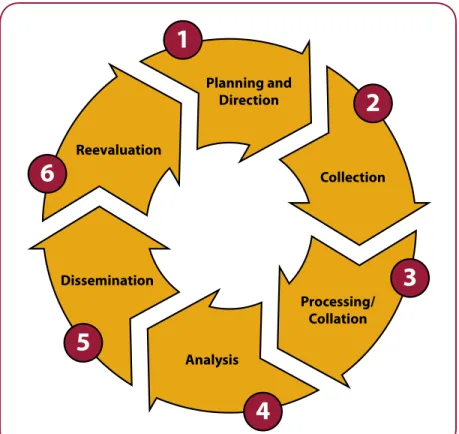
The local, State, tribal, or Federal government representative that will be taking action against the threat stores the products produced by an FC, based on the specific threat. Storing of that product is done in accordance with any FC and/or department policy, to include local, State, and Federal classified information requirements and privacy laws.22 Figure 2-1 illustrates the FC intelligence process.
Figure 2-1: FC Intelligence Process23
Reevaluation Planning and Direction Processing/ Collation Collection Analysis Dissemination
6
1
2
3
4
5
2.4 System Capabilities and Resources
Defining the systems capabilities and resources for TMCs, EOCs, and FCs is a key element to understanding the opportunities for collaboration across these entities. This section sum-21 Fusion Center Guidelines: Developing and Sharing Information and Intelligence in a New Era, January 2008. 22 Ibid.
23 Source: U.S. Department of Justice, The National Criminal Intelligence Sharing Plan, October 2003. http://it.ojp.gov/documents/NCISP_Plan.pdf, accessed 2010.
marizes the resources and systems that enable each center to fulfill its core functions and processes as defined in previous sections.
2.4.1. TMCs
TMCs maintain specific resources and systems to enable the fulfillment of their four primary functions. Monitoring arterial and freeway traffic is one of the primary functions of TMCs. Only with situational awareness of local conditions can TMC managers make decisions on how to increase transportation safety and throughput. ITS applications that are installed in the transportation infrastructure, including traffic sensor systems to monitor traffic condi-tions perform much of the surveillance and detection of traffic condicondi-tions.
In addition to monitoring transportation infrastructure for traffic management functions, the same surveillance and detection technologies can be used to monitor the infrastructure safety and security of transportation infrastructure. Table 2-9 provides examples of monitor-ing systems.
Table 2-9: TMC Monitor Systems and Resources
Description Systems/Resources
Monitor Traffic Loop, acoustic, radar, and video imaging detectors and control, CCTV, IntelliDriveSM, on-board equipment (OBE), wide-area wireless communications between the vehicle and center, dedicated short-range communications (DSRC) between passing vehicles and the roadside, probe data (cellular, Global Positioning System [GPS], toll transponders), police reports (incidents and congestion)
Monitor Safety and Security
In-vehicle and facility surveillance, employee credentialing, remote video systems, speed sensors, safety/service patrols
After collection of information regarding a traffic incident and decision making regarding the appropriate actions and responses, TMCs disseminate traffic information to system users to inform them of conditions and possible actions. Information can be disseminated to users both before and during driving, as illustrated in Table 2-10.
Table 2-10: TMC Inform Systems and Resources
Description Systems/Resources
Disseminate Information
DMS (fixed and portable); in-vehicle systems; Highway Advisory Radio (HAR)/Low Power FM (LPFM); 511/Voice Response Phone Systems; 511 Web Portals (real-time traffic maps); email, pager, fax, short message service (SMS) Implement Road
Geometry Warning Systems
Ramp rollover, curve speed warning, downhill speed warning, overheight/ overwidth warning
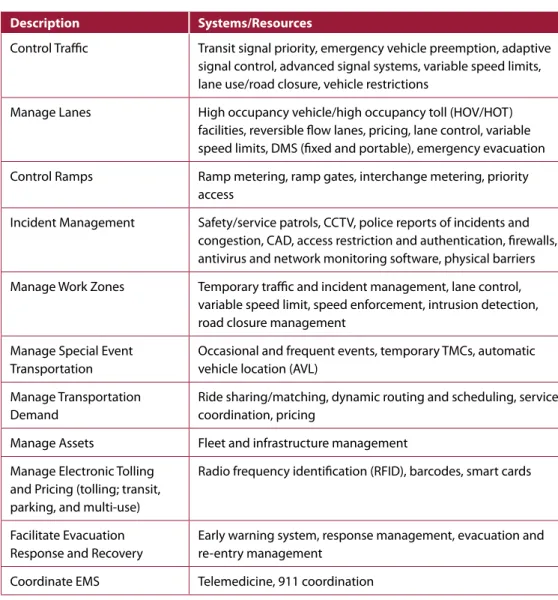
Table 2-11 presents how TMCs employ the information gathered to control traffic and man-age incidents and ongoing activities that impact traffic on a daily basis.
Table 2-11: TMC Control Systems and Resources
Description Systems/Resources
Control Traffic Transit signal priority, emergency vehicle preemption, adaptive signal control, advanced signal systems, variable speed limits, lane use/road closure, vehicle restrictions
Manage Lanes High occupancy vehicle/high occupancy toll (HOV/HOT) facilities, reversible flow lanes, pricing, lane control, variable speed limits, DMS (fixed and portable), emergency evacuation Control Ramps Ramp metering, ramp gates, interchange metering, priority
access
Incident Management Safety/service patrols, CCTV, police reports of incidents and congestion, CAD, access restriction and authentication, firewalls, antivirus and network monitoring software, physical barriers Manage Work Zones Temporary traffic and incident management, lane control,
variable speed limit, speed enforcement, intrusion detection, road closure management
Manage Special Event Transportation
Occasional and frequent events, temporary TMCs, automatic vehicle location (AVL)
Manage Transportation Demand
Ride sharing/matching, dynamic routing and scheduling, service coordination, pricing
Manage Assets Fleet and infrastructure management Manage Electronic Tolling
and Pricing (tolling; transit, parking, and multi-use)
Radio frequency identification (RFID), barcodes, smart cards
Facilitate Evacuation Response and Recovery
Early warning system, response management, evacuation and re-entry management
Coordinate EMS Telemedicine, 911 coordination
To tie together their other direct functions, TMC staff also manage communications among their operations center, the infrastructure, mobile responders (e.g., safety/service patrols), and other relevant agencies and operations centers. This requires TMCs to have access to all necessary communications links and to develop integrated control strategies that enable inter-jurisdictional traffic management. TMCs’ communications include land and wire-less technologies as well as digital and hard lines. Additionally, it is also important to note that TMCs must plan for remaining functions in emergency and disaster situations. Local weather alert and warning systems, such as the National Warning System (NAWAS) and the Tsunami Warning System (TWS), used by EOCs or FCs could give TMCs critical real-time weather alert information on dangerous weather in an area, thus allowing TMCs to better prepare for these emergencies. When faced with such situations, TMCs must implement and install system redundancies to ensure that their systems stay online during an incident. Table 2-12 presents systems and resources that support the indirect functions of a TMC.
Table 2-12: TMC Indirect.Functions Systems and Resources
Description Systems/Resources
Coordination of Communications
Additional communications links and integrated control strategies that enable integrated inter-jurisdictional traffic management, phone systems, (e.g., land line, special 1-800 call-in lines, conference call lines), mobile and satellite phones, dedicated lines, priority telephone services—Wireless Priority Service (WPS), priority cellular services—Government Emergency Telecommunications Service (GETS), push-to-talk services, email/text messaging, personal data assistants (PDAs), pagers, radio communications system (center-to-field, field-to-field, field-to-center), PCs/laptops, Internet Redundancies Back-up servers and facilities
Security Encryption software, access restriction and authentication (username and passwords), firewalls, antivirus and network monitoring software, physical barriers (e.g., fence, spike strips, electronic locks)
2.4.2. .EOCs
An EOC often functions as the hub of emergency management in a community and, in some instances, is co-located with an FC, ensuring that resources are available to respond to a full array of incidents:
• On a day-to-day basis, some EOCs oversee the response to routine incidents (e.g., a fire or an automobile crash) and are generally self-sufficient with respect to their resources. For example, EOC staff and the emergency management offices may own vehicles (e.g., fire trucks and ambulances) and hire employees (e.g., firefighters, police, or emergency medical technicians [EMTs]), or these may be the resources of law enforcement or fire departments.
• When incidents occur that affect a broader geographical area (e.g., a hurricane) or are non-routine (e.g., a chemical spill), the community EOCs seek assistance from an EOC with either a broader geographical jurisdiction or an EOC that may have specialized capabilities to respond to incidents that are not part of the EOC’s day-to-day area of responsibility. In such cases, the community EOC may function as a component of the higher-level or specialized EOC for the duration of the incident, and its resources may be augmented by those of other organizations such as State or Federal government or non-government organizations (e.g., the Red Cross).
As is the case for an EOC’s operating status or its functional organization, the resources available to an EOC depend on a community’s individual needs and investment in pre-paredness, perceived risks, emergency management, and public safety capabilities. With respect to technologies for managing their resources and information, EOCs do not typi-cally have access to specialized technologies. Certain factors mitigate the availability of spe-cialized technologies in EOCs. In many cases, EOC 24/7 staffing constitutes a single watch officer on duty at any given time. The EOC is fully activated only when a significant situation arises that warrants a response. Consequently, highly specialized technologies would be used only intermittently, and the cost-per-use may be prohibitive. Further, if such technolo-gies are not used routinely, there is no opportunity for the staff to become sufficiently
profi-cient with them to warrant the expense. It may even impede response if EOC staff members had to re-acquaint themselves with the technology every time the EOC is activated.
More often, EOCs rely on output from the systems owned and operated by other agencies or use technology that is available to most citizens, including, for example:
• Output from other agencies’ systems: EOCs benefit from technologies operated by other agencies because those agencies have staff that are familiar with the technologies and can provide useful output to the EOCs. This allows the EOCs to benefit from these systems without having to invest their limited resources in them. Modeling tools represent the type of technology borrowed by the EOC as needed.
• Radio and TV: EOCs use information available via radio and TV, which in most cases offers up-to-the-minute information on breaking situations, again without requiring the EOCs to expend any resources on such information.
• Internet: Internet access allows EOCs to access information available to the general public, such as the weather reports provided by the National Oceanic and Atmospheric Administration’s (NOAA’s) National Weather Service (NWS). This is also a method for accessing information generated by the technology owned and operated by other agencies.
Although the commonly available technologies such as radio, TV, and the Internet may not be tailored to the EOCs’ requirements, they provide valuable information without incurring expense and requiring continuous training on the technologies. There are some EOCs that have more advanced technologies. These are generally the EOCs for jurisdictions with high populations or that have significant strategic importance, such as those having high-traffic ports or key government facilities. Examples of more advanced technologies used by EOCs include software programs (e.g., Geographic Information System [GIS]), warning systems, videoconferencing equipment to coordinate with external responders to receive real-time damage estimation, and specialized encryption and security communication areas. Warning systems such as NAWAS are networks of telephone lines used by emergency per-sonnel for coordination and response to natural and man-made disasters. The lines avoid local telephone switches to avoid congestion during an emergency. Both of these warning systems are based on human intervention and can easily be linked to TMCs (e.g., call for-warding, conference calls, and party lines). One of the benefits of this linkage would be near instantaneous information on dangerous weather approaching an area, which the TMC could then use to notify the driving public and place emergency road crews on standby.
2.4.3. FCs
Many FCs have access to unclassified and classified DHS and FBI systems and networks such as HSIN, Law Enforcement Online (LEO), and Homeland Security Data Network (HSDN). HSIN is an encrypted DHS network established to strengthen the real-time, collaborative flow of threat information to State and local communities.24 HSIN links to DHS’ National Operations 24 U.S. Department of Homeland Security, Fact Sheet: Homeland Security Information Network, 2004,
Center (NOC) via the Joint Regional Information Exchange System (JRIES), which is also a secure network that offers FC applications including imaging and mapping resources. Information for FCs is usually gathered through law enforcement or homeland security sources, i.e., LEO and HSIN, but also draws from the emergency management and functional communities (e.g., transportation, health and human services). The agencies that operate within the FCs are able to operate as long as secure portal access is available to them from their home agency. DHS/I&A intelligence operations specialists are deployed to the FCs with both unclassified and classified systems.
Problems are usually encountered when FCs without a specific Federal, State, local, or tribal representative in their center are unable to access some specific piece of information that they need from that State, local, or tribal jurisdiction. This often results if the right people do not have necessary clearances and a need to know. In many cases where the information is of an unclassified nature, there are other avenues, a phone call for example, to obtain the desired information.
2.5 Information Managed and Exchanged
An important aspect of establishing effective information exchange is integration and infor-mation sharing among partnering agencies to avoid inefficient exchanges of inforinfor-mation. Establishing a system includes defining the data for exchange and compensating for any differences in how agencies code their data, including data fields, abbreviations, or sum-mary methodologies. Each agency must account for the available incoming information for exchange with other agencies, considering the information that is of interest to each agency as well as security. Coordination must also occur with software and hardware ven-dors to ensure that linked systems are able to still share information after updates and so that software release schedules are coordinated with agency project schedules. Also, while data duplication should be minimized to decrease redundancy, redundant communications paths are necessary to ensure the reliable delivery of messages during incidents.
2.5.1. TMCs
TMCs gather real-time information and data with a key focus on near-term regional operational transportation information including proactive steps to manage congestion and other bottlenecks. Table 2-13 summarizes the types of traffic data collected and the resources used to acquire the data.