Client Information Bulletin
<<
Launching the new
BDH Self Managed
Super Fund Service
Coming soon we will be launching our new BDH Self Managed Super Fund (SMSF) Service. This is a premium self managed super fund
administration service that will deliver master fund style reporting to the SMSF market. Through our partnership with Smartsuper, the BDH SMSF Service will provide a broad administration service, delivering trustees, members and advisers a simple, timely and effective SMSF product.
Specifically this solution delivers: Flexible administration options including • Administration • Actuarial • Deed Establishment and amendment • Audit • Tax • Personalised service through a dedicated administrator for each fund • Interactive online access to reporting and fund status for advisers and trustees
• Monthly reconciliation of accounts and quarterly report to
Launching the new
BDH Self Managed
Super Fund Service
Coming soon we will be launching our BDH Self Managed Super Fund (SMSF) Service. This is a premium self managed super fund
administration service that will deliver master fund style reporting to the SMSF market. The BDH SMSF Service will provide a broad administration service, delivering trustees, members and advisers a simple, timely and effective SMSF product.
Specifically this solution delivers: Flexible administration options including;
• Administration
• Actuarial
• Deed establishment and amendment
• Audit
• Tax
Personalised service through a dedicated administrator for each fund;
Interactive online access to reporting and fund status for advisers and trustees; Monthly reconciliation of
accounts and quarterly report to members, trustees and advisers.
Self Managed
Superannuation
Funds – Issues to
consider
Self Managed Superannuation funds (SMSF) are growing in
popularity as investors become more sophisticated and aim to have greater control over their retirement savings.
Investors should however, consider several issues when opting to self manage including:
• The high level of compliance required to satisfy:
o The Superannuation Industry (Supervision) Act 1993
o The ATO as the regulator, and o The fund’s auditor.
• Annual charges which may range between $2000-$5000 for an average sized fund, including administration, accounting, tax and audit fees.
• The time required, and investment expertise needed to properly manage the investments. In the current investment climate of reducing asset values, these issues will come to the fore.
• The question – would a professional fund manager be able to obtain higher investment returns than the trustee of the fund.
After considering these issues you may still decide the cost of compliance is less than the fees charged by both insurance companies and industry funds. If you have the time and expertise to devote to properly manage your investments, and you have advisors that you can call on as needed, setting up a SMSF may be your best option to earn reasonable returns on your investments.
Regardless of which decision is taken, it should be an informed
Spring 2008
Contents
1
> Launch of BDH Self Managed Super Fund. > Self ManagedSuperannuation Funds – Issues to consider .
2
> Superannuationcrackdown
> Client Profile. Mark Chain, Smartline Personal Mortgage Adviser. Falling Interest Rates bring new opportunities. > Motor vehicle
expenses.
3
> MYOB Tips> Business travel rates 2008-09.
> Research &
Development (R&D).
4
5
> Climate ready progam launch.
> Company financial reporting obligations. > Council rate notices. > Business Development
* Leadership. * Culture.
6
> Appendix: Business Travel Rates 2008-09.BDH & CO Partners: Brad Hodge
Suite 1, Level 3 Tas Demos
3 Carlingford Road Gede Barone Epping NSW 2121
decision. Please contact Brad, Gede or Tas to discuss the compliance costs and taxation benefits of setting up a Self Managed Superannuation Fund.
Superannuation
crackdown
The ATO has announced they will be cracking down on employers who fail to pay compulsory superannuation contributions on behalf of their workers. Please ensure that you pay nine per cent of ordinary time earnings by the following due dates:
Quarter Due Date
1 July – 30 Sept 28 October 1 Oct – 31 Dec 28 January 1 Jan – 31 Mar 28 April 1 Apr – 30 Jun 28 July If you fail to pay your employee’s superannuation by this date, fines will be imposed and no tax deduction will be allowed for the payment of the late
superannuation.
Employers must also notify their employees of the amount of superannuation contributed and where it has been paid.
Client Profile:
Falling Interest Rates
bring new opportunities.
Mark Chain, Smartline
Personal Mortgage
Adviser, provides some
tips on making the most
of the fall in interest
rates.
The lowering of official interest rates for the first time in nearly seven years is welcome news, and based on recent comments
made by Glenn Stevens,
Governor of the Reserve Bank it appears more likely that further falls are likely. Mr Stevens told a House of Representatives Economics Committee hearing in Melbourne. “Unless something quite surprising happens, it seems unlikely that we'll be reversing course up again in the near term."
On the face of it, the above seems like great news, however the reality is that the reserve bank is only reducing interest rates in response to a slowdown in the economy, and judging from Mr Stevens comments, things may slow down even further before they pick up. Mark’s suggests the following to make the most of falling interest rates:
• Build in a buffer by keeping loan payments at the same level even as interest rates drop, effectively making extra payments towards the loan principal. The
compounding effect of these extra payments can also lead to a huge interest saving over a period of time.
• Direct any extra funds to pay off (non-deductible) debts with the highest interest rates (such as credit cards) first. Falls in the official cash rate are likely to take much longer to flow through to credit card rates.
• Don’t pay the Standard Variable Rate! – A professional mortgage adviser can guide you to products with a lower interest rate.
• Ensure that you have loan product and type are the best for you situation and are structured for maximum tax effectiveness.
• Finally, be prepared for opportunities to build your investment portfolio. A slowing economy often brings buying opportunities while lower interest rates improve purchasing ability. Mark works with his clients to source finance for personal and investment purposes, ensuring that it is both competitively priced, and suited to their longer term financial goals. If you would like to discuss any finance needs, or are interested in a free analysis of your current
borrowings and a comparison of alternative products contact Mark Chain on 0419 613 389.
Motor vehicle
expenses - cents
per km
The motor vehicle cents per kilometre rates for 2008-09 have been issued by the Tax Office and are listed below. Please note these rates remain unchanged from 2007-08.
Engine Capacity Rate Per KM
Up to 1600 cc 58 cpkm 1601cc to 2600cc 69 cpkm 2601cc and above 70 cpkm
Where your business use of a motor vehicle is greater than 70 per cent, it is recommended that a logbook be maintained as this is likely to increase the tax deductions available. A logbook is not required for commercial vehicles that are designed to carry more than one tonne.
MYOB Tips
Once you have sent us your MYOB file, please lock the last financial year so that no entries are made or changed for the old year.
To lock the last financial year;
• Go to the Setup menu and choose Preferences
• Click the Security tab and set the lock periods up to and including field to 30 June 2008.
Business travel
rates 2008-09
The Tax Office has released the 2008-09 travel, accommodation and meal allowance rates. When claiming travel allowance expenses and overtime meal allowance expenses the following key points must be remembered:
• The claim must be
allowable - A deduction claim cannot exceed the amount actually incurred for work-related purposes. The payment of an allowance does not of itself allow a deduction to be claimed.
• An allowance must be
paid - The substantiation exception only applies if the employee is paid an overtime meal allowance or a travel allowance. The allowance must have an identifiable connection with the nature of the expense covered.
• For travel allowance expenses - The employee must sleep away from home.
• The substantiation
exception - Where the
amount claimed is no more than the applicable
reasonable amount, substantiation of the claim with written evidence is not required.
• Claims in excess of
reasonable amounts - If the amount claimed is more than the reasonable amount, the whole claim must be substantiated with written evidence, not just the excess.
• Verification of reasonable claims - In appropriate cases, where the
substantiation exception is relied on, the employee may still be required to show:
o How they worked out their claim;
o An entitlement to a deduction (for example that work-related travel was undertaken); o A bona fide travel
allowance was paid; and o If accommodation is
claimed, that commercial accommodation was used.
The nature and degree of evidence will depend on the circumstances: for example the circumstances under which the employer pays allowances, the occupation of the employee, and the total amount of allowances received and claimed during the year by the employee.
• Tax return treatment - Where a travel or overtime meal allowance which does not exceed the reasonable amounts is not shown on the payment summary, and it has been fully spent on deductible expenses, neither the allowances nor the expenses need be shown on the employee's tax return.
If an amount less than the allowance has been spent, the income tax return must include the allowance and the expense claimed. Whenever a claim is made for overtime meal or travel allowance expenses the allowance must also be included in the tax return. For a detailed listing of the ‘reasonable amounts’ as outlined by the Tax Commissioner go to the Appendix.
Research &
development (R&D)
Are you involved in research & development to create new or improved materials, products, devices, processes or services? Did you know that you can claim 125 per cent and up to 175 per cent tax deductions for eligible expenditure in certain
circumstances?
In order to be eligible you need to register for the income year with the Industry Research & Development Board and meet the minimum R&D threshold expenditure of $20,000 or contract your R&D to an approved Registered Research Agency. You also need to have a R&D plan.
Detailed information about the R&D Tax Concession is available in the Guide to R&D
Tax Concession on the
AusIndustry website www.ausindustry.gov.au If you would like more information on how to claim a deduction for R&D talk to your Chartered Accountant.
Climate ready
program launch
In a media release issued on 29 July, the Minister for Innovation, Science and Research, Senator Kim Carr, announced the Government’s $75m Climate
Ready program was open for
applications.
The program will support Australian businesses developing new products, processes and services to tackle climate change by providing dollar-for-dollar support for research and development, proof-of-concept and early-stage commercialisation activities. Applications are expected in areas as diverse as water recycling, waste recovery, small scale renewable energy
technologies, green-house building materials, and other products, processes or services to monitor emissions or reduce energy use. The Senator said that applicants can apply for grants ranging from $50,000 to $5m.
For further information visit the AusIndustry website at:
www.ausindustry.gov.au or call the hotline on 13 28 46.
Company financial
reporting
obligations
Large Proprietary Companies must lodge Financial
Statements. Set out below for Officeholders is the current criteria used to asses if a company is (or has become) a Large Proprietary Company.
Criteria
A Proprietary Company is considered to be a Large Proprietary Company for a financial year if it satisfies at
least two of the following conditions:
• The consolidated revenue for the financial year of the company and the entities it controls (if any) is $25m or more
• The value of the
consolidated gross assets of the entity for the financial year of the company and the entities it controls (if any) is $12.5m or more
• The company and the entities it controls (if any) have 50 or more employees at the end of the financial year.
If any two of the above criteria holds true for the company then it is considered a Large
Proprietary Company.
It must therefore lodge financial statements for the relevant financial year with a form 388
Copy of Financial Statements
and Reports.
The Financial Statements and Reports form must be lodged within four months after the end of the company’s financial year end.
A Small Proprietary Company is not required to lodge Financial Statements or Reports unless:
• Directed by ASIC or shareholder(s) with at least five per cent of the vote; or
• Controlled by a foreign company for all or part of the year and is not consolidated for that period in financial statements for that year lodged with ASIC: (i) By either a registered foreign company; or (ii) A company, registered scheme, or disclosing entity
If you are unsure of your requirements contact your Chartered Accountant.
Council rate notices
Municipal Council’s are currently issuing their Rate Notices for 1 July 2008 to 30 June 2009.
Included in this year’s Rate Notice is a ‘Notice of Valuation’ which has been set at
1 January 2008.
Councils are required to revalue properties on a bi-annual basis. It is important you check the valuations – particularly the site valuation as this valuation is the valuation that will be used to calculate your land tax. If you wish to object to your valuation you only have a period of two months from the date of notice as placed on the ‘Council Rates Notice’.
If you do need any assistance in obtaining the forms or
completing the objection, please contact Brad, Gede or Tas.
Business
Development
Leadership
Strong leadership is critical to the success of any company. For companies facing constant change due to internal and/or external influences, it becomes even more critical.
To successfully cope with change, businesses need leaders who can provide an understanding of change as well as the motivation to achieve change.
‘Transformational Leadership’, a leadership style where the CEO gets results by challenging, motivating and inspiring employees, benefits organisations undergoing change. A CEO that exhibits this style of leadership can raise the results of their employees. These leaders act as role models and are admired, respected and trusted by their employees. Employees of transformational leaders often aim to emulate their leader’s characteristics.
Examples of transformational leaders in business include:
• Anita Roddick of The Body Shop
• Steve Jobs of Apple Computers
• Jack Welch of General Electric
• Richard Branson of the Virgin Group
• Bob Ansett when at Budget Car Rentals
In all these examples the transformational leaders were
able to inspire their employees and, in doing so, their
companies to greatness.
Culture Is Important
There are many attributes to creating a successful long-term business. No one attribute makes a successful business, but a combination of attributes will significantly contribute to long-term successful business performance.
These include listening to team members, customers and suppliers; learning from their comments and making changes if necessary. Virtually every week something is changing in business. To be successful, you need to keep on top of the ever-changing business climate. Business operators need to encourage loyalty from their team members, suppliers and customers. These people will also expect loyalty from management, directors and owners.
The use of marketing tools such as
• databases on customers,
• surveying customers on what they like and don’t like about your business,
• keeping web pages up to date, and
• testing the market for reaction to new products and services, all help management get important feedback on their
products/services? Most successful businesses create strategic alliances with other people in their industry, either suppliers, similar
businesses in other geographical areas that are not direct
competitors, or allied
organisations. Strategic alliances
can significantly contribute to your knowledge base on what is happening in business.
But all these attributes fade into insignificance if there is no culture within the organisation. Culture affects every aspect of the business, shareholders, directors, management, team members, customers and suppliers. Culture is the hidden success, the icing on the cake, the attitude of team members of “going that extra distance” to satisfy customers’ requirements. An attitude of a supplier making an extra late delivery to you when you need those supplies. The attitude of customers who might be prepared to overlook a late delivery because of their overall satisfaction of dealing with your business.
Culture relates to the image that your business creates in the market place:-
• How people communicate;
• Is the telephone answered in a professional business manner?
• Are telephone calls replied to?
• Are products delivered on time and at the required workmanship?
• Is quality a major issue in the business?
• Are staff pleasant and presentable?
• Culture then is one of the major attributes of a business that will help hold the business together and will give the business that extra strength and perseverance to battle through and survive harsher economic circumstances.
DISCLAIMER: The contents of this publication are general in nature and we accept no responsibility for persons acting on information contained herein.
Appendix: Business Travel Rates 2008-09
Reasonable amount for 2008-09
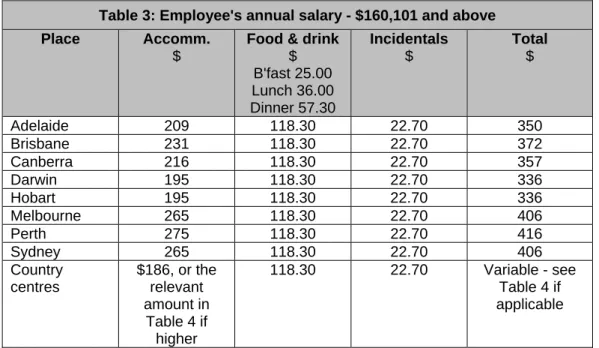
The reasonable amounts for daily travel allowance expenses, according to salary levels and destinations, for the 2008-09 income year are shown in Tables 1 to 5 as follows:
Table 1: Employee's annual salary - $90,000 or below
Place Accomm.
$
Food & drink
$ B'fast 21.10 Lunch 23.65 Dinner 40.65 Incidentals $ Total $ Adelaide 145 85.40 15.90 246.30 Brisbane 198 85.40 15.90 299.30 Canberra 133 85.40 15.90 234.30 Darwin 159 85.40 15.90 260.30 Hobart 117 85.40 15.90 218.30 Melbourne 162 85.40 15.90 263.30 Perth 148 85.40 15.90 249.30 Sydney 183 85.40 15.90 284.30 High cost country centres
See Table 4 85.40 15.90 Variable - see Table 4 Tier 2 country centres (see Table 5) 106 B'fast 18.85 Lunch 21.55 Dinner 37.15 15.90 199.45 Other country centres 89 B'fast 18.85 Lunch 21.55 Dinner 37.15 15.90 182.45
Table 2: Employee's annual salary - $90,001 - $160,100
Place Accomm. $ Food and drink $ B'fast 22.90 Lunch 32.45 Dinner 45.45 Incidentals $ Total $ Adelaide 155 100.80 22.70 278.50 Brisbane 228 100.80 22.70 351.50 Canberra 168 100.80 22.70 291.50 Darwin 170 100.80 22.70 293.50 Hobart 150 100.80 22.70 273.50 Melbourne 192 100.80 22.70 315.50 Perth 184 100.80 22.70 307.50 Sydney 200 100.80 22.70 323.50 High cost country centres
See Table 4 100.80 22.70 Variable - see Table 4 Tier 2 country centres (see Table 5) 127 B'fast 21.10 Lunch 21.55 Dinner 41.95 22.70 234.30 Other country centres 107 B'fast 21.10 Lunch 21.55 Dinner 41.95 22.70 214.30
Table 3: Employee's annual salary - $160,101 and above
Place Accomm.
$
Food & drink
$ B'fast 25.00 Lunch 36.00 Dinner 57.30 Incidentals $ Total $ Adelaide 209 118.30 22.70 350 Brisbane 231 118.30 22.70 372 Canberra 216 118.30 22.70 357 Darwin 195 118.30 22.70 336 Hobart 195 118.30 22.70 336 Melbourne 265 118.30 22.70 406 Perth 275 118.30 22.70 416 Sydney 265 118.30 22.70 406 Country centres $186, or the relevant amount in Table 4 if higher 118.30 22.70 Variable - see Table 4 if applicable
Table 4: High cost country centres - accommodation expenses
Country centre $ Country centre $
Ballarat (VIC) 116.00 Kalgoorlie (WA) 116.50 Bendigo (VIC) 122.00 Karratha (WA) 243.50 Broome (WA) 173.00 Kununurra (WA) 147.00 Burnie (TAS) 123.00 Launceston (TAS) 115.50
Cairns (QLD) 120.50 Mackay (QLD) 112.00
Carnarvon (WA) 133.00 Maitland (NSW) 108.00 Christmas Island (WA) 122.50 Mount Gambier (SA) 107.00 Cocos (Keeling) Islands 110.00 Mount Isa (QLD) 115.00 Dampier (WA) 158.50 Naracoorte (SA) 106.00 Derby (WA) 165.00 Newcastle (NSW) 116.50 Devonport (TAS) 115.50 Newman (WA) 150.00 Emerald (QLD) 106.00 Norfolk Island 108.00 Exmouth (WA) 173.50 Pt Hedland (WA) 247.00 Geraldton (WA) 116.00 Pt Lincoln (SA) 106.00 Gladstone (QLD) 111.00 Port Macquarie
(NSW)
115.00 Gold Coast (QLD) 135.00 Thursday Island
(QLD)
180.00 Halls Creek (WA) 132.00 Warrnambool (VIC) 113.00 Hervey Bay (QLD) 109.50 Weipa (QLD) 138.00 Horn Island (QLD) 139.00 Wilpena-Pound
(SA)
135.00 Jabiru (NT) 190.00 Wonthaggi (VIC) 122.00
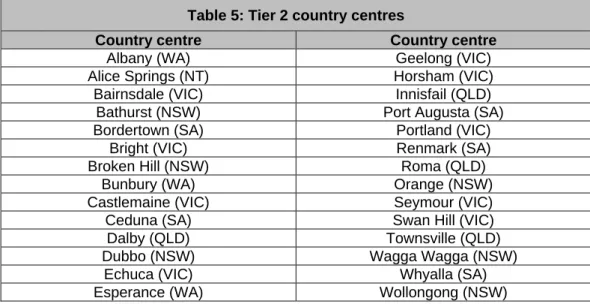
Table 5: Tier 2 country centres
Country centre Country centre
Albany (WA) Geelong (VIC)
Alice Springs (NT) Horsham (VIC)
Bairnsdale (VIC) Innisfail (QLD)
Bathurst (NSW) Port Augusta (SA)
Bordertown (SA) Portland (VIC)
Bright (VIC) Renmark (SA)
Broken Hill (NSW) Roma (QLD)
Bunbury (WA) Orange (NSW)
Castlemaine (VIC) Seymour (VIC)
Ceduna (SA) Swan Hill (VIC)
Dalby (QLD) Townsville (QLD)
Dubbo (NSW) Wagga Wagga (NSW)
Echuca (VIC) Whyalla (SA)
Esperance (WA) Wollongong (NSW)
Overseas travel rates are also available. Contact your Chartered Accountant should you need more information.