AUTHOR(S):
TITLE:
YEAR:
Publisher citation:
OpenAIR citation:
Publisher copyright statement:
OpenAIR takedown statement:
________ open access.
This is the ______________________ version of an article originally published by ____________________________
in
__________________________________________________________________________________________
(ISSN _________; eISSN __________).
This publication is distributed under a CC ____________ license. ____________________________________________________
Section 6 of the “Repository policy for OpenAIR @ RGU” (available from
http://www.rgu.ac.uk/staff-and-current-students/library/library-policies/repository-policies
) provides guidance on the criteria under which RGU will
consider withdrawing material from OpenAIR. If you believe that this item is subject to any of these criteria, or for
any other reason should not be held on OpenAIR, then please contact
with the details of
the item and the nature of your complaint.
GREEN
BANDHAKAVI, A., WIRATUNGA, N., PADMANABHAN, D. and MASSIE, S.
Lexicon based feature extraction for emotion text classification.
2017
BANDHAKAVI, A., WIRATUNGA, N., DEEPAK, P. and MASSIE, S. 2016. Lexicon based
feature extraction for emotion text classification. Pattern recognition letters [online], 93,
pages 133-142. Available from: https://doi.org/10.1016/j.patrec.2016.12.009
BANDHAKAVI, A., WIRATUNGA, N., DEEPAK, P. and MASSIE, S. 2016. Lexicon based
feature extraction for emotion text classification. Pattern recognition letters, 93, pages
133-142. Held on OpenAIR [online]. Available from: https://openair.rgu.ac.uk
AUTHOR ACCEPTED
ELSEVIER
Pattern recognition letters
0167-8655
BY-NC-ND 4.0
https://creativecommons.org/licenses/by-nc-nd/4.0
OpenAIR at RGU
Digitally signed by OpenAIR at RGU DN: cn=OpenAIR at RGU, o=Robert Gordon University, ou=Library, [email protected], c=GB Date: 2017.06.26 10:13:47 +01'00'
Accepted Manuscript
Lexicon based Feature Extraction for Emotion Text Classification
Anil Bandhakavi, Nirmalie Wiratunga, Deepak P., Stewart Massie
PII:
S0167-8655(16)30356-7
DOI:
10.1016/j.patrec.2016.12.009
Reference:
PATREC 6699
To appear in:
Pattern Recognition Letters
Received date:
18 April 2016
Revised date:
8 December 2016
Accepted date:
14 December 2016
Please cite this article as: Anil Bandhakavi, Nirmalie Wiratunga, Deepak P., Stewart Massie, Lexicon
based Feature Extraction for Emotion Text Classification,
Pattern Recognition Letters
(2016), doi:
10.1016/j.patrec.2016.12.009
This is a PDF file of an unedited manuscript that has been accepted for publication. As a service
to our customers we are providing this early version of the manuscript. The manuscript will undergo
copyediting, typesetting, and review of the resulting proof before it is published in its final form. Please
note that during the production process errors may be discovered which could affect the content, and
all legal disclaimers that apply to the journal pertain.
ACCEPTED MANUSCRIPT
1
Pattern Recognition Letters
journal homepage: www.elsevier.com
Lexicon based Feature Extraction for Emotion Text Classification
AnilBandhakavia,∗∗, NirmalieWiratungaa, DeepakP.b, StewartMassieaaSchool of Computing Science and Digital Media, Robert Gordon University, Aberdeen and AB10 7QB, UK bSchool of Electronics Electrical Engineering and Computer Science, Queens University, Belfast and BT7 1NN, UK
ABSTRACT
General Purpose Emotion Lexicons (GPELs) that associate words with emotion categories remain a valuable resource for emotion analysis of text. However the static and formal nature of their vocabu-laries make them inadequate for extracting effective features for document representation, in domains
that are inherently dynamic in nature (e.g. Social Media). This calls for lexicons that are not only adaptive to the lexical variations in a domain but also provide finer-grained quantitative estimates to accurately capture word-emotion associations. In this paper we extend prior work on domain spe-cific emotion lexicon (DSEL) generation and apply it for emotion feature extraction. We demonstrate how our generative unigram mixture model (UMM) based DSEL learnt by harnessing labelled (blogs, news headlines and incident reports) and weakly-labelled (tweets) emotion text can be used to extract effective features for emotion classification. Our results confirm that the features derived using the
pro-posed lexicon outperform those from state-of-the-art lexicons learnt using supervised Latent Dirichlet Allocation (sLDA) and Point-Wise Mutual Information (PMI). Further the proposed lexicon features also outperform state-of-the-art features derived using a combination of n-grams, part-of-speech in-formation and sentiment lexicons.
c
2016 Elsevier Ltd. All rights reserved.
1. Introduction
Emotion is an important factor that influences overall human behaviour which include rational tasks such as reasoning, deci-sion making and interaction. Though emotions are subjective, they occur in objectively deducible ways in text [1]. Emotion analysis concerns the computational study of natural language expressions in order to identify their associations with different
emotions such asanger, fear, joy, sadness, surpriseetc. Sentiment analysis [2] is widely used to gauge user opin-ion expressed in text. However it is often desirable to have more detailed information about the views and opinions of peo-ple. For example, if users like a brand, insights such as they are positive because the brand gives them joy or they felt sur-prised by the endorser, offers crucial business intelligence for
brand management. Given that there is unprecedented access to emotion-rich content through tweets, blogs and discussion posts there is a great opportunity and need to build automatic
∗∗Corresponding author: Tel.:+0-000-000-0000; fax:+0-000-000-0000;
e-mail:[email protected](Anil Bandhakavi)
tools, in order to understand the emotions of the users. Emo-tion classificaEmo-tion is among the most widely studied problems in emotion analysis of text, where supervised machine learn-ing methods are leveraged to classify text documents [3, 4] into emotion classes, induced from emotion theories proposed in psychology by Ekman [5], Parrot [6] and Plutchik [7]. Among the two approaches for emotion modelling [4], one on discrete emotions and another using the continuum approach, this work builds upon the former. Further the discrete model for emotion detection has been subject to extensive exploration in psycho-logical research [8, 9].
Representation of text documents is a crucial step in machine learning approaches for text classification. A popular repre-sentation involves refining the Bag-of-words (BoW) or n-grams feature vector, so that a subset of words are chosen using a se-lection metric to represent a text document [10]; this is nor-mally referred to as feature selection. Feature engineering, on the other hand, is about building a set of new features rather than selecting a subset of words. Such features could be fre-quency of higher-level concepts such as topics [11], or may use semantic representations derived from an ontology [12]. More specialized tasks call for more fine-tuned feature
repre-ACCEPTED MANUSCRIPT
2 sentations; for example, the length of contiguous upper-case
character sequences is found to be a useful feature for spam filtering1 whereas the number of lower-cased words resulted in performance improvements in SMS filtering [13]. Author identification is another area where fine-tuned features such as stylemarkers and short-words (e.g. if, is etc.) have enhanced classification accuracy [14]. Emotion Analysis, being as much or even more specialized than the above tasks, has also relied on fine-tuned features described later.
Emotion analysis of text requires careful modelling of text, since words associate with different emotions in different
con-texts with varying levels of magnitude making the identification of words for document representation more challenging. For example, in a sentence such asbeautiful morning #amazingthe wordbeautifulcould be associated moderately with emotions such asjoyandlove,amazingcould be associated strongly with emotionjoyandmorningcould be weakly associated with emo-tionjoy. Such word-emotion associations are usually captured by emotion lexicons. Existing general purpose emotion lexi-cons (GPELs) such as WordNet-Affect (WNA) [15],
EmoSen-ticNet (ESN) [16] and NRC word-emotion lexicon [17], which are hand crafted, associate between words and emotions identi-fied by Ekman and Plutchik. Emotion features extracted us-ing the knowledge of the GPELs, when combined with tra-ditional BoW features improved emotion classification signif-icantly [18, 19].
However GPELs poorly model the context in which words convey emotions. For example Glee might normally connote
joy, but would need to be assumed neutral in the context of a document corpus talking about the television series with the same name. Further, unfair may be associated with anger
despite being more dominant in sadness related documents; the crisp binary memberships of words in GPELs do not al-low to capture such fuzzy memberships of words to emotion classes, thereby making them limitedly effective for feature
ex-traction. Accordingly, recent efforts in emotion analysis
fo-cused on learning domain specific lexicons [20, 21] and also utilizing them for emotion feature extraction [17, 22]. However the emotion features extracted were limited to simple emotion word counts in a document using the lexicon, which, while be-ing simple, do not exploit the knowledge of the lexicon in its entirety. Accordingly our contributions in this paper are as fol-lows:
• We extend our prior work on domain specific emotion lex-icon (DSEL) generation for feature extraction. This is dif-ferent from our work in [23] since it extracts features be-yond simple word counts using the knowledge of a DSEL; • We introduce novel feature extraction methods to harness the emotion rich knowledge being captured by our DSEL. Unlike our work in [24], which uses DSEL as a direct tool for word and phrase-level emotion analysis, here we ex-tract features to classify text into emotion classes using machine learning; and
1http://archive.ics.uci.edu/ml/datasets/Spambase
• Evaluate through a comparative study the effectiveness
of the proposed emotion features on benchmark emotion classification datasets.
In the rest of the paper we review the most related literature in Section 2. In Section 3 we formulate the methods for extracting emotion lexicon based features. Section 4 describes the state-of-the-art baseline features used in our comparative study. In section 5 we describe our experimental set up and analyse the results. Section 6 presents our conclusions and future direc-tions.
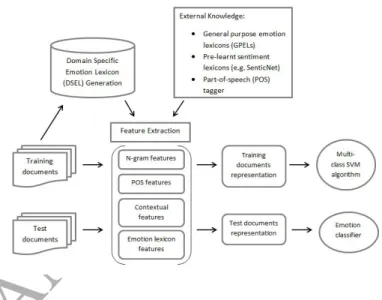
Fig. 1: Feature extraction and emotion classifier learning. A DSEL is learnt from the training documents. Feature extraction is done using standard meth-ods, knowledge of the learnt DSEL and other external resources. An SVM emotion classifier learnt from the training documents is used to classify the test documents.
2. Related Work
A majority of the literature concerning emotion analysis is shaped by machine learning approaches. These approaches rep-resent documents as vectors in a feature space and classify them into predefined emotion categories defined by emotion theories such as Ekman [5], Plutchik [7]. The feature extraction process for emotion classification is summarized in figure 1. Observe that the lexicon based features proposed in this work are ex-tracted using the knowledge of the DSEL learnt on the training documents. POS taggers, sentiment lexicons and GPELs act as external resources for extracting relevant features for emotion classification. In the rest of the section we review the state-of-the-art features proposed for emotion classification of text and also relevant literature on emotion lexicon generation.
2.1. Features for Emotion Classification
Generic n-gram features:This is the most standard represen-tation used in text classification tasks including emotion classi-fication. Documents are represented in a space of unordered list of terms (BoW or n-grams)as vectors. Burget et al. [25] used n-grams with tf-idf weighting [26] to classify Czech news head-lines. Similar to the findings in sentiment classification [27],
ACCEPTED MANUSCRIPT
3 Aman et al. [28] and Matthew et al. [29] demonstrated the
effectiveness of n-gram features with binary weighting (word
presence/absence) in emotion classification of blogs and tweets
respectively. However a common limitation of n-gram features is their inability to capture the underlying emotion semantics, thereby resulting in overall performance degradation. This has lead to research [30, 31] which explores richer features that are better suited for emotion classification.
Special n-gram features: As alluded to earlier, specialized features (e.g. punctuation) have been explored in the case of emotion analysis, as in the case of other specialized tasks such as author identification. These features were designed to cap-ture the emotive expressions that occur in subtle ways, espe-cially in Twitter. For instance, Wang et al. [32] designed fea-tures such as positional n-grams (i.e. n-grams in the first half of a tweet and n-grams in the second half of a tweet) and part-of-speech (POS) tagging to complement generic n-grams for emotion classification of tweets. Similar to the findings in sen-timent classification [27] positional n-grams decreased perfor-mance, whilst POS information lead to marginal improvements over n-grams in emotion classification. Roberts et al. [33] found that modelling the presence/absence of punctuation (!,
?) marginally improves classification performance for emotions such assurpriseandjoyon tweets.
Lexicon based features: These features were designed based on the intuition that sentiment/emotion bearing words
identi-fied by lexicons can form useful knowledge to represent docu-ments for emotion classification. Aman et al. [28] augmented generic n-grams with features to count the occurrences of tion words provided by GPELs to significantly improve emo-tion classificaemo-tion of blogs. Whilst GPELs offer useful
knowl-edge about emotion-rich words, they are static and are likely to have poor coverage of the emotion vocabulary used in do-mains like Twitter. For emotion classification of tweets, Mo-hammad [17] and [22] demonstrated that DSEL based features offer significant gains over n-grams when compared to those
of GPEL based features [32]. However feature extraction using DSELs has not been explored beyond binary and integer counts. In particular the knowledge of a DSEL to quantify the associ-ation between words and emotions can be leveraged to design more sophisticated features for emotion classification, which is the focus of this work.
Additional features: Apart from the aforementioned features additional knowledge sources such as emotion hashtags [34], emotion word lists [30], topic scores [33] were used to design features that complement the n-gram features and general pur-pose lexicons such as WordNet-Affect. Performance
improve-ments were observed in emotion classification tasks over using n-grams alone [34], but were found to be less effective when
compared with lexicon based features suggesting that lexicon based features need to be explored further to design better and more effective text representations for emotion classification of
text. In this work we further explore the potential of DSELs to extract effective representations for emotion classification. We
also evaluate the contributions of the proposed features by com-paring their performance with existing state-of-the-art features in emotion classification.
Table 1: Sample terms in WordNet-Affect Lexicon. The first column in each
row denotes an Ekman emotion and the second column in each row denote the words that connote the emotion.
Emotion Words
Anger irascibility, short-temper, spleen Fear frighten, fright, scare Joy hilarious, screaming, uproarious Sadness penitently, penitentially Surprise astonishing, astounding, staggering Disgust detestably, repulsively, abominably
2.2. Learning emotion lexicons
Existing methods for learning DSELs are mostly supervised, since they rely either on labelled or weakly-labelled emotive content in a domain. Different learning methodologies such as
Point-wise Mutual Information (PMI) [22], Latent Dirichlet Al-location (LDA) in a semi-supervised setting [35] have been ap-plied to learn DSEls. In addition, supervised LDA (sLDA) [36] offers a more accurate means to model emotion classes as
top-ics and for lexicon generation. Further crowd-annotated emo-tional news articles2were leveraged for lexicon generation, by combining the document-frequency distributions of words and the emotion distributions over documents [21, 37]. In our prior work [23, 24], we jointly modelled the emotionality and neu-trality of words using a unigram mixture model (UMM) to learn DSELs from labelled and weakly-labelled emotion documents.
3. Lexicon based Feature Extraction
In this section we first characterize the knowledge offered by
GPELs and the DSELs, followed by a brief illustration of our proposed DSEL generation process. Thereafter we formulate the different emotion relevant features that can be extracted
us-ing the knowledge of GPELs and DSEls.
3.1. Emotion Lexicon Knowledge
A GPEL,Lex(w,j) is a list of words per emotion class:
Lex(w,j)=
(
1 ifw∈List(ej),
0 otherwise (1)
whereList(ej) denotes the list of words corresponding to thejth
emotion in the GPEL. A sample of the GPEL, WNA is shown in table 1
In contrast to GPELs, a DSEL quantifies the associations be-tween words in a vocabularyV and a set of pre-defined emo-tionsE. For any given arbitrary wordw, the dominant emotion
eexpressed is calculated using the lexicon as follows:
e=arg max
j Lex(w,ej) (2)
A DSEL in our case is learnt from a corpus of emotion la-belled documents by jointly modelling emotionality and neu-trality of words using a generative unigram mixture model (UMM). In the following section we briefly explain our posed lexicon generation method. Further details about our pro-posed DSEL generation can be found in [23, 24].
ACCEPTED MANUSCRIPT
4
3.1.1. Mixture Model for Lexicon Generation
We model real-world emotion data to be a mixture of emo-tion bearing words and emoemo-tion-neutral (background) words. More formally our generative model is as follows to describe the generation of documents connoting emotionet:
P(Det,Z|θet)= |Det| Y i=1 Y w∈di [(1−Zw)λetP(w|θet) +(Zw)(1−λet)P(w|N)] c(w,di) (3)
whereθet is the emotion language model andNis the
back-ground language model.λetis the mixture parameter andZwis a
binary hidden variable which indicates the language model (θet
orN) that generated the wordw. Furtherc(w,di) is the number
of times wordwoccurs in documentdi.
The estimation of parameters θet andZ can be done using
expectation maximization (EM), which iteratively maximizes the complete data (Det,Z) by alternating between E-step and
M-step. The E and M steps in our case are as follows:
E-step: P(Zw=0|Det, θ(ent))= λetP(w|θ (n) et ) λetP(w|θ (n) et )+(1−λet)P(w|N) (4) M-step: P(w|θ(θn+1) et )= P|Det| i=1 P(Zw=0|Det, θ (n) et )c(w,di) P w∈VP|iD=et1|P(Zw=0|Det, θ (n) et )c(w,di) (5) wherenindicates the EM iteration number. EM is used to es-timate the parameters of the kmixture models corresponding to the emotions in E. The emotion lexiconU MMlexis learnt by using the kemotion language models and the background modelNas follows: U MMlex(wi, θej)= P(wi|θ(enj)) Pk t=1[P(wi|θ (n) et )]+P(wi|N) (6) U MMlex(wi,N)= Pk P(wi|N) t=1[P(wi|θ(ent))]+P(wi|N) (7) wherekis the number of emotions in the corpus, andU MMlex
is a|V|×(k+1) matrix. A sample of our UMM lexicon is shown
in table 2. Observe that non-standard and creative expressions such as :), good!! are widely used to convey emotions on so-cial media. Such expressions often intensify the emotionality of the text. Modelling such expressions is critical for social me-dia emotion analysis. Therefore in the text preprocessing phase emoticons (e.g. :) ) and concatenated expressions (e.g. good!!) are tokenized as single-words to capture their association with different emotions.
3.2. Emotion Lexicon Features
As mentioned in the related work section, previous research suggests that lexicon based features improve emotion classifica-tion. In this section we explore how the knowledge of a DSEL can be utilized to extract a range of features relevant for emo-tion classificaemo-tion. Observe that all the lexicon based feature
Table 2: A sample of the UMM word-emotion lexicon. Each row represents a word and its association strength with the different emotions captured as a
numerical vector.
Words Anger Fear Joy Sadness Surprise Neutral :) 0.056 0.085 0.533 0.062 0.072 0.192 good!! 0.074 0.109 0.305 0.236 0.093 0.183 #arrogant 0.332 0.173 0.057 0.131 0.150 0.157
vectors proposed in this work are of length|E|, where|E|is the number of emotion classes in a data set. We consider the fol-lowing features to represent documents:
1. Total Emotion Count (TEC) [22]: This feature captures the number of words in a document that associate with an emotion. Given a documentd, its corresponding feature vector is denoted bydT EC. The feature value for the jth
emotion is computed as follows:
dT EC[ej]= X w∈d I(ej=arg max k Lex(w,k))×count(w,d) (8)
I(.) is an indicator function and is set to 1 or 0 when the argument is true or false respectively. count(w,d) is the number of occurrences of wordwin documentd. Note that
T EConly captures the popular emotion context of a word suggested by the lexicon (i.e., emotion with highest score in the lexicon). However not all words associate with just a single emotion. For example, even if the wordbeautiful
may be associated moderately with both the emotionsjoy
andlove, theT ECemotion feature would force the word to contribute a count of 1 towards either of these emo-tions (depending on the scores from the lexiconLex) and 0 towards the other. Therefore it is important to develop features that incorporate the relations between a word and multiple emotions.
2. Total Emotion Intensity (TEI): This is the sum of the emo-tion intensity scores of words present in a document. Un-like the coarse integer counts inT ECfeatures, here word-level emotion intensity scores offered by a DSEL are used
to capture the emotional orientation of documents along multiple emotion concepts (classes). AccordinglydT EI is
the feature vector corresponding to a document d. The feature value for the jthemotion is computed as follows:
dT EI[ej]=
X
w∈d
Lex(w,ej)×count(w,d) (9)
3. Max Emotion Intensity (MEI): Research in Sentiment analysis suggest that high sentiment-bearing terms is in-dicative of sentiment class of the document regardless of the average score for the document [38]. We expect it to be true for emotion analysis as well. Therefore we consider the intensity score of the highest emotion-bearing word in the given document. Given a documentd, and its corre-sponding feature vectordMEI, the feature value for the jth
emotion is computed as follows:
dMEI[ej]=arg max w∈d
ACCEPTED MANUSCRIPT
5 4. Graded Emotion Count (GEC): We extend the idea of
uti-lizing high intensity emotion words to extract document representations by developing variants ofT EC andT EI. BothT ECandT EIconsider all the words in a document regardless of the intensity with which they convey an emo-tion. However it is useful to understand the impact of high intensity words on emotion classification. GECis similar in principle toT EC, except that it only captures the num-ber of words in a document that associate with an emotion and over a threshold value δ. Since our proposed DSEL quantifies the association between each word and the set of emotions in the form of a probability distribution, the intensity scores always lie in the interval [0, 1]. We di-vided this interval into 4 quartiles [0, 0.25), [0.25, 0.5), [0.5, 0.75) and [0.75, 1] respectively. Further we used the three values 0.25, 0.5 and 0.75 as thresholdδin our exper-iments. TheGECfeatures extracted using the DSELs are for the above three thresholds. Given a documentd, and its corresponding feature vectordT EC, the feature value for the jthemotion is computed as follows:
dGEC[ej]= X w∈d Lex(w,j)≥δ I(ej=arg max k Lex(w,k))×count(w,d) (11) 5. Graded Emotion Intensity (GEI): Similar toGEC, we de-velop a variant ofT EI,GEIwhich is the sum of intensity scores of words in a document and over a thresholdδ. The thresholds mentioned earlier are used for extractingGEI
features using DSELs. Given a documentd, and its corre-sponding feature vectordGEI, the feature value for the jth
emotion is computed as follows:
dGEI[ej]=
X
w∈d Lex(w,j)≥δ
Lex(w,ej)×count(w,d) (12)
4. Baseline Emotion Features
In this section we detail the commonly used features to im-prove emotion classification. Unlike the features discussed in the previous section these features do not rely on the knowl-edge of an emotion lexicon. We consider the following:
1. n-grams (n=1): These are the most standard corpus level
features used in different classification tasks including
sen-timent [39] and emotion classification [28]. We used a bi-nary weighting (presence/absence) to construct the feature
vector, since it is found to be effective by earlier research
in sentiment [27] and emotion classification [29].
2. Part-of-Speech (POS) features: Similar to [32], we used features to model the occurrence of verbs, adverbs, nouns and adjectives in a document. Part-of-speech tagging on non-social media data sets is done using the stanford POS tagger3, whilst Twitter NLP tool [40] from Carnegie Mel-lon University was used for tagging social media data sets .
3http://nlp.stanford.edu/software/tagger.shtml
3. Contextual features (CF): Though standard words can con-vey the emotional intention of the author, additional ex-pressions such as punctuation marks, emoticons are often used on social media to express emotions. Further senti-ment bearing words could indicate the emotion in the text and also alter its orientation from positive-emotion(e.g.
joy) to negative-emotion (e.g. sadness) or vice versa. We consider the following contextual features used in senti-ment [39] and emotion [32] classification for our compar-ative study:
• Capitalized words: This feature counts the number of words in a document with all upper case charac-ters [39].
• Elongated words: This feature counts the number of words with character repeated two, three or four times [39]. For examplehaaappy.
• Punctuation: Emotions are intensified on social me-dia using exclamation marks and question marks. Similar to [39], two features were included to model the occurrence of question marks and exclamation marks in a document.
• Emoticons: Emoticons are facial expressions cap-tured pictorially, and are often used on social media to convey emotions. A binary feature is designed to model the presence/absence of emoticons in a
docu-ment. The emoticon list is adopted from an earlier work in emotion classification [41].
• Negation: Though the role of negation is not exten-sively studied for emotion classification, following its usefulness for sentiment classification [27], we in-clude a feature to model the occurrence of negators in documents. We used a standard list of negators pro-posed by a popular work in sentiment analysis [38]. • Sentiment features: Though sentiment and emotion
are different by definition [42], prior research in
emo-tion classificaemo-tion [32] explored the role of sentiment knolwedge offered by lexicons. Similary we define
two integer valued features, to capture for the num-ber of positive words and negative words observed in a document. However in addition to the senti-ment lexicons used in [32] we consider more re-cent lexicons like SentiwordNet [43], SenticNet [44], NRC HashTag sentiment lexicon4and Sentiment140 lexicon4. An exhaustive list of positive and nega-tive words is created by merging the aforementioned lexicons to extract sentiment features from the docu-ments.
5. Evaluation
The objective of our evaluation is to comparatively evalu-ate the quality of different document representations proposed
in literature for emotion classification, emotion lexicon based 4http://saifmohammad.com/WebPages/lexicons.html
ACCEPTED MANUSCRIPT
6 representations extracted using the knowledge of baseline
lexi-cons such as PMI, LDA and the proposed UMM based lexicon. We evaluate the different representations for individual class
(emotion) performance and also overall performance. Based on this evaluation we construct hybrid representations by combin-ing the best performcombin-ing baseline features and the best perform-ing lexicon based features. We combined the best performperform-ing features (i.e. baseline, lexicon based features) to construct hy-brid features expecting further performance improvements. Our evaluation is carried out through emotion classification tasks on benchmark data sets. Emotion classification is chosen, since it is possible to assess the quality of different models that can
classify documents into discrete emotion classes. Significance is reported using a paired one-tailed t-test using 95% confidence (i.e. with p value<=0.05). Observe that results highlighted in
bold indicates best performance obtained on that particular data set.
5.1. Datasets
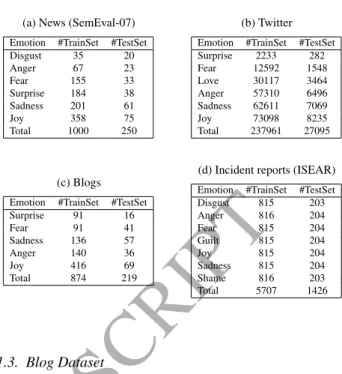
We use four benchmark datasets in our evaluation (see Ta-ble 4a). Note that on the training documents of each data set, DSELs are learnt (see figure 1) using WED [21], PMI [22], sLDA [36] and by the proposed method (refer section 3.1) in order to extract the lexicon based emotion features mentioned in section 3.2.
5.1.1. News data set (SemEval-2007)
Consists of 1250 emotional news headlines harnessed for evaluating the connection between emotions and lexical seman-tics at the SemEval-07 workshop [45]. Each headline was pro-vided with emotion ratings in the range [-100, 100] for the Ek-man basic emotions. We used this data set for emotion classifi-cation, by considering the highest rated emotion for each head-line as the class label. Table 3a shows the distribution of dif-ferent emotion classes in the training and test sets. The dataset is comparatively small with a considerable skewed class distri-bution. We are particularly interested to explore how the gen-erative DSEL based features compare to baseline features. We expect that the smaller dataset size combined with the skewed distribution makes this an interesting dataset for comparison purposes.
5.1.2. Twitter Dataset
A collection of 0.28 million emotional tweets5crawled from the Twitter search API using tweet identification numbers pro-vided by [32]. The emotion labels in the data set correspond to Parrot’s primary emotions [6]. We used this data set for emo-tion classificaemo-tion (stratified 10-fold cross validaemo-tion). Table 3b shows the average distribution of the different emotion classes
over the 10 folds. As is evident from the table, not all emotions are strongly expressed in this data set. Emotions such asjoy, sadnessare more prominent compared to others likefear, sur-prise. Therefore it would be interesting to see how the different
document representations fare in performance amidst such class imbalance.
5http://knoesis.org/?q=projects/emotion
Table 3: Emotion Datasets (a) News (SemEval-07)
Emotion #TrainSet #TestSet Disgust 35 20 Anger 67 23 Fear 155 33 Surprise 184 38 Sadness 201 61 Joy 358 75 Total 1000 250 (b) Twitter
Emotion #TrainSet #TestSet Surprise 2233 282 Fear 12592 1548 Love 30117 3464 Anger 57310 6496 Sadness 62611 7069 Joy 73098 8235 Total 237961 27095 (c) Blogs
Emotion #TrainSet #TestSet Surprise 91 16 Fear 91 41 Sadness 136 57 Anger 140 36 Joy 416 69 Total 874 219
(d) Incident reports (ISEAR)
Emotion #TrainSet #TestSet Disgust 815 203 Anger 816 204 Fear 815 204 Guilt 815 204 Joy 815 204 Sadness 815 204 Shame 816 203 Total 5707 1426 5.1.3. Blog Dataset
Consists of 5500 blog sentences annotated with Ekman ba-sic emotions by 3 annotators with an average inter annotator agreement (kappa of 0.76) [18]. Table 3c shows the average distribution of different emotion classes over the 5 folds. The
emotion class distribution is highly skewed towards the emotion
joy. Further the smaller size of the data set is likely to challenge the modelling of the weakly represented emotions likefear, sur-prise.
5.1.4. Incident reports data set (ISEAR)
Consists of 7000 incident reports obtained from an interna-tional survey on emotion reactions6. Each report is an emotion summary, describing the situation which lead the participant to experience one of 7 emotions:anger, disgust, fear, shame, guilt, joy and sadness. Table 3d shows the average distribution of dif-ferent emotion classes over the 5 folds. Unlike the other data sets the emotion classes here have a near uniform distribution, which is very unlikely in a real word sample of emotion rich content. It will also be interesting to observe how closely re-lated emotions such asshameandguiltmight be differentiated
in the classification task.
5.2. Baselines and Metrics
The following document representations are used in our com-parative study:
• Baseline emotion features (see section 4);
• T EC features extracted using baseline GPELs (WNA, NRC and ESN) (see section 3.1);
• T EC,T EI,MEI,GEIandGECfeatures extracted using baseline DSELs generated using PMI [22], WED [21] and sLDA [36] (see section 3.2);
ACCEPTED MANUSCRIPT
7
Table 4: Emotion examples and Lexicon vocabulary statistics (a) Exdata
Data set Example Emotion Twitter going to las
vegas tomor-row :) #excited #happy
Joy
Blogs I’m scared of my future Fear News (SemEval-07) Trolley Square shooting leaves 6 dead Anger Incident reports (ISEAR) My friend ran away from home,I feel for him Sadness (b) Lexstat Lexicon #terms GPEL (WNA) 1536 GPEL (NRC) 14000 GPEL (ESN) 13189 DSEL (SemEval) 3328 DSEL (Blogs) 3976 DSEL (ISEAR) 11784 DSEL (Tweets) 234923
• T EC, T EI, MEI,GEI andGEC features extracted us-ing the proposed DSEL (see section 3.1). Observe that the GEI andGEC features are extracted using the lexi-con scores for different values of thresholdδ. For example
GECδ1accounts only for words which have an association score with an emotion in the interval [0.25, 1]. Similarly
GECδ2andGECδ3accounts only for words with scores in the intervals [0.5, 1] and [0.75, 1];and
• Hybrid features obtained by combining the best perform-ing baseline features and lexicon-based features
GPELs can only be used to extractT ECfeatures, since they do not offer word-emotion quantifications needed to extract other
features (refer table 1). A multi-class SVM classifier is used in all the emotion classification experiments, given its eff
ective-ness on text classification tasks and robustective-ness on large feature spaces. We use an optimized SVM package7 available for all our experiments. Performance is evaluated using the standard F-score metric in all emotion classification tasks.
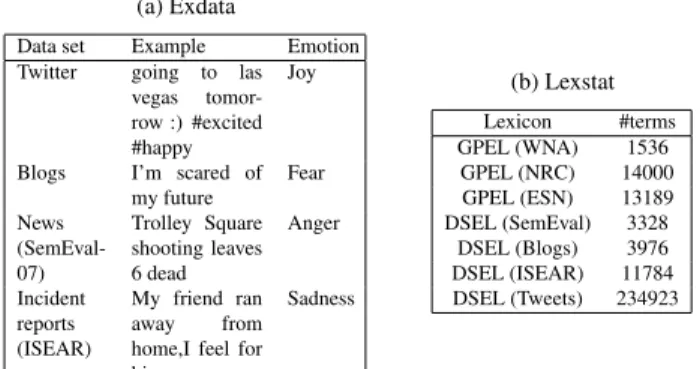
Word coverage of lexicons used in our comparative study for each dataset are shown in Table 4. Observe that on each data set, the coverage remains the same for all the DSELs (sLDA, PMI, WED and UMM). A higher coverage is desirable with domains like Twitter, which not only is voluminous but also contain greater numbers of unique emotive expressions com-pared to other domains. We expect DSELs to perform better than GPELs especially in domains (e.g. Twitter) where high lexical coverage is necessary.
5.3. Results and Analysis
In this section we analyse the emotion classification results obtained using baseline features, lexicon based features and a combination of them (i.e. hybrid features).
5.3.1. Performance of baseline features
Emotion classification experiments using baseline features were done incrementally by beginning with n-grams and adding one feature group (e.g. POS) at a time. Table 5 summarizes
7https://www.csie.ntu.edu.tw/cjlin/liblinear/
Table 5: Overall performance on different datasets with baseline features.
Over-all performance is measured by combining (average) the macro-averaged F-score of all the emotion classes.
Baseline features Overall F-Score
SemEval-07 Twitter Blogs ISEAR ngrams 35.77 49.55 58.32 32.19 ngrams+POS 38.63 46.80 57.15 31.90 ngrams+CF 39.17 48.38 57.60 32.07
ngrams+POS+CF 40.99 47.19 57.03 32.21
the results obtained for baseline features on the four benchmark data sets. In general, the combination of n-grams with POS fea-tures did not significantly improve emotion classification. The ineffectiveness of POS features suggests that emotions are
ex-pressed more implicitly and not just by direct words (e.g. emo-tional adjectives). This is similar to the findings of earlier re-search on emotion classification [32].
On the other hand, when n-grams are combined with con-textual features performance improves over the combination of n-grams and POS features. However the combination does not consistently improve emotion classification over n-grams. This clearly suggests that the simple counts of entities such as nega-tions, emoticons, sentiment words, punctuation etc which are found effective for sentiment classification [39] cannot be
di-rectly extended for emotion classification. Finally the combina-tion of n-grams, POS and CF also did not consistently improve emotion classification over n-grams. These experiments clearly reflect the limitations of corpus level features identified in lit-erature (refer section 2). In the following sections we discuss our results for lexicon based features and the hybrid features obtained by combining baseline and lexicon based features.
5.3.2. Performance of lexicon based features
Emotion classification results using lexicon based features for SemEval-07, Twitter, blogs and ISEAR data sets are shown in figures 2, 3, 4 and 5 respectively. The x-axis in each of these figures indicate the different lexicon based features extracted
using the knowledge of GPELs and DSELs (refer section 3.2). The y-axis indicates the overall performance (F-score) for each feature. Observe that, since GPELs are simple word-emotion lists (refer table 1), they are limited to extract only theT EC fea-ture. However in the case of DSELs performance comparison can be made across different lexicon based features extracted
using the emotion quantification knowledge offered by DSELs
(refer table 2).
In general features extracted from GPELs are significantly outperformed by those extracted using DSELs. The average performance improvements of all the features extracted using DSELs over those using GPELs is nearly 22%, 3% and 13% on twitter, blogs and ISEAR data sets respectively. Further the per-formance improvements of the proposed DSEL based features over those of the GPELs is nearly 8%, 40%, 12% and 19% on SemEval, Twitter, blogs and ISEAR data sets respectively. Es-sentially this confirms that GPELs are less able to capture the context in which emotions are expressed in a domain and also are less effective to model emotions in informal text streams
ACCEPTED MANUSCRIPT
8
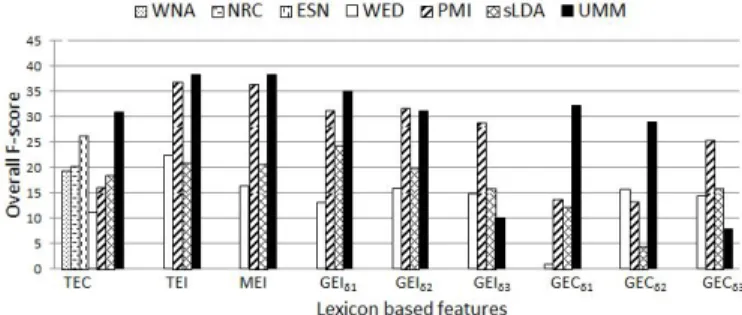
Fig. 2: Overall performance on SemEval-07 with lexicon based features. Over-all performance is measured by combining (average) the macro-averaged F-score of all the emotion classes. Observe thatT EC,T EIandMEIfeatures consider all the words, whereasGEIandGECfeatures are selective. For ex-ampleGECδ1accounts only for words which have an association score with an
emotion in the interval [0.25, 1]. SimilarlyGECδ2andGECδ3accounts only
for words with scores in the intervals [0.5, 1] and [0.75, 1]
Fig. 3: Overall performance on Twitter with lexicon based features. Overall performance is measured by combining (average) the macro-averaged F-score of all the emotion classes. Observe thatT EC,T EIand MEIfeatures con-sider all the words, whereasGEIandGECfeatures are selective. For example GECδ1accounts only for words which have an association score with an
emo-tion in the interval [0.25, 1]. SimilarlyGECδ2andGECδ3accounts only for
words with scores in the intervals [0.5, 1] and [0.75, 1]
Comparing the results in figures 2, 3, 4 and 5 suggest that
T EIandMEIfeatures consistently outperformGEIandGEC
features. This is expected since theGEIandGECfeatures uti-lize only high intensity emotion words from a DSEL, resulting in a drop in coverage. Further a general trend of performance degradation is observed on all the data sets withGEI,GEC fea-tures as threshold values increase fromδ1(0.25) toδ2(0.5) toδ3 (0.75). This is expected since the proportion of high intensity emotion words, follow a decreasing series for increasing values of threshold from 0.25 to 0.75, resulting in a further drop in cov-erage. However it is extremely promising to note that theGEI
andGECfeatures extracted from the proposed lexicon signifi-cantly outperform theT ECfeatures extracted using the GPELs. Further the proposed DSEL based features significantly outper-form those extracted using WED, PMI and sLDA. In general we noticed that the generative models assumed by sLDA and WED do not effectively model the characteristics of real-world
emotional data, thereby impacting the quality of the features extracted from them. Though PMI performed the best amongst the baselines, the ability of the proposed DSEL to effectively
capture the associations between words and multiple emotions resulted in quality feature extraction for documents. Whilst the
other DSELs also capture the word-emotion associations, the additional ability of our DSEL to discriminate between emo-tional and neutral words (refer table 2)improved the quality of the features extracted using its knowledge.
Fig. 4: Overall performance on blogs with lexicon based features. Overall per-formance is measured by combining (average) the macro-averaged F-score of all the emotion classes. Observe thatT EC,T EIandMEIfeatures consider all the words, whereasGEIandGECfeatures are selective. For exampleGECδ1
accounts only for words which have an association score with an emotion in the interval [0.25, 1]. SimilarlyGECδ2andGECδ3accounts only for words with
scores in the intervals [0.5, 1] and [0.75, 1]
Fig. 5: Overall performance on ISEAR with lexicon based features. Overall performance is measured by combining (average) the macro-averaged F-score of all the emotion classes. Observe thatT EC,T EIandMEIfeatures con-sider all the words, whereasGEIandGECfeatures are selective. For example GECδ1accounts only for words which have an association score with an
emo-tion in the interval [0.25, 1]. SimilarlyGECδ2andGECδ3accounts only for
words with scores in the intervals [0.5, 1] and [0.75, 1]
5.3.3. Emotion-level performance analysis
Although the proposed DSEL in general outperformed other lexicons, we observed that the PMI lexicon is a strong com-petitor. Further we are also interested in comparing the per-formance of the lexicon based features with the baseline fea-tures discussed earlier. Accordingly we take a closer look at the baseline features8, PMI and UMM based lexicon features by observing their performance on individual emotion classes. In particular given that not all emotions are equally complex to model, it will be useful to draw insights from those classes considered to be more challenging than others. The average F-score obtained for a class across the baseline features, lexicon based features is used as a metric to indicate its complexity. Es-sentially lower the F-score, the more complex (challenging) is the class prediction.
ACCEPTED MANUSCRIPT
9
Fig. 6: Emotion-level performance of different features on SemEval-07 with
respect to macro-averaged F-score. Comparative analysis is done between the best performing baseline features, best performing lexicon based features ex-tracted using PMI and UMM.
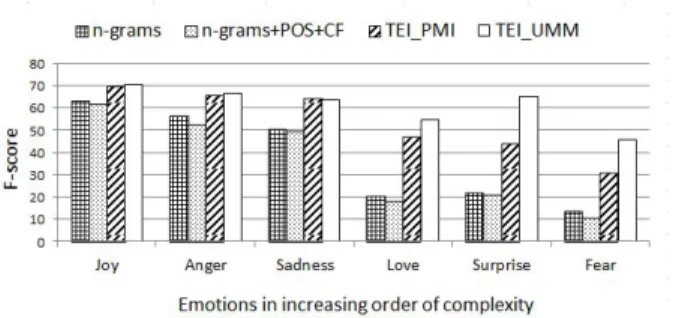
Fig. 7: Emotion-level performance of different features on Twitter with respect
to macro-averaged F-score. Comparative analysis is done between the best performing baseline features, best performing lexicon based features extracted using PMI and UMM.
Figures 6, 7, 8 and 9 capture the emotion-level performance of baseline and lexicon based features. Here the x-axis plots the results in the order of increasing emotion complexity for each data set. In general the results suggest that the proposed UMM lexicon outperforms the PMI lexicon in classifying harder emo-tions. Similarly the proposed lexicon based features are ob-served to be superior to the baseline features in discriminating harder emotions on twitter and ISEAR data sets. However the performance of the proposed lexicon based features were chal-lenged on blogs, which is explained by the skewed class dis-tribution (see table 3) and on SemEval-07, where there is very limited data for learning lexicons (see table 3). Nevertheless the ability to have better or comparable performance to the baseline features with significantly fewer dimensions (|E|, where|E|is the number of emotion classes in a data set) is clearly an advan-tage of the lexicon based feature extraction methods proposed in this paper. In the following section we discuss the results for the hybrid features obtained by combining the baseline and lexicon based features.
5.3.4. Performance of hybrid features
A hybrid feature vectorhybis aK+Edimensional feature
vector obtained by combining a K dimensional baseline fea-ture vector and a E dimensional lexicon based feature vector. We experimented with feature combinations of baseline8 and
Fig. 8: Emotion-level performance of different features on Blogs with respect to macro-averaged F-score. Comparative analysis is done between the best performing baseline features, best performing lexicon based features extracted using PMI and UMM.
Fig. 9: Emotion-level performance of different features on ISEAR with respect
to macro-averaged F-score. Comparative analysis is done between the best performing baseline features, best performing lexicon based features extracted using PMI and UMM.
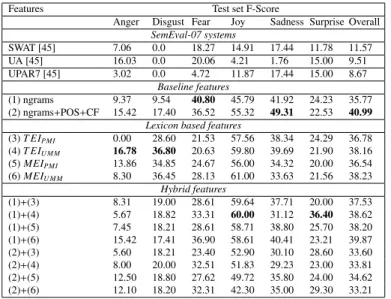
lexicon based9 features to observe for performance improve-ments. Emotion classification results using the hybrid features are summarized in tables 6, 7, 8 and 9. We noticed that the hybrid features involving a combination of n-grams, POS, con-textual features and lexicon based features deteriorates perfor-mance. We believe this is due to the ineffective contributions
of POS and contextual features as discussed earlier (refer sec-tion 5.3.1). However the hybrid features obtained by combining n-grams and lexicon based features result in performance im-provements (overall F-score) over n-grams in general, except for the ISEAR data set. Further the proposed UMM lexicon de-rived features when combined with n-grams record significant improvements over n-grams and rest of the hybrid features. Fur-thermore we also noticed that the hybrid features derived using the knowledge of the proposed lexicon significantly improves performance over n-grams on complex emotions such as sur-priseon SemEval;love, surpriseandfearon Twitter ; and sur-priseon blogs.
6. Conclusions and Future work
In this paper we extensively study the problem of emotion feature extraction using the knowledge of domain-specific lexi-cons (DSELs) and general purpose emotion lexilexi-cons (GPELs). We apply our unigram mixture model (UMM) based DSEL [23, 9We consider the best performing lexicon based features derived using
ACCEPTED MANUSCRIPT
10
Table 6: Emotion classification on SemEval with hybrid features. Performance is measured using macro-averaged F-score. Comparative analysis is done be-tween systems that participated in the SemEval-07 competition, best perform-ing baseline features, best performperform-ing lexicon based features extracted usperform-ing PMI, UMM and the hybrid features.
Features Test set F-Score
Anger Disgust Fear Joy Sadness Surprise Overall
SemEval-07 systems SWAT [45] 7.06 0.0 18.27 14.91 17.44 11.78 11.57 UA [45] 16.03 0.0 20.06 4.21 1.76 15.00 9.51 UPAR7 [45] 3.02 0.0 4.72 11.87 17.44 15.00 8.67 Baseline features (1) ngrams 9.37 9.54 40.80 45.79 41.92 24.23 35.77 (2) ngrams+POS+CF 15.42 17.40 36.52 55.32 49.31 22.53 40.99
Lexicon based features
(3)T EIPMI 0.00 28.60 21.53 57.56 38.34 24.29 36.78 (4)T EIU MM 16.78 36.80 20.63 59.80 39.69 21.90 38.16 (5)MEIPMI 13.86 34.85 24.67 56.00 34.32 20.00 36.54 (6)MEIU MM 8.30 36.45 28.13 61.00 33.63 21.56 38.23 Hybrid features (1)+(3) 8.31 19.00 28.61 59.64 37.71 20.00 37.53 (1)+(4) 5.67 18.82 33.31 60.00 31.12 36.40 38.62 (1)+(5) 7.45 18.21 28.61 58.71 38.80 25.70 38.20 (1)+(6) 15.42 17.41 36.90 58.61 40.41 23.21 39.87 (2)+(3) 5.60 18.21 23.40 52.90 30.10 28.60 33.60 (2)+(4) 8.00 20.00 32.51 51.83 29.23 23.00 33.81 (2)+(5) 12.50 18.80 27.62 49.72 35.80 24.00 34.62 (2)+(6) 12.10 18.20 32.31 42.30 35.00 29.30 33.21
Table 7: Emotion classification on Twitter with hybrid features. Performance is measured using macro-averaged F-score. Comparative analysis is done be-tween best performing baseline features, best performing lexicon based features extracted using PMI, UMM and the hybrid features.
Features Average F-Score (10-fold cross validation)
Anger Fear Joy Sadness Surprise Love Overall
Baseline features
(1) ngrams 56.68 13.56 63.34 50.57 21.65 20.52 49.55
Lexicon based features
(2)T EIPMI 66.00 30.56 69.86 64.42 44.20 46.92 62.53
(3)T EIU MM 66.72 45.57 70.36 63.67 64.91 54.89 64.24
Hybrid features
(1)+(2) 56.79 31.27 61.36 45.43 28.41 24.76 49.32 (1)+(3) 59.71 27.24 67.91 54.80 33.12 31.94 55.16
24], which is unique in its ability to quantify both emotionality and neutrality of words to extract novel features which repre-sent documents along emotion concepts. A comparative analy-sis of emotion classification results on four benchmark data sets (news headlines, tweets, blogs and incident reports) suggests that the proposed features extracted using the knowledge of DSELs significantly outperform those extracted from GPELs. Further the proposed features also perform significantly better over n-gram features and their combination with features based on part-of-speech information and sentiment knowledge.
Closer examination of DSEL results show that the proposed features extracted from our UMM lexicon perform significantly better over those extracted using state-of-the-art methods such as Point-wise Mutual Information (PMI) and supervised latent dirichlet allocation (sLDA) on all the data sets. A deeper anal-ysis of the results suggest that the proposed UMM lexicon fea-tures are better able to classify harder emotions such as love, fear, anger, surpriseetc. Here the use of lexicons as a means to extract new features of very low dimensions for classification purposes is shown to be a promising strategy. These findings are particularly impactful given the need for efficient and
ef-Table 8: Emotion classification on Blogs with hybrid features. Performance is measured using macro-averaged F-score. Comparative analysis is done be-tween best performing baseline features, best performing lexicon based features extracted using PMI, UMM and the hybrid features.
Features Average F-Score (5-fold cross validation) Anger Fear Joy Sadness Surprise Overall
Baseline features
(1) ngrams 60.30 50.04 73.92 52.37 31.32 58.32
Lexicon based features
(2)T EIPMI 33.94 23.72 67.92 35.42 20.14 47.19 (3)T EIU MM 53.80 41.70 71.23 38.50 38.86 52.18 (4)MEIPMI 54.90 34.42 64.50 40.00 29.32 53.34 (5)MEIU MM 39.32 41.63 72.29 42.68 41.54 58.16 Hybrid features (1)+(2) 49.00 32.00 72.10 43.80 25.00 55.20 (1)+(3) 41.56 41.70 71.62 44.90 32.16 56.46 (1)+(4) 58.60 50.00 68.90 42.40 34.10 57.78 (1)+(5) 53.72 45.53 72.78 53.41 34.79 59.66
Table 9: Emotion classification on ISEAR with hybrid features. Performance is measured using macro-averaged F-score. Comparative analysis is done be-tween best performing baseline features, best performing lexicon based features extracted using PMI, UMM and the hybrid features.
Features Average F-Score (5 fold cross validation)
Anger Disgust Fear Guilt Joy Sadness Shame Overall
Baseline features
(1) ngrams 21.11 31.00 30.62 29.85 37.86 27.24 47.56 32.19 (2) ngrams+POS+CF 21.12 33.12 30.40 29.82 38.71 25.60 46.74 32.21
Lexicon based features
(3)T EIPMI 21.86 42.92 40.76 30.93 41.56 31.30 49.48 36.96 (4)T EIU MM 25.96 44.52 42.88 35.42 44.45 32.66 50.54 39.48 Hybrid features (1)+(3) 15.80 21.20 25.70 20.20 32.40 27.60 43.30 26.60 (1)+(4) 22.30 28.20 25.51 27.00 33.50 32.60 43.80 30.40 (2)+(3) 15.80 21.90 25.71 21.40 32.80 27.50 44.31 27.00 (2)+(4) 22.12 28.30 25.61 27.92 34.51 32.41 44.00 30.71
fective representations. Finally the hybrid features derived us-ing the combination of n-grams and the proposed lexicon based features also result in consistent and significant improvements over n-gram features. This clearly confirms that a high qual-ity lexicon which can closely capture the emotional context of a domain, when utilized effectively offers impactful knowledge
for a machine learning classifier.
In future we plan to use the emotion classification system developed for analysing the emotional signatures imprinted by users in social discussion forums. We also plan to utilize the knowledge of the proposed DSEL to predict the potential evoked emotions in the readers of creative text such as fairy tales and movie plot summaries.
References
[1] M. A. M. Shaikh, H. Prendinger, M. Ishizuka, A Linguistic Interpreta-tion of the OCC EmoInterpreta-tion Model for Affect Sensing from Text, Affective
Information Processing, 2009, Ch. 4, pp. 45–73.
[2] B. Pang, L. Lee, Opinion mining and sentiment analysis., Foundations and Trends in Information Retrieval 2(1) (2008) 1–135.
[3] R. Calvo, S. A. D’Mello, Affect detection: An interdisciplinary review of models, methods, and their applications, IEEE Transactions on Affective
Computing Volume: 1 , Issue: 1 (2010) 18– 37.
[4] H. Binali, V. Potdar, Emotion detection state of the art, in: Proc of the CUBE Int Information Technology Conference, 2012, pp. 501–507. [5] P. Ekman, An argument for basic emotions, Cognition and Emotion 6(3)
ACCEPTED MANUSCRIPT
11
[6] W. G. Parrott, Emotions in social psychology, Psychology Press, Philadel-phia, 2001.
[7] R. Plutchik, A general psychoevolutionary theory of emotion, In Emo-tion: Theory, research, and experience: Vol .1, pp 3-33.
[8] H. Gunes, M. Pantic, Automatic, dimensional and continuous emotion recognition, Int Journal of synthetic emotions, pp. 68-99.
[9] R. W. Picard, Affective Computing, 1997.
[10] F. Sebastiani, Machine learning in automated text categorization, ACM Computing Surveys 34 (2002) 1–47.
[11] H. M. Wallach, Topic modeling: beyond bag-of-words, in: Proc of the 23rd int’l conf on Machine learning, ACM, 2006, pp. 977–984. [12] S. Scott, S. Matwin, Feature engineering for text classification, in: ICML,
Vol. 99, 1999, pp. 379–388.
[13] G. V. Cormack, Feature engineering for mobile (sms) spam filtering, in: 30th ACM SIGIR Conf on Research and Development on IR, 2007. [14] O. De Vel, A. Anderson, M. Corney, G. Mohay, Mining e-mail content
for author identification forensics, ACM Sigmod 30 (4) (2001) 55–64. [15] C. Strapparava, A. Valitutti, Wordnet-affect: an affective extension of
wordnet, Tech. rep., ITC-irst, Istituto per la Ricerca Scienti?ca e Tec-nologica I-38050 Povo Trento Italy (2004).
[16] S. Poria, A. Gelbukh, E. Cambria, A. Hussain, G.-B. Huang, Emosen-ticspace: A novel framework for affective common-sense reasoning,
Knowledge-Based Systems 69, pp 108-123, 2014.
[17] S. M. Mohammad, P. Turney, Crowdsourcing a word-emotion association lexicon, Computational Intelligence, 29(3) (2013) 436–465.
[18] S. Aman, S. Szpakowicz, Identifying expressions of emotion in text, in: Proc of the 10th int conf on Text, speech and dialogue, 2007.
[19] S. M. Mohammad, Portable features for classifying emotional text, in: Conf of the NAACL: Human Language Technologies, pp 587-591„ 2012. [20] S. Park, W. Lee, I.-C. Moon, Efficient extraction of domain specific sen-timent lexicon with active learning, Elsevier Pattern Recognition Letters. [21] Y. Rao, J. Lei, L. Wenyin, Q. Li, M. Chen, Building emotional dictionary
for sentiment analysis of online news, WWW, Vol 17, pp 723-742. [22] S. M. Mohammad, #emotional tweets, in: Proc of The First Joint Conf on
Lexical and Computational Semantics, 2012.
[23] A. Bandhakavi, N. Wiratunga, P. Deepak, S. Massie, Generating a word-emotion lexicon from #word-emotional tweets, in: Proc of the 3rd Joint Conf on Lexical and Computational Semantics (*SEM 2014), 2014.
[24] A. Bandhakavi, N. Wiratunga, S. Massie, P. Deepak, Lexicon generation for emotion analysis of text, To appear in IEEE Intelligent Systems, 2016. [25] R. Burget, J. Karasek, Z. Smekal, Recognition of emotions in czech
news-paper headlines, in: Radio Engineering Vol 20 pp 39-47, 2011. [26] G. Salton, E. A. Fox, H. Wu, Extended boolean information retrieval,
ACM Communications 26 (1983) 1022–1036.
[27] B. Pang, L. Lee, S. Vaithyanathan, Thumbs up?: Sentiment classifica-tion using machine learning techniques, in: ACL-02 Conf on Empirical Methods in Natural Language Processing, Vol 10, 2002.
[28] S. Aman, S. Szpakowicz, Using roget’s thesaurus for fine-grained emo-tion recogniemo-tion, in: Int Joint Conf on Natural Language Processing, 2008.
[29] M. Purver, S. Battersby, Experimenting with distant supervision for emo-tion classificaemo-tion, in: Proc of the 13th Conf of the European Chapter of the Association for Computational Linguistics, 2012.
[30] J. D. Albornoz, L. Plaza, P. Gervas, Improving emotional intensity clas-sification using word sense disambiguation, Special issue: Natural Lan-guage Processing and its Applications. Journal on Research in Computing Science 46 (2010) 131 – 142.
[31] D. Ghazi, D. Inkpen, S. Szpakowicz, Hierarchical approach to emotion recognition and classification in texts, in: Proc of the 23rd Canadian con-ference on Advances in Artificial Intelligence, 2010.
[32] W. Wang, L. Chen, K. Thirunarayan, A. P. Sheth, Harnessing twitter "big data" for automatic emotion identification, in: Proc of the ASE/IEEE Int
Conf on Social Computing and Int Conf on Privacy, Security, Risk and Trust, 2012.
[33] K. Roberts, M. Roach, J. Johnson, J. Guthrie, S. M. Harabagiu, Em-patweet: Annotating and detecting emotions on twitter, in: Proc. LREC, 2012, pp.3806-3813., 2012.
[34] A. Qadir, E. Riloff, Bootstrapped learning of emotion hashtags #hash-tags4you, in: 4th Workshop on Computational Approaches to Subjectiv-ity, Sentiment & Social Media Analysis (WASSA 2013), 2013. [35] M. Yang, B. Peng, Z. Chen, a. K. C. Dingju Zhu, A topic model for
building fine-grained domain-specific emotion lexicon, in: Proc of the
52nd Annual Meeting of the Assoc for Computational Linguistics„ 2014. [36] J. D. Mcauliffe, D. M. Blei, Supervised topic models, in: Advances in
Neural Information Processing Systems 20 (NIPS 2007), 2007. [37] J. Staiano, M. Guerini, Depechemood: a lexicon for emotion analysis
from crowd-annotated news, in: Proc of the 52nd Annual Meeting of the Assoc for Computational Linguistics, pp 427-433, 2014.
[38] M. Thelwall, K. Buckley, G. Paltoglou, Sentiment strength detection for the social web, Journal of the American Society for Information Science and Technology, pp 163-173, 2012.
[39] S. M. Mohammad, S. Kiritchenko, X. Zhu, Nrc-canada: Building the state-of-the-art in sentiment analysis of tweets, in: Seventh Int Workshop on Semantic Evaluation (SemEval 2013), pp 321-327, 2013.
[40] K. Gimpel, N. Schneider, B. O’Connor, D. Das, D. Mills, J. Eisenstein, M. Heilman, D. Yogatama, J. Flanigan, N. A. Smith, Part of speech tag-ging for twitter: Annotation, features, and experiments., in: Annual Meet-ing Of the Assoc for Computational LMeet-inguistics, 2011.
[41] J. Suttles, N. Ide, Distant supervision for emotion classification with dis-crete binary values, Computational Linguistics and Intelligent Text Pro-cessing, 2013.
[42] M. Munezero, C. S. Montero, E. Sutinen, J. Pajunen, Are they different? affect, feeling, emotion,sentiment, and opinion detection in text, IEEE
Transactions on Affective Computing, Vol 5 No 2, 2014.
[43] A. Esuli, S. Baccianella, F. Sebastiani, Sentiwordnet 3.0: An enhanced lexical resource for sentiment analysis and opinion mining, in: Proc of LREC, 2010.
[44] E. Cambria, D. Olsher, D. Rajagopal, Senticnet 3: A common and common-sense knowledge base for cognition-driven sentiment analysis, in: 28th AAAI conf on Artificial Intelligence, 2014.
[45] C. Strapparava, R. Mihalcea, Semeval-2007 task 14: Affective text, in: Proc of the 4th International Workshop on Semantic Evaluations (SemEval-2007), pp 70-74„ 2007.