
Subspace Detection of DNN Posterior Probabilities via Sparse Representation
for Query by Example Spoken Term Detection
Dhananjay Ram
1,2, Afsaneh Asaei
1, Herv´e Bourlard
1,2 1Idiap Research Institute, Martigny, Switzerland
2
Ecole Polytechnique F´ed´erale de Lausanne (EPFL), Switzerland
´
{dhananjay.ram,afsaneh.asaei,herve.bourlard}@idiap.chAbstract
We cast the query by example spoken term detection (QbE-STD) problem as subspace detection where query and back-ground subspaces are modeled as union of low-dimensional subspaces. The speech exemplars used for subspace model-ing are class-conditional posterior probabilities estimated us-ing deep neural network (DNN). The query and background training exemplars are exploited to model the underlying low-dimensional subspaces through dictionary learning for sparse representation. Given the dictionaries characterizing the query and background subspaces, QbE-STD is performed based on the ratio of the two corresponding sparse representation recon-struction errors. The proposed subspace detection method can be formulated as the generalized likelihood ratio test for com-posite hypothesis testing. The experimental evaluation demon-strate that the proposed method is able to detect the query given a single example and performs significantly better than a highly competitive QbE-STD baseline system based on dynamic time warping (DTW) for exemplar matching.
Index Terms: Deep neural network posterior probabilities, Subspace detection, Dictionary learning, Sparse representation.
1. Introduction
Query-by-example spoken term detection (QbE-STD) refers to the task of finding a spoken query within spoken audio. It en-ables voice search in the context of multi-lingual unconstrained audio data which can also be used for content indexing and re-trieval applications.
1.1. Prior Works
A traditional QbE-STD approach is to convert spoken audio into a sequence of symbols and then perform text based search. In [1, 2, 3], the audio is first converted into a sequence of sym-bols using automatic speech recognition (ASR) and then lat-tice based search techniques are applied to detect the symbolic representation of the query. These techniques typically require large amount of transcribed data to train statistical acoustic model and language model for the underlying speech recogni-tion system.
To apply the QbE-STD system on raw data available on the web, it is important to process the data without any require-ment for transcription. Hence, recent advances in QbE-STD are largely dominated by the exemplar matching techniques for its superior performance to the statistical methods in low-resource conditions [4, 5]. This approach is conducted in two steps. First, the query and test utterances are represented in terms of fea-tures or exemplars. The query and the test exemplars are then aligned using dynamic time warping (DTW) [6] or one of its variations [7, 5]. The similarity of the query and test exemplars
obtained from DTW is compared with a pre-defined threshold to find out possible regions of query occurrences. Both spec-tral and class-conditional posterior probabilities [8] are used as speech exemplars. Although this approach requires a few query examples, it is sensitive to speaker and acoustic mismatch con-ditions. To overcome these limitations, model based approaches have been investigated [9]. In [10], new acoustic units are dis-covered and modeled using hidden Markov models (HMM) in an unsupervised manner. These units are then used to model the query for model-based query detection.
1.2. Our Contributions
We propose to cast the query detection problem as subspace detection where query and background subspaces are modeled through dictionary learning for sparse representation. This idea is motivated by the success of exemplar-based sparse represen-tation in classification and detection tasks [11, 12]. In the con-text of speech processing, it has been widely studied for robust speech recognition [13, 14, 15]. We aim to study this approach for QbE-STD application. In contrast to the earlier work on exemplar-based sparse representation where spectral features are used as exemplars, we use DNN posterior probabilities as speech exemplars.
In our preliminary development of posterior sparse repre-sentation for keyword detection, we assumed that background speech consists of in-vocabulary words [16]. Hence, the back-ground subspace was modeled as a union of low-dimensional word subspaces using dictionary learning with word exemplars. This framework was not applicable to QbE-STD task where the background speech consists of out-of-vocabulary words. In this paper, we extend our initial framework in several directions. In-stead of word based dictionaries, we use phone based dictio-naries to model the background speech. Since the background and query may have shared phonetic components, a large tem-poral context is exploited through appending adjacent posterior vectors to form contextually rich exemplars for dictionary learn-ing. We also show that sparse subspace detection technique is applicable to a scenario when very limited number of examples are provided to model the query dictionary. We present experi-mental evaluation of the proposed method based on AMI meet-ing corpus [17]. The sparse subspace detection is shown to be equivalent to the generalized likelihood ratio test for composite hypothesis testing where the posterior exemplars admit sparse representation in an over-complete dictionary and the residual error is assumed to have Gaussian distribution.
In the rest of the paper, subspace modeling and detection of query and background posteriors are described in Sections 2 and 3 respectively. Experimental results are presented in Sec-tion 4 and the conclusions are drawn in SecSec-tion 5.
2. Subspace Modeling
In this section, we elaborate on the procedure to characterize the space of query and background posterior exemplars as union of low-dimensional subspaces.
2.1. Union of Low-dimensional Subspaces
When speech is represented in terms of posterior probabilities, the subspace corresponding to each sub-word class is a low-dimensional space [18, 19]. Accordingly, a speech utterance comprised of sub-word classes, can be modeled as a union of low-dimensional subspaces. To state it more precisely, letQ
and B denote the query and background spaces respectively such that
Q=∪mi=1Qi, B=∪
n
i=1Bi (1)
where{Qi}m
i=1and{Bi}ni=1are the corresponding constituent subspaces, andmandndenote the number of composing sub-word classes respectively.
Any data point in union of low-dimensional subspaces can be efficiently reconstructed by a sparse combination of other points in that space, a property referred to as the self-expressiveness [20]. To alleviate the need of all training data, dictionary learning for sparse representation provides an effec-tive way of extracting an over-complete basis set to model the underlying subspaces. This approach reduces the computational cost and improves the accuracy of sparse modeling [21].
Given the dictionary for characterizing the underlying sub-spaces, the independent subspaces are guaranteed to be identi-fied correctly using sparse representation [20]. In the following Section 2.2, we explain how the query and background sub-spaces can be modeled using dictionary learning for sparse rep-resentation.
2.2. Query and Background Dictionaries
Dictionary learning refers to the task of learning an over-complete set of vectors from the training exemplars such that each training exemplar can be reconstructed as a sparse linear combination of the dictionary vectors (atoms).
Denoting a training set ofT training exemplars withY= {y1, y2, ..., yT}, and their sparse representations using
dic-tionaryD∈RK×M withA={α1,α2, ..., αT}, whereK is the dimension of exemplar vectors, andM is the number of dictionary atoms, the objective function for dictionary learning is defined as arg min D,A 1 T T X t=1 1 2kyt−Dαtk 2 2+λkαtk1 (2)
whereλis the regularization parameter. The first term in this ex-pression, quantifies thereconstruction error. The second term denotes the`1-norm ofαdefined askαk1 = Pi|αi|which
quantifies the sparsity ofαt. The joint optimization of this ob-jective function with respect to bothDandαtsimultaneously is non-convex, it can be solved as a convex objective by opti-mizing for one while keeping the other fixed [22].
In this work, we consider the fast online algorithm proposed by Mairal et al. [22] for its good performance in posterior based subspace modeling [21]. This algorithm is based on stochastic gradient descent optimization. It basically alternates between a step of sparse representation for the current training featureyt
and then optimizes the previous estimate of dictionaryD(t−1)
Algorithm 1Online Dictionary Learning
Require: :Y={y1, . . . ,yT}, λ,D(0)(initialization) 1: fort= 1 to Tdo
2: Sparse representation ofytto determineαt: αt= arg minαn1
2kyt−D (t−1)αk2
2+λkαk1
o
3: UpdatingD(t)withD(t−1)as warm restart: D(t)= arg min D 1 t Pt i=1( 1 2kyi−Dαik 2 2+λkαik1) 4: end for 5: returnD(T)
to determine the new estimateD(t) using stochastic gradient descent. The algorithm is summarized in Algorithm 1.
We learn different dictionaries to model the query and back-ground subspaces:
1. The query dictionary denoted byDQ.
2. The background dictionary denoted byDB.
The query dictionary is learned from the available query ex-amples. The background dictionary must represent any speech other than the query. However, the absence of lexical informa-tion corresponding to the query prevents us form constructing a very discriminative background dictionary. Hence, we pro-pose to design a universal background dictionary for all poten-tial queries. Such a background dictionary includes the set of all phone-specific dictionaries asDB ={D1, . . . ,DP}whereP
indicates the number of phones. The phone-specific dictionaries can be learned from a well-resourced speech database.
The query and background dictionaries represent some shared phonetic components which makes classification a diffi-cult task. The primary discriminating property between the two classes is the temporal information underlying the query exem-plars which is modeled in the query dictionary. On the other hand, there is no such structure present in the background dic-tionary due to modeling the separate phone-based dictionaries.
To exploit the temporal structure, a sequence ofcposterior exemplars are concatenated asy˜t = [y>t−c. . .yt>. . .y>t+c]>, and form a contextually rich exemplar for dictionary learning and sparse representation. This mechanism is referred to as
context appendingwhich is a typical approach to incorporate
the dynamics of the exemplars [14, 21].
3. Subspace Detection
Once the query and background subspaces are modeled, the QbE-STD problem is cast as subspace detection where the re-construction errors of the respective sparse representations are used to detect the underlying subspace.
3.1. Detection via Sparse Reconstruction Errors
Given a test posterior exemplarzt and the query and
back-ground dictionariesDQandDB, the test exemplar can be
repre-sented as a sparse linear combination of dictionary atoms char-acterizing the query or background subspaces. Given the over-complete dictionaries, the query and background sparse repre-sentations of a posterior exemplarzt is obtained through the
following optimization problems:
αQt = arg min α 1 2kzt−DQαk 2 2+λkαk1 (3) αBt = arg min α 1 2kzt−DBαk 2 2+λkαk1 (4)
The coefficients of the sparse representation ofztover the query
and background dictionaries are denoted byαQt andα B t
respec-tively. The reconstructed vectors using the corresponding sparse representations will be,
ˆ
zQt =DQαQt , ˆz B
t =DBαBt
The subspace which can best represent a test vectorzt
cor-responds to the least reconstruction error. Hence, we use the Euclidean-norm based reconstruction error to perform binary classification [11]. The reconstruction errors are calculated as follows eQ(zt) =kzt−ˆz Q t k2=kzt−D Q αQt k2 (5) eB(zt) =kzt−ˆz B tk2=kzt−D B αBtk2 (6) The errors are then used to take a frame-level decision by cal-culating their difference as
∆(zt) =eB(zt)−eQ(zt) (7) which is compared with a pre-defined thresholdδ.
If∆(zt) > δ, zt is labeled as a query-frame, otherwise
ztis labeled as a background-frame. The frame-level decisions
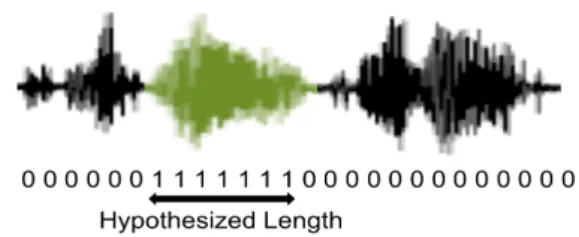
are then accumulated to form an utterance level decision and to detect whether the query occurs in the test utterance. This is achieved by counting the continuous number of frames detected as the query. It provides us with the hypothesized length of the query in a test utterance [23]. Figure 1 depicts this procedure to obtain the hypothesized length. This length is compared with a pre-calculated threshold to take the final decision.
Although the frame-level processing is not able to exploit the temporal information inherent in speech, this information is captured through context appending as discussed in Section 2.2 to obtain the frame-level decisions. In spite of being simple (and disregarding temporal information), this decoding proce-dure has been found advantageous to the Viterbi algorithm in the framework of hidden Markov model (HMM) for keyword detection task [23]. We will see in Section 4.4 that this decision making approach is indeed effective, and outperforms a highly competitive DTW-based baseline system in QbE-STD evalua-tion [4, 5].
3.2. Relation to Generalized Likelihood Ratio Test
The proposed approach is closely related to the generalized like-lihood ratio test for composite hypothesis testing. We assume that each test exemplar is modeled aszt=Dαt+ntwhereD
is an over-complete dictionary andαtis a sparse latent variable with Laplace prior distribution
p(αt)∼ λ 2 M exp(−λkαk1). (8)
with a parameterλ > 0. We assume the model mismatchnt
to be an independent Gaussian noise distributed asN(0, σ2I). Hence, the distribution of a test exemplar zt given the latent
variableαtis given by:
p(zt|αt=α;D)∼ N(Dα, σ2I) (9) For each test posterior, we define the composite hypothesis test-ing problem as
H0 : zt=DQαt+nt H1 : zt=DBαt+nt,
(10)
Figure 1:Hypothesized length of the query in a test utterance.
The maximum likelihood estimate ofαtis obtained as
arg max
α p(α|zt;D) = arg maxα p(zt|α;D)p(α) (11)
Substituting (8) and (9), the maximum likelihood estimate ofαt
amounts to (3) and (4) ifDis chosen as either the queryDQor
backgroundDB dictionary. Hence, the generalized likelihood
ratio test becomes
p(zt;αQt |H0) p(zt;αB t|H1) =kzt−DQα Q t k2 kzt−DBαBtk2 H0 ≶ H1 δ0 (12) which leads to a solution equivalent to (7).
4. Experimental Analysis
The experiments are conducted to evaluate the performance of the proposed subspace detection method in challenging scenar-ios when very few or just one query example is provided for QbE-STD, and the query and background are conversational spontaneous speech with competitive speakers.
4.1. Data
The AMI meeting corpus [17] is used for the experiments where the training, development and evaluation sets are as [24]. That gives us about 81 hours for DNN training and about 9 hours for each of the development and evaluation data. Although, the meeting language was English, many participants were non-native speakers. Also, the headset recordings contain con-siderable amount of overlapping speech (competing speakers). There are approximately 12k words in the training, out of which 50 most frequent words are used for our detection experiments including very short words such as “my” to long words such as “television”. The evaluation set is used for QbE-STD evalua-tion.
We have used Kaldi toolkit [25] to train a DNN for estima-tion of mono-phone posterior probabilities. The CMU pronun-ciation dictionary1 is used for lexical modeling, which consist of 39 non-silence phones. Additionally, 4 phones are consid-ered for silence. Hence, the phone posterior features are 43 di-mensional. The query examples are chosen randomly from the training set to model the query. The same set of examples are used to evaluate the baseline and the proposed system.
4.2. Baseline System
The DTW based QbE-STD system presented in [5] is used as a highly competitive baseline system [4]. This method applies DTW matching of reference query with the test utterance in a recursive manner. In the first pass, the system hypothesizes a detected region with corresponding score. Then, the system searches again in the non-hypothesized region given the fol-lowing three conditions are satisfied: (1) the score of the cur-rent hypothesis is greater than a given thresholds, (2) the non-hypothesized speech segment has long enough duration (half
the query length) and (3) the number of detections (already hy-pothesized + currently computed) is less than a given threshold
N. For our experiments,N = 7is optimized over the de-velopment set. If more than one example of the same query is given, we have used DTW matching to map the frames and averaged the matched frames to generate an average reference query [5, 26].
4.3. Subspace Modeling and Detection
The first step is to construct the dictionaries for query and back-ground classes. The query dictionaries are learned from the given examples of the query. The background dictionary in-cludes all phone-specific dictionaries. The phone dictionaries can be learned from the same data used to train the DNN for feature extraction. We have used phone data from the training set to learn the corresponding phone dictionaries.
We use the query and background phone dictionaries in-dependently as (3) and (4) for sparse representation of a test frame. There are different reconstruction errors corresponding to the different phone dictionaries, and the average error is used as the background score.
Alternative to the average reconstruction error of the back-ground phone dictionaries, the minimum of them can also be used as the background score [16, 27]. However, we found that the average score yields better detection performance. We spec-ulate that the reason is due to the difficulty in dictionary learn-ing uslearn-ing a few random examples of the AMI corpus. Since this corpus has many occurrences of distorted speech due to non-native speaking and competing talkers which are represented in the query dictionary, the reconstruction error is not a score com-petitive to the well-trained background dictionaries. Hence, the average background score is a more conservative choice that leads to higher detection rate without increasing the probability of false alarm.
The difference of query and background reconstruction er-rors or∆(zt)in (7) is used to take frame-level binary decision. The frame-level decisions are then pooled to estimate the length of a hypothesized query. Final decision is made by comparing the hypothesized length to the average query length (c.f. Fig-ure 1).
4.4. QbE-STD Performance
The receiver operating characteristic (ROC) curves are com-puted by varying the thresholdsδandsin predefined ranges for sparse subspace detection and DTW based systems. For both systems, the average query length is used as the minimum hy-pothesized length. The results are averaged over all words used as the query to obtain the final ROC as illustrated in Figure 2.
We consider two cases where only a single query example and 10 examples are provided. In the case of single query ex-ample, the query dictionaryDQconsists of the only query
ex-ample. In the case of 10 query examples, one of them is used for initializing the dictionary whereas the rest are used for learning the dictionary. The value of different parameters are optimized over the development set. Clearly, in both cases our proposed system performs significantly better than the baseline system.
Unlike the DTW baseline system, the sparse subspace de-tection does not show much improvement when 10 examples are provided. This observation is opposite to the results previ-ously obtained on a clean (simple) database [27] where incor-porating more examples of the query were found more effective for the sparse method compared to the baseline DTW system. This issue can be attributed to the large variability and overlap
Probability of False Alarm
0 0.1 0.2 0.3 0.4 0.5 0.6 Probability of Detection 0 0.2 0.4 0.6 0.8 1 DTW-Baseline-1Example DTW-Baseline-10Example Sparse-System-1Example Sparse-System-10Example
Figure 2:ROC curves for the proposed sparse subspace detec-tion system and the baseline DTW system [5] using different numbers of query examples available.
present in the utterances of AMI corpus. When the query ex-amples are noisy, the effect of noise is averaged out through the query averaging for DTW whereas the noisy examples are rep-resented in the dictionary learning. On the contrary, when the query examples are clean, dictionary learning is more effective to characterize the variability present in the data than the simple averaging method.
5. Conclusions and Future Work
We proposed a novel QbE-STD method based on sparse recon-struction for classification. In contrast to the state of the art template matching methods, we cast the problem as subspace detection where the query and background subspaces are mod-eled through dictionary learning. Sparse representation of every frame of test posterior exemplars using the dictionaries charac-terizing the space of query and background enables discrimina-tion of the underlying subspaces, and frame-level classificadiscrimina-tion is achieved based on sparse reconstruction errors. Query deci-sion is then simply performed by accumulating frame-level de-cisions (frames belonging to the query) over the hypothesized template, which results in a simple decoding process without any HMM. In spite of this simplicity (and potential for im-provements), the proposed approach outperforms one of the best DTW baseline systems, demonstrating the great potential of our sparse subspace detection method.
We plan to learn the universal phone dictionaries to eval-uate the system on multilingual QbE-STD tasks for interna-tional benchmarking [28]. To that end, discriminative dictio-nary learning techniques can be considered to reduce the am-biguities of the shared phonetic subspaces. We will also study integration of the phone posterior exemplars with sub-phonetic features, such as phonological posteriors, to address the adverse acoustic variability of multilingual non-native speech. Further-more, we plan to devise alternative decision making procedure to exploit the temporal dependency of adjacent frames.
6. Acknowledgments
The research leading to these results has received funding from SNSF projects on “Parsimonious Hierarchical Auto-matic Speech Recognition (PHASER)” grant agreement num-ber 200021-153507 and “Adaptive Multilingual Speech Pro-cessing (A-MUSE)” grant agreement number 200020-144281.
7. References
[1] W. Shen, C. M. White, and T. J. Hazen, “A comparison of query-by-example methods for spoken term detection,” DTIC Docu-ment, Tech. Rep., 2009.
[2] C. Parada, A. Sethy, and B. Ramabhadran, “Query-by-example spoken term detection for OOV terms,” inIEEE Workshop on Au-tomatic Speech Recognition & Understanding (ASRU), 2009, pp. 404–409.
[3] I. Szoke, M. Fapso, L. Burget, and J. Cernocky, “Hybrid word-subword decoding for spoken term detection,” inProceedings of the 31st Annual International ACM SIGIR Conference on Re-search and Development in Information Retrieval, 2008, pp. 42– 48.
[4] X. Anguera, L. J. Rodriguez-Fuentes, I. Szoke, A. Buzo, F. Metze, and M. Penagarikano, “Query-by-example spoken term detection evaluation on low-resource languages,” inThe 4th International Workshop on Spoken Language Technologies for Under-resourced Languages (SLTU’14), 2014.
[5] L. J. Rodriguez-Fuentes, A. Varona, M. Penagarikano, G. Bor-del, and M. Diez, “High-performance query-by-example spoken term detection on the SWS 2013 evaluation,” inIEEE Interna-tional Conference on Acoustics, Speech and Signal Processing (ICASSP), 2014, pp. 7819–7823.
[6] L. R. Rabiner, A. E. Rosenberg, and S. E. Levinson, “Considera-tions in dynamic time warping algorithms for discrete word recog-nition,”The Journal of the Acoustical Society of America, vol. 63, no. S1, pp. S79–S79, 1978.
[7] Y. Zhang and J. R. Glass, “Unsupervised spoken keyword spotting via segmental DTW on Gaussian posteriorgrams,” inIEEE Work-shop on Automatic Speech Recognition & Understanding (ASRU), 2009, pp. 398–403.
[8] T. J. Hazen, W. Shen, and C. White, “Query-by-example spo-ken term detection using phonetic posteriorgram templates,” in IEEE Workshop on Automatic Speech Recognition & Understand-ing (ASRU), 2009, pp. 421–426.
[9] C. A. Chan and L. S. Lee, “Model-based unsupervised spoken term detection with spoken queries,”Audio, Speech, and Lan-guage Processing, IEEE Transactions on, vol. 21, no. 7, pp. 1330– 1342, 2013.
[10] C. Y. Lee and J. Glass, “A nonparametric Bayesian approach to acoustic model discovery,” inProceedings of the 50th Annual Meeting of the Association for Computational Linguistics: Long Papers-Volume 1. Association for Computational Linguistics, 2012, pp. 40–49.
[11] J. Wright, A. Y. Yang, A. Ganesh, S. S. Sastry, and Y. Ma, “Robust face recognition via sparse representation,”Pattern Analysis and Machine Intelligence, IEEE Transactions on, vol. 31, no. 2, pp. 210–227, 2009.
[12] Y. Chen, N. M. Nasrabadi, and T. D. Tran, “Sparse representation for target detection in hyperspectral imagery,”Selected Topics in Signal Processing, IEEE Journal of, vol. 5, no. 3, pp. 629–640, 2011.
[13] T. N. Sainath, B. Ramabhadran, M. Picheny, D. Nahamoo, and D. Kanevsky, “Exemplar-based sparse representation features: From TIMIT to LVCSR,”Audio, Speech, and Language Process-ing, IEEE Transactions on, vol. 19, no. 8, pp. 2598–2613, 2011. [14] J. F. Gemmeke, T. Virtanen, and A. Hurmalainen,
“Exemplar-based sparse representations for noise robust automatic speech recognition,” Audio, Speech, and Language Processing, IEEE Transactions on, vol. 19, no. 7, pp. 2067–2080, 2011.
[15] A. Asaei, “Model-based sparse component analysis for multiparty distant speech recognition,” Ph.D. dissertation, ´Ecole Polytech-nique F´ed´eral de Lausanne (EPFL), 2013.
[16] D. Ram, A. Asaei, P. Dighe, and H. Bourlard, “Sparse modeling of posterior exemplars for keyword detection,” inSixteenth Annual Conference of the International Speech Communication Associa-tion (INTERSPEECH), 2015.
[17] I. McCowan, J. Carletta, W. Kraaij, S. Ashby, S. Bourban, M. Flynn, M. Guillemot, T. Hain, J. Kadlec, V. Karaiskoset al., “The AMI meeting corpus,” inProceedings of the 5th Interna-tional Conference on Methods and Techniques in Behavioral Re-search, vol. 88, 2005.
[18] P. Dighe, G. Luyet, A. Asaei, and H. Bourlard, “Exploiting low-dimensional structures to enhance DNN based acoustic modeling in speech recognition,” inAcoustics, Speech and Signal Process-ing (ICASSP), IEEE International Conference on, 2016. [19] G. Luyet, P. Dighe, A. Asaei, and H. Bourlard, “Low-rank
rep-resentation of nearest neighbor phone posterior probabilities to enhance DNN acoustic modeling,” Tech. Rep. 217546, 2016, [on-line] https://infoscience.epfl.ch/record/217546.
[20] E. Elhamifar and R. Vidal, “Sparse subspace clustering: Algo-rithm, theory, and applications,”Pattern Analysis and Machine Intelligence, IEEE Transactions on, vol. 35, no. 11, pp. 2765– 2781, 2013.
[21] P. Dighe, A. Asaei, and H. Bourlard, “Sparse modeling of neural network posterior probabilities for exemplar-based speech recog-nition,”Speech Communication, 2015.
[22] J. Mairal, F. Bach, J. Ponce, and G. Sapiro, “Online learning for matrix factorization and sparse coding,”Journal of Machine Learning Research (JMLR), vol. 11, pp. 19–60, 2010.
[23] H. Ketabdar, J. Vepa, S. Bengio, and H. Bourlard, “Posterior based keyword spotting with a priori thresholds,” inInternational Con-ference on Spoken Language Processing (ICSLP), 2006. [24] “AMI corpus partition,” http://groups.inf.ed.ac.uk/ami/corpus/
datasets.shtml.
[25] D. Povey, A. Ghoshal, G. Boulianne, L. Burget, O. Glembek, N. Goel, M. Hannemann, P. Motl´ıˇcek, Y. Qian, P. Schwarzet al., “The Kaldi speech recognition toolkit,” inIEEE workshop on au-tomatic speech recognition and understanding (ASRU), 2011. [26] G. Chen, C. Parada, and T. N. Sainath, “Query-by-example
key-word spotting using long short-term memory networks,”IEEE In-ternational Conference on Acoustics, Speech and Signal Process-ing (ICASSP), 2015.
[27] D. Ram, A. Asaei, and H. Bourlard, “Sparse subspace model-ing for query by example spoken term detection,” Idiap, Idiap-RR Idiap-RR-01-2016, 1 2016.
[28] M. A. Larson, B. Ionescu, M. Sj¨oberg, X. Anguera, J. Poignant, M. Riegler, M. Eskevich, C. Hauff, R. F. E. Sutcliffe, G. J. F. Jones, Y. Yang, M. Soleymani, and S. Papadopoulos, Eds., Working Notes Proceedings of the MediaEval 2015 Workshop, Wurzen, Germany, September 14-15, 2015, ser. CEUR Workshop Proceedings, vol. 1436. CEUR-WS.org, 2015. [Online]. Available: http://ceur-ws.org/Vol-1436
![Figure 2: ROC curves for the proposed sparse subspace detec- detec-tion system and the baseline DTW system [5] using different numbers of query examples available.](https://thumb-us.123doks.com/thumbv2/123dok_us/413755.2547420/4.892.488.773.120.331/figure-proposed-subspace-baseline-different-numbers-examples-available.webp)
