BIROn - Birkbeck Institutional Research Online
Collins, P.J. and Krzyzanowska, K. and Hartmann, S. and Wheeler, G. and
Hahn, Ulrike (2020) Conditionals and Testimony. Cognitive Psychology 122
(101329), ISSN 0010-0285.
Downloaded from:
Usage Guidelines:
Please refer to usage guidelines at
or alternatively
Contents lists available at ScienceDirect
Cognitive Psychology
journal homepage: www.elsevier.com/locate/cogpsych
Conditionals and testimony
Peter J. Collins
a,b,⁎, Karolina Krzyżanowska
b,c,d,⁎, Stephan Hartmann
b,
Gregory Wheeler
e, Ulrike Hahn
a,ba Dept. of Psychological Sciences, Birkbeck, Univ. of London, United Kingdom b Munich Center for Mathematical Philosophy, LMU Munich, Germany
c Institute for Logic, Language and Computation, University of Amsterdam, Netherlands d Arché Research Centre, University of St Andrew’s, United Kingdom
e Frankfurt School of Finance & Management, Germany
A R T I C L E I N F O Keywords: Conditionals Testimony Belief updating Reasoning Bayesian modeling A B S T R A C T
Conditionals and conditional reasoning have been a long-standing focus of research across a number of disciplines, ranging from psychology through linguistics to philosophy. But almost no work has concerned itself with the question of how hearing or reading a conditional changes our beliefs. Given that we acquire much—perhaps most—of what we believe through the testimony of others, the simple matter of acquiring conditionals via others’ assertion of a conditional seems integral to any full understanding of the conditional and conditional reasoning. In this paper we detail a number of basic intuitions about how beliefs might change in response to a conditional being uttered, and show how these are backed by behavioral data. In the remainder of the paper, we then show how these deceptively simple phenomena pose a fundamental challenge to present theoretical accounts of the conditional and conditional reasoning – a challenge which no account presently fully meets.
1. Introduction
Each day we encounter conditional sentences: sentences, most typically, of the form “If P, (then) Q”. Conditionals can make assertions: “If people smoke, they have a higher risk of lung cancer.” They can give advice or warnings: “If you stand here (there), you’ll have a better (worse) view.” They can express promises—“If I’m free, I promise I’ll come to your party”—and bets—“If Liverpool and Tottenham make the final, I bet you £50 Liverpool will win.” They can make claims about worlds that turned out differently from our own—“If Oswald hadn’t killed Kennedy, someone else would have”— or that may yet come to pass—“If a sane candidate were to win, we might not be doomed.” In short, conditionals are a flexible way to communicate information, or perform speech acts, under uncertainty.
When we receive such conditionals, we must interpret them and we may change our beliefs. These sentences seem natural: we seem to understand them effortlessly and, where appropriate, assimilate their content seamlessly. And yet it remains somewhat mysterious how we change our beliefs when we encounter a conditional. This paper pursues the question of how we change our beliefs in response to conditional assertions. It will focus on indicative conditionals: conditional sentences in the indicative mood or, roughly, in which tense has the usual temporal meaning: present means present; past means past; and so on (Declerck & Reed, 2001). Another key type of conditional is the subjunctive or counterfactual conditional. To see the difference, compare these examples from
https://doi.org/10.1016/j.cogpsych.2020.101329
Received 31 July 2018; Received in revised form 2 June 2020; Accepted 21 June 2020
⁎Corresponding authors at: School of Health Sciences, University of Greenwich, Old Royal Naval College, Park Row, Greenwich SE10 9LS, London (P. Collins). Institute for Logic, Language and Computation, University of Amsterdam, Netherlands (K. Krzyżanowska).
E-mail addresses: [email protected] (P.J. Collins), [email protected] (K. Krzyżanowska).
0010-0285/ © 2020 The Author(s). Published by Elsevier Inc. This is an open access article under the CC BY-NC-ND license (http://creativecommons.org/licenses/BY-NC-ND/4.0/).
Declerck and Reed (2001): “I’ll punish you if you do something wrong”, in which the present tense forms are understood in the usual way, and “I’d punish him if he did something wrong”, which can be used of the future despite its past tense form.1 This latter example is a subjunctive or counterfactual. The tense in such conditionals (often) conveys the falsity of the antecedent. While it is important to understand how people change their beliefs in response to subjunctive conditionals—and much work on subjunctives has been inspired by work on the very type of models we discuss in depth later (Pearl, 2000, 2013)—we defer subjunctives until future work. There is a further aspect of the mystery that we find important but neglected: the testimonial use of conditionals. Conditionals will typically be uttered by a source who (like all of us) is not always right: who is less than perfectly reliable even when well-intentioned. It is the assertion of conditionals by a partially reliable source that provides the basis for recipients to change their beliefs. This paper considers, then, how people update their beliefs when they receive conditional assertions in a testimonial context.
In order to appreciate the overall argument in this paper, it seems helpful to provide an initial broad overview of what our research is attempting to do: in any functional context, it seems essential to one’s understanding of what an object is that one takes into consideration what the object does, that is, how one interacts with it. In trying to understand what a tennis racket is, for example, we must observe a game of tennis. Conditionals are no different. There is a long history of trying to understand exactly what conditionals are, in the sense of trying to understand what they mean, but no complete understanding of this can be achieved without engaging with what it is we do with conditionals. For the vast majority of research on conditionals, this has meant examining reasoning with conditionals in the sense of examining the inferences people do and do not draw from a given conditional. But there are other aspects to how we interact with conditionals that have been overlooked: in particular, scant consideration has been given to what changes when we acquire conditionals—specifically how our beliefs change simply on hearing (or reading) a conditional asserted by a testimonial source. As we argue in this paper, consideration of how our beliefs change upon encountering an assertion of a conditional constrains our theories of what conditionals are.
It is by no means unique to the conditional that a theory of what a piece of human language is must engage with the theory of how it is acquired. Historically, it has been integral to debates about the nature of syntax whether or not particular aspects of language might be learnable from the input (Berwick, Pietroski, Yankama, & Chomsky, 2011; Chomsky., 1988; Marcus, 1993). However, it is not just theories of language that are so constrained. Rule-based theories of human general knowledge and common-sense reasoning dominated the early decades of cognitive science (see e.g., Newell & Simon, 1961; Oaksford & Chater, 1991); one of several concerns that brought about their demise was the emergent difficulty of learning suitable rule-based theories (Steels, 1985). In short, theories of what conditionals are must be able to interface broadly with theories of how they are acquired. It is this interface that we explore in the present paper. Specifically, we focus on theories of the conditional that have been influential in the psychology of reasoning, and detail how they fail to interact appropriately with the basic fact that we typically acquire conditionals through testimonial assertion. For reasons that will become apparent, we will consider how, when people acquire a conditional, they change their judgment of the probability of the conditional’s antecendent, the probability of its consequent, and the conditional probability of its consequent given its antecedent. As we will see, some current theories offer straightforward predictions for how our beliefs should change upon hearing such an assertion. These predictions turn out to be wrong. Others offer no direct predictions, but only general ‘machinery’ for modelling the requisite belief change. That machinery, too, turns out to struggle. This , we argue, suggests that present theories of the meaning of conditionals do not fully square with how we interact with conditionals in our daily lives and that there remains an important gap as a result.
1.1. Background
Although we talk of a mystery about conditionals, the mystery is not total. Conditionals have been widely researched, yielding evidence about what conditionals mean, evidence which bears, of course, on how people change their beliefs in response to a conditional. Much of this evidence argues for a close association between conditionals (“If P, then Q”) and the conditional probability of their antecedent given their consequent ( (Q P)).
One source of evidence is the conditional reasoning task. Participants in these experiments read a set of premises, and either derive their own conclusions or decide whether to endorse conclusions supplied by the experimenter(s). A classic finding is the following, with approximate numbers given in brackets:
Modus Ponens If P, then Q. P. Therefore Q. (~100%).
Modus Tollens If P, then Q. Not Q. Therefore not P. (~60%).
Affirmation of the Consequent If P, then Q. Q. Therefore P. (~50%).
Denial of the Antecedent If P, then Q. Not P. Therefore not Q. (~40%). (see, e.g., Evans, Newstead, & Byrne, 1993).
This pattern indicates that people do not reason according to the rules of classical logic, because classical logic predicts 100% endorsement of modus ponens and modus tollens and 0% endorsement of Affirmation of the Consequent and Denial of the Antecedent. While a somewhat better fit is achieved by allowing for biconditional interpretations (“if and only if”), a far closer fit is achieved by a probabilistic model which takes conditional reasoning to be Bayesian belief revision with the conditional premise expressed as the conditional probability (Q P) ( Oaksford & Chater, 2007). A still closer fit is achieved if we allow violations to the “rigidity” 1Note that it is very much up for debate whether the subjunctive mood features at all in “subjunctive” conditionals. We take the view that it does not.
assumption (on the assumption, see Sobel, 2004). That is, learning the minor premise (i.e. the non-conditional premises above) may affect beliefs about the conditional probability. For instance, on hearing “If you turn the key, the car starts” and “The car did not start”, people might lower their judgment of (CarStarts KeyTurned)(see, e.g., Oaksford & Chater, 2013). In short, the comparative success of the probabilistic models suggests that, however people ultimately represent the conditional,2 that representation is closely tied to the conditional probability, and that people draw inferences accordingly (on the psychological plausibility of the model assumptions, see Oaksford & Chater, 2013).
Another source of evidence is the judgment task. Participants in these experiments judge the probability of the conditional alongside various other (theoretically relevant) quantities. Studies typically ask whether the probability of the conditional (“If P, (then) Q”) is best predicted by the conditional probability ( (Q P)), the probability of the conjunction ( (P Q)), or the probability of the material conditional ( (¬P Q)). Judgments of the conditional probability correlate well with judgments of the probability of the conditional (Evans, Handley, Neilens, & Over, 2007; Evans, Handley, & Over, 2003; Over, Hadjichristidis, Evans, Handley, & Sloman, 2007b, 2007a; Oberauer & Wilhelm, 2003; Politzer, Over, & Baratgin, 2010). This correlation does not hold universally, however: data suggest that for sixth graders (aged around 12 years’ old) the probability of the conjunction is a better predictor of the probability of the conditional (Barrouillet & Gauffroy, 2015). Studies with adult participants also identify subgroups of participants for whom the probability of the conjunction3 correlates better with the probability of the conditional (Evans et al., 2003; Oberauer & Wilhelm, 2003; Fugard et al., 2011).4 Supporting evidence for the role of the conditional probability comes from psycholinguistic studies, which suggest that the conditional probability predicts the reading time of conditionals, and that the conditional probability is available early in processing (Haigh, Stewart, & Connell, 2013).
Studies have shown the association with the conditional probability for a wide range of conditionals. These include indicative conditionals (Evans et al., 2003); causal conditionals (Over et al., 2007b); conditional promises (Ohm & Thompson, 2006); condi-tional tips, threats, and warnings (Evans, Neilens, Handley, & Over, 2008); and counterfactual condicondi-tionals (Over et al., 2007b). Given this breadth of evidence, whatever is learnt from a conditional is likely to include something about the conditional probability. Rich though these findings are, and suggestive though the link to probabilities is, such studies have not explicitly treated the question of how our beliefs actually change when we hear a conditional. Reasoning research has, instead, focused on reasoning from a set of supplied premises without much regard to how they are acquired. And research on conditionals more generally has focused on establishing a relationship between, on the one hand, the probability, acceptability, and assertability of the conditional and, on the other, the conditional probability without much regard to how someone changes their beliefs when they learn a conditional. These focuses have arguably made the study of the conditional more tractable. But they may also reflect the philosophical origins of reasoning research. Historically, philosophy has modeled reasoning with classical logic, the natural focus of which is the transition from premises to conclusion. Arguably, the psychology of reasoning has inherited this focus, even though many—perhaps most—psychologists of reasoning have adopted new models: witness the probabilistic New Paradigm.5
We take this question about belief change to be fundamental to the psychology of reasoning. A comprehensive psychology of reasoning should give an account of reasoning in natural contexts. In such contexts, we contend, reasoners do not typically know all the premises from which they derive their conclusions. They must learn at least some of the premises there and then. Often this learning will occur on the basis of someone’s utterance in a conversation. Indeed, as Oaksford and Chater (2019) observe, “even in the simplest conditional inference, our reasoning depends not on pure principles of logic, but on a combination of background knowledge and conversational principles.” It would surely be problematic for a theory of reasoning if it could not be linked to a model of how the premises are learnt in such contexts (and, as we will see, it is quite plausible to extend probabilistic accounts of reasoning, although the methods we consider produce challenging results).
Against this view, that a full understanding of the psychology of reasoning must take into consideration its interaction with background knowledge and conversational principles, one might set the classic distinction between semantics, pragmatics, and the kind of (putatively logical) reasoning people were traditionally taken to conduct with conditionals. These distinctions might be appealed to in order to support a division of labour, whereby the semantic theory can remain entirely separate from pragmatics, or the reasoning theory distinct from pragmatics. On this alternative view, it is no problem for the semanticist or psychologist of reasoning that their theory omits aspects of belief updating and reasoning; handling those aspects is someone else’s job – say, the pragmaticist’s.
While it is difficult to separate the semantic from the pragmatic (see, e.g., Levinson, 2000; Recanati, 2010; Korta & Perry, 2015), it can certainly be helpful to do so, as the resulting data can help to distinguish between theories of the conditional (for a recent attempt, see Skovgaard-Olsen, Collins, Krzyżanowska, Hahn, & Klauer, 2019). But if we maintain a strict separation, we run the risk of generating component theories that fail to interface with other components in the desired ways. Moreover, as we have seen, it may be impossible to distinguish between reasoning and pragmatics, since conversational principles may inform the most basic inference 2We are sympathetic to the view that the conditional is represented at least in part as the conditional probability. But others disagree: see, for example, Goodwin (2014).
3There is reason to think that conjunctive responses result from difficulties with mathematical reasoning in these experimental tasks (Fugard, Pfeifer, Mayerhofer, & Kleiter, 2011), and conjunctive responders can learn to respond with conditional probabilities during an experiment (Fugard et al., 2011).
4Recent data suggest an important qualification: that, for the conditional probability and the probability of the conditional to correspond well, the antecedent may need to be positively relevant for the consequent (Skovgaard-Olsen, Singmann, & Klauer, 2016b).
5There are, of course, influential approaches which use, or are inspired by, logics (see, for instance, Johnson-Laird, Khemlani, & Goodwin, 2015; Stenning & Lambalgen, 2008).
(Oaksford & Chater, 2019). Consequently, in our experiments and modeling, we will not attempt to identify any phenomena as distinctively pragmatic. Some readers might prefer to maintain a separation. But we take the view that strict separation may not only be impossible between the psychology of reasoning and pragmatics, but (even if it were possible) may obscure important constraints on explanatory adequacy.
Similarly, we consider it fundamental that when people learn conditionals—as opposed to, say, probabilistic dependencies from data—they learn from sources that are partially reliable. They learn, that is, from the testimonial use of conditionals. As recipients of information, people are sensitive to sources’ reliability from an early age (for a review, see Mills, 2013) into adulthood (for a review, see Briñol & Petty, 2009). It seems essential, then, to understand how this sensitivity to source reliability interacts with the learning of conditionals. This sensitivity may also arise in experiments, however controlled they seem. As Hilton (1995) and Schwarz (1996) have argued, experiments are social and communicative contexts in which a source (the experimenter; like all of us, with partial reliability) communicates information to a recipient (the participant), who need not take that information at face value (for an example, see Hahn, Harris, & Corner, 2016, for discussion of experimenters as sources in studies on climate science communication). Studying the testimonial use of conditionals, then, allows one to consider a crucial aspect of communication, probe deeper into experimental effects, and test the generalizability of experimental findings across levels of trust.
1.2. Some intuitions
How, then, might our beliefs change on hearing a conditional? For some people, this question may have a straightforward answer. Some participants – notably, 6th graders – treat the conditional as a conjunction (Barrouillet & Gauffroy, 2015). For them, learning a conditional presumably amounts to learning the corresponding conjunction. For instance, on hearing “If a car on this lot is a Mer-cedes, then it’s black”, they learn “A car on this lot is a Mercedes and it’s black.” But there appears to be a developmental trajectory away from such conjunctive responding (Barrouillet & Gauffroy, 2015). We will focus here on how adults’ beliefs change on hearing a conditional, leaving aside the interesting and important question of how children’s beliefs change.
Imagine, then, a simple context. You are looking at cars at a large car dealership, and someone tells you “If a car on this lot is a Mercedes, then it’s black.” Given that there is an association between the conditional and the conditional probability of its antecedent given its consequent, we expect that, when a recipient receives a conditional, they increase this conditional probability. Returning to the car lot example, it seems likely that you would increase your judgment of the probability that a car on this lot is black given that it is a Mercedes. Intuitively, it matters who uttered the conditional: you might well increase the relevant belief if the conditional were uttered by a fellow customer, but you might increase it more if it were uttered by several different people, or if it were uttered by a source with relevant expertise, such as the manager of the car dealership.
This change to the conditional probability is the most obvious intuition, but other changes seem possible. Imagine that you believe today will be a fine, sunny day, but as you prepare to leave your home, someone tells you “If it rains today, then you’ll get wet.” It seems likely that you would increase your judgment of the probability of rain and, perhaps, of the probability of getting wet. In contrast, imagine that you have applied for a fellowship at a psychology department which you believe you are certain to get. A close friend, who is on the selection panel, tells you “If you get the job, then we will be able to collaborate.” Here, it seems possible that you might actually decrease your judgment of the probability of getting the job and, perhaps, of the probability of collaboration. We find it harder to generate intuitions about the probability of the consequent. Our intuitions are weaker and may arise out of coherence: for instance, by modus ponens.6 In the experiments that follow, we treat the probability of the consequent partly for completeness’ sake. But the data will also bear on the theories and models we consider. Our choice of theories should be informed by how, on en-countering a conditional, people change their judgments of the probability of the antecedent, the probability of the consequent, and the probability of the consequent given the antecedent.7
2. The experiments
At present there are only hints in the literature about how people’s judgments change on encountering a conditional (see, for instance, Stevenson & Over (2001) and Thompson & Byrne (2002)). For a clear test of the intuitions above and relevant theories, we need new data which isolate testimony.8 To gather these data, we devised a set of ten simple experiments, which were patterned after a conditional-reasoning task from Stevenson and Over (2001) and standard experimental paradigms for assessing the impact of assertions used in studies on Bayesian argumentation (see, e.g., Hahn & Oaksford, 2007).9
As a first step, we used two tasks to probe the impact of assertion on beliefs. We manipulated source characteristics, and as a result 6A reviewer identifies a type of conditional where the assertion of a conditional might lead to a change in the conditional probability of the consequent given the antecedent and the probability of the consequent, leaving the probability of the antecedent unchanged. This type is non- interference conditionals, such as “If we triple her salary, Betty will leave the Department” (example due to Douven, 2016a, p.11). These and other conditionals need exploring in future work.
7A reviewer argues that a decrease in the probability of the antecedent does not seem intuitively likely in conditionals that express strong inferential relations, such as the following conditional uttered after a winning streak of 9 matches: “If Manchester United win their next match, then they will have won 10 matches in a row.”, an intuition that we find plausible.
8Stevenson and Over (2001) focus on conditional reasoning, and Thompson and Byrne (2002) compare indicative conditionals with counter-factual conditionals, rather than with a neutral baseline of the kind we describe below.
the extent to which the asserted conditional was likely to be correct. We manipulated this in two different ways. In one set of studies, we manipulated the number of people making the assertion; in the other, the expertise of a single person making the assertion. The designs were between-participants, and across all experiments participants only took part in a single experiment. In both tasks, participants indicated their subjective beliefs in three quantities for a conditional “If P, then Q”: these quantities were the probability of the antecedent, (P); the probability of the consequent, (Q); and the conditional probability, (Q P). Participants responded on a scale from 0 (not at all possible) to 10 (certain).
The first task, the Number-of-Assertions Task, probed participants’ response to the mere assertion of a conditional. To illustrate, the following are the different conditions for a single topic, asking about the conditional probability:
Null (No Assertion) Condition: Imagine you are at a large car dealership. What’s the probability that a car on this lot is black given that it’s a Mercedes?
Single Assertion: Adam is at a large car dealership. He tells you, “If a car on this lot is a Mercedes, then it’s black”. What is the probability that a car on this lot is black given that it’s a Mercedes?
Multiple Assertion: Adam, Barbara, Nick and Sue are at a large car dealership. They tell you, “If a car on this lot is a Mercedes, then it’s black?” What’s the probability that a car on this lot is black given that it’s a Mercedes?
Participants read seven conditionals on real-world topics. For each conditional, they provided three ratings, one for each prob-ability (antecedent, consequent, conditional probprob-ability).
The second task probed participants’ response to conditionals with source information. To illustrate, the following are the dif-ferent conditions for a single topic, asking about the probability of the antecedent:
Null Condition: Imagine you are at an infectious-diseases ward. What’s the probability that a patient on this ward has malaria?
Inexpert Source: Imagine you are at an infectious-diseases ward. A medical student tells you, “If a patient on this ward has malaria, then they’ll make a good recovery.” What’s the probability that a patient on this ward has malaria?
Expert Source: Imagine you are at an infectious-diseases ward. A professor of medicine tells you, “If a patient on this ward has malaria, then they’ll make a good recovery”. What’s the probability that a patient on this ward has malaria?
Participants read six conditionals on real-world topic10 in a web survey hosted on Amazon Mechanical Turk (full methods are reported in Appendix A). For each conditional, they provided three ratings, one for each probability (antecedent, consequent, conditional probability). In an initial experiment, we included only the inexpert and expert conditions; from the replication on, we included all three conditions.
In both tasks, we gave the items rather minimal contexts. We intended these contexts to make the items assertable with minimal complexity. We avoided richer contexts to try and isolate the effects of learning a conditional. Richer contexts would require richer representations in any modeling exercise, and would result in less general patterns of belief change.
With these tasks, we explored how people’s beliefs change in response to the assertion of a conditional, by manipulating two factors, one per task: Number-of-Assertions (Null, Single, Multiple) and Expertise (Null, Inexpert, Expert). For ease of exposition, we will not present directional predictions here; but, as we will see later, the direction of any changes has considerable theoretical importance.
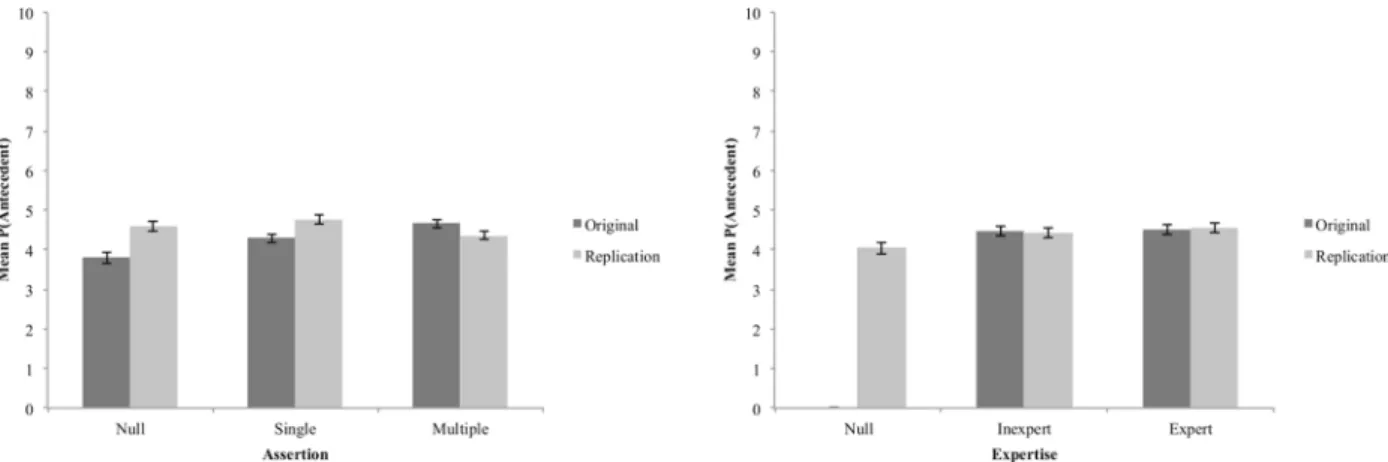
These initial experiments give us data to assess how beliefs change when participants have no evidence to fix their views on the probability of the antecedent or consequent. The full analysis for this and all other experiments can be found in Appendix A.11 Let us consider, first, the effect of assertion by single or multiple sources (Number-of-Assertions). The descriptive data are shown in the left- hand panels of Figs. 1–3. An initial data set (Experiment 1) and replication (Experiment 2) produced a consistent pattern of results.12 Recall that people, here, read conditionals such as “If a car on this lot is a Mercedes, then it’s black”. Number-of-Assertions reliably increased people’s estimates of the conditional probability, (Black Mercedes). This is borne out by the reliable difference between the Null (context only) and Single conditions (“Adam”) and between the Null and Multiple (“Adam, Barbara, Nick, and Sue”) con-ditions. There was however, no difference between the Single and Multiple Concon-ditions. Nor did assertion of the conditional reliably affect the probability of either the antecedent, (Mercedes), or the consequent, (Black)individually. Table 1, below, reports the fixed effects for Experiments 1 and 2.
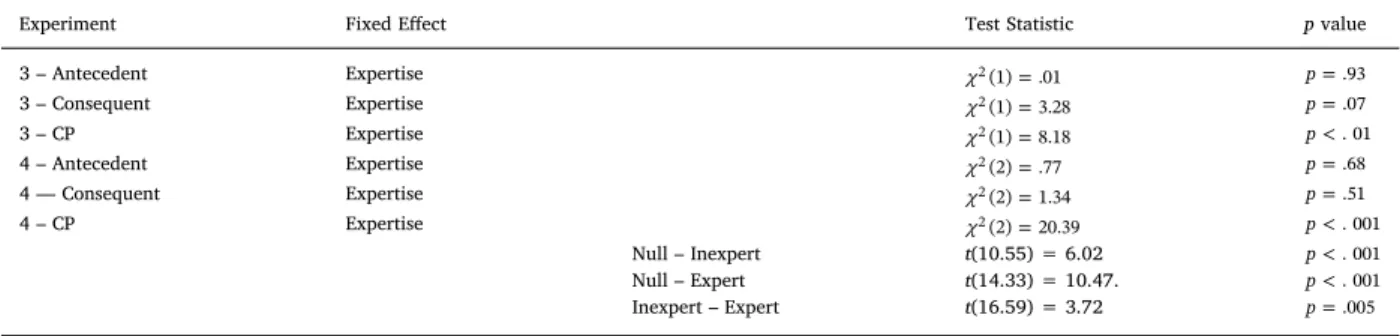
We turn, now, to the effect of source expertise (e.g., “medical student” vs. “professor of medicine”). Expertise affected the extent to which the assertion of the conditional increased estimates of the conditional probability. This effect is seen across two data sets, an initial data set (Experiment 3) and replication (Experiment 4). The descriptive data for these studies are shown in the right-hand 10We note a potential ambiguity with our items. We intended our items to be about a particular person or object. However, some items could be read as generic statements about any such object or person. Studies on conditionals often use wordings that are more clearly about singular persons or objects (see, for example, Evans et al., 2003). However, Cruz and Oberauer (2014) found evidence that people interpret statements such as our “If a patient on this ward…” conditional as though they are about a random instance from the distribution. Similarly Krzyżanowska, Collins, & Hahn, 2019 found no difference among specific and generic readings of conditionals on a range of variables (both semantic and pragmatic).
11Note that the figures show the data aggregated over participants but not over items. They do not, therefore, show the full dependencies in the data, and should be interpreted alongside the parameter estimates in Appendix A. However, the figures and parameter estimates are so close that the figures provide a reasonable and similar summary of the data.
Fig. 1. The Figure shows the descriptive data for (Antecedent)for the Number-of-Assertions Task in the left-hand panel and the Expertise task in the right-hand panel. The error bars show the standard error.
Fig. 2. The Figure shows the descriptive data for (Consequent)for the Number-of-Assertions Task in the left-hand panel and the Expertise task in the right-hand panel. The error bars show the standard error.
Fig. 3. The Figure shows the data for (Consequent Antecedent)for the Number-of-Assertions Task in the left-hand panel and the Expertise task in the right-hand panel.The error bars show the standard error.
Table 2
Test statistics for Experiments 3 and 4; note that CP stands for Conditional Probability.
Experiment Fixed Effect Test Statistic p value
3 – Antecedent Expertise 2(1)=.01 p=.93 3 – Consequent Expertise 2(1)=3.28 p=.07 3 – CP Expertise 2(1)=8.18 p<. 01 4 – Antecedent Expertise 2(2)=.77 p=.68 4 — Consequent Expertise 2(2)=1.34 p=.51 4 – CP Expertise 2(2)=20.39 p<. 001 Null – Inexpert t(10.55) = 6.02 p<. 001 Null – Expert t(14.33) = 10.47. p<. 001 Inexpert – Expert t(16.59) = 3.72 p=.005
Fig. 4. The Figure shows the instructions and response scale for the intervals studies. Table 1
Test statistics for Experiments 1 and 2; note that CP stands for Conditional Probability.
Experiment Fixed Effect Test Statistic p value
1 – Antecedent Assertion 2(2)=4.55 p=.10 1 – Consequent Assertion 2(2)=5.13 p=.08 1 – CP Assertion 2(2)=11.55 p<. 001 Null – Single t(11.04) = 3.63 p=.01 Null – Multiple t(15.87) = 4.38 p=.001 Single – Multiple t(50.52) = −.50 p=.87 2 – Antecedent Assertion 2(2)=3.03 p=.22 2 – Consequent Assertion 2(2)=2.41 p=.30 2 – CP Assertion 2(2)=17.41 p<. 001 Null – Single t(46.55) = 6.09 p<. 001 Null – Multiple t(24.98) = 5.78 p<. 001 Single – Multiple t(103.98) =.77 p=.72
panels of Figs. 1–3.13 Assertion by an inexpert source (a medical student) reliably increased the conditional probability (Experiment 4); so too did assertion by an expert source (a professor of medicine; Experiments 3 an 4); this increase was also reliably larger (Experiment 4). As with number of assertions, neither data set showed reliable effects of source expertise on estimates of the Fig. 5. The Figure shows the effect of Number of Assertions on the three probabilities as measured with sliders. The left-hand panel shows the data as point values. The right-hand panel shows the data as slider ranges. The error bars show the standard error.
Table 3
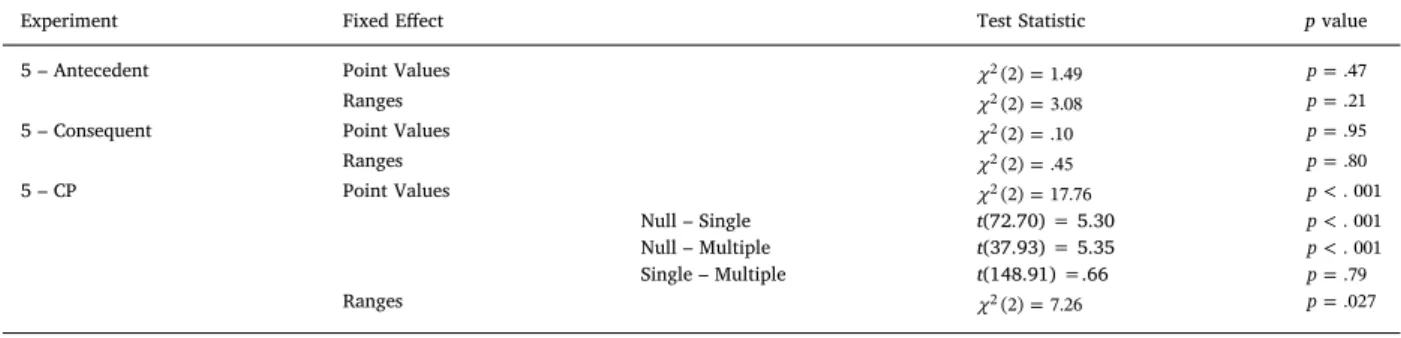
Test statistics for Experiment 5; note that CP stands for Conditional Probability.
Experiment Fixed Effect Test Statistic p value
5 – Antecedent Point Values 2(2)=1.49 p=.47
Ranges 2(2)=3.08 p=.21
5 – Consequent Point Values 2(2)=.10 p=.95
Ranges 2(2)=.45 p=.80 5 – CP Point Values 2(2)=17.76 p<. 001 Null – Single t(72.70) = 5.30 p<. 001 Null – Multiple t(37.93) = 5.35 p<. 001 Single – Multiple t(148.91) =.66 p=.79 Ranges 2(2)=7.26 p=.027
Fig. 6. The Figure shows the effect of Expertise on the three probabilities as measured with sliders. The left-hand panel shows the data as point values. The right-hand panel shows the data as slider ranges. The error bars show the standard error.
13The initial study included only Inexpert and Expert conditions; the replication included a Null condition to allow more direct comparisons with the Number-of-Assertions study.
probability of the antecedent or the consequent. Table 2 reports the fixed effects for Experiments 3 and 4.
There may seem to be a tension between the Number-of-Assertions and Expertise Tasks, in that the effect of Number-of-Assertions seems to plateau, with no reliable difference between Single and Multiple Assertion. But there is reason to believe that this difference is due to the interpretation of the materials in the Multiple condition. The multiple sources can be understood as de-pendent—e.g. making their observations together—or independent (Wheeler & Scheines, 2013). We pursued this point in another study, reported in Collins (2017). This study included a condition in which participants were told that the sources did not know each other, didn’t speak to each other, and gave their testimony independently. In this condition, ratings for the conditional probability were reliably higher than for the single-assertion condition. These additional data suggest that the tension between the Number-of- Assertions and Expertise Tasks is only apparent. We do not discuss the issue of independence further in this paper.
The data from Experiments 1 to 4 suggest that, when people start with intermediate probabilities for the antecedent and con-sequent, they change only the conditional probability. However, there is another way in which people may change their beliefs on hearing the assertion of a conditional, beyond raising their estimate of the conditional probability. People may not just ascribe a particular degree of (un) certainty to a claim, but also have uncertainty about that degree of uncertainty. In other words, people may be entertaining a range of possible probabilities, and assertion of a conditional may also be affecting those ranges. To probe these effects further, we allowed participants to respond with interval estimates. As above, this was a between-participants design. Participants responded by positioning two end points on a sliding scale between 0% and 100%. Fig. 4 shows the instructions and response scale given to participants.
We replicated the Number-of-Assertions and Expertise Tasks using sliders as the dependent variables. We analyzed the data in two ways: firstly, we averaged the end points of the sliders to replicate the data for the earlier studies (henceforth “point values”); secondly, we analyzed the range of the sliders to ascertain whether the underlying distributions changed (henceforth “slider ranges”).14
The sliders data broadly replicated the earlier studies. Take, first, assertion by single or multiple sources (Experiment 5). The descriptive data are shown in Fig. 5. When there were multiple sources, there was a tendency for increased precision (decreased ranges) in the conditional probability judgments, but this trend was only marginally significant. The point values data replicated the earlier findings: both single and multiple sources reliably increased judgments of the conditional probability; there was no reliable difference between single and multiple sources. There were no reliable effects on point values or ranges for either the probability of the antecedent or the probability of the consequent. Table 3 reports the fixed effects for this experiment (note the significance level of
= p .025).
We turn, now, to the the effect of source expertise (Experiment 6). The descriptive data are shown in Fig. 6. Here, there was again a tendency for assertion to increase the precision (decrease the ranges) of conditional probability judgments. But this time this effect was reliable, driven by the difference between Null (context only) and Expert conditions. The point values replicated the earlier data: inexpert and expert sources both reliably increased judgments of the conditional probability, and the effect was reliably larger for expert sources than for inexpert sources. As above, there were no reliable changes to ranges or point values for the probability of the antecedent or the probability of the consequent. Table 4 reports the fixed effects for this experiment.
These intervals data, then, show analogous data patterns to Exp. 1 to 4, which involve point estimates: reliable change only to the conditional probability, both in the mean estimate and (for source expertise) intervals assigned. There were no reliable effects on antecedent or consequent probabilities individually.
But what of the initial intuition that belief change for antecedent and consequent might depend on their prior probabilities? Recall the earlier example of expecting a very dry day and then hearing someone say “If it rains today, then you will get wet.” Conceivably this may increase your estimate of the chance of rain. We explored this possibility by manipulating the prior probability of the antecedent by varying the antecedent’s fit with a context. Compare, for instance, the following conditionals:
Table 4
Test statistics for Experiment 6; note that CP stands for Conditional Probability.
Experiment Fixed Effect Test Statistic p value
6 – Antecedent Point Values 2(2)=1.88 p=.39
Ranges 2(2)=1.25 p=.53
6 – Consequent Point Values 2(2)=1.27 p=.53
Ranges 2(2)=.0008 p=1 6 – CP Point Values 2(2)=23.84 p<. 001 Null – Inexpert t(75.78) = 4.77 p<. 001 Null – Expert t(81.95) = 8.59 p<. 001 Inexpert – Expert t(67.75) = 3.79 p<. 001 Ranges 2(2)=16.84 p<. 001 Null – Inexpert t(117.56) = −2.05 p=.10 Null – Expert t(152.25) = −4.18 p<. 001 Inexpert – Expert t(122.69) = −2.03 p=.11
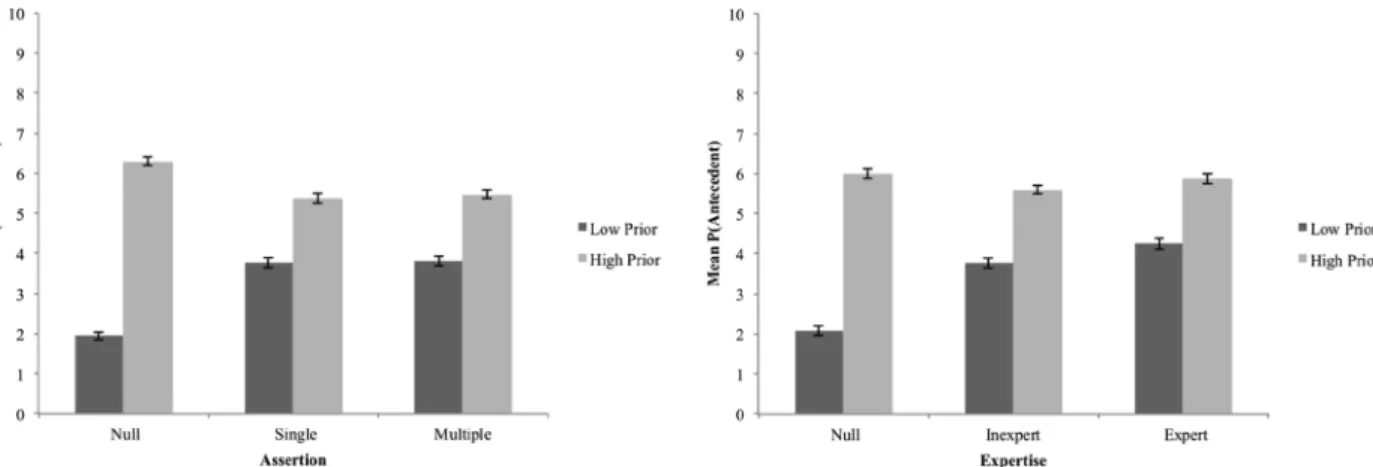
Fig. 7. The Figure shows the effects of Testimony and Prior Probability on (Antecedent)for the Number-of-Assertions Task in the left-hand panel and the Expertise Task in the right-hand panel. The error bars show the standard error.
Table 5
Test statistics for Experiments 7 and 8; note that CP stands for Conditional Probability.
Experiment Fixed Effect Test Statistic p value
7 – Full Interaction 2(2)=81.12 p<. 001
7 – Low Prior Assertion 2(2)=18.04 p<. 001
Null – Single t(25.39) = 5.99 p<. 001
Null – Multiple t(40.71) = 6.13 p<. 001
Single – Multiple t(55.24) =.21 p=.98
7 – High Prior Assertion 2(2)=8.47 p=.01
Null – Single t(14.80) = −2.23 p=.10
Null – Multiple t(32.39) = −3.20 p=.008
Single – Multiple t(25.11) =.37 p=.93
8 – Full Interaction 2(2)=10.11 p=.006
8 – Low Prior Expertise 2(2)=13.13 p=.001
Null – Inexpert t(19.29) = 4.48 p<. 001
Null – Expert t(19.72) = 5.22 p<. 001
Inexpert – Expert t(44.72) = 1.76 p=.19
8 – High Prior Expertise 2(2)=1.90 p=.39
Fig. 8. The Figure shows the effects of Testimony and Prior Probability on (Consequent)for the Number-of-Assertions Task in the left-hand panel and the Expertise Task in the right-hand panel. The error bars show the standard error.
Imagine that you are visiting a Liberal Arts College.
Low Prior: Sue tells you, ‘If Lisa, a student, is majoring in astrophysics, then she’s working late in the library.
High Prior: Sue tells you, ‘If Lisa, a student, is majoring in an arts subject, then she’s working late in the library.’
In this study, then, we manipulated the prior probability and testimony (in one experiment, Number-of-Assertions; in the other, Expertise). Participants were recruited in the same manner as the previous experiments. Participants once again responded on a scale from 0 (not at all possible) to 10 (certain), this time providing a rating only for the probability of the antecedent; and, once again, participants only saw one condition and completed only one task. The key prediction was an interaction between prior probability and testimony: a possible increase when the prior probability is low, and potentially a decrease when the prior probability is high. The data partially vindicate the intuitions about priors.15 We will consider, first, the probability of the antecedent (Experiments 7 and 8). The descriptive data are shown in Fig. 7. In both experiments, there were significant interactions. In both experiments, when the prior probability of the antecedent was low, testimony (Number-of-Assertions, Expertise) reliably increased the probability of the antecedent. For Number-of-Assertions (Experiment 7), there were reliable increases between the Null and Single conditions and the Null and Multiple conditions, but not between the Single and Multiple conditions. For Expertise (Experiment 8), there were reliable increases between the Null and Inexpert conditions and between the Null and Expert conditions, but not between the Inexpert and Expert conditions. When the prior probability of the antecedent was high, the tasks differed. Number of assertions reliably decreased the probability of the antecedent, an effect driven by the decrease from Null to Multiple conditions, the other differences not being significant. Expertise, in contrast, did not reliably decrease the probability of the antecedent. Table 5 reports the fixed effects for these experiments (note the significance level of p=.017).
We turn, now, to the probability of the consequent. As above, the prior was determined by the fit between context and con-sequent. The materials were the same as for the task above; we simply swapped the antecedent and concon-sequent.16 As above, the key prediction was for an interaction between the prior probability of the consequent and testimony (Number-of-Assertions, Expertise). Table 6
Test statistics for Experiments 9 and 10; note that CP stands for Conditional Probability.
Experiment Fixed Effect Test Statistic p value
9 – Full Interaction 2(2)=120.16 p<. 001
9 – Low Prior Assertion 2(2)=18.19 p<. 001
Null – Single t(27.87) = 7.05 p<. 001
Null – Multiple t(15.85) = 5.78 p<. 001
Single – Multiple t(41.48) =.10 p=.99
9 – High Prior Assertion 2(2)=5.48 p=.06
10 – Full Interaction 2(2)=48.66 p<. 001
10 – Low Prior Expertise 2(2)=20.79 p<. 001
Null – Inexpert t(33.39) = 4.33 p<. 001
Null – Expert t(35.64) = 7.51 p<. 001
Inexpert – Expert t(41.67) = 3.57 p=.003
10 – High Prior Expertise 2(2)=1.12 p=.57
Table 7
The table summarize the results reported in Section 2 on the effect of learning “If A, C” on participants’ judgments of (C A), ( )A and ( )C . These results constitute constraints that the data impose on any theory of learning from conditional information that aspires to descriptive accuracy. The asterisk (*) indicates that the increase in probability is only marginally significant.
Prior (no testimony) Posterior (after learning that “If A, C”)
(C A) < “IfA,C (C A)
very low (A) < “IfA,C (A)
(A) = “IfA,C (A)
very high (A) “IfA,C (A)
very low (C) < “IfA,C (C)
(C) = “IfA,C (C)
very high (C) “IfA,C (C)
15For all of the priors studies, we selected a significance level of p=.017to correct for multiple comparisons (in addition to the Tukey correction on pairwise comparisons).
16There was one exception, where a bigger change was required because simple inversion resulted in a highly unnatural sentence. For details, see Appendix A.
The descriptive data are summarized in Fig. 8.
This study produced similar data for both experiments (Experiments 9 and 10). In both experiments, the interaction was sig-nificant. And in both experiments, when the prior probability of the consequent was low, testimony (Number-of-Assertions, Expertise) reliably increased the probability of the consequent. For Number-of-Assertions (Experiment 9), the increase from Null to Single conditions was reliable, as was the increase from Null to Multiple conditions. The increase from Single to Multiple conditions was not reliable. For Expertise (Experiment 10), the increases from Null to Inexpert, from Null to Expert, and Inexpert to Expert were all reliable. For both tasks, when the prior probability of the consequent was high, there was no reliable effect of testimony, in the sense of Number-of-Assertions or Expertise, at the p=.017level. Table 6 reports the fixed effects for Experiments 9 and 10. 2.1. Summary
Across ten experiments we found that participants systematically changed their judgments of the conditional probability, in-creasing it in response to testimony (Number-of-Assertions, Expertise). Participants were also prepared to make their beliefs more precise, in the sense that they narrowed their interval judgments of the conditional probability (reliably for Expertise, and marginally so for Number-of-Assertions). And they were prepared to change their judgments of the probability of the antecedent and the probability of the consequent depending on the respective priors. For the antecedent, when the priors were low, testimony (both Number-of-Assertions and Expertise) reliably increased the probability; when the priors were high, Number-of-Assertions reliably decreased the probability, but Expertise had no reliable effect. For the consequent, when the priors were low, testimony (both Number-of-Assertions and Expertise) increased the probability; when the priors were high, there was no reliable change.
The effects above seem intuitive and simple. Nevertheless, in the rest of this paper, we will argue that these data pose challenges for both modeling and present theories of the meaning of the conditional. These data are, to the best of our knowledge, novel and, as such, require (further) replication. We do not claim that the findings are general across conditionals. A larger research program is needed to explore patterns of belief change across the rich typology of conditionals, following, for instance, corpus linguistic work such as Declerck and Reed (2001). A program of this kind could usefully cover a wider range of prior probabilities. It should also include a wider range of participants, and could usefully compare adult and developmental groups. However, the data seem an appropriate starting point.
Below, we start by considering how the data sit with the dominant, probabilistic theory of the conditional. We consider two possible extensions, using distance measures and Bayesian belief networks, which have limited success. We then consider how the data challenge other leading theories of the conditional.
3. The data meet the suppositional theory
Any theory whose aspiration is to capture the way people reason with indicative conditionals needs to be compatible with data such as ours on belief change, too (for a summary of the findings, see Table 7). In the Background section we saw considerable evidence for an association between a conditional and the conditional probability of its antecedent given its consequent. These data sit most comfortably with a theory that takes the conditional to be fundamentally probabilistic: the Suppositional Theory. It is natural to think of the Suppositional Theory as the most promising candidate for a theory that can handle these data. However, this section will show that, to handle such data, we will need to extend the machinery of the Suppositional Theory.
What is known as the Suppositional Theory is more accurately a family of probabilistic accounts of conditionals that emphasise the association between the probability of a conditional and the corresponding conditional probability. More specifically, the Suppositional Theories are committed to Stalnaker’s Hypothesis (Stalnaker, 1970), which—reflecting its importance in the psy-chology of reasoning—is widely referred to simply as “the Equation”, presented here in a form familiar from the literature on conditionals:
Stalnaker’s Hypothesis (“The Equation”): For all probability functions such that (A)>0, (IfA, C)= (C A).17 As we have explained above, there is considerable evidence that people’s interpretation of conditionals complies with the Equation, at least when the conditional’s antecedent is positively relevant for its consequent.18 These data, however, lead to a puzzle, as they seem to clash with an important formal finding, the Triviality Results. Lewis (1976), and other authors after him, undermine the equating of (IfA, C)and (C A)by showing that it holds only for special, trivial probability functions which cannot be realistic representations of people’s degrees of beliefs. To respond to this clash, many researchers choose not to drop “the Equation” and instead drop one of the main assumption of triviality proofs, namely, the idea that conditionals express propositions, that is, that they can be true or false at all (Adams, 1975; Bennett, 2003; Edgington, 1995b). Others choose to follow de Finetti (1937), who analysed conditionals as conditional events, satisfying the three-valued truth table, as shown below:
17In formulating Stalnaker’s Hypothesis this way, we follow a tradition in the literature on conditionals (e.g.Bennett, 2003; Edgington, 1995a; Lewis, 1976; and Stalnaker, 1976). The condition (A)>0can be dropped if one takes conditional probabilities as primitive (e.g. Dubins et al., 1975; Popper, 1959; Rényi, 1955)
A C If A then C
True True True
True False False
False/Void True/Void Void
False/Void False/Void Void
On this account, a conditional is construed as having truth values only when its antecedent is true. The conditional is then true when its consequent is also true, and false when its consequent is false. When the antecedent is false (similarly, when its truth value is undetermined), the conditional does not have a truth value; it is “void,” in the same way as a bet on, say, a coin landing heads has no winner if the coin is not thrown at all (de Finetti, 1936/1995, 1974).19
The latter approach became predominant in the psychology of reasoning, owing to the considerable evidence from experiments using the truth-table task (e.g. Baratgin, Politzer, & Over, 2013; Over & Baratgin, 2017; Over & Cruz, 2018). In the truth-table task, for a conditional “If A, then C”, participants might be asked which A and C states (i.e. true/false) render the conditional true or would (dis-) prove a conditional rule. It is often reported, here, that, when A, the antecedent, is false, people prefer to say that the con-ditional is neither true nor false but, rather, is irrelevant or void (Over, 2016; Politzer et al., 2010).20 This result, known as the “defective truth table of the conditional,” is argued to be best captured by de Finetti’s three-valued system (Baratgin, Politzer, Over, & Takahashi, 2018).
Since de Finetti’s third value is to be interpreted as representing a state of ignorance, his logic can be naturally augmented with subjective probability (de Finetti, 1974). The resulting truth table for conditionals, known as the Jeffrey table (e.g. Over & Baratgin, 2017; Over & Cruz, 2018), renders conditionals as true or false, when their antecedents are true, depending on the truth value of their consequents. The false antecedent cases, when the conditional’s objective truth value is undetermined or “void,” receive then a subjective probability assignment, that is, an agent’s degree of belief in a given statement. Consequently, when the antecedent is false or undetermined, the evaluation of a conditional amounts to evaluation of the conditional probability of its consequent given the antecedent.
Since conditionals are often—perhaps even most typically—used when there is uncertainty about the truth of their clauses (see, e.g., Elder & Jaszczolt, 2016), the question of how people estimate the corresponding conditional probabilities became the central question of the “New Paradigm” psychology of reasoning. The psychological process of fixing one’s subjective degrees of belief in a conditional has been argued to resemble the Ramsey Test, that is, a procedure for deciding whether or not to accept an indicative conditional suggested by Frank Ramsey in his famous footnote:
If two people are arguing ‘If p will q?’ and are both in doubt as to p, they are adding p hypothetically to their stock of knowledge and arguing on that basis about q: so that in a sense ‘If p q, ’ and ‘If p,¬q’ are contradictories. We can say they are fixing their degrees of belief in q given p (Ramsey, 1929/1990, p. 155).
What the above passage suggests are the acceptability conditions for indicative conditionals which can straightforwardly be understood in probabilistic terms: the degree to which we find that “if A, then C” is acceptable, “goes by,” or is correlated with, our subjective degree of belief in C given A, that is, the corresponding conditional probability (Adams, 1975).21
Usually, unless we have reasons to believe otherwise, we take speakers to assert what they believe to be true, or at least highly likely (see, e.g., Pagin, 2016). In other words, a speaker’s assertion that P conveys that the speaker has a high degree of belief—a high subjective probability value—for P being true. Analogously, whenever a speaker asserts a conditional, it follows from the supposi-tional view on condisupposi-tionals that they convey that their subjective probability of that condisupposi-tional’s consequent is high under the supposition of its antecedent. It is natural then to understand the learning in response to an assertion of a conditional, that is, a testimony that “If A, then C,” assuming that the speaker is sufficiently reliable, as learning that (C A)is high. Thus, the account seems to correctly predict that learning a conditional will result in the increase of the corresponding conditional probability.
However, another consequence of the suppositional account is that we might not be able to directly apply standard probabilistic accounts of learning to the conditional. The Bayesian tradition models the effect of learning a new piece of information, A, on one’s degrees of beliefs in terms of conditionalization. That is, the posterior probability of any arbitrary proposition C upon learning that A is calculated as equal to the prior conditional probability of C given A:
=
(C) (C A)
A (1)
Classical Conditionalization applies when an agent, the learner, accepts A categorically. An agent however may learn A from a not entirely reliable source. In such a case, the agent may change their degrees of belief in A from (A)=.3to, for instance, (A)=.9. Now, to calculate the posterior probability of any other proposition, the agent cannot simply update by Classical Conditionalization.
19See Appendix C for a more detailed discussion of de Finetti’s system, and Politzer et al. (2010) on the empirical investigation of the relationship between conditionals and conditional bets.
20Cf. Schroyens (2010), who question the strength of this finding. See, also, Douven, Elqayam, Singmann, and van Wijnbergen-Huitink (2018) who found evidence that people are happy to assign truth values to conditionals with false or undetermined antecedents, depending on the presence and strength of an inferential connection between the antecedents and consequents.
21Note, however, that while there is significant evidence for “The Equation,” the Adams’ Thesis, which correlates the degree of acceptability of a conditional (since, strictly speaking, one cannot assign probabilities to linguistic constructions that do not express propositions) with the conditional probability of its consequent given the antecedent, has been undermined by the data (Douven & Verbrugge, 2010).
Jeffrey (1983) proposed that in such cases the agent should use Jeffrey Conditionalization and assign
= + ¬ ¬
(C) (C A) (A) (C A) ( A) (2)
for the new probability of C.
But it is subject to debate if Classical Conditionalization or Jeffrey Conditionalization can be applied to calculate (A If A, then C)or (C If A, then C), assuming the suppositional interpretation of the conditional. Since the arguments of the probability function need to be propositions, it is not at all straightforward how to calculate the posterior probabilities of A and C, or any other proposition, upon learning that if A, then C, particularly if conditionals are assumed not to express propositions. This is not to say, of course, that no proposals have been put forward. The matter is, however, by no means settled. For instance, Douven and Dietz (2011) show that the Equation (together with another rather compelling assumption) entails (A If A, then C)= (A), which they argue to be a challenge for the Equation itself (see also Douven, 2012). Furthermore, unlike the non-propositional version of the Suppositional Theory, de Finetti’s three-valued logic allows conditionals to be embedded as antecedents or consequents of other conditionals.22 Consequently, as an anonymous reviewer has pointed out, Sanfilippo, Pfeifer, Over, and Gilio (2018) and Sanfilippo, Gilio, Over, and Pfeifer (2020) provide a way to calculate (A If A, then C), though this method is yet to be extended to belief updating.23
3.1. Summary
We have seen that the Suppositional Theory lacks the machinery to fully account for how people change their beliefs when they encounter a conditional. Aspects of the theory also mean that it cannot rely on traditional models of belief change in the Bayesian tradition. The question arises, then, of whether we can extend the theory in such a way that we can better capture our data on updating on conditionals without having to forsake a large body of evidence. We turn to other ways to model belief updating. We consider two approaches. The first, the distance-based approach to Bayesianism, has emerged as the standard method to model updating on conditionals in formal epistemology (Eva et al., 2019). The second, Bayesian belief networks, adapts a method that does precisely what we want but for assertions of simple propositions.
4. Modeling the data
4.1. Distanced-based Bayesianism
In light of the previous sections, our goal is to model our data while preserving a link with the probabilistic approach to con-ditionals. A promising way to reach this goal is to model the learning process in the distance-based approach to Bayesianism.24 On this approach, we can understand updating on conditionals as follows: We assume that an agent has beliefs about some set of proposi-tions. For a simple example, let these propositions be A and C, and let the beliefs about these propositions be represented by a prior probability distribution over them. The agent now learns new information in the form of a conditional “If A, then C”. We ask: How should she change her beliefs in light of this new information? Let us assume, for now, that the agent sets the new conditional probability, (C A), to 1. The agent now moves to a new set of beliefs about A and C, represented by a new probability distribution , and does so by taking the conditional probability assignment (C A)=1as a constraint on . This constraint does not fix the full new probability distribution uniquely. To find and to make sure that her new beliefs are coherent, she then minimizes some appropriate distance measure between and . The agent is, in a sense, conservative: given the constraint, she changes her other beliefs as little as possible.
To express this account formally, we need some way of measuring the distance between posterior and prior distributions over the Fig. 9. A Bayesian network for simple (non-conditional) testimony, from Bovens and Hartmann (2003).
22Though see Douven (2016) who showed that, given de Finetti’s table, iterated conditionals are equivalent to simple conditionals that are unacceptable in natural language.
23For other proposals of update rules, typically designed to accommodate very specific desiderata related to various specific situations, see, e.g., Kern-Isberner (2001), van Fraassen (1981), Bradley (2005), Douven (2012), Douven and Dietz (2011), Douven and Romeijn (2011), Eva, Hartmann, and Rad (2019), Harper (1976), and Gärdenfors (1988).
24Following Csiszár (1967), the distance-based approach to Bayesianism was introduced in Diaconis and Zabell (1982). It has been developed and applied to conditionals in Eva and Hartmann (2018), Eva et al. (2019), Sprenger and Hartmann (2019) and Stern and Hartmann (2018). Eva, Hartmann, & Singmann, 2019 use the approach to explain the MP–MT asymmetry mentioned in the Background section.
same algebra of propositions. There are several ways to do so. It turns out that all so-called (statistical) divergencies in the class of f- divergences26 (Csiszár, 1967) imply Jeffrey Conditionalization (see Eq. (2)) if the agent entertains beliefs about two propositions and shifts, as a result of the learning, the probability of one of them to a higher or lower value (see Diaconis & Zabell (1982) and Eva et al. (2019)). If the probability of one of them shifts to 1, then one obtains Classical Conditionalization which, in turn, is a limiting case of Jeffrey Conditionalization. As there are many strong arguments in favor of Classical Conditionalization and Jeffrey Con-ditionalization (see, e.g., Schwan & Stern (2007) and Jeffrey (1983)) we consider the fact that both follow from minimizing an f- divergence (taking a certain constriant into account) to support our focus on this class of divergencies.
Formally, then, an agent who learns the conditional “If A, then C” minimizes an f-divergence between and , taking (in the simplest way of deriving a constraint from the learned conditional) (C A)=1as a constraint on . Note that this approach is intrinsically probabilistic and, in that sense, is a natural way of extending the probabilistic approach discussed in the previous sections to the learning of conditionals. It also has the advantage that it gives the intuitively correct results for a number of chal-lenging examples put forward by Douven such as the Ski Trip Example (Dietz & Douven, 2010) and the Sundowners Example (Douven & Romeijn, 2011). One can also show that minimizing an f-divergence between and is equivalent to conditionalizing on the material conditional provided that the corresponding conditional is strict, i.e. if one takes (C A)=1as a constraint on . For details and proofs, see Eva et al. (2019) as well as the discussion below.
What predictions does the distance-based approach make for updating on conditionals? On the simplest version of this account, the agent fixes the new conditional probability to 1 and finds the full new distribution by minimizing an f-divergence between and . One then obtains that she (i) decreases the judgment of the probability of the antecedent and (ii) increases the judgment of the probability of the consequent (Eva et al., 2019). These qualitative results hold for all prior probability distributions, but the amount of change depends on the specific prior distribution. This, of course, is not at all the pattern we saw in our empirical data, where we saw that probabilities for the antecedent and consequent increased when their respective priors were low, and did not change when they were moderate.
But there is a fundamental problem with the simplifying assumption that we made above: that the agent sets the conditional probability to 1. In none of the experiments did participants, on aggregate, set the conditional probability to 1. But we do not need to make this assumption; an agent raising the conditional probability to a value smaller than 1 can also be modeled in the distance-based approach. In this case, the probability of the antecedent again always decreases and the probability of the consequent can decrease, increase or stay the same, at least for the most common f-divergencies such as the Kullback–Leibler diveregence, the Hellinger distance and the 2-divergence. By contrast, for the inverse Kullback–Leibler divergence, which is also an f-divergence, the prob-ability of the antecedent stays the same (For further details, see again Eva et al. (2019)). More success is to be had with models that explicitly incorporate the testimonial context.
4.2. Bayesian belief networks
In this section, we introduce a range of Bayesian Belief Networks which are intended to explicitly model the testimonial context. The details of these models are inevitably somewhat technical. But we will start by introducing a simpler model that can be seen as the basis for the remaining models. For full technical details, we refer readers to the footnotes and Appendix B. For readers less familiar with this form of modelling, we will emphasize the outcomes of the models in brief summary sections so that technicalities can be skipped.
To introduce these models, we first imagine a situation in which a speaker makes a non-conditional claim about the world. Imagine that a high-school history teacher makes the claim that Gutenberg invented the printing press. How should we evaluate this claim? Relevant factors are (1) whether we consider a high-school history teacher a reliable source of information and (2) how plausible we find the claim. We can use subjective probabilities to represent both factors: for (1), the prior probability, or base rate, of the particular source telling the truth; for (2), the prior probability of the claim. Being subjective, these probabilities can differ between recipients of the claim: some might trust high-school history teachers more than others; some, perhaps who have read more Chinese history, may have a lower prior probability than others for Gutenberg being the inventor of the printing press.
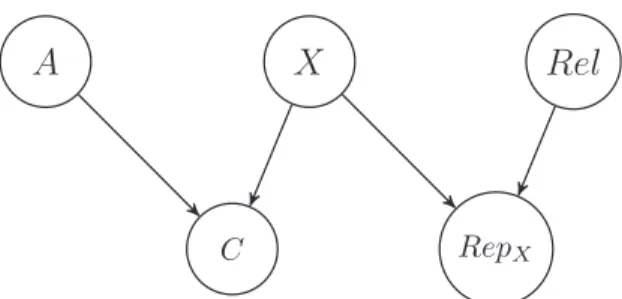
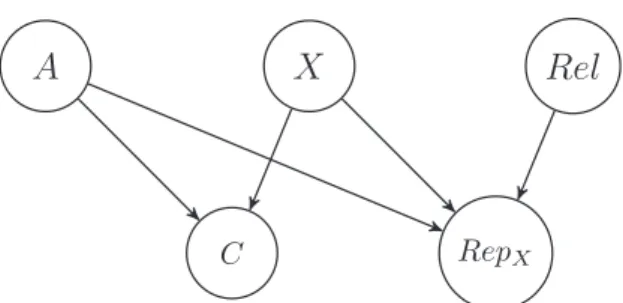
This simple situation is captured by a model from Bovens and Hartmann (2003) depicted in Fig. 9. This model is a simple Bayesian Network: the nodes represent binary propositional variables, and the arcs represent probabilistic dependencies among the variables. The variable Hyp stands for the hypothesis or claim in question and has the values Hyp: “The hypothesis in question is true” and ¬Hyp: “The hypothesis in question in false”. For the example above, the “hypothesis” is that Gutenberg invented the printing press. The variable Rep stands for the report of the claim and has the values Rep: “The information source reports that the hypothesis in 25Statistical divergencies are not strictly speaking distance measures: they may not be symmetrical and they may violate the triangle inequality. 26f-divergences are defined as follows: Let S,…,S
n
1 be the possible values of a random variable S over which a prior probability distributions and a posterior probability distribution are defined. The f-divergence between and is then given by
= D S f S S ( ) ( ) ( ) , f i n i i i 1
where f is a convex function which satisfies f(1)=0. Examples of f-divergences are the Kullback–Leibler divergence (f x( )=xlogx), which is also widely used in information theory, the inverse Kullback–Leibler divergence (f x( )= logx), the Hellinger distance (f x( )=(1 x)2), and the